
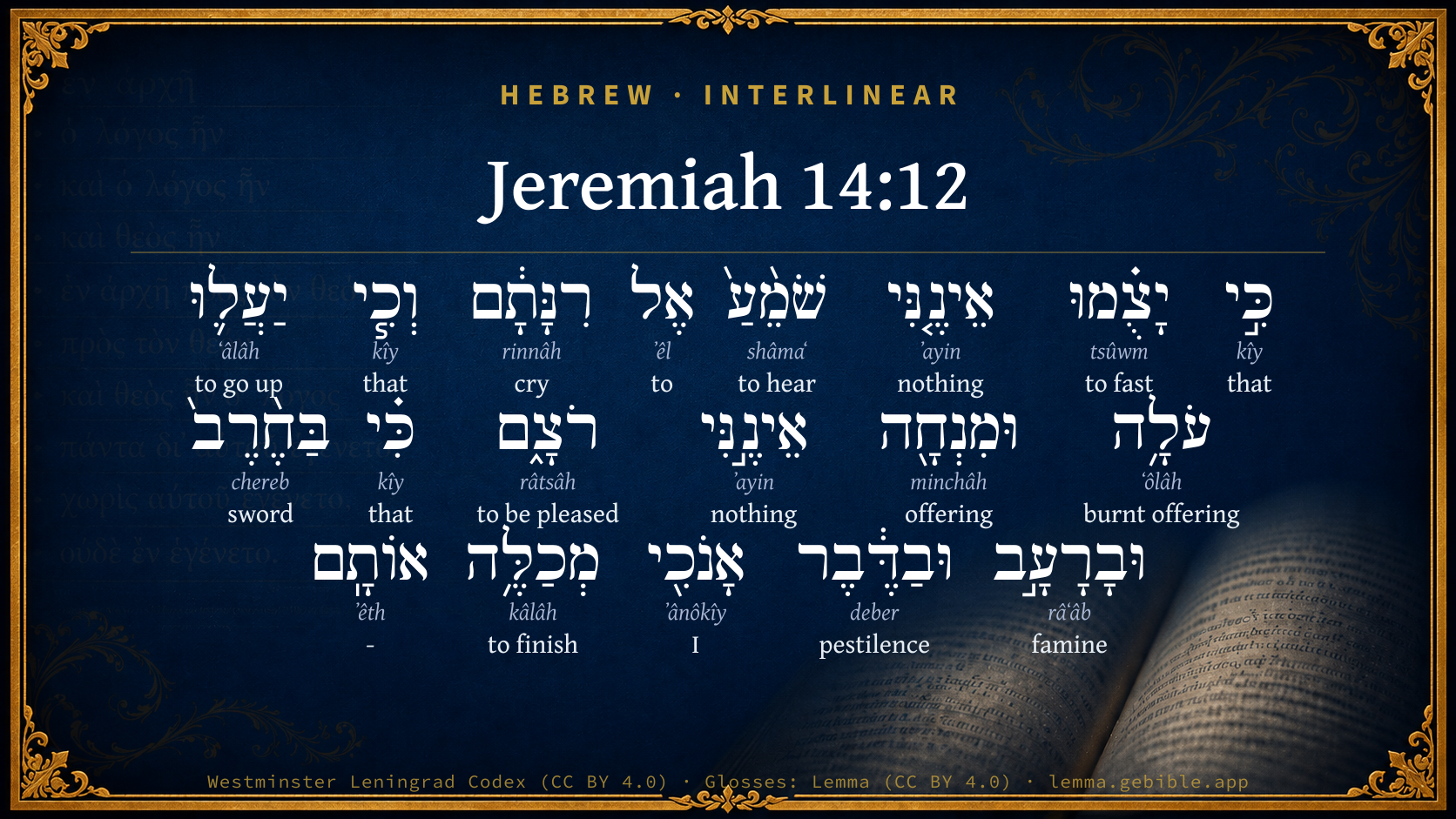
Jeremiah 14:12

Hebrew (Westminster Leningrad Codex) Jeremiah 14:12 appears in the Hebrew Old Testament. The text above is from the Westminster Leningrad Codex. Each word links to its Strong’s number, a concise gloss, and parsing drawn from the Open Scriptures Hebrew Bible morphology. Click any word for its full Brown-Driver-Briggs (BDB) entry.
Download image
Cite this verse

Jeremiah 14:12 (World English Bible). Public Domain. Lemma interlinear Bible study tool, https://lemma.gebible.app/v/jeremiah/14/12.

Show BibTeX & RIS
BibTeX
RIS
English Translation
When they fast, I will not hear their cry; and when they offer burnt offering and meal-offering, I will not accept them; but I will consume them by the sword, and by the famine, and by the pestilence.
World English Bible · Public Domain
Download a study sheet

One document with this verse’s original text, its word-by-word gloss line, the meaning frame, cross-references with their text, attributed commentary, and full source and license credits — printable, and it pastes into notes with its structure intact.

This verse Autodidact and up

Study sheet (.html) Plain text (.txt)

A passage Seminary Student

Up to 50 verses in one chapter. A passage sheet keeps up to 6 commentary sources and 12 cross-references per verse, in the order this page ranks them, and says so on the sheet whenever that leaves anything out. Ask for a single verse and you get the Autodidact verse sheet above.

Everything on this page stays free to read, with no account — the sheet is a download of what is already on screen, not access to it.

Want to remove ads? Support Godless Engineer
Compare translations 3

The same verse in 3 English versions, stacked beneath the original-language interlinear above. Click any original word for its lexicon entry.

Each is an independent rendering of the whole verse — the interlinear is not word-aligned to these translations.

Highlighted words mark where these versions differ — a whole-verse word diff, not a word-by-word alignment.

  • World English Bible Public Domain
    When they fast, I will not hear their cry; and when they offer burnt offering and meal-offering, I will not accept them; but I will consume them by the sword, and by the famine, and by the pestilence.
  • King James Version Public Domain
    When they fast, I will not hear their cry; and when they offer burnt offering and an oblation, I will not accept them: but I will consume them by the sword, and by the famine, and by the pestilence.
  • unfoldingWord Literal Text CC BY-SA 4.0
    When they fast, I will not listen to their cry, and when they offer burnt offering and grain offering, I will not accept them. But by the sword and by the famine and by the plague I will consume them.”

unfoldingWord Literal Text — © unfoldingWord, licensed CC BY-SA 4.0. Word-aligned USFM3 via Door43 (git.door43.org/unfoldingWord/en_ult).

Versions to compare (up to 4)

3 of 4 selected

Show all 18 translations

Every available English version of this verse, each an independent rendering of the whole verse.

  • World English Bible Public Domain
    When they fast, I will not hear their cry; and when they offer burnt offering and meal-offering, I will not accept them; but I will consume them by the sword, and by the famine, and by the pestilence.
  • Berean Standard Bible Public Domain
    Although they may fast, I will not listen to their cry; although they may offer burnt offerings and grain offerings, I will not accept them. Instead, I will finish them off by sword and famine and plague.”
  • Majority Standard Bible Public Domain
    Although they may fast, I will not listen to their cry; although they may offer burnt offerings and grain offerings, I will not accept them. Instead, I will finish them off by sword and famine and plague.”
  • King James Version Public Domain
    When they fast, I will not hear their cry; and when they offer burnt offering and an oblation, I will not accept them: but I will consume them by the sword, and by the famine, and by the pestilence.
  • American Standard Version (1901) Public Domain
    When they fast, I will not hear their cry; and when they offer burnt-offering and meal-offering, I will not accept them; but I will consume them by the sword, and by the famine, and by the pestilence.
  • Revised Version (1885) Public Domain
    When they fast, I will not hear their cry; and when they offer burnt offering and oblation, I will not accept them: but I will consume them by the sword, and by the famine, and by the pestilence;
  • Geneva Bible (1599) Public Domain
    When they fast, I will not heare their cry, and when they offer burnt offering, and an oblation, I will not accept them: but I will consume them by the sworde, and by the famine and by the pestilence.
  • Douay-Rheims (1899) Public Domain
    When they fast I will not hear their prayers: and if they offer holocausts and victims, I will not receive them: for I will consume them by the sword, and by famine, and by the pestilence.
  • Young's Literal Translation Public Domain
    When they fast, I hearken not unto their cry, And when they cause to ascend burnt-offering and present, I accept them not, For by sword, and by famine, And by pestilence, I am consuming them.
  • Literal Standard Version CC BY-SA 4.0
    When they fast, I do not listen to their cry, and when they cause burnt-offering and present to ascend, I do not accept them; for I am consuming them by sword, and by famine, and by pestilence.”
  • Unlocked Literal Bible CC BY-SA 4.0
    For if they fast, I will not listen to their wailing, and if they offer up burnt offerings and food offerings, I will not take pleasure in them. For I will put an end to them by sword, famine, and plague.”
  • unfoldingWord Literal Text CC BY-SA 4.0
    When they fast, I will not listen to their cry, and when they offer burnt offering and grain offering, I will not accept them. But by the sword and by the famine and by the plague I will consume them.”
  • Darby Bible Public Domain
    When they fast, I will not hear their cry; and when they offer up burnt-offering and oblation, I will not accept them: for I will consume them by sword, and by famine, and by pestilence.
  • World Messianic Bible Public Domain
    When they fast, I will not hear their cry; and when they offer burnt offering and meal offering, I will not accept them; but I will consume them by the sword, by famine, and by pestilence.”
  • Webster's Bible Public Domain
    When they fast, I will not hear their cry; and when they offer burnt-offering and an oblation, I will not accept them: but I will consume them by the sword, and by the famine, and by the pestilence.
  • Free Bible Version CC BY-SA 4.0
    Even if they fast, I won't listen to their cry. Even though they offer burnt offerings and grain offerings, I won't accept them. On the contrary I will wipe them out by sword and famine and plague.
  • Bible in Basic English Public Domain
    When they go without food, I will not give ear to their cry; when they give burned offerings and meal offerings, I will not take pleasure in them: but I will put an end to them by the sword and by need of food and by disease.
  • JPS Tanakh (1917) Public Domain
    When they fast, I will not hear their cry; and when they offer burnt-offering and meal-offering, I will not accept them; but I will consume them by the sword, and by the famine, and by the pestilence.'

Literal Standard Version (2020), Covenant Press — licensed CC BY-SA 4.0. Text via the HelloAO Bible API (eBible.org). Unlocked Literal Bible (unfoldingWord) — licensed CC BY-SA 4.0. Text via the HelloAO Bible API (eBible.org). unfoldingWord Literal Text — © unfoldingWord, licensed CC BY-SA 4.0. Word-aligned USFM3 via Door43 (git.door43.org/unfoldingWord/en_ult). Free Bible Version, Dr. Jonathan Gallagher — licensed CC BY-SA 4.0. Text via the HelloAO Bible API (eBible.org).

Word by word

More ways to search: Search by grammar → Find every occurrence → Compare this word →

Practice this passage: Drill this verse → Learn its vocabulary →

יָצֻ֗מוּ
tsûwm
H6684
“to fast”
Verb, Qal, Imperfect, 3rd Person, Masculine, Plural
Part of Speech
Verb
Stem
Qal
Form
Imperfect
Person
3rd Person
Gender
Masculine
Number
Plural
Full BDB Definition

Origin: a primitive root

TWOT: 1890

(Qal) to abstain from food, fast
  1. כִּ֣י kîy H3588 “that” Conjunction
  2. אֵינֶ֤נִּי ʼayin H369 “nothing · me” Particle, Negative + Suffix, Personal, 1st Person, Common, Singular
  3. שֹׁמֵ֨עַ֙ shâmaʻ H8085 “hearing” Verb, Qal, Participle Active, Masculine, Singular, Absolute
  4. אֶל ʼêl H413 “to” Preposition
  5. רִנָּתָ֔ם rinnâh H7440 “cry · their” Noun, Common, Feminine, Singular, Construct + Suffix, Personal, 3rd Person, Masculine, Plural
  6. וְכִ֧י kîy H3588 “and · that” Conjunction + Conjunction
  7. יַעֲל֛וּ ʻâlâh H5927 “to go up” Verb, Hiphil, Imperfect, 3rd Person, Masculine, Plural
  8. עֹלָ֥ה ʻôlâh H5930 “burnt offering” Noun, Common, Feminine, Singular, Absolute
  9. וּמִנְחָ֖ה minchâh H4503 “and · offering” Conjunction + Noun, Common, Feminine, Singular, Absolute
  10. אֵינֶ֣נִּי ʼayin H369 “nothing · me” Particle, Negative + Suffix, Personal, 1st Person, Common, Singular
  11. רֹצָ֑ם râtsâh H7521 “being pleased · them” Verb, Qal, Participle Active, Masculine, Singular, Construct + Suffix, Personal, 3rd Person, Masculine, Plural
  12. כִּ֗י kîy H3588 “that” Conjunction
  13. בַּחֶ֨רֶב֙ chereb H2719 “in/at the · sword” Preposition, Determined + Noun, Common, Feminine, Singular, Absolute
  14. וּבָרָעָ֣ב râʻâb H7458 “and · in/at the · famine” Conjunction + Preposition, Determined + Noun, Common, Masculine, Singular, Absolute
  15. וּבַדֶּ֔בֶר deber H1698 “and · in/at the · pestilence” Conjunction + Preposition, Determined + Noun, Common, Masculine, Singular, Absolute
  16. אָנֹכִ֖י ʼânôkîy H595 “I” Pronoun, Personal, 1st Person, Common, Singular
  17. מְכַלֶּ֥ה kâlâh H3615 “finishing” Verb, Piel, Participle Active, Masculine, Singular, Absolute
  18. אוֹתָֽם ʼêth H853 “- · them” Particle, Direct Object + Suffix, Personal, 3rd Person, Masculine, Plural

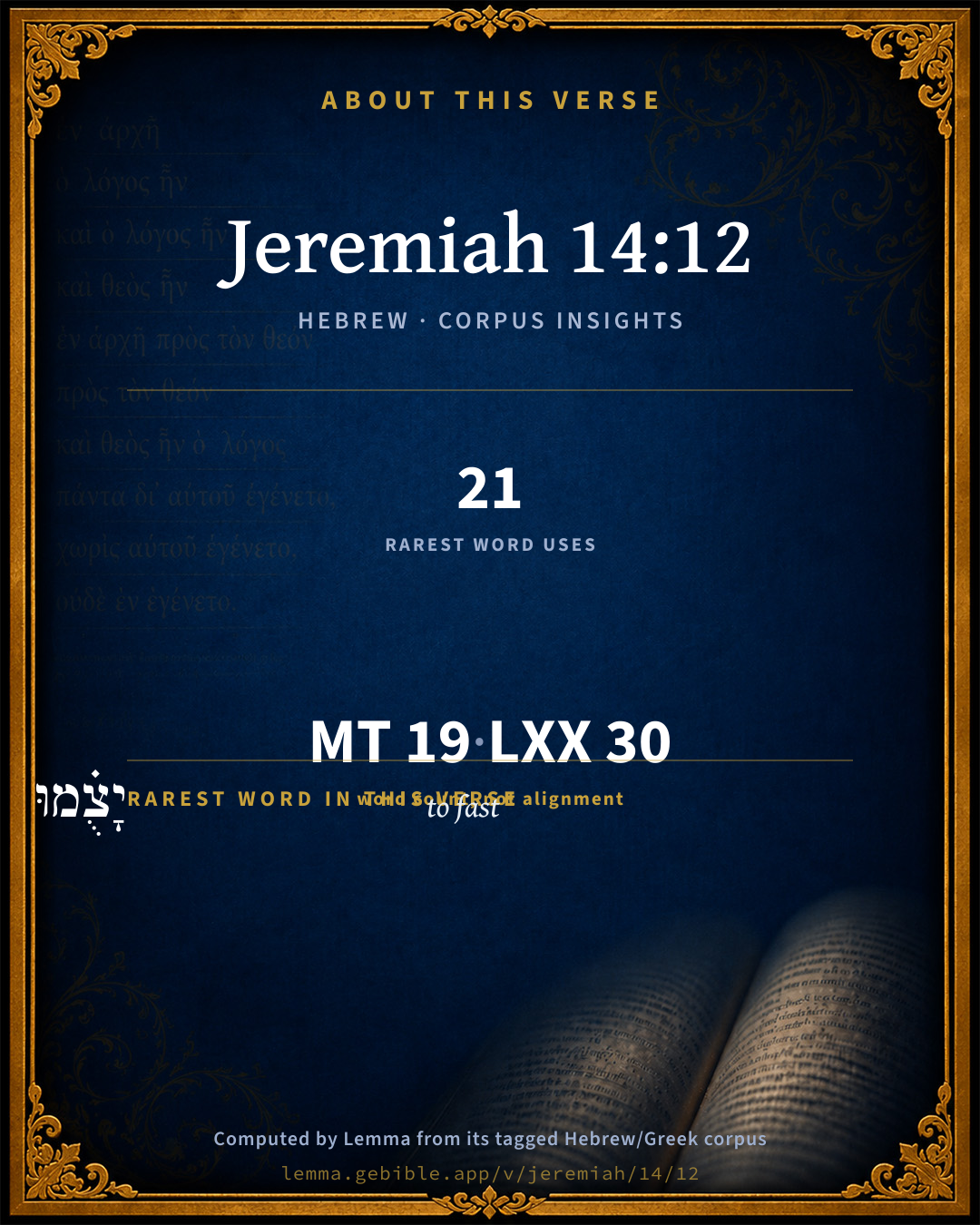
About this verse

These counts appear in no published source. They are computed here, from the morphology-tagged text and Lemma’s own curated glosses. What Lemma adds →

19
words
16
distinct lemmas
Prophets
section

Notable vocabulary

The rarest word here is יָצֻ֗מוּ to fast H6684 — appearing just 21 times in the whole Hebrew Bible.

Shared distinctive vocabulary

יָצֻ֗מוּ to fast H6684 occurs in 17 verses of the Hebrew Bible. Also found in:

Grammatical profile

  • 5 verbs
  • 6 nouns
  • 1 pronoun
  • 1 preposition
  • 3 conjunctions
  • 3 particles

Verb forms

  • יָצֻ֗מוּ Qal · Imperfect
  • שֹׁמֵ֨עַ֙ Qal · Participle Active
  • יַעֲל֛וּ Hiphil · Imperfect
  • רֹצָ֑ם Qal · Participle Active
  • מְכַלֶּ֥ה Piel · Participle Active

Repetition

Words recur within this verse — often emphatic in Hebrew:

  • אֵינֶ֤נִּי nothing H369 ×2
  • כִּ֣י that H3588 ×3

Hebrew & Septuagint length

In the original languages it is 19 Hebrew tokens and 30 Greek tokens — but the two are counted differently (Hebrew bundles its prefixes and suffixes into one token; the Greek is in lemma form), so that isn’t a like-for-like length.

Cross-references

20

Topical passages linked to Jeremiah 14:12 in the Treasury of Scripture Knowledge — connected by theme and wording, ordered by reader-vote popularity; previews shown in the World English Bible.

  • Jeremiah 11:11 Therefore thus says Yahweh, Behold, I will bring evil on them, which they shall not be able to escape; and they shall cry to me, but I will not listen to them.
  • Proverbs 1:28 Then will they call on me, but I will not answer. They will seek me diligently, but they will not find me;
  • Ezekiel 8:18 Therefore will I also deal in wrath; my eye shall not spare, neither will I have pity; and though they cry in my ears with a loud voice, yet will I not hear them.
  • Jeremiah 6:20 To what purpose comes there to me frankincense from Sheba, and the sweet cane from a far country? your burnt offerings are not acceptable, nor your sacrifices pleasing to me.
  • Ezekiel 14:21 For thus says the Lord Yahweh: How much more when I send my four sore judgments on Jerusalem, the sword, and the famine, and the evil animals, and the pestilence, to cut off from it man and animal!
  • Micah 3:4 Then they will cry to Yahweh, But he will not answer them. Yes, he will hide his face from them at that time, Because they made their deeds evil."
  • Zechariah 7:13 It has come to pass that, as he called, and they refused to listen, so they will call, and I will not listen," said Yahweh of Hosts;
  • Jeremiah 16:4 They shall die grievous deaths: they shall not be lamented, neither shall they be buried; they shall be as dung on the surface of the ground; and they shall be consumed by the sword, and by famine; and their dead bodies shall be food for the birds of the sky, and for the animals of the earth.
  • Jeremiah 24:10 I will send the sword, the famine, and the pestilence, among them, until they be consumed from off the land that I gave to them and to their fathers.
  • Proverbs 15:8 The sacrifice made by the wicked is an abomination to Yahweh, But the prayer of the upright is his delight.
  • Proverbs 21:27 The sacrifice of the wicked is an abomination: How much more, when he brings it with a wicked mind!
  • Proverbs 28:9 He who turns away his ear from hearing the law, Even his prayer is an abomination.
  • Isaiah 1:11–15 "What are the multitude of your sacrifices to me?," says Yahweh. "I have had enough of the burnt offerings of rams, And the fat of fed animals. I don't delight in the blood of bulls, Or of lambs, Or of male goats.
  • Isaiah 58:3 Why have we fasted, [say they], and you don't see? [why] have we afflicted our soul, and you take no knowledge? Behold, in the day of your fast you find [your own] pleasure, and exact all your labors.
  • Jeremiah 7:21–22 Thus says Yahweh of Hosts, the God of Israel: Add your burnt offerings to your sacrifices, and eat you flesh.
  • Jeremiah 9:16 I will scatter them also among the nations, whom neither they nor their fathers have known; and I will send the sword after them, until I have consumed them.
  • Jeremiah 15:2–3 It shall happen, when they tell you, Where shall we go forth? then you shall tell them, Thus says Yahweh: Such as are for death, to death; and such as are for the sword, to the sword; and such as are for the famine, to the famine; and such as are for captivity, to captivity.
  • Jeremiah 21:7–9 Afterward, says Yahweh, I will deliver Zedekiah king of Judah, and his servants, and the people, even such as are left in this city from the pestilence, from the sword, and from the famine, into the hand of Nebuchadrezzar king of Babylon, and into the hand of their enemies, and into the hand of those who seek their life: and he shall strike them with the edge of the sword; he shall not spare them, neither have pity, nor have mercy.
  • Jeremiah 29:17–18 thus says Yahweh of Hosts; Behold, I will send on them the sword, the famine, and the pestilence, and will make them like vile figs, that can't be eaten, they are so bad.
  • Ezekiel 5:12–17 A third part of you shall die with the pestilence, and with famine shall they be consumed in the midst of you; and a third part shall fall by the sword round about you; and a third part I will scatter to all the winds, and will draw out a sword after them.

Cross-references courtesy of OpenBible.info (CC BY 4.0).

Hebrew and Greek witnesses Masoretic Hebrew ↔ Greek Septuagint

The same verse in the two great witnesses to the Old Testament, shown verse-for-verse.

These are two independent witnesses, not word-aligned to each other, and the Septuagint is shown in lemma (dictionary) form.

Hebrew Jeremiah 14:12 Masoretic · Westminster Leningrad Codex

כִּ֣י יָצֻ֗מוּ אֵינֶ֤נִּי שֹׁמֵ֨עַ֙ אֶל רִנָּתָ֔ם וְכִ֧י יַעֲל֛וּ עֹלָ֥ה וּמִנְחָ֖ה אֵינֶ֣נִּי רֹצָ֑ם כִּ֗י בַּחֶ֨רֶב֙ וּבָרָעָ֣ב וּבַדֶּ֔בֶר אָנֹכִ֖י מְכַלֶּ֥ה אוֹתָֽם

When they fast, I will not hear their cry; and when they offer burnt offering and meal-offering, I will not accept them; but I will consume them by the sword, and by the famine, and by the pestilence.

World English Bible · Public Domain

Greek LXX Structure differs

In the Septuagint, Jeremiah is about an eighth shorter than the Hebrew and arranges its material differently — the Oracles Against the Nations (Hebrew chapters 46–51) appear in the middle of the Greek book, after 25:13. Because the chapter and verse boundaries do not line up, a verse-for-verse comparison with the Hebrew is not shown.

A verse-for-verse comparison isn’t shown here because the chapters and verses don’t line up. Switch to the LXX edition with the MT / LXX toggle above to read the Greek directly.

Hebrew: Westminster Leningrad Codex (CC BY 4.0). Greek: Septuagint (public domain); English from a public-domain English Septuagint. How the Septuagint differs from the Hebrew →

Targum (Aramaic paraphrase)

1

The Targum is the ancient Jewish Aramaic paraphrase of the Hebrew Scriptures — an interpretive translation, not the Hebrew text itself. Onkelos (literal) and Pseudo-Jonathan (expansive) render the Torah, and Jonathan the Prophets. Coverage is partial: where no permissively-licensed English translation exists for a verse, only the Aramaic is shown. This is verse-level text, not a word-by-word alignment to the Hebrew.

  1. Targum Jonathan Prophets (Joshua–Malachi)
    אֲרֵי יְצוּמוּן לָא רַעֲוָא קֳדָמַי לְקַבָּלָא צְלוֹתְהוֹן וַאֲרֵי יִסְקוּן עֲלָתָא וּמִנְחָתָא לָא רַעֲוָא קָדָמַי בְּהוֹן בְּחַרְבָּא וּבְכַפְנָא וּבְמוֹתָא אֲנָא מְשֵׁיצֵי יַתְהוֹן:

    (no public-domain English translation for this verse)

    Targum Jonathan — Aramaic: “Mikraot Gedolot” (public domain). English: “Sefaria Community Translation” (CC0 1.0 (public-domain dedication)); “London "Chaldee Paraphrase," 1871” (public domain). Text via Sefaria.

Commentary

Notes on Jeremiah 14:12 from classic Christian and Jewish commentators (each source and its license shown beneath its notes). The classic Christian expositions comment on the surrounding passage and are grouped to its opening verse, so a note may address several verses; the Jewish commentaries on the Tanakh (Rashi and others) are per-verse, so they appear only where the commentator wrote on this verse.

Lemma curates 59 commentaries, every one of them public domain or Creative Commons licensed, each selected and text-cleaned for this edition rather than reprinted as found. About our sources →

Trapp's Complete Commentary

John Trapp

Jer 14:12 When they fast, I will not hear their cry; and when they offer burnt offering and an oblation, I will not accept them: but I will consume them by the sword, and by the famine, and by the pestilence.

Ver. 12. When they fast I will not hear their cry.] At their fasts they were wont to pray earnestly, and to make their voices to be heard on high. Sed defuit aliquid intas; their hearts cried not.

John Trapp, A Commentary or Exposition upon All the Books of the Old and New Testament (1647–1656) — public domain. Text from a community e-Sword module.

The Biblical Illustrator

Joseph S. Exell

Jer_14:12

When they fast, I will not hear their cry.

Pasting rendered offensive

I. Pious demeanour is not what God desires, but faith.

1. God abominates a double and false heart; and the greater the fervour hypocrites display in external rites, the more they provoke Him.

2. Fasting is observed as giving intensity to prayer.

3. They who fast professedly avow that they deprecate Gods disfavour.

4. But God values not outward appearance.

II. Fasting is not in itself a religious duty, but a mere index to a humble spirit.

1. What is intended by fasting?

(1) That there may be greater alacrity in prayer.

(2) That it may be an evidence of humility in confessing sins.

(3) Indicative of a purpose to subdue lust.

2. What is fasting, apart from these intents?

(1) A frivolous exercise.

(2) A profanation of Gods worship.

(3) A superstition, provoking Gods wrath.

III. No value in fasting to merry Gods favour.

IV. Mocking profanation was intolerable, and should be punished.

1. God shows Himself armed with various kinds of punishment.

2. He forewarns that they who had provoked Him should surely suffer.

3. God does not disregard or reject religious signs; but when what they signify is separated from them, there is then an intolerable profanation. (J. Calvin.)

The Biblical Illustrator, edited by Joseph S. Exell (c. 1880s–1900s) — public domain. Text from a community e-Sword module.

Jamieson, Fausset & Brown

Robert Jamieson, A. R. Fausset & David Brown

not hear--because their prayers are hypocritical: their hearts are still idolatrous. God never refuses to hear real prayer (Jer 7:21-22; Pro 1:28; Isa 1:15; Isa 58:3).

sword . . . famine . . . pestilence--the three sorest judgments at once; any one of which would be enough for their ruin (Sa2 24:12-13).

Jamieson, Fausset & Brown — Commentary Critical and Explanatory on the Whole Bible (1871) — public domain (CC PDM 1.0). Text via the HelloAO Bible API.

John Calvin's Commentaries

He afterwards adds, Even when they fast, I will not hear their cry, and when they present a sacrifice and an oblation, I will not be pleased with them He doubtless touches the hypocrites, who, though void of all sincerity, yet professed to be the true worshippers of God, and by sacrifices and fastings and other external rites wished to prove themselves to be so. He therefore says that he would not be propitious or appeasable, though they fasted, and prayed, and offered all kinds of sacrifices. The words, as I have said, were especially addressed to hypocrites; for we know that that declaration remains unchangeablesthat God is nigh to all those who call on him in sincerity. (Psalm 145:18) Whosoever, then, calls on God with a true heart, infallibly obtains his favor; for in another place it is ascribed to God as a thing necessarily belonging to him, that he hears prayers. Whenever then God is invoked, he cannot divest himself of what essentially appertains to himshis readiness to hear prayer. But here he intimates that there was no sincerity in the people; for even when they fasted and prayed, and offered sacrifices, they did not truly worship him; for, as it was said before, they could no more put off the wickedness which adhered to their marrow than the Ethiopian could change his skin or the panther his spots, (Jeremiah 13:23) He then shews, in this place, that though they wearied themselves, in pacifying God by an external profession, they did nothing but act falsely, and that therefore their efforts would be all in vain; for they profaned the name of God when they thus grossly dissembled with him. This is the meaning.

Fasting is expressly mentioned, and it hence appears, that when there is nothing wanting as to outward appearance, God still ever regards faith, as we have seen in the fifth chapter. Hence God values not what is highly esteemed by men, and excites their feelings: why? because he regards the faith of the heart, and faith is taken for integrity. So then God abominates a double and a false heart; and the greater the fervor hypocrites display in external rites, the more they provoke him.

We pray to God daily, it may be said, and yet we do not fast daily. It is indeed true that prayer is more intent when we fast; but yet God requires not daily fastings, while he enjoins prayer both in the morning and in the evening, yea, he would have us to implore his grace continually. (1 Thessalonians 5:17) But when fasting is joined to prayer, then prayer becomes more earnest; as it is usually the case when there is any danger, or when there appears any evidence of God’s wrath, or when we labor under any heavy affliction; for we then not only pray but we also fast that we may be more free and more at liberty to pray. Besides, fasting is also an evidence that we are deprecating the wrath of God, while we confess that we are guilty before him; and thus also they who pray stimulate themselves the more to sorrow and to other penitential feelings. It is therefore the same as though he had said, “Even if they pray in no common manner and every day, and add fasting, so that greater fervor may appear in their prayers and extraordinary attention, yet I will not hear their cries, even because their heart is false.”

We further gather from this passage that fasting is not in itself a religious duty or exercise, but that it refers to another end. Except then they who fast have a regard to what is thereby intended — that there may be a greater alacrity in Prayer — that it may be an evidence of humility in confessing their sins — and that they may also strive to subdue all their lusts — except these things be regarded, fasting becomes a frivolous exercise, nay, a profanation of God’s worship, it being only superstitious. We hence see that fastings are not only without benefit except when prayers are added, and those objects which I have stated are regarded, but that they provoke the wrath of God as all superstitions do, for his worship is polluted.

But under the Papacy the reason given for fastings is, that they merit the favor of God. The Papists seek to pacify him by fasting as by a sort of satisfaction; they will have fasting to be a work of merit. I will not now speak of the numberless trifles which also pollute their fasting; but let us suppose that they are not superstitious in their choice of meats, in their hours, and in other childish follies, which are mere trumperies, nay, mockeries also to God — let us suppose them to be free from all these vices, yet the intention, as they call it, is nothing else but a diabolical error, for they determine that fasting is a work of merit and of satisfaction, and a kind of expiation. Let us then know, that though Jeremiah speaks of hypocrites, yet he briefly points out the design of fasting by mentioning prayer. So also Christ, when recommending fasting, makes mention of prayer. (Matthew 17:21; Mark 9:29) The same is done by Paul. (1 Corinthians 7:5.) But it ought to be noticed here, that though hypocrites joined before men prayer with fasting, they were yet rejected, for there was no sincerity in their hearts, but only an outward profession, a mere disguise. But God, as we have, seen, regards the heart, and sincerity alone pleases him.

The same thing is said of sacrificing, When they present sacrifices, or burnt — offerings, and an oblation, מנחה, meneche, that is, the daily offerings, I will not hear them, or, as he says in the second clause, I will not be pleased with them Sacrifice without prayers were no doubt vain and worthless, for as pr ayers were not acceptable to God without a sacrifice, so when sacrifice was without prayers it was only a vain shew these two things are then united as by an indissoluble knot, to offer sacrifices and to pray. Prayers, as I have said, cannot be acceptable to God without a sacrifice; for what can proceed from mortal man but what is abominable before God? Our prayers must therefore be sanctified in order that they please God; and the only way of sanctification is through the sacrifice of Christ. When they offered sacrifices under the law they also joined prayers; and by this ceremony they who made any request professed themselves unworthy except a sacrifice was offered. The Prophet then mentions here what God had commanded under the law, but he shews that hypocrites separated the principal thing from the external signs. God indeed neither disregards nor rejects signs, but when what they signify is separated from them, there is then an intolerable profanation. Let us then know, that though nothing may be wanting in the external worship, yet whatever we seek to do is abominable to God except it be accompanied with sincerity of heart.

But I will consume them, he says, with the sword, and with famine, and with pestilence I render the particle כי ki, “but.” He refers here to three modes of destruction, that the Jews might surely know that they were to perish, according to what is said elsewhere, “He who escapes from the sword shall perish by the famine, and he who survives the famine shall perish by the pestilence.” God shews, in short, that he was armed with various kinds of punishment, so that they who had so provoked him as wholly to lose the hope of pardon, could by no escapes deliver themselves from destruction. God might indeed have consumed the Jews by one punishment, he might have also threatened them in general terms without specifying anything, but as the unbelieving ever promise themselves some way of escape, so his purpose was to hold them bound in every way, that they might know that they were shut up on every side, and that no way of escape could be found. This is the meaning. It follows —

John Calvin's Commentaries (1540-1563) — public domain. Text from the Calvin Translation Society English edition (1840s-50s) via the Christian Classics Ethereal Library (ccel.org). Calvin's coverage is partial (roughly two-thirds of the Bible); uncommented books and verses are honest gaps, never fabricated. The 19th-century editor's footnotes and remarks are omitted so the notes are faithfully Calvin's own voice.

Ellicott's Commentary for English Readers

(12) An oblation.—The minchah or meat-offering of Lev_2:1. We need not assume that the fast and the sacrifice were necessarily hypocritical, though doubtless much of this mingled itself with the worship of Israel now as it had done in the days of Isaiah, and met with a like rejection (Isa_1:15). The lesson here is rather that they came too late to stay the discipline of chastisement.

By the sword, and by the famine, and by the pestilence,—The history of the world shows how constantly the latter plagues have followed in the wake of the former, and the union of the three has become proverbial (Lev_26:25-26; Eze_5:12). In Eze_14:21 the “noisome beast” is added to make up the list of the four sore judgments of God.

A Bible Commentary for English Readers, edited by Charles John Ellicott (1878–1897) — public domain. Text from a community e-Sword module.

The Cambridge Bible for Schools and Colleges

gen. ed. J. J. S. Perowne

12. oblation] mg. meal offering, Heb. minḥah, sometimes, specially in the Levitical laws, in this narrower sense, as accompanying a sacrifice of animals, but also generally, of a present to procure the favour of a superior (Gen_32:20; Gen_43:11), and so used of an offering (including animals) to God (Gen_4:5; 1Sa_2:17; 1Sa_2:29, etc.). See Dr. p. 359.

The Cambridge Bible for Schools and Colleges (gen. ed. J. J. S. Perowne; Cambridge University Press, 1878–1918) — public domain. Text from a community e-Sword module.

John Gill's Exposition

When they fast, I will not hear their cry,.... Or, "though they fast" (k); very probably on account of the want of rain, and the dearth or famine, a fast was proclaimed; see Jer 36:9, when they prayed and cried aloud, and made a great noise; but their prayers being hypocritical, and not arising from a pure heart, or offered up in faith and love, were not heard and accepted by the Lord:

and when they offer burnt offerings and an oblation; or a meat or bread offering, which went along with the burnt offering; thinking by those outward things to atone for their sins, without true repentance for them, or faith in the atoning sacrifice of Christ:

I will not accept them; neither their offerings, nor their persons:

but I will consume them by the sword, and by the famine, and by the pestilence; the Lord not only determines the continuance of the famine, notwithstanding the prayers of the prophet; but adds two other judgments, the sword and pestilence, by which he was resolved to consume them; and therefore it was to no purpose to pray to him on their behalf, he was inexorable.

(k) "quamvis jejunant", Gataker.

John Gill's Exposition of the Whole Bible (1746–1763) — public domain (CC PDM 1.0). Text via the HelloAO Bible API.

Albert Barnes' Notes on the Bible

Their cry i. e - prayer offered aloud.

Oblation - A meat-offering Lev 2:1.

The sword, famine, and pestilence - The two latter ever follow upon the track of the first Eze 5:12, and by these God will consume them, yet so as to leave a remnant. The chastisement, which crushes those who harden themselves against it, purifies the penitent.

Albert Barnes' Notes on the Bible (1834–1885) — public domain. Text from a community e-Sword/MySword module.

Matthew Poole's English Annotations

When they fast, I will not hear their cry; the like threatening we have Pro 1:28; Isa 1:15; Jer 11:11; Eze 8:18; Mic 3:4.

When they offer burnt-offering and an oblation, I will not accept them: men may so long despise God’s calls, exhortations, and counsels, as their case may be desperate, as to the prevention of temporal judgments by such religious applications to God as ordinarily have their effect to prevent and remove judgments. See Jer 15:1; Eze 14:14,20.

But I will consume them by the sword, and by the famine, and by the pestilence; he threateneth to add to their plague three sore judgments, ordinarily accompanying one another, both in God’s threatenings, and in the execution of them, Jer 29:17,18; 34:17, &c.

Matthew Poole's English Annotations on the Holy Bible (1683–1685) — public domain. Text from a community e-Sword/MySword module.

Whedon's Commentary on the Bible

Daniel D. Whedon

12. I will not hear… not accept — Because their prayers were not real or not reasonable. In the case of many they were merely selfish cryings out against the consequences of sin rather than the sin itself; and in the case of others, though penitence was genuine, it came too late to avert the temporal calamity.

Daniel D. Whedon (gen. ed.), Commentary on the Old and New Testaments (1874–1909) — public domain. Text from a community e-Sword module.

The Pulpit Commentary

Their cry. The word is very forcible; it is the shriek in which an unsophisticated man gives vent to his pain and grief. An oblation. It is the vegetable offering (Authorized Version, "meat offering;" Luther, "speisopfer") which is referred to in the so-called minkhah (literally, gift). Though sometimes offered separately, it regularly accompanied a burnt offering. I will not accept them. Dr. Payne Smith tries to soften the rejection of these worshippers by the remark that "there is a time when the most genuine repentance avails nothing to avert the temporal consequences of sin." But the analogy of other similar passages (e.g. Isa_1:15) warrants the view of Keil that the ground of the rejection of the worship is its heartless formalism and insincerity, which was equally a bar to Jehovah"s favor and the prophet"s intercession.

The Pulpit Commentary (1880–1919), ed. H.D.M. Spence-Jones & Joseph S. Exell — public domain. Text from a community e-Sword module.

Lesson kit

Teaching starters — assembled from the data on this page, not authored interpretation. Every prompt links to the verse data it draws on. Edit before teaching.

Jeremiah, in the Prophets, opens this verse with 19 words (16 distinct Hebrew lemmas). Its most distinctive word is tsûwm (“to fast”). A historical commentator’s framing appears above. Read the whole chapter for the surrounding context.

Discussion questions

  1. How does “to fast” (tsûwm) shape what this verse is saying?
  2. How does Judges 20:26, which shares the word «to fast», read alongside this verse?
  3. What does the repetition of “nothing” (2× in this one verse) do in this verse?
  4. These translations render this verse differently. What is at stake in choosing one wording over another?
  5. «יָצֻ֗מוּ» is a Qal Imperfect verb. How does that grammatical form shape the action described?
  6. Compare how Trapp's Complete Commentary and The Biblical Illustrator read this verse. Where do they agree or differ?

Things to notice

Reading settings

Reading text

Shown beneath each verse's original-language words.

Old Testament
Old Testament edition

Read the OT as the Masoretic Hebrew (MT) or the Greek Septuagint (LXX).

English shown for the Greek Septuagint (in the Hebrew ↔ Greek comparison).

Comparing translations? Open the Compare panel on any verse page to stack up to four side by side.