
Joshua 18:7

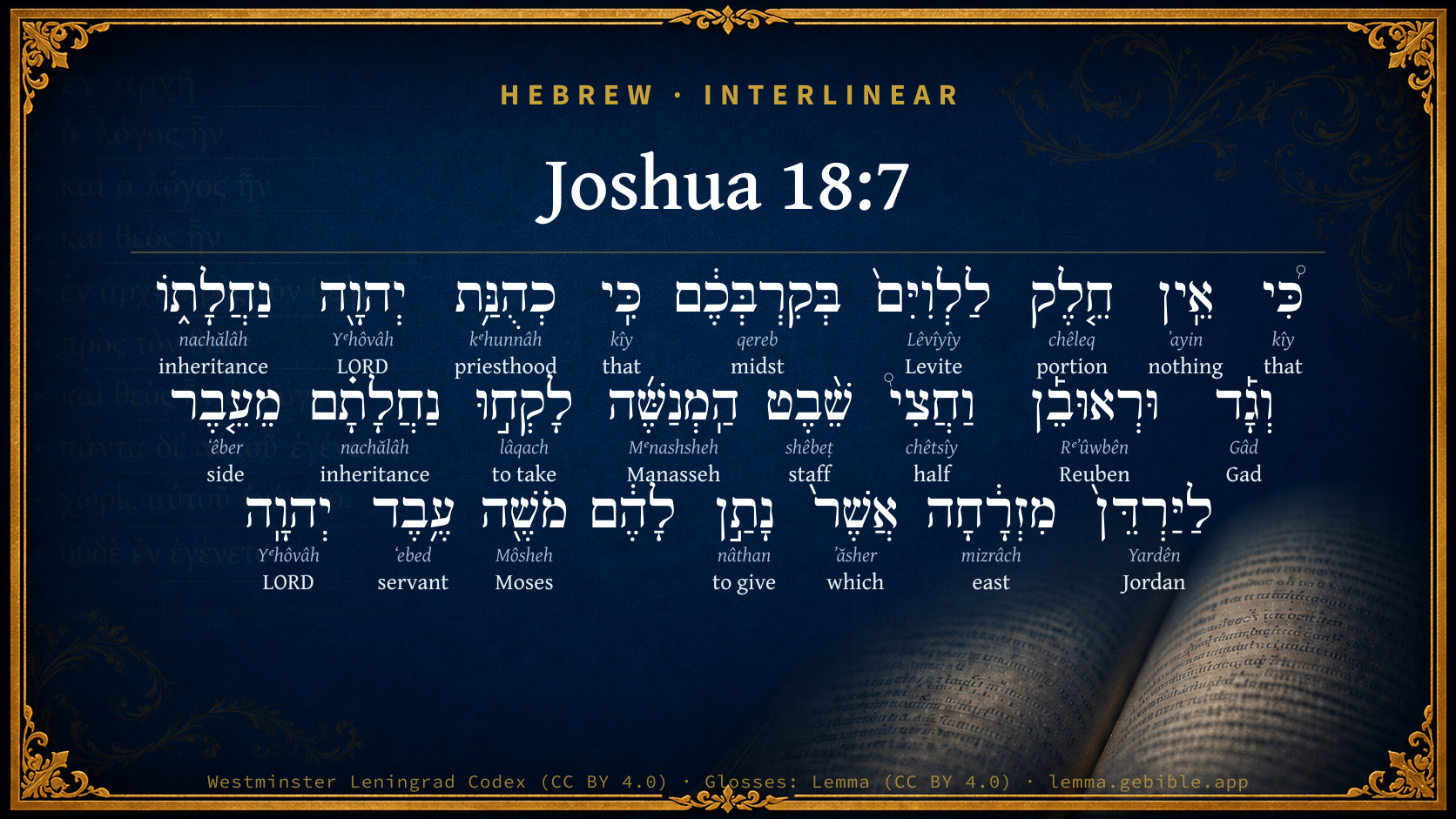
Hebrew (Westminster Leningrad Codex) Joshua 18:7 appears in the Hebrew Old Testament. The text above is from the Westminster Leningrad Codex. Each word links to its Strong’s number, a concise gloss, and parsing drawn from the Open Scriptures Hebrew Bible morphology. Click any word for its full Brown-Driver-Briggs (BDB) entry.
Download image
Cite this verse

Joshua 18:7 (World English Bible). Public Domain. Lemma interlinear Bible study tool, https://lemma.gebible.app/v/joshua/18/7.

Show BibTeX & RIS
BibTeX
RIS
English Translation
For the Levites have no portion among you; for the priesthood of Yahweh is their inheritance: and Gad and Reuben and the half-tribe of Manasseh have received their inheritance beyond the Jordan eastward, which Moses the servant of Yahweh gave them.
World English Bible · Public Domain
Download a study sheet

One document with this verse’s original text, its word-by-word gloss line, the meaning frame, cross-references with their text, attributed commentary, and full source and license credits — printable, and it pastes into notes with its structure intact.

This verse Autodidact and up

Study sheet (.html) Plain text (.txt)

A passage Seminary Student

Up to 50 verses in one chapter. A passage sheet keeps up to 6 commentary sources and 12 cross-references per verse, in the order this page ranks them, and says so on the sheet whenever that leaves anything out. Ask for a single verse and you get the Autodidact verse sheet above.

Everything on this page stays free to read, with no account — the sheet is a download of what is already on screen, not access to it.

Want to remove ads? Support Godless Engineer
Compare translations 3

The same verse in 3 English versions, stacked beneath the original-language interlinear above. Click any original word for its lexicon entry.

Each is an independent rendering of the whole verse — the interlinear is not word-aligned to these translations.

Highlighted words mark where these versions differ — a whole-verse word diff, not a word-by-word alignment.

  • World English Bible Public Domain
    For the Levites have no portion among you; for the priesthood of Yahweh is their inheritance: and Gad and Reuben and the half-tribe of Manasseh have received their inheritance beyond the Jordan eastward, which Moses the servant of Yahweh gave them.
  • King James Version Public Domain
    But the Levites have no part among you; for the priesthood of the LORD is their inheritance: and Gad, and Reuben, and half the tribe of Manasseh, have received their inheritance beyond Jordan on the east, which Moses the servant of the LORD gave them.
  • unfoldingWord Literal Text CC BY-SA 4.0
    But no division within you for the Levites, because the priesthood of Yahweh their inheritance. And Gad and Reuben and half of the tribe of Manasseh have received their inheritance from the other side of the Jordan toward the sunrise, which Moses, the servant of Yahweh, gave to them.”

unfoldingWord Literal Text — © unfoldingWord, licensed CC BY-SA 4.0. Word-aligned USFM3 via Door43 (git.door43.org/unfoldingWord/en_ult).

Versions to compare (up to 4)

3 of 4 selected

Show all 18 translations

Every available English version of this verse, each an independent rendering of the whole verse.

  • World English Bible Public Domain
    For the Levites have no portion among you; for the priesthood of Yahweh is their inheritance: and Gad and Reuben and the half-tribe of Manasseh have received their inheritance beyond the Jordan eastward, which Moses the servant of Yahweh gave them.
  • Berean Standard Bible Public Domain
    The Levites, however, have no portion among you, because their inheritance is the priesthood of the LORD. And Gad, Reuben, and half the tribe of Manasseh have already received the inheritance that Moses the servant of the LORD gave them beyond the Jordan to the east.”
  • Majority Standard Bible Public Domain
    The Levites, however, have no portion among you, because their inheritance is the priesthood of the LORD. And Gad, Reuben, and half the tribe of Manasseh have already received the inheritance that Moses the servant of the LORD gave them beyond the Jordan to the east.”
  • King James Version Public Domain
    But the Levites have no part among you; for the priesthood of the LORD is their inheritance: and Gad, and Reuben, and half the tribe of Manasseh, have received their inheritance beyond Jordan on the east, which Moses the servant of the LORD gave them.
  • American Standard Version (1901) Public Domain
    For the Levites have no portion among you; for the priesthood of Jehovah is their inheritance: and Gad and Reuben and the half-tribe of Manasseh have received their inheritance beyond the Jordan eastward, which Moses the servant of Jehovah gave them.
  • Revised Version (1885) Public Domain
    For the Levites have no portion among you; for the priesthood of the LORD is their inheritance: and Gad and Reuben and the half tribe of Manasseh have received their inheritance beyond Jordan eastward, which Moses the servant of the LORD gave them.
  • Geneva Bible (1599) Public Domain
    But the Leuites shall haue no part among you: for the Priesthood of the Lord is their inheritance: also Gad and Reuben and halfe the tribe of Manasseh haue receiued their inheritance beyond Iorden Eastward, which Moses the seruant of the Lord gaue them.
  • Douay-Rheims (1899) Public Domain
    The land in the midst between these mark ye out into seven parts; and you shall come hither to me, that I may cast lots for you before the Lord your God.
  • Young's Literal Translation Public Domain
    for there is no portion to the Levites in your midst, for the priesthood of Jehovah `is' their inheritance, and Gad, and Reuben, and the half of the tribe of Manasseh received their inheritance beyond the Jordan eastward, which Moses servant of Jehovah gave to them.'
  • Literal Standard Version CC BY-SA 4.0
    for there is no portion for the Levites in your midst, for the priesthood of YHWH [is] their inheritance, and Gad, and Reuben, and half of the tribe of Manasseh received their inheritance beyond the Jordan eastward, which Moses, servant of YHWH, gave to them.”
  • Unlocked Literal Bible CC BY-SA 4.0
    The Levites have no portion among you, for the priesthood of Yahweh is their inheritance. Gad, Reuben, and the half tribe of Manasseh have received their inheritance, beyond Jordan. This is the inheritance that Moses the servant of Yahweh gave them.”
  • unfoldingWord Literal Text CC BY-SA 4.0
    But no division within you for the Levites, because the priesthood of Yahweh their inheritance. And Gad and Reuben and half of the tribe of Manasseh have received their inheritance from the other side of the Jordan toward the sunrise, which Moses, the servant of Yahweh, gave to them.”
  • Darby Bible Public Domain
    But the Levites have no portion among you, for the priesthood of Jehovah is their inheritance. And Gad, and Reuben, and half the tribe of Manasseh have received their inheritance beyond the Jordan on the east, which Moses the servant of Jehovah gave them.
  • World Messianic Bible Public Domain
    However, the Levites have no portion among you; for the priesthood of the LORD is their inheritance. Gad, Reuben, and the half-tribe of Manasseh have received their inheritance east of the Jordan, which Moses the servant of the LORD gave them.”
  • Webster's Bible Public Domain
    But the Levites have no part among you; for the priesthood of the LORD is their inheritance. And Gad, and Reuben, and half the tribe of Manasseh, have received their inheritance beyond Jordan on the east, which Moses the servant of the LORD gave them.
  • Free Bible Version CC BY-SA 4.0
    But the Levites do not receive a share, for their role as priests of the Lord is their allocation. Also, Gad, Reuben, and the half-tribe of Manasseh have already received their allocation that Moses, the servant of the Lord, gave them on the east side of the Jordan.”
  • Bible in Basic English Public Domain
    For the Levites have no part among you; to be the Lord's priests is their heritage; and Gad and Reuben and the half-tribe of Manasseh have had their heritage on the east side of Jordan, given to them by Moses, the servant of the Lord.
  • JPS Tanakh (1917) Public Domain
    For the Levites have no portion among you, for the priesthood of the LORD is their inheritance; and Gad and Reuben and the half-tribe of Manasseh have received their inheritance beyond the Jordan eastward, which Moses the servant of the LORD gave them.'

Literal Standard Version (2020), Covenant Press — licensed CC BY-SA 4.0. Text via the HelloAO Bible API (eBible.org). Unlocked Literal Bible (unfoldingWord) — licensed CC BY-SA 4.0. Text via the HelloAO Bible API (eBible.org). unfoldingWord Literal Text — © unfoldingWord, licensed CC BY-SA 4.0. Word-aligned USFM3 via Door43 (git.door43.org/unfoldingWord/en_ult). Free Bible Version, Dr. Jonathan Gallagher — licensed CC BY-SA 4.0. Text via the HelloAO Bible API (eBible.org).

Word by word

More ways to search: Search by grammar → Find every occurrence → Compare this word →

Practice this passage: Drill this verse → Learn its vocabulary →

כְהֻנַּ֥ת
kᵉhunnâh
H3550
“priesthood of”
Noun, Common, Feminine, Singular, Construct
Part of Speech
Noun
Type
Common
Gender
Feminine
Number
Singular
State
Construct
Full BDB Definition

Origin: from H3547

TWOT: 959b

priesthood
  1. כִּ֠י kîy H3588 “that” Conjunction
  2. אֵֽין ʼayin H369 “nothing” Particle, Negative
  3. חֵ֤לֶק chêleq H2506 “portion” Noun, Common, Masculine, Singular, Absolute
  4. לַלְוִיִּם֙ Lêvîyîy H3881 “to/for the · Levites” Preposition, Determined + Noun, Gentilic, Masculine, Plural, Absolute
  5. בְּקִרְבְּכֶ֔ם qereb H7130 “in/at · midst · your” Preposition + Noun, Common, Masculine, Singular, Construct + Suffix, Personal, 2nd Person, Masculine, Plural
  6. כִּֽי kîy H3588 “that” Conjunction
  7. יְהוָ֖ה Yᵉhôvâh H3068 “LORD” Noun, Proper
  8. נַחֲלָת֑וֹ nachălâh H5159 “inheritance · his” Noun, Common, Feminine, Singular, Construct + Suffix, Personal, 3rd Person, Masculine, Singular
  9. וְגָ֡ד Gâd H1410 “and · Gad” Conjunction + Noun, Proper
  10. וּרְאוּבֵ֡ן Rᵉʼûwbên H7205 “and · Reuben” Conjunction + Noun, Proper
  11. וַחֲצִי֩ chêtsîy H2677 “and · half of” Conjunction + Noun, Common, Masculine, Singular, Construct
  12. שֵׁ֨בֶט shêbeṭ H7626 “staff of” Noun, Common, Masculine, Singular, Construct
  13. הַֽמְנַשֶּׁ֜ה Mᵉnashsheh H4519 “the · Manasseh” Particle, Definite Article + Noun, Proper
  14. לָקְח֣וּ lâqach H3947 “to take” Verb, Qal, Perfect, 3rd Person, Common, Plural
  15. נַחֲלָתָ֗ם nachălâh H5159 “inheritance · their” Noun, Common, Feminine, Singular, Construct + Suffix, Personal, 3rd Person, Masculine, Plural
  16. מֵעֵ֤בֶר ʻêber H5676 “from · side” Preposition + Noun, Common, Masculine, Singular, Absolute
  17. לַיַּרְדֵּן֙ Yardên H3383 “to/for the · Jordan” Preposition, Determined + Noun, Proper
  18. מִזְרָ֔חָה mizrâch H4217 “east · toward” Noun, Common, Masculine, Singular, Absolute + Suffix, Demonstrative
  19. אֲשֶׁר֙ ʼăsher H834 “which” Particle, Relative
  20. נָתַ֣ן nâthan H5414 “to give” Verb, Qal, Perfect, 3rd Person, Masculine, Singular
  21. מֹשֶׁ֖ה Môsheh H4872 “Moses” Noun, Proper
  22. עֶ֥בֶד ʻebed H5650 “servant of” Noun, Common, Masculine, Singular, Construct
  23. יְהוָֽה Yᵉhôvâh H3068 “LORD” Noun, Proper

About this verse

These counts appear in no published source. They are computed here, from the morphology-tagged text and Lemma’s own curated glosses. What Lemma adds →

25
words
21
distinct lemmas
Historical
section

Notable vocabulary

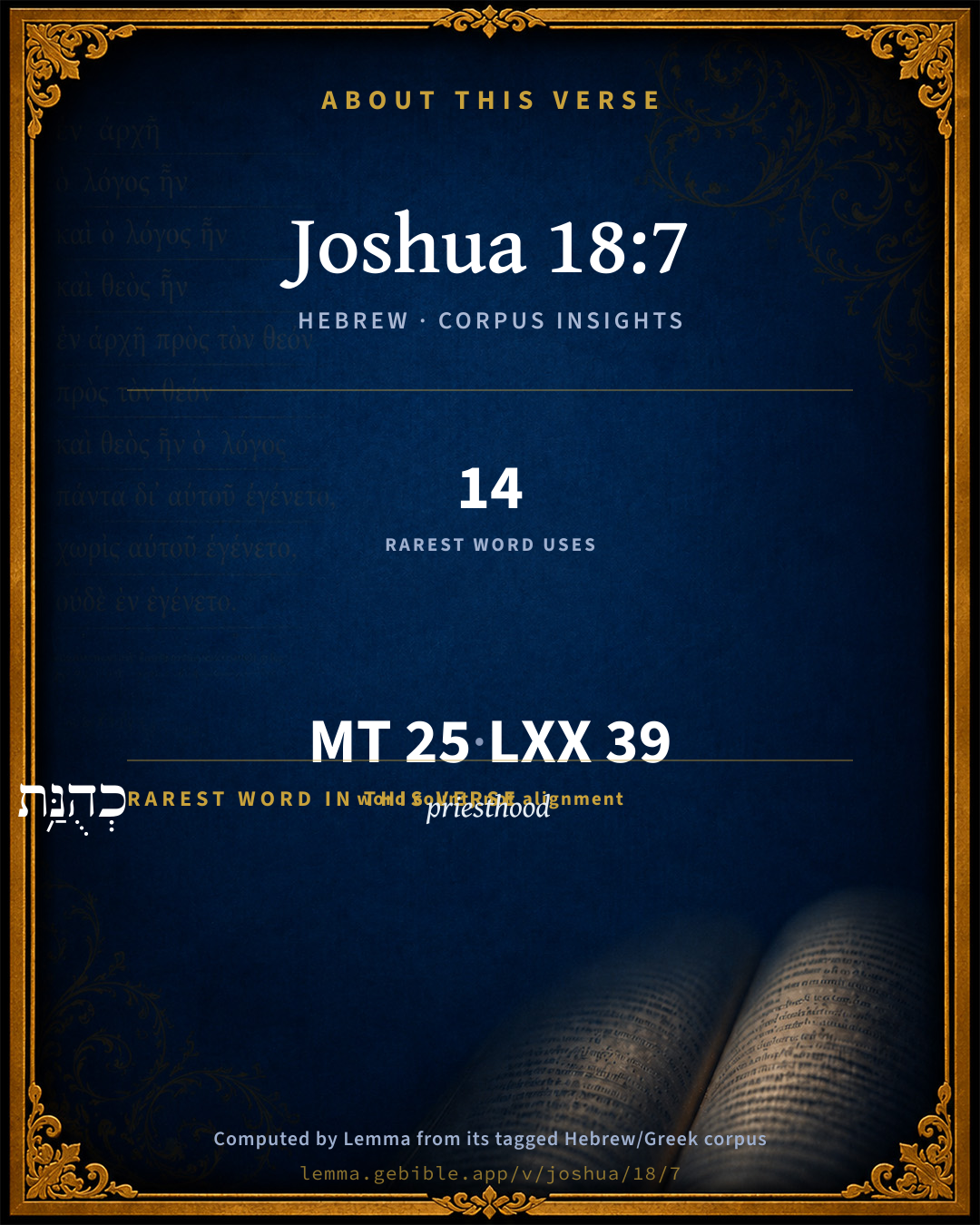
The rarest word here is כְהֻנַּ֥ת priesthood H3550 — appearing just 14 times in the whole Hebrew Bible.

Shared distinctive vocabulary

כְהֻנַּ֥ת priesthood H3550 occurs in 12 verses of the Hebrew Bible. Also found in:

Grammatical profile

  • 2 verbs
  • 18 nouns
  • 1 preposition
  • 2 conjunctions
  • 2 particles

Verb forms

  • לָקְח֣וּ Qal · Perfect
  • נָתַ֣ן Qal · Perfect

Repetition

Words recur within this verse — often emphatic in Hebrew:

  • יְהוָ֖ה LORD H3068 ×2
  • נַחֲלָת֑וֹ inheritance H5159 ×2
  • כִּ֠י that H3588 ×2

Hebrew & Septuagint length

In English translation the verse runs 41 words from the Hebrew and 46 from the Septuagint (LXX English) — closely comparable.

A rough comparison of the two English renderings, which tokenize alike — not a word-level alignment.

Word counts can differ between the Hebrew and the Greek without any difference in meaning — e.g. the Hebrew direct-object marker אֵת has no separate Greek word, and Greek often adds the article ὁ.

In the original languages it is 25 Hebrew tokens and 39 Greek tokens — but the two are counted differently (Hebrew bundles its prefixes and suffixes into one token; the Greek is in lemma form), so that isn’t a like-for-like length.

Cross-references

9

Topical passages linked to Joshua 18:7 in the Treasury of Scripture Knowledge — connected by theme and wording, ordered by reader-vote popularity; previews shown in the World English Bible.

  • Joshua 13:33 But to the tribe of Levi Moses gave no inheritance: Yahweh, the God of Israel, is their inheritance, as he spoke to them.
  • Numbers 18:20 Yahweh said to Aaron, You shall have no inheritance in their land, neither shall you have any portion among them: I am your portion and your inheritance among the children of Israel.
  • Joshua 13:8–31 With him the Reubenites and the Gadites received their inheritance, which Moses gave them, beyond the Jordan eastward, even as Moses the servant of Yahweh gave them:
  • Numbers 18:23 But the Levites shall do the service of the tent of meeting, and they shall bear their iniquity: it shall be a statute forever throughout your generations; and among the children of Israel they shall have no inheritance.
  • Numbers 32:29–41 Moses said to them, If the children of Gad and the children of Reuben will pass with you over the Jordan, every man who is armed to battle, before Yahweh, and the land shall be subdued before you; then you shall give them the land of Gilead for a possession:
  • Deuteronomy 3:12–17 This land we took in possession at that time: from Aroer, which is by the valley of the Arnon, and half the hill-country of Gilead, and the cities of it, gave I to the Reubenites and to the Gadites:
  • Deuteronomy 10:9 Therefore Levi has no portion nor inheritance with his brothers; Yahweh is his inheritance, according as Yahweh your God spoke to him.)
  • Deuteronomy 18:1–2 The priests the Levites, [even] all the tribe of Levi, shall have no portion nor inheritance with Israel: they shall eat the offerings of Yahweh made by fire, and his inheritance.
  • Deuteronomy 4:47–48 They took his land in possession, and the land of Og king of Bashan, the two kings of the Amorites, who were beyond the Jordan toward the sunrise;

Cross-references courtesy of OpenBible.info (CC BY 4.0).

Hebrew and Greek witnesses Masoretic Hebrew ↔ Greek Septuagint

The same verse in the two great witnesses to the Old Testament, shown verse-for-verse.

These are two independent witnesses, not word-aligned to each other, and the Septuagint is shown in lemma (dictionary) form.

Hebrew Joshua 18:7 Masoretic · Westminster Leningrad Codex

כִּ֠י אֵֽין חֵ֤לֶק לַלְוִיִּם֙ בְּקִרְבְּכֶ֔ם כִּֽי כְהֻנַּ֥ת יְהוָ֖ה נַחֲלָת֑וֹ וְגָ֡ד וּרְאוּבֵ֡ן וַחֲצִי֩ שֵׁ֨בֶט הַֽמְנַשֶּׁ֜ה לָקְח֣וּ נַחֲלָתָ֗ם מֵעֵ֤בֶר לַיַּרְדֵּן֙ מִזְרָ֔חָה אֲשֶׁר֙ נָתַ֣ן לָהֶ֔ם מֹשֶׁ֖ה עֶ֥בֶד יְהוָֽה

For the Levites have no portion among you; for the priesthood of Yahweh is their inheritance: and Gad and Reuben and the half-tribe of Manasseh have received their inheritance beyond the Jordan eastward, which Moses the servant of Yahweh gave them.

World English Bible · Public Domain

Greek LXX Joshua 18:7 Septuagint · lemma form

οὐ γάρ εἰμί μερίς ὁ υἱός λευι ἐν σύ ἱερατεία γάρ κύριος μερίς αὐτός καί γαδ καί ρουβην καί ὁ ἥμισυς φυλή μανασσή λαμβάνω ὁ κληρονομία αὐτός πέραν ὁ ἰορδάνης ἐπί ἀνατολή ὅς δίδωμι αὐτός μωυσῆς ὁ παῖς κύριος

For the sons of Levi have no part among you; for the priesthood of the Lord is his portion; and Gad, and Ruben, and the half tribe of Manasse, have received their inheritance beyond Jordan eastward, which Moses the servant of the Lord gave to them.

LXX2012 (modern English Septuagint) · Public Domain

Hebrew: Westminster Leningrad Codex (CC BY 4.0). Greek: Septuagint (public domain); English from LXX2012 (modern English Septuagint) (Public Domain). How the Septuagint differs from the Hebrew →

Targum (Aramaic paraphrase)

1

The Targum is the ancient Jewish Aramaic paraphrase of the Hebrew Scriptures — an interpretive translation, not the Hebrew text itself. Onkelos (literal) and Pseudo-Jonathan (expansive) render the Torah, and Jonathan the Prophets. Coverage is partial: where no permissively-licensed English translation exists for a verse, only the Aramaic is shown. This is verse-level text, not a word-by-word alignment to the Hebrew.

  1. Targum Jonathan Prophets (Joshua–Malachi)
    אֲרֵי לֵית חוּלַק לְלֵוָאֵי בֵּינֵיכוֹן אֱלָהֵן מַתְּנָן דִיהַב לְהוֹן יְיָ אִינוּן אַחְסַנְתְּהוֹן וְגָד וּרְאוּבֵן וּפַלְגוּת שִׁבְטָא דִמְנַשֶׁה קַבִּילוּ אַחְסַנְתְּהוֹן מֵעִבְרָא לְיַרְדְנָא מַדִינְחָא דִיהַב לְהוֹן מֹשֶׁה עַבְדָא דַיָי:

    (no public-domain English translation for this verse)

    Targum Jonathan — Aramaic: “Mikraot Gedolot” (public domain). English: “Sefaria Community Translation” (CC0 1.0 (public-domain dedication)); “London "Chaldee Paraphrase," 1871” (public domain). Text via Sefaria.

Commentary

Notes on Joshua 18:7 from classic Christian and Jewish commentators (each source and its license shown beneath its notes). The classic Christian expositions comment on the surrounding passage and are grouped to its opening verse, so a note may address several verses; the Jewish commentaries on the Tanakh (Rashi and others) are per-verse, so they appear only where the commentator wrote on this verse.

Lemma curates 59 commentaries, every one of them public domain or Creative Commons licensed, each selected and text-cleaned for this edition rather than reprinted as found. About our sources →

Trapp's Complete Commentary

John Trapp

Jos 18:7 But the Levites have no part among you; for the priesthood of the LORD [is] their inheritance: and Gad, and Reuben, and half the tribe of Manasseh, have received their inheritance beyond Jordan on the east, which Moses the servant of the LORD gave them.

Ver. 7. But the Levites, &c.] See on Jos 13:14.

John Trapp, A Commentary or Exposition upon All the Books of the Old and New Testament (1647–1656) — public domain. Text from a community e-Sword module.

Tyndale Open Study Notes

Tyndale Open Resources

18:7 The Levites: See ch 21. • Gad . . . Manasseh: See 13:15-33.

Tyndale Open Study Notes — © Tyndale Open Resources, licensed CC BY-SA 4.0. Text via the HelloAO Bible API.

Geneva Bible (1599)

Geneva Bible translators

That is, the sacrifices and offerings, Josh. 13:14.

Geneva Bible (1599) marginal notes — public domain. Text via Bolls.life.

Adam Clarke's Commentary

Verse 7. The priesthood of the Lord is their inheritance] We have already seen that the priests and Levites had the sacrifices, oblations tithes, first-fruits, redemption-money of the firstborn, c., for their inheritance they had no landed possessions in Israel; the LORD was their portion.

Adam Clarke's Commentary on the Bible (1810–1826) — public domain. Text from a community e-Sword/MySword module.

The Cambridge Bible for Schools and Colleges

gen. ed. J. J. S. Perowne

7. But the Levites] See above, ch. Jos_13:33; Num_18:20.

the priesthood of the Lord] Notice the change here as compared with ch. Jos_13:14. There “the sacrifices of Jehovah” are said to be the portion of Levi, and in Jos_13:33, “Jehovah, God of Israel” is said to be their portion. Here we have “the priesthood of Jehovah,” as in Num_3:10; Num_16:10; Num_18:1-7.

The Cambridge Bible for Schools and Colleges (gen. ed. J. J. S. Perowne; Cambridge University Press, 1878–1918) — public domain. Text from a community e-Sword module.

John Gill's Exposition

But the Levites have no part among you,.... And so needed not to send any men out of their tribe to measure the land on their account, and is a reason why the remaining part of the land was to be divided into seven parts only:

for the priesthood of the Lord is his inheritance; not only the office, but what appertained to it, all the perquisites of it, the tithes, firstfruits, parts of the sacrifices, &c. see Jos 13:14,

and Gad, and Reuben, and half the tribe of Manasseh, have received their inheritance beyond Jordan on the east, which Moses the servant of the Lord gave them; and so had no share in the division of the land of Canaan, being sufficiently provided for.

John Gill's Exposition of the Whole Bible (1746–1763) — public domain (CC PDM 1.0). Text via the HelloAO Bible API.

Haydock's Catholic Bible Commentary

Priesthood, and the rights attached to it, tithes, &c. (Calmet) --- It was therefore necessary to make eight portions. (Menochius)

George Leo Haydock (1774–1849), Haydock's Catholic Family Bible and Commentary, 1859 edition — public domain. Excludes Psalms (Douay-Rheims chapter numbering differs from Protestant) and Deuterocanonical books (Catholic canon only).

Whedon's Commentary on the Bible

Daniel D. Whedon

7. Levites have no part — See on Jos_13:33.

Daniel D. Whedon (gen. ed.), Commentary on the Old and New Testaments (1874–1909) — public domain. Text from a community e-Sword module.

The Pulpit Commentary

But the Levites. (see Jos_13:14, Jos_13:33) The priesthood of the Lord. An equivalent expression to that in Jos 13. Here the office of the priesthood, there, more accurately, the sacrifices which it was the privilege of that tribe to offer up, are said to be the possession of the tribe of Levi. By cities. It was evidently not a land survey, entering into such particulars as the physical conditions of the ground, its fitness for agriculture, for pasture and the like. The division was made by cities. These cities had been taken and destroyed by Joshua, and now it was the intention of the Israelites to be guided by the ancient political system of the country, to occupy those cities, and to cultivate the adjacent land, as the Phoenicians had done before them. Thus, not so much the area of the land, as the size and importance of its cities, was to be the leading principle of the division. And not unwisely. The Israelites were about to relinquish their nomad life, and if they settled in Palestine, how, without walled cities, could they hold their own against the powerful nations round about them? And came again to Joshua. "The result of this examination, which was unquestionably a more careful one than that made by the spies of Moses, was that the unsubdued territory was found to be too small for the wants of seven tribes, while that apportioned to Judah was seen to be disproportionately large. To remedy this difficulty a place was found for Benjamin between Judah and Ephraim, and the portion of Simeon was taken out of the southern portion of Judah, while both Judah and Ephraim had to give up some cities to Dan" (Ritter).

The Pulpit Commentary (1880–1919), ed. H.D.M. Spence-Jones & Joseph S. Exell — public domain. Text from a community e-Sword module.

unfoldingWord translationNotes

Door43 World Missions Community

General Information:

Joshua is continuing his speech to the children of Israel.

no portion

"no portion of land"

for the priesthood of Yahweh is their inheritance

Joshua speaks of the great honor that the Levites have by serving Yahweh as priests as if it were something that they inherited. AT: "for the priesthood of Yahweh is what they have" (See: Metaphor)

the half tribe of Manasseh

"half of the tribe of Manasseh"

have received their inheritance

The land that the tribes received is spoken of as if it were an inheritance that they received as a permanent possession. AT: "have received land as their inheritance" (See: Metaphor)

translationWords

Levi

priest

Yahweh

inherit

Gad

Reuben

tribe

Manasseh

receive

Jordan River

Moses

servant

unfoldingWord translationNotes — © Distant Shores Media and the Door43 World Missions Community, licensed CC BY-SA 4.0. Source: git.door43.org/Door43/en_tn.

Lesson kit

Teaching starters — assembled from the data on this page, not authored interpretation. Every prompt links to the verse data it draws on. Edit before teaching.

Joshua, in the Historical, opens this verse with 25 words (21 distinct Hebrew lemmas). Its most distinctive word is kᵉhunnâh (“priesthood”). A historical commentator’s framing appears above. Read the whole chapter for the surrounding context.

Discussion questions

  1. The word kᵉhunnâh carries the sense “priesthood.” How does it shape the verse?
  2. Exodus 29:9 shares the word «priesthood» with this verse. How do the two illuminate each other?
  3. “LORD” occurs 2× in this one verse. What is the effect of the repetition?
  4. The translations on this page render this verse differently — a whole-verse word diff, not a word-by-word alignment. What might account for the different wordings?
  5. The verb «לָקְח֣וּ» is Qal Perfect. How does its form color the action?
  6. Reading how Trapp's Complete Commentary and Tyndale Open Study Notes read this verse, where do the two commentators agree and where do they part?

Things to notice

Reading settings

Reading text

Shown beneath each verse's original-language words.

Old Testament
Old Testament edition

Read the OT as the Masoretic Hebrew (MT) or the Greek Septuagint (LXX).

English shown for the Greek Septuagint (in the Hebrew ↔ Greek comparison).

Comparing translations? Open the Compare panel on any verse page to stack up to four side by side.