
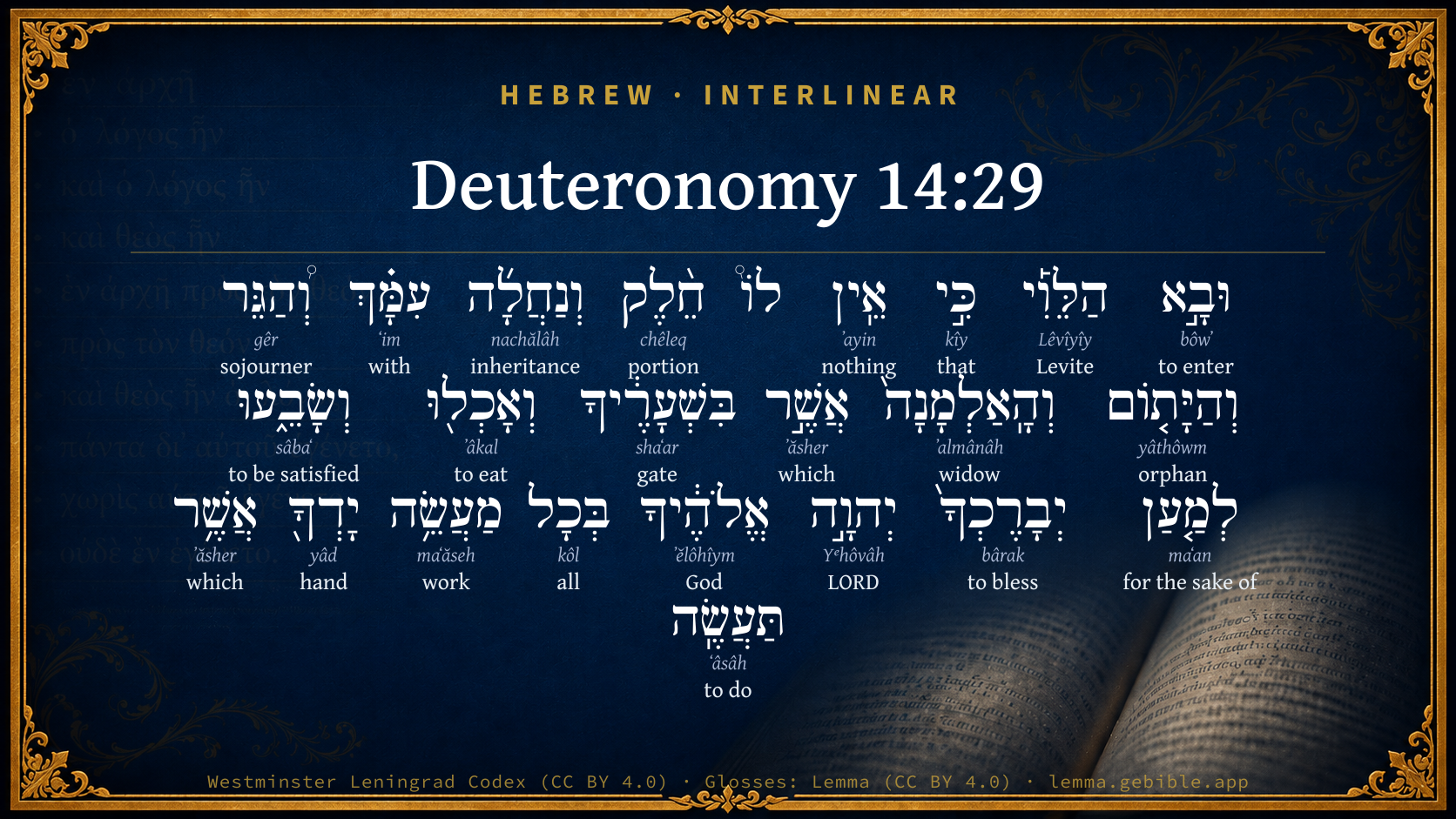
Deuteronomy 14:29

Hebrew (Westminster Leningrad Codex) Deuteronomy 14:29 appears in the Hebrew Old Testament. The text above is from the Westminster Leningrad Codex. Each word links to its Strong’s number, a concise gloss, and parsing drawn from the Open Scriptures Hebrew Bible morphology. Click any word for its full Brown-Driver-Briggs (BDB) entry.
Download image
Cite this verse

Deuteronomy 14:29 (World English Bible). Public Domain. Lemma interlinear Bible study tool, https://lemma.gebible.app/v/deuteronomy/14/29.

Show BibTeX & RIS
BibTeX
RIS
English Translation
and the Levite, because he has no portion nor inheritance with you, and the foreigner living among you, and the fatherless, and the widow, who are within your gates, shall come, and shall eat and be satisfied; that Yahweh your God may bless you in all the work of your hand which you do.
World English Bible · Public Domain
Download a study sheet

One document with this verse’s original text, its word-by-word gloss line, the meaning frame, cross-references with their text, attributed commentary, and full source and license credits — printable, and it pastes into notes with its structure intact.

This verse Autodidact and up

Study sheet (.html) Plain text (.txt)

A passage Seminary Student

Up to 50 verses in one chapter. A passage sheet keeps up to 6 commentary sources and 12 cross-references per verse, in the order this page ranks them, and says so on the sheet whenever that leaves anything out. Ask for a single verse and you get the Autodidact verse sheet above.

Everything on this page stays free to read, with no account — the sheet is a download of what is already on screen, not access to it.

Want to remove ads? Support Godless Engineer
Compare translations 3

The same verse in 3 English versions, stacked beneath the original-language interlinear above. Click any original word for its lexicon entry.

Each is an independent rendering of the whole verse — the interlinear is not word-aligned to these translations.

Highlighted words mark where these versions differ — a whole-verse word diff, not a word-by-word alignment.

  • World English Bible Public Domain
    and the Levite, because he has no portion nor inheritance with you, and the foreigner living among you, and the fatherless, and the widow, who are within your gates, shall come, and shall eat and be satisfied; that Yahweh your God may bless you in all the work of your hand which you do.
  • King James Version Public Domain
    And the Levite, (because he hath no part nor inheritance with thee,) and the stranger, and the fatherless, and the widow, which are within thy gates, shall come, and shall eat and be satisfied; that the LORD thy God may bless thee in all the work of thine hand which thou doest.
  • unfoldingWord Literal Text CC BY-SA 4.0
    and the Levite, because he has no portion nor inheritance with you, and the foreigner and the fatherless and the widow who within your gates, will come and eat and be satisfied so that Yahweh your God may bless you in all the work of your hand that you do.

unfoldingWord Literal Text — © unfoldingWord, licensed CC BY-SA 4.0. Word-aligned USFM3 via Door43 (git.door43.org/unfoldingWord/en_ult).

Versions to compare (up to 4)

3 of 4 selected

Show all 18 translations

Every available English version of this verse, each an independent rendering of the whole verse.

  • World English Bible Public Domain
    and the Levite, because he has no portion nor inheritance with you, and the foreigner living among you, and the fatherless, and the widow, who are within your gates, shall come, and shall eat and be satisfied; that Yahweh your God may bless you in all the work of your hand which you do.
  • Berean Standard Bible Public Domain
    Then the Levite (because he has no portion or inheritance among you), the foreigner, the fatherless, and the widow within your gates may come and eat and be satisfied. And the LORD your God will bless you in all the work of your hands.
  • Majority Standard Bible Public Domain
    Then the Levite (because he has no portion or inheritance among you), the foreigner, the fatherless, and the widow within your gates may come and eat and be satisfied. And the LORD your God will bless you in all the work of your hands.
  • King James Version Public Domain
    And the Levite, (because he hath no part nor inheritance with thee,) and the stranger, and the fatherless, and the widow, which are within thy gates, shall come, and shall eat and be satisfied; that the LORD thy God may bless thee in all the work of thine hand which thou doest.
  • American Standard Version (1901) Public Domain
    and the Levite, because he hath no portion nor inheritance with thee, and the sojourner, and the fatherless, and the widow, that are within thy gates, shall come, and shall eat and be satisfied; that Jehovah thy God may bless thee in all the work of thy hand which thou doest.
  • Revised Version (1885) Public Domain
    and the Levite, because he hath no portion nor inheritance with thee, and the stranger, and the fatherless, and the widow, which are within thy gates, shall come, and shall eat and be satisfied; that the LORD thy God may bless thee in all the work of thine hand which thou doest.
  • Geneva Bible (1599) Public Domain
    Then ye Leuite shall come, because he hath no part nor inheritance with thee, and the stranger, and the fatherlesse, and the widowe, which are within thy gates, and shall eate, and be filled, that the Lord thy God may blesse thee in al the worke of thine hand which thou doest.
  • Douay-Rheims (1899) Public Domain
    And the Levite that hath no other part nor possession with thee, and the stranger and the fatherless and the widow, that are within thy gates, shall come and shall eat and be filled: that the Lord thy God may bless thee in all the works of thy hands that thou shalt do.
  • Young's Literal Translation Public Domain
    and come in hath the Levite (for he hath no part and inheritance with thee), and the sojourner, and the fatherless, and the widow, who `are' within thy gates, and they have eaten, and been satisfied, so that Jehovah thy God doth bless thee in all the work of thy hand which thou dost.
  • Literal Standard Version CC BY-SA 4.0
    and the Levite has come in—for he has no part and inheritance with you—and the sojourner, and the fatherless, and the widow, who [are] within your gates, and they have eaten, and been satisfied, so that your God YHWH blesses you in all the work of your hand which you do.”
  • Unlocked Literal Bible CC BY-SA 4.0
    and the Levite, because he has no portion nor inheritance with you, and the foreigner, and the fatherless, and the widow who are within your gates, will come and eat and be satisfied. Do this so that Yahweh your God may bless you in all the work of your hand that you do.
  • unfoldingWord Literal Text CC BY-SA 4.0
    and the Levite, because he has no portion nor inheritance with you, and the foreigner and the fatherless and the widow who within your gates, will come and eat and be satisfied so that Yahweh your God may bless you in all the work of your hand that you do.
  • Darby Bible Public Domain
    and the Levite -- for he hath no portion nor inheritance with thee -- and the stranger, and the fatherless, and the widow, that are within thy gates, shall come, and shall eat and be satisfied; that Jehovah thy God may bless thee in all the work of thy hand which thou doest.
  • World Messianic Bible Public Domain
    The Levite, because he has no portion nor inheritance with you, as well as the foreigner living among you, the fatherless, and the widow who are within your gates shall come, and shall eat and be satisfied; that the LORD your God may bless you in all the work of your hand which you do.
  • Webster's Bible Public Domain
    And the Levite, (because he hath no part nor inheritance with thee) and the stranger, and the fatherless, and the widow, who are within thy gates, shall come, and shall eat and be satisfied; that the LORD thy God may bless thee in all the work of thy hand which thou doest.
  • Free Bible Version CC BY-SA 4.0
    This way the Levites (who don't have any share in the allotment of land), the foreigners, the orphans, and the widows in your town will be provided with what they need. The Lord your God will bless you in everything you do.
  • Bible in Basic English Public Domain
    And the Levite, because he has no part or heritage in the land, and the man from a strange country, and the child who has no father, and the widow, who are living among you, will come and take food and have enough; and so the blessing of the Lord your God will be on you in everything you do.
  • JPS Tanakh (1917) Public Domain
    And the Levite, because he hath no portion nor inheritance with thee, and the stranger, and the fatherless, and the widow, that are within thy gates, shall come, and shall eat and be satisfied; that the LORD thy God may bless thee in all the work of thy hand which thou doest.

Literal Standard Version (2020), Covenant Press — licensed CC BY-SA 4.0. Text via the HelloAO Bible API (eBible.org). Unlocked Literal Bible (unfoldingWord) — licensed CC BY-SA 4.0. Text via the HelloAO Bible API (eBible.org). unfoldingWord Literal Text — © unfoldingWord, licensed CC BY-SA 4.0. Word-aligned USFM3 via Door43 (git.door43.org/unfoldingWord/en_ult). Free Bible Version, Dr. Jonathan Gallagher — licensed CC BY-SA 4.0. Text via the HelloAO Bible API (eBible.org).

Word by word

More ways to search: Search by grammar → Find every occurrence → Compare this word →

Practice this passage: Drill this verse → Learn its vocabulary →

וְהַיָּת֤וֹם
yâthôwm
H3490
“and · the · orphan”
Conjunction + Particle, Definite Article + Noun, Common, Masculine, Singular, Absolute
Part of Speech
Conjunction + Particle + Noun
Type
Common
Gender
Masculine
Number
Singular
State
Absolute
Full BDB Definition

Origin: from an unused root meaning to be lonely

TWOT: 934a

an orphan, fatherless
  1. וּבָ֣א bôwʼ H935 “and · to enter” Conjunction + Verb, Qal, Sequential Perfect, 3rd Person, Masculine, Singular
  2. הַלֵּוִ֡י Lêvîyîy H3881 “the · Levite” Particle, Definite Article + Noun, Gentilic, Masculine, Singular, Absolute
  3. כִּ֣י kîy H3588 “that” Conjunction
  4. אֵֽין ʼayin H369 “nothing” Particle, Negative
  5. חֵ֨לֶק chêleq H2506 “portion” Noun, Common, Masculine, Singular, Absolute
  6. וְנַחֲלָ֜ה nachălâh H5159 “and · inheritance” Conjunction + Noun, Common, Feminine, Singular, Absolute
  7. עִמָּ֗ךְ ʻim H5973 “with · you” Preposition + Suffix, Personal, 2nd Person, Feminine, Singular
  8. וְ֠הַגֵּר gêr H1616 “and · the · sojourner” Conjunction + Particle, Definite Article + Noun, Common, Masculine, Singular, Absolute
  9. וְהָֽאַלְמָנָה֙ ʼalmânâh H490 “and · the · widow” Conjunction + Particle, Definite Article + Noun, Common, Feminine, Singular, Absolute
  10. אֲשֶׁ֣ר ʼăsher H834 “which” Particle, Relative
  11. בִּשְׁעָרֶ֔יךָ shaʻar H8179 “in/at · gates · your” Preposition + Noun, Common, Masculine, Plural, Construct + Suffix, Personal, 2nd Person, Masculine, Singular
  12. וְאָכְל֖וּ ʼâkal H398 “and · to eat” Conjunction + Verb, Qal, Sequential Perfect, 3rd Person, Common, Plural
  13. וְשָׂבֵ֑עוּ sâbaʻ H7646 “and · to be satisfied” Conjunction + Verb, Qal, Sequential Perfect, 3rd Person, Common, Plural
  14. לְמַ֤עַן maʻan H4616 “for the sake of” Preposition
  15. יְבָרֶכְךָ֙ bârak H1288 “to bless · you” Verb, Piel, Imperfect, 3rd Person, Masculine, Singular + Suffix, Personal, 2nd Person, Masculine, Singular
  16. יְהוָ֣ה Yᵉhôvâh H3068 “LORD” Noun, Proper
  17. אֱלֹהֶ֔יךָ ʼĕlôhîym H430 “God(s) · your” Noun, Common, Masculine, Plural, Construct + Suffix, Personal, 2nd Person, Masculine, Singular
  18. בְּכָל kôl H3605 “in/at · all of” Preposition + Noun, Common, Masculine, Singular, Construct
  19. מַעֲשֵׂ֥ה maʻăseh H4639 “work of” Noun, Common, Masculine, Singular, Construct
  20. יָדְךָ֖ yâd H3027 “hand · your” Noun, Common, Both, Singular, Construct + Suffix, Personal, 2nd Person, Masculine, Singular
  21. אֲשֶׁ֥ר ʼăsher H834 “which” Particle, Relative
  22. תַּעֲשֶֽׂה ʻâsâh H6213 “to do” Verb, Qal, Imperfect, 2nd Person, Masculine, Singular

About this verse

These counts appear in no published source. They are computed here, from the morphology-tagged text and Lemma’s own curated glosses. What Lemma adds →

24
words
22
distinct lemmas
Pentateuch
section

Shared distinctive vocabulary

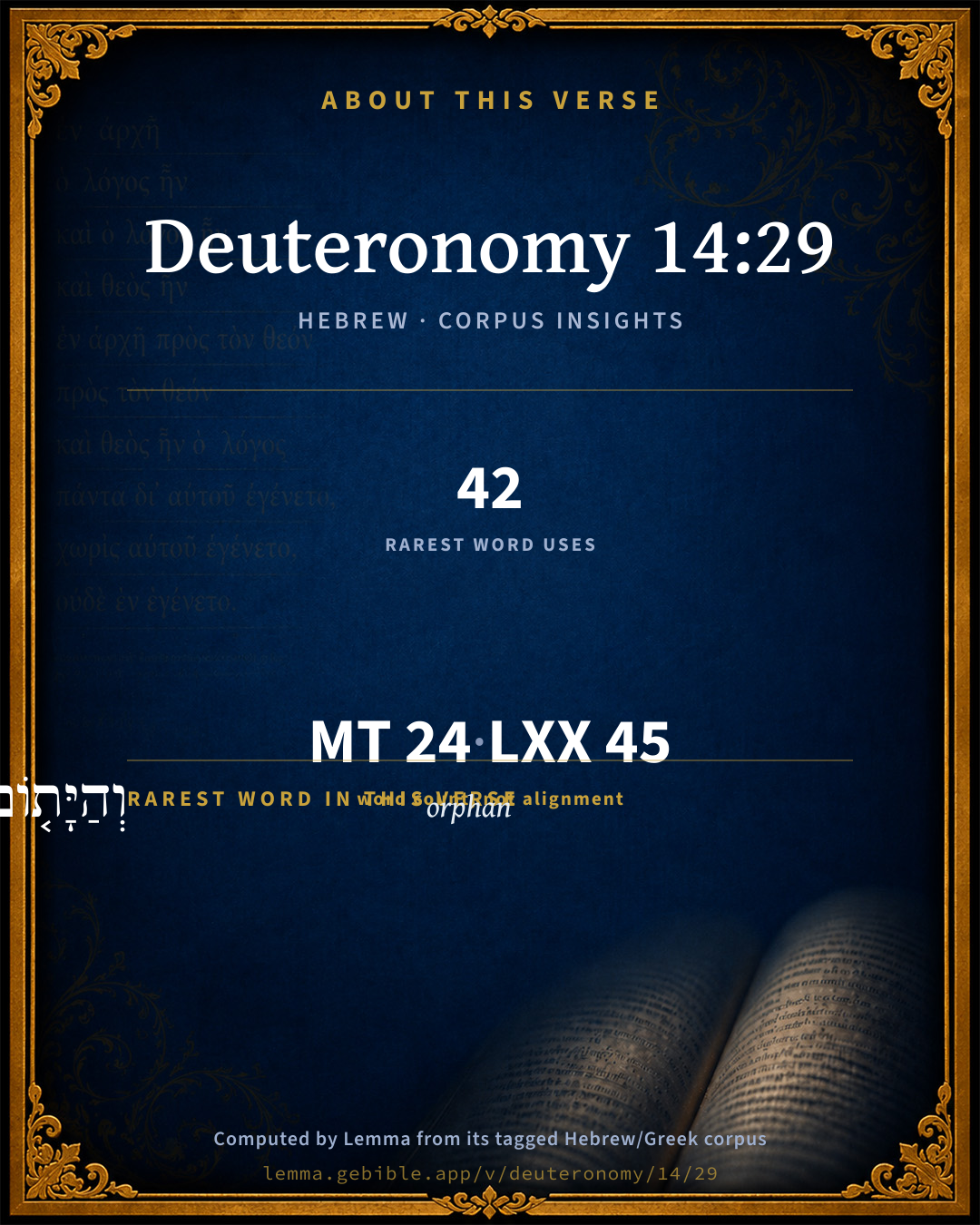
וְהַיָּת֤וֹם orphan H3490 occurs in 42 verses of the Hebrew Bible. Also found in:

Grammatical profile

  • 5 verbs
  • 12 nouns
  • 3 prepositions
  • 1 conjunction
  • 3 particles

Verb forms

  • וּבָ֣א Qal · Sequential Perfect
  • וְאָכְל֖וּ Qal · Sequential Perfect
  • וְשָׂבֵ֑עוּ Qal · Sequential Perfect
  • יְבָרֶכְךָ֙ Piel · Imperfect
  • תַּעֲשֶֽׂה Qal · Imperfect

Repetition

A word recurs within this verse — often emphatic in Hebrew:

  • אֲשֶׁ֣ר which H834 ×2

Hebrew & Septuagint length

In English translation the verse runs 54 words from the Hebrew and 51 from the Septuagint (LXX English) — closely comparable.

A rough comparison of the two English renderings, which tokenize alike — not a word-level alignment.

Word counts can differ between the Hebrew and the Greek without any difference in meaning — e.g. the Hebrew direct-object marker אֵת has no separate Greek word, and Greek often adds the article ὁ.

In the original languages it is 24 Hebrew tokens and 45 Greek tokens — but the two are counted differently (Hebrew bundles its prefixes and suffixes into one token; the Greek is in lemma form), so that isn’t a like-for-like length.

Cross-references

22

Topical passages linked to Deuteronomy 14:29 in the Treasury of Scripture Knowledge — connected by theme and wording, ordered by reader-vote popularity; previews shown in the World English Bible.

  • Deuteronomy 15:10 You shall surely give him, and your heart shall not be grieved when you give to him; because that for this thing Yahweh your God will bless you in all your work, and in all that you put your hand to.
  • Deuteronomy 14:27 The Levite who is within your gates, you shall not forsake him; for he has no portion nor inheritance with you.
  • Proverbs 19:17 He who has pity on the poor lends to Yahweh; He will reward him.
  • Deuteronomy 16:11 and you shall rejoice before Yahweh your God, you, and your son, and your daughter, and your man-servant, and your maid-servant, and the Levite who is within your gates, and the foreigner, and the fatherless, and the widow, who are in the midst of you, in the place which Yahweh your God shall choose, to cause his name to dwell there.
  • Deuteronomy 24:19–21 When you reap your harvest in your field, and have forgot a sheaf in the field, you shall not go again to get it: it shall be for the foreigner, for the fatherless, and for the widow; that Yahweh your God may bless you in all the work of your hands.
  • Malachi 3:10–11 Bring the whole tithe into the store-house, that there may be food in my house, and test me now in this," says Yahweh of hosts, "if I will not open you the windows of heaven, and pour you out a blessing, that there shall not be room enough for.
  • Exodus 22:21–24 "You shall not wrong an alien, neither shall you oppress him, for you were aliens in the land of Egypt.
  • Leviticus 19:34 The stranger who lives as a foreigner with you shall be to you as the native-born among you, and you shall love him as yourself; for you lived as foreigners in the land of Egypt. I am Yahweh your God.
  • Deuteronomy 12:12 You shall rejoice before Yahweh your God, you, and your sons, and your daughters, and your men-servants, and your maid-servants, and the Levite who is within your gates, because he has no portion nor inheritance with you.
  • Deuteronomy 16:14 and you shall rejoice in your feast, you, and your son, and your daughter, and your man-servant, and your maid-servant, and the Levite, and the foreigner, and the fatherless, and the widow, who are within your gates.
  • Deuteronomy 26:12–13 When you have made an end of tithing all the tithe of your increase in the third year, which is the year of tithing, then you shall give it to the Levite, to the foreigner, to the fatherless, and to the widow, that they may eat within your gates, and be filled.
  • Job 31:16–22 "If I have withheld the poor from their desire, Or have caused the eyes of the widow to fail,
  • Psalms 41:1 Blessed is he who considers the poor: Yahweh will deliver him in the day of evil.
  • Proverbs 3:9–10 Honor Yahweh with your substance, With the first fruits of all your increase:
  • Proverbs 11:24 There is one who scatters, and increases yet more. There is one who withholds more than is appropriate, but gains poverty.
  • Isaiah 58:7–12 Isn't it to deal your bread to the hungry, and that you bring the poor who are cast out to your house? when you see the naked, that you cover him; and that you not hide yourself from your own flesh?
  • 2 Corinthians 9:6–11 Remember this: he who sows sparingly will also reap sparingly. He who sows bountifully will also reap bountifully.
  • Luke 6:35 But love your enemies, and do good, and lend, expecting nothing back; and your reward will be great, and you will be children of the Most High; for he is kind toward the unthankful and evil.
  • Luke 11:41 But give for gifts to the needy those things which are within, and behold, all things will be clean to you.
  • Luke 14:12–14 He also said to the one who had invited him, "When you make a dinner or a supper, don't call your friends, nor your brothers, nor your kinsmen, nor rich neighbors, or perhaps they might also return the favor, and pay you back.
  • Hebrews 13:2 Don't forget to show hospitality to strangers, for in doing so, some have entertained angels without knowing it.
  • James 1:27 Pure religion and undefiled before our God and Father is this: to visit the fatherless and widows in their affliction, and to keep oneself unstained by the world.

Cross-references courtesy of OpenBible.info (CC BY 4.0).

Hebrew and Greek witnesses Masoretic Hebrew ↔ Greek Septuagint

The same verse in the two great witnesses to the Old Testament, shown verse-for-verse.

These are two independent witnesses, not word-aligned to each other, and the Septuagint is shown in lemma (dictionary) form.

Hebrew Deuteronomy 14:29 Masoretic · Westminster Leningrad Codex

וּבָ֣א הַלֵּוִ֡י כִּ֣י אֵֽין לוֹ֩ חֵ֨לֶק וְנַחֲלָ֜ה עִמָּ֗ךְ וְ֠הַגֵּר וְהַיָּת֤וֹם וְהָֽאַלְמָנָה֙ אֲשֶׁ֣ר בִּשְׁעָרֶ֔יךָ וְאָכְל֖וּ וְשָׂבֵ֑עוּ לְמַ֤עַן יְבָרֶכְךָ֙ יְהוָ֣ה אֱלֹהֶ֔יךָ בְּכָל מַעֲשֵׂ֥ה יָדְךָ֖ אֲשֶׁ֥ר תַּעֲשֶֽׂה

and the Levite, because he has no portion nor inheritance with you, and the foreigner living among you, and the fatherless, and the widow, who are within your gates, shall come, and shall eat and be satisfied; that Yahweh your God may bless you in all the work of your hand which you do.

World English Bible · Public Domain

Greek LXX Deuteronomy 14:29 Septuagint · lemma form

καί ἔρχομαι ὁ λευείτης ὅτι οὐ εἰμί αὐτός μερίς οὐδέ κλῆρος μετά σύ καί ὁ προσήλυτος καί ὁ ὀρφανός καί ὁ χήρα ὁ ἐν ὁ πόλις σύ καί ἐσθίω καί ἐνπίμπλημι ἵνα εὐλογέω σύ κύριος ὁ θεός σύ ἐν πᾶς ὁ ἔργον ὅς ἐάν ποιέω

And the Levite shall come, because he has no part or lot with you, and the stranger, and the orphan, and the widow which is in your cities; and they shall eat and be filled, that the Lord your God may bless you in all the works which you shall do.

LXX2012 (modern English Septuagint) · Public Domain

On this verse, The Cambridge Bible for Schools and Colleges discusses the Septuagint’s reading. Read the note in Commentary ↓

Hebrew: Westminster Leningrad Codex (CC BY 4.0). Greek: Septuagint (public domain); English from LXX2012 (modern English Septuagint) (Public Domain). How the Septuagint differs from the Hebrew →

Targum (Aramaic paraphrase)

2

The Targum is the ancient Jewish Aramaic paraphrase of the Hebrew Scriptures — an interpretive translation, not the Hebrew text itself. Onkelos (literal) and Pseudo-Jonathan (expansive) render the Torah, and Jonathan the Prophets. Coverage is partial: where no permissively-licensed English translation exists for a verse, only the Aramaic is shown. This is verse-level text, not a word-by-word alignment to the Hebrew.

  1. Targum Onkelos Torah (Genesis–Deuteronomy)
    וְיֵיתֵי לֵוָאָה אֲרֵי לֵית לֵהּ חֳלָק וְאַחֲסָנָא עִמָךְ וְגִיוֹרָא וְיִתַּמָא וְאַרְמְלָא דִי בְקִרְוָיךְ וְיֵיכְלוּן וְיִשְׂבְּעוּן בְּדִיל דִי יְבָרֵכִנָךְ יְיָ אֱלָהָךְ בְּכָל עוֹבָדֵי יְדָךְ דִי תַעְבֵּד

    (no public-domain English translation for this verse)

    Targum Onkelos — Aramaic: “Onkelos Genesis” (public domain); “Onkelos Exodus” (public domain); “Onkelos Leviticus” (public domain); “Onkelos Numbers” (public domain); “Onkelos Deuteronomy” (public domain). English: “Sefaria Community Translation” (CC0 1.0 (public-domain dedication)); “J.W. Etheridge. The Targums of Onkelos and Jonathan Ben Uzziel on the Pentateuch. London: Longmans, Green, 1862” (public domain). Text via Sefaria.

  2. Targum Pseudo-Jonathan Torah (Genesis–Deuteronomy)
    וְיֵיתֵי לֵיוָאָה אֲרוּם לֵית לֵיהּ חוּלַק וְאַחֲסָנָא עִמְכוֹן וְגִיּוֹרָא וְיַתְמָא וְאַרְמַלְתָּא דִבְקִירְוֵיכוֹן וְיֵיכְלוּן וְיִסְבְּעוּן מִן בִּגְלַל דִּיבָרְכֵיכוֹן יְיָ אֱלָהָכוֹן בְּכָל עוֹבָדֵי יְדֵיכוֹן דְּתַעַבְדוּן

    And the Levite, because he hath no part or heritage with you, and the stranger, the orphan, and the widow who are in your cities, shall come and eat and be satisfied; that the Lord your God may bless you in all the works of your hands that you do.

    Targum Pseudo-Jonathan — Aramaic: “Targum Jonathan on Genesis” (public domain); “Targum Jonathan on Exodus” (public domain); “Targum Jonathan on Leviticus” (public domain); “Targum Jonathan on Numbers” (public domain); “Targum Jonathan on Deuteronomy” (public domain). English: “The Targum of Jonathan ben Uzziel, trans. J. W. Etheridge, London, 1862” (public domain). Text via Sefaria.

Commentary

Notes on Deuteronomy 14:29 from classic Christian and Jewish commentators (each source and its license shown beneath its notes). The classic Christian expositions comment on the surrounding passage and are grouped to its opening verse, so a note may address several verses; the Jewish commentaries on the Tanakh (Rashi and others) are per-verse, so they appear only where the commentator wrote on this verse.

Lemma curates 59 commentaries, every one of them public domain or Creative Commons licensed, each selected and text-cleaned for this edition rather than reprinted as found. About our sources →

Trapp's Complete Commentary

John Trapp

Deu 14:29 And the Levite, (because he hath no part nor inheritance with thee,) and the stranger, and the fatherless, and the widow, which [are] within thy gates, shall come, and shall eat and be satisfied; that the LORD thy God may bless thee in all the work of thine hand which thou doest.

Ver. 29. That the Lord thy God, &c.] Not getting, but giving, is the way to thrive in the world.

John Trapp, A Commentary or Exposition upon All the Books of the Old and New Testament (1647–1656) — public domain. Text from a community e-Sword module.

Joseph Benson's Commentary

Deu 14:29. The stranger, the fatherless, and the widow — For this tithe was not to be spent merely in feasting themselves, but for the relief of such as were in want, who otherwise might have been compelled to beg, or to serve strangers, and thereby be in danger of being perverted from their religion.

Joseph Benson's Commentary on the Old and New Testaments (1811–1818) — public domain. Text from a community e-Sword module.

Adam Clarke's Commentary

Verse 29. And the Levite (because he hath no part nor inheritance] And hence much of his support depended on the mere freewill-offerings of the people. God chose to make his ministers thus dependent on the people, that they might be induced (among other motives) to labour for their spiritual profiting, that the people, thus blessed under their ministry, might feel it their duty and privilege to support and render them comfortable.

Adam Clarke's Commentary on the Bible (1810–1826) — public domain. Text from a community e-Sword/MySword module.

Ellicott's Commentary for English Readers

(29) And the Levite.—Rashi says, “the Levite shall come and take the first tithe (described in Numbers 18), and the stranger and the fatherless and the widow the second tithe.” But there is no proof whatever that anything except the second tithe is alluded to in the whole of this passage. The Levite always shared with the poor (see Deu_16:11; Deu_16:14). Rashi’s opinion is worth notice chiefly for the following reason. Some modern critics insist that the Law of Deuteronomy is contradictory to that of Numbers in respect of tithe; but if the Jews, who kept the whole Law strictly, not only saw no discrepancy between its several precepts, but actually took the precept in Deuteronomy to imply the precept in Numbers, why should we go out of our way to make difficulties now? If the precepts were harmonious and compatible, why should they be the work of different men? It is hardly likely that a whole nation would consent to pay double tithes, and acknowledge the obligation to do so by perpetual enactment, if the laws that commanded the tithe were contradictory. And the more closely we look at the subject, the more clearly will the distinction between the first and second tithes appear. The first was only an ordinary rate for the support of the Levitical ministry. No sacredness attached to it. The second was a tithe taken for Jehovah, “that thou mayest learn to fear Jehovah thy God always” (Deu_14:23). The tithe was either to be a joyful feast for the family, or a special gift to God’s poor. It furnished a table spread by the God of Israel for the entertainment of His guests. Why this should be confused with the ordinary rate for the maintenance of the Levitical ministry, it is not easy to understand.

A Bible Commentary for English Readers, edited by Charles John Ellicott (1878–1897) — public domain. Text from a community e-Sword module.

The Cambridge Bible for Schools and Colleges

gen. ed. J. J. S. Perowne

29. the Levite] because he is landless and through the abolition of the local shrines has been deprived of his means of subsistence, and of—

the stranger, the fatherless, and the widow] for they also are landless. D frequently emphasises the duty of caring for them, Deu_16:11; Deu_16:14, Deu_24:17; Deu_24:19 ff., Deu_26:12 f.

shall eat and be satisfied] Here the words before Jehovah and rejoice, used in connection with the eating of tithes at the Sanctuary, are omitted; for this is not like that, a festal celebration. On the contrary the third year tithe is designed for the common daily sustenance of those poor persons. This secularisation of the tithe (as it would be called to-day) is interesting; see Additional Note.

that the Lord thy God may bless thee] Deu_26:15. Such devotion of the tithe to the poor is a condition of the increase of the crop from which it is made.

Additional Note on Tithes

According to 1Sa_8:15; 1Sa_8:17, a king if granted to Israel would be expected—in conformity with the practice of several ancient monarchies—to exact a tithe of his subjects’ cereal crops, vines, olives, herds and flocks. No religious offering under the name of tithe appears in the earlier legislation, the Holiness Code (Leviticus 17-26), or Ezekiel. Yet all these require an offering of the firstfruits of the soil:—E, Exo_22:29 (28), thou shalt not delay thy fulness nor thy trickling (see Driver’s note), LXX firstfruits of thy threshing-floor and wine-press, like D’s law of tithes associated with firstlings, Exo_22:30 (29); H, Lev_23:11 demands merely a sheaf of the firstfruits (reshîth) of harvest; Eze_20:40, I will require your contributions (terumôth) and the firstfruits (reshîth) of your oblations. In the 8th century tithes were offered on the 3rd day of the feast at the royal sanctuary at Bethel (Amo_4:4 : see Wellh.’s note); and E, Gen_28:22 ascribes to Jacob at the same sanctuary the promise to God to tithe all He would give him.

From these data several inferences have been drawn:—(1) that the tithes of D and the later legislation (see below) were the same as the first-fruits (reshîth and bikkurim) of the earlier (Nowack, Hebr. Arch. ii. 257 ff.), cp. the synonymousness of ἀπαρχαί and δεκάται, Dion Halic. i. 23 f. and Philo’s ἀπαρχῆς ἀπαρχή for the priests’ tithe of the Levites’ tithe in P (De Mut. Nom. 1607, Mangey); (2) that the same offering was called firstfruits at some sanctuaries, tithes at others (Now., G. F. Moore, E.B. art. ‘Tithes’ § 1); (3) that tithes is the later name (W. R. Smith, Rel. Sem. 226 ff.); (4) that the use of this name at Bethel, a royal sanctuary, was due to the appropriation of the king’s tithe to the support of the shrine, the result of Phoenician influence in N. Israel, for the earliest reference to a religious tithe is Phoenician (ibid.); (5) that these tithes were the material of a feast for not only the offerers but all the worshippers, including the poor, whose rights to them were sometimes cruelly absorbed by the rich (ibid.). What is sure is that from the time of their settlement Israel shared the belief of many primitive peoples (Frazer, Golden Bough2, ii. 459) that they might not enjoy their harvests till they offered the Deity some of the firstfruits. This was done at the local sanctuaries and became the occasion of a joyful feast, in which the officiating priest, the poor and all who had gêr, or guest, rights at the sanctuary would share. At some places these offerings were called tithes, either because it was found to be necessary to fix their proportion to the whole harvest, or because the royal tithe was actually appropriated to the support of the sanctuary and the solemn entertainment of the worshipping guests.

The tithe-laws of D imply that some such custom prevailed at the rural sanctuaries; but like many others it had to be adapted to D’s law of One Sanctuary. This was done by dividing the tithe between religious and charitable uses. Two years out of three the Israelite farmer must take the tithe, either in kind or in money, to the one sanctuary and (that he might learn to fear God) eat it there before God, with his household and the Levite, who by the abolition of his shrine had lost his opportunity of eating before God. But this deprived both the latter and the other landless poor of their rights in what had included benefactions for them all. Therefore every third year (see on 28 f.) all the tithe was to be stored and reserved for their sustenance, without any religious rites, either in the offering of it (except the prayer Deu_26:12 ff.), or in their enjoyment of it (note the omission in 28 f. of eating before Jehovah). Some think indeed that this third year tithe is the oldest element in D’s law and in fact had been the only real tithe (cp. the expression the year of tithing; Deu_26:12). But all that is older in it is the right of the Levite and the poor and the gçrîm to a share of the annual tithes offered at the local sanctuaries. When these were disestablished and the purely religious interests involved in the tithe could only be satisfied at the One Sanctuary, D compensated the rural Levites and the poor by granting them the whole of the third year’s tithe.

In P the tithe-law, Num_18:21-32, is very different. All the tithe in Israel, the tithe of the children of Israel which they offer as a contribution to Jehovah is given as an inheritance to the landless Levites, for the service which they serve, even the service of the tent of the meeting, the central sanctuary, and they in turn are to give a tithe of this tithe to Aaron the priest. And this was that part of the law of God given by Moses and sworn to by the people under Nehemiah, according to which they were to bring in the tithes of their ground to the Levites—the Levites take the tithes in all the townships of our tillage—and the Levites were to bring the tithe of their tithe to the house of God (Neh_10:37 f.). These injunctions are irreconcileable with those of D. The tithe, which in D is enjoyed by the offerers, by the Levites of the rural sanctuaries, and by the poor and the gçrîm, is in P the inheritance of the Levites at the central sanctuary. D and P represent not, only differing practices, but incompatible principles of practice. Which is the earlier of the two? It is of course possible to argue that the original disposition of the tithe was purely religious or ecclesiastical and that D represents a later and more liberal spirit, which extended the enjoyment of it to the laity. But the converse is far more probable in view of that steady increase of all the priests’ establishments and revenues—with the consequent encroachments on the rights of the people—which is so fully illustrated in the historical Books. For an interesting and suggestive discussion of the problems arising from this subject see ‘The Deuteronomic Tithe’ by Prof. J. M. Powis Smith in The Amer. Journ. of Theology, January, 1914.

The Cambridge Bible for Schools and Colleges (gen. ed. J. J. S. Perowne; Cambridge University Press, 1878–1918) — public domain. Text from a community e-Sword module.

Haydock's Catholic Bible Commentary

Filled. Of this feast the owner did not partake, (St. Augustine, q. 20,) as he did of the former, ver. 26. (Menochius) --- Josephus ([Antiquities?] iv. 8,) acknowledges three sorts of tithes: but Calmet thinks that only two were paid every third year, and that the same tithe is mentioned, ver. 22, and 28., and Tobias i. 7. The only difference is, that on the third and sixth years, the products were consumed on the spot, and in other years they were spent at Jerusalem. See Leviticus xxvii. Many, however, believe that three tithes were then exacted: 1. For the Levites. 2. For a feast at Jerusalem, and to defray the expenses on the road. 3. For the poor at home. (Du Hamel; &c.) (Haydock)

George Leo Haydock (1774–1849), Haydock's Catholic Family Bible and Commentary, 1859 edition — public domain. Excludes Psalms (Douay-Rheims chapter numbering differs from Protestant) and Deuterocanonical books (Catholic canon only).

Rashi

Rabbi Shlomo Yitzchaki (Rashi)

ובא הלוי AND THE LEVITE SHALL COME and take the “First Tithe” which you have failed to give him,

והגר והיתום AND THE STRANGER AND THE FATHERLESS [SHALL COME] and take the “Second Tithe”, which belongs to the poor in that year, and you shall not eat it yourself in Jerusalem, as you were bound to eat the “Second Tithe” of the first two years,

ואכלו ושבעו AND THEY SHALL EAT AND BE SATISFIED — Give them sufficient to satisfy them. From here they (the Rabbis) derived the law: one must give the poor in the barn no less than half a kab of wheat or a kab of barley (Sifrei Devarim 110:3). As for you, go up to Jerusalem with the tithe (i.e. מעשר שני) of the first and the second years which thou hast delayed, and make the confession there: “I have removed the hallowed things from the house” — as it is stated in the section beginning with the words כי תכלה לעשר (Deuteronomy 26:12).

Rashi on the Tanakh — English translations: “The Judaica Press complete Tanach with Rashi, translated by A. J. Rosenberg” (CC BY 4.0); “Pentateuch with Rashi's commentary by M. Rosenbaum and A.M. Silbermann, 1929-1934” (public domain); “The Metsudah Tanach series, Lakewood, N.J” (CC BY 4.0); and “The Book of Joshua, Metsudah Publications, 1997” (CC BY 4.0). Text via Sefaria.

Lesson kit

Teaching starters — assembled from the data on this page, not authored interpretation. Every prompt links to the verse data it draws on. Edit before teaching.

Deuteronomy, in the Pentateuch, opens this verse with 24 words (22 distinct Hebrew lemmas). Its most distinctive word is yâthôwm (“orphan”). A historical commentator’s framing appears above. Read the whole chapter for the surrounding context.

Discussion questions

  1. The word yâthôwm carries the sense “orphan.” How does it shape the verse?
  2. How does Exodus 22:22, which shares the word «orphan», read alongside this verse?
  3. What does the repetition of “which” (2× in this one verse) do in this verse?
  4. These translations render this verse differently. What is at stake in choosing one wording over another?
  5. «וּבָ֣א» is a Qal Sequential Perfect verb. How does that grammatical form shape the action described?
  6. Compare how Trapp's Complete Commentary and Joseph Benson's Commentary read this verse. Where do they agree or differ?

Things to notice

Reading settings

Reading text

Shown beneath each verse's original-language words.

Old Testament
Old Testament edition

Read the OT as the Masoretic Hebrew (MT) or the Greek Septuagint (LXX).

English shown for the Greek Septuagint (in the Hebrew ↔ Greek comparison).

Comparing translations? Open the Compare panel on any verse page to stack up to four side by side.