Genesis 39:23

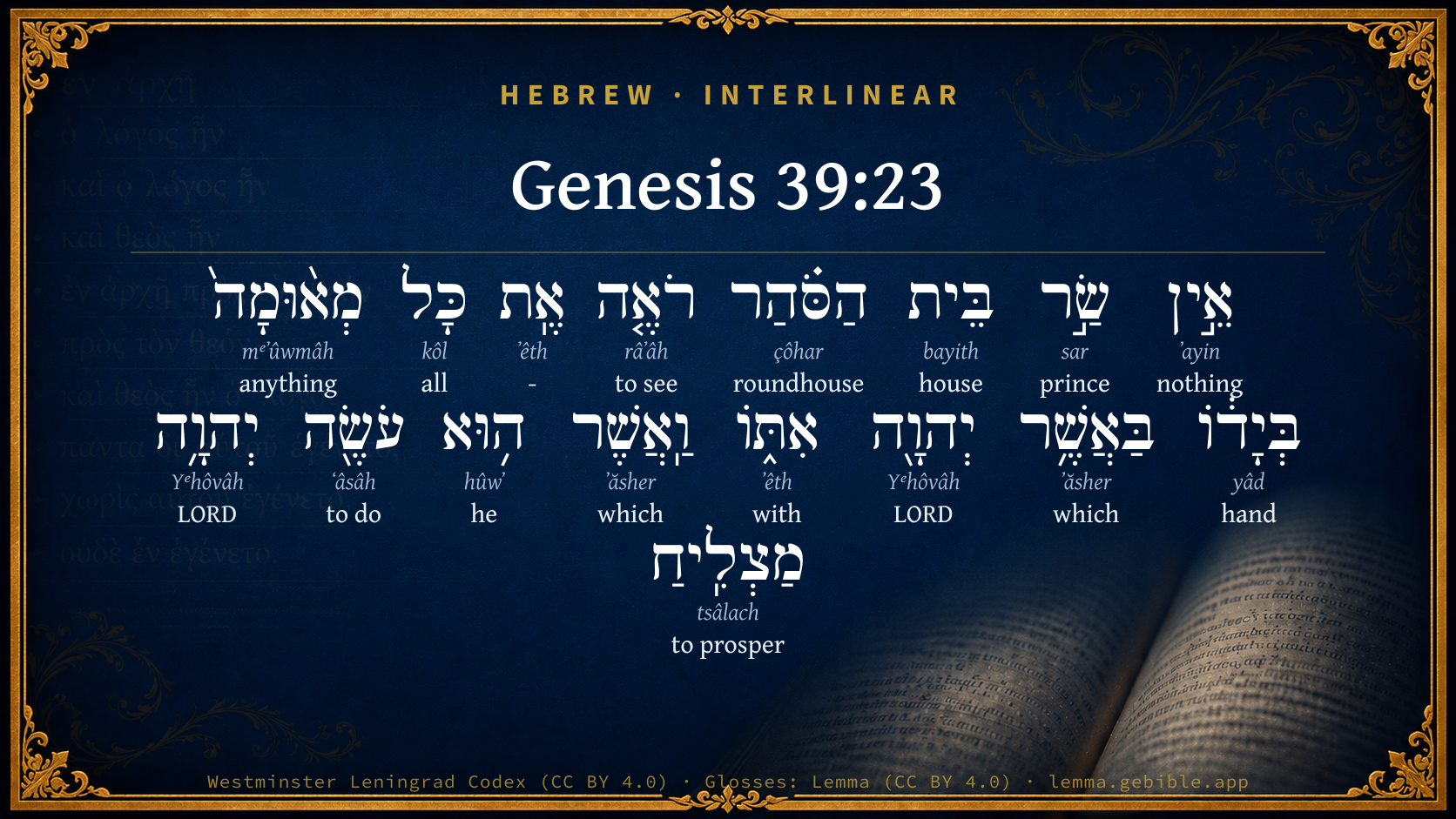
Hebrew (Westminster Leningrad Codex) Genesis 39:23 appears in the Hebrew Old Testament. The text above is from the Westminster Leningrad Codex. Each word links to its Strong’s number, a concise gloss, and parsing drawn from the Open Scriptures Hebrew Bible morphology. Click any word for its full Brown-Driver-Briggs (BDB) entry.
Download image
Cite this verse

Genesis 39:23 (World English Bible). Public Domain. Lemma interlinear Bible study tool, https://lemma.gebible.app/v/genesis/39/23.

Show BibTeX & RIS
BibTeX
RIS
English Translation
The keeper of the prison didn't look after anything that was under his hand, because Yahweh was with him; and that which he did, Yahweh made it prosper.
World English Bible · Public Domain
Download a study sheet

One document with this verse’s original text, its word-by-word gloss line, the meaning frame, cross-references with their text, attributed commentary, and full source and license credits — printable, and it pastes into notes with its structure intact.

This verse Autodidact and up

Study sheet (.html) Plain text (.txt)

A passage Seminary Student

Up to 50 verses in one chapter. A passage sheet keeps up to 6 commentary sources and 12 cross-references per verse, in the order this page ranks them, and says so on the sheet whenever that leaves anything out. Ask for a single verse and you get the Autodidact verse sheet above.

Everything on this page stays free to read, with no account — the sheet is a download of what is already on screen, not access to it.

Want to remove ads? Support Godless Engineer
Compare translations 3

The same verse in 3 English versions, stacked beneath the original-language interlinear above. Click any original word for its lexicon entry.

Each is an independent rendering of the whole verse — the interlinear is not word-aligned to these translations.

Highlighted words mark where these versions differ — a whole-verse word diff, not a word-by-word alignment.

  • World English Bible Public Domain
    The keeper of the prison didn't look after anything that was under his hand, because Yahweh was with him; and that which he did, Yahweh made it prosper.
  • King James Version Public Domain
    The keeper of the prison looked not to any thing that was under his hand; because the LORD was with him, and that which he did, the LORD made it to prosper.
  • unfoldingWord Literal Text CC BY-SA 4.0
    The chief of the round-house did not look anything in his hand, because Yahweh was with him, and Yahweh made what he was doing successful.

unfoldingWord Literal Text — © unfoldingWord, licensed CC BY-SA 4.0. Word-aligned USFM3 via Door43 (git.door43.org/unfoldingWord/en_ult).

Versions to compare (up to 4)

3 of 4 selected

Show all 18 translations

Every available English version of this verse, each an independent rendering of the whole verse.

  • World English Bible Public Domain
    The keeper of the prison didn't look after anything that was under his hand, because Yahweh was with him; and that which he did, Yahweh made it prosper.
  • Berean Standard Bible Public Domain
    The warden did not concern himself with anything under Joseph’s care, because the LORD was with Joseph and gave him success in whatever he did.
  • Majority Standard Bible Public Domain
    The warden did not concern himself with anything under Joseph’s care, because the LORD was with Joseph and gave him success in whatever he did.
  • King James Version Public Domain
    The keeper of the prison looked not to any thing that was under his hand; because the LORD was with him, and that which he did, the LORD made it to prosper.
  • American Standard Version (1901) Public Domain
    The keeper of the prison looked not to anything that was under his hand, because Jehovah was with him; and that which he did, Jehovah made it prosper.
  • Revised Version (1885) Public Domain
    The keeper of the prison looked not to any thing that was under his hand, because the LORD was with him; and that which he did, the LORD made it to prosper.
  • Geneva Bible (1599) Public Domain
    And the keeper of the prison looked vnto nothing that was vnder his hande, seeing that the Lord was with him: for whatsoeuer he did, the Lord made it to prosper.
  • Douay-Rheims (1899) Public Domain
    His master hearing these things, and giving too much credit to his wife's words, was very angry.
  • Young's Literal Translation Public Domain
    the chief of the round-house seeth not anything under his hand, because Jehovah `is' with him, and that which he is doing Jehovah is causing to prosper.
  • Literal Standard Version CC BY-SA 4.0
    the chief of the round-house does not see anything under his hand, because YHWH [is] with him, and that which he is doing YHWH is causing to prosper.
  • Unlocked Literal Bible CC BY-SA 4.0
    The prison warden did not worry about anything that was in his hand, because Yahweh was with him. Whatever he did, Yahweh prospered.
  • unfoldingWord Literal Text CC BY-SA 4.0
    The chief of the round-house did not look anything in his hand, because Yahweh was with him, and Yahweh made what he was doing successful.
  • Darby Bible Public Domain
    The chief of the tower-house looked not to anything under his hand, because Jehovah was with him; and what he did, Jehovah made it prosper.
  • World Messianic Bible Public Domain
    The keeper of the prison didn’t look after anything that was under his hand, because the LORD was with him; and that which he did, the LORD made it prosper.
  • Webster's Bible Public Domain
    The keeper of the prison looked not to any thing that was under his hand; because the LORD was with him: and that which he did the LORD made it to prosper.
  • Free Bible Version CC BY-SA 4.0
    The chief jailer didn't bother with anything for Joseph took care of it all for the Lord was with him and made him successful.
  • Bible in Basic English Public Domain
    And the keeper of the prison gave no attention to anything which was under his care, because the Lord was with him; and the Lord made everything he did go well.
  • JPS Tanakh (1917) Public Domain
    The keeper of the prison looked not to any thing that was under his hand, because the LORD was with him; and that which he did, the LORD made it to prosper.

Literal Standard Version (2020), Covenant Press — licensed CC BY-SA 4.0. Text via the HelloAO Bible API (eBible.org). Unlocked Literal Bible (unfoldingWord) — licensed CC BY-SA 4.0. Text via the HelloAO Bible API (eBible.org). unfoldingWord Literal Text — © unfoldingWord, licensed CC BY-SA 4.0. Word-aligned USFM3 via Door43 (git.door43.org/unfoldingWord/en_ult). Free Bible Version, Dr. Jonathan Gallagher — licensed CC BY-SA 4.0. Text via the HelloAO Bible API (eBible.org).

Word by word

More ways to search: Search by grammar → Find every occurrence → Compare this word →

Practice this passage: Drill this verse → Learn its vocabulary →

הַסֹּ֗הַר
çôhar
H5470
“the · roundhouse”
Particle, Definite Article + Noun, Common, Masculine, Singular, Absolute
Part of Speech
Particle + Noun
Type
Common
Gender
Masculine
Number
Singular
State
Absolute
Full BDB Definition

Origin: from the same as H5469

TWOT: 1468b

house of roundness, roundhouse, prison - name of a prison
  1. אֵ֣ין ʼayin H369 “nothing” Particle, Negative
  2. שַׂ֣ר sar H8269 “prince of” Noun, Common, Masculine, Singular, Construct
  3. בֵּית bayith H1004 “house of” Noun, Common, Masculine, Singular, Construct
  4. רֹאֶ֤ה râʼâh H7200 “seeing” Verb, Qal, Participle Active, Masculine, Singular, Absolute
  5. אֶֽת ʼêth H853 “-” Particle, Direct Object
  6. כָּל kôl H3605 “all of” Noun, Common, Masculine, Singular, Construct
  7. מְא֨וּמָה֙ mᵉʼûwmâh H3972 “anything” Noun, Common, Feminine, Singular, Absolute
  8. בְּיָד֔וֹ yâd H3027 “in/at · hand · his” Preposition + Noun, Common, Both, Singular, Construct + Suffix, Personal, 3rd Person, Masculine, Singular
  9. בַּאֲשֶׁ֥ר ʼăsher H834 “in/at · which” Preposition + Particle, Relative
  10. יְהוָ֖ה Yᵉhôvâh H3068 “LORD” Noun, Proper
  11. אִתּ֑וֹ ʼêth H854 “with · him” Preposition + Suffix, Personal, 3rd Person, Masculine, Singular
  12. וַֽאֲשֶׁר ʼăsher H834 “and · which” Conjunction + Particle, Relative
  13. ה֥וּא hûwʼ H1931 “he” Pronoun, Personal, 3rd Person, Masculine, Singular
  14. עֹשֶׂ֖ה ʻâsâh H6213 “doing” Verb, Qal, Participle Active, Masculine, Singular, Absolute
  15. יְהוָ֥ה Yᵉhôvâh H3068 “LORD” Noun, Proper
  16. מַצְלִֽיחַ tsâlach H6743 “prospering” Verb, Hiphil, Participle Active, Masculine, Singular, Absolute

About this verse

These counts appear in no published source. They are computed here, from the morphology-tagged text and Lemma’s own curated glosses. What Lemma adds →

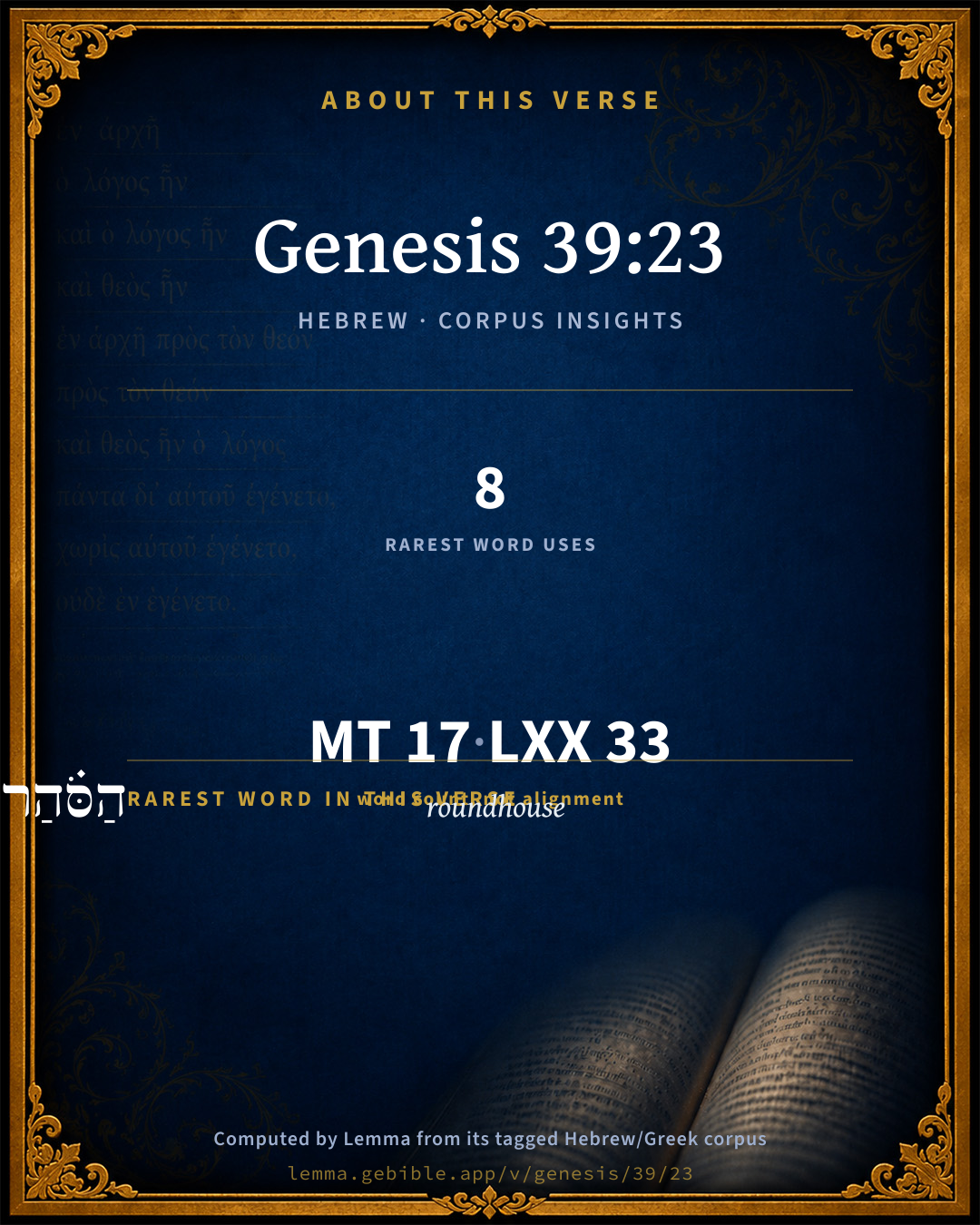
17
words
15
distinct lemmas
Pentateuch
section

Notable vocabulary

The rarest word here is הַסֹּ֗הַר roundhouse H5470 — appearing just 8 times in the whole Hebrew Bible.

Shared distinctive vocabulary

הַסֹּ֗הַר roundhouse H5470 occurs in 6 verses of the Hebrew Bible. Also found in:

Grammatical profile

  • 3 verbs
  • 8 nouns
  • 1 pronoun
  • 1 preposition
  • 4 particles

Verb forms

  • רֹאֶ֤ה Qal · Participle Active
  • עֹשֶׂ֖ה Qal · Participle Active
  • מַצְלִֽיחַ Hiphil · Participle Active

Repetition

Words recur within this verse — often emphatic in Hebrew:

  • יְהוָ֖ה LORD H3068 ×2
  • בַּאֲשֶׁ֥ר which H834 ×2

Hebrew & Septuagint length

In English translation the verse runs 28 words from the Hebrew and 40 from the Septuagint (LXX English) — the Septuagint runs noticeably longer here. See the side-by-side →

A rough comparison of the two English renderings, which tokenize alike — not a word-level alignment.

Word counts can differ between the Hebrew and the Greek without any difference in meaning — e.g. the Hebrew direct-object marker אֵת has no separate Greek word, and Greek often adds the article ὁ.

In the original languages it is 17 Hebrew tokens and 33 Greek tokens — but the two are counted differently (Hebrew bundles its prefixes and suffixes into one token; the Greek is in lemma form), so that isn’t a like-for-like length.

Cross-references

8

Topical passages linked to Genesis 39:23 in the Treasury of Scripture Knowledge — connected by theme and wording, ordered by reader-vote popularity; previews shown in the World English Bible.

  • Isaiah 43:2 When you pass through the waters, I will be with you; and through the rivers, they shall not overflow you: when you walk through the fire, you shall not be burned, neither shall the flame kindle on you.
  • Psalms 1:3 He will be like a tree planted by the streams of water, That brings forth its fruit in its season, Whose leaf also does not wither. Whatever he does shall prosper.
  • Genesis 39:2–3 Yahweh was with Joseph, and he was a prosperous man. He was in the house of his master the Egyptian.
  • Daniel 6:22 My God has sent his angel, and has shut the lions' mouths, and they have not hurt me; because as before him innocence was found in me; and also before you, O king, have I done no hurt.
  • Genesis 49:23–24 The archers have sorely grieved him, Shot at him, and persecute him:
  • 1 Samuel 2:30 Therefore Yahweh, the God of Israel, says, I said indeed that your house, and the house of your father, should walk before me forever: but now Yahweh says, Be it far from me; for those who honor me I will honor, and those who despise me shall be lightly esteemed.
  • Psalms 37:3–11 Trust in Yahweh, and do good. Dwell in the land, and enjoy safe pasture.
  • Genesis 40:3–4 He put them in custody in the house of the captain of the guard, into the prison, the place where Joseph was bound.

Cross-references courtesy of OpenBible.info (CC BY 4.0).

Hebrew and Greek witnesses Masoretic Hebrew ↔ Greek Septuagint

The same verse in the two great witnesses to the Old Testament, shown verse-for-verse.

Here the Septuagint runs noticeably longer than the Hebrew — LXX2012 (modern English Septuagint) 40 words vs World English Bible 28. A rough length comparison of the two English translations, not a word-level alignment — read both below.

These are two independent witnesses, not word-aligned to each other, and the Septuagint is shown in lemma (dictionary) form.

Hebrew Genesis 39:23 Masoretic · Westminster Leningrad Codex

אֵ֣ין שַׂ֣ר בֵּית הַסֹּ֗הַר רֹאֶ֤ה אֶֽת כָּל מְא֨וּמָה֙ בְּיָד֔וֹ בַּאֲשֶׁ֥ר יְהוָ֖ה אִתּ֑וֹ וַֽאֲשֶׁר ה֥וּא עֹשֶׂ֖ה יְהוָ֥ה מַצְלִֽיחַ

The keeper of the prison didn't look after anything that was under his hand, because Yahweh was with him; and that which he did, Yahweh made it prosper.

World English Bible · Public Domain

Greek LXX Genesis 39:23 Septuagint · lemma form

οὐ εἰμί ὁ ἀρχιδεσμοφύλαξ ὁ δεσμωτήριον γιγνώσκω διά αὐτός οὐδείς πᾶς γάρ εἰμί διά χείρ ιωσηφ διά ὁ ὁ κύριος μετά αὐτός εἰμί καί ὅσος αὐτός ποιέω κύριος εὐοδόω ἐν ὁ χείρ αὐτός

Because of him the chief keeper of the prison knew nothing, for all things were in the hand of Joseph, because the Lord was with him; and whatever things he did, the Lord made them to prosper in his hands.

LXX2012 (modern English Septuagint) · Public Domain

Hebrew: Westminster Leningrad Codex (CC BY 4.0). Greek: Septuagint (public domain); English from LXX2012 (modern English Septuagint) (Public Domain). How the Septuagint differs from the Hebrew →

Targum (Aramaic paraphrase)

2

The Targum is the ancient Jewish Aramaic paraphrase of the Hebrew Scriptures — an interpretive translation, not the Hebrew text itself. Onkelos (literal) and Pseudo-Jonathan (expansive) render the Torah, and Jonathan the Prophets. Coverage is partial: where no permissively-licensed English translation exists for a verse, only the Aramaic is shown. This is verse-level text, not a word-by-word alignment to the Hebrew.

  1. Targum Onkelos Torah (Genesis–Deuteronomy)
    לֵית רַב בֵּית אֲסִירֵי חָזֵי יָת כָּל סָרְחָן בִּידֵהּ בְּדִי מֵימְרָא דַּיְיָ בְּסַעְדֵּהּ וְדִי הוּא עָבֵד יְיָ מַצְלָח

    (no public-domain English translation for this verse)

    Targum Onkelos — Aramaic: “Onkelos Genesis” (public domain); “Onkelos Exodus” (public domain); “Onkelos Leviticus” (public domain); “Onkelos Numbers” (public domain); “Onkelos Deuteronomy” (public domain). English: “Sefaria Community Translation” (CC0 1.0 (public-domain dedication)); “J.W. Etheridge. The Targums of Onkelos and Jonathan Ben Uzziel on the Pentateuch. London: Longmans, Green, 1862” (public domain). Text via Sefaria.

  2. Targum Pseudo-Jonathan Torah (Genesis–Deuteronomy)
    לֵית צְרוֹךְ לְרַב בֵּית אֲסִירֵי לְמִנְטַר יַת יוֹסֵף כְּאוֹרַח כָּל אֲסִירַיָא אֲרוּם לָא חָמֵי יַת כָּל סוּרְחַן בִּידֵיהּ בְּגִין דְמֵימַר דַיְיָ הֲוָה בְּסַעֲדֵיהּ וּדְהוּא עֲבִיד יְיָ מַצְלָח

    It was not needful for the captain of the prison to watch Joseph, after the custom of all prisoners, because he saw that there was no fault in his hands; for the Word of the Lord was his Helper, and that which he did the Lord made it to prosper.

    Targum Pseudo-Jonathan — Aramaic: “Targum Jonathan on Genesis” (public domain); “Targum Jonathan on Exodus” (public domain); “Targum Jonathan on Leviticus” (public domain); “Targum Jonathan on Numbers” (public domain); “Targum Jonathan on Deuteronomy” (public domain). English: “The Targum of Jonathan ben Uzziel, trans. J. W. Etheridge, London, 1862” (public domain). Text via Sefaria.

Commentary

Notes on Genesis 39:23 from classic Christian and Jewish commentators (each source and its license shown beneath its notes). The classic Christian expositions comment on the surrounding passage and are grouped to its opening verse, so a note may address several verses; the Jewish commentaries on the Tanakh (Rashi and others) are per-verse, so they appear only where the commentator wrote on this verse.

Lemma curates 59 commentaries, every one of them public domain or Creative Commons licensed, each selected and text-cleaned for this edition rather than reprinted as found. About our sources →

Trapp's Complete Commentary

John Trapp

Gen 39:23 The keeper of the prison looked not to any thing [that was] under his hand; because the LORD was with him, and [that] which he did, the LORD made [it] to prosper.

Ver. 23. Looked not to anything.] {See Trapp on "Gen 40:6"} {See Trapp on "Psa 1:3"}

John Trapp, A Commentary or Exposition upon All the Books of the Old and New Testament (1647–1656) — public domain. Text from a community e-Sword module.

John Gill's Exposition

The keeper of the prison looked not to anything that was under his hand,.... Under the hand of Joseph; he did not inquire into and examine his conduct and management of things; he took no account of what was in his hands, nor required any of him; so satisfied was he with what he did, and had such an opinion of his prudence and faithfulness. The Targums of Onkelos and Jonathan paraphrase it,"he saw no crime in him,''either in the management of affairs he committed to him, or for which he was put into prison, and therefore did not use him as he did other prisoners:

because the Lord was with him; supplying him with his grace, giving him wisdom to do everything in the best manner committed to him, which caused the keeper of the prison to respect him as he did:

and that which he did the Lord made it to prosper; every method he took to secure the prisoners, every scheme he formed to bring them to confession of their crimes, or to clear those that were innocent; and every other thing relative to prison affairs, all through the good hand of God upon him, guiding, directing, and blessing him, succeeded well, which gained him the favour and good will of the keeper and the prisoners.

Next: Genesis Chapter 40

John Gill's Exposition of the Whole Bible (1746–1763) — public domain (CC PDM 1.0). Text via the HelloAO Bible API.

Rashi

Rabbi Shlomo Yitzchaki (Rashi)

באשר ה' אתו — means BECAUSE THE LORD WAS WITH HIM (i.e. באשר means because).

Rashi on the Tanakh — English translations: “The Judaica Press complete Tanach with Rashi, translated by A. J. Rosenberg” (CC BY 4.0); “Pentateuch with Rashi's commentary by M. Rosenbaum and A.M. Silbermann, 1929-1934” (public domain); “The Metsudah Tanach series, Lakewood, N.J” (CC BY 4.0); and “The Book of Joshua, Metsudah Publications, 1997” (CC BY 4.0). Text via Sefaria.

Lesson kit

Teaching starters — assembled from the data on this page, not authored interpretation. Every prompt links to the verse data it draws on. Edit before teaching.

Genesis, in the Pentateuch, opens this verse with 17 words (15 distinct Hebrew lemmas). Its most distinctive word is çôhar (“roundhouse”). The Greek Septuagint runs longer here. A historical commentator’s framing appears above. Read the whole chapter for the surrounding context.

Discussion questions

  1. The word çôhar carries the sense “roundhouse.” How does it shape the verse?
  2. How does Genesis 39:20, which shares the word «roundhouse», read alongside this verse?
  3. What does the repetition of “LORD” (2× in this one verse) do in this verse?
  4. The Septuagint runs longer here than the Hebrew. What might account for the difference?
  5. These translations render this verse differently; the difference is in the English rendering, not the original. What questions does that raise?
  6. «רֹאֶ֤ה» is a Qal Participle Active verb. How does that grammatical form shape the action described?
  7. Compare how Trapp's Complete Commentary and John Gill's Exposition read this verse. Where do they agree or differ?

Things to notice

Reading settings

Reading text

Shown beneath each verse's original-language words.

Old Testament
Old Testament edition

Read the OT as the Masoretic Hebrew (MT) or the Greek Septuagint (LXX).

English shown for the Greek Septuagint (in the Hebrew ↔ Greek comparison).

Comparing translations? Open the Compare panel on any verse page to stack up to four side by side.