
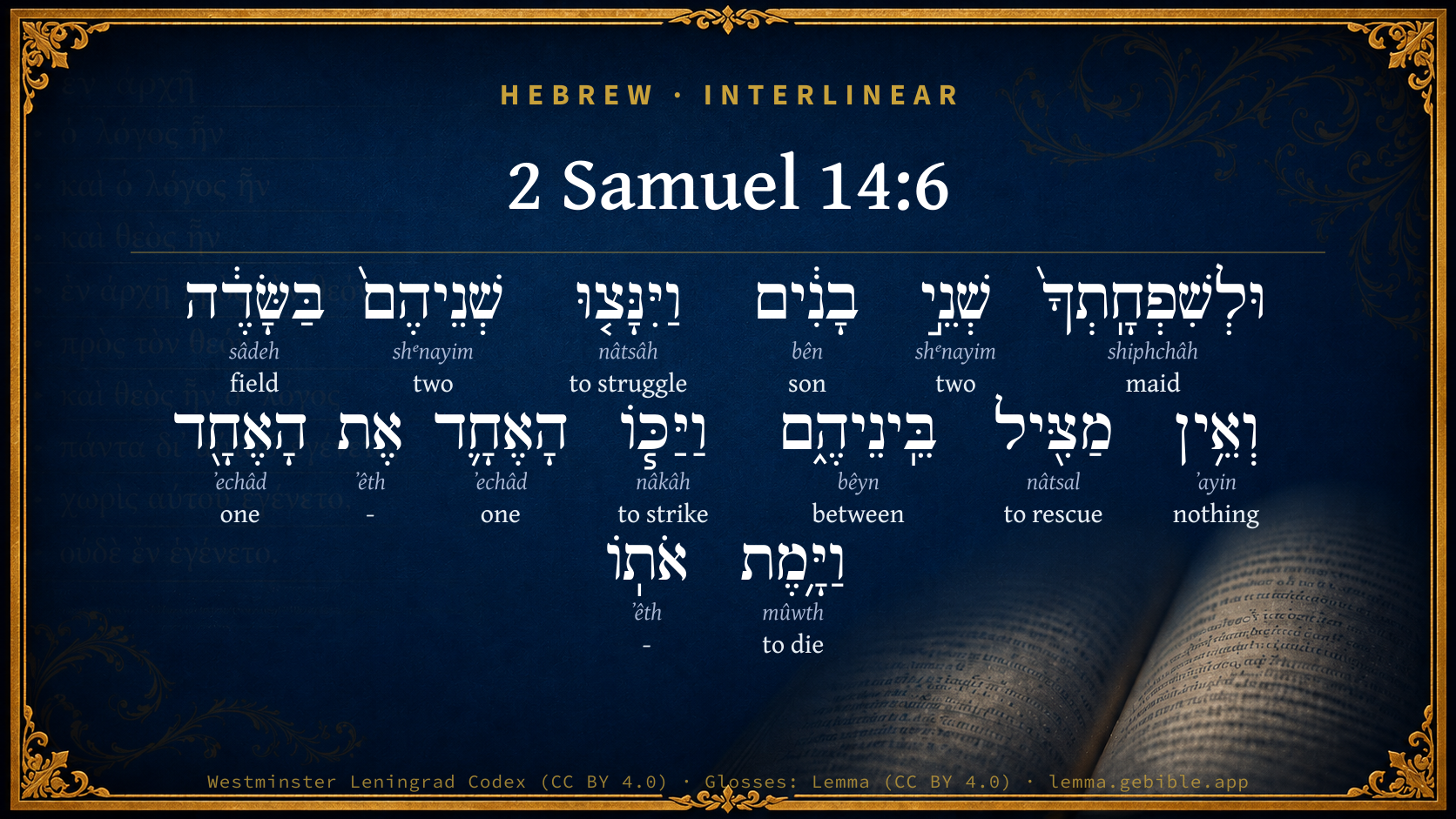
2 Samuel 14:6

Hebrew (Westminster Leningrad Codex) 2 Samuel 14:6 appears in the Hebrew Old Testament. The text above is from the Westminster Leningrad Codex. Each word links to its Strong’s number, a concise gloss, and parsing drawn from the Open Scriptures Hebrew Bible morphology. Click any word for its full Brown-Driver-Briggs (BDB) entry.
Download image
Cite this verse

2 Samuel 14:6 (World English Bible). Public Domain. Lemma interlinear Bible study tool, https://lemma.gebible.app/v/2-samuel/14/6.

Show BibTeX & RIS
BibTeX
RIS
English Translation
Your handmaid had two sons, and they two strove together in the field, and there was none to part them, but the one struck the other, and killed him.
World English Bible · Public Domain
Download a study sheet

One document with this verse’s original text, its word-by-word gloss line, the meaning frame, cross-references with their text, attributed commentary, and full source and license credits — printable, and it pastes into notes with its structure intact.

This verse Autodidact and up

Study sheet (.html) Plain text (.txt)

A passage Seminary Student

Up to 50 verses in one chapter. A passage sheet keeps up to 6 commentary sources and 12 cross-references per verse, in the order this page ranks them, and says so on the sheet whenever that leaves anything out. Ask for a single verse and you get the Autodidact verse sheet above.

Everything on this page stays free to read, with no account — the sheet is a download of what is already on screen, not access to it.

Want to remove ads? Support Godless Engineer
Compare translations 3

The same verse in 3 English versions, stacked beneath the original-language interlinear above. Click any original word for its lexicon entry.

Each is an independent rendering of the whole verse — the interlinear is not word-aligned to these translations.

Highlighted words mark where these versions differ — a whole-verse word diff, not a word-by-word alignment.

  • World English Bible Public Domain
    Your handmaid had two sons, and they two strove together in the field, and there was none to part them, but the one struck the other, and killed him.
  • King James Version Public Domain
    And thy handmaid had two sons, and they two strove together in the field, and there was none to part them, but the one smote the other, and slew him.
  • unfoldingWord Literal Text CC BY-SA 4.0
    And to your maidservant two sons. But the two of them fought in the field, and no deliverer between them. And the one struck him, the one, and he killed him.

unfoldingWord Literal Text — © unfoldingWord, licensed CC BY-SA 4.0. Word-aligned USFM3 via Door43 (git.door43.org/unfoldingWord/en_ult).

Versions to compare (up to 4)

3 of 4 selected

Show all 18 translations

Every available English version of this verse, each an independent rendering of the whole verse.

  • World English Bible Public Domain
    Your handmaid had two sons, and they two strove together in the field, and there was none to part them, but the one struck the other, and killed him.
  • Berean Standard Bible Public Domain
    And your maidservant had two sons who were fighting in the field with no one to separate them, and one struck the other and killed him.
  • Majority Standard Bible Public Domain
    And your maidservant had two sons who were fighting in the field with no one to separate them, and one struck the other and killed him.
  • King James Version Public Domain
    And thy handmaid had two sons, and they two strove together in the field, and there was none to part them, but the one smote the other, and slew him.
  • American Standard Version (1901) Public Domain
    And thy handmaid had two sons, and they two strove together in the field, and there was none to part them, but the one smote the other, and killed him.
  • Revised Version (1885) Public Domain
    And thy handmaid had two sons, and they two strove together in the field, and there was none to part them, but the one smote the other, and killed him.
  • Geneva Bible (1599) Public Domain
    And thine handmayd had two sonnes, and they two stroue together in the fielde: (and there was none to part them) so the one smote the other, and slew him.
  • Douay-Rheims (1899) Public Domain
    And thy handmaid had two sons: and they quarrelled with each other in the field, and there was none to part them: and the one struck the other, and slew him.
  • Young's Literal Translation Public Domain
    and thy maid-servant hath two sons; and they strive both of them in a field, and there is no deliverer between them, and the one smiteth the other, and putteth him to death;
  • Literal Standard Version CC BY-SA 4.0
    and your maidservant has two sons; and both of them strive in a field, and there is no deliverer between them, and one strikes the other, and puts him to death;
  • Unlocked Literal Bible CC BY-SA 4.0
    I, your servant, had two sons, and they fought together in the field, and there was no one to separate them. One struck the other and killed him.
  • unfoldingWord Literal Text CC BY-SA 4.0
    And to your maidservant two sons. But the two of them fought in the field, and no deliverer between them. And the one struck him, the one, and he killed him.
  • Darby Bible Public Domain
    And thy bondmaid had two sons, and they two strove together in the field, and there was none to part them, but the one smote the other and slew him.
  • World Messianic Bible Public Domain
    Your servant had two sons; and they both fought together in the field, and there was no one to part them, but the one struck the other and killed him.
  • Webster's Bible Public Domain
    And thy handmaid had two sons, and they two strove together in the field, and there was none to part them, but the one smote the other and slew him.
  • Free Bible Version CC BY-SA 4.0
    “Your Majesty, I had two sons. They had a fight outside, and there was nobody there to stop them. One of them hit the other, and killed him.
  • Bible in Basic English Public Domain
    And I had two sons, and the two of them had a fight in the field, and there was no one to come between them, and one with a blow put the other to death.
  • JPS Tanakh (1917) Public Domain
    And thy handmaid had two sons, and they two strove together in the field, and there was none to part them, but the one smote the other, and killed him.

Literal Standard Version (2020), Covenant Press — licensed CC BY-SA 4.0. Text via the HelloAO Bible API (eBible.org). Unlocked Literal Bible (unfoldingWord) — licensed CC BY-SA 4.0. Text via the HelloAO Bible API (eBible.org). unfoldingWord Literal Text — © unfoldingWord, licensed CC BY-SA 4.0. Word-aligned USFM3 via Door43 (git.door43.org/unfoldingWord/en_ult). Free Bible Version, Dr. Jonathan Gallagher — licensed CC BY-SA 4.0. Text via the HelloAO Bible API (eBible.org).

Word by word

More ways to search: Search by grammar → Find every occurrence → Compare this word →

Practice this passage: Drill this verse → Learn its vocabulary →

וַיִּנָּצ֤וּ
nâtsâh
H5327
“and · to struggle”
Conjunction + Verb, Niphal, Sequential Imperfect, 3rd Person, Masculine, Plural
Part of Speech
Conjunction + Verb
Stem
Niphal
Form
Sequential Imperfect
Person
3rd Person
Gender
Masculine
Number
Plural
Full BDB Definition

Origin: a primitive root

TWOT: 1399 , 1400 , 1401

(Qal) to fly - to struggle - (Niphal) to struggle - (Hiphil) to struggle - to strip off, make desolate, fall in ruins - (Qal) to fall in ruins - (Niphal) desolated, ruined heaps (participle)
  1. וּלְשִׁפְחָֽתְךָ֙ shiphchâh H8198 “and · to/for · maid · your” Conjunction + Preposition + Noun, Common, Feminine, Singular, Construct + Suffix, Personal, 2nd Person, Masculine, Singular
  2. שְׁנֵ֣י shᵉnayim H8147 “two” Adjective, Cardinal number, Masculine, Dual, Construct
  3. בָנִ֔ים bên H1121 “sons” Noun, Common, Masculine, Plural, Absolute
  4. שְׁנֵיהֶם֙ shᵉnayim H8147 “two · their” Adjective, Cardinal number, Masculine, Dual, Construct + Suffix, Personal, 3rd Person, Masculine, Plural
  5. בַּשָּׂדֶ֔ה sâdeh H7704 “in/at the · field” Preposition, Determined + Noun, Common, Masculine, Singular, Absolute
  6. וְאֵ֥ין ʼayin H369 “and · nothing” Conjunction + Particle, Negative
  7. מַצִּ֖יל nâtsal H5337 “rescuing” Verb, Hiphil, Participle Active, Masculine, Singular, Absolute
  8. בֵּֽינֵיהֶ֑ם bêyn H996 “between · them” Preposition + Suffix, Personal, 3rd Person, Masculine, Plural
  9. וַיַּכּ֧וֹ nâkâh H5221 “and · to strike · him” Conjunction + Verb, Hiphil, Sequential Imperfect, 3rd Person, Masculine, Singular + Suffix, Personal, 3rd Person, Masculine, Singular
  10. הָאֶחָ֛ד ʼechâd H259 “the · one” Particle, Definite Article + Adjective, Cardinal number, Masculine, Singular, Absolute
  11. אֶת ʼêth H853 “-” Particle, Direct Object
  12. הָאֶחָ֖ד ʼechâd H259 “the · one” Particle, Definite Article + Adjective, Cardinal number, Masculine, Singular, Absolute
  13. וַיָּ֥מֶת mûwth H4191 “and · to die” Conjunction + Verb, Hiphil, Sequential Imperfect, 3rd Person, Masculine, Singular
  14. אֹתֽוֹ ʼêth H853 “- · him” Particle, Direct Object + Suffix, Personal, 3rd Person, Masculine, Singular

About this verse

These counts appear in no published source. They are computed here, from the morphology-tagged text and Lemma’s own curated glosses. What Lemma adds →

15
words
12
distinct lemmas
Historical
section

Notable vocabulary

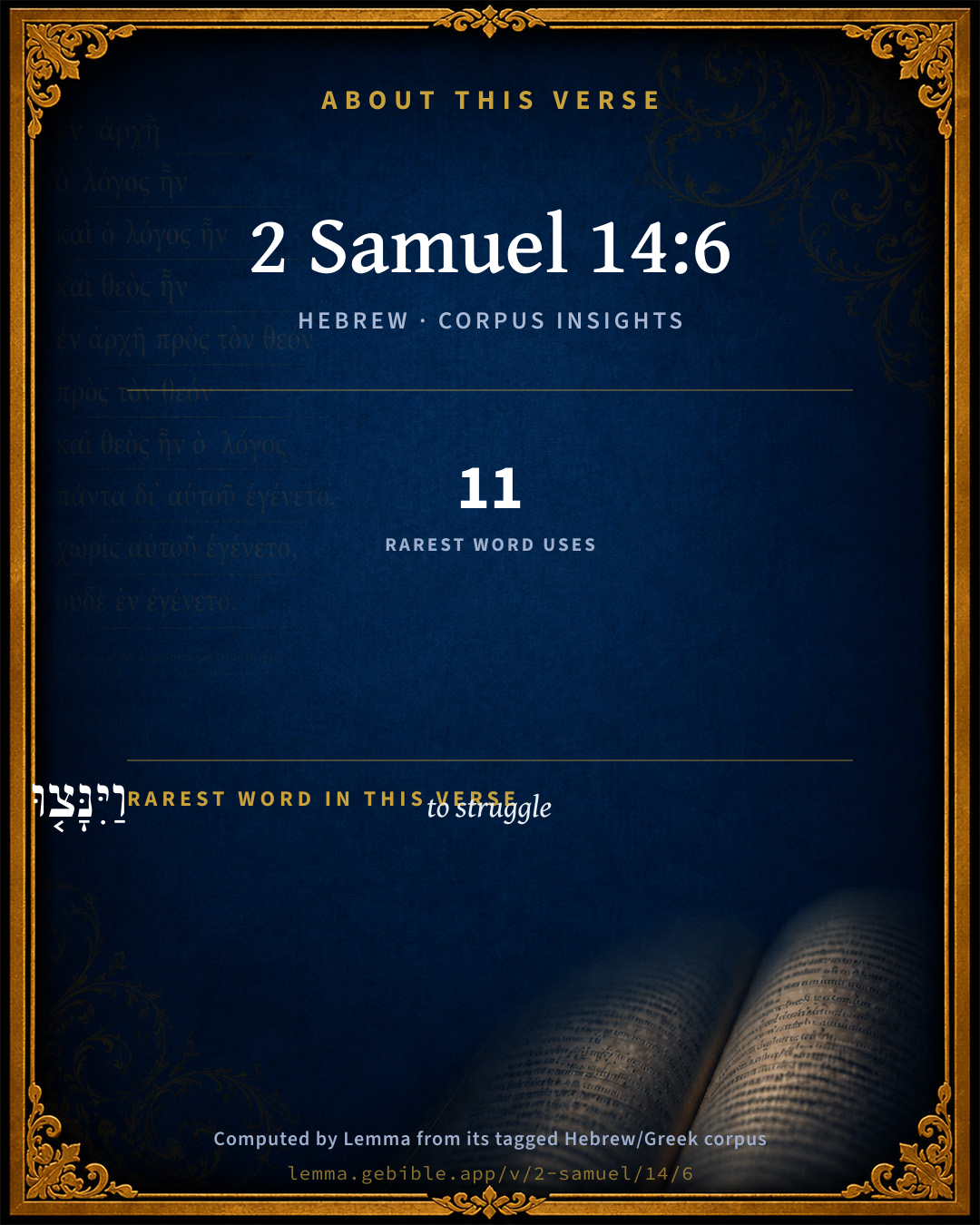
The rarest word here is וַיִּנָּצ֤וּ to struggle H5327 — appearing just 11 times in the whole Hebrew Bible.

Shared distinctive vocabulary

וַיִּנָּצ֤וּ to struggle H5327 occurs in 10 verses of the Hebrew Bible. Also found in:

Grammatical profile

  • 4 verbs
  • 3 nouns
  • 4 adjectives
  • 1 preposition
  • 3 particles

Verb forms

  • וַיִּנָּצ֤וּ Niphal · Sequential Imperfect
  • מַצִּ֖יל Hiphil · Participle Active
  • וַיַּכּ֧וֹ Hiphil · Sequential Imperfect
  • וַיָּ֥מֶת Hiphil · Sequential Imperfect

Repetition

Words recur within this verse — often emphatic in Hebrew:

  • שְׁנֵ֣י two H8147 ×2
  • הָאֶחָ֛ד one H259 ×2

Hebrew & Septuagint length

In English translation the verse runs 29 words from the Hebrew and 33 from the Septuagint (LXX English) — closely comparable.

A rough comparison of the two English renderings, which tokenize alike — not a word-level alignment.

Word counts can differ between the Hebrew and the Greek without any difference in meaning — e.g. the Hebrew direct-object marker אֵת has no separate Greek word, and Greek often adds the article ὁ.

Cross-references

3

Topical passages linked to 2 Samuel 14:6 in the Treasury of Scripture Knowledge — connected by theme and wording, ordered by reader-vote popularity; previews shown in the World English Bible.

  • Genesis 4:8 Cain said to Abel, his brother, "Let's go into the field." It happened, when they were in the field, that Cain rose up against Abel, his brother, and killed him.
  • Exodus 2:13 He went out the second day, and, behold, two men of the Hebrews were fighting with each other. He said to him who did the wrong, "Why do you strike your fellow?"
  • Deuteronomy 22:26–27 but to the lady you shall do nothing; there is in the lady no sin worthy of death: for as when a man rises against his neighbor, and kills him, even so is this matter;

Cross-references courtesy of OpenBible.info (CC BY 4.0).

Hebrew and Greek witnesses Masoretic Hebrew ↔ Greek Septuagint

The same verse in the two great witnesses to the Old Testament, shown verse-for-verse.

These are two independent witnesses, not word-aligned to each other, and the Septuagint is shown in lemma (dictionary) form.

Hebrew 2 Samuel 14:6 Masoretic · Westminster Leningrad Codex

וּלְשִׁפְחָֽתְךָ֙ שְׁנֵ֣י בָנִ֔ים וַיִּנָּצ֤וּ שְׁנֵיהֶם֙ בַּשָּׂדֶ֔ה וְאֵ֥ין מַצִּ֖יל בֵּֽינֵיהֶ֑ם וַיַּכּ֧וֹ הָאֶחָ֛ד אֶת הָאֶחָ֖ד וַיָּ֥מֶת אֹתֽוֹ

Your handmaid had two sons, and they two strove together in the field, and there was none to part them, but the one struck the other, and killed him.

World English Bible · Public Domain

Greek LXX 2 Samuel 14:6 Septuagint · lemma form

καί γέ ὁ δούλη σύ δύο υἱός καί μάχομαι ἀμφότεροι ἐν ὁ ἀγρός καί οὐ εἰμί ὁ ἐκαἱρέω ἀνά μέσος αὐτός καί παίζω ὁ εἷς ὁ ἀδελφός αὐτός καί θανατόω αὐτός

And moreover your handmaid had two sons, and they fought together in the field, and there was no one to part them; and the one struck the other his brother, and killed him.

LXX2012 (modern English Septuagint) · Public Domain

Hebrew: Westminster Leningrad Codex (CC BY 4.0). Greek: Septuagint (public domain); English from LXX2012 (modern English Septuagint) (Public Domain). How the Septuagint differs from the Hebrew →

Targum (Aramaic paraphrase)

1

The Targum is the ancient Jewish Aramaic paraphrase of the Hebrew Scriptures — an interpretive translation, not the Hebrew text itself. Onkelos (literal) and Pseudo-Jonathan (expansive) render the Torah, and Jonathan the Prophets. Coverage is partial: where no permissively-licensed English translation exists for a verse, only the Aramaic is shown. This is verse-level text, not a word-by-word alignment to the Hebrew.

  1. Targum Jonathan Prophets (Joshua–Malachi)
    וּלְאַמְתָךְ תְּרֵין בְּנִין וְאִתְנְצִיאוּ תַרְוֵיהוֹן בְּחַקְלָא וְלֵית דִמְשֵׁיזֵיב בֵּינֵיהוֹן וּמְחוֹ חַד יַת חַד וּקְטַל יָתֵיהּ:

    (no public-domain English translation for this verse)

    Targum Jonathan — Aramaic: “Mikraot Gedolot” (public domain). English: “Sefaria Community Translation” (CC0 1.0 (public-domain dedication)); “London "Chaldee Paraphrase," 1871” (public domain). Text via Sefaria.

Commentary

Notes on 2 Samuel 14:6 from classic Christian and Jewish commentators (each source and its license shown beneath its notes). The classic Christian expositions comment on the surrounding passage and are grouped to its opening verse, so a note may address several verses; the Jewish commentaries on the Tanakh (Rashi and others) are per-verse, so they appear only where the commentator wrote on this verse.

Lemma curates 59 commentaries, every one of them public domain or Creative Commons licensed, each selected and text-cleaned for this edition rather than reprinted as found. About our sources →

Trapp's Complete Commentary

John Trapp

2Sa 14:6 And thy handmaid had two sons, and they two strove together in the field, and [there was] none to part them, but the one smote the other, and slew him.

Ver. 6. And they two strove together in the field.] Upon some sudden and perhaps slight occasion; such as was that recorded by Camerarius, who telleth a story of two brethren walking out in a starlit night: said one of the brethren, Would I had a pasture as large as this element. And said the other, Would I had as many oxen as there be stars. Says the other again, Where would you feed those oxen? In your pasture, replied he. What, whether I would or no? Yea, said he, whether you would or no. What, in spite of me? Yes, said he. And thus it went on from words, till at length the one killed the other.

John Trapp, A Commentary or Exposition upon All the Books of the Old and New Testament (1647–1656) — public domain. Text from a community e-Sword module.

Geneva Bible (1599)

Geneva Bible translators

Under this parable she describeth the death of Amnon by Absalom.

Geneva Bible (1599) marginal notes — public domain. Text via Bolls.life.

Ellicott's Commentary for English Readers

(6) They two strove together.—The woman represents the fratricide as unpremeditated and without malice. This really made the case essentially different from that of Absalom; but at this point of the story the object is to dispose the king favourably towards the culprit, while by the time the application is reached, this point will have passed out of mind.

A Bible Commentary for English Readers, edited by Charles John Ellicott (1878–1897) — public domain. Text from a community e-Sword module.

John Gill's Exposition

And thy handmaid had two sons,.... Two are observed, that her case might suit with Amnon and Absalom:

and they two strove together in the field; they quarrelled, and fought in the field, where there were no witnesses of what they did to each other; whereby she would suggest that Ammon was killed in the field, of which there were no witnesses, and therefore Absalom ought not to die; whereas it was in Absalom's house, at his table, and where the rest of the king's sons were present, and witnesses of it:

and there was none to part them; which, had there been, might have prevented the sad disaster; this, as Abarbinel thinks, is pointed at David, who when Amnon forced Tamar, did not correct him for it, nor seek to make peace between the brethren, and hence followed what had happened:

but the one smote the other, and slew him; as say the accusers of him that is living; for the fable supposes there was none with them; however, she suggests, as the above writer observes, that one gave the first blow, and so was the aggressor; and that he that was smitten rose up in his own defence, and in his passion slew him that smote him; which is observed to lessen the crime, and to intimate that Amnon was the aggressor, who first began the sin and quarrel, in ravishing Tamar, and so reproaching Absalom; and therefore his blood was upon his own head.

John Gill's Exposition of the Whole Bible (1746–1763) — public domain (CC PDM 1.0). Text via the HelloAO Bible API.

Matthew Poole's English Annotations

There was none to part them; and therefore there is no witness, either that he killed him, or how he killed him, whether from some sudden passion and great provocation, or in his own necessary defence, or otherwise.

Slew him; as the avengers of blood report.

Matthew Poole's English Annotations on the Holy Bible (1683–1685) — public domain. Text from a community e-Sword/MySword module.

Lesson kit

Teaching starters — assembled from the data on this page, not authored interpretation. Every prompt links to the verse data it draws on. Edit before teaching.

2 Samuel, in the Historical, opens this verse with 15 words (12 distinct Hebrew lemmas). Its most distinctive word is nâtsâh (“to struggle”). A historical commentator’s framing appears above. Read the whole chapter for the surrounding context.

Discussion questions

  1. The word nâtsâh carries the sense “to struggle.” How does it shape the verse?
  2. Exodus 2:13 shares the word «to struggle» with this verse. How do the two illuminate each other?
  3. “two” occurs 2× in this one verse. What is the effect of the repetition?
  4. The translations on this page render this verse differently — a whole-verse word diff, not a word-by-word alignment. What might account for the different wordings?
  5. The verb «וַיִּנָּצ֤וּ» is Niphal Sequential Imperfect. How does its form color the action?
  6. Reading how Trapp's Complete Commentary and Geneva Bible (1599) read this verse, where do the two commentators agree and where do they part?

Things to notice

Reading settings

Reading text

Shown beneath each verse's original-language words.

Old Testament
Old Testament edition

Read the OT as the Masoretic Hebrew (MT) or the Greek Septuagint (LXX).

English shown for the Greek Septuagint (in the Hebrew ↔ Greek comparison).

Comparing translations? Open the Compare panel on any verse page to stack up to four side by side.