
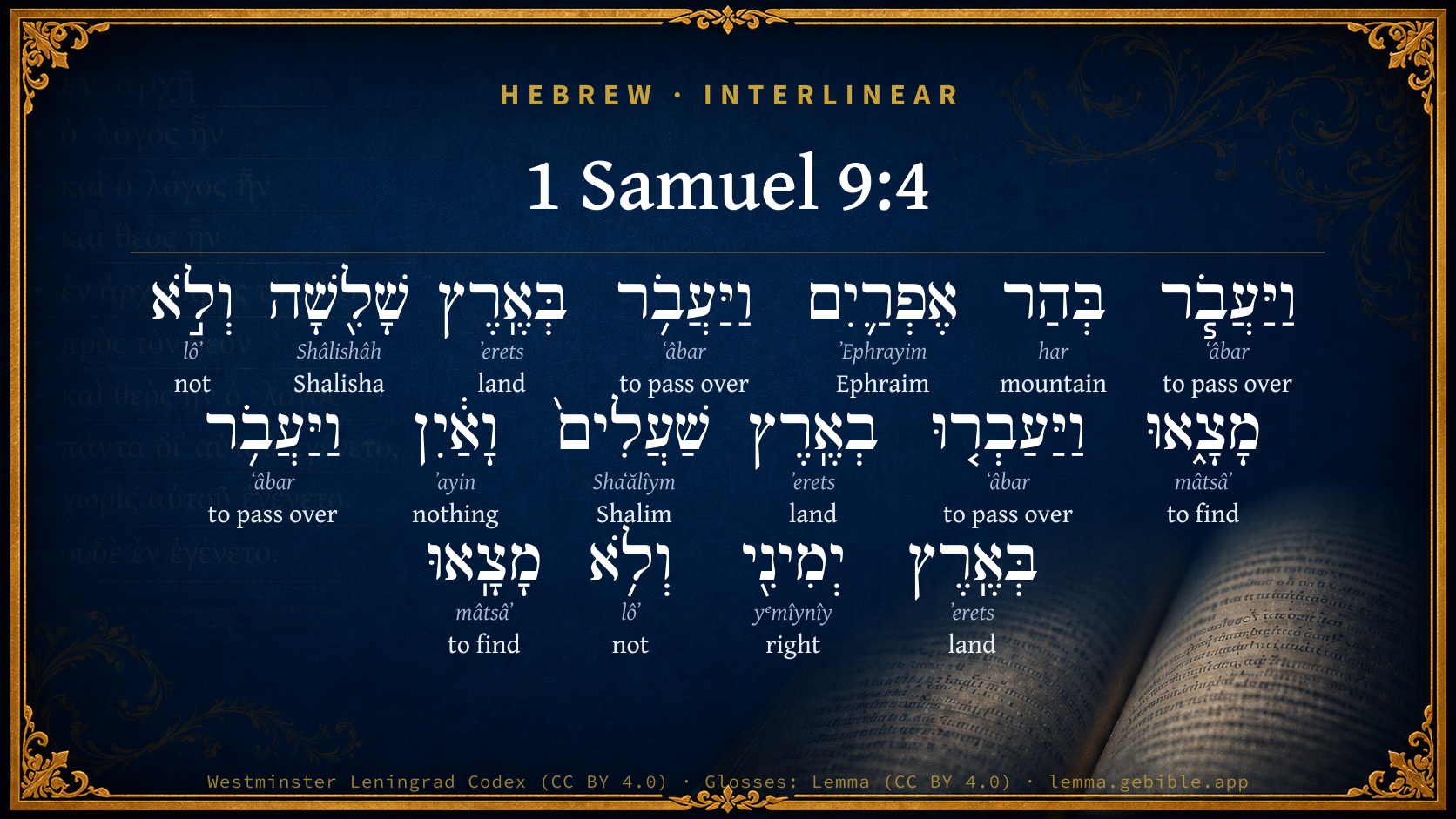
1 Samuel 9:4

Hebrew (Westminster Leningrad Codex) 1 Samuel 9:4 appears in the Hebrew Old Testament. The text above is from the Westminster Leningrad Codex. Each word links to its Strong’s number, a concise gloss, and parsing drawn from the Open Scriptures Hebrew Bible morphology. Click any word for its full Brown-Driver-Briggs (BDB) entry.
Download image
Cite this verse

1 Samuel 9:4 (World English Bible). Public Domain. Lemma interlinear Bible study tool, https://lemma.gebible.app/v/1-samuel/9/4.

Show BibTeX & RIS
BibTeX
RIS
English Translation
He passed through the hill-country of Ephraim, and passed through the land of Shalishah, but they didn't find them: then they passed through the land of Shaalim, and there they weren't there: and he passed through the land of the Benjamites, but they didn't find them.
World English Bible · Public Domain
Highlights
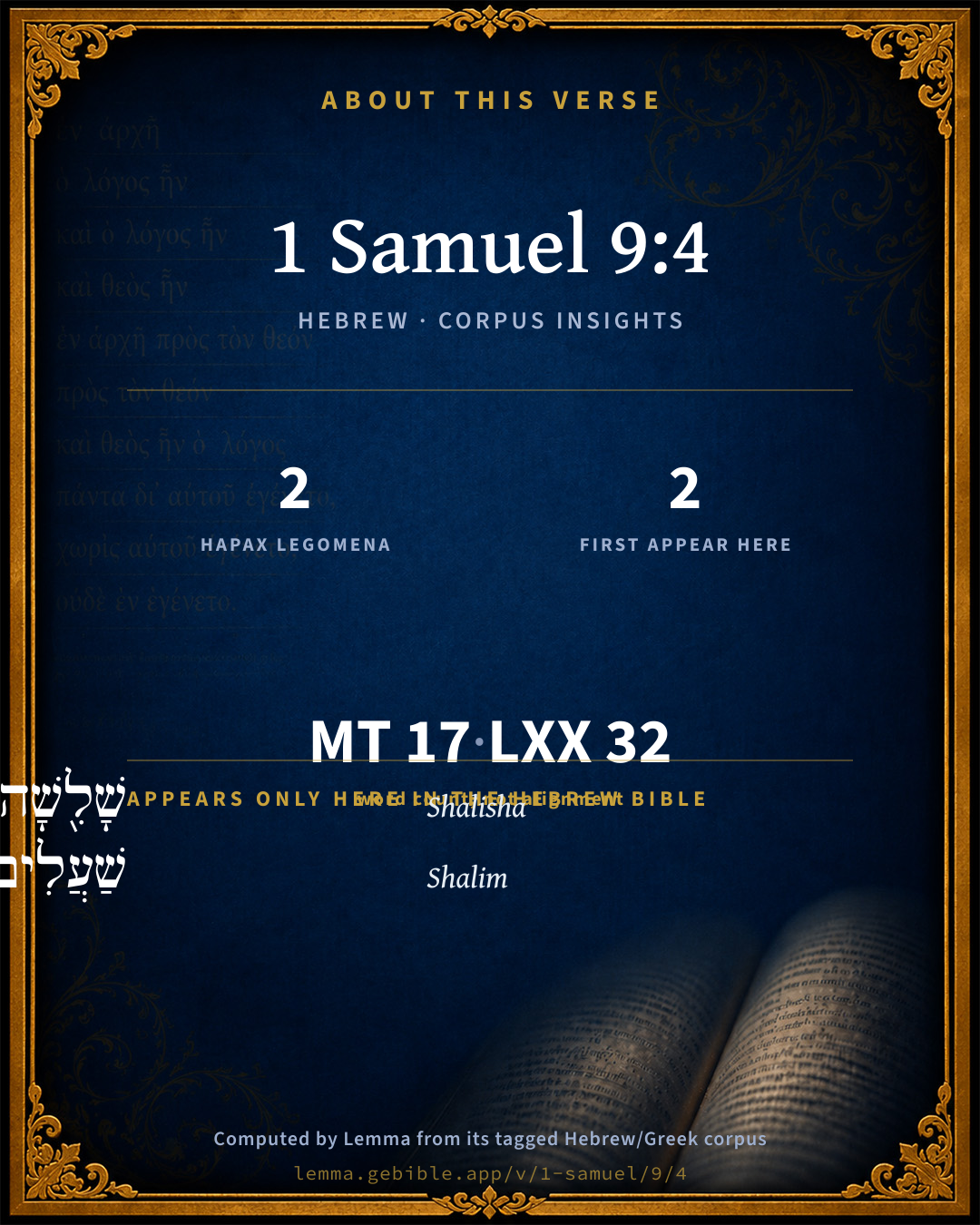
  • 2 hapax legomena — only here in the Hebrew Bible
  • 2 first appearances in the Hebrew Bible
Full analysis ↓
Download a study sheet

One document with this verse’s original text, its word-by-word gloss line, the meaning frame, cross-references with their text, attributed commentary, and full source and license credits — printable, and it pastes into notes with its structure intact.

This verse Autodidact and up

Study sheet (.html) Plain text (.txt)

A passage Seminary Student

Up to 50 verses in one chapter. A passage sheet keeps up to 6 commentary sources and 12 cross-references per verse, in the order this page ranks them, and says so on the sheet whenever that leaves anything out. Ask for a single verse and you get the Autodidact verse sheet above.

Everything on this page stays free to read, with no account — the sheet is a download of what is already on screen, not access to it.

Want to remove ads? Support Godless Engineer
Compare translations 3

The same verse in 3 English versions, stacked beneath the original-language interlinear above. Click any original word for its lexicon entry.

Each is an independent rendering of the whole verse — the interlinear is not word-aligned to these translations.

Highlighted words mark where these versions differ — a whole-verse word diff, not a word-by-word alignment.

  • World English Bible Public Domain
    He passed through the hill-country of Ephraim, and passed through the land of Shalishah, but they didn't find them: then they passed through the land of Shaalim, and there they weren't there: and he passed through the land of the Benjamites, but they didn't find them.
  • King James Version Public Domain
    And he passed through mount Ephraim, and passed through the land of Shalisha, but they found them not: then they passed through the land of Shalim, and there they were not: and he passed through the land of the Benjamites, but they found them not.
  • unfoldingWord Literal Text CC BY-SA 4.0
    And he passed through the hill country of Ephraim, and he passed through the land of Shalishah, but they did not find. And they passed through the land of Shaalim, but nothing. And he passed through the land of the Benjaminite, but they did not find.

unfoldingWord Literal Text — © unfoldingWord, licensed CC BY-SA 4.0. Word-aligned USFM3 via Door43 (git.door43.org/unfoldingWord/en_ult).

Versions to compare (up to 4)

3 of 4 selected

Show all 18 translations

Every available English version of this verse, each an independent rendering of the whole verse.

  • World English Bible Public Domain
    He passed through the hill-country of Ephraim, and passed through the land of Shalishah, but they didn't find them: then they passed through the land of Shaalim, and there they weren't there: and he passed through the land of the Benjamites, but they didn't find them.
  • Berean Standard Bible Public Domain
    So Saul passed through the hill country of Ephraim and then through the land of Shalishah, but did not find the donkeys. He and the servant went through the region of Shaalim, but they were not there. Then they went through the land of Benjamin, and still they did not find them.
  • Majority Standard Bible Public Domain
    So Saul passed through the hill country of Ephraim and then through the land of Shalishah, but they did not find the donkeys. He and the servant went through the region of Shaalim, but they were not there. Then they went through the land of Benjamin, and still they did not find them.
  • King James Version Public Domain
    And he passed through mount Ephraim, and passed through the land of Shalisha, but they found them not: then they passed through the land of Shalim, and there they were not: and he passed through the land of the Benjamites, but they found them not.
  • American Standard Version (1901) Public Domain
    And he passed through the hill-country of Ephraim, and passed through the land of Shalishah, but they found them not: then they passed through the land of Shaalim, and there they were not: and he passed through the land of the Benjamites, but they found them not.
  • Revised Version (1885) Public Domain
    And he passed through the hill country of Ephraim, and passed through the land of Shalishah, but they found them not: then they passed through the land of Shaalim, and there they were not: and he passed through the land of the Benjamites, but they found them not.
  • Geneva Bible (1599) Public Domain
    So he passed through mount Ephraim, and went through the lande of Shalishah, but they found them not. Then they went through the land of Shalim, and there they were not: he went also through ye land of Iemini, but they found the not.
  • Douay-Rheims (1899) Public Domain
    And through the land of Salisa, and had not found them, they passed also through the land of Salim, and they were not there: and through the land of Jemini, and found them not.
  • Young's Literal Translation Public Domain
    And he passeth over through the hill-country of Ephraim, and passeth over through the land of Shalisha, and they have not found; and they pass over through the land of Shaalim, and they are not; and he passeth over through the land of Benjamin, and they have not found.
  • Literal Standard Version CC BY-SA 4.0
    And he passes over through the hill-country of Ephraim, and passes over through the land of Shalisha, and they have not found [them]; and they pass over through the land of Shaalim, and they are not; and he passes over through the land of Benjamin, and they have not found [them].
  • Unlocked Literal Bible CC BY-SA 4.0
    So Saul passed through the hill country of Ephraim and went through the land of Shalishah, but they did not find them. Then they passed through the land of Shaalim, but they were not there. Then he passed through the land of the Benjamites, but they did not find them.
  • unfoldingWord Literal Text CC BY-SA 4.0
    And he passed through the hill country of Ephraim, and he passed through the land of Shalishah, but they did not find. And they passed through the land of Shaalim, but nothing. And he passed through the land of the Benjaminite, but they did not find.
  • Darby Bible Public Domain
    And he passed through mount Ephraim, and passed through the land of Shalishah, but they found [them] not; and they passed through the land of Shaalim, and they were not there; and they passed through the land of Benjamin, and they found [them] not.
  • World Messianic Bible Public Domain
    He passed through the hill country of Ephraim, and passed through the land of Shalishah, but they didn’t find them. Then they passed through the land of Shaalim, and they weren’t there. Then he passed through the land of the Benjamites, but they didn’t find them.
  • Webster's Bible Public Domain
    And he passed through mount Ephraim, and passed through the land of Shalisha, but they found them not: then they passed through the land of Shalim, and there they were not: and he passed through the land of the Benjaminites, but they found them not.
  • Free Bible Version CC BY-SA 4.0
    Saul searched the hill country of Ephraim and then the land of Shalishah, but didn't find the donkeys. He and the servant searched the region of Shaalim, but they weren't there. Then they searched the land of Benjamin, and they still couldn't find them.
  • Bible in Basic English Public Domain
    So they went through the hill-country of Ephraim and through the land of Shalishah, but they saw no sign of them: then they went through the land of Shaalim, but they were not there: and they went through the land of the Benjamites, but they did not come across them.
  • JPS Tanakh (1917) Public Domain
    And he passed through the hill-country of Ephraim, and passed through the land of Shalishah, but they found them not; then they passed through the land of Shaalim, and there they were not; and he passed through the land of the Benjamites, but they found them not.

Literal Standard Version (2020), Covenant Press — licensed CC BY-SA 4.0. Text via the HelloAO Bible API (eBible.org). Unlocked Literal Bible (unfoldingWord) — licensed CC BY-SA 4.0. Text via the HelloAO Bible API (eBible.org). unfoldingWord Literal Text — © unfoldingWord, licensed CC BY-SA 4.0. Word-aligned USFM3 via Door43 (git.door43.org/unfoldingWord/en_ult). Free Bible Version, Dr. Jonathan Gallagher — licensed CC BY-SA 4.0. Text via the HelloAO Bible API (eBible.org).

Word by word

More ways to search: Search by grammar → Find every occurrence → Compare this word →

Practice this passage: Drill this verse → Learn its vocabulary →

שָׁלִ֖שָׁה
Shâlishâh
H8031
“Shalisha”
Noun, Proper
Part of Speech
Noun
Type
Proper
Full BDB Definition

Origin: from H8027

TWOT: None

Shalisha = "third" - a district near Mount Ephraim through which Saul passed as he searched for the asses
  1. וַיַּעֲבֹ֧ר ʻâbar H5674 “and · to pass over” Conjunction + Verb, Qal, Sequential Imperfect, 3rd Person, Masculine, Singular
  2. בְּהַר har H2022 “in/at · mountain of” Preposition + Noun, Common, Masculine, Singular, Construct
  3. אֶפְרַ֛יִם ʼEphrayim H669 “Ephraim” Noun, Proper
  4. וַיַּעֲבֹ֥ר ʻâbar H5674 “and · to pass over” Conjunction + Verb, Qal, Sequential Imperfect, 3rd Person, Masculine, Singular
  5. בְּאֶֽרֶץ ʼerets H776 “in/at · land of” Preposition + Noun, Common, Both, Singular, Construct
  6. וְלֹ֣א lôʼ H3808 “and · not” Conjunction + Particle, Negative
  7. מָצָ֑אוּ mâtsâʼ H4672 “to find” Verb, Qal, Perfect, 3rd Person, Common, Plural
  8. וַיַּעַבְר֤וּ ʻâbar H5674 “and · to pass over” Conjunction + Verb, Qal, Sequential Imperfect, 3rd Person, Masculine, Plural
  9. בְאֶֽרֶץ ʼerets H776 “in/at · land of” Preposition + Noun, Common, Both, Singular, Construct
  10. שַׁעֲלִים֙ Shaʻălîym H8171 “Shalim” Noun, Proper
  11. וָאַ֔יִן ʼayin H369 “and · nothing” Conjunction + Particle, Negative
  12. וַיַּעֲבֹ֥ר ʻâbar H5674 “and · to pass over” Conjunction + Verb, Qal, Sequential Imperfect, 3rd Person, Masculine, Singular
  13. בְּאֶֽרֶץ ʼerets H776 “in/at · land of” Preposition + Noun, Common, Both, Singular, Construct
  14. יְמִינִ֖י yᵉmîynîy H3227 “right” Noun, Gentilic, Masculine, Singular, Absolute
  15. וְלֹ֥א lôʼ H3808 “and · not” Conjunction + Particle, Negative
  16. מָצָֽאוּ mâtsâʼ H4672 “to find” Verb, Qal, Perfect, 3rd Person, Common, Plural

About this verse

These counts appear in no published source. They are computed here, from the morphology-tagged text and Lemma’s own curated glosses. What Lemma adds →

17
words
10
distinct lemmas
Historical
section

Notable vocabulary

2 hapax legomena — words that appear only here in the entire Hebrew Bible:

  • שָׁלִ֖שָׁה Shalisha H8031
  • שַׁעֲלִים֙ Shalim H8171

First appearance in Scripture

These words make their first canonical appearance in the Hebrew Bible here:

  • שָׁלִ֖שָׁה Shalisha H8031
  • שַׁעֲלִים֙ Shalim H8171

Shared distinctive vocabulary

יְמִינִ֖י right H3227 occurs in 6 verses of the Hebrew Bible. Also found in:

Grammatical profile

  • 6 verbs
  • 8 nouns
  • 3 particles

Verb forms

  • וַיַּעֲבֹ֧ר Qal · Sequential Imperfect
  • וַיַּעֲבֹ֥ר Qal · Sequential Imperfect
  • מָצָ֑אוּ Qal · Perfect
  • וַיַּעַבְר֤וּ Qal · Sequential Imperfect
  • וַיַּעֲבֹ֥ר Qal · Sequential Imperfect
  • מָצָֽאוּ Qal · Perfect

Repetition

Words recur within this verse — often emphatic in Hebrew:

  • וַיַּעֲבֹ֧ר to pass over H5674 ×4
  • בְּאֶֽרֶץ land H776 ×3
  • מָצָ֑אוּ to find H4672 ×2
  • וְלֹ֣א not H3808 ×2

Hebrew & Septuagint length

In English translation the verse runs 46 words from the Hebrew and 43 from the Septuagint (LXX English) — closely comparable.

A rough comparison of the two English renderings, which tokenize alike — not a word-level alignment.

Word counts can differ between the Hebrew and the Greek without any difference in meaning — e.g. the Hebrew direct-object marker אֵת has no separate Greek word, and Greek often adds the article ὁ.

In the original languages it is 17 Hebrew tokens and 32 Greek tokens — but the two are counted differently (Hebrew bundles its prefixes and suffixes into one token; the Greek is in lemma form), so that isn’t a like-for-like length.

Cross-references

6

Topical passages linked to 1 Samuel 9:4 in the Treasury of Scripture Knowledge — connected by theme and wording, ordered by reader-vote popularity; previews shown in the World English Bible.

  • 2 Kings 4:42 There came a man from Baal Shalishah, and brought the man of God bread of the first fruits, twenty loaves of barley, and fresh ears of grain in his sack. He said, Give to the people, that they may eat.
  • Joshua 24:33 Eleazar the son of Aaron died; and they buried him in the hill of Phinehas his son, which was given him in the hill-country of Ephraim.
  • Genesis 33:18 Jacob came in peace to the city of Shechem, which is in the land of Canaan, when he came from Paddan Aram; and encamped before the city.
  • Judges 17:1 There was a man of the hill-country of Ephraim, whose name was Micah.
  • Judges 19:1 It happened in those days, when there was no king in Israel, that there was a certain Levite sojourning on the farther side of the hill-country of Ephraim, who took to him a concubine out of Bethlehem Judah.
  • John 3:23 John also was baptizing in Enon near Salim, because there was much water there. They came, and were baptized.

Cross-references courtesy of OpenBible.info (CC BY 4.0).

Hebrew and Greek witnesses Masoretic Hebrew ↔ Greek Septuagint

The same verse in the two great witnesses to the Old Testament, shown verse-for-verse.

These are two independent witnesses, not word-aligned to each other, and the Septuagint is shown in lemma (dictionary) form.

Hebrew 1 Samuel 9:4 Masoretic · Westminster Leningrad Codex

וַיַּעֲבֹ֧ר בְּהַר אֶפְרַ֛יִם וַיַּעֲבֹ֥ר בְּאֶֽרֶץ שָׁלִ֖שָׁה וְלֹ֣א מָצָ֑אוּ וַיַּעַבְר֤וּ בְאֶֽרֶץ שַׁעֲלִים֙ וָאַ֔יִן וַיַּעֲבֹ֥ר בְּאֶֽרֶץ יְמִינִ֖י וְלֹ֥א מָצָֽאוּ

He passed through the hill-country of Ephraim, and passed through the land of Shalishah, but they didn't find them: then they passed through the land of Shaalim, and there they weren't there: and he passed through the land of the Benjamites, but they didn't find them.

World English Bible · Public Domain

Greek LXX 1 Samuel 9:4 Septuagint · lemma form

καί διαἔρχομαι διά ὄρος ἐφράιμ καί διαἔρχομαι διά ὁ γῆ σελχα καί οὐ εὑρίσκω καί διαἔρχομαι διά ὁ γῆ εασακεμ καί οὐ εἰμί καί διαἔρχομαι διά ὁ γῆ ιακιμ καί οὐ εὑρίσκω

And they went through mount Ephraim, and they went through the land of Selcha, and found them not: and they passed through the land of Segalim, and they were not there: and they passed through the land of Jamin, and found them not.

LXX2012 (modern English Septuagint) · Public Domain

Hebrew: Westminster Leningrad Codex (CC BY 4.0). Greek: Septuagint (public domain); English from LXX2012 (modern English Septuagint) (Public Domain). How the Septuagint differs from the Hebrew →

Targum (Aramaic paraphrase)

1

The Targum is the ancient Jewish Aramaic paraphrase of the Hebrew Scriptures — an interpretive translation, not the Hebrew text itself. Onkelos (literal) and Pseudo-Jonathan (expansive) render the Torah, and Jonathan the Prophets. Coverage is partial: where no permissively-licensed English translation exists for a verse, only the Aramaic is shown. This is verse-level text, not a word-by-word alignment to the Hebrew.

  1. Targum Jonathan Prophets (Joshua–Malachi)
    וַעֲבַר בְּטוּרָא דְבֵית אֶפְרַיִם וַעֲבַר בְּאַרַע דָרוֹמָא וְלָא אַשְׁכָּחוּ וַעֲבַר בְּאַרַע מַתְבְּרָא וְלֵית וַעֲבַר בְּאַרַע שִׁבְטָא בִּנְיָמִין וְלָא אַשְׁכָּחוּ:

    (no public-domain English translation for this verse)

    Targum Jonathan — Aramaic: “Mikraot Gedolot” (public domain). English: “Sefaria Community Translation” (CC0 1.0 (public-domain dedication)); “London "Chaldee Paraphrase," 1871” (public domain). Text via Sefaria.

Commentary

Notes on 1 Samuel 9:4 from classic Christian and Jewish commentators (each source and its license shown beneath its notes). The classic Christian expositions comment on the surrounding passage and are grouped to its opening verse, so a note may address several verses; the Jewish commentaries on the Tanakh (Rashi and others) are per-verse, so they appear only where the commentator wrote on this verse.

Lemma curates 59 commentaries, every one of them public domain or Creative Commons licensed, each selected and text-cleaned for this edition rather than reprinted as found. About our sources →

Trapp's Complete Commentary

John Trapp

1Sa 9:4 And he passed through mount Ephraim, and passed through the land of Shalisha, but they found [them] not: then they passed through the land of Shalim, and [there they were] not: and he passed through the land of the Benjamites, but they found [them] not.

Ver. 4. Through the land of Shalim.] Near Jordan, where afterwards John baptized. {Joh 3:23} Called also the land of Shual, {1Sa 13:17} as Junius holdeth; haply because haunted by foxes.

John Trapp, A Commentary or Exposition upon All the Books of the Old and New Testament (1647–1656) — public domain. Text from a community e-Sword module.

Jamieson, Fausset & Brown

Robert Jamieson, A. R. Fausset & David Brown

he passed through mount Ephraim--This being situated on the north of Benjamin, indicates the direction of Saul's journey. The district explored means the whole of the mountainous region, with its valleys and defiles, which belonged to Ephraim. Turning apparently southwards--probably through the verdant hills between Shiloh and the vales of Jordan (Shalisha and Shalim)--he approached again the borders of Benjamin, scoured the land of Zuph, and was proposing to return, when his servant recollected that they were in the immediate neighborhood of the man of God, who would give them counsel.

Jamieson, Fausset & Brown — Commentary Critical and Explanatory on the Whole Bible (1871) — public domain (CC PDM 1.0). Text via the HelloAO Bible API.

Ellicott's Commentary for English Readers

(4) And he passed through mount Ephraim. The chain of the mountains of Ephraim ran southward into the territory of Benjamin, where were situated the patrimonial possessions of Saul’s house.

And passed through the land of Shalisha.—Or land “of the Three;” so called because three valleys there united in one, or one divided into three. It is believed to be the region in which Baal-shalisha lay (2Ki_4:42), fifteen miles north of Diospolis, or Lydda.

The land of Shalim.—Probably a very deep valley, derived from a Hebrew word, signifying “the hollow of the hand.”

A Bible Commentary for English Readers, edited by Charles John Ellicott (1878–1897) — public domain. Text from a community e-Sword module.

The Cambridge Bible for Schools and Colleges

gen. ed. J. J. S. Perowne

4, 5. Saul’s route cannot be traced with any certainty. He started from his home at Gibeah apparently in a N.W. direction (1) through “Mount Ephraim” (see 1Sa_1:1, note); (2) through “the land of Shalisha,” perhaps the district round Baal-shalisha (2Ki_4:42), which lay about 12 miles N. of Lydda; (3) then turning S. he traversed “the land of Shalim” (= foxes), perhaps in the neighbourhood of Shaalabbin (Jos_19:42) in Dan; (4) then striking E. he searched the western part of the “land of Benjamin,” till he reached (5) “the land of Zuph,” in which lay Samuel’s city Ramah. The search occupied parts of three days (1Sa_9:20). It seems best to suppose that the unnamed city of 1Sa_9:6 ff. is Ramah, for (a) the servant speaks of it as the prophet’s regular residence (1Sa_9:6); (b) it is natural to connect “the land of Zuph,” in which it was situated, with the name Ramathaim-Zophim (1Sa_1:1, note); (c) the difficulty raised by the description of Saul’s return in ch. 1Sa_10:2 (see note) may be solved by supposing that he did not go straight home, but was sent by the prophet out of his way in order to meet the men who were looking for him.

The Cambridge Bible for Schools and Colleges (gen. ed. J. J. S. Perowne; Cambridge University Press, 1878–1918) — public domain. Text from a community e-Sword module.

John Gill's Exposition

And they passed through Mount Ephraim,.... The mountainous part of that tribe, which lay contiguous to the tribe of Benjamin, where it might be supposed the asses had strayed to:

and passed through the land of Shalisha; a tract in the tribe of Benjamin, so called from some illustrious person, prince, and duke of it; in it very probably was the place called Baalshalisha; Kg2 4:42 and which perhaps is the same Jerom calls (x) Bethshalisha; and says there was a village of this name in the borders of Diospolis, almost fifteen miles distance from it to the north, in the Tamnitic country; though Bunting (y) says it was situated in Mount Ephraim, eight miles from Jerusalem to the northwest:

but they found them not; the asses, neither in Mount Ephraim, nor in the land of Shalisha:

then they passed through the land of Shalim which some take to be the same with Salim, where John was baptizing, Joh 3:23 but Jerom says (z) it was a village on the borders of Eleutheropolis, to the west, seven miles distant from it:

and there they were not; the asses could not be found there:

and he passed through the land of the Benjamites; or rather of Jemini, which was in Benjamin, so called from a famous man of that name; for it cannot be thought they should pass through the whole tribe of Benjamin in one day. And, according to Bunting (a), from Gibeah, the native place of Saul, through the mountain of Ephraim, and the land of Shalisha, to the borders of Shalim, were sixteen miles; and from thence to Jemini, in the tribe of Benjamin, sixteen more:

but they found them not; the asses.

(x) De loc. Heb. fol. 89. K. (y) Travels of the Patriarchs, &c. p. 129. (z) De loc. Heb. fol. 94. L. (a) Travels of the Patriarchs, &c. p. 126.

John Gill's Exposition of the Whole Bible (1746–1763) — public domain (CC PDM 1.0). Text via the HelloAO Bible API.

Albert Barnes' Notes on the Bible

The land of Shalisha was somewhere near Gilgal, i. e., Jiljulieh. It is thought to derive its name from “three” (Shalosh) wadys which unite in the wady of Karawa. The situation of Shalim is not known: its etymology connects it more probably with the land of Shual 1Sa 13:17, apparently round Taiyibeh, which was about nine miles from Gibeah.

Zuph - 1Sa 9:5, see 1Sa 1:1 note.

Albert Barnes' Notes on the Bible (1834–1885) — public domain. Text from a community e-Sword/MySword module.

Haydock's Catholic Bible Commentary

Salisa, the ancient Segor, (Menochius) or rather a place 15 miles from Diospolis. (Eusebius) --- Salim, or Sual, not far from Galgal, chap. xiii. 17.

George Leo Haydock (1774–1849), Haydock's Catholic Family Bible and Commentary, 1859 edition — public domain. Excludes Psalms (Douay-Rheims chapter numbering differs from Protestant) and Deuterocanonical books (Catholic canon only).

Matthew Poole's English Annotations

Mount Ephraim; a part of the tribe of Ephraim, which bordered upon Benjamin; and therefore they could soon pass out of the one into the other, and back again, as they saw cause.

Matthew Poole's English Annotations on the Holy Bible (1683–1685) — public domain. Text from a community e-Sword/MySword module.

Whedon's Commentary on the Bible

Daniel D. Whedon

4. Mount Ephraim — See note on Jdg_17:1. There is great uncertainty in respect to this route of Saul after his father’s asses. He undoubtedly started from Gibeah, where was his home, (1Sa_10:26,) and, passing through or over (עבר) mount Ephraim, he must have gone in a northwesterly direction. In the absence of any evidence to the contrary, we naturally understand the land of Shalisha to be the country around Baal-shalisha, mentioned 2Ki_4:42, and which, according to Eusebius and Jerome, was situated fifteen Roman miles north of Lydda, or Diospolis — the modern Ludd. Near this spot three water-courses unite in one large stream known as the Wady Kurawa, and hence, perhaps, the name Shalisha — land of three. From this point we can trace their course only by conjecture, for the land of Shalim is unknown, and the land of the Benjamites is literally the land of Yemini, and may, perhaps, have lain outside of the territory of Benjamin. If, however, the land of Yemini here means the territory of Benjamin, then the most probable conjecture is, that from the neighbourhood of Ludd they fetched a circuitous course, first easterly and then south, passing through the land of Benjamin somewhere east of Gibeah.

Daniel D. Whedon (gen. ed.), Commentary on the Old and New Testaments (1874–1909) — public domain. Text from a community e-Sword module.

The Pulpit Commentary

Mount Ephraim. Though Gibeah, Saul"s home, was in Benjamin, it was situated on this long mountain range. (1Sa_1:1) The land of Shalisha. Ie. Three-land, and probably, therefore, the region round Baal-shalisha. It takes its name from the three valleys which there converge in the great Wady Kurawa, The land of Shalim. Ie. of jackals; probably the same as the land of Shual, also = jackal-land. (1Sa_13:17) The very name shows that it was a wild, uninhabited region. The derivation hollow-land is untenable.

The Pulpit Commentary (1880–1919), ed. H.D.M. Spence-Jones & Joseph S. Exell — public domain. Text from a community e-Sword module.

Lesson kit

Teaching starters — assembled from the data on this page, not authored interpretation. Every prompt links to the verse data it draws on. Edit before teaching.

1 Samuel, in the Historical, opens this verse with 17 words (10 distinct Hebrew lemmas). Its most distinctive word is Shâlishâh (“Shalisha”). A historical commentator’s framing appears above. Read the whole chapter for the surrounding context.

Discussion questions

  1. What does “Shalisha” (Shâlishâh) contribute to the verse as a whole?
  2. 2 words here appear nowhere else in the Hebrew Bible. Why might the author reach for such rare wording?
  3. 2 words make their first appearance in Scripture here. What does this debut establish?
  4. How does 1 Samuel 9:1, which shares the word «right», read alongside this verse?
  5. What does the repetition of “to pass over” (4× in this one verse) do in this verse?
  6. These translations render this verse differently; the difference is in the English rendering, not the original. What questions does that raise?
  7. «וַיַּעֲבֹ֧ר» is a Qal Sequential Imperfect verb. How does that grammatical form shape the action described?
  8. Compare how Trapp's Complete Commentary and Jamieson, Fausset & Brown read this verse. Where do they agree or differ?

Things to notice

  • 2 words in this verse appear nowhere else in the Hebrew Bible.
  • 2 words make their first canonical appearance in Scripture here.
  • This verse counts 17 Hebrew ↔ 32 Greek words.
  • These translations choose different wording for 17 words in this verse.
  • “to pass over” occurs 4× in this single verse.

Reading settings

Reading text

Shown beneath each verse's original-language words.

Old Testament
Old Testament edition

Read the OT as the Masoretic Hebrew (MT) or the Greek Septuagint (LXX).

English shown for the Greek Septuagint (in the Hebrew ↔ Greek comparison).

Comparing translations? Open the Compare panel on any verse page to stack up to four side by side.