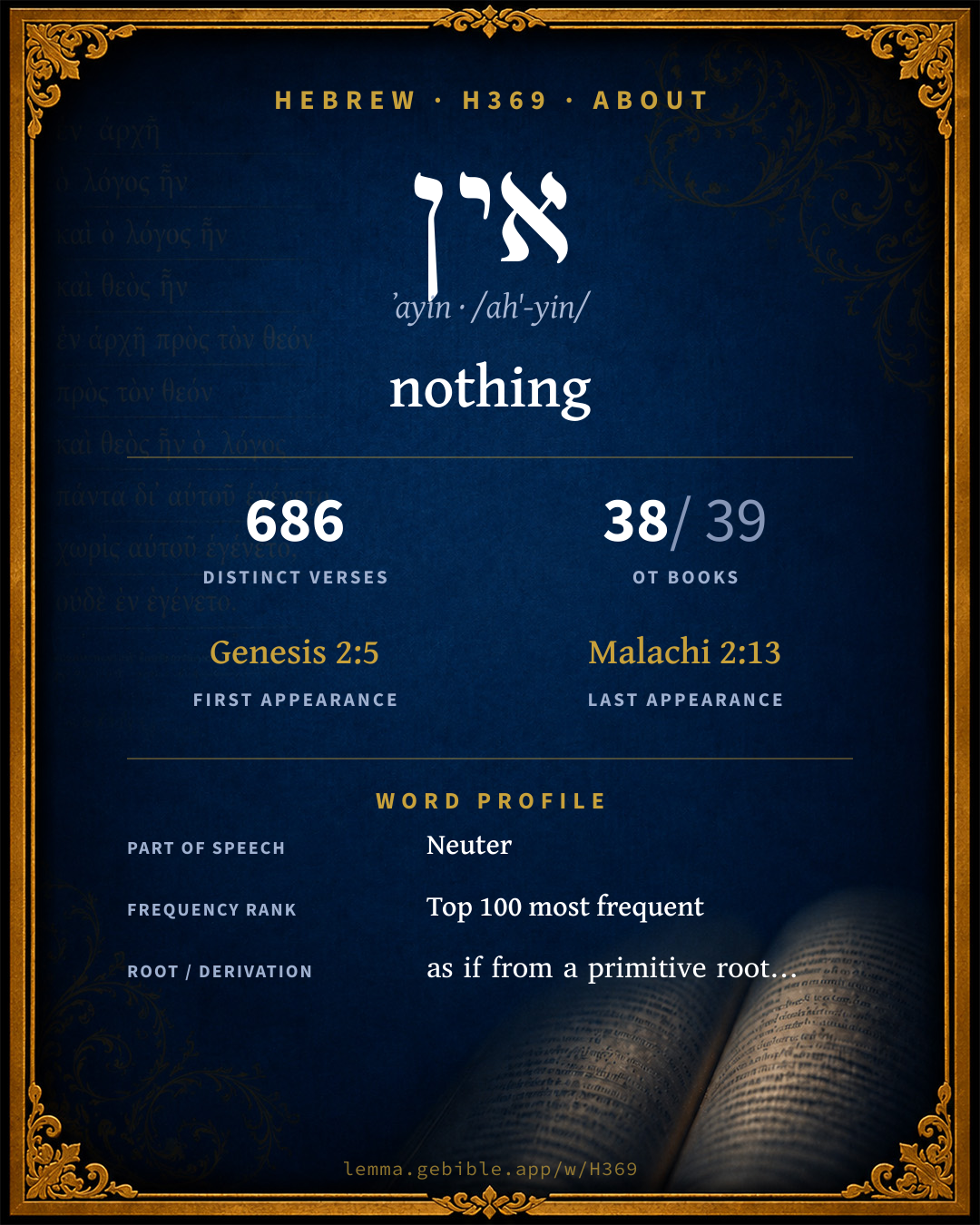
אַ֫יִן
nothing
also: not, nought fuller range ↓
Full lexicon entry — Brown-Driver-Briggs (BDB)
From Brown-Driver-Briggs (BDB)
Where this word appears
Grammar key — what these labels mean
Part of speech
- Particle
- A short function word — article, negation, interrogative, the sign of the direct object, and the like.
Noun type
- Common
- A common noun — a general class of person, place, or thing (“king,” “city,” “water”), not a specific name.
State
- Absolute
- The independent form of a noun, not bound to a following word.
Gender
- Masculine
- Grammatically masculine.
Number
- Singular
- One.
Every verse where H369 appears in the Book of Haggai — 3 distinct verses. Click any verse to open its interlinear word-by-word view. Verse text shown in the World English Bible for context — . Each verse’s Hebrew form is shown with its reference; the English is not keyword-highlighted, since the data carries no word-level English alignment. Use “Compare translations” on any verse to read it across multiple English versions. This concordance covers the Hebrew Bible; Septuagint (Greek Old Testament) occurrences are not indexed here.
Haggai
- Haggai 1:6 וְ/אֵין וְ/אֵין וְ/אֵין conj + ptcl neg conj + ptcl neg conj + ptcl neg You have sown much, and bring in little. You eat, but you don't have enough. You drink, but you aren't filled with drink. You clothe yourselves, but no one is warm, and he who earns wages earns wages to put them into a bag with holes in it."
- Haggai 2:3 כְּ/אַ֖יִן prep + ptcl neg 'Who is left among you who saw this house in its former glory? How do you see it now? Isn't it in your eyes as nothing?
- Haggai 2:17 וְ/אֵין conj + ptcl neg I struck you with blight, mildew, and hail in all the work of your hands; yet you didn't turn to me,' says Yahweh.
About this entry
At a glance — auto-summarized from this page’s data, not written by a person. Every figure links to its source below. This summary describes the numbers; it doesn’t interpret them.
At its core, אין (ʼayin) means “nothing.” Beyond its headline sense, its full sense range takes in “not” and “nought”. Spanning 686 verses in 38 books, it ranks among the most common words of the Hebrew Bible. It first appears in Genesis 2:5. Sharing its root, it stands alongside אין and אין. Each statement above links to its evidence; the full detail follows below.
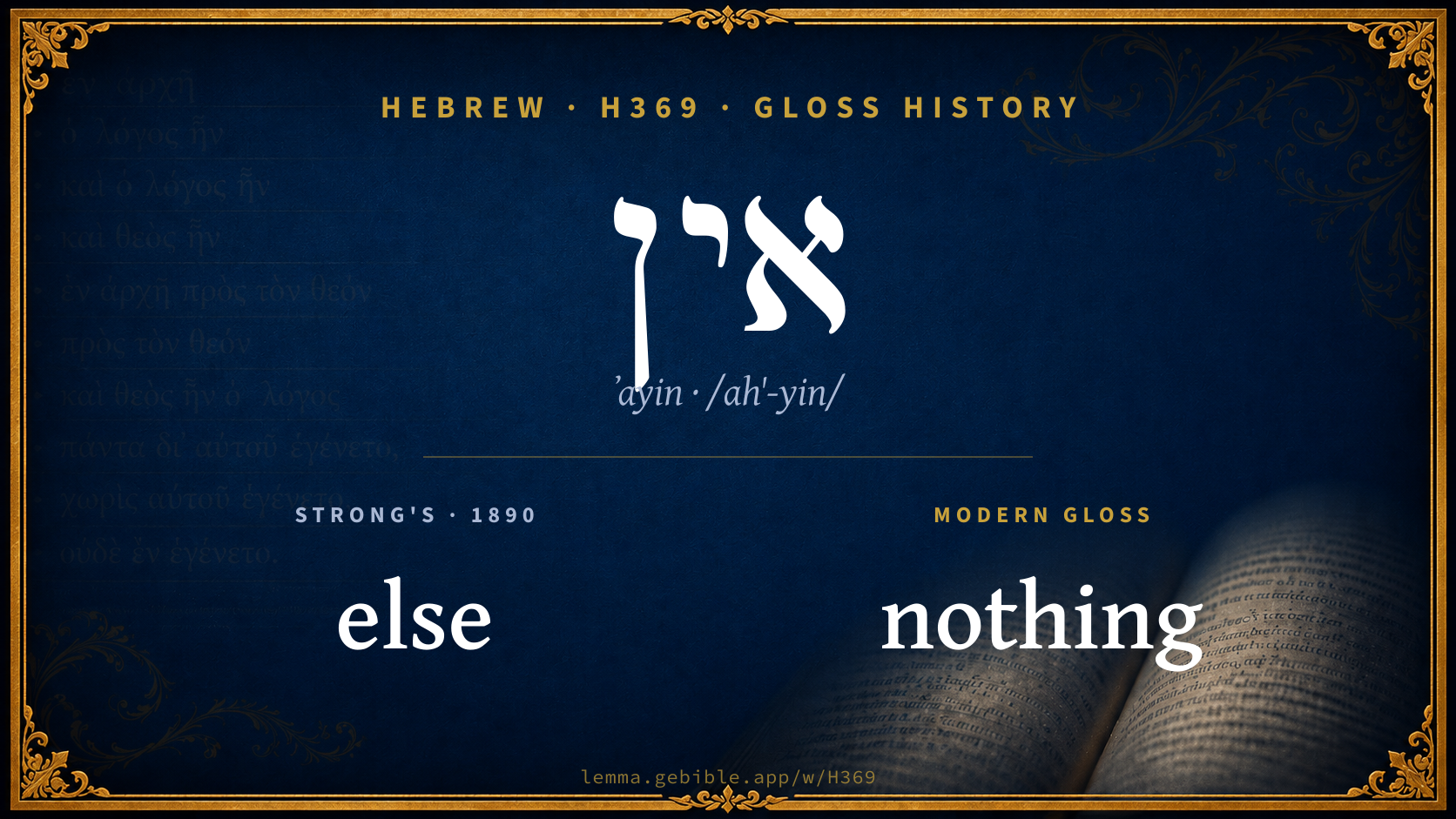
Gloss history
Strong's 1890 vs modern scholarship
About this word
Strong's H369 catalogs a Hebrew word from the Hebrew Old Testament.
These counts are not copied from any lexicon or concordance. They are computed here, from the morphology-tagged Hebrew Old Testament. What Lemma adds →
- 686
- distinct verses
- The word appears in 686 distinct verses.
- 38 / 39
- OT books
- The word appears in 38 of 39 Old Testament books.
- #59
- by frequency
- Top 100 most frequent Hebrew words (rank 59 of 8,640 Hebrew words by occurrence).
View all 686 occurrences in the concordance →
By section of the Old Testament
By traditional corpus
Conventional, traditional groupings — biblical authorship is debated, so this is a traditional corpus grouping, not an authorship claim. Each share is this word’s portion of its verses in that division of the Hebrew canon. Each figure is a share of the word’s 686 distinct verses.
- Prophets (Nevi'im) 325 verses · 47%
- Writings (Ketuvim) 241 verses · 35%
- Torah (Pentateuch) 120 verses · 17%
How translations render this word
Counts come from each version’s own published word-to-Strong’s tagging or interlinear alignment — an approximate guide to how each version renders this word, not a word-level alignment the data otherwise carries. Because each total is that version’s own tagged count, the per-version totals vary from one another and need not match the appearance or distinct-verse counts above. These counts may also differ from a printed concordance because Lemma counts each distinctly tagged rendering and does not collapse phrase taggings into a single head-word total. This is a fixed set of word-tagged versions (KJV, ASV, BSB, ULT) and does not change with the reading translation you choose elsewhere. Each version’s license is shown beside its name below (and on Sources).
BDB lists this Strong’s number as 4 distinct words (homographs). Each count above pools all of them and is not split by sense — see the Senses section below. A low-frequency rendering may belong to a different one of those words, not the primary meaning.
- King James Version†: Abundance 1×, Are innumerable 1×, Are not 1×
- American Standard Version†: Abundance 1×, Are innumerable 1×, Are not 1×
- Berean Standard Bible†: No 114×, Is no 85×, One 68×
- unfoldingWord Literal Text†: Is no 168×, Is not 78×, Was no 52×
King James Version Public Domain
Renders H369 across 29† tagged occurrences — most commonly:
Plus other, less common renderings.
American Standard Version Public Domain
Renders H369 across 29† tagged occurrences — most commonly:
Plus other, less common renderings.
Berean Standard Bible Public Domain
Renders H369 across 745† tagged occurrences — most commonly:
Plus other, less common renderings. Plus 134 renderings that appear only once — usually multi-word phrases or single function words the recovered tagging swept in, not distinct renderings. Not rendered by a distinct English word in 32 further occurrences.
unfoldingWord Literal Text CC BY-SA 4.0
Renders H369 across 834† tagged occurrences — most commonly:
Plus other, less common renderings. Plus 72 renderings that appear only once — usually multi-word phrases or single function words the recovered tagging swept in, not distinct renderings.
16 senses and sub-senses in the full BDB
What do BDB’s symbols mean?
BDB uses these scholarly abbreviations:
| Symbol | Meaning |
|---|---|
| 𝔊 | the Septuagint (the ancient Greek translation, LXX) |
| 𝔙 | the Vulgate (the Latin translation) |
| 𝔖 | the Syriac version (the Peshitta) |
| 𝔗 | the Targum (the Aramaic translation) |
| ψ | the Psalms |
| √ | root (the underlying root or stem) |
| ‖ | parallel passage (a synonymous or contrasted parallel) |
| † | the dagger: every passage where the word occurs is cited |
The 16 senses and sub-senses the full Brown-Driver-Briggs lexicon distinguishes for this word, in lexicon order (not ranked by frequency), with BDB’s own verbatim wording and sub-sense lettering. Shown in Hebrew script with BDB’s own scholarly abbreviations. The condensed entry is in the Lexicon Entry tab. See also the Forms in the corpus table below.
אין I (from אַי
אין II ought, v. p. 34.
אין III whence? v. sub אַי.
אין IV cstr. אֵין subst. proposes nothing, nought (Moab. אן, As. iûnu).
- 1. †Is 40:23 הַנּוֹתֵן רוֹזְנִים לְאָ֑יִן who bringeth princes to nothing; †כְּאַיִן as nothing, ib. 40:17; 41:11, 12 Hg 2:3 ψ 39:6; almost (‖ כִּמְעַט) ψ 73:2; †מֵאַיִן of nothing Is 41:24. e.g. Isaiah 40:23
- 2. cstr. אֵין, very freq. as particle of negation, is not, are not, was not, were not, etc. (corresp. to the affirm. יֵשׁ q.v. Similar in usage, though not etym. akin, are لَيْسَ, לַיִת, ܠܰܝܬ, አልቦ), proposes ‘there is nought of …’ sq. a subst. or a pron. suffix (אֵינֶנִּי [verbal form, Ges§ 100, 5; 152, 1 c], אֵינְךָ, אֵינֵךְ, אֵינֶנּוּ, אֵינֶנָּה, אֵינְכֶם, אֵינָם, also ψ 59:14 אֵינֵ֫מוֹ, 73:5 אֵינֵ֫ימוֹ): twice abnormally, in late Heb., a nom. אֵין אֲנִי, אֵין אֲנַחְנוּ Ne 4:17 (so sts. לַיִת, ܠܰܝܬ, NöM. p. 295); once, incorrectly, את Hg 2:17 (?). e.g. Psalms 59:14
- a. denying existence absolutely Is 44:6; 47:10 אֵין רֹאָנִי there is none that seeth me, lit. nought of one seeing me! אֵין עוֹד there is none else Dt 4:39 1 K 8:60 Is 45:5, 6, 18, 22. e.g. Isaiah 44:6
- b. more commonly, in a limited sense, there is none here or at hand Ex 2:12 and he saw כִּי־אֵין אִישׁ that there was no man (sc. there), Nu 21:5; Gn 5:24 וְאֵינֶנּוּ and he was not (of Enoch’s disappearance from earth) 42:13 one (cas.pend. as oft.), he is not, v 36; oft. = is (or has) vanished Gn 37:30 1 K 20:40 Is 17:14 ψ 37:10; 39:14; 103:16 Jb 8:22; 24:24; 27:19. e.g. Exodus 2:12
- c. with the sense determined by a predic. following: Gn 37:29 Joseph was not in the pit, 41:39 + often; Ex 5:10 אֵינֶנִּי נֹתֵן לָכֶם תֶּבֶן I am not giving you straw; and so often with particip. where duration has to be expressed Gn 39:23 Dt 21:18 Is 1:15 Je 7:16, or intention Gn 20:7 אִם אֵינְךָ מֵשִׁיב דַּע … if thou art not restoring her, know, 43:5 Ex 8:17; 33:15 (idiomatically, after אם; v. Dr§ 137) Ju 12:3. Foll. once pleon. by יֵשׁ ψ 135:17. Treated as a mere part. of negation, אֵין may vary its position in the sentence, the subst. which should strictly stand in the genitive being not only separated from it by a little word, as בּוֹ Gn 37:24, לוֹ Ex 22:1, שָׁם Ex 12:30, גַּם ψ 14:3, etc., but even for emphasis prefixed to it, as Gn 19:31; 40:8 וּפֹתֵר אֵין אֹתוֹ 41:15 Ex 5:16 Ju 13:9; 14:6; 16:15; 19:1 (so MI 24): if however it be thus brought to the end of a sentence, or be disconnected with what follows, it stands in the absol. form, as Gn 2:5 ואדם אַיִן לעבד האדמה and man there was none to till the ground, Lv 26:37 וְרֹדֵף אָ֑יִן, Nu 20:5 2 K 19:3 Ho 13:4 Mi 7:2. e.g. Genesis 37:29
- d. sometimes the subj. has to be supplied from the context: thus (α) †1 S 9:4 and they passed through the land of Shaalim וָאַיִן and they (the asses) were not (lit. and nought!), especially after vbs. of waiting or seeking Is 59:11 ψ 69:21 Jb 3:9; Is 41:17 Ez 7:25 Pr 14:6; 13:4; 20:4. (β) †Ex 17:7 is י׳ in the midst of us אִם־אָֽיִן׃ or not? Nu 13:20. (γ) †Ju 4:20 וְאָמַרְתְּ אָֽיִן׃ then thou shalt say, There is not, 1 K 18:10 1 S 10:14. (δ) Gn 30:1 give me children, וְאִם־אַיִן and if not, I die, Ex 32:32 Ju 9:15, 20 2 S 17:6 (v. Dr) 2 K 2:10 Jb 33:33. e.g. 1 Samuel 9:4
- e. with subj. not expressed, once (late), Dn 8:5 וְאֵין נוֹגֵעַ בָּאָרֶץ and (it) was not touching the earth. e.g. Daniel 8:5
- f. Ec 8:11, Jb 35:15 with the finite vb.; but rd. here כִּי אֵין פֹּקֵד (the usage of لَيْسَ, cited by De, does not justify the anomaly in Heb.) Je 38:5 the impf. may be due to the fact that no ptcp. of יָכֹל was in use, and a relat. must be tacitly supplied: ‘The king is not (one that) can do aught against you.’ On Ex 3:2 see Ges§ 52, 2 R. 6; Ew§ 169 d. e.g. Ecclesiastes 8:11
- 3. אֵין לְ׳, with subst., or pron., there is (was) not to … = … have, has, had, etc. not: Gn 11:30 אֵין לָהּ וָלָד she had no child, Nu 27:9 וְאִם־אֵין לוֹ בַּת and if he have no daughter + oft.; with a ptcp. Dt 22:27 Je 14:16; 30:17; 49:5; 50:32 ψ 142:5 La 1:2, 9, 17; Ex 22:2 אִם־אֵין לוֹ if he have nought, Dn 9:26 ואין לו and have nought (or none). e.g. Genesis 11:30
- 4. in circumst. clauses (Dr§ 164):—(a) Ex 21:11 she shall go out free אֵין כָּ֑סֶף without money, 22:9 אֵין רֹאֶה none seeing it, Nu 11:6 Is 47:1 Je 2:32 Ho 3:4; 7:11 ψ 32:9; 88:5 +. (b) Dt 32:4 a God of faithfulness וְאֵין עָוֶל and no iniquity, i.e. without iniquity, Je 5:21 Jo 1:6 ψ 104:25. (c) very oft., in such phrases as וְאֵין מַחֲרִיד with none to affright Lv 26:6 (12 textual); וְאֵין מְכַבֶּה Is 1:31 al.; וְאֵין מַצִּיל 5:29 ψ 7:3, etc. (Dr§ 159). e.g. Exodus 21:11
- 5. with inf. and ל׳, it is not to …: i.e. (α) like οὐκ ἔστιν, it is not possible to … (cf. sub יֵשׁ and לֹא), but hardly exc. in late Heb.; 2 Ch 20:6 וְאֵין עִמְּךָ לְהִתְיַצֵּב it is not possible to stand (in conflict) with thee, 22:9 Ezr 9:15 Ec 3:14 Est 4:2. Once without ל, ψ 40:6 אֵין עֲרֹךְ אֵלֶיךָ οὐκ ἔστι παραβάλλειν σοι. (β) there is no need to … 1 Ch 23:26 וְגַם לַלְוִיִּם אֵין־לָשֵׂאת for the Levites also there was no need to bear 2 Ch 5:11; 35:15 (v. Dr§ 202. 1). e.g. 2 Chronicles 20:6
- 6. with prefixes:—
- a. †בְּאֵין prop. in defect of:—(α) for want of, without—Pr 5:23 he will die בְּאֵין מוּסָר for lack of instruction, 11:14 בְּאֵין תַּחְבֻּלוֹת without guidance, 14:4; 15:22; 26:20; 29:18 Is 57:1 Ez 38:11; cf. בְּלֹא. (β) of time = when there was (were) not Pr 8:24(×2). e.g. Proverbs 5:23
- b. †כְּאֵין Is 59:10 כְּאֵין עֵינַיִם poet. for כַּאֲשֶׁר אֵין לוֹ עֵינַיִם (cf. Ew§ 286 g Ges§ 152. 1 h). e.g. Isaiah 59:10
- c. †לְאֵין (α) for לַאֲשֶׁר אֵין לוֹ Is 40:29; in late prose 2 Ch 14:10 Ne 8:10. (β) in the condition of not … (ל of state, v. sub ל) = without or so that not … (peculiar to Ch), 1 Ch 22:4 cedar trees לְאֵין מִסְפָּר without number, 2 Ch 14:12 and there fell of the Cushites לְאֵין־לָהֶם מִחְיָה so that they had none remaining alive, 20:25 לְאֵין מַשָּׂא so that there was no carrying away, 21:18 Ezr 9:14. (γ) עַד־לְאֵין (see עַד ל׳), 2 Ch 36:16 until there was no remedy (cf. עַד אֵין … ψ 40:13 Jb 5:9). e.g. Isaiah 40:29
- d. מֵאֵין (α) (מִן causal) from lack of … Is 50:2 Je 7:32; 19:11 Ez 34:8. (β) (v. מִן 7 b) proposes away from there being no … (with אֵין pleon., cf. מִבְּלִי, and מִבְּלִי אֵין), i.e. so that not …, without, mostly epexegetical of some term expressing desolation: Is 5:9 Surely many houses shall be desolate מֵאֵין יוֹשֵׁב without inhabitant, 6:11 + oft. Je & Zp; Is 6:11 מֵאֵין אָדָם, Je 32:43 מֵאֵין אָדָם וּבְהֵמָה 33:10, 12 Ez 33:28; La 3:49. Once sq. inf. Mal 2:13 so that there is no regarding more. (γ) in Je 10:6, 7 מֵאֵין כָּמוֹךָ, מֵאֵין is supposed by some to = a strengthened אֵין, even none, none at all; but it is difficult to justify this expl. logically; and it is preferable to point מֵאַיִן כָּמוֹךָ whence is any like thee? cf. 30:7. (So Mich v. DrHbr ii.34–7.) e.g. Isaiah 50:2
Senses from the full Brown-Driver-Briggs lexicon (Brown, Driver, Briggs; Oxford 1906 — public domain), digitized via Sefaria, supplemented by the OpenScriptures HebrewLexicon (CC BY 4.0). Full attribution on Sources.
Word origin
I. adv. (from אַי; Ass. aina, ainu, Ara. أَيْنَ where? مِنْ أَيْنَ whence?) only in the compound מֵאַ֫יִן17 whence? Gn 29:4; 42:7 (syn. אֵי־מִזֶּה e.g. Gn 16:8 1 S 30:13) Ju 17:9; 19:17 Jb 1:7 (2:2 אֵי־מִזֶּה); used in a rhet. or poet. style (where אֵי־מִזֶּה would be too prosaic) Nu 11:13 מֵאַיִן לִי בָּשָׂר whence have I flesh etc.? 2 K 6:27 Je 30:7 Alas! for that day is great; מֵאַיִן כָּמוֹהוּ whence is its like? (see also II. אַיִן ad fin.) Na 3:7 ψ 121:1 Jb 28:12, 20; in an indirect sentence Jos 2:4 (cf. אֵי־מִזֶּה 1 S 25:11).
III. whence? v. sub אַי.
IV. cstr. אֵין subst. proposes nothing, nought (Moab. אן, As. iûnu).
— Brown-Driver-Briggs (Oxford 1906, public domain), digitized via Sefaria, supplemented by the OpenScriptures HebrewLexicon (CC BY 4.0). See Sources.
Origin: as if from a primitive root meaning to be nothing or not exist
Jastrow Dictionary
A second Hebrew/Aramaic lexicon for comparison, covering Aramaic and post-biblical (Talmudic, Targumic, Midrashic) usage that the biblical-Hebrew BDB does not. Matched by lemma rather than by Strong’s number, so a lemma may carry more than one Jastrow headword (shown separately below), and the entries cover usage well beyond the Bible.
אָיַן
- , Pi. אִיֵּין (= עִיֵּין, v. next w.) to look upon, investigate. B. Bath. 115ᵃ (play on אִין) אַיֵּין עליו Ar. (ed. עַיֵּין) investigate his family relations. Kidd. 4ᵃ
אַיִן I
- (√או; cmp. אָוֶן, עַיִן) [b. h. naught], something rounded, decorative. Koh. R. to III, 12 expl. as נוֹי, ref. to the shape of the human buttock, v. אֱפִיפְּיוֹן.
אַיִן II
- where? (only with pref. מ or ל). לְאַ׳ whither? מֵאַ׳ whence? Y. Snh. X, 28ᵈ bot; Y. Ḥag. II, 77ᵃ bot. מא׳ ולא׳ whence and whither?—Aboth III, 1. Gen. R. s. 2 מא׳ הרגלים whence art thou coming? i.e. where hast thou been staying?—Y. Snh. X, 28ᵇ top היה לו מא׳ ללמוד he had (a precedent) to learn from.—Contr. of מן אין: מִנַיִן, v. מִן.
אֵין
- nothing, not. Ber. 5ᵃ אין עוף אלא וכ׳ uf (flight, Job V, 7) means nothing else but &c.; a. v. fr.—אֵינִי, אֵינְךָ not I &c. אֵינִי יודע I do not know; do I not know? B. Mets. 97ᵇ; a. fr. Ber. l. c. but the Holy One … אֵינוֹ כן is not so; a. fr.—אֵינוֹ דין is it not a legitimate conclusion?, whence so much the more. Y. Naz. VI, 55ᵃ; a. v. fr.—… אין לי אלא … מניין from this I could only prove …, whence, however, will you deduct …? Ḥull. 65ᵇ; a. fr. [Y. Git. IX, end, 50ᵈ אפי׳ כתב אינו read סימנו.] e.g. Job 5:7
אִין I
- (Syr. = הֵין, הֶן) yes, indeed. Keth. 65ᵃ השתא א׳ וכ׳ now,—yes, but not before. B. Mets. 98ᵃ חדא א׳ בעידן וכ׳ as regards the one (cow)—well, she died &c.; a. fr.—אֵינִי = אִין הִי is it really so? indeed?, i.e. it cannot be. Ḥull. 96ᵇ א׳ והאמר it cannot be so; for did not R. … say &c.? M. Kat. 20ᵃ; a. v. fr.
אִין II
- 1. if, whether. Targ. Ps. VII, 4; a. e. [Apocopated: אִי q. v.]—אין תימר (h. אם תאמר) if thou wilt say (argue). Y. Macc. II, 31ᵈ bot.; a. fr.—אין כיני (h. אם כן היא) if this is (be) the case. Y. Naz. VI, 54ᵈ bot.—Lam. R. introd. end אן את יתיב וכ׳ if thou remainest here, or &c. Koh. R. to X, 5 אן אתת ענתה וכ׳ if the (my dying) time comes first, what of it? and if &c.
- 2. adv. of interrogation, introducing the alternative, or. Targ. Job VI, 6; a. e.
A Dictionary of the Targumim, the Talmud Babli and Yerushalmi, and the Midrashic Literature (Marcus Jastrow; London, Luzac, 1903) — Public Domain. Digitized via Sefaria. Digitized via Sefaria. Full attribution on Sources.
Forms in the corpus
The 119 distinct written forms H369 takes in the Hebrew Bible, most frequent first — each parse links to that state’s occurrences in the concordance. Hebrew forms include their vowel points and cantillation, so a single lemma takes many written forms.
| Form | Parsing | Example | Uses |
|---|---|---|---|
| אֵ֥ין | Particle, Negative | Amos 5:2 | 102 |
| וְ/אֵ֥ין | Particle, Negative | Daniel 8:4 | 98 |
| אֵ֣ין | Particle, Negative | Amos 3:4 | 89 |
| וְ/אֵ֣ין | Particle, Negative | Daniel 9:26 | 73 |
| אֵֽין | Particle, Negative | Amos 2:11 | 60 |
| אֵין | Particle, Negative | Ecclesiastes 8:11 | 56 |
| אֵ֤ין | Particle, Negative | Deuteronomy 31:17 | 23 |
| וְ/אֵין | Particle, Negative | Amos 5:6 | 21 |
| מֵ/אֵ֥ין | Particle, Negative | Ezekiel 33:28 | 18 |
| אֵינֶ֥/נּוּ | Particle, Negative | Deuteronomy 21:20 | 11 |
| אֵ֖ין | Particle, Negative | Deuteronomy 4:39 | 10 |
| וְ/אֵ֖ין | Particle, Negative | Deuteronomy 28:26 | 10 |
| וְ/אֵֽין | Particle, Negative | Ecclesiastes 9:5 | 10 |
| אַ֖יִן | Particle, Negative | Genesis 30:1 | 8 |
| וְ/אֵ֤ין | Particle, Negative | Ecclesiastes 4:1 | 8 |
| בְּ/אֵ֣ין | Particle, Negative | Ezekiel 38:11 | 7 |
| אֵ֨ין | Particle, Negative | Ecclesiastes 2:16 | 6 |
| אֵינֶ֣/נּוּ | Particle, Negative | Deuteronomy 21:18 | 6 |
| וְ/אֵ֨ין | Particle, Negative | Daniel 10:21 | 6 |
| מֵ/אֵ֣ין | Particle, Negative | Ezekiel 34:8 | 6 |
| לְ/אֵ֣ין | Particle, Negative | 1 Chronicles 22:4 | 5 |
| אָ֑יִן | Particle, Negative | 1 Kings 18:10 | 4 |
| וְ/אֵינֶֽ/נּוּ | Particle, Negative | Isaiah 19:7 | 4 |
| אֵינֶ֣/נִּי | Particle, Negative | Isaiah 1:15 | 3 |
| אֵ֚ין | Particle, Negative | 1 Kings 8:9 | 3 |
| אֵינֶ֑/נּוּ | Particle, Negative | 1 Kings 20:40 | 3 |
| אֵינֶ֔/נּוּ | Particle, Negative | Genesis 37:30 | 3 |
| אֵינֶ֛/נּוּ | Particle, Negative | Deuteronomy 29:15 | 3 |
| אֵינֶ֨/נּוּ | Particle, Negative | Genesis 39:9 | 3 |
| אֵינֶֽ/נּוּ | Particle, Negative | Genesis 42:13 | 3 |
| אֵינָ֥/ם | Particle, Negative | Ecclesiastes 5:1 | 3 |
| אַ֔יִן | Particle, Negative | Genesis 2:5 | 3 |
| אַ֕יִן | Particle, Negative | Exodus 32:32 | 3 |
| אָֽיִן | Particle, Negative | Exodus 17:7 | 3 |
| הַ/אֵ֨ין | Particle, Negative | 1 Kings 22:7 | 3 |
| וְ/אֵינֶ֑/נּוּ | Particle, Negative | Job 3:21 | 3 |
| וְ/אֵינֶֽ/נִּי | Particle, Negative | Job 7:8 | 3 |
| וָ/אַ֔יִן | Particle, Negative | 1 Samuel 9:4 | 3 |
| לְ/אֵ֥ין | Particle, Negative | Ezra 9:14 | 3 |
| אֵ֝֗ין | Particle, Negative | Psalms 14:3 | 2 |
| אֵֽינְ/ךָ֣ | Particle, Negative | Genesis 20:7 | 2 |
| אֵֽינְ/כֶם֙ | Particle, Negative | Deuteronomy 1:32 | 2 |
| אֵין֙ | Particle, Negative | Genesis 47:13 | 2 |
| אֵינְ/ךָ֣ | Particle, Negative | 2 Samuel 19:7 | 2 |
| אֵינְ/כֶ֖ם | Particle, Negative | Ezekiel 20:39 | 2 |
| אֵינְ/כֶ֥ם | Particle, Negative | Deuteronomy 4:12 | 2 |
| אֵינֶ֛/נָּה | Particle, Negative | Leviticus 13:21 | 2 |
| אֵינֶ֣/נָּה | Particle, Negative | Leviticus 11:26 | 2 |
| אֵינֶ֤/נִּי | Particle, Negative | Jeremiah 14:12 | 2 |
| אֵינֶ֥/נִּי | Particle, Negative | Deuteronomy 4:22 | 2 |
| אֵינָ֣/ם | Particle, Negative | Esther 3:8 | 2 |
| אַ֭יִן | Particle, Negative | Job 33:33 | 2 |
| וְ/אֵינְ/ךָ֖ | Particle, Negative | Ezekiel 28:19 | 2 |
| וְ/אֵינָ֔/ם | Particle, Negative | Jeremiah 10:20 | 2 |
| וְ/אֵינָ֥/ם | Particle, Negative | Jeremiah 32:33 | 2 |
| וְֽ/אֵין | Particle, Negative | Hosea 4:1 | 2 |
| וָ/אַ֑יִן | Particle, Negative | Job 3:9 | 2 |
| וָ/אָֽיִן | Particle, Negative | Ezekiel 7:25 | 2 |
| וּ/מֵ/אֵ֥ין | Particle, Negative | Jeremiah 33:10 | 2 |
| כְ/אַ֛יִן | Noun, Common, Masculine, Singular, Absolute | Isaiah 41:11 | 2 |
The 60 most common forms are shown; 59 rarer forms follow in the full concordance.
Same root — word family
Other BDB entries built from the same root as H369, grouped by Strong’s listed origin. These share a root / origin per the lexicon — not necessarily a shared meaning. Each links to that word’s own entry.
Derived from this word
Proper names from this root
People and places named from this root — a name, not an additional meaning of the word.
Compare all same-root words → 1 of the same-root words is a proper name (a person or place). They share a root, not necessarily a meaning.
Septuagint verse parallels
This word appears in 646 verses that also exist in the Greek Old Testament (Septuagint), out of the 686 Hebrew verses it occurs in. You can read those verses in Greek by switching the Old Testament edition to the Septuagint.
Read these verses in the Septuagint
- Genesis 2:5
- Exodus 2:12
- Leviticus 11:4
- Numbers 5:8
- Deuteronomy 1:32
- Joshua 6:1
- Judges 3:25
- Ruth 4:4
- 1 Samuel 1:2
- 2 Samuel 3:22
- 1 Kings 3:18
- 2 Kings 1:3
This is a verse-level parallel only — the same verses exist in both the Hebrew and Greek Old Testaments. No word-level Hebrew↔Greek correspondence is claimed: the data carries no such alignment, so no Greek word is shown as this Hebrew word’s translation. Coverage is not total — the Septuagint omits the deuterocanon and renumbers the Psalms, so some Hebrew verses have no direct Greek parallel.