
Psalms 59:14

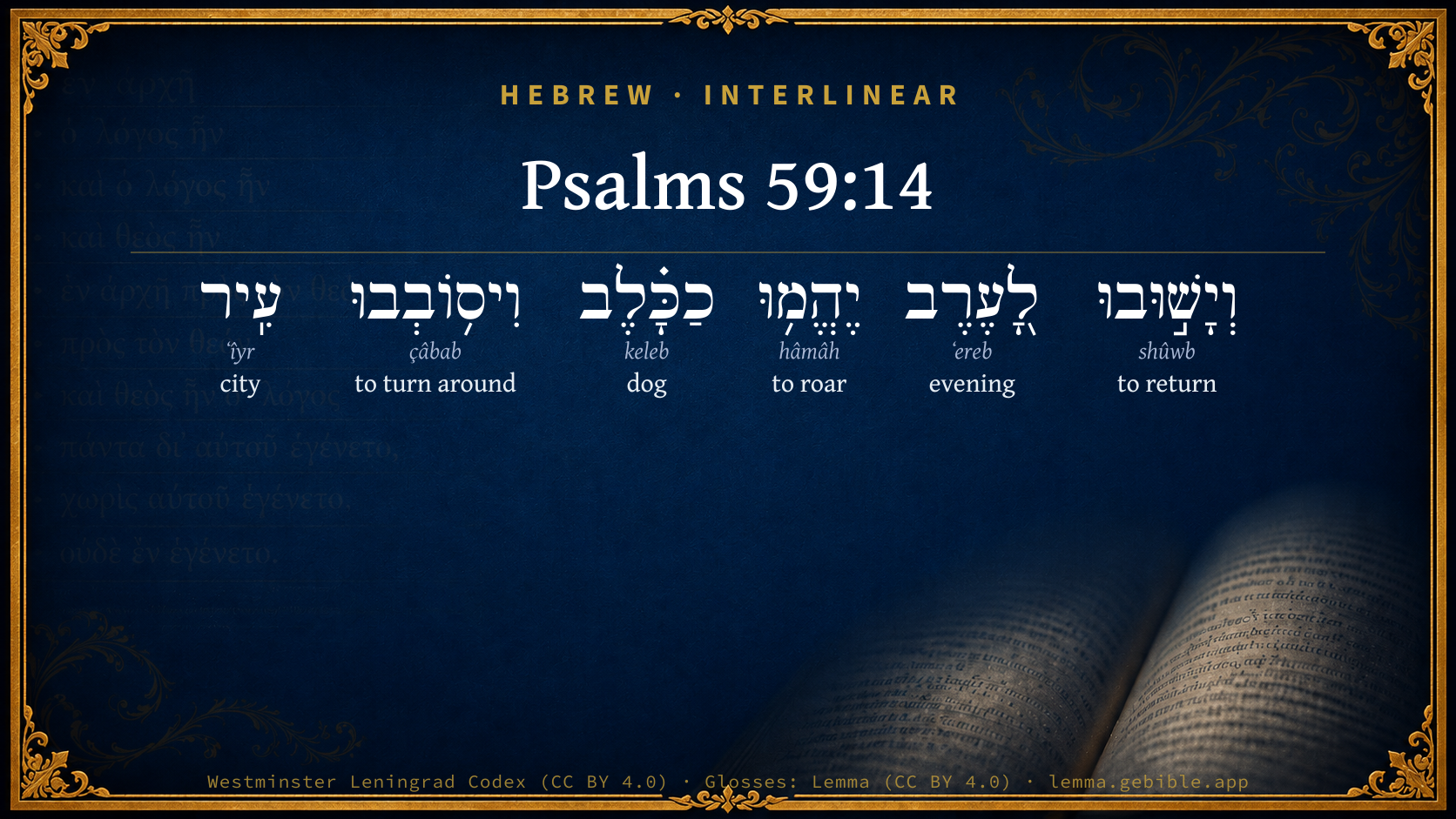
Hebrew (Westminster Leningrad Codex) Psalms 59:14 appears in the Hebrew Old Testament. The text above is from the Westminster Leningrad Codex. Each word links to its Strong’s number, a concise gloss, and parsing drawn from the Open Scriptures Hebrew Bible morphology. Click any word for its full Brown-Driver-Briggs (BDB) entry.
Download image
Cite this verse

Psalms 59:14 (World English Bible). Public Domain. Lemma interlinear Bible study tool, https://lemma.gebible.app/v/psalms/59/14.

Show BibTeX & RIS
BibTeX
RIS
English Translation
At evening let them return. Let them howl like a dog, and go around the city.
World English Bible · Public Domain
Download a study sheet

One document with this verse’s original text, its word-by-word gloss line, the meaning frame, cross-references with their text, attributed commentary, and full source and license credits — printable, and it pastes into notes with its structure intact.

This verse Autodidact and up

Study sheet (.html) Plain text (.txt)

A passage Seminary Student

Up to 50 verses in one chapter. A passage sheet keeps up to 6 commentary sources and 12 cross-references per verse, in the order this page ranks them, and says so on the sheet whenever that leaves anything out. Ask for a single verse and you get the Autodidact verse sheet above.

Everything on this page stays free to read, with no account — the sheet is a download of what is already on screen, not access to it.

Want to remove ads? Support Godless Engineer
Compare translations 3

The same verse in 3 English versions, stacked beneath the original-language interlinear above. Click any original word for its lexicon entry.

Each is an independent rendering of the whole verse — the interlinear is not word-aligned to these translations.

Highlighted words mark where these versions differ — a whole-verse word diff, not a word-by-word alignment.

  • World English Bible Public Domain
    At evening let them return. Let them howl like a dog, and go around the city.
  • King James Version Public Domain
    And at evening let them return; and let them make a noise like a dog, and go round about the city.
  • unfoldingWord Literal Text CC BY-SA 4.0
    They return at evening; they growl like a dog and go around the city.

unfoldingWord Literal Text — © unfoldingWord, licensed CC BY-SA 4.0. Word-aligned USFM3 via Door43 (git.door43.org/unfoldingWord/en_ult).

Versions to compare (up to 4)

3 of 4 selected

Show all 18 translations

Every available English version of this verse, each an independent rendering of the whole verse.

  • World English Bible Public Domain
    At evening let them return. Let them howl like a dog, and go around the city.
  • Berean Standard Bible Public Domain
    They return in the evening, snarling like dogs and prowling around the city.
  • Majority Standard Bible Public Domain
    They return in the evening, snarling like dogs and prowling around the city.
  • King James Version Public Domain
    And at evening let them return; and let them make a noise like a dog, and go round about the city.
  • American Standard Version (1901) Public Domain
    And at evening let them return, let them howl like a dog, And go round about the city.
  • Revised Version (1885) Public Domain
    And at evening let them return, let them make a noise like a dog, and go round about the city.
  • Geneva Bible (1599) Public Domain
    And in the euening they shall go to and from, and barke like dogs, and go about the citie.
  • Douay-Rheims (1899) Public Domain
    when they are consumed: when they are consumed by thy wrath, and they shall be no more. And they shall know that God will rule Jacob, and all the ends of the earth.
  • Young's Literal Translation Public Domain
    And they turn back at evening, They make a noise like a dog, And they go round about the city.
  • Literal Standard Version CC BY-SA 4.0
    And they return at evening, || They make a noise like a dog, || And they go around the city.
  • Unlocked Literal Bible CC BY-SA 4.0
    At evening they return, howling like dogs going around the city.
  • unfoldingWord Literal Text CC BY-SA 4.0
    They return at evening; they growl like a dog and go around the city.
  • Darby Bible Public Domain
    And in the evening they shall return, they shall howl like a dog, and go round about the city.
  • World Messianic Bible Public Domain
    At evening let them return. Let them howl like a dog, and go around the city.
  • Webster's Bible Public Domain
    \\59:13\\Consume them in wrath, consume them, that they may not be: and let them know that God ruleth in Jacob to the ends of the earth. Selah.
  • Free Bible Version CC BY-SA 4.0
    In the evening they return, snarling like dogs as they roam around the city.
  • Bible in Basic English Public Domain
    And in the evening let them come back, and make a noise like a dog, and go round the town.
  • JPS Tanakh (1917) Public Domain
    (59-15) And they return at evening, they howl like a dog, and go round about the city;

Literal Standard Version (2020), Covenant Press — licensed CC BY-SA 4.0. Text via the HelloAO Bible API (eBible.org). Unlocked Literal Bible (unfoldingWord) — licensed CC BY-SA 4.0. Text via the HelloAO Bible API (eBible.org). unfoldingWord Literal Text — © unfoldingWord, licensed CC BY-SA 4.0. Word-aligned USFM3 via Door43 (git.door43.org/unfoldingWord/en_ult). Free Bible Version, Dr. Jonathan Gallagher — licensed CC BY-SA 4.0. Text via the HelloAO Bible API (eBible.org).

Word by word

More ways to search: Search by grammar → Find every occurrence → Compare this word →

Practice this passage: Drill this verse → Learn its vocabulary →

About this verse

These counts appear in no published source. They are computed here, from the morphology-tagged text and Lemma’s own curated glosses. What Lemma adds →

6
words
6
distinct lemmas
Wisdom
section

Shared distinctive vocabulary

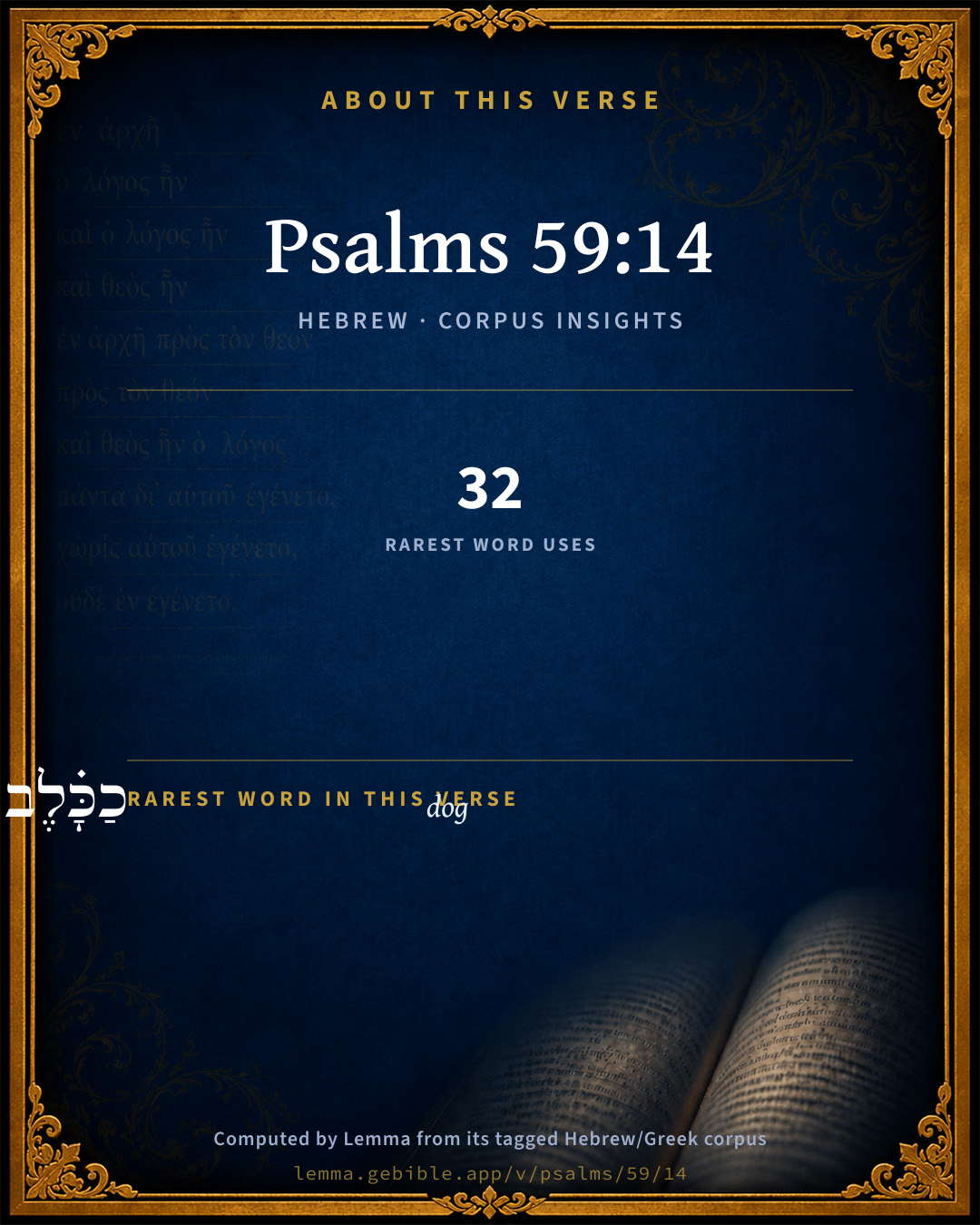
כַכָּ֗לֶב dog H3611 occurs in 31 verses of the Hebrew Bible. Also found in:

Grammatical profile

  • 3 verbs
  • 3 nouns

Verb forms

  • וְיָשׁ֣וּבוּ Qal · Imperfect
  • יֶהֱמ֥וּ Qal · Imperfect
  • וִיס֥וֹבְבוּ Poel · Imperfect

Hebrew & Septuagint length

In English translation the verse runs 16 words from the Hebrew and 17 from the Septuagint (LXX English) — closely comparable.

A rough comparison of the two English renderings, which tokenize alike — not a word-level alignment.

Word counts can differ between the Hebrew and the Greek without any difference in meaning — e.g. the Hebrew direct-object marker אֵת has no separate Greek word, and Greek often adds the article ὁ.

Cross-references

2

Topical passages linked to Psalms 59:14 in the Treasury of Scripture Knowledge — connected by theme and wording, ordered by reader-vote popularity; previews shown in the World English Bible.

  • Psalms 22:16 For dogs have surrounded me. A company of evil-doers have enclosed me. They pierced my hands and my feet.
  • Psalms 59:6 They return at evening, howling like dogs, And prowl around the city.

Cross-references courtesy of OpenBible.info (CC BY 4.0).

Hebrew and Greek witnesses Masoretic Hebrew ↔ Greek Septuagint

The same verse in the two great witnesses to the Old Testament, shown verse-for-verse.

You’re reading Greek Psalm 58 (Hebrew Psalm 59). The Septuagint counts the superscription, so verse numbers can differ from the Hebrew — chapter-level alignment, not verse-by-verse. Numbering follows Rahlfs.

These are two independent witnesses, not word-aligned to each other, and the Septuagint is shown in lemma (dictionary) form.

Hebrew Psalms 59:14 Masoretic · Westminster Leningrad Codex

וְיָשׁ֣וּבוּ לָ֭עֶרֶב יֶהֱמ֥וּ כַכָּ֗לֶב וִיס֥וֹבְבוּ עִֽיר

At evening let them return. Let them howl like a dog, and go around the city.

World English Bible · Public Domain

Greek LXX Greek Psalm 58:14 Septuagint · lemma form

ἐν ὀργή συντέλεια καί οὐ μή ὑποἄρχω καί γιγνώσκω ὅτι ὁ θεός δεσπόζω ὁ ἰακώβ ὁ πέρας ὁ γῆ διάψαλμα

They shall return at evening, and be hungry as a dog, and go round about the city.

LXX2012 (modern English Septuagint) · Public Domain

On this verse, The Cambridge Bible for Schools and Colleges discusses the Septuagint’s reading. Read the note in Commentary ↓

Hebrew: Westminster Leningrad Codex (CC BY 4.0). Greek: Septuagint (public domain); English from LXX2012 (modern English Septuagint) (Public Domain). How the Septuagint differs from the Hebrew →

Commentary

Notes on Psalms 59:14 from classic Christian and Jewish commentators (each source and its license shown beneath its notes). The classic Christian expositions comment on the surrounding passage and are grouped to its opening verse, so a note may address several verses; the Jewish commentaries on the Tanakh (Rashi and others) are per-verse, so they appear only where the commentator wrote on this verse.

Lemma curates 59 commentaries, every one of them public domain or Creative Commons licensed, each selected and text-cleaned for this edition rather than reprinted as found. About our sources →

Trapp's Complete Commentary

John Trapp

Psa 59:14 And at evening let them return; [and] let them make a noise like a dog, and go round about the city.

Ver. 14. And at evening let them return, &c.] Let these backsliders in heart be filled with their own ways; run about for hunger, as before they did for malice, Psa 59:6. Here the prophet mindeth to mock them, saith an interpreter, Revertantur famelici (Vat.). Sit poena eorum sicur peccatum (Kimchi).

John Trapp, A Commentary or Exposition upon All the Books of the Old and New Testament (1647–1656) — public domain. Text from a community e-Sword module.

Joseph Benson's Commentary

Psa 59:14-15. And at evening let them return, &c. — This is a repetition of the sixth verse, but is to be understood in a different sense. The sixth verse is a real complaint of their fury and diligence in pursuing him; here he speaks of them with a kind of indifference and contempt; and as free from any apprehension of danger from them. “Let them, if they please, return in the evening, growl at me like dogs, and watch all the avenues of the city, to take me; yet, like greedy dogs, they shall want their food, and wander about, as those shivering for hunger; for they shall not be satisfied, but murmur on account of their disappointment.” The Hebrew verbs of these verses are in the future tense, and ought to have been rendered, “They shall return, &c. They shall make a noise, and go round about the city. They shall wander about, shivering for hunger, and, because not satisfied, they shall murmur.” — Chandler and Houbigant.

Joseph Benson's Commentary on the Old and New Testaments (1811–1818) — public domain. Text from a community e-Sword module.

J. A. Alexander on Psalms

Joseph Addison Alexander

15. (Psa 59:14). Then let them return at evening, howl like the dog, and go around the city. The first word in Hebrew is a simple copulative, meaning and; but the connection seems to be, since God is my protector and these enemies are doomed to destruction, let them threaten as they will, I shall not fear them. It is equally grammatical, though not so natural, to understand the verse as a prediction or confident anticipation of the miserable state to which these enemies should be reduced, like a herd of oriental dogs without a master or a home, prowling about in search of food, and howling with hunger, but remaining still unsatisfied. See above, on Psa 59:6.

Joseph Addison Alexander, The Psalms Translated and Explained (1850) — public domain. Text from a community e-Sword module.

Tyndale Open Study Notes

Tyndale Open Resources

59:14-16 The wicked will go unsatisfied, but the psalmist will praise the Lord’s power and unfailing love.

Tyndale Open Study Notes — © Tyndale Open Resources, licensed CC BY-SA 4.0. Text via the HelloAO Bible API.

Geneva Bible (1599)

Geneva Bible translators

He mocketh at their vain enterprises, being assured that they shall not bring their purpose to pass.

Geneva Bible (1599) marginal notes — public domain. Text via Bolls.life.

Jamieson, Fausset & Brown

Robert Jamieson, A. R. Fausset & David Brown

Meanwhile let the rapacious dogs prowl, they cannot hurt the pious; yea, they shall wander famished and sleepless.

Jamieson, Fausset & Brown — Commentary Critical and Explanatory on the Whole Bible (1871) — public domain (CC PDM 1.0). Text via the HelloAO Bible API.

Adam Clarke's Commentary

Verse 14. At evening let them return] He had mentioned before, Ps 59:6, that these persons came like beasts of prey round the city striving to get in, that they might take possession. Now, being fully assured of God's protection, and that they shall soon be made a public example, he says, Let them return and make a noise like a dog, c., like dogs, jackals, and other famished creatures, who come howling about the city-walls for something to eat, and wander up and down for meat, grumbling because they are not satisfied, Ps 59:15. Nehemiah had made up all the breaches and had the city guarded so well day and night, by watches who continually relieved each other, that there was no longer any fear of being taken by surprise: and now they must feel like the hungry beasts who were disappointed of their prey.

Adam Clarke's Commentary on the Bible (1810–1826) — public domain. Text from a community e-Sword/MySword module.

John Calvin's Commentaries

14 And at evening they shall return It is of no consequence whether we read the words in the future tense or in the subjunctive, understanding it to be a continuance of the preceding prayer. But it seems more probable that David, after having brought his requests to a close, anticipates the happy issue which he desired. And he makes an apt allusion to what he had already said of their insatiable hunger. The words which he had formerly used he repeats, but with a different application, ironically declaring that they would be ravenous in another sense, and that matters would issue otherwise than they had looked for. Above he had complained that they made a noise like dogs, adverting to the eagerness and fierceness with which they were bent upon mischief; now he derides their malicious efforts, and says, that after wearying themselves with their endless pursuit all day, they would go disappointed of their purpose. He uses no longer the language of complaint, but congratulates himself upon the abortive issue of their activity. The Hebrew word which I have translated, if not, in the close of the fifteenth verse, is by some considered to be the form of an oath. But this is an over-refined interpretation. Others would have the negation repeated, reading, if they shall not have been satisfied, neither shall they lodge for the night But this also is far-fetched. The simple and true meaning suggests itself at once, that, although they might not be satisfied, they would be forced to lay themselves down, and the misery of their hunger would be aggravated, by the circumstance that they had passed the whole day in fruitless application, and must lie down for the night empty, wearied, and unsatisfied.

John Calvin's Commentaries (1540-1563) — public domain. Text from the Calvin Translation Society English edition (1840s-50s) via the Christian Classics Ethereal Library (ccel.org). Calvin's coverage is partial (roughly two-thirds of the Bible); uncommented books and verses are honest gaps, never fabricated. The 19th-century editor's footnotes and remarks are omitted so the notes are faithfully Calvin's own voice.

The Cambridge Bible for Schools and Colleges

gen. ed. J. J. S. Perowne

14. A repetition of Psa_59:6. But is it (1) as the A.V. appears to take it, an ironical repetition as a curse? let them do now perforce what they did before in malice and wantonness, wandering to and fro (cp. Psa_59:11) in unsatisfied hunger. Or is it (2) a reiterated description of the writer’s present situation, introduced here to emphasise the contrast of his own security under Jehovah’s protection? The second alternative is preferable, as giving full force to the emphatic they (Psa_59:15) and But I (Psa_59:16). Render,

And though they return at evening, howl like dogs, and go round about the city,

Though they wander to and fro for meat,

And tarry all night if they be not satisfied;

Yet as for me, I shall sing &c.

The prey of which they were in quest was the Psalmist himself. Disappointed in their attempt they might tarry all night, yet he is confident that the dawn will see him still safe, and bring fresh occasion for praise. The A.V. grudge, i.e. murmur, follows the LXX and Jer.; but the contrast ‘in the morning’ (Psa_59:15) is in favour of R.V. (cp. A.V. marg.) tarry all night.

14–17. The Psalmist contrasts the baffled rage of his persecutors with his own calm trust in God.

The Cambridge Bible for Schools and Colleges (gen. ed. J. J. S. Perowne; Cambridge University Press, 1878–1918) — public domain. Text from a community e-Sword module.

John Gill's Exposition

And at evening let them return; and let them make a noise like a dog, and go round about the city. What in Psa 59:6 is related as matter of fact, is here expressed by way of imprecation; and what is there taken notice of as their sin, is here wished for at their punishment; unless it can be thought that this should refer to the conversion and return of the Jews in the evening of the world, and to their humiliation and mourning for piercing Christ, and to their very distressed and uncomfortable condition they will be in, until they have satisfaction that their sins are forgiven them; See Gill on Psa 59:6.

.

Psalms 59:15

psa 59:15

psa 59:15

psa 59:15Let them wander up and down for meat,.... Like hungry dogs;

and grudge if they be not satisfied; or murmur and howl as dogs when hungry, and can find nothing to eat; or "when they shall not be satisfied, and shall lodge" (z); when they shall get nothing to satisfy their hungry appetite, and shall go to bed without a supper, and lie all night without food. The Targum is,

"they shall wander about to seize the prey to eat, and will not rest till the are satisfied, and will lie all night;''

that is, in quest of prey.

(z) "nec satiati cubabunt", Tigurine version; "famelici pernoctabunt", Michaelis.

John Gill's Exposition of the Whole Bible (1746–1763) — public domain (CC PDM 1.0). Text via the HelloAO Bible API.

Albert Barnes' Notes on the Bible

And at evening let them return - See the notes at Psa 59:6. The original here is the same as in Psa 59:6, with the exception of the word “and” at the beginning. This qualifies the sentence, and makes the construction in our version proper. The language is that of confident triumph. They came around the city to take David; they shouted and shrieked as dogs bark and howl when they come upon their prey. David asked God to interpose and save him; and then, says he, let them come if they will, and howl around the city; they will find no prey; they will be like hungry dogs from whom their anticipated victim has escaped. Let them come, and howl and rage. They can do no harm. They will meet with disappointment; and such disappointment will be a proper punishment for their sins.

Albert Barnes' Notes on the Bible (1834–1885) — public domain. Text from a community e-Sword/MySword module.

Matthew Poole's English Annotations

What was their sin and their choice to do with evil design, let it be their punishment to do it by constraint, and for meat, as it follows, Psa 59:15.

Matthew Poole's English Annotations on the Holy Bible (1683–1685) — public domain. Text from a community e-Sword/MySword module.

The Treasury of David

Charles H. Spurgeon

Ver. 14. Here verse six is repeated, as if the songster defied his foes and revelled in the thought of their futile search, their malice, their disappointment, their rage, their defeated vigilance, their wasted energy. He laughs to think that all the city would know how they were deceived, and all Israel would ring with the story of the image and the goats' hair in the bed. Nothing was more a subject of Oriental merriment than a case in which the crafty are deceived, and nothing more makes a man the object of derision than to be outwitted by a woman, as in this instance Saul and his base minions were by Michal. The warrior poet hears in fancy the howl of rage in the council of his foes when they found their victim clean escaped from their hands.

Ver. 14. Dog. Is it the influence of Christianity extending its law of kindness to the lower animals, or something in the nature of northern dogs and northern men which makes dogs among us Anglo Saxons, and all the associations connected with them, so entirely different from what they are in the East? Imagine the effigy of an Oriental saint reposing with its feet on a dog, like that of William the Silent, the heroic Prince of Orange, on the faithful spaniel which rescued his life in the night attack of the Spanish troops, and like so many a sculptured knight of medieval times! The very presence of such an image would, in Oriental eyes, be the greatest desecration an enemy could inflict on a sacred edifice. And in the Bible how exceedingly contemptuous, and how inapplicable to English dogs, are the terms employed in describing canine habits. "They grin like a dog, and go about the city, and grudge if they be not satisfied; " "Without are dogs." What possible resemblance is there between such a description and the grave dignity of a Newfoundland; the sagacious, acute expression of a terrier; the wistful, almost human eyes of our house spaniels? But here at Tyre, as in most Eastern towns, the familiar words came to us with all their true and forcible meaning. The wolfish, hungry, masterless dogs which "go about the cities (of Alexandria, for instance), gathering in packs like jackals, prowling about for offal, and grudging if they be not satisfied; "or the famished outcasts, like our dogs at Tyre, prowling "outside" the city. To these we may apply the highly unfavourable definitions of Scripture, which every Englishman and Englishwoman must indignantly disclaim on behalf of the loyal, faithful, patient creatures who watch beside our homes like sentinels, and guard our flocks like shepherds, and welcome us with ecstatic joy when we come home again, and sometimes will even die rather than desert a master's grave. From "Wanderings over Bible Lands and Seas, "1862.

Ver. 14. Those that repent of their sins when they are in trouble, mourn like doves; those whose hearts are hardened when they are in trouble, make a noise like dogs. Matthew Henry.

None.

Psalms 59:15*

Charles H. Spurgeon's The Treasury of David (1869–1885) — public domain. Psalms only. Text from a community e-Sword/MySword module.

Whedon's Commentary on the Bible

Daniel D. Whedon

14. And at evening let them return—Or, they shall return. A recurrence of the refrain, Psa_59:6, and an expression of the last degree of contempt, which must have produced inimitable effect in the musical performance.

Daniel D. Whedon (gen. ed.), Commentary on the Old and New Testaments (1874–1909) — public domain. Text from a community e-Sword module.

The Pulpit Commentary

Vers. 14-17. David here turns back from the future fate of his enemies to their present condition, and repeats ver. 7 verbatim. He thus reminds himself of his existing danger; he is still being sought they are still in quest of their prey, and will continue so till morning comes (ver. 15). But in the morning he will be gone he will have escaped them. Upon this thought occurring, he raises a renewed thanksgiving to God (vers. 16, 17)

And at evening let them return; rather, they return, as in ver. 6. And let them make a noise like a dog; rather, they make a noise. And go round about the city. Keeping their watch upon me.

The Pulpit Commentary (1880–1919), ed. H.D.M. Spence-Jones & Joseph S. Exell — public domain. Text from a community e-Sword module.

unfoldingWord translationNotes

Door43 World Missions Community

howling like dogs

The psalmist speaks of his enemies threatening to attack people as if they were dogs howling, growling, or barking at people. AT: "threatening to attack us" or "threatening to attack us like wild dogs" (See: Simile)

satisfied

content, having everything they want

unfoldingWord translationNotes — © Distant Shores Media and the Door43 World Missions Community, licensed CC BY-SA 4.0. Source: git.door43.org/Door43/en_tn.

Rashi

Rabbi Shlomo Yitzchaki (Rashi)

Destroy [them] with wrath Destroy them with Your wrath, O King Who judges, and let them know that You rule over Jacob.

Rashi on the Tanakh — English translations: “The Judaica Press complete Tanach with Rashi, translated by A. J. Rosenberg” (CC BY 4.0); “Pentateuch with Rashi's commentary by M. Rosenbaum and A.M. Silbermann, 1929-1934” (public domain); “The Metsudah Tanach series, Lakewood, N.J” (CC BY 4.0); and “The Book of Joshua, Metsudah Publications, 1997” (CC BY 4.0). Text via Sefaria.

Lesson kit

Teaching starters — assembled from the data on this page, not authored interpretation. Every prompt links to the verse data it draws on. Edit before teaching.

Psalms, in the Wisdom, opens this verse with 6 words (6 distinct Hebrew lemmas). Its most distinctive word is keleb (“dog”). A historical commentator’s framing appears above. Read the whole chapter for the surrounding context.

Discussion questions

  1. What does “dog” (keleb) contribute to the verse as a whole?
  2. How does Exodus 11:7, which shares the word «dog», read alongside this verse?
  3. These translations render this verse differently. What is at stake in choosing one wording over another?
  4. «וְיָשׁ֣וּבוּ» is a Qal Imperfect verb. How does that grammatical form shape the action described?
  5. Compare how Trapp's Complete Commentary and Joseph Benson's Commentary read this verse. Where do they agree or differ?

Things to notice

Reading settings

Reading text

Shown beneath each verse's original-language words.

Old Testament
Old Testament edition

Read the OT as the Masoretic Hebrew (MT) or the Greek Septuagint (LXX).

English shown for the Greek Septuagint (in the Hebrew ↔ Greek comparison).

Comparing translations? Open the Compare panel on any verse page to stack up to four side by side.