
Joshua 22:27

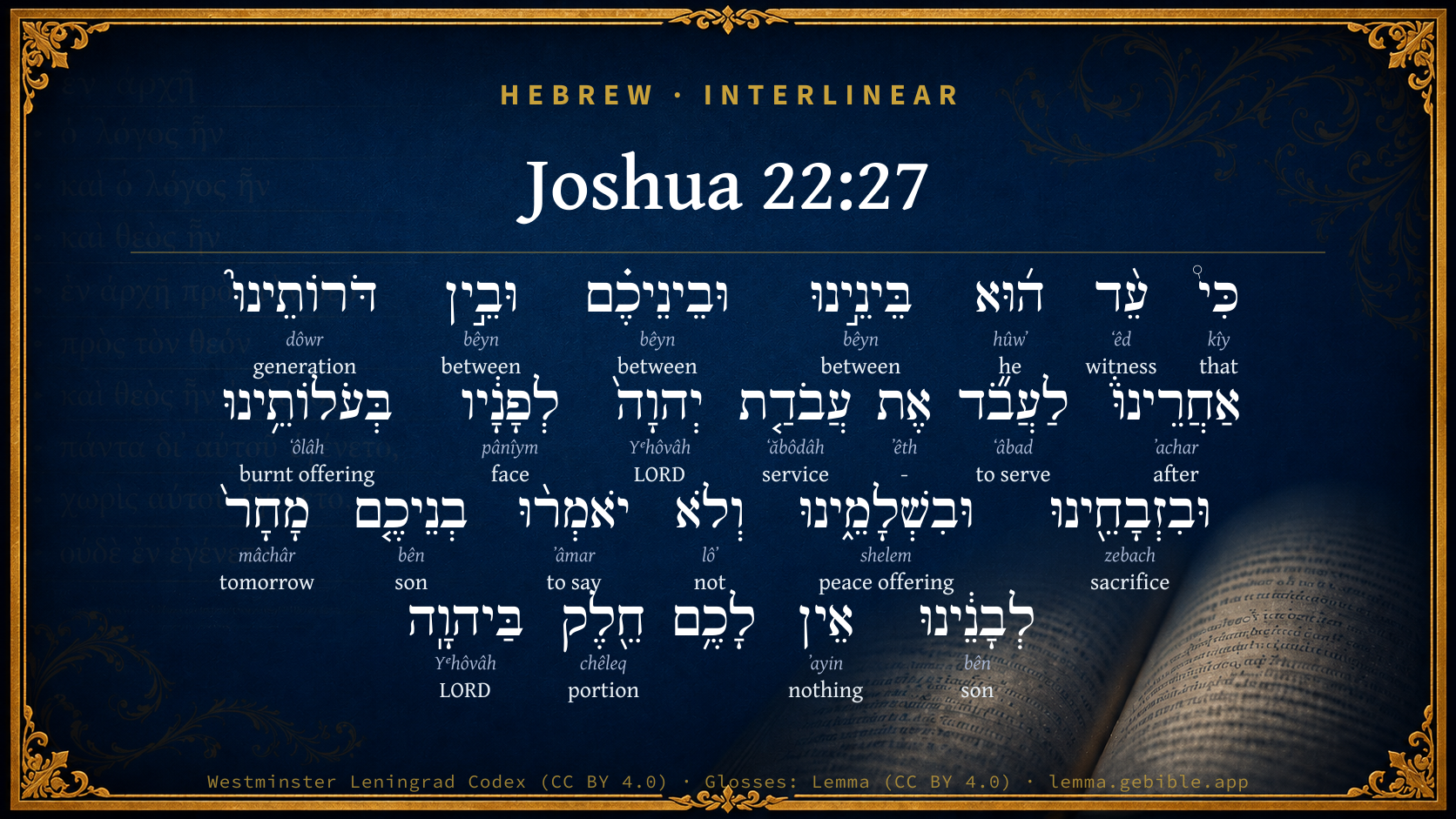
Hebrew (Westminster Leningrad Codex) Joshua 22:27 appears in the Hebrew Old Testament. The text above is from the Westminster Leningrad Codex. Each word links to its Strong’s number, a concise gloss, and parsing drawn from the Open Scriptures Hebrew Bible morphology. Click any word for its full Brown-Driver-Briggs (BDB) entry.
Download image
Cite this verse

Joshua 22:27 (World English Bible). Public Domain. Lemma interlinear Bible study tool, https://lemma.gebible.app/v/joshua/22/27.

Show BibTeX & RIS
BibTeX
RIS
English Translation
but it shall be a witness between us and you, and between our generations after us, that we may do the service of Yahweh before him with our burnt offerings, and with our sacrifices, and with our peace-offerings; that your children may not tell our children in time to come, You have no portion in Yahweh.
World English Bible · Public Domain
Download a study sheet

One document with this verse’s original text, its word-by-word gloss line, the meaning frame, cross-references with their text, attributed commentary, and full source and license credits — printable, and it pastes into notes with its structure intact.

This verse Autodidact and up

Study sheet (.html) Plain text (.txt)

A passage Seminary Student

Up to 50 verses in one chapter. A passage sheet keeps up to 6 commentary sources and 12 cross-references per verse, in the order this page ranks them, and says so on the sheet whenever that leaves anything out. Ask for a single verse and you get the Autodidact verse sheet above.

Everything on this page stays free to read, with no account — the sheet is a download of what is already on screen, not access to it.

Want to remove ads? Support Godless Engineer
Compare translations 3

The same verse in 3 English versions, stacked beneath the original-language interlinear above. Click any original word for its lexicon entry.

Each is an independent rendering of the whole verse — the interlinear is not word-aligned to these translations.

Highlighted words mark where these versions differ — a whole-verse word diff, not a word-by-word alignment.

  • World English Bible Public Domain
    but it shall be a witness between us and you, and between our generations after us, that we may do the service of Yahweh before him with our burnt offerings, and with our sacrifices, and with our peace-offerings; that your children may not tell our children in time to come, You have no portion in Yahweh.
  • King James Version Public Domain
    But that it may be a witness between us, and you, and our generations after us, that we might do the service of the LORD before him with our burnt offerings, and with our sacrifices, and with our peace offerings; that your children may not say to our children in time to come, Ye have no part in the LORD.
  • unfoldingWord Literal Text CC BY-SA 4.0
    but it a witness between us and between you and between our generations after us, to serve the service of Yahweh to his face with our burnt offerings and with our sacrifices and with our peace offerings. And your sons will not say to our sons tomorrow, “No portion for you in Yahweh.”’

unfoldingWord Literal Text — © unfoldingWord, licensed CC BY-SA 4.0. Word-aligned USFM3 via Door43 (git.door43.org/unfoldingWord/en_ult).

Versions to compare (up to 4)

3 of 4 selected

Show all 18 translations

Every available English version of this verse, each an independent rendering of the whole verse.

  • World English Bible Public Domain
    but it shall be a witness between us and you, and between our generations after us, that we may do the service of Yahweh before him with our burnt offerings, and with our sacrifices, and with our peace-offerings; that your children may not tell our children in time to come, You have no portion in Yahweh.
  • Berean Standard Bible Public Domain
    Rather, let it be a witness between us and you and the generations to come, that we will worship the LORD in His presence with our burnt offerings, sacrifices, and peace offerings.’ Then in the future, your descendants cannot say to ours, ‘You have no share in the LORD!’
  • Majority Standard Bible Public Domain
    Rather, let it be a witness between us and you and the generations to come, that we will worship the LORD in His presence with our burnt offerings, sacrifices, and peace offerings.’ Then in the future, your descendants cannot say to ours, ‘You have no share in the LORD!’
  • King James Version Public Domain
    But that it may be a witness between us, and you, and our generations after us, that we might do the service of the LORD before him with our burnt offerings, and with our sacrifices, and with our peace offerings; that your children may not say to our children in time to come, Ye have no part in the LORD.
  • American Standard Version (1901) Public Domain
    but it shall be a witness between us and you, and between our generations after us, that we may do the service of Jehovah before him with our burnt-offerings, and with our sacrifices, and with our peace-offerings; that your children may not say to our children in time to come, Ye have no portion in Jehovah.
  • Revised Version (1885) Public Domain
    but it shall be a witness between us and you, and between our generations after us, that we may do the service of the LORD before him with our burnt offerings, and with our sacrifices, and with our peace offerings; that your children may not say to our children in time to come, Ye have no portion in the LORD.
  • Geneva Bible (1599) Public Domain
    But it shall be a witnesse betweene vs and you, and betweene our generations after vs, to execute the seruice of the Lord before him in our burnt offerings, and in our sacrifices, and in our peace offerings, and that your children should not say to our children in time to come, Ye haue no part in the Lord.
  • Douay-Rheims (1899) Public Domain
    But for a testimony between us and you, and our posterity and yours, that we may serve the Lord, and that we may have a right to offer both holocausts, and victims and sacrifices of peace offerings: and that your children to morrow may not say to our children: You have no part in the Lord.
  • Young's Literal Translation Public Domain
    but a witness it `is' between us and you, and between our generations after us, to do the service of Jehovah before Him with our burnt-offerings, and with our sacrifices, and with our peace-offerings, and your sons do not say hereafter to our sons, Ye have no portion in Jehovah.
  • Literal Standard Version CC BY-SA 4.0
    but it [is] a witness between us and you, and between our generations after us, to do the service of YHWH before Him with our burnt-offerings, and with our sacrifices, and with our peace-offerings, and your sons do not say hereafter to our sons, You have no portion in YHWH.
  • Unlocked Literal Bible CC BY-SA 4.0
    but to be a witness between us and you, and between our generations after us, that we will perform the service of Yahweh before him, with our burnt offerings and with our sacrifices and with our peace offerings, so that your children will never say to our children in time to come, “You have no share in Yahweh.”'
  • unfoldingWord Literal Text CC BY-SA 4.0
    but it a witness between us and between you and between our generations after us, to serve the service of Yahweh to his face with our burnt offerings and with our sacrifices and with our peace offerings. And your sons will not say to our sons tomorrow, “No portion for you in Yahweh.”’
  • Darby Bible Public Domain
    but to be a witness between us and you, and between our generations after us, that we might do service to Jehovah before him with our burnt-offerings, and with our sacrifices, and with our peace-offerings; that your children may not say to our children in future, Ye have no portion in Jehovah.
  • World Messianic Bible Public Domain
    but it will be a witness between us and you, and between our generations after us, that we may perform the service of the LORD before him with our burnt offerings, with our sacrifices, and with our peace offerings;’ that your children may not tell our children in time to come, ‘You have no portion in the LORD.’
  • Webster's Bible Public Domain
    But that it may be a witness between us, and you, and our generations after us, that we may do the service of the LORD before him with our burnt-offerings, and with our sacrifices, and with our peace-offerings; that your children may not say to our children in time to come, Ye have no part in the LORD.
  • Free Bible Version CC BY-SA 4.0
    but as a witness between us and you, and for the generations that come after us, that we will come to worship the Lord in his presence with our burnt offerings, sacrifices, and friendship offerings.’ Then your descendants will not be able to say to ours in the future, ‘You don't belong to the Lord.’
  • Bible in Basic English Public Domain
    But to be a witness between us and you, and between the future generations, that we have the right of worshipping the Lord with our burned offerings and our offerings of beasts and our peace-offerings; so that your children will not be able to say to our children in time to come, You have no part in the Lord.
  • JPS Tanakh (1917) Public Domain
    but it shall be a witness between us and you, and between our generations after us, that we may do the service of the LORD before Him with our burnt-offerings, and with our sacrifices, and with our peace-offerings; that your children may not say to our children in time to come: Ye have no portion in the LORD.

Literal Standard Version (2020), Covenant Press — licensed CC BY-SA 4.0. Text via the HelloAO Bible API (eBible.org). Unlocked Literal Bible (unfoldingWord) — licensed CC BY-SA 4.0. Text via the HelloAO Bible API (eBible.org). unfoldingWord Literal Text — © unfoldingWord, licensed CC BY-SA 4.0. Word-aligned USFM3 via Door43 (git.door43.org/unfoldingWord/en_ult). Free Bible Version, Dr. Jonathan Gallagher — licensed CC BY-SA 4.0. Text via the HelloAO Bible API (eBible.org).

Word by word

More ways to search: Search by grammar → Find every occurrence → Compare this word →

Practice this passage: Drill this verse → Learn its vocabulary →

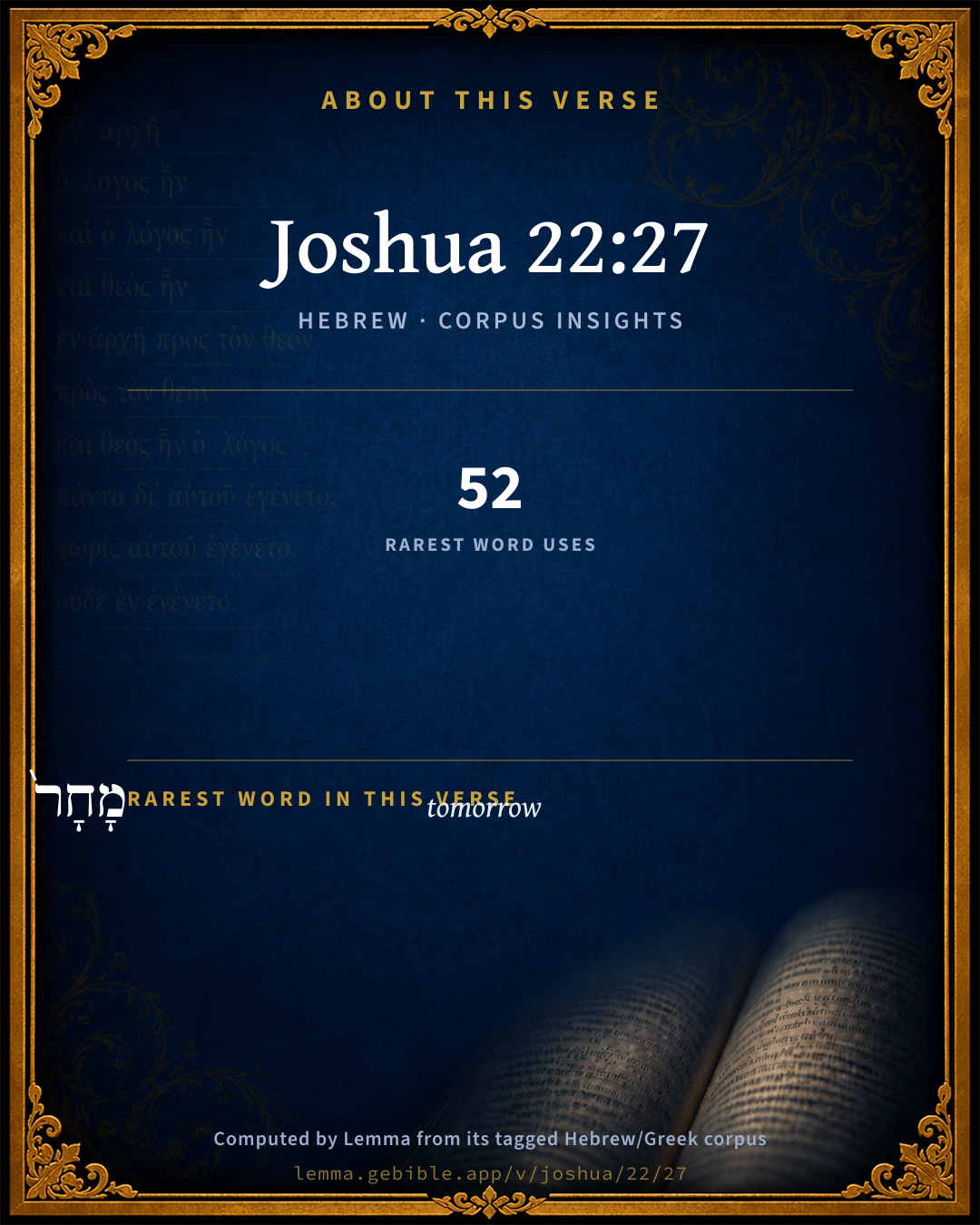
מָחָר֙
mâchâr
H4279
“tomorrow”
Noun, Common, Masculine, Singular, Absolute
Part of Speech
Noun
Type
Common
Gender
Masculine
Number
Singular
State
Absolute
Full BDB Definition

Origin: probably from H309

TWOT: 1185a

tomorrow, in time to come, in the future - tomorrow (as the day following the present day) - in future time
  1. כִּי֩ kîy H3588 “that” Conjunction
  2. עֵ֨ד ʻêd H5707 “witness” Noun, Common, Masculine, Singular, Absolute
  3. ה֜וּא hûwʼ H1931 “he” Pronoun, Personal, 3rd Person, Masculine, Singular
  4. בֵּינֵ֣ינוּ bêyn H996 “between · us” Preposition + Suffix, Personal, 1st Person, Common, Plural
  5. וּבֵינֵיכֶ֗ם bêyn H996 “and · between · you” Conjunction + Preposition + Suffix, Personal, 2nd Person, Masculine, Plural
  6. וּבֵ֣ין bêyn H996 “and · between” Conjunction + Preposition
  7. דֹּרוֹתֵינוּ֮ dôwr H1755 “generations · our” Noun, Common, Masculine, Plural, Construct + Suffix, Personal, 1st Person, Common, Plural
  8. אַחֲרֵינוּ֒ ʼachar H310 “after · us” Preposition + Suffix, Personal, 1st Person, Common, Plural
  9. לַעֲבֹ֞ד ʻâbad H5647 “to serve” Preposition + Verb, Qal, Infinitive Construct
  10. אֶת ʼêth H853 “-” Particle, Direct Object
  11. עֲבֹדַ֤ת ʻăbôdâh H5656 “service of” Noun, Common, Feminine, Singular, Construct
  12. יְהוָה֙ Yᵉhôvâh H3068 “LORD” Noun, Proper
  13. לְפָנָ֔יו pânîym H6440 “to/for · face(s) · his” Preposition + Noun, Common, Both, Plural, Construct + Suffix, Personal, 3rd Person, Masculine, Singular
  14. בְּעֹלוֹתֵ֥ינוּ ʻôlâh H5930 “in/at · burnt offerings · our” Preposition + Noun, Common, Feminine, Plural, Construct + Suffix, Personal, 1st Person, Common, Plural
  15. וּבִזְבָחֵ֖ינוּ zebach H2077 “and · in/at · sacrifices · our” Conjunction + Preposition + Noun, Common, Masculine, Plural, Construct + Suffix, Personal, 1st Person, Common, Plural
  16. וּבִשְׁלָמֵ֑ינוּ shelem H8002 “and · in/at · peace offerings · our” Conjunction + Preposition + Noun, Common, Masculine, Plural, Construct + Suffix, Personal, 1st Person, Common, Plural
  17. וְלֹא lôʼ H3808 “and · not” Conjunction + Particle, Negative
  18. יֹאמְר֨וּ ʼâmar H559 “to say” Verb, Qal, Imperfect, 3rd Person, Masculine, Plural
  19. בְנֵיכֶ֤ם bên H1121 “sons · your” Noun, Common, Masculine, Plural, Construct + Suffix, Personal, 2nd Person, Masculine, Plural
  20. לְבָנֵ֔ינוּ bên H1121 “to/for · sons · our” Preposition + Noun, Common, Masculine, Plural, Construct + Suffix, Personal, 1st Person, Common, Plural
  21. אֵין ʼayin H369 “nothing” Particle, Negative
  22. חֵ֖לֶק chêleq H2506 “portion” Noun, Common, Masculine, Singular, Absolute
  23. בַּיהוָֽה Yᵉhôvâh H3068 “in/at · LORD” Preposition + Noun, Proper

About this verse

These counts appear in no published source. They are computed here, from the morphology-tagged text and Lemma’s own curated glosses. What Lemma adds →

25
words
20
distinct lemmas
Historical
section

Shared distinctive vocabulary

מָחָר֙ tomorrow H4279 occurs in 52 verses of the Hebrew Bible. Also found in:

Grammatical profile

  • 2 verbs
  • 13 nouns
  • 1 pronoun
  • 5 prepositions
  • 1 conjunction
  • 3 particles

Verb forms

  • לַעֲבֹ֞ד Qal · Infinitive Construct
  • יֹאמְר֨וּ Qal · Imperfect

Repetition

Words recur within this verse — often emphatic in Hebrew:

  • בֵּינֵ֣ינוּ between H996 ×3
  • יְהוָה֙ LORD H3068 ×2
  • בְנֵיכֶ֤ם son H1121 ×2

Hebrew & Septuagint length

In English translation the verse runs 56 words from the Hebrew and 54 from the Septuagint (LXX English) — closely comparable.

A rough comparison of the two English renderings, which tokenize alike — not a word-level alignment.

Word counts can differ between the Hebrew and the Greek without any difference in meaning — e.g. the Hebrew direct-object marker אֵת has no separate Greek word, and Greek often adds the article ὁ.

Cross-references

10

Topical passages linked to Joshua 22:27 in the Treasury of Scripture Knowledge — connected by theme and wording, ordered by reader-vote popularity; previews shown in the World English Bible.

  • Joshua 24:27 Joshua said to all the people, Behold, this stone shall be a witness against us; for it has heard all the words of Yahweh which he spoke to us: it shall be therefore a witness against you, lest you deny your God.
  • Genesis 31:48 Laban said, "This heap is witness between me and you this day." Therefore it was named Galeed
  • Deuteronomy 12:5–6 But to the place which Yahweh your God shall choose out of all your tribes, to put his name there, even to his habitation shall you seek, and there you shall come;
  • Deuteronomy 12:11 then it shall happen that to the place which Yahweh your God shall choose, to cause his name to dwell there, there shall you bring all that I command you: your burnt offerings, and your sacrifices, your tithes, and the heave-offering of your hand, and all your choice vows which you vow to Yahweh.
  • Deuteronomy 12:17–18 You may not eat within your gates the tithe of your grain, or of your new wine, or of your oil, or the firstborn of your herd or of your flock, nor any of your vows which you vow, nor your freewill-offerings, nor the heave-offering of your hand;
  • Joshua 22:34 The children of Reuben and the children of Gad called the altar [Ed]: For, [said they], it is a witness between us that Yahweh is God.
  • Genesis 31:52 May this heap be a witness, and the pillar be a witness, that I will not pass over this heap to you, and that you will not pass over this heap and this pillar to me, for harm.
  • Deuteronomy 12:26–27 Only your holy things which you have, and your vows, you shall take, and go to the place which Yahweh shall choose:
  • Joshua 22:10 When they came to the region about the Jordan, that is in the land of Canaan, the children of Reuben and the children of Gad and the half-tribe of Manasseh built there an altar by the Jordan, a great altar to look on.
  • 1 Samuel 7:12 Then Samuel took a stone, and set it between Mizpah and Shen, and called the name of it Ebenezer, saying, Hitherto has Yahweh helped us.

Cross-references courtesy of OpenBible.info (CC BY 4.0).

Hebrew and Greek witnesses Masoretic Hebrew ↔ Greek Septuagint

The same verse in the two great witnesses to the Old Testament, shown verse-for-verse.

These are two independent witnesses, not word-aligned to each other, and the Septuagint is shown in lemma (dictionary) form.

Hebrew Joshua 22:27 Masoretic · Westminster Leningrad Codex

כִּי֩ עֵ֨ד ה֜וּא בֵּינֵ֣ינוּ וּבֵינֵיכֶ֗ם וּבֵ֣ין דֹּרוֹתֵינוּ֮ אַחֲרֵינוּ֒ לַעֲבֹ֞ד אֶת עֲבֹדַ֤ת יְהוָה֙ לְפָנָ֔יו בְּעֹלוֹתֵ֥ינוּ וּבִזְבָחֵ֖ינוּ וּבִשְׁלָמֵ֑ינוּ וְלֹא יֹאמְר֨וּ בְנֵיכֶ֤ם מָחָר֙ לְבָנֵ֔ינוּ אֵין לָכֶ֥ם חֵ֖לֶק בַּיהוָֽה

but it shall be a witness between us and you, and between our generations after us, that we may do the service of Yahweh before him with our burnt offerings, and with our sacrifices, and with our peace-offerings; that your children may not tell our children in time to come, You have no portion in Yahweh.

World English Bible · Public Domain

Greek LXX Joshua 22:27 Septuagint · lemma form

ἀλλά ἵνα εἰμί οὗτος μαρτύριον ἀνά μέσος ἐγώ καί σύ καί ἀνά μέσος ὁ γενεά ἐγώ μετά ἐγώ ὁ λατρεύω λατρεία κύριος ἐναντίον αὐτός ἐν ὁ κάρπωμα ἐγώ καί ἐν ὁ θυσία ἐγώ καί ἐν ὁ θυσία ὁ σωτήριον ἐγώ καί οὐ εἶπον ὁ τέκνον σύ ὁ τέκνον ἐγώ αὔριον οὐ εἰμί σύ μερίς κύριος

but that this may be a witness between you and us, and between our posterity after us, that we may do service to the Lord before him, with our burnt offerings and our meat-offerings and our peace-offerings: so your sons shall not say to our sons, hereafter, You⌃ have no portion in the Lord.

LXX2012 (modern English Septuagint) · Public Domain

Hebrew: Westminster Leningrad Codex (CC BY 4.0). Greek: Septuagint (public domain); English from LXX2012 (modern English Septuagint) (Public Domain). How the Septuagint differs from the Hebrew →

Targum (Aramaic paraphrase)

1

The Targum is the ancient Jewish Aramaic paraphrase of the Hebrew Scriptures — an interpretive translation, not the Hebrew text itself. Onkelos (literal) and Pseudo-Jonathan (expansive) render the Torah, and Jonathan the Prophets. Coverage is partial: where no permissively-licensed English translation exists for a verse, only the Aramaic is shown. This is verse-level text, not a word-by-word alignment to the Hebrew.

  1. Targum Jonathan Prophets (Joshua–Malachi)
    אֲרֵי סָהִיד הוּא בֵּינָנָא וּבֵינֵיכוֹן וּבֵין דָרָנָא בַּתְרָנָא לְמִפְלַח יַת פּוּלְחָנָא דַייָ קֳדָמוֹהִי בְּעַלָוְתָנָא וּבְדִבְחָנָא וּבְנִכְסַת קוּדְשָׁנָא וְלָא יֵמְרוּן בְּנֵיכוֹן לִבְנָנָא מְחַר לֵית לְכוֹן חוּלַק בְּמֵימְרָא דַיָי:

    (no public-domain English translation for this verse)

    Targum Jonathan — Aramaic: “Mikraot Gedolot” (public domain). English: “Sefaria Community Translation” (CC0 1.0 (public-domain dedication)); “London "Chaldee Paraphrase," 1871” (public domain). Text via Sefaria.

Commentary

Notes on Joshua 22:27 from classic Christian and Jewish commentators (each source and its license shown beneath its notes). The classic Christian expositions comment on the surrounding passage and are grouped to its opening verse, so a note may address several verses; the Jewish commentaries on the Tanakh (Rashi and others) are per-verse, so they appear only where the commentator wrote on this verse.

Lemma curates 59 commentaries, every one of them public domain or Creative Commons licensed, each selected and text-cleaned for this edition rather than reprinted as found. About our sources →

Trapp's Complete Commentary

John Trapp

Jos 22:27 But [that] it [may be] a witness between us, and you, and our generations after us, that we might do the service of the LORD before him with our burnt offerings, and with our sacrifices, and with our peace offerings; that your children may not say to our children in time to come, Ye have no part in the LORD.

Ver. 27. But that it may be a witness.] Of our care to hold communion with you in the sincere service of God, by our engraving some inscription upon it, or keeping in our treasury of monuments some public record, when, by whom, or to what end that altar was built.

John Trapp, A Commentary or Exposition upon All the Books of the Old and New Testament (1647–1656) — public domain. Text from a community e-Sword module.

Joseph Benson's Commentary

Jos 22:27. But that it may be a witness — It was an ancient way of preserving the remembrance of things to raise such structures. That we might do the service of the Lord before him — That we and ours may have and retain the privilege of serving and worshipping God, not upon this altar, but in the place of God’s presence, in your tabernacle, and upon your altar.

Joseph Benson's Commentary on the Old and New Testaments (1811–1818) — public domain. Text from a community e-Sword module.

Tyndale Open Study Notes

Tyndale Open Resources

22:27 The altar near the bank of the Jordan would stand as a memorial (literally witness) through the generations that the eastern tribes were also part of Israel.

Tyndale Open Study Notes — © Tyndale Open Resources, licensed CC BY-SA 4.0. Text via the HelloAO Bible API.

Ellicott's Commentary for English Readers

(27) Ye have no part in the Lord.—Something of the kind was insinuated in the abuse of the Gileadites by the men of Ephraim (Jdg_12:4), when they said, “Ye Gileadites are fugitives of Ephraim among the Ephraimites, and among the Manassites.” That taunt cost the Ephraimites the lives of 42,000 men. The person who made it the law of Israel to have no part in Jehovah was “Jeroboam the son of Nebat, who made Israel to sin” by setting up the calves, and thus diverting the stream of national worshippers from Jerusalem, the place chosen by the Lord. It may be further observed that Joshua’s efforts under the direction of Jehovah for the establishment of national unity in Israel are proved by the narrative in this chapter to have taken considerable effect. At whatever cost, it was felt that the unity of national worship must be maintained. Rebellion “against Jehovah” is treated by the heads of Israel (Jos_22:19) as rebellion “against us.”

A Bible Commentary for English Readers, edited by Charles John Ellicott (1878–1897) — public domain. Text from a community e-Sword module.

The Cambridge Bible for Schools and Colleges

gen. ed. J. J. S. Perowne

27. be a witness] Instead of meaning a separation, they had set up their altar as a monument to future ages of the connection between the tribes divided by the river, so that if, at any time to come, their descendants should attempt to cast off the connection and assert their own independence, or if the Israelites should hereafter attempt to disown their union, and declare that the people beyond the river “had no part in the Lord,” this monument might be pointed to in evidence of the fact. Observe the calmness maintained by the accused tribes. There is no syllable of reproach or recrimination in their vindication of themselves.

The Cambridge Bible for Schools and Colleges (gen. ed. J. J. S. Perowne; Cambridge University Press, 1878–1918) — public domain. Text from a community e-Sword module.

John Gill's Exposition

Therefore said we,.... To prevent any such usage of our children, and that they might have a ready answer to give:

that it shall be, when they should so say unto us, or to our generations, in time to come; as above suggested, that they were a separate people from them, and had no interest in the Lord, nor right to his altar, nor concern in his worship:

that we may say again; in reply, that is, our posterity:

behold the pattern of the altar of the Lord, which our fathers made; which exactly agrees with the Mosaic altar, and which they could never have framed in so exact a manner if they had not seen it, and served at it; wherefore this was a plain proof of their being originally worshippers of the same God, partakers of the same altar, and were in the faith, fellowship, and communion of Israel. According to Gussetius (n), this was not the altar the Reubenites, &c. built, which the children of Israel would be bid to behold, but the Mosaic altar at the tabernacle or temple, which was the archetype and exemplar, according to which that of the Reubenites was formed; and therefore say not, come and behold, but behold the altar present before them, that of Moses, and acknowledge that to be a type and exemplar, which they had related, and so confess it to be a testimony of their mutual fellowship: and what they had made in imitation of it, which exactly answered to it, was

not for burnt offerings, nor for sacrifices; of any sort, that was not the intention of erecting it:

but it is a witness between us and you; that we worship the same God, and are of the same faith and fellowship.

(n) Ebr. Comment. p. 135.

John Gill's Exposition of the Whole Bible (1746–1763) — public domain (CC PDM 1.0). Text via the HelloAO Bible API.

Matthew Poole's English Annotations

That we might do the service of the Lord before him; that we and ours may have and hold our privilege of serving and worshipping God, not upon this altar, but in the office of God’s presence, in your tabernacle, and upon your altar.

Matthew Poole's English Annotations on the Holy Bible (1683–1685) — public domain. Text from a community e-Sword/MySword module.

Whedon's Commentary on the Bible

Daniel D. Whedon

27. That it may be a witness — Having disavowed that their altar was intended for sacrificial uses, they now plainly declare that it was intended for a memorial that their children were entitled to appear as worshippers before that altar in Shiloh of which this was a facsimile.

Daniel D. Whedon (gen. ed.), Commentary on the Old and New Testaments (1874–1909) — public domain. Text from a community e-Sword module.

The Pulpit Commentary

But that it may be a witness. Rather, for this altar is a witness before Him. Literally, before His face; in the tabernacle, that is, where His special presence was enshrined.

The Pulpit Commentary (1880–1919), ed. H.D.M. Spence-Jones & Joseph S. Exell — public domain. Text from a community e-Sword module.

John Wesley's Explanatory Notes

Before him - That we and ours may have and hold our privilege of serving and worshiping God, not upon this altar, but in the place of God's presence, in your tabernacle, and upon your altar.

John Wesley, Explanatory Notes Upon the Whole Bible (1754–1765) — public domain. Text via the GEBible commentary corpus.

Rashi

Rabbi Shlomo Yitzchaki (Rashi)

Rather it will bear witness that we have not withdrawn ourselves from the law governing the altar.

Rashi on the Tanakh — English translations: “The Judaica Press complete Tanach with Rashi, translated by A. J. Rosenberg” (CC BY 4.0); “Pentateuch with Rashi's commentary by M. Rosenbaum and A.M. Silbermann, 1929-1934” (public domain); “The Metsudah Tanach series, Lakewood, N.J” (CC BY 4.0); and “The Book of Joshua, Metsudah Publications, 1997” (CC BY 4.0). Text via Sefaria.

Lesson kit

Teaching starters — assembled from the data on this page, not authored interpretation. Every prompt links to the verse data it draws on. Edit before teaching.

Joshua, in the Historical, opens this verse with 25 words (20 distinct Hebrew lemmas). Its most distinctive word is mâchâr (“tomorrow”). A historical commentator’s framing appears above. Read the whole chapter for the surrounding context.

Discussion questions

  1. The word mâchâr carries the sense “tomorrow.” How does it shape the verse?
  2. How does Genesis 30:33, which shares the word «tomorrow», read alongside this verse?
  3. What does the repetition of “between” (3× in this one verse) do in this verse?
  4. These translations render this verse differently; the difference is in the English rendering, not the original. What questions does that raise?
  5. «לַעֲבֹ֞ד» is a Qal Infinitive Construct verb. How does that grammatical form shape the action described?
  6. Compare how Trapp's Complete Commentary and Joseph Benson's Commentary read this verse. Where do they agree or differ?

Things to notice

Reading settings

Reading text

Shown beneath each verse's original-language words.

Old Testament
Old Testament edition

Read the OT as the Masoretic Hebrew (MT) or the Greek Septuagint (LXX).

English shown for the Greek Septuagint (in the Hebrew ↔ Greek comparison).

Comparing translations? Open the Compare panel on any verse page to stack up to four side by side.