
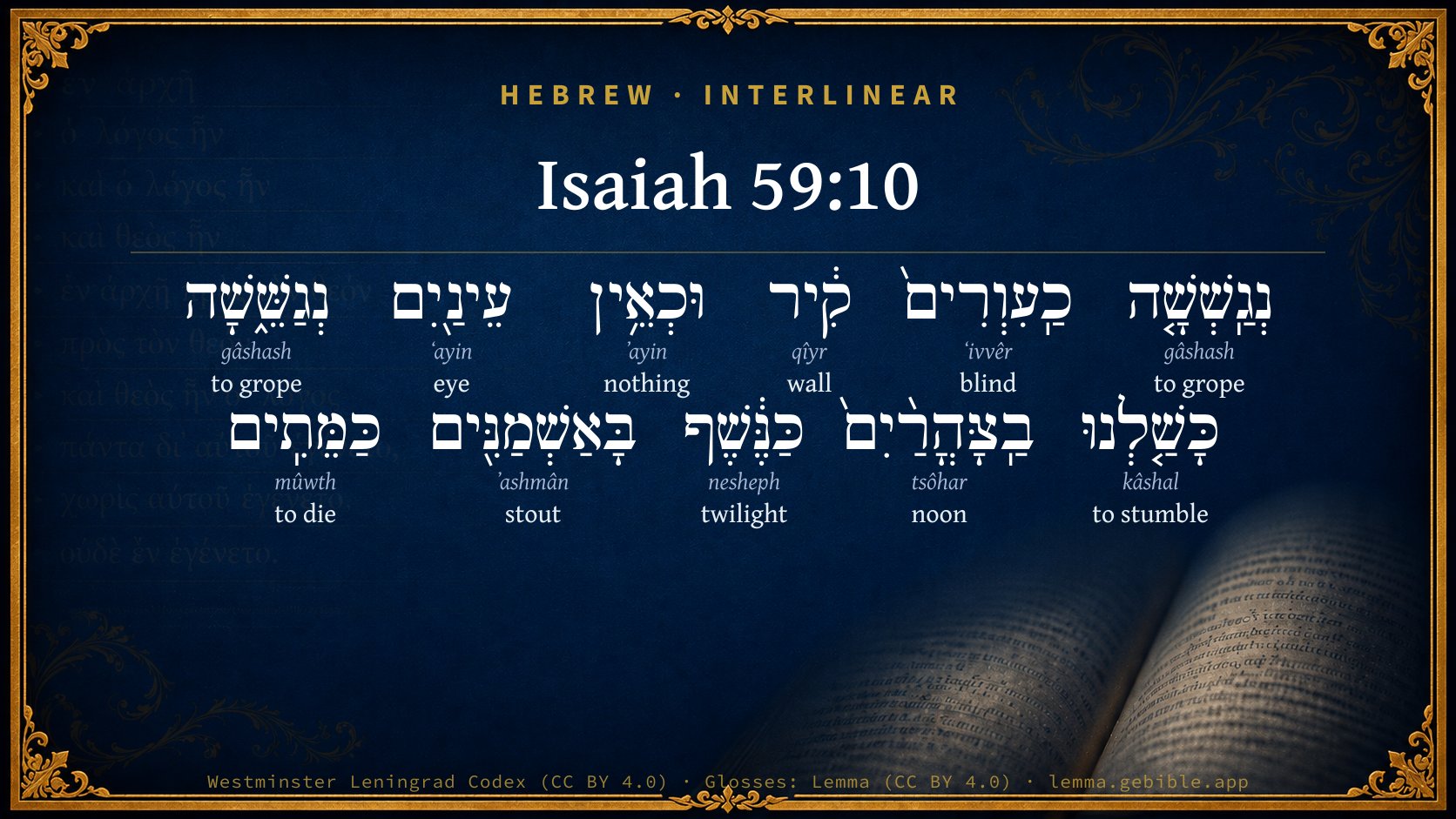
Isaiah 59:10

Hebrew (Westminster Leningrad Codex) Isaiah 59:10 appears in the Hebrew Old Testament. The text above is from the Westminster Leningrad Codex. Each word links to its Strong’s number, a concise gloss, and parsing drawn from the Open Scriptures Hebrew Bible morphology. Click any word for its full Brown-Driver-Briggs (BDB) entry.
Download image
Cite this verse

Isaiah 59:10 (World English Bible). Public Domain. Lemma interlinear Bible study tool, https://lemma.gebible.app/v/isaiah/59/10.

Show BibTeX & RIS
BibTeX
RIS
English Translation
We grope for the wall like the blind; yes, we grope as those who have no eyes: we stumble at noonday as in the twilight; among those who are lusty we are as dead men.
World English Bible · Public Domain
Highlights
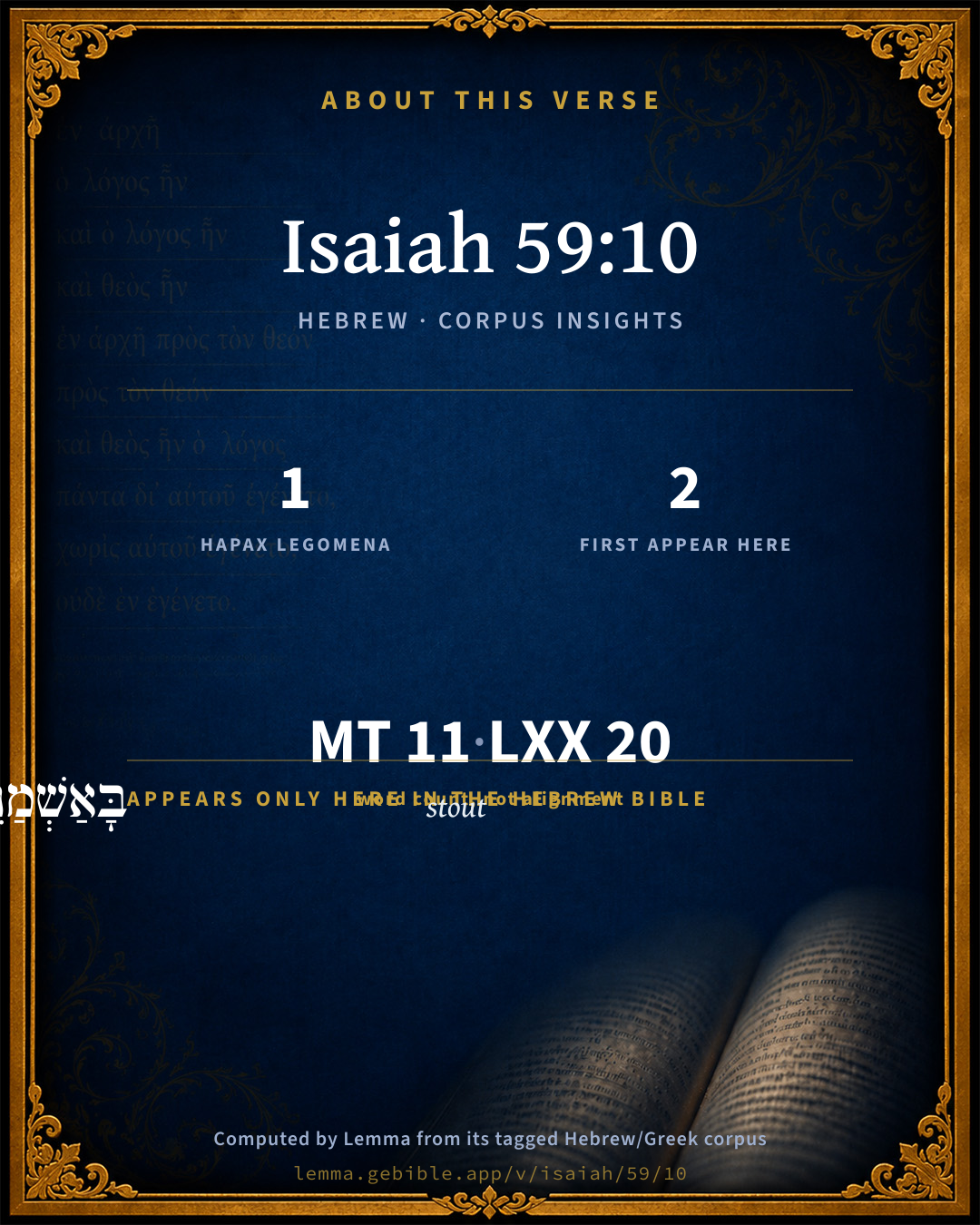
  • 1 hapax legomenon — only here in the Hebrew Bible
  • 2 first appearances in the Hebrew Bible
Full analysis ↓
Download a study sheet

One document with this verse’s original text, its word-by-word gloss line, the meaning frame, cross-references with their text, attributed commentary, and full source and license credits — printable, and it pastes into notes with its structure intact.

This verse Autodidact and up

Study sheet (.html) Plain text (.txt)

A passage Seminary Student

Up to 50 verses in one chapter. A passage sheet keeps up to 6 commentary sources and 12 cross-references per verse, in the order this page ranks them, and says so on the sheet whenever that leaves anything out. Ask for a single verse and you get the Autodidact verse sheet above.

Everything on this page stays free to read, with no account — the sheet is a download of what is already on screen, not access to it.

Want to remove ads? Support Godless Engineer
Compare translations 3

The same verse in 3 English versions, stacked beneath the original-language interlinear above. Click any original word for its lexicon entry.

Each is an independent rendering of the whole verse — the interlinear is not word-aligned to these translations.

Highlighted words mark where these versions differ — a whole-verse word diff, not a word-by-word alignment.

  • World English Bible Public Domain
    We grope for the wall like the blind; yes, we grope as those who have no eyes: we stumble at noonday as in the twilight; among those who are lusty we are as dead men.
  • King James Version Public Domain
    We grope for the wall like the blind, and we grope as if we had no eyes: we stumble at noon day as in the night; we are in desolate places as dead men.
  • unfoldingWord Literal Text CC BY-SA 4.0
    We grope the wall like the blind, and like without eyes, we grope. We stumble at noon as twilight; among the strong, like ones having died.

unfoldingWord Literal Text — © unfoldingWord, licensed CC BY-SA 4.0. Word-aligned USFM3 via Door43 (git.door43.org/unfoldingWord/en_ult).

Versions to compare (up to 4)

3 of 4 selected

Show all 18 translations

Every available English version of this verse, each an independent rendering of the whole verse.

  • World English Bible Public Domain
    We grope for the wall like the blind; yes, we grope as those who have no eyes: we stumble at noonday as in the twilight; among those who are lusty we are as dead men.
  • Berean Standard Bible Public Domain
    Like the blind, we feel our way along the wall, groping like those without eyes. We stumble at midday as in the twilight; among the vigorous we are like the dead.
  • Majority Standard Bible Public Domain
    Like the blind, we feel our way along the wall, groping like those without eyes. We stumble at midday as in the twilight; among the vigorous we are like the dead.
  • King James Version Public Domain
    We grope for the wall like the blind, and we grope as if we had no eyes: we stumble at noon day as in the night; we are in desolate places as dead men.
  • American Standard Version (1901) Public Domain
    We grope for the wall like the blind; yea, we grope as they that have no eyes: we stumble at noonday as in the twilight; among them that are lusty we are as dead men.
  • Revised Version (1885) Public Domain
    We grope for the wall like the blind, yea, we grope as they that have no eyes: we stumble at noonday as in the twilight; among them that are lusty we are as dead men.
  • Geneva Bible (1599) Public Domain
    Wee grope for the wall like the blinde, and we grope as one without eyes: we stumble at the noone day as in the twilight: we are in solitarie places, as dead men.
  • Douay-Rheims (1899) Public Domain
    We have groped for the wall, and like the blind we have groped as if we had no eyes: we have stumbled at noonday as in darkness, we are in dark places as dead men.
  • Young's Literal Translation Public Domain
    We feel like the blind `for' the wall, Yea, as without eyes we feel, We have stumbled at noon as at twilight, In desolate places as the dead.
  • Literal Standard Version CC BY-SA 4.0
    We feel [for] the wall like the blind, || Indeed, we feel as without eyes, || We have stumbled at noon as at twilight, || In desolate places as the dead.
  • Unlocked Literal Bible CC BY-SA 4.0
    We grope for the wall like the blind, like those who cannot see. We stumble at noonday as in the twilight; among the strong we are like dead men.
  • unfoldingWord Literal Text CC BY-SA 4.0
    We grope the wall like the blind, and like without eyes, we grope. We stumble at noon as twilight; among the strong, like ones having died.
  • Darby Bible Public Domain
    We grope for the wall like the blind, and we grope as if we had no eyes: we stumble at midday as in the twilight; amongst the flourishing we are as the dead.
  • World Messianic Bible Public Domain
    We grope for the wall like the blind. Yes, we grope as those who have no eyes. We stumble at noon as if it were twilight. Among those who are strong, we are like dead men.
  • Webster's Bible Public Domain
    We grope for the wall like the blind, and we grope as if we had no eyes: we stumble at noon day as in the night; we are in desolate places as dead men.
  • Free Bible Version CC BY-SA 4.0
    We grope like blind people along a wall, feeling with our hands as if we have no eyes. We stumble at noon as if it were the evening. Among those who are full of life, we are like the dead.
  • Bible in Basic English Public Domain
    We go on our way, like blind men feeling for the wall, even like those who have no eyes: we are running against things in daylight as if it was evening; our place is in the dark like dead men.
  • JPS Tanakh (1917) Public Domain
    We grope for the wall like the blind, yea, as they that have no eyes do we grope; we stumble at noonday as in the twilight; we are in dark places like the dead.

Literal Standard Version (2020), Covenant Press — licensed CC BY-SA 4.0. Text via the HelloAO Bible API (eBible.org). Unlocked Literal Bible (unfoldingWord) — licensed CC BY-SA 4.0. Text via the HelloAO Bible API (eBible.org). unfoldingWord Literal Text — © unfoldingWord, licensed CC BY-SA 4.0. Word-aligned USFM3 via Door43 (git.door43.org/unfoldingWord/en_ult). Free Bible Version, Dr. Jonathan Gallagher — licensed CC BY-SA 4.0. Text via the HelloAO Bible API (eBible.org).

Word by word

More ways to search: Search by grammar → Find every occurrence → Compare this word →

Practice this passage: Drill this verse → Learn its vocabulary →

בָּאַשְׁמַנִּ֖ים
ʼashmân
H820
“in/at the · stout ones”
Preposition, Determined + Noun, Common, Masculine, Plural, Absolute
Part of Speech
Preposition + Noun
Type
Common
Gender
Masculine
Number
Plural
State
Absolute
Full BDB Definition

Origin: probably from H8081

TWOT: 2410d

the stout, among the stout - (CLBL) the desolate, like dead
  1. נְגַֽשְׁשָׁ֤ה gâshash H1659 “to grope” Verb, Piel, Imperfect, 1st Person, Common, Plural
  2. כַֽעִוְרִים֙ ʻivvêr H5787 “like/as the · blind” Preposition, Determined + Adjective, Adjective, Masculine, Plural, Absolute
  3. קִ֔יר qîyr H7023 “wall” Noun, Common, Masculine, Singular, Absolute
  4. וּכְאֵ֥ין ʼayin H369 “and · like/as · nothing” Conjunction + Preposition + Particle, Negative
  5. עֵינַ֖יִם ʻayin H5869 “eyes” Noun, Common, Both, Dual, Absolute
  6. נְגַשֵּׁ֑שָׁה gâshash H1659 “to grope” Verb, Piel, Imperfect, 1st Person, Common, Plural
  7. כָּשַׁ֤לְנוּ kâshal H3782 “to stumble” Verb, Qal, Perfect, 1st Person, Common, Plural
  8. בַֽצָּהֳרַ֨יִם֙ tsôhar H6672 “in/at the · noon” Preposition, Determined + Noun, Common, Masculine, Plural, Absolute
  9. כַּנֶּ֔שֶׁף nesheph H5399 “like/as the · twilight” Preposition, Determined + Noun, Common, Masculine, Singular, Absolute
  10. כַּמֵּתִֽים mûwth H4191 “like/as the · dying” Preposition, Determined + Verb, Qal, Participle Active, Masculine, Plural, Absolute

About this verse

These counts appear in no published source. They are computed here, from the morphology-tagged text and Lemma’s own curated glosses. What Lemma adds →

11
words
10
distinct lemmas
Prophets
section

Notable vocabulary

1 hapax legomenon — a word that appears only here in the entire Hebrew Bible:

  • בָּאַשְׁמַנִּ֖ים stout H820

First appearance in Scripture

These words make their first canonical appearance in the Hebrew Bible here:

  • נְגַֽשְׁשָׁ֤ה to grope H1659
  • בָּאַשְׁמַנִּ֖ים stout H820

Grammatical profile

  • 4 verbs
  • 5 nouns
  • 1 adjective
  • 1 particle

Verb forms

  • נְגַֽשְׁשָׁ֤ה Piel · Imperfect
  • נְגַשֵּׁ֑שָׁה Piel · Imperfect
  • כָּשַׁ֤לְנוּ Qal · Perfect
  • כַּמֵּתִֽים Qal · Participle Active

Repetition

A word recurs within this verse — often emphatic in Hebrew:

  • נְגַֽשְׁשָׁ֤ה to grope H1659 ×2

Hebrew & Septuagint length

In English translation the verse runs 35 words from the Hebrew and 35 from the Septuagint (LXX English) — the same length.

A rough comparison of the two English renderings, which tokenize alike — not a word-level alignment.

Word counts can differ between the Hebrew and the Greek without any difference in meaning — e.g. the Hebrew direct-object marker אֵת has no separate Greek word, and Greek often adds the article ὁ.

In the original languages it is 11 Hebrew tokens and 20 Greek tokens — but the two are counted differently (Hebrew bundles its prefixes and suffixes into one token; the Greek is in lemma form), so that isn’t a like-for-like length.

Cross-references

12

Topical passages linked to Isaiah 59:10 in the Treasury of Scripture Knowledge — connected by theme and wording, ordered by reader-vote popularity; previews shown in the World English Bible.

  • Deuteronomy 28:29 and you shall grope at noonday, as the blind gropes in darkness, and you shall not prosper in your ways: and you shall be only oppressed and robbed always, and there shall be none to save you.
  • Job 5:14 They meet with darkness in the day-time, And grope at noonday as in the night.
  • Lamentations 3:6 He has made me to dwell in dark places, as those that have been long dead.
  • Proverbs 4:19 The way of the wicked is like darkness. They don't know what they stumble over.
  • Isaiah 8:15 Many shall stumble thereon, and fall, and be broken, and be snared, and be taken.
  • Jeremiah 13:16 Give glory to Yahweh your God, before he cause darkness, and before your feet stumble on the dark mountains, and, while you look for light, he turn it into the shadow of death, and make it gross darkness.
  • Lamentations 4:14 They wander as blind men in the streets, they are polluted with blood, So that men can't touch their garments.
  • Amos 8:9 "It will happen in that day," says the Lord Yahweh, "That I will cause the sun to go down at noon, And I will darken the earth in the clear day.
  • John 11:9–10 Jesus answered, "Aren't there twelve hours of daylight? If a man walks in the day, he doesn't stumble, because he sees the light of this world.
  • John 12:35 Jesus therefore said to them, "Yet a little while the light is with you. Walk while you have the light, that darkness doesn't overtake you. He who walks in the darkness doesn't know where he is going.
  • John 12:40 "He has blinded their eyes and he hardened their heart, Lest they should see with their eyes, And perceive with their heart, And would turn, And I would heal them."
  • 1 John 2:11 But he who hates his brother is in the darkness, and walks in the darkness, and doesn't know where he is going, because the darkness has blinded his eyes.

Cross-references courtesy of OpenBible.info (CC BY 4.0).

Hebrew and Greek witnesses Masoretic Hebrew ↔ Greek Septuagint

The same verse in the two great witnesses to the Old Testament, shown verse-for-verse.

These are two independent witnesses, not word-aligned to each other, and the Septuagint is shown in lemma (dictionary) form.

Hebrew Isaiah 59:10 Masoretic · Westminster Leningrad Codex

נְגַֽשְׁשָׁ֤ה כַֽעִוְרִים֙ קִ֔יר וּכְאֵ֥ין עֵינַ֖יִם נְגַשֵּׁ֑שָׁה כָּשַׁ֤לְנוּ בַֽצָּהֳרַ֨יִם֙ כַּנֶּ֔שֶׁף בָּאַשְׁמַנִּ֖ים כַּמֵּתִֽים

We grope for the wall like the blind; yes, we grope as those who have no eyes: we stumble at noonday as in the twilight; among those who are lusty we are as dead men.

World English Bible · Public Domain

Greek LXX Isaiah 59:10 Septuagint · lemma form

ψηλαφάω ὡς τυφλός τοῖχος καί ὡς οὐ ὑποἄρχω ὀφθαλμός ψηλαφάω καί πίπτω ἐν μεσημβρία ὡς ἐν μεσονύκτιον ὡς ἀποθνήσκω στενάζω

They shall feel for the wall as blind men, and shall feel for it as if they had no eyes: and they shall feel at noon-day as at midnight; they shall groan as dying men.

LXX2012 (modern English Septuagint) · Public Domain

On this verse, Albert Barnes' Notes on the Bible discusses the Septuagint’s reading. Read the note in Commentary ↓

Hebrew: Westminster Leningrad Codex (CC BY 4.0). Greek: Septuagint (public domain); English from LXX2012 (modern English Septuagint) (Public Domain). How the Septuagint differs from the Hebrew →

Targum (Aramaic paraphrase)

1

The Targum is the ancient Jewish Aramaic paraphrase of the Hebrew Scriptures — an interpretive translation, not the Hebrew text itself. Onkelos (literal) and Pseudo-Jonathan (expansive) render the Torah, and Jonathan the Prophets. Coverage is partial: where no permissively-licensed English translation exists for a verse, only the Aramaic is shown. This is verse-level text, not a word-by-word alignment to the Hebrew.

  1. Targum Jonathan Prophets (Joshua–Malachi)
    נְמַשְׁמֵשׁ כְּסָמָן כּוּתְלִין וְכִדְלֵית לְהוֹן עַיְנִין נְמַשְׁמֵשׁ אִתְקֵילָנָא בְטִיהֲרָא כְּמָא דְמִתַּקְלִין בְּקִבְלָא אִתְאֲחַד בְּאַפָּנָא כְּמָא דַאֲחִידִין קִבְרַיָא בְּאַפֵּי מֵתַיָא:

    We grope for the wall like the blind, and we grope as if we had no eyes: we stumble at noonday as those that stumble in the dark; it is shut up before graves are shut up before the dead.

    Targum Jonathan — Aramaic: “Mikraot Gedolot” (public domain). English: “Sefaria Community Translation” (CC0 1.0 (public-domain dedication)); “London "Chaldee Paraphrase," 1871” (public domain). Text via Sefaria.

Commentary

Notes on Isaiah 59:10 from classic Christian and Jewish commentators (each source and its license shown beneath its notes). The classic Christian expositions comment on the surrounding passage and are grouped to its opening verse, so a note may address several verses; the Jewish commentaries on the Tanakh (Rashi and others) are per-verse, so they appear only where the commentator wrote on this verse.

Lemma curates 59 commentaries, every one of them public domain or Creative Commons licensed, each selected and text-cleaned for this edition rather than reprinted as found. About our sources →

Trapp's Complete Commentary

John Trapp

Isa 59:10 We grope for the wall like the blind, and we grope as if [we had] no eyes: we stumble at noonday as in the night; [we are] in desolate places as dead [men].

Ver. 10. We grope for the wall like the blind.] We are altogether to seek, utterly destitute of good counsel or advice; neither can we enjoy those comforts that we have.

We are in desolate places as dead men.] As "free among the dead," free of that company. {Psa 88:5} Leo Judae rendereth it, We are in our graves as dead carcases; Piscator thus, In fatness (that is, in the abundance of all things) we are as dead men.

John Trapp, A Commentary or Exposition upon All the Books of the Old and New Testament (1647–1656) — public domain. Text from a community e-Sword module.

Tyndale Open Study Notes

Tyndale Open Resources

59:10 people without eyes: See 6:10; Deut 28:29.

Tyndale Open Study Notes — © Tyndale Open Resources, licensed CC BY-SA 4.0. Text via the HelloAO Bible API.

Geneva Bible (1599)

Geneva Bible translators

We are altogether destitute of counsel, and can find no end of our miseries.

Geneva Bible (1599) marginal notes — public domain. Text via Bolls.life.

Jamieson, Fausset & Brown

Robert Jamieson, A. R. Fausset & David Brown

grope--fulfilling Moses' threat (Deu 28:29).

stumble at noon . . . as . . . night--There is no relaxation of our evils; at the time when we might look for the noon of relief, there is still the night of our calamity.

in desolate places--rather, to suit the parallel words "at noonday," in fertile (literally, "fat"; Gen 27:28) fields [GESENIUS] (where all is promising) we are like the dead (who have no hope left them); or, where others are prosperous, we wander about as dead men; true of all unbelievers (Isa 26:10; Luk 15:17).

Jamieson, Fausset & Brown — Commentary Critical and Explanatory on the Whole Bible (1871) — public domain (CC PDM 1.0). Text via the HelloAO Bible API.

Adam Clarke's Commentary

Verse 10. We stumble at noon day as in the night - "We stumble at mid-day, as in the twilight"] I adopt here an emendation of Houbigant, נשגגה nishgegah, instead of the second, נגששה negasheshah, the repetition of which has a poverty and inelegance extremely unworthy of the prophet, and unlike his manner. The mistake is of long standing, being prior to all the ancient versions. It was a very easy and obvious mistake, and I have little doubt of our having recovered the true reading in this ingenious correction.

Adam Clarke's Commentary on the Bible (1810–1826) — public domain. Text from a community e-Sword/MySword module.

Ellicott's Commentary for English Readers

(10) We grope for the wall . . .—The words present a striking parallelism with Deu_28:29, and may have been reproduced from, or in, it.

We are in desolate places . . .—Many critics render, (1) among those full of life, or (2) in luxuriant fields, of which (1) is preferable, as giving an antithesis like that of the other clauses. So taken, we have a parallelism with Psa_73:5-8.

A Bible Commentary for English Readers, edited by Charles John Ellicott (1878–1897) — public domain. Text from a community e-Sword module.

The Cambridge Bible for Schools and Colleges

gen. ed. J. J. S. Perowne

10. We grope for the wall, &c.] Rather, along the wall seeking an outlet. Comp. the very similar passage Deu_28:29.

we are in desolate places as dead men] R.V. among them that are lusty we are as dead men. The A.V. follows the Vulgate, but the rendering “desolate places” seems destitute of any etymological basis. The word, which occurs only here, comes apparently from a root denoting “fatness”; hence the translation of the R.V., which gives a more effective turn to the figure than any other that has been proposed. The soundness of the text, however, is open to suspicion.

The Cambridge Bible for Schools and Colleges (gen. ed. J. J. S. Perowne; Cambridge University Press, 1878–1918) — public domain. Text from a community e-Sword module.

John Gill's Exposition

We grope for the wall like the blind,.... Who either with their hands, or with a staff in them, feel for the wall to lean against, or to guide them in the way, or into the house, that they may know whereabout they are, and how they should steer their course:

and we grope as if we had no eyes: which yet they had, the eyes of their reason and understanding; but which either were not opened, or they made no use of them in searching the Scriptures, to come at the light and knowledge of divine things; and therefore only at most groped after them by the dim light of nature, if thereby they might find them. This is to be understood not of them all, but of many, and of the greatest part:

we stumble at noonday as in the night; as many persons do now: for though it is noonday in some respects, and in some places, where the Gospel and the truths of it are clearly preached; yet men stumble and fall into the greatest errors, as in the night of the greatest darkness; as if it was either the night of Paganism or Popery with them:

we are in desolate places as dead men; or "in fatnesses" (a); in fat places where the word and ordinances are administered, where is plenty of the means of grace, yet not quickened thereby; are as dead men, dead in trespasses and sin, and at most have only a name to live, but are dead. Some render it, "in the graves" (b); and the Targum thus,

"it is shut before us, as the graves are shut before the dead;''

we have no more light, joy, and comfort, than those in the graves have.

(a) "in rebus pinguissimis", Junius & Tremellius; "in pinguetudinibus", Piscator; "in opimis rebus", Vitringa. (b) "In sepulchris", Pagninus; and so Ben Melech interprets it.

John Gill's Exposition of the Whole Bible (1746–1763) — public domain (CC PDM 1.0). Text via the HelloAO Bible API.

Albert Barnes' Notes on the Bible

We grope for the wall like the blind - A blind man, not being able to see his way, feels along by a wall, a fence, or any other object that will guide him. They were like the blind. They had no distinct views of truth, and they were endeavoring to feel their way along as well as they could. Probably the prophet here alludes to the threatening made by Moses in Deu 28:28-29, ‘And the Lord shall smite thee with madness, and blindness, and astonishment of heart; and thou shalt grope at noon-day as the blind gropeth in darkness, and thou shalt not prosper in thy ways.’

We stumble at noon-day as in the night - The idea here is, that they were in a state of utter disorder and confusion. Obstacles were in their way on all hands, and they could no more walk than people could who at noon-day found their path filled with obstructions. There was no remission, no relaxation of their evils. They were continued at all times, and they had no intervals of day. Travelers, though at night they wander and fall, may look for approaching day, and be relieved by the returning light. But not so with them. It was all night. There were no returning intervals of light, repose and peace. It was as if the sun was blotted out, and all was one long, uninterrupted, and gloomy night.

We are in desolate places - There has been great variety in the interpretation of this phrase. Noyes, after Gesenius. translates it, ‘In the midst of fertile fields we are like the dead.’ One principal reason which Gesenius gives for this translation (Commentary in loc.) is, that this best agrees with the sense of the passage, and answers better to the previous member of the sentence, thus more perfectly preserving the parallelism:

At noon-day we stumble as in the night;

In fertile fields we are like the dead.

Thus, the idea would be, that even when all seemed like noon-day they were as in the night; and that though they were in places that seemed luxuriant, they were like the wandering spirits of the dead. Jerome renders it, Caliginosis quasi mortui. The Septuagint, ‘They fall at mid-day as at midnight: they groan as the dying’ (ὡς ἀποθνῄσκοντες στενάξουσιν hōs apothnēskontes stenachousin). The Syriac follows this. ‘We groan as those who are near to death.’ The Chaldee renders it, ‘It (the way) is closed before us as the sepulchre is closed upon the dead;’ that is, we are enclosed on every side by calamity and trial, as the dead are in their graves. The derivation of the Hebrew word אשׁמנים 'ashemanı̂ym is uncertain, and this uncertainty has given rise to the variety of interpretation. Some regard it as derived from שׁמם shâmam, to be laid waste, to be desolate; and others from שׁמן shâman, to be, or become fat.

The word שׁמנים shemannı̂ym, in the sense of fatness, that is, fat and fertile fields, occurs in Gen 27:28, Gen 27:39; and this is probably the sense here. According to this, the idea is, we are in fertile fields like the dead. Though surrounded by lands that are adapted to produce abundance, yet we are cut off from the enjoyment of them like the dead. Such is the disturbed state of public affairs; and such the weight of the divine judgments, that we have no participation in these blessings and comforts. The idea which. I suppose, the prophet means to present is, that the land was suited to produce abundance, but that such was the pressure of the public calamity, that all this now availed them nothing, and they were like the dead who are separated from all enjoyments. The original reference here was to the Jew suffering for their sins, whether regarded as in Palestine under their heavy judgments, or as in Babylon, where all was night and gloom. But the language here is strikingly descriptive of the condition of the world at large. Sinners at noon-day grope and stumble as in the night. In a world that is full of the light of divine truth as it beams from the works and the word of God, they are in deep darkness. They feel their way as blind people do along a wall, and not a ray of light penetrates the darkness of their minds. And in a world full of fertility, rich and abundant and overflowing in its bounties, they are still like ‘the dead.’ True comfort and peace they have not; and they seem to wander as in the darkness of night, far from peace, from comfort, and from God.

Albert Barnes' Notes on the Bible (1834–1885) — public domain. Text from a community e-Sword/MySword module.

Haydock's Catholic Bible Commentary

Dead. The Jews will not recognize Christ, notwithstanding the prophecies and miracles.

George Leo Haydock (1774–1849), Haydock's Catholic Family Bible and Commentary, 1859 edition — public domain. Excludes Psalms (Douay-Rheims chapter numbering differs from Protestant) and Deuterocanonical books (Catholic canon only).

Matthew Poole's English Annotations

We grope: as a blind man that hath no other eyes than his hands feels for the wall, from whence he expects either direction or a resting place to lean on; so they expect salvation as it were blindfold, not taking direction from the prophets, but hoping to obtain it by their cries and fasts, though they continued in their sins, and therefore may well be said to grope after it. See Deu 28:28,29; Job 12:25.

And we grope as if we had no eyes; as if we were stark blind; and being here put for yea, thereby aggravating the misery in repeating the expression.

We stumble at noon-day: this notes their exceeding blindness, as it must needs be with one that can discern no more at noon-day than if it were midnight, Job 5:14.

We are as dead men: he compares their captivity to men dead without hope of recovery; their bonds render them as free among the dead, Psa 88:5. They can see the way, or get out of their captivity, no more than dead men can get out of their graves; thus a calamitous estate is set forth, Psa 44:19, great calamity and despair oft going together: they are as men cast out, no more to be looked after. Compare Lam 3:6. All darkness is uncomfortable, but that of the grave terrible.

Matthew Poole's English Annotations on the Holy Bible (1683–1685) — public domain. Text from a community e-Sword/MySword module.

Whedon's Commentary on the Bible

Daniel D. Whedon

10, 11. We grope for the wall — Like the blind we feel our way. And the same or similar course of figures continues to Isa_59:15, each illustrating some comprehensive phase in this confession which the people are openly and freely making, but which, in chap. lviii, it was boasted there was no need to make. Self-righteousness was uppermost in that chapter. Now it is confessed, “Moral blindness and darkness is our lot. Light and peace belong to the lot of the good, but to us it is the same as if we were dead.” In Isa_59:11 the figure is changed to indicate still the same bad state of the heart. With the insolence of a bear we growl; with hopeless sadness we moan like the turtledove.

For judgment — That is, for vindication, (see Isa_59:9,) for apology for our condition, but in vain.

For salvation — For deliverance from this state; but it fails to appear.

Daniel D. Whedon (gen. ed.), Commentary on the Old and New Testaments (1874–1909) — public domain. Text from a community e-Sword module.

The Pulpit Commentary

We grope for the wall; rather, we grope along the wall Deu_28:29; and for the "blindness that had happened unto Israel". (see above, Isa_29:10, 18 35:5 42:16, etc.) We stumble at noonday . It was not that light was really wanting, but they had no eyes to behold it. We are in desolate places; rather, in dark places (Vulgate, Rodiger, Kay, Knobel). The word occurs only in this place, and is of doubtful signification.

The Pulpit Commentary (1880–1919), ed. H.D.M. Spence-Jones & Joseph S. Exell — public domain. Text from a community e-Sword module.

John Wesley's Explanatory Notes

As dead men - He compares their captivity to men dead without hope of recovery.

John Wesley, Explanatory Notes Upon the Whole Bible (1754–1765) — public domain. Text via the GEBible commentary corpus.

J. A. Alexander on Isaiah

Joseph Addison Alexander

“We grope like the blind for the wall, like the eyeless we grope; we stumble at noonday as in twilight, in thick darkness like the dead.” These figures are expressive not only of physical but of moral evil. Compare Deu 28:29 and Zep 1:17.

Joseph Addison Alexander, The Prophecies of Isaiah (1846–1847; New York: Scribner, 1870–1878) — public domain. Text from a community e-Sword module.

Rashi

Rabbi Shlomo Yitzchaki (Rashi)

in dark places Heb. בָּאַשְׁמַנִּים. Menahem (Machbereth, p. 35) interpreted it as an expression of dark places, and most exegetes concur with him. Dunash, however, (Tesuhvoth Dunash, p. 93) interprets it as an expression of fat (שׁוּמָן), with the ‘alef’ prefixed to it like the ‘alef’ that is in (Job 13:17) אַחְוָתִי, “my narrative,” [derived from חוה]; and that is in (Jer. 15:18) אַכְזָב, “a failure,” (derived from כזב; and (Num. 21:1) “the way of the spies (הָאֲתָרִים),” [derived from תור]. Here, too, among the שְׁמֵנִים, among the lusty living, we are like dead. And Jonathan rendered it as an expression of locking: It is locked before us as the graves are locked before the dead.

Rashi on the Tanakh — English translations: “The Judaica Press complete Tanach with Rashi, translated by A. J. Rosenberg” (CC BY 4.0); “Pentateuch with Rashi's commentary by M. Rosenbaum and A.M. Silbermann, 1929-1934” (public domain); “The Metsudah Tanach series, Lakewood, N.J” (CC BY 4.0); and “The Book of Joshua, Metsudah Publications, 1997” (CC BY 4.0). Text via Sefaria.

Ibn Ezra

Rabbi Abraham ibn Ezra

נגששה We grope. It is hap. leg. Some connect it with גוש a clod (Job 7:5).

At noon day as in the night, that is, as if it were in the evening. It is a figurative expression.

באשמנים. Some say that it means in graves; but it is equally admissible to explain it, at noon, or, amongst the living. or, considering the א to be prosthetic, among the fat ones, that is, the heathen people.

Ibn Ezra on the Tanakh — English translations: “Sefaria Community Translation” (CC0 1.0 (public-domain dedication)); “Yalkut, Sifsei Chachomim Chumash, Metsudah Publications, 2009” (CC BY 4.0); and “Commentary of Ibn Ezra on Isaiah - trans. by M. Friedlander, 1873” (public domain). Text via Sefaria.

Lesson kit

Teaching starters — assembled from the data on this page, not authored interpretation. Every prompt links to the verse data it draws on. Edit before teaching.

Isaiah, in the Prophets, opens this verse with 11 words (10 distinct Hebrew lemmas). Its most distinctive word is ʼashmân (“stout”). A historical commentator’s framing appears above. Read the whole chapter for the surrounding context.

Discussion questions

  1. The word ʼashmân carries the sense “stout.” How does it shape the verse?
  2. This verse holds 1 word here found nowhere else in the Hebrew Bible. What might the rare word draw attention to?
  3. 2 words here appear for the first time in Scripture. What is being introduced at this debut?
  4. Deuteronomy 28:29 shares this passage’s theme. How do the two illuminate each other?
  5. “to grope” occurs 2× in this one verse. What is the effect of the repetition?
  6. These translations render this verse differently; the difference is in the English rendering, not the original. What questions does that raise?
  7. The verb «נְגַֽשְׁשָׁ֤ה» is Piel Imperfect. How does its form color the action?
  8. Reading how Trapp's Complete Commentary and Tyndale Open Study Notes read this verse, where do the two commentators agree and where do they part?

Things to notice

  • 1 word in this verse appears nowhere else in the Hebrew Bible.
  • 2 words make their first canonical appearance in Scripture here.
  • This verse counts 11 Hebrew ↔ 20 Greek words.
  • These translations choose different wording for 20 words in this verse.
  • “to grope” occurs 2× in this single verse.

Reading settings

Reading text

Shown beneath each verse's original-language words.

Old Testament
Old Testament edition

Read the OT as the Masoretic Hebrew (MT) or the Greek Septuagint (LXX).

English shown for the Greek Septuagint (in the Hebrew ↔ Greek comparison).

Comparing translations? Open the Compare panel on any verse page to stack up to four side by side.