
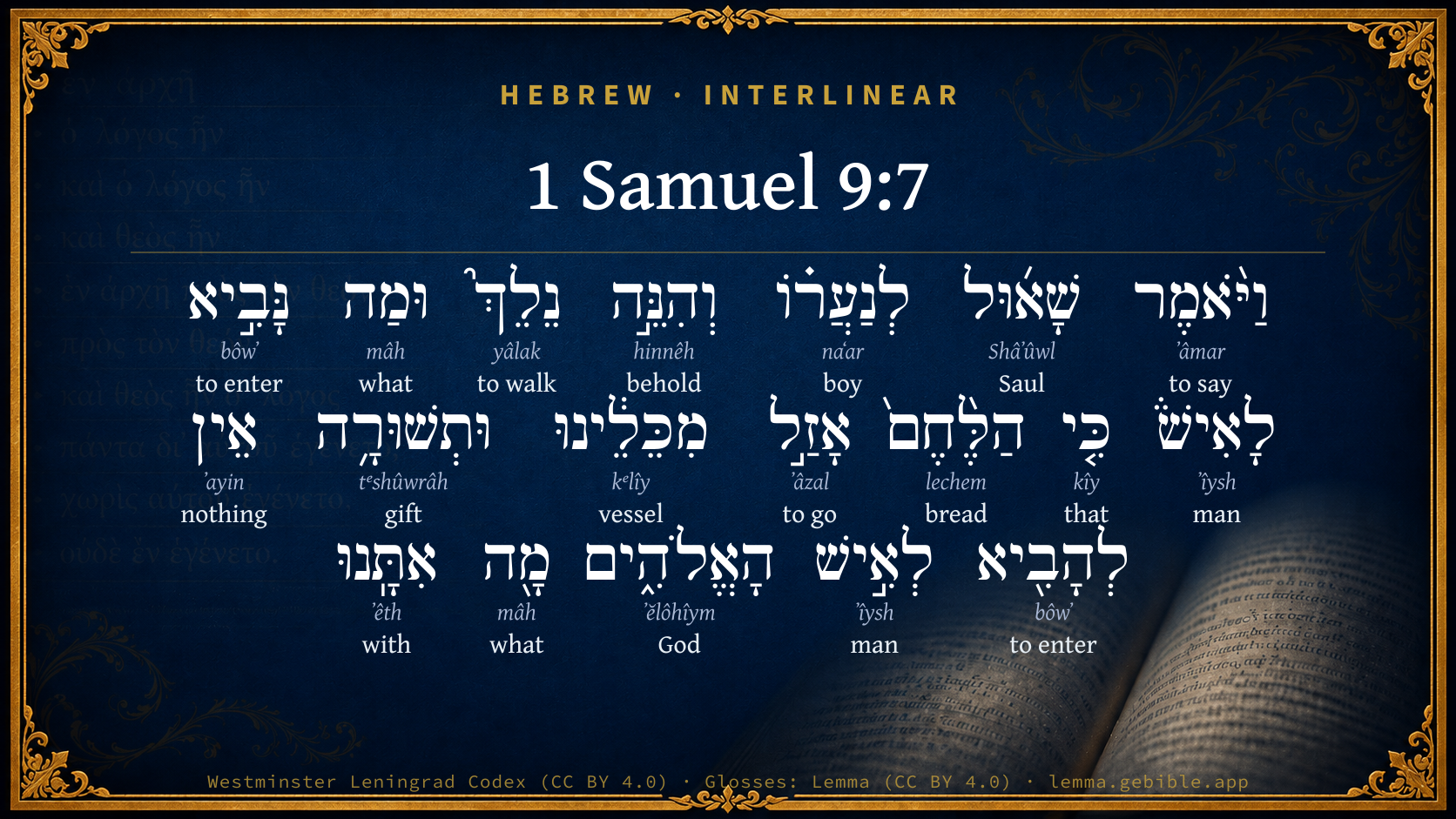
1 Samuel 9:7

Hebrew (Westminster Leningrad Codex) 1 Samuel 9:7 appears in the Hebrew Old Testament. The text above is from the Westminster Leningrad Codex. Each word links to its Strong’s number, a concise gloss, and parsing drawn from the Open Scriptures Hebrew Bible morphology. Click any word for its full Brown-Driver-Briggs (BDB) entry.
Download image
Cite this verse

1 Samuel 9:7 (World English Bible). Public Domain. Lemma interlinear Bible study tool, https://lemma.gebible.app/v/1-samuel/9/7.

Show BibTeX & RIS
BibTeX
RIS
English Translation
Then said Saul to his servant, But, behold, if we go, what shall we bring the man? for the bread is spent in our vessels, and there is not a present to bring to the man of God: what have we?
World English Bible · Public Domain
Highlights
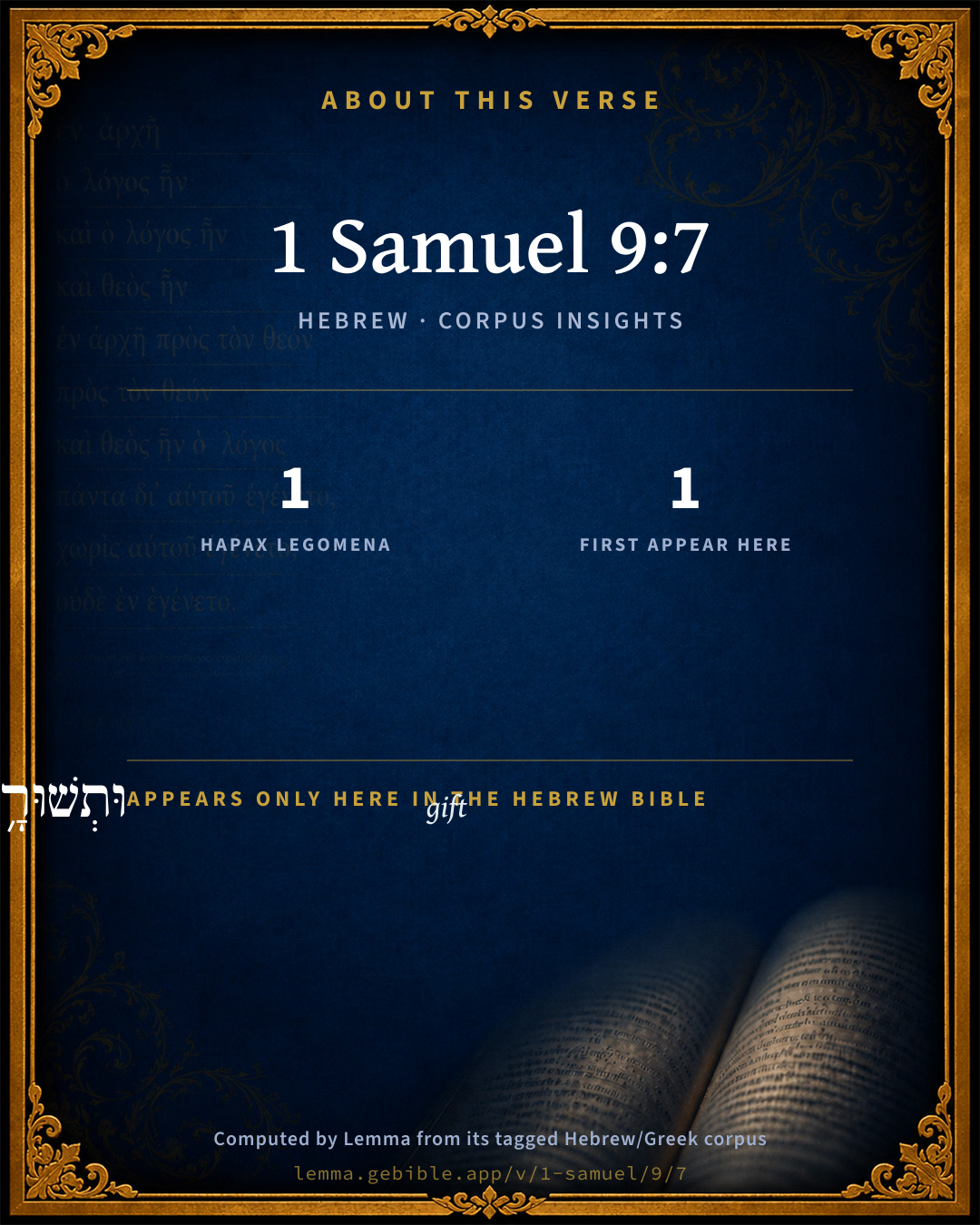
  • 1 hapax legomenon — only here in the Hebrew Bible
  • 1 first appearance in the Hebrew Bible
Full analysis ↓
Download a study sheet

One document with this verse’s original text, its word-by-word gloss line, the meaning frame, cross-references with their text, attributed commentary, and full source and license credits — printable, and it pastes into notes with its structure intact.

This verse Autodidact and up

Study sheet (.html) Plain text (.txt)

A passage Seminary Student

Up to 50 verses in one chapter. A passage sheet keeps up to 6 commentary sources and 12 cross-references per verse, in the order this page ranks them, and says so on the sheet whenever that leaves anything out. Ask for a single verse and you get the Autodidact verse sheet above.

Everything on this page stays free to read, with no account — the sheet is a download of what is already on screen, not access to it.

Want to remove ads? Support Godless Engineer
Compare translations 3

The same verse in 3 English versions, stacked beneath the original-language interlinear above. Click any original word for its lexicon entry.

Each is an independent rendering of the whole verse — the interlinear is not word-aligned to these translations.

Highlighted words mark where these versions differ — a whole-verse word diff, not a word-by-word alignment.

  • World English Bible Public Domain
    Then said Saul to his servant, But, behold, if we go, what shall we bring the man? for the bread is spent in our vessels, and there is not a present to bring to the man of God: what have we?
  • King James Version Public Domain
    Then said Saul to his servant, But, behold, if we go, what shall we bring the man? for the bread is spent in our vessels, and there is not a present to bring to the man of God: what have we?
  • unfoldingWord Literal Text CC BY-SA 4.0
    And Saul said to his servant, “Now behold, we shall go, but what shall we bring to the man? For the bread has gone from our sacks and no gift to bring to the man of God. What with us?”

unfoldingWord Literal Text — © unfoldingWord, licensed CC BY-SA 4.0. Word-aligned USFM3 via Door43 (git.door43.org/unfoldingWord/en_ult).

Versions to compare (up to 4)

3 of 4 selected

Show all 18 translations

Every available English version of this verse, each an independent rendering of the whole verse.

  • World English Bible Public Domain
    Then said Saul to his servant, But, behold, if we go, what shall we bring the man? for the bread is spent in our vessels, and there is not a present to bring to the man of God: what have we?
  • Berean Standard Bible Public Domain
    “If we do go,” Saul replied, “what can we give the man? For the bread in our packs is gone, and there is no gift to take to the man of God. What do we have?”
  • Majority Standard Bible Public Domain
    “If we do go,” Saul replied, “what can we give the man? For the bread in our packs is gone, and there is no gift to take to the man of God. What do we have?”
  • King James Version Public Domain
    Then said Saul to his servant, But, behold, if we go, what shall we bring the man? for the bread is spent in our vessels, and there is not a present to bring to the man of God: what have we?
  • American Standard Version (1901) Public Domain
    Then said Saul to his servant, But, behold, if we go, what shall we bring the man? for the bread is spent in our vessels, and there is not a present to bring to the man of God: what have we?
  • Revised Version (1885) Public Domain
    Then said Saul to his servant, But, behold, if we go, what shall we bring the man? for the bread is spent in our vessels, and there is not a present to bring to the man of God: what have we?
  • Geneva Bible (1599) Public Domain
    Then saide Saul to his seruant, Well then, let vs goe: but what shall we bring vnto the man? For the bread is spent in our vessels, and there is no present to bring to the man of God: what haue we?
  • Douay-Rheims (1899) Public Domain
    And Saul said to his servant: Behold we will go: but what shall we carry to the man of God? the bread is spent in our bags: and we have no present to make to the man of God, nor any thing at all.
  • Young's Literal Translation Public Domain
    And Saul saith to his young man, `And lo, we go, and what do we bring in to the man? for the bread hath gone from our vessels, and a present there is not to bring in to the man of God -- what `is' with us?'
  • Literal Standard Version CC BY-SA 4.0
    And Saul says to his young man, “And behold, we go, and what do we bring to the man? For the bread has gone from our vessels, and there is no present to bring to the man of God—what [is] with us?”
  • Unlocked Literal Bible CC BY-SA 4.0
    Then Saul said to his servant, “But if we go, what can we bring the man? For the bread in our sack is gone, and there is no present to bring to the man of God. What do we have?”
  • unfoldingWord Literal Text CC BY-SA 4.0
    And Saul said to his servant, “Now behold, we shall go, but what shall we bring to the man? For the bread has gone from our sacks and no gift to bring to the man of God. What with us?”
  • Darby Bible Public Domain
    And Saul said to his servant, But if we go, what shall we bring the man? for the bread is spent in our vessels, and we have no present to give to the man of God: what have we?
  • World Messianic Bible Public Domain
    Then Saul said to his servant, “But behold, if we go, what should we bring the man? For the bread is spent in our sacks, and there is not a present to bring to the man of God. What do we have?”
  • Webster's Bible Public Domain
    Then said Saul to his servant, But behold, if we go, what shall we bring to the man? for the bread is spent in our vessels, and there is not a present to bring to the man of God: what have we?
  • Free Bible Version CC BY-SA 4.0
    “But if we do go, what can we give him?” Saul replied. “All the bread in our bags is gone. We don't have anything to take to the man of God. What do we have with us?”
  • Bible in Basic English Public Domain
    Then Saul said to his servant, But if we go, what are we to take the man? all our bread is gone, and we have no offering to take to the man of God: what are we to do?
  • JPS Tanakh (1917) Public Domain
    Then said Saul to his servant: 'But, behold, if we go, what shall we bring the man? for the bread is spent in our vessels, and there is not a present to bring to the man of God; what have we?'

Literal Standard Version (2020), Covenant Press — licensed CC BY-SA 4.0. Text via the HelloAO Bible API (eBible.org). Unlocked Literal Bible (unfoldingWord) — licensed CC BY-SA 4.0. Text via the HelloAO Bible API (eBible.org). unfoldingWord Literal Text — © unfoldingWord, licensed CC BY-SA 4.0. Word-aligned USFM3 via Door43 (git.door43.org/unfoldingWord/en_ult). Free Bible Version, Dr. Jonathan Gallagher — licensed CC BY-SA 4.0. Text via the HelloAO Bible API (eBible.org).

Word by word

More ways to search: Search by grammar → Find every occurrence → Compare this word →

Practice this passage: Drill this verse → Learn its vocabulary →

וּתְשׁוּרָ֥ה
tᵉshûwrâh
H8670
“and · gift”
Conjunction + Noun, Common, Feminine, Singular, Absolute
Part of Speech
Conjunction + Noun
Type
Common
Gender
Feminine
Number
Singular
State
Absolute
Full BDB Definition

Origin: from H7788 in the sense of arrival

TWOT: 2353a

gift, present
  1. וַיֹּ֨אמֶר ʼâmar H559 “and · to say” Conjunction + Verb, Qal, Sequential Imperfect, 3rd Person, Masculine, Singular
  2. שָׁא֜וּל Shâʼûwl H7586 “Saul” Noun, Proper
  3. לְנַעֲר֗וֹ naʻar H5288 “to/for · boy · his” Preposition + Noun, Common, Masculine, Singular, Construct + Suffix, Personal, 3rd Person, Masculine, Singular
  4. וְהִנֵּ֣ה hinnêh H2009 “and · behold” Conjunction + Particle, Demonstrative
  5. נֵלֵךְ֮ yâlak H3212 “to walk” Verb, Qal, Imperfect, 1st Person, Common, Plural
  6. וּמַה mâh H4100 “and · what” Conjunction + Particle, Interrogative
  7. נָּבִ֣יא bôwʼ H935 “to enter” Verb, Hiphil, Imperfect, 1st Person, Common, Plural
  8. לָאִישׁ֒ ʼîysh H376 “to/for the · man” Preposition, Determined + Noun, Common, Masculine, Singular, Absolute
  9. כִּ֤י kîy H3588 “that” Conjunction
  10. הַלֶּ֨חֶם֙ lechem H3899 “the · bread” Particle, Definite Article + Noun, Common, Both, Singular, Absolute
  11. אָזַ֣ל ʼâzal H235 “to go” Verb, Qal, Perfect, 3rd Person, Masculine, Singular
  12. מִכֵּלֵ֔ינוּ kᵉlîy H3627 “from · vessels · our” Preposition + Noun, Common, Masculine, Plural, Construct + Suffix, Personal, 1st Person, Common, Plural
  13. אֵין ʼayin H369 “nothing” Particle, Negative
  14. לְהָבִ֖יא bôwʼ H935 “to enter” Preposition + Verb, Hiphil, Infinitive Construct
  15. לְאִ֣ישׁ ʼîysh H376 “to/for · man of” Preposition + Noun, Common, Masculine, Singular, Construct
  16. הָאֱלֹהִ֑ים ʼĕlôhîym H430 “the · God(s)” Particle, Definite Article + Noun, Common, Masculine, Plural, Absolute
  17. מָ֖ה mâh H4100 “what” Particle, Interrogative
  18. אִתָּֽנוּ ʼêth H854 “with · us” Preposition + Suffix, Personal, 1st Person, Common, Plural

About this verse

These counts appear in no published source. They are computed here, from the morphology-tagged text and Lemma’s own curated glosses. What Lemma adds →

19
words
16
distinct lemmas
Historical
section

Notable vocabulary

1 hapax legomenon — a word that appears only here in the entire Hebrew Bible:

  • וּתְשׁוּרָ֥ה gift H8670

First appearance in Scripture

This word makes its first canonical appearance in the Hebrew Bible here:

  • וּתְשׁוּרָ֥ה gift H8670

Shared distinctive vocabulary

אָזַ֣ל to go H235 occurs in 5 verses of the Hebrew Bible. Also found in:

Grammatical profile

  • 5 verbs
  • 8 nouns
  • 1 preposition
  • 1 conjunction
  • 4 particles

Verb forms

  • וַיֹּ֨אמֶר Qal · Sequential Imperfect
  • נֵלֵךְ֮ Qal · Imperfect
  • נָּבִ֣יא Hiphil · Imperfect
  • אָזַ֣ל Qal · Perfect
  • לְהָבִ֖יא Hiphil · Infinitive Construct

Repetition

Words recur within this verse — often emphatic in Hebrew:

  • נָּבִ֣יא to enter H935 ×2
  • לָאִישׁ֒ man H376 ×2
  • וּמַה what H4100 ×2

Hebrew & Septuagint length

In English translation the verse runs 41 words from the Hebrew and 52 from the Septuagint (LXX English) — closely comparable.

A rough comparison of the two English renderings, which tokenize alike — not a word-level alignment.

Word counts can differ between the Hebrew and the Greek without any difference in meaning — e.g. the Hebrew direct-object marker אֵת has no separate Greek word, and Greek often adds the article ὁ.

Cross-references

7

Topical passages linked to 1 Samuel 9:7 in the Treasury of Scripture Knowledge — connected by theme and wording, ordered by reader-vote popularity; previews shown in the World English Bible.

  • 1 Kings 14:3 Take with you ten loaves, and cakes, and a jar of honey, and go to him: he will tell you what shall become of the child.
  • 2 Kings 8:8 The king said to Hazael, Take a present in your hand, and go, meet the man of God, and inquire of Yahweh by him, saying, Shall I recover of this sickness?
  • 2 Kings 4:42 There came a man from Baal Shalishah, and brought the man of God bread of the first fruits, twenty loaves of barley, and fresh ears of grain in his sack. He said, Give to the people, that they may eat.
  • Judges 6:18 Please don't go away, until I come to you, and bring out my present, and lay it before you. He said, I will wait until you come again.
  • Judges 13:15–17 Manoah said to the angel of Yahweh, I pray you, let us detain you, that we may make ready a kid for you.
  • 2 Kings 5:5 The king of Syria said, Go now, and I will send a letter to the king of Israel. He departed, and took with him ten talents of silver, and six thousand [pieces] of gold, and ten changes of clothing.
  • 2 Kings 5:15 He returned to the man of God, he and all his company, and came, and stood before him; and he said, See now, I know that there is no God in all the earth, but in Israel: now therefore, please take a present from your servant.

Cross-references courtesy of OpenBible.info (CC BY 4.0).

Hebrew and Greek witnesses Masoretic Hebrew ↔ Greek Septuagint

The same verse in the two great witnesses to the Old Testament, shown verse-for-verse.

These are two independent witnesses, not word-aligned to each other, and the Septuagint is shown in lemma (dictionary) form.

Hebrew 1 Samuel 9:7 Masoretic · Westminster Leningrad Codex

וַיֹּ֨אמֶר שָׁא֜וּל לְנַעֲר֗וֹ וְהִנֵּ֣ה נֵלֵךְ֮ וּמַה נָּבִ֣יא לָאִישׁ֒ כִּ֤י הַלֶּ֨חֶם֙ אָזַ֣ל מִכֵּלֵ֔ינוּ וּתְשׁוּרָ֥ה אֵין לְהָבִ֖יא לְאִ֣ישׁ הָאֱלֹהִ֑ים מָ֖ה אִתָּֽנוּ

Then said Saul to his servant, But, behold, if we go, what shall we bring the man? for the bread is spent in our vessels, and there is not a present to bring to the man of God: what have we?

World English Bible · Public Domain

Greek LXX 1 Samuel 9:7 Septuagint · lemma form

καί εἶπον σαούλ ὁ παιδάριον αὐτός ὁ μετά αὐτός καί ἰδού πορεύομαι καί τίς φέρω ὁ ἄνθρωπος ὁ θεός ὅτι ὁ ἄρτος ἐκλοίπω ἐκ ὁ ἀγγεῖον ἐγώ καί πολύς οὐ εἰμί μετά ἐγώ εἰςφέρω ὁ ἄνθρωπος ὁ θεός ὁ ὑποἄρχω ἐγώ

And Saul said to his young man that was with him, Behold, then, we will go; but what shall we bring the man of God? for the loaves are spent out of our vessels, and we have nothing more with us that belongs to us to bring to the man of God.

LXX2012 (modern English Septuagint) · Public Domain

Hebrew: Westminster Leningrad Codex (CC BY 4.0). Greek: Septuagint (public domain); English from LXX2012 (modern English Septuagint) (Public Domain). How the Septuagint differs from the Hebrew →

Targum (Aramaic paraphrase)

1

The Targum is the ancient Jewish Aramaic paraphrase of the Hebrew Scriptures — an interpretive translation, not the Hebrew text itself. Onkelos (literal) and Pseudo-Jonathan (expansive) render the Torah, and Jonathan the Prophets. Coverage is partial: where no permissively-licensed English translation exists for a verse, only the Aramaic is shown. This is verse-level text, not a word-by-word alignment to the Hebrew.

  1. Targum Jonathan Prophets (Joshua–Malachi)
    וַאֲמַר שָׁאוּל לְעוּלֵימֵיהּ וְהָא נֵיזִיל וְאִם מְקַבֵּל מָמוֹן מָה נָעֵיל לִנְבִיָא דַייָ אַף אֲנַחְנָא זְוָדִין עֲדַן עֲטָרוּ מִנָנָא וּמִדַעַם דְכָשַׁר לֵית לְאַעָלָא לִנְבִיָא דַייָ וּמָה עִמָנָא לְמֶעְבַּד:

    (no public-domain English translation for this verse)

    Targum Jonathan — Aramaic: “Mikraot Gedolot” (public domain). English: “Sefaria Community Translation” (CC0 1.0 (public-domain dedication)); “London "Chaldee Paraphrase," 1871” (public domain). Text via Sefaria.

Commentary

Notes on 1 Samuel 9:7 from classic Christian and Jewish commentators (each source and its license shown beneath its notes). The classic Christian expositions comment on the surrounding passage and are grouped to its opening verse, so a note may address several verses; the Jewish commentaries on the Tanakh (Rashi and others) are per-verse, so they appear only where the commentator wrote on this verse.

Lemma curates 59 commentaries, every one of them public domain or Creative Commons licensed, each selected and text-cleaned for this edition rather than reprinted as found. About our sources →

Trapp's Complete Commentary

John Trapp

1Sa 9:7 Then said Saul to his servant, But, behold, [if] we go, what shall we bring the man? for the bread is spent in our vessels, and [there is] not a present to bring to the man of God: what have we?

Ver. 7. What shall we bring the man?] q.d., Incivile esset sine honorario eum accedere antea ignotum: It would be no good manners to go empty handed. See 1Ki 14:3 2Ki 4:42, and learn to show all thankful respects to God’s faithful ministers. But the word and the world is now altered. Once it was, What shall we bring the man? what have we? Now it is, What shall we take, or keep back from the man? and to rob a minister, is held neither sin nor pity.

John Trapp, A Commentary or Exposition upon All the Books of the Old and New Testament (1647–1656) — public domain. Text from a community e-Sword module.

Joseph Benson's Commentary

1Sa 9:7-8. Behold, if we go, what shall we bring the man — It was a part of the honour they did great men, in those countries, to make them a present when they had occasion to address themselves to them. Particularly their prophets were thus honoured; being men of God, before whom they judged they ought not to appear empty, but to bring them presents, either as a testimony of respect, or as a grateful acknowledgment, or for the support of the prophets themselves, or of the sons of the prophets, or of other persons in want known to them. Thus, also, it was usual to show their respect to their king, 1Sa 10:27. The fourth part of a shekel of silver — A small present, but as acceptable as the widow’s mite, being all they had left on their journey.

Joseph Benson's Commentary on the Old and New Testaments (1811–1818) — public domain. Text from a community e-Sword module.

Tyndale Open Study Notes

Tyndale Open Resources

9:7 anything to offer him: Evidently, it was customary to take a gift when one sought the help of a prophet (cp. 1 Kgs 14:2-3; 2 Kgs 5:5, 15; 8:8). Some false prophets demanded gifts in return for their services (Mic 3:11). Saul’s concern might reflect the spiritual ignorance of thinking that advice from a prophet of God could be purchased (Acts 8:20).

Tyndale Open Study Notes — © Tyndale Open Resources, licensed CC BY-SA 4.0. Text via the HelloAO Bible API.

Geneva Bible (1599)

Geneva Bible translators

Or, vittles.

Geneva Bible (1599) marginal notes — public domain. Text via Bolls.life.

Jamieson, Fausset & Brown

Robert Jamieson, A. R. Fausset & David Brown

Saul said to his servant, But, behold, if we go, what shall we bring the man?--According to Eastern notions, it would be considered a want of respect for any person to go into the presence of a superior man of rank or of official station without a present of some kind in his hand, however trifling in value.

the bread is spent in our vessels--Shepherds, going in quest of their cattle, put up in a bag as much flour for making bread as will last sometimes for thirty days. It appears that Saul thought of giving the man of God a cake from his travelling bag, and this would have been sufficient to render the indispensable act of civility--the customary tribute to official dignity.

Jamieson, Fausset & Brown — Commentary Critical and Explanatory on the Whole Bible (1871) — public domain (CC PDM 1.0). Text via the HelloAO Bible API.

Adam Clarke's Commentary

Verse 7. There is not a present to bring to the man of God] We are not to suppose from this that the prophets took money to predict future events: Saul only refers to an invariable custom, that no man approached a superior without a present of some kind or other. We have often seen this before; even God, who needs nothing, would not that his people should approach him with empty hands. "It is very common in Bengal for a person, who is desirous of asking a favour from a superior, to take a present of fruits or sweetmeats in his hand. If not accepted, the feelings of the offerer are greatly wounded. The making of presents to appease a superior is also very common in Bengal." - WARD'S Customs.

Adam Clarke's Commentary on the Bible (1810–1826) — public domain. Text from a community e-Sword/MySword module.

Ellicott's Commentary for English Readers

(7) What shall we bring?—It would seem at first strange that one like Samuel should be approached by presents, but the custom of offering gifts was in many cases an act of respectful homage to a superior rather than a mere fee. Compare, for instance, the many detailed accounts of presents offered and accepted, chronicled in the varied sacred records—such as the little present of spicery, &c, sent by Jacob to the great minister or vizier of the Pharaoh of Egypt (Gen_43:11), and the ten cheeses Jesse gave to the captain of the thousand in which his sons were serving, and in the days of the highest civilisation and culture known in Israel, the gifts offered by the Queen of Sheba to the magnificent Solomon (1Ki_10:10).

A Bible Commentary for English Readers, edited by Charles John Ellicott (1878–1897) — public domain. Text from a community e-Sword module.

The Cambridge Bible for Schools and Colleges

gen. ed. J. J. S. Perowne

7. a present] A word occurring here only, to denote the present with which one approaches a great man. The cognate verb is found in Isa_57:9, “Thou wentest to the king with ointment.” For presents offered to prophets compare 1Ki_14:3; 2Ki_5:15 ff; 2Ki_8:8-9 : and for the present of bread which Saul suggests they might have given compare the “handfuls of barley and pieces of bread” received by the false prophetesses in Eze_13:19. See Smith’s Dict. of the Bible, Art. Gifts.

The Cambridge Bible for Schools and Colleges (gen. ed. J. J. S. Perowne; Cambridge University Press, 1878–1918) — public domain. Text from a community e-Sword module.

John Gill's Exposition

Then Saul said to his servant, but behold, if we go,.... The Targum is,"if he receives money,''which it seems Saul was not clear in; some sort of persons that set up for prophets, and a sort of diviners and fortune tellers, did; but he could not tell whether so eminent and honourable a person as Samuel was, did; in as much he was not better known by him, who had been so many years a judge in Israel:

what shall we bring the man? it being usual, when persons addressed great men for a favour, to carry a present with them; or a man of God, a prophet of the Lord, to inquire of the Lord by him concerning any thing, see Kg1 14:2,

for the bread is spent in our vessels; the food they brought with them in their bags or scrips for their journey, this was all exhausted; not that he meant by it, that if they had had any quantity, they might present it to the man of God, though yet sometimes such things were done, as the instances before referred to show; but that since their stock of bread was gone, what money they had, if they had any, must be spent in recruiting themselves, and therefore could have none to spare to give to the man:

and there is not a present to bring to the man of God; neither bread nor money, without which he seems to intimate it would be to no purpose to go to him:

what have we? Saul knew he had none, he had spent what he brought out, with him for the journey, and he put this question to try what his servant had; unless it can be supposed it was the custom now, as afterwards among the Romans (b), for servants to carry the purse, and as it was with the Jews in Christ's time, Joh 12:6 though this may have respect not to a price of divination, but to the common custom in eastern countries, and which continues to this day with the Turks, who reckon it uncivil to visit any person, whether in authority, or an inferior person, without a present; and even the latter are seldom visited without presenting a flower, or an orange, and some token of respect to the person visited (c).

(b) A. Gell. Noct. Attic. l. 20. c. 1. (c) Maundrell's Journey from Aleppo, &c. p. 26, 27.

John Gill's Exposition of the Whole Bible (1746–1763) — public domain (CC PDM 1.0). Text via the HelloAO Bible API.

Albert Barnes' Notes on the Bible

Presents of bread or meat were as common as presents of money. (Compare Eze 13:19; Hos 3:2.)

Albert Barnes' Notes on the Bible (1834–1885) — public domain. Text from a community e-Sword/MySword module.

Haydock's Catholic Bible Commentary

What. Were they uninformed of the disinterestedness of Samuel? or did they think that he would sell his oracles? By no means. But the manners of the ancients were very different from ours, and people chose to shew their respect for God, the king, prophets, &c., by making them some presents. People still never go to visit one another in Syria without something of the kind, as it would be deemed uncivil or cruel to act otherwise. See 3 Kings xiv. 1., and Micheas iii. 11. --- Bread. They would have made a present of some. Saul received two loaves, chap. x. 4. See chap. xvi. 20. Hence we may form some idea of the beautiful simplicity of those ages. People were then forced to carry their own provisions, as there were no inns which supplied any. (Calmet) --- Present. Sportula means a little basket. (Haydock) --- But here it is taken for a present, as meat was commonly given. (Menochius) --- Cyrus sent his friends geese half eaten, from his own table, for greater distinction. (Xenophon) (Haydock) --- Hebrew, "what have we?" Syriac, "we have none of our provisions left." (Calmet)

George Leo Haydock (1774–1849), Haydock's Catholic Family Bible and Commentary, 1859 edition — public domain. Excludes Psalms (Douay-Rheims chapter numbering differs from Protestant) and Deuterocanonical books (Catholic canon only).

Matthew Poole's English Annotations

The bread is spent in our vessels: this he saith, because bread was not unusually given by way of present, as we see, 1Sa 10:3,4. Or bread is put for all manner of provisions, as is frequent; and among these they might have something not unfit, in these plain times, to make a present of, as clusters of raisins, or cakes of figs, such as Abigail presented to David, 1Sa 25:18. See also 1Ki 14:3; 2Ki 4:42.

There is not a present; such presents were then made to the prophets, 1Ki 14:2,3; 2Ki 4:42; 8:8; either as a testimony of respect to him as their superior; upon which account subjects made presents to their kings, 1Sa 10:27; and the Persians never came to their king without some gift: or as a grateful acknowledgment of his favour; or for the support of the prophets themselves; or of the sons of the prophets; or of other persons in want, known to them.

Matthew Poole's English Annotations on the Holy Bible (1683–1685) — public domain. Text from a community e-Sword/MySword module.

Whedon's Commentary on the Bible

Daniel D. Whedon

7. What shall we bring the man — “Then, as now, in the East, it would have been the height of rudeness and indecorum for any one to present himself before a superior or equal, especially if he had any request to make, without some present, more or less, according to his degree — not by any means as a fee or bribe, but in testimony of his homage, his respect, or his compliments.” — Kitto. See biblical examples of this custom in 1Sa_10:27, and the marginal references there.

Daniel D. Whedon (gen. ed.), Commentary on the Old and New Testaments (1874–1909) — public domain. Text from a community e-Sword module.

The Pulpit Commentary

The bread is spent in our vessels. In the East a great man is always approached with a present, and offerings of food were no doubt the most usual gifts. (1Sa_16:20) Those made to the false prophets are contemptuously described in Eze_13:19 as "handfuls of barley and pieces of bread." A present. The word is rare, and apparently is the technical name for a fee of this kind, half payment and half gift.

The Pulpit Commentary (1880–1919), ed. H.D.M. Spence-Jones & Joseph S. Exell — public domain. Text from a community e-Sword module.

John Wesley's Explanatory Notes

A present - Presents were then made to the prophets, either as a testimony of respect: or, as a grateful acknowledgement: or, for the support of the Prophets themselves: or, of the sons of the prophets: or, of other persons in want, known to them.

John Wesley, Explanatory Notes Upon the Whole Bible (1754–1765) — public domain. Text via the GEBible commentary corpus.

unfoldingWord translationNotes

Door43 World Missions Community

what can we bring the man?

Giving a gift is a sign of respect for the man of God.

man of God

This phrase usually means a prophet of Yahweh. See how you translated this in 1 Samuel 2:27. AT: "a man who hears and tells words from God"

one-fourth of a shekel

"1/4 of a shekel." A shekel is a type of money used in the Old Testament. (See: Biblical Money and Fractions)

translationWords

bread

silver

unfoldingWord translationNotes — © Distant Shores Media and the Door43 World Missions Community, licensed CC BY-SA 4.0. Source: git.door43.org/Door43/en_tn.

Rashi

Rabbi Shlomo Yitzchaki (Rashi)

What shall we bring to the man. Targum Yonoson renders, 'If he accepts money, what shall we bring to the man?' Shaul was not familiar with Shmuel's habits and thought that he would ask for remuneration.

And [we have no] gift. Targum Yonoson renders, 'and there is nothing proper.' This is an expression of יוֹשֶׁר [=propriety]. Menachem, however, explains תְּשׁוּרָה as an expression of a tribute for the privilege of seeing a king or an important person; [תְּשׁוּרָה being] an expression related to אֲשׁוּרֶנּוּ [meaning] 'I behold them,' and I agree with his explanation.

Rashi on the Tanakh — English translations: “The Judaica Press complete Tanach with Rashi, translated by A. J. Rosenberg” (CC BY 4.0); “Pentateuch with Rashi's commentary by M. Rosenbaum and A.M. Silbermann, 1929-1934” (public domain); “The Metsudah Tanach series, Lakewood, N.J” (CC BY 4.0); and “The Book of Joshua, Metsudah Publications, 1997” (CC BY 4.0). Text via Sefaria.

Lesson kit

Teaching starters — assembled from the data on this page, not authored interpretation. Every prompt links to the verse data it draws on. Edit before teaching.

1 Samuel, in the Historical, opens this verse with 19 words (16 distinct Hebrew lemmas). Its most distinctive word is tᵉshûwrâh (“gift”). A historical commentator’s framing appears above. Read the whole chapter for the surrounding context.

Discussion questions

  1. The word tᵉshûwrâh carries the sense “gift.” How does it shape the verse?
  2. This verse holds 1 word here found nowhere else in the Hebrew Bible. What might the rare word draw attention to?
  3. The word “gift” first appears here in Scripture. What is being introduced at this debut?
  4. Deuteronomy 32:36 shares the word «to go» with this verse. How do the two illuminate each other?
  5. “to enter” occurs 2× in this one verse. What is the effect of the repetition?
  6. These translations render this verse differently. What is at stake in choosing one wording over another?
  7. The verb «וַיֹּ֨אמֶר» is Qal Sequential Imperfect. How does its form color the action?
  8. Reading how Trapp's Complete Commentary and Joseph Benson's Commentary read this verse, where do the two commentators agree and where do they part?

Things to notice

  • 1 word in this verse appears nowhere else in the Hebrew Bible.
  • 1 word makes its first canonical appearance in Scripture here.
  • These translations choose different wording for 11 words in this verse.
  • “to enter” occurs 2× in this single verse.
  • 16 distinct Hebrew lemmas span 19 words in this verse.

Reading settings

Reading text

Shown beneath each verse's original-language words.

Old Testament
Old Testament edition

Read the OT as the Masoretic Hebrew (MT) or the Greek Septuagint (LXX).

English shown for the Greek Septuagint (in the Hebrew ↔ Greek comparison).

Comparing translations? Open the Compare panel on any verse page to stack up to four side by side.