
Judges 9:20

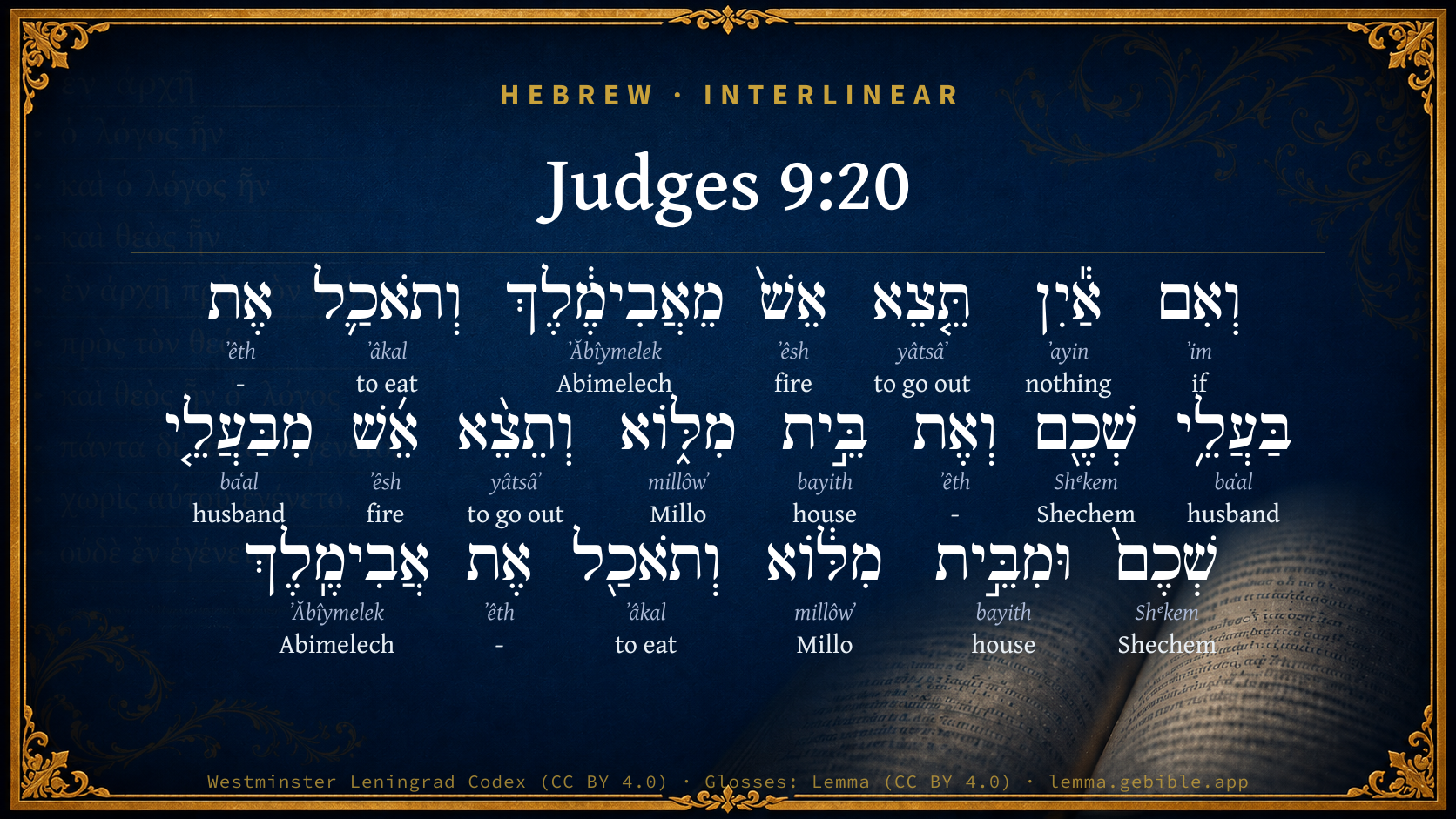
Hebrew (Westminster Leningrad Codex) Judges 9:20 appears in the Hebrew Old Testament. The text above is from the Westminster Leningrad Codex. Each word links to its Strong’s number, a concise gloss, and parsing drawn from the Open Scriptures Hebrew Bible morphology. Click any word for its full Brown-Driver-Briggs (BDB) entry.
Download image
Cite this verse

Judges 9:20 (World English Bible). Public Domain. Lemma interlinear Bible study tool, https://lemma.gebible.app/v/judges/9/20.

Show BibTeX & RIS
BibTeX
RIS
English Translation
but if not, let fire come out from Abimelech, and devour the men of Shechem, and the house of Millo; and let fire come out from the men of Shechem, and from the house of Millo, and devour Abimelech.
World English Bible · Public Domain
Download a study sheet

One document with this verse’s original text, its word-by-word gloss line, the meaning frame, cross-references with their text, attributed commentary, and full source and license credits — printable, and it pastes into notes with its structure intact.

This verse Autodidact and up

Study sheet (.html) Plain text (.txt)

A passage Seminary Student

Up to 50 verses in one chapter. A passage sheet keeps up to 6 commentary sources and 12 cross-references per verse, in the order this page ranks them, and says so on the sheet whenever that leaves anything out. Ask for a single verse and you get the Autodidact verse sheet above.

Everything on this page stays free to read, with no account — the sheet is a download of what is already on screen, not access to it.

Want to remove ads? Support Godless Engineer
Compare translations 3

The same verse in 3 English versions, stacked beneath the original-language interlinear above. Click any original word for its lexicon entry.

Each is an independent rendering of the whole verse — the interlinear is not word-aligned to these translations.

Highlighted words mark where these versions differ — a whole-verse word diff, not a word-by-word alignment.

  • World English Bible Public Domain
    but if not, let fire come out from Abimelech, and devour the men of Shechem, and the house of Millo; and let fire come out from the men of Shechem, and from the house of Millo, and devour Abimelech.
  • King James Version Public Domain
    But if not, let fire come out from Abimelech, and devour the men of Shechem, and the house of Millo; and let fire come out from the men of Shechem, and from the house of Millo, and devour Abimelech.
  • unfoldingWord Literal Text CC BY-SA 4.0
    But if not, may fire go forth from Abimelech, and may it consume the lords of Shechem and Beth Millo, and may fire go forth from the lords of Shechem and from Beth Millo, and may it consume Abimelech.”

unfoldingWord Literal Text — © unfoldingWord, licensed CC BY-SA 4.0. Word-aligned USFM3 via Door43 (git.door43.org/unfoldingWord/en_ult).

Versions to compare (up to 4)

3 of 4 selected

Show all 18 translations

Every available English version of this verse, each an independent rendering of the whole verse.

  • World English Bible Public Domain
    but if not, let fire come out from Abimelech, and devour the men of Shechem, and the house of Millo; and let fire come out from the men of Shechem, and from the house of Millo, and devour Abimelech.
  • Berean Standard Bible Public Domain
    But if not, may fire come from Abimelech and consume the leaders of Shechem and Beth-millo, and may fire come from the leaders of Shechem and Beth-millo and consume Abimelech.”
  • Majority Standard Bible Public Domain
    But if not, may fire come from Abimelech and consume the leaders of Shechem and Beth-millo, and may fire come from the leaders of Shechem and Beth-millo and consume Abimelech.”
  • King James Version Public Domain
    But if not, let fire come out from Abimelech, and devour the men of Shechem, and the house of Millo; and let fire come out from the men of Shechem, and from the house of Millo, and devour Abimelech.
  • American Standard Version (1901) Public Domain
    but if not, let fire come out from Abimelech, and devour the men of Shechem, and the house of Millo; and let fire come out from the men of Shechem, and from the house of Millo, and devour Abimelech.
  • Revised Version (1885) Public Domain
    but if not, let fire come out from Abimelech, and devour the men of Shechem, and the house of Millo; and let fire come out from the men of Shechem, and from the house of Millo, and devour Abimelech.
  • Geneva Bible (1599) Public Domain
    But if not, let a fire come out from Abimelech, and consume the men of Shechem and the house of Millo: also let a fire come foorth from the men of Shechem, and from the house of Millo, and consume Abimelech.
  • Douay-Rheims (1899) Public Domain
    But if unjustly: let fire come out from him, and consume the inhabitants of Sichem, and the town of Mello: and let fire come out from the men of Sichem, and from the town of Mello, and devour Abimelech.
  • Young's Literal Translation Public Domain
    and if not -- fire cometh out from Abimelech and devoureth the masters of Shechem and the house of Millo, and fire cometh out from the masters of Shechem and from the house of Millo, and devoureth Abimelech.'
  • Literal Standard Version CC BY-SA 4.0
    and if not—fire comes out from Abimelech and devours the masters of Shechem and the house of Millo, and fire comes out from the masters of Shechem and from the house of Millo, and devours Abimelech.”
  • Unlocked Literal Bible CC BY-SA 4.0
    But if not, let fire come out from Abimelech and burn up the men of Shechem and Beth Millo. Let fire come out from the men of Shechem and Beth Millo, to burn up Abimelech.”
  • unfoldingWord Literal Text CC BY-SA 4.0
    But if not, may fire go forth from Abimelech, and may it consume the lords of Shechem and Beth Millo, and may fire go forth from the lords of Shechem and from Beth Millo, and may it consume Abimelech.”
  • Darby Bible Public Domain
    but if not, let fire come out from Abim'elech, and devour the citizens of Shechem, and Beth-millo; and let fire come out from the citizens of Shechem, and from Beth-millo, and devour Abim'elech."
  • World Messianic Bible Public Domain
    but if not, let fire come out from Abimelech and devour the men of Shechem and the house of Millo; and let fire come out from the men of Shechem and from the house of Millo and devour Abimelech.”
  • Webster's Bible Public Domain
    But if not, let fire come out from Abimelech, and devour the men of Shechem, and the house of Millo; and let fire come out from the men of Shechem, and from the house of Millo, and devour Abimelech.
  • Free Bible Version CC BY-SA 4.0
    But if you haven't, then may fire flame out from Abimelech, and may it burn up the leaders of Shechem and Beth-millo, and may fire flame out from the leaders of Shechem and Beth-millo and burn up Abimelech!”
  • Bible in Basic English Public Domain
    But if not, may fire come out from Abimelech, burning up the townsmen of Shechem and Beth-millo; and may fire come out from the townsmen of Shechem and Beth-millo, for the destruction of Abimelech.
  • JPS Tanakh (1917) Public Domain
    But if not, let fire come out from Abimelech, and devour the men of Shechem, and Beth-millo; and let fire come out from the men of Shechem, and from Beth-millo, and devour Abimelech.'

Literal Standard Version (2020), Covenant Press — licensed CC BY-SA 4.0. Text via the HelloAO Bible API (eBible.org). Unlocked Literal Bible (unfoldingWord) — licensed CC BY-SA 4.0. Text via the HelloAO Bible API (eBible.org). unfoldingWord Literal Text — © unfoldingWord, licensed CC BY-SA 4.0. Word-aligned USFM3 via Door43 (git.door43.org/unfoldingWord/en_ult). Free Bible Version, Dr. Jonathan Gallagher — licensed CC BY-SA 4.0. Text via the HelloAO Bible API (eBible.org).

Word by word

More ways to search: Search by grammar → Find every occurrence → Compare this word →

Practice this passage: Drill this verse → Learn its vocabulary →

מִלּ֑וֹא
millôwʼ
H4407
“Millo”
Noun, Proper
Part of Speech
Noun
Type
Proper
Full BDB Definition

Origin: from H4390

TWOT: None

Millo = "rampart" or " mound" - a place near Shechem; site unknown - a part of the fortifications of Jerusalem
  1. וְאִם ʼim H518 “and · if” Conjunction + Conjunction
  2. אַ֕יִן ʼayin H369 “nothing” Particle, Negative
  3. תֵּ֤צֵא yâtsâʼ H3318 “to go out” Verb, Qal, Imperfect, 3rd Person, Feminine, Singular
  4. אֵשׁ֙ ʼêsh H784 “fire” Noun, Common, Both, Singular, Absolute
  5. מֵאֲבִימֶ֔לֶךְ ʼĂbîymelek H40 “from · Abimelech” Preposition + Noun, Proper
  6. וְתֹאכַ֛ל ʼâkal H398 “and · to eat” Conjunction + Verb, Qal, Imperfect, 3rd Person, Feminine, Singular
  7. אֶת ʼêth H853 “-” Particle, Direct Object
  8. בַּעֲלֵ֥י baʻal H1167 “husbands of” Noun, Common, Masculine, Plural, Construct
  9. שְׁכֶ֖ם Shᵉkem H7927 “Shechem” Noun, Proper
  10. וְאֶת ʼêth H853 “and · -” Conjunction + Particle, Direct Object
  11. בֵּ֣ית bayith H1004 “house of” Noun, Common, Masculine, Singular, Construct
  12. וְתֵצֵ֨א yâtsâʼ H3318 “and · to go out” Conjunction + Verb, Qal, Imperfect, 3rd Person, Feminine, Singular
  13. אֵ֜שׁ ʼêsh H784 “fire” Noun, Common, Both, Singular, Absolute
  14. מִבַּעֲלֵ֤י baʻal H1167 “from · husbands of” Preposition + Noun, Common, Masculine, Plural, Construct
  15. שְׁכֶם֙ Shᵉkem H7927 “Shechem” Noun, Proper
  16. וּמִבֵּ֣ית bayith H1004 “and · from · house of” Conjunction + Preposition + Noun, Common, Masculine, Singular, Construct
  17. מִלּ֔וֹא millôwʼ H4407 “Millo” Noun, Proper
  18. וְתֹאכַ֖ל ʼâkal H398 “and · to eat” Conjunction + Verb, Qal, Imperfect, 3rd Person, Feminine, Singular
  19. אֶת ʼêth H853 “-” Particle, Direct Object
  20. אֲבִימֶֽלֶךְ ʼĂbîymelek H40 “Abimelech” Noun, Proper

About this verse

These counts appear in no published source. They are computed here, from the morphology-tagged text and Lemma’s own curated glosses. What Lemma adds →

21
words
11
distinct lemmas
Historical
section

Notable vocabulary

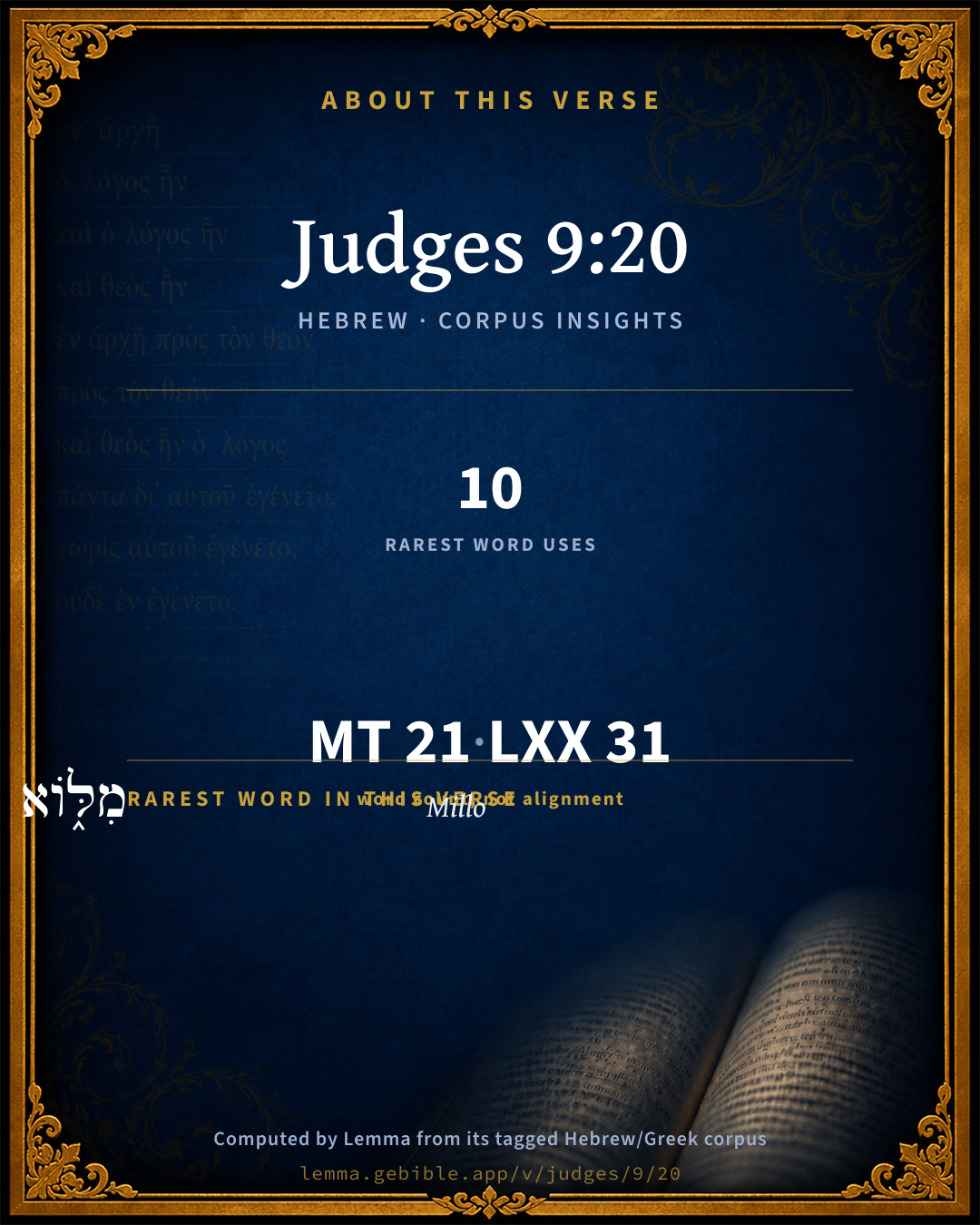
The rarest word here is מִלּ֑וֹא Millo H4407 — appearing just 10 times in the whole Hebrew Bible.

Shared distinctive vocabulary

מִלּ֑וֹא Millo H4407 occurs in 9 verses of the Hebrew Bible. Also found in:

Grammatical profile

  • 4 verbs
  • 12 nouns
  • 1 conjunction
  • 4 particles

Verb forms

  • תֵּ֤צֵא Qal · Imperfect
  • וְתֹאכַ֛ל Qal · Imperfect
  • וְתֵצֵ֨א Qal · Imperfect
  • וְתֹאכַ֖ל Qal · Imperfect

Repetition

Words recur within this verse — often emphatic in Hebrew:

  • תֵּ֤צֵא to go out H3318 ×2
  • אֵשׁ֙ fire H784 ×2
  • מֵאֲבִימֶ֔לֶךְ Abimelech H40 ×2
  • וְתֹאכַ֛ל to eat H398 ×2
  • בַּעֲלֵ֥י husband H1167 ×2
  • שְׁכֶ֖ם Shechem H7927 ×2
  • בֵּ֣ית house H1004 ×2
  • מִלּ֑וֹא Millo H4407 ×2

Hebrew & Septuagint length

In English translation the verse runs 39 words from the Hebrew and 39 from the Septuagint (LXX English) — the same length.

A rough comparison of the two English renderings, which tokenize alike — not a word-level alignment.

Word counts can differ between the Hebrew and the Greek without any difference in meaning — e.g. the Hebrew direct-object marker אֵת has no separate Greek word, and Greek often adds the article ὁ.

In the original languages it is 21 Hebrew tokens and 31 Greek tokens — but the two are counted differently (Hebrew bundles its prefixes and suffixes into one token; the Greek is in lemma form), so that isn’t a like-for-like length.

Cross-references

10

Topical passages linked to Judges 9:20 in the Treasury of Scripture Knowledge — connected by theme and wording, ordered by reader-vote popularity; previews shown in the World English Bible.

  • Judges 9:15 The bramble said to the trees, If in truth you anoint me king over you, then come and take refuge in my shade; and if not, let fire come out of the bramble, and devour the cedars of Lebanon.
  • Judges 9:56–57 Thus God requited the wickedness of Abimelech, which he did to his father, in killing his seventy brothers;
  • 2 Chronicles 20:22–23 When they began to sing and to praise, Yahweh set liers-in-wait against the children of Ammon, Moab, and Mount Seir, who had come against Judah; and they were struck.
  • Psalms 28:4 Give them according to their work, and according to the wickedness of their doings. Give them according to the operation of their hands. Bring back on them what they deserve.
  • Psalms 140:10 Let burning coals fall on them. Let them be thrown into the fire, Into miry pits, from where they never rise.
  • Judges 7:22 They blew the three hundred trumpets, and Yahweh set every man's sword against his fellow, and against all the host; and the host fled as far as Beth-shittah toward Zererah, as far as the border of Abel Meholah, by Tabbath.
  • Judges 9:23 God sent an evil spirit between Abimelech and the men of Shechem; and the men of Shechem dealt treacherously with Abimelech:
  • Psalms 21:9–10 You will make them as a fiery furnace in the time of your anger. Yahweh will swallow them up in his wrath. The fire shall devour them.
  • Psalms 52:1–5 Why do you boast of mischief, mighty man? God's loving kindness endures continually.
  • Psalms 120:3–4 What will be given to you, and what will be done more to you, You deceitful tongue?

Cross-references courtesy of OpenBible.info (CC BY 4.0).

Hebrew and Greek witnesses Masoretic Hebrew ↔ Greek Septuagint

The same verse in the two great witnesses to the Old Testament, shown verse-for-verse.

These are two independent witnesses, not word-aligned to each other, and the Septuagint is shown in lemma (dictionary) form.

Hebrew Judges 9:20 Masoretic · Westminster Leningrad Codex

וְאִם אַ֕יִן תֵּ֤צֵא אֵשׁ֙ מֵאֲבִימֶ֔לֶךְ וְתֹאכַ֛ל אֶת בַּעֲלֵ֥י שְׁכֶ֖ם וְאֶת בֵּ֣ית מִלּ֑וֹא וְתֵצֵ֨א אֵ֜שׁ מִבַּעֲלֵ֤י שְׁכֶם֙ וּמִבֵּ֣ית מִלּ֔וֹא וְתֹאכַ֖ל אֶת אֲבִימֶֽלֶךְ

but if not, let fire come out from Abimelech, and devour the men of Shechem, and the house of Millo; and let fire come out from the men of Shechem, and from the house of Millo, and devour Abimelech.

World English Bible · Public Domain

Greek LXX Judges 9:20 Septuagint · lemma form

εἰ δέ οὐ ἐκἔρχομαι πῦρ ἀπό αβιμελεχ καί ἐσθίω ὁ ἀνήρ σικιμα καί ὁ οἶκος βηθμααλλων καί ἐκἔρχομαι πῦρ ἀπό ἀνήρ σικιμα καί ἐκ ὁ οἶκος βηθμααλλων καί καταἐσθίω ὁ αβιμελεχ

but if not, let fire come out from Abimelech, and devour the men of Sicima, and the house of Bethmaalo; and let fire come out from the men of Sicima and from the house of Bethmaalo, and devour Abimelech.

LXX2012 (modern English Septuagint) · Public Domain

Hebrew: Westminster Leningrad Codex (CC BY 4.0). Greek: Septuagint (public domain); English from LXX2012 (modern English Septuagint) (Public Domain). How the Septuagint differs from the Hebrew →

Targum (Aramaic paraphrase)

1

The Targum is the ancient Jewish Aramaic paraphrase of the Hebrew Scriptures — an interpretive translation, not the Hebrew text itself. Onkelos (literal) and Pseudo-Jonathan (expansive) render the Torah, and Jonathan the Prophets. Coverage is partial: where no permissively-licensed English translation exists for a verse, only the Aramaic is shown. This is verse-level text, not a word-by-word alignment to the Hebrew.

  1. Targum Jonathan Prophets (Joshua–Malachi)
    וְאִם לָא תִפּוֹק אֶשְׁתָּא מֵאֲבִימֶלֶךְ וְתֵיכוּל יַת יַתְבֵי שְׁכֶם וְיַת בֵּית מִלוֹא וְתִפּוֹק אֶשְׁתָּא מִיַתְבֵי שְׁכֶם וּמִבֵּית מִלוֹא וְתֵיכוּל יַת אֲבִימֶלֶךְ:

    (no public-domain English translation for this verse)

    Targum Jonathan — Aramaic: “Mikraot Gedolot” (public domain). English: “Sefaria Community Translation” (CC0 1.0 (public-domain dedication)); “London "Chaldee Paraphrase," 1871” (public domain). Text via Sefaria.

Commentary

Notes on Judges 9:20 from classic Christian and Jewish commentators (each source and its license shown beneath its notes). The classic Christian expositions comment on the surrounding passage and are grouped to its opening verse, so a note may address several verses; the Jewish commentaries on the Tanakh (Rashi and others) are per-verse, so they appear only where the commentator wrote on this verse.

Lemma curates 59 commentaries, every one of them public domain or Creative Commons licensed, each selected and text-cleaned for this edition rather than reprinted as found. About our sources →

Trapp's Complete Commentary

John Trapp

Jdg 9:20 But if not, let fire come out from Abimelech, and devour the men of Shechem, and the house of Millo; and let fire come out from the men of Shechem, and from the house of Millo, and devour Abimelech.

Ver. 20. But if not.] As your own consciences, those domestical chaplains, will tell you: for

“ Conscia mens ut cuique sua est, ira concipit intra

Pectora pro facto spemque metumque, suo. ” - Ovid.

Let fire come.] See Jdg 9:15.

John Trapp, A Commentary or Exposition upon All the Books of the Old and New Testament (1647–1656) — public domain. Text from a community e-Sword module.

Joseph Benson's Commentary

Jdg 9:20. Devour Abimelech — This is not so much a prediction as an imprecation, which, being grounded upon just cause, had its effect, as others in like case have had.

Joseph Benson's Commentary on the Old and New Testaments (1811–1818) — public domain. Text from a community e-Sword module.

Adam Clarke's Commentary

Verse 20. Let fire come out from Abimelech] As the thorn or bramble may be the means of kindling other wood, because it may be easily ignited; so shall Abimelech be the cause of kindling a fire of civil discord among you, that shall consume the rulers and great men of your country. A prophetic declaration of what would take place.

Adam Clarke's Commentary on the Bible (1810–1826) — public domain. Text from a community e-Sword/MySword module.

Ellicott's Commentary for English Readers

(20) Let fire come out.—The malediction is that they may perish by mutual destruction. It was exactly fulfilled (Jdg_9:45-49). So when (Œetes is crucified as he had crucified Polykrates, Herodotus notices the similarity of the Nemesis (3:128).

A Bible Commentary for English Readers, edited by Charles John Ellicott (1878–1897) — public domain. Text from a community e-Sword module.

The Cambridge Bible for Schools and Colleges

gen. ed. J. J. S. Perowne

20. but if not etc.] ‘Your chief will be fatal to you and you to him,’ cf. Jdg_9:15 b. This was Jotham’s ‘curse’; the fulfilment comes in Jdg_9:44 ff., Jdg_9:56 f.

The Cambridge Bible for Schools and Colleges (gen. ed. J. J. S. Perowne; Cambridge University Press, 1878–1918) — public domain. Text from a community e-Sword module.

John Gill's Exposition

But if not,.... If it appeared that they had not acted uprightly and sincerely in this matter:

let fire come out of Abimelech, and devour the men of Shechem, and the house of Millo; let wrath, rage, and fury, break out from Abimelech like fire, and issue in the destruction of those that made him king, both those of Shechem and of Millo:

and let fire come out from the men of Shechem, and from the house of Millo, and devour Abimelech; let them be incensed against Abimelech, and seek his ruin, and procure it: the sense is, that he wishes that strife, contention, and quarrels, might arise among them, and they mutually destroy each other; the words are imprecative of evil upon them both, and which had its exact fulfilment.

John Gill's Exposition of the Whole Bible (1746–1763) — public domain (CC PDM 1.0). Text via the HelloAO Bible API.

Haydock's Catholic Bible Commentary

Town of. Hebrew, "the house of Mello," ver. 6. (Calmet) --- the imprecation of Joatham was prophetical. He had not the smallest doubt but the people had done wrong; (Haydock) and the three different fruit-trees, which rejected the offer of promotion, represented all the virtuous Israelites, who knew that they could not lawfully assume the regal or judicial authority, without the divine call. Ezechiel (xvii. 24,) attributes knowledge to trees by the same figure of speech, as Joatham does here. (Menochius)

George Leo Haydock (1774–1849), Haydock's Catholic Family Bible and Commentary, 1859 edition — public domain. Excludes Psalms (Douay-Rheims chapter numbering differs from Protestant) and Deuterocanonical books (Catholic canon only).

Matthew Poole's English Annotations

This is not a prediction, but an imprecation or curse, as it is called, Jdg 9:57, which, being grounded upon just cause, and being the only way by which Jotham could perform the duty of the avenger of his brethren’s blood, which was incumbent upon him, had its effect, as others in like case had, as Jos 6:26, compared with 1Ki 16:34; 2Ki 2:24.

Matthew Poole's English Annotations on the Holy Bible (1683–1685) — public domain. Text from a community e-Sword/MySword module.

Whedon's Commentary on the Bible

Daniel D. Whedon

20. Devour Abimelech — The application transcends the fable itself. Not only shall Abimelech, the accursed bramble, kindle a fire to the destruction of many lords of Shechem, but also fires of revengeful judgment shall come out in fury from the latter, and devour Abimelech himself. All this, as the subsequent history shows, was a true prophecy. See Jdg_9:49-57.

Daniel D. Whedon (gen. ed.), Commentary on the Old and New Testaments (1874–1909) — public domain. Text from a community e-Sword module.

John Wesley's Explanatory Notes

Devour Abimelech - This is not so much a prediction as an imprecation, which, being grounded upon just cause, had its effect, as others in like case had.

John Wesley, Explanatory Notes Upon the Whole Bible (1754–1765) — public domain. Text via the GEBible commentary corpus.

Lesson kit

Teaching starters — assembled from the data on this page, not authored interpretation. Every prompt links to the verse data it draws on. Edit before teaching.

Judges, in the Historical, opens this verse with 21 words (11 distinct Hebrew lemmas). Its most distinctive word is millôwʼ (“Millo”). A historical commentator’s framing appears above. Read the whole chapter for the surrounding context.

Discussion questions

  1. The word millôwʼ carries the sense “Millo.” How does it shape the verse?
  2. How does Judges 9:6, which shares the word «Millo», read alongside this verse?
  3. What does the repetition of “to go out” (2× in this one verse) do in this verse?
  4. These translations render this verse differently. What is at stake in choosing one wording over another?
  5. «תֵּ֤צֵא» is a Qal Imperfect verb. How does that grammatical form shape the action described?
  6. Compare how Trapp's Complete Commentary and Joseph Benson's Commentary read this verse. Where do they agree or differ?

Things to notice

Reading settings

Reading text

Shown beneath each verse's original-language words.

Old Testament
Old Testament edition

Read the OT as the Masoretic Hebrew (MT) or the Greek Septuagint (LXX).

English shown for the Greek Septuagint (in the Hebrew ↔ Greek comparison).

Comparing translations? Open the Compare panel on any verse page to stack up to four side by side.