Isaiah 44:6

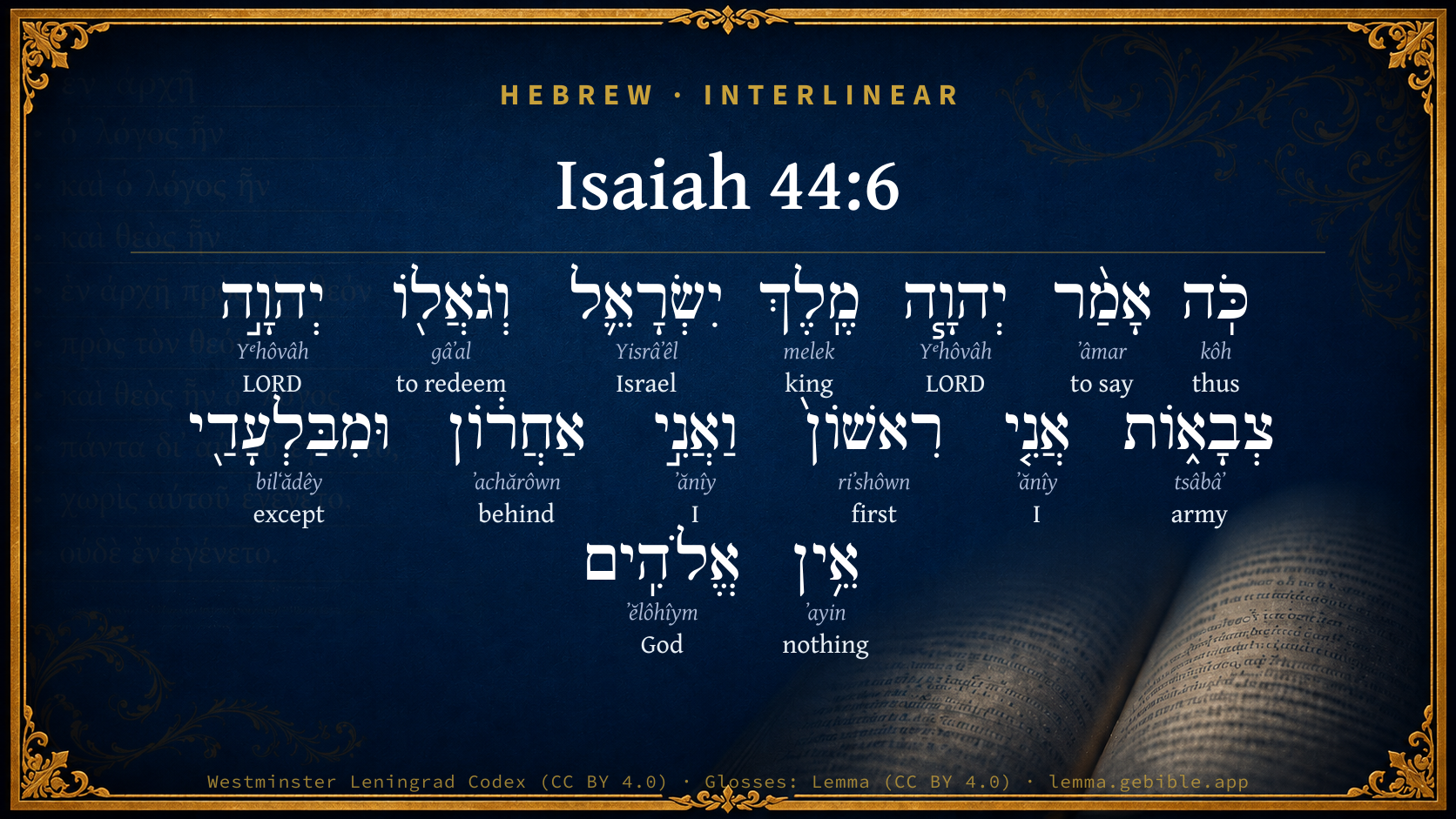
Hebrew (Westminster Leningrad Codex) Isaiah 44:6 appears in the Hebrew Old Testament. The text above is from the Westminster Leningrad Codex. Each word links to its Strong’s number, a concise gloss, and parsing drawn from the Open Scriptures Hebrew Bible morphology. Click any word for its full Brown-Driver-Briggs (BDB) entry.
Download image
Cite this verse

Isaiah 44:6 (World English Bible). Public Domain. Lemma interlinear Bible study tool, https://lemma.gebible.app/v/isaiah/44/6.

Show BibTeX & RIS
BibTeX
RIS
English Translation
Thus says Yahweh, the King of Israel, and his Redeemer, Yahweh of Hosts: I am the first, and I am the last; and besides me there is no God.
World English Bible · Public Domain
Download a study sheet

One document with this verse’s original text, its word-by-word gloss line, the meaning frame, cross-references with their text, attributed commentary, and full source and license credits — printable, and it pastes into notes with its structure intact.

This verse Autodidact and up

Study sheet (.html) Plain text (.txt)

A passage Seminary Student

Up to 50 verses in one chapter. A passage sheet keeps up to 6 commentary sources and 12 cross-references per verse, in the order this page ranks them, and says so on the sheet whenever that leaves anything out. Ask for a single verse and you get the Autodidact verse sheet above.

Everything on this page stays free to read, with no account — the sheet is a download of what is already on screen, not access to it.

Want to remove ads? Support Godless Engineer
Compare translations 3

The same verse in 3 English versions, stacked beneath the original-language interlinear above. Click any original word for its lexicon entry.

Each is an independent rendering of the whole verse — the interlinear is not word-aligned to these translations.

Highlighted words mark where these versions differ — a whole-verse word diff, not a word-by-word alignment.

  • World English Bible Public Domain
    Thus says Yahweh, the King of Israel, and his Redeemer, Yahweh of Hosts: I am the first, and I am the last; and besides me there is no God.
  • King James Version Public Domain
    Thus saith the LORD the King of Israel, and his redeemer the LORD of hosts; I am the first, and I am the last; and beside me there is no God.
  • unfoldingWord Literal Text CC BY-SA 4.0
    Thus says Yahweh, the King of Israel and his Redeemer, Yahweh of Armies: “I the first, and I the last; and there is no God except me.

unfoldingWord Literal Text — © unfoldingWord, licensed CC BY-SA 4.0. Word-aligned USFM3 via Door43 (git.door43.org/unfoldingWord/en_ult).

Versions to compare (up to 4)

3 of 4 selected

Show all 18 translations

Every available English version of this verse, each an independent rendering of the whole verse.

  • World English Bible Public Domain
    Thus says Yahweh, the King of Israel, and his Redeemer, Yahweh of Hosts: I am the first, and I am the last; and besides me there is no God.
  • Berean Standard Bible Public Domain
    Thus says the LORD, the King and Redeemer of Israel, the LORD of Hosts: “I am the first and I am the last, and there is no God but Me.
  • Majority Standard Bible Public Domain
    Thus says the LORD, the King and Redeemer of Israel, the LORD of Hosts: “I am the first and I am the last, and there is no God but Me.
  • King James Version Public Domain
    Thus saith the LORD the King of Israel, and his redeemer the LORD of hosts; I am the first, and I am the last; and beside me there is no God.
  • American Standard Version (1901) Public Domain
    Thus saith Jehovah, the King of Israel, and his Redeemer, Jehovah of hosts: I am the first, and I am the last; and besides me there is no God.
  • Revised Version (1885) Public Domain
    Thus saith the LORD, the King of Israel, and his redeemer the LORD of hosts: I am the first, and I am the last; and beside me there is no God.
  • Geneva Bible (1599) Public Domain
    Thus saith the Lord the King of Israel and his redeemer, the Lord of hostes, I am the first, and I am the last, and without me is there no God.
  • Douay-Rheims (1899) Public Domain
    Thus saith the Lord the king of Israel, and his redeemer the Lord of hosts: I am the brat, and I am the last, and besides me there is no God.
  • Young's Literal Translation Public Domain
    Thus said Jehovah, king of Israel, And his Redeemer, Jehovah of Hosts: `I `am' the first, and I the last, And besides Me there is no God.
  • Literal Standard Version CC BY-SA 4.0
    Thus said YHWH, King of Israel, || And his Redeemer, YHWH of Hosts: “I [am] the first, and I [am] the last, || And besides Me there is no God.
  • Unlocked Literal Bible CC BY-SA 4.0
    This is what Yahweh says—the King of Israel and his Redeemer, Yahweh of hosts: “I am the first, and I am the last; and there is no God but me.
  • unfoldingWord Literal Text CC BY-SA 4.0
    Thus says Yahweh, the King of Israel and his Redeemer, Yahweh of Armies: “I the first, and I the last; and there is no God except me.
  • Darby Bible Public Domain
    Thus saith Jehovah, the King of Israel, and his Redeemer, Jehovah of hosts: I [am] the first, and I [am] the last, and beside me there is no God.
  • World Messianic Bible Public Domain
    This is what the LORD, the King of Israel, and his Redeemer, the LORD of Hosts, says: “I am the first, and I am the last; and besides me there is no God.
  • Webster's Bible Public Domain
    Thus saith the LORD the King of Israel, and his redeemer the LORD of hosts; I am the first, and I am the last; and besides me there is no God.
  • Free Bible Version CC BY-SA 4.0
    This is what the Lord says, the King and Redeemer of Israel, the Lord Almighty: I am the first and I am the last, and there is no God besides me.
  • Bible in Basic English Public Domain
    The Lord, the King of Israel, even the Lord of armies who has taken up his cause, says, I am the first and the last, and there is no God but me.
  • JPS Tanakh (1917) Public Domain
    Thus saith the LORD, the King of Israel, and his Redeemer the LORD of hosts: I am the first, and I am the last, and beside Me there is no God.

Literal Standard Version (2020), Covenant Press — licensed CC BY-SA 4.0. Text via the HelloAO Bible API (eBible.org). Unlocked Literal Bible (unfoldingWord) — licensed CC BY-SA 4.0. Text via the HelloAO Bible API (eBible.org). unfoldingWord Literal Text — © unfoldingWord, licensed CC BY-SA 4.0. Word-aligned USFM3 via Door43 (git.door43.org/unfoldingWord/en_ult). Free Bible Version, Dr. Jonathan Gallagher — licensed CC BY-SA 4.0. Text via the HelloAO Bible API (eBible.org).

Word by word

More ways to search: Search by grammar → Find every occurrence → Compare this word →

Practice this passage: Drill this verse → Learn its vocabulary →

וּמִבַּלְעָדַ֖י
bilʻădêy
H1107
“and · from · except · me”
Conjunction + Preposition + Preposition + Suffix, Personal, 1st Person, Common, Singular
Part of Speech
Conjunction + Preposition + Preposition
Full BDB Definition

Origin: constructive pl. from H1077 and H5703

TWOT: 246h

apart from, except, without, besides
  1. כֹּֽה kôh H3541 “thus” Adverb
  2. אָמַ֨ר ʼâmar H559 “to say” Verb, Qal, Perfect, 3rd Person, Masculine, Singular
  3. יְהוָ֧ה Yᵉhôvâh H3068 “LORD” Noun, Proper
  4. מֶֽלֶךְ melek H4428 “king of” Noun, Common, Masculine, Singular, Construct
  5. יִשְׂרָאֵ֛ל Yisrâʼêl H3478 “Israel” Noun, Proper
  6. וְגֹאֲל֖וֹ gâʼal H1350 “and · redeeming · him” Conjunction + Verb, Qal, Participle Active, Masculine, Singular, Construct + Suffix, Personal, 3rd Person, Masculine, Singular
  7. יְהוָ֣ה Yᵉhôvâh H3068 “LORD” Noun, Proper
  8. צְבָא֑וֹת tsâbâʼ H6635 “armies” Noun, Common, Both, Plural, Absolute
  9. אֲנִ֤י ʼănîy H589 “I” Pronoun, Personal, 1st Person, Common, Singular
  10. רִאשׁוֹן֙ riʼshôwn H7223 “first” Adjective, Adjective, Masculine, Singular, Absolute
  11. וַאֲנִ֣י ʼănîy H589 “and · I” Conjunction + Pronoun, Personal, 1st Person, Common, Singular
  12. אַחֲר֔וֹן ʼachărôwn H314 “behind” Adjective, Adjective, Masculine, Singular, Absolute
  13. אֵ֥ין ʼayin H369 “nothing” Particle, Negative
  14. אֱלֹהִֽים ʼĕlôhîym H430 “God(s)” Noun, Common, Masculine, Plural, Absolute

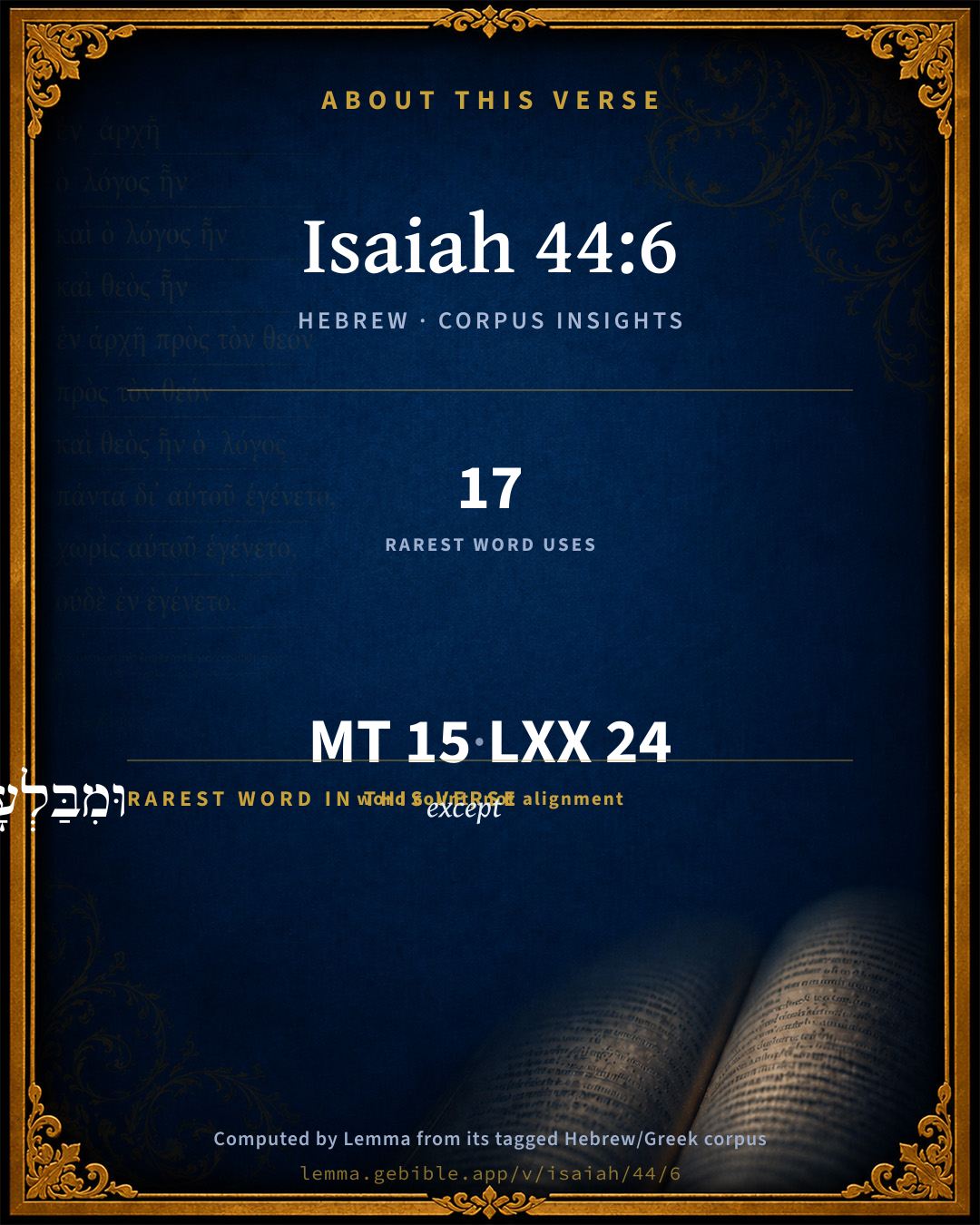
About this verse

These counts appear in no published source. They are computed here, from the morphology-tagged text and Lemma’s own curated glosses. What Lemma adds →

15
words
13
distinct lemmas
Prophets
section

Notable vocabulary

The rarest word here is וּמִבַּלְעָדַ֖י except H1107 — appearing just 17 times in the whole Hebrew Bible.

Shared distinctive vocabulary

וּמִבַּלְעָדַ֖י except H1107 occurs in 16 verses of the Hebrew Bible. Also found in:

Grammatical profile

  • 2 verbs
  • 6 nouns
  • 2 adjectives
  • 2 pronouns
  • 1 preposition
  • 1 adverb
  • 1 particle

Verb forms

  • אָמַ֨ר Qal · Perfect
  • וְגֹאֲל֖וֹ Qal · Participle Active

Repetition

Words recur within this verse — often emphatic in Hebrew:

  • יְהוָ֧ה LORD H3068 ×2
  • אֲנִ֤י I H589 ×2

Hebrew & Septuagint length

In English translation the verse runs 29 words from the Hebrew and 29 from the Septuagint (LXX English) — the same length.

A rough comparison of the two English renderings, which tokenize alike — not a word-level alignment.

Word counts can differ between the Hebrew and the Greek without any difference in meaning — e.g. the Hebrew direct-object marker אֵת has no separate Greek word, and Greek often adds the article ὁ.

In the original languages it is 15 Hebrew tokens and 24 Greek tokens — but the two are counted differently (Hebrew bundles its prefixes and suffixes into one token; the Greek is in lemma form), so that isn’t a like-for-like length.

Cross-references

32

Topical passages linked to Isaiah 44:6 in the Treasury of Scripture Knowledge — connected by theme and wording, ordered by reader-vote popularity; previews shown in the World English Bible.

  • Isaiah 41:4 Who has worked and done it, calling the generations from the beginning? I, Yahweh, the first, and with the last, I am he.
  • Isaiah 43:10–11 You are my witnesses, says Yahweh, and my servant whom I have chosen; that you may know and believe me, and understand that I am he: before me there was no God formed, neither shall there be after me.
  • Revelation 1:8 "I am the Alpha and the Omega," says the Lord God, "who is and who was and who is to come, the Almighty."
  • Revelation 22:13 I am the Alpha and the Omega, the First and the Last, the Beginning and the End.
  • Isaiah 44:8 Don't fear, neither be afraid: haven't I declared to you of old, and shown it? You are my witnesses. Is there a God besides me? Indeed, there is not. I don't know any Rock.
  • Isaiah 45:5–6 I am Yahweh, and there is none else; besides me there is no God. I will gird you, though you have not known me;
  • Isaiah 48:17 Thus says Yahweh, your Redeemer, the Holy One of Israel: I am Yahweh your God, who teaches you to profit, who leads you by the way that you should go.
  • Isaiah 48:12 Listen to me, O Jacob, and Israel my called: I am he; I am the first, I also am the last.
  • Deuteronomy 32:39 See now that I, even I, am he, There is no god with me: I kill, and I make alive; I wound, and I heal; There is none who can deliver out of my hand.
  • Isaiah 42:8 I am Yahweh, that is my name; and my glory will I not give to another, neither my praise to engraved images.
  • Isaiah 44:24 Thus says Yahweh, your Redeemer, and he who formed you from the womb: I am Yahweh, who makes all things; who stretches forth the heavens alone; who spreads abroad the earth (who is with me?);
  • Deuteronomy 6:4 Hear, Israel: Yahweh is our God; Yahweh is one:
  • Isaiah 45:21–22 Declare you, and bring [it] forth; yes, let them take counsel together: who has shown this from ancient time? who has declared it of old? Haven't I, Yahweh? and there is no God else besides me, a just God and a Savior; there is no one besides me.
  • Deuteronomy 4:39 Know therefore this day, and lay it to your heart, that Yahweh he is God in heaven above and on the earth beneath; there is none else.
  • Isaiah 43:1 But now thus says Yahweh who created you, Jacob, and he who formed you, Israel: Don't be afraid, for I have redeemed you; I have called you by your name, you are mine.
  • Isaiah 37:16 Yahweh of hosts, the God of Israel, who sits [above] the cherubim, you are the God, even you alone, of all the kingdoms of the earth; you have made heaven and earth.
  • Deuteronomy 4:35 To you it was shown, that you might know that Yahweh he is God; there is none else besides him.
  • Isaiah 33:22 For Yahweh is our judge, Yahweh is our lawgiver, Yahweh is our king; he will save us.
  • Isaiah 43:14–15 Thus says Yahweh, your Redeemer, the Holy One of Israel: For your sake I have sent to Babylon, and I will bring down all of them as fugitives, even the Chaldeans, in the ships of their rejoicing.
  • Isaiah 41:14 Don't be afraid, you worm Jacob, and you men of Israel; I will help you, says Yahweh, and your Redeemer is the Holy One of Israel.
  • Isaiah 54:5 For your Maker is your husband; Yahweh of Hosts is his name: and the Holy One of Israel is your Redeemer; the God of the whole earth shall he be called.
  • Revelation 1:17–18 When I saw him, I fell at his feet like a dead man. He laid his right hand on me, saying, "Don't be afraid. I am the first and the last,
  • Revelation 2:8 "To the angel of the assembly in Smyrna write: "The first and the last, who was dead, and has come to life says these things:
  • Matthew 25:34 Then the King will tell those on his right hand, 'Come, blessed of my Father, inherit the Kingdom prepared for you from the foundation of the world;
  • Isaiah 59:20 A Redeemer will come to Zion, and to those who turn from disobedience in Jacob, says Yahweh.
  • Jeremiah 50:34 Their Redeemer is strong; Yahweh of Hosts is his name: he will thoroughly plead their cause, that he may give rest to the earth, and disquiet the inhabitants of Babylon.
  • Malachi 1:14 "But the deceiver is cursed, who has in his flock a male, and vows, and sacrifices to the Lord a blemished thing; for I am a great King," says Yahweh of hosts, "and my name is awesome among the nations."
  • Isaiah 37:20 Now therefore, Yahweh our God, save us from his hand, that all the kingdoms of the earth may know that you are Yahweh, even you only.
  • Matthew 27:37 They set up over his head the accusation against him written, "THIS IS JESUS, THE KING OF THE JEWS."
  • Isaiah 41:21 Produce your cause, says Yahweh; bring forth your strong reasons, says the King of Jacob.
  • 1 Timothy 3:16 Without controversy, the mystery of godliness is great: God was revealed in the flesh, Justified in the spirit, Seen by angels, Preached among the nations, Believed on in the world, And received up in glory.
  • Revelation 1:11 saying, "What you see, write in a book and send to the seven assemblies: to Ephesus, Smyrna, Pergamum, Thyatira, Sardis, Philadelphia, and to Laodicea."

Cross-references courtesy of OpenBible.info (CC BY 4.0).

Hebrew and Greek witnesses Masoretic Hebrew ↔ Greek Septuagint

The same verse in the two great witnesses to the Old Testament, shown verse-for-verse.

These are two independent witnesses, not word-aligned to each other, and the Septuagint is shown in lemma (dictionary) form.

Hebrew Isaiah 44:6 Masoretic · Westminster Leningrad Codex

כֹּֽה אָמַ֨ר יְהוָ֧ה מֶֽלֶךְ יִשְׂרָאֵ֛ל וְגֹאֲל֖וֹ יְהוָ֣ה צְבָא֑וֹת אֲנִ֤י רִאשׁוֹן֙ וַאֲנִ֣י אַחֲר֔וֹן וּמִבַּלְעָדַ֖י אֵ֥ין אֱלֹהִֽים

Thus says Yahweh, the King of Israel, and his Redeemer, Yahweh of Hosts: I am the first, and I am the last; and besides me there is no God.

World English Bible · Public Domain

Greek LXX Isaiah 44:6 Septuagint · lemma form

οὕτως λέγω ὁ θεός ὁ βασιλεύς ὁ ἰσραήλ ὁ ῥύομαι αὐτός θεός σαβαωθ ἐγώ πρῶτος καί ἐγώ μετά οὗτος πλήν ἐγώ οὐ εἰμί θεός

Thus says God the King of Israel, and the God of hosts that delivered him; I am the first, and I am hereafter: beside me there is no God.

LXX2012 (modern English Septuagint) · Public Domain

On this verse, Joseph Benson's Commentary discusses the Septuagint’s reading. Read the note in Commentary ↓

Hebrew: Westminster Leningrad Codex (CC BY 4.0). Greek: Septuagint (public domain); English from LXX2012 (modern English Septuagint) (Public Domain). How the Septuagint differs from the Hebrew →

Targum (Aramaic paraphrase)

1

The Targum is the ancient Jewish Aramaic paraphrase of the Hebrew Scriptures — an interpretive translation, not the Hebrew text itself. Onkelos (literal) and Pseudo-Jonathan (expansive) render the Torah, and Jonathan the Prophets. Coverage is partial: where no permissively-licensed English translation exists for a verse, only the Aramaic is shown. This is verse-level text, not a word-by-word alignment to the Hebrew.

  1. Targum Jonathan Prophets (Joshua–Malachi)
    כִּדְנַן אֲמַר יְיָ מַלְכָּא דְיִשְׂרָאֵל וּפַרְקֵהּ יְיָ צְבָאוֹת אֲנָא הוּא דְמִלְקַדְמִין אַף עַלְמֵי עָלְמַיָא דִילִי אִינוּן וּבַר מִנִי לֵית אֱלֶהּ:

    Thus saith the King of Israel, and His Redeemer, the Lord of hosts; I am He who was from the beginning, yea, eternities of eternities are mine; and beside me there is no God.

    Targum Jonathan — Aramaic: “Mikraot Gedolot” (public domain). English: “Sefaria Community Translation” (CC0 1.0 (public-domain dedication)); “London "Chaldee Paraphrase," 1871” (public domain). Text via Sefaria.

Commentary

Notes on Isaiah 44:6 from classic Christian and Jewish commentators (each source and its license shown beneath its notes). The classic Christian expositions comment on the surrounding passage and are grouped to its opening verse, so a note may address several verses; the Jewish commentaries on the Tanakh (Rashi and others) are per-verse, so they appear only where the commentator wrote on this verse.

Lemma curates 59 commentaries, every one of them public domain or Creative Commons licensed, each selected and text-cleaned for this edition rather than reprinted as found. About our sources →

The Cambridge Bible for Schools and Colleges

gen. ed. J. J. S. Perowne

6–8. There is no God but Jehovah and Israel is His witness: this is the substance of the verses, and the proof is the familiar one from prophecy.

the King of Israel] See on ch. Isa_41:21.

the Lord of hosts] this solemn appellation (see on ch. Isa_1:9) occurs here for the first time in this prophecy (cf. ch. Isa_45:13, Isa_47:4, Isa_48:2, Isa_51:15, Isa_54:5).

I am the first and I am the last] So ch. Isa_48:12; see on Isa_41:4, and cf. Rev_1:8; Rev_1:17; Rev_22:13. besides me there is no God] a fuller expression of monotheism than ch. Isa_43:10.

Ch. Isa_44:6-23. The Reality of Jehovah’s Godhead, evinced by His Predictions, and contrasted with the manifold absurdities of Idolatry

The passage, which is merely a restatement of ideas already expressed, consists of three divisions:

i. Isa_44:6-8. A re-assertion and demonstration of the eternity and sole Divinity of Jehovah.

ii. Isa_44:9-20. A fresh exposure—the most complete and remorseless that the book contains—of the irrationality of idol-worship.

iii. Isa_44:21-23. An exhortation to the exiles to lay these truths to heart, and cleave to the God who forgives their sins and who alone can deliver. Isa_44:23 is a lyrical effusion, such as the thought of the redemption frequently calls forth from the prophet.

The Cambridge Bible for Schools and Colleges (gen. ed. J. J. S. Perowne; Cambridge University Press, 1878–1918) — public domain. Text from a community e-Sword module.

Trapp's Complete Commentary

John Trapp

Isa 44:6 Thus saith the LORD the King of Israel, and his redeemer the LORD of hosts; I [am] the first, and I [am] the last; and beside me [there is] no God.

Ver. 6. Thus saith the Lord.] Here and in the subsequent verses we have an evident and excellent testimony of the unity of the true God, and vanity of idols.

John Trapp, A Commentary or Exposition upon All the Books of the Old and New Testament (1647–1656) — public domain. Text from a community e-Sword module.

The Biblical Illustrator

Joseph S. Exell

Isa_44:6

Thus saith the Lord, the King of Israel

I am the First, and I am the Last

This affirmation of Gods existence appears more comprehensive than the similar one, made by Him to Moses, I am that I am.

It is true, when we say that He is by His own absolute will and power, we assert by implication all that belongs necessarily to the essence and character of the Almighty. We assert His eternity; for He who so exists could have had no beginning, and can have no end: we assert His creation of all other beings, and His sovereignty over them; for He who alone is from eternity, must have given existence to all things that are besides Himself; and, as the Author of all, in and for whom all exist, must be the sovereign Ruler and Disposer of all. Nevertheless the ampler form of expression, I am the First and I am the Last, implying comparison with and precedency to all other existences, would seem to convey-to- the mined more distinct notions of the eternity, the omnipotence, the creative will and beneficence, of that infinite Being who is above all, and before all, and in all. (R. Cattermole, B. D.)

The First and the Last

Bitter was the sorrow of the prophet who spoke these words when he saw his people turn away from Jehovah. Israel had been enlightened by the purest lights. Alone of all the nations of the ancient world, it possessed the knowledge of the One living and holy God. Yet these truths are forgotten; these privileges are rejected; this God is denied. Obedient to the idolatrous inspirations of the Semitic races whose vitiated blood runs through their veins, the Israelites turn towards Moloch, Baal, Astarte. Then the prophet argues, struggles, waxes indignant, implores; he shows the inanity of that idolatrous worship and the infamy of those hideous rites; he reminds Israel of the greatness of their origin and of their destiny; he calls up before their eyes the sacred figure of Jehovah; he tells his people, in the words which the Almighty Himself has put into his mouth, Thus saith the Lord, the King of Israel, and His redeemer the Lord of Hosts; I am the First, and I am the Last; and beside Me there is no God. This history is our own. A light more resplendent far than that which illumined Israel hath shone upon the Christian nations. What has all this availed us, and whither are marching the rising generations? Doubtless, the stone and wooden idols of the past cannot be set up again. But this gloomy fatality before which men would compel us to abdicate our reason, is it not an idol too?

I. I AM THE FIRST.

1. We find in this the affirmation of the fundamental doctrine of the supreme God, the Creator of all things. To-day men would teach us another Genesis of the world: the old doctrines of Epicurus are once more becoming current; we hear of eternal matter, of millions and millions of atoms which, by whirling about continually in space, have unconsciously and spontaneously invested themselves with a motion in accordance with the mathematical laws which they had themselves called into existence. We are told that out of a mechanical combination suddenly issued a living cell, and that, millions of centuries aiding, this life has become vegetative, then animal, then conscious, intellectual, and finally moral; we axe asked to acknowledge this ascending progression of matter which, from the inert molecule it was in the first instance, has become sensitive protoplasm, then has been transformed into the plant, which in its turn has become endowed with motion, then advancing one step further has turned into the hideous animal, creeping in the mire of the primitive marshes, to rise up at length in its conquered majesty and call itself Plato, Aristotle, Jesus Christ. And having thus accounted for the formation of things, men look with scornful pity upon those who still have recourse to the intervention of an all-creating God; their idea of the Divine Being may be expressed in the words of the learned Laplace to Napoleon the First. I have had no need of this hypothesis. In presence of this self-styled scientific Genesis, it is not only my faith which revolts, but my reason repeats, with the enthusiasm of a conviction firmer than ever, I believe in God the Father Almighty, Maker of heaven and earth; for if there is m my reason an immovable principle, it is indeed this: that no effect can exist without a cause, that all which is in the effect must also be in the cause; that, consequently, matter can never have brought forth intelligence, chaos can never have given birth to harmony, for in nowise can the lesser ever have produced the greater. 2 This reminds us, further, that as God is the supreme Cause, He must also be the supreme End of all that exists, the centre of the thoughts and affections of all the beings He has created. All things, says St. Paul, are by Him and for Him. Every being has a destination, and the noblest destination of all beings is that which the Scriptures call the glory of God. You know what this ideal has become, and what sin has made of it.

3. This means, further, that God is at the basis of all that is done to raise and save humanity, to bring it back to the true life which it has lost by separating itself from Him. God is at work in the midst of mankind. It is in a region higher than that of science that we must seek the hidden sources of the river of life which brings regeneration, consolation, and eternal hope to the world. Whence come they then? They gush from the depths of the religious revelation which the God whom we serve has given to mankind. God the Creator is also God the Redeemer, and, in order of grace as in that of nature, He may truly say: I am the First. What has been accomplished in the world must also be accomplished in each individual being, and the redemption of humanity is nothing if it is not worked out in the innermost soul of those who are to reap its fruits.

II. I AM THE LAST. By this we must understand--

1. That God never abdicates, and that He shall ever remain the Supreme Master, when all the lords of a day shall have passed away after having made a little noise in the world.

2. That God remains the Supreme Judge, and that, consequently, the hour of justice shall certainly strike.

3. That God is the Supreme Refuge of every soul that calls upon Him, the only one which remains standing when all others have disappeared. (E. Bersier, D. D.)

Bibical monotheism:

As to this, the sublimest utterance of Scripture, we offer three preliminary remarks--

1. It is supported by the structure and order of nature. So far as the universe has come within the sweep of scientific observation and research, it appears as one complete whole. All its parts are beautifully harmonised; all its forces are nicely balanced.

2. It is in direct antagonism to certain prevalent opinions. It is opposed to atheism, which declares there is no God; to fetichism, the worship of any material object that a capricious superstition may select; to polytheism, which holds the plurality of gods; and to pantheism, which regards nature as identical with Deity, and thus destroys a Divine personality.

3. It is accepted as a fundamental truth in all evangelical churches. But our object is to consider the practical uses of Biblical monotheism.

I. IT REVEALS THE GREATNESS OF THE CREATOR. Survey this wondrous universe. Gaze upon the vast, and examine the minute in the clearest and broadest light of modem science, and what do you see--wisdom? Yes, manifold wisdom. Goodness? Yes, like an overflowing tide, overflowing all. Power? In rearing the stupendous fabrics, building up the mountains, pouring out the oceans, stretching out the heavens. Do you see wealth in all this? If you attach value to one acre of earth, what is the value of the globe? If there be but one God, how great must He be!

II. IT REVEALS THE DEFINITENESS OF MORAL OBLIGATION. Deep in the souls of all men is the sense of duty. My definition of virtue is this--following a right rule from a right motive. What is the rule? Clearly, if there be but one God, the will of that one God must be the rule. What is the motive? Clearly, if there be but one God, supreme love to that one God. Were there a plurality of gods there would be a difficulty to find out what virtue is; we should have to determine whose will to obey--the will of each, or some, or all. And we should also have to find out who of all the gods we should love the most.

III. IT REVEALS THE FITNESS OF RELIGION TO THE CONSTITUTION OF THE SOUL.

1. The human heart has a centralising tendency. Deep in our emotional nature is a craving for some one object on which to place entire confidence, and centre the deepest love.

2. The moral character of the soul depends upon its central object. By a law of our nature we become like that we most love. He who loves God becomes a partaker of the Divine nature.

3. The souls happiness is determined by the character of the object most loved. All experience shows that most of our happiness and misery comes out of our supreme love. All, in every age, who have loved the one God supremely have felt with the psalmist who said, Whom have I in heaven but Thee?

IV. IT REVEALS THE HUMAN BROTHERHOOD OF SOULS. To us, says Paul, there is but one God, the Father of all things, and we in Him.

V. IT REVEALS THE WONDERFUL IN MEDIATION. God so loved the world that He gave His only-begotten Son, &c. Here is love passing knowledge.

1. What a disparity between Him who loves and them who are loved! What a disparity in natures! God, the Almighty, the All-wise, the Eternal. Man, the feeble, the ignorant, and the dying. What a disparity in character! God, the Essence and Fountain of all holiness. Man, vile and polluted with sin.

2. What a manifestation of the greatness of His love. Is this one God our one God? Have we no idols? (D. Thomas, D. D.)

The Biblical Illustrator, edited by Joseph S. Exell (c. 1880s–1900s) — public domain. Text from a community e-Sword module.

Joseph Benson's Commentary

Isa 44:6-8. Thus saith the Lord, &c. — Here God renews his contest with idols, which he insists an so often, and so much, because his own people were exceeding prone to idolatry. And who — Which of all the heathen gods; shall call, and shall declare it — Shall, by his powerful call, cause a future event to be, and, by his infinite foreknowledge, declare that it shall be. And set it in order for me — Orderly relate all future events in the same manner as they shall happen. Since I appointed the ancient people — Αφ’ ου εποιησα ανθρωπον. Since I first made man upon the earth: so the LXX. And the things that are coming, &c. — Such things as are near at hand, and such as are to come hereafter. Have not I told thee? — Thee, O Israel, whom he bids not to fear. The sense is, I call you Israelites to bear me witness, whether I have not, from time to time, acquainted you with things to come; from that time — When I appointed the ancient people, (Isa 44:7,) from the first ages of the world. And have declared it — Have published it to the world in my sacred records. Ye are even my witnesses — Both of my predictions, and of the exact agreeableness of events to them.

Joseph Benson's Commentary on the Old and New Testaments (1811–1818) — public domain. Text from a community e-Sword module.

Whedon's Commentary on the Bible

Daniel D. Whedon

SEC. 4, (1) CYRUS AND IMMANUEL, Isa_44:6 to Isa_45:23.

1. The folly of idols, Isa_44:6-28.

6. Observe the same attributes are assumed by Christ in Rev_1:8; Rev_1:17; Rev_22:13. This mission of the Lord Jesus in its outcome, as the New Testament presents it, is, that he is also Messiah, and that he is king and judge of Messiah’s kingdom, the kingdom of all the true Israel, whether of Jews or Gentiles.

Daniel D. Whedon (gen. ed.), Commentary on the Old and New Testaments (1874–1909) — public domain. Text from a community e-Sword module.

The Preacher's Complete Homiletical Commentary

Joseph S. Exell (gen. ed.)

THE SOLITARINESS AND ETERNITY OF GOD

Isa_44:6. Thus saith the Lord, the King of Israel, &c.

A magnificent text! It places before us three of the loftiest of all themes of thought—the solitariness and eternity of God, and His relations to the Church. There are speculations that are profitless; but others are ennobling. These! About such topics we should often think; or the noblest faculties of our mind will dwindle and die (H. E. I. 3294, 3493).

I. THE SOLITARINESS OF GOD. “Beside Me there is no God.” To us a familiar fact; but let us think about it. One God! Then—

1. One Creator of all things. All—what a comprehensive term! Includes—

(1.) The lifeless universe. The sun—suns. Mountains, gems. The rocks, the waves that roll and dash against them, &c.

(2.) The living universe. How varied the living forms in this earth, this infinitesimal fragment of the universe! But God is the one source of all the life of the universe, of all its grandeur, of all its beauty.

(3.) The moral universe. Men. Angels. What a wonderful Being, of whom the outcome is so various and glorious (P. D. 631).

2. One Sustainer of all things. The regularity of the procession of the seasons, of all the events of the universe, is a sufficient proof that behind all things there is one God (H. E. I. 362–365, 3173–3182).

3. One Ruler of all things. Every departure from the laws of righteousness and love, is not merely an infraction of law, but a sin against GOD (H. E. I. 4478).

In all these respects God abides alone, eternally!

II. THE ETERNITY OF GOD. “I am the first, and I am the last.” Space and time the two mysteries before which the human mind stands defeated and appalled. They defy our attempts to grasp them (P. D. 1078). But science has done a noble service by enlarging our ideas of both. Astronomy and geology—what suggestions they are giving concerning the meaning of the word Time! But when our thoughts have travelled back as far as is possible, with what do they find themselves confronted? With God! “In the beginning GOD created the heavens and the earth” (H. E. I. 2253). Let us travel forward. What a changing universe we are in! The predictions of science concerning the solar system. When they are fulfilled, what will remain unchanged? GOD! With Him there is no variableness (P. D. 2536).

1. This enables us to look forward without foreboding. The one Ruler will overrule all the changes for His glory and the good of His creatures. There is a richer universe ahead (P. D. 1492.)

2. How certain is the fulfilment of the promises of Scripture! He who made them will remain to fulfil them (H. E. I. 2254).

3. What an immense interest we have in this truth of the eternity of God! His children shall share in His eternity with Him (Psa_122:4-8; P. D. 1693, 1971).

III. GOD’S RELATIONS TO HIS CHURCH. In considering them, remember that what He is to His Church He is also to each member of it.

1. He is its King. “Thus saith the Lord, the King of Israel.”

(1.) Its ruler. His will only should be consulted by it. The Church should not fear man nor seek his favour; to GOD only should obedience be rendered. This the inspiring, ennobling principle of the martyrs (Act_4:19-20; Act_5:29).

(2.) Its defender. No evil can happen to it (Mat_16:18). The testimony of the past. No fear as to the future (H. E. I. 1246–1251, 2249).

2. He is its Redeemer. “And his redeemer the Lord of hosts.” “Redeemer,” i.e., rescuer. Two modes of rescue, by payment and by power. By payment He has rescued His people from the just claims of the avenging LAW (Mat_20:28; 1Ti_2:6; Rom_3:24-26; H. E. I. 382). By sanctifying power He will rescue them from the dominion of ignorance and sin (Mat_1:21).

(1.) There are many imperfections in the Church. But they shall all be removed (Eph_5:25-27). His ransomed ones shall form a glorious host with which He shall be “satisfied.”

(2.) There are many imperfections in us. Let us not be dismayed because of them, but let us struggle against them valiantly. In our case, too, God will show that He is the Redeemer of Israel (Php_1:6; Jud_1:24; H. E. I. 1053–1070).

The Preacher's Complete Homiletical Commentary (gen. ed. Joseph S. Exell; Funk & Wagnalls, c. 1892) — public domain (pre-1929). A full-Bible homiletical/sermon-outline anthology covering 65 of 66 books (2 John is absent from the source module). Text from a community e-Sword module.

Keil & Delitzsch

C. F. Keil & F. Delitzsch

A new pledge of redemption is given, and a fresh exhortation to trust in Jehovah; the wretchedness of the idols and their worshippers being pointed out, in contrast with Jehovah, the only speaking and acting God. Isa 44:6 "Thus saith Jehovah the King of Israel, and its Redeemer, Jehovah of hosts; I am first, and I last; and beside me there is no God." The fact that His deity, which rules over not only the natural world, but history as well, is thus without equal and above all time, is now proved by Him from the fact that He alone manifests Himself as God, and that by the utterance of prophecy. Isa 44:7 "And who preaches as I do? Let him make it known, and show it to me; since I founded the people of ancient time! And future things, and what is approaching, let them only make known." Jehovah shows Himself as the God of prophecy since the time that He founded עם־עולם (יקרא refers to the continued preaching of prophecy). ‛Am‛ōlâm is the epithet applied in Eze 26:20 to the people of the dead, who are sleeping the long sleep of the grave; and here it does not refer to Israel, which could neither be called an "eternal" nation, nor a people of the olden time, and which would have been more directly named; but according to Isa 40:7 and Isa 42:5, where ‛am signifies the human race, and Job 22:15., where ‛ōlâm is the time of the old world before the flood, it signifies humanity as existing from the very earliest times. The prophecies of Jehovah reach back even to the history of paradise. The parenthetical clause, "Let him speak it out, and tell it me," is like the apodosis of a hypothetical protasis: "if any one thinks that he can stand by my side." The challenge points to earlier prophecies; with ואתיּות it takes a turn to what is future, אתיות itself denoting what is absolutely future, according to Isa 41:23, and תּבאנה אשׁר what is about to be realized immediately; lâmō is an ethical dative.

Keil & Delitzsch — Biblical Commentary on the Old Testament (1861–1891) — public domain (CC PDM 1.0). Text via the HelloAO Bible API. (Old Testament only.)

Tyndale Open Study Notes

Tyndale Open Resources

44:6-20 This passage uses the form of a trial speech to press God’s argument that disgrace comes to all who trust in idols and false gods.

Tyndale Open Study Notes — © Tyndale Open Resources, licensed CC BY-SA 4.0. Text via the HelloAO Bible API.

Geneva Bible (1599)

Geneva Bible translators

I am always like myself, that is, merciful toward my Church, and most able to maintain it, as Isa. 41:4 and 48:12; Rev. 1:17 and 22:13.

Geneva Bible (1599) marginal notes — public domain. Text via Bolls.life.

Jamieson, Fausset & Brown

Robert Jamieson, A. R. Fausset & David Brown

Here follows an argument for Jehovah, as the only God, and against the idols, as vanity (see on Isa 41:4; Isa 43:1; Isa 43:10-12).

Jamieson, Fausset & Brown — Commentary Critical and Explanatory on the Whole Bible (1871) — public domain (CC PDM 1.0). Text via the HelloAO Bible API.

Ellicott's Commentary for English Readers

(6) Thus saith the Lord . . .—A new section opens, repeating the argument of Isaiah 41, 43 against idolatry.

A Bible Commentary for English Readers, edited by Charles John Ellicott (1878–1897) — public domain. Text from a community e-Sword module.

John Gill's Exposition

Thus saith the Lord the King of Israel,.... The King of the whole world, and Governor among the nations; and in a peculiar manner King of Israel, that nation being a theocracy; and especially King of spiritual Israel, or King of saints, be they of what nation they will:

and his Redeemer, the Lord of hosts; who redeemed Israel out of Egypt, from the house of bondage, and would again redeem them from the Babylonish captivity, and the whole Israel of God from sin, Satan, and the law; which he was able to do, being "the Lord of hosts", of the armies above and below:

I am the first, and I am the last; the first cause and last end, of all things in nature, and providence, and grace; all things are of him, through him, and from him; all things were made by him in creation, and for his pleasure they are and were created; and all things are disposed of in his providence for his own glory; and he is the first in reconciliation, justification, and salvation, and all are to the glory of his grace: or this is a periphrasis of his eternity, who is from everlasting to everlasting, without beginning or end, the Alpha and Omega; the same is said of Christ, Rev 1:8, and all the other characters before mentioned agree with him:

and besides me there is no God: all others are only gods by name, not by nature, mere nominal fictitious deities, not real ones; and it is to the exclusion of these from the rank of deity, these words are said; but not to the exclusion of the Son of God, and the Holy Spirit, who, with the Father, are the one true God.

John Gill's Exposition of the Whole Bible (1746–1763) — public domain (CC PDM 1.0). Text via the HelloAO Bible API.

Albert Barnes' Notes on the Bible

Thus saith the Lord - This commences, as I suppose (see Analysis), the argument to prove that Yahweh is the only true God, and that the idols were vanity. The object is, to show to the Jews, that he who had made to them such promises of protection and deliverance was able to perform what he had pledged himself to do.

The King of Israel - (See the notes at Isa 41:21).

And his Redeemer - (See the notes at Isa 43:1).

The Lord of hosts - (See the notes at Isa 1:9).

I am the first - (See the notes at Isa 41:4).

And I am the last - In Isa 41:4, this is expressed ‘with the last;’ in Rev 1:8, ‘I am Alpha and Omega.’ The sense is, that God existed before all things, and will exist forever.

And besides me there is no God - This is repeatedly declared (Deu 4:35, Deu 4:39; see the note at Isa 43:10-12). This great truth it was God‘s purpose to keep steadily before the minds of the Jews; and to keep it in the world, and ultimately to diffuse it abroad among the nations, was one of the leading reasons why he selected them as a special people, and separated them from the rest of mankind.

Albert Barnes' Notes on the Bible (1834–1885) — public domain. Text from a community e-Sword/MySword module.

Matthew Poole's English Annotations

Here God reneweth his contest with idols; which he insisteth upon so oft and so much, because his own people were exceeding prone to idolatry.

Matthew Poole's English Annotations on the Holy Bible (1683–1685) — public domain. Text from a community e-Sword/MySword module.

The Pulpit Commentary

Vers. 6-20. A FURTHER CONTRAST OF GOD WITH IDOLS. The captive Jews, dwelling scattered in a land the inhabitants of which were, one and all, idolaters, and having by hereditary taint an inclination to idolatry, would be easily tempted, during the long and weary period of the Captivity, to put away the worship and even the thought of Jehovah, who had allowed their subjugation, and conform to the religion of their conquerors. Hence the repeated contrasts in these later chapters specially addressed to caprice Israel between Jehovah and idols, and the sharp ridicule of the latter. (comp. Isa_40:18-25 Isa_41:4-7, Isa_41:21-29)

The Lord the King of Israel. Therefore entitled to Israel"s allegiance. (comp. Isa_43:15) And his Redeemer; i.e. Israel"s Redeemer he who had redeemed them from Egyptian bondage who will redeem them from the power of Babylon who, best of all, will redeem them from their sins. The First... the Last. (comp. Isa_41:4, with the comment) Beside me there is no God. This had been distinctly asserted in the Law; (Deu_4:35, 39 32:39) but Israel could not be induced practically to believe it. The "gods of the nations" were supposed generally to be realities, actual powers, not perhaps so potent as Jehovah, but still real beings, capable of doing good and harm. (see Isa_41:23) It is one of Isaiah"s special objects in these later chapters to disabuse Israel of this notion. (see Isa_41:21-24 Isa_43:9-11 Isa_45:5, Isa_45:6, Isa_45:14-22, etc.)

Vers. 6-28. Jehovah and the images.

I SELF-MANIFESTATION OF JEHOVAH. He is the First and the Last, Alpha and Omega. Existing before the creation, he will endure when it shall have passed away. (Isa_48:12) It is a thought which strikes us at once by its sublimity, anal, what is better, with its truth. Men sometimes speak of the material world as real, of the world of faith and imagination as dreamy. Not so the greatest prophets and poets. Shakespeare describes the globe and all its human splendours as passing away like an "insubstantial pageant faded." But Isaiah outdoes Shakespeare, making the very heavens themselves pass; and perhaps St. Paul goes a step further when he sees "knowledge itself" vanishing away. Moreover, Jehovah is the incomparable God. He can admit no "rival near the throne;" cannot accommodate other deities to places in a tolerant pantheon. He is the sole Object of worship, the only Being to whom is due the title "God." So, too, he alone can tell the future. Let the long past bear witness. He placed the "ancient people," or the "everlasting people." The reference seems to be to the ever-enduring covenant spoken of in Exo_31:16, to the priesthood and the kingdom which are everlasting. (Exo_40:15 2Sa_13:16) It suggests "the everlastingness of God"s people," in opposition to the proximate fall of the idolatrous nations. Or, the reference may be to the days before the Flood to the most ancient inhabitants of the world. In any case, he has appointed beforehand the times and the bounds of the habitations of men. And history is intended to teach men of him, that they may with mind and heart glorify him. Israel herself is the great witness on the earth to God. He is her "Rock a great and memorable figure. (Deu_32:4, Deu_32:30, 31 Psa_19:14 Psa_31:2, 3 42:9) Rock of Ages, Dwelling-place of all generations: who can wear such titles but himself? "If there were another Rock of Ages, Jehovah would not complain; but as his Being is unique, it pains him that men will not have him for a God.

II IDOLATRY CRITICIZED. The image-makers are all of them "chaos an expression of extreme contempt. There is no use, no profit, in their trade. To that question of use all institutions, yea, all men, must ultimately come. Now, what can be said on behalf of idolatry? Produce the witnesses.

Blind and ignorant, what have they to say? To produce them is to abash and confound them. And so it is with many an idol and institution of our time. It tries to keep off criticism under the plea of sacredness; when the age insists on criticism, and will have an answer, its silence or its confused apologies are its condemnation. What can be answered to the following questions? How can you turn an image into a living spiritual being? Quis nisi demens who but one out of his senses can confound the one with the other? The worship of these idols was sacra mental, and was kept up by societies and guilds. The members were in association with the idol and with one another; like Ephraim, (Hos_4:17) they were in fellowship with demons. (cf. 1Co_10:20) If the idol be nothing in the world, what becomes of those "joined to him"? Let that question be answered. And then, again, how can these human craftsmen make their Maker? Let them all combine in their toil: the ludicrousness of their endeavours is the more manifest. There is the smith with his sharp axe and his hammers, sweating at the fire till he is faint; the carpenter with his line and sharp chisel, plane and compasses. The semblance of a human figure appears. The god is made; and sacrifice and prayer follow. "Save me!" the benighted worshipper cries to his manufacture. The scene is enough to carry conviction to the spectator"s mind, and to convince him that these votaries can have no perception, so "daubed" are their eyes and their hearts by the habits of sense. The power of reflection seems gone the power to hold up the act before the mind and judge it. A thoughtless religion, an uninquiring compliance with tradition and custom, is often enjoined upon us; but only thoughtful religion will endure. God is Mind; and if we fail to offer him the best of our mind, we sink down into some such miserable delusion, such ashy refuse of religion, as is here held up to scorn and ridicule.

III ADMONITION TO ISRAEL. Let the child, the servant of Jehovah, remember these things, and lay to heart the folly of idolatry, and the glorious constancy of the God who has claimed them for his own. Do they think they are forgotten of God? Impossible! "O Israel, thou canst not be forgotten of me!" He is beforehand with her. Before she confesses, he proclaims her sins forgiven; before she returns to her allegiance, be cries, "I have blotted out as a mist thy rebellions;" before she prays for deliverance, he proclaims, "I have released thee; then return!" Here is the heart of the gospel, the heart of the infinite love. We, with too narrow heart, too often make human good the antecedent of Divine grace. "Repent," we say, "and God will forgive; be obedient and God will reward." But on the prophet"s representation, Jehovah makes the first advances. He calls for conversion on the ground that he has released Israel. And so ever. The parable of the prodigal reflects the same ideas. The "goodness of God leadeth thee to repentance." It is this thought which makes hardness of heart housing up wrath against the day of wrath appear so odious in the sinner"s own eyes. We need to represent the gospel so that the sinner shall throw all the blame of his condition on self, not on God. Let us ever speak of him as One who "keeps mercy for thousands," and whose stores of compassion cannot be exhausted. "Oh for this love let rocks and hills Their lasting silence break!

Let heaven and earth join in a chorus of sympathy, with shoutings from the depth of the earth, and ringings from the mountain-heights and from the forests. Let his praise be even "sounded down to hell"; (cf. Psa_6:5 Psa_88:12) for he is Redeemer, has "beautified himself" in Israel (cf. Isa_49:3; 60:21; 61:3).

IV JEHOVAH AND HIS PURPOSES. He is the God, the Guardian Spirit, the Guide, the Avenging Judge, for Israel. He has moulded Israel in the womb of time, who has made the universe of things. He only is wise, "bringing to nought the signs of the praters, and making the diviners mad," turning the wise backward, and proving their knowledge folly. On the other hand, he speaks by the prophet. He causes his servant"s word to stand, and fulfils the counsel of his messengers. And his word and counsel is that Jerusalem shall be peopled, and the waste places of Judah be built upon; the flood of Euphrates be dried up. And already the word is passing into deed. The instrument of Jehovah"s purposes has been selected; no prince of the Davidic house, but Cyrus shall be his shepherd and accomplish all his pleasure. And we read in Josephus that Cyrus read the prophecy of Isaiah, and was seized by an impulse to fulfil it ("Ant.," 11:1.2). God has jurisdiction over heathen monarchs; their plans are directed by him and made subservient to his will. What the Greeks thought of as Ananke, Necessity, the Hebrew thinks of as the will of the Eternal. J.

The Pulpit Commentary (1880–1919), ed. H.D.M. Spence-Jones & Joseph S. Exell — public domain. Text from a community e-Sword module.

J. A. Alexander on Isaiah

Joseph Addison Alexander

“Thus saith Jehovah, king of Israel, and his redeemer, Jehovah of Hosts: I (am) first, and I (am) last, and without me there is no God.” This is a description of the God whom the nations, in the preceding verse, are represented as acknowledging. The attributes ascribed to Him afford, at the same time, a sufficient reason for confiding in His promises. The terms here used are appropriated to the Lord Jesus Christ in Rev 1:18; Rev 2:8; Rev 22:13. There is no need of giving to the preposition in the last clause the restricted sense ‘besides’, which is really included in the usual and strict sense of ‘without’, (i.e., without my knowledge and permission), or without subjection to my sovereign authority. The meaning is not simply, that there is no other true God in existence, but that even the lords (1Co 8:5) exist only by His sufferance, and cannot therefore be His equals or competitors.

Joseph Addison Alexander, The Prophecies of Isaiah (1846–1847; New York: Scribner, 1870–1878) — public domain. Text from a community e-Sword module.

Scofield Reference Notes

C. I. Scofield

redeemed

Heb. "goel," Redemp. (Kinsman type). (See Scofield "Isa 59:20").

The Scofield Reference Bible (1917 edition), notes by C. I. Scofield — public domain. Text from a community e-Sword module.

unfoldingWord translationNotes

Door43 World Missions Community

his Redeemer

"Israel's Redeemer"

Yahweh of hosts

See how you translated this phrase in Isaiah 1:9.

I am the first, and I am the last

This phrase emphasizes Yahweh's eternal nature. Possible meanings are 1) "I am the one who began all things, and I am the one who ends all things" or 2) "I am the one who has always lived, and I am the one who always will live." (See: Merism)

translationWords

king

Israel

redeem

Yahweh of hosts

God

unfoldingWord translationNotes — © Distant Shores Media and the Door43 World Missions Community, licensed CC BY-SA 4.0. Source: git.door43.org/Door43/en_tn.

Ibn Ezra

Rabbi Abraham ibn Ezra

The King of Israel, When the Israelites were in their own land. And his redeemer, when he is in exile.

The Lord of hosts. He is always king, and the hosts of heaven testify it.

I am the first, the first king.

Ibn Ezra on the Tanakh — English translations: “Sefaria Community Translation” (CC0 1.0 (public-domain dedication)); “Yalkut, Sifsei Chachomim Chumash, Metsudah Publications, 2009” (CC BY 4.0); and “Commentary of Ibn Ezra on Isaiah - trans. by M. Friedlander, 1873” (public domain). Text via Sefaria.

Lesson kit

Teaching starters — assembled from the data on this page, not authored interpretation. Every prompt links to the verse data it draws on. Edit before teaching.

Isaiah, in the Prophets, opens this verse with 15 words (13 distinct Hebrew lemmas). Its most distinctive word is bilʻădêy (“except”). A historical commentator’s framing appears above. Read the whole chapter for the surrounding context.

Discussion questions

  1. What does “except” (bilʻădêy) contribute to the verse as a whole?
  2. How does Genesis 14:24, which shares the word «except», read alongside this verse?
  3. What does the repetition of “LORD” (2× in this one verse) do in this verse?
  4. These translations render this verse differently. What is at stake in choosing one wording over another?
  5. «אָמַ֨ר» is a Qal Perfect verb. How does that grammatical form shape the action described?
  6. Compare how The Cambridge Bible for Schools and Colleges and Trapp's Complete Commentary read this verse. Where do they agree or differ?

Things to notice

Reading settings

Reading text

Shown beneath each verse's original-language words.

Old Testament
Old Testament edition

Read the OT as the Masoretic Hebrew (MT) or the Greek Septuagint (LXX).

English shown for the Greek Septuagint (in the Hebrew ↔ Greek comparison).

Comparing translations? Open the Compare panel on any verse page to stack up to four side by side.