
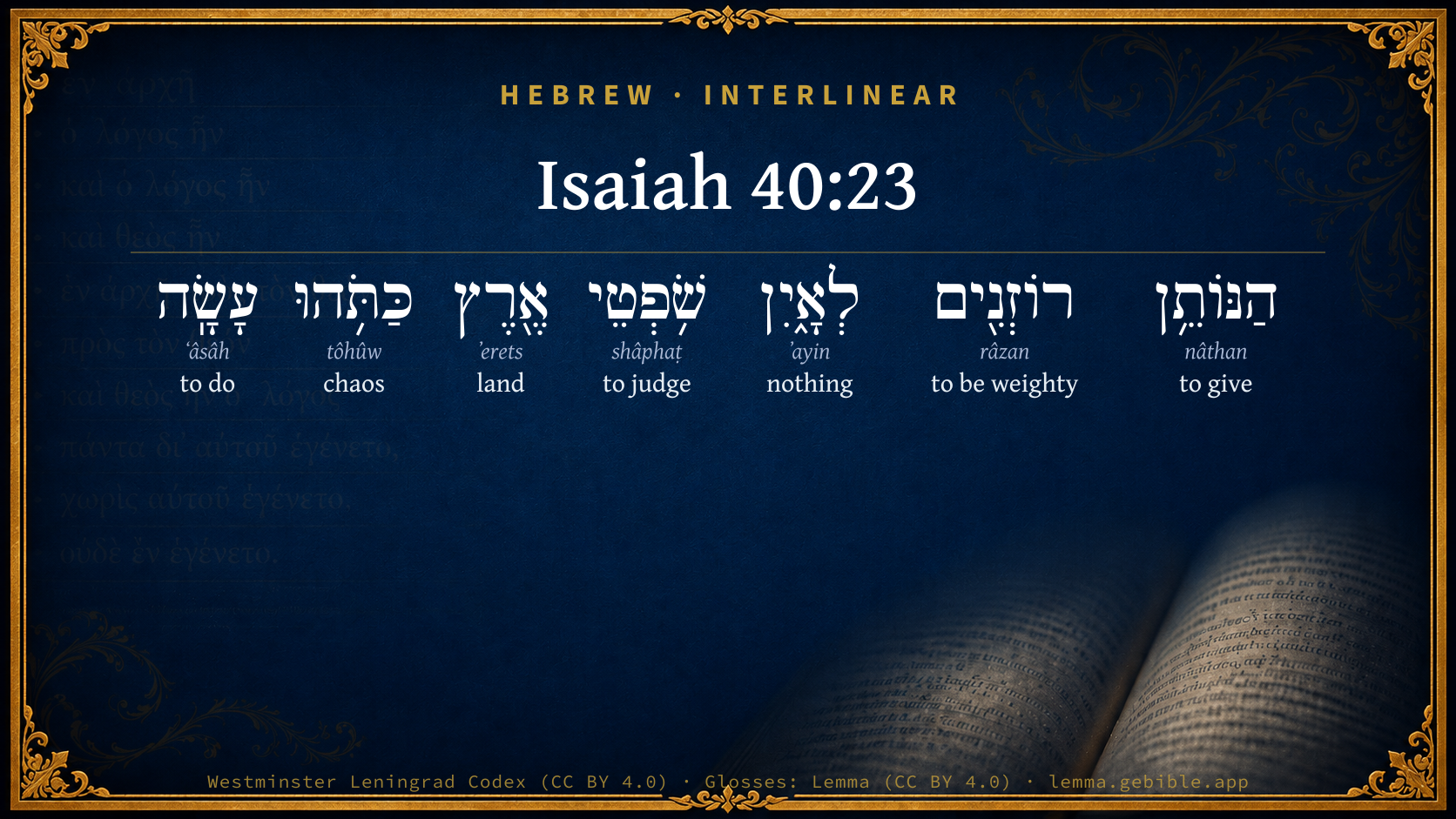
Isaiah 40:23

Hebrew (Westminster Leningrad Codex) Isaiah 40:23 appears in the Hebrew Old Testament. The text above is from the Westminster Leningrad Codex. Each word links to its Strong’s number, a concise gloss, and parsing drawn from the Open Scriptures Hebrew Bible morphology. Click any word for its full Brown-Driver-Briggs (BDB) entry.
Download image
Cite this verse

Isaiah 40:23 (World English Bible). Public Domain. Lemma interlinear Bible study tool, https://lemma.gebible.app/v/isaiah/40/23.

Show BibTeX & RIS
BibTeX
RIS
English Translation
who brings princes to nothing; who makes the judges of the earth as vanity.
World English Bible · Public Domain
Download a study sheet

One document with this verse’s original text, its word-by-word gloss line, the meaning frame, cross-references with their text, attributed commentary, and full source and license credits — printable, and it pastes into notes with its structure intact.

This verse Autodidact and up

Study sheet (.html) Plain text (.txt)

A passage Seminary Student

Up to 50 verses in one chapter. A passage sheet keeps up to 6 commentary sources and 12 cross-references per verse, in the order this page ranks them, and says so on the sheet whenever that leaves anything out. Ask for a single verse and you get the Autodidact verse sheet above.

Everything on this page stays free to read, with no account — the sheet is a download of what is already on screen, not access to it.

Want to remove ads? Support Godless Engineer
Compare translations 3

The same verse in 3 English versions, stacked beneath the original-language interlinear above. Click any original word for its lexicon entry.

Each is an independent rendering of the whole verse — the interlinear is not word-aligned to these translations.

Highlighted words mark where these versions differ — a whole-verse word diff, not a word-by-word alignment.

  • World English Bible Public Domain
    who brings princes to nothing; who makes the judges of the earth as vanity.
  • King James Version Public Domain
    That bringeth the princes to nothing; he maketh the judges of the earth as vanity.
  • unfoldingWord Literal Text CC BY-SA 4.0
    the one making princes into nothing; he makes the judges of the earth like emptiness.

unfoldingWord Literal Text — © unfoldingWord, licensed CC BY-SA 4.0. Word-aligned USFM3 via Door43 (git.door43.org/unfoldingWord/en_ult).

Versions to compare (up to 4)

3 of 4 selected

Show all 18 translations

Every available English version of this verse, each an independent rendering of the whole verse.

  • World English Bible Public Domain
    who brings princes to nothing; who makes the judges of the earth as vanity.
  • Berean Standard Bible Public Domain
    He brings the princes to nothing and makes the rulers of the earth meaningless.
  • Majority Standard Bible Public Domain
    He brings the princes to nothing and makes the rulers of the earth meaningless.
  • King James Version Public Domain
    That bringeth the princes to nothing; he maketh the judges of the earth as vanity.
  • American Standard Version (1901) Public Domain
    that bringeth princes to nothing; that maketh the judges of the earth as vanity.
  • Revised Version (1885) Public Domain
    that bringeth princes to nothing; he maketh the judges of the earth as vanity.
  • Geneva Bible (1599) Public Domain
    He bringeth the princes to nothing, and maketh the iudges of the earth, as vanitie,
  • Douay-Rheims (1899) Public Domain
    He that bringeth the searchers of secrets to nothing, that hath made the judges of the earth as vanity.
  • Young's Literal Translation Public Domain
    He who is making princes become nothing, Judges of earth as emptiness hath made;
  • Literal Standard Version CC BY-SA 4.0
    He who is making princes become nothing, || Has made judges of earth formless;
  • Unlocked Literal Bible CC BY-SA 4.0
    He reduces rulers to nothing and makes the rulers of the earth insignificant.
  • unfoldingWord Literal Text CC BY-SA 4.0
    the one making princes into nothing; he makes the judges of the earth like emptiness.
  • Darby Bible Public Domain
    that bringeth the princes to nothing, that maketh the judges of the earth as vanity.
  • World Messianic Bible Public Domain
    who brings princes to nothing, who makes the judges of the earth meaningless.
  • Webster's Bible Public Domain
    That bringeth the princes to nothing; he maketh the judges of the earth as vanity.
  • Free Bible Version CC BY-SA 4.0
    He brings leaders down; he makes the rulers of the world like nothing.
  • Bible in Basic English Public Domain
    He makes rulers come to nothing; the judges of the earth are of no value.
  • JPS Tanakh (1917) Public Domain
    That bringeth princes to nothing; He maketh the judges of the earth as a thing of nought.

Literal Standard Version (2020), Covenant Press — licensed CC BY-SA 4.0. Text via the HelloAO Bible API (eBible.org). Unlocked Literal Bible (unfoldingWord) — licensed CC BY-SA 4.0. Text via the HelloAO Bible API (eBible.org). unfoldingWord Literal Text — © unfoldingWord, licensed CC BY-SA 4.0. Word-aligned USFM3 via Door43 (git.door43.org/unfoldingWord/en_ult). Free Bible Version, Dr. Jonathan Gallagher — licensed CC BY-SA 4.0. Text via the HelloAO Bible API (eBible.org).

Word by word

More ways to search: Search by grammar → Find every occurrence → Compare this word →

Practice this passage: Drill this verse → Learn its vocabulary →

About this verse

These counts appear in no published source. They are computed here, from the morphology-tagged text and Lemma’s own curated glosses. What Lemma adds →

7
words
7
distinct lemmas
Prophets
section

Notable vocabulary

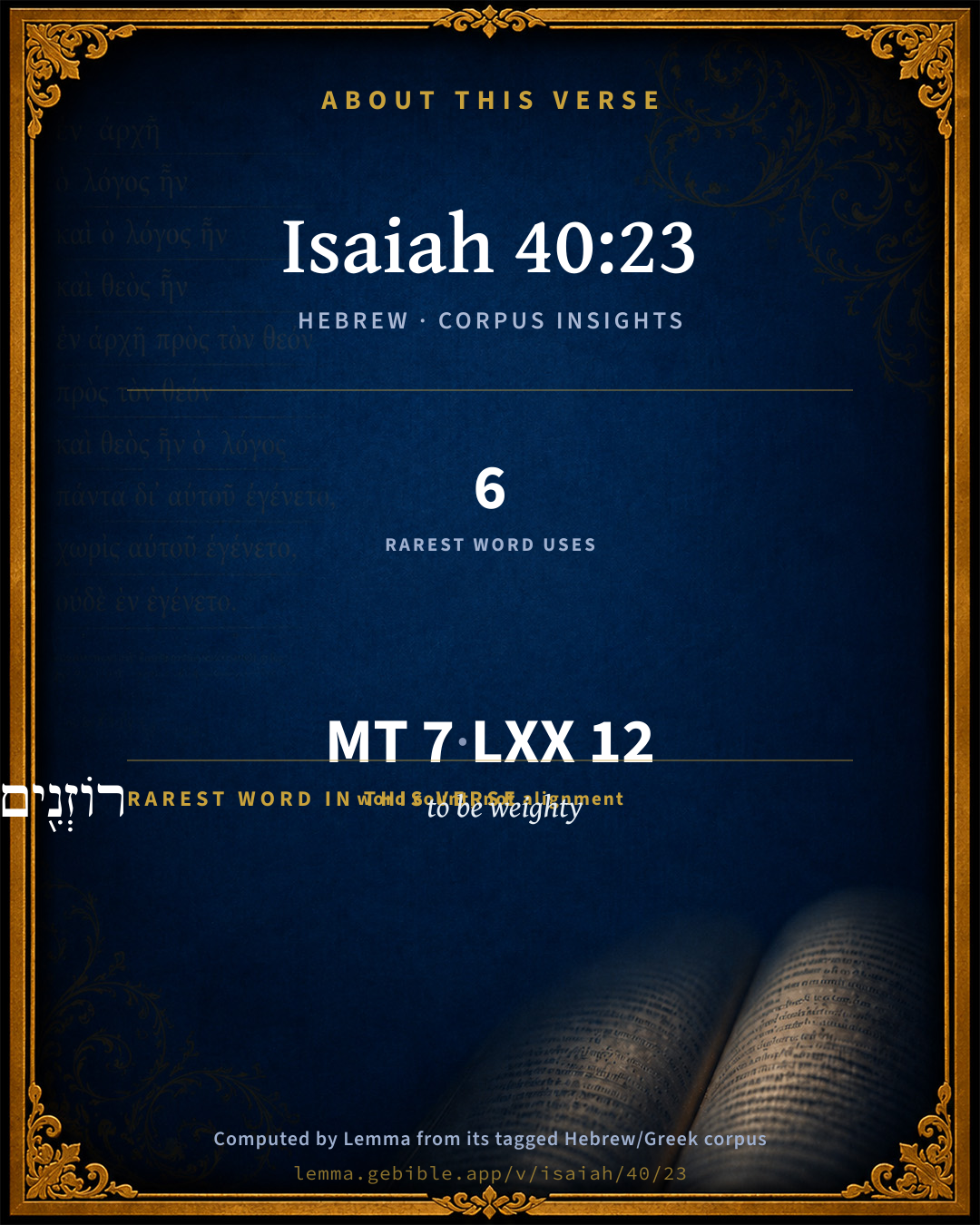
The rarest word here is רוֹזְנִ֖ים to be weighty H7336 — appearing just 6 times in the whole Hebrew Bible.

Shared distinctive vocabulary

רוֹזְנִ֖ים to be weighty H7336 occurs in 6 verses of the Hebrew Bible. Also found in:

Grammatical profile

  • 4 verbs
  • 2 nouns
  • 1 particle

Verb forms

  • הַנּוֹתֵ֥ן Qal · Participle Active
  • רוֹזְנִ֖ים Qal · Participle Active
  • שֹׁ֥פְטֵי Qal · Participle Active
  • עָשָֽׂה Qal · Perfect

Hebrew & Septuagint length

In English translation the verse runs 14 words from the Hebrew and 15 from the Septuagint (LXX English) — closely comparable.

A rough comparison of the two English renderings, which tokenize alike — not a word-level alignment.

Word counts can differ between the Hebrew and the Greek without any difference in meaning — e.g. the Hebrew direct-object marker אֵת has no separate Greek word, and Greek often adds the article ὁ.

In the original languages it is 7 Hebrew tokens and 12 Greek tokens — but the two are counted differently (Hebrew bundles its prefixes and suffixes into one token; the Greek is in lemma form), so that isn’t a like-for-like length.

Cross-references

11

Topical passages linked to Isaiah 40:23 in the Treasury of Scripture Knowledge — connected by theme and wording, ordered by reader-vote popularity; previews shown in the World English Bible.

  • Job 12:21 He pours contempt on princes, And loosens the belt of the strong.
  • Psalms 107:40 He pours contempt on princes, And causes them to wander in a trackless waste.
  • Isaiah 34:12 They shall call the nobles of it to the kingdom, but none shall be there; and all its princes shall be nothing.
  • Jeremiah 25:18–27 [to wit], Jerusalem, and the cities of Judah, and the kings of it, and the princes of it, to make them a desolation, an astonishment, a hissing, and a curse, as it is this day;
  • Job 34:19–20 Who doesn't respect the persons of princes, Nor regards the rich more than the poor; For they all are the work of his hands.
  • Psalms 76:12 He will cut off the spirit of princes. He is feared by the kings of the earth.
  • Isaiah 19:13–14 The princes of Zoan are become fools, the princes of Memphis are deceived; they have caused Egypt to go astray, who are the corner-stone of her tribes.
  • Isaiah 23:9 Yahweh of hosts has purposed it, to stain the pride of all glory, to bring into contempt all the honorable of the earth.
  • Isaiah 24:21–22 It shall happen in that day, that Yahweh will punish the host of the high ones on high, and the kings of the earth on the earth.
  • Luke 1:51–52 He has shown strength with his arm. He has scattered the proud in the imagination of their heart.
  • Revelation 19:18–20 that you may eat the flesh of kings, the flesh of captains, the flesh of mighty men, and the flesh of horses and of those who sit on them, and the flesh of all men, both free and slave, and small and great."

Cross-references courtesy of OpenBible.info (CC BY 4.0).

Hebrew and Greek witnesses Masoretic Hebrew ↔ Greek Septuagint

The same verse in the two great witnesses to the Old Testament, shown verse-for-verse.

These are two independent witnesses, not word-aligned to each other, and the Septuagint is shown in lemma (dictionary) form.

Hebrew Isaiah 40:23 Masoretic · Westminster Leningrad Codex

הַנּוֹתֵ֥ן רוֹזְנִ֖ים לְאָ֑יִן שֹׁ֥פְטֵי אֶ֖רֶץ כַּתֹּ֥הוּ עָשָֽׂה

who brings princes to nothing; who makes the judges of the earth as vanity.

World English Bible · Public Domain

Greek LXX Isaiah 40:23 Septuagint · lemma form

ὁ δίδωμι ἄρχων εἰς οὐδείς ἄρχω ὁ δέ γῆ ὡς οὐδείς ποιέω

he that appoints princes to rule as nothing, and has made the earth as nothing.

LXX2012 (modern English Septuagint) · Public Domain

Hebrew: Westminster Leningrad Codex (CC BY 4.0). Greek: Septuagint (public domain); English from LXX2012 (modern English Septuagint) (Public Domain). How the Septuagint differs from the Hebrew →

Targum (Aramaic paraphrase)

1

The Targum is the ancient Jewish Aramaic paraphrase of the Hebrew Scriptures — an interpretive translation, not the Hebrew text itself. Onkelos (literal) and Pseudo-Jonathan (expansive) render the Torah, and Jonathan the Prophets. Coverage is partial: where no permissively-licensed English translation exists for a verse, only the Aramaic is shown. This is verse-level text, not a word-by-word alignment to the Hebrew.

  1. Targum Jonathan Prophets (Joshua–Malachi)
    דִמְסַר שִׁלְטוֹנִין לְחוּלְשָׁא דַיָנֵי אַרְעָא כִּלְמָא עֲבֵיד:

    Who gives princes over to weakness; the judges of the earth He bringeth to naught.

    Targum Jonathan — Aramaic: “Mikraot Gedolot” (public domain). English: “Sefaria Community Translation” (CC0 1.0 (public-domain dedication)); “London "Chaldee Paraphrase," 1871” (public domain). Text via Sefaria.

Commentary

Notes on Isaiah 40:23 from classic Christian and Jewish commentators (each source and its license shown beneath its notes). The classic Christian expositions comment on the surrounding passage and are grouped to its opening verse, so a note may address several verses; the Jewish commentaries on the Tanakh (Rashi and others) are per-verse, so they appear only where the commentator wrote on this verse.

Lemma curates 59 commentaries, every one of them public domain or Creative Commons licensed, each selected and text-cleaned for this edition rather than reprinted as found. About our sources →

Trapp's Complete Commentary

John Trapp

Isa 40:23 That bringeth the princes to nothing; he maketh the judges of the earth as vanity.

Ver. 23. That bringeth princes to nothing.] After their part acted here a while, they go off the stage of life, and are seen no more. Augustus Caesar said, that his life was nothing else but a kind of a comedy; and that he had acted his part, as became him, and therefore, at his death, he called for a Plaudite. applause.

John Trapp, A Commentary or Exposition upon All the Books of the Old and New Testament (1647–1656) — public domain. Text from a community e-Sword module.

The Biblical Illustrator

Joseph S. Exell

Isa_40:23-24

That bringeth the princes to nothing

Great men reduced to nothing

Earth has its great men.

Social distinctions grow out of the constitution of things, and are, therefore, Divine in their foundation.

I. EARTHS GREAT MEN GOD REDUCES TO NOTHING.

1. Death is the destruction of all mere worldly distinctions.

2. Death is effected by the agency of God. He bringeth, etc. Not chance, fate, accident, etc.

II. Earths great men He reduces to nothing NOTWITHSTANDING THEIR DETERMINED EFFORTS TO BE SOMETHING. Their stock shall not take root in the earth;

1. The implied tendency of earths great men in relation to life. They seek to root themselves here.

2. The manifest folly of earths great men. They are trying to do what they cannot accomplish. Heavens decree is against it, and there is no overcoming that decree. The roots of our earthly life, such as they are, are only like those of certain marine plants, that spring up one floating wavelet to be destroyed by the next; or rather like the roots of those atmospheric plants that strike only into a wave of air; that roll swiftly on, Heaven only knows where.

III. HE DOES THIS WITH THE GREATEST EASE. He blows upon them and they wither, etc. (Homilist.)

The Biblical Illustrator, edited by Joseph S. Exell (c. 1880s–1900s) — public domain. Text from a community e-Sword module.

Tyndale Open Study Notes

Tyndale Open Resources

40:23 great people: God is unimpressed by human power and fame.

Tyndale Open Study Notes — © Tyndale Open Resources, licensed CC BY-SA 4.0. Text via the HelloAO Bible API.

Jamieson, Fausset & Brown

Robert Jamieson, A. R. Fausset & David Brown

(Psa 107:4; Dan 2:21).

judges--that is, rulers; for these exercised judicial authority (Psa 2:10). The Hebrew, shophtee, answers to the Carthaginian chief magistrates, suffetes.

Jamieson, Fausset & Brown — Commentary Critical and Explanatory on the Whole Bible (1871) — public domain (CC PDM 1.0). Text via the HelloAO Bible API.

Ellicott's Commentary for English Readers

(23) That bringeth the princes to nothing.—The words imply, like those of Isa_14:9, the prophetic strain of experience. The past is full of the records of kingdoms that are no more; so also shall the future be; mortalia facta peribunt. In “vanity” we have the familiar tohu once more.

A Bible Commentary for English Readers, edited by Charles John Ellicott (1878–1897) — public domain. Text from a community e-Sword module.

The Cambridge Bible for Schools and Colleges

gen. ed. J. J. S. Perowne

23, 24. The majesty of God displayed in Providence.

princes] dignitaries (a poetic word), “potent, grave and reverend signiors.” as vanity] “as nothingness,” lit. “chaos”; see on Isa_40:17. For he maketh, render who maketh.

The Cambridge Bible for Schools and Colleges (gen. ed. J. J. S. Perowne; Cambridge University Press, 1878–1918) — public domain. Text from a community e-Sword module.

John Gill's Exposition

That bringeth princes to nothing,.... The great men of the earth, kings, rulers, and nobles, these he brings to the dust; and all their counsels, schemes, and purposes, come to nothing; and their monarchies and kingdoms too in time. Where are now the Babylonish, Persian, and Grecian monarchies, and those great princes that formerly reigned in them?

he maketh the judges of the earth as vanity; their decrees and decisions to stand for nothing, as "tohu" and "bohu", the first of which words is used here; so that they are no more regarded and attended to.

John Gill's Exposition of the Whole Bible (1746–1763) — public domain (CC PDM 1.0). Text via the HelloAO Bible API.

Albert Barnes' Notes on the Bible

That bringeth the princes to nothing - That is, all princes and kings. No matter how great their power, their wealth, and their dignity, they are, by his hand, reduced to nothing before him. The design of this passage is to contrast the majesty of God with that of princes and nobles, and to show how far he excels them all. The general truth is therefore stated, that all monarchs are by him removed from their thrones, and consigned to nothing. The same idea is expressed in Job 12:21 :

He poureth contempt upon princes,

And weakeneth the strength of the mighty.

And in Psa 107:40 :

He poureth contempt upon princes,

And causeth them to wander in the wilderness where there is no way.

The particular idea here, as appears from the next verse, is, that the princes and rulers who are opposed to God constitute no real resistance to the execution of his purposes. He can strip off their honors and glory, and obliterate even their names.

He maketh the judges of the earth - Kings and princes often executed judgment personally, and hence, the words judges and kings seem to be synonymous as they are used here, and in Psa 2:10 :

Be wise now, therefore, O ye kings;

Be instructed, ye judges of the earth.

Albert Barnes' Notes on the Bible (1834–1885) — public domain. Text from a community e-Sword/MySword module.

Haydock's Catholic Bible Commentary

Searchers. Hebrew, "princes to nothing." (Protestants) --- Philosophers know nothing independently of God, nor can they subsist without him. (Worthington)

George Leo Haydock (1774–1849), Haydock's Catholic Family Bible and Commentary, 1859 edition — public domain. Excludes Psalms (Douay-Rheims chapter numbering differs from Protestant) and Deuterocanonical books (Catholic canon only).

Matthew Poole's English Annotations

That bringeth the princes to nothing; that can at his pleasure destroy all the great potentates of the world.

Matthew Poole's English Annotations on the Holy Bible (1683–1685) — public domain. Text from a community e-Sword/MySword module.

Whedon's Commentary on the Bible

Daniel D. Whedon

23, 24. Princes… judges… vanity — Other predicates are here added respecting God, the ruler of the universe. He annihilates the potentates and judges of the earth when they displease him. In various ways hevisits them. They are scarcely planted, (to use the figure of the verse,) scarcely sown, etc., ere the hot eastern blast withers them, and carries them away. The meaning is plain, though the figure is mixed.

Daniel D. Whedon (gen. ed.), Commentary on the Old and New Testaments (1874–1909) — public domain. Text from a community e-Sword module.

The Pulpit Commentary

The princes... the judges; rather, princes, judges. The entire class of such is meant, not any special individuals. (comp. Psa_107:40 Job_12:19-21) As vanity; or, as chaos the same word that is used in ver. 17.

The Pulpit Commentary (1880–1919), ed. H.D.M. Spence-Jones & Joseph S. Exell — public domain. Text from a community e-Sword module.

Keil & Delitzsch

C. F. Keil & F. Delitzsch

This is followed by a series of predicates of God the Ruler of the universe. "He who giveth up rulers to annihilation; maketh judges of the earth like a desolation. They are hardly planted, hardly sown, their stem has hardly taken root in the earth, and He only blows upon them, and they dry up, and the storm carries them away like stubble." There is nothing so high and inaccessible in the world, that He cannot bring it to nothing, even in the midst of its most self-confident and threatening exaltation. Rōzenı̄m are solemn persons, σεμνοί, possessors of the greatest distinction and influence; shōphelı̄m, those who combine in themselves the highest judicial and administrative power. The former He gives up to annihilation; the latter He brings into a condition resembling the negative state of the tōhū out of which the world was produced, and to which it can be reduced again. We are reminded here of such descriptions as Job 12:17, Job 12:24. The suddenness of the catastrophe is depicted in Isa 40:24. אף בּל (which only occurs here), when followed by וגם in the apodosis (cf., Kg2 20:4), signifies that even this has not yet taken place when the other also occurs: hence vixdum plantati sunt, etc. The niphal נטּע and the pual זרע denote the hopeful commencement; the poelשׁרשׁ the hopeful continuation. A layer or seed excites the hope of blossom and fruit, more especially when it has taken root; but nothing more is needed than a breath of Jehovah, and it is all over with it (the verb nâshaph is used in this verse, where plants with stems are referred to; a verb with a softer labial, nâshabh, was employed above in connection with grass and flowers). A single withering breath lays them at rest; and by the power of Jehovah there rises a stormy wind, which carries them away like light dry stubble (נשׂא); compare, on the other hand, the verb used in Isa 40:15, viz., tūl = nâtal, to lift up, to keep in the air).

Keil & Delitzsch — Biblical Commentary on the Old Testament (1861–1891) — public domain (CC PDM 1.0). Text via the HelloAO Bible API. (Old Testament only.)

J. A. Alexander on Isaiah

Joseph Addison Alexander

“The (one) bringing (literally giving or putting) princes to nothing, the judges (or rulers) of the earth like emptiness (or desolation) He has made.” Not only nature but man, not only individuals but nations, not only nations but their rulers, are completely subject to the power of God.

Joseph Addison Alexander, The Prophecies of Isaiah (1846–1847; New York: Scribner, 1870–1878) — public domain. Text from a community e-Sword module.

unfoldingWord translationNotes

Door43 World Missions Community

He reduces

"Yahweh reduces"

They are barely planted ... and they wither

The prophet speaks of rulers being helpless before Yahweh as if they were new plants that wither away when a hot wind blows on them. (See: Metaphor)

They are barely planted, barely sown

These two phrases mean basically the same thing and refer to the point at which the plants or seeds are placed into the ground. They can be stated in active form. AT: "As soon as someone plants them ... as soon as someone sows them" (See: Parallelism and Active or Passive)

he blows upon them

The prophet speaks of Yahweh removing the rulers from power as if Yahweh were a scorching wind that blows upon the plants and causes them to wither. (See: Metaphor)

the wind carries them away like straw

This simile extends the metaphor of the rulers as plants and Yahweh as the wind that causes them to wither. The wind of Yahweh's judgement will remove the withered plants as easily as wind blows away straw. (See: Simile)

translationWords

rule

earth

plant

unfoldingWord translationNotes — © Distant Shores Media and the Door43 World Missions Community, licensed CC BY-SA 4.0. Source: git.door43.org/Door43/en_tn.

Ibn Ezra

Rabbi Abraham ibn Ezra

רוזנים Princes. Comp. רזון prince (Prov. 14:28); the adjective has various forms.

Ibn Ezra on the Tanakh — English translations: “Sefaria Community Translation” (CC0 1.0 (public-domain dedication)); “Yalkut, Sifsei Chachomim Chumash, Metsudah Publications, 2009” (CC BY 4.0); and “Commentary of Ibn Ezra on Isaiah - trans. by M. Friedlander, 1873” (public domain). Text via Sefaria.

Lesson kit

Teaching starters — assembled from the data on this page, not authored interpretation. Every prompt links to the verse data it draws on. Edit before teaching.

Isaiah, in the Prophets, opens this verse with 7 words (7 distinct Hebrew lemmas). Its most distinctive word is râzan (“to be weighty”). A historical commentator’s framing appears above. Read the whole chapter for the surrounding context.

Discussion questions

  1. How does “to be weighty” (râzan) shape what this verse is saying?
  2. Judges 5:3 shares the word «to be weighty» with this verse. How do the two illuminate each other?
  3. These translations render this verse differently; the difference is in the English rendering, not the original. What questions does that raise?
  4. The verb «הַנּוֹתֵ֥ן» is Qal Participle Active. How does its form color the action?
  5. Reading how Trapp's Complete Commentary and The Biblical Illustrator read this verse, where do the two commentators agree and where do they part?

Things to notice

Reading settings

Reading text

Shown beneath each verse's original-language words.

Old Testament
Old Testament edition

Read the OT as the Masoretic Hebrew (MT) or the Greek Septuagint (LXX).

English shown for the Greek Septuagint (in the Hebrew ↔ Greek comparison).

Comparing translations? Open the Compare panel on any verse page to stack up to four side by side.