
1 Samuel 14:39

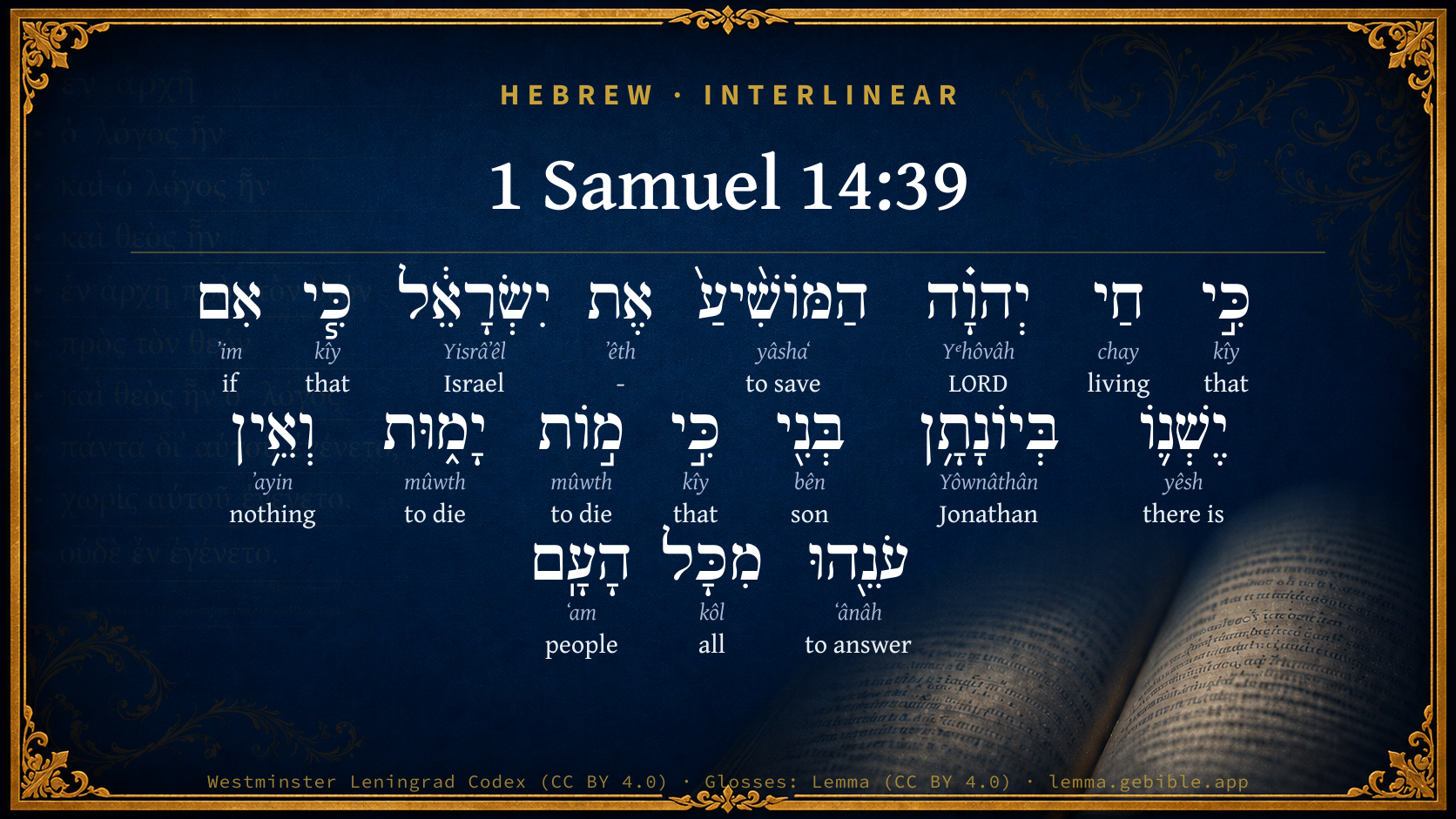
Hebrew (Westminster Leningrad Codex) 1 Samuel 14:39 appears in the Hebrew Old Testament. The text above is from the Westminster Leningrad Codex. Each word links to its Strong’s number, a concise gloss, and parsing drawn from the Open Scriptures Hebrew Bible morphology. Click any word for its full Brown-Driver-Briggs (BDB) entry.
Download image
Cite this verse

1 Samuel 14:39 (World English Bible). Public Domain. Lemma interlinear Bible study tool, https://lemma.gebible.app/v/1-samuel/14/39.

Show BibTeX & RIS
BibTeX
RIS
English Translation
For, as Yahweh lives, who saves Israel, though it be in Jonathan my son, he shall surely die. But there was not a man among all the people who answered him.
World English Bible · Public Domain
Download a study sheet

One document with this verse’s original text, its word-by-word gloss line, the meaning frame, cross-references with their text, attributed commentary, and full source and license credits — printable, and it pastes into notes with its structure intact.

This verse Autodidact and up

Study sheet (.html) Plain text (.txt)

A passage Seminary Student

Up to 50 verses in one chapter. A passage sheet keeps up to 6 commentary sources and 12 cross-references per verse, in the order this page ranks them, and says so on the sheet whenever that leaves anything out. Ask for a single verse and you get the Autodidact verse sheet above.

Everything on this page stays free to read, with no account — the sheet is a download of what is already on screen, not access to it.

Want to remove ads? Support Godless Engineer
Compare translations 3

The same verse in 3 English versions, stacked beneath the original-language interlinear above. Click any original word for its lexicon entry.

Each is an independent rendering of the whole verse — the interlinear is not word-aligned to these translations.

Highlighted words mark where these versions differ — a whole-verse word diff, not a word-by-word alignment.

  • World English Bible Public Domain
    For, as Yahweh lives, who saves Israel, though it be in Jonathan my son, he shall surely die. But there was not a man among all the people who answered him.
  • King James Version Public Domain
    For, as the LORD liveth, which saveth Israel, though it be in Jonathan my son, he shall surely die. But there was not a man among all the people that answered him.
  • unfoldingWord Literal Text CC BY-SA 4.0
    For, the life of Yahweh, the one having saved Israel, that if it is by Jonathan my son, that dying, he shall die.” But no one answering him from all of the people.

unfoldingWord Literal Text — © unfoldingWord, licensed CC BY-SA 4.0. Word-aligned USFM3 via Door43 (git.door43.org/unfoldingWord/en_ult).

Versions to compare (up to 4)

3 of 4 selected

Show all 18 translations

Every available English version of this verse, each an independent rendering of the whole verse.

  • World English Bible Public Domain
    For, as Yahweh lives, who saves Israel, though it be in Jonathan my son, he shall surely die. But there was not a man among all the people who answered him.
  • Berean Standard Bible Public Domain
    As surely as the LORD who saves Israel lives, even if it is my son Jonathan, he must die!” But not one of the troops said a word.
  • Majority Standard Bible Public Domain
    As surely as the LORD who saves Israel lives, even if it is my son Jonathan, he must die!” But not one of the troops said a word.
  • King James Version Public Domain
    For, as the LORD liveth, which saveth Israel, though it be in Jonathan my son, he shall surely die. But there was not a man among all the people that answered him.
  • American Standard Version (1901) Public Domain
    For, as Jehovah liveth, who saveth Israel, though it be in Jonathan my son, he shall surely die. But there was not a man among all the people that answered him.
  • Revised Version (1885) Public Domain
    For, as the LORD liveth, which saveth Israel, though it be in Jonathan my son, he shall surely die. But there was not a man among all the people that answered him.
  • Geneva Bible (1599) Public Domain
    For as the Lord liueth, which saueth Israel, though it be done by Ionathan my sonne, he shall dye the death. But none of all the people answered him.
  • Douay-Rheims (1899) Public Domain
    As the Lord liveth who is the saviour of Israel, if it was done by Jonathan my son, he shall surely die. In this none of the people gainsaid him.
  • Young's Literal Translation Public Domain
    for, Jehovah liveth, who is saving Israel: surely if it be in Jonathan my son, surely he doth certainly die;' and none is answering him out of all the people.
  • Literal Standard Version CC BY-SA 4.0
    for YHWH lives, who is saving Israel: surely if it is in my son Jonathan, surely he certainly dies”; and none is answering him out of all the people.
  • Unlocked Literal Bible CC BY-SA 4.0
    For, as Yahweh lives, who saves Israel, even if it is in Jonathan my son, he will surely die.” But none of the men among all the people answered him.
  • unfoldingWord Literal Text CC BY-SA 4.0
    For, the life of Yahweh, the one having saved Israel, that if it is by Jonathan my son, that dying, he shall die.” But no one answering him from all of the people.
  • Darby Bible Public Domain
    For, [as] Jehovah liveth, who has saved Israel, though it be in Jonathan my son, he shall certainly die. And no one answered him among all the people.
  • World Messianic Bible Public Domain
    For as the LORD lives, who saves Israel, though it is in Jonathan my son, he shall surely die.” But there was not a man among all the people who answered him.
  • Webster's Bible Public Domain
    For as the LORD liveth, who saveth Israel, though it is in Jonathan my son, he shall surely die. But there was not a man among all the people that answered him.
  • Free Bible Version CC BY-SA 4.0
    I swear on the life of the Lord who saves Israel, that even if it's my son Jonathan, he will have to die!” But no one of the whole army said anything.
  • Bible in Basic English Public Domain
    For, by the living Lord, the saviour of Israel, even if the sinner is Jonathan, my son, death will certainly be his fate. But not a man among all the people gave him any answer.
  • JPS Tanakh (1917) Public Domain
    For, as the LORD liveth, who saveth Israel, though it be in Jonathan my son, he shall surely die.' But there was not a man among all the people that answered him.

Literal Standard Version (2020), Covenant Press — licensed CC BY-SA 4.0. Text via the HelloAO Bible API (eBible.org). Unlocked Literal Bible (unfoldingWord) — licensed CC BY-SA 4.0. Text via the HelloAO Bible API (eBible.org). unfoldingWord Literal Text — © unfoldingWord, licensed CC BY-SA 4.0. Word-aligned USFM3 via Door43 (git.door43.org/unfoldingWord/en_ult). Free Bible Version, Dr. Jonathan Gallagher — licensed CC BY-SA 4.0. Text via the HelloAO Bible API (eBible.org).

Word by word

More ways to search: Search by grammar → Find every occurrence → Compare this word →

Practice this passage: Drill this verse → Learn its vocabulary →

בְּיוֹנָתָ֥ן
Yôwnâthân
H3129
“in/at · Jonathan”
Preposition + Noun, Proper
Part of Speech
Preposition + Noun
Type
Proper
Full BDB Definition

Origin: a form of H3083

TWOT: None

Jonathan or Jehonathan = "Jehovah has given" - a son of king Saul and a friend of David - a son of the high priest Abiathar and the last descendant of Eli of whom we hear - one of David's mighty warriors - a Levite and father of Zechariah, a priest who blew the trumpet at the dedication of the wall - a son of Kareah and a brother of Johanan; a Judaite captain after the fall of Jerusalem - another Judaite - father of Ebed in the time of Ezra - son of Asahel in the time of Ezra - a priest of the family of Melicu in the time of Nehemiah - son of Joiada and his successor to the high priesthood in the time of Nehemiah
  1. כִּ֣י kîy H3588 “that” Conjunction
  2. חַי chay H2416 “living” Adjective, Adjective, Masculine, Singular, Absolute
  3. יְהוָ֗ה Yᵉhôvâh H3068 “LORD” Noun, Proper
  4. הַמּוֹשִׁ֨יעַ֙ yâshaʻ H3467 “the · saving” Particle, Definite Article + Verb, Hiphil, Participle Active, Masculine, Singular, Absolute
  5. אֶת ʼêth H853 “-” Particle, Direct Object
  6. יִשְׂרָאֵ֔ל Yisrâʼêl H3478 “Israel” Noun, Proper
  7. כִּ֧י kîy H3588 “that” Conjunction
  8. אִם ʼim H518 “if” Conjunction
  9. יֶשְׁנ֛וֹ yêsh H3426 “there is · him” Particle, Demonstrative + Suffix, Personal, 3rd Person, Masculine, Singular
  10. בְּנִ֖י bên H1121 “son · my” Noun, Common, Masculine, Singular, Construct + Suffix, Personal, 1st Person, Common, Singular
  11. כִּ֣י kîy H3588 “that” Conjunction
  12. מ֣וֹת mûwth H4191 “to die” Verb, Qal, Infinitive Absolute
  13. יָמ֑וּת mûwth H4191 “to die” Verb, Qal, Imperfect, 3rd Person, Masculine, Singular
  14. וְאֵ֥ין ʼayin H369 “and · nothing” Conjunction + Particle, Negative
  15. עֹנֵ֖הוּ ʻânâh H6030 “answering · him” Verb, Qal, Participle Active, Masculine, Singular, Construct + Suffix, Personal, 3rd Person, Masculine, Singular
  16. מִכָּל kôl H3605 “from · all of” Preposition + Noun, Common, Masculine, Singular, Construct
  17. הָעָֽם ʻam H5971 “the · people” Particle, Definite Article + Noun, Common, Masculine, Singular, Absolute

About this verse

These counts appear in no published source. They are computed here, from the morphology-tagged text and Lemma’s own curated glosses. What Lemma adds →

18
words
15
distinct lemmas
Historical
section

Shared distinctive vocabulary

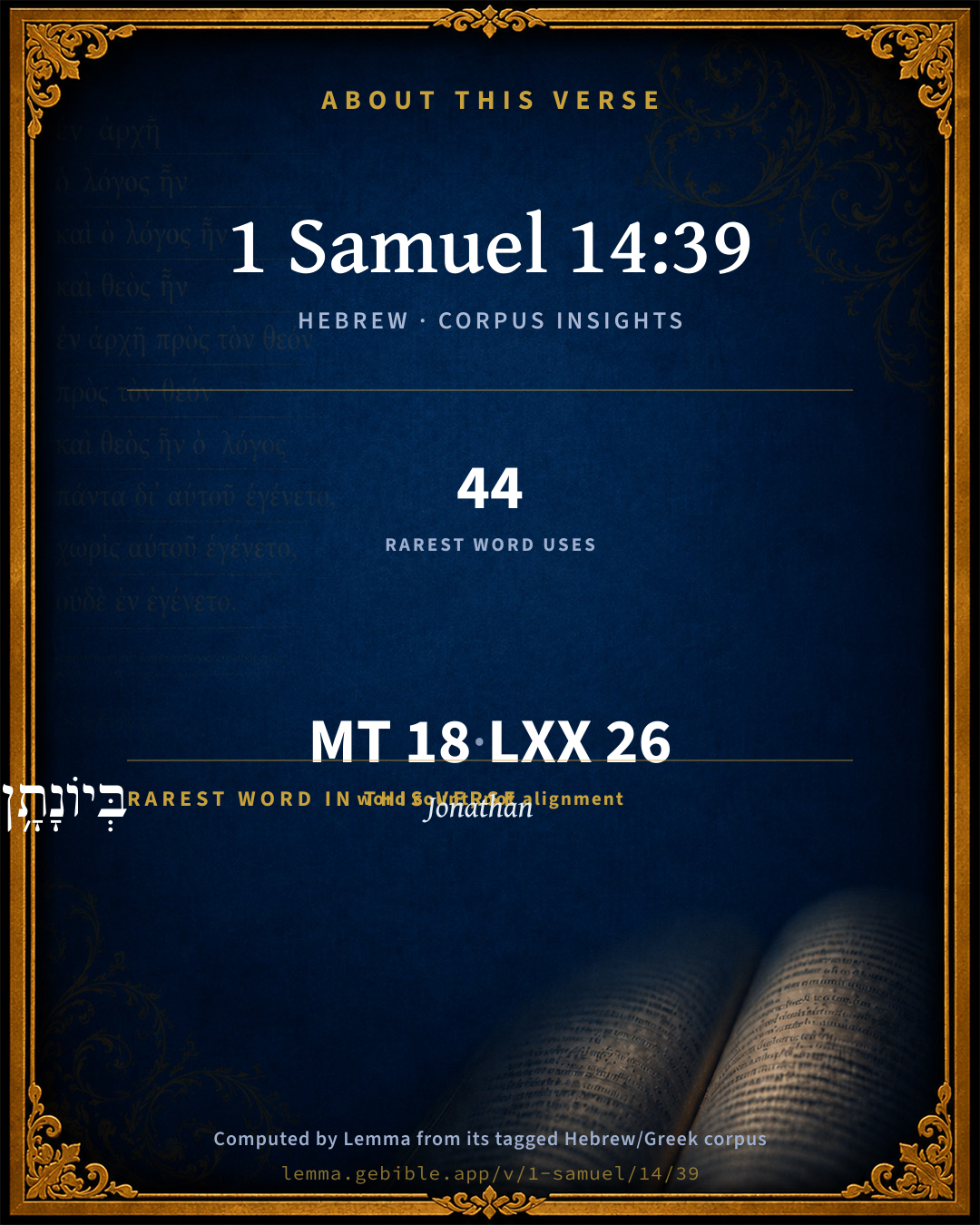
בְּיוֹנָתָ֥ן Jonathan H3129 occurs in 36 verses of the Hebrew Bible. Also found in:

Grammatical profile

  • 4 verbs
  • 6 nouns
  • 1 adjective
  • 4 conjunctions
  • 3 particles

Verb forms

  • הַמּוֹשִׁ֨יעַ֙ Hiphil · Participle Active
  • מ֣וֹת Qal · Infinitive Absolute
  • יָמ֑וּת Qal · Imperfect
  • עֹנֵ֖הוּ Qal · Participle Active

Repetition

Words recur within this verse — often emphatic in Hebrew:

  • מ֣וֹת to die H4191 ×2
  • כִּ֣י that H3588 ×3

Hebrew & Septuagint length

In English translation the verse runs 31 words from the Hebrew and 33 from the Septuagint (LXX English) — closely comparable.

A rough comparison of the two English renderings, which tokenize alike — not a word-level alignment.

Word counts can differ between the Hebrew and the Greek without any difference in meaning — e.g. the Hebrew direct-object marker אֵת has no separate Greek word, and Greek often adds the article ὁ.

In the original languages it is 18 Hebrew tokens and 26 Greek tokens — but the two are counted differently (Hebrew bundles its prefixes and suffixes into one token; the Greek is in lemma form), so that isn’t a like-for-like length.

Cross-references

8

Topical passages linked to 1 Samuel 14:39 in the Treasury of Scripture Knowledge — connected by theme and wording, ordered by reader-vote popularity; previews shown in the World English Bible.

  • 1 Samuel 14:44 Saul said, God do so and more also; for you shall surely die, Jonathan.
  • 2 Samuel 12:5 David's anger was greatly kindled against the man, and he said to Nathan, "As Yahweh lives, the man who has done this is worthy to die!
  • 1 Samuel 14:24 The men of Israel were distressed that day; for Saul had adjured the people, saying, Cursed be the man who eats any food until it be evening, and I be avenged on my enemies. So none of the people tasted food.
  • 1 Samuel 19:6 Saul listened to the voice of Jonathan: and Saul swore, As Yahweh lives, he shall not be put to death.
  • 1 Samuel 20:31 For as long as the son of Jesse lives on the earth, you shall not be established, nor your kingdom. Therefore now send and bring him to me, for he shall surely die.
  • 1 Samuel 22:16 The king said, You shall surely die, Ahimelech, you, and all your father's house.
  • 1 Samuel 28:10 Saul swore to her by Yahweh, saying, As Yahweh lives, there shall no punishment happen to you for this thing.
  • Ecclesiastes 9:2 All things come alike to all. There is one event to the righteous and to the wicked; to the good, to the clean, to the unclean, to him who sacrifices, and to him who doesn't sacrifice. As is the good, so is the sinner; he who takes an oath, as he who fears an oath.

Cross-references courtesy of OpenBible.info (CC BY 4.0).

Hebrew and Greek witnesses Masoretic Hebrew ↔ Greek Septuagint

The same verse in the two great witnesses to the Old Testament, shown verse-for-verse.

These are two independent witnesses, not word-aligned to each other, and the Septuagint is shown in lemma (dictionary) form.

Hebrew 1 Samuel 14:39 Masoretic · Westminster Leningrad Codex

כִּ֣י חַי יְהוָ֗ה הַמּוֹשִׁ֨יעַ֙ אֶת יִשְׂרָאֵ֔ל כִּ֧י אִם יֶשְׁנ֛וֹ בְּיוֹנָתָ֥ן בְּנִ֖י כִּ֣י מ֣וֹת יָמ֑וּת וְאֵ֥ין עֹנֵ֖הוּ מִכָּל הָעָֽם

For, as Yahweh lives, who saves Israel, though it be in Jonathan my son, he shall surely die. But there was not a man among all the people who answered him.

World English Bible · Public Domain

Greek LXX 1 Samuel 14:39 Septuagint · lemma form

ὅτι ζάω κύριος ὁ σώζω ὁ ἰσραήλ ὅτι ἐάν ἀποκρίνω κατά ιωναθαν ὁ υἱός ἐγώ θάνατος ἀποθνήσκω καί οὐ εἰμί ὁ ἀποκρίνω ἐκ πᾶς ὁ λαός

For as the Lord lives who has saved Israel, if answer should be against my son Jonathan, he shall surely die. And there was no one that answered out of all the people.

LXX2012 (modern English Septuagint) · Public Domain

Hebrew: Westminster Leningrad Codex (CC BY 4.0). Greek: Septuagint (public domain); English from LXX2012 (modern English Septuagint) (Public Domain). How the Septuagint differs from the Hebrew →

Targum (Aramaic paraphrase)

1

The Targum is the ancient Jewish Aramaic paraphrase of the Hebrew Scriptures — an interpretive translation, not the Hebrew text itself. Onkelos (literal) and Pseudo-Jonathan (expansive) render the Torah, and Jonathan the Prophets. Coverage is partial: where no permissively-licensed English translation exists for a verse, only the Aramaic is shown. This is verse-level text, not a word-by-word alignment to the Hebrew.

  1. Targum Jonathan Prophets (Joshua–Malachi)
    אֲרֵי קַיָם הוּא יְיָ דְפָרִיק יַת יִשְׂרָאֵל אֲרֵי אִלּוּ אִיתוֹהִי בְּיוֹנָתָן בְּרִי אֲרֵי אִתְקְטָלָא יִתְקְטֵל וְלֵית דְמֵתִיב לֵיהּ מִכָּל עַמָא:

    (no public-domain English translation for this verse)

    Targum Jonathan — Aramaic: “Mikraot Gedolot” (public domain). English: “Sefaria Community Translation” (CC0 1.0 (public-domain dedication)); “London "Chaldee Paraphrase," 1871” (public domain). Text via Sefaria.

Commentary

Notes on 1 Samuel 14:39 from classic Christian and Jewish commentators (each source and its license shown beneath its notes). The classic Christian expositions comment on the surrounding passage and are grouped to its opening verse, so a note may address several verses; the Jewish commentaries on the Tanakh (Rashi and others) are per-verse, so they appear only where the commentator wrote on this verse.

Lemma curates 59 commentaries, every one of them public domain or Creative Commons licensed, each selected and text-cleaned for this edition rather than reprinted as found. About our sources →

Trapp's Complete Commentary

John Trapp

1Sa 14:39 For, [as] the LORD liveth, which saveth Israel, though it be in Jonathan my son, he shall surely die. But [there was] not a man among all the people [that] answered him.

Ver. 39. For, as the Lord liveth.] Saul seemeth to have been a very great swearer, rapping out oath upon oath, which belike he thought he might do by authority. Chrysostom {a} rightly condemneth this oath of his, how specious soever, Ut temerarium et parricidale, ideoque a Diabolo suggestum, as rash and bloody, suggested by the very devil, for a public mischief.

He shall surely die.] This law was like those of Draco, that punished every peccadillo almost with death; and was therefore said to be written not with black, but with blood.

{a} Hom. xiv., Ad Pop. Antioch.

John Trapp, A Commentary or Exposition upon All the Books of the Old and New Testament (1647–1656) — public domain. Text from a community e-Sword module.

Joseph Benson's Commentary

1Sa 14:39. As the Lord liveth — Here again we have a proof of Saul’s rashness and folly, and of the violence and impetuosity of his temper. As he had before adjured the people, and exposed them to an execration uttered most inconsiderately; so now he lays himself under an execration to put to death, as it turned out, even his son Jonathan, who had been the first and almost sole instrument of effecting this glorious deliverance for Israel, and that for no other fault than tasting a little honey, without knowing that he had thereby exposed himself to his father’s curse. But not a man answered him — None of those that saw Jonathan eating informed against him; because they were satisfied that his ignorance excused him; and from their great love to Jonathan, whom they would not expose to death for so small an offence.

Joseph Benson's Commentary on the Old and New Testaments (1811–1818) — public domain. Text from a community e-Sword module.

Ellicott's Commentary for English Readers

(39) Though it be in Jonathan my son.—“Were Jonathan himself the transgressor, he [Saul] would not spare his life; and so, feeling inwardly bound by his oath, presses for decision by means of the sacred lot, amid the ominous silence of the horror-stricken people.”—Ewald.

A Bible Commentary for English Readers, edited by Charles John Ellicott (1878–1897) — public domain. Text from a community e-Sword module.

John Gill's Exposition

For as the Lord liveth, which saveth Israel,.... And had saved them that day with a great salvation and had wrought a great deliverance for them in freeing them from the Philistines, who had threatened the ruin of the whole nation. This is the form of an oath:

though it be in Jonathan my son, he shall surely die; that is, though the sin should be found in him, or he should be found guilty of the breach of what he had charged them with an oath to observe, namely, to eat no food that day till evening:

but there was not a man among all the people that answered him; who knew that Jonathan had tasted of honey, but they would not acquaint him with it; partly because they knew he did it ignorantly, having no knowledge of his father's charge and oath, and partly because of their great affection to him, who had been the instrument of their deliverance and salvation that day.

John Gill's Exposition of the Whole Bible (1746–1763) — public domain (CC PDM 1.0). Text via the HelloAO Bible API.

Albert Barnes' Notes on the Bible

Saul’s rashness becomes more and more apparent. He now adds an additional oath, to bring down yet further guilt in “taking God’s name in vain” The expressions in 1Sa 14:36, 1Sa 14:40, indicate the fear in which the people stood of Saul. None dared to resist his will.

Albert Barnes' Notes on the Bible (1834–1885) — public domain. Text from a community e-Sword/MySword module.

Haydock's Catholic Bible Commentary

Gainsayed him, out of respect. Saul gives another proof of his precipitation, in swearing; and the people, by this silence, acquiesce, not suspecting that Jonathan could have offended in what he had done. (Calmet) --- One of them, at least, knew that he had transgressed the order of his father, ver. 28. But extreme necessity might plead his excuse. (Haydock) --- They might be silent through fear, or reverence, without giving their consent. (Salien)

George Leo Haydock (1774–1849), Haydock's Catholic Family Bible and Commentary, 1859 edition — public domain. Excludes Psalms (Douay-Rheims chapter numbering differs from Protestant) and Deuterocanonical books (Catholic canon only).

Matthew Poole's English Annotations

None of those who either saw Jonathan eating, or heard of it, informed against him; partly because they were satisfied that his ignorance excused him, and that there was some other reason of God’s not answering; and partly from their great love to Jonathan, whom they would not expose to death for so small an offence.

Matthew Poole's English Annotations on the Holy Bible (1683–1685) — public domain. Text from a community e-Sword/MySword module.

The Pulpit Commentary

He shall surely die. With despotic violence, without waiting to learn what the offence was, and judging simply by consequences, because he was delayed in following up the pursuit, he takes a solemn oath that the offending person shall be put to death. Thus twice in the same day he was guilty of the sin of rash swearing. The people condemn him by their silence. They had obeyed him with ready devotion; but now they listen in terror to the rash and violent words which condemn to death the young hero by whom God had that day wrought deliverance for them.

The Pulpit Commentary (1880–1919), ed. H.D.M. Spence-Jones & Joseph S. Exell — public domain. Text from a community e-Sword module.

John Wesley's Explanatory Notes

Answered - None of those who saw Jonathan eating, informed against him; because they were satisfied that his ignorance excused him; and from their great love to Jonathan, whom they would not expose to death for so small an offense.

John Wesley, Explanatory Notes Upon the Whole Bible (1754–1765) — public domain. Text via the GEBible commentary corpus.

Lesson kit

Teaching starters — assembled from the data on this page, not authored interpretation. Every prompt links to the verse data it draws on. Edit before teaching.

1 Samuel, in the Historical, opens this verse with 18 words (15 distinct Hebrew lemmas). Its most distinctive word is Yôwnâthân (“Jonathan”). A historical commentator’s framing appears above. Read the whole chapter for the surrounding context.

Discussion questions

  1. The word Yôwnâthân carries the sense “Jonathan.” How does it shape the verse?
  2. How does Judges 18:30, which shares the word «Jonathan», read alongside this verse?
  3. What does the repetition of “to die” (2× in this one verse) do in this verse?
  4. These translations render this verse differently; the difference is in the English rendering, not the original. What questions does that raise?
  5. «הַמּוֹשִׁ֨יעַ֙» is a Hiphil Participle Active verb. How does that grammatical form shape the action described?
  6. Compare how Trapp's Complete Commentary and Joseph Benson's Commentary read this verse. Where do they agree or differ?

Things to notice

Reading settings

Reading text

Shown beneath each verse's original-language words.

Old Testament
Old Testament edition

Read the OT as the Masoretic Hebrew (MT) or the Greek Septuagint (LXX).

English shown for the Greek Septuagint (in the Hebrew ↔ Greek comparison).

Comparing translations? Open the Compare panel on any verse page to stack up to four side by side.