
Isaiah 50:2

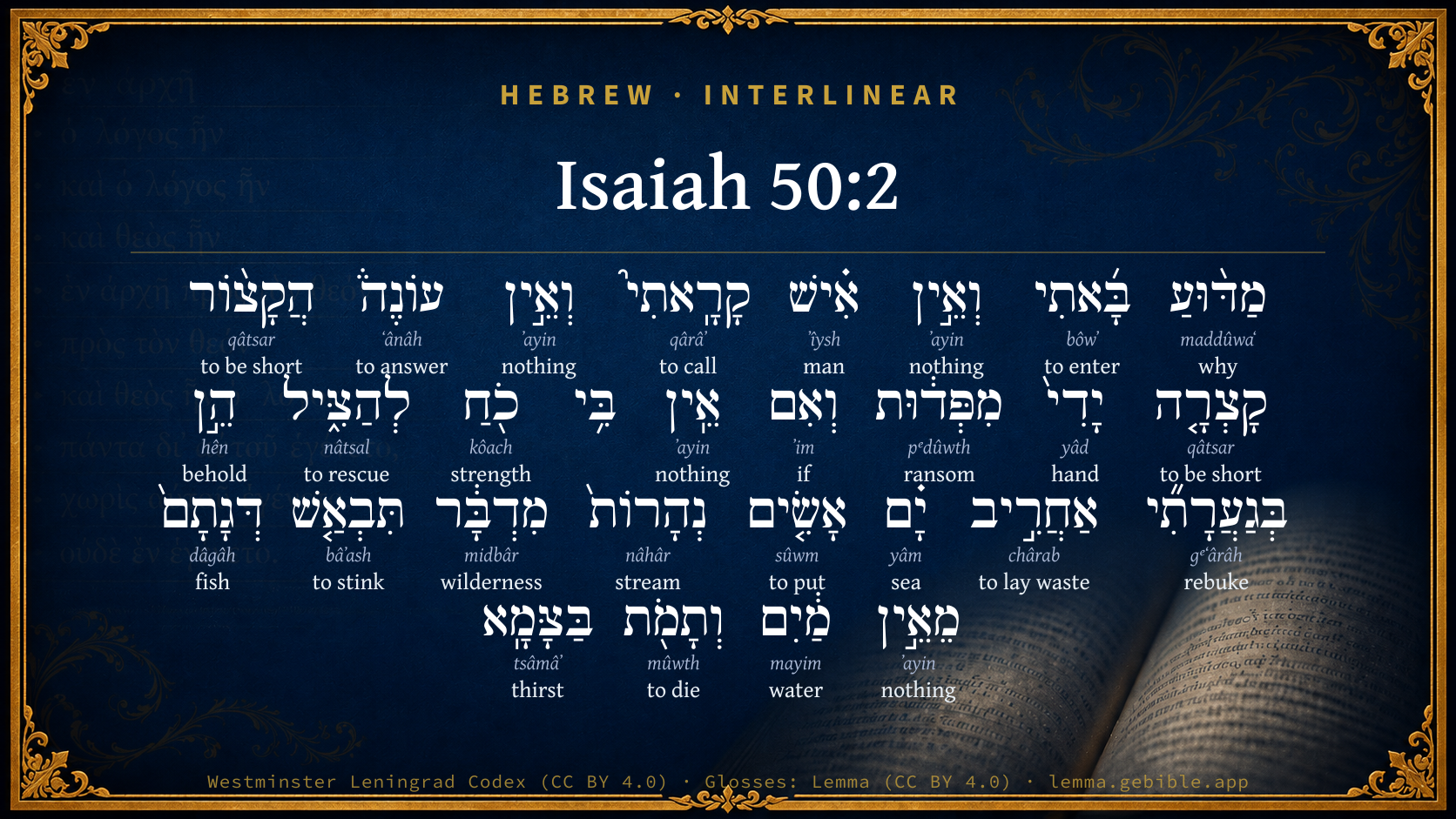
Hebrew (Westminster Leningrad Codex) Isaiah 50:2 appears in the Hebrew Old Testament. The text above is from the Westminster Leningrad Codex. Each word links to its Strong’s number, a concise gloss, and parsing drawn from the Open Scriptures Hebrew Bible morphology. Click any word for its full Brown-Driver-Briggs (BDB) entry.
Download image
Cite this verse

Isaiah 50:2 (World English Bible). Public Domain. Lemma interlinear Bible study tool, https://lemma.gebible.app/v/isaiah/50/2.

Show BibTeX & RIS
BibTeX
RIS
English Translation
Why, when I came, was there no man? when I called, was there none to answer? Is my hand shortened at all, that it can't redeem? or have I no power to deliver? Behold, at my rebuke I dry up the sea, I make the rivers a wilderness: their fish stink, because there is no water, and die for thirst.
World English Bible · Public Domain
Download a study sheet

One document with this verse’s original text, its word-by-word gloss line, the meaning frame, cross-references with their text, attributed commentary, and full source and license credits — printable, and it pastes into notes with its structure intact.

This verse Autodidact and up

Study sheet (.html) Plain text (.txt)

A passage Seminary Student

Up to 50 verses in one chapter. A passage sheet keeps up to 6 commentary sources and 12 cross-references per verse, in the order this page ranks them, and says so on the sheet whenever that leaves anything out. Ask for a single verse and you get the Autodidact verse sheet above.

Everything on this page stays free to read, with no account — the sheet is a download of what is already on screen, not access to it.

Want to remove ads? Support Godless Engineer
Compare translations 3

The same verse in 3 English versions, stacked beneath the original-language interlinear above. Click any original word for its lexicon entry.

Each is an independent rendering of the whole verse — the interlinear is not word-aligned to these translations.

Highlighted words mark where these versions differ — a whole-verse word diff, not a word-by-word alignment.

  • World English Bible Public Domain
    Why, when I came, was there no man? when I called, was there none to answer? Is my hand shortened at all, that it can't redeem? or have I no power to deliver? Behold, at my rebuke I dry up the sea, I make the rivers a wilderness: their fish stink, because there is no water, and die for thirst.
  • King James Version Public Domain
    Wherefore, when I came, was there no man? when I called, was there none to answer? Is my hand shortened at all, that it cannot redeem? or have I no power to deliver? behold, at my rebuke I dry up the sea, I make the rivers a wilderness: their fish stinketh, because there is no water, and dieth for thirst.
  • unfoldingWord Literal Text CC BY-SA 4.0
    Why did I come, and there was no man? I called, but there was none answering. Being short, is my hand too short for redemption? Or if there is no power in me to deliver? Behold, with my rebuke I dry up the sea. I make rivers a wilderness; their fish stink from there being no water, and they die of thirst.

unfoldingWord Literal Text — © unfoldingWord, licensed CC BY-SA 4.0. Word-aligned USFM3 via Door43 (git.door43.org/unfoldingWord/en_ult).

Versions to compare (up to 4)

3 of 4 selected

Show all 18 translations

Every available English version of this verse, each an independent rendering of the whole verse.

  • World English Bible Public Domain
    Why, when I came, was there no man? when I called, was there none to answer? Is my hand shortened at all, that it can't redeem? or have I no power to deliver? Behold, at my rebuke I dry up the sea, I make the rivers a wilderness: their fish stink, because there is no water, and die for thirst.
  • Berean Standard Bible Public Domain
    Why was no one there when I arrived? Why did no one answer when I called? Is My hand too short to redeem you? Or do I lack the strength to deliver you? Behold, My rebuke dries up the sea; I turn the rivers into a desert; the fish rot for lack of water and die of thirst.
  • Majority Standard Bible Public Domain
    Why was no one there when I arrived? Why did no one answer when I called? Is My hand too short to redeem you? Or do I lack the strength to deliver you? Behold, My rebuke dries up the sea; I turn the rivers into a desert; the fish rot for lack of water and die of thirst.
  • King James Version Public Domain
    Wherefore, when I came, was there no man? when I called, was there none to answer? Is my hand shortened at all, that it cannot redeem? or have I no power to deliver? behold, at my rebuke I dry up the sea, I make the rivers a wilderness: their fish stinketh, because there is no water, and dieth for thirst.
  • American Standard Version (1901) Public Domain
    Wherefore, when I came, was there no man? when I called, was there none to answer? Is my hand shortened at all, that it cannot redeem? or have I no power to deliver? Behold, at my rebuke I dry up the sea, I make the rivers a wilderness: their fish stink, because there is no water, and die for thirst.
  • Revised Version (1885) Public Domain
    Wherefore, when I came, was there no man? when I called, was there none to answer? Is my hand shortened at all, that it cannot redeem? or have I no power to deliver? Behold, at my rebuke I dry up the sea, I make the rivers a wilderness: their fish stinketh, because there is no water, and dieth for thirst.
  • Geneva Bible (1599) Public Domain
    Wherefore came I, and there was no man? I called, and none answered: is mine hand so shortened, that it cannot helpe? or haue I no power to deliuer? Beholde, at my rebuke I drie vp the Sea: I make the floods desert: their fish rotteth for want of water, and dieth for thirst.
  • Douay-Rheims (1899) Public Domain
    Because I came, and there was not a man: I called, and there was none that would hear. Is my hand shortened and become little, that I cannot redeem? or is there no strength in me to deliver? Behold at my rebuke I will make the sea a desert, I will turn the rivers into dry land: the fishes shall rot for want of water, and shall die for thirst.
  • Young's Literal Translation Public Domain
    Wherefore have I come, and there is no one? I called, and there is none answering, Hath My hand been at all short of redemption? And is there not in me power to deliver? Lo, by My rebuke I dry up a sea, I make rivers a wilderness, Their fish stinketh, for there is no water, And dieth with thirst.
  • Literal Standard Version CC BY-SA 4.0
    Why have I come, and there is no one? I called, and there is none answering, || Has My hand been at all short of redemption? And is there not power in Me to deliver? Behold, by My rebuke I dry up a sea, || I make rivers a wilderness, || Their fish stink, for there is no water, || And die with thirst.
  • Unlocked Literal Bible CC BY-SA 4.0
    Why did I come but there was no one there? Why did I call but no one answered? Was my hand too short to ransom you? Was there no power in me to rescue you? Look, at my rebuke I dry up the sea; I make the rivers a desert; their fish die for lack of water and rot.
  • unfoldingWord Literal Text CC BY-SA 4.0
    Why did I come, and there was no man? I called, but there was none answering. Being short, is my hand too short for redemption? Or if there is no power in me to deliver? Behold, with my rebuke I dry up the sea. I make rivers a wilderness; their fish stink from there being no water, and they die of thirst.
  • Darby Bible Public Domain
    Wherefore did I come, and there was no man? I called, and there was none to answer? Is my hand at all shortened that I cannot redeem, or have I no power to deliver? behold, at my rebuke I dry up the sea, I make rivers a wilderness; their fish stink because there is no water, and die for thirst.
  • World Messianic Bible Public Domain
    Why, when I came, was there no one? When I called, why was there no one to answer? Is my hand shortened at all, that it can’t redeem? Or have I no power to deliver? Behold, at my rebuke I dry up the sea. I make the rivers a wilderness. Their fish stink because there is no water, and die of thirst.
  • Webster's Bible Public Domain
    Why, when I came, was there no man? when I called, was there none to answer? Is my hand shortened at all, that it cannot redeem? or have I no power to deliver? behold, at my rebuke I dry up the sea, I make the rivers a wilderness: their fish becometh putrid, because there is no water, and dieth for thirst.
  • Free Bible Version CC BY-SA 4.0
    When I came, why wasn't anyone there? When I called, why didn't anyone answer? Is it because I don't have the strength to save you, or the power to rescue you? Can't you see that if I order it, the sea will dry up? I can turn rivers into a desert. Their fish stink because they've died of thirst since there's no water.
  • Bible in Basic English Public Domain
    Why, then, when I came, was there no man? and no one to give answer to my voice? has my hand become feeble, so that it is unable to take up your cause? or have I no power to make you free? See, at my word the sea becomes dry, I make the rivers a waste land: their fish are dead for need of water, and make an evil smell.
  • JPS Tanakh (1917) Public Domain
    Wherefore, when I came, was there no man? when I called, was there none to answer? Is My hand shortened at all, that it cannot redeem? Or have I no power to deliver? Behold, at My rebuke I dry up the sea, I make the rivers a wilderness; their fish become foul, because there is no water, and die for thirst.

Literal Standard Version (2020), Covenant Press — licensed CC BY-SA 4.0. Text via the HelloAO Bible API (eBible.org). Unlocked Literal Bible (unfoldingWord) — licensed CC BY-SA 4.0. Text via the HelloAO Bible API (eBible.org). unfoldingWord Literal Text — © unfoldingWord, licensed CC BY-SA 4.0. Word-aligned USFM3 via Door43 (git.door43.org/unfoldingWord/en_ult). Free Bible Version, Dr. Jonathan Gallagher — licensed CC BY-SA 4.0. Text via the HelloAO Bible API (eBible.org).

Word by word

More ways to search: Search by grammar → Find every occurrence → Compare this word →

Practice this passage: Drill this verse → Learn its vocabulary →

מִפְּד֔וּת
pᵉdûwth
H6304
“from · ransom”
Preposition + Noun, Common, Feminine, Singular, Absolute
Part of Speech
Preposition + Noun
Type
Common
Gender
Feminine
Number
Singular
State
Absolute
Full BDB Definition

Origin: from H6929

TWOT: 1734b

ransom
  1. מַדּ֨וּעַ maddûwaʻ H4069 “why” Particle, Interrogative
  2. בָּ֜אתִי bôwʼ H935 “to enter” Verb, Qal, Perfect, 1st Person, Common, Singular
  3. וְאֵ֣ין ʼayin H369 “and · nothing” Conjunction + Particle, Negative
  4. אִ֗ישׁ ʼîysh H376 “man” Noun, Common, Masculine, Singular, Absolute
  5. קָרָֽאתִי֮ qârâʼ H7121 “to call” Verb, Qal, Perfect, 1st Person, Common, Singular
  6. וְאֵ֣ין ʼayin H369 “and · nothing” Conjunction + Particle, Negative
  7. עוֹנֶה֒ ʻânâh H6030 “answering” Verb, Qal, Participle Active, Masculine, Singular, Absolute
  8. הֲקָצ֨וֹר qâtsar H7114 “to be short” Particle, Interrogative + Verb, Qal, Infinitive Absolute
  9. קָצְרָ֤ה qâtsar H7114 “to be short” Verb, Qal, Perfect, 3rd Person, Feminine, Singular
  10. יָדִי֙ yâd H3027 “hand · my” Noun, Common, Both, Singular, Construct + Suffix, Personal, 1st Person, Common, Singular
  11. וְאִם ʼim H518 “and · if” Conjunction + Conjunction
  12. אֵֽין ʼayin H369 “nothing” Particle, Negative
  13. כֹ֖חַ kôach H3581 “strength” Noun, Common, Masculine, Singular, Absolute
  14. לְהַצִּ֑יל nâtsal H5337 “to rescue” Preposition + Verb, Hiphil, Infinitive Construct
  15. הֵ֣ן hên H2005 “behold” Particle, Demonstrative
  16. בְּגַעֲרָתִ֞י gᵉʻârâh H1606 “in/at · rebuke · my” Preposition + Noun, Common, Feminine, Singular, Construct + Suffix, Personal, 1st Person, Common, Singular
  17. אַחֲרִ֣יב chârab H2717 “to lay waste” Verb, Hiphil, Imperfect, 1st Person, Common, Singular
  18. יָ֗ם yâm H3220 “sea” Noun, Common, Masculine, Singular, Absolute
  19. אָשִׂ֤ים sûwm H7760 “to put” Verb, Qal, Imperfect, 1st Person, Common, Singular
  20. נְהָרוֹת֙ nâhâr H5104 “streams” Noun, Common, Masculine, Plural, Absolute
  21. מִדְבָּ֔ר midbâr H4057 “wilderness” Noun, Common, Masculine, Singular, Absolute
  22. תִּבְאַ֤שׁ bâʼash H887 “to stink” Verb, Qal, Imperfect, 3rd Person, Feminine, Singular
  23. דְּגָתָם֙ dâgâh H1710 “fish · their” Noun, Common, Feminine, Singular, Construct + Suffix, Personal, 3rd Person, Masculine, Plural
  24. מֵאֵ֣ין ʼayin H369 “from · nothing” Preposition + Particle, Negative
  25. מַ֔יִם mayim H4325 “water(s)” Noun, Common, Masculine, Plural, Absolute
  26. וְתָמֹ֖ת mûwth H4191 “and · to die” Conjunction + Verb, Qal, Imperfect, 3rd Person, Feminine, Singular
  27. בַּצָּמָֽא tsâmâʼ H6772 “in/at the · thirst” Preposition, Determined + Noun, Common, Masculine, Singular, Absolute

About this verse

These counts appear in no published source. They are computed here, from the morphology-tagged text and Lemma’s own curated glosses. What Lemma adds →

29
words
24
distinct lemmas
Prophets
section

Notable vocabulary

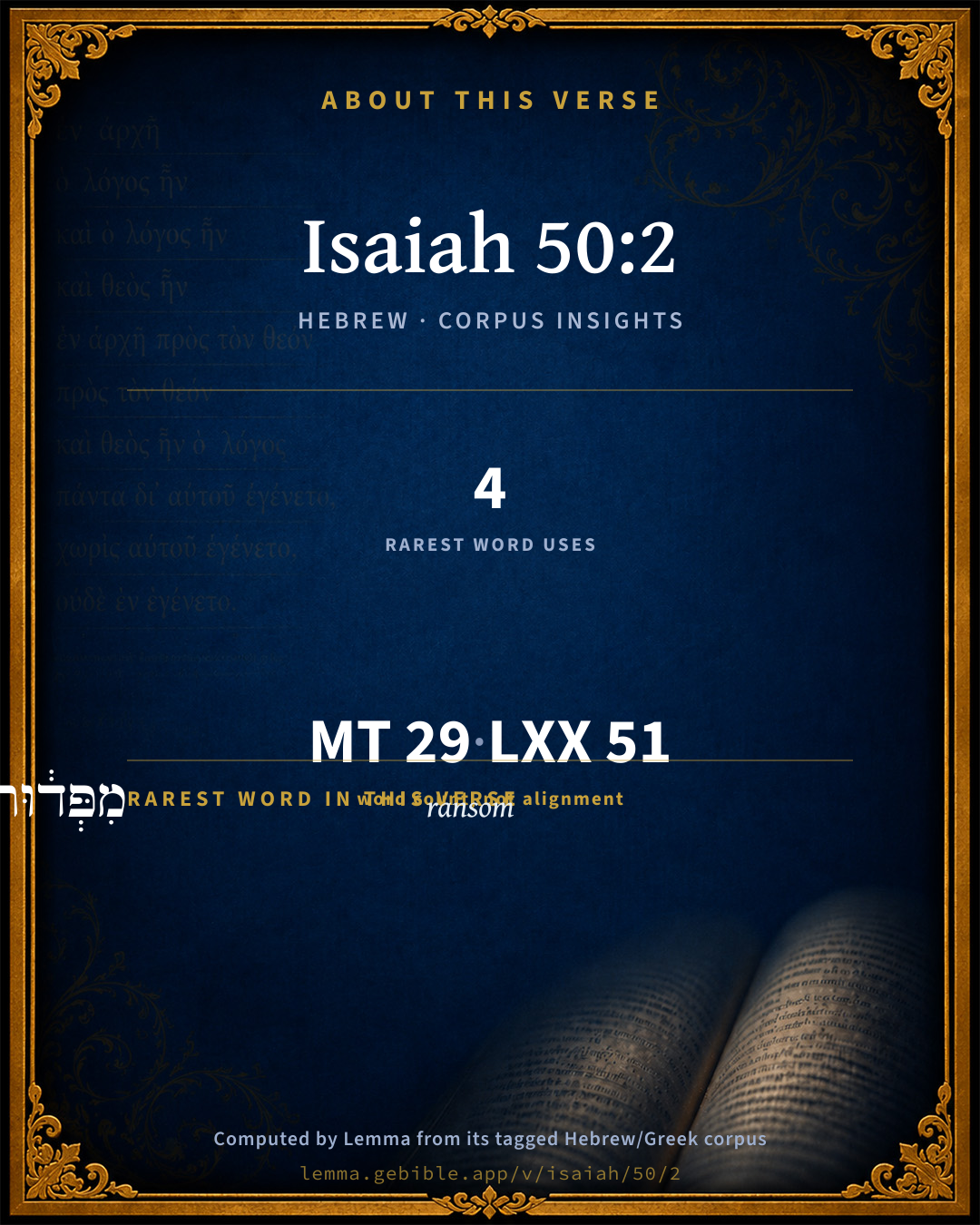
The rarest word here is מִפְּד֔וּת ransom H6304 — appearing just 4 times in the whole Hebrew Bible.

Shared distinctive vocabulary

מִפְּד֔וּת ransom H6304 occurs in 4 verses of the Hebrew Bible. Also found in:

Grammatical profile

  • 10 verbs
  • 11 nouns
  • 1 preposition
  • 1 conjunction
  • 6 particles

Verb forms

  • בָּ֜אתִי Qal · Perfect
  • קָרָֽאתִי֮ Qal · Perfect
  • עוֹנֶה֒ Qal · Participle Active
  • הֲקָצ֨וֹר Qal · Infinitive Absolute
  • קָצְרָ֤ה Qal · Perfect
  • לְהַצִּ֑יל Hiphil · Infinitive Construct
  • אַחֲרִ֣יב Hiphil · Imperfect
  • אָשִׂ֤ים Qal · Imperfect
  • תִּבְאַ֤שׁ Qal · Imperfect
  • וְתָמֹ֖ת Qal · Imperfect

Repetition

Words recur within this verse — often emphatic in Hebrew:

  • וְאֵ֣ין nothing H369 ×4
  • הֲקָצ֨וֹר to be short H7114 ×2

Hebrew & Septuagint length

In English translation the verse runs 60 words from the Hebrew and 63 from the Septuagint (LXX English) — closely comparable.

A rough comparison of the two English renderings, which tokenize alike — not a word-level alignment.

Word counts can differ between the Hebrew and the Greek without any difference in meaning — e.g. the Hebrew direct-object marker אֵת has no separate Greek word, and Greek often adds the article ὁ.

In the original languages it is 29 Hebrew tokens and 51 Greek tokens — but the two are counted differently (Hebrew bundles its prefixes and suffixes into one token; the Greek is in lemma form), so that isn’t a like-for-like length.

Cross-references

37

Topical passages linked to Isaiah 50:2 in the Treasury of Scripture Knowledge — connected by theme and wording, ordered by reader-vote popularity; previews shown in the World English Bible.

  • Isaiah 59:1 Behold, Yahweh's hand is not shortened, that it can't save; neither his ear heavy, that it can't hear:
  • Numbers 11:23 Yahweh said to Moses, Has Yahweh's hand grown short? now shall you see whether my word shall happen to you or not.
  • Isaiah 66:4 I also will choose their delusions, and will bring their fears on them; because when I called, none did answer; when I spoke, they did not hear: but they did that which was evil in my eyes, and chose that in which I didn't delight.
  • Joshua 3:16 that the waters which came down from above stood, and rose up in one heap, a great way off, at Adam, the city that is beside Zarethan; and those that went down toward the sea of the Arabah, even the Salt Sea, were wholly cut off: and the people passed over right against Jericho.
  • Genesis 18:14 Is anything too hard for Yahweh? At the set time I will return to you, when the season comes round, and Sarah will have a son."
  • Proverbs 1:24 Because I have called, and you have refused; I have stretched out my hand, and no one has paid attention;
  • Exodus 14:21 Moses stretched out his hand over the sea, and Yahweh caused the sea to go back by a strong east wind all the night, and made the sea dry land, and the waters were divided.
  • Exodus 7:21 The fish that were in the river died; and the river became foul, and the Egyptians couldn't drink water from the river; and the blood was throughout all the land of Egypt.
  • Isaiah 42:15 I will lay waste mountains and hills, and dry up all their herbs; and I will make the rivers islands, and will dry up the pools.
  • Isaiah 43:16 Thus says Yahweh, who makes a way in the sea, and a path in the mighty waters;
  • Hosea 11:7 My people are determined to turn from me. Though they call to the Most High, He certainly won't exalt them.
  • Nahum 1:4 He rebukes the sea, and makes it dry, and dries up all the rivers. Bashan languishes, and Carmel; and the flower of Lebanon languishes.
  • Exodus 7:18 The fish that are in the river shall die, and the river shall become foul; and the Egyptians shall loathe to drink water from the river."'"
  • Isaiah 59:16 He saw that there was no man, and wondered that there was no intercessor: therefore his own arm brought salvation to him; and his righteousness, it upheld him.
  • Isaiah 65:12 I will destine you to the sword, and you shall all bow down to the slaughter; because when I called, you did not answer; when I spoke, you did not hear; but you did that which was evil in my eyes, and chose that in which I didn't delight.
  • Jeremiah 35:15 I have sent also to you all my servants the prophets, rising up early and sending them, saying, Return you now every man from his evil way, and amend your doings, and don't go after other gods to serve them, and you shall dwell in the land which I have given to you and to your fathers: but you have not inclined your ear, nor listened to me.
  • Daniel 3:15 Now if you are ready whenever you hear the sound of the horn, flute, zither, lyre, harp, pipe, and all kinds of music to you fall down and worship the image which I have made, [well]: but if you don't worship, you shall be cast the same hour into the midst of a burning fiery furnace; and who is that god that shall deliver you out of my hands?
  • Daniel 3:29 Therefore I make a decree, that every people, nation, and language, which speak anything evil against the God of Shadrach, Meshach, and Abednego, shall be cut in pieces, and their houses shall be made a dunghill; because there is no other god who is able to deliver after this sort.
  • Daniel 6:20 When he came near to the den to Daniel, he cried with a lamentable voice; the king spoke and said to Daniel, Daniel, servant of the living God, is your God, whom you serve continually, able to deliver you from the lions?
  • Hosea 11:2 They called to them, so they went from them. They sacrificed to the Baals, And burned incense to engraved images.
  • Mark 4:39 He awoke, and rebuked the wind, and said to the sea, "Peace! Be still!" The wind ceased, and there was a great calm.
  • John 1:11 He came to his own, and those who were his own didn't receive him.
  • Exodus 14:29 But the children of Israel walked on dry land in the midst of the sea, and the waters were a wall to them on their right hand, and on their left.
  • 2 Chronicles 32:15 Now therefore don't let Hezekiah deceive you, nor persuade you after this manner, neither believe you him; for no god of any nation or kingdom was able to deliver his people out of my hand, and out of the hand of my fathers: how much less shall your God deliver you out of my hand?
  • Psalms 106:9 He rebuked the Red Sea also, and it was dried up; So he led them through the depths, as through a desert.
  • Psalms 107:33 He turns rivers into a desert, Water springs into a thirsty ground,
  • Psalms 114:3–7 The sea saw it, and fled. The Jordan was driven back.
  • Isaiah 19:5 The waters shall fail from the sea, and the river shall be wasted and become dry.
  • Isaiah 36:20 Who are they among all the gods of these countries, that have delivered their country out of my hand, that Yahweh should deliver Jerusalem out of my hand?
  • Isaiah 41:28 When I look, there is no man: even among them there is no counselor who, when I ask of them, can answer a word.
  • Isaiah 51:10 Isn't it you who dried up the sea, the waters of the great deep; who made the depths of the sea a way for the redeemed to pass over?
  • Isaiah 63:13 who led them through the depths, as a horse in the wilderness, so that they didn't stumble?
  • Jeremiah 5:1 Run you back and forth through the streets of Jerusalem, and see now, and know, and seek in the broad places of it, if you can find a man, if there are any who does justly, who seeks truth; and I will pardon her.
  • John 3:19 This is the judgment, that the light has come into the world, and men loved the darkness rather than the light; for their works were evil.
  • Jeremiah 8:6 I listened and heard, but they didn't speak aright: no man repents him of his wickedness, saying, What have I done? everyone turns to his course, as a horse that rushes headlong in the battle.
  • Jeremiah 7:13 Now, because you have done all these works, says Yahweh, and I spoke to you, rising up early and speaking, but you didn't hear; and I called you, but you didn't answer:
  • Daniel 6:27 He delivers and rescues, and he works signs and wonders in heaven and in earth, who has delivered Daniel from the power of the lions.

Cross-references courtesy of OpenBible.info (CC BY 4.0).

Hebrew and Greek witnesses Masoretic Hebrew ↔ Greek Septuagint

The same verse in the two great witnesses to the Old Testament, shown verse-for-verse.

These are two independent witnesses, not word-aligned to each other, and the Septuagint is shown in lemma (dictionary) form.

Hebrew Isaiah 50:2 Masoretic · Westminster Leningrad Codex

מַדּ֨וּעַ בָּ֜אתִי וְאֵ֣ין אִ֗ישׁ קָרָֽאתִי֮ וְאֵ֣ין עוֹנֶה֒ הֲקָצ֨וֹר קָצְרָ֤ה יָדִי֙ מִפְּד֔וּת וְאִם אֵֽין בִּ֥י כֹ֖חַ לְהַצִּ֑יל הֵ֣ן בְּגַעֲרָתִ֞י אַחֲרִ֣יב יָ֗ם אָשִׂ֤ים נְהָרוֹת֙ מִדְבָּ֔ר תִּבְאַ֤שׁ דְּגָתָם֙ מֵאֵ֣ין מַ֔יִם וְתָמֹ֖ת בַּצָּמָֽא

Why, when I came, was there no man? when I called, was there none to answer? Is my hand shortened at all, that it can't redeem? or have I no power to deliver? Behold, at my rebuke I dry up the sea, I make the rivers a wilderness: their fish stink, because there is no water, and die for thirst.

World English Bible · Public Domain

Greek LXX Isaiah 50:2 Septuagint · lemma form

τίς ὅτι ἔρχομαι καί οὐ εἰμί ἄνθρωπος καλέω καί οὐ εἰμί ὁ ὑποἀκούω μή οὐ ἰσχύω ὁ χείρ ἐγώ ὁ ῥύομαι ἤ οὐ ἰσχύω ὁ ἐκαἱρέω ἰδού ὁ ἀπειλή ἐγώ ἐκἐρημόω ὁ θάλασσα καί τίθημι ποταμός ἔρημος καί ξηραίνω ὁ ἰχθύς αὐτός ἀπό ὁ μή εἰμί ὕδωρ καί ἀποθνήσκω ἐν δίψος

Why did I come, and there was no man? why did I call, and there was none to listen? Is not my hand strong to redeem? or can I not deliver? behold, by my rebuke I will dry up the sea, and make rivers a wilderness; and their fish shall be dried up because there is no water, and shall die for thirst.

LXX2012 (modern English Septuagint) · Public Domain

On this verse, Adam Clarke's Commentary discusses the Septuagint’s reading. Read the note in Commentary ↓

Hebrew: Westminster Leningrad Codex (CC BY 4.0). Greek: Septuagint (public domain); English from LXX2012 (modern English Septuagint) (Public Domain). How the Septuagint differs from the Hebrew →

Targum (Aramaic paraphrase)

1

The Targum is the ancient Jewish Aramaic paraphrase of the Hebrew Scriptures — an interpretive translation, not the Hebrew text itself. Onkelos (literal) and Pseudo-Jonathan (expansive) render the Torah, and Jonathan the Prophets. Coverage is partial: where no permissively-licensed English translation exists for a verse, only the Aramaic is shown. This is verse-level text, not a word-by-word alignment to the Hebrew.

  1. Targum Jonathan Prophets (Joshua–Malachi)
    מָא דֵין שְׁלִיחַת נְבִיֵי וְלָא תָבוּ אִתְנַבִּיאוּ וְלָא קַבִּילוּ הַאִתְקְפָדָא אִתְקְפָדַת גְבוּרְתִּי מִלְמִפְרַק וְאִם לֵית קֳדָמַי חֵיל לְשֵׁיזָבָא הָא בִמְזוֹפִיתִי אַחֲרִיב יַמָא אֱשַׁוֵי נַהֲרִין מַדְבְּרָא יִסְרוֹן נוּנֵיהוֹן מִבְּלִי מַיָא וִימוּתוּן בְּצַחוּתָא:

    Wherefore have I sent my prophets, and they have not repented? They prophesied, but they obeyed not. Is my power altogether deficient, that I cannot save? Behold, at my rebuke I dry up the sea, I make the rivers a wilderness: their fish stinketh, because there is no water, and dieth for thirst.

    Targum Jonathan — Aramaic: “Mikraot Gedolot” (public domain). English: “Sefaria Community Translation” (CC0 1.0 (public-domain dedication)); “London "Chaldee Paraphrase," 1871” (public domain). Text via Sefaria.

Commentary

Notes on Isaiah 50:2 from classic Christian and Jewish commentators (each source and its license shown beneath its notes). The classic Christian expositions comment on the surrounding passage and are grouped to its opening verse, so a note may address several verses; the Jewish commentaries on the Tanakh (Rashi and others) are per-verse, so they appear only where the commentator wrote on this verse.

Lemma curates 59 commentaries, every one of them public domain or Creative Commons licensed, each selected and text-cleaned for this edition rather than reprinted as found. About our sources →

Trapp's Complete Commentary

John Trapp

Isa 50:2 Wherefore, when I came, [was there] no man? when I called, [was there] none to answer? Is my hand shortened at all, that it cannot redeem? or have I no power to deliver? behold, at my rebuke I dry up the sea, I make the rivers a wilderness: their fish stinketh, because [there is] no water, and dieth for thirst.

Ver. 2. Wherefore, when I came, was there no man?] Christ "came unto his own, but his own received him not." {Joh 1:11} This was condemnation, {Joh 3:19} their rebelling against the light of the gospel; this was the great offence, the damning sin, the very cause of their utter rejection.

Is my hand shortened at all?] Or rather, Have not you, by your obstinace and incredulity, transfused, as it were, a dead palsy into the hand of Omnipotence? "He could do there no mighty work because of their unbelief": {Mar 6:5} of so venomous a nature is that cursed sin.

Behold, at my rebuke I dry up the sea.] I have done it, you know, {Psa 106:9} and can do it again. Be not therefore "faithless, but believing." {Joh 20:27}

John Trapp, A Commentary or Exposition upon All the Books of the Old and New Testament (1647–1656) — public domain. Text from a community e-Sword module.

The Biblical Illustrator

Joseph S. Exell

Isa_50:2-6

Wherefore, when I came, was there no man?

--

The Mediator: Divine and human

These words could have been spoken only by the Mediator between God and man, the man Christ Jesus They place before our thoughts--

I. His DIVINE POWER AND GLORY. Power is naturally calm. The power that sustains the universe is, in fact, most wonderful when, unseen, unfelt, with its Divine silence and infinite ease, it moves on in its ordinary course; but we are often most impressed by it when it strikes against obstructions, and startles the senses by its violence. Knowing our frame, and dealing with us as with children, our Teacher seeks to impress us with a sense of His Divine power, by bidding us think of Him as working by inexorable force certain awful changes and displacements in nature. I dry up the sea, etc.

II. HIS HUMAN LIFE AND EDUCATION. The Lord God hath given me the tongue of the learned, etc. Gradually, it seems, the Divine Spirit, like a mysterious voice, woke up within Him the consciousness of what He was, and of what He had come on earth to fulfil. Morning by morning, through all the days of His childhood, the voice was ever awakening Him to higher consciousness and more awful knowledge.

III. THE MEDIATORIAL TEACHING FOR WHICH HE HAD BEEN THUS PREPARED.

1. It is personal. If His own personal teaching had not been in view, there would have been no need for all this personal preparation. The Lord hath given Me the tongue of the learned, that I should know how to speak. This is His own testimony to the great fact that He Himself personally teaches every soul that is saved.

2. It is suitable. Suitable to our weariness.

(1) While we are yet in a state of unregeneracy.

(2) When we are sinking under the burden of guilt.

(3) When fainting under the burden of care.

(4) When burdened under the intellectual mysteries of theology.

(5) When under the burden of mortal infirmity.

3. The teaching of Christ is minutely direct and particular. When I read that He is ordained to speak to him that is weary, I understand that He does not speak in a general, impersonal, unrecognizing way to the forlorn crowd of sufferers, but to every man in particular, and to every man apart. (C. Stanford, D. D.)

The Redeemer described by Himself

In my opinion, these verses (2-6) run on without any break, so that you are not to separate them, and ascribe one to the prophet, another to the Messiah, and another to Jehovah Himself; but you must take the whole as the utterance of one Divine Person. That Jehovah-Jesus is the One who is speaking here, is very clear from the last verse of the previous chapter: I the Lord (I, Jehovah, it is,) am thy Saviour and thy Redeemer, the mighty One of Jacob.

I. BEHOLD THE MESSIAH AS GOD. Link Isa_50:3; Isa_6:1-13 : I clothe the heavens with blackness, and I make sackcloth their covering . . . I gave my back to the smiters, etc. He, then, who suffered thus, and whom we regard as redeeming us by His death, and as saving us by His life, is no less than the Almighty God. I think the first reference, in these words, is to the miracles which were wrought by the plagues in Egypt. It was Jehovah-Jesus who was then plaguing His adversaries. In a later chapter, Isaiah says that the Angel of His presence saved them; and who is that great Angel of His presence but the Angel of the covenant in whom we delight, even Jesus Christ our Lord and Saviour? But we must not restrict the text to that which happened in the land of Egypt, for it has a far wider reference. All the great wonders of nature are to be ascribed to Him upon whom we build all our hopes for time and for eternity. The last miracle recorded here, namely, that of covering the heavens with sackcloth, was performed by our Lord even when He was in His death agony. You are not depending for your salvation upon a mere man. He is man, but He is just as truly Divine.

II. BEHOLD THE MESSIAH AS THE INSTRUCTED TEACHER (verse 4). I call your special attention to the condescension of our Lord in coming here on purpose to care for the weak--to speak consoling and sustaining words to them; and also to the fact that, before He performed that service, He learned the sacred art from His Father. For thirty years was He learning much in Josephs carpenters shop. Little do we know how much He learned there; but this much we do know, Jesus increased in wisdom and stature, and in favour with God and man. And afterwards, when He entered upon His public work among men, He spake with the tongue of the learned, saying to His disciples, All things that I have heard of My Father I have made known unto you. All through His time of teaching, He was still listening and learning.

III. BEHOLD JESUS CHRIST AS THE SERVANT OF THE LORD (verse 5).

1. He speaks of Himself as being prepared by grace. The Lord God hath opened Mine ear, as if there had been a work wrought upon Him to prepare Him for His service. And the same Spirit, which rested upon Christ, must also open our ears.

2. Being thus prepared by grace, He was consecrated in due form, so that He could say to Himself, The Lord God hath opened Mine ear. He heard the faintest whispers of His Fathers voice.

3. He not only heard His Fathers voice, but He was obedient to it in all things. I was not rebellious. From the day when, as a child, He said to His parents, Wist ye not that I must be about My Fathers business? till the hour when, on the cross, He cried, It is finished, He was always obedient to the will of God.

4. In that obedience, He was persevering through all trials. He says that He did not turn away back. Having commenced the work of saving men, He went through with it.

IV. BEHOLD THE MESSIAH AS THE PEERLESS SUFFERER (verse 6). It has been asked, Did God really die? No; for God cannot die, yet He who died was God; so, if there be a confusion in your mind, it is the confusion of Holy Scripture itself, for we read, Feed the Church of God, which He hath purchased with His own blood. In addition to the pain, we are asked, in this verse, to notice particularly the contempt which the Saviour endured. The plucking of His hair was a proof of the malicious contempt of His enemies, yet they went still further, and did spit in His face. Spitting was regarded by Orientals, and, I suppose, by all of us, as the most contemptuous thing which one man could do to another; yet the vile soldiers gathered round Him, and spat upon Him. I must point out the beautiful touch of voluntariness here: I hid not my face. Our Saviour did not turn away, or seek to escape. If He had wished to do so, He could readily have done it. Conclusion: Notice three combinations which the verses of my text will make.

(1) Verses 2 and 6. Those verses together show the full ability of Christ to save. Here we have God and the Sufferer.

(2) Verses 4 and 5. Here you have the Teacher and the Servant, and the two together make up this truth--that Christ teaches us, not with words only, but with His life. What a wonderful Teacher He is, who Himself learned the lessons which He would have us learn!

(3) Now put the whole text together, and I think the result will be--at least to Gods people--that they will say, This God shall be our God for ever and ever; and it shall be our delight to do His bidding at all times. It is a high honour to serve God; and Christ is God. It is a great thing to be the servant of a wise teacher; and Christ has the tongue of the learned. It is a very sweet thing to walk in the steps of a perfect Exemplar; and Christ is that. And, last and best of all, it is delightful to live for Him who suffered and died on our behalf. (C. H. Spurgeon.)

The Biblical Illustrator, edited by Joseph S. Exell (c. 1880s–1900s) — public domain. Text from a community e-Sword module.

Joseph Benson's Commentary

Isa 50:2-3. Wherefore, &c. — The general accusation, delivered in the last words, he now proves by particular instances: When I came was there no man. — How comes it to pass, that, when I sent to you by my servants the prophets, there was no man that regarded my message and offer of grace, and complied with my will? Whereby he implies that the generality of the Jews were guilty of gross infidelity and obstinate disobedience, and therefore might justly be rejected. When I called them to repentance and reformation, there was none to come — None to come at my call, or to obey my commands. Is my hand shortened at all, &c. — What is the reason of this contempt and rebellion? Is it because you expect no good from me, but think I am either unwilling or unable to save you? Behold, at my rebuke I dry up the sea — At my word or command I can not only check its proud waves, but make its channel dry. Here, for a proof of his power, God appeals to the miracles he wrought in Egypt, at the Red sea, and at Jordan. I make the rivers a wilderness — As dry and fit for travelling over as a wilderness. I clothe the heavens with blackness — Or, I will, or can clothe, &c. What I once did in Egypt when I drew thick curtains before all the heavenly lights, and caused an unparalleled and amazing darkness to take place for three successive days, to the great terror of my enemies, so I can and will do still, when it is necessary to save my people. And therefore you have no reason to distrust me. And I make sackcloth their covering — I cover them with clouds as black as sackcloth.

Joseph Benson's Commentary on the Old and New Testaments (1811–1818) — public domain. Text from a community e-Sword module.

Tyndale Open Study Notes

Tyndale Open Resources

50:2 Why didn’t anyone answer: The people had not responded to God’s repeated call to trust in him and repent of their sins. They were deaf and stubborn (see 6:9-10; 29:18; 35:5; 42:18-19). • The Lord came and called the people through the prophets (see also 65:1-3). • Is it because I have no power to rescue? God was fully able to rescue Israel and Judah from the Assyrians and Babylonians, but he first had to deal justly with his people’s sinfulness (see 59:1). • speak to the sea and make it dry: This was an allusion to the parting of the Red Sea during the exodus from Egypt (Exod 14:21-22).

Tyndale Open Study Notes — © Tyndale Open Resources, licensed CC BY-SA 4.0. Text via the HelloAO Bible API.

Geneva Bible (1599)

Geneva Bible translators

He came by his Prophets and ministers, but they would not believe their doctrine and convert.

Am I not able to help you, as I have helped your fathers of old, when I dried up the red Sea, and killed the fish in the rivers, and also afterward in Jordan?

Geneva Bible (1599) marginal notes — public domain. Text via Bolls.life.

Jamieson, Fausset & Brown

Robert Jamieson, A. R. Fausset & David Brown

I--Messiah.

no man--willing to believe in and obey Me (Isa 52:1, Isa 52:3). The same Divine Person had "come" by His prophets in the Old Testament (appealing to them, but in vain, Jer 7:25-26), who was about to come under the New Testament.

hand shortened--the Oriental emblem of weakness, as the long stretched-out hand is of power (Isa 59:1). Notwithstanding your sins, I can still "redeem" you from your bondage and dispersion.

dry up . . . sea-- (Exo 14:21). The second exodus shall exceed, while it resembles in wonders, the first (Isa 11:11, Isa 11:15; Isa 51:15).

make . . . rivers . . . wilderness--turn the prosperity of Israel's foes into adversity.

fish stinketh--the very judgment inflicted on their Egyptian enemies at the first exodus (Exo 7:18, Exo 7:21).

Jamieson, Fausset & Brown — Commentary Critical and Explanatory on the Whole Bible (1871) — public domain (CC PDM 1.0). Text via the HelloAO Bible API.

Adam Clarke's Commentary

Verse 2. Their fish stinketh - "Their fish is dried up"] For תבאש tibaosh, stinketh, read תיבש tibash, is dried up; so it stands in the Bodl. MS., and it is confirmed by the Septuagint, ξηρανθησονται, they shall be dried up.

Adam Clarke's Commentary on the Bible (1810–1826) — public domain. Text from a community e-Sword/MySword module.

Ellicott's Commentary for English Readers

(2) Wherefore, when I came . . .?—The “coming” of Jehovah must be taken in all its width of meaning. He came in the deliverance from Babylon, in a promise of still greater blessings, in the fullest sense, in and through His Servant, and yet none came to help in the work, or even to receive the message. (Comp. Isa_63:3.) Not that He needed human helpers. In words that remind us, in their sequence, of the phenomena of the plagues of Egypt, the prophet piles up the mighty works of which He is capable. The words are echoed in Rev_6:12; Rev_8:9; Rev_8:12.

A Bible Commentary for English Readers, edited by Charles John Ellicott (1878–1897) — public domain. Text from a community e-Sword module.

The Cambridge Bible for Schools and Colleges

gen. ed. J. J. S. Perowne

2. Jehovah expresses surprise that His message of redemption (delivered through the prophet) has been received with so little enthusiasm by the people.

was there no man?] The expression occurs again in Isa_59:16; in both places the indefinite “man” is explained by the second member of the parallelism; here, therefore, it means “no man to answer.”

Is my hand shortened at all &c.] Is it the case that my hand is too short to redeem? (cf. Isa_59:1). And the unreasonableness of such doubts as to Jehovah’s power is then proved by an appeal to His mighty works in the natural sphere, probably with a special allusion to the miracles of the Exodus period.

at (by) my rebuke] Cf. ch. Isa_17:13; esp. Psa_104:7; Psa_106:9.

I make [the] rivers a wilderness] Psa_107:33.

their fish stinketh &c.] Exo_7:18.

The Cambridge Bible for Schools and Colleges (gen. ed. J. J. S. Perowne; Cambridge University Press, 1878–1918) — public domain. Text from a community e-Sword module.

John Gill's Exposition

Wherefore, when I came, was there no man?.... The Targum is,

"why have I sent my prophets, and they are not converted?''

And so Aben Ezra and Kimchi interpret it of the prophets that prophesied unto them, to bring them to repentance: the Lord might be said to come by his prophets, his messengers; but they did not receive them, nor their messages, but despised and rejected them, and therefore were carried captive, Ch2 36:15, but it is best to understand it of the coming of Christ in the flesh; when there were none that would receive, nor even come to him, but hid their faces from him, nor suffer others to be gathered unto him, or attend his ministry; they would neither go in themselves into the kingdom of the Messiah, nor let others go in that were entering, Joh 1:11,

when I called, was there none to answer? he called them to the marriage feast, to his word and ordinances, but they made light of it, and went about their worldly business; many were called externally in his ministry, but few were chosen, and effectually wrought upon; he called, but there was no answer given; for there was no internal principle in them, no grace to answer to the call; he stretched out his hands to a rebellious and gainsaying people, Mat 22:2,

is my hand shortened at all, that it cannot redeem? or have I no power to deliver? they did not know him to be the mighty God; they took him to be a mere man; and being descended from such mean parents, and making such a mean appearance, they could not think he was able to be their Redeemer and Saviour; but that he had sufficient ability appears by what follows:

behold, at my rebuke I dry up the sea; he was able to do it, and did do it for the children of Israel, and made a passage through the Red sea for them, as on dry land; which was done by a strong east wind he caused to blow, here called his "rebuke", Exo 14:20, of Christ's rebuking the sea, see Mat 8:26.

I make the rivers a wilderness; as dry as the wilderness, and parched ground; in which persons may pass as on dry ground, and as travellers pass through a wilderness; so Jordan was made for the Israelites, Jos 3:17, and may be here particularly meant; called "rivers" because of the excellency of it, and the abundance of water in it, which sometimes overflowed its banks; and because other rivers fall into it, as Kimchi observes:

their flesh stinketh because there is no water, and dieth for thirst; as they did when the rivers of Egypt were turned into blood, Exo 7:21.

John Gill's Exposition of the Whole Bible (1746–1763) — public domain (CC PDM 1.0). Text via the HelloAO Bible API.

Albert Barnes' Notes on the Bible

Wherefore, when I came, was there no man? - That is, when I came to call you to repentance, why was there no man of the nation to yield obedience? The sense is, that they had not been punished without warning. He had called them to repentance, but no one heard his voice. The Chaldee renders this, ‘Wherefore did I send my prophets, and they did not turn? They prophesied, but they did not attend.’

When I called, was there none to answer? - None obeyed, or regarded my voice. It was not, therefore, by his fault that they had been punished, but it was because they did not listen to the messengers which he had sent unto them.

Is my hand shortened at all? - The meaning of this is, that it was not because God was unable to save, that they had been thus punished. The hand, in the Scriptures, is an emblem of strength, as it is the instrument by which we accomplish our purposes. To shorten the hand, that is, to cut it off, is an emblem of diminishing, or destroying our ability to execute any purpose (see Isa 59:1). So in Num 11:23 : ‘Is the Lord’s hand waxed short?’

That it cannot redeem? - That it cannot rescue or deliver you. The idea is, that it was not because he was less able to save them than he had been in former times, that they were sold into captivity, and sighed in bondage.

Behold, at my rebuke - At my chiding - as a father rebukes a disobedient child, or as a man would rebuke an excited multitude. Similar language is used of the Saviour when he stilled the tempest on the sea of Gennesareth: ‘Then he arose and rebuked the winds and the sea, and there was a great calm’ Mat 8:26. The reference here is, undoubtedly, to the fact that God dried up the Red Sea, or made a way for the children of Israel to pass through it. The idea is, that he who had power to perform such a stupendous miracle as that, had power also to deliver his people at any time, and that, therefore, it was for no want of power in him that the Jews were suffering in exile.

I make the rivers a wilderness - I dry up streams at pleasure, and have power even to make the bed of rivers, and all the country watered by them, a pathless, and an unfruitful desert.

Their fish stinketh - The waters leave them, and the fish die, and putrify. It is not uncommon in the East for large streams and even rivers thus to be dried up by the intense heat of the sun, and by being lost in the sand. Thus the river Barrady which flows through the fertile plain on which Damascus is situated, and which is divided into innumerable streams and canals to water the city and the gardens adjacent to it, after flowing to a short distance from the city is wholly lost - partly absorbed in the sands, and partly dried up by the intense rays of the sun (see Jones’ ‘Excursions to Jerusalem, Egypt, etc. ‘) The idea here is, that it was God who had power to dry up those streams, and that he who could do that, could save and vindicate his people.

Albert Barnes' Notes on the Bible (1834–1885) — public domain. Text from a community e-Sword/MySword module.

Haydock's Catholic Bible Commentary

Hear. My spouse had gone after other lovers. The people refused to hear the prophets; and the priests were become as corrupt as the rest, when the city was taken by the Chaldeans and by the Romans. (Calmet) --- Sea. Babylon, chap. xxi. (Haydock) --- I could work the same miracles, as I did when Israel came out of Egypt.

George Leo Haydock (1774–1849), Haydock's Catholic Family Bible and Commentary, 1859 edition — public domain. Excludes Psalms (Douay-Rheims chapter numbering differs from Protestant) and Deuterocanonical books (Catholic canon only).

Matthew Poole's English Annotations

The general accusation delivered in the last words he now proveth by particular instances. When I came; when I, first by my prophets, and at last by my Son, came unto them, to call them to repentance, and to redeem and deliver them, as it is explained in the following clauses of this verse. No man that regarded and received me, that complied with my call and offer of grace, as it follows; whereby he implies that the generality of the Jews were guilty of gross infidelity and obstinate disobedience, and therefore might justly be rejected.

When I called; called them to repentance, or to come unto me, or to do my will, as masters call their servants.

None to answer; to come at my call, to obey my commands. Have I no power to deliver? what is the reason of this horrible contempt and rebellion? Is it because you expect no good from me, but think that I am either unwilling or unable to save you? Because you see no miracles wrought for you to save you from the Babylonians; and because my Son, your Messiah, cometh not with pomp and power, as you expect, but in the form of a servant, poor, and exposed to contempt and death; do you therefore believe that my power to deliver you is less than it was?

At my rebuke: this phrase is borrowed from Psa 106:9, and it is used Mat 8:26. At my word or command, whereby I rebuke and check its proud waves.

I dry up, Heb. I will dry up; or, I can dry up; the future verb being put potentially. As I did it once, so I can and will do it again, when occasion requires it. I make the rivers a wilderness; as dry and fit for travel as a wilderness.

Matthew Poole's English Annotations on the Holy Bible (1683–1685) — public domain. Text from a community e-Sword/MySword module.

Whedon's Commentary on the Bible

Daniel D. Whedon

2. Wherefore, when I came… no man — No man of you answers to my call when I come to my people. Guilt is timid, and shrinks out of sight. It feels condemnation, not confidence. Is this your case?

Is my hand shortened — That is, cut off, and thus disabled.

That it cannot redeem — Cannot rescue and redeem my own when they stray and get enslaved.

Behold, at my rebuke — God’s kindly providence is always over his people, as against others hostile to them. Instances: the Red Sea deliverance; the retention of waters in desert wady-trunks, when winter is gone and summer drought has come; such as Wady Feiran, near Sinai; but other wadies become all dry, yet new founts are opened where not known before.

Daniel D. Whedon (gen. ed.), Commentary on the Old and New Testaments (1874–1909) — public domain. Text from a community e-Sword module.

The Pulpit Commentary

Wherefore, when I came, was there no man? Such being the condition of things; Judah having rejected me, not I them why, "when I came" and announced deliverance from Babylon, was there no response?

Why did no champion appear? Is it that my power was doubted? that it was feared my hand was shortened, so that it could not redeem or deliver? But I am he who has power with his rebuke to dry up the sea, (Exo_14:21) to make rivers a wilderness; (Exo_7:20 Jos_3:16, Jos_3:17) in fact, to change the course of nature as seemeth him good, and accomplish his will against all obstacles. Is my hand shortened? i.e. "is my power less than it was?" Can any one suppose this? Surely what I have once done I can do again. If I delivered from Egypt, I can redeem from Babylon. Their fish stinketh. (comp. Exo_7:21) But the object is rather to assert an absolute control over nature than to take the thoughts of the hearers back to any special occasions when control was exercised.

Vers. 2, 3. God"s power over nature.

Modern pseudo-science, or "un-science," as it has been called, seems to hold that nature, having been once for all arranged and ordered by God, was thenceforth left to itself, being an automatic machine, bound to work in a certain way, needing no superintendence, and brooking no interference thenceforward. Hence miracles are regarded as impossible, or at any rate as non occurrent; and we are invited to ascribe to the combined influence of priestcraft and credulity all the statements with respect to supernatural interferences with nature which we find in the history of our race. The view of the sacred writers is the direct opposite of this. God is not regarded as having ever left nature to itself". On the contrary, he is always represented as working with nature and in nature. He" covereth the heaven with clouds, and prepareth rain for the earth, and maketh the grass to grow upon the mountains. He giveth to the beast his food, and to the young ravens which cry He giveth snow like wool, and scattereth the hoar-frost like ashes. He casteth forth his ice like morsels: who can stand before his cold? He sendeth out his word, and melteth them: he causeth his wind to blow, and the waters flow". (Psa_147:8-18) He is, in fact, ever in his laws, executing them continually making the sun to shine, and the moon to give her light, and the stars to sparkle in the canopy of heaven, and the mountains to stand firm, and the winds to blow, and the rain to fall, and the earth to give her increase. The secret of the quasi-unvarying character of nature"s laws is his unchangeableness the fact that "with him is no variableness, neither shadow of turning". (Jam_1:17) But, as he thus holds nature in his hand, and does not let it go, so he is necessarily at all times omnipotent over nature, and can suspend or change any "law of nature" at his pleasure. In point of fact, he does not do so unless upon emergencies. But, let a fitting occasion come, and it is as easy for him to reverse a law as to maintain it. He can "dry up the sea" in a moment, "make rivers a desert" (ver. 2), "clothe the heaven with blackness" (ver. 3), cause the stars to fall, (Mat_24:29) create a new heaven and a new, (Rev_21:1) cast death and hell into the lake of fire. (Rev_20:14) To regard miracles as impossible is to be an atheist; to say that they are non-occurrent is to fly in the face of history. No doubt many false miracles have been alleged, and an alleged miracle is not to be received without a searching scrutiny. But the summary rejection of all miracles, which modern pseudo-science proclaims, is as little reasonable as the wholesale acceptance of all alleged miracles without exception.

The Pulpit Commentary (1880–1919), ed. H.D.M. Spence-Jones & Joseph S. Exell — public domain. Text from a community e-Sword module.

John Wesley's Explanatory Notes

Wherefore - The general accusation delivered in the last words he now proves by particular instances. When - When I, first by my prophets, came to call them to repentance. No man - That complied with my call. To answer - To come at my call. Is my hand - What is the reason of this contempt? Is it because you think I am either unwilling or unable to save you? A wilderness - As dry and fit for travelling as a wilderness.

John Wesley, Explanatory Notes Upon the Whole Bible (1754–1765) — public domain. Text via the GEBible commentary corpus.

Keil & Delitzsch

C. F. Keil & F. Delitzsch

The radical sin, however, which has lasted from the time of the captivity down to the present time, is disobedience to the word of God. This sin brought upon Zion and her children the judgment of banishment, and it was this which made it last so long. "Why did I come, and there was no one there? Why did I call, and there was no one who answered? Is my hand too short to redeem? or is there no strength in me to deliver? Behold, through my threatening I dry up the sea; turn streams into a plain: their fish rot, because there is no water, and die for thirst. I clothe the heavens in mourning, and make sackcloth their covering." Jehovah has come, and with what? It follows, from the fact of His bidding them consider, that His hand is not too short to set Israel loose and at liberty, that He is not so powerless as to be unable to draw it out; that He is the Almighty, who by His mere threatening word (Psa 106:9; Psa 104:7) can dry up the sea, and turn streams into a hard and barren soil, so that the fishes putrefy for want of water (Exo 7:18, etc.), and die from thirst (thâmōth a voluntative used as an indicative, as in Isa 12:1, and very frequently in poetical composition); who can clothe the heavens in mourning, and make sackcloth their (dull, dark) covering (for the expression itself, compare Isa 37:1-2); who therefore, fiat applicatio, can annihilate the girdle of waters behind which Babylon fancies herself concealed (see Isa 42:15; Isa 44:27), and cover the empire, which is now enslaving and torturing Israel, with a sunless and starless night of destruction (Isa 13:10). It follows from all this, that He has come with a gospel of deliverance from sin and punishment; but Israel has given no answer, has not received this message of salvation with faith, since faith is assent to the word of God. And in whom did Jehovah come? Knobel and most of the commentators reply, "in His prophets." This answer is not wrong, but it does not suffice to show the connection between what follows and what goes before. For there it is one person who speaks; and who is that, but the servant of Jehovah, who is introduced in these prophecies with dramatic directness, as speaking in his own name? Jehovah has come to His people in His servant. We know who was the servant of Jehovah in the historical fulfilment. It was He whom even the New Testament Scriptures describe as τὸν παῖδα τοῦ κυρίου, especially in the Acts (Act 3:13, Act 3:26; Act 4:27, Act 4:30). It was not indeed during the Babylonian captivity that the servant of Jehovah appeared in Israel with the gospel of redemption; but, as we shall never be tired of repeating, this is the human element in these prophecies, that they regard the appearance of the "servant of Jehovah," the Saviour of Israel and the heathen, as connected with the captivity: the punishment of Israel terminating, according to the law of the perspective foreshortening of prophetic vision, with the termination of the captivity - a connection which we regard as one of the strongest confirmations of the composition of these addresses before the captivity, as well as of Isaiah's authorship. But this ἀνθρώπινον does not destroy the θεῖον in them, inasmuch as the time at which Jesus appeared was not only similar to that of the Babylonian captivity, but stood in a causal connection with it, since the Roman empire was the continuation of the Babylonian, and the moral state of the people under the iron arm of the Roman rule resembled that of the Babylonian exiles (Eze 2:6-7). At the same time, whatever our opinion on this point may be, it is perfectly certain that it is to the servant of Jehovah, who was seen by the prophet in connection with the Babylonian captivity, that the words "wherefore did I come" refer.

Keil & Delitzsch — Biblical Commentary on the Old Testament (1861–1891) — public domain (CC PDM 1.0). Text via the HelloAO Bible API. (Old Testament only.)

J. A. Alexander on Isaiah

Joseph Addison Alexander

“Why did I come, and there was no man? (why) did I call, and there was no one answering?” The idiom of occidental languages would here admit, if not require, a more involved and hypothetical construction. Why, when I came, was there no one (to receive me), and, when I called, no one to answer me? (See above, Isa 5:4) In themselves, the words imply nothing more than that God had come near to the people by His word and providence, but without any suitable response on their part. The clause is explanatory of their being sold and put away, as represented in the foregoing verse. The general truth which it teaches is, that God has never and will never put away His people even for a time without preceding disobedience and alienation upon their part. Particular examples of this general truth are furnished by the Babylonish exile and by every season of distress and persecution. The other clause precludes the vindication of their unbelief and disobedience on the ground that they had not sufficient reason to obey his commands and rely upon his promises. Such doubts are rendered impious and foolish by the proofs of His almighty power. This power is first asserted indirectly by a question implying the strongest negation: “Is my hand shortened, shortened, from redemption? and is there with me no power (i.e., have I no power) to deliver?” Shortness of hand or arm is a common oriental figure for defect of power, especially in reference to some particular effect, which is thus represented as beyond the reach. (See Isa 59:1; Num 11:23: Isa 37:17). According to Gesenius, Artaxerxes Longimanus was so called, not in reference to any corporeal peculiarity, but as being possessed of extraordinary power. The emphatic repetition of the Hebrew verb may, as usual, be variously expressed in translation by the introduction of intensive phrases, such as ‘altogether’ or ‘at all’, or by a simple repetition of the verb in English. “From redemption,” (i.e., so as not to redeem or deliver from distress. (See above, on Isa 49:15)). “Behold, by my rebuke (a term often used to express God’s control over the elements) I will dry up the sea.” I can make a complete change in the face of nature. Most of the modern writers use the present form, “I dry up the sea.” But this, as expressing a habitual fact, fails to give the sense of the original, which is not a description of what He usually does, but a declaration of what He can do and what He will do in the present instance if it should be necessary. Hence the best translation of the verb is the exact one which adheres to the strict sense of the future. As in many other cases, this general expression may involve a particular allusion, namely, to the crossing of the Red Sea at the exodus from Egypt. But to make this the direct and main sense of the words, is equally at variance with good taste and the context. The remaining words of this verse are intended merely to complete the picture, by subjoining to the cause its natural effect. “Let their fish stink for want of water and die of thirst.” It seems that the writer here passes from the tone of prediction or general description to that of actual command. It may however be a poetical variation of the ordinary future form, in which case the sense will be, their fish shall die etc.; or it may indicate an indirect or oblique construction, so that their fish shall stink etc., which last explanation is the one preferred by the latest writers. The pronoun their refers to sea and rivers, or to the last alone.

Joseph Addison Alexander, The Prophecies of Isaiah (1846–1847; New York: Scribner, 1870–1878) — public domain. Text from a community e-Sword module.

Scofield Reference Notes

C. I. Scofield

redeem

(See Scofield "Isa 59:20") See Scofield "Exo 14:30".

The Scofield Reference Bible (1917 edition), notes by C. I. Scofield — public domain. Text from a community e-Sword module.

unfoldingWord translationNotes

Door43 World Missions Community

General Information:

Yahweh continues speaking to the people of Israel.

Why did I come but there was no one there? Why did I call but no one answered?

These two sentences mean basically the same thing. Yahweh uses questions to emphasize that the people are in exile because they did not respond to him, not because he was unwilling to save them. AT: "When I came to you, you should have been there, but you were not. When I called you, you should have answered, but you did not." or "When I came to speak to you, you did not respond to me." (See: Parallelism and Rhetorical Question)

Was my hand too short to ransom you? Was there no power in me to rescue you?

Yahweh uses two similar questions to rebuke the people for believing that he was not strong enough to rescue them. AT: "My hand was certainly not too short for me to ransom you, and I had the power to rescue you!" or "I certainly have the power to rescue you from your enemies." (See: Parallelism and Rhetorical Question)

Was my hand too short

Here the word "hand" represents Yahweh's power. Yahweh not being strong enough is spoken of as if his hand were short. AT: "Was I not strong enough" (See: Metonymy and Metaphor)

Was there no power in me

"Did I not have the power"

I make the rivers a desert

Yahweh speaks of drying up the rivers as if he were turning them into a desert. AT: "I make the rivers as dry as a desert" (See: Metaphor)

their fish die for lack of water and rot

"their fish die and rot for lack of water." The word "their" refers to the sea and the rivers.

I clothe the sky with darkness; I cover it with sackcloth

These two phrases mean basically the same thing. Yahweh speaks of causing the sky to become dark as if he were clothing it with sackcloth. AT: "I make the sky dark, as if it were wearing dark sackcloth" (See: Metaphor and Parallelism)

translationWords

call

hand

ransom

power

rebuke

desert

darkness

sackcloth

unfoldingWord translationNotes — © Distant Shores Media and the Door43 World Missions Community, licensed CC BY-SA 4.0. Source: git.door43.org/Door43/en_tn.

Rashi

Rabbi Shlomo Yitzchaki (Rashi)

Why have I come to draw near to you, and none of you turns to Me?

Rashi on the Tanakh — English translations: “The Judaica Press complete Tanach with Rashi, translated by A. J. Rosenberg” (CC BY 4.0); “Pentateuch with Rashi's commentary by M. Rosenbaum and A.M. Silbermann, 1929-1934” (public domain); “The Metsudah Tanach series, Lakewood, N.J” (CC BY 4.0); and “The Book of Joshua, Metsudah Publications, 1997” (CC BY 4.0). Text via Sefaria.

Ibn Ezra

Rabbi Abraham ibn Ezra

Wherefore when I come, etc. This verse proves that already prophets have tried to make Israel return to the Lord.

Behold I dry up, etc. This proves that the power of God will not fail in redeeming Israel.

Ibn Ezra on the Tanakh — English translations: “Sefaria Community Translation” (CC0 1.0 (public-domain dedication)); “Yalkut, Sifsei Chachomim Chumash, Metsudah Publications, 2009” (CC BY 4.0); and “Commentary of Ibn Ezra on Isaiah - trans. by M. Friedlander, 1873” (public domain). Text via Sefaria.

Lesson kit

Teaching starters — assembled from the data on this page, not authored interpretation. Every prompt links to the verse data it draws on. Edit before teaching.

Isaiah, in the Prophets, opens this verse with 29 words (24 distinct Hebrew lemmas). Its most distinctive word is pᵉdûwth (“ransom”). A historical commentator’s framing appears above. Read the whole chapter for the surrounding context.

Discussion questions

  1. How does “ransom” (pᵉdûwth) shape what this verse is saying?
  2. Exodus 8:23 shares the word «ransom» with this verse. How do the two illuminate each other?
  3. “nothing” occurs 4× in this one verse. What is the effect of the repetition?
  4. The translations on this page render this verse differently — a whole-verse word diff, not a word-by-word alignment. What might account for the different wordings?
  5. The verb «בָּ֜אתִי» is Qal Perfect. How does its form color the action?
  6. Reading how Trapp's Complete Commentary and The Biblical Illustrator read this verse, where do the two commentators agree and where do they part?

Things to notice

Reading settings

Reading text

Shown beneath each verse's original-language words.

Old Testament
Old Testament edition

Read the OT as the Masoretic Hebrew (MT) or the Greek Septuagint (LXX).

English shown for the Greek Septuagint (in the Hebrew ↔ Greek comparison).

Comparing translations? Open the Compare panel on any verse page to stack up to four side by side.