Numbers 27:4

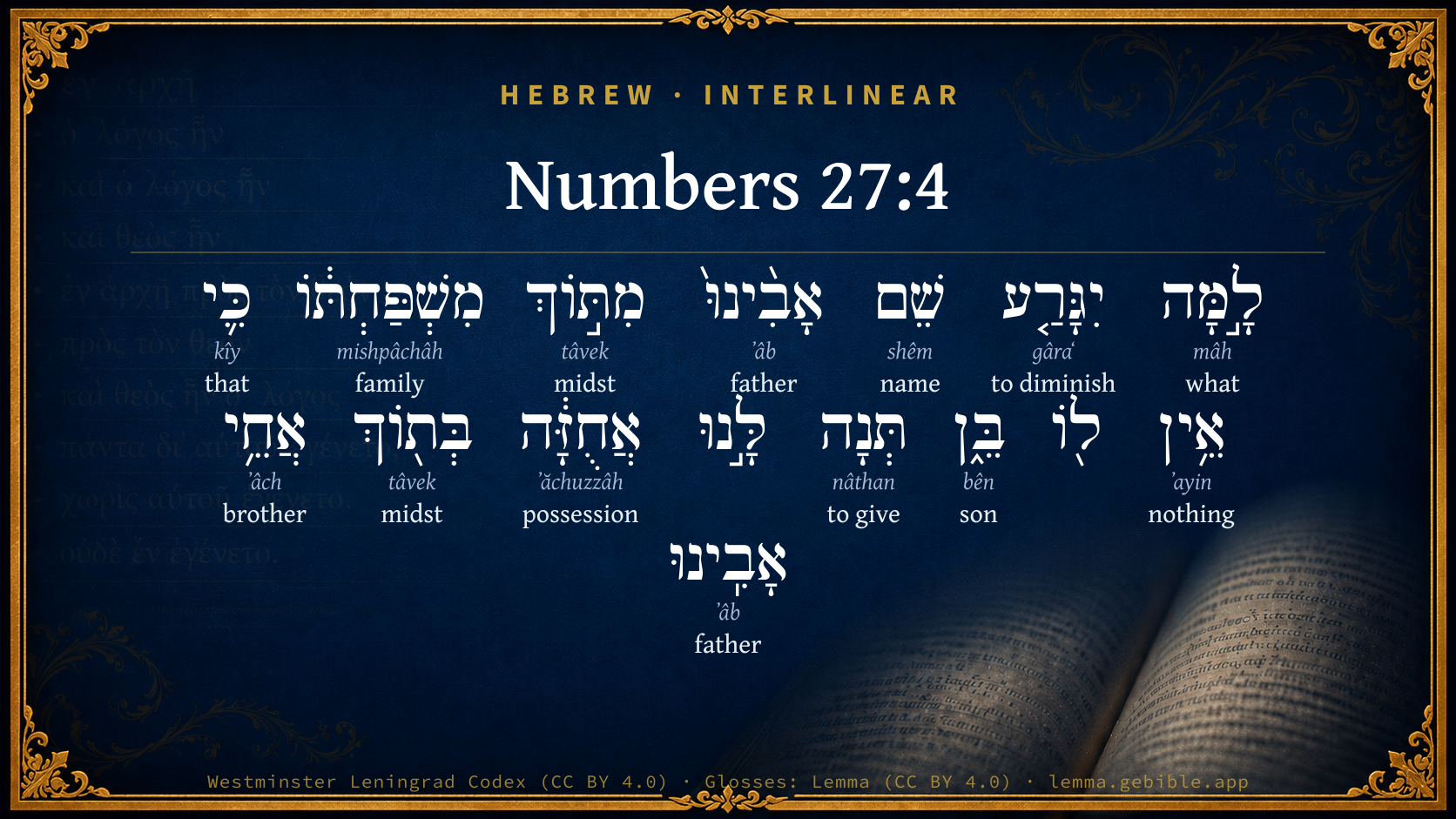
Hebrew (Westminster Leningrad Codex) Numbers 27:4 appears in the Hebrew Old Testament. The text above is from the Westminster Leningrad Codex. Each word links to its Strong’s number, a concise gloss, and parsing drawn from the Open Scriptures Hebrew Bible morphology. Click any word for its full Brown-Driver-Briggs (BDB) entry.
Download image
Cite this verse

Numbers 27:4 (World English Bible). Public Domain. Lemma interlinear Bible study tool, https://lemma.gebible.app/v/numbers/27/4.

Show BibTeX & RIS
BibTeX
RIS
English Translation
Why should the name of our father be taken away from among his family, because he had no son? Give to us a possession among the brothers of our father.
World English Bible · Public Domain
Download a study sheet

One document with this verse’s original text, its word-by-word gloss line, the meaning frame, cross-references with their text, attributed commentary, and full source and license credits — printable, and it pastes into notes with its structure intact.

This verse Autodidact and up

Study sheet (.html) Plain text (.txt)

A passage Seminary Student

Up to 50 verses in one chapter. A passage sheet keeps up to 6 commentary sources and 12 cross-references per verse, in the order this page ranks them, and says so on the sheet whenever that leaves anything out. Ask for a single verse and you get the Autodidact verse sheet above.

Everything on this page stays free to read, with no account — the sheet is a download of what is already on screen, not access to it.

Want to remove ads? Support Godless Engineer
Compare translations 3

The same verse in 3 English versions, stacked beneath the original-language interlinear above. Click any original word for its lexicon entry.

Each is an independent rendering of the whole verse — the interlinear is not word-aligned to these translations.

Highlighted words mark where these versions differ — a whole-verse word diff, not a word-by-word alignment.

  • World English Bible Public Domain
    Why should the name of our father be taken away from among his family, because he had no son? Give to us a possession among the brothers of our father.
  • King James Version Public Domain
    Why should the name of our father be done away from among his family, because he hath no son? Give unto us therefore a possession among the brethren of our father.
  • unfoldingWord Literal Text CC BY-SA 4.0
    Why should the name of our father be withdrawn from the midst of his clan because there is no son for him? Give to us a possession in the midst of the brothers of our father.”

unfoldingWord Literal Text — © unfoldingWord, licensed CC BY-SA 4.0. Word-aligned USFM3 via Door43 (git.door43.org/unfoldingWord/en_ult).

Versions to compare (up to 4)

3 of 4 selected

Show all 18 translations

Every available English version of this verse, each an independent rendering of the whole verse.

  • World English Bible Public Domain
    Why should the name of our father be taken away from among his family, because he had no son? Give to us a possession among the brothers of our father.
  • Berean Standard Bible Public Domain
    Why should the name of our father disappear from his clan because he had no sons? Give us property among our father’s brothers.”
  • Majority Standard Bible Public Domain
    Why should the name of our father disappear from his clan because he had no sons? Give us property among our father’s brothers.”
  • King James Version Public Domain
    Why should the name of our father be done away from among his family, because he hath no son? Give unto us therefore a possession among the brethren of our father.
  • American Standard Version (1901) Public Domain
    Why should the name of our father be taken away from among his family, because he had no son? Give unto us a possession among the brethren of our father.
  • Revised Version (1885) Public Domain
    Why should the name of our father be taken away from among his family, because he had no son? Give unto us a possession among the brethren of our father.
  • Geneva Bible (1599) Public Domain
    Wherefore should the name of our father be taken away from among his familie, because he hath no sonne? giue vs a possession among the brethren of our father.
  • Douay-Rheims (1899) Public Domain
    And Moses referred their cause to the judgment of the Lord.
  • Young's Literal Translation Public Domain
    why is the name of our father withdrawn from the midst of his family because he hath no son? give to us a possession in the midst of the brethren of our father;'
  • Literal Standard Version CC BY-SA 4.0
    why is the name of our father withdrawn from the midst of his family because he has no son? Give a possession to us in the midst of the brothers of our father”;
  • Unlocked Literal Bible CC BY-SA 4.0
    Why should our father's name be taken away from among his clan members because he had no son? Give us land among our father's relatives.”
  • unfoldingWord Literal Text CC BY-SA 4.0
    Why should the name of our father be withdrawn from the midst of his clan because there is no son for him? Give to us a possession in the midst of the brothers of our father.”
  • Darby Bible Public Domain
    Why should the name of our father be taken away from his family, because he has no son? Give unto us a possession among the brethren of our father.
  • World Messianic Bible Public Domain
    Why should the name of our father be taken away from among his family, because he had no son? Give to us a possession among the brothers of our father.”
  • Webster's Bible Public Domain
    Why should the name of our father be done away from among his family, because he hath no son? Give to us therefore a possession among the brethren of our father.
  • Free Bible Version CC BY-SA 4.0
    Why should our family name be lost simply because he didn't have a son? Give us land to own alongside our uncles.”
  • Bible in Basic English Public Domain
    Why is the name of our father to be taken away from among his family, because he had no son? Give us a heritage among our father's brothers.
  • JPS Tanakh (1917) Public Domain
    Why should the name of our father be done away from among his family, because he had no son? Give unto us a possession among the brethren of our father.'

Literal Standard Version (2020), Covenant Press — licensed CC BY-SA 4.0. Text via the HelloAO Bible API (eBible.org). Unlocked Literal Bible (unfoldingWord) — licensed CC BY-SA 4.0. Text via the HelloAO Bible API (eBible.org). unfoldingWord Literal Text — © unfoldingWord, licensed CC BY-SA 4.0. Word-aligned USFM3 via Door43 (git.door43.org/unfoldingWord/en_ult). Free Bible Version, Dr. Jonathan Gallagher — licensed CC BY-SA 4.0. Text via the HelloAO Bible API (eBible.org).

Word by word

More ways to search: Search by grammar → Find every occurrence → Compare this word →

Practice this passage: Drill this verse → Learn its vocabulary →

יִגָּרַ֤ע
gâraʻ
H1639
“to diminish”
Verb, Niphal, Imperfect, 3rd Person, Masculine, Singular
Part of Speech
Verb
Stem
Niphal
Form
Imperfect
Person
3rd Person
Gender
Masculine
Number
Singular
Full BDB Definition

Origin: a primitive root

TWOT: 384

to diminish, restrain, withdraw, abate, keep back, do away, take from, clip - (Qal) - to diminish - to restrain - to withdraw - (Niphal) - to be withdrawn - to be restrained - (Piel) to withdraw, draw up
  1. לָ֣מָּה mâh H4100 “to/for · what” Preposition + Particle, Interrogative
  2. שֵׁם shêm H8034 “name of” Noun, Common, Masculine, Singular, Construct
  3. אָבִ֨ינוּ֙ ʼâb H1 “father · our” Noun, Common, Masculine, Singular, Construct + Suffix, Personal, 1st Person, Common, Plural
  4. מִתּ֣וֹךְ tâvek H8432 “from · midst of” Preposition + Noun, Common, Masculine, Singular, Construct
  5. מִשְׁפַּחְתּ֔וֹ mishpâchâh H4940 “family · his” Noun, Common, Feminine, Singular, Construct + Suffix, Personal, 3rd Person, Masculine, Singular
  6. כִּ֛י kîy H3588 “that” Conjunction
  7. אֵ֥ין ʼayin H369 “nothing” Particle, Negative
  8. בֵּ֑ן bên H1121 “son” Noun, Common, Masculine, Singular, Absolute
  9. תְּנָה nâthan H5414 “give” Verb, Qal, Imperative, 2nd Person, Masculine, Singular + Suffix, h
  10. אֲחֻזָּ֔ה ʼăchuzzâh H272 “possession” Noun, Common, Feminine, Singular, Absolute
  11. בְּת֖וֹךְ tâvek H8432 “in/at · midst of” Preposition + Noun, Common, Masculine, Singular, Construct
  12. אֲחֵ֥י ʼâch H251 “brothers of” Noun, Common, Masculine, Plural, Construct
  13. אָבִֽינוּ ʼâb H1 “father · our” Noun, Common, Masculine, Singular, Construct + Suffix, Personal, 1st Person, Common, Plural

About this verse

These counts appear in no published source. They are computed here, from the morphology-tagged text and Lemma’s own curated glosses. What Lemma adds →

16
words
12
distinct lemmas
Pentateuch
section

Notable vocabulary

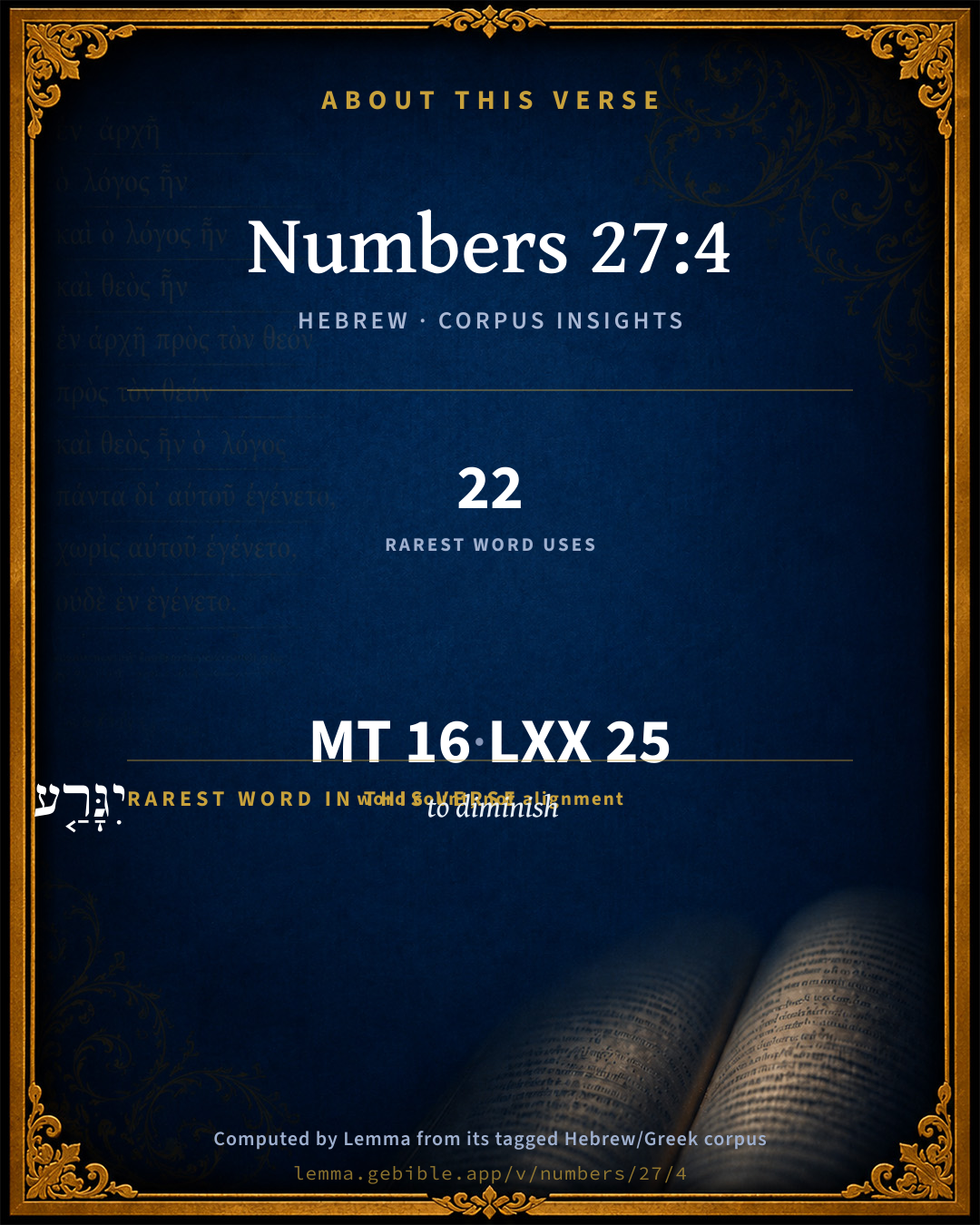
The rarest word here is יִגָּרַ֤ע to diminish H1639 — appearing just 22 times in the whole Hebrew Bible.

Shared distinctive vocabulary

יִגָּרַ֤ע to diminish H1639 occurs in 21 verses of the Hebrew Bible. Also found in:

Grammatical profile

  • 2 verbs
  • 9 nouns
  • 2 prepositions
  • 1 conjunction
  • 2 particles

Verb forms

  • יִגָּרַ֤ע Niphal · Imperfect
  • תְּנָה Qal · Imperative

Repetition

Words recur within this verse — often emphatic in Hebrew:

  • אָבִ֨ינוּ֙ father H1 ×2
  • מִתּ֣וֹךְ midst H8432 ×2

Hebrew & Septuagint length

In English translation the verse runs 30 words from the Hebrew and 8 from the Septuagint (LXX English) — the Septuagint runs noticeably shorter here. See the side-by-side →

A rough comparison of the two English renderings, which tokenize alike — not a word-level alignment.

Word counts can differ between the Hebrew and the Greek without any difference in meaning — e.g. the Hebrew direct-object marker אֵת has no separate Greek word, and Greek often adds the article ὁ.

In the original languages it is 16 Hebrew tokens and 25 Greek tokens — but the two are counted differently (Hebrew bundles its prefixes and suffixes into one token; the Greek is in lemma form), so that isn’t a like-for-like length.

Cross-references

4

Topical passages linked to Numbers 27:4 in the Treasury of Scripture Knowledge — connected by theme and wording, ordered by reader-vote popularity; previews shown in the World English Bible.

  • Joshua 17:4 They came near before Eleazar the priest, and before Joshua the son of Nun, and before the princes, saying, Yahweh commanded Moses to give us an inheritance among our brothers: therefore according to the commandment of Yahweh he gave them an inheritance among the brothers of their father.
  • Exodus 32:11 Moses begged Yahweh his God, and said, "Yahweh, why does your wrath burn hot against your people, that you have brought forth out of the land of Egypt with great power and with a mighty hand?
  • Psalms 109:13 Let his posterity be cut off. In the generation following let their name be blotted out.
  • Proverbs 13:9 The light of the righteous shines brightly, But the lamp of the wicked is snuffed out.

Cross-references courtesy of OpenBible.info (CC BY 4.0).

Hebrew and Greek witnesses Masoretic Hebrew ↔ Greek Septuagint

The same verse in the two great witnesses to the Old Testament, shown verse-for-verse.

Here the Septuagint runs noticeably shorter than the Hebrew — LXX2012 (modern English Septuagint) 8 words vs World English Bible 30. A rough length comparison of the two English translations, not a word-level alignment — read both below.

These are two independent witnesses, not word-aligned to each other, and the Septuagint is shown in lemma (dictionary) form.

Hebrew Numbers 27:4 Masoretic · Westminster Leningrad Codex

לָ֣מָּה יִגָּרַ֤ע שֵׁם אָבִ֨ינוּ֙ מִתּ֣וֹךְ מִשְׁפַּחְתּ֔וֹ כִּ֛י אֵ֥ין ל֖וֹ בֵּ֑ן תְּנָה לָּ֣נוּ אֲחֻזָּ֔ה בְּת֖וֹךְ אֲחֵ֥י אָבִֽינוּ

Why should the name of our father be taken away from among his family, because he had no son? Give to us a possession among the brothers of our father.

World English Bible · Public Domain

Greek LXX Numbers 27:4 Septuagint · lemma form

μή ἐκἀλείφω ὁ ὄνομα ὁ πατήρ ἐγώ ἐκ μέσος ὁ δῆμος αὐτός ὅτι οὐ εἰμί αὐτός υἱός δίδωμι ἐγώ κατάσχεσις ἐν μέσος ἀδελφός πατήρ ἐγώ

And Moses brought their case before the Lord.

LXX2012 (modern English Septuagint) · Public Domain

Hebrew: Westminster Leningrad Codex (CC BY 4.0). Greek: Septuagint (public domain); English from LXX2012 (modern English Septuagint) (Public Domain). How the Septuagint differs from the Hebrew →

Targum (Aramaic paraphrase)

2

The Targum is the ancient Jewish Aramaic paraphrase of the Hebrew Scriptures — an interpretive translation, not the Hebrew text itself. Onkelos (literal) and Pseudo-Jonathan (expansive) render the Torah, and Jonathan the Prophets. Coverage is partial: where no permissively-licensed English translation exists for a verse, only the Aramaic is shown. This is verse-level text, not a word-by-word alignment to the Hebrew.

  1. Targum Onkelos Torah (Genesis–Deuteronomy)
    לְמָא יִתְמְנַע שְׁמָא דַאֲבוּנָא מִגוֹ זַרְעִיתֵיהּ אֲרֵי לֵית לֵיהּ בָּר הַב לָנָא אַחֲסָנָא בְּגוֹ אֲחֵי אָבוּנָא

    (no public-domain English translation for this verse)

    Targum Onkelos — Aramaic: “Onkelos Genesis” (public domain); “Onkelos Exodus” (public domain); “Onkelos Leviticus” (public domain); “Onkelos Numbers” (public domain); “Onkelos Deuteronomy” (public domain). English: “Sefaria Community Translation” (CC0 1.0 (public-domain dedication)); “J.W. Etheridge. The Targums of Onkelos and Jonathan Ben Uzziel on the Pentateuch. London: Longmans, Green, 1862” (public domain). Text via Sefaria.

  2. Targum Pseudo-Jonathan Torah (Genesis–Deuteronomy)
    לְמָא יִתְמְנַע שׁוּם אָבוּנָא מִגוֹ גְנִיסְתֵּיהּ אֲרוּם לֵית לֵיהּ בִּיר דְכַר אִין לֵית אֲנַן חֲשִׁיבִין כְּבִיר וְאִימָן כְּנַטְרָא יָיבָם תִּסַב אִימָן חוֹלַק אָבוּנָן וְחוּלַק אָחָא דַאֲבוּנָן וְאִין אֲנַן חֲשִׁיבִין כְּבִיר הַב לָן אַחְסָנָא בְגוֹ אֲחֵי אָבוּנָן

    Why should the name of our father be taken away from among his family because he had not a male child? if we are not reckoned as a son, and our mother claim (or observe) the Jebam, our mother will take the portion of our father and of our father's brother. But if we be reckoned as a son, give us an inheritance among our father's brethren.

    Targum Pseudo-Jonathan — Aramaic: “Targum Jonathan on Genesis” (public domain); “Targum Jonathan on Exodus” (public domain); “Targum Jonathan on Leviticus” (public domain); “Targum Jonathan on Numbers” (public domain); “Targum Jonathan on Deuteronomy” (public domain). English: “The Targum of Jonathan ben Uzziel, trans. J. W. Etheridge, London, 1862” (public domain). Text via Sefaria.

Commentary

Notes on Numbers 27:4 from classic Christian and Jewish commentators (each source and its license shown beneath its notes). The classic Christian expositions comment on the surrounding passage and are grouped to its opening verse, so a note may address several verses; the Jewish commentaries on the Tanakh (Rashi and others) are per-verse, so they appear only where the commentator wrote on this verse.

Lemma curates 59 commentaries, every one of them public domain or Creative Commons licensed, each selected and text-cleaned for this edition rather than reprinted as found. About our sources →

Trapp's Complete Commentary

John Trapp

Num 27:4 Why should the name of our father be done away from among his family, because he hath no son? Give unto us [therefore] a possession among the brethren of our father.

Ver. 4. Give unto us, therefore, a possession.] This plea for a part in a land not yet conquered is a proof of their faith, and could not but encourage others. Such a masculine faith was that of Mrs. Anne Askew, martyr, who thus subscribed her confession: Written by me, Anne Askew, that neither wisheth for death, nor feareth his might; and as merry as one that is bound for heaven. {a} I will not bid you good night - said Helen Stirk, a Scotchwoman, to her husband, at the place where they both suffered martyrdom - for we shall suddenly meet in the heavenly Canaan. {b} And was it not by the force of her faith, - that "substance of things hoped for, the evidence of things not seen," {Heb 11:1} - that Crispina gaudebat, cum tenebatur, cum audiebatur, cum damnabatur, cum ducibatur. {c}

{a} Act. and Mon., fol. 1128.

{b} Ibid., 1154.

{c} Aug., in Psal. cxxxvi.

John Trapp, A Commentary or Exposition upon All the Books of the Old and New Testament (1647–1656) — public domain. Text from a community e-Sword module.

Joseph Benson's Commentary

Num 27:4. Be done away — As it will be, if it be not preserved by an inheritance given to us in his name and for his sake. Hence some gather, that the first son of each of these heiresses was called by their father’s name, by virtue of that law, (Deu 25:6,) by which the brother’s first son was to bear the name of his elder brother, whose widow he married. Give us a possession — In the land of Canaan, upon the division of it, which, though not yet conquered, they concluded would certainly be so, and thereby they gave glory to God.

Joseph Benson's Commentary on the Old and New Testaments (1811–1818) — public domain. Text from a community e-Sword module.

Jamieson, Fausset & Brown

Robert Jamieson, A. R. Fausset & David Brown

Give unto us a possession among the brethren of our father--Those young women perceived that the males only in families had been registered in the census. Because there were none in their household, their family was omitted. So they made known their grievance to Moses, and the authorities conjoined with him in administering justice. The case was important; and as the peculiarity of daughters being the sole members of a family would be no infrequent or uncommon occurrence, the law of inheritance, under divine authority, was extended not only to meet all similar cases, but other cases also--such as when there were no children left by the proprietor, and no brothers to succeed him. A distribution of the promised land was about to be made; and it is interesting to know the legal provision made in these comparatively rare cases for preserving a patrimony from being alienated to another tribe. (See on Num 36:5).

Jamieson, Fausset & Brown — Commentary Critical and Explanatory on the Whole Bible (1871) — public domain (CC PDM 1.0). Text via the HelloAO Bible API.

John Gill's Exposition

Why should the name of our father be done away from among his family, because he hath no son.... Or be withdrawn, and his family lose their part and share on that account; this they thought was unreasonable: according to the Targum of Jonathan, to prevent the name of their father being lost, and his part in the land, their motion was, that their mother might marry their father's brother, according to the law in Deu 25:5, with which Jarchi agrees; but it does not appear that that law was as yet in being; though how otherwise the name of their father would be preserved, than by raising up seed in that way, is not easy to say; except, as some think, it was done by a son of one of those heiresses, or by the first son of everyone of them, being called after the name of their grandfather Zelophehad, or their mother's grandfather Hepher; though the Jews (t) commonly by the "name" understand no other than the "inheritance", which seems to be confirmed by what follows:

give us therefore a possession among the brethren of our fathers; a part with their uncles, or their children; by which they express their faith that the children of Israel would inherit the land, though as yet it was not conquered, nor even entered into; and might signify, as some think, their concern to have a part and portion in the heavenly inheritance the land of Canaan was typical of; and if so, as Ainsworth observes, they may be considered as five wise virgins indeed.

(t) Pesikta, T. Bab. Jebamot, fol. 49. 1. Moses Cotzensis Praecept. Affirm. 51. Apud Selden. de Succession. ad leg. Ebra. c. 14. p. 97, 98.

John Gill's Exposition of the Whole Bible (1746–1763) — public domain (CC PDM 1.0). Text via the HelloAO Bible API.

Albert Barnes' Notes on the Bible

Give unto us - As representing our father; that so he, through us his representatives, may enjoy a like inheritance with his brethren.

Albert Barnes' Notes on the Bible (1834–1885) — public domain. Text from a community e-Sword/MySword module.

Haydock's Catholic Bible Commentary

Their. The first of these pronouns is written larger than usual, the second is improperly masculine in Hebrew; both, it is pretended, to honour the young women. (Kennicott)

George Leo Haydock (1774–1849), Haydock's Catholic Family Bible and Commentary, 1859 edition — public domain. Excludes Psalms (Douay-Rheims chapter numbering differs from Protestant) and Deuterocanonical books (Catholic canon only).

Matthew Poole's English Annotations

Be done away; as it will be, if it be not preserved by an inheritance given to us in his name and for his sake. Hence some gather that the first son of each of these heiresses was called by their father’s name, by virtue of that law, Deu 25:6, whereby the brother’s first son was to bear the name of his elder brother, whose widow he married.

A possession in the land of Canaan upon the division of it, which, though not yet conquered, they concluded would certainly be so, and thereby gave glory to God by believing.

Matthew Poole's English Annotations on the Holy Bible (1683–1685) — public domain. Text from a community e-Sword/MySword module.

Whedon's Commentary on the Bible

Daniel D. Whedon

4. The name of our father — Their father having died without male issue, and there being at that time no provision whereby female children could perpetuate his name, nor his name and property could be transmitted to the nearest male descendant, his name, with its family rights, would become blotted out.

Give unto us… a possession — This was to be transmitted to a son bearing the name of his mother’s father.

Daniel D. Whedon (gen. ed.), Commentary on the Old and New Testaments (1874–1909) — public domain. Text from a community e-Sword module.

The Pulpit Commentary

Give unto us...a possession among the brethren of our father. The daughters of Zelophehad did not ask for any share of what had been their father"s, but they asked that the lands which would have been assigned to their father in the settlement of Canaan might still be assigned to them, so that their father"s name might attach to those lands, and be handed down with them. The request assumes that the "brethren" of Zelophehad would receive an inheritance in the promised land, either personally or as represented by their sons; hence it seems clear that Zelophehad was not of the elder generation, which had forfeited all their rights and expectations in Canaan, but of the younger, to whom the inheritance was transferred. (Num_14:29-32) This is confirmed by the consideration that these women were not married until some time after this, (Num_36:11; cf. Jos_17:8, Jos_17:4) and must, therefore, according to the almost invariable custom, have been quite young at this time. It is reasonable to suppose that the heads of separate families to whom the land was distributed would be at this time men of from forty-five to sixty years of age, comprising the elder half of the generation which grew up in the wilderness. Zelophehad would have been among these, but that he was cut off, perhaps in the plague of serpents, or in the plague of the Arboth Mesh, and left only unmarried girls to represent him.

The Pulpit Commentary (1880–1919), ed. H.D.M. Spence-Jones & Joseph S. Exell — public domain. Text from a community e-Sword module.

John Wesley's Explanatory Notes

Be done away - As it will be, if it be not preserved by an inheritance given to us in his name and for his sake. Hence some gather, that the first son of each of these heiresses was called by their father's name, by virtue of that law, Deut. xxv, 6, whereby the brother's first son was to bear the name of his elder brother, whose widow he married. Give us a possession - In the land of Canaan upon the division of it, which though not yet conquered, they concluded would certainly be so, and thereby gave glory to God.

John Wesley, Explanatory Notes Upon the Whole Bible (1754–1765) — public domain. Text via the GEBible commentary corpus.

unfoldingWord translationNotes

Door43 World Missions Community

Why should our father's name be taken away from among his clan members because he had no son?

At that time, only sons received land as an inheritance. The daughters use this question to suggest that they should receive the inheritance and continue the family clan. This can be written as a statement. AT: "You should not remove our father's name from the clan members just because he did not have a son." (See: Rhetorical Question)

Give us land among our father's relatives

This means that they are asking to inherit land near where their father's relatives are inheriting land. The meaning of this can be made clear. AT: "Give us land where our father's relatives live" (See: Assumed Knowledge and Implicit Information)

translationWords

clan

unfoldingWord translationNotes — © Distant Shores Media and the Door43 World Missions Community, licensed CC BY-SA 4.0. Source: git.door43.org/Door43/en_tn.

Rashi

Rabbi Shlomo Yitzchaki (Rashi)

למה יגרע שם אבינו WHY SHOULD THE NAME OF OUR FATHER BE DONE AWAY — We stand in the place of male children, and if you say that females are not regarded as issue in respect to inheritance, then our mother should marry her deceased husband’s brother (cf. Deuteronomy 25:5, 6) (Bava Batra 119b).

כי אין לו בן [WHY SHOULD OUR FATHER'S NAME BE DONE AWAY WITH] BECAUSE HE HATH NO SON — Thus it follows that if he had had a son they would have made no claim of any kind: this tells us that they were women of intelligence (Sifrei Bamidbar 133:4; cf. Bava Batra 119b).

Rashi on the Tanakh — English translations: “The Judaica Press complete Tanach with Rashi, translated by A. J. Rosenberg” (CC BY 4.0); “Pentateuch with Rashi's commentary by M. Rosenbaum and A.M. Silbermann, 1929-1934” (public domain); “The Metsudah Tanach series, Lakewood, N.J” (CC BY 4.0); and “The Book of Joshua, Metsudah Publications, 1997” (CC BY 4.0). Text via Sefaria.

Lesson kit

Teaching starters — assembled from the data on this page, not authored interpretation. Every prompt links to the verse data it draws on. Edit before teaching.

Numbers, in the Pentateuch, opens this verse with 16 words (12 distinct Hebrew lemmas). Its most distinctive word is gâraʻ (“to diminish”). The Greek Septuagint runs shorter here. A historical commentator’s framing appears above. Read the whole chapter for the surrounding context.

Discussion questions

  1. How does “to diminish” (gâraʻ) shape what this verse is saying?
  2. How does Exodus 5:8, which shares the word «to diminish», read alongside this verse?
  3. What does the repetition of “father” (2× in this one verse) do in this verse?
  4. The Septuagint runs shorter here than the Hebrew. What might account for the difference?
  5. These translations render this verse differently; the difference is in the English rendering, not the original. What questions does that raise?
  6. «יִגָּרַ֤ע» is a Niphal Imperfect verb. How does that grammatical form shape the action described?
  7. Compare how Trapp's Complete Commentary and Joseph Benson's Commentary read this verse. Where do they agree or differ?

Things to notice

Reading settings

Reading text

Shown beneath each verse's original-language words.

Old Testament
Old Testament edition

Read the OT as the Masoretic Hebrew (MT) or the Greek Septuagint (LXX).

English shown for the Greek Septuagint (in the Hebrew ↔ Greek comparison).

Comparing translations? Open the Compare panel on any verse page to stack up to four side by side.