
Numbers 11:6

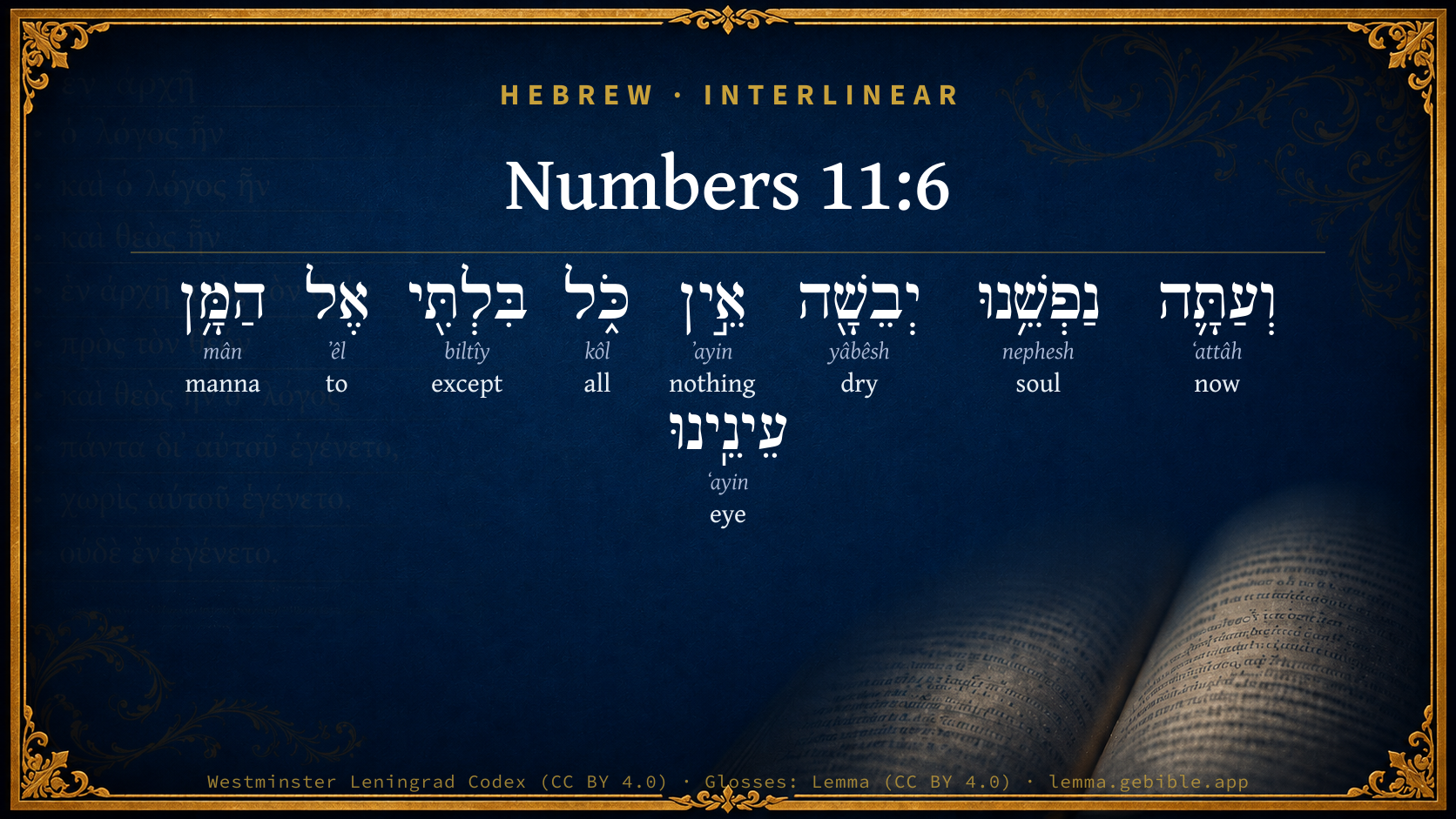
Hebrew (Westminster Leningrad Codex) Numbers 11:6 appears in the Hebrew Old Testament. The text above is from the Westminster Leningrad Codex. Each word links to its Strong’s number, a concise gloss, and parsing drawn from the Open Scriptures Hebrew Bible morphology. Click any word for its full Brown-Driver-Briggs (BDB) entry.
Download image
Cite this verse

Numbers 11:6 (World English Bible). Public Domain. Lemma interlinear Bible study tool, https://lemma.gebible.app/v/numbers/11/6.

Show BibTeX & RIS
BibTeX
RIS
English Translation
but now our soul is dried away; there is nothing at all save this manna to look on.
World English Bible · Public Domain
Download a study sheet

One document with this verse’s original text, its word-by-word gloss line, the meaning frame, cross-references with their text, attributed commentary, and full source and license credits — printable, and it pastes into notes with its structure intact.

This verse Autodidact and up

Study sheet (.html) Plain text (.txt)

A passage Seminary Student

Up to 50 verses in one chapter. A passage sheet keeps up to 6 commentary sources and 12 cross-references per verse, in the order this page ranks them, and says so on the sheet whenever that leaves anything out. Ask for a single verse and you get the Autodidact verse sheet above.

Everything on this page stays free to read, with no account — the sheet is a download of what is already on screen, not access to it.

Want to remove ads? Support Godless Engineer
Compare translations 3

The same verse in 3 English versions, stacked beneath the original-language interlinear above. Click any original word for its lexicon entry.

Each is an independent rendering of the whole verse — the interlinear is not word-aligned to these translations.

Highlighted words mark where these versions differ — a whole-verse word diff, not a word-by-word alignment.

  • World English Bible Public Domain
    but now our soul is dried away; there is nothing at all save this manna to look on.
  • King James Version Public Domain
    But now our soul is dried away: there is nothing at all, beside this manna, before our eyes.
  • unfoldingWord Literal Text CC BY-SA 4.0
    And now our life dry; there is not anything except for the manna our eyes.”

unfoldingWord Literal Text — © unfoldingWord, licensed CC BY-SA 4.0. Word-aligned USFM3 via Door43 (git.door43.org/unfoldingWord/en_ult).

Versions to compare (up to 4)

3 of 4 selected

Show all 18 translations

Every available English version of this verse, each an independent rendering of the whole verse.

  • World English Bible Public Domain
    but now our soul is dried away; there is nothing at all save this manna to look on.
  • Berean Standard Bible Public Domain
    But now our appetite is gone; there is nothing to see but this manna!”
  • Majority Standard Bible Public Domain
    But now our appetite is gone; there is nothing to see but this manna!”
  • King James Version Public Domain
    But now our soul is dried away: there is nothing at all, beside this manna, before our eyes.
  • American Standard Version (1901) Public Domain
    but now our soul is dried away; there is nothing at all save this manna to look upon.
  • Revised Version (1885) Public Domain
    but now our soul is dried away; there is nothing at all: we have nought save this manna to look to.
  • Geneva Bible (1599) Public Domain
    But now our soule is dryed away, we can see nothing but this Man.
  • Douay-Rheims (1899) Public Domain
    Our soul is dry, our eyes behold nothing else but manna.
  • Young's Literal Translation Public Domain
    and now our soul `is' dry, there is not anything, save the manna, before our eyes.'
  • Literal Standard Version CC BY-SA 4.0
    and now our soul [is] dry, there is not anything, except the manna, before our eyes.”
  • Unlocked Literal Bible CC BY-SA 4.0
    Now our appetite is gone, because all we can see is this manna.”
  • unfoldingWord Literal Text CC BY-SA 4.0
    And now our life dry; there is not anything except for the manna our eyes.”
  • Darby Bible Public Domain
    and now our soul is dried up: there is nothing at all but the manna before our eyes.
  • World Messianic Bible Public Domain
    but now we have lost our appetite. There is nothing at all except this manna to look at.”
  • Webster's Bible Public Domain
    But now our soul is dried away; there is nothing at all, besides this manna, before our eyes.
  • Free Bible Version CC BY-SA 4.0
    We're fading away here! The only thing we ever see is this manna!”
  • Bible in Basic English Public Domain
    But now our soul is wasted away; there is nothing at all: we have nothing but this manna before our eyes.
  • JPS Tanakh (1917) Public Domain
    but now our soul is dried away; there is nothing at all; we have nought save this manna to look to.' —

Literal Standard Version (2020), Covenant Press — licensed CC BY-SA 4.0. Text via the HelloAO Bible API (eBible.org). Unlocked Literal Bible (unfoldingWord) — licensed CC BY-SA 4.0. Text via the HelloAO Bible API (eBible.org). unfoldingWord Literal Text — © unfoldingWord, licensed CC BY-SA 4.0. Word-aligned USFM3 via Door43 (git.door43.org/unfoldingWord/en_ult). Free Bible Version, Dr. Jonathan Gallagher — licensed CC BY-SA 4.0. Text via the HelloAO Bible API (eBible.org).

Word by word

More ways to search: Search by grammar → Find every occurrence → Compare this word →

Practice this passage: Drill this verse → Learn its vocabulary →

About this verse

These counts appear in no published source. They are computed here, from the morphology-tagged text and Lemma’s own curated glosses. What Lemma adds →

9
words
9
distinct lemmas
Pentateuch
section

Notable vocabulary

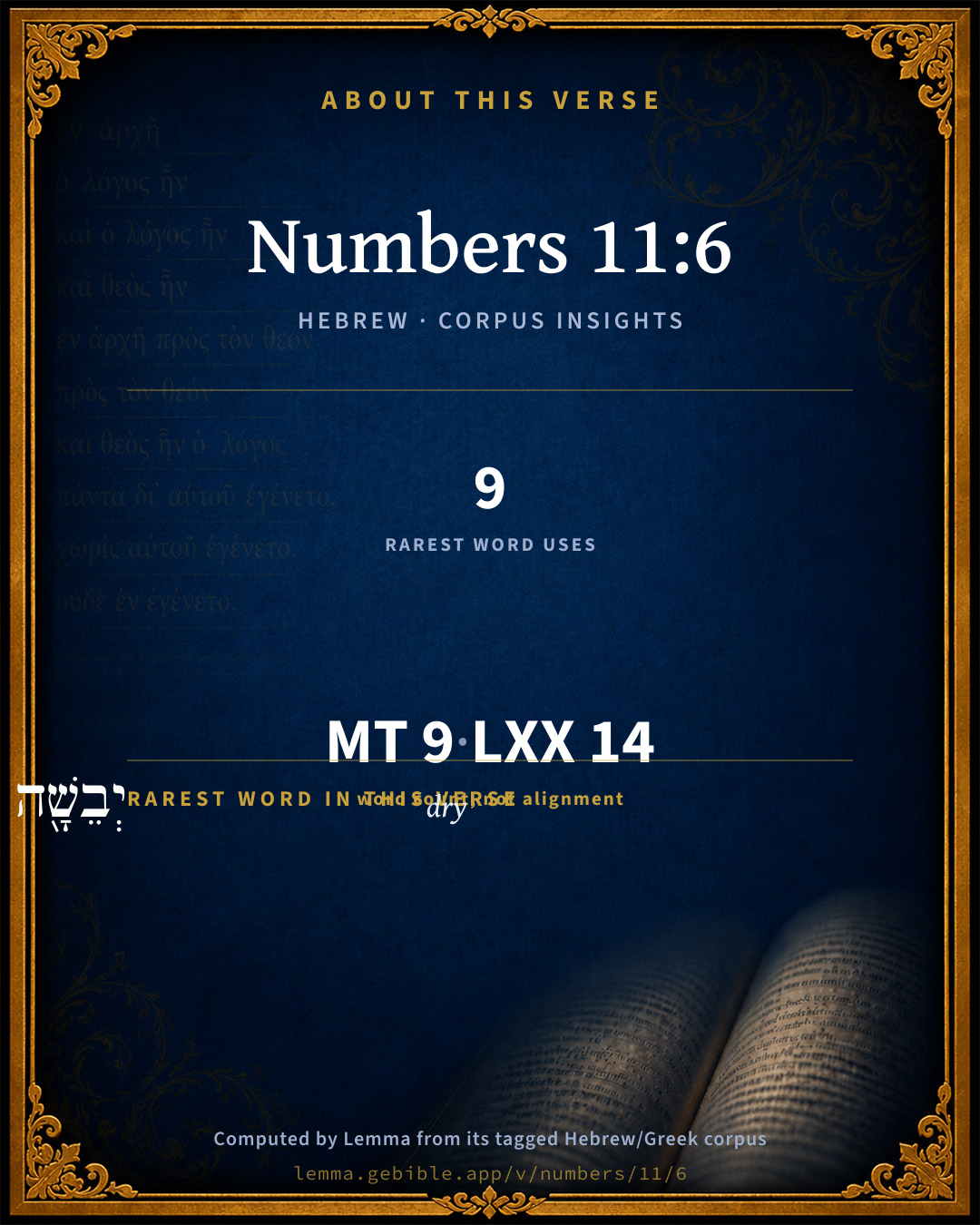
The rarest word here is יְבֵשָׁ֖ה dry H3002 — appearing just 9 times in the whole Hebrew Bible.

Shared distinctive vocabulary

יְבֵשָׁ֖ה dry H3002 occurs in 9 verses of the Hebrew Bible. Also found in:

Grammatical profile

  • 4 nouns
  • 1 adjective
  • 1 preposition
  • 1 conjunction
  • 1 adverb
  • 1 particle

Hebrew & Septuagint length

In English translation the verse runs 18 words from the Hebrew and 16 from the Septuagint (LXX English) — closely comparable.

A rough comparison of the two English renderings, which tokenize alike — not a word-level alignment.

Word counts can differ between the Hebrew and the Greek without any difference in meaning — e.g. the Hebrew direct-object marker אֵת has no separate Greek word, and Greek often adds the article ὁ.

In the original languages it is 9 Hebrew tokens and 14 Greek tokens — but the two are counted differently (Hebrew bundles its prefixes and suffixes into one token; the Greek is in lemma form), so that isn’t a like-for-like length.

Cross-references

2

Topical passages linked to Numbers 11:6 in the Treasury of Scripture Knowledge — connected by theme and wording, ordered by reader-vote popularity; previews shown in the World English Bible.

  • Numbers 21:5 The people spoke against God, and against Moses, Why have you brought us up out of Egypt to die in the wilderness? for there is no bread, and there is no water; and our soul loathes this light bread.
  • 2 Samuel 13:4 He said to him, Why, son of the king, are you thus lean from day to day? Won't you tell me? Amnon said to him, I love Tamar, my brother Absalom's sister.

Cross-references courtesy of OpenBible.info (CC BY 4.0).

Hebrew and Greek witnesses Masoretic Hebrew ↔ Greek Septuagint

The same verse in the two great witnesses to the Old Testament, shown verse-for-verse.

These are two independent witnesses, not word-aligned to each other, and the Septuagint is shown in lemma (dictionary) form.

Hebrew Numbers 11:6 Masoretic · Westminster Leningrad Codex

וְעַתָּ֛ה נַפְשֵׁ֥נוּ יְבֵשָׁ֖ה אֵ֣ין כֹּ֑ל בִּלְתִּ֖י אֶל הַמָּ֥ן עֵינֵֽינוּ

but now our soul is dried away; there is nothing at all save this manna to look on.

World English Bible · Public Domain

Greek LXX Numbers 11:6 Septuagint · lemma form

νυνί δέ ὁ ψυχή ἐγώ κατάξηρος οὐδείς πλήν εἰς ὁ μαννα ὁ ὀφθαλμός ἐγώ

But now our soul is dried up; our eyes turn to nothing but to the manna.

LXX2012 (modern English Septuagint) · Public Domain

Hebrew: Westminster Leningrad Codex (CC BY 4.0). Greek: Septuagint (public domain); English from LXX2012 (modern English Septuagint) (Public Domain). How the Septuagint differs from the Hebrew →

Targum (Aramaic paraphrase)

2

The Targum is the ancient Jewish Aramaic paraphrase of the Hebrew Scriptures — an interpretive translation, not the Hebrew text itself. Onkelos (literal) and Pseudo-Jonathan (expansive) render the Torah, and Jonathan the Prophets. Coverage is partial: where no permissively-licensed English translation exists for a verse, only the Aramaic is shown. This is verse-level text, not a word-by-word alignment to the Hebrew.

  1. Targum Onkelos Torah (Genesis–Deuteronomy)
    וּכְעַן נַפְשָׁנָא תְאִיבָא לֵית כָּל מִדָעַם אֶלָהֵן לְמַנָא עֵינָנָא

    (no public-domain English translation for this verse)

    Targum Onkelos — Aramaic: “Onkelos Genesis” (public domain); “Onkelos Exodus” (public domain); “Onkelos Leviticus” (public domain); “Onkelos Numbers” (public domain); “Onkelos Deuteronomy” (public domain). English: “Sefaria Community Translation” (CC0 1.0 (public-domain dedication)); “J.W. Etheridge. The Targums of Onkelos and Jonathan Ben Uzziel on the Pentateuch. London: Longmans, Green, 1862” (public domain). Text via Sefaria.

  2. Targum Pseudo-Jonathan Torah (Genesis–Deuteronomy)
    וּכְדוֹן נַפְשָׁנָא מְנַגְבָא לֵית כָּל מִדַעַם אֱלָהֵן לְמַנָא אֲנַן מִסְתַּכְיָין כְּמִסְכַּן דְמוֹדִיק מְגִיסָא מִיָדַיָא

    But now our life is dried up; there is not anything; we see only the manna, as the pauper who looks upon a morsel (bestowed) by the hands.

    Targum Pseudo-Jonathan — Aramaic: “Targum Jonathan on Genesis” (public domain); “Targum Jonathan on Exodus” (public domain); “Targum Jonathan on Leviticus” (public domain); “Targum Jonathan on Numbers” (public domain); “Targum Jonathan on Deuteronomy” (public domain). English: “The Targum of Jonathan ben Uzziel, trans. J. W. Etheridge, London, 1862” (public domain). Text via Sefaria.

Commentary

Notes on Numbers 11:6 from classic Christian and Jewish commentators (each source and its license shown beneath its notes). The classic Christian expositions comment on the surrounding passage and are grouped to its opening verse, so a note may address several verses; the Jewish commentaries on the Tanakh (Rashi and others) are per-verse, so they appear only where the commentator wrote on this verse.

Lemma curates 59 commentaries, every one of them public domain or Creative Commons licensed, each selected and text-cleaned for this edition rather than reprinted as found. About our sources →

Trapp's Complete Commentary

John Trapp

Num 11:6 But now our soul [is] dried away: [there is] nothing at all, beside this manna, [before] our eyes.

Ver. 6. There is nothing at all besides.] The wheat of heaven was held a light meat, because lightly come by; Cito parta vilescunt. How are many queasy stomachs even nauseated with the bread of life! it makes not to their dainty palates; plain preaching is disrelished.

John Trapp, A Commentary or Exposition upon All the Books of the Old and New Testament (1647–1656) — public domain. Text from a community e-Sword module.

Tyndale Open Study Notes

Tyndale Open Resources

11:6 The Lord had earlier provided manna and quail (Exod 16).

Tyndale Open Study Notes — © Tyndale Open Resources, licensed CC BY-SA 4.0. Text via the HelloAO Bible API.

Geneva Bible (1599)

Geneva Bible translators

For the greedy lust of flesh.

Geneva Bible (1599) marginal notes — public domain. Text via Bolls.life.

Jamieson, Fausset & Brown

Robert Jamieson, A. R. Fausset & David Brown

But now . . . there is nothing . . . beside this manna--Daily familiarity had disgusted them with the sight and taste of the monotonous food; and, ungrateful for the heavenly gift, they longed for a change of fare. It may be noticed that the resemblance of the manna to coriander seed was not in the color, but in the size and figure; and from its comparison to bdellium, which is either a drop of white gum or a white pearl, we are enabled to form a better idea of it. Moreover, it is evident, from the process of baking into cakes, that it could not have been the natural manna of the Arabian desert, for that is too gummy or unctuous to admit of being ground into meal. In taste it is said to have been like "wafers made with honey" (Exo 16:31), and here to have the taste of fresh oil. The discrepancy in these statements is only apparent; for in the latter the manna is described in its raw state; in the former, after it was ground and baked. The minute description given here of its nature and use was designed to show the great sinfulness of the people, in being dissatisfied with such excellent food, furnished so plentifully and gratuitously.

Jamieson, Fausset & Brown — Commentary Critical and Explanatory on the Whole Bible (1871) — public domain (CC PDM 1.0). Text via the HelloAO Bible API.

Ellicott's Commentary for English Readers

(6) There is nothing at all . . . —Better, there is nothing, except that our eyes (look) upon, the manna.

A Bible Commentary for English Readers, edited by Charles John Ellicott (1878–1897) — public domain. Text from a community e-Sword module.

The Cambridge Bible for Schools and Colleges

gen. ed. J. J. S. Perowne

6. this manna] No account has been given in this chapter of the sending of the manna; and it is possible that the writer means to describe not a miraculous food from heaven but a natural phenomenon of the district. Different substances which have been suggested, such as a gum from the tamarisk or târfâ tree, oak honey, or an edible lichen, are described in art. ‘Manna’ in DB. and EBib. If the numbers of the people were really 600,000 (Num_11:21), the only miraculous feature in the present case would be the enormous supply required for them. But their numbers were, in all probability, much smaller (see on Num_1:46). When the time of D was reached, the manna had come to be considered a mysterious unknown food (Deu_8:3; Deu_8:16), and the same idea is seen in P (Exodus 16), who relates (Num_11:33 f.) that a pot containing one omer of it was laid up in front of the ark in the Holy of Holies (cf. Heb_9:4, Rev_2:17). The manna as a type of the spiritual ‘Bread that came down from heaven’ forms the subject of our Lord’s discourse to the Jews in Joh_6:30-35; Joh_6:41-58.

The Cambridge Bible for Schools and Colleges (gen. ed. J. J. S. Perowne; Cambridge University Press, 1878–1918) — public domain. Text from a community e-Sword module.

John Gill's Exposition

But now our soul is dried away,.... Meaning their bodies, which, for want of flesh food, they pretended had no moisture in them, or they were half starved, and in wasting and consuming circumstances:

there is nothing at all besides this manna before our eyes; which in itself was a truth and matter of fact; they had nothing to look to, and live upon but the manna, and that was enough, and with which, no doubt, many of them were contented, and satisfied and thankful for it, though the greater part were not; and therefore this, though a truth, was foolishly and wickedly spoken, being said in disdain and contempt of the manna: so Christ, the heavenly manna, the antitype of this, of which See Gill on Exo 16:14; See Gill on Exo 16:15; See Gill on Exo 16:16; See Gill on Exo 16:17; See Gill on Exo 16:18; is indeed the only food that is set before us in the Gospel to feed and live upon; nor is there anything at all besides him, nor do true believers in him desire any other, but pray that evermore this bread may be given them; but carnal men and carnal professors slight the Gospel feast, of which Christ is the sum and substance; and at least would have something besides him, something along with him, something of their own in justification for him, or to give them a right unto him, or to trust in along with him; they cannot bear to have nothing at all but Christ; or that he, and he alone, should be exalted, and be all in all, as he is justification and salvation, and in the Gospel provision, in which nothing is set before us but him.

John Gill's Exposition of the Whole Bible (1746–1763) — public domain (CC PDM 1.0). Text via the HelloAO Bible API.

Haydock's Catholic Bible Commentary

Dry, like people quite worn out for want of food. (Psalm ci. 5, 12; Lamentations iv. 8.) --- Nothing. An exaggeration. We are disgusted with this light food. (Calmet) --- They wished not only for the taste, but also for the colour, of other meats. (Menochius) --- How often do we imitate their folly, when we are disgusted with the bread of life! (Haydock)

George Leo Haydock (1774–1849), Haydock's Catholic Family Bible and Commentary, 1859 edition — public domain. Excludes Psalms (Douay-Rheims chapter numbering differs from Protestant) and Deuterocanonical books (Catholic canon only).

Matthew Poole's English Annotations

Our soul; either,

1. Our life, as the soul signifies, Gen 9:5; Psa 33:19; Job 36:14; or,

2. Our body, which is oft signified by the soul, as Psa 16:10; Psa 35:12; 105:18. So Lev 19:28; 21:1; Num 5:2.

Is dried away; is withered, and pines away; which possibly might be true through envy and discontent, and inordinate appetite, as 2Sa 13:4; Pro 14:30.

Before our eyes;

Heb. our eyes see or look to nothing but this manna. They speak as if the manna were only useful to please their eyes with its fine colour and shape, but not to satisfy their appetites, or sustain their natures.

Matthew Poole's English Annotations on the Holy Bible (1683–1685) — public domain. Text from a community e-Sword/MySword module.

Whedon's Commentary on the Bible

Daniel D. Whedon

6. Our soul is dried away — Our animal life faints for want of strong and refreshing food. Such a use of the term soul is still common in the East, where, hungry or thirsty, the people say, “Our soul is withered.”

Nothing at all, besides this manna — The skilful reader will not fail, by correct intonation, to bring out the contempt here poured upon the bread of heaven, which prefigures our Lord Jesus according to his own words in Joh_6:32-33, and to St. Paul’s in 1Co_10:3. We know of nothing in the conduct of these Israelites that more strikingly exhibits their low moral character than this complaint. The animal appetites have completely subverted their intellectual and spiritual tastes, if they ever had any, and they here exhibit a disgusting sensuality. The carnal mind to-day treats the glorious Antitype with no more respect than these sensual Israelites treated the type. Sin is the same in all ages.

Daniel D. Whedon (gen. ed.), Commentary on the Old and New Testaments (1874–1909) — public domain. Text from a community e-Sword module.

The Pulpit Commentary

Our soul is dried away. This exaggerated statement expressed their craving for the juicy and savoury food of which they had been thinking, and which was obviously unattainable in the wilderness. There is a physical craving in man for variety of diet, and especially for such condiments and flavours as he has been used to all his life, which makes the lack of them a real hardship. It is not necessary to condemn the Israelites for feeling very keenly the loss of their accustomed food, which is notoriously the one thing which the poorest classes are least able to bear; it is only necessary to condemn them for making this one loss of more account than all their gain. There is nothing at all, beside this manna, before our eyes. Rather, "we have nothing (lKo yae) except that our eye (falls) upon this manna." These graphic words speak of the longing looks which turned in every direction after the accustomed dainties, only to fall with disgust upon the inevitable manna. It was very ungrateful of them to speak disparagingly of the manna, which was good and wholesome food, and sufficient to keep them in health and strength; but it is useless to deny that manna only for people who had been accustomed to a rich and varied diet must have been exceedingly trying both to the palate and the stomach. (cf. Num_21:5)

The Pulpit Commentary (1880–1919), ed. H.D.M. Spence-Jones & Joseph S. Exell — public domain. Text from a community e-Sword module.

John Wesley's Explanatory Notes

Our soul - Either our life, as the soul signifies, Gen. ix, 5, or our body, which is often signified by the soul. Dried away - Is withered and pines away; which possibly might be true, through envy and discontent, and inordinate appetite.

John Wesley, Explanatory Notes Upon the Whole Bible (1754–1765) — public domain. Text via the GEBible commentary corpus.

Scofield Reference Notes

C. I. Scofield

manna

(See Scofield "Exo 16:35").

The Scofield Reference Bible (1917 edition), notes by C. I. Scofield — public domain. Text from a community e-Sword module.

Rashi

Rabbi Shlomo Yitzchaki (Rashi)

אל המן עינינו OUR EYES ARE ON THIS MANNA (i. e. we see nothing but this manna) — “manna in the morning, manna in the evening!” (Sifrei Bamidbar 87)

Rashi on the Tanakh — English translations: “The Judaica Press complete Tanach with Rashi, translated by A. J. Rosenberg” (CC BY 4.0); “Pentateuch with Rashi's commentary by M. Rosenbaum and A.M. Silbermann, 1929-1934” (public domain); “The Metsudah Tanach series, Lakewood, N.J” (CC BY 4.0); and “The Book of Joshua, Metsudah Publications, 1997” (CC BY 4.0). Text via Sefaria.

Ramban (Nachmanides)

Rabbi Moshe ben Nachman (Ramban / Nachmanides)

BUT NOW OUR SOUL IS DRIED AWAY. This means that because of their many desires their temperaments had become heated and then dried up, as Onkelos translates it [“but now our soul is lusting”]. Or it may be that [they meant that] our soul is dried away because there is nothing with which to moisten it, since food produces [essential] liquids in the body which satisfy the soul. And they said, we have nought save this manna ‘to look to,’ meaning that even the food [i.e., the manna] on which we live is not in our possession so that our soul can be nourished and satisfied with it; but we desire it and look to it [i.e., we are dependent upon it] at all times, in anticipation that it will come to us; thus we have nothing at all save our hope for the manna. They thus gave expression to the known proverb: “One cannot compare a person who has bread in his basket with one who does not have bread in his basket.”, Verse 20), they were therefore in constant worry for their next day’s food. Therefore Scripture tells how many qualities the manna had, stating that its taste was as the taste of a cake baked with oil, thus declaring that the souls of those who ate it did not dry up, for it [the manna] supplied the body with the [essential] liquids and kept it satisfied, and the souls of those who ate it were like a watered garden and like a spring of water.

Ramban (Nachmanides) on the Tanakh — English translation: “Commentary on the Torah by Ramban (Nachmanides). Translated and annotated by Charles B. Chavel. New York, Shilo Pub. House, 1971-1976” (CC BY 4.0). Text via Sefaria.

Lesson kit

Teaching starters — assembled from the data on this page, not authored interpretation. Every prompt links to the verse data it draws on. Edit before teaching.

Numbers, in the Pentateuch, opens this verse with 9 words (9 distinct Hebrew lemmas). Its most distinctive word is yâbêsh (“dry”). A historical commentator’s framing appears above. Read the whole chapter for the surrounding context.

Discussion questions

  1. The word yâbêsh carries the sense “dry.” How does it shape the verse?
  2. Numbers 6:3 shares the word «dry» with this verse. How do the two illuminate each other?
  3. These translations render this verse differently. What is at stake in choosing one wording over another?
  4. Reading how Trapp's Complete Commentary and Tyndale Open Study Notes read this verse, where do the two commentators agree and where do they part?

Things to notice

Reading settings

Reading text

Shown beneath each verse's original-language words.

Old Testament
Old Testament edition

Read the OT as the Masoretic Hebrew (MT) or the Greek Septuagint (LXX).

English shown for the Greek Septuagint (in the Hebrew ↔ Greek comparison).

Comparing translations? Open the Compare panel on any verse page to stack up to four side by side.