
Genesis 41:8

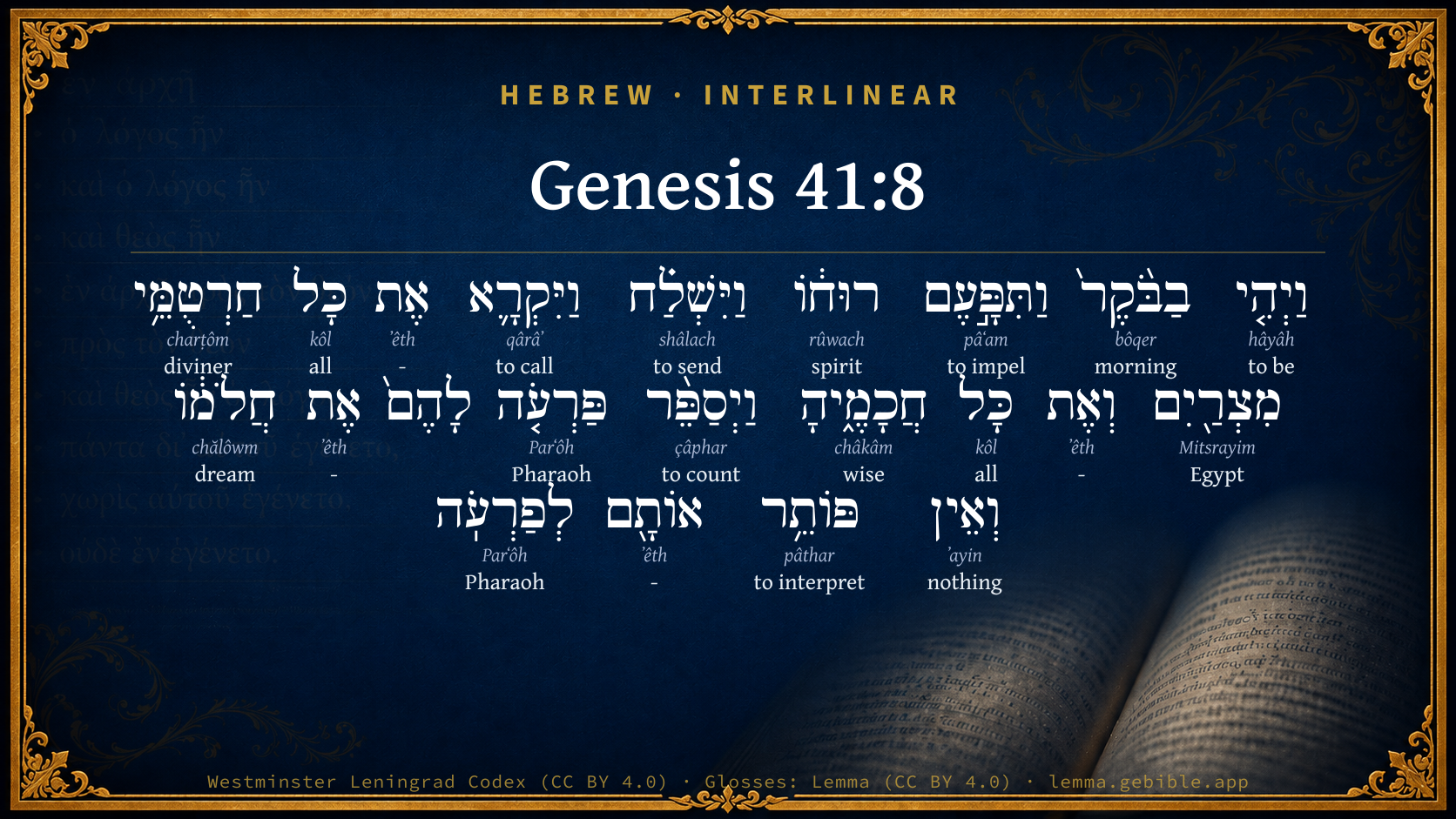
Hebrew (Westminster Leningrad Codex) Genesis 41:8 appears in the Hebrew Old Testament. The text above is from the Westminster Leningrad Codex. Each word links to its Strong’s number, a concise gloss, and parsing drawn from the Open Scriptures Hebrew Bible morphology. Click any word for its full Brown-Driver-Briggs (BDB) entry.
Download image
Cite this verse

Genesis 41:8 (World English Bible). Public Domain. Lemma interlinear Bible study tool, https://lemma.gebible.app/v/genesis/41/8.

Show BibTeX & RIS
BibTeX
RIS
English Translation
It happened in the morning that his spirit was troubled, and he sent and called for all the magicians of Egypt, and all the wise men of it. Pharaoh told them his dream, but there was no one who could interpret them to Pharaoh.
World English Bible · Public Domain
Highlights
  • 3 first appearances in the Hebrew Bible
Full analysis ↓
Download a study sheet

One document with this verse’s original text, its word-by-word gloss line, the meaning frame, cross-references with their text, attributed commentary, and full source and license credits — printable, and it pastes into notes with its structure intact.

This verse Autodidact and up

Study sheet (.html) Plain text (.txt)

A passage Seminary Student

Up to 50 verses in one chapter. A passage sheet keeps up to 6 commentary sources and 12 cross-references per verse, in the order this page ranks them, and says so on the sheet whenever that leaves anything out. Ask for a single verse and you get the Autodidact verse sheet above.

Everything on this page stays free to read, with no account — the sheet is a download of what is already on screen, not access to it.

Want to remove ads? Support Godless Engineer
Compare translations 3

The same verse in 3 English versions, stacked beneath the original-language interlinear above. Click any original word for its lexicon entry.

Each is an independent rendering of the whole verse — the interlinear is not word-aligned to these translations.

Highlighted words mark where these versions differ — a whole-verse word diff, not a word-by-word alignment.

  • World English Bible Public Domain
    It happened in the morning that his spirit was troubled, and he sent and called for all the magicians of Egypt, and all the wise men of it. Pharaoh told them his dream, but there was no one who could interpret them to Pharaoh.
  • King James Version Public Domain
    And it came to pass in the morning that his spirit was troubled; and he sent and called for all the magicians of Egypt, and all the wise men thereof: and Pharaoh told them his dream; but there was none that could interpret them unto Pharaoh.
  • unfoldingWord Literal Text CC BY-SA 4.0
    And it happened in the morning that his spirit was agitated, so he sent and called for all the magicians of Egypt and all its wise men. Then Pharaoh told his dreams to them, but no one could interpret them for Pharaoh.

unfoldingWord Literal Text — © unfoldingWord, licensed CC BY-SA 4.0. Word-aligned USFM3 via Door43 (git.door43.org/unfoldingWord/en_ult).

Versions to compare (up to 4)

3 of 4 selected

Show all 17 translations

Every available English version of this verse, each an independent rendering of the whole verse.

  • World English Bible Public Domain
    It happened in the morning that his spirit was troubled, and he sent and called for all the magicians of Egypt, and all the wise men of it. Pharaoh told them his dream, but there was no one who could interpret them to Pharaoh.
  • Berean Standard Bible Public Domain
    In the morning his spirit was troubled, so he summoned all the magicians and wise men of Egypt. Pharaoh told them his dreams, but no one could interpret them for him.
  • Majority Standard Bible Public Domain
    In the morning his spirit was troubled, so he summoned all the magicians and wise men of Egypt. Pharaoh told them his dreams, but no one could interpret them for him.
  • King James Version Public Domain
    And it came to pass in the morning that his spirit was troubled; and he sent and called for all the magicians of Egypt, and all the wise men thereof: and Pharaoh told them his dream; but there was none that could interpret them unto Pharaoh.
  • American Standard Version (1901) Public Domain
    And it came to pass in the morning that his spirit was troubled; and he sent and called for all the magicians of Egypt, and all the wise men thereof: and Pharaoh told them his dream; but there was none that could interpret them unto Pharaoh.
  • Revised Version (1885) Public Domain
    And it came to pass in the morning that his spirit was troubled; and he sent and called for all the magicians of Egypt, and all the wise men thereof: and Pharaoh told them his dream; but there was none that could interpret them unto Pharaoh.
  • Geneva Bible (1599) Public Domain
    Nowe when the morning came, his spirit was troubled: therefore he sent and called all the soothsayers of Egypt, and all the wise men thereof, and Pharaoh tolde them his dreames: but none coulde interprete them to Pharaoh.
  • Young's Literal Translation Public Domain
    And it cometh to pass in the morning, that his spirit is moved, and he sendeth and calleth all the scribes of Egypt, and all its wise men, and Pharaoh recounteth to them his dream, and there is no interpreter of them to Pharaoh.
  • Literal Standard Version CC BY-SA 4.0
    And it comes to pass in the morning, that his spirit is moved, and he sends and calls all the enchanters of Egypt, and all its wise men, and Pharaoh recounts to them his dream, and there is no interpreter of them to Pharaoh.
  • Unlocked Literal Bible CC BY-SA 4.0
    It came about in the morning that his spirit was troubled. He sent and called for all the magicians and wise men of Egypt. Pharaoh told them his dreams, but there was no one who could interpret them to Pharaoh.
  • unfoldingWord Literal Text CC BY-SA 4.0
    And it happened in the morning that his spirit was agitated, so he sent and called for all the magicians of Egypt and all its wise men. Then Pharaoh told his dreams to them, but no one could interpret them for Pharaoh.
  • Darby Bible Public Domain
    And it came to pass in the morning, that his spirit was troubled; and he sent and called for all the scribes of Egypt, and all the sages who were therein, and Pharaoh told them his dream; but [there was] none to interpret them to Pharaoh.
  • World Messianic Bible Public Domain
    In the morning, his spirit was troubled, and he sent and called for all of Egypt’s magicians and wise men. Pharaoh told them his dreams, but there was no one who could interpret them to Pharaoh.
  • Webster's Bible Public Domain
    And it came to pass in the morning, that his spirit was troubled; and he sent and called for all the magicians of Egypt, and all the wise men thereof: and Pharaoh told them his dream; but there was none that could interpret them to Pharaoh.
  • Free Bible Version CC BY-SA 4.0
    The next morning Pharaoh was worried by his dreams, so he sent for all the magicians and wise men in Egypt. Pharaoh told them about his dreams, but no one could interpret their meaning for him.
  • Bible in Basic English Public Domain
    And in the morning his spirit was troubled; and he sent for all the wise men of Egypt and all the holy men, and put his dream before them, but no one was able to give him the sense of it.
  • JPS Tanakh (1917) Public Domain
    And it came to pass in the morning that his spirit was troubled; and he sent and called for all the magicians of Egypt, and all the wise men thereof; and Pharaoh told them his dream; but there was none that could interpret them unto Pharaoh.

Literal Standard Version (2020), Covenant Press — licensed CC BY-SA 4.0. Text via the HelloAO Bible API (eBible.org). Unlocked Literal Bible (unfoldingWord) — licensed CC BY-SA 4.0. Text via the HelloAO Bible API (eBible.org). unfoldingWord Literal Text — © unfoldingWord, licensed CC BY-SA 4.0. Word-aligned USFM3 via Door43 (git.door43.org/unfoldingWord/en_ult). Free Bible Version, Dr. Jonathan Gallagher — licensed CC BY-SA 4.0. Text via the HelloAO Bible API (eBible.org).

Word by word

More ways to search: Search by grammar → Find every occurrence → Compare this word →

Practice this passage: Drill this verse → Learn its vocabulary →

וַתִּפָּ֣עֶם
pâʻam
H6470
“and · to impel”
Conjunction + Verb, Niphal, Sequential Imperfect, 3rd Person, Feminine, Singular
Part of Speech
Conjunction + Verb
Stem
Niphal
Form
Sequential Imperfect
Person
3rd Person
Gender
Feminine
Number
Singular
Full BDB Definition

Origin: a primitive root

TWOT: 1793

to thrust, impel, push, beat persistently - (Qal) to impel - (Niphal) to be beaten, be disturbed - (Hithpael) to be disturbed
  1. וַיְהִ֤י hâyâh H1961 “and · to be” Conjunction + Verb, Qal, Sequential Imperfect, 3rd Person, Masculine, Singular
  2. בַבֹּ֨קֶר֙ bôqer H1242 “in/at the · morning” Preposition, Determined + Noun, Common, Masculine, Singular, Absolute
  3. רוּח֔וֹ rûwach H7307 “spirit · his” Noun, Common, Both, Singular, Construct + Suffix, Personal, 3rd Person, Masculine, Singular
  4. וַיִּשְׁלַ֗ח shâlach H7971 “and · to send” Conjunction + Verb, Qal, Sequential Imperfect, 3rd Person, Masculine, Singular
  5. וַיִּקְרָ֛א qârâʼ H7121 “and · to call” Conjunction + Verb, Qal, Sequential Imperfect, 3rd Person, Masculine, Singular
  6. אֶת ʼêth H853 “-” Particle, Direct Object
  7. כָּל kôl H3605 “all of” Noun, Common, Masculine, Singular, Construct
  8. חַרְטֻמֵּ֥י charṭôm H2748 “diviners of” Noun, Common, Masculine, Plural, Construct
  9. מִצְרַ֖יִם Mitsrayim H4714 “Egypt” Noun, Proper
  10. וְאֶת ʼêth H853 “and · -” Conjunction + Particle, Direct Object
  11. כָּל kôl H3605 “all of” Noun, Common, Masculine, Singular, Construct
  12. חֲכָמֶ֑יהָ châkâm H2450 “wise · her” Adjective, Adjective, Masculine, Plural, Construct + Suffix, Personal, 3rd Person, Feminine, Singular
  13. וַיְסַפֵּ֨ר çâphar H5608 “and · to count” Conjunction + Verb, Piel, Sequential Imperfect, 3rd Person, Masculine, Singular
  14. פַּרְעֹ֤ה Parʻôh H6547 “Pharaoh” Noun, Proper
  15. אֶת ʼêth H853 “-” Particle, Direct Object
  16. חֲלֹמ֔וֹ chălôwm H2472 “dream · his” Noun, Common, Masculine, Singular, Construct + Suffix, Personal, 3rd Person, Masculine, Singular
  17. וְאֵין ʼayin H369 “and · nothing” Conjunction + Particle, Negative
  18. פּוֹתֵ֥ר pâthar H6622 “interpreting” Verb, Qal, Participle Active, Masculine, Singular, Absolute
  19. אוֹתָ֖ם ʼêth H853 “- · them” Particle, Direct Object + Suffix, Personal, 3rd Person, Masculine, Plural
  20. לְפַרְעֹֽה Parʻôh H6547 “to/for · Pharaoh” Preposition + Noun, Proper

About this verse

These counts appear in no published source. They are computed here, from the morphology-tagged text and Lemma’s own curated glosses. What Lemma adds →

22
words
16
distinct lemmas
Pentateuch
section

Notable vocabulary

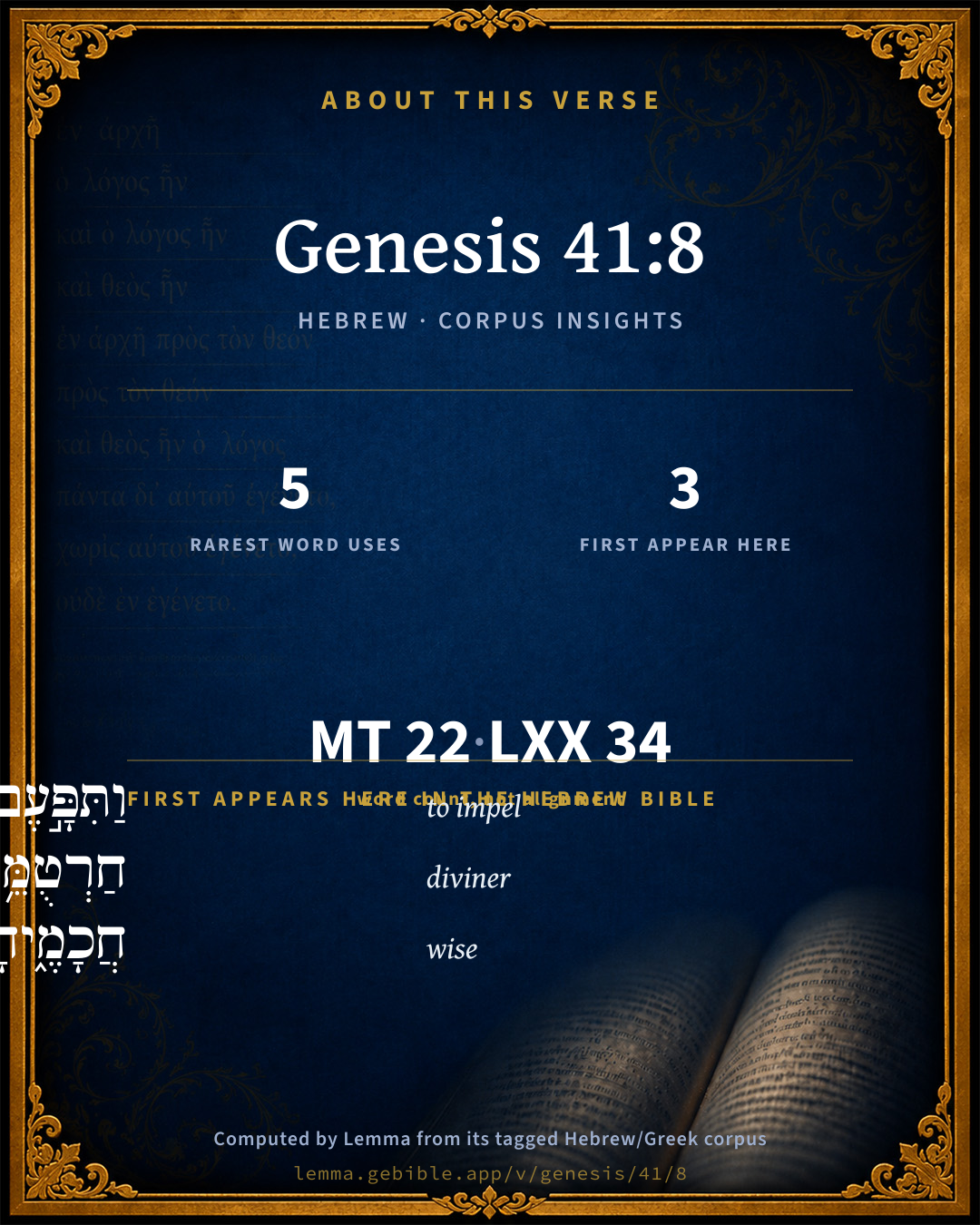
The rarest word here is וַתִּפָּ֣עֶם to impel H6470 — appearing just 5 times in the whole Hebrew Bible.

First appearance in Scripture

These words make their first canonical appearance in the Hebrew Bible here:

  • וַתִּפָּ֣עֶם to impel H6470
  • חַרְטֻמֵּ֥י diviner H2748
  • חֲכָמֶ֑יהָ wise H2450

Shared distinctive vocabulary

וַתִּפָּ֣עֶם to impel H6470 occurs in 5 verses of the Hebrew Bible. Also found in:

Grammatical profile

  • 6 verbs
  • 9 nouns
  • 1 adjective
  • 1 preposition
  • 5 particles

Verb forms

  • וַיְהִ֤י Qal · Sequential Imperfect
  • וַתִּפָּ֣עֶם Niphal · Sequential Imperfect
  • וַיִּשְׁלַ֗ח Qal · Sequential Imperfect
  • וַיִּקְרָ֛א Qal · Sequential Imperfect
  • וַיְסַפֵּ֨ר Piel · Sequential Imperfect
  • פּוֹתֵ֥ר Qal · Participle Active

Repetition

Words recur within this verse — often emphatic in Hebrew:

  • כָּל all H3605 ×2
  • פַּרְעֹ֤ה Pharaoh H6547 ×2

Hebrew & Septuagint length

In English translation the verse runs 44 words from the Hebrew and 41 from the Septuagint (LXX English) — closely comparable.

A rough comparison of the two English renderings, which tokenize alike — not a word-level alignment.

Word counts can differ between the Hebrew and the Greek without any difference in meaning — e.g. the Hebrew direct-object marker אֵת has no separate Greek word, and Greek often adds the article ὁ.

In the original languages it is 22 Hebrew tokens and 34 Greek tokens — but the two are counted differently (Hebrew bundles its prefixes and suffixes into one token; the Greek is in lemma form), so that isn’t a like-for-like length.

Cross-references

32

Topical passages linked to Genesis 41:8 in the Treasury of Scripture Knowledge — connected by theme and wording, ordered by reader-vote popularity; previews shown in the World English Bible.

  • Daniel 4:7 Then came in the magicians, the enchanters, the Chaldeans, and the soothsayers; and I told the dream before them; but they did not make known to me the interpretation of it.
  • Exodus 7:22 The magicians of Egypt did in like manner with their enchantments; and Pharaoh's heart was hardened, and he didn't listen to them; as Yahweh had spoken.
  • Exodus 7:11 Then Pharaoh also called for the wise men and the sorcerers. They also, the magicians of Egypt, did in like manner with their enchantments.
  • Isaiah 29:14 therefore, behold, I will proceed to do a marvelous work among this people, even a marvelous work and a wonder; and the wisdom of their wise men shall perish, and the understanding of their prudent men shall be hid.
  • Daniel 1:20 In every matter of wisdom and understanding, concerning which the king inquired of them, he found them ten times better than all the magicians and enchanters who were in all his realm.
  • Daniel 4:5 I saw a dream which made me afraid; and the thoughts on my bed and the visions of my head troubled me.
  • Matthew 2:1 Now when Jesus was born in Bethlehem of Judea in the days of Herod the king, behold, wise men from the east came to Jerusalem, saying,
  • Genesis 40:6 Joseph came in to them in the morning, and saw them, and saw that they were sad.
  • Genesis 40:8 They said to him, "We have dreamed a dream, and there is no one who can interpret it." Joseph said to them, "Don't interpretations belong to God? Please tell it to me."
  • Exodus 8:7 The magicians did in like manner with their enchantments, and brought up frogs on the land of Egypt.
  • Leviticus 19:31 "'Don't turn to those who are mediums, nor to the wizards. Don't seek them out, to be defiled by them. I am Yahweh your God.
  • Isaiah 8:19 When they shall tell you, "Consult with those who have familiar spirits and with the wizards, who chirp and who mutter:" shouldn't a people consult with their God? on behalf of the living [should they consult] with the dead?
  • Daniel 4:19 Then Daniel, whose name was Belteshazzar, was stricken mute for a while, and his thoughts troubled him. The king answered, Belteshazzar, don't let the dream, or the interpretation, trouble you. Belteshazzar answered, My lord, the dream be to those who hate you, and the interpretation of it to your adversaries.
  • Exodus 8:18–19 The magicians tried with their enchantments to bring forth lice, but they couldn't. There were lice on man, and on animal.
  • Exodus 9:11 The magicians couldn't stand before Moses because of the boils; for the boils were on the magicians, and on all the Egyptians.
  • Leviticus 20:6 "'The person that turns to those who are mediums, and to the wizards, to play the prostitute after them, I will even set my face against that person, and will cut him off from among his people.
  • Deuteronomy 18:9–14 When you are come into the land which Yahweh your God gives you, you shall not learn to do after the abominations of those nations.
  • Job 5:12–13 He frustrates the devices of the crafty, So that their hands can't perform their enterprise.
  • Psalms 25:14 The friendship of Yahweh is with those who fear him. He will show them his covenant.
  • Isaiah 19:3 The spirit of Egypt shall fail in the midst of it; and I will destroy the counsel of it: and they shall seek to the idols, and to the charmers, and to those who have familiar spirits, and to the wizards.
  • Isaiah 19:11–13 The princes of Zoan are utterly foolish; the counsel of the wisest counselors of Pharaoh is become brutish: how do you say to Pharaoh, I am the son of the wise, the son of ancient kings?
  • Isaiah 47:12–13 Stand now with your enchantments, and with the multitude of your sorceries, in which you have labored from your youth; if so be you shall be able to profit, if so be you may prevail.
  • Daniel 2:1–11 In the second year of the reign of Nebuchadnezzar, Nebuchadnezzar dreamed dreams; and his spirit was troubled, and his sleep went from him.
  • Daniel 2:27–28 Daniel answered before the king, and said, The secret which the king has demanded can neither wise men, enchanters, magicians, nor soothsayers, show to the king;
  • Daniel 5:6–8 Then the king's face was changed in him, and his thoughts troubled him; and the joints of his loins were loosened, and his knees struck one against another.
  • Daniel 5:11 There is a man in your kingdom, in whom is the spirit of the holy gods; and in the days of your father light and understanding and wisdom, like the wisdom of the gods, were found in him; and the king Nebuchadnezzar your father, the king, [I say], your father, made him master of the magicians, enchanters, Chaldeans, and soothsayers;
  • Daniel 7:28 Here is the end of the matter. As for me, Daniel, my thoughts much troubled me, and my face was changed in me: but I kept the matter in my heart.
  • Daniel 8:27 I, Daniel, fainted, and was sick certain days; then I rose up, and did the king's business: and I wondered at the vision, but none understood it.
  • Habakkuk 3:16 I heard, and my body trembled. My lips quivered at the voice. Rottenness enters into my bones, and I tremble in my place, Because I must wait quietly for the day of trouble, For the coming up of the people who invade us.
  • Acts 17:18 Some of the Epicurean and Stoic philosophers also were conversing with him. Some said, "What does this babbler want to say?" Others said, "He seems to be advocating foreign deities," because he preached Jesus and the resurrection.
  • 1 Corinthians 1:19 For it is written, "I will destroy the wisdom of the wise, I will bring the discernment of the discerning to nothing."
  • 1 Corinthians 3:18–20 Let no one deceive himself. If anyone thinks that he is wise among you in this world, let him become a fool, that he may become wise.

Cross-references courtesy of OpenBible.info (CC BY 4.0).

Hebrew and Greek witnesses Masoretic Hebrew ↔ Greek Septuagint

The same verse in the two great witnesses to the Old Testament, shown verse-for-verse.

These are two independent witnesses, not word-aligned to each other, and the Septuagint is shown in lemma (dictionary) form.

Hebrew Genesis 41:8 Masoretic · Westminster Leningrad Codex

וַיְהִ֤י בַבֹּ֨קֶר֙ וַתִּפָּ֣עֶם רוּח֔וֹ וַיִּשְׁלַ֗ח וַיִּקְרָ֛א אֶת כָּל חַרְטֻמֵּ֥י מִצְרַ֖יִם וְאֶת כָּל חֲכָמֶ֑יהָ וַיְסַפֵּ֨ר פַּרְעֹ֤ה לָהֶם֙ אֶת חֲלֹמ֔וֹ וְאֵין פּוֹתֵ֥ר אוֹתָ֖ם לְפַרְעֹֽה

It happened in the morning that his spirit was troubled, and he sent and called for all the magicians of Egypt, and all the wise men of it. Pharaoh told them his dream, but there was no one who could interpret them to Pharaoh.

World English Bible · Public Domain

Greek LXX Genesis 41:8 Septuagint · lemma form

γίγνομαι δέ πρωΐ καί ταράσσω ὁ ψυχή αὐτός καί ἀποστέλλω καλέω πᾶς ὁ ἐξηγητής αἴγυπτος καί πᾶς ὁ σοφός αὐτός καί διαἡγέομαι αὐτός φαραώ ὁ ἐνύπνιον καί οὐ εἰμί ὁ ἀποἀγγέλλω αὐτός ὁ φαραώ

And it was morning, and his soul was troubled; and he sent and called all the interpreters of Egypt, and all her wise men; and Pharao related to them his dream, and there was no one to interpret it to Pharao.

LXX2012 (modern English Septuagint) · Public Domain

On this verse, The Cambridge Bible for Schools and Colleges discusses the Septuagint’s reading. Read the note in Commentary ↓

Hebrew: Westminster Leningrad Codex (CC BY 4.0). Greek: Septuagint (public domain); English from LXX2012 (modern English Septuagint) (Public Domain). How the Septuagint differs from the Hebrew →

Targum (Aramaic paraphrase)

2

The Targum is the ancient Jewish Aramaic paraphrase of the Hebrew Scriptures — an interpretive translation, not the Hebrew text itself. Onkelos (literal) and Pseudo-Jonathan (expansive) render the Torah, and Jonathan the Prophets. Coverage is partial: where no permissively-licensed English translation exists for a verse, only the Aramaic is shown. This is verse-level text, not a word-by-word alignment to the Hebrew.

  1. Targum Onkelos Torah (Genesis–Deuteronomy)
    וַהֲוָה בְצַפְרָא וּמִטַּרְפָּא רוּחֵהּ וּשְׁלַח וּקְרָא יָת כָּל חֳרָשֵׁי מִצְרַיִם וְיָת כָּל חַכִּימָהָא וְאִשְׁתָּעִי פַרְעֹה לְהוֹן יָת חֶלְמֵהּ וְלֵית דְּפָשַׁר יָתְהוֹן לְפַרְעֹה

    (no public-domain English translation for this verse)

    Targum Onkelos — Aramaic: “Onkelos Genesis” (public domain); “Onkelos Exodus” (public domain); “Onkelos Leviticus” (public domain); “Onkelos Numbers” (public domain); “Onkelos Deuteronomy” (public domain). English: “Sefaria Community Translation” (CC0 1.0 (public-domain dedication)); “J.W. Etheridge. The Targums of Onkelos and Jonathan Ben Uzziel on the Pentateuch. London: Longmans, Green, 1862” (public domain). Text via Sefaria.

  2. Targum Pseudo-Jonathan Torah (Genesis–Deuteronomy)
    וַהֲוָה בְּצַפְרָא וּמְטַרְפָא רוּחֵיהּ וְשָׁדַר וּקְרָא יַת כָּל חַרְשֵׁי מִצְרָאֵי וְיַת כָּל חַכִּימָהָא וְאִישְׁתָּעֵי פַּרְעה לְהוֹם יַת חֶלְמַיָא וְלָא הֲוָה אֶפְשַׁר לִגְבַר דִי יִפְשַׁר יָתֵיהּ אֲרוּם מִן קֳדָם יְיָ אִסְתַּקֵף מִן בִּגְלַל דִי מָטָא זִמְנֵיהּ דְיוֹסֵף לְמִיפַּק מִן בֵּית אֲסִירֵי

    And in the morning his spirit was troubled, and he sent and called all the magicians of Mizraim and all the wise men; and Pharoh told them the dreams; but no man was able to interpret it; for it was occasioned by the Lord, because the time had come that Joseph should come forth from the house of the bound.

    Targum Pseudo-Jonathan — Aramaic: “Targum Jonathan on Genesis” (public domain); “Targum Jonathan on Exodus” (public domain); “Targum Jonathan on Leviticus” (public domain); “Targum Jonathan on Numbers” (public domain); “Targum Jonathan on Deuteronomy” (public domain). English: “The Targum of Jonathan ben Uzziel, trans. J. W. Etheridge, London, 1862” (public domain). Text via Sefaria.

Commentary

Notes on Genesis 41:8 from classic Christian and Jewish commentators (each source and its license shown beneath its notes). The classic Christian expositions comment on the surrounding passage and are grouped to its opening verse, so a note may address several verses; the Jewish commentaries on the Tanakh (Rashi and others) are per-verse, so they appear only where the commentator wrote on this verse.

Lemma curates 59 commentaries, every one of them public domain or Creative Commons licensed, each selected and text-cleaned for this edition rather than reprinted as found. About our sources →

Trapp's Complete Commentary

John Trapp

Gen 41:8 And it came to pass in the morning that his spirit was troubled; and he sent and called for all the magicians of Egypt, and all the wise men thereof: and Pharaoh told them his dream; but [there was] none that could interpret them unto Pharaoh.

Ver. 8. All the magicians.] Or, Natural philosophers, that studied the secrets of nature, and could give a ready reason of everything. Magus is a Persian word, and hath affinity with the Hebrew פחנה, a contemplative person; συφος θεωρητικος: Such as was Aristotle among the heathens, and Augustine among Christians - the greatest and accuratest of men, after the apostles, in contemplation and argumentation, as many are of opinion. The Grecians were so delighted with his learned labours, that they have translated him wholly into their tongue. {a} As for the deep theorems of natural philosophy, they make one learned indeed, but seldom better, ofttimes worse, nearly atheists; as these wise men of Egypt, elsewhere called enchanters, wizards. {Exo 7:11} Of these were "Jannes and Jambres" that "resisted Moses"; {2Ti 3:8} learned they were, and lewd, as were those philosophers. {Rom 1:18-32}

But there was none that could interpret.] Because God had smitten them with a spirit of dizziness, and made the "wisdom of the wise to perish"; {Isa 29:14} for else, it had been easy for them to have seen plenty in the fat kine, and penury in the lean, &c. But God had reserved that honour to Joseph, as a step or stirrup to further preferment.

{a} Planudes eum transtulit anis aliquot ante Constantinopolim captum. Manl., loc. com., p. 684.

John Trapp, A Commentary or Exposition upon All the Books of the Old and New Testament (1647–1656) — public domain. Text from a community e-Sword module.

Joseph Benson's Commentary

Gen 41:8. His spirit was troubled — Because he was impressed with an idea that the dreams were supernatural, that something extraordinary was intended by them, and because he understood not their meaning, and dreaded the consequences. Compare Gen 40:6; Dan 2:1-3; and Mat 27:19. He called for the magicians, who professed to discover secret and future things, either by consulting the stars, or by other superstitious practices; but if they ever did any thing of that kind, no doubt it was by the help of evil spirits. The wise men, distinguished from these, were employed, it seems, in the study of nature, and, by their great sagacity, often made happy conjectures respecting abstruse and future things. On what principles they interpreted dreams, does not appear. In this instance, however, they were puzzled, and the rules of their art failed them. But this was intended to render Joseph’s interpretation of these dreams, by the Spirit of God, the more wonderful.

Joseph Benson's Commentary on the Old and New Testaments (1811–1818) — public domain. Text from a community e-Sword module.

Tyndale Open Study Notes

Tyndale Open Resources

41:8 The magicians and wise men belonged to a guild of supposed experts in spiritual matters, including dreams and visions (cp. Exod 8:18-19; Dan 2:10-11), but they could not interpret these dreams. God used an Israelite slave to confound the wisdom of the world (cp. Dan 2). However powerful a nation becomes, it is still under God’s sovereign control (Dan 2:20-23).

Tyndale Open Study Notes — © Tyndale Open Resources, licensed CC BY-SA 4.0. Text via the HelloAO Bible API.

Geneva Bible (1599)

Geneva Bible translators

This fear was enough to teach him that this vision was sent of God.

The wise of the world understand not God’s secrets, but to his servants his will is revealed.

Geneva Bible (1599) marginal notes — public domain. Text via Bolls.life.

Jamieson, Fausset & Brown

Robert Jamieson, A. R. Fausset & David Brown

he called for all the magicians of Egypt--It is not possible to define the exact distinction between "magicians" and "wise men"; but they formed different branches of a numerous body, who laid claim to supernatural skill in occult arts and sciences, in revealing mysteries, explaining portents, and, above all, interpreting dreams. Long practice had rendered them expert in devising a plausible way of getting out of every difficulty and framing an answer suitable to the occasion. But the dreams of Pharaoh baffled their united skill. Unlike their Assyrian brethren (Dan 2:4), they did not pretend to know the meaning of the symbols contained in them, and the providence of God had determined that they should all be nonplussed in the exercise of their boasted powers, in order that the inspired wisdom of Joseph might appear the more remarkable.

Jamieson, Fausset & Brown — Commentary Critical and Explanatory on the Whole Bible (1871) — public domain (CC PDM 1.0). Text via the HelloAO Bible API.

Adam Clarke's Commentary

Verse 8. Called for all the magicians] חרטמים chartummim. The word here used may probably mean no more than interpreters of abstruse and difficult subjects; and especially of the Egyptian hieroglyphics, an art which is now entirely lost. It is most likely that the term is Egyptian, and consequently its etymology must remain unknown to us. If Hebrew, Mr. Parkhurst's definition may be as good as any: "חרט cheret, a pen or instrument to write or draw with, and תם tam, to perfect or accomplish; those who were perfect in drawing their sacred, astrological, and hieroglyphical figures or characters, and who, by means of them, pretended to extraordinary feats, among which was the interpretation of dreams. They seem to have been such persons as Josephus (Ant., lib. ii., c. 9, s. 2) calls Ἱερογραμματεις sacred scribes, or professors of sacred learning."

Wise men] חכמיה chacameyha, the persons who, according to Porphyry, "addicted themselves to the worship of God and the study of wisdom, passing their whole life in the contemplation of Divine things. Contemplation of the stars, self-purification, arithmetic, and geometry, and singing hymns in honour of their gods, was their continual employment." - See Dodd. It was probably among these that Pythagoras conversed, and from whom he borrowed that modest name by which he wished his countrymen to distinguish him, viz., φιλοσοφος, a philosopher, simply, a lover of wisdom.

Adam Clarke's Commentary on the Bible (1810–1826) — public domain. Text from a community e-Sword/MySword module.

John Calvin's Commentaries

8. In the morning his spirit was troubled. A sting was left in Pharaoh’s heart, that he might know that he had to deal with God; for this anxiety was as an inward seal of the Spirit of God, to give authenticity to the dream; although Pharaoh deserved to be deprived of the advantage of this revelation, when he resorted to magicians and soothsayers, who were wont to turn the truth of God into a lie. He was convinced by a secret impulse that the dream sent by God portended something important; but he seeks out imposters, who would darken, by their fallacies, the light which was divinely kindled; and it is the folly of the human mind to gather to itself leaders and teachers of error. No doubt he believed them to be true prophets; but because he voluntarily closes his eyes, and hastens into the snare, his false opinion forms no sufficient excuse for him; otherwise men, by merely shutting their eyes, might have some plausible pretext for mocking God with impunity: and we see that many seek protection for themselves in that gross ignorance in which they knowingly and purposely involve themselves. Pharaoh, therefore, as far as he was able, deprived himself of the benefit of the prophecy, by seeking for magicians as the interpreters of it. So we see it daily happens that many lose hold of the truth, because they either bring a cloud over themselves by their own indolence, or too eagerly catch at false and spurious inventions. But because the Lord would, at that time, succor the kingdom of Egypt, he drew Pharaoh back, as by main force, from his error.

There was none that could interpret. By this remedy God provided that the dream should not fail. We know what an inflated and impudent race of men these soothsayers were, and how extravagantly they boasted. How did it then happen that they gave the king no answer, seeing they might have trifled in any way whatever with a credulous man, who willingly suffered himself to be deluded? Therefore, that he might desist from inquiry, he is not allowed to find what he had expected in his magicians: and the Lord so strikes dumb the wicked workers of deceit, that they cannot even find a specious explanation of the dreams. Moreover, by this method, the anxiety of the king is sharpened; because he considers that what has escaped the sagacity of the magicians must be something very serious and secret. By which example we are taught, that the Lord provides the best for us, when he removes the incitements of error from those of us who with to be deceived; and we must regard it as a singular favor, when either false prophets are silenced, or their fatuity is, in any manner, discovered to us. As for the rest, the king might hence easily gather how frivolous and nugatory was the profession of wisdom, in which the Egyptians gloried above all others; for they boasted that they were possessed of the science of divination which ascended above the very heavens. But now, as far as they are concerned, the king is without counsel, and, being disappointed of his hope, is filled with anguish; nevertheless he does not so awake as to shake off his superstition. Thus we see that men, though admonished, remain still in their torpor. Whence we plainly perceive how inexcusable is the obstinacy of the world, which does not desist from following those delusions which are openly condemned as foolishness, from heaven.

John Calvin's Commentaries (1540-1563) — public domain. Text from the Calvin Translation Society English edition (1840s-50s) via the Christian Classics Ethereal Library (ccel.org). Calvin's coverage is partial (roughly two-thirds of the Bible); uncommented books and verses are honest gaps, never fabricated. The 19th-century editor's footnotes and remarks are omitted so the notes are faithfully Calvin's own voice.

Ellicott's Commentary for English Readers

(8) Magicians.—The word used here probably means the “sacred scribes,” who were skilled in writing and reading hieroglyphics. But in ancient times the possession of real knowledge was generally accompanied by a claim to an occult and mysterious acquaintance with the secrets of the gods and of nature. And as the people regarded the knowledge which such scribes really possessed as more than human, the claim was easily maintained, or, rather, grew naturally out of the superstition of the multitude. So, too, the “wise men” were men educated and trained, but probably the profession of magic, of divination, and astrology was that which gained for them wealth and honour, and not the possession of whatever real science existed at that time in Egypt. We find, subsequently, even Joseph claiming the power of divination.

There was none that could interpret . . . —Probably many of the wise men made the attempt, but in such an imperfect manner as not to be able to satisfy Pharaoh’s mind, or allay the excitement of his spirit.

A Bible Commentary for English Readers, edited by Charles John Ellicott (1878–1897) — public domain. Text from a community e-Sword module.

The Cambridge Bible for Schools and Colleges

gen. ed. J. J. S. Perowne

8–32. Joseph as Interpreter

8. his spirit was troubled] Compare the effect of the dreams in Gen_40:6; Dan_2:1-3.

all the magicians] or, as R.V. marg., sacred scribes. The Heb. ḥartummim used in this chapter and Exodus 7-9 probably designates the priestly class, which was credited with the knowledge of all sacred mysteries, cf. Gen_41:24; Exo_7:11, &c. LXX renders by ἐξηγηταί = “interpreters,” Lat. conjectores. The rendering “magicians” represents “possessors of occult knowledge or magic.” The same Heb. word is used in Dan_2:2, probably in imitation of this passage; but it does not occur elsewhere. Possibly the word is derived from a root meaning “to cut” or “engrave,” from which came ḥeret, “stylus” or “pen.” Cf. Tacitus, Hist. iv. 83, Ptolemaeus … sacerdotibus Aegyptiorum, quibus mos talia intellegere, nocturnos visus aperit.

The Cambridge Bible for Schools and Colleges (gen. ed. J. J. S. Perowne; Cambridge University Press, 1878–1918) — public domain. Text from a community e-Sword module.

John Gill's Exposition

And it came to pass in the morning, that his spirit was troubled,.... With the thoughts of his dreams; they were uppermost in his mind; he was continually thinking of them; it was as if he had always the same images before him now awake, as well as when asleep, and therefore could not be easy without getting knowledge of the meaning of them:

and he sent and called for all the magicians of Egypt, and all the wise men thereof; who pretended to have great skill in the things of nature, and in astrology and other sciences, by which they pretended to know future events, and to interpret dreams among other things; and show what they portended, and what things would happen for the accomplishment of them:

and Pharaoh told them his dream; both his dreams, which for the similarity of them, and there being so little interruption between them, are represented as one dream; for that both were told them appears by what follows:

but there was none that could interpret them unto Pharaoh; they were nonplussed and confounded, and did not know what to say; the things were so strange and surprising that he related, that they could not offer any conjectures about them, or, if they did, they were very unsatisfactory to Pharaoh.

John Gill's Exposition of the Whole Bible (1746–1763) — public domain (CC PDM 1.0). Text via the HelloAO Bible API.

Haydock's Catholic Bible Commentary

Interpreters: chartumim is probably an Egyptian word; denoting magicians, priests, and interpreters of their sacred books, hieroglyphics, &c. K. Ptolemy consulted them. (Tacitus, Hist. iv.)

George Leo Haydock (1774–1849), Haydock's Catholic Family Bible and Commentary, 1859 edition — public domain. Excludes Psalms (Douay-Rheims chapter numbering differs from Protestant) and Deuterocanonical books (Catholic canon only).

Matthew Poole's English Annotations

His spirit was troubled, because he understood not the meaning of it, and dreaded the consequences of it. Compare Gen 40:6; Dan 2:1,3; Mt 27:19.

The magicians, whose profession it was to discover secret and future things; which they did either by the observation of the stars, or by other superstitious practices, and the help of evil spirits. See Exo 7:11; 8:19; Dan 2:2,10.

The wise men, who were conversant in the study of nature; and by reason of their great sagacity, did ofttimes make happy conjectures.

Pharoah calls them both one dream, either because they seemed to portend the same thing, or because they were the product of one night, and were divided only by a very little interruption.

Matthew Poole's English Annotations on the Holy Bible (1683–1685) — public domain. Text from a community e-Sword/MySword module.

Whedon's Commentary on the Bible

Daniel D. Whedon

8. Spirit was troubled — The dream was sent of God, and designed to impress him deeply, that it might lead to the great provisions which followed. Compare the effect of Nebuchadnezzar’s dream. Dan_2:1; Dan_2:3.

All the magicians of Egypt — Of whom there were many, and they very skilful. Comp. Exo_7:11. The word rendered magicians (חרשׂמים) is usually understood of the sacred scribes, who were supposed to be conversant with all mystic arts, and able to unravel the secrets of men’s lives.

Wise men — A more general term, denoting all those who were devoted to the study of science or philosophy. All these belonged to a regular order in Egypt, as in other Oriental kingdoms. Comp. Dan_2:2; Dan_2:48; Dan_4:9; Dan_5:11.

Daniel D. Whedon (gen. ed.), Commentary on the Old and New Testaments (1874–1909) — public domain. Text from a community e-Sword module.

The Pulpit Commentary

And it came to pass in the morning that his spirit was troubled; or, rather, his mind was agitated, ejtaracqh hJ cuch aujtou (LXX), pavore perterritus (Vulgate), the ruach being the seat of the senses, affections, and emotions of various kinds (cf. Dan_2:1 Dan_4:5, Dan_4:19) and he sent and called for all the magicians of Egypt, the from frj (unused), to engrave, whence frj a stylus (Gesenius), or from rWj to see or explain, and to conceal, i.e. he who explains hidden or mysterious things (Kalisch), were sacred scribes, iJerogrammateiv, belonging to the priestly caste, who were skilled in making and deciphering the hieroglyphics. Besides figuring in the Court of Pharaoh (Exo_7:11, 22 8:3 14:15) in the time of Moses, they recur again at a later period in that of the Babylonian monarch Nebuchadnezzar (Dan_1:20 Dan_2:2) and all the wise men thereof. The from the primary idea of which is that of judging (Gesenius), were persons capable of judging, hence persons endowed with pre-eminent abilities for the prosecution of the ordinary business of life, the cultivation of the arts and sciences, the practice of divination, the interpreting of dreams, and other kindred occupations. They were the sages of the nation. And Pharaoh told them his dream; but there was none that could interpret them unto Pharaoh. The magicians of Egypt were not so conceited as their Brethren in Babylon afterwards showed themselves to be, Dan_2:4 (Lawson). That they could not explain the dream, though couched in the symbolical language of the time, was no doubt surprising; but "the things of God knoweth no man, but the Spirit of God", (1Co_2:11) and they to whom the Spirit doth reveal them. (1Co_2:10)

The Pulpit Commentary (1880–1919), ed. H.D.M. Spence-Jones & Joseph S. Exell — public domain. Text from a community e-Sword module.

John Wesley's Explanatory Notes

His spirit was troubled - It cannot but put us into a concern to receive any extraordinary message from heaven. And his magicians were puzzled; the rules of their art failed them; these dreams of Pharaoh did not fall within the compass of them. This was to make Joseph's performance by the Spirit of God the more admirable.

John Wesley, Explanatory Notes Upon the Whole Bible (1754–1765) — public domain. Text via the GEBible commentary corpus.

Keil & Delitzsch

C. F. Keil & F. Delitzsch

Being troubled about this double dream, Pharaoh sent the next morning for all the scribes and wise men of Egypt, to have it interpreted. חרטתּים, from חרט a stylus (pencil), and the ίερογραμματεῖς, men of the priestly caste, who occupied themselves with the sacred arts and sciences of the Egyptians, the hieroglyphic writings, astrology, the interpretation of dreams, the foretelling of events, magic, and conjuring, and who were regarded as the possessors of secret arts (vid., Exo 7:11) and the wise men of the nation. But not one of these could interpret it, although the clue to the interpretation was to be found in the religious symbols of Egypt. For the cow was the symbol of Isis, the goddess of the all-sustaining earth, and in the hieroglyphics it represented the earth, agriculture, and food; and the Nile, by its overflowing, was the source of the fertility of the land. But however simple the explanation of the fat and lean cows ascending out of the Nile appears to be, it is "the fate of the wisdom of this world, that where it suffices it is compelled to be silent. For it belongs to the government of God to close the lips of the eloquent, and take away the understanding of the aged (Job 12:20)." Baumgarten.

Keil & Delitzsch — Biblical Commentary on the Old Testament (1861–1891) — public domain (CC PDM 1.0). Text via the HelloAO Bible API. (Old Testament only.)

Rashi

Rabbi Shlomo Yitzchaki (Rashi)

ותפעם רוחו HIS SPIRIT WAS TROUBLED — The Targum renders it by “his spirit was agitated” (beaten upon) — it rang within like a bell (פעמון). With regard to Nebuchadnezzar it states (Daniel 2:1) ותתפעם רוחו (the verb in the Hithpael, thus having a double ת), because in that case there were two reasons for perturbation — his forgetting the dream and his ignorance of its interpretation (Genesis Rabbah 89:5).

חרטמי ENGRAVERS OF HIEROGLYPHICS — It is a compound word הנחרים בטימי those who excite themselves by means of the bones of the dead — because they enquire of the dead. טימי used in this phrase means bones in Aramaic. In the Misnna we have (Mishnah Oholot 17:3) “a house that is full of טמיא” — full of bones.

ואין פותר אותם לפרעה AND THERE WAS NONE THAT COULD INTERPRET IT TO PHARAOH — There were, indeed, some who interpreted it, but not in reference to Pharaoh (לפרעה) (i.e., their interpretations had no reference to him as a Pharaoh, as a king), so that their words found no acceptance by him and he was not satisfied with their interpretation. They said: “You will beget seven daughters and you will bury seven daughters” (Genesis Rabbah 89:6).

Rashi on the Tanakh — English translations: “The Judaica Press complete Tanach with Rashi, translated by A. J. Rosenberg” (CC BY 4.0); “Pentateuch with Rashi's commentary by M. Rosenbaum and A.M. Silbermann, 1929-1934” (public domain); “The Metsudah Tanach series, Lakewood, N.J” (CC BY 4.0); and “The Book of Joshua, Metsudah Publications, 1997” (CC BY 4.0). Text via Sefaria.

Radak

Rabbi David Kimhi (Radak)

ויהי בבוקר ותפעם רוחו, his spirit was broken due to his profound worry about the meaning of this dream. Although he had dreamt in two stages having awoken in between the two sections, he was convinced that the message conveyed by what he had been shown was a single message, that the dream was a single dream containing two parts.

וישלח ויקרא, he summoned them by means of messengers.

ואין פותר אותם, none of the them could interpret. The word אותם does not refer to the dreams but is used as in 44,4 הם יצאו את העיר. “they had departed from the city.

Radak on the Tanakh — English translations: “Sefaria Community Translation” (CC0 1.0 (public-domain dedication)); “Eliyahu Munk, HaChut Hameshulash” (CC BY 4.0); “Rabbi Mike Feuer, Jerusalem Anthology” (CC BY 4.0); and “R. David Kimhi on the first book of Psalms, Translated by R.G. Finch, London, 1919” (public domain). Text via Sefaria.

Lesson kit

Teaching starters — assembled from the data on this page, not authored interpretation. Every prompt links to the verse data it draws on. Edit before teaching.

Genesis, in the Pentateuch, opens this verse with 22 words (16 distinct Hebrew lemmas). Its most distinctive word is pâʻam (“to impel”). A historical commentator’s framing appears above. Read the whole chapter for the surrounding context.

Discussion questions

  1. What does “to impel” (pâʻam) contribute to the verse as a whole?
  2. 3 words make their first appearance in Scripture here. What does this debut establish?
  3. How does Judges 13:25, which shares the word «to impel», read alongside this verse?
  4. What does the repetition of “all” (2× in this one verse) do in this verse?
  5. The translations on this page render this verse differently — a whole-verse word diff, not a word-by-word alignment. What might account for the different wordings?
  6. «וַיְהִ֤י» is a Qal Sequential Imperfect verb. How does that grammatical form shape the action described?
  7. Compare how Trapp's Complete Commentary and Joseph Benson's Commentary read this verse. Where do they agree or differ?

Things to notice

Reading settings

Reading text

Shown beneath each verse's original-language words.

Old Testament
Old Testament edition

Read the OT as the Masoretic Hebrew (MT) or the Greek Septuagint (LXX).

English shown for the Greek Septuagint (in the Hebrew ↔ Greek comparison).

Comparing translations? Open the Compare panel on any verse page to stack up to four side by side.