Deuteronomy 29:15

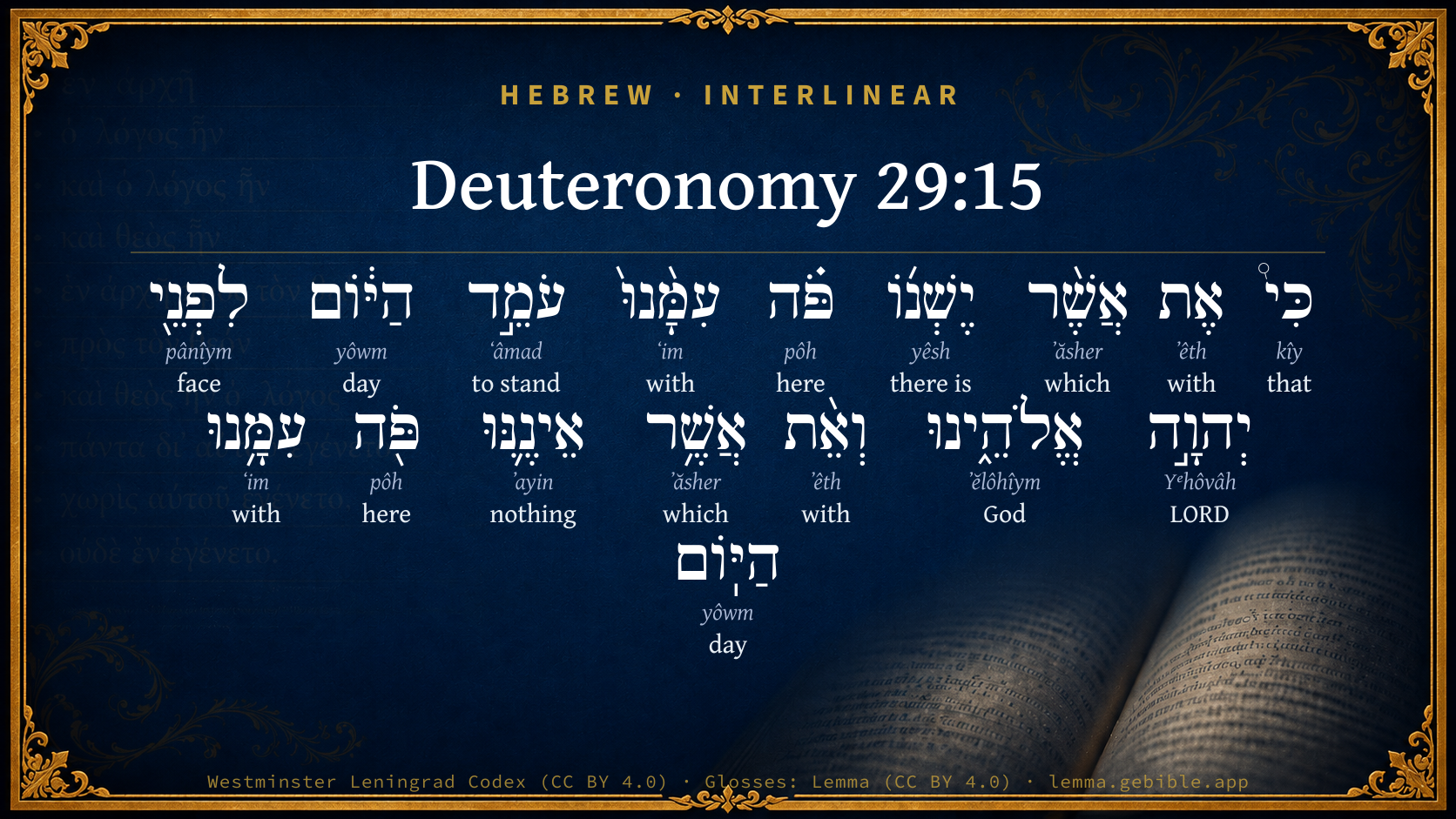
Hebrew (Westminster Leningrad Codex) Deuteronomy 29:15 appears in the Hebrew Old Testament. The text above is from the Westminster Leningrad Codex. Each word links to its Strong’s number, a concise gloss, and parsing drawn from the Open Scriptures Hebrew Bible morphology. Click any word for its full Brown-Driver-Briggs (BDB) entry.
Download image
Cite this verse

Deuteronomy 29:15 (World English Bible). Public Domain. Lemma interlinear Bible study tool, https://lemma.gebible.app/v/deuteronomy/29/15.

Show BibTeX & RIS
BibTeX
RIS
English Translation
but with him who stands here with us this day before Yahweh our God, and also with him who is not here with us this day
World English Bible · Public Domain
Download a study sheet

One document with this verse’s original text, its word-by-word gloss line, the meaning frame, cross-references with their text, attributed commentary, and full source and license credits — printable, and it pastes into notes with its structure intact.

This verse Autodidact and up

Study sheet (.html) Plain text (.txt)

A passage Seminary Student

Up to 50 verses in one chapter. A passage sheet keeps up to 6 commentary sources and 12 cross-references per verse, in the order this page ranks them, and says so on the sheet whenever that leaves anything out. Ask for a single verse and you get the Autodidact verse sheet above.

Everything on this page stays free to read, with no account — the sheet is a download of what is already on screen, not access to it.

Want to remove ads? Support Godless Engineer
Compare translations 3

The same verse in 3 English versions, stacked beneath the original-language interlinear above. Click any original word for its lexicon entry.

Each is an independent rendering of the whole verse — the interlinear is not word-aligned to these translations.

Highlighted words mark where these versions differ — a whole-verse word diff, not a word-by-word alignment.

  • World English Bible Public Domain
    but with him who stands here with us this day before Yahweh our God, and also with him who is not here with us this day
  • King James Version Public Domain
    But with him that standeth here with us this day before the LORD our God, and also with him that is not here with us this day:
  • unfoldingWord Literal Text CC BY-SA 4.0
    but those who are standing here with us today to the face of Yahweh our God, and those who are not here with us today.

unfoldingWord Literal Text — © unfoldingWord, licensed CC BY-SA 4.0. Word-aligned USFM3 via Door43 (git.door43.org/unfoldingWord/en_ult).

Versions to compare (up to 4)

3 of 4 selected

Show all 18 translations

Every available English version of this verse, each an independent rendering of the whole verse.

  • World English Bible Public Domain
    but with him who stands here with us this day before Yahweh our God, and also with him who is not here with us this day
  • Berean Standard Bible Public Domain
    but also with those who are standing here with us today in the presence of the LORD our God, as well as with those who are not here today.
  • Majority Standard Bible Public Domain
    but also with those who are standing here with us today in the presence of the LORD our God, as well as with those who are not here today.
  • King James Version Public Domain
    But with him that standeth here with us this day before the LORD our God, and also with him that is not here with us this day:
  • American Standard Version (1901) Public Domain
    but with him that standeth here with us this day before Jehovah our God, and also with him that is not here with us this day;
  • Revised Version (1885) Public Domain
    but with him that standeth here with us this day before the LORD our God, and also with him that is not here with us this day:
  • Geneva Bible (1599) Public Domain
    But aswel with him that standeth here with vs this day before the Lord our God, as with him that is not here with vs this day.
  • Douay-Rheims (1899) Public Domain
    But with all that are present and that are absent.
  • Young's Literal Translation Public Domain
    but with him who is here with us, standing to-day before Jehovah our God, and with him who is not here with us to-day,
  • Literal Standard Version CC BY-SA 4.0
    but with him who is here with us, standing before our God YHWH today, and with him who is not here with us today,
  • Unlocked Literal Bible CC BY-SA 4.0
    with everyone standing here with us today before Yahweh our God—but also with those who are not here with us today.
  • unfoldingWord Literal Text CC BY-SA 4.0
    but those who are standing here with us today to the face of Yahweh our God, and those who are not here with us today.
  • Darby Bible Public Domain
    but with him that standeth here with us this day before Jehovah our God, and with him that is not here with us this day
  • World Messianic Bible Public Domain
    but with those who stand here with us today before the LORD our God, and also with those who are not here with us today
  • Webster's Bible Public Domain
    But with him that standeth here with us this day before the LORD our God, and also with him that is not here with us this day:
  • Free Bible Version CC BY-SA 4.0
    those who are standing here with us today in the presence of the Lord our God, but also with those who are not here today.
  • Bible in Basic English Public Domain
    But with everyone who is here with us today before the Lord our God, as well as with those who are not here:
  • JPS Tanakh (1917) Public Domain
    (29-14) but with him that standeth here with us this day before the LORD our God, and also with him that is not here with us this day —

Literal Standard Version (2020), Covenant Press — licensed CC BY-SA 4.0. Text via the HelloAO Bible API (eBible.org). Unlocked Literal Bible (unfoldingWord) — licensed CC BY-SA 4.0. Text via the HelloAO Bible API (eBible.org). unfoldingWord Literal Text — © unfoldingWord, licensed CC BY-SA 4.0. Word-aligned USFM3 via Door43 (git.door43.org/unfoldingWord/en_ult). Free Bible Version, Dr. Jonathan Gallagher — licensed CC BY-SA 4.0. Text via the HelloAO Bible API (eBible.org).

Word by word

More ways to search: Search by grammar → Find every occurrence → Compare this word →

Practice this passage: Drill this verse → Learn its vocabulary →

פֹּ֗ה
pôh
H6311
“here”
Adverb
Part of Speech
Adverb
Full BDB Definition

Origin: probably from a primitive inseparable particle "p" (of demonstrative force) and H1931

TWOT: 1739

here, from here, hither - here - hither
  1. כִּי֩ kîy H3588 “that” Conjunction
  2. אֶת ʼêth H854 “with” Preposition
  3. אֲשֶׁ֨ר ʼăsher H834 “which” Particle, Relative
  4. יֶשְׁנ֜וֹ yêsh H3426 “there is · him” Particle, Demonstrative + Suffix, Personal, 3rd Person, Masculine, Singular
  5. עִמָּ֨נוּ֙ ʻim H5973 “with · us” Preposition + Suffix, Personal, 1st Person, Common, Plural
  6. עֹמֵ֣ד ʻâmad H5975 “standing” Verb, Qal, Participle Active, Masculine, Singular, Absolute
  7. הַיּ֔וֹם yôwm H3117 “the · day” Particle, Definite Article + Noun, Common, Masculine, Singular, Absolute
  8. לִפְנֵ֖י pânîym H6440 “to/for · face(s) of” Preposition + Noun, Common, Both, Plural, Construct
  9. יְהוָ֣ה Yᵉhôvâh H3068 “LORD” Noun, Proper
  10. אֱלֹהֵ֑ינוּ ʼĕlôhîym H430 “God(s) · our” Noun, Common, Masculine, Plural, Construct + Suffix, Personal, 1st Person, Common, Plural
  11. וְאֵ֨ת ʼêth H854 “and · with” Conjunction + Preposition
  12. אֲשֶׁ֥ר ʼăsher H834 “which” Particle, Relative
  13. אֵינֶ֛נּוּ ʼayin H369 “nothing · him” Particle, Negative + Suffix, Personal, 3rd Person, Masculine, Singular
  14. פֹּ֖ה pôh H6311 “here” Adverb
  15. עִמָּ֥נוּ ʻim H5973 “with · us” Preposition + Suffix, Personal, 1st Person, Common, Plural
  16. הַיּֽוֹם yôwm H3117 “the · day” Particle, Definite Article + Noun, Common, Masculine, Singular, Absolute

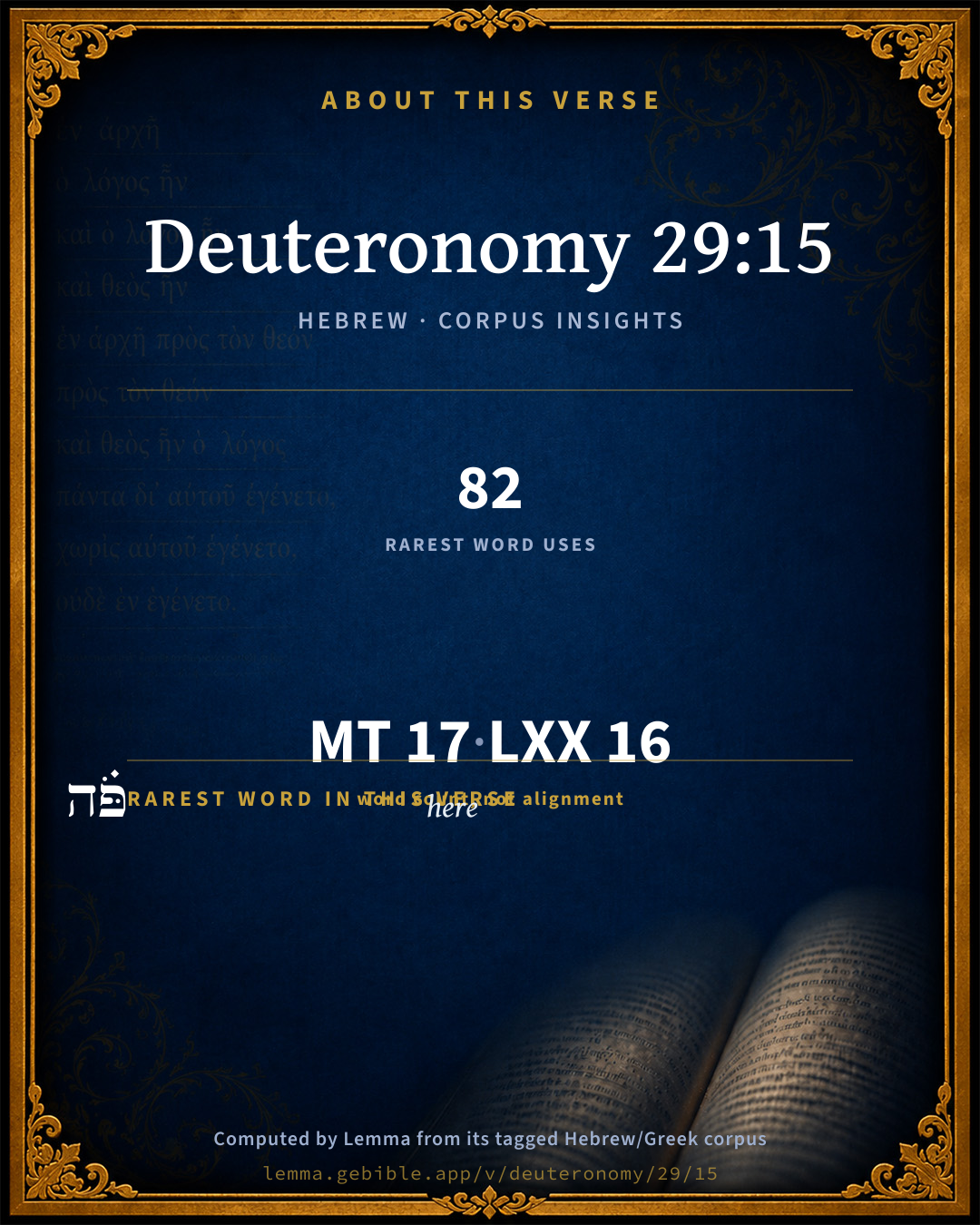
About this verse

These counts appear in no published source. They are computed here, from the morphology-tagged text and Lemma’s own curated glosses. What Lemma adds →

17
words
12
distinct lemmas
Pentateuch
section

Grammatical profile

  • 1 verb
  • 5 nouns
  • 4 prepositions
  • 1 conjunction
  • 2 adverbs
  • 4 particles

Verb forms

  • עֹמֵ֣ד Qal · Participle Active

Repetition

Words recur within this verse — often emphatic in Hebrew:

  • פֹּ֗ה here H6311 ×2
  • הַיּ֔וֹם day H3117 ×2
  • אֶת with H854 ×2
  • אֲשֶׁ֨ר which H834 ×2
  • עִמָּ֨נוּ֙ with H5973 ×2

Hebrew & Septuagint length

In English translation the verse runs 26 words from the Hebrew and 25 from the Septuagint (LXX English) — closely comparable.

A rough comparison of the two English renderings, which tokenize alike — not a word-level alignment.

Word counts can differ between the Hebrew and the Greek without any difference in meaning — e.g. the Hebrew direct-object marker אֵת has no separate Greek word, and Greek often adds the article ὁ.

In the original languages it is 17 Hebrew tokens and 16 Greek tokens — but the two are counted differently (Hebrew bundles its prefixes and suffixes into one token; the Greek is in lemma form), so that isn’t a like-for-like length.

Cross-references

5

Topical passages linked to Deuteronomy 29:15 in the Treasury of Scripture Knowledge — connected by theme and wording, ordered by reader-vote popularity; previews shown in the World English Bible.

  • Acts 2:39 For to you is the promise, and to your children, and to all who are far off, even as many as the Lord our God will call to himself."
  • 1 Corinthians 7:14 For the unbelieving husband is sanctified in the wife, and the unbelieving wife is sanctified in the husband. Otherwise your children would be unclean, but now are they holy.
  • Deuteronomy 5:3 Yahweh didn't make this covenant with our fathers, but with us, even us, who are all of us here alive this day.
  • Jeremiah 32:39 and I will give them one heart and one way, that they may fear me forever, for the good of them, and of their children after them:
  • Jeremiah 50:5 They shall inquire concerning Zion with their faces turned toward it, [saying], Come you, and join yourselves to Yahweh in an everlasting covenant that shall not be forgotten.

Cross-references courtesy of OpenBible.info (CC BY 4.0).

Hebrew and Greek witnesses Masoretic Hebrew ↔ Greek Septuagint

The same verse in the two great witnesses to the Old Testament, shown verse-for-verse.

These are two independent witnesses, not word-aligned to each other, and the Septuagint is shown in lemma (dictionary) form.

Hebrew Deuteronomy 29:15 Masoretic · Westminster Leningrad Codex

כִּי֩ אֶת אֲשֶׁ֨ר יֶשְׁנ֜וֹ פֹּ֗ה עִמָּ֨נוּ֙ עֹמֵ֣ד הַיּ֔וֹם לִפְנֵ֖י יְהוָ֣ה אֱלֹהֵ֑ינוּ וְאֵ֨ת אֲשֶׁ֥ר אֵינֶ֛נּוּ פֹּ֖ה עִמָּ֥נוּ הַיּֽוֹם

but with him who stands here with us this day before Yahweh our God, and also with him who is not here with us this day

World English Bible · Public Domain

Greek LXX Deuteronomy 29:15 Septuagint · lemma form

ὅτι σύ οἶδα ὡς καταοἰκέω ἐν γῆ αἴγυπτος καί παραἔρχομαι ἐν μέσος ὁ ἔθνος ὅς παραἔρχομαι

but to those also who are here with you today before the Lord your God, and to those who are not here with you today.

LXX2012 (modern English Septuagint) · Public Domain

Hebrew: Westminster Leningrad Codex (CC BY 4.0). Greek: Septuagint (public domain); English from LXX2012 (modern English Septuagint) (Public Domain). How the Septuagint differs from the Hebrew →

Targum (Aramaic paraphrase)

2

The Targum is the ancient Jewish Aramaic paraphrase of the Hebrew Scriptures — an interpretive translation, not the Hebrew text itself. Onkelos (literal) and Pseudo-Jonathan (expansive) render the Torah, and Jonathan the Prophets. Coverage is partial: where no permissively-licensed English translation exists for a verse, only the Aramaic is shown. This is verse-level text, not a word-by-word alignment to the Hebrew.

  1. Targum Onkelos Torah (Genesis–Deuteronomy)
    אֲרֵי אַתּוּן יְדַעְתּוּן יָת דִיתֵבְנָא בְּאַרְעָא דְמִצְרָיִם וְיָת דִי עֲבַרְנָא בְּגוֹ עַמְמַיָא דִי עֲבַרְתּוּן

    (no public-domain English translation for this verse)

    Targum Onkelos — Aramaic: “Onkelos Genesis” (public domain); “Onkelos Exodus” (public domain); “Onkelos Leviticus” (public domain); “Onkelos Numbers” (public domain); “Onkelos Deuteronomy” (public domain). English: “Sefaria Community Translation” (CC0 1.0 (public-domain dedication)); “J.W. Etheridge. The Targums of Onkelos and Jonathan Ben Uzziel on the Pentateuch. London: Longmans, Green, 1862” (public domain). Text via Sefaria.

  2. Targum Pseudo-Jonathan Torah (Genesis–Deuteronomy)
    אֲרוּם אַתּוּן יְדַעְתּוּן סְכוּם שְׁנַיָא דְיָתִיבְנָא בְּאַרְעָא דְמִצְרַיִם וּגְבוּרָן דְעָבַד לָנָא בֵּינֵי עַמְמַיָא דַעֲבַרְתּוּן

    For you know the number of the years that we dwelt in the land of Mizraim, and the mighty works which were wrought for us among the nations through which you have passed.

    Targum Pseudo-Jonathan — Aramaic: “Targum Jonathan on Genesis” (public domain); “Targum Jonathan on Exodus” (public domain); “Targum Jonathan on Leviticus” (public domain); “Targum Jonathan on Numbers” (public domain); “Targum Jonathan on Deuteronomy” (public domain). English: “The Targum of Jonathan ben Uzziel, trans. J. W. Etheridge, London, 1862” (public domain). Text via Sefaria.

Commentary

Notes on Deuteronomy 29:15 from classic Christian and Jewish commentators (each source and its license shown beneath its notes). The classic Christian expositions comment on the surrounding passage and are grouped to its opening verse, so a note may address several verses; the Jewish commentaries on the Tanakh (Rashi and others) are per-verse, so they appear only where the commentator wrote on this verse.

Lemma curates 59 commentaries, every one of them public domain or Creative Commons licensed, each selected and text-cleaned for this edition rather than reprinted as found. About our sources →

Joseph Benson's Commentary

Deu 29:15. So also with him that is not here — With your posterity. For so the covenant was made at first with Abraham and his seed, by which, as God engaged himself to continue the blessing of Abraham upon his posterity, so he also engaged them to the same duties which were required of Abraham. Thus it is even among men: where a king confers an estate upon a subject and his heirs for ever, upon some certain conditions, all his heirs who enjoy that benefit are obliged to the same conditions. It may likewise include those who were then constrained to be absent by sickness, or any necessary occasion. Nay, one of the Chaldee paraphrasts reads it, “All the generations that have been from the first days of the world, and all that shall arise to the end of the whole world, stand with us here this day.” And thus, taking this covenant as a typical dispensation of the covenant of grace, it is a noble testimony to the Mediator of that covenant, who is the same yesterday, to-day, and forever.

Joseph Benson's Commentary on the Old and New Testaments (1811–1818) — public domain. Text from a community e-Sword module.

Tyndale Open Study Notes

Tyndale Open Resources

29:15 future generations: The covenant made with Moses’ generation was also for generations yet to be born. Abraham’s descendants of the future would have the privileges of the covenant, but they would also need to obey it personally to enjoy its blessings (see 4:9).

Tyndale Open Study Notes — © Tyndale Open Resources, licensed CC BY-SA 4.0. Text via the HelloAO Bible API.

Geneva Bible (1599)

Geneva Bible translators

Meaning, their posterity.

Geneva Bible (1599) marginal notes — public domain. Text via Bolls.life.

Adam Clarke's Commentary

Verse 15. Him that standeth here] The present generation. Him that is not here - all future generations of this people.

Adam Clarke's Commentary on the Bible (1810–1826) — public domain. Text from a community e-Sword/MySword module.

John Gill's Exposition

For ye know how we have dwelt in the land of Egypt,.... How long they and their fathers had dwelt there, the number of years they had been in the land, as the Targum of Jonathan, which was upwards of two hundred years; and being a country the inhabitants of which were much given to idolatry, they had seen many of their idols, and much of their idolatrous worship; and their hearts had been apt to be ensnared by it, and the minds of some tinctured with it, and the remembrance thereof might make ill impressions on them; to remove or prevent which this covenant was made:

and how we came through the nations which ye passed by; as the Edomites, Ammonites, Moabites, and Midianites, as Aben Ezra observes, through whose borders they came, as they passed by their countries in their journeys in the wilderness.

John Gill's Exposition of the Whole Bible (1746–1763) — public domain (CC PDM 1.0). Text via the HelloAO Bible API.

Albert Barnes' Notes on the Bible

With him that is not here with us - i. e. as the Jews explain, posterity; which throughout all generations was to be taken as bound by the act and deed of those present and living.

Albert Barnes' Notes on the Bible (1834–1885) — public domain. Text from a community e-Sword/MySword module.

Haydock's Catholic Bible Commentary

Absent. Hebrew, "with him that standeth here this day before the Lord, and with him that is not here with us this day." If all were present, (ver. 11,) the absent must here denote the posterity of the Israelites yet unborn. (Haydock) --- God made the covenant with Abraham and with his seed, before he had any children in the world.

George Leo Haydock (1774–1849), Haydock's Catholic Family Bible and Commentary, 1859 edition — public domain. Excludes Psalms (Douay-Rheims chapter numbering differs from Protestant) and Deuterocanonical books (Catholic canon only).

Matthew Poole's English Annotations

i.e. With your posterity; for so the covenant was made at first with Abraham and his seed, by which, as God engaged himself to continue the blessing of Abraham upon his posterity, so he also engaged them to the same duties and conditions which were required of Abraham. So it is even among men, where a king confers an estate upon a subject and his heirs for ever, upon some certain conditions, all his heirs who enjoy that benefit are obliged to the same conditions. But whatsoever becomes of man’s right, God the Creator and sovereign Lord of all men and things hath an unquestionable right and power to oblige all persons that are or shall be to such conditions as he pleaseth, and especially to such conditions as are for their own benefit, which is the present case.

Matthew Poole's English Annotations on the Holy Bible (1683–1685) — public domain. Text from a community e-Sword/MySword module.

John Wesley's Explanatory Notes

So also - With your posterity. For so the covenant was made at first with Abraham and his seed, by which as God engaged himself to continue the blessing of Abraham upon his posterity, so he also engaged them to the same duties which were required of Abraham. So it is even among men, where a king confers an estate upon a subject and forever enjoy that benefit, are obliged to the same conditions. It may likewise include those who were then constrained to be absent, by sickness, or any necessary occasion. Nay one of the Chaldee pharaphrasts reads it, all the generations that have been from the first days of the world, and all that shall arise to the end of the whole world, stand with us here this day. And so taking this covenant as a typical dispensation of the covenant of grace, 'tis a noble testimony to the Mediator of that covenant, who is the same yesterday, to day, and forx ever. 16. Egypt - Where you have seen their idolatries, and learned too much of them, as the golden calf shewed, and therefore have need to renew your covenant with God; where also we were in dreadful bondage whence God alone hath delivered us, to whom therefore we are deeply obliged, and have all reason to renew our covenant with him. Through the nations - With what hazard, if God had not appeared for us!

John Wesley, Explanatory Notes Upon the Whole Bible (1754–1765) — public domain. Text via the GEBible commentary corpus.

Rashi

Rabbi Shlomo Yitzchaki (Rashi)

כי אתם ידעתם וגו׳ FOR YE KNOW [HOW WE HAVE ABODE IN THE LAND OF EGYPT] etc. — The meaning of these verses is: Because you have seen the conduct of the other nations, and perhaps the heart of one of you might beguile him to follow them, — as it goes on to state, “Lest there should be among you a man, or a woman … [whose heart turneth away this day from the Lord]”, — on this account I must place you under an oath.

Rashi on the Tanakh — English translations: “The Judaica Press complete Tanach with Rashi, translated by A. J. Rosenberg” (CC BY 4.0); “Pentateuch with Rashi's commentary by M. Rosenbaum and A.M. Silbermann, 1929-1934” (public domain); “The Metsudah Tanach series, Lakewood, N.J” (CC BY 4.0); and “The Book of Joshua, Metsudah Publications, 1997” (CC BY 4.0). Text via Sefaria.

Ramban (Nachmanides)

Rabbi Moshe ben Nachman (Ramban / Nachmanides)

FOR YE KNOW HOW WE DWELT IN THE LAND OF EGYPT etc. AND YE HAVE SEEN THEIR ABOMINATIONS. Because you have seen the nations that worship idols, and perhaps the heart of one of you might beguile him to follow them.

Ramban (Nachmanides) on the Tanakh — English translation: “Commentary on the Torah by Ramban (Nachmanides). Translated and annotated by Charles B. Chavel. New York, Shilo Pub. House, 1971-1976” (CC BY 4.0). Text via Sefaria.

Lesson kit

Teaching starters — assembled from the data on this page, not authored interpretation. Every prompt links to the verse data it draws on. Edit before teaching.

Deuteronomy, in the Pentateuch, opens this verse with 17 words (12 distinct Hebrew lemmas). Its most distinctive word is pôh (“here”). A historical commentator’s framing appears above. Read the whole chapter for the surrounding context.

Discussion questions

  1. What does “here” (pôh) contribute to the verse as a whole?
  2. Acts 2:39 shares this passage’s theme. How do the two illuminate each other?
  3. “here” occurs 2× in this one verse. What is the effect of the repetition?
  4. These translations render this verse differently. What is at stake in choosing one wording over another?
  5. The verb «עֹמֵ֣ד» is Qal Participle Active. How does its form color the action?
  6. Reading how Joseph Benson's Commentary and Tyndale Open Study Notes read this verse, where do the two commentators agree and where do they part?

Things to notice

Reading settings

Reading text

Shown beneath each verse's original-language words.

Old Testament
Old Testament edition

Read the OT as the Masoretic Hebrew (MT) or the Greek Septuagint (LXX).

English shown for the Greek Septuagint (in the Hebrew ↔ Greek comparison).

Comparing translations? Open the Compare panel on any verse page to stack up to four side by side.