

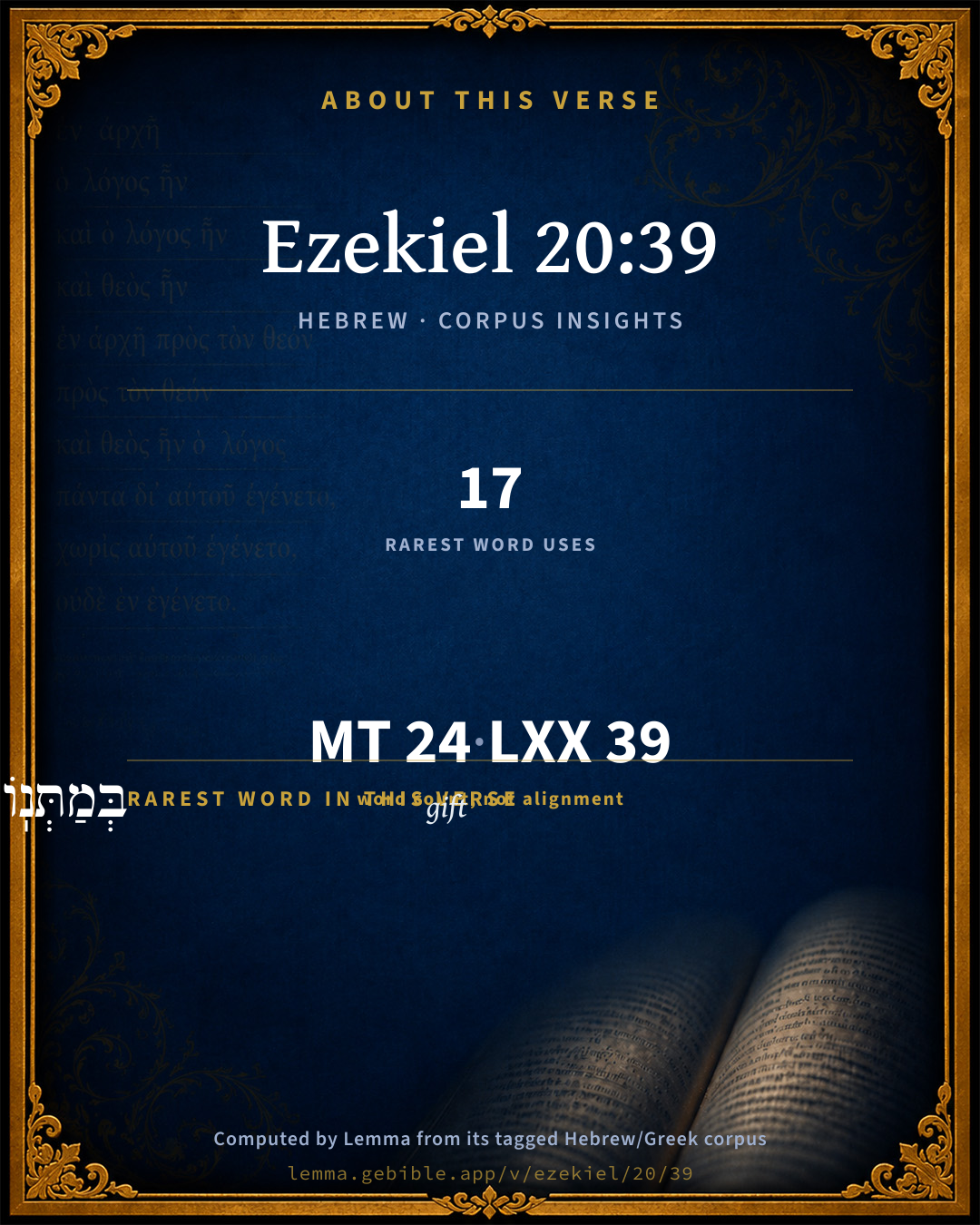
Ezekiel 20:39

Hebrew (Westminster Leningrad Codex) Ezekiel 20:39 appears in the Hebrew Old Testament. The text above is from the Westminster Leningrad Codex. Each word links to its Strong’s number, a concise gloss, and parsing drawn from the Open Scriptures Hebrew Bible morphology. Click any word for its full Brown-Driver-Briggs (BDB) entry.
Download image
Cite this verse

Ezekiel 20:39 (World English Bible). Public Domain. Lemma interlinear Bible study tool, https://lemma.gebible.app/v/ezekiel/20/39.

Show BibTeX & RIS
BibTeX
RIS
English Translation
As for you, house of Israel, thus says the Lord Yahweh: Go you, serve everyone his idols, and hereafter also, if you will not listen to me; but my holy name shall you no more profane with your gifts, and with your idols.
World English Bible · Public Domain
Download a study sheet

One document with this verse’s original text, its word-by-word gloss line, the meaning frame, cross-references with their text, attributed commentary, and full source and license credits — printable, and it pastes into notes with its structure intact.

This verse Autodidact and up

Study sheet (.html) Plain text (.txt)

A passage Seminary Student

Up to 50 verses in one chapter. A passage sheet keeps up to 6 commentary sources and 12 cross-references per verse, in the order this page ranks them, and says so on the sheet whenever that leaves anything out. Ask for a single verse and you get the Autodidact verse sheet above.

Everything on this page stays free to read, with no account — the sheet is a download of what is already on screen, not access to it.

Want to remove ads? Support Godless Engineer
Compare translations 3

The same verse in 3 English versions, stacked beneath the original-language interlinear above. Click any original word for its lexicon entry.

Each is an independent rendering of the whole verse — the interlinear is not word-aligned to these translations.

Highlighted words mark where these versions differ — a whole-verse word diff, not a word-by-word alignment.

  • World English Bible Public Domain
    As for you, house of Israel, thus says the Lord Yahweh: Go you, serve everyone his idols, and hereafter also, if you will not listen to me; but my holy name shall you no more profane with your gifts, and with your idols.
  • King James Version Public Domain
    As for you, O house of Israel, thus saith the Lord GOD; Go ye, serve ye every one his idols, and hereafter also, if ye will not hearken unto me: but pollute ye my holy name no more with your gifts, and with your idols.
  • unfoldingWord Literal Text CC BY-SA 4.0
    So to you, house of Israel, the Lord Yahweh says this: Each of you should go to his own idols. Worship them if you will refuse to listen to me, but you must no longer profane my holy name with your gifts and your idols.

unfoldingWord Literal Text — © unfoldingWord, licensed CC BY-SA 4.0. Word-aligned USFM3 via Door43 (git.door43.org/unfoldingWord/en_ult).

Versions to compare (up to 4)

3 of 4 selected

Show all 18 translations

Every available English version of this verse, each an independent rendering of the whole verse.

  • World English Bible Public Domain
    As for you, house of Israel, thus says the Lord Yahweh: Go you, serve everyone his idols, and hereafter also, if you will not listen to me; but my holy name shall you no more profane with your gifts, and with your idols.
  • Berean Standard Bible Public Domain
    And as for you, O house of Israel, this is what the Lord GOD says: Go and serve your idols, every one of you. But afterward, you will surely listen to Me, and you will no longer defile My holy name with your gifts and idols.
  • Majority Standard Bible Public Domain
    And as for you, O house of Israel, this is what the Lord GOD says: Go and serve your idols, every one of you. But afterward, you will surely listen to Me, and you will no longer defile My holy name with your gifts and idols.
  • King James Version Public Domain
    As for you, O house of Israel, thus saith the Lord GOD; Go ye, serve ye every one his idols, and hereafter also, if ye will not hearken unto me: but pollute ye my holy name no more with your gifts, and with your idols.
  • American Standard Version (1901) Public Domain
    As for you, O house of Israel, thus saith the Lord Jehovah: Go ye, serve every one his idols, and hereafter also, if ye will not hearken unto me; but my holy name shall ye no more profane with your gifts, and with your idols.
  • Revised Version (1885) Public Domain
    As for you, O house of Israel, thus saith the Lord GOD: Go ye, serve every one his idols, and hereafter also, if ye will not hearken unto me: but my holy name shall ye no more profane with your gifts, and with your idols.
  • Geneva Bible (1599) Public Domain
    As for you, O house of Israel, thus saith the Lord God, Goe you, and serue euery one his idole, seeing that ye will not obey me, and pollute mine holy Name no more with your giftes and with your idoles.
  • Douay-Rheims (1899) Public Domain
    And as for you, O house of Israel: thus saith the Lord God: Walk ye every one after your idols, and serve them. But if in this also you hear me not, but defile my holy name any more with your gifts, and with your idols;
  • Young's Literal Translation Public Domain
    And ye, O house of Israel, thus said the Lord Jehovah: Each his idols -- go -- serve ye, And, afterwards, if ye are not hearkening to me, And My holy name ye do not pollute any more by your gifts, and by your idols.
  • Literal Standard Version CC BY-SA 4.0
    And you, O house of Israel, thus said Lord YHWH: Each go, serve his idols, || And afterward, if you are not listening to Me [anyway], || But you do not defile My holy Name anymore by your gifts, and by your idols.
  • Unlocked Literal Bible CC BY-SA 4.0
    So to you, house of Israel, the Lord Yahweh says this: Each of you should go to his own idols. Worship them if you will refuse to listen to me, but you must no longer profane my holy name with your gifts and your idols.
  • unfoldingWord Literal Text CC BY-SA 4.0
    So to you, house of Israel, the Lord Yahweh says this: Each of you should go to his own idols. Worship them if you will refuse to listen to me, but you must no longer profane my holy name with your gifts and your idols.
  • Darby Bible Public Domain
    As for you, O house of Israel, thus saith the Lord Jehovah: Go ye, serve every one his idols henceforth also, if none of you will hearken unto me; but profane my holy name no more with your gifts and with your idols.
  • World Messianic Bible Public Domain
    “‘As for you, house of Israel, the Lord GOD says: “Go, everyone serve his idols, and hereafter also, if you will not listen to me; but you shall no more profane my holy name with your gifts and with your idols.
  • Webster's Bible Public Domain
    As for you, O house of Israel, thus saith the Lord GOD; Go ye, serve ye every one his idols, and hereafter also, if ye will not hearken to me: but profane ye my holy name no more with your gifts, and with your idols.
  • Free Bible Version CC BY-SA 4.0
    This is what the Lord God says to you, you people of Israel: All of you, go ahead and worship your idols. But after that if you don't listen to me you won't continue to disgrace me with your pagan offerings and idols.
  • Bible in Basic English Public Domain
    As for you, O children of Israel, the Lord has said: Let every man completely put away his images and give ear to me: and let my holy name no longer be shamed by your offerings and your images.
  • JPS Tanakh (1917) Public Domain
    As for you, O house of Israel, thus saith the Lord GOD: Go ye, serve every one his idols, even because ye will not hearken unto Me; but My holy name shall ye no more profane with your gifts, and with your idols.

Literal Standard Version (2020), Covenant Press — licensed CC BY-SA 4.0. Text via the HelloAO Bible API (eBible.org). Unlocked Literal Bible (unfoldingWord) — licensed CC BY-SA 4.0. Text via the HelloAO Bible API (eBible.org). unfoldingWord Literal Text — © unfoldingWord, licensed CC BY-SA 4.0. Word-aligned USFM3 via Door43 (git.door43.org/unfoldingWord/en_ult). Free Bible Version, Dr. Jonathan Gallagher — licensed CC BY-SA 4.0. Text via the HelloAO Bible API (eBible.org).

Word by word

More ways to search: Search by grammar → Find every occurrence → Compare this word →

Practice this passage: Drill this verse → Learn its vocabulary →

בְּמַתְּנֽוֹתֵיכֶ֖ם
mattânâh
H4979
“in/at · gifts · your”
Preposition + Noun, Common, Feminine, Plural, Construct + Suffix, Personal, 2nd Person, Masculine, Plural
Part of Speech
Preposition + Noun
Type
Common
Gender
Feminine
Number
Plural
State
Construct
Full BDB Definition

Origin: from H4976

TWOT: 1443c

gift
  1. וְאַתֶּ֨ם ʼattâh H859 “and · you” Conjunction + Pronoun, Personal, 2nd Person, Masculine, Plural
  2. בֵּֽית bayith H1004 “house of” Noun, Common, Masculine, Singular, Construct
  3. יִשְׂרָאֵ֜ל Yisrâʼêl H3478 “Israel” Noun, Proper
  4. כֹּֽה kôh H3541 “thus” Adverb
  5. אָמַ֣ר ʼâmar H559 “to say” Verb, Qal, Perfect, 3rd Person, Masculine, Singular
  6. אֲדֹנָ֣י ʼĂdônây H136 “Lord · my” Noun, Common, Masculine, Plural, Construct + Suffix, Personal, 1st Person, Common, Singular
  7. יְהֹוִ֗ה Yᵉhôvih H3069 “LORD” Noun, Proper
  8. אִ֤ישׁ ʼîysh H376 “man” Noun, Common, Masculine, Singular, Absolute
  9. גִּלּוּלָיו֙ gillûwl H1544 “idols · his” Noun, Common, Masculine, Plural, Construct + Suffix, Personal, 3rd Person, Masculine, Singular
  10. לְכ֣וּ yâlak H3212 “walk” Verb, Qal, Imperative, 2nd Person, Masculine, Plural
  11. עֲבֹ֔דוּ ʻâbad H5647 “serve” Verb, Qal, Imperative, 2nd Person, Masculine, Plural
  12. וְאַחַ֕ר ʼachar H310 “and · after” Conjunction + Adverb
  13. אִם ʼim H518 “if” Conjunction
  14. אֵינְכֶ֖ם ʼayin H369 “nothing · you” Particle, Negative + Suffix, Personal, 2nd Person, Masculine, Plural
  15. שֹׁמְעִ֣ים shâmaʻ H8085 “hearing” Verb, Qal, Participle Active, Masculine, Plural, Absolute
  16. אֵלָ֑י ʼêl H413 “to · me” Preposition + Suffix, Personal, 1st Person, Common, Singular
  17. וְאֶת ʼêth H853 “and · -” Conjunction + Particle, Direct Object
  18. שֵׁ֤ם shêm H8034 “name of” Noun, Common, Masculine, Singular, Construct
  19. קָדְשִׁי֙ qôdesh H6944 “holiness · my” Noun, Common, Masculine, Singular, Construct + Suffix, Personal, 1st Person, Common, Singular
  20. לֹ֣א lôʼ H3808 “not” Particle, Negative
  21. תְחַלְּלוּ châlal H2490 “to profane” Verb, Piel, Imperfect, 2nd Person, Masculine, Plural
  22. ע֔וֹד ʻôwd H5750 “still” Adverb
  23. וּבְגִלּוּלֵיכֶֽם gillûwl H1544 “and · in/at · idols · your” Conjunction + Preposition + Noun, Common, Masculine, Plural, Construct + Suffix, Personal, 2nd Person, Masculine, Plural

About this verse

These counts appear in no published source. They are computed here, from the morphology-tagged text and Lemma’s own curated glosses. What Lemma adds →

24
words
23
distinct lemmas
Prophets
section

Notable vocabulary

The rarest word here is בְּמַתְּנֽוֹתֵיכֶ֖ם gift H4979 — appearing just 17 times in the whole Hebrew Bible.

Shared distinctive vocabulary

בְּמַתְּנֽוֹתֵיכֶ֖ם gift H4979 occurs in 17 verses of the Hebrew Bible. Also found in:

Grammatical profile

  • 5 verbs
  • 10 nouns
  • 1 pronoun
  • 1 preposition
  • 1 conjunction
  • 3 adverbs
  • 3 particles

Verb forms

  • אָמַ֣ר Qal · Perfect
  • לְכ֣וּ Qal · Imperative
  • עֲבֹ֔דוּ Qal · Imperative
  • שֹׁמְעִ֣ים Qal · Participle Active
  • תְחַלְּלוּ Piel · Imperfect

Repetition

A word recurs within this verse — often emphatic in Hebrew:

  • גִּלּוּלָיו֙ idols H1544 ×2

Hebrew & Septuagint length

In English translation the verse runs 43 words from the Hebrew and 44 from the Septuagint (LXX English) — closely comparable.

A rough comparison of the two English renderings, which tokenize alike — not a word-level alignment.

Word counts can differ between the Hebrew and the Greek without any difference in meaning — e.g. the Hebrew direct-object marker אֵת has no separate Greek word, and Greek often adds the article ὁ.

In the original languages it is 24 Hebrew tokens and 39 Greek tokens — but the two are counted differently (Hebrew bundles its prefixes and suffixes into one token; the Greek is in lemma form), so that isn’t a like-for-like length.

Cross-references

18

Topical passages linked to Ezekiel 20:39 in the Treasury of Scripture Knowledge — connected by theme and wording, ordered by reader-vote popularity; previews shown in the World English Bible.

  • Judges 10:14 Go and cry to the gods which you have chosen; let them save you in the time of your distress.
  • Isaiah 1:13–15 Bring no more vain offerings. Incense is an abomination to me; New moons, Sabbaths, and convocations: I can't bear with evil assemblies.
  • Ezekiel 20:25–26 Moreover also I gave them statutes that were not good, and ordinances in which they should not live;
  • Ezekiel 43:7 He said to me, Son of man, [this is] the place of my throne, and the place of the soles of my feet, where I will dwell in the midst of the children of Israel forever. The house of Israel shall no more defile my holy name, neither they, nor their kings, by their prostitution, and by the dead bodies of their kings [in] their high places;
  • Hosea 4:17 Ephraim is joined to idols. Leave him alone!
  • 2 Kings 3:13 Elisha said to the king of Israel, What have I to do with you? get you to the prophets of your father, and to the prophets of your mother. The king of Israel said to him, No; for Yahweh has called these three kings together to deliver them into the hand of Moab.
  • Psalms 81:12 So I let them go after the stubbornness of their hearts, That they might walk in their own counsels.
  • Proverbs 21:27 The sacrifice of the wicked is an abomination: How much more, when he brings it with a wicked mind!
  • Isaiah 66:3 He who kills an ox is as he who kills a man; he who sacrifices a lamb, as he who breaks a dog's neck; he who offers an offering, [as he who offers] pig's blood; he who burns frankincense, as he who blesses an idol. Yes, they have chosen their own ways, and their soul delights in their abominations:
  • Jeremiah 7:9–11 Will you steal, murder, and commit adultery, and swear falsely, and burn incense to Baal, and walk after other gods that you have not known,
  • Jeremiah 44:25–26 Thus says Yahweh of Hosts, the God of Israel, saying, You and your wives have both spoken with your mouths, and with your hands have fulfilled it, saying, We will surely perform our vows that we have vowed, to burn incense to the queen of the sky, and to pour out drink-offerings to her: establish then your vows, and perform your vows.
  • Ezekiel 23:37–39 For they have committed adultery, and blood is in their hands; and with their idols have they committed adultery; and they have also caused their sons, whom they bore to me, to pass through [the fire] to them to be devoured.
  • Amos 4:4–5 "Go to Bethel, and sin; To Gilgal, and sin more. Bring your sacrifices every morning, Your tithes every three days,
  • Zephaniah 1:4–5 I will stretch out my hand against Judah, and against all the inhabitants of Jerusalem. I will cut off the remnant of Baal from this place: the name of the idolatrous and pagan priests,
  • Matthew 6:24 "No one can serve two masters, for either he will hate the one and love the other; or else he will be devoted to one and despise the other. You can't serve both God and Mammon.
  • Romans 1:24–28 Therefore God also gave them up in the lusts of their hearts to uncleanness, that their bodies should be dishonored among themselves,
  • 2 Thessalonians 2:11 Because of this, God sends them a working of error, that they should believe a lie;
  • Revelation 3:15–16 "I know your works, that you are neither cold nor hot. I wish you were cold or hot.

Cross-references courtesy of OpenBible.info (CC BY 4.0).

Hebrew and Greek witnesses Masoretic Hebrew ↔ Greek Septuagint

The same verse in the two great witnesses to the Old Testament, shown verse-for-verse.

These are two independent witnesses, not word-aligned to each other, and the Septuagint is shown in lemma (dictionary) form.

Hebrew Ezekiel 20:39 Masoretic · Westminster Leningrad Codex

וְאַתֶּ֨ם בֵּֽית יִשְׂרָאֵ֜ל כֹּֽה אָמַ֣ר אֲדֹנָ֣י יְהֹוִ֗ה אִ֤ישׁ גִּלּוּלָיו֙ לְכ֣וּ עֲבֹ֔דוּ וְאַחַ֕ר אִם אֵינְכֶ֖ם שֹׁמְעִ֣ים אֵלָ֑י וְאֶת שֵׁ֤ם קָדְשִׁי֙ לֹ֣א תְחַלְּלוּ ע֔וֹד בְּמַתְּנֽוֹתֵיכֶ֖ם וּבְגִלּוּלֵיכֶֽם

As for you, house of Israel, thus says the Lord Yahweh: Go you, serve everyone his idols, and hereafter also, if you will not listen to me; but my holy name shall you no more profane with your gifts, and with your idols.

World English Bible · Public Domain

Greek LXX Ezekiel 20:39 Septuagint · lemma form

καί σύ οἶκος ἰσραήλ ὅδε λέγω κύριος κύριος ἕκαστος ὁ ἐπιτήδευμα αὐτός ἐκαἴρω καί μετά οὗτος εἰ μή σύ εἰςἀκούω ἐγώ καί ὁ ὄνομα ἐγώ ὁ ἅγιος οὐ βεβηλόω οὐκέτι ἐν ὁ δῶρον σύ καί ἐν ὁ ἐπιτήδευμα σύ

And as to you, O house of Israel, thus says the Lord, even the Lord; Put away each one his evil practices, and hereafter if you⌃ listen to me, then shall you⌃ no more profane my holy name by your gifts and by devices.

LXX2012 (modern English Septuagint) · Public Domain

On this verse, Haydock's Catholic Bible Commentary discusses the Septuagint’s reading. Read the note in Commentary ↓

Hebrew: Westminster Leningrad Codex (CC BY 4.0). Greek: Septuagint (public domain); English from LXX2012 (modern English Septuagint) (Public Domain). How the Septuagint differs from the Hebrew →

Targum (Aramaic paraphrase)

1

The Targum is the ancient Jewish Aramaic paraphrase of the Hebrew Scriptures — an interpretive translation, not the Hebrew text itself. Onkelos (literal) and Pseudo-Jonathan (expansive) render the Torah, and Jonathan the Prophets. Coverage is partial: where no permissively-licensed English translation exists for a verse, only the Aramaic is shown. This is verse-level text, not a word-by-word alignment to the Hebrew.

  1. Targum Jonathan Prophets (Joshua–Malachi)
    וְאַתּוּן בֵּית יִשְׂרָאֵל כִּדְנַן אֲמַר יְיָ אֱלֹהִים גְבַר פּוּלְחַן טַעֲוָתֵהּ אֱזִילוּ פְלָחוּ וּבָתַר דְתַבְתּוּן לֵיתֵיכוֹן צָבָן לְקַבָּלָא לְמֵימְרִי וְיַת שְׁמָא דְקוּדְשִׁי לָא תַחֲלוּן עוֹד בְּמַתְּנָתֵכוֹן וּבְטַעֲוָתְכוֹן:

    (no public-domain English translation for this verse)

    Targum Jonathan — Aramaic: “Mikraot Gedolot” (public domain). English: “Sefaria Community Translation” (CC0 1.0 (public-domain dedication)); “London "Chaldee Paraphrase," 1871” (public domain). Text via Sefaria.

Commentary

Notes on Ezekiel 20:39 from classic Christian and Jewish commentators (each source and its license shown beneath its notes). The classic Christian expositions comment on the surrounding passage and are grouped to its opening verse, so a note may address several verses; the Jewish commentaries on the Tanakh (Rashi and others) are per-verse, so they appear only where the commentator wrote on this verse.

Lemma curates 59 commentaries, every one of them public domain or Creative Commons licensed, each selected and text-cleaned for this edition rather than reprinted as found. About our sources →

Trapp's Complete Commentary

John Trapp

Eze 20:39 As for you, O house of Israel, thus saith the Lord GOD; Go ye, serve ye every one his idols, and hereafter [also], if ye will not hearken unto me: but pollute ye my holy name no more with your gifts, and with your idols.

Ver. 39. Go ye, serve ye everyone his idols,] q.d., You may for me; and I had rather you would, than dissemble, as you do, and play on both hands, to the scandal of the weak, and scorn of the wicked. For my part, I have done with you for ever; take your own course.

And with your idols.] Away with these abominable mixtures. I will be served truly and totally, or not at all.

John Trapp, A Commentary or Exposition upon All the Books of the Old and New Testament (1647–1656) — public domain. Text from a community e-Sword module.

Joseph Benson's Commentary

Eze 20:39. As for you, O house of Israel, go ye, serve, &c. — Go at present, and serve your idols; persist in your idolatries, agreeably to the stubbornness of your hearts. An indignant concession. And hereafter also, if ye will not hearken unto me — And continue to do so if you are resolved not to do according to my commandments, or to worship me as I have appointed. But pollute ye my holy name no more, &c. — While you are such idolaters, forbear to take my name into your lips. In other words, While you offer your gifts, and immolate your children to idols, do not call yourselves any longer my servants, nor pretend to pay your devotions in my temple, and thereby bring a reproach upon my name and worship.

Joseph Benson's Commentary on the Old and New Testaments (1811–1818) — public domain. Text from a community e-Sword module.

The Preacher's Complete Homiletical Commentary

Joseph S. Exell (gen. ed.)

(From MSS. Sermons by the Rev. S. Thodey.)

(Eze_20:39-44.)

EXEGETICAL NOTES.—The prophet now declares the promise for the future. Israel is to be gathered again, and to be converted to the Lord.

Eze_20:39. “Go ye, serve ye every one his idols, and hereafter also if ye will not hearken unto Me.” “Jehovah here utterly disowns all relationship with the rebels. He would have idolatrous worship severed from all connexion with His name. The tone in which they are addressed is one of the keenest irony. Compare Rev_22:11. It is as much as to say, Well, since you will not listen to Me and return to My service, you may take your own course; we henceforth part company. The expression “and afterwards” is intended to give emphasis to the address, and anticipates the continued apostacy of the rebels.” (—Henderson.)

Eze_20:40. “In the mountain of the height of Israel.” Mount Moriah. “There shall all the house of Israel, all of them in the land, serve Me.” Not the former rebellious house of Israel (Eze_20:39), but the people now restored to the practice of true religion. They should all congregate at the appointed festivals as of old, at Jerusalem. “There will I accept them, and there will I require your offerings and the firstfruits of your oblations, with all your holy things.” The Lord will then accept them with delight, and all their sacrificial gifts and offerings. This promise implies the bringing back of Israel from its banishment.

Eze_20:41. “Your sweet savour.” Heb., Odour of satisfaction. “This is the technical expression for the cheerful (well-pleased) acceptance of the sacrifice, or rather of the feelings of the worshipper presenting the sacrifice, which ascends to God in the sacrificial odour (Gen_8:21). The thought therefore is the following: When God shall eventually gather His people out of their dispersion, He will accept them as a sacrifice well-pleasing to Him, and direct all His good pleasure towards them.”—(Keil.) “And I will be sanctified in you before the heathen.” “The restoration of the Hebrews from the captivity and the re-establishment of their religious services, would have the double effect of procuring honour to Jehovah from the surrounding nations, and attesting in their own experience the happiness springing out of the true knowledge of the Divine character.—(Henderson.)

Eze_20:43. “And there shall ye remember your ways.” In Eze_20:40 the outward acts of the religion are described; here we have that inner condition of spirit, that heart of repentance, which alone can make such acts acceptable to God.

Eze_20:44. “And ye shall know that I am the Lord, when I have wrought with you for My name’s sake.” “The gathering of Israel from among the heathen will be fulfilled in its conversion to Christ, and hitherto it has only taken place in very small beginnings. The principal fulfilment is still to come, when Israel, as a nation, shall be converted to Christ.”—(Keil.)

HOMILETICS

ISRAEL’S CONVERSION TO THE LORD

I. The divine method in their conversion.

1. They were urged to decision. “Go ye, serve ye every one his idols” (Eze_20:39). Make your choice, at once; let there be no double-heartedness. Make full proof of the idols ye have chosen, “If the Lord be God, follow Him; but if Baal, then follow him” (1Ki_18:21). This would have the effect of detecting hypocrites, and bringing the true servants of the Lord to a full determination.

2. They are brought to contrition. Contrition for past sins always accompanies true conversion. Such a condition is produced

(1) By a remembrance of sin as a transgression against God. “Ye shall remember your ways, and all your doings wherein ye have been defiled” Eze_20:43. Ye shall think of your sins as having defiled your souls, and therefore were contrary to the nature and will of a God who is holy, and whose commandment is holy, just, and good.

(2.) By self-loathing. “Ye shall loathe yourselves in your own sight for all your evils which ye have done.” The conviction of sin, when brought home to a man, makes him to see himself in the true light.

II. The results of their conversion.

1. They should be in reality what they had hitherto been only in name. In Eze_20:39, they are addressed as, the “House of Israel,” though they went after their idols. The name was but a hollow unreality. They are now the true “House of Israel” (Eze_20:40). They should still worship on the height, but that would be on God’s holy mountain and with a pure worship (Eze_20:28).

2. They should render an acceptable worship (Eze_20:41). As they were in a right state of heart, their service of worship and offerings would be well-pleasing unto the Lord. The principle of Divine worship, in both Testaments, is the same,—“In spirit and in truth.”

3. The penalty of their sin should be remitted. For their sins they were scattered; now they are to be restored (Eze_20:42).

4. They should give God all the glory. His forbearing mercy. His forgiving mercy. His mercy so great as not to be restrained by all their sins from granting the greatest gifts.

5. Their conversion would promote the true knowledge of God.

(1) Among the nations around them. “I will be sanctified in you before the heathen.” (Eze_20:41). The heathen would see that the God of Israel was holy, just in all His ways; yet merciful, and faithful to His covenant promises.

(2) Among themselves. “And ye shall know that I am the Lord.” (Eze_20:44). And there is a knowledge of God which we can gain from the history of His dealings with His ancient people. We see that God brings His purposes to pass amidst all human opposition and rebellion. We know that, in the worst times, there has always been an elect, remnant of faithful men to glorify Him. And the history of the past assures us that it will be thus in the future.

(Eze_20:41).

“I will accept you with your sweet savour.” The spirit of the Gospel is observable under the law. There can be but one way to heaven. David, Isaiah, Ezekiel, and Daniel were sinners saved by grace as much as Paul, and Peter, and John. And they were saved by the same Mediator. Let us consider the blessings promised in the text, and then we shall give some directions for the attainment and preservation of the enjoyment it reveals.

I. Some remarks upon the blessing promised. These are acceptance with God through a Redeemer, through His grace and righteousness. His sacrifice is as a sweet smelling savour, and the worship of His people is as incense acceptable to Him. Acceptance stands opposed to condemnation, and is enjoyed through faith in Christ.

1. This blessing is the grand discovery of the gospel. It is the design and end of all God’s communications with men—“God in Christ reconciling the world unto Himself.”

2. It is always the result of an experience of the work of grace upon the soul. It puts the life of hope into obedience. Our persons must be accepted before our works.

3. It secures the true and right enjoyment of all temporal blessings. To a man who has no sense of God’s friendship, the best earthly enjoyments lose their charm; and to a man who has hope of pardon through Christ, all outward trials lose their sting.

4. It is essential to a victory over death and a joyful eternity.

II. Some directions for the attainment and enjoyment of this blessing.

1. Look carefully to the fact of your own acceptance of Christ, and to the sincerity of your hearts in their covenant closure with Christ. See that you take him, with the happiness He has promised, for your All. Take heed of looking after another felicity, or cherishing other hopes than those of which He is the Author and object. Christ is the great promise made to faith; and faith is the soul’s acceptance of Christ as He is freely promised. To present Christ before us with all his gifts and blessings is the design of the Gospel; and to rest in Christ as the fountain of all our hope and joys is the first act of a believer. God prays you to accept Christ: as though God did beseech you by us, we pray you in Christ’s stead be ye reconciled to God.

2. Cherish habitual and confiding thoughts of the freeness and riches of God’s grace through a Redeemer. This will greatly kindle that love which brings its own evidence of its truth. This will make God appear more amiable in your eyes, and then you will love him more abundantly; and as your conscious love to Him increases your doubts and apprehensions will give way. So much love, so much comfort. Those right apprehensions of God also will do much to drive away those terrors which arise from false apprehensions of Him. Delightful objects draw the heart after them as the loadstone draws iron. In Christ you see goodness and mercy in its condescension, and brought nearer to you than the Divine nature originally was. In Christ God is come down into our nature, and so Infinite Goodness is become incarnate.

3. Every day renew your apprehensions of the truth and value of the promised felicity. Consider the end of your faith, in order to see the vain and delusive character of things below. Let not heaven lose with you its attractive force through your forgetfulness or unbelief. He is the best Christian who knows best why he is a Christian. Look upon all present actions and conditions with a remembrance of their end. Value not earthly things beyond their true worth. Be not ambitious of that honour which must end in confusion, nor of the favour of those whom God will call His enemies.

4. Guard against those snares and temptations which you know to be most hurtful to the life of religion in the soul.

5. Gather up and improve your own past experience of God’s mercy towards you and others. We do God and ourselves great wrong by forgetting, or not improving, our experience of His goodness. God does not give His mercies only for present use, but for the future also. What a wrong it is to God in your next trial to forget His last deliverance! Have not mercies come so unexpectedly, and in such a wonderful manner, that you have (as it were) the name of God written on them? (Jdg_13:23). “All my bones shall say, who is like unto thee.” You may make great use also of the experience of others.

(From MSS. Sermons by the Rev. S. Thodey).

(Eze_20:43.)

1. Sense of mercies, rather than of judgments, makes sin bitter, and leads unto repentance. Their captivity, and the sad things they suffered therein, did not embitter their sin unto them, and break their hearts; but God’s kindness in bringing them out of Babylon into the land of Israel, that prevaileth with them; when they had received marvellous kindness from God, then they were marvellously affected, greatly ashamed of their ways, and loathed themselves. Mercies in Zion produced that which judgments in Babylon did not. Great mercies bestowed upon great sinners, do preach the doctrine of repentance most effectually, convincing them strongly of their unworthy and vile carriages towards the Lord. David’s kindness brake the heart of Saul, and made him to weep and say, “Thou art more righteous than I; for thou hast rewarded me good, whereas I have rewarded thee evil” (1 Samuel 24.) If human favour hath such influence into a sinful heart, what hath Divine? Moses, by his strokes, fetched water out of a rock; David, by his kindness. God sometimes by His judgments humbles men, and brings them to repentance, but mostly by His mercies. The sweet influences of the Gospel have pierced deeper into sinners’ hearts than the terrors of the law.

2. When the Lord gathers up His people out of the world, and brings them into nearer relation to Himself, into Canaan, and Church order, He looks that they should review their former ways and be much affected with them, and thoroughly repent for them. When brought into Canaan, they were not only to eat the milk and honey, to behold the glory thereof, but they were to remember days of old, their sins in Babylon, how they had polluted themselves and provoked the Lord; and thereupon to mourn kindly for their unkindnesses to Him, who hath showed such marvellous loving-kindness unto them. When God brings man out of the world now unto Zion, gives them the milk and honey of the gospel, shows them the glory thereof, then they look back, wonder at their wickedness, and loathe themselves for it, saying, Who is like unto us in sin and wickedness, and who is like unto our God in grace and goodness, in pardon and forgiveness? (Mic_7:18). When it shall please God to bring the Jews out of that Babylon they are now in, unto the true Canaan, the Church of Christ, they will remember their iniquities, their bitter and bloody doings against Christ, mourn and loathe themselves for the same (Zec_12:10; Rev_1:7).)

3. When repentance springs from sense of love and kindness, as it is real and deep, so it is secret and universal. They should, being brought into Canaan, not only remember their sins, but they should loathe themselves, be displeased so with themselves, that they should smite and abhor themselves, and that in their own sight, and for all the evils they had committed; when no eye saw them, they would spread all their sins before them, and in the sight and sense of them be vile in their own eyes.—(Greenhill.)

The Preacher's Complete Homiletical Commentary (gen. ed. Joseph S. Exell; Funk & Wagnalls, c. 1892) — public domain (pre-1929). A full-Bible homiletical/sermon-outline anthology covering 65 of 66 books (2 John is absent from the source module). Text from a community e-Sword module.

Keil & Delitzsch

C. F. Keil & F. Delitzsch

The Ultimate Gathering of Israel, and Its Conversion to the Lord

Eze 20:39. Ye then, O house of Israel, thus saith the Lord Jehovah, Go ye, serve every one his idols! but afterwards - truly ye will hearken to me, and no longer desecrate my holy name with your sacrificial gifts and your idols, Eze 20:40. But upon my holy mountain, upon the high mountain of Israel, is the saying of the Lord Jehovah, there will all the house of Israel serve me, the whole of it in the land; there will I accept them gladly; there will I ask for your heave-offerings and the first-fruits of your gifts in all that ye make holy. Eze 20:41. As a pleasant odour will I accept you gladly, when I bring you out from the nations, and gather you out of the lands, in which you have been scattered, and sanctify myself in you before the eyes of the heathen nations. Eze 20:42. And ye shall know that I am Jehovah, when I bring you into the land of Israel, into the land which I lifted up my hand to give to your fathers; Eze 20:43. And there ye will think of your ways and your deeds, with which ye have defiled yourselves, and will loathe yourselves (lit., experience loathing before yourselves) on account of all your evil deeds. which ye have performed; Eze 20:44. And ye will know that I am Jehovah, when I deal with you for my name's sake, not according to your evil ways and according to your corrupt deeds, O house of Israel, is the saying of Jehovah. - After the Lord has declared to the people that He will prevent its being absorbed into the heathen world, and will exterminate the ungodly by severe judgments, the address passes on, with the direction henceforth to serve idols only, to a prediction of the eventual conversion, and the restoration to Canaan of the purified nation. The direction, "Go ye, serve every one his idols," contains, after what precedes it, a powerful appeal to repent. God thereby gives up the impenitent to do whatever they will, having first of all told them that not one of them will come into the land of Canaan. Their opposition will not frustrate His plan of salvation. The words which follow from ואחר onwards have been interpreted in different ways. It is opposed to the usage of the language to connect ואחר with עבדוּ, serve ye hereafter also (De Wette, etc.), for ו has not the force of the Latin et = etiam, and still less does it signify "afterwards just as before." Nor is it allowable to connect ואחר closely with what follows, in the sense of "and hereafter also, if ye will hearken to me, profane ye my name no more" (Rosenmller, Maurer). For if תּחלּלוּ were used as an imperative, either it would have to stand at the beginning of the sentence, or it would be preceded by אל instead of לא. Moreover, the antithesis between not being willing to hear and not profaning the name of God, is imported arbitrarily into the text. The name of the Lord is profaned not only by sacrifices offered in external form to Jehovah and in the heart to idols, but also by disobedience to the word and commandments of God. It is much better to take ואחר by itself, and to render the following particle, אם, as the ordinary sign of an oath: "but afterwards (i.e., in the future)...verily, ye will hearken to me;" that is to say, ye will have been converted from your idolatry through the severe judgments that have fallen upon you. The ground for this thought is introduced in Eze 20:40 by a reference to the fact that all Israel will then serve the Lord upon His holy mountain. כּי is not "used emphatically before a direct address" (Hitzig), but has a causal signification. For 'הר מרום ישׂ, see the comm. on Eze 17:23. In the expression "all Israel," which is rendered more emphatic by the addition of כּלּה, there is an allusion to the eventual termination of the severance of the people of God (compare Eze 37:22). Then will the Lord accept with delight both them and their sacrificial gifts. תּרוּמות, heave-offerings (see the comm. on Exo 25:2 and Lev 2:9), used here in the broader sense of all the sacrificial gifts, along with which the gifts of first-fruits are specially named. משׂאות, as applied to holy offerings in the sense of ἀναθήματα, belongs to the later usage of the language. בּכל־קדשׁיכם, consisting of all your consecrated gifts. קדשׁים, as in Lev 22:15. This promise includes implicite the bringing back of Israel from its banishment. This is expressly mentioned in Eze 20:41; but even there it is only introduced as self-evident in the subordinate clause, whereas the cheerful acceptance of Israel on the part of God constitutes the leading thought.

בּריח ניחח, as an odour of delight (ב, the so-called Beth essentiae), will God accept His people. ריח ניחח, odour of satisfaction, is the technical expression for the cheerful (well-pleased) acceptance of the sacrifice, or rather of the feelings of the worshipper presenting the sacrifice, which ascend to God in the sacrificial odour (see the comm. on Gen 8:21). The thought therefore is the following: When God shall eventually gather His people out of their dispersion, He will accept them as a sacrifice well-pleasing to Him, and direct all His good pleasure towards them. ונקדּשׁתּי בכם does not mean, I shall be sanctified through you, and is not to be explained in the same sense as Lev 22:32 (Rosenmller), for ב is not equivalent to בּתוך; but it signifies "I will sanctify myself on you," as in Num 20:13; Lev 10:3, and other passages, where נקדּשׁ is construed with ב pers. (cf. Eze 28:25; Eze 36:23; Eze 38:16; Eze 39:27), in the sense of proving oneself holy, mostly by judgment, but here through having made Israel into a holy nation by the refining judgment, and one to which He can therefore grant the promised inheritance. - Eze 20:42. Then will Israel also recognise its God in His grace, and be ashamed of its former sins. For Eze 20:43, compare Eze 6:9 and Eze 16:61. - With regard to the fulfilment, as Kliefoth has correctly observed, "in the prediction contained in Eze 20:32-38, the whole of the searching judgments, by which God would lead Israel to conversion, are summed up in one, which includes not only the Babylonian captivity, the nearest and the first, but the still more remote judgment, namely, the present dispersion; for it is only in the present dispersion of Israel that God has really taken it into the wilderness of the nations, just as it was only in the rejection of Christ that its rebellious attitude was fully manifested. And as the prophecy of the state of punishment combines in this way both the nearer and more remote; so are both the nearer and more distant combined in what Eze 20:40 to 44 affirm with regard to the ultimate fate of Israel." The gathering of Israel from among the heathen will be fulfilled in its conversion to Christ, and hitherto it has only taken place in very small beginnings. The principal fulfilment is still to come, when Israel, as a nation, shall be converted to Christ. With regard to the bringing back of the people into "the land of Israel," see the comm. on Ezekiel 37, where this promise is more fully expanded.

Keil & Delitzsch — Biblical Commentary on the Old Testament (1861–1891) — public domain (CC PDM 1.0). Text via the HelloAO Bible API. (Old Testament only.)

Tyndale Open Study Notes

Tyndale Open Resources

20:39-44 The people of Israel might continue to worship . . . idols, but in the end, they would worship God in spirit and in truth on his holy mountain (see chs 40–48, in which the purified worship of God is restored in the Temple; cp. John 4:21-24). God’s purpose in choosing Israel to be a holy nation would ultimately stand. The people would be a pleasing sacrifice to him and would display God’s holiness. The result of this new exodus would be pure worship, offered by a purified people who were saved by sovereign grace.

Tyndale Open Study Notes — © Tyndale Open Resources, licensed CC BY-SA 4.0. Text via the HelloAO Bible API.

Geneva Bible (1599)

Geneva Bible translators

This is spoken to the hypocrites.

Geneva Bible (1599) marginal notes — public domain. Text via Bolls.life.

Jamieson, Fausset & Brown

Robert Jamieson, A. R. Fausset & David Brown

Equivalent to, "I would rather have you open idolaters than hypocrites, fancying you can worship Me and yet at the same time serve idols" (Amo 5:21-22, Amo 5:25-26; compare Kg1 18:21; Kg2 17:41; Mat 6:24; Rev 3:15-16).

Go ye, serve--This is not a command to serve idols, but a judicial declaration of God's giving up of the half-idol, half-Jehovah worshippers to utter idolatry, if they will not serve Jehovah alone (Psa 81:12; Rev 22:11).

hereafter also--God anticipates the same apostasy afterwards, as now.

Jamieson, Fausset & Brown — Commentary Critical and Explanatory on the Whole Bible (1871) — public domain (CC PDM 1.0). Text via the HelloAO Bible API.

Adam Clarke's Commentary

Verse 39. Go ye, serve ye every one his idols] Thus, God gave them statutes that were not good, and judgments whereby they could not live, by thus permitting them to take their own way, serve their gods, and follow the maxims and rites of that abominable worship.

Adam Clarke's Commentary on the Bible (1810–1826) — public domain. Text from a community e-Sword/MySword module.

John Calvin's Commentaries

Now again God expressly bears witness that he rejects the Israelites because they infected the pure worship of the law with their mixtures; for we said that they were deceived by a vain imagination when they thought God pleased with their obedience, while they worshipped him only half-heartedly. When they heaped up fictions, they thought this diligence would be pleasing to God, because they professed to acknowledge the true God as their redeemer. Here again he announces that he rejects all half-worship, since he wished to have the entire affections, and to admit no rival: Now, says he, O house of Israel, thus says Jehovah, Go each of you and serve your idols, just as if he would cast them off from his family. And yet we see that they were always under his dominion; and thus some kind of inconsistency arises when God rejects them from his sway, and yet retains them as his right. But the liberty which is now granted is to show them that it is in vain to worship God by halves.

This passage is peculiarly remarkable, since at this time many are deceived, while they rest upon their own inventions, and think that they best discharge their duty towards God when they partially obey his commandments, and then pile up a great heap of superstitions, partly received from their fathers and partly fabricated by themselves. Again, scarcely one in a hundred will be found who does not think it better partially to worship God than entirely to devote themselves to idols; and this indeed is true as far as man is concerned; for the impiety is more foul and detestable when men openly reject God, and divorce themselves from him, and devote themselves to idols, than if they partly worshipped God and partly idols. But in the meantime, we see that God pronounces that he cannot bear this profanation; and we must diligently notice the reason which is added; for when gross and palpable impiety is indulged in, God’s name is not so profaned as when clever men reconcile the pure worship of God with superstitions: and for this reason, that monstrous Indecision was in God’s sight worse than the papacy; and why so? for although the papists profane God’s name, yet their madness is at present so detected, that it openly appears that they are idolaters; but that invention mingled darkness with light, and infected the pure doctrine with its leaven. But God here exclaims that he could not endure this deception when men profess to worship him, for they defile themselves with superstitions, since profaneness is added to impiety, and both are the result of hypocrisy. The rest tomorrow.

John Calvin's Commentaries (1540-1563) — public domain. Text from the Calvin Translation Society English edition (1840s-50s) via the Christian Classics Ethereal Library (ccel.org). Calvin's coverage is partial (roughly two-thirds of the Bible); uncommented books and verses are honest gaps, never fabricated. The 19th-century editor's footnotes and remarks are omitted so the notes are faithfully Calvin's own voice.

Ellicott's Commentary for English Readers

(39) Go ye, serve ye every one his idols.—Comp. Jos_24:15. If, after the warning given, ye still refuse obedience, then the Lord gives you up to your fate; “go, serve your idols.” Such should be the terrible end of the persistently rebellious part of the nation, as with the obdurate sinner of all ages, they will be given up to the punishment—than which nothing can be imagined more fearful—of being allowed to follow to the end the ways of their own choice.

A Bible Commentary for English Readers, edited by Charles John Ellicott (1878–1897) — public domain. Text from a community e-Sword module.

The Cambridge Bible for Schools and Colleges

gen. ed. J. J. S. Perowne

39. The present text must read: Go, serve ye every one his idols; but hereafter surely ye shall hearken unto me, and no more profane my holy name with your gifts (cf. Eze_20:26), cf. Eze_23:38-39. The ironical advice or concession refers to Eze_20:32-33, cf. Amo_4:4.

The Cambridge Bible for Schools and Colleges (gen. ed. J. J. S. Perowne; Cambridge University Press, 1878–1918) — public domain. Text from a community e-Sword module.

John Gill's Exposition

For in mine holy mountain, in the mountain of the height of Israel, saith the Lord God,.... Alluding to Mount Zion, or Moriah, on which the temple was built, on the highest part of the land of Israel, as Kimchi and Ben Melech observe; here the Gospel church is meant, comparable to a "mountain" for its firmness and durableness; said to be a "holy" one, because consisting of holy persons, performing holy worship to a holy God; and represented as "high", being established, as it will be in the latter day, upon the top of the mountains, and be very visible and glorious:

there shall all the house of Israel, all of them in the land, serve me: when all Israel shall be saved, or converted; and, the rebels and transgressors being purged away from them, they shall join themselves to the Gospel church, and in it serve the Lord, according to the rules of the Gospel, and the ordinances of it; even all of them that shall enter into their own land and dwell in it; the rest being not admitted to it:

there will I accept them; their persons, and their sacrifices of prayer and praise, being offered up, in the name and faith of Christ, that altar which sanctities every gift; see Isa 56:7,

and there will I require your offerings, and the firstfruits of your oblations, with all your holy things; meaning the offering up of their persons: bodies, and souls, as a living, holy, and acceptable sacrifice, which he would require of them as their reasonable service; together with all holy duties of prayer, praise, and beneficence; sacrifices with which God is well pleased through Christ and his sacrifice; and which are the only sacrifices he now requires under the Gospel dispensation; for ceremonial ones he does not require, seek after, enjoin, or accept; these are done away and made void by the sacrifice of his son; only it may be observed, as in other places and prophecies of Gospel times, that New Testament worship is expressed by the phrases, forms, and usages suited to the Old Testament; see Psa 40:6.

John Gill's Exposition of the Whole Bible (1746–1763) — public domain (CC PDM 1.0). Text via the HelloAO Bible API.

Haydock's Catholic Bible Commentary

Walk, &c. It is not an allowance, much less a commandment to serve idols; but a figure of speech, by which God would have them to understand, that if they would walk after their idols, they must not pretend to serve him at the same time: for that he would by no means suffer such a mixture of worship. (Challoner) (St. Jerome) --- Continue, if you dare, to serve idols. I will still bring you back. (Calmet) --- Septuagint, "take away each your devices; and then if you hear me, (Grabe’s copy adds, not) and defile not my," &c. (Haydock) --- God would rather have idolaters leave him wholly, than halt between two, (3 Kings xviii.) neither hot nor cold; (Apocalypse iii.) for such dishonour God’s name the most, Romans ii. 24. (Worthington)

George Leo Haydock (1774–1849), Haydock's Catholic Family Bible and Commentary, 1859 edition — public domain. Excludes Psalms (Douay-Rheims chapter numbering differs from Protestant) and Deuterocanonical books (Catholic canon only).

Matthew Poole's English Annotations

In short, you have done wickedly as you could, and I have done what was sufficient to reclaim you, I have foretold you what will be the final event, O house of Israel, and further I will not strive with you.

Go ye; ironically spoken, or, as is usually said to unreclaimable ones, Take your course, which allows not, nor commands, but threatens the evil course of such a one; or it is a divorce of this adulterous house, an utter casting them off for their idolatry.

Hereafter also: it seems an abrupt, vehement speech, which includes some heavy sentence, but it is suppressed, as too great to be uttered, or to leave room for doing more than the offender expected, Ecc 11:9; Amo 4:4; Mat 23:23. You take yours, I will take my course, and see whose word shall stand. But while ye are such idolaters and notorious sinners, forbear to take my name into your lips, bring me none of your gifts and sacrifices to your idols, and pretend you bring them ultimately to me.

Matthew Poole's English Annotations on the Holy Bible (1683–1685) — public domain. Text from a community e-Sword/MySword module.

Whedon's Commentary on the Bible

Daniel D. Whedon

39. And hereafter, etc. — Rather, but hereafter you shall surely hearken unto me, and pollute my holy name no more with your gifts. Dr. Skinner prefers the Syriac, “but as for you, O house of Israel, if ye will not hearken unto me, go serve every man his idols. Yet hereafter ye shall no more profane my holy name,” etc. If they persist in mixing Jehovah with idol worship (Eze_20:32), they shall be left to perish in the wilderness as their fathers did (Eze_20:38); but the remnant of the nation, which shall include all the true house of Israel (Eze_20:40), shall return to their own land and worship Jehovah, and him only, on the holy mountain. The one God cannot accept gifts from any who at the same time are hiding idols in their homes or hearts.

My holy name — Ezekiel often used the word “holy.” Duhm thinks Bible holiness is ceremonial or aesthetic, meaning merely to be separated from something; but Alexander Duff has well shown that it means rather to be separated to something; namely, to “Jehovah’s holiness, his devoted love, his guiding, healing, and ever-forgiving grace.”

Daniel D. Whedon (gen. ed.), Commentary on the Old and New Testaments (1874–1909) — public domain. Text from a community e-Sword module.

The Pulpit Commentary

Go ye, serve every man his idols, etc. The command comes as with a grave irony. "Be at least consistent. Sin on, if it is your will to sin; but do not make the sin worse by the hypocrisy of an unreal worship, and mix up the name of Jehovah with the ritual of Moloch". (comp. Jos_24:19, Jos_24:20) The margin of the Revised Version, with not a few critics (Keil), gives, "but hereafter surely ye shall hearken unto me". ("if not" equivalent to "ye shall," as in the familiar idiom of Psa_95:11, where "if" is equivalent to "shall not So taken, the verse looks forward to what follows.

Vers. 39-44. The gracious restoration of the people.

for you, O house of Israel, thus saith the Lord God; Go ye, serve ye every one his idols," etc. It is here distinctly recognized that not at once would this reformation and restoration be accomplished. The house of Israel is told to "go, serve ye every one his idols." These words are spoken of as an "ironical conversion". (cf. 1Ki_22:15; Amo_4:4; Mat_23:32) They are also described as" the holy irony of him who knows that mercy is laid up for the future." It is important to bear in mind that the words were addressed to the dissimulating elders of Israel. They had come to Ezekiel to inquire of the Lord through him, while in their heart they were resolved to "be as the heathen to serve wood and stone" They received such an answer as they were fitted for: "Go ye, serve ye every one his idols." Not quickly are men of such character separated from their sins. Not quickly are the stern lessons of chastisement truly and thoroughly learned by them. Moreover, this ironical concession of their idolatry would perhaps impress them more deeply with the evil thereof than a renewed prohibition or denunciation of it might have done. Then follows the assured declaration of their restoration through the mercy of the Lord God. Of this restoration the more prominent features ate these.

I THEIR RENUNCIATION OF IDOLATRY AND CONSECRATION TO THE LORD JEHOVAH,

1. The renunciation of their idolatry. (Ver. 39.) The rendering of the margin of the Revised Version seems to us preferable: "Go ye, serve every one his idols, hut hereafter surely ye shall hearken unto me, and my holy Name shall ye no more profane with your gifts, and with your idols." Hengstenberg and the "Speaker"s Commentary" take this view of the verse. "You have pretended," says Greenhill, "that by your idols set up in my stead, and the gifts you have offered to them, or by them to me, that you have honoured my Name, but by joining them and me together, you have polluted my Name." And he declares that this pollution shall cease; that they will abandon their idols. And since their release from the Babylonian captivity, the Jews have never been guilty of idolatry like that mentioned in ver. 32 the service of wood and stone; they have never since then forsaken the Lord God for the idols of heathenism.

2. Their consecration to the Lord Jehovah. For in mine holy mountain, in the mountain of the height of Israel, saith the Lord God, there shall all the house of Israel, all of them in the land, serve me." Notice:

(1) The scene of this service. "In mine holy mountain, in the mountain of the height of Israel." After the return from the exile the temple at Jerusalem was rebuilt by the Jews, and there they worshipped God. But in the largest and grandest fulfilment of this prophecy the holy mountain is to be understood spiritually. (cf. Joh_4:20-24) "The spiritual worship of the New Testament," as Schroder observes, "can be well described in the phraseology of the Old Testament worship, by which it was symbolized and prefigured. We still speak of the heavenly Jerusalem". (cf. Isa_2:2, Isa_2:3; Gal_4:24-26; Heb_12:22)

(2) The universality of this service. This is very emphatically expressed here. "There shall all the house of Israel, all of them, serve me." Partially this was fulfilled on the return from the exile. "When the Jews had returned from Babylon under Zerubbabel and Ezra, along with those who adhered to then, from all the tribes, they formed a unity, possessed a temple at Jerusalem, and became a single people under the same presidency "(Cocceius). But the prophecy yet awaits its complete fulfilment. "All the seperation between Israel and Judah shall cease. This points to times yet future, when in Messiah"s kingdom Jews and Gentiles alike shall be gathered into one kingdom the kingdom of Christ. (comp. Jer 31; Mal_3:1, etc.; also Rom_11:25, Rom_11:26; Rev_11:15) Jerusalem is the Church of Christ, (Gal_4:26) into which the children of Israel shall at last be gathered, and so the prophecy shall be fulfilled". (Rev_21:2) ("Speaker"s Commentary").

(3) And as for the nature of this service; they shall worship the living and true God as the only worthy Object of adoration, and they shall obey him as their sovereign Lord.

II THE ACCEPTATION OF THEMSELVES AND THEIR WORSHIP BY THE LORD JEHOVAH.

1. The acceptation of themselves. "There will I accept them As a sweet savour will I accept you." This acceptation includes:

(1) The full forgiveness of all their offences. That he receives the sinner is an evidence that he will remember his sins against him no more.

(2) The gracious reception of themselves: that God would regard them with complacency, and enrich them with his favour. When God accepts man he does it heartily and with a glad welcome, even as the father received his prodigal son. (Luk_15:20-24) When we pray," Take away all iniquity, and receive us graciously." he speedily answers, "I will heal their backsliding, I will love them freely: for mine anger is turned away from him.

2. The acceptation of their worship. "There will I require your offerings, and the first fruits of your oblations, with all your holy things." When the worshippers are themselves accepted, their worship will be accepted also. But when the worshippers are insincere and wicked, the Lord demands of them, "To what purpose is the multitude of your sacrifices unto me?" etc.. (Isa_1:11-15) It is the contrite and believing heart of the offerer that commends the offerings unto God. Where this state of heart is we may say, with David, "Then shalt thou be pleased with the sacrifices of righteousness," etc.. (Psa_51:19)

III GATHERING THEM FROM THEIR EXILE, AND THEIR RESTORATION TO THEIR OWN LAND.

1. Gathering them from their exile. "When I bring you out from the peoples, and gather you out of the countries, wherein ye have been scattered." The Lord does not lose sight of his people when they are scattered abroad. He does not cease to care for them or to protect them. Not one of them shall be lost through any failure on his part. (cf. Eze_34:11; Joh_10:28)

2. Restoring them to their own land. "When I shall bring you into the land of Israel, into the country which I hired up mine hand to give unto your fathers." The Jews were restored to their own land after the exile in Babylon. That restoration was a remarkable fulfilment of many prophecies, There is perhaps in the text a reference to another and yet future restoration thither. God by the gospel restores man to his forfeited inheritance. By sin man was exiled from Eden; by the grace of God in Christ Jesus he is introduced into a holier and more beautiful Paradise. "When Divine grace renews the heart of the fallen sinner, Paradise is regained, and much of its beauty restored to the soul.

IV THEIR GRACIOUS RECOGNITION OF GOD, AND SINCERE REPENTANCE OF THEIR SINS. (The points which arise under this head we have already noticed in our homily on Eze_6:8-10)

1. Their gracious recognition of the Lord God. "And ye shall know that I am the Lord," etc. (vers. 42, 44). This knowledge does not spring from his judgments, but from the experience of his gracious dealings. It is a sympathetic and saving acquaintance with him.

2. Sincere repentance of their sirs.

(1) Here is a prerequisite to true repentance. "There shall ye remember your ways, and all your doings, wherein ye have been defiled.

(2) Here is an essential characteristic of true repentance. "And ye shall loathe yourselves in your own sight for all your evils that ye have committed." in genuine penitence the sinner reproaches himself because of his sins.

V AND IN ALL THESE FEATURES OF THIS RESTORATION WE HAVE AN IMPRESSIVE AND BEAUTIFUL ILLUSTRATION OF THE UNMERITED GRACE OF GOD. "Ye shall know that I am the Lord, when I have wrought with you for my Name"s sake, not according to your wicked ways, nor according to your corrupt doings, O ye house of Israel, saith the Lord God." All our blessings flow to us from the inexhaustible fountain of the grace of God. Mankind has merited no good from him. Our "evil ways and corrupt doings" have deserved his unmixed wrath. But in his infinite mercy he has pared our guilty race, enriched us with many physical and mental blessings, and provided for us an eternal and glorious salvation through the gift of his beloved Son. And as this restoration of his people originated in his grace, it shall redound to his glory. "I will be sanctified in you in the sight of the nations" (ver. 41); "I have wrought with you for my Name"s sake" (ver. 44); "In them as a holy people, anew consecrated to God, shall be exhibited to the heathen the holiness of Jehovah." And the redemption of man by Jesus Christ shall issue in the eternal glory of the God or all grace. (Gal_1:5; Heb_13:20, Heb_13:21; 1Pe_5:10, 1Pe_5:11; Rev_7:9-12)

Not unto us, O Lord, not unto us, But unto thy Name give glory, For thy mercy, and for thy truth"s sake. W.J.

The Pulpit Commentary (1880–1919), ed. H.D.M. Spence-Jones & Joseph S. Exell — public domain. Text from a community e-Sword module.

John Wesley's Explanatory Notes

But pollute - But while ye are such idolaters, forbear to take my name into your lips.

John Wesley, Explanatory Notes Upon the Whole Bible (1754–1765) — public domain. Text via the GEBible commentary corpus.

unfoldingWord translationNotes

Door43 World Missions Community

General Information:

Yahweh continues giving Ezekiel his message to the house of Israel.

house of Israel

The word "house" is a metonym for the family that lives in the house, in this case the Israelites, the descendants of Jacob over many years. See how you translated this in Ezekiel 3:1. AT: "the Israelite people group" (See: Metonymy)

to listen to me

"to obey me" or "to pay attention to me"

profane my holy name

Here the word "name" represents Yahweh himself. AT: "dishonor me" (See: Metonymy)

translationWords

Lord Yahweh

false god

worship

profane

holy

name

gift

unfoldingWord translationNotes — © Distant Shores Media and the Door43 World Missions Community, licensed CC BY-SA 4.0. Source: git.door43.org/Door43/en_tn.

Rashi

Rabbi Shlomo Yitzchaki (Rashi)

go worship and do not show the nations that you are called by My Name by coming to the prophet to inquire of him [about the] Torah, and, after he tells you My words, not hearkening to Me, as the matter that is stated (33:32): “And behold you are to them like the song of the flutes, etc.” They hear your words, but they do not carry them out.

with your gifts and with your idols For you separate the first born to be designated as a firstborn as I commanded you, but once My Name is called upon the thing, you sacrifice them to idols.

Rashi on the Tanakh — English translations: “The Judaica Press complete Tanach with Rashi, translated by A. J. Rosenberg” (CC BY 4.0); “Pentateuch with Rashi's commentary by M. Rosenbaum and A.M. Silbermann, 1929-1934” (public domain); “The Metsudah Tanach series, Lakewood, N.J” (CC BY 4.0); and “The Book of Joshua, Metsudah Publications, 1997” (CC BY 4.0). Text via Sefaria.

Lesson kit

Teaching starters — assembled from the data on this page, not authored interpretation. Every prompt links to the verse data it draws on. Edit before teaching.

Ezekiel, in the Prophets, opens this verse with 24 words (23 distinct Hebrew lemmas). Its most distinctive word is mattânâh (“gift”). A historical commentator’s framing appears above. Read the whole chapter for the surrounding context.

Discussion questions

  1. What does “gift” (mattânâh) contribute to the verse as a whole?
  2. How does Genesis 25:6, which shares the word «gift», read alongside this verse?
  3. What does the repetition of “idols” (2× in this one verse) do in this verse?
  4. The translations on this page render this verse differently — a whole-verse word diff, not a word-by-word alignment. What might account for the different wordings?
  5. «אָמַ֣ר» is a Qal Perfect verb. How does that grammatical form shape the action described?
  6. Compare how Trapp's Complete Commentary and Joseph Benson's Commentary read this verse. Where do they agree or differ?

Things to notice

Reading settings

Reading text

Shown beneath each verse's original-language words.

Old Testament
Old Testament edition

Read the OT as the Masoretic Hebrew (MT) or the Greek Septuagint (LXX).

English shown for the Greek Septuagint (in the Hebrew ↔ Greek comparison).

Comparing translations? Open the Compare panel on any verse page to stack up to four side by side.