
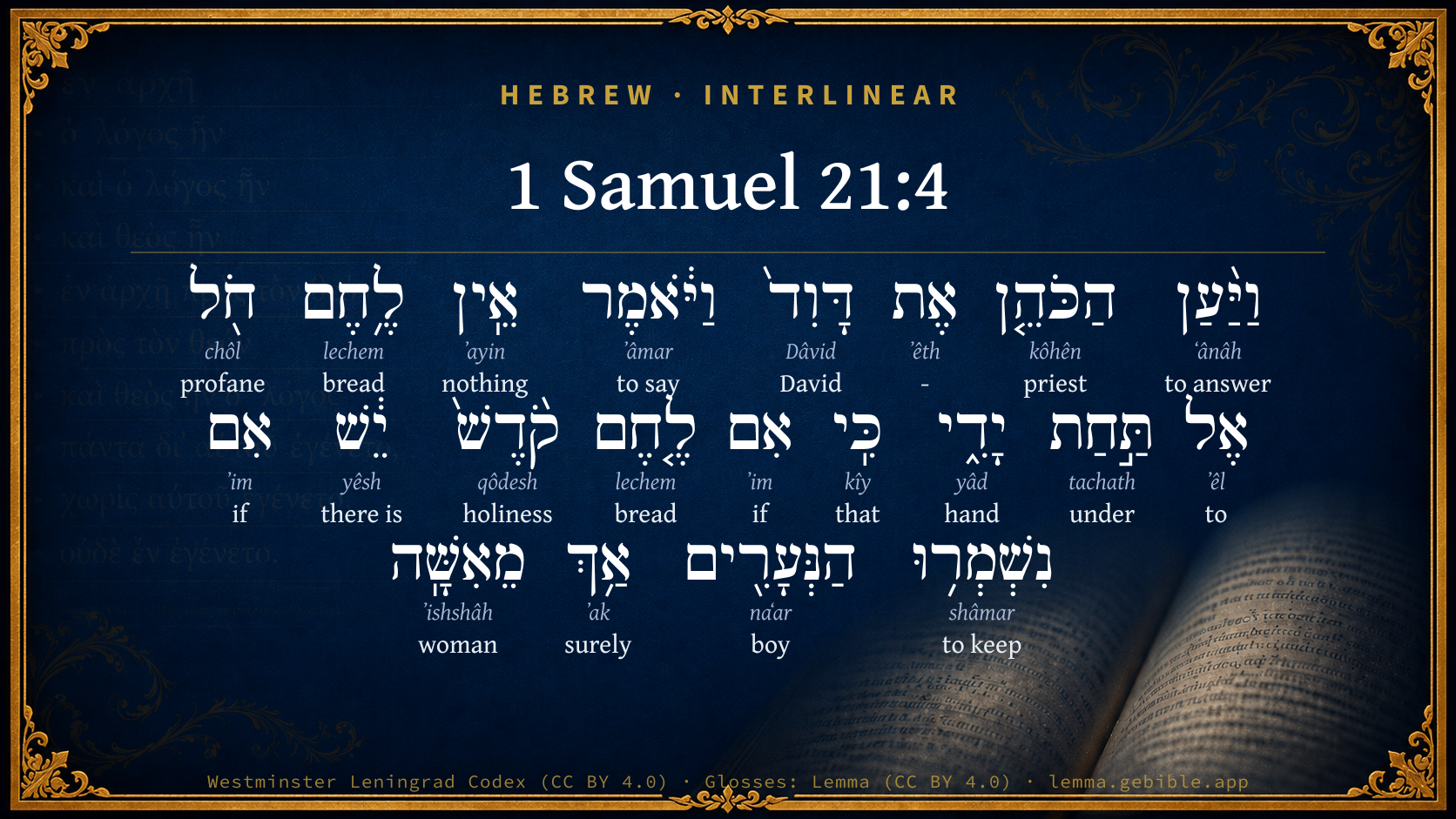
1 Samuel 21:4

Hebrew (Westminster Leningrad Codex) 1 Samuel 21:4 appears in the Hebrew Old Testament. The text above is from the Westminster Leningrad Codex. Each word links to its Strong’s number, a concise gloss, and parsing drawn from the Open Scriptures Hebrew Bible morphology. Click any word for its full Brown-Driver-Briggs (BDB) entry.
Download image
Cite this verse

1 Samuel 21:4 (World English Bible). Public Domain. Lemma interlinear Bible study tool, https://lemma.gebible.app/v/1-samuel/21/4.

Show BibTeX & RIS
BibTeX
RIS
English Translation
The priest answered David, and said, There is no common bread under my hand, but there is holy bread; if only the young men have kept themselves from women.
World English Bible · Public Domain
Download a study sheet

One document with this verse’s original text, its word-by-word gloss line, the meaning frame, cross-references with their text, attributed commentary, and full source and license credits — printable, and it pastes into notes with its structure intact.

This verse Autodidact and up

Study sheet (.html) Plain text (.txt)

A passage Seminary Student

Up to 50 verses in one chapter. A passage sheet keeps up to 6 commentary sources and 12 cross-references per verse, in the order this page ranks them, and says so on the sheet whenever that leaves anything out. Ask for a single verse and you get the Autodidact verse sheet above.

Everything on this page stays free to read, with no account — the sheet is a download of what is already on screen, not access to it.

Want to remove ads? Support Godless Engineer
Compare translations 3

The same verse in 3 English versions, stacked beneath the original-language interlinear above. Click any original word for its lexicon entry.

Each is an independent rendering of the whole verse — the interlinear is not word-aligned to these translations.

Highlighted words mark where these versions differ — a whole-verse word diff, not a word-by-word alignment.

  • World English Bible Public Domain
    The priest answered David, and said, There is no common bread under my hand, but there is holy bread; if only the young men have kept themselves from women.
  • King James Version Public Domain
    And the priest answered David, and said, There is no common bread under mine hand, but there is hallowed bread; if the young men have kept themselves at least from women.
  • unfoldingWord Literal Text CC BY-SA 4.0
    And the priest answered David and said, “ no common bread toward under my hand, but there is holy bread. If the young men have only kept themselves from women.”

unfoldingWord Literal Text — © unfoldingWord, licensed CC BY-SA 4.0. Word-aligned USFM3 via Door43 (git.door43.org/unfoldingWord/en_ult).

Versions to compare (up to 4)

3 of 4 selected

Show all 18 translations

Every available English version of this verse, each an independent rendering of the whole verse.

  • World English Bible Public Domain
    The priest answered David, and said, There is no common bread under my hand, but there is holy bread; if only the young men have kept themselves from women.
  • Berean Standard Bible Public Domain
    “There is no common bread on hand,” the priest replied, “but there is some consecrated bread—provided that the young men have kept themselves from women.”
  • Majority Standard Bible Public Domain
    “There is no common bread on hand,” the priest replied, “but there is some consecrated bread—provided that the young men have kept themselves from women.”
  • King James Version Public Domain
    And the priest answered David, and said, There is no common bread under mine hand, but there is hallowed bread; if the young men have kept themselves at least from women.
  • American Standard Version (1901) Public Domain
    And the priest answered David, and said, There is no common bread under my hand, but there is holy bread; if only the young men have kept themselves from women.
  • Revised Version (1885) Public Domain
    And the priest answered David, and said, There is no common bread under mine hand, but there is holy bread; if only the young men have kept themselves from women.
  • Geneva Bible (1599) Public Domain
    And the Priest answered Dauid, and saide, There is no common bread vnder mine hande, but here is halowed bread, if the yong men haue kept themselues, at least from women.
  • Douay-Rheims (1899) Public Domain
    And the priest answered David, saying: I have no common bread at hand, but only holy bread, if the young men be clean, especially from women?
  • Young's Literal Translation Public Domain
    And the priest answereth David, and saith, `There is no common bread under my hand, but there is holy bread; if the youths have been kept only from women.'
  • Literal Standard Version CC BY-SA 4.0
    And the priest answers David and says, “There is no common bread under my hand, but there is holy bread; if only the youths have been kept from women.”
  • Unlocked Literal Bible CC BY-SA 4.0
    The priest answered David and said, “There is no ordinary bread on hand, but there is holy bread—if the young men have kept themselves from women.”
  • unfoldingWord Literal Text CC BY-SA 4.0
    And the priest answered David and said, “ no common bread toward under my hand, but there is holy bread. If the young men have only kept themselves from women.”
  • Darby Bible Public Domain
    And the priest answered David and said, There is no common bread under my hand, but there is holy bread; if the young men have kept themselves at least from women.
  • World Messianic Bible Public Domain
    The priest answered David, and said, “I have no common bread, but there is holy bread; if only the young men have kept themselves from women.”
  • Webster's Bible Public Domain
    And the priest answered David, and said, There is no common bread under my hand, but there is hallowed bread; if the young men have kept themselves at least from women.
  • Free Bible Version CC BY-SA 4.0
    “There's no ordinary bread,” the priest told David, “but there's some holy bread, as long as your men have not slept with any women lately.”
  • Bible in Basic English Public Domain
    And the priest, answering David, said, I have no common bread here but there is holy bread; if only the young men have kept themselves from women.
  • JPS Tanakh (1917) Public Domain
    (21-5) And the priest answered David, and said: 'There is no common bread under my hand, but there is holy bread; if only the young men have kept themselves from women.'

Literal Standard Version (2020), Covenant Press — licensed CC BY-SA 4.0. Text via the HelloAO Bible API (eBible.org). Unlocked Literal Bible (unfoldingWord) — licensed CC BY-SA 4.0. Text via the HelloAO Bible API (eBible.org). unfoldingWord Literal Text — © unfoldingWord, licensed CC BY-SA 4.0. Word-aligned USFM3 via Door43 (git.door43.org/unfoldingWord/en_ult). Free Bible Version, Dr. Jonathan Gallagher — licensed CC BY-SA 4.0. Text via the HelloAO Bible API (eBible.org).

Word by word

More ways to search: Search by grammar → Find every occurrence → Compare this word →

Practice this passage: Drill this verse → Learn its vocabulary →

חֹ֖ל
chôl
H2455
“profane”
Noun, Common, Masculine, Singular, Absolute
Part of Speech
Noun
Type
Common
Gender
Masculine
Number
Singular
State
Absolute
Full BDB Definition

Origin: from H2490

TWOT: 623a , 661a

profaneness, commonness, unholy, profane, common, sand
  1. וַיַּ֨עַן ʻânâh H6030 “and · to answer” Conjunction + Verb, Qal, Sequential Imperfect, 3rd Person, Masculine, Singular
  2. הַכֹּהֵ֤ן kôhên H3548 “the · priest” Particle, Definite Article + Noun, Common, Masculine, Singular, Absolute
  3. אֶת ʼêth H853 “-” Particle, Direct Object
  4. דָּוִד֙ Dâvid H1732 “David” Noun, Proper
  5. וַיֹּ֔אמֶר ʼâmar H559 “and · to say” Conjunction + Verb, Qal, Sequential Imperfect, 3rd Person, Masculine, Singular
  6. אֵֽין ʼayin H369 “nothing” Particle, Negative
  7. לֶ֥חֶם lechem H3899 “bread of” Noun, Common, Both, Singular, Construct
  8. אֶל ʼêl H413 “to” Preposition
  9. תַּ֣חַת tachath H8478 “under” Preposition
  10. יָדִ֑י yâd H3027 “hand · my” Noun, Common, Both, Singular, Construct + Suffix, Personal, 1st Person, Common, Singular
  11. כִּֽי kîy H3588 “that” Conjunction
  12. אִם ʼim H518 “if” Conjunction
  13. לֶ֤חֶם lechem H3899 “bread of” Noun, Common, Both, Singular, Construct
  14. קֹ֨דֶשׁ֙ qôdesh H6944 “holiness” Noun, Common, Masculine, Singular, Absolute
  15. יֵ֔שׁ yêsh H3426 “there is” Particle, Demonstrative
  16. אִם ʼim H518 “if” Conjunction
  17. נִשְׁמְר֥וּ shâmar H8104 “to keep” Verb, Niphal, Perfect, 3rd Person, Common, Plural
  18. הַנְּעָרִ֖ים naʻar H5288 “the · boys” Particle, Definite Article + Noun, Common, Masculine, Plural, Absolute
  19. אַ֥ךְ ʼak H389 “surely” Particle, Accusative
  20. מֵאִשָּֽׁה ʼishshâh H802 “from · woman” Preposition + Noun, Common, Feminine, Singular, Absolute

About this verse

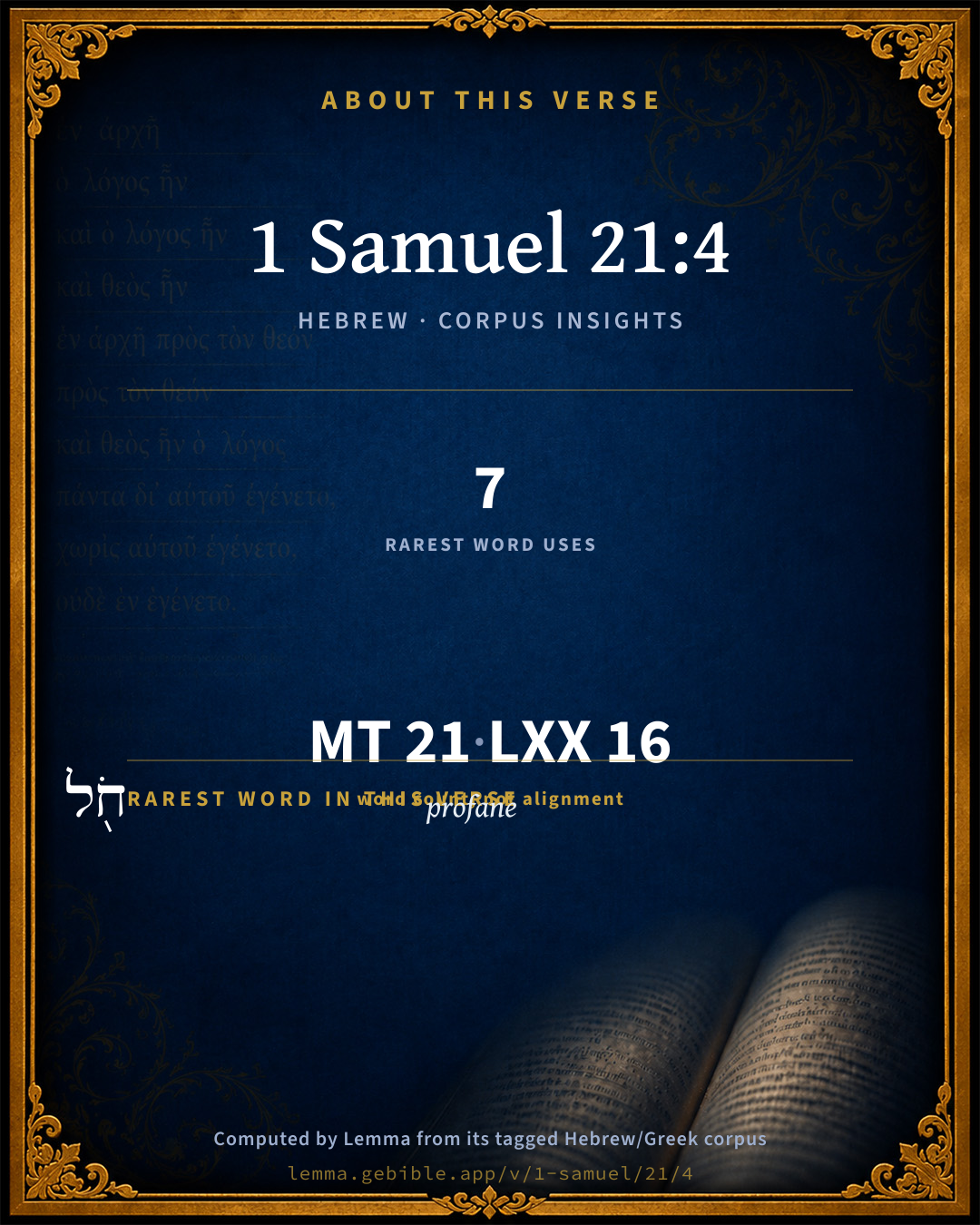
These counts appear in no published source. They are computed here, from the morphology-tagged text and Lemma’s own curated glosses. What Lemma adds →

21
words
19
distinct lemmas
Historical
section

Notable vocabulary

The rarest word here is חֹ֖ל profane H2455 — appearing just 7 times in the whole Hebrew Bible.

Shared distinctive vocabulary

חֹ֖ל profane H2455 occurs in 7 verses of the Hebrew Bible. Also found in:

Grammatical profile

  • 3 verbs
  • 9 nouns
  • 2 prepositions
  • 3 conjunctions
  • 4 particles

Verb forms

  • וַיַּ֨עַן Qal · Sequential Imperfect
  • וַיֹּ֔אמֶר Qal · Sequential Imperfect
  • נִשְׁמְר֥וּ Niphal · Perfect

Repetition

Words recur within this verse — often emphatic in Hebrew:

  • לֶ֥חֶם bread H3899 ×2
  • אִם if H518 ×2

Hebrew & Septuagint length

In English translation the verse runs 29 words from the Hebrew and 38 from the Septuagint (LXX English) — closely comparable.

A rough comparison of the two English renderings, which tokenize alike — not a word-level alignment.

Word counts can differ between the Hebrew and the Greek without any difference in meaning — e.g. the Hebrew direct-object marker אֵת has no separate Greek word, and Greek often adds the article ὁ.

In the original languages it is 21 Hebrew tokens and 16 Greek tokens — but the two are counted differently (Hebrew bundles its prefixes and suffixes into one token; the Greek is in lemma form), so that isn’t a like-for-like length.

Cross-references

7

Topical passages linked to 1 Samuel 21:4 in the Treasury of Scripture Knowledge — connected by theme and wording, ordered by reader-vote popularity; previews shown in the World English Bible.

  • Matthew 12:3–4 But he said to them, "Haven't you read what David did, when he was hungry, and those who were with him;
  • Exodus 19:15 He said to the people, "Be ready by the third day. Don't have sexual relations with a woman."
  • Exodus 25:30 You shall set bread of the presence on the table before me always.
  • Leviticus 24:5–9 "You shall take fine flour, and bake twelve cakes of it: two tenth parts of an ephah shall be in one cake.
  • 1 Samuel 21:6 So the priest gave him holy [bread]; for there was no bread there but the show bread, that was taken from before Yahweh, to put hot bread in the day when it was taken away.
  • Zechariah 7:3 and to speak to the priests of the house of Yahweh of Hosts, and to the prophets, saying, "Should I weep in the fifth month, separating myself, as I have done these so many years?"
  • 1 Corinthians 7:5 Don't deprive one another, unless it is by consent for a season, that you may give yourselves to fasting and prayer, and may be together again, that Satan doesn't tempt you because of your lack of self-control.

Cross-references courtesy of OpenBible.info (CC BY 4.0).

Hebrew and Greek witnesses Masoretic Hebrew ↔ Greek Septuagint

The same verse in the two great witnesses to the Old Testament, shown verse-for-verse.

These are two independent witnesses, not word-aligned to each other, and the Septuagint is shown in lemma (dictionary) form.

Hebrew 1 Samuel 21:4 Masoretic · Westminster Leningrad Codex

וַיַּ֨עַן הַכֹּהֵ֤ן אֶת דָּוִד֙ וַיֹּ֔אמֶר אֵֽין לֶ֥חֶם חֹ֖ל אֶל תַּ֣חַת יָדִ֑י כִּֽי אִם לֶ֤חֶם קֹ֨דֶשׁ֙ יֵ֔שׁ אִם נִשְׁמְר֥וּ הַנְּעָרִ֖ים אַ֥ךְ מֵאִשָּֽׁה

The priest answered David, and said, There is no common bread under my hand, but there is holy bread; if only the young men have kept themselves from women.

World English Bible · Public Domain

Greek LXX 1 Samuel 21:4 Septuagint · lemma form

καί νῦν εἰ εἰμί ὑπό ὁ χείρ σύ πέντε ἄρτος δίδωμι εἰς χείρ ἐγώ ὁ εὑρίσκω

And the priest answered David, and said, There are no common loaves under my hand, for I have none but holy loaves: if the young men have been kept at least from women, then they shall eat them.

LXX2012 (modern English Septuagint) · Public Domain

Hebrew: Westminster Leningrad Codex (CC BY 4.0). Greek: Septuagint (public domain); English from LXX2012 (modern English Septuagint) (Public Domain). How the Septuagint differs from the Hebrew →

Targum (Aramaic paraphrase)

1

The Targum is the ancient Jewish Aramaic paraphrase of the Hebrew Scriptures — an interpretive translation, not the Hebrew text itself. Onkelos (literal) and Pseudo-Jonathan (expansive) render the Torah, and Jonathan the Prophets. Coverage is partial: where no permissively-licensed English translation exists for a verse, only the Aramaic is shown. This is verse-level text, not a word-by-word alignment to the Hebrew.

  1. Targum Jonathan Prophets (Joshua–Malachi)
    וּכְעַן מָה אִית כָּא תְּחוֹת יְדָךְ חַמְשָׁא טוּלְמִין דְלַחְמָא הַב בִּידִי אוֹ מַה דְאִשְׁתְּכַח:

    (no public-domain English translation for this verse)

    Targum Jonathan — Aramaic: “Mikraot Gedolot” (public domain). English: “Sefaria Community Translation” (CC0 1.0 (public-domain dedication)); “London "Chaldee Paraphrase," 1871” (public domain). Text via Sefaria.

Commentary

Notes on 1 Samuel 21:4 from classic Christian and Jewish commentators (each source and its license shown beneath its notes). The classic Christian expositions comment on the surrounding passage and are grouped to its opening verse, so a note may address several verses; the Jewish commentaries on the Tanakh (Rashi and others) are per-verse, so they appear only where the commentator wrote on this verse.

Lemma curates 59 commentaries, every one of them public domain or Creative Commons licensed, each selected and text-cleaned for this edition rather than reprinted as found. About our sources →

Trapp's Complete Commentary

John Trapp

1Sa 21:4 And the priest answered David, and said, [There is] no common bread under mine hand, but there is hallowed bread; if the young men have kept themselves at least from women.

Ver. 4. There is no common bread under mine hand.] He kept house at Anathoth, where doubtless he had common bread; but David’s haste called for present supply.

If the young men have kept themselves at least from women.] From companying with their wives; which, though lawful enough, {Heb 13:4} yet through men’s corruption, it sometimes is not without sin; and some legal uncleanness was contracted by it. See Lev 15:18 Exo 19:15. Howbeit this was not a sufficient impediment to David and his followers in this necessity: and therefore Jerome saith that this was a ridiculous and preposterous objection.

John Trapp, A Commentary or Exposition upon All the Books of the Old and New Testament (1647–1656) — public domain. Text from a community e-Sword module.

Tyndale Open Study Notes

Tyndale Open Resources

21:4 Only priests were permitted to partake of holy bread (see Exod 25:22-30; Lev 24:5-9), and only within the sacred precincts. • slept with any women: The consecrated bread was to be eaten only by the ritually pure, so the priest verified that David’s men were free from ritual impurity caused by sexual activity (see Lev 15:16-18). Typically, such bread would not be available for consumption by laity. The priest made an exception in this case probably because he sensed the men’s physical needs and he believed they were on a royal mission.

Tyndale Open Study Notes — © Tyndale Open Resources, licensed CC BY-SA 4.0. Text via the HelloAO Bible API.

Geneva Bible (1599)

Geneva Bible translators

If they have not accompanied with their wives.

Geneva Bible (1599) marginal notes — public domain. Text via Bolls.life.

Jamieson, Fausset & Brown

Robert Jamieson, A. R. Fausset & David Brown

there is hallowed bread--There would be plenty of bread in his house; but there was no time to wait for it. "The hallowed bread" was the old shew-bread, which had been removed the previous day, and which was reserved for the use of the priests alone (Lev 24:9). Before entertaining the idea that this bread could be lawfully given to David and his men, the high priest seems to have consulted the oracle (Sa1 22:10) as to the course to be followed in this emergency. A dispensation to use the hallowed bread was specially granted by God Himself.

Jamieson, Fausset & Brown — Commentary Critical and Explanatory on the Whole Bible (1871) — public domain (CC PDM 1.0). Text via the HelloAO Bible API.

Ellicott's Commentary for English Readers

(4) There is no common bread.—The condition of the priests in these days of Saul was evidently a pitiable one. The terrible massacre related in the next chapter seems not to have excited the wail of indignation and woe which such a wholesale murder of the priests of the living God should naturally have called out from the entire people. They were evidently held in little esteem, and their murder was regarded at the time, not as an awful act of sacrilege, but simply as an act of political vengeance—of punishment for what the king was pleased to style treason. Here the almost destitute condition of the ministers of the principal sanctuary of Israel appears from the quiet answer of the high priest to David, telling him they had positively no bread but the stale bread removed from before “the Presence” in the holy building.

This “hallowed bread,” or shewbread, five loaves of which David petitioned for, consisted of twelve loaves, one for each tribe, which were placed in the Tabernacle fresh every Sabbath Day. The law of Moses was that this bread, being most holy, could only be eaten by the priests in the holy place. It is probable that this regulation had been relaxed, and that the bread was now often being carried away and eaten in the homes of the ministering priests, and on urgent occasions, perhaps, was even given to the “laity,” as in this case, the proviso only being made that the consumers of the bread should be ceremonially pure. Our Saviour, in Mat_12:3, especially uses this example, drawn from the Tabernacle’s honoured customs, to justify a violation of the letter of the law, when its strict observance would stand in the way of the fulfilment of man’s sacred duty to his neighbour.

The natural inference from this incident would be that such a violation of the Mosaic Law was not an uncommon occurrence, as Ahimelech at once gave him the hallowed bread, only making a conditional inquiry about ceremonial purity—a condition which came out so readily that we feel it had often been made before. The Talmud, however, is most anxious that this inference should not be drawn, and points out in the treatise Menachoth, “Meat-offerings” (Seder Kodashim), that this bread was not newly taken out of the sanctuary, but had been removed on some previous day, and that as, after a week’s exposure, it was stale and dry, the priests ate but little of it, and the rest was left. (See Treatise Yoma, 39.) It also points out that had such violation of the Levitical Law been common, so much importance would not have been attached to this incident.

A Bible Commentary for English Readers, edited by Charles John Ellicott (1878–1897) — public domain. Text from a community e-Sword module.

The Cambridge Bible for Schools and Colleges

gen. ed. J. J. S. Perowne

4. common] Lit. profane or unholy, i.e. unconsecrated. Vulg. “laicos panes.”

The Cambridge Bible for Schools and Colleges (gen. ed. J. J. S. Perowne; Cambridge University Press, 1878–1918) — public domain. Text from a community e-Sword module.

John Gill's Exposition

And the priest answered David, and said, there is no common bread under mine hand,.... In the tabernacle, though he might have such in his own house; which was common for any man to eat of, even such as were not priests; but he had none there, and David was in haste to be gone because of Doeg, and could not stay till such was fetched:

but there is hallowed bread; such as was devoted to sacred use. Kimchi's father thinks this was the bread of the thank offering, to which Ben Gersom inclines; otherwise the Jewish writers in general understand it of the shewbread; and it is clear it was that from Sa1 21:6 and from what our Lord says, Mat 12:4. Now this the priest had under his hand, being just taken off of the shewbread table, and was the perquisite of the priests; and which, though it was not lawful for any but priests to eat of, yet in this case of necessity he seemed willing to give it to David and his men, on this condition: if the young men have kept themselves at least from women; from their wives or others, and from any pollution by them, in any way or manner; but as this was also only of a ceremonial kind, it might as well have been dispensed with, had this been the case, as the other.

John Gill's Exposition of the Whole Bible (1746–1763) — public domain (CC PDM 1.0). Text via the HelloAO Bible API.

Albert Barnes' Notes on the Bible

Common - As opposed to holy. (See the marginal references, and compare the use of the word in Act 10:14-15, Act 10:28.) It gives an idea of the depressed and poor condition of the priesthood at that time, that Ahimelech should have had no bread at hand except the showbread.

Albert Barnes' Notes on the Bible (1834–1885) — public domain. Text from a community e-Sword/MySword module.

Haydock's Catholic Bible Commentary

If the young men be clean, &c. If this cleanness was required of them that were to eat that bread, which was but a figure of the bread of life which we receive in the blessed sacrament [the Eucharist]; how clean ought Christians be when they approach to our tremendous mysteries? And what reason hath the Church of God to admit none to be her ministers, to consecrate and daily receive this most pure sacrament, but such as devote themselves to a life of perpetual purity. (Challoner) --- Women. God required this on many occasions, Exodus xix. 15. Urgent necessity determined Achimelech to grant the loaves, as our Saviour intimates, though it is probable that he first consulted the Lord, chap. xxii. 16. (Calmet) --- David perhaps went to Nobe on purpose to ask advice. (Menochius) --- We have here an example of a dispensation, and of the distinction between lay, or common, and holy bread. (Worthington)

George Leo Haydock (1774–1849), Haydock's Catholic Family Bible and Commentary, 1859 edition — public domain. Excludes Psalms (Douay-Rheims chapter numbering differs from Protestant) and Deuterocanonical books (Catholic canon only).

Matthew Poole's English Annotations

Under mine hand, to wit, here in the tabernacle; though doubtless he had enough of that and of other provisions in his house; but David was in great haste, and in fear of Doeg, whom he saw and knew there, 1Sa 22:22, and therefore would not stay till any thing could be fetched thence.

Hallowed bread; the shew-bread, which was appropriated to the priests; of which see Exo 25:30; Lev 24:5.

At least from women; either from uncleanness by women, which might be divers ways contracted; or from conjugal converse with their wives; which though it did not defile them, yet he thought might debar them from the participation of such very sacred things; which he gathered by the analogy of that precept, Exo 19:15. There was a double impediment to the giving of this bread to them:

1. Its sacredness in itself; which the priest implies, and David answers, 1Sa 21:5, and the priest was satisfied therein by David’s extraordinary occasions and great necessities.

2. The purity and abstinence from all women, which he supposeth should be in those that use it; concerning which he now inquires. And though he mention this only concerning David’s young men, and out of modesty and reverence to David forbears to name him; yet he is also included in the number, as David’s answer shows.

Matthew Poole's English Annotations on the Holy Bible (1683–1685) — public domain. Text from a community e-Sword/MySword module.

Whedon's Commentary on the Bible

Daniel D. Whedon

4. Common bread — Bread not consecrated; such as might lawfully be eaten by ordinary persons.

Hallowed bread — That is, the showbread, which it was unlawful for any but the priests to eat. Exo_29:32; Lev_24:9.

If the young men have kept themselves… from women — If they take of the hallowed bread, it is necessary that they should be at least ceremonially clean in the matter here specified. Sexual intercourse made a person unfit for contact with holy things. Exo_19:15; Lev_15:16. Thus the high priest judges that in a case of necessity, the requirements of the law regarding this bread might be set aside. Compare Mat_12:4, and Mar_2:26.

Daniel D. Whedon (gen. ed.), Commentary on the Old and New Testaments (1874–1909) — public domain. Text from a community e-Sword module.

John Wesley's Explanatory Notes

There is, &c. - Here in the tabernacle: though doubtless he had other provisions is his house; but David was in great haste, and in fear of Doeg whom he saw, and knew and therefore would not stay 'till any thing could be fetched thence. There was a double impediment to the giving this bread to them;

1. Its sacredness in itself; which the priest implies, and David answers ver. 5, and the priest was satisfied therein by David's great necessities.

2. The abstinence from all women, which he supposed should be in those that use it; concerning which he now inquires. And though he mentions this only concerning David's young men, and out of reverence forbears to name him; yet he is also included in the number, as David's answer shews.

John Wesley, Explanatory Notes Upon the Whole Bible (1754–1765) — public domain. Text via the GEBible commentary corpus.

Rashi

Rabbi Shlomo Yitzchaki (Rashi)

Or whatever there is. If there are not five, give me whatever is in your possession.

Rashi on the Tanakh — English translations: “The Judaica Press complete Tanach with Rashi, translated by A. J. Rosenberg” (CC BY 4.0); “Pentateuch with Rashi's commentary by M. Rosenbaum and A.M. Silbermann, 1929-1934” (public domain); “The Metsudah Tanach series, Lakewood, N.J” (CC BY 4.0); and “The Book of Joshua, Metsudah Publications, 1997” (CC BY 4.0). Text via Sefaria.

Lesson kit

Teaching starters — assembled from the data on this page, not authored interpretation. Every prompt links to the verse data it draws on. Edit before teaching.

1 Samuel, in the Historical, opens this verse with 21 words (19 distinct Hebrew lemmas). Its most distinctive word is chôl (“profane”). A historical commentator’s framing appears above. Read the whole chapter for the surrounding context.

Discussion questions

  1. What does “profane” (chôl) contribute to the verse as a whole?
  2. How does Leviticus 10:10, which shares the word «profane», read alongside this verse?
  3. What does the repetition of “bread” (2× in this one verse) do in this verse?
  4. The translations on this page render this verse differently — a whole-verse word diff, not a word-by-word alignment. What might account for the different wordings?
  5. «וַיַּ֨עַן» is a Qal Sequential Imperfect verb. How does that grammatical form shape the action described?
  6. Compare how Trapp's Complete Commentary and Tyndale Open Study Notes read this verse. Where do they agree or differ?

Things to notice

Reading settings

Reading text

Shown beneath each verse's original-language words.

Old Testament
Old Testament edition

Read the OT as the Masoretic Hebrew (MT) or the Greek Septuagint (LXX).

English shown for the Greek Septuagint (in the Hebrew ↔ Greek comparison).

Comparing translations? Open the Compare panel on any verse page to stack up to four side by side.