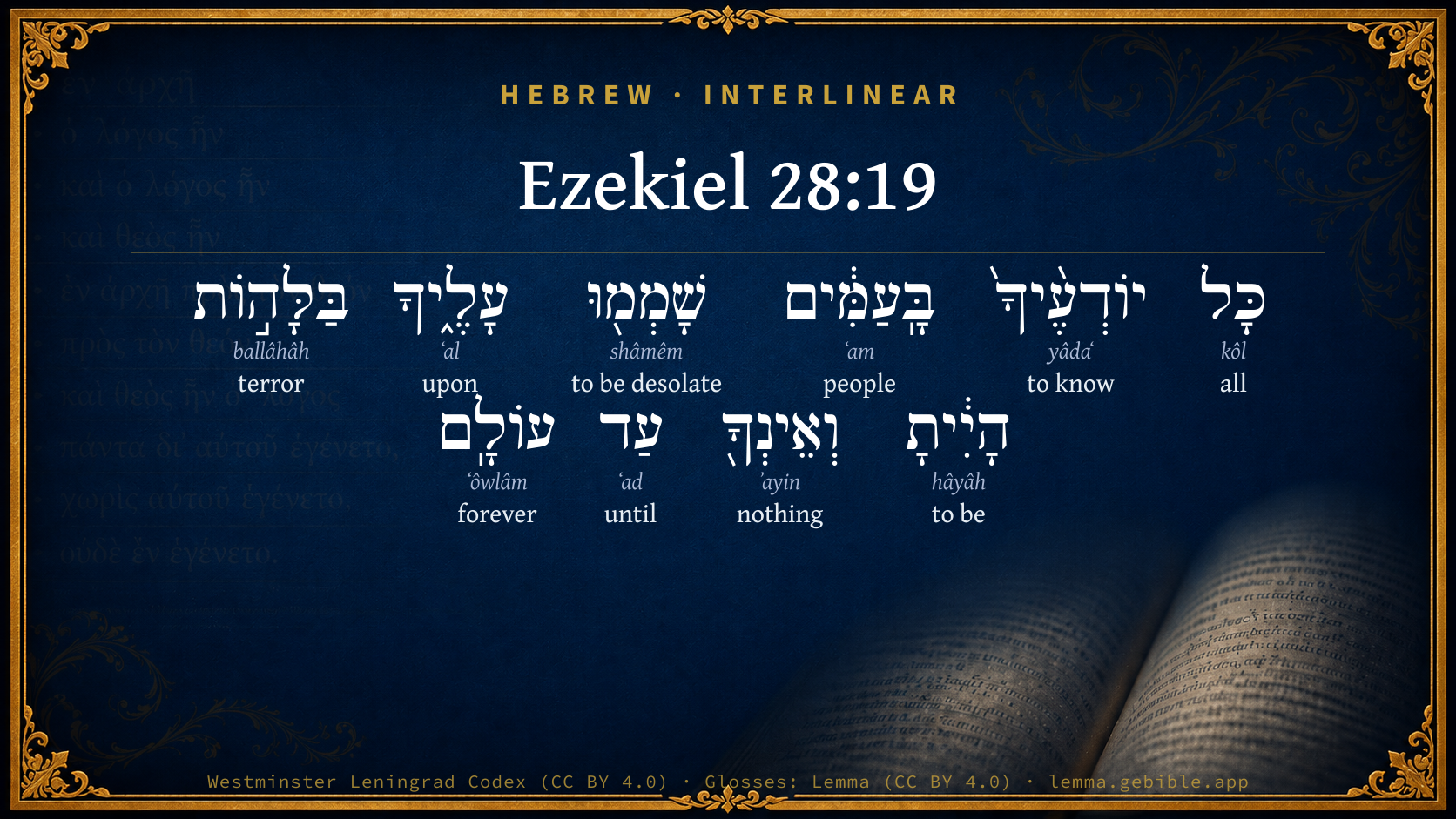
Ezekiel 28:19

Hebrew (Westminster Leningrad Codex) Ezekiel 28:19 appears in the Hebrew Old Testament. The text above is from the Westminster Leningrad Codex. Each word links to its Strong’s number, a concise gloss, and parsing drawn from the Open Scriptures Hebrew Bible morphology. Click any word for its full Brown-Driver-Briggs (BDB) entry.
Download image
Cite this verse

Ezekiel 28:19 (World English Bible). Public Domain. Lemma interlinear Bible study tool, https://lemma.gebible.app/v/ezekiel/28/19.

Show BibTeX & RIS
BibTeX
RIS
English Translation
All those who know you among the peoples shall be astonished at you: you are become a terror, and you shall nevermore have any being.
World English Bible · Public Domain
Download a study sheet

One document with this verse’s original text, its word-by-word gloss line, the meaning frame, cross-references with their text, attributed commentary, and full source and license credits — printable, and it pastes into notes with its structure intact.

This verse Autodidact and up

Study sheet (.html) Plain text (.txt)

A passage Seminary Student

Up to 50 verses in one chapter. A passage sheet keeps up to 6 commentary sources and 12 cross-references per verse, in the order this page ranks them, and says so on the sheet whenever that leaves anything out. Ask for a single verse and you get the Autodidact verse sheet above.

Everything on this page stays free to read, with no account — the sheet is a download of what is already on screen, not access to it.

Want to remove ads? Support Godless Engineer
Compare translations 3

The same verse in 3 English versions, stacked beneath the original-language interlinear above. Click any original word for its lexicon entry.

Each is an independent rendering of the whole verse — the interlinear is not word-aligned to these translations.

Highlighted words mark where these versions differ — a whole-verse word diff, not a word-by-word alignment.

  • World English Bible Public Domain
    All those who know you among the peoples shall be astonished at you: you are become a terror, and you shall nevermore have any being.
  • King James Version Public Domain
    All they that know thee among the people shall be astonished at thee: thou shalt be a terror, and never shalt thou be any more.
  • unfoldingWord Literal Text CC BY-SA 4.0
    All the ones who knew you among the peoples will shudder at you; they will be horrified, and you will be no more forever.’”

unfoldingWord Literal Text — © unfoldingWord, licensed CC BY-SA 4.0. Word-aligned USFM3 via Door43 (git.door43.org/unfoldingWord/en_ult).

Versions to compare (up to 4)

3 of 4 selected

Show all 18 translations

Every available English version of this verse, each an independent rendering of the whole verse.

  • World English Bible Public Domain
    All those who know you among the peoples shall be astonished at you: you are become a terror, and you shall nevermore have any being.
  • Berean Standard Bible Public Domain
    All the nations who know you are appalled over you. You have come to a horrible end and will be no more.’”
  • Majority Standard Bible Public Domain
    All the nations who know you are appalled over you. You have come to a horrible end and will be no more.’”
  • King James Version Public Domain
    All they that know thee among the people shall be astonished at thee: thou shalt be a terror, and never shalt thou be any more.
  • American Standard Version (1901) Public Domain
    All they that know thee among the peoples shall be astonished at thee: thou art become a terror, and thou shalt nevermore have any being.
  • Revised Version (1885) Public Domain
    All they that know thee among the peoples shall be astonished at thee: thou art become a terror, and thou shalt never be any more.
  • Geneva Bible (1599) Public Domain
    All they that knowe thee among the people, shalbe astonished at thee: thou shalt be a terrour, and neuer shalt thou be any more.
  • Douay-Rheims (1899) Public Domain
    All that shall see thee among the nations, shall be astonished at thee: thou art brought to nothing, and thou shalt never be any more.
  • Young's Literal Translation Public Domain
    All knowing thee among the peoples Have been astonished at thee, Wastes thou hast been, and thou art not -- to the age.'
  • Literal Standard Version CC BY-SA 4.0
    All knowing you among the peoples || Have been astonished at you, || You have been terrors, and you are not—for all time.”
  • Unlocked Literal Bible CC BY-SA 4.0
    All the ones who knew you among the peoples will shudder at you; they will be horrified, and you will be no more forever.'”
  • unfoldingWord Literal Text CC BY-SA 4.0
    All the ones who knew you among the peoples will shudder at you; they will be horrified, and you will be no more forever.’”
  • Darby Bible Public Domain
    All they that know thee among the peoples shall be amazed at thee: thou art become a terror, and thou shalt never be any more.
  • World Messianic Bible Public Domain
    All those who know you among the peoples will be astonished at you. You have become a terror, and you will exist no more.”’”
  • Webster's Bible Public Domain
    All they that know thee among the people shall be astonished at thee: thou shalt be a terror, and never shalt thou be any more.
  • Free Bible Version CC BY-SA 4.0
    All who know you among the nations are horrified at what happened to you. Disaster has brought you down and you're finished forever.”
  • Bible in Basic English Public Domain
    All who have knowledge of you among the peoples will be overcome with wonder at you: you have become a thing of fear, and you will never be seen again.
  • JPS Tanakh (1917) Public Domain
    All they that know thee among the peoples shall be appalled at thee; thou art become a terror, and thou shalt never be any more.'

Literal Standard Version (2020), Covenant Press — licensed CC BY-SA 4.0. Text via the HelloAO Bible API (eBible.org). Unlocked Literal Bible (unfoldingWord) — licensed CC BY-SA 4.0. Text via the HelloAO Bible API (eBible.org). unfoldingWord Literal Text — © unfoldingWord, licensed CC BY-SA 4.0. Word-aligned USFM3 via Door43 (git.door43.org/unfoldingWord/en_ult). Free Bible Version, Dr. Jonathan Gallagher — licensed CC BY-SA 4.0. Text via the HelloAO Bible API (eBible.org).

Word by word

More ways to search: Search by grammar → Find every occurrence → Compare this word →

Practice this passage: Drill this verse → Learn its vocabulary →

בַּלָּה֣וֹת
ballâhâh
H1091
“terrors”
Noun, Common, Feminine, Plural, Absolute
Part of Speech
Noun
Type
Common
Gender
Feminine
Number
Plural
State
Absolute
Full BDB Definition

Origin: from H1089

TWOT: 247a

terror, destruction, calamity, dreadful event
  1. כָּל kôl H3605 “all of” Noun, Common, Masculine, Singular, Construct
  2. יוֹדְעֶ֨יךָ֙ yâdaʻ H3045 “knowing · you” Verb, Qal, Participle Active, Masculine, Plural, Construct + Suffix, Personal, 2nd Person, Masculine, Singular
  3. בָּֽעַמִּ֔ים ʻam H5971 “in/at the · peoples” Preposition, Determined + Noun, Common, Masculine, Plural, Absolute
  4. שָׁמְמ֖וּ shâmêm H8074 “to be desolate” Verb, Qal, Perfect, 3rd Person, Common, Plural
  5. עָלֶ֑יךָ ʻal H5921 “upon · you” Preposition + Suffix, Personal, 2nd Person, Masculine, Singular
  6. הָיִ֔יתָ hâyâh H1961 “to be” Verb, Qal, Perfect, 2nd Person, Masculine, Singular
  7. וְאֵינְךָ֖ ʼayin H369 “and · nothing · you” Conjunction + Particle, Negative + Suffix, Personal, 2nd Person, Masculine, Singular
  8. עַד ʻad H5704 “until” Preposition
  9. עוֹלָֽם ʻôwlâm H5769 “forever” Noun, Common, Masculine, Singular, Absolute

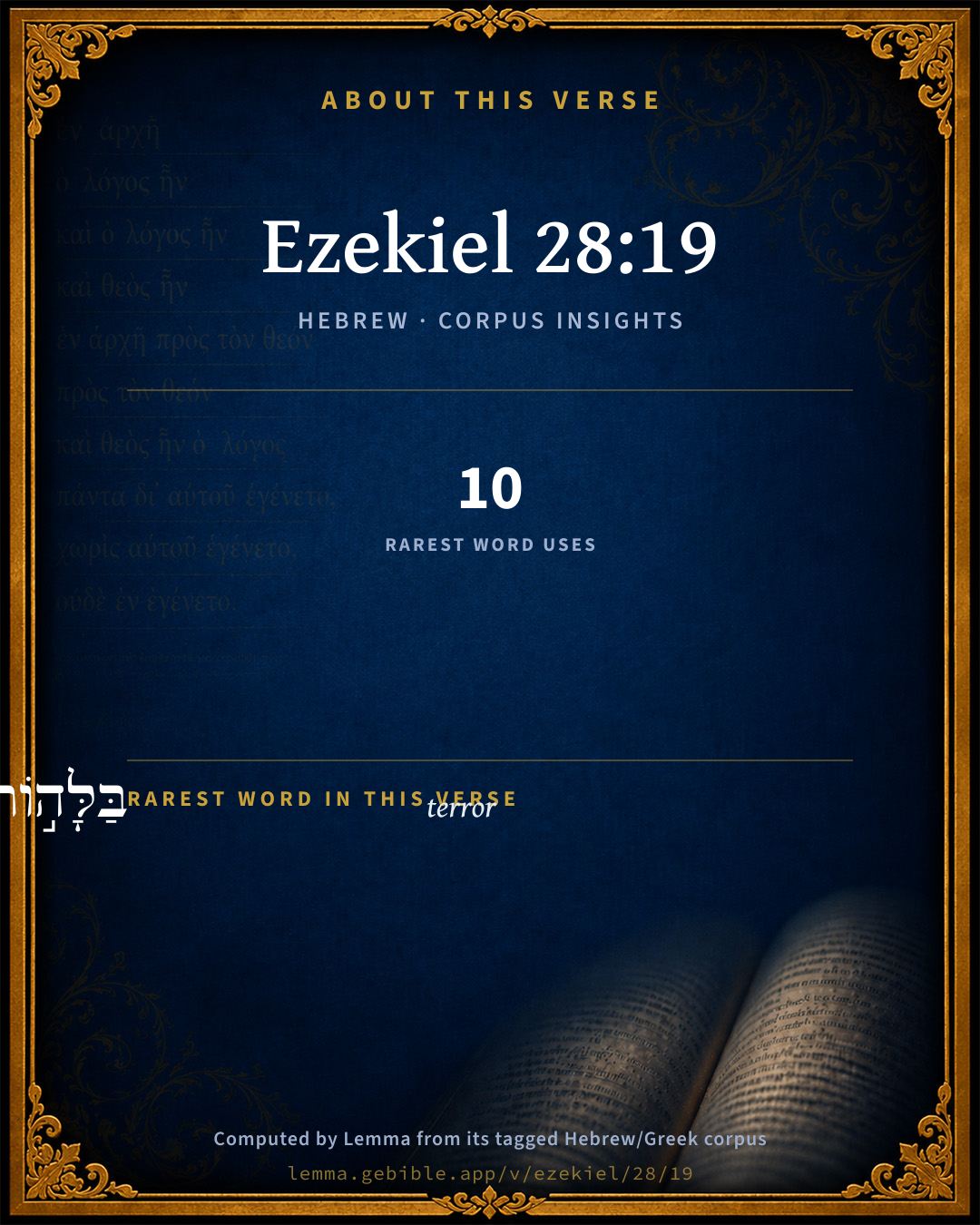
About this verse

These counts appear in no published source. They are computed here, from the morphology-tagged text and Lemma’s own curated glosses. What Lemma adds →

10
words
10
distinct lemmas
Prophets
section

Notable vocabulary

The rarest word here is בַּלָּה֣וֹת terror H1091 — appearing just 10 times in the whole Hebrew Bible.

Shared distinctive vocabulary

בַּלָּה֣וֹת terror H1091 occurs in 10 verses of the Hebrew Bible. Also found in:

Grammatical profile

  • 3 verbs
  • 4 nouns
  • 2 prepositions
  • 1 particle

Verb forms

  • יוֹדְעֶ֨יךָ֙ Qal · Participle Active
  • שָׁמְמ֖וּ Qal · Perfect
  • הָיִ֔יתָ Qal · Perfect

Hebrew & Septuagint length

In English translation the verse runs 25 words from the Hebrew and 24 from the Septuagint (LXX English) — closely comparable.

A rough comparison of the two English renderings, which tokenize alike — not a word-level alignment.

Word counts can differ between the Hebrew and the Greek without any difference in meaning — e.g. the Hebrew direct-object marker אֵת has no separate Greek word, and Greek often adds the article ὁ.

Cross-references

9

Topical passages linked to Ezekiel 28:19 in the Treasury of Scripture Knowledge — connected by theme and wording, ordered by reader-vote popularity; previews shown in the World English Bible.

  • Ezekiel 26:21 I will make you a terror, and you shall no more have any being; though you are sought for, yet shall you never be found again, says the Lord Yahweh.
  • Revelation 18:15–19 The merchants of these things, who were made rich by her, will stand far away for the fear of her torment, weeping and mourning;
  • Revelation 18:21 A mighty angel took up a stone like a great millstone and cast it into the sea, saying, "Thus with violence will Babylon, the great city, be thrown down, and will be found no more at all.
  • Psalms 76:12 He will cut off the spirit of princes. He is feared by the kings of the earth.
  • Isaiah 14:16–19 Those who see you shall gaze at you, they shall consider you, [saying], "Is this the man who made the earth to tremble, who shook kingdoms;
  • Jeremiah 51:63–64 It shall be, when you have made an end of reading this book, that you shall bind a stone to it, and cast it into the midst of the Euphrates:
  • Ezekiel 26:14 I will make you a bare rock; you shall be a place for the spreading of nets; you shall be built no more: for I Yahweh have spoken it, says the Lord Yahweh.
  • Ezekiel 27:35–36 All the inhabitants of the isles are astonished at you, and their kings are horribly afraid; they are troubled in their face.
  • Revelation 18:9–10 The kings of the earth, who committed sexual immorality and lived wantonly with her, will weep and wail over her, when they look at the smoke of her burning,

Cross-references courtesy of OpenBible.info (CC BY 4.0).

Hebrew and Greek witnesses Masoretic Hebrew ↔ Greek Septuagint

The same verse in the two great witnesses to the Old Testament, shown verse-for-verse.

These are two independent witnesses, not word-aligned to each other, and the Septuagint is shown in lemma (dictionary) form.

Hebrew Ezekiel 28:19 Masoretic · Westminster Leningrad Codex

כָּל יוֹדְעֶ֨יךָ֙ בָּֽעַמִּ֔ים שָׁמְמ֖וּ עָלֶ֑יךָ בַּלָּה֣וֹת הָיִ֔יתָ וְאֵינְךָ֖ עַד עוֹלָֽם

All those who know you among the peoples shall be astonished at you: you are become a terror, and you shall nevermore have any being.

World English Bible · Public Domain

Greek LXX Ezekiel 28:19 Septuagint · lemma form

καί πᾶς ὁ ἐπιἵστημι σύ ἐν ὁ ἔθνος στυγνάζω ἐπί σύ ἀπώλεια γίγνομαι καί οὐ ὑποἄρχω ἔτι εἰς ὁ αἰών

And all that know you among the nations shall groan over you: you are gone to destruction, and you shall not exist any more.

LXX2012 (modern English Septuagint) · Public Domain

Hebrew: Westminster Leningrad Codex (CC BY 4.0). Greek: Septuagint (public domain); English from LXX2012 (modern English Septuagint) (Public Domain). How the Septuagint differs from the Hebrew →

Targum (Aramaic paraphrase)

1

The Targum is the ancient Jewish Aramaic paraphrase of the Hebrew Scriptures — an interpretive translation, not the Hebrew text itself. Onkelos (literal) and Pseudo-Jonathan (expansive) render the Torah, and Jonathan the Prophets. Coverage is partial: where no permissively-licensed English translation exists for a verse, only the Aramaic is shown. This is verse-level text, not a word-by-word alignment to the Hebrew.

  1. Targum Jonathan Prophets (Joshua–Malachi)
    כָּל דְיָדְעָךְ בְּעַמְמַיָא צְדִיאוּ עֲלָךְ כִּדְלָא הֲוֵית אֶתְנִינָךְ וְכֵן תְּהֵי עַד עָלְמָא:

    (no public-domain English translation for this verse)

    Targum Jonathan — Aramaic: “Mikraot Gedolot” (public domain). English: “Sefaria Community Translation” (CC0 1.0 (public-domain dedication)); “London "Chaldee Paraphrase," 1871” (public domain). Text via Sefaria.

Commentary

Notes on Ezekiel 28:19 from classic Christian and Jewish commentators (each source and its license shown beneath its notes). The classic Christian expositions comment on the surrounding passage and are grouped to its opening verse, so a note may address several verses; the Jewish commentaries on the Tanakh (Rashi and others) are per-verse, so they appear only where the commentator wrote on this verse.

Lemma curates 59 commentaries, every one of them public domain or Creative Commons licensed, each selected and text-cleaned for this edition rather than reprinted as found. About our sources →

Trapp's Complete Commentary

John Trapp

Eze 28:19 All they that know thee among the people shall be astonished at thee: thou shalt be a terror, and never [shalt] thou [be] any more.

Ver. 19. Thou shalt be a terror.] As kings exceed all others in glory, so their fall is oft with so great ignominy, that they become a wonder and a terror to all people.

John Trapp, A Commentary or Exposition upon All the Books of the Old and New Testament (1647–1656) — public domain. Text from a community e-Sword module.

Geneva Bible (1599)

Geneva Bible translators

Or, brought to nothing.

Geneva Bible (1599) marginal notes — public domain. Text via Bolls.life.

Adam Clarke's Commentary

Verse 19. Thou shalt be a terror] Instead of being an object of adoration thou shalt be a subject of horror, and at last be destroyed with thy city, so that nothing but thy name shall remain. It was entirely burnt by Alexander the Great, as it had been before by Nebuchadnezzar.

Adam Clarke's Commentary on the Bible (1810–1826) — public domain. Text from a community e-Sword/MySword module.

The Cambridge Bible for Schools and Colleges

gen. ed. J. J. S. Perowne

19. shalt be a terror] Cf. Eze_26:21, Eze_27:36.

The Cambridge Bible for Schools and Colleges (gen. ed. J. J. S. Perowne; Cambridge University Press, 1878–1918) — public domain. Text from a community e-Sword module.

John Gill's Exposition

All they that know thee among the people shall be astonished at thee,.... At thy fall; that such a mighty city, and powerful prince, should be destroyed at once; that, from such a height of prosperity, they should be brought to so low an estate of adversity; this will be the astonishment of kings, merchants, and others, that knew the riches, power, and flourishing estate of Rome, as before observed:

thou shalt be a terror; to the said persons, who will be afraid to come nigh for fear of the same torments and punishment, Rev 18:10, or, though thou "hast been a terror"; or "terrors"; exceeding terrible to others in time past, yet now, as the Targum,

"I will give thee (or make thee) as if thou wast not:''

and never shalt thou be any more; as thou hast been, or after thy last destruction; so mystical Tyre or Babylon shall be no more, when once destroyed, Rev 18:21.

John Gill's Exposition of the Whole Bible (1746–1763) — public domain (CC PDM 1.0). Text via the HelloAO Bible API.

Matthew Poole's English Annotations

All that have heard, seen, or formerly known thy riches, power, allies, wisdom, and vigilance, shall be astonished at thee; be amazed at the certain news of thy great fall, from greatest glory to greatest reproach.

Thou shalt be a terror to all that hear the bruit hereof:

though thou hast been a terror, so the Hebrew, to others by thy puissance and arms, thou shalt never be so again for ever: and this word hath been made good; Tyre never rose to that greatness as to be feared by her neighbours.

Matthew Poole's English Annotations on the Holy Bible (1683–1685) — public domain. Text from a community e-Sword/MySword module.

Whedon's Commentary on the Bible

Daniel D. Whedon

19. A terror — Compare Eze_26:21.

Daniel D. Whedon (gen. ed.), Commentary on the Old and New Testaments (1874–1909) — public domain. Text from a community e-Sword module.

The Pulpit Commentary

Thou shalt be a terror, etc. The knell of doom, as heard in Eze_27:36, rings out again. The same judgment falls alike on the city and on its king. The question when and in what manner the prediction received its fulfillment has been much discussed. Josephus ("Ant.," 10:11. 1; "Contra Apion," 1:19) states that Nebuchadnezzar besieged the island Tyre and Ithobal (Ethbaal III) for thirteen years; that, on his father"s death, leaving his Phoenician and other captives to be brought by slower stages, he himself hastened to Babylon, and that afterwards he conquered the whole of Syria and Phoenicia; but he does not say, with all the Tyrian records before him, that the city was actually captured by him. It has been inferred, indeed, from Eze_29:18, that Nebuchadnezzar"s siege of Tyre ended in, at least, partial failure, that he and his army had no "wages" for their work, i.e. that the spoil of the city was meager and disappointing. Possibly the merchant-princes of the city had contrived to carry off part of their treasures in their ships. On the other hand, it may be noted

(1) that the national historians of the ancient world (perhaps not of that only) willingly minimized the disasters of their country; and

(2) that the Phoenician fragment quoted by Josephus ("Contra Apion," 1:21) simply for synchronistic purposes, shows a significant change of government following on the siege. Ithobal was "king" during the thirteen years, but afterwards "judges" were appointed, and these ruled for periods of two, or three, or ten months. All this indicates a period of confusion and anarchy, the consequence of some great catastrophe. As a whole, too, we have to remember that it was with Tyre, as with Babylon and with other nations. The prophecies against them had "springing and germinant accomplishments." What the prophet saw in vision, as wrought out in a moment of time, was actually the outcome of the slow decay of centuries, and of catastrophes separated from each other by long intervals of a dwindling history. The main facts of that history may be briefly stated. There was, as implied in Isa_23:17, a revival of commerce under the Persian monarchy, and of this we have traces in Neh_13:16. Two hundred and fifty years after Nebuchadnezzar, Tyre was still so strongly fortified that Alexander the Great did not take it till after a seven years" siege (Died. Sic., 17:20; Arrian., 2:17; Q. Curtius, 4:2-4). It rose again into wealth and power under the Selencidare, and the Romans made it the capital of their province of Phoenicia. It appears as a flourishing town in Mat_15:21; Act_12:20 Act_21:37, and is described by Strabo (16:2, 23), as having two harbors and lofty houses. From A.D. 636 to 1125 it was in the hands of the Saracens. Saladin attacked it without success in A.D. 1189. In A.D. 1291, after Acre had been taken by storm by El-Ashraf, Sultan of Egypt, Tyro passed into his hands without a struggle. When it again passed into the power of the Saracens, its fortifications were demolished, and from that time it sank gradually into its present obscurity. The present Sur is a small town of narrow, crooked, and dirty streets, and the ruins of the old Phoenician city cover the suburbs to the extent of half a league round. The harbor is choked up with sand, and with remains of the old palaces and walls and temples, and is available for small boats only. The sea has swallowed up its grandeur. The soft on which the traveler stands is a mass of debris, in which marble, porphyry, and granite mingle with coarser stones. So it has come to pass that it is little more than "a place for the spreading of nets" and that the sentence, "Thou shalt never be any more," seems to be receiving its fulfillment. There was for it no prospect of an earthly restoration, still less that of a transfigured and glorified existence like that which, in the prophet"s visions, was connected with Jerusalem.

The Pulpit Commentary (1880–1919), ed. H.D.M. Spence-Jones & Joseph S. Exell — public domain. Text from a community e-Sword module.

John Wesley's Explanatory Notes

All - All that have formerly known thy riches, power, allies, and wisdom.

John Wesley, Explanatory Notes Upon the Whole Bible (1754–1765) — public domain. Text via the GEBible commentary corpus.

Rashi

Rabbi Shlomo Yitzchaki (Rashi)

will wander [Heb. שָּׁמְמוּ.] will wonder.

Rashi on the Tanakh — English translations: “The Judaica Press complete Tanach with Rashi, translated by A. J. Rosenberg” (CC BY 4.0); “Pentateuch with Rashi's commentary by M. Rosenbaum and A.M. Silbermann, 1929-1934” (public domain); “The Metsudah Tanach series, Lakewood, N.J” (CC BY 4.0); and “The Book of Joshua, Metsudah Publications, 1997” (CC BY 4.0). Text via Sefaria.

Lesson kit

Teaching starters — assembled from the data on this page, not authored interpretation. Every prompt links to the verse data it draws on. Edit before teaching.

Ezekiel, in the Prophets, opens this verse with 10 words (10 distinct Hebrew lemmas). Its most distinctive word is ballâhâh (“terror”). A historical commentator’s framing appears above. Read the whole chapter for the surrounding context.

Discussion questions

  1. How does “terror” (ballâhâh) shape what this verse is saying?
  2. How does Job 18:11, which shares the word «terror», read alongside this verse?
  3. These translations render this verse differently. What is at stake in choosing one wording over another?
  4. «יוֹדְעֶ֨יךָ֙» is a Qal Participle Active verb. How does that grammatical form shape the action described?
  5. Compare how Trapp's Complete Commentary and Geneva Bible (1599) read this verse. Where do they agree or differ?

Things to notice

Reading settings

Reading text

Shown beneath each verse's original-language words.

Old Testament
Old Testament edition

Read the OT as the Masoretic Hebrew (MT) or the Greek Septuagint (LXX).

English shown for the Greek Septuagint (in the Hebrew ↔ Greek comparison).

Comparing translations? Open the Compare panel on any verse page to stack up to four side by side.