
Genesis 40:8

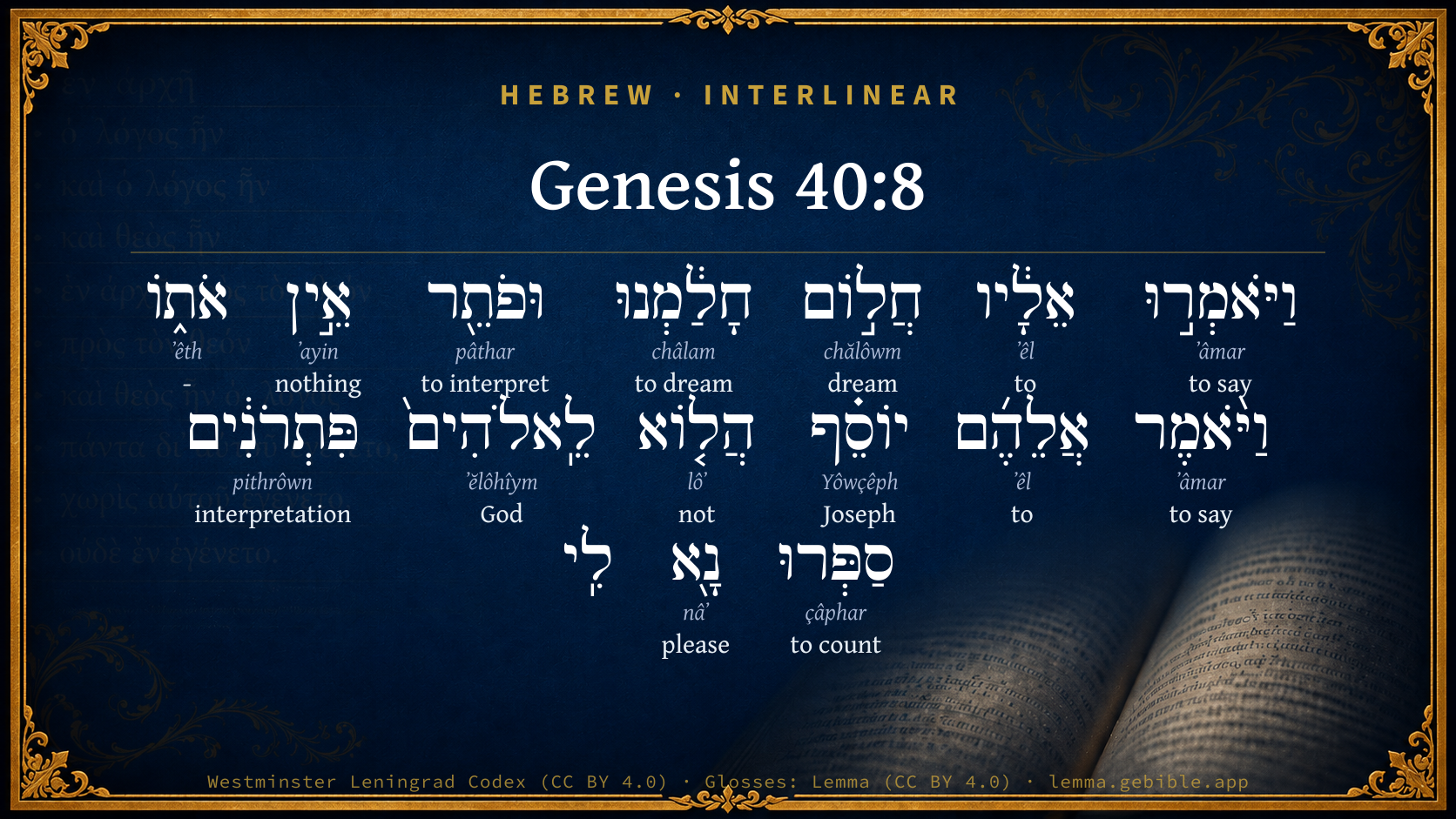
Hebrew (Westminster Leningrad Codex) Genesis 40:8 appears in the Hebrew Old Testament. The text above is from the Westminster Leningrad Codex. Each word links to its Strong’s number, a concise gloss, and parsing drawn from the Open Scriptures Hebrew Bible morphology. Click any word for its full Brown-Driver-Briggs (BDB) entry.
Download image
Cite this verse

Genesis 40:8 (World English Bible). Public Domain. Lemma interlinear Bible study tool, https://lemma.gebible.app/v/genesis/40/8.

Show BibTeX & RIS
BibTeX
RIS
English Translation
They said to him, "We have dreamed a dream, and there is no one who can interpret it." Joseph said to them, "Don't interpretations belong to God? Please tell it to me."
World English Bible · Public Domain
Highlights
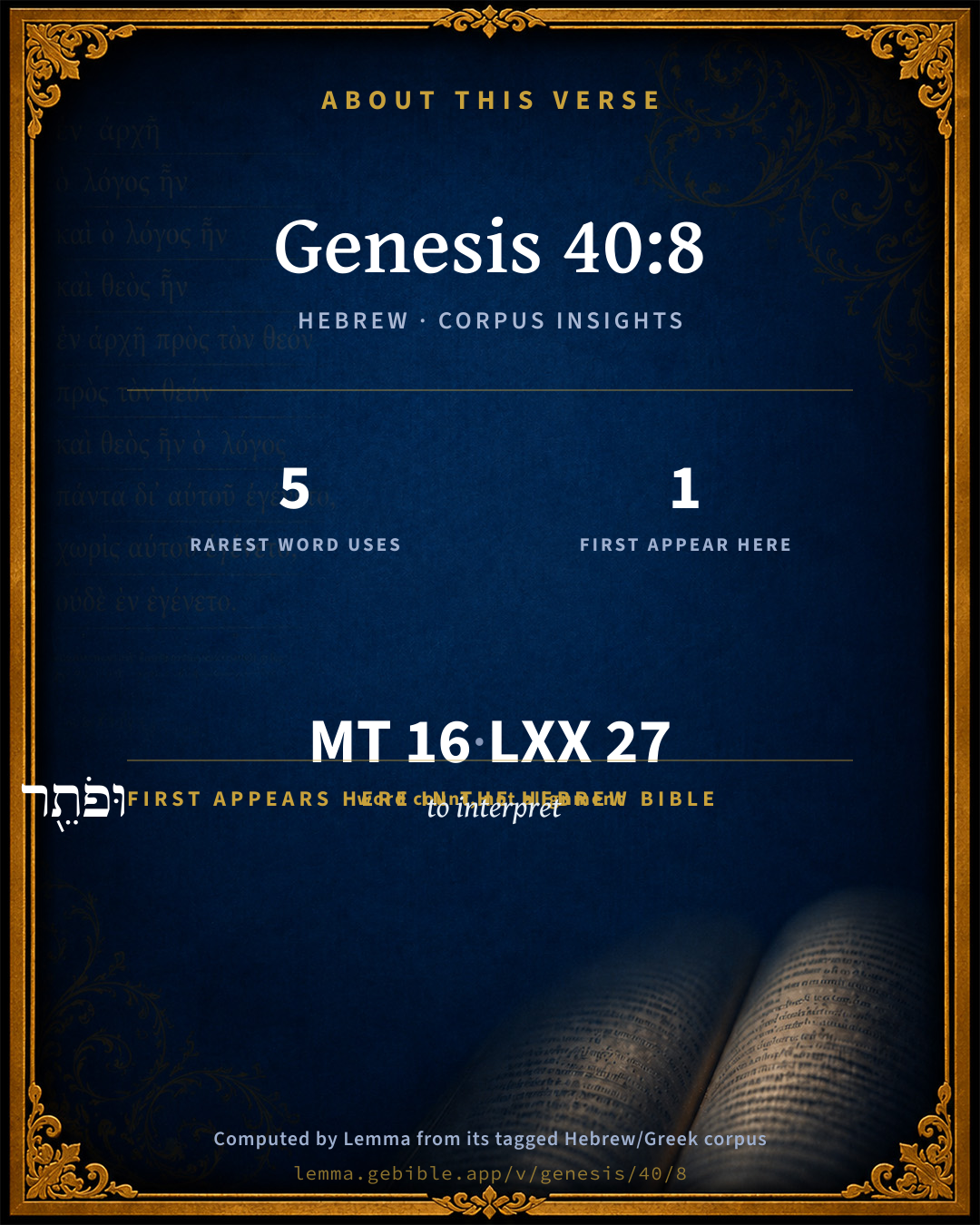
  • 1 first appearance in the Hebrew Bible
Full analysis ↓
Download a study sheet

One document with this verse’s original text, its word-by-word gloss line, the meaning frame, cross-references with their text, attributed commentary, and full source and license credits — printable, and it pastes into notes with its structure intact.

This verse Autodidact and up

Study sheet (.html) Plain text (.txt)

A passage Seminary Student

Up to 50 verses in one chapter. A passage sheet keeps up to 6 commentary sources and 12 cross-references per verse, in the order this page ranks them, and says so on the sheet whenever that leaves anything out. Ask for a single verse and you get the Autodidact verse sheet above.

Everything on this page stays free to read, with no account — the sheet is a download of what is already on screen, not access to it.

Want to remove ads? Support Godless Engineer
Compare translations 3

The same verse in 3 English versions, stacked beneath the original-language interlinear above. Click any original word for its lexicon entry.

Each is an independent rendering of the whole verse — the interlinear is not word-aligned to these translations.

Highlighted words mark where these versions differ — a whole-verse word diff, not a word-by-word alignment.

  • World English Bible Public Domain
    They said to him, "We have dreamed a dream, and there is no one who can interpret it." Joseph said to them, "Don't interpretations belong to God? Please tell it to me."
  • King James Version Public Domain
    And they said unto him, We have dreamed a dream, and there is no interpreter of it. And Joseph said unto them, Do not interpretations belong to God? tell me them, I pray you.
  • unfoldingWord Literal Text CC BY-SA 4.0
    And they said to him, “We dreamed a dream, but no one to interpret it.” Then Joseph said to them, “Do interpretations not to God? Please tell to me.”

unfoldingWord Literal Text — © unfoldingWord, licensed CC BY-SA 4.0. Word-aligned USFM3 via Door43 (git.door43.org/unfoldingWord/en_ult).

Versions to compare (up to 4)

3 of 4 selected

Show all 18 translations

Every available English version of this verse, each an independent rendering of the whole verse.

  • World English Bible Public Domain
    They said to him, "We have dreamed a dream, and there is no one who can interpret it." Joseph said to them, "Don't interpretations belong to God? Please tell it to me."
  • Berean Standard Bible Public Domain
    “We both had dreams,” they replied, “but there is no one to interpret them.” Then Joseph said to them, “Don’t interpretations belong to God? Tell me your dreams.”
  • Majority Standard Bible Public Domain
    “We both had dreams,” they replied, “but there is no one to interpret them.” Then Joseph said to them, “Don’t interpretations belong to God? Tell me your dreams.”
  • King James Version Public Domain
    And they said unto him, We have dreamed a dream, and there is no interpreter of it. And Joseph said unto them, Do not interpretations belong to God? tell me them, I pray you.
  • American Standard Version (1901) Public Domain
    And they said unto him, We have dreamed a dream, and there is none that can interpret it. And Joseph said unto them, Do not interpretations belong to God? tell it me, I pray you.
  • Revised Version (1885) Public Domain
    And they said unto him, We have dreamed a dream, and there is none that can interpret it. And Joseph said unto them, Do not interpretations belong to God? tell it me, I pray you.
  • Geneva Bible (1599) Public Domain
    Who answered him, We haue dreamed, eche one a dreame, and there is none to interprete the same. Then Ioseph saide vnto them, Are not interpretations of God? tell them me nowe.
  • Douay-Rheims (1899) Public Domain
    They answered: We have dreamed a dream, and there is nobody to interpret it to us. And Joseph said to them: Both not interpretation belong to God? Tell me what you have dreamed. g The chief butler first told his dream: I saw before me a vine,
  • Young's Literal Translation Public Domain
    And they say unto him, `A dream we have dreamed, and there is no interpreter of it;' and Joseph saith unto them, `Are not interpretations with God? recount, I pray you, to me.'
  • Literal Standard Version CC BY-SA 4.0
    And they say to him, “We have dreamed a dream, and there is no interpreter of it”; and Joseph says to them, “Are interpretations not with God? Please recount to me.”
  • Unlocked Literal Bible CC BY-SA 4.0
    They said to him, “We have both dreamed a dream and no one can interpret it.” Joseph said to them, “Do not interpretations belong to God? Tell me, please.”
  • unfoldingWord Literal Text CC BY-SA 4.0
    And they said to him, “We dreamed a dream, but no one to interpret it.” Then Joseph said to them, “Do interpretations not to God? Please tell to me.”
  • Darby Bible Public Domain
    And they said to him, We have dreamt a dream, and there is no interpreter of it. And Joseph said to them, [Do] not interpretations [belong] to God? tell me [your dreams], I pray you.
  • World Messianic Bible Public Domain
    They said to him, “We have dreamed a dream, and there is no one who can interpret it.” Joseph said to them, “Don’t interpretations belong to God? Please tell it to me.”
  • Webster's Bible Public Domain
    And they said to him, We have dreamed a dream, and there is no interpreter of it. And Joseph said to them, Do not interpretations belong to God? tell me them, I pray you.
  • Free Bible Version CC BY-SA 4.0
    “We've both had dreams but can't find anyone to explain what they mean,” they said. So Joseph told them, “Isn't God the one who can interpret the meaning of dreams? Tell me your dreams.”
  • Bible in Basic English Public Domain
    Then they said to him, We have had a dream, and no one is able to give us the sense. And Joseph said, Does not the sense of dreams come from God? what was your dream?
  • JPS Tanakh (1917) Public Domain
    And they said unto him: 'We have dreamed a dream, and there is none that can interpret it.' And Joseph said unto them: 'Do not interpretations belong to God? tell it me, I pray you.'

Literal Standard Version (2020), Covenant Press — licensed CC BY-SA 4.0. Text via the HelloAO Bible API (eBible.org). Unlocked Literal Bible (unfoldingWord) — licensed CC BY-SA 4.0. Text via the HelloAO Bible API (eBible.org). unfoldingWord Literal Text — © unfoldingWord, licensed CC BY-SA 4.0. Word-aligned USFM3 via Door43 (git.door43.org/unfoldingWord/en_ult). Free Bible Version, Dr. Jonathan Gallagher — licensed CC BY-SA 4.0. Text via the HelloAO Bible API (eBible.org).

Word by word

More ways to search: Search by grammar → Find every occurrence → Compare this word →

Practice this passage: Drill this verse → Learn its vocabulary →

פִּתְרֹנִ֔ים
pithrôwn
H6623
“interpretations”
Noun, Common, Masculine, Plural, Absolute
Part of Speech
Noun
Type
Common
Gender
Masculine
Number
Plural
State
Absolute
Full BDB Definition

Origin: from H6622

TWOT: 1860a

interpretation
  1. וַיֹּאמְר֣וּ ʼâmar H559 “and · to say” Conjunction + Verb, Qal, Sequential Imperfect, 3rd Person, Masculine, Plural
  2. אֵלָ֔יו ʼêl H413 “to · him” Preposition + Suffix, Personal, 3rd Person, Masculine, Singular
  3. חֲל֣וֹם chălôwm H2472 “dream” Noun, Common, Masculine, Singular, Absolute
  4. חָלַ֔מְנוּ châlam H2492 “to dream” Verb, Qal, Perfect, 1st Person, Common, Plural
  5. וּפֹתֵ֖ר pâthar H6622 “and · interpreting” Conjunction + Verb, Qal, Participle Active, Masculine, Singular, Absolute
  6. אֵ֣ין ʼayin H369 “nothing” Particle, Negative
  7. אֹת֑וֹ ʼêth H853 “- · him” Particle, Direct Object + Suffix, Personal, 3rd Person, Masculine, Singular
  8. וַיֹּ֨אמֶר ʼâmar H559 “and · to say” Conjunction + Verb, Qal, Sequential Imperfect, 3rd Person, Masculine, Singular
  9. אֲלֵהֶ֜ם ʼêl H413 “to · them” Preposition + Suffix, Personal, 3rd Person, Masculine, Plural
  10. יוֹסֵ֗ף Yôwçêph H3130 “Joseph” Noun, Proper
  11. הֲל֤וֹא lôʼ H3808 “not” Particle, Interrogative + Particle, Negative
  12. לֵֽאלֹהִים֙ ʼĕlôhîym H430 “to/for · God(s)” Preposition + Noun, Common, Masculine, Plural, Absolute
  13. סַפְּרוּ çâphar H5608 “count” Verb, Piel, Imperative, 2nd Person, Masculine, Plural
  14. נָ֖א nâʼ H4994 “please” Particle, Exhortation

About this verse

These counts appear in no published source. They are computed here, from the morphology-tagged text and Lemma’s own curated glosses. What Lemma adds →

16
words
13
distinct lemmas
Pentateuch
section

Notable vocabulary

The rarest word here is פִּתְרֹנִ֔ים interpretation H6623 — appearing just 5 times in the whole Hebrew Bible.

First appearance in Scripture

This word makes its first canonical appearance in the Hebrew Bible here:

  • וּפֹתֵ֖ר to interpret H6622

Shared distinctive vocabulary

פִּתְרֹנִ֔ים interpretation H6623 occurs in 5 verses of the Hebrew Bible. Also found in:

Grammatical profile

  • 5 verbs
  • 4 nouns
  • 3 prepositions
  • 4 particles

Verb forms

  • וַיֹּאמְר֣וּ Qal · Sequential Imperfect
  • חָלַ֔מְנוּ Qal · Perfect
  • וּפֹתֵ֖ר Qal · Participle Active
  • וַיֹּ֨אמֶר Qal · Sequential Imperfect
  • סַפְּרוּ Piel · Imperative

Repetition

Words recur within this verse — often emphatic in Hebrew:

  • וַיֹּאמְר֣וּ to say H559 ×2
  • אֵלָ֔יו to H413 ×2

Hebrew & Septuagint length

In English translation the verse runs 32 words from the Hebrew and 35 from the Septuagint (LXX English) — closely comparable.

A rough comparison of the two English renderings, which tokenize alike — not a word-level alignment.

Word counts can differ between the Hebrew and the Greek without any difference in meaning — e.g. the Hebrew direct-object marker אֵת has no separate Greek word, and Greek often adds the article ὁ.

In the original languages it is 16 Hebrew tokens and 27 Greek tokens — but the two are counted differently (Hebrew bundles its prefixes and suffixes into one token; the Greek is in lemma form), so that isn’t a like-for-like length.

Cross-references

11

Topical passages linked to Genesis 40:8 in the Treasury of Scripture Knowledge — connected by theme and wording, ordered by reader-vote popularity; previews shown in the World English Bible.

  • Daniel 2:47 The king answered to Daniel, and said, Of a truth your God is the God of gods, and the Lord of kings, and a revealer of secrets, seeing you have been able to reveal this secret.
  • Genesis 41:15–16 Pharaoh said to Joseph, "I have dreamed a dream, and there is no one who can interpret it. I have heard it said of you, that when you hear a dream you can interpret it."
  • Daniel 2:28 but there is a God in heaven who reveals secrets, and he has made known to the king Nebuchadnezzar what shall be in the latter days. Your dream, and the visions of your head on your bed, are these:
  • Isaiah 8:19 When they shall tell you, "Consult with those who have familiar spirits and with the wizards, who chirp and who mutter:" shouldn't a people consult with their God? on behalf of the living [should they consult] with the dead?
  • Amos 3:7 Surely the Lord Yahweh will do nothing, Unless he reveals his secret to his servants the prophets.
  • 1 Corinthians 12:10–11 and to another workings of miracles; and to another prophecy; and to another discerning of spirits; to another different kinds of languages; and to another the interpretation of languages.
  • Job 33:15–16 In a dream, in a vision of the night, When deep sleep falls on men, In slumbering on the bed;
  • Psalms 25:14 The friendship of Yahweh is with those who fear him. He will show them his covenant.
  • Daniel 2:11 It is a rare thing that the king requires, and there is no other who can show it before the king, except the gods, whose dwelling is not with flesh.
  • Daniel 4:8 But at the last Daniel came in before me, whose name was Belteshazzar, according to the name of my god, and in whom is the spirit of the holy gods: and I told the dream before him, [saying],
  • Daniel 5:11–15 There is a man in your kingdom, in whom is the spirit of the holy gods; and in the days of your father light and understanding and wisdom, like the wisdom of the gods, were found in him; and the king Nebuchadnezzar your father, the king, [I say], your father, made him master of the magicians, enchanters, Chaldeans, and soothsayers;

Cross-references courtesy of OpenBible.info (CC BY 4.0).

Hebrew and Greek witnesses Masoretic Hebrew ↔ Greek Septuagint

The same verse in the two great witnesses to the Old Testament, shown verse-for-verse.

These are two independent witnesses, not word-aligned to each other, and the Septuagint is shown in lemma (dictionary) form.

Hebrew Genesis 40:8 Masoretic · Westminster Leningrad Codex

וַיֹּאמְר֣וּ אֵלָ֔יו חֲל֣וֹם חָלַ֔מְנוּ וּפֹתֵ֖ר אֵ֣ין אֹת֑וֹ וַיֹּ֨אמֶר אֲלֵהֶ֜ם יוֹסֵ֗ף הֲל֤וֹא לֵֽאלֹהִים֙ פִּתְרֹנִ֔ים סַפְּרוּ נָ֖א לִֽי

They said to him, "We have dreamed a dream, and there is no one who can interpret it." Joseph said to them, "Don't interpretations belong to God? Please tell it to me."

World English Bible · Public Domain

Greek LXX Genesis 40:8 Septuagint · lemma form

ὁ δέ εἶπον αὐτός ἐνύπνιον ὁράω καί ὁ συνκρίνω οὐ εἰμί αὐτός εἶπον δέ αὐτός ιωσηφ οὐ διά ὁ θεός ὁ διασάφησις αὐτός εἰμί διαἡγέομαι οὖν ἐγώ

And they said to him, We have seen a dream, and there is no interpreter of it. And Joseph said to them, Is not the interpretation of them through god? tell them than to me.

LXX2012 (modern English Septuagint) · Public Domain

Hebrew: Westminster Leningrad Codex (CC BY 4.0). Greek: Septuagint (public domain); English from LXX2012 (modern English Septuagint) (Public Domain). How the Septuagint differs from the Hebrew →

Targum (Aramaic paraphrase)

2

The Targum is the ancient Jewish Aramaic paraphrase of the Hebrew Scriptures — an interpretive translation, not the Hebrew text itself. Onkelos (literal) and Pseudo-Jonathan (expansive) render the Torah, and Jonathan the Prophets. Coverage is partial: where no permissively-licensed English translation exists for a verse, only the Aramaic is shown. This is verse-level text, not a word-by-word alignment to the Hebrew.

  1. Targum Onkelos Torah (Genesis–Deuteronomy)
    וַאֲמָרוּ לֵהּ חֶלְמָא חֲלֵמְנָא וּפָשַׁר לֵית לֵהּ וַאֲמַר לְהוֹן יוֹסֵף הֲלָא מִן קֳדָם יְיָ פּוּשְׁרַן חֶלְמַיָּא אִשְׁתָּעוּ כְעַן לִי

    (no public-domain English translation for this verse)

    Targum Onkelos — Aramaic: “Onkelos Genesis” (public domain); “Onkelos Exodus” (public domain); “Onkelos Leviticus” (public domain); “Onkelos Numbers” (public domain); “Onkelos Deuteronomy” (public domain). English: “Sefaria Community Translation” (CC0 1.0 (public-domain dedication)); “J.W. Etheridge. The Targums of Onkelos and Jonathan Ben Uzziel on the Pentateuch. London: Longmans, Green, 1862” (public domain). Text via Sefaria.

  2. Targum Pseudo-Jonathan Torah (Genesis–Deuteronomy)
    וַאֲמָרוּ לֵיהּ חֵילְמָא חֲלֵימְנָא וּפְשַׁר לֵית לֵיהּ וַאֲמַר לְהוֹן יוֹסֵף הֲלָא מִן קֳדָם יְיָ פּוּשְׁרַן חֶלְמַיָיא אִשְׁתְּעוּ כְּדוֹן לִי

    And they said to him, We have dreamed a dream, and there is no interpreter for it. And Joseph answered, Are not the interpretations of dreams from tile Lord? Tell it now to me.

    Targum Pseudo-Jonathan — Aramaic: “Targum Jonathan on Genesis” (public domain); “Targum Jonathan on Exodus” (public domain); “Targum Jonathan on Leviticus” (public domain); “Targum Jonathan on Numbers” (public domain); “Targum Jonathan on Deuteronomy” (public domain). English: “The Targum of Jonathan ben Uzziel, trans. J. W. Etheridge, London, 1862” (public domain). Text via Sefaria.

Commentary

Notes on Genesis 40:8 from classic Christian and Jewish commentators (each source and its license shown beneath its notes). The classic Christian expositions comment on the surrounding passage and are grouped to its opening verse, so a note may address several verses; the Jewish commentaries on the Tanakh (Rashi and others) are per-verse, so they appear only where the commentator wrote on this verse.

Lemma curates 59 commentaries, every one of them public domain or Creative Commons licensed, each selected and text-cleaned for this edition rather than reprinted as found. About our sources →

Trapp's Complete Commentary

John Trapp

Gen 40:8 And they said unto him, We have dreamed a dream, and [there is] no interpreter of it. And Joseph said unto them, [Do] not interpretations [belong] to God? tell me [them], I pray you.

Ver. 8. And there is no interpreter.] The superstitious Egyptians did curiously observe their dreams; and commonly repaired to the soothsayers for an interpretation. {Gen 41:8} Joseph calls these idolaters from their superstitions vanities to the living God; as Isaiah did those of his time, {Isa 8:19-20} and Daniel those of his. {Dan 2:28; Dan 5:18} He had consulted with God by prayer, and with the Scripture, which revealed sufficient direction to him, {Eze 31:1-12} and so soon despatched the interpretation of Nebuchadnezzar’s dream. {Dan 4:10} So Joseph here; he suffered "troubles as an evildoer, even unto bonds: but the word of God is not bound." {2Ti 2:9}

John Trapp, A Commentary or Exposition upon All the Books of the Old and New Testament (1647–1656) — public domain. Text from a community e-Sword module.

Joseph Benson's Commentary

Gen 40:8. Do not interpretations belong to God? — He means the God whom he worshipped, to the knowledge of whom he endeavours hereby to lead them. And if interpretations belong to God, he is a free agent, and may communicate the power to whom he pleases, therefore tell me your dreams.

Joseph Benson's Commentary on the Old and New Testaments (1811–1818) — public domain. Text from a community e-Sword module.

Geneva Bible (1599)

Geneva Bible translators

Cannot God raise up such as shall interpret such things?

Geneva Bible (1599) marginal notes — public domain. Text via Bolls.life.

Adam Clarke's Commentary

Verse 8. There is no interpreter] They either had access to none, or those to whom they applied could give them no consistent, satisfactory meaning.

Do not interpretations belong to God?] God alone, the Supreme Being, knows what is in futurity; and if he have sent a significant dream, he alone can give the solution.

Adam Clarke's Commentary on the Bible (1810–1826) — public domain. Text from a community e-Sword/MySword module.

Ellicott's Commentary for English Readers

(8) There is no interpreter.—In Egypt it was the business of men trained for the purpose, called in Gen_41:8, magicians and wise men, to interpret dreams, and to such the butler and baker could have no access from their prison. But Joseph denies that art and training can really avail, and claims that the interpretation belongs to God.

A Bible Commentary for English Readers, edited by Charles John Ellicott (1878–1897) — public domain. Text from a community e-Sword module.

The Cambridge Bible for Schools and Colleges

gen. ed. J. J. S. Perowne

8. none that can interpret it] The Egyptians regarded the interpretation of dreams as a science requiring special study; or as a department of magic needing special initiation. Had the two officials been at liberty, they would have each repaired to their special soothsayer or dream-interpreter for an explanation of the dream that had so greatly disturbed them.

belong to God] Joseph claims that the interpretation of dreams is neither science nor magic. The man, to whom God reveals His secrets, alone can interpret them. He himself does not pretend to interpret. But, possibly, God may make use of His servant to make known His mind, cf. Gen_41:16; Gen_41:38-39 and Dan_2:19; Dan_2:28; Dan_2:47.

The Cambridge Bible for Schools and Colleges (gen. ed. J. J. S. Perowne; Cambridge University Press, 1878–1918) — public domain. Text from a community e-Sword module.

John Gill's Exposition

And they said unto him, we have dreamed a dream,.... Each of them:

and there is no interpreter of it; in that place in which they were, the prison; otherwise there were persons enough in the land that pretended to the interpretation of dreams, Gen 41:8; but they could not come at them, being in prison:

and Joseph said unto them, do not interpretations belong to God? that is, of dreams, and to him only, meaning the true God whom he worshipped; for as dreams themselves, which are of importance, and predict things to come, are of God; for none can foretell future events but he, and such to whom he imparts the gift of prophecy; so none can interpret dreams with any certainty but God himself, and those to whom he gives the faculty of interpretation of them; this Joseph said to take off their minds from the magicians and wise men, and interpreters of dreams among the Egyptians, these officers were hankering after, and wished they had them with them to interpret their dreams to them; and to suggest unto them, that though he did not arrogate such a power to himself, as having it of himself, yet intimates that he doubted not, but upon an address to his God, he would favour him with the interpretation of their dreams, and therefore encourages them to relate them to him:

tell me them, I pray you; or "now" (z), directly, as the Targums of Onkelos and Jonathan; signifying, that he would immediately interpret them to them; no doubt Joseph said this under a divine impulse.

(z) "nunc", Drusius.

John Gill's Exposition of the Whole Bible (1746–1763) — public domain (CC PDM 1.0). Text via the HelloAO Bible API.

Haydock's Catholic Bible Commentary

Doth not interpretation belong to God? When dreams are from God, as these were, the interpretation of them is a gift of God. But the generality of dreams are not of this sort; but either proceed from the natural complexions and dispositions of persons, or the roving of their imaginations in the day on such objects as they are much affected with, or from their mind being disturbed with cares and troubles, and oppressed with bodily infirmities: or they are suggested by evil spirits, to flatter, or to terrify weak minds; in order to gain belief, and so draw them into error or superstition; or at least to trouble them in their sleep, whom they cannot move while they are awake: so that the general rule, with regard to dreams, is not to observe them, nor to give any credit to them. (Challoner) --- Physicians indeed, sometimes from some judgment of the nature of a distemper from dreams; on which subject, Hippocrates and Galen have written. But to pretend to discover by them the future actions of free agents, would be superstitious, Deuteronomy xviii. 10. (Tirinus) --- Justin (xxxvi. 2,) says, "Joseph was the first interpreter of dreams, and often gave proofs of his knowledge," &c.

George Leo Haydock (1774–1849), Haydock's Catholic Family Bible and Commentary, 1859 edition — public domain. Excludes Psalms (Douay-Rheims chapter numbering differs from Protestant) and Deuterocanonical books (Catholic canon only).

Matthew Poole's English Annotations

There is no interpreter of it, to wit, with us, or to whom we can now resort; for otherwise there were many in Egypt of that profession, Gen 41:8.

Do not interpretations belong to God? In vain do you expect such things from your wise men, for it is only that God who sends these dreams that can interpret them, and to him you should seek for it.

Tell me, who am the servant of the true God, who useth to communicate his secrets to his people, and who, I doubt not, will hear my prayers for this mercy. This he spoke by special direction and instinct from God, who had given this gift to him.

Matthew Poole's English Annotations on the Holy Bible (1683–1685) — public domain. Text from a community e-Sword/MySword module.

Whedon's Commentary on the Bible

Daniel D. Whedon

8. Do not interpretations belong to God — He who had been visited with prophetic dreams in childhood, (Gen_37:5; Gen_37:9,) believed that God alone could interpret them. Comp. Gen_41:16; Gen_41:25; Gen_41:32. In his imprisonment and loneliness he might well have despaired of any fulfilling of his own dreams, but he trusts in God.

Daniel D. Whedon (gen. ed.), Commentary on the Old and New Testaments (1874–1909) — public domain. Text from a community e-Sword module.

The Pulpit Commentary

And they said unto him, We hays dreamed a dream, and there is no interpreter of it literally, a dream have we dreamt, and interpreting it there is none. This must be noted as a third peculiarity connected with these dreams, that both of their recipients were similarly affected by them, though there was much in the butler s dream to inspire hope rather than dejection. And Joseph said unto them, Do not interpretations belong to God? literally, Are not interpretations to Elohim? i.e. the Supreme Being (cf. Gen_41:16; Dan_2:11, Dan_2:28, Dan_2:47) The Egyptians believed oti ajnqrwpwn men oujdenietai hJ tecnh mantikh twn deroise (Herod., 2:83). Tell me them, I pray you. Joseph"s request implies that the consciousness of his Divine calling to be a prophet had begun to dawn upon him, and that he was now speaking from an inward conviction, doubtless produced within his mind by Elohim, that he could unfold the true significance of the dreams.

HOMILIES BY J.F. MONTGOMERY Ver. 8.

The interpreter of God"s message.

We cannot but notice the importance often assigned in the Bible to dreams, as channels of revelation from God. The dreams of Jacob and of Pharaoh, and passages such as Deu_13:1 and Joe_2:28, show this.It may be that in the absence of the written word, which in its completeness is our heritage, God"s message was thus given to them in portions. Applying this thought to the circumstances of the text, we see men who had received a message from God which they believed was of importance; but they could not understand it, and they are sad because there is no interpreter.

I THE DEEP IMPORTANCE OF GOD"S MESSAGE. How many questions does life present! What and where are we? Whither going? What lies beyond the present? I see that all things decay; yet on all sides life from death. Is there such revival for me? Can the active, thinking spirit be as though it had never been passed from existence ere the frail body began to decay? And if there be a life beyond the present, what is its nature? and what the preparation for it? Vainly does human wisdom try to answer these questions. He who made all things alone can explain his works, (Psa_94:9-12) and the Bible is his answer to our questions, wherein he tells us what we are, for what created, and how to fulfill the object of our being. (Psa_119:105)

II But WE NEED AN INTERPRETER. It may be asked, Why? The Bible is open. Its words are such as any one can understand. This is true, as far as regards facts, and precepts, and doctrines. There is a knowledge of the word which the natural man can attain to; but the Holy Spirit alone can so open it as to make it "the power of God." It is one thing to know the doctrines of sin and of salvation, and quite another to know ourselves as sinners, and Christ as the Savior. The one puffs up with pride of knowledge, the other leads to the one Foundation. There is no more dangerous snare than of ignoring this work of the Holy Spirit. Too often men do not believe their need of it, and do not believe in his help. And thus the Bible is found dull, and its teaching departed from in daily life.

III How TO GET THE INTERPRETER"S HELP. "Tell me." Think of our Lord watching his disciples in the boat. So he watches over thee, ready to help. Hast thou found it so? Has the light of God"s love entered thy heart? It is the special work of the Holy Spirit to guide into all truth; (Joh_16:13) not in solving mysteries and hard questions, but in revealing Christ to the heart. Have you sought this; sought with expectation the full gift; sought to know Christ, (Php_3:10) and the transforming power of belief in his love? Will you seek? There lies the difficulty the want of earnestness. Men seem afraid of being earnest. But it is the earnest (Mat_11:12, biastai) who enter the kingdom of heaven. M.

The Pulpit Commentary (1880–1919), ed. H.D.M. Spence-Jones & Joseph S. Exell — public domain. Text from a community e-Sword module.

John Wesley's Explanatory Notes

Do not interpretations belong to God? - He means the God whom he worshipped, to the knowledge of whom he endeavours hereby to lead them. And if interpretations belong to God, he is a free agent, and may communicate the power to whom he pleases, therefore tell me your dreams.

John Wesley, Explanatory Notes Upon the Whole Bible (1754–1765) — public domain. Text via the GEBible commentary corpus.

Keil & Delitzsch

C. F. Keil & F. Delitzsch

On their replying that they had dreamed, and there was no one to interpret the dream, Joseph reminded them first of all that "interpretations are God's," come from God, are His gift; at the same time he bade them tell him their dreams, from a consciousness, no doubt, that he was endowed with this divine gift.

Keil & Delitzsch — Biblical Commentary on the Old Testament (1861–1891) — public domain (CC PDM 1.0). Text via the HelloAO Bible API. (Old Testament only.)

Ramban (Nachmanides)

Rabbi Moshe ben Nachman (Ramban / Nachmanides)

AND THERE IS NO INTERPRETER OF IT. The meaning thereof is that “there is no one to inform us concerning the future which can be derived from the dream.”It is possible that they sent for some magicians in the morning, or that there were people with them in the prison, but no one could interpret it. It may be that they said; “There is no one in the world, in our opinion, who can interpret it, for it is very obscure.”

DO NOT (‘HALO’) INTERPRETATIONS BELONG TO G-D? Rabbi Abraham ibn Ezra explained it as saying that “future events destined to come as indicated in dreams belong to G-d, for He alone brings on the dream and lets the future be known, and it is He who makes peace, and creates evil, but in my speaking to you there is neither benefit nor loss.” This he said so that they should not punish him if evil should befall them, or so that they should tell him the dreams and not scorn him. But if so, there is no sense for the word halo (do not) in this context. is out of place. Perhaps its meaning is the same as that of the word hinei (behold). Thus Joseph is saying, “Behold, to G-d alone belong interpretations, but not to man the interpreter.”In my opinion the correct interpretation is that Joseph is saying; “Do not interpretations of all dreams which are obscure and confined belong to G-d? He can make known the interpretation of your dreams. Now if it is obscure to you tell it to me; perhaps He will be pleased to reveal His secret to me.”

Ramban (Nachmanides) on the Tanakh — English translation: “Commentary on the Torah by Ramban (Nachmanides). Translated and annotated by Charles B. Chavel. New York, Shilo Pub. House, 1971-1976” (CC BY 4.0). Text via Sefaria.

Radak

Rabbi David Kimhi (Radak)

ופתר אין אותו, they had already asked other people to explain their dreams to them but had not found anyone who could interpret it.

?הלא לאלוקים פתרונים, he was reminded of his own dreams. He was still awaiting the correct interpretation of his own dreams, something known only to G’d. He knew however, that G’d lets you dream certain dreams in order to foreshadow coming events. Seeing that this is so, there must be people who can interpret such dreams, why else would the phenomenon of dreams exist? The reason why their dreams were so confused, i.e. that they perceived themselves to be merely bakers and cup-bearers respectively, was that at the time they themselves were imprisoned and it would not have reflected their psychological makeup to perceive of themselves as occupying positions of authority.

ספרו נא לי, perhaps G’d will grant me the insight to interpret the dream.

Radak on the Tanakh — English translations: “Sefaria Community Translation” (CC0 1.0 (public-domain dedication)); “Eliyahu Munk, HaChut Hameshulash” (CC BY 4.0); “Rabbi Mike Feuer, Jerusalem Anthology” (CC BY 4.0); and “R. David Kimhi on the first book of Psalms, Translated by R.G. Finch, London, 1919” (public domain). Text via Sefaria.

Lesson kit

Teaching starters — assembled from the data on this page, not authored interpretation. Every prompt links to the verse data it draws on. Edit before teaching.

Genesis, in the Pentateuch, opens this verse with 16 words (13 distinct Hebrew lemmas). Its most distinctive word is pithrôwn (“interpretation”). A historical commentator’s framing appears above. Read the whole chapter for the surrounding context.

Discussion questions

  1. How does “interpretation” (pithrôwn) shape what this verse is saying?
  2. The word “to interpret” first appears here in Scripture. What is being introduced at this debut?
  3. Genesis 40:5 shares the word «interpretation» with this verse. How do the two illuminate each other?
  4. “to say” occurs 2× in this one verse. What is the effect of the repetition?
  5. These translations render this verse differently. What is at stake in choosing one wording over another?
  6. The verb «וַיֹּאמְר֣וּ» is Qal Sequential Imperfect. How does its form color the action?
  7. Reading how Trapp's Complete Commentary and Joseph Benson's Commentary read this verse, where do the two commentators agree and where do they part?

Things to notice

Reading settings

Reading text

Shown beneath each verse's original-language words.

Old Testament
Old Testament edition

Read the OT as the Masoretic Hebrew (MT) or the Greek Septuagint (LXX).

English shown for the Greek Septuagint (in the Hebrew ↔ Greek comparison).

Comparing translations? Open the Compare panel on any verse page to stack up to four side by side.