Ecclesiastes 9:5

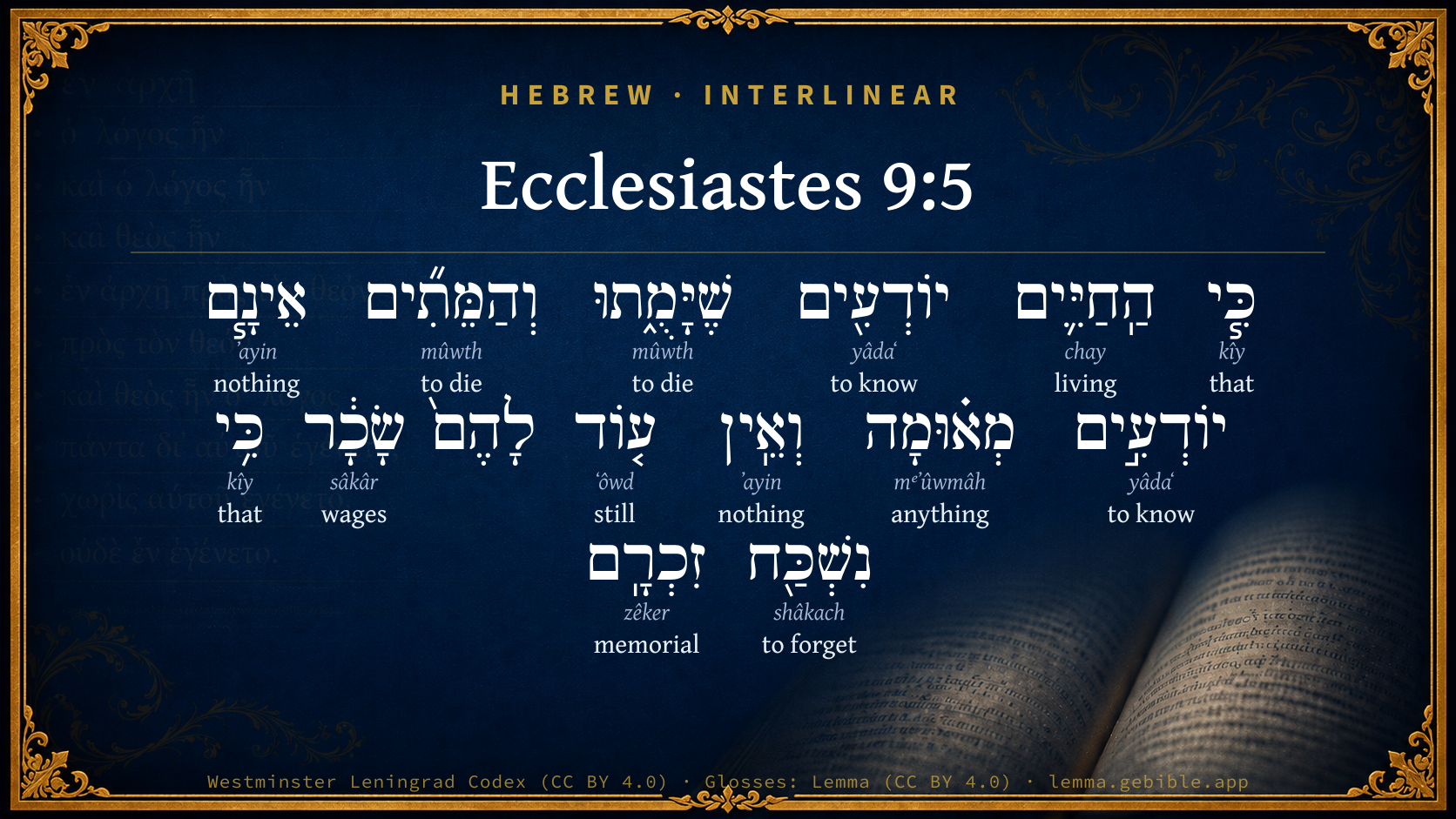
Hebrew (Westminster Leningrad Codex) Ecclesiastes 9:5 appears in the Hebrew Old Testament. The text above is from the Westminster Leningrad Codex. Each word links to its Strong’s number, a concise gloss, and parsing drawn from the Open Scriptures Hebrew Bible morphology. Click any word for its full Brown-Driver-Briggs (BDB) entry.
Download image
Cite this verse

Ecclesiastes 9:5 (World English Bible). Public Domain. Lemma interlinear Bible study tool, https://lemma.gebible.app/v/ecclesiastes/9/5.

Show BibTeX & RIS
BibTeX
RIS
English Translation
For the living know that they will die, but the dead don't know anything, neither do they have any more a reward; for the memory of them is forgotten.
World English Bible · Public Domain
Download a study sheet

One document with this verse’s original text, its word-by-word gloss line, the meaning frame, cross-references with their text, attributed commentary, and full source and license credits — printable, and it pastes into notes with its structure intact.

This verse Autodidact and up

Study sheet (.html) Plain text (.txt)

A passage Seminary Student

Up to 50 verses in one chapter. A passage sheet keeps up to 6 commentary sources and 12 cross-references per verse, in the order this page ranks them, and says so on the sheet whenever that leaves anything out. Ask for a single verse and you get the Autodidact verse sheet above.

Everything on this page stays free to read, with no account — the sheet is a download of what is already on screen, not access to it.

Want to remove ads? Support Godless Engineer
Compare translations 3

The same verse in 3 English versions, stacked beneath the original-language interlinear above. Click any original word for its lexicon entry.

Each is an independent rendering of the whole verse — the interlinear is not word-aligned to these translations.

Highlighted words mark where these versions differ — a whole-verse word diff, not a word-by-word alignment.

  • World English Bible Public Domain
    For the living know that they will die, but the dead don't know anything, neither do they have any more a reward; for the memory of them is forgotten.
  • King James Version Public Domain
    For the living know that they shall die: but the dead know not any thing, neither have they any more a reward; for the memory of them is forgotten.
  • unfoldingWord Literal Text CC BY-SA 4.0
    for the living know that they will die, but the dead—they are not knowing anything, and there is no longer for them a reward— even their memory is forgotten!

unfoldingWord Literal Text — © unfoldingWord, licensed CC BY-SA 4.0. Word-aligned USFM3 via Door43 (git.door43.org/unfoldingWord/en_ult).

Versions to compare (up to 4)

3 of 4 selected

Show all 18 translations

Every available English version of this verse, each an independent rendering of the whole verse.

  • World English Bible Public Domain
    For the living know that they will die, but the dead don't know anything, neither do they have any more a reward; for the memory of them is forgotten.
  • Berean Standard Bible Public Domain
    For the living know that they will die, but the dead know nothing. They have no further reward, because the memory of them is forgotten.
  • Majority Standard Bible Public Domain
    For the living know that they will die, but the dead know nothing. They have no further reward, because the memory of them is forgotten.
  • King James Version Public Domain
    For the living know that they shall die: but the dead know not any thing, neither have they any more a reward; for the memory of them is forgotten.
  • American Standard Version (1901) Public Domain
    For the living know that they shall die: but the dead know not anything, neither have they any more a reward; for the memory of them is forgotten.
  • Revised Version (1885) Public Domain
    For the living know that they shall die: but the dead know not any thing, neither have they any more a reward; for the memory of them is forgotten.
  • Geneva Bible (1599) Public Domain
    For the liuing knowe that they shall dye, but the dead knowe nothing at all: neither haue they any more a rewarde: for their remembrance is forgotten.
  • Douay-Rheims (1899) Public Domain
    For the living know that they shall die, but the dead know nothing more, neither have they a reward any more: for the memory of them is forgotten.
  • Young's Literal Translation Public Domain
    For the living know that they die, and the dead know not anything, and there is no more to them a reward, for their remembrance hath been forgotten.
  • Literal Standard Version CC BY-SA 4.0
    For the living know that they die, and the dead do not know anything, and there is no more reward to them, for their remembrance has been forgotten.
  • Unlocked Literal Bible CC BY-SA 4.0
    For living people know they will die, but the dead do not know anything. They no longer have any reward because their memory is forgotten.
  • unfoldingWord Literal Text CC BY-SA 4.0
    for the living know that they will die, but the dead—they are not knowing anything, and there is no longer for them a reward— even their memory is forgotten!
  • Darby Bible Public Domain
    For the living know that they shall die; but the dead know not anything, neither have they any more a reward, for the memory of them is forgotten.
  • World Messianic Bible Public Domain
    For the living know that they will die, but the dead don’t know anything, neither do they have any more a reward; for their memory is forgotten.
  • Webster's Bible Public Domain
    For the living know that they shall die: but the dead know not any thing, neither have they any more a reward; for the memory of them is forgotten.
  • Free Bible Version CC BY-SA 4.0
    The living are conscious of the fact that they're going to die, but the dead have no consciousness of anything. They don't receive any further benefit; they're forgotten.
  • Bible in Basic English Public Domain
    The living are conscious that death will come to them, but the dead are not conscious of anything, and they no longer have a reward, because there is no memory of them.
  • JPS Tanakh (1917) Public Domain
    For the living know that they shall die; but the dead know not any thing, neither have they any more a reward; for the memory of them is forgotten.

Literal Standard Version (2020), Covenant Press — licensed CC BY-SA 4.0. Text via the HelloAO Bible API (eBible.org). Unlocked Literal Bible (unfoldingWord) — licensed CC BY-SA 4.0. Text via the HelloAO Bible API (eBible.org). unfoldingWord Literal Text — © unfoldingWord, licensed CC BY-SA 4.0. Word-aligned USFM3 via Door43 (git.door43.org/unfoldingWord/en_ult). Free Bible Version, Dr. Jonathan Gallagher — licensed CC BY-SA 4.0. Text via the HelloAO Bible API (eBible.org).

Word by word

More ways to search: Search by grammar → Find every occurrence → Compare this word →

Practice this passage: Drill this verse → Learn its vocabulary →

זִכְרָֽם
zêker
H2143
“memorial · their”
Noun, Common, Masculine, Singular, Construct + Suffix, Personal, 3rd Person, Masculine, Plural
Part of Speech
Noun
Type
Common
Gender
Masculine
Number
Singular
State
Construct
Full BDB Definition

Origin: from H2142

TWOT: 551a

memorial, remembrance - remembrance, memory - memorial
  1. כִּ֧י kîy H3588 “that” Conjunction
  2. הַֽחַיִּ֛ים chay H2416 “the · living” Particle, Definite Article + Adjective, Adjective, Masculine, Plural, Absolute
  3. יוֹדְעִ֖ים yâdaʻ H3045 “knowing” Verb, Qal, Participle Active, Masculine, Plural, Absolute
  4. שֶׁיָּמֻ֑תוּ mûwth H4191 “who/which · to die” Particle, Relative + Verb, Qal, Imperfect, 3rd Person, Masculine, Plural
  5. וְהַמֵּתִ֞ים mûwth H4191 “and · the · dying” Conjunction + Particle, Definite Article + Verb, Qal, Participle Active, Masculine, Plural, Absolute
  6. אֵינָ֧ם ʼayin H369 “nothing · them” Particle, Negative + Suffix, Personal, 3rd Person, Masculine, Plural
  7. יוֹדְעִ֣ים yâdaʻ H3045 “knowing” Verb, Qal, Participle Active, Masculine, Plural, Absolute
  8. מְא֗וּמָה mᵉʼûwmâh H3972 “anything” Noun, Common, Feminine, Singular, Absolute
  9. וְאֵֽין ʼayin H369 “and · nothing” Conjunction + Particle, Negative
  10. ע֤וֹד ʻôwd H5750 “still” Adverb
  11. שָׂכָ֔ר sâkâr H7939 “wages” Noun, Common, Masculine, Singular, Absolute
  12. כִּ֥י kîy H3588 “that” Conjunction
  13. נִשְׁכַּ֖ח shâkach H7911 “to forget” Verb, Niphal, Perfect, 3rd Person, Masculine, Singular

About this verse

These counts appear in no published source. They are computed here, from the morphology-tagged text and Lemma’s own curated glosses. What Lemma adds →

15
words
10
distinct lemmas
Wisdom
section

Notable vocabulary

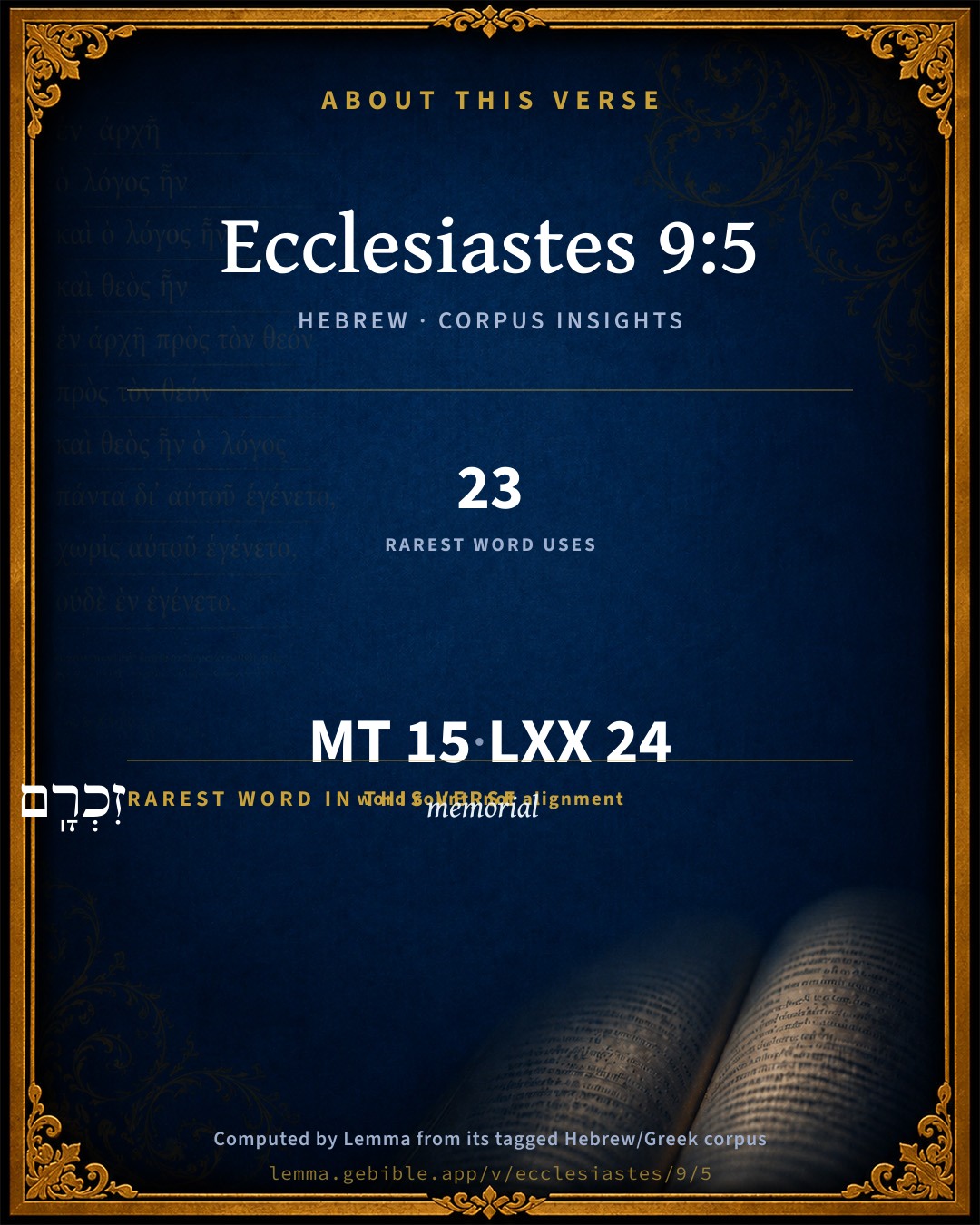
The rarest word here is זִכְרָֽם memorial H2143 — appearing just 23 times in the whole Hebrew Bible.

Shared distinctive vocabulary

זִכְרָֽם memorial H2143 occurs in 23 verses of the Hebrew Bible. Also found in:

Grammatical profile

  • 5 verbs
  • 3 nouns
  • 1 adjective
  • 1 preposition
  • 2 conjunctions
  • 1 adverb
  • 2 particles

Verb forms

  • יוֹדְעִ֖ים Qal · Participle Active
  • שֶׁיָּמֻ֑תוּ Qal · Imperfect
  • וְהַמֵּתִ֞ים Qal · Participle Active
  • יוֹדְעִ֣ים Qal · Participle Active
  • נִשְׁכַּ֖ח Niphal · Perfect

Repetition

Words recur within this verse — often emphatic in Hebrew:

  • יוֹדְעִ֖ים to know H3045 ×2
  • שֶׁיָּמֻ֑תוּ to die H4191 ×2
  • אֵינָ֧ם nothing H369 ×2
  • כִּ֧י that H3588 ×2

Hebrew & Septuagint length

In English translation the verse runs 29 words from the Hebrew and 28 from the Septuagint (LXX English) — closely comparable.

A rough comparison of the two English renderings, which tokenize alike — not a word-level alignment.

Word counts can differ between the Hebrew and the Greek without any difference in meaning — e.g. the Hebrew direct-object marker אֵת has no separate Greek word, and Greek often adds the article ὁ.

In the original languages it is 15 Hebrew tokens and 24 Greek tokens — but the two are counted differently (Hebrew bundles its prefixes and suffixes into one token; the Greek is in lemma form), so that isn’t a like-for-like length.

Cross-references

13

Topical passages linked to Ecclesiastes 9:5 in the Treasury of Scripture Knowledge — connected by theme and wording, ordered by reader-vote popularity; previews shown in the World English Bible.

  • Isaiah 26:14 [They are] dead, they shall not live; [they are] deceased, they shall not rise: therefore have you visited and destroyed them, and made all memory of them to perish.
  • Ecclesiastes 1:11 There is no memory of the former; neither shall there be any memory of the latter that are to come, among those that shall come after.
  • Psalms 6:5 For in death there is no memory of you. In Sheol, who shall give you thanks?
  • Psalms 88:10–12 Do you show wonders to the dead? Do the dead rise up and praise you? Selah.
  • Job 14:21 His sons come to honor, and he doesn't know it; They are brought low, but he doesn't perceive it of them.
  • Hebrews 9:27 Inasmuch as it is appointed for men to die once, and after this, judgment,
  • Psalms 109:15 Let them be before Yahweh continually, That he may cut off the memory of them from the earth;
  • Ecclesiastes 2:16 For of the wise man, even as of the fool, there is no memory for ever, seeing that in the days to come all will have been long forgotten. Indeed, the wise man must die just like the fool!
  • Ecclesiastes 8:10 So I saw the wicked buried. Indeed they came also from holiness. They went and were forgotten in the city where they did this. This also is vanity.
  • Isaiah 63:16 For you are our Father, though Abraham doesn't know us, and Israel does not acknowledge us: you, Yahweh, are our Father; our Redeemer from everlasting is your name.
  • Job 7:8–10 The eye of him who sees me shall see me no more. Your eyes shall be on me, but I shall not be.
  • Ecclesiastes 7:2 It is better to go to the house of mourning than to go to the house of feasting: for that is the end of all men, and the living should take this to heart.
  • Job 30:23 For I know that you will bring me to death, To the house appointed for all living.

Cross-references courtesy of OpenBible.info (CC BY 4.0).

Hebrew and Greek witnesses Masoretic Hebrew ↔ Greek Septuagint

The same verse in the two great witnesses to the Old Testament, shown verse-for-verse.

These are two independent witnesses, not word-aligned to each other, and the Septuagint is shown in lemma (dictionary) form.

Hebrew Ecclesiastes 9:5 Masoretic · Westminster Leningrad Codex

כִּ֧י הַֽחַיִּ֛ים יוֹדְעִ֖ים שֶׁיָּמֻ֑תוּ וְהַמֵּתִ֞ים אֵינָ֧ם יוֹדְעִ֣ים מְא֗וּמָה וְאֵֽין ע֤וֹד לָהֶם֙ שָׂכָ֔ר כִּ֥י נִשְׁכַּ֖ח זִכְרָֽם

For the living know that they will die, but the dead don't know anything, neither do they have any more a reward; for the memory of them is forgotten.

World English Bible · Public Domain

Greek LXX Ecclesiastes 9:5 Septuagint · lemma form

ὅτι ὁ ζάω γιγνώσκω ὅτι ἀποθνήσκω καί ὁ νεκρός οὐ εἰμί γιγνώσκω οὐδείς καί οὐ εἰμί αὐτός ἔτι μισθός ὅτι ἐπιλανθάνω ὁ μνήμη αὐτός

For the living will know that they shall die: but the dead know nothing, and there is no longer any reward to them; for their memory is lost.

LXX2012 (modern English Septuagint) · Public Domain

Hebrew: Westminster Leningrad Codex (CC BY 4.0). Greek: Septuagint (public domain); English from LXX2012 (modern English Septuagint) (Public Domain). How the Septuagint differs from the Hebrew →

Commentary

Notes on Ecclesiastes 9:5 from classic Christian and Jewish commentators (each source and its license shown beneath its notes). The classic Christian expositions comment on the surrounding passage and are grouped to its opening verse, so a note may address several verses; the Jewish commentaries on the Tanakh (Rashi and others) are per-verse, so they appear only where the commentator wrote on this verse.

Lemma curates 59 commentaries, every one of them public domain or Creative Commons licensed, each selected and text-cleaned for this edition rather than reprinted as found. About our sources →

Trapp's Complete Commentary

John Trapp

Ecc 9:5 For the living know that they shall die: but the dead know not any thing, neither have they any more a reward; for the memory of them is forgotten.

Ver. 5. For the living know that they shall die.] Hence that proverb among us, As sure as death. Howbeit, that they think little of it to any good purpose, appears by that other proverb, I thought no more of it than of my dying day.

But the dead know not anything.] So it seemeth to those atheists that deny the immortality of the soul. But they shall know at death that there is another life beyond this, wherein the righteous shall be "comforted," and their knowledge perfected, but the wicked "tormented"; {Luk 16:25} and with nothing more than to know that such and such poor souls as they would have disdained to have "set with the dogs of their flocks." {Job 30:1} are now "sitting down with Abraham, Isaac, and Jacob in the kingdom of God, and themselves thrust out into utter darkness," {Luk 13:28} in tenebras ex tenebris infeliciter exclusi, infelicius excludendi, {a}

Neither have they any more a reward.] What! not a "reward for the righteous?" {Psa 58:11} Not a "certain fearful looking for of judgment, and fiery indignation which shall devour evildoers?" {Heb 10:27} That were strange. But wicked men would fain persuade themselves so: Ut liberius peccent, libenter ignorant, {b} - "Of these things they are willingly ignorant." {2Pe 2:5}

For the memory of them is forgotten.] This is true in part, but not altogether. Joseph was forgotten in Egypt, {Exo 1:1-22} Gideon in Israel. {Jdg 9:1-57} Joash remembered not the kindness which Jehoiadah had done to him, but slew his son. {2Ch 24:22} Nevertheless the "foundation of God stands firm, having this seal, The Lord knoweth them that are his"; {2Ti 2:19} and there is "a book of remembrance written before him for them that fear the Lord"; {Mal 3:16} their "names are written in heaven," {Luk 10:20} and "the memory of the just is blessed." {Pro 10:7; see the note there}

{a} Augustine.

{b} Bernard.

John Trapp, A Commentary or Exposition upon All the Books of the Old and New Testament (1647–1656) — public domain. Text from a community e-Sword module.

The Biblical Illustrator

Joseph S. Exell

Ecc_9:5

For the living know that they shall die.

A funeral sermon

I. Whence it is that the living attain the sure and infallible knowledge of their own death.

1. There be many things from whence we may collect the necessity of dying.

(1) We may collect it by those harbingers and forerunners of death, diseases, pains, and natural decays which are incident to all men.

(2) The observation of deaths universal empire over all other things, and over all other men, may give us a certain knowledge that we also must shortly die.

(3) We may certainly know ourselves mortal by knowing ourselves sinful creatures. There is a double necessity of death on account of sin. As a punishment. As a purgation of it.

2. Now, though, by these and other such-like considerations, we may arrive at a certain knowledge that we shall die; yet the particular circumstances of the time and manner of our death are known to God only.

(1) He only knows the critical and punctual time of our death; for He hath determined it, to a very moment.

(2) In what manner our death will appear to us, we know not: this is a secret of Gods own breast.

II. Whence it proceeds, that men are so stupidly irrational, that, though they all know they. Shall die, yet so few seriously prepare themselves for it.

1. Men are generally so immersed in the businesses and pleasures of life, that these swallow up all serious thoughts of death and preparations for it. They are employed about other things: like a heap of ants, that are busily toiling to get in their provision, without regarding the foot that is ready to crush them. Such are the impertinent and vain cares of men! The riches and honours, which are but the dust and smoke of this world, have so blinded our eyes, that we cannot discern the near approaches of death; and thus, while we, Archimedes like, are busily drawing projects and designs in the dust, and are wholly intent about vainer speculations than his, we mind not the alarm, nor perceive the enemy is upon us, till we are stricken dead through the reins.

2. Men delay serious preparations for death, because they generally look upon it as afar off.

(1) Men reckon old age a vast while off.

(2) Most men presume that they shall live to extreme age.

(3) Men think a few of their latest days and thoughts are enough to prepare them for death. Think you your souls can then vigorously bestir themselves when they are grown stiff with age; when your faculties are benumbed, and your spirits congealed past the thaw of a fire?

3. Men generally put off serious thoughts of dying because of the terrors and insupportable dread which such apprehensions bring with them. And therefore death is called (Job_18:14) the king of terrors: a king that comes attended with a thousand phantoms and frightful apparitions.

III. Application.

1. If we all certainly know that we must die, this might teach us so much wisdom as not to set our affections eagerly upon anything in this present world; a world which we must shortly leave.

2. Since we all know that we shall die, let this serve to exhort us seriously to prepare for our death. Some sad instances there have been of those who, having neglected this great work till the end of their life, have then spent that little remnant of time which they had in crying out for more. But if we have carefully prepared ourselves for death, it will be to us a repose instead of a terror. (Bp. E. Hopkins.)

The Biblical Illustrator, edited by Joseph S. Exell (c. 1880s–1900s) — public domain. Text from a community e-Sword module.

Jamieson, Fausset & Brown

Robert Jamieson, A. R. Fausset & David Brown

know that they shall die--and may thereby be led "so to number their days, that they may apply their hearts to wisdom" (Ecc 7:1-4; Psa 90:12).

dead know not anything--that is, so far as their bodily senses and worldly affairs are concerned (Job 14:21; Isa 63:16); also, they know no door of repentance open to them, such as is to all on earth.

neither . . . reward--no advantage from their worldly labors (Ecc 2:18-22; Ecc 4:9).

memory--not of the righteous (Psa 112:6; Mal 3:16), but the wicked, who with all the pains to perpetuate their names (Psa 49:11) are soon "forgotten" (Ecc 8:10).

Jamieson, Fausset & Brown — Commentary Critical and Explanatory on the Whole Bible (1871) — public domain (CC PDM 1.0). Text via the HelloAO Bible API.

Adam Clarke's Commentary

Verse 5. The living know that they shall die] This is so self-evident that none can doubt it; and therefore all that have this conviction should prepare for death and eternal blessedness.

But the dead know not any thing] Cut off from life, they know nothing of what passes under the sun. Their day of probation is ended, and therefore they can have no farther reward in living a holy life; nor can they be liable to any farther punishment for crimes in a state of probation, that being ended.

Adam Clarke's Commentary on the Bible (1810–1826) — public domain. Text from a community e-Sword/MySword module.

The Cambridge Bible for Schools and Colleges

gen. ed. J. J. S. Perowne

5. For the living know that they shall die] The writer in one of the strange paradoxes of the mood of pessimism finds that though life is vanity, it is yet better than the death which he looks upon as its only outcome. There is a greatness in the very consciousness of the coming doom. Man, knowing he must perish and lamenting over his fate, is nobler than those that are already numbered with the dead. There is a pride even in the cry with which those who enter on the arena as doomed to death greet the sovereign Power that dooms them:

“Ave, Cæsar; morituri te salutamus.”

“Hail to thee Cæsar, hail! on our way to our death-doom we greet thee.”

They were nobler then than when their bleeding and mangled car-cases on the arena were all that was left of them.

neither have they any more a reward] The words exclude the thought (in the then phase of the Debater’s feeling) of reward in a life after death, but the primary meaning of the word is that of “hire” and “wages” (Gen_30:28; Exo_2:9), and the idea conveyed is that the dead no longer find, as on earth, that which rewards their labour. There is no longer even death to look forward to as the wages of his life.

So we have in Shakespeare:

“Thou thy worldly task hast done,

Home art gone and ta’en thy wages.”

Cymbeline, Act iv., Sc. 2.

for the memory of them is forgotten] The Hebrew gives an assonance between “reward” (sheker) and “memory” (zeker), which it is hard to reproduce in English. “Reward” and “record” suggest themselves as the nearest approximation. For the thought see note on ch. Ecc_1:11. Even the immortality of living in the memory of others, which modern thinkers have substituted for the Christian hope, is denied to the vast majority of mankind.

The Cambridge Bible for Schools and Colleges (gen. ed. J. J. S. Perowne; Cambridge University Press, 1878–1918) — public domain. Text from a community e-Sword module.

John Gill's Exposition

For the living know that they shall die,.... Death is certain, it is the demerit of sin, the appointment of God and the time of it is fixed; it may be known that it will be, from the word of God that assures it, from all experience which confirms it, and from the decline of nature, and the seeds of death in men. This "the living" know that live corporeally, even the wicked themselves, though they put the evil day far from them; and so good men, that live spiritually, being quickened by the Spirit and grace of God, and live a life of faith and holiness; they know they shall die, though Christ died for them, and has abolished death, as a punishment and a curse, and took away its sting, and made it a blessing; wherefore it is desirable to them, as being for their good: but there are some things about death they ordinarily know not; they do not know the time of their death; nor the place where they shall die; nor of what death they shall die; nor in what circumstances, both outward and inward: of these the Targum understands the passage;

"for the righteous know that if they sin, they shall be reckoned as dead men in the world to come, therefore they keep their ways, and sin not; but if they sin, they return by repentance;''

but the dead know not anything; this is not to be understood of their separate spirits, and of the things of the other world; for the righteous dead know much, their knowledge is greatly increased; they know, as they are known; they know much of God in Christ, of his perfections, purposes, covenant, grace, and love; they know much of Christ, of his person, offices, and glory, and see him as he is; they know much of the Gospel, and the mysteries of it; and of angels, and the spirits of just men, they now converse with; and of the glories and happiness of the heavenly state; even they know abundantly more than they did in this life: and the wicked dead, in their separate spirits, know there is a God that judgeth; that their souls are immortal; that there is a future state; indeed they know and feel the torments of hell, the worm that never dies, and the fire that is not quenched: but this is to be interpreted of their bodily senses now extinct, and of worldly things they have now nothing to do with; they know not any thing that is done in this world, nor how it fares with their children and friends they have left behind them; see Job 14:21; nor therefore are they to be prayed unto, and used as mediators with God. The Targum is,

"and sinners know not any good, so that they do not make their works good while they live; and they know not any good in the world to come;''

neither have they any more a reward; not but that there will be rewards in a future state, in which everyone shall have his own reward; there will be a reward for the righteous; they will receive the reward of the inheritance, though it will be, not of debt, but of grace; and particularly in the millennium state, Psa 58:11; and every transgression of the wicked will receive a just recompence of reward; to whom the reward of their hands will be given them, Heb 2:2; but the sense is, that after death there will be no enjoyment of a man's labours; he will not have the use, profit, and advantage of them, but his heirs that succeed him, Ecc 4:9;

for the memory of them is forgotten; not the memory of the righteous with God, for whom a book of remembrance is written, and whose names are written in heaven; these are had in everlasting remembrance, and their memory blessed: but the memory of wicked men; who, though they take pains to perpetuate their names, which they give to their lands, yet the Lord causes their memory to cease, and they are forgotten in the place where they lived; not only among the righteous, as the Targum, but among others, Isa 26:14; even among those that enjoy the fruit of their labour; they will scarce think of them any more, or, however, in a little time they will be quite forgotten by them.

John Gill's Exposition of the Whole Bible (1746–1763) — public domain (CC PDM 1.0). Text via the HelloAO Bible API.

Albert Barnes' Notes on the Bible

See Ecc 8:12, note; Ecc 8:14, note. The living are conscious that there is a future before them: but the dead are unconscious; they earn nothing, receive nothing, even the memory of them soon disappears; they are no longer excited by the passions which belong to people in this life; their share in its activity has ceased. Solomon here describes what he sees, not what he believes; there is no reference here to the fact or the mode of the existence of the soul in another world, which are matters of faith.

The last clause of Ecc 9:6 indicates that the writer confines his observations on the dead to their portion in, or relation to, this world.

Ecc 9:6

Now - Rather: “long ago.”

Albert Barnes' Notes on the Bible (1834–1885) — public domain. Text from a community e-Sword/MySword module.

Haydock's Catholic Bible Commentary

Know nothing more, viz., As to the transactions of this world, in which they have now no part, unless it be revealed to them; neither have they any knowledge or power now of doing any thing to secure their eternal state, (if they have not taken care of it in their lifetime) nor can they now procure themselves any good, as the living always may do, by the grace of God. (Challoner)

George Leo Haydock (1774–1849), Haydock's Catholic Family Bible and Commentary, 1859 edition — public domain. Excludes Psalms (Douay-Rheims chapter numbering differs from Protestant) and Deuterocanonical books (Catholic canon only).

Matthew Poole's English Annotations

The living know that they shall die; whereby they are taught to improve life, whilst they have it, to their greatest comfort and advantage.

The dead know not anything, to wit, of the actions and events in this world, as this is limited in the end of the next verse. Compare Job 14:21; Isa 13:16.

A reward; the reward or fruit of their labours in this world, which is utterly lost as to them, and enjoyed by others. See Ecc 2:21. For otherwise, that there are future rewards after death, is asserted by Solomon elsewhere, as we have seen, and shall hereafter see.

Is forgotten, to wit, amongst living men, and even in those places where they had lived in great power and glory; as was noted, Ecc 8:10.

Matthew Poole's English Annotations on the Holy Bible (1683–1685) — public domain. Text from a community e-Sword/MySword module.

Whedon's Commentary on the Bible

Daniel D. Whedon

5. The living… the dead — The idea is, that though the living know that they must die, yet this very consciousness, acting in other directions, enables them to enjoy some pleasures. “Under the shadow of death they can still be merry.” The dead, sunken in unconsciousness, have no longer any faculty for enjoyment.

A reward — That is, advantage of any sort.

The memory of them — Not that they are forgotten, which would be contrary to the grammar of the clause, and to that plain, palpable look of things now under discussion, but that they forget every thing — which is the basis of the statement of the next verse. “After life’s fitful fever,” they lie down in oblivion of all things.

Daniel D. Whedon (gen. ed.), Commentary on the Old and New Testaments (1874–1909) — public domain. Text from a community e-Sword module.

The Pulpit Commentary

For the living know that they shall die. This is added in confirmation of the statement in ver. 4. The living have at least the consciousness that they will soon have to die, and this leads them to work while it is day, to employ their faculties worthily, to make use of opportunities, to enjoy and profit by the present. They have a certain fixed event to which they must look forward; and they have not to stand idle, lamenting their fate, but their duty and their happiness is to accept the inevitable and make the best of it. But the dead know not anything. They are cut off from the active, bustling world; their work is done; they have nothing to expect, nothing to labor for. What passes upon earth affects them not; the knowledge of it reaches them no longer. Aristotle"s idea was that the dead did know something, in a hazy and indistinct way, of what went on in the upper world, and were in some slight degree influenced thereby, but not to such a degree as to change happiness into misery, or vice versa ("Eth. Nicom.," 1:10 and 11). Neither have they any more a reward; i.e. no fruit for labor done. There is no question here about future retribution in another world. The gloomy view of the writer at this moment precludes all idea of such an adjustment of anomalies after death. For the memory of them is forgotten. They have not even the poor reward of being remembered by loving posterity, which in the mind of an Oriental was an eminent blessing, to be much desired. There is a paronomasia in zeker, "memory," and sakar, "reward," which, as Plumptre suggests, may be approximately represented in English by the words "record" and "reward."

The Pulpit Commentary (1880–1919), ed. H.D.M. Spence-Jones & Joseph S. Exell — public domain. Text from a community e-Sword module.

John Wesley's Explanatory Notes

Die - Whereby they are taught to improve life. Any thing - Of the actions and events of this world. Reward - The fruit of their labours in this world, are utterly lost as to them. Forgotten - Even in those places where they had lived in great power and glory.

John Wesley, Explanatory Notes Upon the Whole Bible (1754–1765) — public domain. Text via the GEBible commentary corpus.

Keil & Delitzsch

C. F. Keil & F. Delitzsch

He sarcastically verifies his comparison in favour of a living dog. "For the living know that they shall die; but the dead know not anything, and have no more a reward; for their memory is forgotten. Their love, as well as their hatred and their envy, has long ago perished, and they have part no more for ever in all that is done under the sun." The description of the condition of death begins sarcastically and then becomes elegiac. "They have no reward further," viz., in this upper world, since there it is only too soon forgotten that they once existed, and that they did anything worthy of being remembered; Koheleth might here indeed, with his view shrouded in dark clouds, even suppose that God also forgot them, Job 14:13. The suff. of אהב, etc., present themselves was subjective, and there is no reason, with Knobel and Ginsburg, to render them objectively: not merely the objects of their love, and hatred, and envy, are lost to them, but these their affections and strivings themselves have ceased (Rosenm., Hitzig, Zckl., and others), they lie (Kevar 'avadah) far behind them as absolutely gone; for the dead have no part more in the history which is unfolding itself amid the light of the upper world, and they can have no more any part therein, for the dead as not living are not only without knowledge, but also without feeling and desire. The representation of the state after death is here more comfortless than anywhere else. For elsewhere we read that those who have been living here spend in Sheol, i.e., in the deep (R. של, to be loose, to hang down, to go downwards) realm of the dead, as rephaim (Isa 14:9, etc.), lying beneath the upper world, far from the love and the praise of God (Psa 6:3; Psa 30:10), a prospectless (Job 7:7., Job 14:6-12; Job 18:11-13), dark, shadowy existence; the soul in Hades, though neither annihilated nor sleeping, finds itself in a state of death no less than does the body in the grave. But here the state of death is not even set forth over against the idea of the dissolution of life, the complete annihilation of individuality, much less that a retribution in eternity, i.e., a retribution executed, if not here, yet at some time, postulated elsewhere by the author, throws a ray of light into the night of death. The apocryphal book of the Wisdom of Solomon, which distinguishes between a state of blessedness and a state of misery measured out to men in the future following death, has in this surpassed the canonical Book of Koheleth. In vain do the Targ., Midrash, and the older Christian interpreters refer that which is said to the wicked dead; others regard Koheleth as introducing here the discourse of atheists (e.g., Oetinger), and interpret, under the influence of monstrous self-deception, Ecc 9:7 as the voice of the spirit (Hengst.) opposing the voice of the flesh. But that which Koheleth expresses here only in a particularly rugged way is the view of Hades predominating in the O.T. It is the consequence of viewing death from the side of its anger. Revelation intentionally permits this manner of viewing it to remain; but from premises which the revelation sets forth, the religious consciousness in the course of time draws always more decidedly the conclusion, that the man who is united to God will fully reach through death that which since the entrance of sin into the world cannot be reached without the loss of this present life, i.e., without death, viz., a more perfect life in fellowship with God. Yet the confusion of the O.T. representation of Hades remains; in the Book of Sirach it also still throws its deep shadows (17:22f.) into the contemplation of the future; for the first time the N.T. solution actually removes the confusion, and turns the scale in favour of the view of death on its side of light. In this history of the ideas of eternity moving forward amid many fluctuations to the N.T. goal, a significant place belongs to the Book of Koheleth; certainly the Christian interpreter ought not to have an interest in explaining away and concealing the imperfections of knowledge which made it impossible for the author spiritually to rise above his pessimism. He does not rise, in contrast to his pessimism, above an eudaemonism which is earthly, which, without knowing of a future life (not like the modern pessimism, without wishing to know of a future life), recommends a pleasant enjoyment of the present life, so far as that is morally allowable:

Keil & Delitzsch — Biblical Commentary on the Old Testament (1861–1891) — public domain (CC PDM 1.0). Text via the HelloAO Bible API. (Old Testament only.)

Rashi

Rabbi Shlomo Yitzchaki (Rashi)

For the living know that they will die and perhaps their hearts will return on the day of death and they will repent of their ways, but after they die, they do not know anything, and they have no more reward for the actions that they do from their deaths and onwards, for whoever toils on the eve of the Sabbath will eat on the Sabbath.

Rashi on the Tanakh — English translations: “The Judaica Press complete Tanach with Rashi, translated by A. J. Rosenberg” (CC BY 4.0); “Pentateuch with Rashi's commentary by M. Rosenbaum and A.M. Silbermann, 1929-1934” (public domain); “The Metsudah Tanach series, Lakewood, N.J” (CC BY 4.0); and “The Book of Joshua, Metsudah Publications, 1997” (CC BY 4.0). Text via Sefaria.

Lesson kit

Teaching starters — assembled from the data on this page, not authored interpretation. Every prompt links to the verse data it draws on. Edit before teaching.

Ecclesiastes, in the Wisdom, opens this verse with 15 words (10 distinct Hebrew lemmas). Its most distinctive word is zêker (“memorial”). A historical commentator’s framing appears above. Read the whole chapter for the surrounding context.

Discussion questions

  1. What does “memorial” (zêker) contribute to the verse as a whole?
  2. Exodus 3:15 shares the word «memorial» with this verse. How do the two illuminate each other?
  3. “to know” occurs 2× in this one verse. What is the effect of the repetition?
  4. These translations render this verse differently; the difference is in the English rendering, not the original. What questions does that raise?
  5. The verb «יוֹדְעִ֖ים» is Qal Participle Active. How does its form color the action?
  6. Reading how Trapp's Complete Commentary and The Biblical Illustrator read this verse, where do the two commentators agree and where do they part?

Things to notice

Reading settings

Reading text

Shown beneath each verse's original-language words.

Old Testament
Old Testament edition

Read the OT as the Masoretic Hebrew (MT) or the Greek Septuagint (LXX).

English shown for the Greek Septuagint (in the Hebrew ↔ Greek comparison).

Comparing translations? Open the Compare panel on any verse page to stack up to four side by side.