
Numbers 5:8

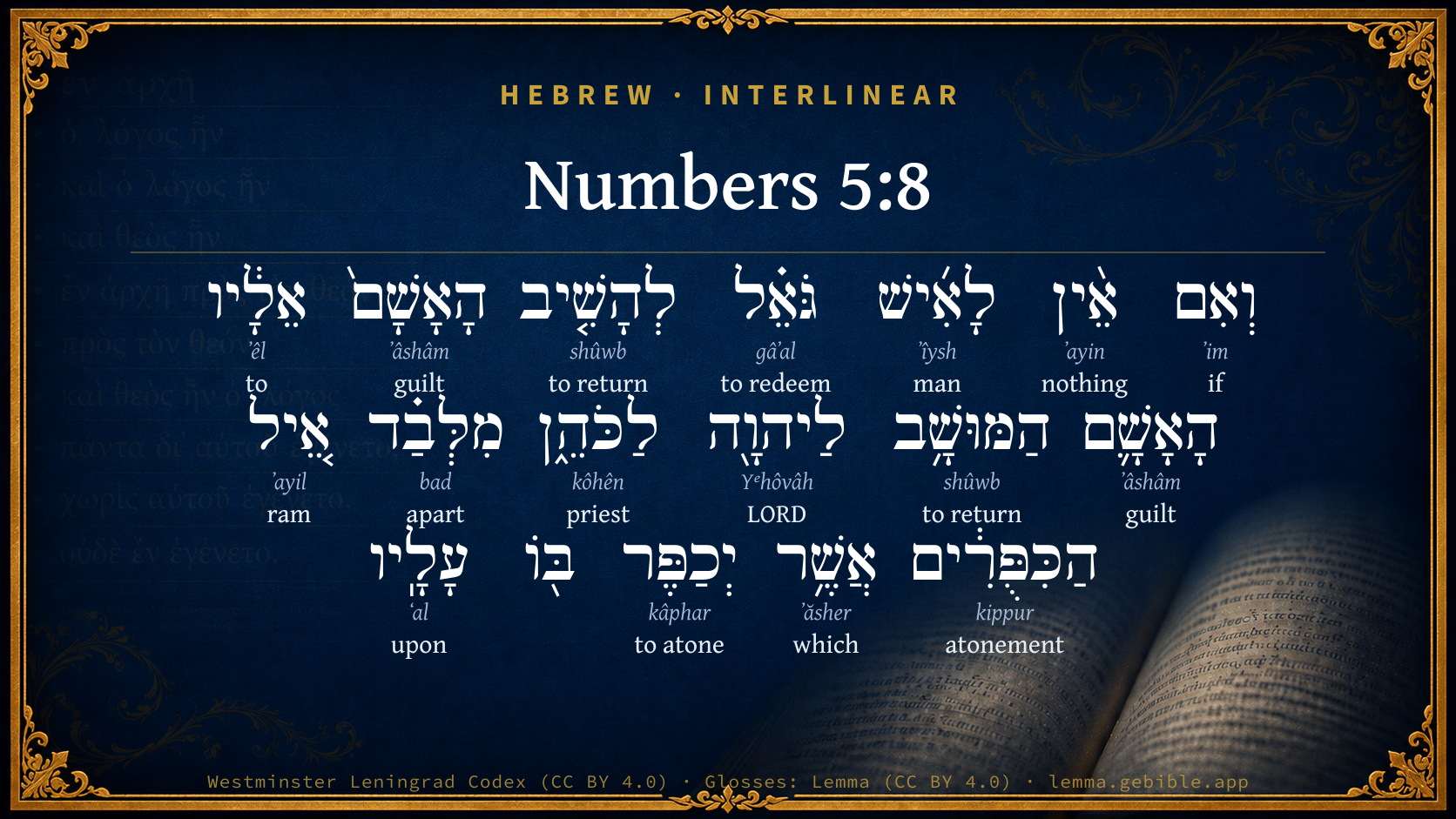
Hebrew (Westminster Leningrad Codex) Numbers 5:8 appears in the Hebrew Old Testament. The text above is from the Westminster Leningrad Codex. Each word links to its Strong’s number, a concise gloss, and parsing drawn from the Open Scriptures Hebrew Bible morphology. Click any word for its full Brown-Driver-Briggs (BDB) entry.
Download image
Cite this verse

Numbers 5:8 (World English Bible). Public Domain. Lemma interlinear Bible study tool, https://lemma.gebible.app/v/numbers/5/8.

Show BibTeX & RIS
BibTeX
RIS
English Translation
But if the man has no kinsman to whom restitution may be made for the guilt, the restitution for guilt which is made to Yahweh shall be the priest's; besides the ram of the atonement, by which atonement shall be made for him.
World English Bible · Public Domain
Download a study sheet

One document with this verse’s original text, its word-by-word gloss line, the meaning frame, cross-references with their text, attributed commentary, and full source and license credits — printable, and it pastes into notes with its structure intact.

This verse Autodidact and up

Study sheet (.html) Plain text (.txt)

A passage Seminary Student

Up to 50 verses in one chapter. A passage sheet keeps up to 6 commentary sources and 12 cross-references per verse, in the order this page ranks them, and says so on the sheet whenever that leaves anything out. Ask for a single verse and you get the Autodidact verse sheet above.

Everything on this page stays free to read, with no account — the sheet is a download of what is already on screen, not access to it.

Want to remove ads? Support Godless Engineer
Compare translations 3

The same verse in 3 English versions, stacked beneath the original-language interlinear above. Click any original word for its lexicon entry.

Each is an independent rendering of the whole verse — the interlinear is not word-aligned to these translations.

Highlighted words mark where these versions differ — a whole-verse word diff, not a word-by-word alignment.

  • World English Bible Public Domain
    But if the man has no kinsman to whom restitution may be made for the guilt, the restitution for guilt which is made to Yahweh shall be the priest's; besides the ram of the atonement, by which atonement shall be made for him.
  • King James Version Public Domain
    But if the man have no kinsman to recompense the trespass unto, let the trespass be recompensed unto the LORD, even to the priest; beside the ram of the atonement, whereby an atonement shall be made for him.
  • unfoldingWord Literal Text CC BY-SA 4.0
    And if there is not one redeeming for the man to return the guilt to him, the guilt being returned to Yahweh to the priest, besides the ram of the atonement upon which he shall make atonement for him.

unfoldingWord Literal Text — © unfoldingWord, licensed CC BY-SA 4.0. Word-aligned USFM3 via Door43 (git.door43.org/unfoldingWord/en_ult).

Versions to compare (up to 4)

3 of 4 selected

Show all 18 translations

Every available English version of this verse, each an independent rendering of the whole verse.

  • World English Bible Public Domain
    But if the man has no kinsman to whom restitution may be made for the guilt, the restitution for guilt which is made to Yahweh shall be the priest's; besides the ram of the atonement, by which atonement shall be made for him.
  • Berean Standard Bible Public Domain
    But if the man has no relative to whom restitution can be made for the wrong, the restitution belongs to the LORD and must be given to the priest along with the ram of atonement, by which the atonement is made for him.
  • Majority Standard Bible Public Domain
    But if the man has no relative to whom restitution can be made for the wrong, the restitution belongs to the LORD and must be given to the priest along with the ram of atonement, by which the atonement is made for him.
  • King James Version Public Domain
    But if the man have no kinsman to recompense the trespass unto, let the trespass be recompensed unto the LORD, even to the priest; beside the ram of the atonement, whereby an atonement shall be made for him.
  • American Standard Version (1901) Public Domain
    But if the man have no kinsman to whom restitution may be made for the guilt, the restitution for guilt which is made unto Jehovah shall be the priest's; besides the ram of the atonement, whereby atonement shall be made for him.
  • Revised Version (1885) Public Domain
    But if the man have no kinsman to whom restitution may be made for the guilt, the restitution for guilt which is made unto the LORD shall be the priest’s; besides the ram of the atonement, whereby atonement shall be made for him.
  • Geneva Bible (1599) Public Domain
    But if the man haue no kinseman, to whom he shoulde restore the domage, the domage shall be restored to the Lord for the Priests vse besides the ramme of the atonement, whereby hee shall make atonement for him.
  • Douay-Rheims (1899) Public Domain
    But if there be no one to receive it, they shall give it to the Lord, and it shall be the priest's, besides the ram that is offered for expiation, to be an atoning sacrifice.
  • Young's Literal Translation Public Domain
    `And if the man have no redeemer to restore the guilt to, the guilt which is restored `is' Jehovah's, the priest's, apart from the ram of the atonements, whereby he maketh atonement for him.
  • Literal Standard Version CC BY-SA 4.0
    And if the man has no redeemer to restore the guilt to, the guilt which is restored [is] to YHWH for the priest, apart from the ram of the atonements, whereby he makes atonement for him.
  • Unlocked Literal Bible CC BY-SA 4.0
    But if the wronged person has no close relative to receive the payment, he must pay the price for his guilt to me through a priest, along with a ram to atone for himself.
  • unfoldingWord Literal Text CC BY-SA 4.0
    And if there is not one redeeming for the man to return the guilt to him, the guilt being returned to Yahweh to the priest, besides the ram of the atonement upon which he shall make atonement for him.
  • Darby Bible Public Domain
    And if the man have no kinsman to recompense the trespass unto, the trespass which is recompensed to Jehovah shall be the priest's, besides the ram of the atonement, wherewith an atonement is made for him.
  • World Messianic Bible Public Domain
    But if the man has no kinsman to whom restitution may be made for the guilt, the restitution for guilt which is made to the LORD shall be the priest’s, in addition to the ram of the atonement, by which atonement shall be made for him.
  • Webster's Bible Public Domain
    But if the man shall have no kinsman to recompense the trespass to, let the trespass be recompensed to the LORD, even to the priest; besides the ram of the atonement, by which an atonement shall be made for him.
  • Free Bible Version CC BY-SA 4.0
    However, if that person doesn't have a relative who can be paid the compensation, it belongs to the Lord and shall be given to the priest, together with a sacrificial ram by which the guilty person is set right.
  • Bible in Basic English Public Domain
    But if the man has no relation to whom the payment may be made, then the payment for sin made to the Lord will be the priest's, in addition to the sheep offered to take away his sin.
  • JPS Tanakh (1917) Public Domain
    But if the man have no kinsman to whom restitution may be made for the guilt, the restitution for guilt which is made shall be the LORD'S, even the priest's; besides the ram of the atonement, whereby atonement shall be made for him.

Literal Standard Version (2020), Covenant Press — licensed CC BY-SA 4.0. Text via the HelloAO Bible API (eBible.org). Unlocked Literal Bible (unfoldingWord) — licensed CC BY-SA 4.0. Text via the HelloAO Bible API (eBible.org). unfoldingWord Literal Text — © unfoldingWord, licensed CC BY-SA 4.0. Word-aligned USFM3 via Door43 (git.door43.org/unfoldingWord/en_ult). Free Bible Version, Dr. Jonathan Gallagher — licensed CC BY-SA 4.0. Text via the HelloAO Bible API (eBible.org).

Word by word

More ways to search: Search by grammar → Find every occurrence → Compare this word →

Practice this passage: Drill this verse → Learn its vocabulary →

הַכִּפֻּרִ֔ים
kippur
H3725
“the · atonement”
Particle, Definite Article + Noun, Common, Masculine, Plural, Absolute
Part of Speech
Particle + Noun
Type
Common
Gender
Masculine
Number
Plural
State
Absolute
Full BDB Definition

Origin: from H3722

TWOT: 1023b

atonement
  1. וְאִם ʼim H518 “and · if” Conjunction + Conjunction
  2. אֵ֨ין ʼayin H369 “nothing” Particle, Negative
  3. לָאִ֜ישׁ ʼîysh H376 “to/for the · man” Preposition, Determined + Noun, Common, Masculine, Singular, Absolute
  4. גֹּאֵ֗ל gâʼal H1350 “redeeming” Verb, Qal, Participle Active, Masculine, Singular, Absolute
  5. לְהָשִׁ֤יב shûwb H7725 “to return” Preposition + Verb, Hiphil, Infinitive Construct
  6. הָאָשָׁם֙ ʼâshâm H817 “the · guilt” Particle, Definite Article + Noun, Common, Masculine, Singular, Absolute
  7. אֵלָ֔יו ʼêl H413 “to · him” Preposition + Suffix, Personal, 3rd Person, Masculine, Singular
  8. הָאָשָׁ֛ם ʼâshâm H817 “the · guilt” Particle, Definite Article + Noun, Common, Masculine, Singular, Absolute
  9. הַמּוּשָׁ֥ב shûwb H7725 “the · returned” Particle, Definite Article + Verb, Hophal, Participle Passive, Masculine, Singular, Absolute
  10. לַיהוָ֖ה Yᵉhôvâh H3068 “to/for · LORD” Preposition + Noun, Proper
  11. לַכֹּהֵ֑ן kôhên H3548 “to/for the · priest” Preposition, Determined + Noun, Common, Masculine, Singular, Absolute
  12. מִלְּבַ֗ד bad H905 “from · to/for · apart of” Preposition + Preposition + Noun, Common, Masculine, Singular, Construct
  13. אֵ֚יל ʼayil H352 “ram of” Noun, Common, Masculine, Singular, Construct
  14. אֲשֶׁ֥ר ʼăsher H834 “which” Particle, Relative
  15. יְכַפֶּר kâphar H3722 “to atone” Verb, Piel, Imperfect, 3rd Person, Masculine, Singular
  16. עָלָֽיו ʻal H5921 “upon · him” Preposition + Suffix, Personal, 3rd Person, Masculine, Singular

About this verse

These counts appear in no published source. They are computed here, from the morphology-tagged text and Lemma’s own curated glosses. What Lemma adds →

18
words
15
distinct lemmas
Pentateuch
section

Notable vocabulary

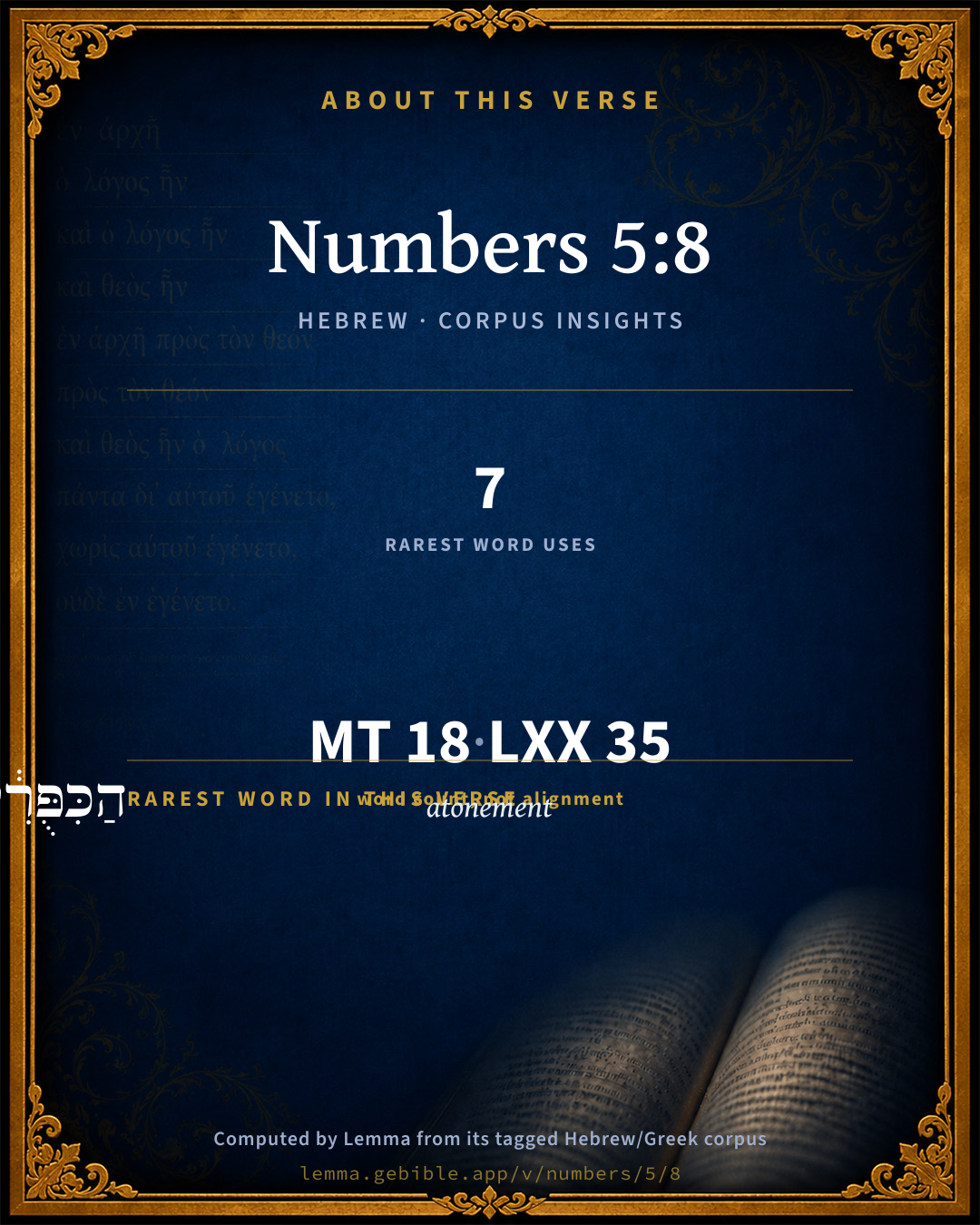
The rarest word here is הַכִּפֻּרִ֔ים atonement H3725 — appearing just 7 times in the whole Hebrew Bible.

Shared distinctive vocabulary

הַכִּפֻּרִ֔ים atonement H3725 occurs in 7 verses of the Hebrew Bible. Also found in:

Grammatical profile

  • 4 verbs
  • 8 nouns
  • 3 prepositions
  • 1 conjunction
  • 2 particles

Verb forms

  • גֹּאֵ֗ל Qal · Participle Active
  • לְהָשִׁ֤יב Hiphil · Infinitive Construct
  • הַמּוּשָׁ֥ב Hophal · Participle Passive
  • יְכַפֶּר Piel · Imperfect

Repetition

Words recur within this verse — often emphatic in Hebrew:

  • לְהָשִׁ֤יב to return H7725 ×2
  • הָאָשָׁם֙ guilt H817 ×2

Hebrew & Septuagint length

In English translation the verse runs 43 words from the Hebrew and 44 from the Septuagint (LXX English) — closely comparable.

A rough comparison of the two English renderings, which tokenize alike — not a word-level alignment.

Word counts can differ between the Hebrew and the Greek without any difference in meaning — e.g. the Hebrew direct-object marker אֵת has no separate Greek word, and Greek often adds the article ὁ.

In the original languages it is 18 Hebrew tokens and 35 Greek tokens — but the two are counted differently (Hebrew bundles its prefixes and suffixes into one token; the Greek is in lemma form), so that isn’t a like-for-like length.

Cross-references

3

Topical passages linked to Numbers 5:8 in the Treasury of Scripture Knowledge — connected by theme and wording, ordered by reader-vote popularity; previews shown in the World English Bible.

  • Leviticus 6:6–7 He shall bring his trespass offering to Yahweh, a ram without blemish from the flock, according to your estimation, for a trespass offering, to the priest.
  • Leviticus 7:7 "'As is the sin offering, so is the trespass offering; there is one law for them. The priest who makes atonement with them shall have it.
  • Leviticus 25:25–26 "'If your brother becomes poor, and sells some of his possessions, then his kinsman who is next to him shall come, and redeem that which his brother has sold.

Cross-references courtesy of OpenBible.info (CC BY 4.0).

Hebrew and Greek witnesses Masoretic Hebrew ↔ Greek Septuagint

The same verse in the two great witnesses to the Old Testament, shown verse-for-verse.

These are two independent witnesses, not word-aligned to each other, and the Septuagint is shown in lemma (dictionary) form.

Hebrew Numbers 5:8 Masoretic · Westminster Leningrad Codex

וְאִם אֵ֨ין לָאִ֜ישׁ גֹּאֵ֗ל לְהָשִׁ֤יב הָאָשָׁם֙ אֵלָ֔יו הָאָשָׁ֛ם הַמּוּשָׁ֥ב לַיהוָ֖ה לַכֹּהֵ֑ן מִלְּבַ֗ד אֵ֚יל הַכִּפֻּרִ֔ים אֲשֶׁ֥ר יְכַפֶּר בּ֖וֹ עָלָֽיו

But if the man has no kinsman to whom restitution may be made for the guilt, the restitution for guilt which is made to Yahweh shall be the priest's; besides the ram of the atonement, by which atonement shall be made for him.

World English Bible · Public Domain

Greek LXX Numbers 5:8 Septuagint · lemma form

ἐάν δέ μή εἰμί ὁ ἄνθρωπος ὁ ἀγχιστεύω ὥστε ἀποδίδωμι αὐτός ὁ πλημμέλημα πρός αὐτός ὁ πλημμέλημα ὁ ἀποδίδωμι κύριος ὁ ἱερεύς εἰμί πλήν ὁ κριός ὁ ἱλασμός διά ὅς ἐκἱλάσκομαι ἐν αὐτός περί αὐτός

But if a man have no near kinsman, so as to make satisfaction for his trespass to him, the trespass-offering paid to the Lord shall be for the priest, besides the ram of atonement, by which he shall make atonement with it for him.

LXX2012 (modern English Septuagint) · Public Domain

Hebrew: Westminster Leningrad Codex (CC BY 4.0). Greek: Septuagint (public domain); English from LXX2012 (modern English Septuagint) (Public Domain). How the Septuagint differs from the Hebrew →

Targum (Aramaic paraphrase)

2

The Targum is the ancient Jewish Aramaic paraphrase of the Hebrew Scriptures — an interpretive translation, not the Hebrew text itself. Onkelos (literal) and Pseudo-Jonathan (expansive) render the Torah, and Jonathan the Prophets. Coverage is partial: where no permissively-licensed English translation exists for a verse, only the Aramaic is shown. This is verse-level text, not a word-by-word alignment to the Hebrew.

  1. Targum Onkelos Torah (Genesis–Deuteronomy)
    וְאִם לֵית לִגְבַר פָּרִיק לַאֲתָבָא חוֹבְתָא לֵהּ חוֹבְתָא דִמְתֵב קֳדָם יְיָ לְכַהֲנָא בַּר מִדְכַר כִּפּוּרַיָא דִי יְכַפֵּר בֵּהּ עֲלוֹהִי

    (no public-domain English translation for this verse)

    Targum Onkelos — Aramaic: “Onkelos Genesis” (public domain); “Onkelos Exodus” (public domain); “Onkelos Leviticus” (public domain); “Onkelos Numbers” (public domain); “Onkelos Deuteronomy” (public domain). English: “Sefaria Community Translation” (CC0 1.0 (public-domain dedication)); “J.W. Etheridge. The Targums of Onkelos and Jonathan Ben Uzziel on the Pentateuch. London: Longmans, Green, 1862” (public domain). Text via Sefaria.

  2. Targum Pseudo-Jonathan Torah (Genesis–Deuteronomy)
    וְאִין לָא אִית לְגַבֵּיהּ פָּרִיק לְאָתָבָא חוֹבְתֵיהּ לֵיהּ חוֹבְתֵיהּ דִמְיֵיתַב קֳדָם יְיָ לְכַהֲנָא יִתֵּן בַּר מִדְכַר כִּפּוּרַיָא דִי יְכַפֵּר בֵּיהּ עֲלוֹי

    And if the man (hath died and) hath no kinsman to whom the debt may be rendered, the debt to be restored (shall he render) before the Lord; he shall give it to the priest, besides the ram for his atonement, by which atonement is to be made for him.

    Targum Pseudo-Jonathan — Aramaic: “Targum Jonathan on Genesis” (public domain); “Targum Jonathan on Exodus” (public domain); “Targum Jonathan on Leviticus” (public domain); “Targum Jonathan on Numbers” (public domain); “Targum Jonathan on Deuteronomy” (public domain). English: “The Targum of Jonathan ben Uzziel, trans. J. W. Etheridge, London, 1862” (public domain). Text via Sefaria.

Commentary

Notes on Numbers 5:8 from classic Christian and Jewish commentators (each source and its license shown beneath its notes). The classic Christian expositions comment on the surrounding passage and are grouped to its opening verse, so a note may address several verses; the Jewish commentaries on the Tanakh (Rashi and others) are per-verse, so they appear only where the commentator wrote on this verse.

Lemma curates 59 commentaries, every one of them public domain or Creative Commons licensed, each selected and text-cleaned for this edition rather than reprinted as found. About our sources →

Trapp's Complete Commentary

John Trapp

Num 5:8 But if the man have no kinsman to recompense the trespass unto, let the trespass be recompensed unto the LORD, [even] to the priest; beside the ram of the atonement, whereby an atonement shall be made for him.

Ver. 8. Unto the Lord, even to the priest.] The priest is the Lord’s receiver. {a} {So Heb 7:6-9} Tithes are due to the ministers of Christ "that liveth," because due to him, and they are in his stead. {2Co 5:20}

{a} Sacerdos est vicarius et quasi haeres. - Dio.

John Trapp, A Commentary or Exposition upon All the Books of the Old and New Testament (1647–1656) — public domain. Text from a community e-Sword module.

Joseph Benson's Commentary

Num 5:8. No kinsman — This supposes the person injured to be dead, or gone into some unknown place. To the priest — Whom God appointed as his deputy, to receive his dues, and take them to his own use, that so he might more cheerfully and entirely devote himself to the ministration of holy things. This is an additional explication to that law, Lev 6:2, and for the sake thereof it seems here to be repeated.

Joseph Benson's Commentary on the Old and New Testaments (1811–1818) — public domain. Text from a community e-Sword module.

Tyndale Open Study Notes

Tyndale Open Resources

5:8 Because sin is ultimately against God (5:6; Ps 51:4), the perpetrator had a moral obligation to make restitution to the Lord, who authorized the human victims of the sin to receive that payment; if none were living, the Lord received payment through the priest. Perpetrators also had to offer a valuable sacrifice that restored their ritual purity (Num 5:1-4) and their relationship with God. • purified and made right with the Lord: See study note on Lev 1:4.

Tyndale Open Study Notes — © Tyndale Open Resources, licensed CC BY-SA 4.0. Text via the HelloAO Bible API.

Geneva Bible (1599)

Geneva Bible translators

If he be dead to whom the wrong is done, and also have no kinsman.

Geneva Bible (1599) marginal notes — public domain. Text via Bolls.life.

Adam Clarke's Commentary

Verse 8. If the man have no kinsman] The Jews think that this law respects the stranger and the sojourner only, because every Israelite is in a state of affinity to all the rest; but there might be a stranger in the camp who has no relative in any of the tribes of Israel.

Adam Clarke's Commentary on the Bible (1810–1826) — public domain. Text from a community e-Sword/MySword module.

The Cambridge Bible for Schools and Colleges

gen. ed. J. J. S. Perowne

8. The verse deals with the case in which the injured person dies before restitution has been made to him, and leaves no representative.

kinsman] Heb. gô’çl. A technical term of considerable importance in Israelite law. A man’s next of kin was (1) a full brother, (2) failing him, an uncle on the father’s side, (3) failing him, a first cousin on the father’s side, (4) failing him, any near kinsman. His duties were manifold. In civil law: (a) to buy back the family estate of his kinsman, which the latter had sold through poverty (Lev_25:25, Rth_4:1-6). He also had the refusal of it before it was sold (Jer_32:8-12). (b) To buy back the person of his kinsman, if the latter had sold himself as a slave through poverty (Lev_25:47 ff.). In both these cases his action may be denoted by the word ‘redeem.’ (c) To receive restitution due to his deceased kinsman (here). In criminal law: to claim satisfaction for the blood of his murdered kinsman, in which case he was known as the gô’çl haddâm, ‘avenger of blood.’

unto the Lord shall be the priest’s] lit. ‘shall be for Jehovah for the priest.’ The priest shall receive it as the representative of Jehovah.

the ram of the atonement] The guilt-offering described in Lev_6:6.

The Cambridge Bible for Schools and Colleges (gen. ed. J. J. S. Perowne; Cambridge University Press, 1878–1918) — public domain. Text from a community e-Sword module.

John Gill's Exposition

But if a man have no kinsman to recompense the trespass to,.... This supposes that if a man should die, against whom the trespass is, before the restitution is made, then it shall be made to his heirs; and if he has none, then it was to be given to the priest, as after directed: the Jews (g) generally understand this of a proselyte, that has no heirs, for they say, there is no Israelite but has kinsmen, a brother or a son, or some one or other near of kin to him, of his father's family, even up to Jacob:

let the trespass be recompensed unto the Lord, even to the priest; that is, let the principal, with the fifth part, which is the recompence for the trespass committed, be given to the priest of the Lord, which is the same as if it was given to him, he being his minister:

beside the ram of the atonement, whereby an atonement shall be made for him; which, in this case, was ordered to be offered for the expiation, of the trespass, see Lev 6:6; the Jewish canon is,"he that takes away anything by force from a proselyte, and swears to him, and he (the proselyte) dies, lo, he shall pay the principal and the fifth to the priests, and the trespass offering to the altar, as it is said, "if a man has no kinsman", &c. when he brings the money and the trespass offering, and he is dead, the money shall be given to his sons, but the trespass offering (the ram) shall feed until it contracts some blemish, and then it shall be sold, and the price of it shall fall to the freewill offerings (h).''

(g) Maimon. & Bartenora in Misn. Bava Kama, c. 9. sect. 11. Jarchi in loc. (h) Misn. Bava Kama, ib.

John Gill's Exposition of the Whole Bible (1746–1763) — public domain (CC PDM 1.0). Text via the HelloAO Bible API.

Haydock's Catholic Bible Commentary

But if. Moses does not mention this case, Leviticus vi. 2, 5. Here he determines that the heirs, if known, must be entitled to the restitution. A Hebrew could not die without an heir; but a proselyte might, and then restitution was to be made to God. The Rabbins say, that when the person injured was already dead, the offender took 10 persons with him to the grave of the deceased, and said, "I have sinned against the Lord and against. N.; I have injured him thus." After which he gave what was due to his heirs; or, if none could be found, to the house of judgment or the judges, who might restore it, if any claimant appeared afterwards.

George Leo Haydock (1774–1849), Haydock's Catholic Family Bible and Commentary, 1859 edition — public domain. Excludes Psalms (Douay-Rheims chapter numbering differs from Protestant) and Deuterocanonical books (Catholic canon only).

Matthew Poole's English Annotations

If the man have no kinsman, which might be the case commonly with proselytes, if not with Israelites. This also suppposeth the person injured to be dead or gone away into some unknown place, and the person injured to be known to the injurer.

God appointed

the priest as his deputy to receive his dues, and take them to his own use, that so he might more cheerfully and entirely devote himself to the ministration of holy things. This is au additional explication to that law, Lev 6:2, and for the sake thereof it seems here to be repeated.

Matthew Poole's English Annotations on the Holy Bible (1683–1685) — public domain. Text from a community e-Sword/MySword module.

Whedon's Commentary on the Bible

Daniel D. Whedon

8. No kinsman — The Hebrew goel was the nearest relative, whose duty it was to redeem his enslaved kinsman, as well as to avenge his death at another’s hand. See note introductory to Num_5:1, and on Gen_9:5.

In this is implied the fact of the death of the injured party.

To the priest — As the representative of Jehovah, who in a peculiar sense is the kin of the deceased, the restitution is to be made. He is our ultimate legatee and avenger. The restitution money paid to the priest was put into a common purse and distributed among all the priests in that course.

The ram of the atonement — This was the sacrifice by which the expiation to Jehovah was effected. Lev_6:7. As he was offended by the sin, his wrath must be appeased, as well as the violated rights of man be restored. Hengstenberg interprets this to signify that Jehovah, the natural heir, who was wronged in the injured person, was to receive a double trespass offering. The original law required, with the ram, a sum of money estimated to be an equivalent to the injury done to the person. “The ram of the asham receives an imaginary value according to the estimate of the priests.” The ram presented by the delinquent “as a compensation for the spiritual debt was taxed as high as the sum which was given for the compensation of the outward material debt. By this symbolic act the idea of debt was most vividly impressed, and the necessity of making a settlement with God was clearly exhibited.” This verse supplements the original law of the trespass offering, which is silent respecting the death of the injured person who had no heir or goel. It is probable that such a case had occurred, and hence additional legislation was required.

Daniel D. Whedon (gen. ed.), Commentary on the Old and New Testaments (1874–1909) — public domain. Text from a community e-Sword module.

The Pulpit Commentary

If the man have no kinsman. No goel, or personal representative. This supposes that the wronged man himself is dead, and it is an addition to the law of restitution as given in Leviticus 6, an addition clearly necessary to its completeness. The wrong-doer must in no case be the gainer by his own wrong, and if the trespass could not be "recompensed" to man, it must be "recompensed" to the Lord, who was as it were joint-plaintiff in the cause. To the priest. On the general principle that the priest was the visible representative of the invisible majesty.

The Pulpit Commentary (1880–1919), ed. H.D.M. Spence-Jones & Joseph S. Exell — public domain. Text from a community e-Sword module.

John Wesley's Explanatory Notes

No kinsman - This supposes the person injured to be dead or gone, into some unknown place, and the person injured to be known to the injurer. To the priest - Whom God appointed as his deputy to receive his dues, and take them to his own use, that so he might more cheerfully and entirely devote himself to the ministration of holy things. This is an additional explication to that law, Lev. vi, 2, and for the sake thereof it seems here to be repeated.

John Wesley, Explanatory Notes Upon the Whole Bible (1754–1765) — public domain. Text via the GEBible commentary corpus.

Scofield Reference Notes

C. I. Scofield

kinsman Heb. goel, Redemp. (Kinsman type). (See Scofield "Isa 59:20").

atonement (See Scofield "Exo 29:33")

The Scofield Reference Bible (1917 edition), notes by C. I. Scofield — public domain. Text from a community e-Sword module.

unfoldingWord translationNotes

Door43 World Missions Community

But if the wronged person has no close relative to receive the payment

Usually the wronged person would receive the payment but if that person has died the payment goes to the closest relative. The full meaning of this statement can be made explicit. AT: "But if the wronged person has died and has no close relative to receive the payment" (See: Assumed Knowledge and Implicit Information)

if the wronged person

This can be stated in active form. AT: "if the person whom the guilty person has wronged" (See: Active or Passive)

he must pay the price for his guilt to me through a priest

If a person made a payment to a priest to pay for his guilt it was the same as if the person had made the payment to Yahweh.

to atone for himself

The atonement is made for the man's sin. Here Yahweh refers to the man's sin as the man who committed it. AT: "to atone for his sin" (See: Metonymy)

the things that are set aside and brought to the priest by the people of Israel

This can be stated in active form. AT: "the things that the people of Israel set aside and bring to the priest" (See: Active or Passive)

The offerings of every person will be for the priest; if anyone gives anything to the priest, it will belong to him

These two phrases mean basically the same thing and may be combined to state that the offerings that someone gives belong to the priest to whom they have been given. (See: Parallelism)

translationWords

receive

priest

ewe

atonement

sacrifice

holy

unfoldingWord translationNotes — © Distant Shores Media and the Door43 World Missions Community, licensed CC BY-SA 4.0. Source: git.door43.org/Door43/en_tn.

Rashi

Rabbi Shlomo Yitzchaki (Rashi)

ואם אין לאיש גאל BUT IF THE MAN HAS NO KINSMAN — This means that the claimant who put him to the oath, died and has left no heirs,

להשיב האשם אליו TO WHOM THAT WHEREIN HE IS GUILTY COULD BE RESTORED, when he decided at a later period to confess his sin. — Our Rabbis asked (Sifrei Bamidbar 4:1; Bava Kamma 109a): But can you find anyone in Israel who has no kinsman whatsoever, neither a son nor a brother nor other relative near akin to him from his father’s family, going back as far as Jacob? But this person referred to is a proselyte who died and has no heirs (his heathen relatives not being entitled to succeed to his property) (Sifrei Bamidbar 4:1; Bava Kamma 109a).

האשם המושב THAT WHEREIN HE IS GUILTY AND WHICH HATH TO BE RESTORED — i.e. the principal (האשם) and the fifth thereof (המושב) (cf. Bava Kamma 110a),

לה’ לכהן BELONGS TO THE LORD, FOR THE PRIEST — This means the Lord becomes its owner and gives it to the priest of that Mishmar (shift) (Bava Kamma 109b).

מלבד איל הכפרים BESIDES THE RAM OF EXPIATION which is mentioned in the Sedrah ויקרא (Leviticus 5:25), as being incumbent upon him to offer.

Rashi on the Tanakh — English translations: “The Judaica Press complete Tanach with Rashi, translated by A. J. Rosenberg” (CC BY 4.0); “Pentateuch with Rashi's commentary by M. Rosenbaum and A.M. Silbermann, 1929-1934” (public domain); “The Metsudah Tanach series, Lakewood, N.J” (CC BY 4.0); and “The Book of Joshua, Metsudah Publications, 1997” (CC BY 4.0). Text via Sefaria.

Lesson kit

Teaching starters — assembled from the data on this page, not authored interpretation. Every prompt links to the verse data it draws on. Edit before teaching.

Numbers, in the Pentateuch, opens this verse with 18 words (15 distinct Hebrew lemmas). Its most distinctive word is kippur (“atonement”). A historical commentator’s framing appears above. Read the whole chapter for the surrounding context.

Discussion questions

  1. What does “atonement” (kippur) contribute to the verse as a whole?
  2. How does Exodus 29:36, which shares the word «atonement», read alongside this verse?
  3. What does the repetition of “to return” (2× in this one verse) do in this verse?
  4. These translations render this verse differently. What is at stake in choosing one wording over another?
  5. «גֹּאֵ֗ל» is a Qal Participle Active verb. How does that grammatical form shape the action described?
  6. Compare how Trapp's Complete Commentary and Joseph Benson's Commentary read this verse. Where do they agree or differ?

Things to notice

Reading settings

Reading text

Shown beneath each verse's original-language words.

Old Testament
Old Testament edition

Read the OT as the Masoretic Hebrew (MT) or the Greek Septuagint (LXX).

English shown for the Greek Septuagint (in the Hebrew ↔ Greek comparison).

Comparing translations? Open the Compare panel on any verse page to stack up to four side by side.