
Deuteronomy 28:31

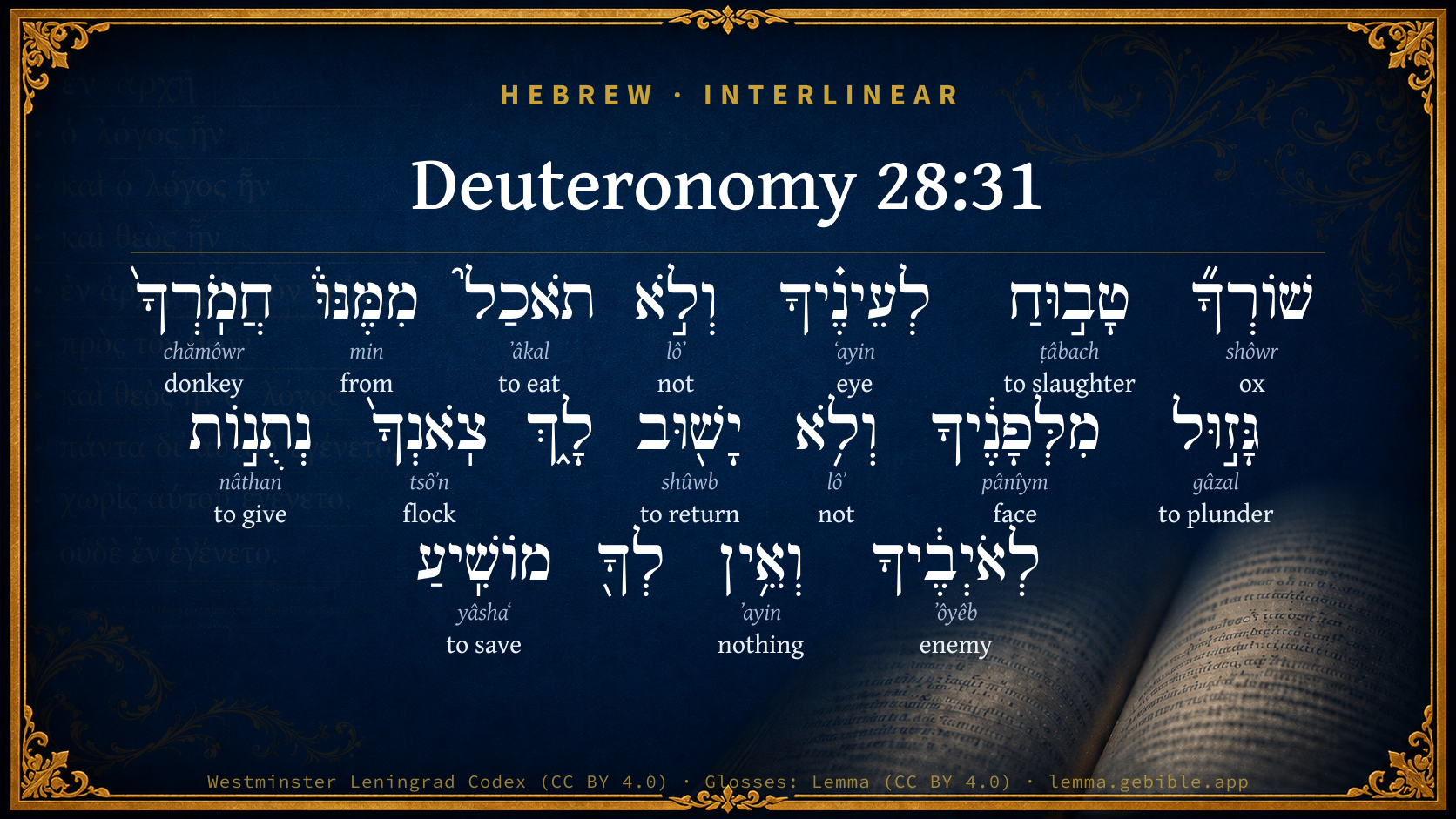
Hebrew (Westminster Leningrad Codex) Deuteronomy 28:31 appears in the Hebrew Old Testament. The text above is from the Westminster Leningrad Codex. Each word links to its Strong’s number, a concise gloss, and parsing drawn from the Open Scriptures Hebrew Bible morphology. Click any word for its full Brown-Driver-Briggs (BDB) entry.
Download image
Cite this verse

Deuteronomy 28:31 (World English Bible). Public Domain. Lemma interlinear Bible study tool, https://lemma.gebible.app/v/deuteronomy/28/31.

Show BibTeX & RIS
BibTeX
RIS
English Translation
Your ox shall be slain before your eyes, and you shall not eat of it: your donkey shall be violently taken away from before your face, and shall not be restored to you: your sheep shall be given to your enemies, and you shall have none to save you.
World English Bible · Public Domain
Download a study sheet

One document with this verse’s original text, its word-by-word gloss line, the meaning frame, cross-references with their text, attributed commentary, and full source and license credits — printable, and it pastes into notes with its structure intact.

This verse Autodidact and up

Study sheet (.html) Plain text (.txt)

A passage Seminary Student

Up to 50 verses in one chapter. A passage sheet keeps up to 6 commentary sources and 12 cross-references per verse, in the order this page ranks them, and says so on the sheet whenever that leaves anything out. Ask for a single verse and you get the Autodidact verse sheet above.

Everything on this page stays free to read, with no account — the sheet is a download of what is already on screen, not access to it.

Want to remove ads? Support Godless Engineer
Compare translations 3

The same verse in 3 English versions, stacked beneath the original-language interlinear above. Click any original word for its lexicon entry.

Each is an independent rendering of the whole verse — the interlinear is not word-aligned to these translations.

Highlighted words mark where these versions differ — a whole-verse word diff, not a word-by-word alignment.

  • World English Bible Public Domain
    Your ox shall be slain before your eyes, and you shall not eat of it: your donkey shall be violently taken away from before your face, and shall not be restored to you: your sheep shall be given to your enemies, and you shall have none to save you.
  • King James Version Public Domain
    Thine ox shall be slain before thine eyes, and thou shalt not eat thereof: thine ass shall be violently taken away from before thy face, and shall not be restored to thee: thy sheep shall be given unto thine enemies, and thou shalt have none to rescue them.
  • unfoldingWord Literal Text CC BY-SA 4.0
    Your ox slain before your eyes, but you will not eat from it. Your donkey will be robbed from to your face and will not be returned to you. Your sheep given to your enemies, and there will be no deliverer for you.

unfoldingWord Literal Text — © unfoldingWord, licensed CC BY-SA 4.0. Word-aligned USFM3 via Door43 (git.door43.org/unfoldingWord/en_ult).

Versions to compare (up to 4)

3 of 4 selected

Show all 18 translations

Every available English version of this verse, each an independent rendering of the whole verse.

  • World English Bible Public Domain
    Your ox shall be slain before your eyes, and you shall not eat of it: your donkey shall be violently taken away from before your face, and shall not be restored to you: your sheep shall be given to your enemies, and you shall have none to save you.
  • Berean Standard Bible Public Domain
    Your ox will be slaughtered before your eyes, but you will not eat any of it. Your donkey will be taken away and not returned to you. Your flock will be given to your enemies, and no one will save you.
  • Majority Standard Bible Public Domain
    Your ox will be slaughtered before your eyes, but you will not eat any of it. Your donkey will be taken away and not returned to you. Your flock will be given to your enemies, and no one will save you.
  • King James Version Public Domain
    Thine ox shall be slain before thine eyes, and thou shalt not eat thereof: thine ass shall be violently taken away from before thy face, and shall not be restored to thee: thy sheep shall be given unto thine enemies, and thou shalt have none to rescue them.
  • American Standard Version (1901) Public Domain
    Thine ox shall be slain before thine eyes, and thou shalt not eat thereof: thine ass shall be violently taken away from before thy face, and shall not be restored to thee: thy sheep shall be given unto thine enemies, and thou shalt have none to save thee.
  • Revised Version (1885) Public Domain
    Thine ox shall be slain before thine eyes, and thou shalt not eat thereof: thine ass shall be violently taken away from before thy face, and shall not be restored to thee: thy sheep shall be given unto thine enemies, and thou shalt have none to save thee.
  • Geneva Bible (1599) Public Domain
    Thine oxe shalbe slayne before thine eyes, and thou shalt not eate thereof: thine asse shall be violently taken away before thy face, and shall not be restored to thee: thy sheepe shalbe giuen vnto thine enemies, and no man shall rescue them for thee.
  • Douay-Rheims (1899) Public Domain
    May thy ox be slain before thee, and thou not eat thereof. May thy ass be taken away in thy sight, and not restored to thee. May thy sheep be given to thy enemies, and may there be none to help thee.
  • Young's Literal Translation Public Domain
    thine ox `is' slaughtered before thine eyes, and thou dost not eat of it; thine ass `is' taken violently away from before thee, and it is not given back to thee; thy sheep `are' given to thine enemies, and there is no saviour for thee.
  • Literal Standard Version CC BY-SA 4.0
    your ox [is] slaughtered before your eyes, and you do not eat of it; your donkey [is] violently taken away from before you, and it is not given back to you; your sheep [are] given to your enemies, and there is no savior for you.
  • Unlocked Literal Bible CC BY-SA 4.0
    Your ox will be slain before your eyes, but you will not eat its meat; your donkey will be forcibly taken away from before you and will not be restored to you. Your sheep will be given to your enemies, and you will have no one to aid you.
  • unfoldingWord Literal Text CC BY-SA 4.0
    Your ox slain before your eyes, but you will not eat from it. Your donkey will be robbed from to your face and will not be returned to you. Your sheep given to your enemies, and there will be no deliverer for you.
  • Darby Bible Public Domain
    Thine ox shall be slaughtered before thine eyes, and thou shalt not eat thereof; thine ass shall be snatched away from before thy face, and shall not return to thee; thy sheep shall be given unto thine enemies, and thou shalt have none to recover them.
  • World Messianic Bible Public Domain
    Your ox will be slain before your eyes, and you will not eat any of it. Your donkey will be violently taken away from before your face, and will not be restored to you. Your sheep will be given to your enemies, and you will have no one to save you.
  • Webster's Bible Public Domain
    Thy ox shall be slain before thy eyes, and thou shalt not eat of it: thy ass shall be violently taken away from before thy face, and shall not be restored to thee: thy sheep shall be given to thy enemies, and thou shalt have none to rescue them.
  • Free Bible Version CC BY-SA 4.0
    Your ox will be slaughtered right in front of you, but you won't eat any of it. Your donkey will be taken away and won't be returned to you. Your sheep will be taken by your enemies, and no one will come and save you.
  • Bible in Basic English Public Domain
    Your ox will be put to death before your eyes, but its flesh will not be your food: your ass will be violently taken away before your face, and will not be given back to you: your sheep will be given to your haters, and there will be no saviour for you.
  • JPS Tanakh (1917) Public Domain
    Thine ox shall be slain before thine eyes, and thou shalt not eat thereof; thine ass shall be violently taken away from before thy face, and shall not be restored to thee; thy sheep shall be given unto thine enemies; and thou shalt have none to save thee.

Literal Standard Version (2020), Covenant Press — licensed CC BY-SA 4.0. Text via the HelloAO Bible API (eBible.org). Unlocked Literal Bible (unfoldingWord) — licensed CC BY-SA 4.0. Text via the HelloAO Bible API (eBible.org). unfoldingWord Literal Text — © unfoldingWord, licensed CC BY-SA 4.0. Word-aligned USFM3 via Door43 (git.door43.org/unfoldingWord/en_ult). Free Bible Version, Dr. Jonathan Gallagher — licensed CC BY-SA 4.0. Text via the HelloAO Bible API (eBible.org).

Word by word

More ways to search: Search by grammar → Find every occurrence → Compare this word →

Practice this passage: Drill this verse → Learn its vocabulary →

טָב֣וּחַ
ṭâbach
H2873
“slaughtered”
Verb, Qal, Participle Passive, Masculine, Singular, Absolute
Part of Speech
Verb
Stem
Qal
Form
Participle Passive
Gender
Masculine
Number
Singular
State
Absolute
Full BDB Definition

Origin: a primitive root

TWOT: 786

to slaughter, slay, butcher, kill ruthlessly - (Qal) - to slaughter, butcher - to slay, kill ruthlessly (figuratively)
  1. שׁוֹרְךָ֞ shôwr H7794 “ox · your” Noun, Common, Masculine, Singular, Construct + Suffix, Personal, 2nd Person, Masculine, Singular
  2. לְעֵינֶ֗יךָ ʻayin H5869 “to/for · eyes · your” Preposition + Noun, Common, Both, Dual, Construct + Suffix, Personal, 2nd Person, Masculine, Singular
  3. וְלֹ֣א lôʼ H3808 “and · not” Conjunction + Particle, Negative
  4. תֹאכַל֮ ʼâkal H398 “to eat” Verb, Qal, Imperfect, 2nd Person, Masculine, Singular
  5. מִמֶּנּוּ֒ min H4480 “from · us” Preposition + Suffix, Personal, 1st Person, Common, Plural
  6. חֲמֹֽרְךָ֙ chămôwr H2543 “donkey · your” Noun, Common, Both, Singular, Construct + Suffix, Personal, 2nd Person, Masculine, Singular
  7. גָּז֣וּל gâzal H1497 “plundered” Verb, Qal, Participle Passive, Masculine, Singular, Absolute
  8. מִלְּפָנֶ֔יךָ pânîym H6440 “from · to/for · face(s) · your” Preposition + Preposition + Noun, Common, Both, Plural, Construct + Suffix, Personal, 2nd Person, Masculine, Singular
  9. וְלֹ֥א lôʼ H3808 “and · not” Conjunction + Particle, Negative
  10. יָשׁ֖וּב shûwb H7725 “to return” Verb, Qal, Imperfect, 3rd Person, Masculine, Singular
  11. צֹֽאנְךָ֙ tsôʼn H6629 “flock · your” Noun, Common, Both, Singular, Construct + Suffix, Personal, 2nd Person, Masculine, Singular
  12. נְתֻנ֣וֹת nâthan H5414 “given” Verb, Qal, Participle Passive, Feminine, Plural, Absolute
  13. לְאֹיְבֶ֔יךָ ʼôyêb H341 “to/for · enemy · you” Preposition + Verb, Qal, Participle Active, Masculine, Plural, Construct + Suffix, Personal, 2nd Person, Masculine, Singular
  14. וְאֵ֥ין ʼayin H369 “and · nothing” Conjunction + Particle, Negative
  15. מוֹשִֽׁיעַ yâshaʻ H3467 “saving” Verb, Hiphil, Participle Active, Masculine, Singular, Absolute

About this verse

These counts appear in no published source. They are computed here, from the morphology-tagged text and Lemma’s own curated glosses. What Lemma adds →

18
words
15
distinct lemmas
Pentateuch
section

Notable vocabulary

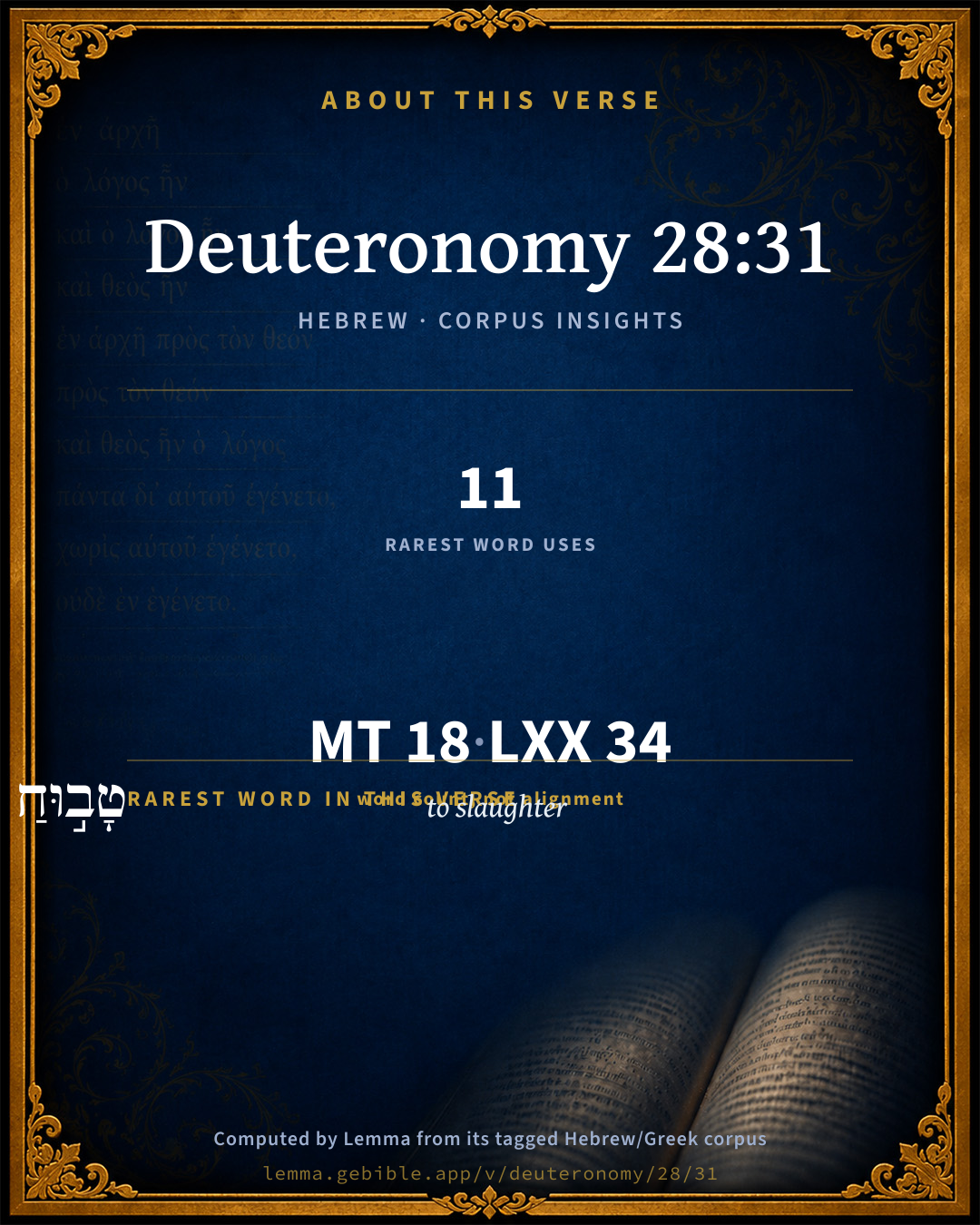
The rarest word here is טָב֣וּחַ to slaughter H2873 — appearing just 11 times in the whole Hebrew Bible.

Shared distinctive vocabulary

טָב֣וּחַ to slaughter H2873 occurs in 11 verses of the Hebrew Bible. Also found in:

Grammatical profile

  • 7 verbs
  • 5 nouns
  • 3 prepositions
  • 3 particles

Verb forms

  • טָב֣וּחַ Qal · Participle Passive
  • תֹאכַל֮ Qal · Imperfect
  • גָּז֣וּל Qal · Participle Passive
  • יָשׁ֖וּב Qal · Imperfect
  • נְתֻנ֣וֹת Qal · Participle Passive
  • לְאֹיְבֶ֔יךָ Qal · Participle Active
  • מוֹשִֽׁיעַ Hiphil · Participle Active

Repetition

A word recurs within this verse — often emphatic in Hebrew:

  • וְלֹ֣א not H3808 ×2

Hebrew & Septuagint length

In English translation the verse runs 49 words from the Hebrew and 44 from the Septuagint (LXX English) — closely comparable.

A rough comparison of the two English renderings, which tokenize alike — not a word-level alignment.

Word counts can differ between the Hebrew and the Greek without any difference in meaning — e.g. the Hebrew direct-object marker אֵת has no separate Greek word, and Greek often adds the article ὁ.

In the original languages it is 18 Hebrew tokens and 34 Greek tokens — but the two are counted differently (Hebrew bundles its prefixes and suffixes into one token; the Greek is in lemma form), so that isn’t a like-for-like length.

Cross-references

2

Topical passages linked to Deuteronomy 28:31 in the Treasury of Scripture Knowledge — connected by theme and wording, ordered by reader-vote popularity; previews shown in the World English Bible.

  • Judges 6:1 The children of Israel did that which was evil in the sight of Yahweh: and Yahweh delivered them into the hand of Midian seven years.
  • Job 1:14–15 that there came a messenger to Job, and said, "The oxen were plowing, and the donkeys feeding beside them,

Cross-references courtesy of OpenBible.info (CC BY 4.0).

Hebrew and Greek witnesses Masoretic Hebrew ↔ Greek Septuagint

The same verse in the two great witnesses to the Old Testament, shown verse-for-verse.

These are two independent witnesses, not word-aligned to each other, and the Septuagint is shown in lemma (dictionary) form.

Hebrew Deuteronomy 28:31 Masoretic · Westminster Leningrad Codex

שׁוֹרְךָ֞ טָב֣וּחַ לְעֵינֶ֗יךָ וְלֹ֣א תֹאכַל֮ מִמֶּנּוּ֒ חֲמֹֽרְךָ֙ גָּז֣וּל מִלְּפָנֶ֔יךָ וְלֹ֥א יָשׁ֖וּב לָ֑ךְ צֹֽאנְךָ֙ נְתֻנ֣וֹת לְאֹיְבֶ֔יךָ וְאֵ֥ין לְךָ֖ מוֹשִֽׁיעַ

Your ox shall be slain before your eyes, and you shall not eat of it: your donkey shall be violently taken away from before your face, and shall not be restored to you: your sheep shall be given to your enemies, and you shall have none to save you.

World English Bible · Public Domain

Greek LXX Deuteronomy 28:31 Septuagint · lemma form

ὁ μόσχος σύ σφάζω ἐναντίον σύ καί οὐ ἐσθίω ἐκ αὐτός ὁ ὄνος σύ ἁρπάζω ἀπό σύ καί οὐ ἀποδίδωμι σύ ὁ πρόβατον σύ δίδωμι ὁ ἐχθρός σύ καί οὐ εἰμί σύ ὁ βοηθέω

Your calf shall be slain before you, and you shall not eat of it; your ass shall be violently taken away from you, and shall not be restored to you: your sheep shall be given to your enemies, and you shall have no helper.

LXX2012 (modern English Septuagint) · Public Domain

Hebrew: Westminster Leningrad Codex (CC BY 4.0). Greek: Septuagint (public domain); English from LXX2012 (modern English Septuagint) (Public Domain). How the Septuagint differs from the Hebrew →

Targum (Aramaic paraphrase)

2

The Targum is the ancient Jewish Aramaic paraphrase of the Hebrew Scriptures — an interpretive translation, not the Hebrew text itself. Onkelos (literal) and Pseudo-Jonathan (expansive) render the Torah, and Jonathan the Prophets. Coverage is partial: where no permissively-licensed English translation exists for a verse, only the Aramaic is shown. This is verse-level text, not a word-by-word alignment to the Hebrew.

  1. Targum Onkelos Torah (Genesis–Deuteronomy)
    תּוֹרָךְ יְהֵי נָכֵס לְעֵינָיךְ וְלָא תֵיכוּל מִנֵהּ חֲמָרָךְ יְהֵי אָנֵס מִקֳדָמָךְ וְלָא יְתוּב לָךְ עָנָךְ מְסִירִין לְבַעֲלֵי דְבָבָךְ וְלֵית לָךְ פָּרִיק

    (no public-domain English translation for this verse)

    Targum Onkelos — Aramaic: “Onkelos Genesis” (public domain); “Onkelos Exodus” (public domain); “Onkelos Leviticus” (public domain); “Onkelos Numbers” (public domain); “Onkelos Deuteronomy” (public domain). English: “Sefaria Community Translation” (CC0 1.0 (public-domain dedication)); “J.W. Etheridge. The Targums of Onkelos and Jonathan Ben Uzziel on the Pentateuch. London: Longmans, Green, 1862” (public domain). Text via Sefaria.

  2. Targum Pseudo-Jonathan Torah (Genesis–Deuteronomy)
    תּוֹרֵיכוֹן יְהוֹן נְכִיסִין וְאַתּוּן חַמְיַין וְלָא תֵיכְלוּן מִנְהוֹן חַמְרֵיכוֹן יֶהֱוְיָין אֲנִיסִין מִן קֳדָמֵיכוֹן וְלָא יְתוּבוּן לְכוֹן עָנֵיכוֹן מְסִירִין לְבַעֲלֵי דְבָבֵיכוֹן וְלֵית לְכוֹן פָּרִיק

    Your oxen will be killed, you looking on, but without eating of them; your asses will be taken away from before you, but they will not be returned; your sheep will be delivered over to your enemies, and there will for you be no deliverance;

    Targum Pseudo-Jonathan — Aramaic: “Targum Jonathan on Genesis” (public domain); “Targum Jonathan on Exodus” (public domain); “Targum Jonathan on Leviticus” (public domain); “Targum Jonathan on Numbers” (public domain); “Targum Jonathan on Deuteronomy” (public domain). English: “The Targum of Jonathan ben Uzziel, trans. J. W. Etheridge, London, 1862” (public domain). Text via Sefaria.

Commentary

Notes on Deuteronomy 28:31 from classic Christian and Jewish commentators (each source and its license shown beneath its notes). The classic Christian expositions comment on the surrounding passage and are grouped to its opening verse, so a note may address several verses; the Jewish commentaries on the Tanakh (Rashi and others) are per-verse, so they appear only where the commentator wrote on this verse.

Lemma curates 59 commentaries, every one of them public domain or Creative Commons licensed, each selected and text-cleaned for this edition rather than reprinted as found. About our sources →

Trapp's Complete Commentary

John Trapp

Deu 28:31 Thine ox [shall be] slain before thine eyes, and thou shalt not eat thereof: thine ass [shall be] violently taken away from before thy face, and shall not be restored to thee: thy sheep [shall be] given unto thine enemies, and thou shalt have none to rescue [them].

Ver. 31. Thine ox shall be slain, &c.] Thou shalt be plundered of all, that is, deplumed, thy feathers plucked from thee to the very bare skin; - as plundering signifies in Dutch; and from the Dutch wars we first had the word plunder.

John Trapp, A Commentary or Exposition upon All the Books of the Old and New Testament (1647–1656) — public domain. Text from a community e-Sword module.

Ellicott's Commentary for English Readers

(31) Thou shalt have none to rescue.—Here and in Deu_28:29 the Hebrew literally is, “Thou shalt have no Saviour.” The times of oppression before the several judges were raised up, who are called saviours, must often have temporarily fulfilled these anticipations.

A Bible Commentary for English Readers, edited by Charles John Ellicott (1878–1897) — public domain. Text from a community e-Sword module.

John Gill's Exposition

So that thou shalt be mad, for the sight of thine eyes that thou shall see. On account of the shocking things seen by them, their dreadful calamities, oppressions, and persecutions, such as before related; not only violent diseases on their bodies, which were grievous to behold, as well as their pains were intolerable, and made them mad; but to be deprived of a betrothed wife, a newly built house, and a newly planted vineyard; to have an ox slain, and an ass taken away by their enemies, and their sheep given to them before their eyes; to have their sons and daughters taken from them, and brought up in another religion, and to be stripped of their substance; these have made them stark mad, insomuch that they have sometimes destroyed themselves and their families. In Germany, in their rage and madness, they burnt a city and themselves in it; and, in the same country, being summoned by an edict to change their religion, or to be burnt, they agreed to meet together in a certain house, and destroy one another; and first parents killed their children, and husbands their wives, and then killed themselves; leaving only one person to be their doorkeeper, who finished the tragedy by destroying himself, as their own historian relates (m). Other stories of the like kind are reported of them, and some such facts as done in our own nation (n).

(m) Ib. (Shebet Judah, sive Hist. Jud.) sect. 34, 36. p. 214, 215, 216, 217. (n) See Bishop Patrick in loc. and Dr. Newton (Bishop of Bristol) on Prophecies, vol. 1. Dissert. 7. sect. 14. p. 195, 196.

John Gill's Exposition of the Whole Bible (1746–1763) — public domain (CC PDM 1.0). Text via the HelloAO Bible API.

Haydock's Catholic Bible Commentary

Slain, (immoletur,) for a feast, and not for a sacrifice. (Menochius)

George Leo Haydock (1774–1849), Haydock's Catholic Family Bible and Commentary, 1859 edition — public domain. Excludes Psalms (Douay-Rheims chapter numbering differs from Protestant) and Deuterocanonical books (Catholic canon only).

Lesson kit

Teaching starters — assembled from the data on this page, not authored interpretation. Every prompt links to the verse data it draws on. Edit before teaching.

Deuteronomy, in the Pentateuch, opens this verse with 18 words (15 distinct Hebrew lemmas). Its most distinctive word is ṭâbach (“to slaughter”). A historical commentator’s framing appears above. Read the whole chapter for the surrounding context.

Discussion questions

  1. What does “to slaughter” (ṭâbach) contribute to the verse as a whole?
  2. How does Genesis 43:16, which shares the word «to slaughter», read alongside this verse?
  3. What does the repetition of “not” (2× in this one verse) do in this verse?
  4. These translations render this verse differently; the difference is in the English rendering, not the original. What questions does that raise?
  5. «טָב֣וּחַ» is a Qal Participle Passive verb. How does that grammatical form shape the action described?
  6. Compare how Trapp's Complete Commentary and Ellicott's Commentary for English Readers read this verse. Where do they agree or differ?

Things to notice

Reading settings

Reading text

Shown beneath each verse's original-language words.

Old Testament
Old Testament edition

Read the OT as the Masoretic Hebrew (MT) or the Greek Septuagint (LXX).

English shown for the Greek Septuagint (in the Hebrew ↔ Greek comparison).

Comparing translations? Open the Compare panel on any verse page to stack up to four side by side.