Amos 5:6

Hebrew (Westminster Leningrad Codex) Amos 5:6 appears in the Hebrew Old Testament. The text above is from the Westminster Leningrad Codex. Each word links to its Strong’s number, a concise gloss, and parsing drawn from the Open Scriptures Hebrew Bible morphology. Click any word for its full Brown-Driver-Briggs (BDB) entry.
Download image
Cite this verse

Amos 5:6 (World English Bible). Public Domain. Lemma interlinear Bible study tool, https://lemma.gebible.app/v/amos/5/6.

Show BibTeX & RIS
BibTeX
RIS
English Translation
Seek Yahweh, and you will live; Lest he break out like fire in the house of Joseph, And it devour, and there be no one to quench it in Bethel.
World English Bible · Public Domain
Download a study sheet

One document with this verse’s original text, its word-by-word gloss line, the meaning frame, cross-references with their text, attributed commentary, and full source and license credits — printable, and it pastes into notes with its structure intact.

This verse Autodidact and up

Study sheet (.html) Plain text (.txt)

A passage Seminary Student

Up to 50 verses in one chapter. A passage sheet keeps up to 6 commentary sources and 12 cross-references per verse, in the order this page ranks them, and says so on the sheet whenever that leaves anything out. Ask for a single verse and you get the Autodidact verse sheet above.

Everything on this page stays free to read, with no account — the sheet is a download of what is already on screen, not access to it.

Want to remove ads? Support Godless Engineer
Compare translations 3

The same verse in 3 English versions, stacked beneath the original-language interlinear above. Click any original word for its lexicon entry.

Each is an independent rendering of the whole verse — the interlinear is not word-aligned to these translations.

Highlighted words mark where these versions differ — a whole-verse word diff, not a word-by-word alignment.

  • World English Bible Public Domain
    Seek Yahweh, and you will live; Lest he break out like fire in the house of Joseph, And it devour, and there be no one to quench it in Bethel.
  • King James Version Public Domain
    Seek the LORD, and ye shall live; lest he break out like fire in the house of Joseph, and devour it, and there be none to quench it in Bethel.
  • unfoldingWord Literal Text CC BY-SA 4.0
    Seek Yahweh and live, or he will break out like fire in the house of Joseph. It will devour, and there will be no one to quench it in Bethel.

unfoldingWord Literal Text — © unfoldingWord, licensed CC BY-SA 4.0. Word-aligned USFM3 via Door43 (git.door43.org/unfoldingWord/en_ult).

Versions to compare (up to 4)

3 of 4 selected

Show all 18 translations

Every available English version of this verse, each an independent rendering of the whole verse.

  • World English Bible Public Domain
    Seek Yahweh, and you will live; Lest he break out like fire in the house of Joseph, And it devour, and there be no one to quench it in Bethel.
  • Berean Standard Bible Public Domain
    Seek the LORD and live, or He will sweep like fire through the house of Joseph; it will devour everything, with no one at Bethel to extinguish it.
  • Majority Standard Bible Public Domain
    Seek the LORD and live, or He will sweep like fire through the house of Joseph; it will devour everything, with no one at Bethel to extinguish it.
  • King James Version Public Domain
    Seek the LORD, and ye shall live; lest he break out like fire in the house of Joseph, and devour it, and there be none to quench it in Bethel.
  • American Standard Version (1901) Public Domain
    Seek Jehovah, and ye shall live; lest he break out like fire in the house of Joseph, and it devour, and there be none to quench it in Beth-el.
  • Revised Version (1885) Public Domain
    Seek the LORD, and ye shall live; lest he break out like fire in the house of Joseph, and it devour and there be none to quench it in Beth-el:
  • Geneva Bible (1599) Public Domain
    Seeke the Lord, and yee shall liue, least he breake out like fire in the house of Ioseph and deuoure it, and there be none to quench it in Beth-el.
  • Douay-Rheims (1899) Public Domain
    Seek ye the Lord, and live: lest the house of Joseph be burnt with fire, and it shall devour, and there shall be none to quench Bethel.
  • Young's Literal Translation Public Domain
    Seek ye Jehovah, and live, Lest He prosper as fire `against' the house of Joseph, And it hath consumed, And there is no quencher for Beth-El.
  • Literal Standard Version CC BY-SA 4.0
    Seek YHWH, and live, || Lest He prosper as fire [against] the house of Joseph, || And it has consumed, || And there is no quencher for Beth-El—
  • Unlocked Literal Bible CC BY-SA 4.0
    Seek Yahweh and live, or he will break out like fire in the house of Joseph. It will devour, and there will be no one to quench it in Bethel.
  • unfoldingWord Literal Text CC BY-SA 4.0
    Seek Yahweh and live, or he will break out like fire in the house of Joseph. It will devour, and there will be no one to quench it in Bethel.
  • Darby Bible Public Domain
    Seek Jehovah, and ye shall live; lest he break out like fire in the house of Joseph, and devour [it], and there be none to quench [it] in Bethel.
  • World Messianic Bible Public Domain
    Seek the LORD, and you will live, lest he break out like fire in the house of Joseph, and it devour, and there be no one to quench it in Bethel.
  • Webster's Bible Public Domain
    Seek the LORD, and ye shall live; lest he break out like fire in the house of Joseph, and devour it, and there be none to quench it in Beth-el.
  • Free Bible Version CC BY-SA 4.0
    Look to the Lord so you may live! Otherwise he will explode like fire against the descendants of Joseph and no one from Bethel will be able to quench it.
  • Bible in Basic English Public Domain
    Go to the Lord for help so that you may have life; for fear that he may come like fire bursting out in the family of Joseph, causing destruction, and there will be no one to put it out in Beth-el.
  • JPS Tanakh (1917) Public Domain
    Seek the LORD, and live — lest He break out like fire in the house of Joseph, and it devour, and there be none to quench it in Bethel —

Literal Standard Version (2020), Covenant Press — licensed CC BY-SA 4.0. Text via the HelloAO Bible API (eBible.org). Unlocked Literal Bible (unfoldingWord) — licensed CC BY-SA 4.0. Text via the HelloAO Bible API (eBible.org). unfoldingWord Literal Text — © unfoldingWord, licensed CC BY-SA 4.0. Word-aligned USFM3 via Door43 (git.door43.org/unfoldingWord/en_ult). Free Bible Version, Dr. Jonathan Gallagher — licensed CC BY-SA 4.0. Text via the HelloAO Bible API (eBible.org).

Word by word

More ways to search: Search by grammar → Find every occurrence → Compare this word →

Practice this passage: Drill this verse → Learn its vocabulary →

מְכַבֶּ֖ה
kâbâh
H3518
“quenching”
Verb, Piel, Participle Active, Masculine, Singular, Absolute
Part of Speech
Verb
Stem
Piel
Form
Participle Active
Gender
Masculine
Number
Singular
State
Absolute
Full BDB Definition

Origin: a primitive root

TWOT: 944

to quench, put out, be put out, be quenched, be extinguished - (Qal) to be quenched, be extinguished - (Piel) to quench, extinguish
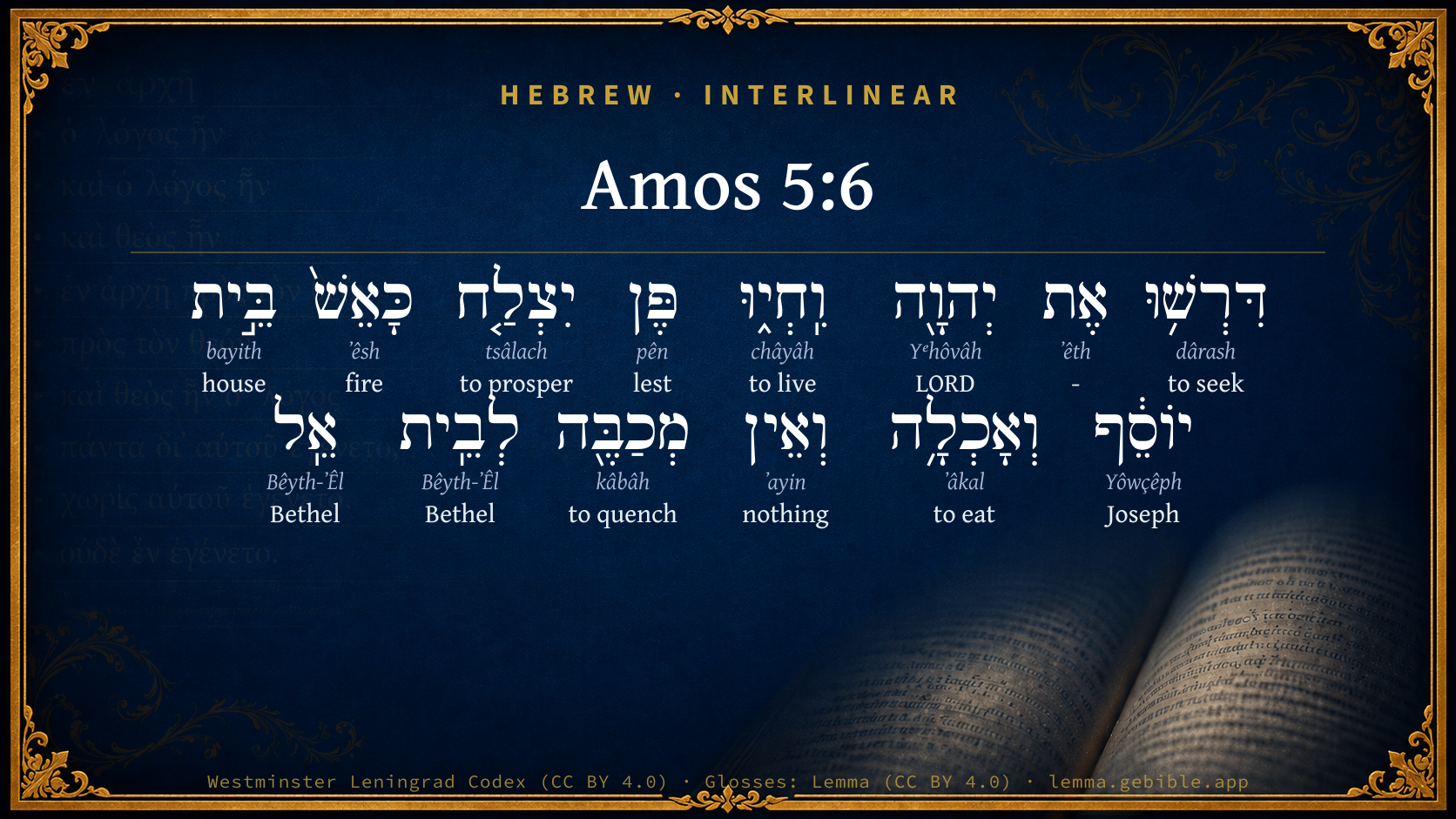
  1. דִּרְשׁ֥וּ dârash H1875 “seek” Verb, Qal, Imperative, 2nd Person, Masculine, Plural
  2. אֶת ʼêth H853 “-” Particle, Direct Object
  3. יְהוָ֖ה Yᵉhôvâh H3068 “LORD” Noun, Proper
  4. וִֽחְי֑וּ châyâh H2421 “and · live” Conjunction + Verb, Qal, Imperative, 2nd Person, Masculine, Plural
  5. פֶּן pên H6435 “lest” Conjunction
  6. יִצְלַ֤ח tsâlach H6743 “to prosper” Verb, Qal, Imperfect, 3rd Person, Masculine, Singular
  7. כָּאֵשׁ֙ ʼêsh H784 “like/as the · fire” Preposition, Determined + Noun, Common, Both, Singular, Absolute
  8. בֵּ֣ית bayith H1004 “house of” Noun, Common, Masculine, Singular, Construct
  9. יוֹסֵ֔ף Yôwçêph H3130 “Joseph” Noun, Proper
  10. וְאָכְלָ֥ה ʼâkal H398 “and · to eat” Conjunction + Verb, Qal, Sequential Perfect, 3rd Person, Feminine, Singular
  11. וְאֵין ʼayin H369 “and · nothing” Conjunction + Particle, Negative
  12. לְבֵֽית Bêyth-ʼÊl H1008 “to/for · Bethel” Preposition + Noun, Proper
  13. אֵֽל Bêyth-ʼÊl H1008 “Bethel” Noun, Proper

About this verse

These counts appear in no published source. They are computed here, from the morphology-tagged text and Lemma’s own curated glosses. What Lemma adds →

14
words
13
distinct lemmas
Prophets
section

Notable vocabulary

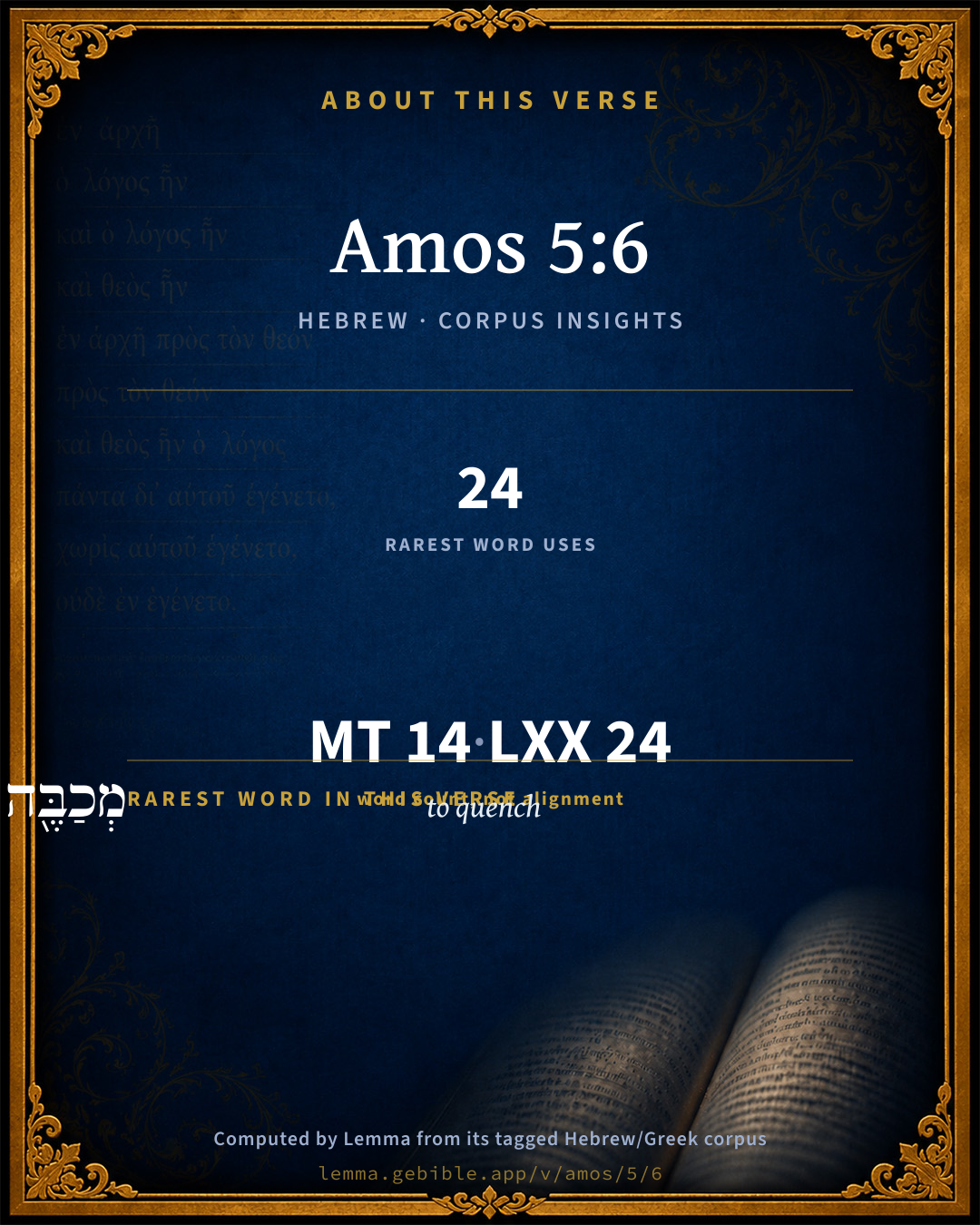
The rarest word here is מְכַבֶּ֖ה to quench H3518 — appearing just 24 times in the whole Hebrew Bible.

Shared distinctive vocabulary

מְכַבֶּ֖ה to quench H3518 occurs in 24 verses of the Hebrew Bible. Also found in:

Grammatical profile

  • 5 verbs
  • 6 nouns
  • 1 conjunction
  • 2 particles

Verb forms

  • דִּרְשׁ֥וּ Qal · Imperative
  • וִֽחְי֑וּ Qal · Imperative
  • יִצְלַ֤ח Qal · Imperfect
  • וְאָכְלָ֥ה Qal · Sequential Perfect
  • מְכַבֶּ֖ה Piel · Participle Active

Repetition

A word recurs within this verse — often emphatic in Hebrew:

  • לְבֵֽית Bethel H1008 ×2

Hebrew & Septuagint length

In English translation the verse runs 30 words from the Hebrew and 33 from the Septuagint (LXX English) — closely comparable.

A rough comparison of the two English renderings, which tokenize alike — not a word-level alignment.

Word counts can differ between the Hebrew and the Greek without any difference in meaning — e.g. the Hebrew direct-object marker אֵת has no separate Greek word, and Greek often adds the article ὁ.

In the original languages it is 14 Hebrew tokens and 24 Greek tokens — but the two are counted differently (Hebrew bundles its prefixes and suffixes into one token; the Greek is in lemma form), so that isn’t a like-for-like length.

Cross-references

19

Topical passages linked to Amos 5:6 in the Treasury of Scripture Knowledge — connected by theme and wording, ordered by reader-vote popularity; previews shown in the World English Bible.

  • Isaiah 55:6 Seek you Yahweh while he may be found; call you on him while he is near:
  • Ezekiel 20:47–48 and tell the forest of the South, Hear the word of Yahweh: Thus says the Lord Yahweh, Behold, I will kindle a fire in you, and it shall devour every green tree in you, and every dry tree: the flaming flame shall not be quenched, and all faces from the south to the north shall be burnt thereby.
  • Ezekiel 33:11 Tell them, As I live, says the Lord Yahweh, I have no pleasure in the death of the wicked; but that the wicked turn from his way and live: turn you, turn you from your evil ways; for why will you die, house of Israel?
  • Genesis 48:8–20 Israel saw Joseph's sons, and said, "Who are these?"
  • Amos 5:4 For thus says Yahweh to the house of Israel: "Seek me, and you will live;
  • Amos 5:14 Seek good, and not evil, That you may live; And so Yahweh, the God of hosts, will be with you, As you say.
  • Zechariah 10:6 "I will strengthen the house of Judah, And I will save the house of Joseph, And I will bring them back; For I have mercy on them; And they will be as though I had not cast them off: For I am Yahweh their God, and I will hear them.
  • Mark 9:43–48 If your hand causes you to stumble, cut it off. It is better for you to enter into life maimed, rather than having your two hands to go into Gehenna, into the unquenchable fire,
  • Exodus 22:6 "If fire breaks out, and catches in thorns so that the shocks of grain, or the standing grain, or the field are consumed; he who kindled the fire shall surely make restitution.
  • Deuteronomy 4:24 For Yahweh your God is a devouring fire, a jealous God.
  • Joshua 18:5 They shall divide it into seven portions: Judah shall abide in his border on the south, and the house of Joseph shall abide in their border on the north.
  • Judges 1:22–23 The house of Joseph, they also went up against Bethel; and Yahweh was with them.
  • 2 Samuel 19:20 For your servant does know that I have sinned: therefore, behold, I am come this day the first of all the house of Joseph to go down to meet my lord the king.
  • 1 Kings 11:28 The man Jeroboam was a mighty man of valor; and Solomon saw the young man that he was industrious, and he gave him charge over all the labor of the house of Joseph.
  • Isaiah 1:31 The strong will be like tinder, And his work like a spark. They will both burn together, And no one will quench them."
  • Jeremiah 4:4 Circumcise yourselves to Yahweh, and take away the foreskins of your heart, you men of Judah and inhabitants of Jerusalem; lest my wrath go forth like fire, and burn so that none can quench it, because of the evil of your doings.
  • Jeremiah 7:20 Therefore thus says the Lord Yahweh: Behold, my anger and my wrath shall be poured out on this place, on man, and on animal, and on the trees of the field, and on the fruit of the ground; and it shall burn, and shall not be quenched.
  • Ezekiel 37:19 tell them, Thus says the Lord Yahweh: Behold, I will take the stick of Joseph, which is in the hand of Ephraim, and the tribes of Israel his companions; and I will put them with it, [even] with the stick of Judah, and make them one stick, and they shall be one in my hand.
  • Amos 6:6 Who drink wine in bowls, And anoint themselves with the best oils; But they are not grieved for the affliction of Joseph.

Cross-references courtesy of OpenBible.info (CC BY 4.0).

Hebrew and Greek witnesses Masoretic Hebrew ↔ Greek Septuagint

The same verse in the two great witnesses to the Old Testament, shown verse-for-verse.

These are two independent witnesses, not word-aligned to each other, and the Septuagint is shown in lemma (dictionary) form.

Hebrew Amos 5:6 Masoretic · Westminster Leningrad Codex

דִּרְשׁ֥וּ אֶת יְהוָ֖ה וִֽחְי֑וּ פֶּן יִצְלַ֤ח כָּאֵשׁ֙ בֵּ֣ית יוֹסֵ֔ף וְאָכְלָ֥ה וְאֵין מְכַבֶּ֖ה לְבֵֽית אֵֽל

Seek Yahweh, and you will live; Lest he break out like fire in the house of Joseph, And it devour, and there be no one to quench it in Bethel.

World English Bible · Public Domain

Greek LXX Amos 5:6 Septuagint · lemma form

ἐκζητέω ὁ κύριος καί ζάω ὅπως μή ἀναλάμπω ὡς πῦρ ὁ οἶκος ιωσηφ καί καταἐσθίω αὐτός καί οὐ εἰμί ὁ σβέννυμι ὁ οἶκος ἰσραήλ

Seek you⌃ the Lord, and you⌃ shall live; lest the house of Joseph blaze as fire, and it devour him, and there shall be none to quench it for the house of Israel.

LXX2012 (modern English Septuagint) · Public Domain

On this verse, Haydock's Catholic Bible Commentary discusses the Septuagint’s reading. Read the note in Commentary ↓

Hebrew: Westminster Leningrad Codex (CC BY 4.0). Greek: Septuagint (public domain); English from LXX2012 (modern English Septuagint) (Public Domain). How the Septuagint differs from the Hebrew →

Targum (Aramaic paraphrase)

1

The Targum is the ancient Jewish Aramaic paraphrase of the Hebrew Scriptures — an interpretive translation, not the Hebrew text itself. Onkelos (literal) and Pseudo-Jonathan (expansive) render the Torah, and Jonathan the Prophets. Coverage is partial: where no permissively-licensed English translation exists for a verse, only the Aramaic is shown. This is verse-level text, not a word-by-word alignment to the Hebrew.

  1. Targum Jonathan Prophets (Joshua–Malachi)
    תְּבָעוּ יַת דַחַלְתָּא דַייָ וְאִתְקַיָמוּ דִלְמָא יִדְלַק כְּאֶשְׁתָּא רוּגְזֵיהּ בְּבֵית יוֹסֵף וִישֵׁיצֵיהּ וְלָא יְהֵי חָיַס בְּחוֹבִין דַהֲוֵיתוּן פָּלְחִין לְטַעֲוָתָא בְּבֵית אֵל:

    (no public-domain English translation for this verse)

    Targum Jonathan — Aramaic: “Mikraot Gedolot” (public domain). English: “Sefaria Community Translation” (CC0 1.0 (public-domain dedication)); “London "Chaldee Paraphrase," 1871” (public domain). Text via Sefaria.

Commentary

Notes on Amos 5:6 from classic Christian and Jewish commentators (each source and its license shown beneath its notes). The classic Christian expositions comment on the surrounding passage and are grouped to its opening verse, so a note may address several verses; the Jewish commentaries on the Tanakh (Rashi and others) are per-verse, so they appear only where the commentator wrote on this verse.

Lemma curates 59 commentaries, every one of them public domain or Creative Commons licensed, each selected and text-cleaned for this edition rather than reprinted as found. About our sources →

Trapp's Complete Commentary

John Trapp

Amo 5:6 Seek the LORD, and ye shall live; lest he break out like fire in the house of Joseph, and devour [it], and [there be] none to quench [it] in Bethel.

Ver. 6. Seek ye the Lord, and ye shall live] See Amo 5:4. Sic eadem saepe surdis et obstinatis inculcantur (Mercer). The continual pressing of a duty imports: 1. The excellency; 2. The necessity; 3. The difficulty of doing it: else what need so many words? Perquam durum est, sed ita lex scripts est, saith Ulpian. Hard or not hard, it must be done, or men are undone.

Lest he break out like fire] Lest he go through you and burn you together, Isa 27:4, lest ye be "utterly burnt with fire in the same place," 2Sa 23:7, that is, in hell (as some expound it), which the prophet called tormenting Tophet, Isa 30:33, and Plato calleth πυριφλεγεθων, a fiery lake; so terrible, saith Bellarmine, that one glimpse of it were enough to make a man not only turn Christian and sober, but anchorite {a} and monk; to live after the strictest rule that may be.

{a} A person who has withdrawn or secluded himself from the world; usually one who has done so for religious reasons, a recluse, a hermit. ŒD

John Trapp, A Commentary or Exposition upon All the Books of the Old and New Testament (1647–1656) — public domain. Text from a community e-Sword module.

Joseph Benson's Commentary

Amo 5:6. Seek the Lord, and ye shall live — He repeats his exhortation, and also the promise of a good issue on their complying with it. Lest he break out like fire in the house of Joseph — That is, the kingdom of the ten tribes, the chief whereof was Ephraim the son of Joseph. And there be none to quench it in Beth-el — As if he had said, If once this fire break out, all your idols in Beth-el shall not be able to quench it. A proper caution this to the Israelites, not to trust in their idolatrous worship for their safety, because it would be so far from averting the divine wrath, or saving them from God’s judgments, that it would provoke that wrath still more, and hasten the execution of his judgments.

Joseph Benson's Commentary on the Old and New Testaments (1811–1818) — public domain. Text from a community e-Sword module.

Tyndale Open Study Notes

Tyndale Open Resources

5:6 The northern kingdom of Israel (literally the house of Joseph) was dominated by the tribes of Joseph’s sons, Ephraim and Manasseh (see study note on 5:15; see Hos 5:3, 5).

Tyndale Open Study Notes — © Tyndale Open Resources, licensed CC BY-SA 4.0. Text via the HelloAO Bible API.

Jamieson, Fausset & Brown

Robert Jamieson, A. R. Fausset & David Brown

break out like fire--bursting through everything in His way. God is "a consuming fire" (Deu 4:24; Isa 10:17; Lam 2:3).

the house of Joseph--the kingdom of Israel, of which the tribe of Ephraim, Joseph's son, was the chief tribe (compare Eze 37:16).

none to quench it in Beth-el--that is, none in Beth-el to quench it; none of the Beth-el idols on which Israel so depended, able to remove the divine judgments.

Jamieson, Fausset & Brown — Commentary Critical and Explanatory on the Whole Bible (1871) — public domain (CC PDM 1.0). Text via the HelloAO Bible API.

Adam Clarke's Commentary

Verse 6. Seek the Lord, and ye shall live] Repeated from Am 5:4.

In the house of Joseph] The Israelites of the ten tribes, of whom Ephraim and Manasseh, sons of Joseph, were the chief.

Adam Clarke's Commentary on the Bible (1810–1826) — public domain. Text from a community e-Sword/MySword module.

John Calvin's Commentaries

He then adds, Seek Jehovah, and ye shall live This repetition is not superfluous: the Prophet confirms what I have already stated, that such was the opposition between the true and legitimate worship of God, and idolatry and superstition, that the people of Israel, as long as they retained their corruptions, proved that they had nothing to do with God, whatever they may have pretended with their mouths and by their ceremonies. Seek God, he says, and ye shall live; and this repetition was very useful for this end, that hypocrites might know that they were justly condemned, inasmuch as they did not consecrate themselves wholly to God; for they were ever ready to contend with God whenever they could. “Why does God deal so strictly with us? why does he not concede to us at least something? for we do not deny him every thing. But if we do what we think to be right, why does he not indulge us at least on this account?” But when God not only urges hypocrites by his doctrine, but visits them also with punishments then they become angry, and even raise a clamor. Hence the Prophet, the second time, calls them to this duty, Seek Jehovah, and ye shall live; as though he said, “Ye will gain nothing by evasion; for if any one seeks God truly and from the heart, God will not disappoint him; he will receive him into favor and will bless him. That ye then pine away in your calamities, impute this to your own obstinacy and stubbornness: it is so, because ye do not truly seek God; for while ye retain your corruptions, as I have said before, ye do not seek him.”

But he adds Lest he pass on like a fire. צלח, tselach, means to pass on, to advance; it means also to break out, and sometimes to prosper; but, in this place, the Prophet no doubt meant what I have said. Then it is, Lest he advance like fire upon the house of Joseph and consume it, and there be none to extinguish it in Bethel. The kind of vengeance which God threatened is not here expressed, but it may be easily understood. There is, therefore, in the meaning no obscurity; for he declares, that if the Israelites hardened their hearts against God, a burning was nigh at hand, which would seize on them, devour, and consume them. There shall come then or shall advance, a fire upon the house of Joseph; some say, shall burst out, which amounts to the same thing. By the house of Joseph is meant Ephraim; for he was, we know, the second son of Joseph; and, by taking a part for the whole, the Prophets usually include the ten tribes, as it is well known, when they mention Ephraim; and the kingdom of Israel is sometimes called the house of Joseph. Lest then he ascend as fire into the house of Joseph, and consume it, and there be none to extinguish it: this was said, because the Israelites never thought that they should be thus consumed by a sudden burning. The fire then shall devour the house of Joseph, and there will be none to quench it.

In the verse before I omitted one thing, to which I shall now advert. The Prophet said, that Bethel would be for a trouble, or be nothing. Bethel, we know, is called in another place Bethaven, the house of iniquity; and Aven means in Hebrew sometimes iniquity, sometimes grief or trouble, sometimes labor or difficulty, and sometimes nothing. It is not to be taken for iniquity in this place; this is certain: but Amos, on the contrary, speaks of punishment, which awaited that place, since it was abominable in the sight of God. As then he had said of Gilgal, that it would be rolled; so now he says of Bethel, that it would be for a trouble or grief, or be nothing. Either senses would be appropriate; — that Bethel, from which the Israelites hoped for a remedy to all their evils, would be to them a trouble, that is, the cause of their ruin, or that it would be nothing; as though he had said, that their hopes would be fallacious and empty in expecting any relief from Bethel. It afterwards follows —

John Calvin's Commentaries (1540-1563) — public domain. Text from the Calvin Translation Society English edition (1840s-50s) via the Christian Classics Ethereal Library (ccel.org). Calvin's coverage is partial (roughly two-thirds of the Bible); uncommented books and verses are honest gaps, never fabricated. The 19th-century editor's footnotes and remarks are omitted so the notes are faithfully Calvin's own voice.

Ellicott's Commentary for English Readers

(6) Render, lest he rush down like fire on the house of Joseph (i.e., the Northern Kingdom). For “in Bethel” read “for Bethel.” Let the blending of mercy with judgment be here observed, “Seek Jehovah and live, lest this evil befall you.” The curse is still conditional.

A Bible Commentary for English Readers, edited by Charles John Ellicott (1878–1897) — public domain. Text from a community e-Sword module.

The Cambridge Bible for Schools and Colleges

gen. ed. J. J. S. Perowne

6. Seek Jehovah, &c.] The exhortation of Amo_5:4 is repeated, and enforced with a fresh motive—lest a fire, namely, kindled by Jehovah, advance irresistibly, and spread irretrievable destruction in Israel.

break out] lit. come mightily, advance forcibly. It is the word used of the spirit of God coming mightily upon Samson (Jdg_14:6; Jdg_14:19; Jdg_15:14), Saul (1Sa_10:6; 1Sa_11:6), and David (1Sa_16:13). The comparison of Jehovah to a fire, as Deu_4:24; Isa_10:17; cf. Deu_32:22; Jer_4:4 (“lest my fury go forth as fire, and burn, and there be none to quench it”; so Jer_21:12).

house of Joseph] i.e. the Northern kingdom generally, Joseph being the ancestor of its most powerful tribe, Ephraim (which accordingly is used often by Hosea in the same sense). Son_5:15; Son_6:6; Oba_1:18; Zec_10:6; Psa_78:67; cf. Eze_37:16; Eze_37:19.

for Beth-el] named specially as the principal religious centre of Israel.

The Cambridge Bible for Schools and Colleges (gen. ed. J. J. S. Perowne; Cambridge University Press, 1878–1918) — public domain. Text from a community e-Sword module.

John Gill's Exposition

Seek the Lord, and ye shall live,.... This is, repeated to stir up unto it, because of their backwardness and slothfulness, and to show the importance and necessity of it. By the "Lord" may be meant the Messiah, Israel's God that was to come, and they were to prepare to meet, Amo 4:12; and the rather, since life spiritual and eternal is only to be had from him, and he is to be sought unto for it, and all the blessings of it, peace, pardon, righteousness, rest, and salvation as well as temporal deliverance, and all outward mercies:

lest he break out like fire in the house of Joseph, and devour it; that is, lest his wrath and fury break out like fire as the Targum, by sending an enemy to invade the land, destroy it, and carry the inhabitants of it captive; even all the ten tribes, who frequently go by the name of Ephraim the son of Joseph, that being the principal tribe, and the first king of them being of it:

and there be none to quench it in Bethel; the calf worshipped there, and the priests that officiated, would not be able to avert the stroke of divine vengeance, or turn back the enemy, and save the land from ruin. The Targum is,

"and there be none to quench it, because of your sins, who have been serving idols in Bethel.''

John Gill's Exposition of the Whole Bible (1746–1763) — public domain (CC PDM 1.0). Text via the HelloAO Bible API.

Albert Barnes' Notes on the Bible

Seek ye the Lord and ye shall live - Literally, “seek the Lord and live;” being united to Him, the Fountain of life. He reimpresses on them the one simple need of the creature, “seek God,” the one true God as He revealed Himself, not as worldly people, or the politicians of Jeroboam’s court, or the calf-priests, fabled of Him. “Seek Him.” For in Him is all; without Him, nothing.

Lest He break out like fire in Bethel - Formerly the Spirit of God came vehemently down upon Sansom Jdg 14:6, Jdg 14:19; Jdg 15:14 and Saul 1Sa 10:6; 1Sa 11:6 and David 1Sa 16:13, to fit them as instruments for God; as did the Evil spirit, when God departed from Saul 1Sa 18:10. So now, unless they repented, God Himself would suddenly show His powerful presence among them, but, as He had revealed Himself to be, “the, Lord thy God is a consuming Fire” Deu 4:24. “And devour” it, literally, “and it” (the fire) “shall devor, and” there be “none to quench” it “in” (better, “for”) Bethel.” Bethel, the center of their idol-hopes, so far from aiding them then, shall not be able to help itself, nor shall there be any to help it. The fire of God kindles around it, and there is none to quench it for her (as in Jer 4:4).

Montanus: “The whole place treateth of mercy and justice. The whole ground of people’s punishment, calamities, condemnation is ascribed to their own fault and negligence, who neglect the deliverance often promised and offered them by God, and ‘love darkness rather than light, because their deeds are evil’ Joh 3:19. Whoever is not saved, the whole blame lies in their own will and negligence and malice. God, who ‘willeth not that any should perish, but that all should come to repentance’ 2Pe 3:9, Himself unsought, seeks, entreats, ceases not to monish, exhort, set before them their guilt, that they may cease to prepare such evil for themselves. But they neither give Him entrance, nor hear His entreaties, nor admit the warnings of the divine mercy, which if they neglect, they must needs be made over to His justice. The goodness of God is lacking to no one, save those who are wanting to themselves. Wherefore, having often besought them before, He invites them yet again to salvation, putting forth that His Name, so full of mysteries of mercy; ‘Seek the Lord and live,’” seek Him who is, the Unchangeable. He who had willed their salvation, still willed it, for He “changes not” Mal 3:6. “He adds threatenings, that those whom He calls to life, He might either allure by promises, or scare from death through fear of the impending evil.”

Albert Barnes' Notes on the Bible (1834–1885) — public domain. Text from a community e-Sword/MySword module.

Haydock's Catholic Bible Commentary

Joseph. His two grandchildren gave name to the principle tribes of the kingdom. --- Bethel. Septuagint, "Israel," which seems preferable. (Calmet) --- Yet Bethel may stand, as it denotes the apostate Israelites.

George Leo Haydock (1774–1849), Haydock's Catholic Family Bible and Commentary, 1859 edition — public domain. Excludes Psalms (Douay-Rheims chapter numbering differs from Protestant) and Deuterocanonical books (Catholic canon only).

Matthew Poole's English Annotations

Seek the Lord, and ye shall life: the prophet repeateth his exhortation to repentance with the repeated promise of a good issue hereon: see Amo 5:4.

Lest he break out: this is a new argument to persuade them to do their duty, for unless they do it God’s judgments will break out upon them.

Like fire; suddenly, with strength and prevalence, as the Hebrew word here rendered break out importeth. In the house of Joseph; the kingdom of the ten tribes, the chief whereof was Ephraim, who was the younger son of Joseph, and the first erecter of this kingdom was an Ephraimite, 1Ki 11:26.

And devour it; utterly consume it, as fire useth to do where it gets head and prevaileth.

And there be none to quench it in Beth-el; if once this fire break out from God, all your idols in Beth-el shall not be able to quench it; no tears from your eyes there shed, no blood of sacrifice there offered, shall quench it.

Matthew Poole's English Annotations on the Holy Bible (1683–1685) — public domain. Text from a community e-Sword/MySword module.

The Pulpit Commentary

Break out like fire. God is called "a consuming fire" (Deu_4:24; Heb_12:29; comp. Jer_4:4) And devour it; Septuagint, Opwv mhmyh wJv pur oJ oikov jIwshf kaigh aujton, "Lest the house of Joseph blaze as fire, and he devour him;" Vulgate, Ne forte comburatur ut ignis domus Joseph, et devorabit. But it is best to take the last member of the sentence thus: "and it (the fire) devour." The house of Joseph. Ephraim, i.e. the kingdom of Israel, of which Ephraim was the distinguishing tribe. In Bethel; or, for Bethel. The LXX, paraphrasing, has, tw oikw jIsrahl, "for the house of Israel."

The Pulpit Commentary (1880–1919), ed. H.D.M. Spence-Jones & Joseph S. Exell — public domain. Text from a community e-Sword module.

John Wesley's Explanatory Notes

The house of Joseph - The kingdom of the ten tribes, the chief whereof was Ephraim, the son of Joseph. In Beth-el - If once this fire breaks out, all your idols in Beth-el shall not be able to quench it.

John Wesley, Explanatory Notes Upon the Whole Bible (1754–1765) — public domain. Text via the GEBible commentary corpus.

unfoldingWord translationNotes

Door43 World Missions Community

Seek Yahweh

Here "Seek Yahweh" represents asking him for help. AT: "Ask Yahweh for help" or "Ask me, Yahweh, for help" (See: Metaphor)

he will break out like fire

Here "break out like a fire" represents destroying things as fire destroys things. AT: "he will become like a fire that breaks out suddenly and destroys everything" or "he will destroy everything like a fire" (See: Simile)

the house of Joseph

This phrase is a metonym for the descendants of Joseph. Here it represents the northern kingdom of Israel, whose two largest tribes were the descendants of Joseph. AT: "the descendants of Joseph" or "Israel" (See: Metonymy and Synecdoche)

It will devour

The word "it" refers to the fire, and "devour" represents destroying everything. God destroying everything is spoken of as if a fire were to destroy everything. AT: "It will destroy everything" or "He will destroy everything" (See: Metaphor)

there will be no one to quench it

"there will no one to stop it" or "there will be no one to stop him from destroying everything"

turn justice into a bitter thing

Here "a bitter thing" represents actions that harm people, and "turn justice into a bitter thing" represents harming people rather than doing for them what is just. AT: "say that they are doing what is just, but instead they harm people" or "refuse to do what is just and harm people instead" (See: Metaphor)

throw righteousness down to the ground

This represents treating righteousness as if it were worthless. AT: "treat righteousness as though it were as unimportant as dirt" or "you despise what is righteous" (See: Metaphor)

translationWords

fire

devour

quench

just

righteous

unfoldingWord translationNotes — © Distant Shores Media and the Door43 World Missions Community, licensed CC BY-SA 4.0. Source: git.door43.org/Door43/en_tn.

Rashi

Rabbi Shlomo Yitzchaki (Rashi)

lest He break out like fire Heb. יִצְלַח. Lest His anger ascend as fire to the house of Joseph.

the house of Joseph—Like לְבֵית יוֹסֵף, to the house of Joseph.

Rashi on the Tanakh — English translations: “The Judaica Press complete Tanach with Rashi, translated by A. J. Rosenberg” (CC BY 4.0); “Pentateuch with Rashi's commentary by M. Rosenbaum and A.M. Silbermann, 1929-1934” (public domain); “The Metsudah Tanach series, Lakewood, N.J” (CC BY 4.0); and “The Book of Joshua, Metsudah Publications, 1997” (CC BY 4.0). Text via Sefaria.

Lesson kit

Teaching starters — assembled from the data on this page, not authored interpretation. Every prompt links to the verse data it draws on. Edit before teaching.

Amos, in the Prophets, opens this verse with 14 words (13 distinct Hebrew lemmas). Its most distinctive word is kâbâh (“to quench”). A historical commentator’s framing appears above. Read the whole chapter for the surrounding context.

Discussion questions

  1. What does “to quench” (kâbâh) contribute to the verse as a whole?
  2. How does Leviticus 6:12, which shares the word «to quench», read alongside this verse?
  3. What does the repetition of “Bethel” (2× in this one verse) do in this verse?
  4. These translations render this verse differently. What is at stake in choosing one wording over another?
  5. «דִּרְשׁ֥וּ» is a Qal Imperative verb. How does that grammatical form shape the action described?
  6. Compare how Trapp's Complete Commentary and Joseph Benson's Commentary read this verse. Where do they agree or differ?

Things to notice

Reading settings

Reading text

Shown beneath each verse's original-language words.

Old Testament
Old Testament edition

Read the OT as the Masoretic Hebrew (MT) or the Greek Septuagint (LXX).

English shown for the Greek Septuagint (in the Hebrew ↔ Greek comparison).

Comparing translations? Open the Compare panel on any verse page to stack up to four side by side.