
2 Samuel 12:3

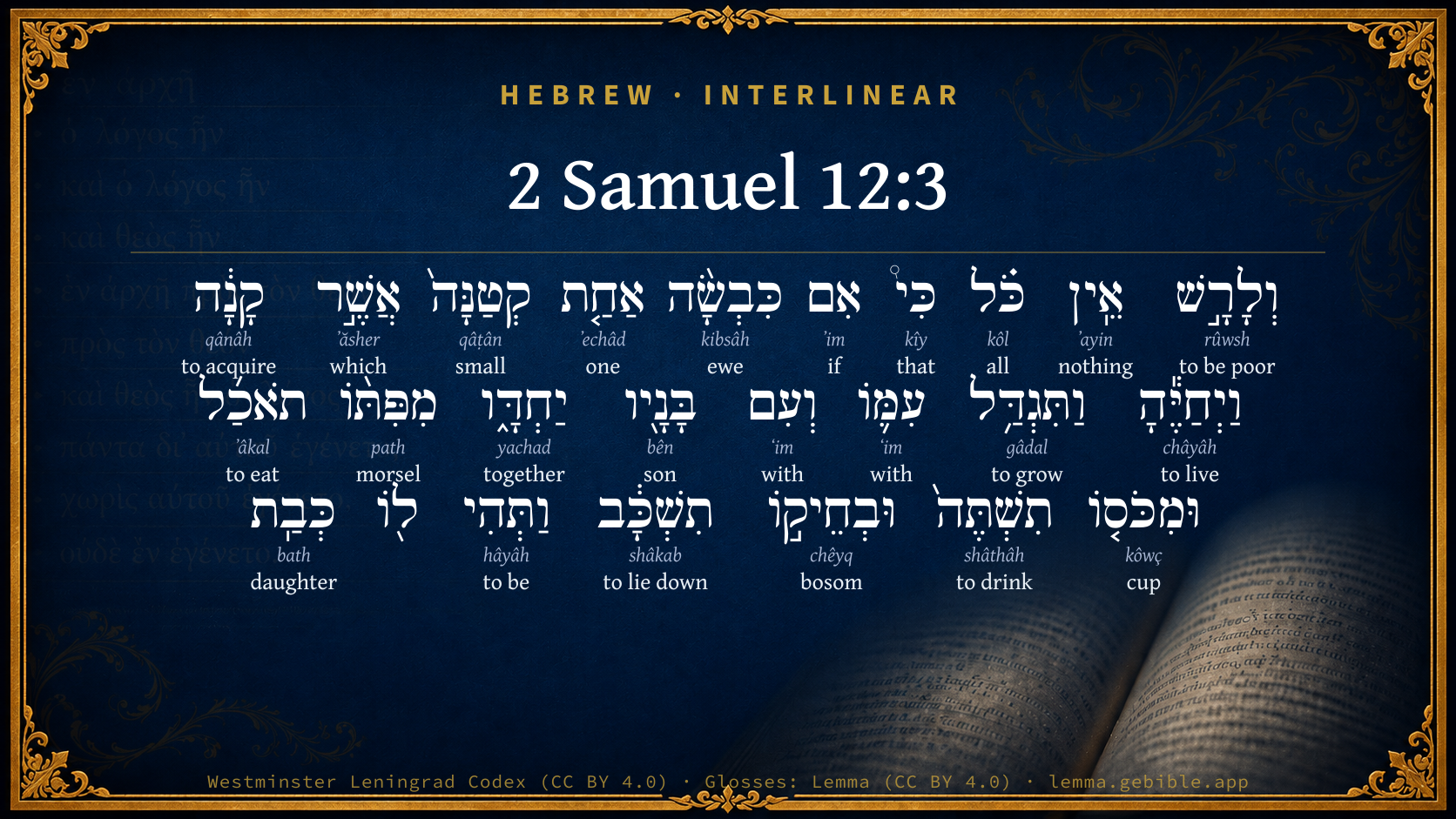
Hebrew (Westminster Leningrad Codex) 2 Samuel 12:3 appears in the Hebrew Old Testament. The text above is from the Westminster Leningrad Codex. Each word links to its Strong’s number, a concise gloss, and parsing drawn from the Open Scriptures Hebrew Bible morphology. Click any word for its full Brown-Driver-Briggs (BDB) entry.
Download image
Cite this verse

2 Samuel 12:3 (World English Bible). Public Domain. Lemma interlinear Bible study tool, https://lemma.gebible.app/v/2-samuel/12/3.

Show BibTeX & RIS
BibTeX
RIS
English Translation
but the poor man had nothing, except one little ewe lamb, which he had bought and raised. It grew up together with him, and with his children. It ate of his own food, drank of his own cup, and lay in his bosom, and was to him like a daughter.
World English Bible · Public Domain
Download a study sheet

One document with this verse’s original text, its word-by-word gloss line, the meaning frame, cross-references with their text, attributed commentary, and full source and license credits — printable, and it pastes into notes with its structure intact.

This verse Autodidact and up

Study sheet (.html) Plain text (.txt)

A passage Seminary Student

Up to 50 verses in one chapter. A passage sheet keeps up to 6 commentary sources and 12 cross-references per verse, in the order this page ranks them, and says so on the sheet whenever that leaves anything out. Ask for a single verse and you get the Autodidact verse sheet above.

Everything on this page stays free to read, with no account — the sheet is a download of what is already on screen, not access to it.

Want to remove ads? Support Godless Engineer
Compare translations 3

The same verse in 3 English versions, stacked beneath the original-language interlinear above. Click any original word for its lexicon entry.

Each is an independent rendering of the whole verse — the interlinear is not word-aligned to these translations.

Highlighted words mark where these versions differ — a whole-verse word diff, not a word-by-word alignment.

  • World English Bible Public Domain
    but the poor man had nothing, except one little ewe lamb, which he had bought and raised. It grew up together with him, and with his children. It ate of his own food, drank of his own cup, and lay in his bosom, and was to him like a daughter.
  • King James Version Public Domain
    But the poor man had nothing, save one little ewe lamb, which he had bought and nourished up: and it grew up together with him, and with his children; it did eat of his own meat, and drank of his own cup, and lay in his bosom, and was unto him as a daughter.
  • unfoldingWord Literal Text CC BY-SA 4.0
    But to the poor not anything except one little ewe that he had bought. And he nourished it, and it grew up together with him and with his sons. It would eat from his morsel, and it would drink from his cup, and it would lie down in his lap. And it was like a daughter to him.

unfoldingWord Literal Text — © unfoldingWord, licensed CC BY-SA 4.0. Word-aligned USFM3 via Door43 (git.door43.org/unfoldingWord/en_ult).

Versions to compare (up to 4)

3 of 4 selected

Show all 18 translations

Every available English version of this verse, each an independent rendering of the whole verse.

  • World English Bible Public Domain
    but the poor man had nothing, except one little ewe lamb, which he had bought and raised. It grew up together with him, and with his children. It ate of his own food, drank of his own cup, and lay in his bosom, and was to him like a daughter.
  • Berean Standard Bible Public Domain
    but the poor man had nothing except one small ewe lamb that he had bought. He raised it, and it grew up with him and his children. It shared his food and drank from his cup; it slept in his arms and was like a daughter to him.
  • Majority Standard Bible Public Domain
    but the poor man had nothing except one small ewe lamb that he had bought. He raised it, and it grew up with him and his children. It shared his food and drank from his cup; it slept in his arms and was like a daughter to him.
  • King James Version Public Domain
    But the poor man had nothing, save one little ewe lamb, which he had bought and nourished up: and it grew up together with him, and with his children; it did eat of his own meat, and drank of his own cup, and lay in his bosom, and was unto him as a daughter.
  • American Standard Version (1901) Public Domain
    but the poor man had nothing, save one little ewe lamb, which he had bought and nourished up: and it grew up together with him, and with his children; it did eat of his own morsel, and drank of his own cup, and lay in his bosom, and was unto him as a daughter.
  • Revised Version (1885) Public Domain
    but the poor man had nothing, save one little ewe lamb, which he had bought and nourished up: and it grew up together with him, and with his children; it did eat of his own morsel, and drank of his own cup, and lay in his bosom, and was unto him as a daughter.
  • Geneva Bible (1599) Public Domain
    But the poore had none at all, saue one litle sheepe which he had bought, and nourished vp: and it grew vp with him, and with his children also, and did eate of his owne morsels, and dranke of his owne cup, and slept in his bosome, and was vnto him as his daughter.
  • Douay-Rheims (1899) Public Domain
    But the poor man had nothing at all but one little ewe lamb, which he had bought and nourished up, and which had grown up in his house together with his children, eating of his bread, and drinking of his cup, and sleeping in his bosom: and it was unto him as a daughter.
  • Young's Literal Translation Public Domain
    And the poor one hath nothing, Except one little ewe-lamb, Which he hath bought, and keepeth alive, And it groweth up with him, And with his sons together; Of his morsel it eateth, And from his cup it drinketh, And in his bosom it lieth, And it is to him as a daughter;
  • Literal Standard Version CC BY-SA 4.0
    but the poor one has nothing, except one little ewe-lamb which he has bought and keeps alive. And it grows up together with him and with his sons. It eats of his morsel, and it drinks from his cup, and it lies in his bosom, and it is as a daughter to him.
  • Unlocked Literal Bible CC BY-SA 4.0
    but the poor man had nothing except one little ewe lamb, which he had bought and fed and raised. It grew up together with him and with his children. The lamb even ate with him and drank from his own cup, and it slept in his arms and was like a daughter to him.
  • unfoldingWord Literal Text CC BY-SA 4.0
    But to the poor not anything except one little ewe that he had bought. And he nourished it, and it grew up together with him and with his sons. It would eat from his morsel, and it would drink from his cup, and it would lie down in his lap. And it was like a daughter to him.
  • Darby Bible Public Domain
    but the poor man had nothing at all, but one little ewe lamb which he had bought, and was nourishing; and it grew up with him, and together with his children: it ate of his morsel, and drank of his own cup, and slept in his bosom, and was to him as a daughter.
  • World Messianic Bible Public Domain
    but the poor man had nothing, except one little ewe lamb, which he had bought and raised. It grew up together with him and with his children. It ate of his own food, drank of his own cup, and lay in his bosom, and was like a daughter to him.
  • Webster's Bible Public Domain
    But the poor man had nothing save one little ewe-lamb, which he had bought and nourished: and it grew up together with him, and with his children: it fed of his own meat, and drank of his own cup, and lay in his bosom, and was to him as a daughter.
  • Free Bible Version CC BY-SA 4.0
    but the poor man didn't have anything but one small ewe lamb that he had bought. He cared for it, and it grew up with him and his children. It would eat from his plate and drink from his cup. It slept on his lap and was like a daughter to him.
  • Bible in Basic English Public Domain
    But the poor man had only one little she-lamb, which he had got and taken care of: from its birth it had been with him like one of his children; his meat was its food, and from his cup it took its drink, resting in his arms, and it was like a daughter to him.
  • JPS Tanakh (1917) Public Domain
    but the poor man had nothing save one little ewe lamb, which he had bought and reared; and it grew up together with him, and with his children; it did eat of his own morsel, and drank of his own cup, and lay in his bosom, and was unto him as a daughter.

Literal Standard Version (2020), Covenant Press — licensed CC BY-SA 4.0. Text via the HelloAO Bible API (eBible.org). Unlocked Literal Bible (unfoldingWord) — licensed CC BY-SA 4.0. Text via the HelloAO Bible API (eBible.org). unfoldingWord Literal Text — © unfoldingWord, licensed CC BY-SA 4.0. Word-aligned USFM3 via Door43 (git.door43.org/unfoldingWord/en_ult). Free Bible Version, Dr. Jonathan Gallagher — licensed CC BY-SA 4.0. Text via the HelloAO Bible API (eBible.org).

Word by word

More ways to search: Search by grammar → Find every occurrence → Compare this word →

Practice this passage: Drill this verse → Learn its vocabulary →

כִּבְשָׂ֨ה
kibsâh
H3535
“ewe”
Noun, Common, Feminine, Singular, Absolute
Part of Speech
Noun
Type
Common
Gender
Feminine
Number
Singular
State
Absolute
Full BDB Definition

Origin: from H3532

TWOT: 950

ewe-lamb, lamb
  1. וְלָרָ֣שׁ rûwsh H7326 “and · to/for the · being poor” Conjunction + Preposition, Determined + Verb, Qal, Participle Active, Masculine, Singular, Absolute
  2. אֵֽין ʼayin H369 “nothing” Particle, Negative
  3. כֹּ֗ל kôl H3605 “all” Noun, Common, Masculine, Singular, Absolute
  4. כִּי֩ kîy H3588 “that” Conjunction
  5. אִם ʼim H518 “if” Conjunction
  6. אַחַ֤ת ʼechâd H259 “one” Adjective, Cardinal number, Feminine, Singular, Absolute
  7. קְטַנָּה֙ qâṭân H6996 “small” Adjective, Adjective, Feminine, Singular, Absolute
  8. אֲשֶׁ֣ר ʼăsher H834 “which” Particle, Relative
  9. קָנָ֔ה qânâh H7069 “to acquire” Verb, Qal, Perfect, 3rd Person, Masculine, Singular
  10. וַיְחַיֶּ֕הָ châyâh H2421 “and · to live · her” Conjunction + Verb, Piel, Sequential Imperfect, 3rd Person, Masculine, Singular + Suffix, Personal, 3rd Person, Feminine, Singular
  11. וַתִּגְדַּ֥ל gâdal H1431 “and · to grow” Conjunction + Verb, Qal, Sequential Imperfect, 3rd Person, Feminine, Singular
  12. עִמּ֛וֹ ʻim H5973 “with · him” Preposition + Suffix, Personal, 3rd Person, Masculine, Singular
  13. וְעִם ʻim H5973 “and · with” Conjunction + Preposition
  14. בָּנָ֖יו bên H1121 “sons · his” Noun, Common, Masculine, Plural, Construct + Suffix, Personal, 3rd Person, Masculine, Singular
  15. יַחְדָּ֑ו yachad H3162 “together” Adverb
  16. מִפִּתּ֨וֹ path H6595 “from · morsel · his” Preposition + Noun, Common, Feminine, Singular, Construct + Suffix, Personal, 3rd Person, Masculine, Singular
  17. תֹאכַ֜ל ʼâkal H398 “to eat” Verb, Qal, Imperfect, 3rd Person, Feminine, Singular
  18. וּמִכֹּס֤וֹ kôwç H3563 “and · from · cup · his” Conjunction + Preposition + Noun, Common, Feminine, Singular, Construct + Suffix, Personal, 3rd Person, Masculine, Singular
  19. תִשְׁתֶּה֙ shâthâh H8354 “to drink” Verb, Qal, Imperfect, 3rd Person, Feminine, Singular
  20. וּבְחֵיק֣וֹ chêyq H2436 “and · in/at · bosom · his” Conjunction + Preposition + Noun, Common, Masculine, Singular, Construct + Suffix, Personal, 3rd Person, Masculine, Singular
  21. תִשְׁכָּ֔ב shâkab H7901 “to lie down” Verb, Qal, Imperfect, 3rd Person, Feminine, Singular
  22. וַתְּהִי hâyâh H1961 “and · to be” Conjunction + Verb, Qal, Sequential Imperfect, 3rd Person, Feminine, Singular
  23. כְּבַֽת bath H1323 “like/as · daughter” Preposition + Noun, Common, Feminine, Singular, Absolute

About this verse

These counts appear in no published source. They are computed here, from the morphology-tagged text and Lemma’s own curated glosses. What Lemma adds →

25
words
23
distinct lemmas
Historical
section

Notable vocabulary

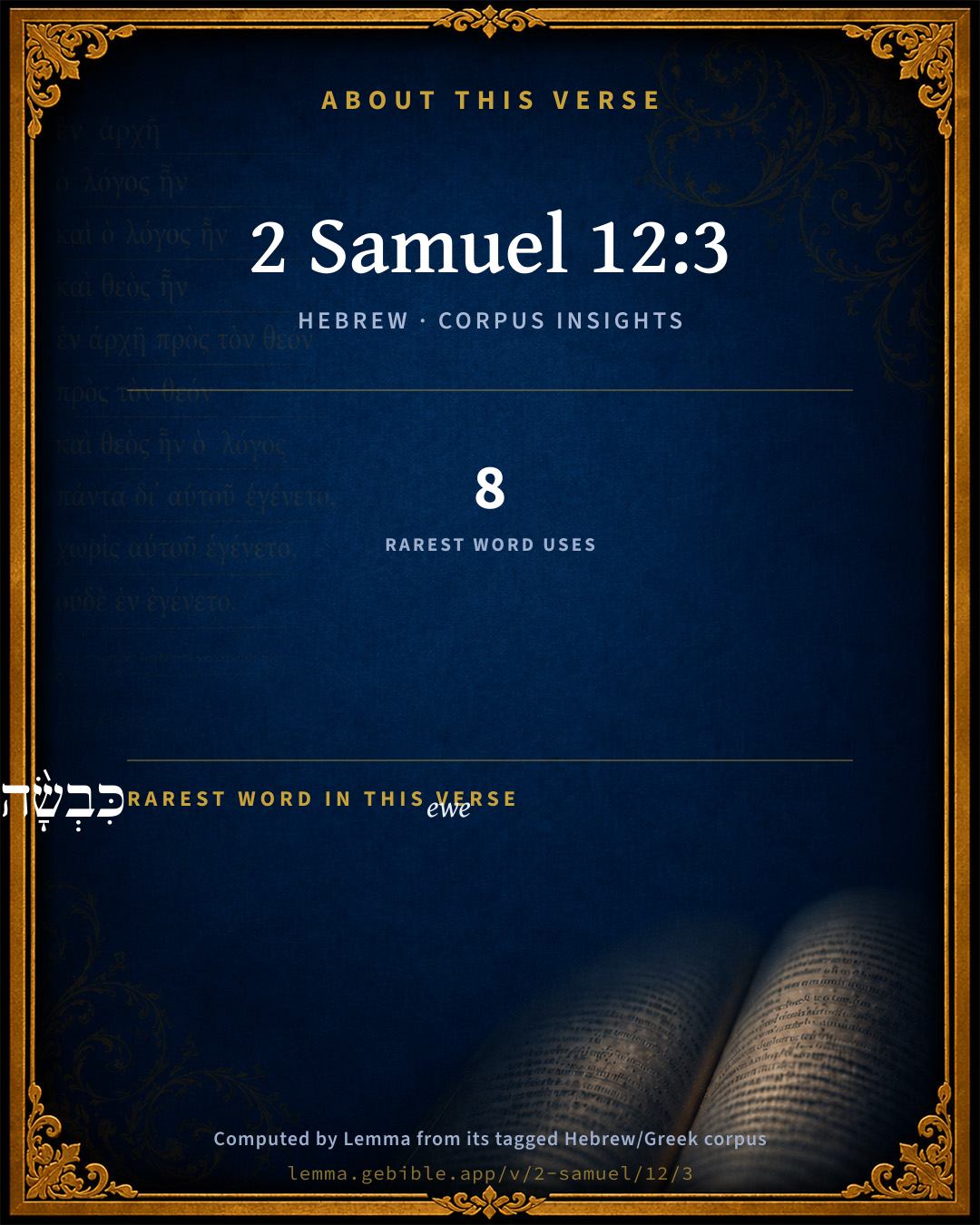
The rarest word here is כִּבְשָׂ֨ה ewe H3535 — appearing just 8 times in the whole Hebrew Bible.

Shared distinctive vocabulary

כִּבְשָׂ֨ה ewe H3535 occurs in 8 verses of the Hebrew Bible. Also found in:

Grammatical profile

  • 8 verbs
  • 7 nouns
  • 2 adjectives
  • 3 prepositions
  • 2 conjunctions
  • 1 adverb
  • 2 particles

Verb forms

  • וְלָרָ֣שׁ Qal · Participle Active
  • קָנָ֔ה Qal · Perfect
  • וַיְחַיֶּ֕הָ Piel · Sequential Imperfect
  • וַתִּגְדַּ֥ל Qal · Sequential Imperfect
  • תֹאכַ֜ל Qal · Imperfect
  • תִשְׁתֶּה֙ Qal · Imperfect
  • תִשְׁכָּ֔ב Qal · Imperfect
  • וַתְּהִי Qal · Sequential Imperfect

Repetition

A word recurs within this verse — often emphatic in Hebrew:

  • עִמּ֛וֹ with H5973 ×2

Hebrew & Septuagint length

In English translation the verse runs 50 words from the Hebrew and 51 from the Septuagint (LXX English) — closely comparable.

A rough comparison of the two English renderings, which tokenize alike — not a word-level alignment.

Word counts can differ between the Hebrew and the Greek without any difference in meaning — e.g. the Hebrew direct-object marker אֵת has no separate Greek word, and Greek often adds the article ὁ.

Cross-references

4

Topical passages linked to 2 Samuel 12:3 in the Treasury of Scripture Knowledge — connected by theme and wording, ordered by reader-vote popularity; previews shown in the World English Bible.

  • 2 Samuel 11:3 David send and inquired after the woman. One said, Is not this Bathsheba, the daughter of Eliam, the wife of Uriah the Hittite?
  • Micah 7:5 Don't trust in a neighbor. Don't put confidence in a friend. With the woman lying in your embrace, Be careful of the words of your mouth!
  • Deuteronomy 13:6 If your brother, the son of your mother, or your son, or your daughter, or the wife of your bosom, or your friend, who is as your own soul, entice you secretly, saying, Let us go and serve other gods, which you have not known, you, nor your fathers;
  • Proverbs 5:18–19 Let your spring be blessed. Rejoice in the wife of your youth.

Cross-references courtesy of OpenBible.info (CC BY 4.0).

Hebrew and Greek witnesses Masoretic Hebrew ↔ Greek Septuagint

The same verse in the two great witnesses to the Old Testament, shown verse-for-verse.

These are two independent witnesses, not word-aligned to each other, and the Septuagint is shown in lemma (dictionary) form.

Hebrew 2 Samuel 12:3 Masoretic · Westminster Leningrad Codex

וְלָרָ֣שׁ אֵֽין כֹּ֗ל כִּי֩ אִם כִּבְשָׂ֨ה אַחַ֤ת קְטַנָּה֙ אֲשֶׁ֣ר קָנָ֔ה וַיְחַיֶּ֕הָ וַתִּגְדַּ֥ל עִמּ֛וֹ וְעִם בָּנָ֖יו יַחְדָּ֑ו מִפִּתּ֨וֹ תֹאכַ֜ל וּמִכֹּס֤וֹ תִשְׁתֶּה֙ וּבְחֵיק֣וֹ תִשְׁכָּ֔ב וַתְּהִי ל֖וֹ כְּבַֽת

but the poor man had nothing, except one little ewe lamb, which he had bought and raised. It grew up together with him, and with his children. It ate of his own food, drank of his own cup, and lay in his bosom, and was to him like a daughter.

World English Bible · Public Domain

Greek LXX 2 Samuel 12:3 Septuagint · lemma form

καί ὁ πένης οὐδείς ἀλλά ἤ ἀμνάς εἷς μικρός ὅς κτάομαι καί περιποιέω καί ἐκτρέφω αὐτός καί ἁδρύνω μετά αὐτός καί μετά ὁ υἱός αὐτός ἐπί ὁ αὐτός ἐκ ὁ ἄρτος αὐτός ἐσθίω καί ἐκ ὁ ποτήριον αὐτός πίνω καί ἐν ὁ κόλπος αὐτός καθεύδω καί εἰμί αὐτός ὡς θυγάτηρ

But the poor man had only one little ewe lamb, which he had purchased, and preserved, and reared; and it grew up with himself and his children in common; it ate of his bread and drank of his cup, and slept in his bosom, and was to him as a daughter.

LXX2012 (modern English Septuagint) · Public Domain

Hebrew: Westminster Leningrad Codex (CC BY 4.0). Greek: Septuagint (public domain); English from LXX2012 (modern English Septuagint) (Public Domain). How the Septuagint differs from the Hebrew →

Targum (Aramaic paraphrase)

1

The Targum is the ancient Jewish Aramaic paraphrase of the Hebrew Scriptures — an interpretive translation, not the Hebrew text itself. Onkelos (literal) and Pseudo-Jonathan (expansive) render the Torah, and Jonathan the Prophets. Coverage is partial: where no permissively-licensed English translation exists for a verse, only the Aramaic is shown. This is verse-level text, not a word-by-word alignment to the Hebrew.

  1. Targum Jonathan Prophets (Joshua–Malachi)
    וּלְמִסְכֵּינָא לֵית כָּל מִדָעַם אֱלָהֵין אִמַרְתָּא חֲדָא זְעֵירָא דְזַבְּנָא וְקַיְימָהּ וּרְבַת עִמֵיהּ וְעִם בְּנוֹהִי כַּחֲדָא מִפִּתֵּיהּ אֲכָלַת וּמִכּוֹסֵיהּ שַׁתְיָא וּבְחֵיקֵיהּ שָׁכְבָא וַהֲוַת לֵיהּ כִּבְרַתָּא:

    (no public-domain English translation for this verse)

    Targum Jonathan — Aramaic: “Mikraot Gedolot” (public domain). English: “Sefaria Community Translation” (CC0 1.0 (public-domain dedication)); “London "Chaldee Paraphrase," 1871” (public domain). Text via Sefaria.

Commentary

Notes on 2 Samuel 12:3 from classic Christian and Jewish commentators (each source and its license shown beneath its notes). The classic Christian expositions comment on the surrounding passage and are grouped to its opening verse, so a note may address several verses; the Jewish commentaries on the Tanakh (Rashi and others) are per-verse, so they appear only where the commentator wrote on this verse.

Lemma curates 59 commentaries, every one of them public domain or Creative Commons licensed, each selected and text-cleaned for this edition rather than reprinted as found. About our sources →

Trapp's Complete Commentary

John Trapp

2Sa 12:3 But the poor [man] had nothing, save one little ewe lamb, which he had bought and nourished up: and it grew up together with him, and with his children; it did eat of his own meat, and drank of his own cup, and lay in his bosom, and was unto him as a daughter.

Ver. 3. But the poor man.] Poor Uriah; poor in comparison of David, who had all that heart could wish.

Save one little ewe lamb.] This was his Bathsheba, he had no more wives but her: as Isaac never had more than Rebecca, whom therefore he loved tenderly and entirely.

And it grew up together with him, and with his children.] Which he had by a former wife, as some think.

It did eat of his own meat.] Heb., Morsel; he spared it out of his own belly for his favoured lamb; neither was anything good to him, whereof his wife had not part.

And lay in his bosom.] Where he nourished and cherished her, {Eph 5:29} as the hen doth her chickens, or as the cock pigeon doth the eggs.

And was unto him as a daughter.] Yea, much dearer. The greater was her disloyalty against so loving a husband, and so gallant a man: the more heinous also was David’s offence in wronging and robbing him of such an only jewel.

John Trapp, A Commentary or Exposition upon All the Books of the Old and New Testament (1647–1656) — public domain. Text from a community e-Sword module.

Tyndale Open Study Notes

Tyndale Open Resources

12:3 like a baby daughter: Nathan’s comparison of this lamb to a daughter (Hebrew bath) strikes a parallel with Bathsheba’s name (see study note on 11:3).

Tyndale Open Study Notes — © Tyndale Open Resources, licensed CC BY-SA 4.0. Text via the HelloAO Bible API.

Adam Clarke's Commentary

Verse 3. And lay in his bosom] This can only mean that this lamb was what we call a pet or favourite in the family, else the circumstance would be very unnatural, and most likely would have prevented David from making the application which he did, as otherwise it would have appeared absurd. It is the only part of this parable which is at variance with nature and fact.

Adam Clarke's Commentary on the Bible (1810–1826) — public domain. Text from a community e-Sword/MySword module.

Ellicott's Commentary for English Readers

(3) It grew up together.—“All these circumstances are exquisitely contrived to heighten the pity of the hearer for the oppressed, and his indignation against the oppressor.”—Speaker’s Commentary.

A Bible Commentary for English Readers, edited by Charles John Ellicott (1878–1897) — public domain. Text from a community e-Sword module.

The Cambridge Bible for Schools and Colleges

gen. ed. J. J. S. Perowne

3. of his own meat] Of his own morsel. The E. V. misses something of the graphic tenderness of the original, describing how the lamb actually shared the poor man’s meal.

The Cambridge Bible for Schools and Colleges (gen. ed. J. J. S. Perowne; Cambridge University Press, 1878–1918) — public domain. Text from a community e-Sword module.

John Gill's Exposition

And there came a traveller unto the rich man,.... By which some understand Satan, who came to David, and stirred up his lust by the temptations that offered; who is a walker, as the word used signifies, that goes about seeking whom he may devour, and is with good men only as a wayfaring man, who does not abide with them; and whose temptations, when they succeed with such, are as meat and drink to him, very entertaining but the Jews generally understand it of the evil imagination or concupiscence in man, the lustful appetite in David, that wandered after another man's wife, and wanted to be satiated with her:

and he spared to take of his own flock, and of his own herd, to dress for the wayfaring man that came unto him; when his heart was inflamed with lust at the sight of Bathsheba, he did not go as he might, and take one of his wives and concubines, whereby he might have satisfied and repressed his lust:

but took the poor man's lamb, and dressed it for the man that came to him; sent for Bathsheba and lay with her, for the gratification of his lust, she being a young beautiful woman, and more agreeable to his lustful appetite. The Jews, in their Talmud (r), observe a gradation in these words that the evil imagination is represented first as a traveller that passes by a man, and lodges not with him; then as a wayfaring man or host, that passes in and lodges with him; and at last as a man, as the master of the house that rules over him, and therefore called the man that came to him.

(r) T. Bab. Succah, fol. 52. 2. Jarchi, Kimchi, & Abarbinel in loc.

John Gill's Exposition of the Whole Bible (1746–1763) — public domain (CC PDM 1.0). Text via the HelloAO Bible API.

Haydock's Catholic Bible Commentary

Daughter. All these expressions tended to shew the affection of the owner for this pet lamb. (Haydock) --- In Arabia, one of the finest is commonly fed in the house along with the children. (Bochart, Anim. T. i. B. ii. 46.) --- It is not necessary that every word of this parable should have been verified in Bethsabee. (Calmet) --- Many things are usually added for ornament. (Menochius) --- Yet she had been treated in the most tender manner by her husband, who had her alone, while David had eighteen wives. (Haydock)

George Leo Haydock (1774–1849), Haydock's Catholic Family Bible and Commentary, 1859 edition — public domain. Excludes Psalms (Douay-Rheims chapter numbering differs from Protestant) and Deuterocanonical books (Catholic canon only).

Matthew Poole's English Annotations

The poor man had nothing, save one little ewe lamb; designing Uriah, with his own and only wife. Which he had bought; as men then used to buy their wives; or, had procured. Lay in his bosom; which David might take for hyperbolical expressions of his tender care of and affection to it; although there want not instances of some who have treated such brute creatures in this manner.

Matthew Poole's English Annotations on the Holy Bible (1683–1685) — public domain. Text from a community e-Sword/MySword module.

Whedon's Commentary on the Bible

Daniel D. Whedon

3. One little ewe lamb — Referring tenderly to Bathsheba.

Lay in his bosom — As a family pet. Perhaps designed to indicate that Uriah was passionately devoted to his wife.

Daniel D. Whedon (gen. ed.), Commentary on the Old and New Testaments (1874–1909) — public domain. Text from a community e-Sword module.

The Pulpit Commentary

Was unto him as a daughter. The Orientals are excessively fond of pet animals, and, as the dog is with them unclean, its place is taken by fawns, kids, or lambs. The description, therefore, is not overcharged, for in many an English home the dog or cat takes its place as one of the family. The Revised Version preserves the tenderness of the original in translating "it did eat of his own morsel."

The Pulpit Commentary (1880–1919), ed. H.D.M. Spence-Jones & Joseph S. Exell — public domain. Text from a community e-Sword module.

John Wesley's Explanatory Notes

Bought - As men then used to buy their wives: or, had procured.

John Wesley, Explanatory Notes Upon the Whole Bible (1754–1765) — public domain. Text via the GEBible commentary corpus.

Lesson kit

Teaching starters — assembled from the data on this page, not authored interpretation. Every prompt links to the verse data it draws on. Edit before teaching.

2 Samuel, in the Historical, opens this verse with 25 words (23 distinct Hebrew lemmas). Its most distinctive word is kibsâh (“ewe”). A historical commentator’s framing appears above. Read the whole chapter for the surrounding context.

Discussion questions

  1. What does “ewe” (kibsâh) contribute to the verse as a whole?
  2. How does Genesis 21:28, which shares the word «ewe», read alongside this verse?
  3. What does the repetition of “with” (2× in this one verse) do in this verse?
  4. These translations render this verse differently. What is at stake in choosing one wording over another?
  5. «וְלָרָ֣שׁ» is a Qal Participle Active verb. How does that grammatical form shape the action described?
  6. Compare how Trapp's Complete Commentary and Tyndale Open Study Notes read this verse. Where do they agree or differ?

Things to notice

Reading settings

Reading text

Shown beneath each verse's original-language words.

Old Testament
Old Testament edition

Read the OT as the Masoretic Hebrew (MT) or the Greek Septuagint (LXX).

English shown for the Greek Septuagint (in the Hebrew ↔ Greek comparison).

Comparing translations? Open the Compare panel on any verse page to stack up to four side by side.