
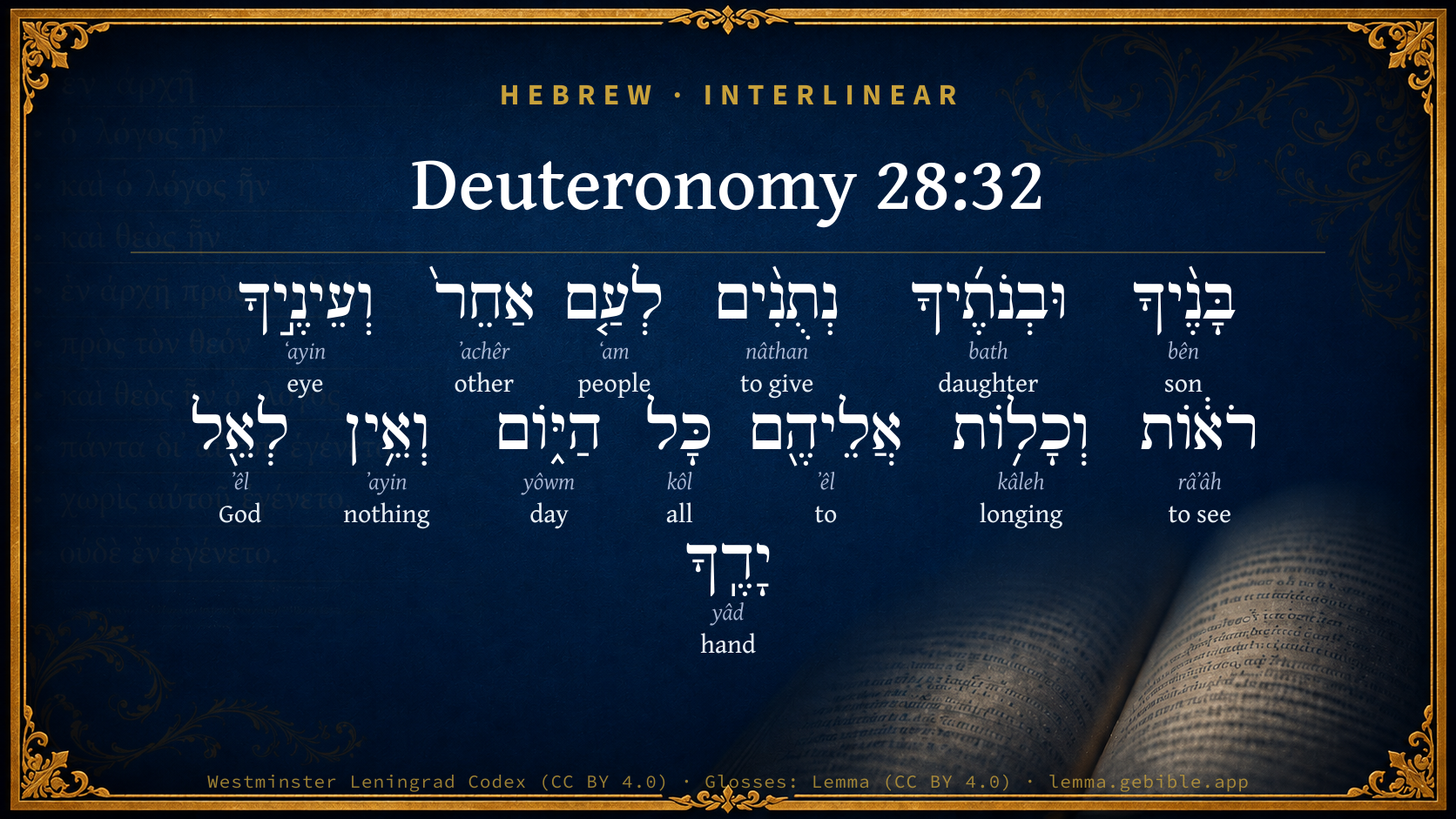
Deuteronomy 28:32

Hebrew (Westminster Leningrad Codex) Deuteronomy 28:32 appears in the Hebrew Old Testament. The text above is from the Westminster Leningrad Codex. Each word links to its Strong’s number, a concise gloss, and parsing drawn from the Open Scriptures Hebrew Bible morphology. Click any word for its full Brown-Driver-Briggs (BDB) entry.
Download image
Cite this verse

Deuteronomy 28:32 (World English Bible). Public Domain. Lemma interlinear Bible study tool, https://lemma.gebible.app/v/deuteronomy/28/32.

Show BibTeX & RIS
BibTeX
RIS
English Translation
Your sons and your daughters shall be given to another people; and your eyes shall look, and fail with longing for them all the day: and there shall be nothing in the power of your hand.
World English Bible · Public Domain
Highlights
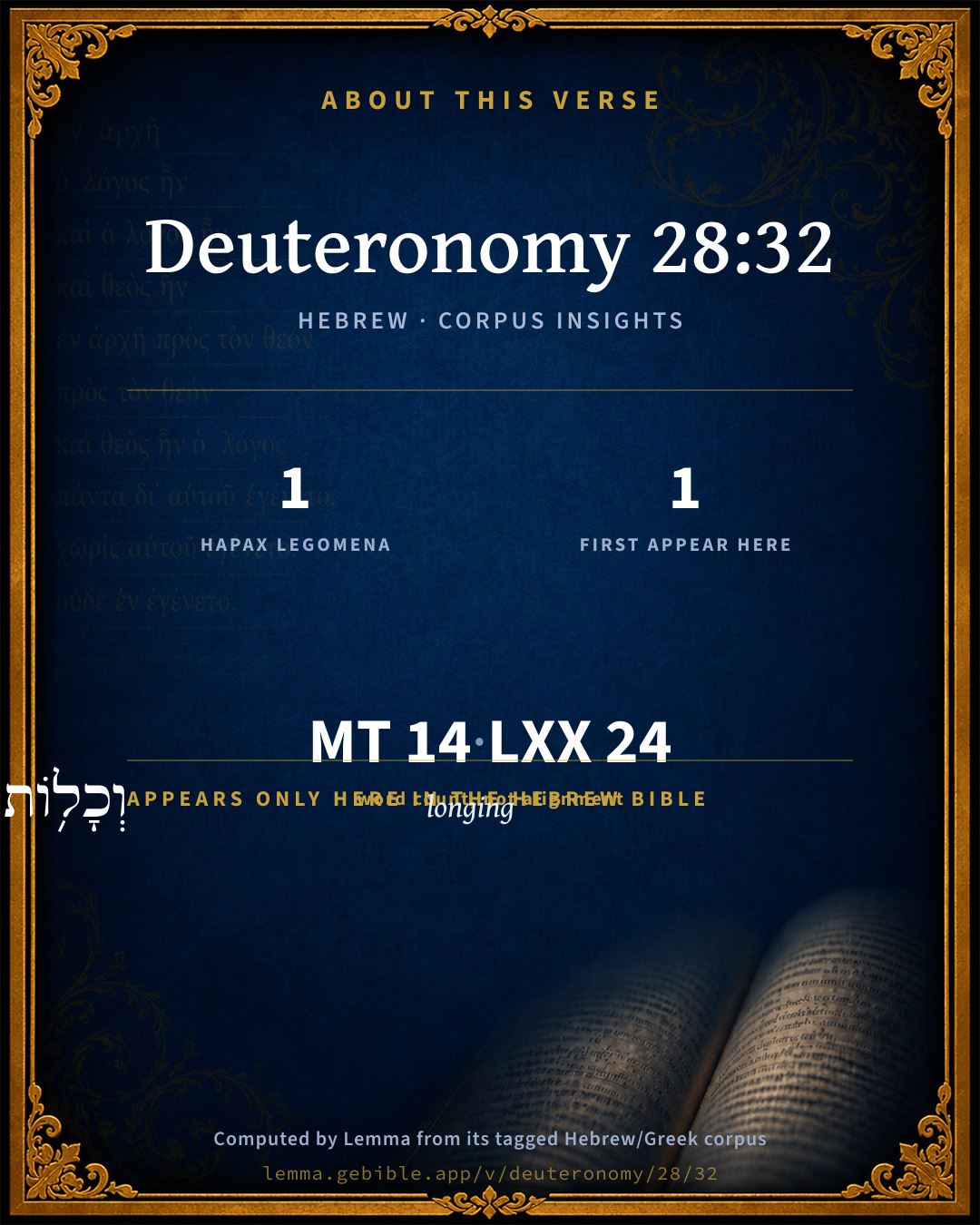
  • 1 hapax legomenon — only here in the Hebrew Bible
  • 1 first appearance in the Hebrew Bible
Full analysis ↓
Download a study sheet

One document with this verse’s original text, its word-by-word gloss line, the meaning frame, cross-references with their text, attributed commentary, and full source and license credits — printable, and it pastes into notes with its structure intact.

This verse Autodidact and up

Study sheet (.html) Plain text (.txt)

A passage Seminary Student

Up to 50 verses in one chapter. A passage sheet keeps up to 6 commentary sources and 12 cross-references per verse, in the order this page ranks them, and says so on the sheet whenever that leaves anything out. Ask for a single verse and you get the Autodidact verse sheet above.

Everything on this page stays free to read, with no account — the sheet is a download of what is already on screen, not access to it.

Want to remove ads? Support Godless Engineer
Compare translations 3

The same verse in 3 English versions, stacked beneath the original-language interlinear above. Click any original word for its lexicon entry.

Each is an independent rendering of the whole verse — the interlinear is not word-aligned to these translations.

Highlighted words mark where these versions differ — a whole-verse word diff, not a word-by-word alignment.

  • World English Bible Public Domain
    Your sons and your daughters shall be given to another people; and your eyes shall look, and fail with longing for them all the day: and there shall be nothing in the power of your hand.
  • King James Version Public Domain
    Thy sons and thy daughters shall be given unto another people, and thine eyes shall look, and fail with longing for them all the day long; and there shall be no might in thine hand.
  • unfoldingWord Literal Text CC BY-SA 4.0
    Your sons and your daughters given to other peoples, and your eyes will look on and will long for them all the day, and your hand will have no strength.

unfoldingWord Literal Text — © unfoldingWord, licensed CC BY-SA 4.0. Word-aligned USFM3 via Door43 (git.door43.org/unfoldingWord/en_ult).

Versions to compare (up to 4)

3 of 4 selected

Show all 18 translations

Every available English version of this verse, each an independent rendering of the whole verse.

  • World English Bible Public Domain
    Your sons and your daughters shall be given to another people; and your eyes shall look, and fail with longing for them all the day: and there shall be nothing in the power of your hand.
  • Berean Standard Bible Public Domain
    Your sons and daughters will be given to another nation, while your eyes grow weary looking for them day after day, with no power in your hand.
  • Majority Standard Bible Public Domain
    Your sons and daughters will be given to another nation, while your eyes grow weary looking for them day after day, with no power in your hand.
  • King James Version Public Domain
    Thy sons and thy daughters shall be given unto another people, and thine eyes shall look, and fail with longing for them all the day long; and there shall be no might in thine hand.
  • American Standard Version (1901) Public Domain
    Thy sons and thy daughters shall be given unto another people; and thine eyes shall look, and fail with longing for them all the day: and there shall be nought in the power of thy hand.
  • Revised Version (1885) Public Domain
    Thy sons and thy daughters shall be given unto another people, and thine eyes shall look, and fail with longing for them all the day: and there shall be nought in the power of thine hand.
  • Geneva Bible (1599) Public Domain
    Thy sonnes and thy daughters shalbe giuen vnto another people, and thine eyes shall still looke for them, euen till they fall out, and there shalbe no power in thine hand.
  • Douay-Rheims (1899) Public Domain
    May thy sons and thy daughters be given to another people, thy eyes looking on, and languishing at the sight of them all the day, and may there be no strength in thy hand.
  • Young's Literal Translation Public Domain
    `Thy sons and thy daughters `are' given to another people, and thine eyes are looking and consuming for them all the day, and thy hand is not to God!
  • Literal Standard Version CC BY-SA 4.0
    Your sons and your daughters [are] given to another people, and your eyes are looking and consumed for them all the day, but your hand is not to God!
  • Unlocked Literal Bible CC BY-SA 4.0
    Your sons and your daughters will be given to other peoples; your eyes will look for them the entire day, but will fail with longing for them. There will be no strength in your hand.
  • unfoldingWord Literal Text CC BY-SA 4.0
    Your sons and your daughters given to other peoples, and your eyes will look on and will long for them all the day, and your hand will have no strength.
  • Darby Bible Public Domain
    Thy sons and thy daughters shall be given unto another people, and thine eyes shall look, and languish for them all the day long; and there shall be no power in thy hand [to help it].
  • World Messianic Bible Public Domain
    Your sons and your daughters will be given to another people. Your eyes will look and fail with longing for them all day long. There will be no power in your hand.
  • Webster's Bible Public Domain
    Thy sons and thy daughters shall be given to another people, and thy eyes shall look, and fail with longing for them all the day long: and there shall be no might in thy hand.
  • Free Bible Version CC BY-SA 4.0
    Your sons and daughters will be taken away as slaves to other nations while you watch, and you'll wear your eyes out crying over them, but there won't be anything you can do about it.
  • Bible in Basic English Public Domain
    Your sons and your daughters will be given to another people, and your eyes will be wasted away with looking and weeping for them all the day: and you will have no power to do anything.
  • JPS Tanakh (1917) Public Domain
    Thy sons and thy daughters shall be given unto another people, and thine eyes shall look, and fail with longing for them all the day; and there shall be nought in the power of thy hand.

Literal Standard Version (2020), Covenant Press — licensed CC BY-SA 4.0. Text via the HelloAO Bible API (eBible.org). Unlocked Literal Bible (unfoldingWord) — licensed CC BY-SA 4.0. Text via the HelloAO Bible API (eBible.org). unfoldingWord Literal Text — © unfoldingWord, licensed CC BY-SA 4.0. Word-aligned USFM3 via Door43 (git.door43.org/unfoldingWord/en_ult). Free Bible Version, Dr. Jonathan Gallagher — licensed CC BY-SA 4.0. Text via the HelloAO Bible API (eBible.org).

Word by word

More ways to search: Search by grammar → Find every occurrence → Compare this word →

Practice this passage: Drill this verse → Learn its vocabulary →

וְכָל֥וֹת
kâleh
H3616
“and · longing”
Conjunction + Adjective, Adjective, Feminine, Plural, Absolute
Part of Speech
Conjunction + Adjective
Type
Adjective
Gender
Feminine
Number
Plural
State
Absolute
Full BDB Definition

Origin: from H3615

TWOT: 982b

failing with desire, longing, longing for
  1. בָּנֶ֨יךָ bên H1121 “sons · your” Noun, Common, Masculine, Plural, Construct + Suffix, Personal, 2nd Person, Masculine, Singular
  2. וּבְנֹתֶ֜יךָ bath H1323 “and · daughters · your” Conjunction + Noun, Common, Feminine, Plural, Construct + Suffix, Personal, 2nd Person, Masculine, Singular
  3. נְתֻנִ֨ים nâthan H5414 “given” Verb, Qal, Participle Passive, Masculine, Plural, Absolute
  4. לְעַ֤ם ʻam H5971 “to/for · people” Preposition + Noun, Common, Masculine, Singular, Absolute
  5. אַחֵר֙ ʼachêr H312 “other” Adjective, Adjective, Masculine, Singular, Absolute
  6. וְעֵינֶ֣יךָ ʻayin H5869 “and · eyes · your” Conjunction + Noun, Common, Both, Dual, Construct + Suffix, Personal, 2nd Person, Masculine, Singular
  7. רֹא֔וֹת râʼâh H7200 “seeing” Verb, Qal, Participle Active, Feminine, Plural, Absolute
  8. אֲלֵיהֶ֖ם ʼêl H413 “to · them” Preposition + Suffix, Personal, 3rd Person, Masculine, Plural
  9. כָּל kôl H3605 “all of” Noun, Common, Masculine, Singular, Construct
  10. הַיּ֑וֹם yôwm H3117 “the · day” Particle, Definite Article + Noun, Common, Masculine, Singular, Absolute
  11. וְאֵ֥ין ʼayin H369 “and · nothing” Conjunction + Particle, Negative
  12. לְאֵ֖ל ʼêl H410 “to/for · God of” Preposition + Noun, Common, Masculine, Singular, Construct
  13. יָדֶֽךָ yâd H3027 “hand · your” Noun, Common, Both, Singular, Construct + Suffix, Personal, 2nd Person, Masculine, Singular

About this verse

These counts appear in no published source. They are computed here, from the morphology-tagged text and Lemma’s own curated glosses. What Lemma adds →

14
words
14
distinct lemmas
Pentateuch
section

Notable vocabulary

1 hapax legomenon — a word that appears only here in the entire Hebrew Bible:

  • וְכָל֥וֹת longing H3616

First appearance in Scripture

This word makes its first canonical appearance in the Hebrew Bible here:

  • וְכָל֥וֹת longing H3616

Grammatical profile

  • 2 verbs
  • 8 nouns
  • 2 adjectives
  • 1 preposition
  • 1 particle

Verb forms

  • נְתֻנִ֨ים Qal · Participle Passive
  • רֹא֔וֹת Qal · Participle Active

Hebrew & Septuagint length

In English translation the verse runs 36 words from the Hebrew and 26 from the Septuagint (LXX English) — closely comparable.

A rough comparison of the two English renderings, which tokenize alike — not a word-level alignment.

Word counts can differ between the Hebrew and the Greek without any difference in meaning — e.g. the Hebrew direct-object marker אֵת has no separate Greek word, and Greek often adds the article ὁ.

In the original languages it is 14 Hebrew tokens and 24 Greek tokens — but the two are counted differently (Hebrew bundles its prefixes and suffixes into one token; the Greek is in lemma form), so that isn’t a like-for-like length.

Cross-references

21

Topical passages linked to Deuteronomy 28:32 in the Treasury of Scripture Knowledge — connected by theme and wording, ordered by reader-vote popularity; previews shown in the World English Bible.

  • Deuteronomy 28:41 You shall father sons and daughters, but they shall not be yours; for they shall go into captivity.
  • Joel 3:6 And have sold the children of Judah and the children of Jerusalem to the sons of the Greeks, That you may remove them far from their border.
  • 2 Chronicles 29:9 For, behold, our fathers have fallen by the sword, and our sons and our daughters and our wives are in captivity for this.
  • Job 17:5 He who denounces his friends for a prey, Even the eyes of his children shall fail.
  • Numbers 21:29 Woe to you, Moab! You are undone, people of Chemosh: He has given his sons as fugitives, His daughters into captivity, To Sihon king of the Amorites.
  • Deuteronomy 28:18 Cursed shall be the fruit of your body, and the fruit of your ground, the increase of your cattle, and the young of your flock.
  • Deuteronomy 28:65 Among these nations shall you find no ease, and there shall be no rest for the sole of your foot: but Yahweh will give you there a trembling heart, and failing of eyes, and pining of soul;
  • Nehemiah 5:2–5 For there were that said, We, our sons and our daughters, are many: let us get grain, that we may eat and live.
  • Job 11:20 But the eyes of the wicked shall fail, They shall have no way to flee; Their hope shall be the giving up of the spirit."
  • Psalms 69:3 I am weary with my crying. My throat is dry. My eyes fail, looking for my God.
  • Psalms 119:82 My eyes fail for your word. I say, "When will you comfort me?"
  • Psalms 119:123 My eyes fail looking for your salvation, For your righteous word.
  • Isaiah 38:14 Like a swallow [or] a crane, so did I chatter; I did moan as a dove; my eyes fail [with looking] upward: Lord, I am oppressed, be my collateral.
  • Jeremiah 15:7–9 I have winnowed them with a fan in the gates of the land; I have bereaved [them] of children, I have destroyed my people; they didn't return from their ways.
  • Jeremiah 16:2–4 You shall not take a wife, neither shall you have sons or daughters, in this place.
  • Lamentations 2:11 My eyes do fail with tears, my heart is troubled; My liver is poured on the earth, because of the destruction of the daughter of my people, Because the young children and the infants swoon in the streets of the city.
  • Lamentations 5:17 For this our heart is faint; For these things our eyes are dim;
  • Ezekiel 24:25 You, son of man, shall it not be in the day when I take from them their strength, the joy of their glory, the desire of their eyes, and that whereupon they set their heart, their sons and their daughters,
  • Amos 5:27 Therefore will I cause you to go into captivity beyond Damascus," says Yahweh, whose name is the God of hosts.
  • Micah 4:10 Be in pain, and labor to bring forth, daughter of Zion, Like a woman in travail; For now you will go forth out of the city, And will dwell in the field, And will come even to Babylon. There you will be rescued. There Yahweh will redeem you from the hand of your enemies.
  • Lamentations 4:17 Our eyes do yet fail [in looking] for our vain help: In our watching we have watched for a nation that could not save.

Cross-references courtesy of OpenBible.info (CC BY 4.0).

Hebrew and Greek witnesses Masoretic Hebrew ↔ Greek Septuagint

The same verse in the two great witnesses to the Old Testament, shown verse-for-verse.

These are two independent witnesses, not word-aligned to each other, and the Septuagint is shown in lemma (dictionary) form.

Hebrew Deuteronomy 28:32 Masoretic · Westminster Leningrad Codex

בָּנֶ֨יךָ וּבְנֹתֶ֜יךָ נְתֻנִ֨ים לְעַ֤ם אַחֵר֙ וְעֵינֶ֣יךָ רֹא֔וֹת וְכָל֥וֹת אֲלֵיהֶ֖ם כָּל הַיּ֑וֹם וְאֵ֥ין לְאֵ֖ל יָדֶֽךָ

Your sons and your daughters shall be given to another people; and your eyes shall look, and fail with longing for them all the day: and there shall be nothing in the power of your hand.

World English Bible · Public Domain

Greek LXX Deuteronomy 28:32 Septuagint · lemma form

ὁ υἱός σύ καί ὁ θυγάτηρ σύ δίδωμι ἔθνος ἕτερος καί ὁ ὀφθαλμός σύ βλέπω σφακελίζω εἰς αὐτός καί οὐ ἰσχύω ὁ χείρ σύ

Your sons and your daughters shall be given to another nation, and your eyes wasting away shall look for them: your hand shall have no strength.

LXX2012 (modern English Septuagint) · Public Domain

Hebrew: Westminster Leningrad Codex (CC BY 4.0). Greek: Septuagint (public domain); English from LXX2012 (modern English Septuagint) (Public Domain). How the Septuagint differs from the Hebrew →

Targum (Aramaic paraphrase)

2

The Targum is the ancient Jewish Aramaic paraphrase of the Hebrew Scriptures — an interpretive translation, not the Hebrew text itself. Onkelos (literal) and Pseudo-Jonathan (expansive) render the Torah, and Jonathan the Prophets. Coverage is partial: where no permissively-licensed English translation exists for a verse, only the Aramaic is shown. This is verse-level text, not a word-by-word alignment to the Hebrew.

  1. Targum Onkelos Torah (Genesis–Deuteronomy)
    בְּנָיךְ וּבְנָתָיךְ מְסִירִין לְעַמָא אָחָרָן וְעֵינָךְ חֲזָן וִיסוּפָן בִּגְלָלְהֵן כָּל יוֹמָא וְלֵית חֵילָא בִּידָךְ

    (no public-domain English translation for this verse)

    Targum Onkelos — Aramaic: “Onkelos Genesis” (public domain); “Onkelos Exodus” (public domain); “Onkelos Leviticus” (public domain); “Onkelos Numbers” (public domain); “Onkelos Deuteronomy” (public domain). English: “Sefaria Community Translation” (CC0 1.0 (public-domain dedication)); “J.W. Etheridge. The Targums of Onkelos and Jonathan Ben Uzziel on the Pentateuch. London: Longmans, Green, 1862” (public domain). Text via Sefaria.

  2. Targum Pseudo-Jonathan Torah (Genesis–Deuteronomy)
    בְּנֵיכוֹן וּבְנָתֵיכוֹן מְסִירִין לְעַם חִילוֹנֵי וְעֵינֵיכוֹן חַמְיָין וְחַשְׁכָן עֲלֵיהוֹן כָּל יוֹמָא וְלֵית בִּידֵיכוֹן עָבְדִין טָבְיָן דְתִיתוֹקְפָן יְדֵיכוֹן בִּצְלוֹ קֳדָם יְיָ אֲבוּכוֹן דְבִשְׁמַיָא דְיִפְרוֹק יַתְכוֹן

    your sons and daughters will be given up to another people, and your eyes see it, and grow dim because of them from day to day; and in your hand will be no good work by which you may prevail in prayer before the Lord your Father who is in heaven, that He may save you.

    Targum Pseudo-Jonathan — Aramaic: “Targum Jonathan on Genesis” (public domain); “Targum Jonathan on Exodus” (public domain); “Targum Jonathan on Leviticus” (public domain); “Targum Jonathan on Numbers” (public domain); “Targum Jonathan on Deuteronomy” (public domain). English: “The Targum of Jonathan ben Uzziel, trans. J. W. Etheridge, London, 1862” (public domain). Text via Sefaria.

Commentary

Notes on Deuteronomy 28:32 from classic Christian and Jewish commentators (each source and its license shown beneath its notes). The classic Christian expositions comment on the surrounding passage and are grouped to its opening verse, so a note may address several verses; the Jewish commentaries on the Tanakh (Rashi and others) are per-verse, so they appear only where the commentator wrote on this verse.

Lemma curates 59 commentaries, every one of them public domain or Creative Commons licensed, each selected and text-cleaned for this edition rather than reprinted as found. About our sources →

Trapp's Complete Commentary

John Trapp

Deu 28:32 Thy sons and thy daughters [shall be] given unto another people, and thine eyes shall look, and fail [with longing] for them all the day long: and [there shall be] no might in thine hand.

Ver. 32. And thine eyes shall look.] A sad sight to see our children butchered before our eyes, as Mauricius the Emperor did; or otherwise misused by a merciless enemy. Doves sometimes sit in their dove-cotes and see their nests destroyed, their young ones taken away and killed before their eyes, neither do they ever offer to rescue or revenge, as all other creatures either do or desire to do.

And fail with looking.] As Sisera’s mother’s did. {Jdg 5:28}

John Trapp, A Commentary or Exposition upon All the Books of the Old and New Testament (1647–1656) — public domain. Text from a community e-Sword module.

Joseph Benson's Commentary

Deu 28:32. Thy sons and thy daughters shall be given — When you have provoked the divine justice to deliver you into the hands of your enemies, you shall have nothing left which you can call your own. Your very wives and children shall become a prey to your enemies; shall be taken from you and given, or sold, to another people — By those who have conquered you and taken them captives. Thine eyes shall fail — Or be consumed, partly with grief and plentiful tears, and partly with earnest desire, and long and vain expectation of their return. There shall be no might in thy hand — No power to rescue, nor money to ransom them.

Joseph Benson's Commentary on the Old and New Testaments (1811–1818) — public domain. Text from a community e-Sword module.

Geneva Bible (1599)

Geneva Bible translators

When they shall return from their captivity.

Geneva Bible (1599) marginal notes — public domain. Text via Bolls.life.

Adam Clarke's Commentary

Verse 32. Thy sons and thy daughters shall be given unto another people] In several countries, particularly in Spain and Portugal, the children of the Jews have been taken from them by order of government, and educated in the Popish faith. There have been some instances of Jewish children being taken from their parents even in Protestant countries.

Adam Clarke's Commentary on the Bible (1810–1826) — public domain. Text from a community e-Sword/MySword module.

Ellicott's Commentary for English Readers

(32) Thy sons and thy daughters.—The language of this verse is perhaps the most pathetic piece of description in the whole chapter. Many of the nations bordering on Israel were accustomed when they made inroads to take away, not only the cattle, but the children for slaves. Another equally pathetic passage in Jeremiah touches on the very same thing. “A voice was heard in Ramah, lamentation and bitter weeping; Rachel weeping for her children, refused to be comforted for her children, because they were not.” And it would not always be said, as it was then, “they shall come again from the land of the enemy” (Jer_31:15-17).

Thine eyes shall . . . fail—i.e., shall consume. “All longing after that which comes not is called consumption of the eyes” (Rashi).

And there shall be no might in thine hand.—The Hebrew phrase here is very remarkable. It occurs also in Gen_31:29. “It is in the power of mine hand to do you hurt.” But it means, literally, thou shalt have no hand toward God, i.e., “thou shalt not be able to lift a hand to Him.” We may compare Jacob wrestling with the angel, and Moses in the fight with Amalek: “When he held up his hand, Israel prevailed, and when he let down his hand, Amalek prevailed.” Some would perhaps explain the phrase in another way; but this explanation is thoroughly in accordance with the genius of the Hebrew language, and I have good authority for it. Hezekiah said, “Mine eyes fail with looking upward.” Here the eyes fail with looking, but cannot look up.

A Bible Commentary for English Readers, edited by Charles John Ellicott (1878–1897) — public domain. Text from a community e-Sword module.

The Cambridge Bible for Schools and Colleges

gen. ed. J. J. S. Perowne

32. Judah suffered from a large deportation of her people by Sennacherib in 701. On any of the conflicting estimates of the deportations under Nebuchadrezzar, there must have remained in the land a majority of the people, lamenting, as this v. describes, the exile of the rest. See Jerusalem, ii. 266 ff.

hand] Many MSS read hands; cp. Neh_5:5.

The Cambridge Bible for Schools and Colleges (gen. ed. J. J. S. Perowne; Cambridge University Press, 1878–1918) — public domain. Text from a community e-Sword module.

John Gill's Exposition

The Lord shall smite thee in the knees, and in the legs, with a sore botch, that cannot be healed,.... Which in those parts as it is very painful, so is not easily cured; and this which is threatened was incurable by the art of man, as others in Deu 28:27; and which should not stop there in the lower parts of the body, but proceed and spread:

from the sole of thy foot unto the top of thy head; and so be filled with them, as Job was with his boils and ulcers.

John Gill's Exposition of the Whole Bible (1746–1763) — public domain (CC PDM 1.0). Text via the HelloAO Bible API.

Haydock's Catholic Bible Commentary

Hand. Hebrew also, "thy hand shall not be lifted up towards God." Targum of Jerusalem says, Thou shalt possess nothing, wherewith thou mayest render God propitious. (Calmet) --- Thou shalt not be able to rescue, (Menochius) or to assist thy distressed children.

George Leo Haydock (1774–1849), Haydock's Catholic Family Bible and Commentary, 1859 edition — public domain. Excludes Psalms (Douay-Rheims chapter numbering differs from Protestant) and Deuterocanonical books (Catholic canon only).

Matthew Poole's English Annotations

Shall be given unto another people, by those who have conquered them, and taken them captives, who shall give or sell them to other persons, as the manner was.

Fail, or, be consumed, partly with grief and plentiful tears shed for them; and partly with earnest desire, and vain and long expectation of their return. See Psa 119:82. No might, i.e. no power to rescue them, nor money to ransom them.

Matthew Poole's English Annotations on the Holy Bible (1683–1685) — public domain. Text from a community e-Sword/MySword module.

Whedon's Commentary on the Bible

Daniel D. Whedon

32. No might in thine hand — This expression is more literally rendered, thy hand is not to God. Thy hand is not strong enough to deliver thee.

Daniel D. Whedon (gen. ed.), Commentary on the Old and New Testaments (1874–1909) — public domain. Text from a community e-Sword module.

The Pulpit Commentary

And there shall be no might in thine hand. Keil proposes to render here, "Thy hand shall not be to thee towards God;" and others, "Thy hand shall not be to thee for God," i.e. instead of God. But It here is not "the Mighty One, God; but simply" might, strength, power," as in Gen_31:29; Pro_3:27; Mic_2:1. Literally rendered, the words are, And not for might is thy hand, the meaning of which is well expressed in the Authorized Version.

The Pulpit Commentary (1880–1919), ed. H.D.M. Spence-Jones & Joseph S. Exell — public domain. Text from a community e-Sword module.

John Wesley's Explanatory Notes

Unto another people - By those who have conquered them, and taken them captives, who shall give or sell them to other persons. Fail - Or, be consumed, partly with grief and plentiful tears; and partly with earnest desire, and vain and long expectation of their return. No might - No power to rescue, nor money to ransom them.

John Wesley, Explanatory Notes Upon the Whole Bible (1754–1765) — public domain. Text via the GEBible commentary corpus.

unfoldingWord translationNotes

Door43 World Missions Community

General Information:

Moses speaks to the Israelites as if they were one man, so the words "you" and "your" here are singular. (See: Forms of You)

Your sons and your daughters will be given to other peoples

This can be stated in active form. AT: "I will give your sons and your daughters to other peoples" or "Your enemies will take your sons and daughters" (See: Active or Passive)

your eyes will look for them the entire day, but will fail with longing for them

Here "your eyes" refers to the whole person. AT: "you will grow tired as you constantly watch for them and long to see them again" (See: Synecdoche)

There will be no strength in your hand

Here the metonym "strength in your hand" refers to power. "AT: "You will be powerless to do anything about it" (See: Metonymy)

translationWords

people group

day

strength

hand

unfoldingWord translationNotes — © Distant Shores Media and the Door43 World Missions Community, licensed CC BY-SA 4.0. Source: git.door43.org/Door43/en_tn.

Rashi

Rabbi Shlomo Yitzchaki (Rashi)

וכלות אליהם [AND THINE EYES SHALL SEE] AND LONG FOR THEM — i.e. they will look expectantly for them (the children) that they should return home, but they will not return. — Any desire that does not come to fulfillment is termed a “failing of the eyes” (cf. Deuteronomy 28:65).

Rashi on the Tanakh — English translations: “The Judaica Press complete Tanach with Rashi, translated by A. J. Rosenberg” (CC BY 4.0); “Pentateuch with Rashi's commentary by M. Rosenbaum and A.M. Silbermann, 1929-1934” (public domain); “The Metsudah Tanach series, Lakewood, N.J” (CC BY 4.0); and “The Book of Joshua, Metsudah Publications, 1997” (CC BY 4.0). Text via Sefaria.

Lesson kit

Teaching starters — assembled from the data on this page, not authored interpretation. Every prompt links to the verse data it draws on. Edit before teaching.

Deuteronomy, in the Pentateuch, opens this verse with 14 words (14 distinct Hebrew lemmas). Its most distinctive word is kâleh (“longing”). A historical commentator’s framing appears above. Read the whole chapter for the surrounding context.

Discussion questions

  1. How does “longing” (kâleh) shape what this verse is saying?
  2. This verse holds 1 word here found nowhere else in the Hebrew Bible. What might the rare word draw attention to?
  3. The word “longing” first appears here in Scripture. What is being introduced at this debut?
  4. Deuteronomy 28:41 shares this passage’s theme. How do the two illuminate each other?
  5. The translations on this page render this verse differently — a whole-verse word diff, not a word-by-word alignment. What might account for the different wordings?
  6. The verb «נְתֻנִ֨ים» is Qal Participle Passive. How does its form color the action?
  7. Reading how Trapp's Complete Commentary and Joseph Benson's Commentary read this verse, where do the two commentators agree and where do they part?

Things to notice

Reading settings

Reading text

Shown beneath each verse's original-language words.

Old Testament
Old Testament edition

Read the OT as the Masoretic Hebrew (MT) or the Greek Septuagint (LXX).

English shown for the Greek Septuagint (in the Hebrew ↔ Greek comparison).

Comparing translations? Open the Compare panel on any verse page to stack up to four side by side.