
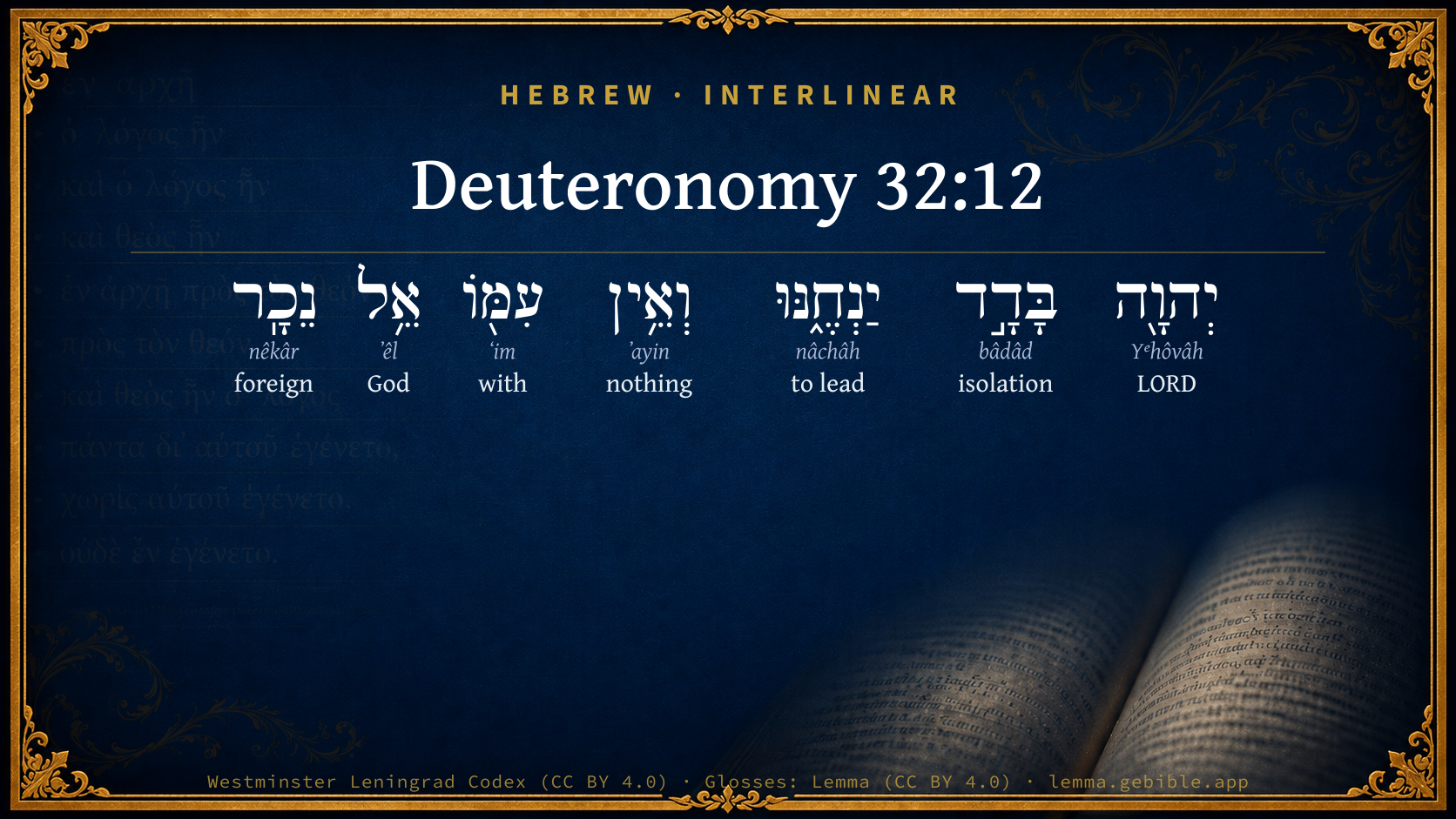
Deuteronomy 32:12

Hebrew (Westminster Leningrad Codex) Deuteronomy 32:12 appears in the Hebrew Old Testament. The text above is from the Westminster Leningrad Codex. Each word links to its Strong’s number, a concise gloss, and parsing drawn from the Open Scriptures Hebrew Bible morphology. Click any word for its full Brown-Driver-Briggs (BDB) entry.
Download image
Cite this verse

Deuteronomy 32:12 (World English Bible). Public Domain. Lemma interlinear Bible study tool, https://lemma.gebible.app/v/deuteronomy/32/12.

Show BibTeX & RIS
BibTeX
RIS
English Translation
Yahweh alone did lead him, There was no foreign god with him.
World English Bible · Public Domain
Download a study sheet

One document with this verse’s original text, its word-by-word gloss line, the meaning frame, cross-references with their text, attributed commentary, and full source and license credits — printable, and it pastes into notes with its structure intact.

This verse Autodidact and up

Study sheet (.html) Plain text (.txt)

A passage Seminary Student

Up to 50 verses in one chapter. A passage sheet keeps up to 6 commentary sources and 12 cross-references per verse, in the order this page ranks them, and says so on the sheet whenever that leaves anything out. Ask for a single verse and you get the Autodidact verse sheet above.

Everything on this page stays free to read, with no account — the sheet is a download of what is already on screen, not access to it.

Want to remove ads? Support Godless Engineer
Compare translations 3

The same verse in 3 English versions, stacked beneath the original-language interlinear above. Click any original word for its lexicon entry.

Each is an independent rendering of the whole verse — the interlinear is not word-aligned to these translations.

Highlighted words mark where these versions differ — a whole-verse word diff, not a word-by-word alignment.

  • World English Bible Public Domain
    Yahweh alone did lead him, There was no foreign god with him.
  • King James Version Public Domain
    So the LORD alone did lead him, and there was no strange god with him.
  • unfoldingWord Literal Text CC BY-SA 4.0
    Yahweh alone led him, and there was not with him a god of foreigners. ts\*

unfoldingWord Literal Text — © unfoldingWord, licensed CC BY-SA 4.0. Word-aligned USFM3 via Door43 (git.door43.org/unfoldingWord/en_ult).

Versions to compare (up to 4)

3 of 4 selected

Show all 18 translations

Every available English version of this verse, each an independent rendering of the whole verse.

  • World English Bible Public Domain
    Yahweh alone did lead him, There was no foreign god with him.
  • Berean Standard Bible Public Domain
    The LORD alone led him, and no foreign god was with him.
  • Majority Standard Bible Public Domain
    The LORD alone led him, and no foreign god was with him.
  • King James Version Public Domain
    So the LORD alone did lead him, and there was no strange god with him.
  • American Standard Version (1901) Public Domain
    Jehovah alone did lead him, And there was no foreign god with him.
  • Revised Version (1885) Public Domain
    The LORD alone did lead him, And there was no strange god with him.
  • Geneva Bible (1599) Public Domain
    So the Lord alone led him, and there was no strange god with him.
  • Douay-Rheims (1899) Public Domain
    The Lord alone was his leader: and there was no strange god with him.
  • Young's Literal Translation Public Domain
    Jehovah alone doth lead him, And there is no strange god with him.
  • Literal Standard Version CC BY-SA 4.0
    YHWH alone leads him, || And there is no strange god with him.
  • Unlocked Literal Bible CC BY-SA 4.0
    Yahweh alone led him; no foreign god was with him.
  • unfoldingWord Literal Text CC BY-SA 4.0
    Yahweh alone led him, and there was not with him a god of foreigners. ts\*
  • Darby Bible Public Domain
    So Jehovah alone did lead him, And no strange ùgod [was] with him.
  • World Messianic Bible Public Domain
    The LORD alone led him. There was no foreign god with him.
  • Webster's Bible Public Domain
    So the LORD alone did lead him, and there was no strange God with him.
  • Free Bible Version CC BY-SA 4.0
    The Lord was the only one who led you; no foreign god was with him.
  • Bible in Basic English Public Domain
    So the Lord only was his guide, no other god was with him.
  • JPS Tanakh (1917) Public Domain
    The LORD alone did lead him, and there was no strange god with Him.

Literal Standard Version (2020), Covenant Press — licensed CC BY-SA 4.0. Text via the HelloAO Bible API (eBible.org). Unlocked Literal Bible (unfoldingWord) — licensed CC BY-SA 4.0. Text via the HelloAO Bible API (eBible.org). unfoldingWord Literal Text — © unfoldingWord, licensed CC BY-SA 4.0. Word-aligned USFM3 via Door43 (git.door43.org/unfoldingWord/en_ult). Free Bible Version, Dr. Jonathan Gallagher — licensed CC BY-SA 4.0. Text via the HelloAO Bible API (eBible.org).

Word by word

More ways to search: Search by grammar → Find every occurrence → Compare this word →

Practice this passage: Drill this verse → Learn its vocabulary →

About this verse

These counts appear in no published source. They are computed here, from the morphology-tagged text and Lemma’s own curated glosses. What Lemma adds →

7
words
7
distinct lemmas
Pentateuch
section

Notable vocabulary

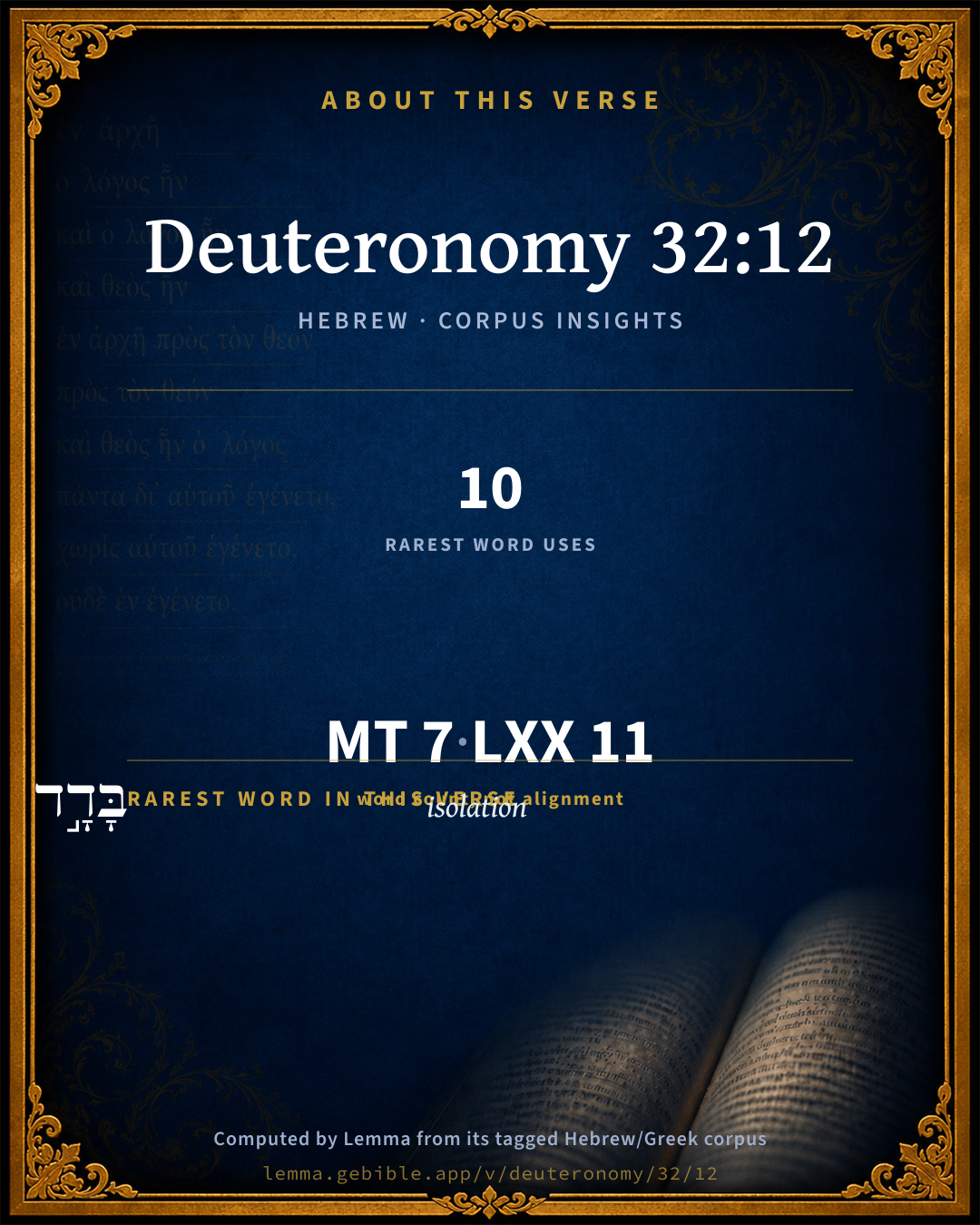
The rarest word here is בָּדָ֣ד isolation H910 — appearing just 10 times in the whole Hebrew Bible.

Shared distinctive vocabulary

בָּדָ֣ד isolation H910 occurs in 10 verses of the Hebrew Bible. Also found in:

Grammatical profile

  • 1 verb
  • 4 nouns
  • 1 preposition
  • 1 particle

Verb forms

  • יַנְחֶ֑נּוּ Hiphil · Imperfect

Hebrew & Septuagint length

In English translation the verse runs 12 words from the Hebrew and 12 from the Septuagint (LXX English) — the same length.

A rough comparison of the two English renderings, which tokenize alike — not a word-level alignment.

Word counts can differ between the Hebrew and the Greek without any difference in meaning — e.g. the Hebrew direct-object marker אֵת has no separate Greek word, and Greek often adds the article ὁ.

In the original languages it is 7 Hebrew tokens and 11 Greek tokens — but the two are counted differently (Hebrew bundles its prefixes and suffixes into one token; the Greek is in lemma form), so that isn’t a like-for-like length.

Cross-references

12

Topical passages linked to Deuteronomy 32:12 in the Treasury of Scripture Knowledge — connected by theme and wording, ordered by reader-vote popularity; previews shown in the World English Bible.

  • Psalms 78:52–53 But he led forth his own people like sheep, And guided them in the wilderness like a flock.
  • Isaiah 46:4 and even to old age I am he, and even to gray hairs will I carry you. I have made, and I will bear; yes, I will carry, and will deliver.
  • Isaiah 44:7–8 Who, as I, shall call, and shall declare it, and set it in order for me, since I established the ancient people? and the things that are coming, and that shall happen, let them declare.
  • Deuteronomy 1:31 and in the wilderness, where you have seen how that Yahweh your God bore you, as a man does bear his son, in all the way that you went, until you came to this place.
  • Psalms 78:14 In the daytime he also led them with a cloud, And all night with a light of fire.
  • Psalms 136:16 To him who led his people through the wilderness; For his loving kindness endures forever:
  • Isaiah 43:11–12 I, even I, am Yahweh; and besides me there is no savior.
  • Isaiah 63:9–13 In all their affliction he was afflicted, and the angel of his presence saved them: in his love and in his pity he redeemed them; and he bore them, and carried them all the days of old.
  • Deuteronomy 32:39 See now that I, even I, am he, There is no god with me: I kill, and I make alive; I wound, and I heal; There is none who can deliver out of my hand.
  • Nehemiah 9:12 Moreover in a pillar of cloud you led them by day; and in a pillar of fire by night, to give them light in the way in which they should go.
  • Psalms 27:11 Teach me your way, Yahweh. Lead me in a straight path, because of my enemies.
  • Psalms 80:1 Hear us, Shepherd of Israel, You who lead Joseph like a flock, You who sit above the cherubim, shine forth.

Cross-references courtesy of OpenBible.info (CC BY 4.0).

Hebrew and Greek witnesses Masoretic Hebrew ↔ Greek Septuagint

The same verse in the two great witnesses to the Old Testament, shown verse-for-verse.

These are two independent witnesses, not word-aligned to each other, and the Septuagint is shown in lemma (dictionary) form.

Hebrew Deuteronomy 32:12 Masoretic · Westminster Leningrad Codex

יְהוָ֖ה בָּדָ֣ד יַנְחֶ֑נּוּ וְאֵ֥ין עִמּ֖וֹ אֵ֥ל נֵכָֽר

Yahweh alone did lead him, There was no foreign god with him.

World English Bible · Public Domain

Greek LXX Deuteronomy 32:12 Septuagint · lemma form

κύριος μόνος ἄγω αὐτός καί οὐ εἰμί μετά αὐτός θεός ἀλλότριος

the Lord alone led them, there was no strange god with them.

LXX2012 (modern English Septuagint) · Public Domain

Hebrew: Westminster Leningrad Codex (CC BY 4.0). Greek: Septuagint (public domain); English from LXX2012 (modern English Septuagint) (Public Domain). How the Septuagint differs from the Hebrew →

Targum (Aramaic paraphrase)

2

The Targum is the ancient Jewish Aramaic paraphrase of the Hebrew Scriptures — an interpretive translation, not the Hebrew text itself. Onkelos (literal) and Pseudo-Jonathan (expansive) render the Torah, and Jonathan the Prophets. Coverage is partial: where no permissively-licensed English translation exists for a verse, only the Aramaic is shown. This is verse-level text, not a word-by-word alignment to the Hebrew.

  1. Targum Onkelos Torah (Genesis–Deuteronomy)
    יְיָ בִּלְחוֹדוֹהִי עֲתִיד לְאַשְׁרָיוּתְהוֹן בְּעָלְמָא דְּהוּא עָתִיד לְאִתְחַדָתָא וְלָא יִתְקַיַם קֳדָמוֹהִי פָּלְחַן טַּעֲוָן

    (no public-domain English translation for this verse)

    Targum Onkelos — Aramaic: “Onkelos Genesis” (public domain); “Onkelos Exodus” (public domain); “Onkelos Leviticus” (public domain); “Onkelos Numbers” (public domain); “Onkelos Deuteronomy” (public domain). English: “Sefaria Community Translation” (CC0 1.0 (public-domain dedication)); “J.W. Etheridge. The Targums of Onkelos and Jonathan Ben Uzziel on the Pentateuch. London: Longmans, Green, 1862” (public domain). Text via Sefaria.

  2. Targum Pseudo-Jonathan Torah (Genesis–Deuteronomy)
    מֵימְרָא דַיְיָ בִּלְחוֹדֵיהוֹן יַשְׁרִינוּן בְּאַרְעֲהוֹן וְלָא מַשְׁרֵי בֵּינֵיהוֹן פַּלְחֵי פּוּלְחָנָא נוּכְרָאָה

    The Word of the Lord made them to dwell in His land, nor suffered any among them to be the followers of strange worship.

    Targum Pseudo-Jonathan — Aramaic: “Targum Jonathan on Genesis” (public domain); “Targum Jonathan on Exodus” (public domain); “Targum Jonathan on Leviticus” (public domain); “Targum Jonathan on Numbers” (public domain); “Targum Jonathan on Deuteronomy” (public domain). English: “The Targum of Jonathan ben Uzziel, trans. J. W. Etheridge, London, 1862” (public domain). Text via Sefaria.

Commentary

Notes on Deuteronomy 32:12 from classic Christian and Jewish commentators (each source and its license shown beneath its notes). The classic Christian expositions comment on the surrounding passage and are grouped to its opening verse, so a note may address several verses; the Jewish commentaries on the Tanakh (Rashi and others) are per-verse, so they appear only where the commentator wrote on this verse.

Lemma curates 59 commentaries, every one of them public domain or Creative Commons licensed, each selected and text-cleaned for this edition rather than reprinted as found. About our sources →

Trapp's Complete Commentary

John Trapp

Deu 32:12 [So] the LORD alone did lead him, and [there was] no strange god with him.

Ver. 12. And there was no strange god with him.] Why, then, should any share with him in his service? Be the gods of the heathen good fellows? saith one. The true God will endure no co-rival.

John Trapp, A Commentary or Exposition upon All the Books of the Old and New Testament (1647–1656) — public domain. Text from a community e-Sword module.

Joseph Benson's Commentary

Deu 32:12. So — With such tenderness and care; the Lord alone did lead him — When they were shut up in Egypt, as in their nest, whence they durst not venture to fly or stir, he taught, and encouraged, and enabled them to fly out from that bondage; he dealt tenderly with them, bearing with their infirmities, keeping them from all harms. There was no strange god with him — To assist him at that work, or to deliver them. The more unworthy they, in giving to idols a share in that worship which they owe to God only.

Joseph Benson's Commentary on the Old and New Testaments (1811–1818) — public domain. Text from a community e-Sword module.

Geneva Bible (1599)

Geneva Bible translators

Or, god of strange nations.

Geneva Bible (1599) marginal notes — public domain. Text via Bolls.life.

Adam Clarke's Commentary

Verse 12. So the Lord alone did lead him] By his power, and by his only, were they brought out of Egypt, and supported in the wilderness.

And there was no strange god] They had help from no other quarter. The Egyptian idols were not able to save their own votaries; but God not only saved his people, but destroyed the Egyptians.

Adam Clarke's Commentary on the Bible (1810–1826) — public domain. Text from a community e-Sword/MySword module.

The Cambridge Bible for Schools and Colleges

gen. ed. J. J. S. Perowne

12. did lead him] Still the imperf. for vividness.

strange] Not the adj. in Deu_32:16, but foreign, Deu_15:3, Deu_31:16.

13 He made him to ride the highlands,

And to eat of the fruit of the hills,

Suckled him with honey from the crag

And oil of the flinty rock,

14 Curd of the kine, milk of the flock,

With the fatness of lambs and of rams,

Bulls of Bashán and he-goats,

With the finest flour of the wheat—

And the grape’s blood thou drankest in foam!

The Cambridge Bible for Schools and Colleges (gen. ed. J. J. S. Perowne; Cambridge University Press, 1878–1918) — public domain. Text from a community e-Sword module.

John Gill's Exposition

He made him to ride on the high places of the earth,.... Or land, the land of Canaan; by which are meant the towers, castles, and fortified places in it, some of which might be built on hills and mountains; and being made to ride on them may denote the delivery of them into their hands, their conquests and possession of them, and triumph in them; see Isa 58:14; so the Targum of Jonathan paraphrases, it,"made him to dwell in the towers of the land of Israel,''those high walled and strongly fenced cities which they dreaded; this may be an emblem of the conquest believers have of their spiritual enemies, sin. Satan, and the world, in and through Christ; of their safety and triumph in him; of their high and elevated frames of soul, when they have got above the world and the things of it; this will be the case of spiritual Israel in every sense in the latter day, when the mountain of the Lord's house shall be established on the top of the mountains:

that he might eat the increase of the fields: the produce of them, particularly corn for bread, and which the Israelites ate of as soon as they came into the land of Canaan, Jos 5:11; an emblem of the Gospel, and the truths of it, which are salutary, nourishing, strengthening, reviving, and cheering, and of Christ the bread of life, which believers by faith eat of, and feed upon and live:

and he made him to suck honey out of the rock; not water out of the rock, as sweet to them as honey, that they had in the wilderness; but either the honey of bees that made their nests in rocks, as a swarm of them did in the carcass of a lion; and so in like manner as honey came out of the lion, it may be said to be sucked out of the rock: so Homer (a) speaks of swarms of bees out of a hollow rock: or this was the honey of palm trees, as Aben Ezra observes, some say, which might grow on rocks; see Gill on Deu 8:8; and this is favoured by the Targum of Jonathan, which paraphrases the words,"honey from those fruits which grow on the rocks,''unless it means honey gathered by bees from such fruits; the rock may typify Christ, and the honey out of it the Gospel, which is from him and concerning him; comparable to honey for the manner of its production and gathering, by the laborious ministers of the word; for its nourishment, and especially for its sweetness, its precious promises, and pleasant doctrines:

and oil out of the flinty rock; that is, oil out of the olives, which grow on rocks, and these delight to grow on hills and mountains; hence we read of the mount of Olives, see Job 29:6; and so the Targum of Jonathan,"and oil out of the olives and suckers which grow on the strong rocks;''this may signify the Spirit and his graces, the unction which comes from Christ the Holy One, and the blessings of grace had from him, and the Gospel and its truths; which are cheering and refreshing, mollifying and healing, feeding and fattening, pure and unmixed, and useful for light, as oil is.

(a) Iliad. 2. l. 87, 88.

John Gill's Exposition of the Whole Bible (1746–1763) — public domain (CC PDM 1.0). Text via the HelloAO Bible API.

Haydock's Catholic Bible Commentary

With him, to stand up in their defence, though the Israelites adored but too many others in the desert.

George Leo Haydock (1774–1849), Haydock's Catholic Family Bible and Commentary, 1859 edition — public domain. Excludes Psalms (Douay-Rheims chapter numbering differs from Protestant) and Deuterocanonical books (Catholic canon only).

Matthew Poole's English Annotations

i.e. When they were shut up in Egypt, as in their nest, whence they durst not venture to fly nor stir, he taught, and encouraged, and enabled them to fly out and flee themselves from that bondage, and brought them into a state of liberty and safety; he dealt tenderly with them, bearing with their infirmities, keeping them from all harms.

No strange god with him, to wit, to assist him at that work, or to deliver them. The more unworthy they in giving to idols a share in that worship and service which they owe to God only.

Matthew Poole's English Annotations on the Holy Bible (1683–1685) — public domain. Text from a community e-Sword/MySword module.

Whedon's Commentary on the Bible

Daniel D. Whedon

12. So the Lord alone did lead him — Omit so, and read Jehovah alone did lead him.

No strange god with him — It was Jehovah who delivered. He is to be served, and he alone.

Daniel D. Whedon (gen. ed.), Commentary on the Old and New Testaments (1874–1909) — public domain. Text from a community e-Sword module.

The Pulpit Commentary

The Lord alone did lead him. (cf. Exo_13:21 Exo_15:13) With him; i.e. along with Jehovah, as aiding him.

The Pulpit Commentary (1880–1919), ed. H.D.M. Spence-Jones & Joseph S. Exell — public domain. Text from a community e-Sword module.

John Wesley's Explanatory Notes

Did lead them - When they were shut up in Egypt as in their nest whence they durst not venture to fly nor stir, he taught and encouraged and enabled them to fly out from that bondage, he dealt tenderly with them, bearing with their infirmities, keeping them from all harms. With him - To assist him at that work or to deliver them. The more unworthy they in giving to idols a share in that worship which they owe to God only.

John Wesley, Explanatory Notes Upon the Whole Bible (1754–1765) — public domain. Text via the GEBible commentary corpus.

Rashi

Rabbi Shlomo Yitzchaki (Rashi)

ה׳ בדד ינחנו THE LORD ALONE GUIDED THEM — i.e. He guided them in the wilderness alone (unassisted) and yet in security,

ואין עמו אל נכר AND THERE WAS NO STRANGE GOD WITH HIM — for not one of the gods of the other peoples possessed the power to display its might and to war with them. — Our Rabbis, however, explained it as a promise referring to the future (cf. Sifrei Devarim 315), and so, too, does Onkelos render it. But I say that they (the statements of this chapter) are words of reproof which he said with the view of calling heaven and earth as witnesses against them, and also in order that this song (cf. Deuteronomy 31:21) should be witness, because He knew (Deuteronomy 31:29) that they would in future prove faithless and would bear in mind neither the past (lit., the first) deeds that He performed for them nor those that would come to pass (lit., that would be born), which at a future time He would do for them. For this reason it is necessary to make the text fit in with this and with that (the past and the future). Indeed, the whole section is to be connected with (v. 7) “Remember the days of old (i.e., the past), consider the years of generation after generation” (the future) (cf. Rashi on that verse): Thus has He done for them and thus will He in the future do for them — all this they ought to bear in mind.

Rashi on the Tanakh — English translations: “The Judaica Press complete Tanach with Rashi, translated by A. J. Rosenberg” (CC BY 4.0); “Pentateuch with Rashi's commentary by M. Rosenbaum and A.M. Silbermann, 1929-1934” (public domain); “The Metsudah Tanach series, Lakewood, N.J” (CC BY 4.0); and “The Book of Joshua, Metsudah Publications, 1997” (CC BY 4.0). Text via Sefaria.

Ramban (Nachmanides)

Rabbi Moshe ben Nachman (Ramban / Nachmanides)

THE ETERNAL ALONE DID LEAD HIM — G-d dwells in Israel securely alone; AND THERE WAS NOT WITH HIM — the pronoun referring either to G-d or Israel — ANY STRANGE GOD. The purport is that Israel has no prince or ruler of all the bnei ha’elohim that guides the nation or assists in its guidance except for G-d alone, for it [Israel] is His portion and His inheritance, as he mentioned. I have already written on this subject. And in the Sifre we find: 315. “The Eternal alone did lead him. The Holy One, blessed be He, said to Israel: Just as you dwelled alone in this world and derived no benefit from the nations, so will I place you alone in the World to Come and none of the nations will benefit from you at all. And there was not with him any strange god — none of the princes of the nations of the world will have the right to come and dominate you. This is similar to what is said, and when I go forth, lo, the prince of Greece shall come; but the prince of the kingdom of Persia withstood me;, Verse 13. nevertheless I will declare unto thee that which is inscribed in the writing of truth etc.”, Verse 21.

Ramban (Nachmanides) on the Tanakh — English translation: “Commentary on the Torah by Ramban (Nachmanides). Translated and annotated by Charles B. Chavel. New York, Shilo Pub. House, 1971-1976” (CC BY 4.0). Text via Sefaria.

Lesson kit

Teaching starters — assembled from the data on this page, not authored interpretation. Every prompt links to the verse data it draws on. Edit before teaching.

Deuteronomy, in the Pentateuch, opens this verse with 7 words (7 distinct Hebrew lemmas). Its most distinctive word is bâdâd (“isolation”). A historical commentator’s framing appears above. Read the whole chapter for the surrounding context.

Discussion questions

  1. How does “isolation” (bâdâd) shape what this verse is saying?
  2. How does Numbers 23:9, which shares the word «isolation», read alongside this verse?
  3. These translations render this verse differently; the difference is in the English rendering, not the original. What questions does that raise?
  4. «יַנְחֶ֑נּוּ» is a Hiphil Imperfect verb. How does that grammatical form shape the action described?
  5. Compare how Trapp's Complete Commentary and Joseph Benson's Commentary read this verse. Where do they agree or differ?

Things to notice

Reading settings

Reading text

Shown beneath each verse's original-language words.

Old Testament
Old Testament edition

Read the OT as the Masoretic Hebrew (MT) or the Greek Septuagint (LXX).

English shown for the Greek Septuagint (in the Hebrew ↔ Greek comparison).

Comparing translations? Open the Compare panel on any verse page to stack up to four side by side.