
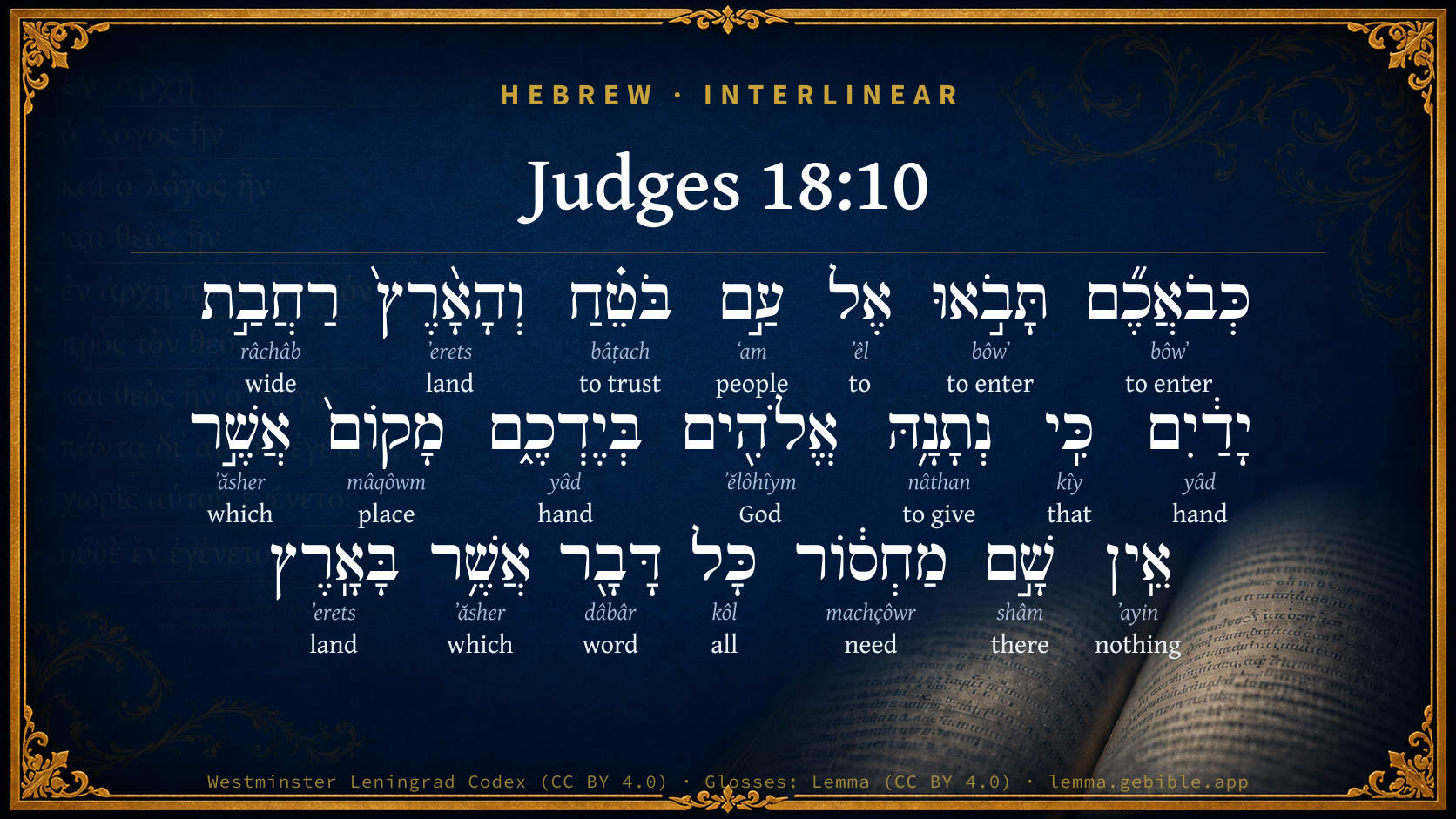
Judges 18:10

Hebrew (Westminster Leningrad Codex) Judges 18:10 appears in the Hebrew Old Testament. The text above is from the Westminster Leningrad Codex. Each word links to its Strong’s number, a concise gloss, and parsing drawn from the Open Scriptures Hebrew Bible morphology. Click any word for its full Brown-Driver-Briggs (BDB) entry.
Download image
Cite this verse

Judges 18:10 (World English Bible). Public Domain. Lemma interlinear Bible study tool, https://lemma.gebible.app/v/judges/18/10.

Show BibTeX & RIS
BibTeX
RIS
English Translation
When you go, you shall come to a people secure, and the land is large; for God has given it into your hand, a place where there is no want of anything that is in the earth.
World English Bible · Public Domain
Download a study sheet

One document with this verse’s original text, its word-by-word gloss line, the meaning frame, cross-references with their text, attributed commentary, and full source and license credits — printable, and it pastes into notes with its structure intact.

This verse Autodidact and up

Study sheet (.html) Plain text (.txt)

A passage Seminary Student

Up to 50 verses in one chapter. A passage sheet keeps up to 6 commentary sources and 12 cross-references per verse, in the order this page ranks them, and says so on the sheet whenever that leaves anything out. Ask for a single verse and you get the Autodidact verse sheet above.

Everything on this page stays free to read, with no account — the sheet is a download of what is already on screen, not access to it.

Want to remove ads? Support Godless Engineer
Compare translations 3

The same verse in 3 English versions, stacked beneath the original-language interlinear above. Click any original word for its lexicon entry.

Each is an independent rendering of the whole verse — the interlinear is not word-aligned to these translations.

Highlighted words mark where these versions differ — a whole-verse word diff, not a word-by-word alignment.

  • World English Bible Public Domain
    When you go, you shall come to a people secure, and the land is large; for God has given it into your hand, a place where there is no want of anything that is in the earth.
  • King James Version Public Domain
    When ye go, ye shall come unto a people secure, and to a large land: for God hath given it into your hands; a place where there is no want of any thing that is in the earth.
  • unfoldingWord Literal Text CC BY-SA 4.0
    When you go, you will come to a people being secure, and the land is broad two hands. For God has given it into your hand, a place where no lack there of any thing that on the earth.”

unfoldingWord Literal Text — © unfoldingWord, licensed CC BY-SA 4.0. Word-aligned USFM3 via Door43 (git.door43.org/unfoldingWord/en_ult).

Versions to compare (up to 4)

3 of 4 selected

Show all 18 translations

Every available English version of this verse, each an independent rendering of the whole verse.

  • World English Bible Public Domain
    When you go, you shall come to a people secure, and the land is large; for God has given it into your hand, a place where there is no want of anything that is in the earth.
  • Berean Standard Bible Public Domain
    When you enter, you will come to an unsuspecting people and a spacious land, for God has delivered it into your hand. It is a place where nothing on earth is lacking.”
  • Majority Standard Bible Public Domain
    When you enter, you will come to an unsuspecting people and a spacious land, for God has delivered it into your hand. It is a place where nothing on earth is lacking.”
  • King James Version Public Domain
    When ye go, ye shall come unto a people secure, and to a large land: for God hath given it into your hands; a place where there is no want of any thing that is in the earth.
  • American Standard Version (1901) Public Domain
    When ye go, ye shall come unto a people secure, and the land is large; for God hath given it into your hand, a place where there is no want of anything that is in the earth.
  • Revised Version (1885) Public Domain
    When ye go, ye shall come unto a people secure, and the land is large: for God hath given it into your hand; a place where there is no want of any thing that is in the earth.
  • Geneva Bible (1599) Public Domain
    (If ye will goe, ye shall come vnto a carelesse people, and the countrey is large) for God hath giuen it into your hande. It is a place which doeth lacke nothing that is in the worlde.
  • Douay-Rheims (1899) Public Domain
    We shall come to a people that is secure, into a spacious country, and the Lord will deliver the place to us, in which there is no want of any thing that groweth on the earth.
  • Young's Literal Translation Public Domain
    When ye go, ye come in unto a people confident, and the land `is' large on both hands, for God hath given it into your hand, a place where there is no lack of anything which `is' in the land.'
  • Literal Standard Version CC BY-SA 4.0
    When you go, you come to a confident people, and the land [is] large on both hands, for God has given it into your hand, a place where there is no lack of anything which [is] in the land.”
  • Unlocked Literal Bible CC BY-SA 4.0
    When you go, you will come to a people who think they are secure, and the land is wide! God has given it to you—a place that does not lack anything in the land.”
  • unfoldingWord Literal Text CC BY-SA 4.0
    When you go, you will come to a people being secure, and the land is broad two hands. For God has given it into your hand, a place where no lack there of any thing that on the earth.”
  • Darby Bible Public Domain
    When you go, you will come to an unsuspecting people. The land is broad; yea, God has given it into your hands, a place where there is no lack of anything that is in the earth."
  • World Messianic Bible Public Domain
    When you go, you will come to an unsuspecting people, and the land is large; for God has given it into your hand, a place where there is no lack of anything that is in the earth.”
  • Webster's Bible Public Domain
    When ye go, ye shall come to a people secure, and to a large land: for God hath given it into your hands; a place where there is no want of any thing that is on the earth.
  • Free Bible Version CC BY-SA 4.0
    When you get there you'll find the people are unsuspecting and the land is extensive. God has given you a place where there's no shortage of anything!”
  • Bible in Basic English Public Domain
    When you come there you will come to a people living without thought of danger; and the land is wide, and God has given it into your hands: a place where there is everything on earth for man's needs.
  • JPS Tanakh (1917) Public Domain
    When ye go, ye shall come unto a people secure, and the land is large; for God hath given it into your hand; a place where there is no want; it hath every thing that is in the earth.'

Literal Standard Version (2020), Covenant Press — licensed CC BY-SA 4.0. Text via the HelloAO Bible API (eBible.org). Unlocked Literal Bible (unfoldingWord) — licensed CC BY-SA 4.0. Text via the HelloAO Bible API (eBible.org). unfoldingWord Literal Text — © unfoldingWord, licensed CC BY-SA 4.0. Word-aligned USFM3 via Door43 (git.door43.org/unfoldingWord/en_ult). Free Bible Version, Dr. Jonathan Gallagher — licensed CC BY-SA 4.0. Text via the HelloAO Bible API (eBible.org).

Word by word

More ways to search: Search by grammar → Find every occurrence → Compare this word →

Practice this passage: Drill this verse → Learn its vocabulary →

מַחְס֔וֹר
machçôwr
H4270
“need of”
Noun, Common, Masculine, Singular, Construct
Part of Speech
Noun
Type
Common
Gender
Masculine
Number
Singular
State
Construct
Full BDB Definition

Origin: from H2637

TWOT: 705e

need, poverty, thing needed - need, thing needed - lack, want - need, poverty
  1. כְּבֹאֲכֶ֞ם bôwʼ H935 “like/as · to enter · you” Preposition + Verb, Qal, Infinitive Construct + Suffix, Personal, 2nd Person, Masculine, Plural
  2. תָּבֹ֣אוּ bôwʼ H935 “to enter” Verb, Qal, Imperfect, 2nd Person, Masculine, Plural
  3. אֶל ʼêl H413 “to” Preposition
  4. עַ֣ם ʻam H5971 “people” Noun, Common, Masculine, Singular, Absolute
  5. בֹּטֵ֗חַ bâṭach H982 “trusting” Verb, Qal, Participle Active, Masculine, Singular, Absolute
  6. וְהָאָ֨רֶץ֙ ʼerets H776 “and · the · land” Conjunction + Particle, Definite Article + Noun, Common, Both, Singular, Absolute
  7. רַחֲבַ֣ת râchâb H7342 “wide of” Adjective, Adjective, Feminine, Singular, Construct
  8. יָדַ֔יִם yâd H3027 “hands” Noun, Common, Both, Dual, Absolute
  9. כִּֽי kîy H3588 “that” Conjunction
  10. נְתָנָ֥הּ nâthan H5414 “to give · her” Verb, Qal, Perfect, 3rd Person, Masculine, Singular + Suffix, Personal, 3rd Person, Feminine, Singular
  11. אֱלֹהִ֖ים ʼĕlôhîym H430 “God(s)” Noun, Common, Masculine, Plural, Absolute
  12. בְּיֶדְכֶ֑ם yâd H3027 “in/at · hand · your” Preposition + Noun, Common, Both, Singular, Construct + Suffix, Personal, 2nd Person, Masculine, Plural
  13. מָקוֹם֙ mâqôwm H4725 “place” Noun, Common, Masculine, Singular, Absolute
  14. אֲשֶׁ֣ר ʼăsher H834 “which” Particle, Relative
  15. אֵֽין ʼayin H369 “nothing” Particle, Negative
  16. שָׁ֣ם shâm H8033 “there” Adverb
  17. כָּל kôl H3605 “all of” Noun, Common, Masculine, Singular, Construct
  18. דָּבָ֖ר dâbâr H1697 “word” Noun, Common, Masculine, Singular, Absolute
  19. אֲשֶׁ֥ר ʼăsher H834 “which” Particle, Relative
  20. בָּאָֽרֶץ ʼerets H776 “in/at the · land” Preposition, Determined + Noun, Common, Both, Singular, Absolute

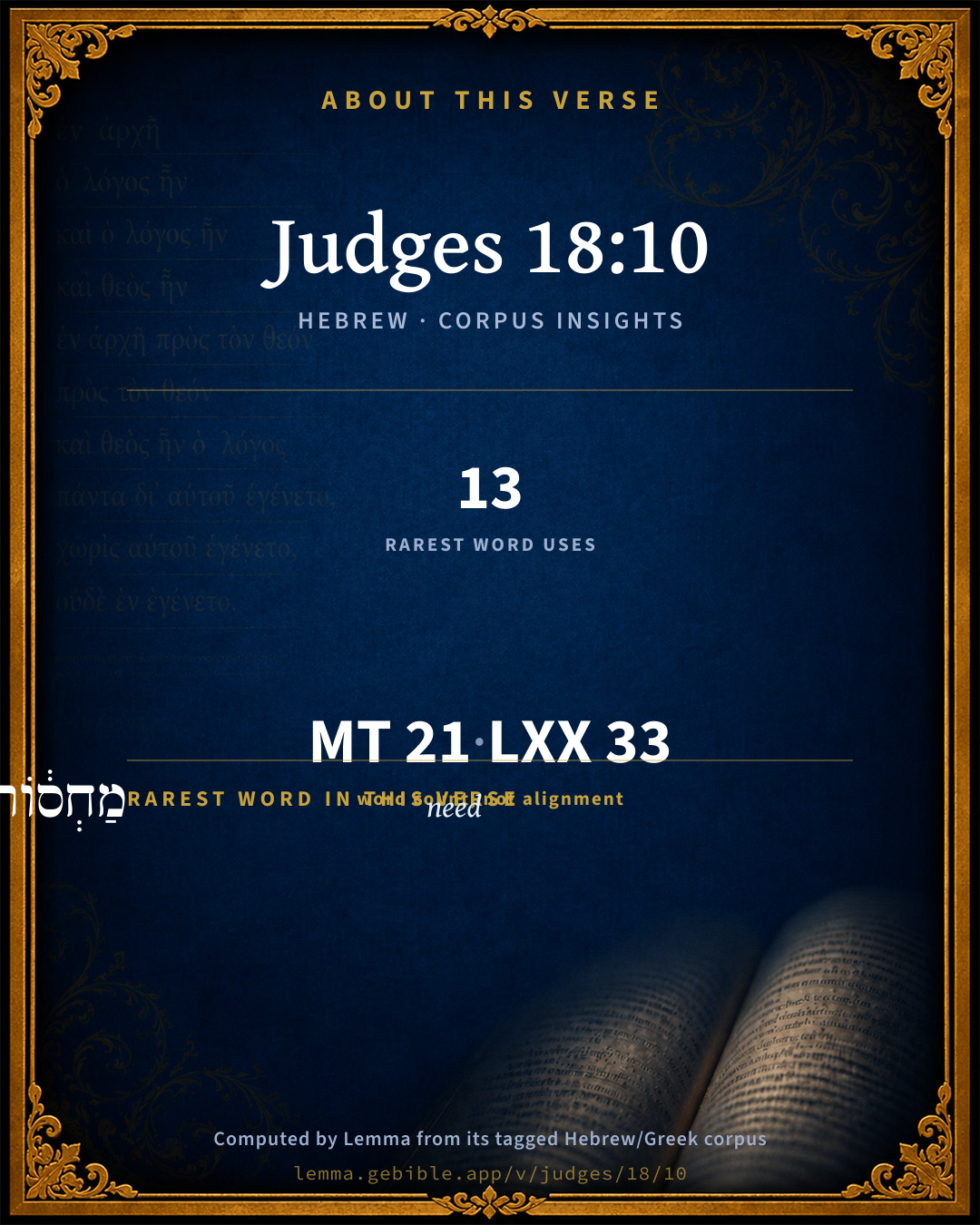
About this verse

These counts appear in no published source. They are computed here, from the morphology-tagged text and Lemma’s own curated glosses. What Lemma adds →

21
words
17
distinct lemmas
Historical
section

Notable vocabulary

The rarest word here is מַחְס֔וֹר need H4270 — appearing just 13 times in the whole Hebrew Bible.

Shared distinctive vocabulary

מַחְס֔וֹר need H4270 occurs in 13 verses of the Hebrew Bible. Also found in:

Grammatical profile

  • 4 verbs
  • 10 nouns
  • 1 adjective
  • 1 preposition
  • 1 conjunction
  • 1 adverb
  • 3 particles

Verb forms

  • כְּבֹאֲכֶ֞ם Qal · Infinitive Construct
  • תָּבֹ֣אוּ Qal · Imperfect
  • בֹּטֵ֗חַ Qal · Participle Active
  • נְתָנָ֥הּ Qal · Perfect

Repetition

Words recur within this verse — often emphatic in Hebrew:

  • כְּבֹאֲכֶ֞ם to enter H935 ×2
  • וְהָאָ֨רֶץ֙ land H776 ×2
  • יָדַ֔יִם hand H3027 ×2
  • אֲשֶׁ֣ר which H834 ×2

Hebrew & Septuagint length

In English translation the verse runs 37 words from the Hebrew and 39 from the Septuagint (LXX English) — closely comparable.

A rough comparison of the two English renderings, which tokenize alike — not a word-level alignment.

Word counts can differ between the Hebrew and the Greek without any difference in meaning — e.g. the Hebrew direct-object marker אֵת has no separate Greek word, and Greek often adds the article ὁ.

In the original languages it is 21 Hebrew tokens and 33 Greek tokens — but the two are counted differently (Hebrew bundles its prefixes and suffixes into one token; the Greek is in lemma form), so that isn’t a like-for-like length.

Cross-references

10

Topical passages linked to Judges 18:10 in the Treasury of Scripture Knowledge — connected by theme and wording, ordered by reader-vote popularity; previews shown in the World English Bible.

  • Judges 18:27 They took that which Micah had made, and the priest whom he had, and came to Laish, to a people quiet and secure, and struck them with the edge of the sword; and they burnt the city with fire.
  • Judges 18:7 Then the five men departed, and came to Laish, and saw the people who were therein, how they lived in security, after the manner of the Sidonians, quiet and secure; for there was none in the land, possessing authority, that might put [them] to shame in anything, and they were far from the Sidonians, and had no dealings with any man.
  • 1 Timothy 6:17 Charge those who are rich in this present world that they not be haughty, nor have their hope set on the uncertainty of riches, but on the living God, who richly provides us with everything to enjoy;
  • Exodus 3:8 I have come down to deliver them out of the hand of the Egyptians, and to bring them up out of that land to a good and large land, to a land flowing with milk and honey; to the place of the Canaanite, the Hittite, the Amorite, the Perizzite, the Hivite, and the Jebusite.
  • Deuteronomy 2:29 as the children of Esau who dwell in Seir, and the Moabites who dwell in Ar, did to me; until I shall pass over the Jordan into the land which Yahweh our God gives us.
  • Deuteronomy 4:1 Now, Israel, listen to the statutes and to the ordinances, which I teach you, to do them; that you may live, and go in and possess the land which Yahweh, the God of your fathers, gives you.
  • Deuteronomy 8:7–9 For Yahweh your God brings you into a good land, a land of brooks of water, of springs and springs, flowing forth in valleys and hills;
  • Deuteronomy 11:11–12 but the land, where you go over to possess it, is a land of hills and valleys, [and] drinks water of the rain of the sky,
  • Joshua 6:16 It happened at the seventh time, when the priests blew the trumpets, Joshua said to the people, Shout; for Yahweh has given you the city.
  • Ezekiel 20:6 in that day I swore to them, to bring them forth out of the land of Egypt into a land that I had searched out for them, flowing with milk and honey, which is the glory of all lands.

Cross-references courtesy of OpenBible.info (CC BY 4.0).

Hebrew and Greek witnesses Masoretic Hebrew ↔ Greek Septuagint

The same verse in the two great witnesses to the Old Testament, shown verse-for-verse.

These are two independent witnesses, not word-aligned to each other, and the Septuagint is shown in lemma (dictionary) form.

Hebrew Judges 18:10 Masoretic · Westminster Leningrad Codex

כְּבֹאֲכֶ֞ם תָּבֹ֣אוּ אֶל עַ֣ם בֹּטֵ֗חַ וְהָאָ֨רֶץ֙ רַחֲבַ֣ת יָדַ֔יִם כִּֽי נְתָנָ֥הּ אֱלֹהִ֖ים בְּיֶדְכֶ֑ם מָקוֹם֙ אֲשֶׁ֣ר אֵֽין שָׁ֣ם מַחְס֔וֹר כָּל דָּבָ֖ר אֲשֶׁ֥ר בָּאָֽרֶץ

When you go, you shall come to a people secure, and the land is large; for God has given it into your hand, a place where there is no want of anything that is in the earth.

World English Bible · Public Domain

Greek LXX Judges 18:10 Septuagint · lemma form

καί ἡνίκα ἄν ἔρχομαι εἰςἔρχομαι πρός λαός ἐπί ἐλπίς καί ὁ γῆ πλατεῖα ὅτι δίδωμι αὐτός ὁ θεός ἐν χείρ σύ τόπος ὅπου οὐ εἰμί ἐκεῖ ὑστέρημα πᾶς ῥῆμα ὁ ἐν ὁ γῆ

And whenever you⌃ shall go, you⌃ shall come in upon a people secure, and the land is extensive, for God has given it into your hand; a place where there is no lack of anything that the earth affords.

LXX2012 (modern English Septuagint) · Public Domain

Hebrew: Westminster Leningrad Codex (CC BY 4.0). Greek: Septuagint (public domain); English from LXX2012 (modern English Septuagint) (Public Domain). How the Septuagint differs from the Hebrew →

Targum (Aramaic paraphrase)

1

The Targum is the ancient Jewish Aramaic paraphrase of the Hebrew Scriptures — an interpretive translation, not the Hebrew text itself. Onkelos (literal) and Pseudo-Jonathan (expansive) render the Torah, and Jonathan the Prophets. Coverage is partial: where no permissively-licensed English translation exists for a verse, only the Aramaic is shown. This is verse-level text, not a word-by-word alignment to the Hebrew.

  1. Targum Jonathan Prophets (Joshua–Malachi)
    כְּמֵיתֵיכוֹן תַּעֲלוּן לְוַת עַמָא דְשָׁרָן לְרוֹחֲצָן וְאַרְעָא פַּתְיוּת יְדִין אֲרֵי מַסְרָא יְיָ בִידֵיכוֹן אַתְרָא דְלֵית תַּמָן חֻסְרָן כָּל מִדַעַם דִי בְאַרְעָא:

    (no public-domain English translation for this verse)

    Targum Jonathan — Aramaic: “Mikraot Gedolot” (public domain). English: “Sefaria Community Translation” (CC0 1.0 (public-domain dedication)); “London "Chaldee Paraphrase," 1871” (public domain). Text via Sefaria.

Commentary

Notes on Judges 18:10 from classic Christian and Jewish commentators (each source and its license shown beneath its notes). The classic Christian expositions comment on the surrounding passage and are grouped to its opening verse, so a note may address several verses; the Jewish commentaries on the Tanakh (Rashi and others) are per-verse, so they appear only where the commentator wrote on this verse.

Lemma curates 59 commentaries, every one of them public domain or Creative Commons licensed, each selected and text-cleaned for this edition rather than reprinted as found. About our sources →

Trapp's Complete Commentary

John Trapp

Jdg 18:10 When ye go, ye shall come unto a people secure, and to a large land: for God hath given it into your hands; a place where [there is] no want of any thing that [is] in the earth.

Ver. 10. A place where there is no want of anything.] And might therefore have been called Macaria, or Blessed; as the island Cyprus was of old, because of the abundance of commodities which it sendeth to other countries, of whom it craveth no help again. {a} The people therein generally lived so at ease and pleasure, that therefore the island was dedicated to Venus, who was therehence called Cypria. Sextus Rufus, writing thereof, saith, Cyprus, famous for its wealth, solicited the poverty of the people of Rome to seize upon it. Ita ut ius eius insulae avarius magis quam iustius simus assecuti: so that we got that island more covetously than justly. So did the Danites this city of Laish, if at least, as some will have it, it belonged to the tribe of Asher, and not to them.

{a} Turk. Hist.

John Trapp, A Commentary or Exposition upon All the Books of the Old and New Testament (1647–1656) — public domain. Text from a community e-Sword module.

Joseph Benson's Commentary

Jdg 18:10. God hath given it into your hands — This they gather partly from God’s promises, which they supposed they had from the Levite’s mouth, and partly from his providence, which had so disposed them that they would be an easy prey.

Joseph Benson's Commentary on the Old and New Testaments (1811–1818) — public domain. Text from a community e-Sword module.

Ellicott's Commentary for English Readers

(10) To a large land.—Literally, wide on both hands (Gen_34:11). This well describes the position of Tel el-Kadi. (See Notes on Jdg_18:7; Jdg_18:28.)

God hath given it into your hands.—Of this they feel confident, from the interpretation which they put upon the oracular response given them by Jonathan in Jdg_18:6.

A Bible Commentary for English Readers, edited by Charles John Ellicott (1878–1897) — public domain. Text from a community e-Sword module.

John Gill's Exposition

When ye go, ye shall come to a people secure, and to a large land,.... For though it was but one city, the territories of it were large, and the villages belonging to it might be many; which, with the security of the people, might easily be surprised and taken, not being upon their guard, are the arguments used by the spies to encourage their countrymen to go up and take it, to which they add others:

for God hath given it into your hands; which they concluded from the state and condition they found the people in, thoughtless and defenceless; or it may be on account of the oracle in Micah's house they had consulted, and to which they gave credit; though some think their faith was grounded upon this place being given by lot to the tribe of Dan, but this does not appear:

a place where there is no want of anything that is in the earth; in the land of Canaan; meaning, that there was nothing in the whole land but might be found there, as wheat and barley, vines, fig trees, pomegranates, olives, and honey, with all other necessaries and conveniences of life.

John Gill's Exposition of the Whole Bible (1746–1763) — public domain (CC PDM 1.0). Text via the HelloAO Bible API.

Haydock's Catholic Bible Commentary

Secure. "No one is sooner overcome than the man who has no fear; and security is generally the forerunner of ruin." Velleius 2., initium est calamitatis securitas.

George Leo Haydock (1774–1849), Haydock's Catholic Family Bible and Commentary, 1859 edition — public domain. Excludes Psalms (Douay-Rheims chapter numbering differs from Protestant) and Deuterocanonical books (Catholic canon only).

Matthew Poole's English Annotations

God hath given it into your hands: this they gather partly from God’s word or promise, which they supposed they had from the Levite’s mouth; and partly from his providence, which hath so disposed them, that they will be an easy prey to you.

Matthew Poole's English Annotations on the Holy Bible (1683–1685) — public domain. Text from a community e-Sword/MySword module.

The Pulpit Commentary

Translate, "When ye come, ye shall come unto a people secure; and the land is very large (for God hath given it into your hands), a place where there is no want," etc. The Hebrew of very large is, literally, wide on both hands. The parenthetic for God hath given it into your hands, merely explains why they speak so confidently about it. (cf. Deu_8:9)

The Pulpit Commentary (1880–1919), ed. H.D.M. Spence-Jones & Joseph S. Exell — public domain. Text from a community e-Sword module.

John Wesley's Explanatory Notes

Given - This they gather partly from God's promise which they supposed they had from the Levite's mouth; and partly from his providence, which had so disposed them, that they would be an easy prey.

John Wesley, Explanatory Notes Upon the Whole Bible (1754–1765) — public domain. Text via the GEBible commentary corpus.

Keil & Delitzsch

C. F. Keil & F. Delitzsch

"When ye arrive, ye will come to a secure people (i.e., a people living in careless security, and therefore very easy to overcome); and the land is broad on both sides (i.e., furnishes space to dwell in, and also to extend: vid., Gen 34:21; Ch1 4:40); for God has given it into your hand." They infer this from the oracular reply they had received from the Levite (Jdg 18:6). "A place where there is no want of anything that is in the land (of Canaan)."

Keil & Delitzsch — Biblical Commentary on the Old Testament (1861–1891) — public domain (CC PDM 1.0). Text via the HelloAO Bible API. (Old Testament only.)

Lesson kit

Teaching starters — assembled from the data on this page, not authored interpretation. Every prompt links to the verse data it draws on. Edit before teaching.

Judges, in the Historical, opens this verse with 21 words (17 distinct Hebrew lemmas). Its most distinctive word is machçôwr (“need”). A historical commentator’s framing appears above. Read the whole chapter for the surrounding context.

Discussion questions

  1. How does “need” (machçôwr) shape what this verse is saying?
  2. Deuteronomy 15:8 shares the word «need» with this verse. How do the two illuminate each other?
  3. “to enter” occurs 2× in this one verse. What is the effect of the repetition?
  4. These translations render this verse differently; the difference is in the English rendering, not the original. What questions does that raise?
  5. The verb «כְּבֹאֲכֶ֞ם» is Qal Infinitive Construct. How does its form color the action?
  6. Reading how Trapp's Complete Commentary and Joseph Benson's Commentary read this verse, where do the two commentators agree and where do they part?

Things to notice

Reading settings

Reading text

Shown beneath each verse's original-language words.

Old Testament
Old Testament edition

Read the OT as the Masoretic Hebrew (MT) or the Greek Septuagint (LXX).

English shown for the Greek Septuagint (in the Hebrew ↔ Greek comparison).

Comparing translations? Open the Compare panel on any verse page to stack up to four side by side.