
Deuteronomy 8:15

Hebrew (Westminster Leningrad Codex) Deuteronomy 8:15 appears in the Hebrew Old Testament. The text above is from the Westminster Leningrad Codex. Each word links to its Strong’s number, a concise gloss, and parsing drawn from the Open Scriptures Hebrew Bible morphology. Click any word for its full Brown-Driver-Briggs (BDB) entry.
Download image
Cite this verse

Deuteronomy 8:15 (World English Bible). Public Domain. Lemma interlinear Bible study tool, https://lemma.gebible.app/v/deuteronomy/8/15.

Show BibTeX & RIS
BibTeX
RIS
English Translation
who led you through the great and terrible wilderness, [in which were] fiery serpents and scorpions, and thirsty ground where was no water; who brought you forth water out of the rock of flint;
World English Bible · Public Domain
Highlights
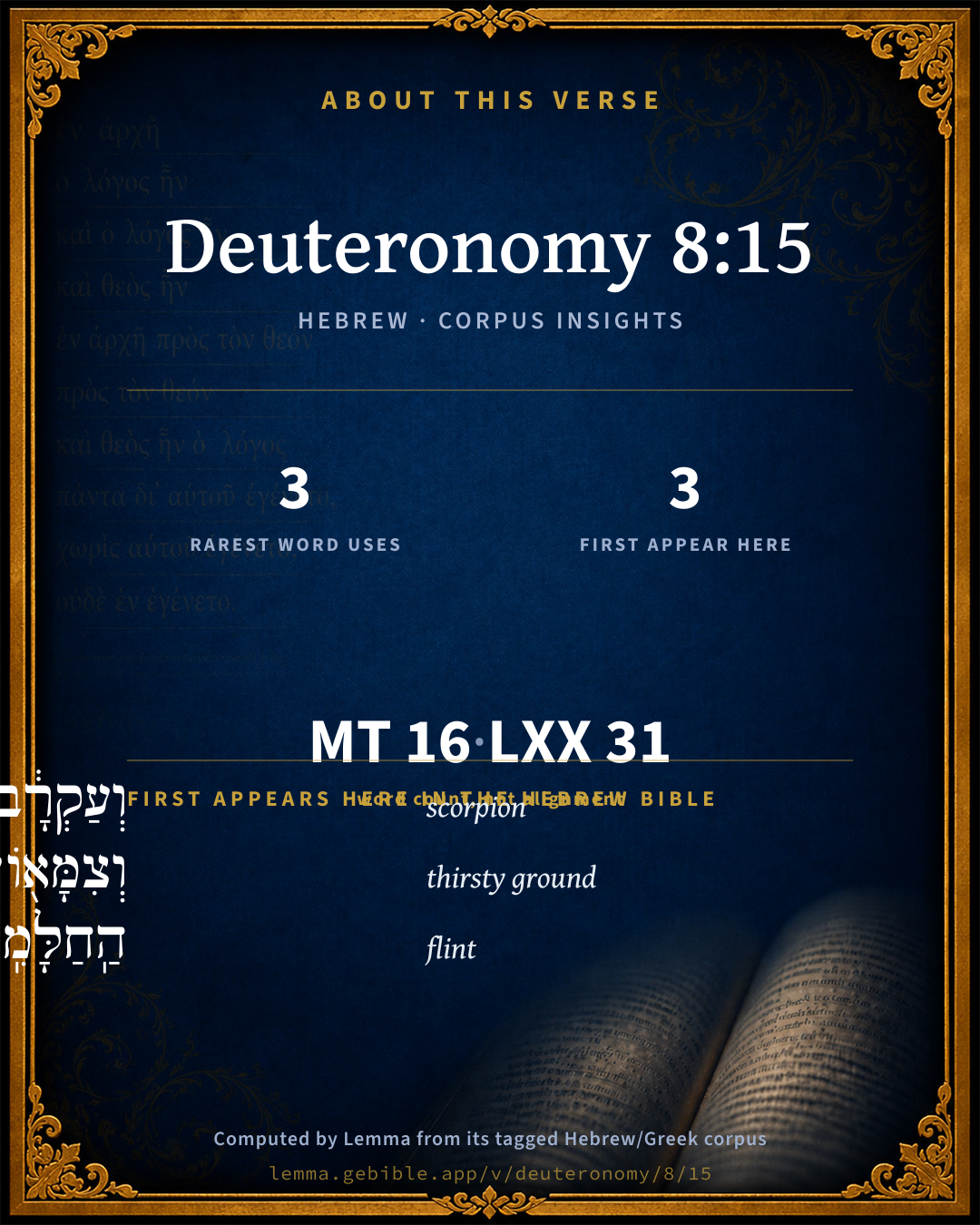
  • 3 first appearances in the Hebrew Bible
Full analysis ↓
Download a study sheet

One document with this verse’s original text, its word-by-word gloss line, the meaning frame, cross-references with their text, attributed commentary, and full source and license credits — printable, and it pastes into notes with its structure intact.

This verse Autodidact and up

Study sheet (.html) Plain text (.txt)

A passage Seminary Student

Up to 50 verses in one chapter. A passage sheet keeps up to 6 commentary sources and 12 cross-references per verse, in the order this page ranks them, and says so on the sheet whenever that leaves anything out. Ask for a single verse and you get the Autodidact verse sheet above.

Everything on this page stays free to read, with no account — the sheet is a download of what is already on screen, not access to it.

Want to remove ads? Support Godless Engineer
Compare translations 3

The same verse in 3 English versions, stacked beneath the original-language interlinear above. Click any original word for its lexicon entry.

Each is an independent rendering of the whole verse — the interlinear is not word-aligned to these translations.

Highlighted words mark where these versions differ — a whole-verse word diff, not a word-by-word alignment.

  • World English Bible Public Domain
    who led you through the great and terrible wilderness, [in which were] fiery serpents and scorpions, and thirsty ground where was no water; who brought you forth water out of the rock of flint;
  • King James Version Public Domain
    Who led thee through that great and terrible wilderness, wherein were fiery serpents, and scorpions, and drought, where there was no water; who brought thee forth water out of the rock of flint;
  • unfoldingWord Literal Text CC BY-SA 4.0
    He led you in the great and terrible wilderness, fiery serpent and scorpion and thirsty ground where there was no water, he brought out water for you from the rock of flint.

unfoldingWord Literal Text — © unfoldingWord, licensed CC BY-SA 4.0. Word-aligned USFM3 via Door43 (git.door43.org/unfoldingWord/en_ult).

Versions to compare (up to 4)

3 of 4 selected

Show all 18 translations

Every available English version of this verse, each an independent rendering of the whole verse.

  • World English Bible Public Domain
    who led you through the great and terrible wilderness, [in which were] fiery serpents and scorpions, and thirsty ground where was no water; who brought you forth water out of the rock of flint;
  • Berean Standard Bible Public Domain
    He led you through the vast and terrifying wilderness with its venomous snakes and scorpions, a thirsty and waterless land. He brought you water from the rock of flint.
  • Majority Standard Bible Public Domain
    He led you through the vast and terrifying wilderness with its venomous snakes and scorpions, a thirsty and waterless land. He brought you water from the rock of flint.
  • King James Version Public Domain
    Who led thee through that great and terrible wilderness, wherein were fiery serpents, and scorpions, and drought, where there was no water; who brought thee forth water out of the rock of flint;
  • American Standard Version (1901) Public Domain
    who led thee through the great and terrible wilderness, `wherein were' fiery serpents and scorpions, and thirsty ground where was no water; who brought thee forth water out of the rock of flint;
  • Revised Version (1885) Public Domain
    who led thee through the great and terrible wilderness, wherein were fiery serpents and scorpions, and thirsty ground where was no water; who brought thee forth water out of the rock of flint;
  • Geneva Bible (1599) Public Domain
    Who was thy guide in the great and terrible wildernes (wherein were fierie serpents, and scorpions, and drought, where was no water, who brought forth water for thee out of ye rock of flint:
  • Douay-Rheims (1899) Public Domain
    And was thy leader in the great and terrible wilderness, wherein there was the serpent burning with his breath, and the scorpion and the dipsas, and no waters at all: who brought forth streams out of the hardest rock,
  • Young's Literal Translation Public Domain
    who is causing thee to go in the great and the terrible wilderness -- burning serpent, and scorpion, and thirst -- where there is no water; who is bringing out to thee waters from the flinty rock;
  • Literal Standard Version CC BY-SA 4.0
    who is causing you to go in the great and the terrible wilderness [with] burning serpent, and scorpion, and thirst—where there is no water; who is bringing out waters to you from the flinty rock;
  • Unlocked Literal Bible CC BY-SA 4.0
    Do not forget him who led you through the great and terrifying wilderness, with its fiery serpents and scorpions and thirsty ground where there was no water, who brought you water out of the rock of flint.
  • unfoldingWord Literal Text CC BY-SA 4.0
    He led you in the great and terrible wilderness, fiery serpent and scorpion and thirsty ground where there was no water, he brought out water for you from the rock of flint.
  • Darby Bible Public Domain
    who led thee through the great and terrible wilderness, [a wilderness of] fiery serpents, and scorpions, and drought, where there is no water; who brought thee forth water out of the rock of flint;
  • World Messianic Bible Public Domain
    who led you through the great and terrible wilderness, with venomous snakes and scorpions, and thirsty ground where there was no water; who poured water for you out of the rock of flint;
  • Webster's Bible Public Domain
    Who led thee through that great and terrible wilderness, in which were fiery serpents, and scorpions, and drouth, where there was no water; who brought thee forth water out of the rock of flint;
  • Free Bible Version CC BY-SA 4.0
    He guided you through the immense and terrifying desert with its poisonous snakes and scorpions—a dried up, waterless land. He brought water for you out of a flint rock.
  • Bible in Basic English Public Domain
    Who was your guide through that great and cruel waste, where there were poison-snakes and scorpions and a dry land without water; who made water come out of the hard rock for you;
  • JPS Tanakh (1917) Public Domain
    who led thee through the great and dreadful wilderness, wherein were serpents, fiery serpents, and scorpions, and thirsty ground where was no water; who brought thee forth water out of the rock of flint;

Literal Standard Version (2020), Covenant Press — licensed CC BY-SA 4.0. Text via the HelloAO Bible API (eBible.org). Unlocked Literal Bible (unfoldingWord) — licensed CC BY-SA 4.0. Text via the HelloAO Bible API (eBible.org). unfoldingWord Literal Text — © unfoldingWord, licensed CC BY-SA 4.0. Word-aligned USFM3 via Door43 (git.door43.org/unfoldingWord/en_ult). Free Bible Version, Dr. Jonathan Gallagher — licensed CC BY-SA 4.0. Text via the HelloAO Bible API (eBible.org).

Word by word

More ways to search: Search by grammar → Find every occurrence → Compare this word →

Practice this passage: Drill this verse → Learn its vocabulary →

וְצִמָּא֖וֹן
tsimmâʼôwn
H6774
“and · thirsty ground”
Conjunction + Noun, Common, Masculine, Singular, Absolute
Part of Speech
Conjunction + Noun
Type
Common
Gender
Masculine
Number
Singular
State
Absolute
Full BDB Definition

Origin: from H6771

TWOT: 1926d

thirsty ground
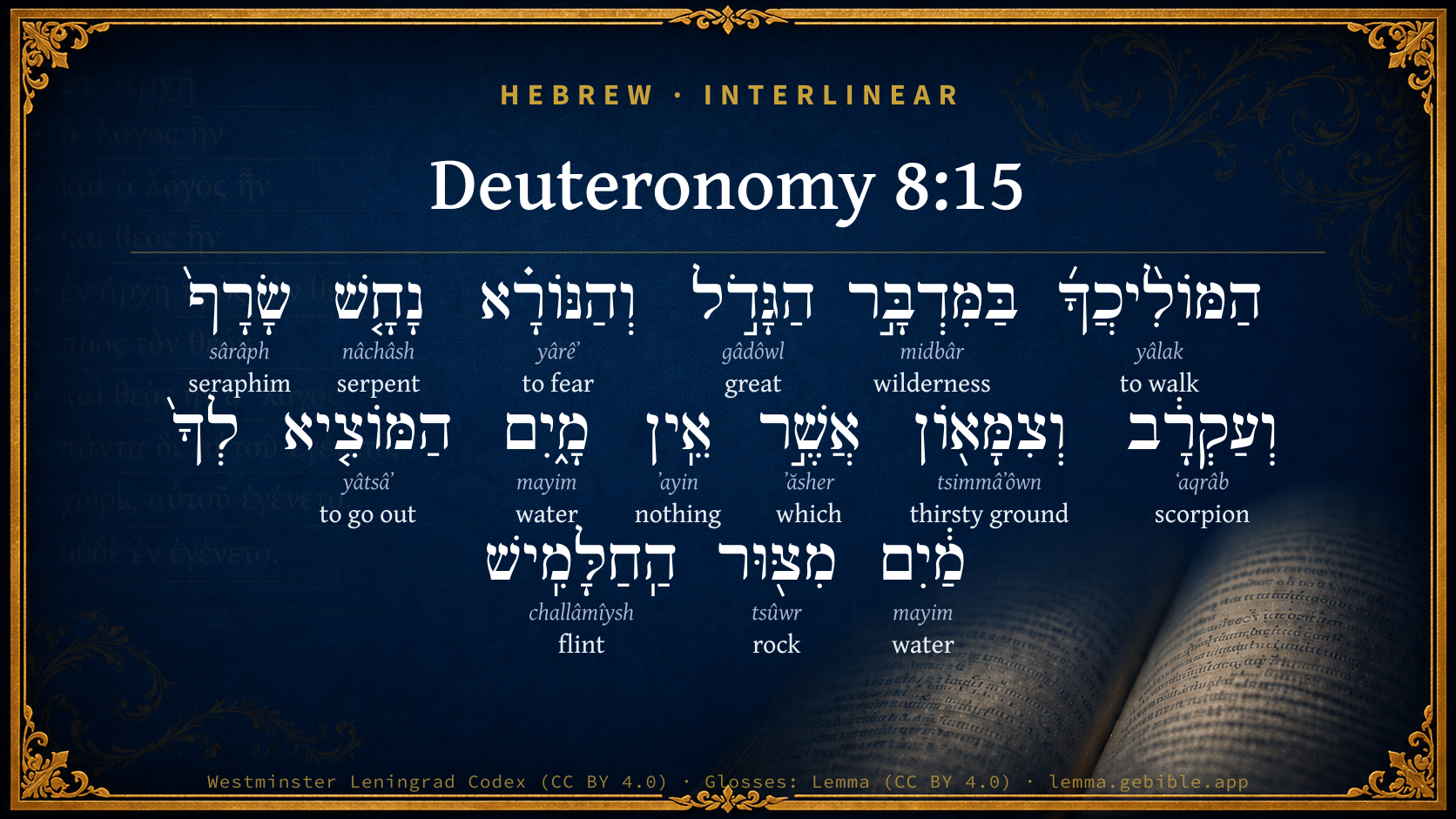
  1. הַמּוֹלִ֨יכֲךָ֜ yâlak H3212 “the · walking · you” Particle, Definite Article + Verb, Hiphil, Participle Active, Masculine, Singular, Construct + Suffix, Personal, 2nd Person, Masculine, Singular
  2. בַּמִּדְבָּ֣ר midbâr H4057 “in/at the · wilderness” Preposition, Determined + Noun, Common, Masculine, Singular, Absolute
  3. הַגָּדֹ֣ל gâdôwl H1419 “the · great” Particle, Definite Article + Adjective, Adjective, Masculine, Singular, Absolute
  4. וְהַנּוֹרָ֗א yârêʼ H3372 “and · the · fearing” Conjunction + Particle, Definite Article + Verb, Niphal, Participle Active, Masculine, Singular, Absolute
  5. נָחָ֤שׁ nâchâsh H5175 “serpent” Noun, Common, Masculine, Singular, Absolute
  6. שָׂרָף֙ sârâph H8314 “seraphim” Noun, Common, Masculine, Singular, Absolute
  7. וְעַקְרָ֔ב ʻaqrâb H6137 “and · scorpion” Conjunction + Noun, Common, Masculine, Singular, Absolute
  8. אֲשֶׁ֣ר ʼăsher H834 “which” Particle, Relative
  9. אֵֽין ʼayin H369 “nothing” Particle, Negative
  10. מָ֑יִם mayim H4325 “water(s)” Noun, Common, Masculine, Plural, Absolute
  11. הַמּוֹצִ֤יא yâtsâʼ H3318 “the · going out” Particle, Definite Article + Verb, Hiphil, Participle Active, Masculine, Singular, Absolute
  12. מַ֔יִם mayim H4325 “water(s)” Noun, Common, Masculine, Plural, Absolute
  13. מִצּ֖וּר tsûwr H6697 “from · rock of” Preposition + Noun, Common, Masculine, Singular, Construct
  14. הַֽחַלָּמִֽישׁ challâmîysh H2496 “the · flint” Particle, Definite Article + Noun, Common, Masculine, Singular, Absolute

About this verse

These counts appear in no published source. They are computed here, from the morphology-tagged text and Lemma’s own curated glosses. What Lemma adds →

16
words
14
distinct lemmas
Pentateuch
section

Notable vocabulary

The rarest word here is וְצִמָּא֖וֹן thirsty ground H6774 — appearing just 3 times in the whole Hebrew Bible.

First appearance in Scripture

These words make their first canonical appearance in the Hebrew Bible here:

  • וְעַקְרָ֔ב scorpion H6137
  • וְצִמָּא֖וֹן thirsty ground H6774
  • הַֽחַלָּמִֽישׁ flint H2496

Shared distinctive vocabulary

וְצִמָּא֖וֹן thirsty ground H6774 occurs in 3 verses of the Hebrew Bible. Also found in:

Grammatical profile

  • 3 verbs
  • 9 nouns
  • 1 adjective
  • 1 preposition
  • 2 particles

Verb forms

  • הַמּוֹלִ֨יכֲךָ֜ Hiphil · Participle Active
  • וְהַנּוֹרָ֗א Niphal · Participle Active
  • הַמּוֹצִ֤יא Hiphil · Participle Active

Repetition

A word recurs within this verse — often emphatic in Hebrew:

  • מָ֑יִם water H4325 ×2

Hebrew & Septuagint length

In English translation the verse runs 34 words from the Hebrew and 35 from the Septuagint (LXX English) — closely comparable.

A rough comparison of the two English renderings, which tokenize alike — not a word-level alignment.

Word counts can differ between the Hebrew and the Greek without any difference in meaning — e.g. the Hebrew direct-object marker אֵת has no separate Greek word, and Greek often adds the article ὁ.

In the original languages it is 16 Hebrew tokens and 31 Greek tokens — but the two are counted differently (Hebrew bundles its prefixes and suffixes into one token; the Greek is in lemma form), so that isn’t a like-for-like length.

Cross-references

14

Topical passages linked to Deuteronomy 8:15 in the Treasury of Scripture Knowledge — connected by theme and wording, ordered by reader-vote popularity; previews shown in the World English Bible.

  • Numbers 20:11 Moses lifted up his hand, and struck the rock with his rod twice: and water came forth abundantly, and the congregation drank, and their cattle.
  • Numbers 21:6 Yahweh sent fiery serpents among the people, and they bit the people; and much people of Israel died.
  • Deuteronomy 1:19 We traveled from Horeb, and went through all that great and terrible wilderness which you saw, by the way to the hill-country of the Amorites, as Yahweh our God commanded us; and we came to Kadesh-barnea.
  • Psalms 114:8 Who turned the rock into a pool of water, The flint into a spring of waters.
  • Jeremiah 2:6 Neither said they, Where is Yahweh who brought us up out of the land of Egypt, who led us through the wilderness, through a land of deserts and of pits, through a land of drought and of the shadow of death, through a land that none passed through, and where no man lived?
  • Psalms 78:15–16 He split rocks in the wilderness, And gave them drink abundantly as out of the depths.
  • Isaiah 63:12–14 who caused his glorious arm to go at the right hand of Moses? who divided the waters before them, to make himself an everlasting name?
  • Hosea 13:5 I knew you in the wilderness, In the land of great drought.
  • 1 Corinthians 10:4 and all drank the same spiritual drink. For they drank of a spiritual rock that followed them, and the rock was Christ.
  • Exodus 17:5–6 Yahweh said to Moses, "Walk on before the people, and take the elders of Israel with you, and take the rod in your hand with which you struck the Nile, and go.
  • Psalms 105:41 He opened the rock, and waters gushed out. They ran as a river in the dry places.
  • Psalms 136:16 To him who led his people through the wilderness; For his loving kindness endures forever:
  • Isaiah 35:7 The glowing sand shall become a pool, and the thirsty ground springs of water: in the habitation of jackals, where they lay, shall be grass with reeds and rushes.
  • Deuteronomy 32:13 He made him ride on the high places of the earth, He ate the increase of the field; He made him to suck honey out of the rock, Oil out of the flinty rock;

Cross-references courtesy of OpenBible.info (CC BY 4.0).

Hebrew and Greek witnesses Masoretic Hebrew ↔ Greek Septuagint

The same verse in the two great witnesses to the Old Testament, shown verse-for-verse.

These are two independent witnesses, not word-aligned to each other, and the Septuagint is shown in lemma (dictionary) form.

Hebrew Deuteronomy 8:15 Masoretic · Westminster Leningrad Codex

הַמּוֹלִ֨יכֲךָ֜ בַּמִּדְבָּ֣ר הַגָּדֹ֣ל וְהַנּוֹרָ֗א נָחָ֤שׁ שָׂרָף֙ וְעַקְרָ֔ב וְצִמָּא֖וֹן אֲשֶׁ֣ר אֵֽין מָ֑יִם הַמּוֹצִ֤יא לְךָ֙ מַ֔יִם מִצּ֖וּר הַֽחַלָּמִֽישׁ

who led you through the great and terrible wilderness, [in which were] fiery serpents and scorpions, and thirsty ground where was no water; who brought you forth water out of the rock of flint;

World English Bible · Public Domain

Greek LXX Deuteronomy 8:15 Septuagint · lemma form

ὁ ἄγω σύ διά ὁ ἔρημος ὁ μέγας καί ὁ φοβερός ἐκεῖνος οὗ ὄφις δάκνω καί σκορπίος καί δίψα οὗ οὐ εἰμί ὕδωρ ὁ ἐκἄγω σύ ἐκ πέτρα ἀκρότομος πηγή ὕδωρ

who brought you through that great and terrible wilderness, where is the biting serpent, and scorpion, and drought, where there was no water; who brought you a fountain of water out of the flinty rock:

LXX2012 (modern English Septuagint) · Public Domain

On this verse, John Gill's Exposition discusses the Septuagint’s reading. Read the note in Commentary ↓

Hebrew: Westminster Leningrad Codex (CC BY 4.0). Greek: Septuagint (public domain); English from LXX2012 (modern English Septuagint) (Public Domain). How the Septuagint differs from the Hebrew →

Targum (Aramaic paraphrase)

2

The Targum is the ancient Jewish Aramaic paraphrase of the Hebrew Scriptures — an interpretive translation, not the Hebrew text itself. Onkelos (literal) and Pseudo-Jonathan (expansive) render the Torah, and Jonathan the Prophets. Coverage is partial: where no permissively-licensed English translation exists for a verse, only the Aramaic is shown. This is verse-level text, not a word-by-word alignment to the Hebrew.

  1. Targum Onkelos Torah (Genesis–Deuteronomy)
    דְדַבְּרָךְ בְּמַדְבְּרָא רַבָּא וּדְחִילָא אֲתַר חֵיוָן קָלָן וְעַקְרַבִּין וּבֵית צַחֲוָנָא אֲתַר דִי לֵית מַיָא דְאַפֵּק לָךְ מַיָא מִטִּנָרָא תַּקִיפָא

    (no public-domain English translation for this verse)

    Targum Onkelos — Aramaic: “Onkelos Genesis” (public domain); “Onkelos Exodus” (public domain); “Onkelos Leviticus” (public domain); “Onkelos Numbers” (public domain); “Onkelos Deuteronomy” (public domain). English: “Sefaria Community Translation” (CC0 1.0 (public-domain dedication)); “J.W. Etheridge. The Targums of Onkelos and Jonathan Ben Uzziel on the Pentateuch. London: Longmans, Green, 1862” (public domain). Text via Sefaria.

  2. Targum Pseudo-Jonathan Torah (Genesis–Deuteronomy)
    דְּדַבְּרָךְ בְּרַחֲמִין בְּמַדְבְּרָא רַבָּא וּדְחֵילָא אֲתַר מָלֵי חֵיוָן קָלִין וְעַקְרַבִּין עַקְצִין וּבֵית צַחְוָונָא אֲתַר דְּלֵית מוֹי דְּאַפֵּיק לָךְ מוֹי מִשָׁמִיר טִנְרָא

    who led thee in mercy through that great and fearful desert, a place abounding in burning serpents and scorpions with stings, a place where there is thirst but no water; but (where) He brought thee forth water out of the hard rock,

    Targum Pseudo-Jonathan — Aramaic: “Targum Jonathan on Genesis” (public domain); “Targum Jonathan on Exodus” (public domain); “Targum Jonathan on Leviticus” (public domain); “Targum Jonathan on Numbers” (public domain); “Targum Jonathan on Deuteronomy” (public domain). English: “The Targum of Jonathan ben Uzziel, trans. J. W. Etheridge, London, 1862” (public domain). Text via Sefaria.

Commentary

Notes on Deuteronomy 8:15 from classic Christian and Jewish commentators (each source and its license shown beneath its notes). The classic Christian expositions comment on the surrounding passage and are grouped to its opening verse, so a note may address several verses; the Jewish commentaries on the Tanakh (Rashi and others) are per-verse, so they appear only where the commentator wrote on this verse.

Lemma curates 59 commentaries, every one of them public domain or Creative Commons licensed, each selected and text-cleaned for this edition rather than reprinted as found. About our sources →

Trapp's Complete Commentary

John Trapp

Deu 8:15 Who led thee through that great and terrible wilderness, [wherein were] fiery serpents, and scorpions, and drought, where [there was] no water; who brought thee forth water out of the rock of flint;

Ver. 15. Who led thee through, &c.] Good turns aggravate unkindnesses, and our offences are increased by our obligations.

John Trapp, A Commentary or Exposition upon All the Books of the Old and New Testament (1647–1656) — public domain. Text from a community e-Sword module.

Tyndale Open Study Notes

Tyndale Open Resources

8:15 water from the rock! See Exod 17:6; Num 20:2-13; see also Deut 1:37.

Tyndale Open Study Notes — © Tyndale Open Resources, licensed CC BY-SA 4.0. Text via the HelloAO Bible API.

Jamieson, Fausset & Brown

Robert Jamieson, A. R. Fausset & David Brown

Who led thee through that great and terrible wilderness, wherein were fiery serpents, and scorpions--Large and venomous reptiles are found in great numbers there still, particularly in autumn. Travellers must use great caution in arranging their tents and beds at night; even during the day the legs not only of men, but of the animals they ride, are liable to be bitten.

who brought thee forth water out of the rock of flint--(See on Deu 9:21).

Next: Deuteronomy Chapter 9

Jamieson, Fausset & Brown — Commentary Critical and Explanatory on the Whole Bible (1871) — public domain (CC PDM 1.0). Text via the HelloAO Bible API.

Adam Clarke's Commentary

Verse 15. Who led thee through that - terrible wilderness] See the account of their journeying in the notes, See Clarke on Ex 16:1, c. Nu 21:10-35, &c.

Fiery serpents] Serpents whose bite occasioned a most violent inflammation, accompanied with an unquenchable thirst, and which terminated in death. See Clarke on Nu 21:6.

Adam Clarke's Commentary on the Bible (1810–1826) — public domain. Text from a community e-Sword/MySword module.

Ellicott's Commentary for English Readers

(15) The rock of flint.—The rock in Horeb is called tsûr; the rock smitten in Kadesh, selagh. The first word conveys the idea of “hardness”; the other is rather a “cliff,” or “height,” and suggests the idea of inaccessibility. In Num_20:10, the words of Moses to the rebels, “Must we fetch you water out of this rock?” seem to help the distinction, whatever its purpose may be. On the associations of the word tsûr with flint, see Note on Jos_5:2. The word challâmîsh, here used for flint, occurs in Deu_32:13, Job_28:9, Psa_114:8 (an allusion to this passage), and Isa_1:7.

A Bible Commentary for English Readers, edited by Charles John Ellicott (1878–1897) — public domain. Text from a community e-Sword module.

The Cambridge Bible for Schools and Colleges

gen. ed. J. J. S. Perowne

15. great and terrible wilderness] Deu_1:19 : cp. Deu_7:21.

fiery serpents and scorpions] The former, in the collective singular naḥash sarapḥ, are described in the plural in Num_21:6 E: cp. Isa_30:6 : the flying saraph. If saraph really means burning and is not a foreign word (for dragon or the like), it refers to the inflammation produced by the serpent’s bite. Scorpions is added characteristically by D.

out of the rock of flint] Exo_17:6 (E): Num_20:8; Num_20:11 (JE): in both cases only the rock. D’s characteristic rhetoric adds of flint. The word does not occur before D, and elsewhere only in Deu_32:13; Psa_114:8; Job_28:9; Isa_50:7.

The Cambridge Bible for Schools and Colleges (gen. ed. J. J. S. Perowne; Cambridge University Press, 1878–1918) — public domain. Text from a community e-Sword module.

John Gill's Exposition

Who fed thee in the wilderness with manna,.... Even all the forty years they were in it, Exo 16:35 which thy fathers knew not; when they first saw it, Exo 16:15.

that he might humble thee, and that he might prove thee; they were kept humble, being dependent on God for their daily bread, having nothing in the wilderness to support themselves with; and this tried them, whether they would trust in God for their daily supply, and be thankful for it, or not:

to do thee good at thy latter end; that by living on such light bread, and this only and continually, his goodness might appear the greater, and be the sweeter to them, when they came into a land abounding with all good things; which is not to be understood of the latter end and last days of their commonwealth, as our version, with the Septuagint, Samaritan, Arabic versions, and others, and the Targum of Onkelos; but of time following nearer, and the phrase should be rendered "hereafter" (y); which better agrees with the promise of a divine blessing; though, come when it would, it was the more acceptable for the trial; as heaven will be the sweeter to the saints, through the afflictions, hardships, straits, and difficulties, which attend them here.

(y) "tandem", Tigurine version, Vatablus, Piscator; "posthac", Noldius, p. 180. No. 807.

John Gill's Exposition of the Whole Bible (1746–1763) — public domain (CC PDM 1.0). Text via the HelloAO Bible API.

Albert Barnes' Notes on the Bible

Render: “Who brought thee through that great and terrible wilderness, the fiery serpent and the scorpion, and the dry land where are no waters.” On the fiery serpents see Num 21:6 note.

Albert Barnes' Notes on the Bible (1834–1885) — public domain. Text from a community e-Sword/MySword module.

Haydock's Catholic Bible Commentary

Breath. Hebrew saraphh, or the basilisk, as it is rendered, Isaias xxx. 6. It destroys both the grass and animals, by the burning infection of its breath. (Galen; Pliny, [Natural History?] viii. 19. See Numbers xxi. 6. (Tirinus) --- Scorpion stings with its tail. --- Dipsas. A serpent whose bite causeth a violent thirst: from whence it has its name; for in Greek, dipsa signifies thirst. (Challoner) --- It is impossible to quench this thirst, (Worthington) and those who are bitten by this serpent can discharge no water. (Calmet) --- They drink till they burst, unless they can procure some treacle, or remedy against the poison. (Dioscorides) (Tirinus) --- Some translate the Hebrew, "scorpions, and (at the place of) drought, where there was no water: he brought," &c., whether Tsommaon be the name of a particular place, (Isaias xxxv. 7.; Onkelos; Calmet) or it may be applied to the greatest part of that desert, where the want of water so often occasioned the murmurs of the people. (Haydock)

George Leo Haydock (1774–1849), Haydock's Catholic Family Bible and Commentary, 1859 edition — public domain. Excludes Psalms (Douay-Rheims chapter numbering differs from Protestant) and Deuterocanonical books (Catholic canon only).

Whedon's Commentary on the Bible

Daniel D. Whedon

15. Who led thee — This passage is better rendered, “Who led thee through that great and terrible wilderness, poisonous serpents, and scorpions, and parched land, where were no waters.” Even in such a land they were the objects of a providential care. Bread from heaven, water from the rock, had supplied their wants.

Daniel D. Whedon (gen. ed.), Commentary on the Old and New Testaments (1874–1909) — public domain. Text from a community e-Sword module.

The Pulpit Commentary

Who led thee through that great and terrible wilderness, wherein were fiery serpents, etc. "The fiery serpent" and "the scorpion" (sing.) are in apposition to the "wilderness," and illustrate its terribleness. Fiery serpents ufeiv touv qanatounsav LXX or burning serpents, so called from the burning pain caused by their bite; probably the cerastes, or one of the naja species (cf. Num_21:6)

The Pulpit Commentary (1880–1919), ed. H.D.M. Spence-Jones & Joseph S. Exell — public domain. Text from a community e-Sword module.

unfoldingWord translationNotes

Door43 World Missions Community

General Information:

Moses continues to speak to the Israelites as if they are one person. (See: Forms of You)

who led you ... in the end

Moses continues to remind the Israelites of what they know about Yahweh (Deuteronomy 8:14). (See: Distinguishing versus Informing or Reminding)

who led ... who brought ... He fed

"Yahweh, who led ... Yahweh, who brought ... Yahweh fed"

fiery serpents

"poisonous snakes"

thirsty ground

This phrase describes the ground as being thirsty just like a person is thirsty when he needs water. AT: "dry ground" (See: Personification)

to do you good

"to help you" or "because it would be good for you"

but you may say in your heart

This is the third thing the people might do when their hearts "become lifted up" and they "forget Yahweh" (Deuteronomy 8:14). Here "heart" is a metonym for a person's innermost thoughts. AT: "but you may think to yourself" (See: Metonymy)

My power and the might of my hand acquired all this wealth

Here "hand" refers to a man's power or ability. AT: "I got this wealth because I am so strong and powerful" or "I have acquired all these things by my own power and ability" (See: Metonymy)

translationWords

desert

serpent

power

might

hand

unfoldingWord translationNotes — © Distant Shores Media and the Door43 World Missions Community, licensed CC BY-SA 4.0. Source: git.door43.org/Door43/en_tn.

Lesson kit

Teaching starters — assembled from the data on this page, not authored interpretation. Every prompt links to the verse data it draws on. Edit before teaching.

Deuteronomy, in the Pentateuch, opens this verse with 16 words (14 distinct Hebrew lemmas). Its most distinctive word is tsimmâʼôwn (“thirsty ground”). A historical commentator’s framing appears above. Read the whole chapter for the surrounding context.

Discussion questions

  1. How does “thirsty ground” (tsimmâʼôwn) shape what this verse is saying?
  2. 3 words make their first appearance in Scripture here. What does this debut establish?
  3. How does Psalms 107:33, which shares the word «thirsty ground», read alongside this verse?
  4. What does the repetition of “water” (2× in this one verse) do in this verse?
  5. These translations render this verse differently; the difference is in the English rendering, not the original. What questions does that raise?
  6. «הַמּוֹלִ֨יכֲךָ֜» is a Hiphil Participle Active verb. How does that grammatical form shape the action described?
  7. Compare how Trapp's Complete Commentary and Tyndale Open Study Notes read this verse. Where do they agree or differ?

Things to notice

Reading settings

Reading text

Shown beneath each verse's original-language words.

Old Testament
Old Testament edition

Read the OT as the Masoretic Hebrew (MT) or the Greek Septuagint (LXX).

English shown for the Greek Septuagint (in the Hebrew ↔ Greek comparison).

Comparing translations? Open the Compare panel on any verse page to stack up to four side by side.