Judges 19:28

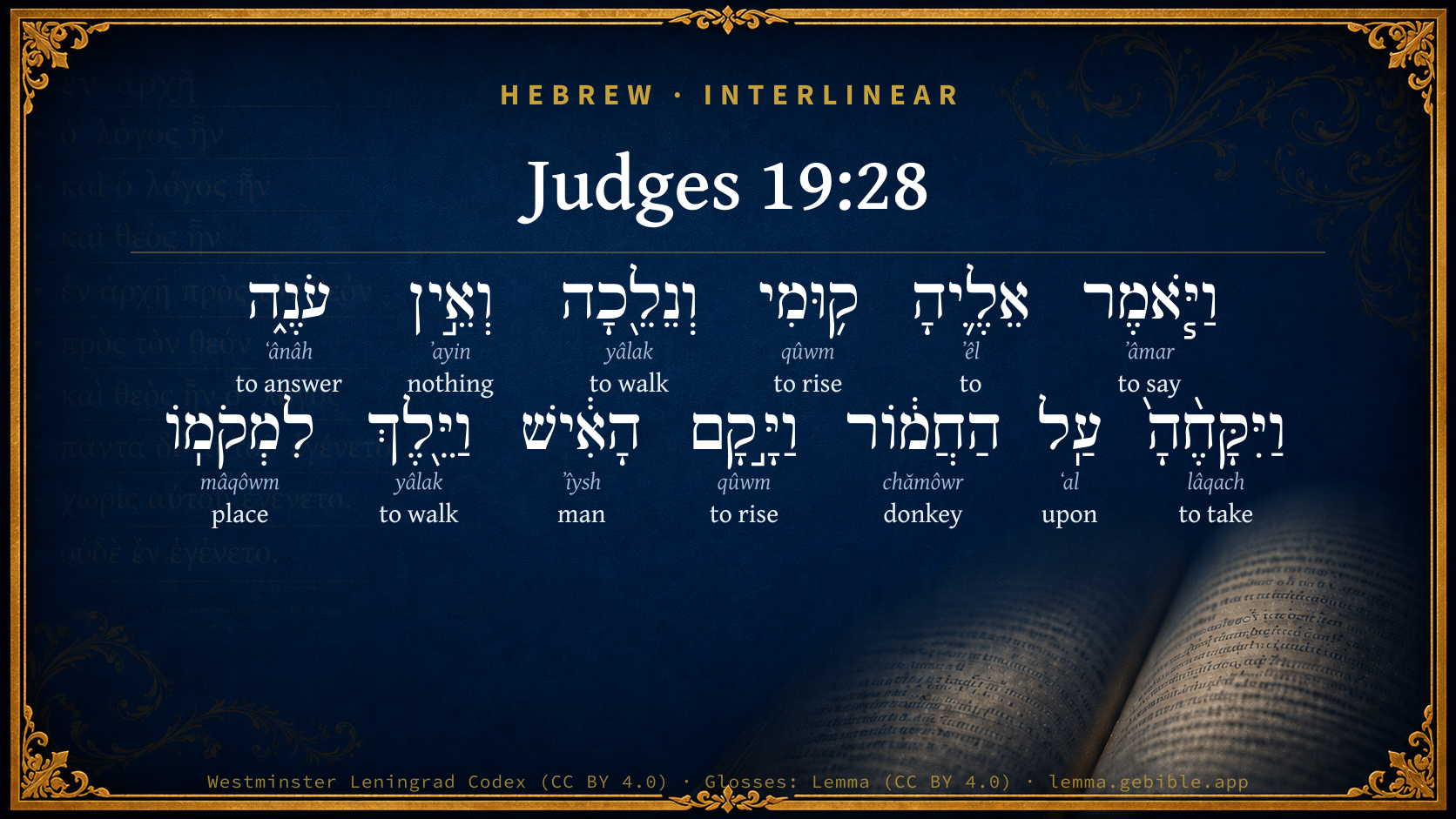
Hebrew (Westminster Leningrad Codex) Judges 19:28 appears in the Hebrew Old Testament. The text above is from the Westminster Leningrad Codex. Each word links to its Strong’s number, a concise gloss, and parsing drawn from the Open Scriptures Hebrew Bible morphology. Click any word for its full Brown-Driver-Briggs (BDB) entry.
Download image
Cite this verse

Judges 19:28 (World English Bible). Public Domain. Lemma interlinear Bible study tool, https://lemma.gebible.app/v/judges/19/28.

Show BibTeX & RIS
BibTeX
RIS
English Translation
He said to her, Up, and let us be going; but none answered: then he took her up on the donkey; and the man rose up, and got him to his place.
World English Bible · Public Domain
Download a study sheet

One document with this verse’s original text, its word-by-word gloss line, the meaning frame, cross-references with their text, attributed commentary, and full source and license credits — printable, and it pastes into notes with its structure intact.

This verse Autodidact and up

Study sheet (.html) Plain text (.txt)

A passage Seminary Student

Up to 50 verses in one chapter. A passage sheet keeps up to 6 commentary sources and 12 cross-references per verse, in the order this page ranks them, and says so on the sheet whenever that leaves anything out. Ask for a single verse and you get the Autodidact verse sheet above.

Everything on this page stays free to read, with no account — the sheet is a download of what is already on screen, not access to it.

Want to remove ads? Support Godless Engineer
Compare translations 3

The same verse in 3 English versions, stacked beneath the original-language interlinear above. Click any original word for its lexicon entry.

Each is an independent rendering of the whole verse — the interlinear is not word-aligned to these translations.

Highlighted words mark where these versions differ — a whole-verse word diff, not a word-by-word alignment.

  • World English Bible Public Domain
    He said to her, Up, and let us be going; but none answered: then he took her up on the donkey; and the man rose up, and got him to his place.
  • King James Version Public Domain
    And he said unto her, Up, and let us be going. But none answered. Then the man took her up upon an ass, and the man rose up, and gat him unto his place.
  • unfoldingWord Literal Text CC BY-SA 4.0
    And he said to her, “Arise, and let us go.” But no answering, so he took her on the donkey, and the man arose and went to his place.

unfoldingWord Literal Text — © unfoldingWord, licensed CC BY-SA 4.0. Word-aligned USFM3 via Door43 (git.door43.org/unfoldingWord/en_ult).

Versions to compare (up to 4)

3 of 4 selected

Show all 18 translations

Every available English version of this verse, each an independent rendering of the whole verse.

  • World English Bible Public Domain
    He said to her, Up, and let us be going; but none answered: then he took her up on the donkey; and the man rose up, and got him to his place.
  • Berean Standard Bible Public Domain
    “Get up,” he told her. “Let us go.” But there was no response. So the man put her on his donkey and set out for home.
  • Majority Standard Bible Public Domain
    “Get up,” he told her. “Let us go.” But there was no response. So the man put her on his donkey and set out for home.
  • King James Version Public Domain
    And he said unto her, Up, and let us be going. But none answered. Then the man took her up upon an ass, and the man rose up, and gat him unto his place.
  • American Standard Version (1901) Public Domain
    And he said unto her, Up, and let us be going; but none answered: then he took her up upon the ass; and the man rose up, and gat him unto his place.
  • Revised Version (1885) Public Domain
    And he said unto her, Up, and let us be going; but none answered: then he took her up upon the ass; and the man rose up, and gat him unto his place.
  • Geneva Bible (1599) Public Domain
    And hee said vnto her, Vp and let vs goe: but shee answered not. Then he tooke her vp vpon the asse, and the man rose vp, and went vnto his place.
  • Douay-Rheims (1899) Public Domain
    He thinking she was taking her rest, said to her: Arise, and let us be going. But as she made no answer, perceiving she was dead, he took her up, and laid her upon his ass, and returned to his house.
  • Young's Literal Translation Public Domain
    and he saith unto her, `Rise, and we go;' and there is none answering, and he taketh her on the ass, and the man riseth and goeth to his place,
  • Literal Standard Version CC BY-SA 4.0
    and he says to her, “Rise, and we go”; but there is no answering, and he takes her on the donkey, and the man rises and goes to his place,
  • Unlocked Literal Bible CC BY-SA 4.0
    The Levite said to her, “Get up. Let us go.” But there was no answer. He put her on the donkey, and the man set out for home.
  • unfoldingWord Literal Text CC BY-SA 4.0
    And he said to her, “Arise, and let us go.” But no answering, so he took her on the donkey, and the man arose and went to his place.
  • Darby Bible Public Domain
    He said to her, "Get up, let us be going." But there was no answer. Then he put her upon the ass; and the man rose up and went away to his home.
  • World Messianic Bible Public Domain
    He said to her, “Get up, and let’s get going!” but no one answered. Then he took her up on the donkey; and the man rose up, and went to his place.
  • Webster's Bible Public Domain
    And he said to her, Rise, and let us be going. But none answered. Then the man took her upon an ass, and the man rose, and went to his place.
  • Free Bible Version CC BY-SA 4.0
    “Get up, let's go,” he told her, but there was no answer. Then the man lifted her onto his donkey and went home.
  • Bible in Basic English Public Domain
    And he said to her, Get up and let us be going; but there was no answer; so he took her up and put her on the ass, and went on his way and came to his house.
  • JPS Tanakh (1917) Public Domain
    And he said unto her. 'Up, and let us be going'; but none answered; then he took her up upon the ass; and the man rose up, and got him unto his place.

Literal Standard Version (2020), Covenant Press — licensed CC BY-SA 4.0. Text via the HelloAO Bible API (eBible.org). Unlocked Literal Bible (unfoldingWord) — licensed CC BY-SA 4.0. Text via the HelloAO Bible API (eBible.org). unfoldingWord Literal Text — © unfoldingWord, licensed CC BY-SA 4.0. Word-aligned USFM3 via Door43 (git.door43.org/unfoldingWord/en_ult). Free Bible Version, Dr. Jonathan Gallagher — licensed CC BY-SA 4.0. Text via the HelloAO Bible API (eBible.org).

Word by word

More ways to search: Search by grammar → Find every occurrence → Compare this word →

Practice this passage: Drill this verse → Learn its vocabulary →

הַחֲמ֔וֹר
chămôwr
H2543
“the · donkey”
Particle, Definite Article + Noun, Common, Both, Singular, Absolute
Part of Speech
Particle + Noun
Type
Common
Gender
Both
Number
Singular
State
Absolute
Full BDB Definition

Origin: from H2560

TWOT: 685a

(he) ass
  1. וַיֹּ֧אמֶר ʼâmar H559 “and · to say” Conjunction + Verb, Qal, Sequential Imperfect, 3rd Person, Masculine, Singular
  2. אֵלֶ֛יהָ ʼêl H413 “to · her” Preposition + Suffix, Personal, 3rd Person, Feminine, Singular
  3. ק֥וּמִי qûwm H6965 “rise” Verb, Qal, Imperative, 2nd Person, Feminine, Singular
  4. וְנֵלֵ֖כָה yâlak H3212 “and · to walk” Conjunction + Verb, Qal, Cohortative, 1st Person, Common, Plural
  5. וְאֵ֣ין ʼayin H369 “and · nothing” Conjunction + Particle, Negative
  6. עֹנֶ֑ה ʻânâh H6030 “answering” Verb, Qal, Participle Active, Masculine, Singular, Absolute
  7. וַיִּקָּחֶ֨הָ֙ lâqach H3947 “and · to take · her” Conjunction + Verb, Qal, Sequential Imperfect, 3rd Person, Masculine, Singular + Suffix, Personal, 3rd Person, Feminine, Singular
  8. עַֽל ʻal H5921 “upon” Preposition
  9. וַיָּ֣קָם qûwm H6965 “and · to rise” Conjunction + Verb, Qal, Sequential Imperfect, 3rd Person, Masculine, Singular
  10. הָאִ֔ישׁ ʼîysh H376 “the · man” Particle, Definite Article + Noun, Common, Masculine, Singular, Absolute
  11. וַיֵּ֖לֶךְ yâlak H3212 “and · to walk” Conjunction + Verb, Qal, Sequential Imperfect, 3rd Person, Masculine, Singular
  12. לִמְקֹמֽוֹ mâqôwm H4725 “to/for · place · his” Preposition + Noun, Common, Masculine, Singular, Construct + Suffix, Personal, 3rd Person, Masculine, Singular

About this verse

These counts appear in no published source. They are computed here, from the morphology-tagged text and Lemma’s own curated glosses. What Lemma adds →

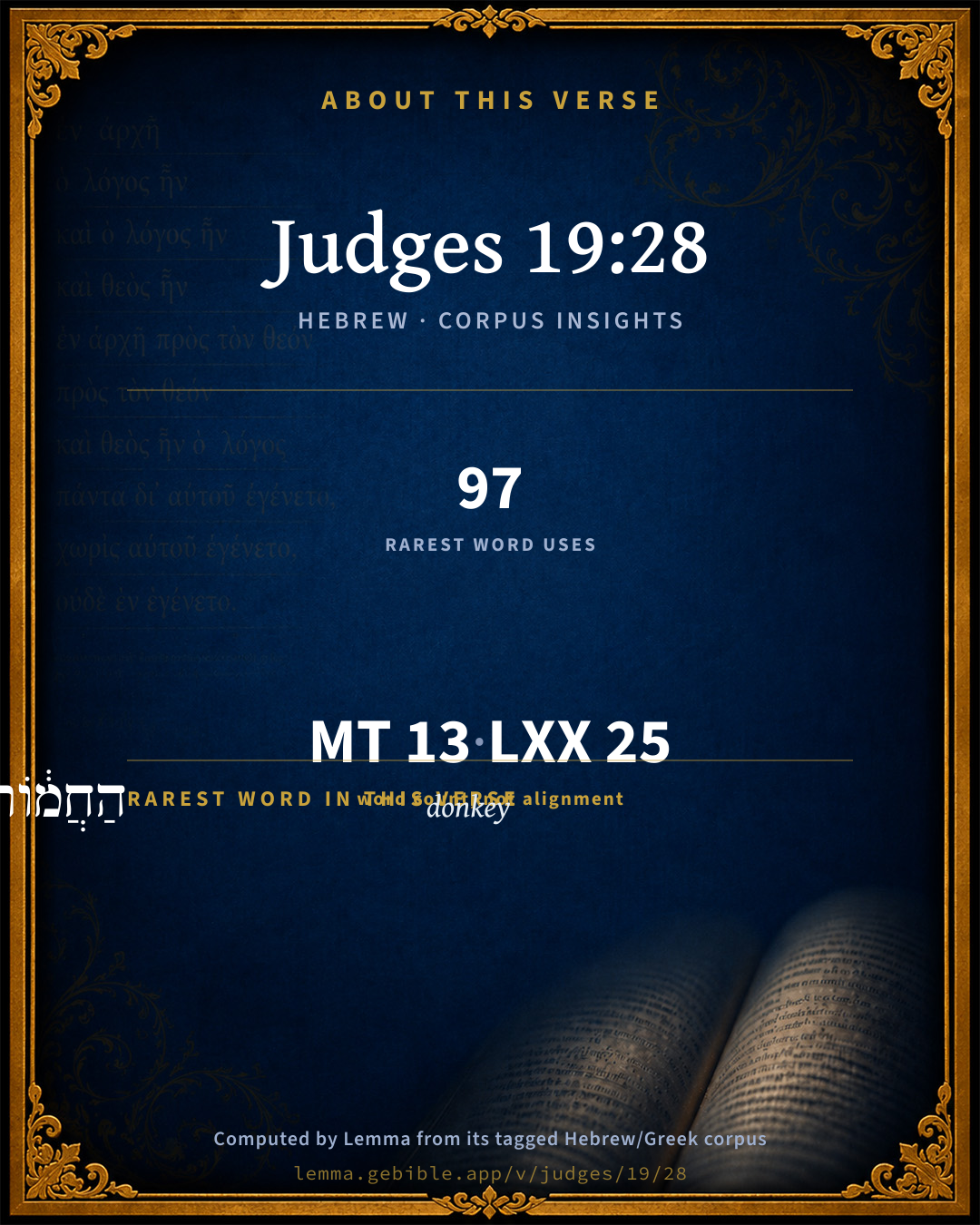
13
words
11
distinct lemmas
Historical
section

Grammatical profile

  • 7 verbs
  • 3 nouns
  • 2 prepositions
  • 1 particle

Verb forms

  • וַיֹּ֧אמֶר Qal · Sequential Imperfect
  • ק֥וּמִי Qal · Imperative
  • וְנֵלֵ֖כָה Qal · Cohortative
  • עֹנֶ֑ה Qal · Participle Active
  • וַיִּקָּחֶ֨הָ֙ Qal · Sequential Imperfect
  • וַיָּ֣קָם Qal · Sequential Imperfect
  • וַיֵּ֖לֶךְ Qal · Sequential Imperfect

Repetition

Words recur within this verse — often emphatic in Hebrew:

  • ק֥וּמִי to rise H6965 ×2
  • וְנֵלֵ֖כָה to walk H3212 ×2

Hebrew & Septuagint length

In English translation the verse runs 32 words from the Hebrew and 30 from the Septuagint (LXX English) — closely comparable.

A rough comparison of the two English renderings, which tokenize alike — not a word-level alignment.

Word counts can differ between the Hebrew and the Greek without any difference in meaning — e.g. the Hebrew direct-object marker אֵת has no separate Greek word, and Greek often adds the article ὁ.

In the original languages it is 13 Hebrew tokens and 25 Greek tokens — but the two are counted differently (Hebrew bundles its prefixes and suffixes into one token; the Greek is in lemma form), so that isn’t a like-for-like length.

Cross-references

2

Topical passages linked to Judges 19:28 in the Treasury of Scripture Knowledge — connected by theme and wording, ordered by reader-vote popularity; previews shown in the World English Bible.

  • Judges 20:5 The men of Gibeah rose against me, and beset the house round about me by night; me they thought to have slain, and my concubine they forced, and she is dead.
  • 1 Kings 18:29 It was so, when midday was past, that they prophesied until the time of the offering of the [evening] offering; but there was neither voice, nor any to answer, nor any who regarded.

Cross-references courtesy of OpenBible.info (CC BY 4.0).

Hebrew and Greek witnesses Masoretic Hebrew ↔ Greek Septuagint

The same verse in the two great witnesses to the Old Testament, shown verse-for-verse.

These are two independent witnesses, not word-aligned to each other, and the Septuagint is shown in lemma (dictionary) form.

Hebrew Judges 19:28 Masoretic · Westminster Leningrad Codex

וַיֹּ֧אמֶר אֵלֶ֛יהָ ק֥וּמִי וְנֵלֵ֖כָה וְאֵ֣ין עֹנֶ֑ה וַיִּקָּחֶ֨הָ֙ עַֽל הַחֲמ֔וֹר וַיָּ֣קָם הָאִ֔ישׁ וַיֵּ֖לֶךְ לִמְקֹמֽוֹ

He said to her, Up, and let us be going; but none answered: then he took her up on the donkey; and the man rose up, and got him to his place.

World English Bible · Public Domain

Greek LXX Judges 19:28 Septuagint · lemma form

καί εἶπον πρός αὐτός ἀναἵστημι καί ἀποἔρχομαι καί οὐ ἀποκρίνω ὅτι εἰμί νεκρός καί λαμβάνω αὐτός ἐπί ὁ ὄνος καί πορεύομαι εἰς ὁ τόπος αὐτός

And he said to her, Rise, and let us go; and she answered not, for she was dead: and he took her upon his ass, and went to his place.

LXX2012 (modern English Septuagint) · Public Domain

On this verse, The Cambridge Bible for Schools and Colleges discusses the Septuagint’s reading. Read the note in Commentary ↓

Hebrew: Westminster Leningrad Codex (CC BY 4.0). Greek: Septuagint (public domain); English from LXX2012 (modern English Septuagint) (Public Domain). How the Septuagint differs from the Hebrew →

Targum (Aramaic paraphrase)

1

The Targum is the ancient Jewish Aramaic paraphrase of the Hebrew Scriptures — an interpretive translation, not the Hebrew text itself. Onkelos (literal) and Pseudo-Jonathan (expansive) render the Torah, and Jonathan the Prophets. Coverage is partial: where no permissively-licensed English translation exists for a verse, only the Aramaic is shown. This is verse-level text, not a word-by-word alignment to the Hebrew.

  1. Targum Jonathan Prophets (Joshua–Malachi)
    וַאֲמַר לָהּ קוּמִי וְנֵיזֵיל וְלָא מְתִיבָא וְנַסְבָהּ עַל חֲמָרָא וְקָם גַבְרָא וְאַזַל לְאַתְרֵיהּ:

    (no public-domain English translation for this verse)

    Targum Jonathan — Aramaic: “Mikraot Gedolot” (public domain). English: “Sefaria Community Translation” (CC0 1.0 (public-domain dedication)); “London "Chaldee Paraphrase," 1871” (public domain). Text via Sefaria.

Commentary

Notes on Judges 19:28 from classic Christian and Jewish commentators (each source and its license shown beneath its notes). The classic Christian expositions comment on the surrounding passage and are grouped to its opening verse, so a note may address several verses; the Jewish commentaries on the Tanakh (Rashi and others) are per-verse, so they appear only where the commentator wrote on this verse.

Lemma curates 59 commentaries, every one of them public domain or Creative Commons licensed, each selected and text-cleaned for this edition rather than reprinted as found. About our sources →

Trapp's Complete Commentary

John Trapp

Jdg 19:28 And he said unto her, Up, and let us be going. But none answered. Then the man took her [up] upon an ass, and the man rose up, and gat him unto his place.

Ver. 28. And he said unto her, Up.] Little thinking she had been dead, but either asleep, or sick from ill-humour.

John Trapp, A Commentary or Exposition upon All the Books of the Old and New Testament (1647–1656) — public domain. Text from a community e-Sword module.

Geneva Bible (1599)

Geneva Bible translators

Meaning, home unto mount Ephraim.

Geneva Bible (1599) marginal notes — public domain. Text via Bolls.life.

Ellicott's Commentary for English Readers

(28) But none answered.—The sacred writer, in his horror, will not say that she was dead.

Upon an ass.—Rather, the ass, which had borne her while she was living. The omission of every detail, the narration of the naked facts in the simplest words, without pausing to say so much as a single word respecting the Levite’s or the old man’s feelings, is a striking example of the difference of the historic method of ancient and modern times.

A Bible Commentary for English Readers, edited by Charles John Ellicott (1878–1897) — public domain. Text from a community e-Sword module.

The Cambridge Bible for Schools and Colleges

gen. ed. J. J. S. Perowne

28. The sheer brutality of the Levite’s words prepares us for his savage appeal for vengeance.

but none answered] The LXX spoils the effect by adding for she was dead. Josephus tries to palliate it: ‘her husband thought that she was overcome by deep sleep,’ Ant. Jdg_19:2; Jdg_19:8.

The Cambridge Bible for Schools and Colleges (gen. ed. J. J. S. Perowne; Cambridge University Press, 1878–1918) — public domain. Text from a community e-Sword module.

John Gill's Exposition

And he said unto her, up, and let us be going,.... He spoke to her as supposing her asleep, in order to awake her, and prepare for their journey with all the haste they could, lest greater mischief should befall them:

but none answered; for she was dead; and her death was occasioned, as Josephus (w) says, partly through grief at what she had suffered, and partly through shame, not daring to come into the sight of her husband; but chiefly through the injuries done her by the number of persons that had lain with her: so it is reported (x) of the Thessalonians, when they took Phocis, many women were destroyed through the abundance of rapes committed upon them. To these Abarbinel adds, the cold of the night, being without her clothes, or anything to cover her:

then the man took her up upon an ass; and carried off her dead body, without making any remonstrance to the inhabitants, from whom he could not expect that any justice would be done him:

and the man rose up, and got him unto his place; to his city on one side Mount Ephraim, to which he made as much haste as he could, instead of going to the house of God at Shiloh, as he proposed; for now the circumstances of things were changed with him, and instead of sacrificing and giving praise to God in his house, his business was to seek for justice from the tribes of Israel.

(w) Ut supra. (Antiqu. l. 5. c. 2. sect. 8.) (x) Herodot. Urania, sive, l. 8. c. 33.

John Gill's Exposition of the Whole Bible (1746–1763) — public domain (CC PDM 1.0). Text via the HelloAO Bible API.

Matthew Poole's English Annotations

None answered; for she was dead, as is said, Jdg 20:5.

Matthew Poole's English Annotations on the Holy Bible (1683–1685) — public domain. Text from a community e-Sword/MySword module.

Rashi

Rabbi Shlomo Yitzchaki (Rashi)

There was no answer, for she was dead.

Rashi on the Tanakh — English translations: “The Judaica Press complete Tanach with Rashi, translated by A. J. Rosenberg” (CC BY 4.0); “Pentateuch with Rashi's commentary by M. Rosenbaum and A.M. Silbermann, 1929-1934” (public domain); “The Metsudah Tanach series, Lakewood, N.J” (CC BY 4.0); and “The Book of Joshua, Metsudah Publications, 1997” (CC BY 4.0). Text via Sefaria.

Lesson kit

Teaching starters — assembled from the data on this page, not authored interpretation. Every prompt links to the verse data it draws on. Edit before teaching.

Judges, in the Historical, opens this verse with 13 words (11 distinct Hebrew lemmas). Its most distinctive word is chămôwr (“donkey”). A historical commentator’s framing appears above. Read the whole chapter for the surrounding context.

Discussion questions

  1. The word chămôwr carries the sense “donkey.” How does it shape the verse?
  2. Judges 20:5 shares this passage’s theme. How do the two illuminate each other?
  3. “to rise” occurs 2× in this one verse. What is the effect of the repetition?
  4. The translations on this page render this verse differently — a whole-verse word diff, not a word-by-word alignment. What might account for the different wordings?
  5. The verb «וַיֹּ֧אמֶר» is Qal Sequential Imperfect. How does its form color the action?
  6. Reading how Trapp's Complete Commentary and Geneva Bible (1599) read this verse, where do the two commentators agree and where do they part?

Things to notice

Reading settings

Reading text

Shown beneath each verse's original-language words.

Old Testament
Old Testament edition

Read the OT as the Masoretic Hebrew (MT) or the Greek Septuagint (LXX).

English shown for the Greek Septuagint (in the Hebrew ↔ Greek comparison).

Comparing translations? Open the Compare panel on any verse page to stack up to four side by side.