
Numbers 27:11

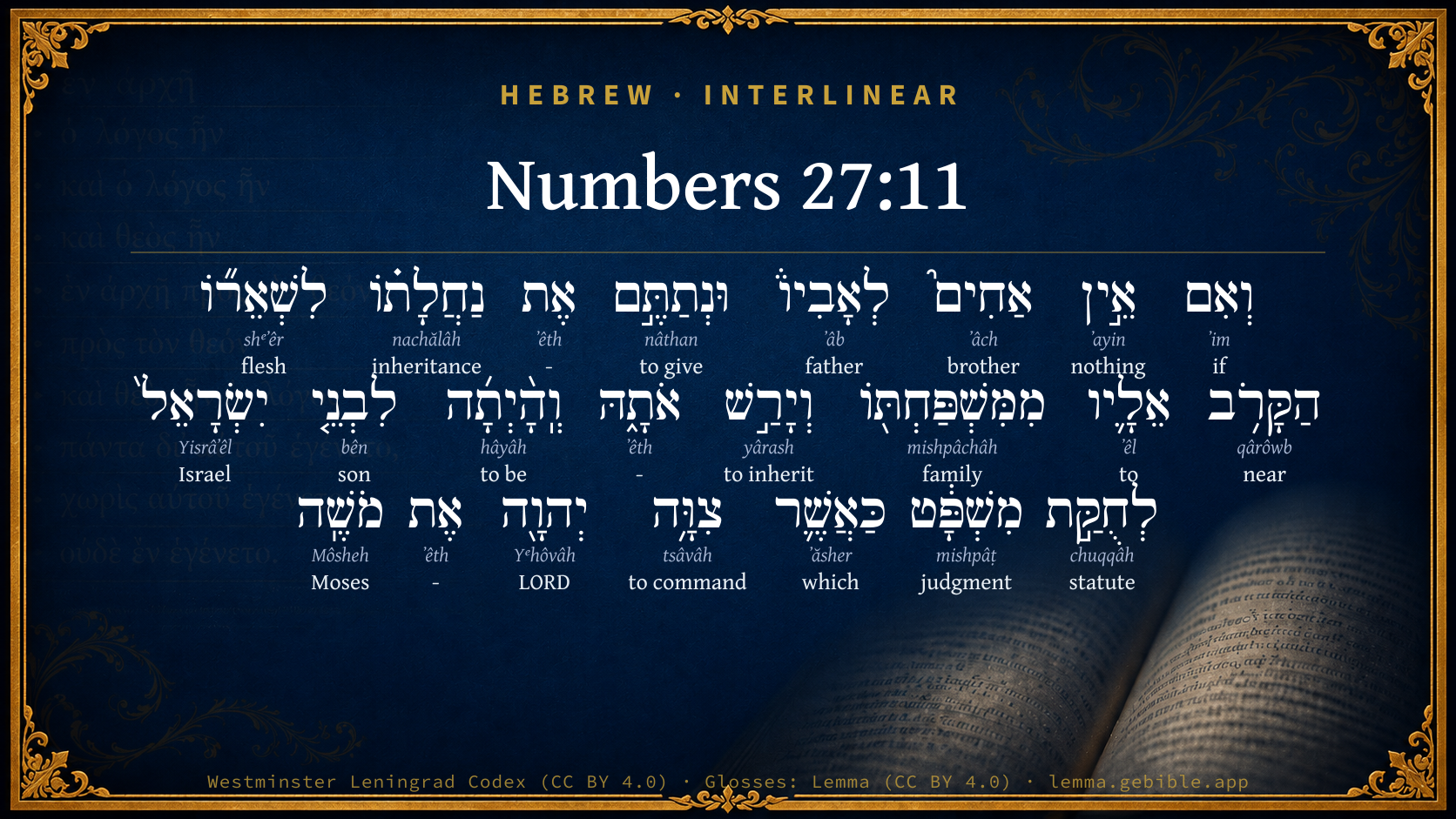
Hebrew (Westminster Leningrad Codex) Numbers 27:11 appears in the Hebrew Old Testament. The text above is from the Westminster Leningrad Codex. Each word links to its Strong’s number, a concise gloss, and parsing drawn from the Open Scriptures Hebrew Bible morphology. Click any word for its full Brown-Driver-Briggs (BDB) entry.
Download image
Cite this verse

Numbers 27:11 (World English Bible). Public Domain. Lemma interlinear Bible study tool, https://lemma.gebible.app/v/numbers/27/11.

Show BibTeX & RIS
BibTeX
RIS
English Translation
If his father have no brothers, then you shall give his inheritance to his kinsman who is next to him of his family, and he shall possess it: and it shall be to the children of Israel a statute [and] ordinance, as Yahweh commanded Moses.
World English Bible · Public Domain
Download a study sheet

One document with this verse’s original text, its word-by-word gloss line, the meaning frame, cross-references with their text, attributed commentary, and full source and license credits — printable, and it pastes into notes with its structure intact.

This verse Autodidact and up

Study sheet (.html) Plain text (.txt)

A passage Seminary Student

Up to 50 verses in one chapter. A passage sheet keeps up to 6 commentary sources and 12 cross-references per verse, in the order this page ranks them, and says so on the sheet whenever that leaves anything out. Ask for a single verse and you get the Autodidact verse sheet above.

Everything on this page stays free to read, with no account — the sheet is a download of what is already on screen, not access to it.

Want to remove ads? Support Godless Engineer
Compare translations 3

The same verse in 3 English versions, stacked beneath the original-language interlinear above. Click any original word for its lexicon entry.

Each is an independent rendering of the whole verse — the interlinear is not word-aligned to these translations.

Highlighted words mark where these versions differ — a whole-verse word diff, not a word-by-word alignment.

  • World English Bible Public Domain
    If his father have no brothers, then you shall give his inheritance to his kinsman who is next to him of his family, and he shall possess it: and it shall be to the children of Israel a statute [and] ordinance, as Yahweh commanded Moses.
  • King James Version Public Domain
    And if his father have no brethren, then ye shall give his inheritance unto his kinsman that is next to him of his family, and he shall possess it: and it shall be unto the children of Israel a statute of judgment, as the LORD commanded Moses.
  • unfoldingWord Literal Text CC BY-SA 4.0
    And if there are no brothers for his father, then you shall give his inheritance to his blood-relative, the nearest to him from his clan, and he shall take possession of it. And it shall be for the sons of Israel as a statute of judgment, just as Yahweh has commanded Moses.’”

unfoldingWord Literal Text — © unfoldingWord, licensed CC BY-SA 4.0. Word-aligned USFM3 via Door43 (git.door43.org/unfoldingWord/en_ult).

Versions to compare (up to 4)

3 of 4 selected

Show all 18 translations

Every available English version of this verse, each an independent rendering of the whole verse.

  • World English Bible Public Domain
    If his father have no brothers, then you shall give his inheritance to his kinsman who is next to him of his family, and he shall possess it: and it shall be to the children of Israel a statute [and] ordinance, as Yahweh commanded Moses.
  • Berean Standard Bible Public Domain
    And if his father has no brothers, give his inheritance to the next of kin from his clan, that he may take possession of it. This is to be a statutory ordinance for the Israelites, as the LORD has commanded Moses.’”
  • Majority Standard Bible Public Domain
    And if his father has no brothers, give his inheritance to the next of kin from his clan, that he may take possession of it. This is to be a statutory ordinance for the Israelites, as the LORD has commanded Moses.’”
  • King James Version Public Domain
    And if his father have no brethren, then ye shall give his inheritance unto his kinsman that is next to him of his family, and he shall possess it: and it shall be unto the children of Israel a statute of judgment, as the LORD commanded Moses.
  • American Standard Version (1901) Public Domain
    And if his father have no brethren, then ye shall give his inheritance unto his kinsman that is next to him of his family, and he shall possess it: and it shall be unto the children of Israel a statute `and' ordinance, as Jehovah commanded Moses.
  • Revised Version (1885) Public Domain
    And if his father have no brethren, then ye shall give his inheritance unto his kinsman that is next to him of his family, and he shall possess it: and it shall be unto the children of Israel a statute of judgment, as the LORD commanded Moses.
  • Geneva Bible (1599) Public Domain
    And if his father haue no brethren, ye shall giue his inheritance vnto his next kinsman of his familie, and he shall possesse it: and this shall be vnto the children of Israel a law of iudgement, as the Lord hath commanded Moses.
  • Douay-Rheims (1899) Public Domain
    But if he have no uncles by the father, the inheritance shall be given to them that are the next akin. And this shall be to the children of Israel sacred by a perpetual law, as the Lord hath commanded Moses.
  • Young's Literal Translation Public Domain
    and if his father have no brethren, then ye have given his inheritance to his relation who is near unto him of his family, and he hath possessed it;' and it hath been to the sons of Israel for a statute of judgment, as Jehovah hath commanded Moses.
  • Literal Standard Version CC BY-SA 4.0
    and if his father has no brothers, then you have given his inheritance to his relation who is near to him of his family, and he has possessed it”; and it has been to the sons of Israel for a statute of judgment, as YHWH has commanded Moses.
  • Unlocked Literal Bible CC BY-SA 4.0
    If his father has no brothers, then you must give his inheritance to his nearest relative in his clan, and he must take it for his own. This will be a law established by decree for the people of Israel, as Yahweh has commanded me.'”
  • unfoldingWord Literal Text CC BY-SA 4.0
    And if there are no brothers for his father, then you shall give his inheritance to his blood-relative, the nearest to him from his clan, and he shall take possession of it. And it shall be for the sons of Israel as a statute of judgment, just as Yahweh has commanded Moses.’”
  • Darby Bible Public Domain
    And if his father have no brethren, ye shall give his inheritance to his kinsman that is nearest to him in his family, and he shall possess it; and it shall be unto the children of Israel a statute of right, as Jehovah commanded Moses.
  • World Messianic Bible Public Domain
    If his father has no brothers, then you shall give his inheritance to his kinsman who is next to him of his family, and he shall possess it. This shall be a statute and ordinance for the children of Israel, as the LORD commanded Moses.’”
  • Webster's Bible Public Domain
    And if his father shall have no brethren, then ye shall give inheritance to his kinsman that is next to him of his family, and he shall possess it: and it shall be to the children of Israel a statute of judgment, as the LORD commanded Moses.
  • Free Bible Version CC BY-SA 4.0
    If his father doesn't have any brothers, give his property to his family's next of kin so that they can own it. This is a legal regulation for the Israelites, given as an order by the Lord to Moses.’”
  • Bible in Basic English Public Domain
    And if his father has no brothers, then give it to his nearest relation in the family, as his heritage: this is to be a decision made by law for the children of Israel, as the Lord gave orders to Moses.
  • JPS Tanakh (1917) Public Domain
    And if his father have no brethren, then ye shall give his inheritance unto his kinsman that is next to him of his family, and he shall possess it. And it shall be unto the children of Israel a statute of judgment, as the LORD commanded Moses.'

Literal Standard Version (2020), Covenant Press — licensed CC BY-SA 4.0. Text via the HelloAO Bible API (eBible.org). Unlocked Literal Bible (unfoldingWord) — licensed CC BY-SA 4.0. Text via the HelloAO Bible API (eBible.org). unfoldingWord Literal Text — © unfoldingWord, licensed CC BY-SA 4.0. Word-aligned USFM3 via Door43 (git.door43.org/unfoldingWord/en_ult). Free Bible Version, Dr. Jonathan Gallagher — licensed CC BY-SA 4.0. Text via the HelloAO Bible API (eBible.org).

Word by word

More ways to search: Search by grammar → Find every occurrence → Compare this word →

Practice this passage: Drill this verse → Learn its vocabulary →

לִשְׁאֵר֞וֹ
shᵉʼêr
H7607
“to/for · flesh · his”
Preposition + Noun, Common, Masculine, Singular, Construct + Suffix, Personal, 3rd Person, Masculine, Singular
Part of Speech
Preposition + Noun
Type
Common
Gender
Masculine
Number
Singular
State
Construct
Full BDB Definition

Origin: from H7604

TWOT: 2308a

flesh, food, body, near kin, near kinswoman - flesh - as food - for physical power (figuratively) - flesh relation, blood relation - self
  1. וְאִם ʼim H518 “and · if” Conjunction + Conjunction
  2. אֵ֣ין ʼayin H369 “nothing” Particle, Negative
  3. אַחִים֮ ʼâch H251 “brothers” Noun, Common, Masculine, Plural, Absolute
  4. לְאָבִיו֒ ʼâb H1 “to/for · father · his” Preposition + Noun, Common, Masculine, Singular, Construct + Suffix, Personal, 3rd Person, Masculine, Singular
  5. וּנְתַתֶּ֣ם nâthan H5414 “and · to give” Conjunction + Verb, Qal, Sequential Perfect, 2nd Person, Masculine, Plural
  6. אֶת ʼêth H853 “-” Particle, Direct Object
  7. נַחֲלָת֗וֹ nachălâh H5159 “inheritance · his” Noun, Common, Feminine, Singular, Construct + Suffix, Personal, 3rd Person, Masculine, Singular
  8. הַקָּרֹ֥ב qârôwb H7138 “the · near” Particle, Definite Article + Adjective, Adjective, Masculine, Singular, Absolute
  9. אֵלָ֛יו ʼêl H413 “to · him” Preposition + Suffix, Personal, 3rd Person, Masculine, Singular
  10. מִמִּשְׁפַּחְתּ֖וֹ mishpâchâh H4940 “from · family · his” Preposition + Noun, Common, Feminine, Singular, Construct + Suffix, Personal, 3rd Person, Masculine, Singular
  11. וְיָרַ֣שׁ yârash H3423 “and · to inherit” Conjunction + Verb, Qal, Sequential Perfect, 3rd Person, Masculine, Singular
  12. אֹתָ֑הּ ʼêth H853 “- · her” Particle, Direct Object + Suffix, Personal, 3rd Person, Feminine, Singular
  13. וְֽהָ֨יְתָ֜ה hâyâh H1961 “and · to be” Conjunction + Verb, Qal, Sequential Perfect, 3rd Person, Feminine, Singular
  14. לִבְנֵ֤י bên H1121 “to/for · sons of” Preposition + Noun, Common, Masculine, Plural, Construct
  15. יִשְׂרָאֵל֙ Yisrâʼêl H3478 “Israel” Noun, Proper
  16. לְחֻקַּ֣ת chuqqâh H2708 “to/for · statute of” Preposition + Noun, Common, Both, Singular, Construct
  17. מִשְׁפָּ֔ט mishpâṭ H4941 “judgment” Noun, Common, Masculine, Singular, Absolute
  18. כַּאֲשֶׁ֛ר ʼăsher H834 “like/as · which” Preposition + Particle, Relative
  19. צִוָּ֥ה tsâvâh H6680 “to command” Verb, Piel, Perfect, 3rd Person, Masculine, Singular
  20. יְהוָ֖ה Yᵉhôvâh H3068 “LORD” Noun, Proper
  21. אֶת ʼêth H853 “-” Particle, Direct Object
  22. מֹשֶֽׁה Môsheh H4872 “Moses” Noun, Proper

About this verse

These counts appear in no published source. They are computed here, from the morphology-tagged text and Lemma’s own curated glosses. What Lemma adds →

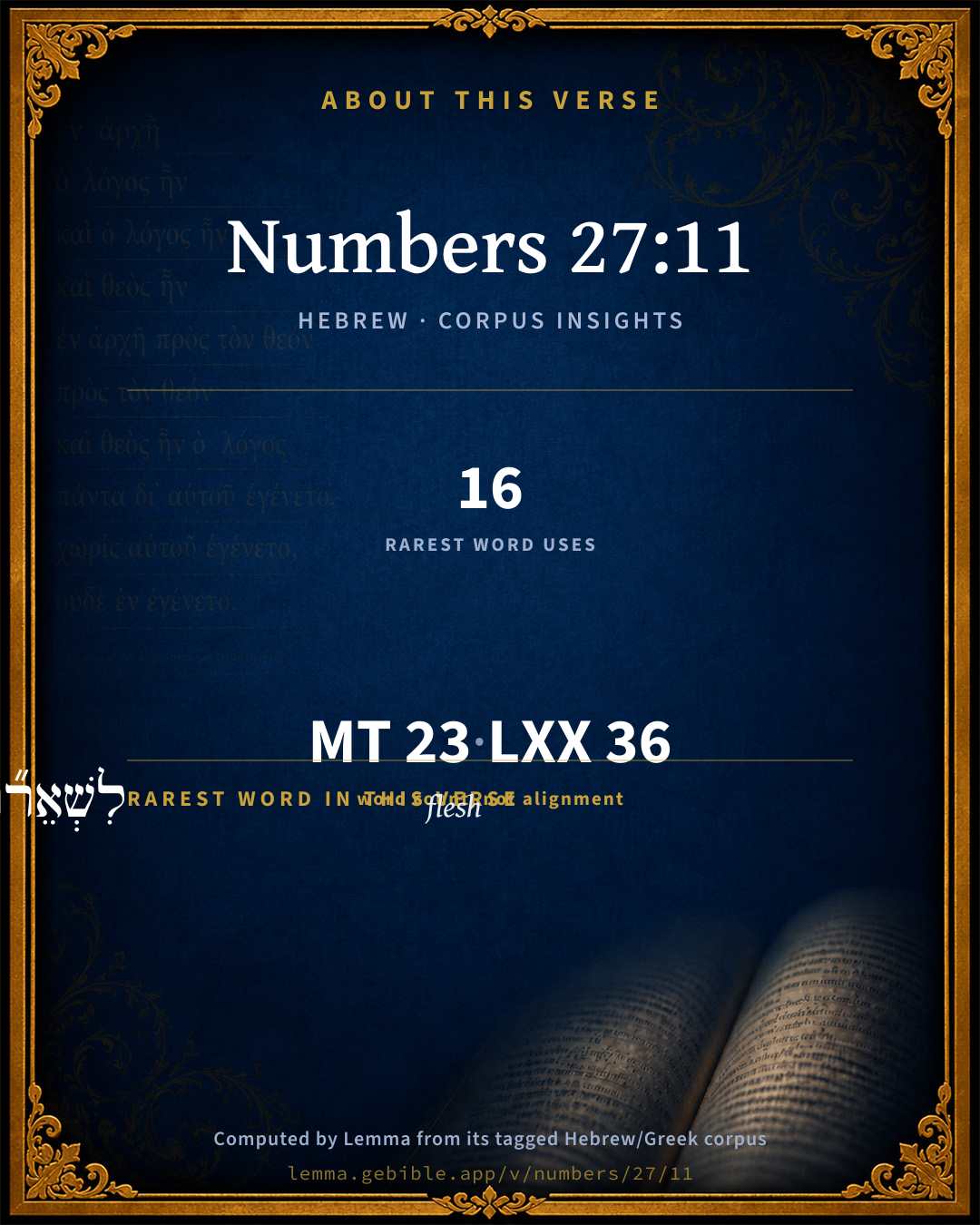
23
words
21
distinct lemmas
Pentateuch
section

Notable vocabulary

The rarest word here is לִשְׁאֵר֞וֹ flesh H7607 — appearing just 16 times in the whole Hebrew Bible.

Shared distinctive vocabulary

לִשְׁאֵר֞וֹ flesh H7607 occurs in 16 verses of the Hebrew Bible. Also found in:

Grammatical profile

  • 4 verbs
  • 11 nouns
  • 1 adjective
  • 1 preposition
  • 1 conjunction
  • 5 particles

Verb forms

  • וּנְתַתֶּ֣ם Qal · Sequential Perfect
  • וְיָרַ֣שׁ Qal · Sequential Perfect
  • וְֽהָ֨יְתָ֜ה Qal · Sequential Perfect
  • צִוָּ֥ה Piel · Perfect

Hebrew & Septuagint length

In English translation the verse runs 45 words from the Hebrew and 43 from the Septuagint (LXX English) — closely comparable.

A rough comparison of the two English renderings, which tokenize alike — not a word-level alignment.

Word counts can differ between the Hebrew and the Greek without any difference in meaning — e.g. the Hebrew direct-object marker אֵת has no separate Greek word, and Greek often adds the article ὁ.

In the original languages it is 23 Hebrew tokens and 36 Greek tokens — but the two are counted differently (Hebrew bundles its prefixes and suffixes into one token; the Greek is in lemma form), so that isn’t a like-for-like length.

Cross-references

6

Topical passages linked to Numbers 27:11 in the Treasury of Scripture Knowledge — connected by theme and wording, ordered by reader-vote popularity; previews shown in the World English Bible.

  • Numbers 35:29 These things shall be for a statute [and] ordinance to you throughout your generations in all your dwellings.
  • Ruth 4:3–6 He said to the near kinsman, Naomi, who has come back out of the country of Moab, is selling the parcel of land, which was our brother Elimelech's:
  • Jeremiah 32:8 So Hanamel my uncle's son came to me in the court of the guard according to the word of Yahweh, and said to me, Please buy my field that is in Anathoth, which is in the land of Benjamin; for the right of inheritance is yours, and the redemption is yours; buy it for yourself. Then I knew that this was the word of Yahweh.
  • Leviticus 25:25 "'If your brother becomes poor, and sells some of his possessions, then his kinsman who is next to him shall come, and redeem that which his brother has sold.
  • Leviticus 25:49 or his uncle, or his uncle's son, may redeem him, or any who is a close relative to him of his family may redeem him; or if he has grown rich, he may redeem himself.
  • 1 Samuel 30:25 It was so from that day forward, that he made it a statute and an ordinance for Israel to this day.

Cross-references courtesy of OpenBible.info (CC BY 4.0).

Hebrew and Greek witnesses Masoretic Hebrew ↔ Greek Septuagint

The same verse in the two great witnesses to the Old Testament, shown verse-for-verse.

These are two independent witnesses, not word-aligned to each other, and the Septuagint is shown in lemma (dictionary) form.

Hebrew Numbers 27:11 Masoretic · Westminster Leningrad Codex

וְאִם אֵ֣ין אַחִים֮ לְאָבִיו֒ וּנְתַתֶּ֣ם אֶת נַחֲלָת֗וֹ לִשְׁאֵר֞וֹ הַקָּרֹ֥ב אֵלָ֛יו מִמִּשְׁפַּחְתּ֖וֹ וְיָרַ֣שׁ אֹתָ֑הּ וְֽהָ֨יְתָ֜ה לִבְנֵ֤י יִשְׂרָאֵל֙ לְחֻקַּ֣ת מִשְׁפָּ֔ט כַּאֲשֶׁ֛ר צִוָּ֥ה יְהוָ֖ה אֶת מֹשֶֽׁה

If his father have no brothers, then you shall give his inheritance to his kinsman who is next to him of his family, and he shall possess it: and it shall be to the children of Israel a statute [and] ordinance, as Yahweh commanded Moses.

World English Bible · Public Domain

Greek LXX Numbers 27:11 Septuagint · lemma form

ἐάν δέ μή εἰμί ἀδελφός ὁ πατήρ αὐτός δίδωμι ὁ κληρονομία ὁ οἰκεῖος ὁ ἐγγύς αὐτός ἐκ ὁ φυλή αὐτός κληρονομέω ὁ αὐτός καί εἰμί οὗτος ὁ υἱός ἰσραήλ δικαίωμα κρίσις καθά συντάσσω κύριος ὁ μωυσῆς

And if there be no brethren of his father, you⌃ shall give the inheritance to his nearest relation of his tribe, to inherit his possessions; and this shall be to the children of Israel an ordinance of judgment, as the Lord commanded Moses.

LXX2012 (modern English Septuagint) · Public Domain

On this verse, The Pulpit Commentary discusses the Septuagint’s reading. Read the note in Commentary ↓

Hebrew: Westminster Leningrad Codex (CC BY 4.0). Greek: Septuagint (public domain); English from LXX2012 (modern English Septuagint) (Public Domain). How the Septuagint differs from the Hebrew →

Targum (Aramaic paraphrase)

2

The Targum is the ancient Jewish Aramaic paraphrase of the Hebrew Scriptures — an interpretive translation, not the Hebrew text itself. Onkelos (literal) and Pseudo-Jonathan (expansive) render the Torah, and Jonathan the Prophets. Coverage is partial: where no permissively-licensed English translation exists for a verse, only the Aramaic is shown. This is verse-level text, not a word-by-word alignment to the Hebrew.

  1. Targum Onkelos Torah (Genesis–Deuteronomy)
    וְאִם לֵית אַחִין לַאֲבוּהִי וְתִתְּנוּן יָת אַחֲסַנְתֵּיהּ לְקָרִיבֵיהּ דְקָרֵיבּ לֵיהּ מִזַרְעִיתֵיהּ וְיֵרַת יָתַהּ וּתְהֵי לִבְנֵי יִשְׂרָאֵל לִגְזֵירַת דִין כְּמָא דִי פַקִיד יְיָ יָת משֶׁה

    (no public-domain English translation for this verse)

    Targum Onkelos — Aramaic: “Onkelos Genesis” (public domain); “Onkelos Exodus” (public domain); “Onkelos Leviticus” (public domain); “Onkelos Numbers” (public domain); “Onkelos Deuteronomy” (public domain). English: “Sefaria Community Translation” (CC0 1.0 (public-domain dedication)); “J.W. Etheridge. The Targums of Onkelos and Jonathan Ben Uzziel on the Pentateuch. London: Longmans, Green, 1862” (public domain). Text via Sefaria.

  2. Targum Pseudo-Jonathan Torah (Genesis–Deuteronomy)
    וְאִין לֵית לֵיהּ אָחִין לְאָבוֹי וְתִתְּנוּן יַת אַחְסַנְתֵּיהּ לְקָרִיבֵיהּ דְקָרִיב לֵיהּ מִגְנִיסַת אָבוֹי וְיֵרוּת יָתָהּ וּתְהֵי לִבְנֵי יִשְרָאֵל לְאַחְוָיַית גְזֵירַת דִין הֵיכְמָא דְפַקֵיד יְיָ יַת משֶׁה

    but if his father had no brothers, then you shall give his possession to his kinsman who is nearest to him of his father's family to inherit. And this shall be the publication of a decree of judgment to the children of Israel, as the Lord hath commanded Mosheh.

    Targum Pseudo-Jonathan — Aramaic: “Targum Jonathan on Genesis” (public domain); “Targum Jonathan on Exodus” (public domain); “Targum Jonathan on Leviticus” (public domain); “Targum Jonathan on Numbers” (public domain); “Targum Jonathan on Deuteronomy” (public domain). English: “The Targum of Jonathan ben Uzziel, trans. J. W. Etheridge, London, 1862” (public domain). Text via Sefaria.

Commentary

Notes on Numbers 27:11 from classic Christian and Jewish commentators (each source and its license shown beneath its notes). The classic Christian expositions comment on the surrounding passage and are grouped to its opening verse, so a note may address several verses; the Jewish commentaries on the Tanakh (Rashi and others) are per-verse, so they appear only where the commentator wrote on this verse.

Lemma curates 59 commentaries, every one of them public domain or Creative Commons licensed, each selected and text-cleaned for this edition rather than reprinted as found. About our sources →

Trapp's Complete Commentary

John Trapp

Num 27:11 And if his father have no brethren, then ye shall give his inheritance unto his kinsman that is next to him of his family, and he shall possess it: and it shall be unto the children of Israel a statute of judgment, as the LORD commanded Moses.

Ver. 11. A statute of judgment.] A standing law; a standard for all cases of like kind in that policy at least. For we cannot consent to Carolostadius, who contended, in foro ius ex Mose discendum esse, that all other national and municipal laws were to be abolished; and that all courts were now to pass sentence according to Moses’ laws. Hic non intellexit vim et naturam Christianae libertatis, This man knew not the extent of Christian liberty, saith Melancthon.

John Trapp, A Commentary or Exposition upon All the Books of the Old and New Testament (1647–1656) — public domain. Text from a community e-Sword module.

Geneva Bible (1599)

Geneva Bible translators

Meaning, an ordinance to judge by.

Geneva Bible (1599) marginal notes — public domain. Text via Bolls.life.

The Cambridge Bible for Schools and Colleges

gen. ed. J. J. S. Perowne

11. a statute of judgement] The expression recurs in Num_35:29 only. It means ‘a statute which embodies a fixed and authoritative custom.’

12–23 (P ). Moses views the land of Canaan, and Joshua is appointed to succeed him.

The Cambridge Bible for Schools and Colleges (gen. ed. J. J. S. Perowne; Cambridge University Press, 1878–1918) — public domain. Text from a community e-Sword module.

John Gill's Exposition

And the Lord said unto Moses,.... After the covenant made with Israel in the plains of Moab, and the song delivered to them, Deu 29:1.

get thee up to this Mount Abarim; which was a range of mountains, so called from the passages by them over Jordan into the land of Canaan; one part of which was Nebo, and the top of that Pisgah, from whence Moses had the view of the good land here directed to; see Num 33:47.

and see the land which I have given unto the children of Israel; for though he was now one hundred and twenty years old, his eyes were not dim, he could see at a great distance; and the height of this hill gave him an advantage of taking a prospect of the land, a great way into it; and very probably his sight might be greatly strengthened and increased at this time by the Lord, for the purpose; this may be an emblem of that sight by faith, which believers have at times of the heavenly Canaan, and sometimes are favoured with an enlarged one of it before their death.

John Gill's Exposition of the Whole Bible (1746–1763) — public domain (CC PDM 1.0). Text via the HelloAO Bible API.

Haydock's Catholic Bible Commentary

Uncles. His nephews are at a greater distance from the original stock. The Phœnicians carried the same regulations into Africa. (Grotius, Jur. ii. 7.) The relations by the mother’s side, could claim no part. The husband was heir to all his wife’s goods, except her dowry, which went to her children. People born of a slave, or of a harlot or strange woman, were not lawful heirs. "These regulations have been adopted by all civilized nations." (Origen, hom. 22.) (Calmet)

George Leo Haydock (1774–1849), Haydock's Catholic Family Bible and Commentary, 1859 edition — public domain. Excludes Psalms (Douay-Rheims chapter numbering differs from Protestant) and Deuterocanonical books (Catholic canon only).

Matthew Poole's English Annotations

A statute of judgment; a statute or rule by which the magistrate shall give judgment in such cases.

Matthew Poole's English Annotations on the Holy Bible (1683–1685) — public domain. Text from a community e-Sword/MySword module.

The Pulpit Commentary

A statute of judgment, fpvmi tQ Septuagint, dikaiwma krisewv . A statute determining a legal right.

The Pulpit Commentary (1880–1919), ed. H.D.M. Spence-Jones & Joseph S. Exell — public domain. Text from a community e-Sword module.

John Wesley's Explanatory Notes

A statute of judgment - A statute or rule, by which the magistrates shall give judgment in such cases.

John Wesley, Explanatory Notes Upon the Whole Bible (1754–1765) — public domain. Text via the GEBible commentary corpus.

Rashi

Rabbi Shlomo Yitzchaki (Rashi)

לשארו הקרוב אליו ממשפחתו TO HIS KIN THAT IS NEXT TO HIM OF HIS FAMILY — The term משפחה used in connection with inheritance denotes kinship only on the father’s side (Sifrei Bamidbar 134:3; Bava Batra 119b).

Rashi on the Tanakh — English translations: “The Judaica Press complete Tanach with Rashi, translated by A. J. Rosenberg” (CC BY 4.0); “Pentateuch with Rashi's commentary by M. Rosenbaum and A.M. Silbermann, 1929-1934” (public domain); “The Metsudah Tanach series, Lakewood, N.J” (CC BY 4.0); and “The Book of Joshua, Metsudah Publications, 1997” (CC BY 4.0). Text via Sefaria.

Ramban (Nachmanides)

Rabbi Moshe ben Nachman (Ramban / Nachmanides)

AND IT SHALL BE UNTO THE CHILDREN OF ISRAEL A STATUTE OF JUDGMENT. The meaning thereof is that this judgment should be for all [future] generations, and not only for now when they inherited the Land [hence the expression “a statute, i.e., a permanent one, for all the children of Israel in all future generations”].

AS THE ETERNAL COMMANDED MOSES. This means: “as I have commanded you,” and the usage here is similar to [that in the verse], This is the statute of the law which the Eternal hath commanded. There are many similar cases.

Ramban (Nachmanides) on the Tanakh — English translation: “Commentary on the Torah by Ramban (Nachmanides). Translated and annotated by Charles B. Chavel. New York, Shilo Pub. House, 1971-1976” (CC BY 4.0). Text via Sefaria.

Lesson kit

Teaching starters — assembled from the data on this page, not authored interpretation. Every prompt links to the verse data it draws on. Edit before teaching.

Numbers, in the Pentateuch, opens this verse with 23 words (21 distinct Hebrew lemmas). Its most distinctive word is shᵉʼêr (“flesh”). A historical commentator’s framing appears above. Read the whole chapter for the surrounding context.

Discussion questions

  1. What does “flesh” (shᵉʼêr) contribute to the verse as a whole?
  2. How does Exodus 21:10, which shares the word «flesh», read alongside this verse?
  3. These translations render this verse differently. What is at stake in choosing one wording over another?
  4. «וּנְתַתֶּ֣ם» is a Qal Sequential Perfect verb. How does that grammatical form shape the action described?
  5. Compare how Trapp's Complete Commentary and Geneva Bible (1599) read this verse. Where do they agree or differ?

Things to notice

Reading settings

Reading text

Shown beneath each verse's original-language words.

Old Testament
Old Testament edition

Read the OT as the Masoretic Hebrew (MT) or the Greek Septuagint (LXX).

English shown for the Greek Septuagint (in the Hebrew ↔ Greek comparison).

Comparing translations? Open the Compare panel on any verse page to stack up to four side by side.