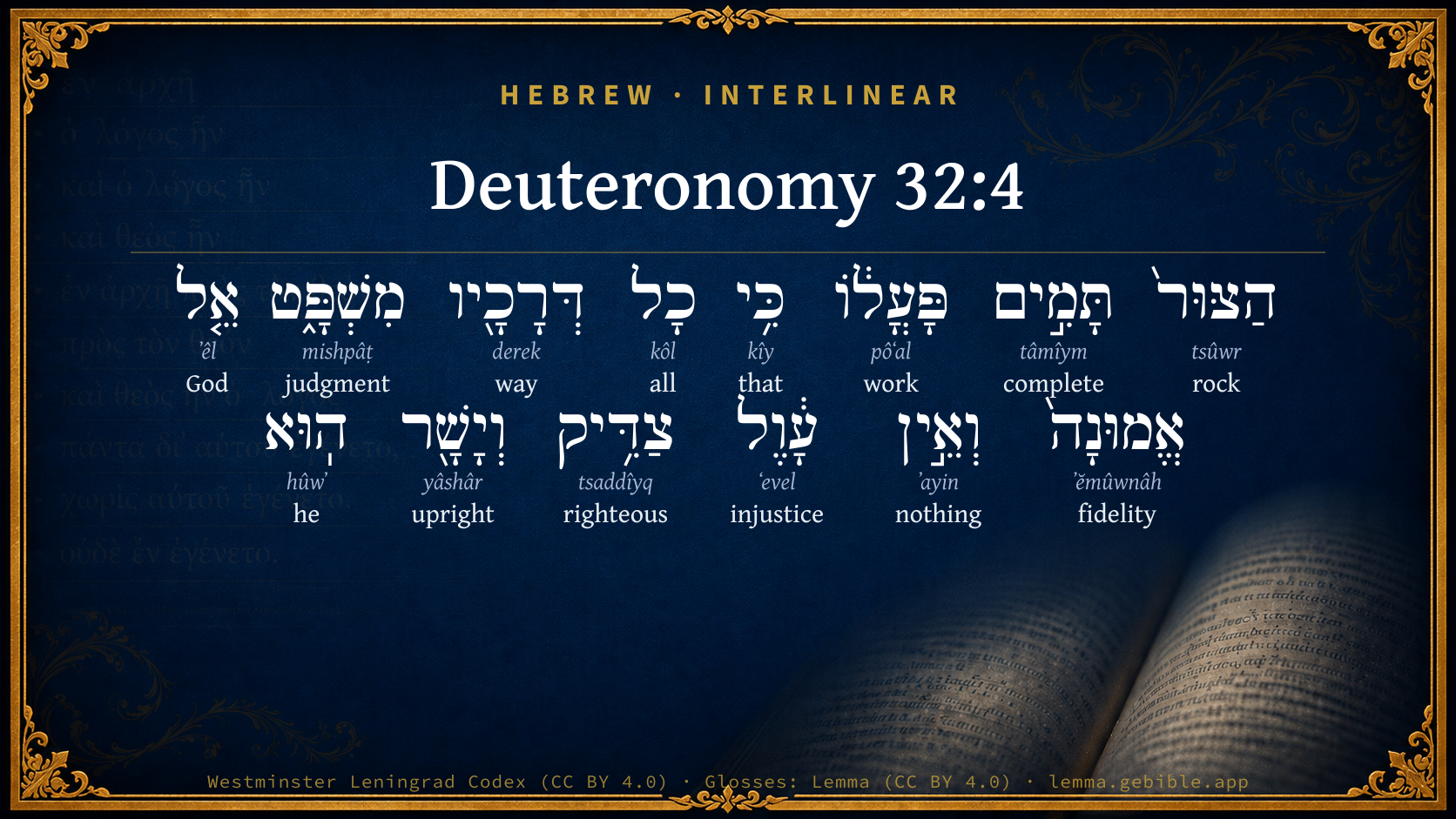
Deuteronomy 32:4

Hebrew (Westminster Leningrad Codex) Deuteronomy 32:4 appears in the Hebrew Old Testament. The text above is from the Westminster Leningrad Codex. Each word links to its Strong’s number, a concise gloss, and parsing drawn from the Open Scriptures Hebrew Bible morphology. Click any word for its full Brown-Driver-Briggs (BDB) entry.
Download image
Cite this verse

Deuteronomy 32:4 (World English Bible). Public Domain. Lemma interlinear Bible study tool, https://lemma.gebible.app/v/deuteronomy/32/4.

Show BibTeX & RIS
BibTeX
RIS
English Translation
The Rock, his work is perfect; For all his ways are justice: A God of faithfulness and without iniquity, Just and right is he.
World English Bible · Public Domain
Highlights
  • 1 first appearance in the Hebrew Bible
Full analysis ↓
Download a study sheet

One document with this verse’s original text, its word-by-word gloss line, the meaning frame, cross-references with their text, attributed commentary, and full source and license credits — printable, and it pastes into notes with its structure intact.

This verse Autodidact and up

Study sheet (.html) Plain text (.txt)

A passage Seminary Student

Up to 50 verses in one chapter. A passage sheet keeps up to 6 commentary sources and 12 cross-references per verse, in the order this page ranks them, and says so on the sheet whenever that leaves anything out. Ask for a single verse and you get the Autodidact verse sheet above.

Everything on this page stays free to read, with no account — the sheet is a download of what is already on screen, not access to it.

Want to remove ads? Support Godless Engineer
Compare translations 3

The same verse in 3 English versions, stacked beneath the original-language interlinear above. Click any original word for its lexicon entry.

Each is an independent rendering of the whole verse — the interlinear is not word-aligned to these translations.

Highlighted words mark where these versions differ — a whole-verse word diff, not a word-by-word alignment.

  • World English Bible Public Domain
    The Rock, his work is perfect; For all his ways are justice: A God of faithfulness and without iniquity, Just and right is he.
  • King James Version Public Domain
    He is the Rock, his work is perfect: for all his ways are judgment: a God of truth and without iniquity, just and right is he.
  • unfoldingWord Literal Text CC BY-SA 4.0
    The Rock, his work perfect, for all his ways just. A faithful God without iniquity, righteous and upright he. ts\*

unfoldingWord Literal Text — © unfoldingWord, licensed CC BY-SA 4.0. Word-aligned USFM3 via Door43 (git.door43.org/unfoldingWord/en_ult).

Versions to compare (up to 4)

3 of 4 selected

Show all 18 translations

Every available English version of this verse, each an independent rendering of the whole verse.

  • World English Bible Public Domain
    The Rock, his work is perfect; For all his ways are justice: A God of faithfulness and without iniquity, Just and right is he.
  • Berean Standard Bible Public Domain
    He is the Rock, His work is perfect; all His ways are just. A God of faithfulness without injustice, righteous and upright is He.
  • Majority Standard Bible Public Domain
    He is the Rock, His work is perfect; all His ways are just. A God of faithfulness without injustice, righteous and upright is He.
  • King James Version Public Domain
    He is the Rock, his work is perfect: for all his ways are judgment: a God of truth and without iniquity, just and right is he.
  • American Standard Version (1901) Public Domain
    The Rock, his work is perfect; For all his ways are justice: A God of faithfulness and without iniquity, Just and right is he.
  • Revised Version (1885) Public Domain
    The Rock, his work is perfect; For all his ways are judgment: A God of faithfulness and without iniquity, Just and right is he.
  • Geneva Bible (1599) Public Domain
    Perfect is the worke of the mighty God: for all his wayes are iudgement. God is true, and without wickednesse: iust, and righteous is he.
  • Douay-Rheims (1899) Public Domain
    The works of God are perfect, and all his ways are judgments: God is faithful and without any iniquity, he is just and right.
  • Young's Literal Translation Public Domain
    The Rock! -- perfect `is' His work, For all His ways `are' just; God of stedfastness, and without iniquity: Righteous and upright `is' He.
  • Literal Standard Version CC BY-SA 4.0
    The Rock—His work [is] perfect, || For all His ways [are] just; God of steadfastness, and without iniquity; Righteous and upright [is] He.
  • Unlocked Literal Bible CC BY-SA 4.0
    The Rock, his work is perfect; for all his paths are just. He is the faithful God, without iniquity. He is just and upright.
  • unfoldingWord Literal Text CC BY-SA 4.0
    The Rock, his work perfect, for all his ways just. A faithful God without iniquity, righteous and upright he. ts\*
  • Darby Bible Public Domain
    [He is] the Rock, his work is perfect, For all his ways are righteousness; A ùGod of faithfulness without deceit, Just and right is he.
  • World Messianic Bible Public Domain
    The Rock: his work is perfect, for all his ways are just. A God of faithfulness who does no wrong, just and right is he.
  • Webster's Bible Public Domain
    He is the Rock, his work is perfect: for all his ways are judgment: a God of truth and without iniquity: just and right is he.
  • Free Bible Version CC BY-SA 4.0
    He is the Rock. Everything he does is perfect, for all his ways are right. He is the trustworthy God who is never unjust; he is fair and honest.
  • Bible in Basic English Public Domain
    He is the Rock, complete is his work; for all his ways are righteousness: a God without evil who keeps faith, true and upright is he.
  • JPS Tanakh (1917) Public Domain
    The Rock, His work is perfect; for all His ways are justice; a God of faithfulness and without iniquity, just and right is He.

Literal Standard Version (2020), Covenant Press — licensed CC BY-SA 4.0. Text via the HelloAO Bible API (eBible.org). Unlocked Literal Bible (unfoldingWord) — licensed CC BY-SA 4.0. Text via the HelloAO Bible API (eBible.org). unfoldingWord Literal Text — © unfoldingWord, licensed CC BY-SA 4.0. Word-aligned USFM3 via Door43 (git.door43.org/unfoldingWord/en_ult). Free Bible Version, Dr. Jonathan Gallagher — licensed CC BY-SA 4.0. Text via the HelloAO Bible API (eBible.org).

Word by word

More ways to search: Search by grammar → Find every occurrence → Compare this word →

Practice this passage: Drill this verse → Learn its vocabulary →

פָּעֳל֔וֹ
pôʻal
H6467
“work · his”
Noun, Common, Masculine, Singular, Construct + Suffix, Personal, 3rd Person, Masculine, Singular
Part of Speech
Noun
Type
Common
Gender
Masculine
Number
Singular
State
Construct
Full BDB Definition

Origin: from H6466

TWOT: 1792a

work, deed, doing - deed, thing done - work, thing made - wages of work - acquisition (of treasure)
  1. הַצּוּר֙ tsûwr H6697 “the · rock” Particle, Definite Article + Noun, Common, Masculine, Singular, Absolute
  2. תָּמִ֣ים tâmîym H8549 “complete” Adjective, Adjective, Masculine, Singular, Absolute
  3. כִּ֥י kîy H3588 “that” Conjunction
  4. כָל kôl H3605 “all of” Noun, Common, Masculine, Singular, Construct
  5. דְּרָכָ֖יו derek H1870 “ways · his” Noun, Common, Both, Plural, Construct + Suffix, Personal, 3rd Person, Masculine, Singular
  6. מִשְׁפָּ֑ט mishpâṭ H4941 “judgment” Noun, Common, Masculine, Singular, Absolute
  7. אֵ֤ל ʼêl H410 “God of” Noun, Common, Masculine, Singular, Construct
  8. אֱמוּנָה֙ ʼĕmûwnâh H530 “fidelity” Noun, Common, Feminine, Singular, Absolute
  9. וְאֵ֣ין ʼayin H369 “and · nothing” Conjunction + Particle, Negative
  10. עָ֔וֶל ʻevel H5766 “injustice” Noun, Common, Both, Singular, Absolute
  11. צַדִּ֥יק tsaddîyq H6662 “righteous” Adjective, Adjective, Masculine, Singular, Absolute
  12. וְיָשָׁ֖ר yâshâr H3477 “and · upright” Conjunction + Adjective, Adjective, Masculine, Singular, Absolute
  13. הֽוּא hûwʼ H1931 “he” Pronoun, Personal, 3rd Person, Masculine, Singular

About this verse

These counts appear in no published source. They are computed here, from the morphology-tagged text and Lemma’s own curated glosses. What Lemma adds →

14
words
14
distinct lemmas
Pentateuch
section

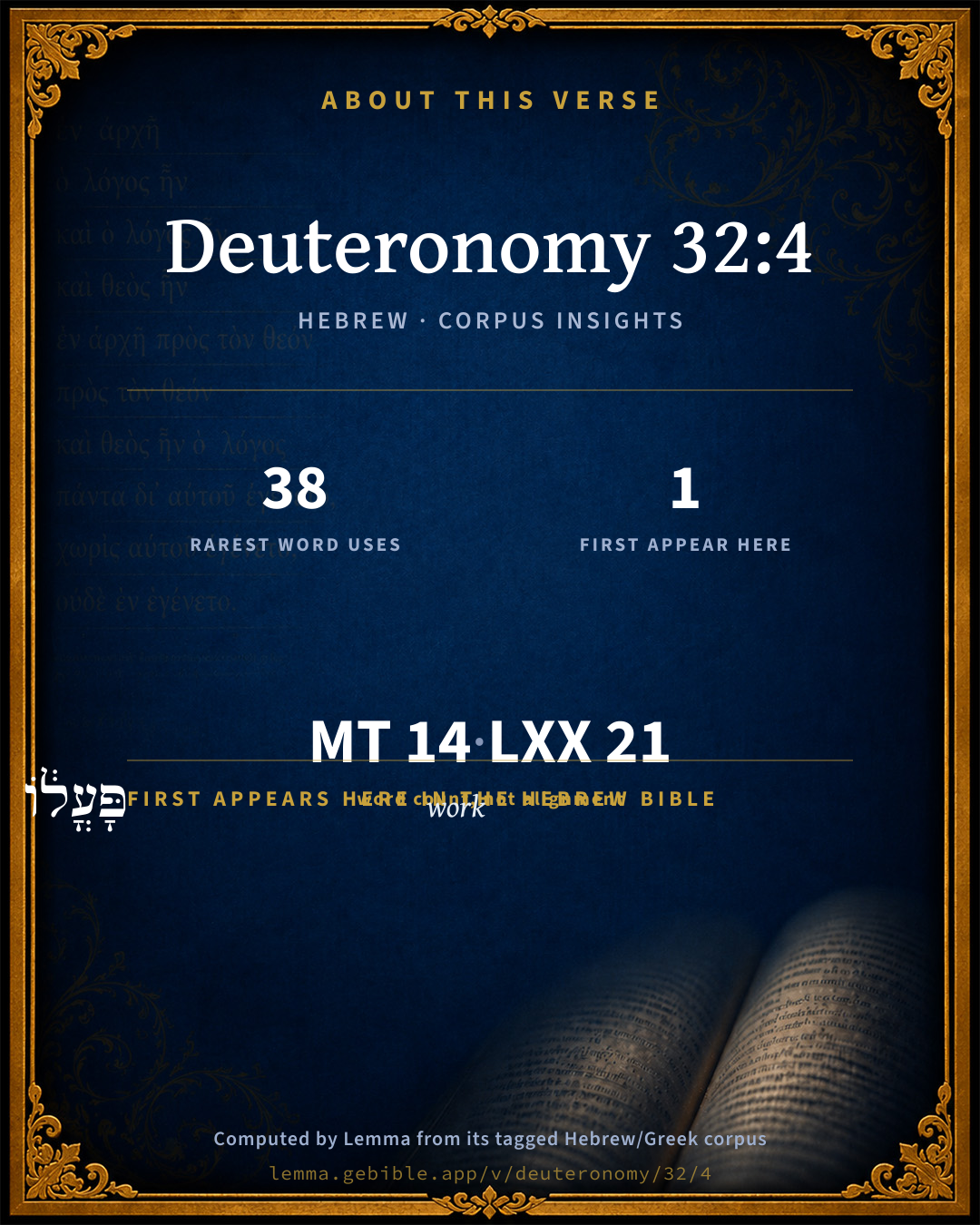
First appearance in Scripture

This word makes its first canonical appearance in the Hebrew Bible here:

  • פָּעֳל֔וֹ work H6467

Shared distinctive vocabulary

פָּעֳל֔וֹ work H6467 occurs in 38 verses of the Hebrew Bible. Also found in:

Grammatical profile

  • 8 nouns
  • 3 adjectives
  • 1 pronoun
  • 1 conjunction
  • 1 particle

Hebrew & Septuagint length

In English translation the verse runs 24 words from the Hebrew and 29 from the Septuagint (LXX English) — closely comparable.

A rough comparison of the two English renderings, which tokenize alike — not a word-level alignment.

Word counts can differ between the Hebrew and the Greek without any difference in meaning — e.g. the Hebrew direct-object marker אֵת has no separate Greek word, and Greek often adds the article ὁ.

In the original languages it is 14 Hebrew tokens and 21 Greek tokens — but the two are counted differently (Hebrew bundles its prefixes and suffixes into one token; the Greek is in lemma form), so that isn’t a like-for-like length.

Cross-references

54

Topical passages linked to Deuteronomy 32:4 in the Treasury of Scripture Knowledge — connected by theme and wording, ordered by reader-vote popularity; previews shown in the World English Bible.

  • Psalms 18:30–31 As for God, his way is perfect. The word of Yahweh is tried. He is a shield to all those who take refuge in him.
  • Psalms 92:15 To show that Yahweh is upright. He is my rock, And there is no unrighteousness in him.
  • Isaiah 26:4 Trust in Yahweh forever; for in Yah, Yahweh, is an everlasting Rock.
  • 2 Samuel 22:31–32 As for God, his way is perfect: The word of Yahweh is tried; He is a shield to all those who take refuge in him.
  • Psalms 18:2 Yahweh is my rock, my fortress, and my deliverer; My God, my rock, in whom I take refuge; My shield, and the horn of my salvation, my high tower.
  • Daniel 4:37 Now I, Nebuchadnezzar, praise and extol and honor the King of heaven; for all his works are truth, and his ways justice; and those who walk in pride he is able to abase.
  • Revelation 15:3–4 They sang the song of Moses, the servant of God, and the song of the Lamb, saying, "Great and marvelous are your works, Lord God, the Almighty; Righteous and true are your ways, you King of the nations.
  • Deuteronomy 32:30–31 How should one chase a thousand, Two put ten thousand to flight, Except their Rock had sold them, Yahweh had delivered them up?
  • Psalms 100:5 For Yahweh is good. His loving kindness endures forever, His faithfulness to all generations.
  • Matthew 5:48 Therefore you shall be perfect, just as your Father in heaven is perfect.
  • James 1:17 Every good gift and every perfect gift is from above, coming down from the Father of lights, with whom can be no variation, nor turning shadow.
  • 2 Samuel 22:2–3 and he said, Yahweh is my rock, and my fortress, and my deliverer, even mine;
  • 1 Corinthians 10:4 and all drank the same spiritual drink. For they drank of a spiritual rock that followed them, and the rock was Christ.
  • Genesis 18:25 Be it far from you to do things like that, to kill the righteous with the wicked, that so the righteous should be as the wicked. May that be far from you. Shouldn't the Judge of all the earth do right?"
  • Jeremiah 9:24 but let him who glories glory in this, that he has understanding, and knows me, that I am Yahweh who exercises loving kindness, justice, and righteousness, in the earth: for in these things I delight, says Yahweh.
  • Isaiah 25:1 Yahweh, you are my God; I will exalt you, I will praise your name; for you have done wonderful things, [even] counsels of old, in faithfulness [and] truth.
  • John 1:14 The Word became flesh, and lived among us. We saw his glory, such glory as of the one and only Son of the Father, full of grace and truth.
  • John 14:6 Jesus said to him, "I am the way, the truth, and the life. No one comes to the Father, except through me.
  • Romans 2:2 We know that the judgment of God is according to truth against those who practice such things.
  • Romans 3:5 But if our unrighteousness commends the righteousness of God, what will we say? Is God unrighteous who inflicts wrath? I speak like men do.
  • Deuteronomy 32:15 But Jeshurun grew fat, and kicked: You have grown fat, you are grown thick, you are become sleek; Then he forsook God who made him, Lightly esteemed the Rock of his salvation.
  • Deuteronomy 32:18 Of the Rock that became your father, you are unmindful, Have forgotten God who gave you birth.
  • Job 34:10 "Therefore listen to me, you men of understanding: Far be it from God, that he should do wickedness, From the Almighty, that he should commit iniquity.
  • Psalms 97:2 Clouds and darkness are around him. Righteousness and justice are the foundation of his throne.
  • Isaiah 28:16 therefore thus says the Lord Yahweh, Behold, I lay in Zion for a foundation a stone, a tried stone, a precious corner -[stone] of sure foundation: he who believes shall not be in haste.
  • Habakkuk 1:13 You who have purer eyes than to see evil, and who cannot look on perversity, why do you tolerate those who deal treacherously, and keep silent when the wicked swallows up the man who is more righteous than he,
  • John 5:22 For the Father judges no one, but he has given all judgment to the Son,
  • 1 Peter 2:6 Because it is contained in Scripture, "Behold, I lay in Zion a chief cornerstone, chosen, and precious: He who believes in him will not be disappointed."
  • 1 Samuel 2:2 There is none holy as Yahweh; For there is none besides you, Neither is there any rock like our God.
  • 2 Samuel 22:47 Yahweh lives; Blessed be my rock; Exalted be God, the rock of my salvation,
  • 2 Samuel 23:3 The God of Israel said, The Rock of Israel spoke to me: One who rules over men righteously, Who rules in the fear of God,
  • Job 35:14 How much less when you say you don't see him. The cause is before him, and you wait for him!
  • Psalms 9:16 Yahweh has made himself known. He has executed judgment. The wicked is snared by the work of his own hands. Meditation. Selah.
  • Psalms 18:46 Yahweh lives; and blessed be my rock. Exalted be the God of my salvation,
  • Psalms 19:7 Yahweh's law is perfect, restoring the soul. Yahweh's testimony is sure, making wise the simple.
  • Psalms 31:5 Into your hand I commend my spirit. You redeem me, Yahweh, God of truth.
  • Psalms 61:2–4 From the end of the earth, I will call to you, when my heart is overwhelmed. Lead me to the rock that is higher than I.
  • Psalms 98:3 He has remembered his loving kindness and his faithfulness toward the house of Israel. All the ends of the earth have seen the salvation of our God.
  • Psalms 99:4 The King's strength also loves justice. You do establish equity. You execute justice and righteousness in Jacob.
  • Psalms 138:8 Yahweh will fulfill that which concerns me; Your loving kindness, Yahweh, endures forever. Don't forsake the works of your own hands.
  • Psalms 146:6 Who made heaven and earth, The sea, and all that is in them; Who keeps truth forever;
  • Ecclesiastes 3:14 I know that whatever God does, it shall be forever. Nothing can be added to it, nor anything taken from it; and God has done it, that men should fear before him.
  • Isaiah 30:18 Therefore will Yahweh wait, that he may be gracious to you; and therefore will he be exalted, that he may have mercy on you: for Yahweh is a God of justice; blessed are all those who wait for him.
  • Isaiah 32:2 A man shall be as a hiding-place from the wind, and a covert from the tempest, as streams of water in a dry place, as the shade of a great rock in a weary land.
  • Jeremiah 10:10 But Yahweh is the true God; he is the living God, and an everlasting King: at his wrath the earth trembles, and the nations are not able to abide his indignation.
  • Matthew 16:16–18 Simon Peter answered, "You are the Christ, the Son of the living God."
  • John 1:17 For the law was given through Moses. Grace and truth came through Jesus Christ.
  • Romans 1:32 who, knowing the ordinance of God, that those who practice such things are worthy of death, not only do the same, but also approve of those who practice them.
  • Romans 2:5 But according to your hardness and unrepentant heart you are treasuring up for yourself wrath in the day of wrath, revelation, and of the righteous judgment of God;
  • James 4:12 Only one is the lawgiver, who is able to save and to destroy. But who are you to judge another?
  • Exodus 34:6 Yahweh passed by before him, and proclaimed, "Yahweh! Yahweh, a merciful and gracious God, slow to anger, and abundant in loving kindness and truth,
  • Deuteronomy 7:9 Know therefore that Yahweh your God, he is God, the faithful God, who keeps covenant and loving kindness with them who love him and keep his commandments to a thousand generations,
  • Deuteronomy 10:18 He does execute justice for the fatherless and widow, and loves the foreigner, in giving him food and clothing.
  • Genesis 1:31 God saw everything that he had made, and, behold, it was very good. There was evening and there was morning, the sixth day.

Cross-references courtesy of OpenBible.info (CC BY 4.0).

Hebrew and Greek witnesses Masoretic Hebrew ↔ Greek Septuagint

The same verse in the two great witnesses to the Old Testament, shown verse-for-verse.

These are two independent witnesses, not word-aligned to each other, and the Septuagint is shown in lemma (dictionary) form.

Hebrew Deuteronomy 32:4 Masoretic · Westminster Leningrad Codex

הַצּוּר֙ תָּמִ֣ים פָּעֳל֔וֹ כִּ֥י כָל דְּרָכָ֖יו מִשְׁפָּ֑ט אֵ֤ל אֱמוּנָה֙ וְאֵ֣ין עָ֔וֶל צַדִּ֥יק וְיָשָׁ֖ר הֽוּא

The Rock, his work is perfect; For all his ways are justice: A God of faithfulness and without iniquity, Just and right is he.

World English Bible · Public Domain

Greek LXX Deuteronomy 32:4 Septuagint · lemma form

θεός ἀληθινός ὁ ἔργον αὐτός καί πᾶς ὁ ὁδός αὐτός κρίσις θεός πιστός καί οὐ εἰμί ἀδικία δίκαιος καί ὅσιος κύριος

As for God, his works are true, and all his ways are judgment: God is faithful, and there is no unrighteousness in him; just and holy is the Lord.

LXX2012 (modern English Septuagint) · Public Domain

On this verse, Ellicott's Commentary for English Readers discusses the Septuagint’s reading. Read the note in Commentary ↓

Hebrew: Westminster Leningrad Codex (CC BY 4.0). Greek: Septuagint (public domain); English from LXX2012 (modern English Septuagint) (Public Domain). How the Septuagint differs from the Hebrew →

Targum (Aramaic paraphrase)

2

The Targum is the ancient Jewish Aramaic paraphrase of the Hebrew Scriptures — an interpretive translation, not the Hebrew text itself. Onkelos (literal) and Pseudo-Jonathan (expansive) render the Torah, and Jonathan the Prophets. Coverage is partial: where no permissively-licensed English translation exists for a verse, only the Aramaic is shown. This is verse-level text, not a word-by-word alignment to the Hebrew.

  1. Targum Onkelos Torah (Genesis–Deuteronomy)
    תַּקִיפָא דְשָׁלְמִין עוֹבָדוֹהִי אֲרֵי כָּל אֹרְחָתֵהּ דִינָא אֱלָהָא מְהֵימְנָא דְמִן קֳדָמוֹהִי עַוְלָה לָא נָפֵק מִן קֳדָם דְזַכַּי וְקַשִׁיט הוּא

    (no public-domain English translation for this verse)

    Targum Onkelos — Aramaic: “Onkelos Genesis” (public domain); “Onkelos Exodus” (public domain); “Onkelos Leviticus” (public domain); “Onkelos Numbers” (public domain); “Onkelos Deuteronomy” (public domain). English: “Sefaria Community Translation” (CC0 1.0 (public-domain dedication)); “J.W. Etheridge. The Targums of Onkelos and Jonathan Ben Uzziel on the Pentateuch. London: Longmans, Green, 1862” (public domain). Text via Sefaria.

  2. Targum Pseudo-Jonathan Torah (Genesis–Deuteronomy)
    אָמַר משֶׁה נְבִיָא כַּד סְלֵיקַת לְטַוְורָא דְסִינַי חָמִית רִבּוֹן כָּל עָלְמַיָא יְיָ מְרַבַּע יוֹמָא לְאַרְבָּעָא חוּלְקִין תְּלַת שָׁעִין עָסִיק בְּאוֹרַיְיתָא וּתְלַת עָסִיק בְּדִינָא וּתְלַת מְכַרְזֵג בֵּין גְבַר לְאִיתָא וּגְזַר לִמְרוֹמָם וּמָאִיךְ וּתְלַת מְפַרְנֵס כָּל בִּרְיָיתָא דְהָכִין כְּתִיב תַּקִיף דְשַׁלְמִין עוֹבָדוֹי אֲרוּם כָּל אָרְחָתוֹי דִינָא אֱלָהָא מְהֵימְנָא דְמִן קֳדָמוֹי עַוְלָא לָא נָפִיק דְזַכַּאי וְקָשִׁיט הוּא

    Mosheh the prophet said: When I ascended the mountain of Sinai, I beheld the Lord of all the worlds, the Lord, dividing the day into four portions; three hours employed in the law, three with judgment, three in making marriage bonds between man and woman, and appointing to elevate or to abase, and three hours in the care of every created thing: for so it is written: The Mighty One whose works are perfect, for all His ways are judgment, a faithful God before whom no iniquity comes forth, pure and upright is He.

    Targum Pseudo-Jonathan — Aramaic: “Targum Jonathan on Genesis” (public domain); “Targum Jonathan on Exodus” (public domain); “Targum Jonathan on Leviticus” (public domain); “Targum Jonathan on Numbers” (public domain); “Targum Jonathan on Deuteronomy” (public domain). English: “The Targum of Jonathan ben Uzziel, trans. J. W. Etheridge, London, 1862” (public domain). Text via Sefaria.

Commentary

Notes on Deuteronomy 32:4 from classic Christian and Jewish commentators (each source and its license shown beneath its notes). The classic Christian expositions comment on the surrounding passage and are grouped to its opening verse, so a note may address several verses; the Jewish commentaries on the Tanakh (Rashi and others) are per-verse, so they appear only where the commentator wrote on this verse.

Lemma curates 59 commentaries, every one of them public domain or Creative Commons licensed, each selected and text-cleaned for this edition rather than reprinted as found. About our sources →

Trapp's Complete Commentary

John Trapp

Deu 32:4 [He is] the Rock, his work [is] perfect: for all his ways [are] judgment: a God of truth and without iniquity, just and right [is] he.

Ver. 4. He is the rock.] A firm and everlasting refuge, a "Rock of Ages." {Isa 26:4} One age passeth away, and another, and a third, &c., but the rock remains. "The name of the Lord is a strong tower"; {Pro 18:10} "munition of rocks"; {Isa 33:16} rocks so deep, no pioneer can undermine them; so thick, no cannon can pierce them; so high, no ladder can scale them.

John Trapp, A Commentary or Exposition upon All the Books of the Old and New Testament (1647–1656) — public domain. Text from a community e-Sword module.

The Biblical Illustrator

Joseph S. Exell

Deu_32:4

He is the Rock.

The Rock and its associations

Seven times does this strong figure the Rock occur in the song. The metaphor is self-explanatory, the stability of rock being a fit emblem of the Divine immutability of purpose, and of God being faithful to His covenant and promises. This is the ruling and recurring idea of the song, coming in like a refrain, and giving unity to the whole. And how deeply did this image of God, the Rock, take hold upon the mind of Israel! Here it stands in the very forefront; the first word in the construction, to mark the importance we must assign to it. For, besides its native significance of impregnable strength and security, an additional depth of meaning was imparted to the emblem from Moses own history and experience (Exo_17:6; Exo_33:21-22). It gradually passes upwards from an objective to a subjective or experimental application, when not only the nature of the rock, but its various uses, afforded fresh and serviceable emblems. The Gospel to the Old Testament Church was not merely, God is a rock, firm and faithful, but He is the Rock, with all the precious associations and all the realised practical value added to the term, whether it were employed for a hiding place and protection or for shade--the shadow of a great rock in a weary land--or, most significantly of all, suggested by the smitten rock in Horeb, a source and guarantee of suitable and sufficient supply in case of dire necessity to the perishing. It is emphatically a covenant made, and speaks the language of redemption. The song proceeds to develop the applicability of the word in a three-fold direction, attaching it at once to Gods work, His ways, and His character. The Rock--

1. His work is perfect. It is not as artificer, but as architect, we are here to regard His work as perfect. He has a providential and redemptive plan, complete in all its details; having no need for after-thoughts, and not requiring reconstruction or amendment. In this respect His work is perfect; and when fully accomplished will justify and vindicate itself.

2. To understand the Divine plan or speak of it aright, we must wait till then. For all His ways are judgment, nothing being subject to caprice or arbitrariness. His is an immutability of counsel, carried into execution by the goodwill He hath purposed in Himself. What a contrast to the feeble, vacillating, arbitrary ways of man!

3. But, above all, He Himself in His own character is the Rock. This confidence in the Divine nature itself; in Jehovahs absolute truth and equity; in His unerring rectitude and all-wise faithfulness--this is the supreme resting place. It is also set forth here as the high well-spring of all dutiful submission, of all loyal-hearted allegiance, and of all uncorruptness in religion and piety. In it the singer finds the strongest ground for rebuke, remonstrance, and reproach to the people. (A. H. Drysdale, M. A.)

God as a Rock

He is the Rock, a Rock indeed. If we speak of strength, lo, He is strong; if of stability, He is the Lord, and changes not--the Ancient of Days. Hast not thou heard and considered this, that the Almighty faints not, and wearies not? He holds forth Himself in such a name to His people, a ready, all-sufficient, and enduring Refuge to all that trust in Him; and this is the foundation that the Church is built on, against which the gates of hell shall not prevail. Gods omnipotency for defences, His eternity, faithfulness, and unchangeableness to make that sure, His mercy and goodness make a hole in that Rock to enter in, a ready access for poor shipwrecked and broken men, who have no other refuge. This is our Rock, on which the Church is built, Jesus Christ (1Co_10:4; Mat_16:18). God were inaccessible in Himself--an impregnable Rook; how would sinners overcome Him, and enter into Him to be saved from wrath? Oh, how sad is the secret reproof contained in this commendation of God! He hath been a Rock to us, our Refuge that we fled unto, and found sure, yet have we left our Rock, gone out from our Strength; He offers Himself a Rock unto us--His all-sufficiency--and yet we leave the Fountain of living waters and dig broken cisterns; had rather choose our own broken ship to toss up and down into. He abides forever the same; though we change, He changes not. How may it reprove our backslidings, that we depart from our Rock, and where shall we find a refuge in the day of indignation? Is there any created mountain, but some floods will cover? Therefore it is folly and madness to forsake this Rock. (H. Binning.)

His work is perfect.

Gods works perfect

As He doth not trouble Himself when all is troubled about Him, so He keeps him all in perfect peace whose mind is stayed on Him; so also what He doth among men, though it cannot pass without mans censure, yet it is in itself perfect, complete, without defect.

1. His works are perfect in relation to the beginning and original of them--His own everlasting purpose. Men often bring forth works by guess, by their purpose, so no wonder it answer not their desire; but known to Him are all His works from the beginning, and so He doth nothing in time but what was His everlasting pleasure. Often we purpose well, and resolve perfectly, but our practice is a cripple--execution of it is maimed and imperfect; but all His works are carved out and done just as He designed them, without the least alteration; and, if it had not been well, would He have thought on it so and resolved it beforehand?

2. His works are perfect in relation to the end to which He appointed them. It may be it is not perfect in itself--a blind eye is not so perfect as a seeing eye: nay, but in relation to the glory of His name, who hath a purpose to declare His power by restoring that sight, it is as perfect. And in this sense all the imperfection of the creatures and creation, all of them are perfect works, for they accomplish the end wherefor they were sent; and so the night declares His name, and utters a speech as well as the day, the winter as the summer, the wilderness as the fruitful field; for what is the perfection of the creature but in as far as it accomplishes His purpose as the Maker of it? And therefore all His work is perfect, for it is all framed in wisdom to His own ends, in number, measure, and weight; it is so exactly agreeing to that, that you could not imagine it better.

3. Again, His work is perfect if we take it altogether, and do not cut it in parcels and look on it so. Letters and syllables make no sense till you conjoin them in words, and words in sentences. Even so it is here: if we look on the day alone, the light of it being perpetual would weary us, the night alone would be more so; but the interchange of them is pleasant. Day and night together make a distinct language of Gods praise. So God has set prosperity and adversity the one over against the other; one of them, it may be, seems imperfect; nay, but it is a perfect work that is made up of both. Spots in the face commend the beauty of the rest of it. If you would, then, look upon Gods work aright, look at it in the sanctuarys light, and you shall say, He hath done all well.

4. Entertain this thought in your heart, that He hath done all well; let not your secret thoughts so much as call them in question. If once you question, you will quickly censure them. Hold this persuasion, that nothing can be better than what He doth.

5. Let this secretly reprove your hearts, the perfection of His works stains our works. Oh, how imperfect are they! And which is worse, how bold are we to censure His and absolve our own! If He have a hand in our work, yet these imperfect works are perfect in regard of Him; as we have a hand in His perfect works, yet His perfect works are imperfect in regard of us. (H. Binning.)

All His ways are judgment.--

Gods ways perfect

This is to the same purpose--His ways and His works are one; and this is the perfection of His work, that it is all right and equal. Whether they be in justice or mercy, they are all righteous and holy--no iniquity in them. His ways are straight and equal, exact as if they were measured by an exact, even rule; but because we make application of a crooked rule to them, we do imagine that they are crooked--as the blind man judges no light to be because he sees it not. How may the Lord contend and plead with us, as with the people? (Eze_18:25.) And yet behold the iniquity of mens hearts; there is a secret reflection of our spirits upon His majesty as if His ways were not equal, whenever we repine against them. Behold, the Lord will assert His own ways, and plead with all flesh this controversy, that all His proceedings are full of equity; He walks according to a rule, though He be not tied to a rule. But we walk not according to a rule, though we be bound to a rule, and a rule full of equity. Here is the equity of His ways; the Gospel holds it forth in a two-fold consideration.

1. If any man turn from his iniquity, and flee unto My Son as the City of Refuge, he shall live. Iniquity shall not be his ruin, although he hath done iniquity. Oh! who is a God like unto Thee, that pardoneth iniquity? Is not this complete mercy? And on the other hand, whosoever continueth in sin, though he appear to himself and others never so righteous, shall not he die in his iniquity? Is there any iniquity in this, that he receive the wages of his works, that he eat of the fruit of his own ways, and drink of his own devices?

2. This way of the Lord is equal and right in itself, but it is not so to everyone; the just man shall walk in it, and not stumble--as in an even way; nothing shall offend him (Hos_14:9). Yet, equal and straight as it is, many other transgressors shall fall therein; they stumble even in the noonday and highway, where no offence is. By all means embrace the Word, and be satisfied with it, when you do not comprehend His work; it teaches as much in general as may put us to quietness. All His ways are judgment; just and true in all His ways is the King of saints. If I do not comprehend how it is, no wonder, for He makes darkness His covering; He spreads over His most curious pieces of workmanship a veil of darkness for a season. Therefore let us hearken to His Word, and believe its sentence on His work, when reason cannot comprehend it. (H. Binning.)

A God of truth--

The truth of God

I. What we are to understand by the truth of God. Not only His veracity, but His faithfulness.

II. That this perfection belongs to God. And this I shall endeavour to prove.

1. From the dictates of natural light. Natural light tells us that truth and faithfulness are perfections, and consequently belong to the Divine nature; and that falsehood and a lie are imperfections, and to be removed from God.

2. From Scripture. The Scripture doth very frequently attribute this to God (2Sa_7:28; Psa_25:10; Psa_31:5; Rev_3:7; Rev_6:10; Psa_15:3; Psa_16:7). And the Scripture doth not only in general attribute this perfection to God, but doth more particularly assure us of His sincerity and truth and faithfulness. Of His sincerity, that He deals plainly with us and speaks what He intends, that His words are the image of His thoughts and a true representation of His mind. And as the Scripture assures us of His sincerity, He of His truth and faithfulness in the accomplishment of His predictions and performance of His promises.

I come now to the last thing I proposed, to make some use of this doctrine.

1. If God be a God of truth, then this gives us assurance that He doth not deceive us, that the faculties which He hath given us are not false, but when they have clear perceptions of things, they do not err and mistake.

2. If God be a God of truth, then there is reason why we should believe whatever we are satisfied is revealed to us by God. A Divine revelation is a sufficient ground for the most firm assent; for this very thing, that anything is revealed by God is the highest evidence, and ought to give us the most firm assurance, of the truth of it. Hence it is that the Word of God is called the Word of truth, yea, and truth itself: Thy Word is truth (Joh_17:17).

3. If God be a God of truth, and faithful in performing His promise, then here is a firm foundation for our hope and trust.

4. The truth of God is matter of terror to the wicked.

5. Let us propound to ourselves the truth of God for our pattern and imitation. Would you be like God? be true and faithful. (Abp. Tillotson.)

A God of truth

Strange it is that His Majesty is pleased to clothe Himself with so many titles and names for us. He considers what our necessity is, and accordingly expresses His own name. I think nothing doth more hold forth the unbelief of men and atheism of our hearts than the many several titles God takes in Scripture; there is a necessity for a multitude of them, to make us take up God, because we, staying upon a general notion of God, rather frame in our imaginations an idol than the true God. Needed there any more to be said but I am your God, I am God, if our spirits were not so far degenerated into atheism and unbelief? Therefore wonder at these two when you read the Scriptures, Gods condescension to us and our unbelief of Him. There is not a name of God but it gives us a reproach. This name is clear--He is a God of truth; not only a true God, but Truth itself, to note His eminency in it. It is Christs name--I am the Truth, the substantial Truth, in whom all the promises are truth, are yea and amen. His truth is His faithfulness in performing His promises and doing what His mouth hath spoken: and this is established in the very heavens (Psa_89:2). His everlasting purpose is in heaven, where He dwells, and therefore there is nothing done in time that can impair or hinder it. He may change His commands as He pleases, but He may not change His promise. This puts an obligation on Him, as He is faithful and true, to perform it; and when an oath is superadded, oh! how immutable are these two!--when He promises in His truth and swears in His holiness. Is there any power in heaven and earth can break that double cord? (Mat_5:18; Heb_6:18.) There is no name of God but it is comfortable to some, and as terrible to others. What comfort is it to a godly man that trusts in His Word, He is a God of truth! You who have ventured your souls on His Word, you have an unspeakable advantage: His truth endures forever, and it is established in the heavens; the ground of it is without beginning, the end of it without end. Mercy made so many precious promises, and truth keeps them. Mercy is the fountain of our consolation, and truth and faithfulness convey it to us, and keep it for us. It is these two that go before His face when He sits on a throne of majesty and makes Himself accessible to sinners (Psa_89:14), and so they are the pathway He walks in towards those who seek Him (Psa_25:10). But this precious name, that is as ointment poured forth to those who love Him, how doth it smell of death to those who walk contrary to Him! He is a God of truth, to execute His threatenings on those who despise His commands; and though you flatter yourselves in your own eyes, and cry, Peace, peace, even though you walk in the imagination of your heart, yet certainly He is a God of truth. It was unbelief of Gods threatening that first ruined man; it is this still that keeps so many from the remedy and makes their misery irrecoverable. But if any man have set to his seal that God is true in His threatening, and subscribed unto the law, then, I beseech you, add not the unbelief of the Gospel unto your former disobedience. You have not kept His commands, and so the curse is come upon you. Do you believe that? If you do, then the Gospel speaks unto you, the God of truth has one word more--He that believes shall be saved, not withstanding all his breaking of the law. If you do not set your seal to this also, then you say He is not a God of truth; you say He is a liar. And as for you who have committed your souls to Him, as to a faithful keeper, and acquiesced unto His word of promise for salvation, think how unsuitable it is for you to distrust Him in other lesser things. (H. Binning.)

Without iniquity.--

Mans sinfulness as contrasted with Gods infinite perfections

There are none can behold their own vileness as it is but in the sight of Gods glorious holiness. Sin is darkness, and neither sees itself nor anything else; therefore must His light shine to discover this darkness. Among all the aggravations of sin, nothing doth so demonstrate the madness of it as the perfection, goodness, and absolute unspottedness of God. It is this that takes away all pretence of excuse; and therefore it is that Moses, when he would convince this people of their ways and make them inexcusable, he draws the parallel of Gods ways and their ways, declares what God is, how absolutely perfect in Himself and in His works, and had given no cause for provocation to them to depart from Him. And then how odious must their departing be! When both are painted on a board before their eyes, it makes sin become exceeding sinful. There are two things in sin that exceedingly abuse the creature, the iniquity of it and folly of it. It is contrary to all equity and reason to depart from Him that hath made us and given us a law, to whom we are by so many obligations tied. But what is the madness of it, to depart from the Fountain of living waters and dig broken cisterns that can hold none! This is a thing that the heavens may be astonished at; and if the earth had the sense to understand such a thing, the whole fabric of it would tremble for horror at such folly of reasonable souls. And this evil hath two evils in it--we forsake life and love death, go from Him and choose vanity. It is great iniquity to depart without an offence on His part. He may appeal to all our consciences, and let them sit down and examine His way most narrowly. What iniquity have ye found in Me? What cause have ye to leave Me? But when withal He is a living Fountain, He is our glory, He is a fruitful land, a land of light, our ornament and attire; in a word, our life and our consolation, our happiness and our beauty. What word shall be found to express the extreme madness of men to depart from such an one, and change their glory into that which doth not profit? If either He were not a Fountain of living waters, or if there were any fountain beside that could yield water to satisfy the unsatiable desires of men, it were more excusable; but what shadow shall be found to cover such an iniquity, that is both infinite sin and incomparable loss? Oh, that men would consider how good the blessed Lord is, how He is alone and nothing beside Him in heaven and earth; all broken cisterns, all unprofitable; He only self-sufficient, all others insufficient, and therefore a proportioned good for our necessity and desires; and I am sure you would be constrained to cry out with David, Whom have I in heaven with Thee, or in earth beside Thee? It is good for me to draw near to God. You would look on drawing near and walking with Him and before Him not only as the most reasonable thing, but the best thing, most beautiful for you, most profitable for you, and all other ways would be looked on as the ways of death. (H. Binning.)

Just and right is He.--

The justice of God

By the justice of God we understand that universal rectitude of His nature whereby, in His government of the world, He does all things with perfect righteousness, giving to everyone his due.

1. We are to consider God, not only as the Maker and Preserver of men, but as their Governor also. He who made man has an unbounded right to prescribe laws for his conduct, and to enforce the laws by rewards and punishments; and in so doing He consults the good of His creatures as well as His own glory.

2. God is just in punishing disobedience to His holy law.

3. If we consult the Scriptures we shall find that God has displayed His justice, in many awful instances, by the punishment of sinners.

4. But the most affecting display of Divine justice was made in the sufferings and death of our Saviour, Jesus Christ. (G. Burder.)

The justice of God

I. Let us think of justice as residing from eternity in the Divine Being, and as operating independently of the existence of created beings.

1. In this view, justice must be contemplated as rising out of the very existence of Deity. Justice exists necessarily and infinitely in the glorious Godhead.

2. It may be viewed as operating within the Divine Being itself, distinctly from every prospect of the future existence of a universe of creatures, in such ways as these: in a righteous valuing and honouring of the distinct preciousness of other Divine excellencies, such as power, holiness, goodness, etc.; in a fair arrangement, union, and well-adjusted harmony of all the other Divine perfections; and in the mutual acknowledgments of the equal rights, dignity, and relations of each of the Three Persons in the Godhead.

II. Let us think of the nature of moral good and evil, as found in creature agents, which is the proper object of justice.

1. Such agents possess the natural image of God, in spirituality, in intelligence, in capacity of choice, in voluntary activity, in discernment of good and evil. These things are necessary to the existence of either moral good or moral evil. It may be asked, What is the meaning of these words?

2. Moral good and evil are opposite qualities of such creatures, as to their dispositions and actions.

3. The chief moral good and evil must be found in the dispositions and actions of the creature towards God Himself. Here must be the greatest, the noblest beauty, or the foulest deformity, the richest flavoured sweetness or the most poisonous bitterness.

4. There is a wide range of good and of evil, in disposition and in action, relative to man made in the image of God.

5. There is a general importance in all moral good and evil, even in their most ordinary and tranquil movements; for they are the acts of a creature endowed with the natural image of the great God, to whom also these acts and qualities have an ultimate reference.

6. In connection with these things we have to think of the vast multitude of moral agents, men and angels, whom we know with certainty, and of the vast variety of circumstances and events, and also the long flight of ages, before the final judgment; besides the numberless worlds of intelligent agents which may lie behind an impenetrable veil of obscurity and uncertainty. And thus we have some view of that awful, wide-extended, moral empire, the direct object of the cognisance and procedure of Divine justice, and of which everyone who now thinks on this subject is an interested and important part.

Application--

1. How contrary to this whole doctrine of the justice of God is that spirit of frivolous, presumptuous ease and gaiety which generally reign in the world!

2. Let us consider the majesty and power of the justice of God as the guardian attribute of all the other excellencies of Divinity.

3. Who can sufficiently estimate the preciousness of deliverance from the wrath to come by the sufferings and blood of Jesus, the Son of God?

III. The nature of this glorious justice and of its exercise respecting good and evil.

1. His penetrating and transcendently perfect inspection of moral good and evil (Isa_3:8; 2Ch_16:9; Rev_1:14).

2. His approbation of moral good, and His complacency and delight therein.

3. His honouring and rewarding moral goodness.

4. Let us think of the aspect and procedure of this great Judge against moral evil, by rejection, disapprobation, and vengeance.

Application--

1. In review of the things spoken on this subject, the glorious justice of Jehovah, it is of importance to notice the place which this excellency holds among the other perfections of Deity. It is, in some respects, a consequence of the general rectitude of the Divine Being and of some other particular excellencies of God. But it is specially to be remarked that to justice belongs the high character of the guardian attribute, both in relation to the glory of all that is Divine, and in reference to the rights and interests of created beings among one another.

2. It demands our most serious consideration, that it is not without very great difficulty that an apostate creature can attain genuine and powerful views of the attribute of justice.

3. How solemn are the exercises of an awakened believing soul, making express application to God for reconciliation and peace by the blood of Jesus!

4. How perfect is the glory of the sacrifice and righteousness of Jesus, the Son of God! (John Love, D. D.)

The justice of God

I. The excellence of His nature proves it. If he that ruleth over men must be just, if human rulers must be just, how much more must He be who requires them to be so, the Governor, the Maker of all the world! And if it suits his office that He should be so, what is there to induce Him to depart from His character?

II. His own Word shows it (Jer_9:24; Psa_19:9; Psa_145:17; Act_17:31).

III. His commandments to men prove it. The qualities He requires in them are those which exist in Himself, and the end of mans obedience is to be likened to his Maker.

IV. His dealings with men show it. To them He declares Himself to be eminently holy and just; that He will by no means clear the guilty, and that He will finally render to every man according to the things he has done.

V. The necessity of His very nature shows it. It is utterly impossible that a being holy, good, and wise as the Deity should be indifferent to the actions of His creatures, or that having given a law for their guidance, He should be indifferent as to the measure of their obedience to it. What, then, do we mean when we speak of the justice of God? It means that He will execute His whole law; that He will fulfil His word, and render to everyone according to his works. To make this justice perfect, as all the attributes of God must be supposed to be, it will descend to every particular in our conduct; nothing will be too small to be noted; nothing can be concealed from Him; nothing will be overlooked by Him. To make it consistent with the spiritual character of His nature, and with that spiritual holiness which He requires in His people, it will extend to every thought, to every purpose, to every hidden wish of the heart, as well as to every work and to every action. (H. Raikes, M. A.)

The Biblical Illustrator, edited by Joseph S. Exell (c. 1880s–1900s) — public domain. Text from a community e-Sword module.

Joseph Benson's Commentary

Deu 32:4. He is a rock — Stable in his nature, invincible in his power, fixed and immutable in his counsels, promises, and ways; so that if there should be a sad change in your affairs, remember that this proceeds from yourselves, and from the change of your ways toward God, and not from God, with whom is no variableness nor shadow of turning, Jas 1:17. His work is perfect — All his works, whether of creation, providence, or grace, and all his actions are unblameable, perfect, wise, and righteous. All his ways are judgment — His dealings with you his people, and his administrations in the world toward all mankind, are just and holy in the highest degree. A God of truth — Ever faithful and constant to his promises. This seems to be mentioned in opposition to the infidelity and inconstancy of Israel, which he speaks of afterward. And with out iniquity — Although we are often ignorant of the methods and reasons of the divine procedure, yet it is as impossible there should be injustice or iniquity in God, as that infinite and unchangeable wisdom should act foolishly, or essential goodness should degenerate into malice, or, in the Scripture language, that light should become darkness. Just and right is he — Righteous in all that he doth. How should he do wrong, all whose actions are necessarily founded on perfect and immutable wisdom, justice, and equity?

Joseph Benson's Commentary on the Old and New Testaments (1811–1818) — public domain. Text from a community e-Sword module.

Tyndale Open Study Notes

Tyndale Open Resources

32:4 the Rock: This metaphor represents the Lord as strong, stable, and reliable; he is more than capable of providing righteousness and justice (see 32:15, 18, 30; Hab 1:12).

Tyndale Open Study Notes — © Tyndale Open Resources, licensed CC BY-SA 4.0. Text via the HelloAO Bible API.

Geneva Bible (1599)

Geneva Bible translators

The Hebrew word is rock, noting that God only is mighty, faithful and constant in his promise.

Geneva Bible (1599) marginal notes — public domain. Text via Bolls.life.

Jamieson, Fausset & Brown

Robert Jamieson, A. R. Fausset & David Brown

He is the Rock--a word expressive of power and stability. The application of it in this passage is to declare that God had been true to His covenant with their fathers and them. Nothing that He had promised had failed; so that if their national experience had been painfully checkered by severe and protracted trials, notwithstanding the brightest promises, that result was traceable to their own undutiful and perverse conduct; not to any vacillation or unfaithfulness on the part of God (Jam 1:17), whose procedure was marked by justice and judgment, whether they had been exalted to prosperity or plunged into the depths of affliction.

Jamieson, Fausset & Brown — Commentary Critical and Explanatory on the Whole Bible (1871) — public domain (CC PDM 1.0). Text via the HelloAO Bible API.

Adam Clarke's Commentary

Verse 4. He is the Rock] The word צור tsur is rendered Creator by some eminent critics; and [Arabic] khalyk is the reading in the Arabic Version. Rab. Moses ben Maimon, in his valuable work, Moreh Nebochim, observes that the word צור tsur, which is ordinarily translated rock, signifies origin, fountain, first cause, c., and in this way it should be translated here: "He is the first principle, his work is perfect." As he is the cause of all things, he must be infinitely perfect and consequently all his works must be perfect in their respective kinds. As is the cause, so must the effect be. Some think the word rock gives a very good sense: for, as in those lands, rocks were the ordinary places of defence and security, God may be metaphorically represented thus, to signify his protection of his followers. I prefer the opinion of Maimon.

Adam Clarke's Commentary on the Bible (1810–1826) — public domain. Text from a community e-Sword/MySword module.

Ellicott's Commentary for English Readers

(4) He is the rock, his work is perfect: for all his ways are judgment: a God of truth and without iniquity, just and right is he.—No such combination of all the words for uprightness, sincerity, equity, and reliability is to be found elsewhere in all Scripture. This is the character of the Rock. This name of God ( Tzur) is one of the characteristics of the song. The word occurs first in Exodus 17, where the Rock in Horeb was smitten; “and that Rock was Christ.” From that time we find that the very names of the leaders in Israel embody this confession. Elizur, my God is a Rock; Zurishaddai, the Almighty is my Rock; and Pedahzur, redeemed by the Rock (Num_1:5-6; Num_1:10), are examples. So exclusively is the term in Hebrew (Tzûr or Sêlagh) used in this sense, that no man is ever described by it in the Old Testament. And the LXX., in this song and in many other places, do not translate it at all, but give it as God (Θεός). In other places the word Petra (never Petros) is employed. This fact convinces me that the Petra of Mat_16:18 could only have been understood by Jews as denoting Deity; and that it not only referred to Christ, but to Christ as God. No other interpretation will suit the language of Holy Scripture. This fourth verse, like the third, is a stanza of four lines. The first line is answered by the third, and the second line by the fourth.

A Bible Commentary for English Readers, edited by Charles John Ellicott (1878–1897) — public domain. Text from a community e-Sword module.

The Cambridge Bible for Schools and Colleges

gen. ed. J. J. S. Perowne

4. The Rock] Or a Rock. This name, Ṣûr, is applied in Deu_32:15; Deu_32:18; Deu_32:30-31; Deu_32:37, both to Israel’s God and to others. It appears to have been a general Semitic figure for the divine unchangeableness and its refuge for men, and virtually a synonym for God; LXX, θεός as here, βοηθός, φύλαξ and even δίκαιος (1Sa_2:2). In Assyr. Bel and other gods are called ‘great mountain’; and with other Semites several theophorous names are compounded with ṣur, e.g. Bar-ṣur in the Senjerli inscription and others in S. Arabia (Zimmern, KAT3[151], 355, 358, 477).

[151] Die Keilinschriften und das AIte Testament, 3rd edition (1903), by H. Zimmern and H. Winckler.

his ways are judgement] Rather Law. Heb. mishpaṭ, which means now a single law or judgement and now justice, is here Law in the sense of order or consistency. So Isa_30:18 a God of mishpaṭ. Having laid down the lines of His action in righteousness and wisdom He remains in His dealings with men consistent with those. The idea is expounded in the next two lines: Iniquity is to be taken in its primary sense of breach or deviation, treason. For he LXX read Jehovah.

4–6. God’s Faithfulness, Israel’s Folly

4 The Rock—outright is His working!

Yea, all of His ways are Law,

The God of troth, without treason,

Righteous and upright is He.

5 His sons have dealt corruptly with Him … (?),

A twisted and crooked generation!

6 The Lord do ye thus requite,

O foolish folk and unwise?

Is He not thy sire who begat thee,

He ’tis that made and hath framed thee.

The Cambridge Bible for Schools and Colleges (gen. ed. J. J. S. Perowne; Cambridge University Press, 1878–1918) — public domain. Text from a community e-Sword module.

John Gill's Exposition

He is the rock,.... That is, Jehovah is the rock, whose name Moses proposed to publish; and our God, to whom the heavens and the earth are called upon to ascribe greatness, even Christ the rock of salvation: here begins the song; the first word in it is very emphatic; it has a letter in it larger than usual, to denote the greatness of this Person, and to make it observable; he is "this" or "that rock" (k), by way of eminence, that rock and stone of Israel, Jacob prophesied of, which was typified by the rock Moses had smitten in the wilderness, and which, no doubt, he knew, as the Apostle Paul did, that it was a type of Christ, and had taught the Israelites so to understand it; and therefore this epithet of a divine Person would not seem strange to them, and yet is that rock the unbelieving Jews would and did stumble at, and the rock of salvation they lightly esteemed and rejected; the rock of refuge for sensible sinners to flee unto for shelter and safety from the wrath and justice of God, and from every enemy; the rock the church of God and every believer are built upon, and in which they dwell; and who is the rock of ages that will endure forever, as the Saviour of his people, and the foundation of their faith and hope:

his work is perfect; not so much the work of creation or of providence, which are both the works of Christ, but that of redemption and salvation, in which there is not only a display of all the divine perfections, but is complete in all its parts; the law is perfectly fulfilled, justice is fully satisfied, a perfect righteousness is wrought out, a complete pardon is procured, perfect peace is made, full atonement of sins obtained, and the whole work is finished; and is so perfect that nothing is wanting in it, or can be added to it, nor can it be unravelled or undone again: likewise the work of building the church on this rock is carrying on, and will be perfected when all the elect of God, all given to Christ and redeemed by his blood, shall be called by grace and gathered in; when the last of the chosen ones, and redeemed of the Lamb, is brought in and laid in the building; when Christ shall deliver up the kingdom to the Father complete, and God shall be all in all, and his church and people will be in a perfect state to all eternity:

for all his ways are judgment; his ways, which he himself has taken and walked in; his ways of providence are according to the best judgment and highest wisdom, and according to the strictest justice and equity; his ways of grace towards the salvation of his people, and the building up his church on himself, the rock; all the methods he took in eternity and time were all formed according to the counsel of God, and planned with the greatest wisdom, founded in his righteous nature, and according to covenant compact with his Father, and entered into in the most honourable manner; and in which he brought about the salvation of his people, in perfect consistence with the justice and holiness of God, and to the honour of them and his holy law: and he has executed all his offices of prophet, priest, and King, in the most just and righteous manner: the ways which he has prescribed his people to walk in, and in which he leads them, are ways of truth, righteousness, and holiness; such are all his ordinances and commandments:

a God of truth; so Christ is called; see Gill on Isa 65:16; or the true God, which also is his name, Jo1 5:20; and is so called in opposition to fictitious deities, and such who are only so by name or office, but not by nature; whereas he is truly and properly God, as appears from his names and nature, from his perfections, works, and worship, ascribed to him: or "God the truth" (l), for he is "the truth", Joh 14:6; the truth of all types, promises, and prophecies, which all have their accomplishment in him; the sum and substance of all truths and doctrines, from whom they all come, and in whom they all centre: or "the God of faith" or "faithfulness" (m); the object of faith, and the author and finisher of it; and who is faithful, as the God-man and Mediator, to him that appointed him, being intrusted with all the elect of God, with all promises and blessings of grace for them, with the fulness of grace to communicate unto them, with the glory of God in their salvation, and with their future and final happiness; and is faithful in the discharge of his offices of prophet, priest, and King:

and without iniquity; in his nature, in his heart, in his lips, and in his life; nor was ever any committed by him:

just and right is he; just, both as a divine Person, and as man and Mediator; a lover and doer of righteousness, a worker out of righteousness for his people, and the justifier of them by it; just and righteous, as the, servant of God, as King of saints, and Judge of the whole world; "right" or "upright", which is the character of a divine Person, agrees with Christ, and may denote his sincerity, uprightness, and faithfulness.

(k) "quod attinet ad rupem illam", Piscator; "rupes illa", Van Till; "rupes illa", Vitringa. (l) "Deus veritas", Pagninus, Montanus. (m) "Deus fidei", Vatablus, Cocceius; "Deus veritatis sive fidei", Vitringa.

John Gill's Exposition of the Whole Bible (1746–1763) — public domain (CC PDM 1.0). Text via the HelloAO Bible API.

Haydock's Catholic Bible Commentary

Right. You cannot complain of having been first abandoned by God. All his works and proceedings are entitled to praise. Hebrew, "This rock, (hatsur) his works are perfect." (Calmet) --- Septuagint, "God, his works are true." (Haydock) --- God is often styled a rock, to denote this strength, ver. 18., and Psalm lxii. 8.

George Leo Haydock (1774–1849), Haydock's Catholic Family Bible and Commentary, 1859 edition — public domain. Excludes Psalms (Douay-Rheims chapter numbering differs from Protestant) and Deuterocanonical books (Catholic canon only).

Matthew Poole's English Annotations

The rock, or, a rock, as for the stability and everlastingness of his nature, and invincibleness of his power, so also for his fixedness and immutability in his counsels and promises and ways; so that if there shall be a sad change in your affairs from a high and prosperous to a calamitous and deplorable condition, as there will be, remember that this proceeds from yourselves, and from the change of your ways and carriages towards God, and not from God, in whom there is no variableness nor shadow of change, Jam 1:17.

His work is perfect; all his works and actions are unblamable, as being perfect, wise, and righteous, as it follows.

All his ways are judgment; all his administrations in the world, and particularly all his dealings with you, are managed with judgment and justice.

A God of truth, constant to his promises: you cannot accuse him of any levity or unfaithfulness towards you to this day.

Matthew Poole's English Annotations on the Holy Bible (1683–1685) — public domain. Text from a community e-Sword/MySword module.

Whedon's Commentary on the Bible

Daniel D. Whedon

4. He is the Rock, his work is perfect — The Rock, perfect his work. In the Hebrew the position of the word translated Rock makes it very emphatic. The figure is a favourite one in Hebrew poetry. David, who in his wanderings had found the protection of Jehovah like the rocky fastnesses of Judea, says, in 2Sa_22:2, “The Lord is my rock.” While the figure is used for shelter and protection it is also employed to denote power, stability. Comp. Isa_26:4 : “In the Lord Jehovah is everlasting strength,” which might more literally be rendered, “in the Lord Jehovah is the rock of ages.”

All his ways are judgment — In all his dealings he is just.

Daniel D. Whedon (gen. ed.), Commentary on the Old and New Testaments (1874–1909) — public domain. Text from a community e-Sword module.

The Pulpit Commentary

Vers. 4, 5. He is the Rock, his work is perfect; rather, The Rock! his work is perfect, i.e. blameless, without fault. God is called "the Rock" (rWxh), as the unchangeable Refuge and Stronghold of his people, by which they are sustained, and to which they can resort for defense and protection at all times. The epithet is applied to God four times besides in this song. (vers. 15, 18, 30, 31); it occurs also frequently in the Psalms cf. Psa_19:14 Psa_28:1 Psa_31:2, 3 62:2, 7; etc.) The Hebrew word, tsur, gut, or zur, appears in several proper names of the Mosaic period, as e.g. Pedahzur, "Rock delivers", (Num_1:10) a name of the same import as Pedahel, "God delivers"; (Num_34:28) Elizur, God is a Rock"; (Num_1:5) Zuriel (Num_3:35) and Zurishaddai, "the Almighty is Rock". (Num_1:6 Num_2:12) "Jehovah," says Baumgarten, "is here called Rock, without any qualification, the reason is that he is the only true rock, and all the strength and firmness of earth"s stones is but an ectype of his unchangeable faithfulness and rectitude. If one cleaves to the dualism of spirit and nature, and regards the figure as a merely subjective, arbitrary union of the two, such an expression is simply unintelligible; but if we would understand Scripture and religious speech, we must with all earnestness accustom ourselves to recognize the spiritual ground in nature, and apprehend this in the Biblical expression (comp. Steffens" "Religionsphilosophie," 1. s. 101, 102)." It is remarkable that none of the ancient versions have retained this epithet here. The LXX have Qeov: the Vulgate, Dens ("Dei opera"); the Targum of Onkelos, apyqiT, "Mighty;" while the Peshito has simply the pronoun "his" appended to "works,". For all his ways are judgment; i.e. accordant with rectitude. (Psa_145:17) A God of truth; rather, of faithfulness (tnWma from ma to stay, or be stayed, to be firm). They have corrupted themselves, their spot is not the spot of his children: they are a perverse and crooked generation. Of this difficult passage the following seems the best construction and rendering:A perverse and crooked generation not his children, but their spot has become corrupt towards him. The subject of the verb at the beginning of the verse is the "perverse and crooked generation," at the end of it, and between the verb and its subject there is interjected parenthetically the clause, "not his children, but their spot." Spot is here used in a moral sense, as in Job_11:15 Job_31:7; Pro_9:7. These corrupt persons claimed to be children of God, but they were not; they were rather a stain and a reproach to them. (cf. 2Pe_2:13; Isa_1:4) The rendering above given is substantially that of De Wette, Knobel, Keil, and Herxheimer, by all of whom the "perverse generation "is regarded as the subject of the sentence. This is the view adopted also in the "Speaker"s Commentary." Some would make "God" the subject, and render, "He hath corrupted to him, or to himself" (margin, Authorized Version; Ibn Ezra, etc.). Others take "spot" as the subject, thus: "Their spot or blemish hath corrupted before him children not his" (Lowth, Dathe); but such renderings are forced, and proceed on constructions of the text which are illegitimate. Donaldson ("Jashar," pp. 186, 223, edit. See.), following Lowth"s construction, appeals to muae al (ver. 20) as a similar inversion. But the two cases are not parallel. To make them so, we must have here al wyn; b; "his children in whom is no spot." Ewald takes hm; Wm as the noun here, instead of and tracing it to the Syriac, juravit, renders "to him they, his not sons, have corrupted their oath," i.e. have broken it; and this Furst approves. But the phrase, "to corrupt an oath" is unexampled in the Old Testament, and there is no ground for changing the noun. The ancient versions vary considerably here: LXX, hJmartosan oujk aujtw tekna mwmhta: Aq., diefqeiran aujtw oujk di uiJoi aujtou: Sym., diefqeiran prov auton oujc oiJuiJoi tonolon: Vulgate, peccaverunt ei et non filii ejus in sordibus; Ver. Itala., peeca verunt non ei filii maculati; Syriac, "They corrupted but not him, children of defilement." These various renderings indicate that probably the text is and has long been corrupt. Some of the older English versions are worth noting on this verse. Rogers Matthew, "The frowarde and overthwart generation hath marred them selves to himward, and are not his sonnes for their deformitie"s sake;" Bishop"s Bible, "Frowardly have they done agaynst him by their vices, not being his own children, but a wicked and froward generation;" Geneva Version, "They have corrupted themselves towards him by their vice, not being his children, but a froward and crooked generation.

God the Rock.

(Cf. vers. 15, 18, 31, 37.) This name for God occurs chiefly in this song of Moses, and in the compositions of David and of later psalmists. It was a name full of significance to those familiar with the desert. Rock rock rock Israel had seen little else during the thirty-eight years of wandering. The older men could remember the seclusion and granitic sublimity of the rock sanctuary of Sinai. The congregation had mourned for Aaron under the shadow of Mount Hor, "rising high aloft into the blue sky, like a huge, grand, but shattered rock-city, with vast cliffs, perpendicular walls of stone, pinnacles, and naked peaks of every shape." They had witnessed the security of Edom in the hills in which now stand the wondrous rock-hewn ruin of Petra. They had traversed the defiles of the terrible and precipitous Arabah. When David was hunted in the wilderness, he, too, was often led to think of God, his Rock. (Psa_18:2 Psa_61:2 Psa_62:2, Psa_62:7, etc.) It is wilderness experience which still makes the name so precious.

I ROCK A NATURAL IMAGE OF DIVINE ATTRIBUTES. The image is not an arbitrary one. Nature abounds in shadows of the spiritual. It is what the mind puts into the objects of its survey which makes them what they are. "The Alps and Andes are but millions of atoms till thought combines them, and stamps on them the conception of the everlasting hills. Niagara is a gush of water-drops till the soul puts into it that sweep of resistless power which the beholder feels. The ocean, wave behind wave, is only great when the spirit has breathed into it the idea of immensity. If we analyze our feelings, we shall find that thought meets us wherever we turn. The real grandeur of the world is in the soul which looks on it, which sees some conception of its own reflected from the mirror around it; for mind is not only living, but life-giving, and has received from its Maker a portion of his own creative power" (Dr. John Ker). Rock is thus more than rock its awfulness, grandeur, immovability, everlastingness, strength, are born of spiritual conceptions. These attributes do not in reality belong to it. Rock is not everlasting, moveless, abiding, etc. Old rocks are being worn away, new rocks are being formed; the whole system had a beginning and will have an end. (Psa_90:2) It is not that these attributes belong to rock, and are thence by metaphor attributed to God; but these attributes of God, being dimly present in the mind, are by metaphor attributed to rock. We clothe the natural object with shadowy attributes of Deity. God is the true Rock, the other is the image. God is rock, in virtue of:

1. The eternity of his existence. (Psa_90:2)

2. The omnipotence of his might. (Dan_4:35)

3. The wisdom of his counsel. (Isa_40:13)

4. The immutability of his purpose (Psa_33:11; Isa_46:10)

5. The faithfulness of his Word. (Psa_119:89, Psa_119:90)

6. The rectitude of his government. (Psa_145:17) Whence:

7. The perfection of his work. Christ is like the Father, eternal, (Rev_1:11) unchangeable, (Heb_13:8) all-powerful, (Mat_28:18) faithful, (Joh_13:1 Joh_14:18-20) righteous, (Rev_19:11) wise. (Isa_9:6)

II ROCK A NATURAL IMAGE OF WHAT, IN VIRTUE OF HIS ATTRIBUTES, GOD IS TO HIS PEOPLE.

1. A shelter. (Psa_61:3)

2. A defense. (Psa_18:2 Psa_62:6)

3. A dwelling-place. (Psa_90:1)

4. A shadow from the heat (cf. Isa_32:2)

5. A move-less standing-ground. (Psa_40:2)

6. A foundation (cf. Mat_7:24) The rock smitten in the wilderness furnishes the additional idea of:

7. A source of spiritual refreshment.

Apply throughout to Christ, the Rock on which his Church is built (Mat_16:18; 1Co_2:11) the smitten Savior (1Co_10:4; 1Jn_5:6) the spiritual Refuge and Salvation of his people. (Rom_8:1, Rom_8:34-39) Toplady"s hymn, "Rock of Ages. J.O.

Vers. 4-7. God"s righteousness and man"s iniquity.

The sin of man is only fully seen in contrast with God"s righteousness and love. The light is needed to bring out the depth of the shadow. It reveals the "spot.

I GOD"S FAVOR TO ISRAEL. God"s dealings with Israel had been marked by:

1. Rectitude (ver. 4). He had done everything that was just and right to them. His ways had been equal. He had given them just statutes. His covenant-keeping faithfulness had been signally manifested. There was not the shadow of a pretence for accusing God of injustice or of infidelity to his engagements.

2. Love. Love and grace had been more conspicuous in his treatment of them than even justice. It was shown in their election, in the deliverance from Egypt, in the guidance of the desert, in pardon of offences, in the many and undeserved favors which had been heaped upon them (cf. vers. 9-14). Rectitude and love have reached their fullest manifestation in the gospel. The cross displays both. It harmonizes their apparently conflicting claims, and exhibits them in new glories. God"s character, revealed in Christ, is the condemnation of an unbelieving world.

II ISRAEL"S REQUITAL OF GOD"S KINDNESS. (Vers. 5, 6.) Their requital was an incredibly base one. They corrupted themselves. They wantonly departed from the ways of right. They behaved ungratefully. Instead of imitating God in the example of rectitude he had set them, and walking before him "as dear children," they flung to the winds the remembrance of his mercies, and brought disgrace upon his Name. He was their Father (ver. 6), but instead of reflecting the features of his image, they dishonored and discredited it cf. Isa_1:2-4, which appears to bebased on this passage) Their sin was:

1. Self-caused. There was nothing which they had seen in their God to cause it, to account for it, or to excuse it.

2. Irrational. Their powers, given by God, ought willingly to have been devoted in his service. Obedience is the normal condition. Heaven and earth, undeviatingly obeying the law of their existence, condemn man"s apostasy (ver. 1). The very brute creation testifies against him. (Isa_1:3)

3. Ungrateful. God had bought them for himself, had made a nation of them, and established them in Canaan. Yet, without compunction, they cast off his yoke.

4. Foolish; for the way they chose was the way of death, whereas in God"s favor was life (ver. 47), with every blessing that heart could wish for. The same remarks apply to sinners despising the gracious overtures which God makes to them, with all the favors, temporal and spiritual, he has actually shown them, and careering on to their eternal ruin. "O foolish people and unwise! J.O.

The Pulpit Commentary (1880–1919), ed. H.D.M. Spence-Jones & Joseph S. Exell — public domain. Text from a community e-Sword module.

John Wesley's Explanatory Notes

A rock - As for the stability of his nature, and invincibleness of his power, so also for his fixedness and immutability in his counsels and promises and ways; so that is there shall be a sad change in your affairs, remember that this proceeds from yourselves and from the change of your ways towards God, and not from God, in whom there is no variableness or shadow of change, James i, 17. His work - All his works and actions are unblameable, perfect, wise and righteous. His ways - All his administrations in the world and particularly with you are managed with wisdom and justice. A God of truth - Constant to his promises: you cannot accuse him of any unfaithfulness to this day.

John Wesley, Explanatory Notes Upon the Whole Bible (1754–1765) — public domain. Text via the GEBible commentary corpus.

Rashi

Rabbi Shlomo Yitzchaki (Rashi)

הצור תמים פעלו THE ROCK, HIS WORK IS PERFECT — Although He is strong (הצור!) yet when He brings punishment upon those who transgress His will, He does not bring it in a flood of anger, but in deliberate judgment, because תמים פעלו HIS WORK IS PERFECT.

אל אמונה A GOD OF FAITHFULNESS — faithful to recompense the righteous their righteousness in the world to come; and even though He defers their recompense, in the end He will prove faithful (אמן) to His promise.

ואין עול AND WITHOUT INJUSTICE — even to the wicked He pays the reward for their meritorious deeds, but in this world (Sifrei Devarim 307:11; cf. Rashi on Deuteronomy 7:10).

צדיק וישר הוא — The meaning is: All acknowledge His judgment to be just (צדיק), and this is befitting and right of them (ישר), i.e., He is declared צדיק by the mouth of men, וישר, and it is right for them to declare Him צדיק, as righteous.

Rashi on the Tanakh — English translations: “The Judaica Press complete Tanach with Rashi, translated by A. J. Rosenberg” (CC BY 4.0); “Pentateuch with Rashi's commentary by M. Rosenbaum and A.M. Silbermann, 1929-1934” (public domain); “The Metsudah Tanach series, Lakewood, N.J” (CC BY 4.0); and “The Book of Joshua, Metsudah Publications, 1997” (CC BY 4.0). Text via Sefaria.

Ramban (Nachmanides)

Rabbi Moshe ben Nachman (Ramban / Nachmanides)

THE ROCK, HIS WORK IS PERFECT. This is an allusion to the attribute of justice. He states His work is perfect for whatever act emanates from Him is perfect and complete, eternally immovable and unchangeable. For all His ways are justice. They are [indeed] the merciful ways, and there is no deficiency in [His] work; [rather, His work is performed] but in a just measure. For justice belongs to the G-d of faithfulness and there is no injustice in the Rock. Thus the justice [dispensed] is righteous and the Rock is upright.

Ramban (Nachmanides) on the Tanakh — English translation: “Commentary on the Torah by Ramban (Nachmanides). Translated and annotated by Charles B. Chavel. New York, Shilo Pub. House, 1971-1976” (CC BY 4.0). Text via Sefaria.

Lesson kit

Teaching starters — assembled from the data on this page, not authored interpretation. Every prompt links to the verse data it draws on. Edit before teaching.

Deuteronomy, in the Pentateuch, opens this verse with 14 words (14 distinct Hebrew lemmas). Its most distinctive word is pôʻal (“work”). A historical commentator’s framing appears above. Read the whole chapter for the surrounding context.

Discussion questions

  1. What does “work” (pôʻal) contribute to the verse as a whole?
  2. The word “work” first appears here in Scripture. What is being introduced at this debut?
  3. Deuteronomy 33:11 shares the word «work» with this verse. How do the two illuminate each other?
  4. These translations render this verse differently. What is at stake in choosing one wording over another?
  5. Reading how Trapp's Complete Commentary and The Biblical Illustrator read this verse, where do the two commentators agree and where do they part?

Things to notice

Reading settings

Reading text

Shown beneath each verse's original-language words.

Old Testament
Old Testament edition

Read the OT as the Masoretic Hebrew (MT) or the Greek Septuagint (LXX).

English shown for the Greek Septuagint (in the Hebrew ↔ Greek comparison).

Comparing translations? Open the Compare panel on any verse page to stack up to four side by side.