
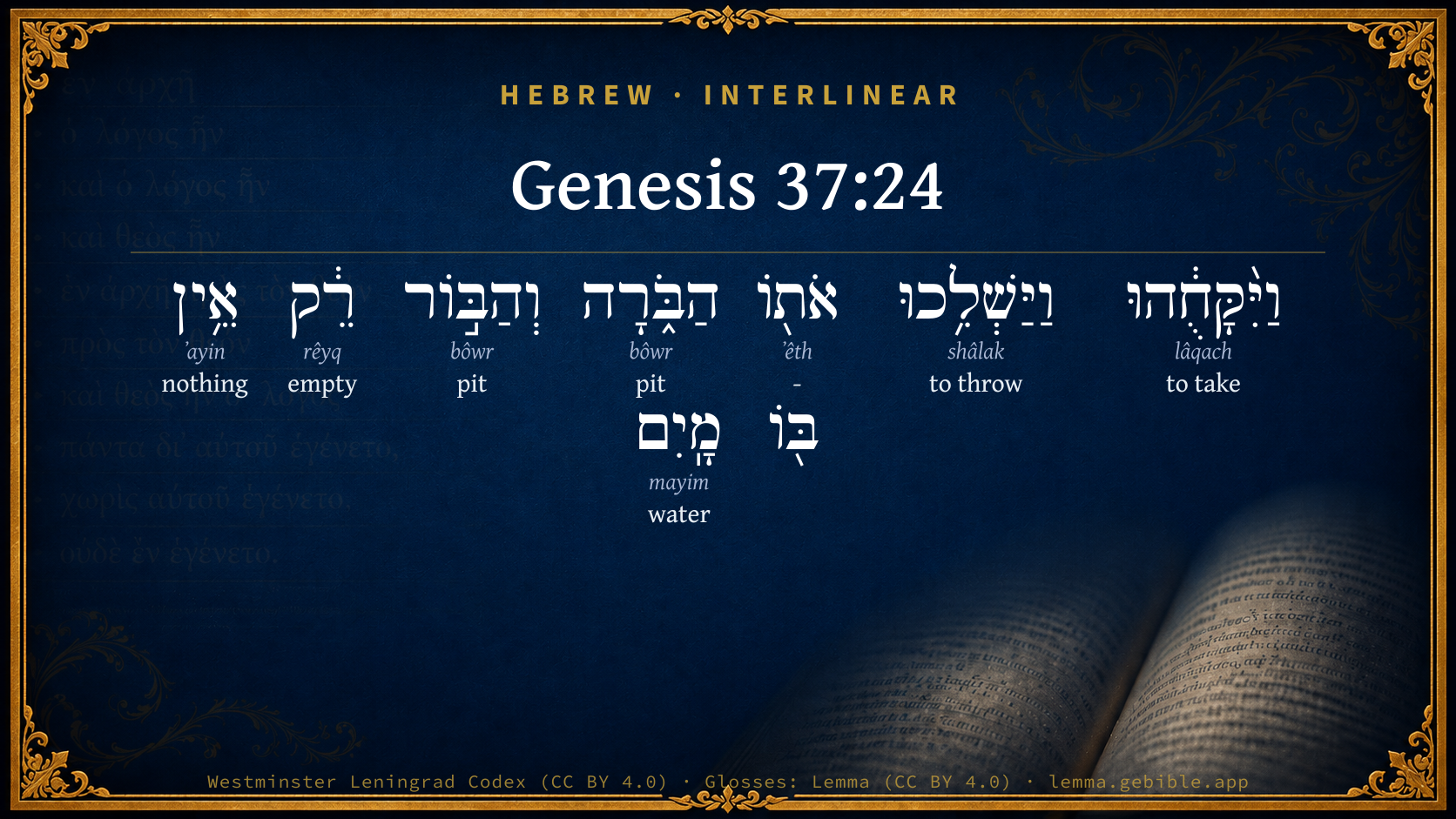
Genesis 37:24

Hebrew (Westminster Leningrad Codex) Genesis 37:24 appears in the Hebrew Old Testament. The text above is from the Westminster Leningrad Codex. Each word links to its Strong’s number, a concise gloss, and parsing drawn from the Open Scriptures Hebrew Bible morphology. Click any word for its full Brown-Driver-Briggs (BDB) entry.
Download image
Cite this verse

Genesis 37:24 (World English Bible). Public Domain. Lemma interlinear Bible study tool, https://lemma.gebible.app/v/genesis/37/24.

Show BibTeX & RIS
BibTeX
RIS
English Translation
and they took him, and threw him into the pit. The pit was empty. There was no water in it.
World English Bible · Public Domain
Highlights
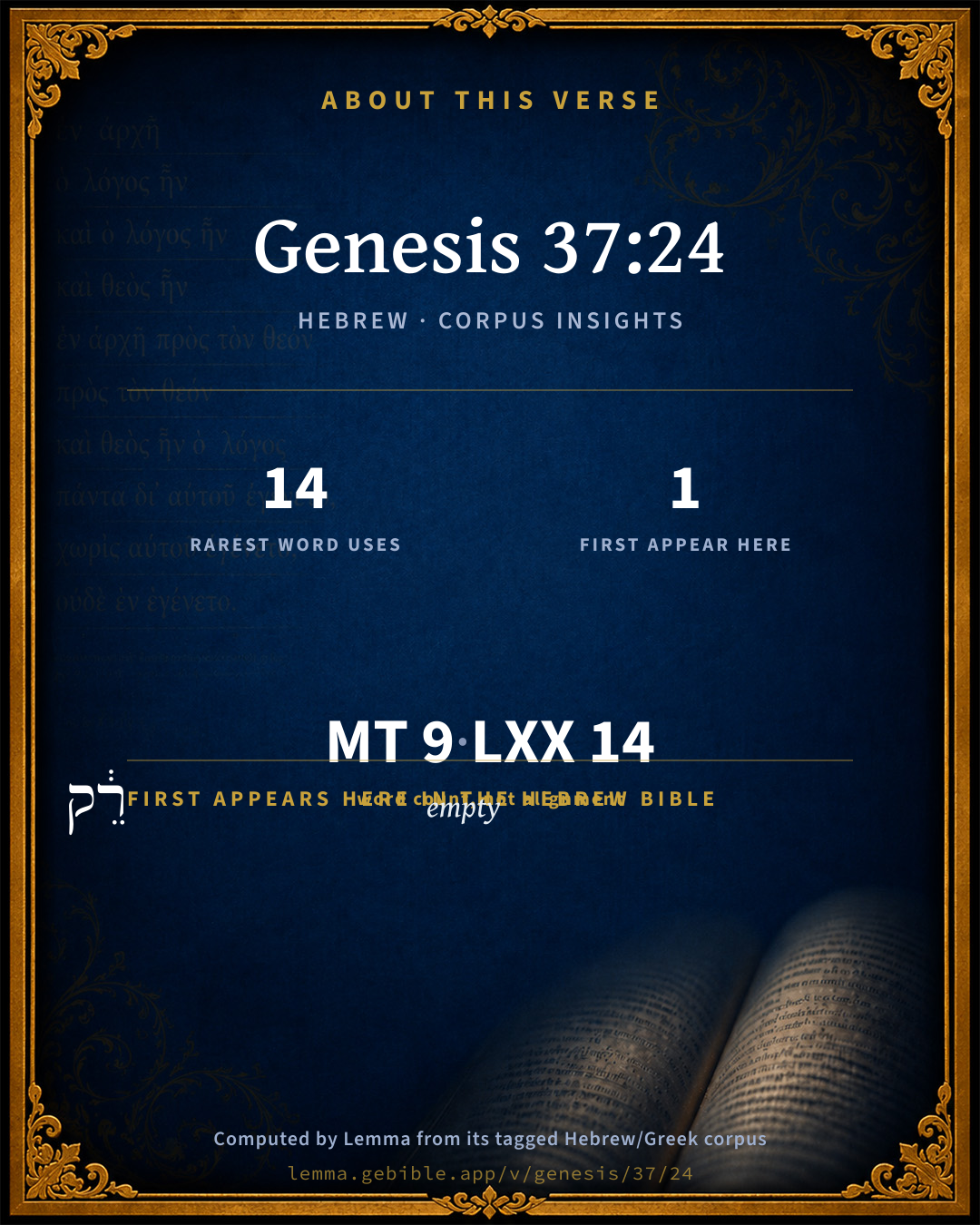
  • 1 first appearance in the Hebrew Bible
Full analysis ↓
Download a study sheet

One document with this verse’s original text, its word-by-word gloss line, the meaning frame, cross-references with their text, attributed commentary, and full source and license credits — printable, and it pastes into notes with its structure intact.

This verse Autodidact and up

Study sheet (.html) Plain text (.txt)

A passage Seminary Student

Up to 50 verses in one chapter. A passage sheet keeps up to 6 commentary sources and 12 cross-references per verse, in the order this page ranks them, and says so on the sheet whenever that leaves anything out. Ask for a single verse and you get the Autodidact verse sheet above.

Everything on this page stays free to read, with no account — the sheet is a download of what is already on screen, not access to it.

Want to remove ads? Support Godless Engineer
Compare translations 3

The same verse in 3 English versions, stacked beneath the original-language interlinear above. Click any original word for its lexicon entry.

Each is an independent rendering of the whole verse — the interlinear is not word-aligned to these translations.

Highlighted words mark where these versions differ — a whole-verse word diff, not a word-by-word alignment.

  • World English Bible Public Domain
    and they took him, and threw him into the pit. The pit was empty. There was no water in it.
  • King James Version Public Domain
    And they took him, and cast him into a pit: and the pit was empty, there was no water in it.
  • unfoldingWord Literal Text CC BY-SA 4.0
    Then they took him and threw him into the cistern. And the cistern empty; there was not water in it.

unfoldingWord Literal Text — © unfoldingWord, licensed CC BY-SA 4.0. Word-aligned USFM3 via Door43 (git.door43.org/unfoldingWord/en_ult).

Versions to compare (up to 4)

3 of 4 selected

Show all 18 translations

Every available English version of this verse, each an independent rendering of the whole verse.

  • World English Bible Public Domain
    and they took him, and threw him into the pit. The pit was empty. There was no water in it.
  • Berean Standard Bible Public Domain
    and they took him and threw him into the pit. Now the pit was empty, with no water in it.
  • Majority Standard Bible Public Domain
    and they took him and threw him into the pit. Now the pit was empty, with no water in it.
  • King James Version Public Domain
    And they took him, and cast him into a pit: and the pit was empty, there was no water in it.
  • American Standard Version (1901) Public Domain
    and they took him, and cast him into the pit: and the pit was empty, there was no water in it.
  • Revised Version (1885) Public Domain
    and they took him, and cast him into the pit: and the pit was empty, there was no water in it.
  • Geneva Bible (1599) Public Domain
    And they tooke him, and cast him into a pit, and the pit was emptie, without water in it.
  • Douay-Rheims (1899) Public Domain
    And cast him into an old pit, where there was no water.
  • Young's Literal Translation Public Domain
    and take him and cast him into the pit, and the pit `is' empty, there is no water in it.
  • Literal Standard Version CC BY-SA 4.0
    and take him and cast him into the pit, and the pit [is] empty, there is no water in it.
  • Unlocked Literal Bible CC BY-SA 4.0
    They took him and threw him into the pit. The pit was empty with no water in it.
  • unfoldingWord Literal Text CC BY-SA 4.0
    Then they took him and threw him into the cistern. And the cistern empty; there was not water in it.
  • Darby Bible Public Domain
    and they took him and cast him into the pit; now the pit was empty -- there was no water in it.
  • World Messianic Bible Public Domain
    and they took him, and threw him into the pit. The pit was empty. There was no water in it.
  • Webster's Bible Public Domain
    And they took him, and cast him into a pit: and the pit was empty; there was no water in it.
  • Free Bible Version CC BY-SA 4.0
    grabbed him and threw him into a pit. (The pit was empty—it didn't have any water in it.)
  • Bible in Basic English Public Domain
    And they took him and put him in the hole: now the hole had no water in it.
  • JPS Tanakh (1917) Public Domain
    and they took him, and cast him into the pit — and the pit was empty, there was no water in it.

Literal Standard Version (2020), Covenant Press — licensed CC BY-SA 4.0. Text via the HelloAO Bible API (eBible.org). Unlocked Literal Bible (unfoldingWord) — licensed CC BY-SA 4.0. Text via the HelloAO Bible API (eBible.org). unfoldingWord Literal Text — © unfoldingWord, licensed CC BY-SA 4.0. Word-aligned USFM3 via Door43 (git.door43.org/unfoldingWord/en_ult). Free Bible Version, Dr. Jonathan Gallagher — licensed CC BY-SA 4.0. Text via the HelloAO Bible API (eBible.org).

Word by word

More ways to search: Search by grammar → Find every occurrence → Compare this word →

Practice this passage: Drill this verse → Learn its vocabulary →

רֵ֔ק
rêyq
H7386
“empty”
Adjective, Adjective, Masculine, Singular, Absolute
Part of Speech
Adjective
Type
Adjective
Gender
Masculine
Number
Singular
State
Absolute
Full BDB Definition

Origin: from H7324

TWOT: 2161a

empty, vain - empty (of vessels) - empty, idle, worthless (ethically)
  1. וַיִּ֨קָּחֻ֔הוּ lâqach H3947 “and · to take · him” Conjunction + Verb, Qal, Sequential Imperfect, 3rd Person, Masculine, Plural + Suffix, Personal, 3rd Person, Masculine, Singular
  2. וַיַּשְׁלִ֥כוּ shâlak H7993 “and · to throw” Conjunction + Verb, Hiphil, Sequential Imperfect, 3rd Person, Masculine, Plural
  3. אֹת֖וֹ ʼêth H853 “- · him” Particle, Direct Object + Suffix, Personal, 3rd Person, Masculine, Singular
  4. הַבֹּ֑רָה bôwr H953 “the · pit · toward” Particle, Definite Article + Noun, Common, Masculine, Singular, Absolute + Suffix, Demonstrative
  5. וְהַבּ֣וֹר bôwr H953 “and · the · pit” Conjunction + Particle, Definite Article + Noun, Common, Masculine, Singular, Absolute
  6. אֵ֥ין ʼayin H369 “nothing” Particle, Negative
  7. מָֽיִם mayim H4325 “water(s)” Noun, Common, Masculine, Plural, Absolute

About this verse

These counts appear in no published source. They are computed here, from the morphology-tagged text and Lemma’s own curated glosses. What Lemma adds →

9
words
7
distinct lemmas
Pentateuch
section

Notable vocabulary

The rarest word here is רֵ֔ק empty H7386 — appearing just 14 times in the whole Hebrew Bible.

First appearance in Scripture

This word makes its first canonical appearance in the Hebrew Bible here:

Shared distinctive vocabulary

רֵ֔ק empty H7386 occurs in 14 verses of the Hebrew Bible. Also found in:

Grammatical profile

  • 2 verbs
  • 3 nouns
  • 1 adjective
  • 1 preposition
  • 2 particles

Verb forms

  • וַיִּ֨קָּחֻ֔הוּ Qal · Sequential Imperfect
  • וַיַּשְׁלִ֥כוּ Hiphil · Sequential Imperfect

Repetition

A word recurs within this verse — often emphatic in Hebrew:

  • הַבֹּ֑רָה pit H953 ×2

Hebrew & Septuagint length

In English translation the verse runs 20 words from the Hebrew and 19 from the Septuagint (LXX English) — closely comparable.

A rough comparison of the two English renderings, which tokenize alike — not a word-level alignment.

Word counts can differ between the Hebrew and the Greek without any difference in meaning — e.g. the Hebrew direct-object marker אֵת has no separate Greek word, and Greek often adds the article ὁ.

In the original languages it is 9 Hebrew tokens and 14 Greek tokens — but the two are counted differently (Hebrew bundles its prefixes and suffixes into one token; the Greek is in lemma form), so that isn’t a like-for-like length.

Cross-references

9

Topical passages linked to Genesis 37:24 in the Treasury of Scripture Knowledge — connected by theme and wording, ordered by reader-vote popularity; previews shown in the World English Bible.

  • Jeremiah 38:6 Then took they Jeremiah, and cast him into the dungeon of Malchijah the king's son, that was in the court of the guard: and they let down Jeremiah with cords. In the dungeon there was no water, but mire; and Jeremiah sank in the mire.
  • Psalms 130:1–2 Out of the depths I have cried to you, Yahweh.
  • Zechariah 9:11 As for you also, Because of the blood of your covenant, I have set free your prisoners from the pit in which is no water.
  • Psalms 35:7 For without cause they have hidden their net in a pit for me. Without cause they have dug a pit for my soul.
  • Psalms 40:2 He brought me up also out of a horrible pit, Out of the miry clay. He set my feet on a rock, And gave me a firm place to stand.
  • Psalms 88:6 You have laid me in the lowest pit, In the darkest depths.
  • Psalms 88:8 You have taken my friends from me. You have made me an abomination to them. I am confined, and I can't escape.
  • Lamentations 3:52–55 They have chased me sore like a bird, those who are my enemies without cause.
  • Lamentations 4:20 The breath of our nostrils, the anointed of Yahweh, was taken in their pits; Of whom we said, Under his shadow we shall live among the nations.

Cross-references courtesy of OpenBible.info (CC BY 4.0).

Hebrew and Greek witnesses Masoretic Hebrew ↔ Greek Septuagint

The same verse in the two great witnesses to the Old Testament, shown verse-for-verse.

These are two independent witnesses, not word-aligned to each other, and the Septuagint is shown in lemma (dictionary) form.

Hebrew Genesis 37:24 Masoretic · Westminster Leningrad Codex

וַיִּ֨קָּחֻ֔הוּ וַיַּשְׁלִ֥כוּ אֹת֖וֹ הַבֹּ֑רָה וְהַבּ֣וֹר רֵ֔ק אֵ֥ין בּ֖וֹ מָֽיִם

and they took him, and threw him into the pit. The pit was empty. There was no water in it.

World English Bible · Public Domain

Greek LXX Genesis 37:24 Septuagint · lemma form

καί λαμβάνω αὐτός ῥίπτω εἰς ὁ λάκκος ὁ δέ λάκκος κενός ὕδωρ οὐ ἔχω

And they took him and cast him into the pit; and the pit was empty, it had not water.

LXX2012 (modern English Septuagint) · Public Domain

On this verse, The Pulpit Commentary discusses the Septuagint’s reading. Read the note in Commentary ↓

Hebrew: Westminster Leningrad Codex (CC BY 4.0). Greek: Septuagint (public domain); English from LXX2012 (modern English Septuagint) (Public Domain). How the Septuagint differs from the Hebrew →

Targum (Aramaic paraphrase)

2

The Targum is the ancient Jewish Aramaic paraphrase of the Hebrew Scriptures — an interpretive translation, not the Hebrew text itself. Onkelos (literal) and Pseudo-Jonathan (expansive) render the Torah, and Jonathan the Prophets. Coverage is partial: where no permissively-licensed English translation exists for a verse, only the Aramaic is shown. This is verse-level text, not a word-by-word alignment to the Hebrew.

  1. Targum Onkelos Torah (Genesis–Deuteronomy)
    וְנָסְבוּהִי וּרְמוֹ יָתֵהּ לְגֻבָּא וְגֻבָּא רֵיקָא לֵית בֵּהּ מַיָּא

    (no public-domain English translation for this verse)

    Targum Onkelos — Aramaic: “Onkelos Genesis” (public domain); “Onkelos Exodus” (public domain); “Onkelos Leviticus” (public domain); “Onkelos Numbers” (public domain); “Onkelos Deuteronomy” (public domain). English: “Sefaria Community Translation” (CC0 1.0 (public-domain dedication)); “J.W. Etheridge. The Targums of Onkelos and Jonathan Ben Uzziel on the Pentateuch. London: Longmans, Green, 1862” (public domain). Text via Sefaria.

  2. Targum Pseudo-Jonathan Torah (Genesis–Deuteronomy)
    וְנָסְבוּ יָתֵיהּ וְטַלְקוּ יָתֵיהּ לְגוּבָא וְגוּבָא סָרֵיק לֵית בֵּיהּ מוֹי בְּרַם חֵיוִין וְעַקְרַבִּין הֲווֹ בֵיהּ

    and took and threw him into the pit; but the pit was empty, no water was therein, but serpents and scorpions were in it.

    Targum Pseudo-Jonathan — Aramaic: “Targum Jonathan on Genesis” (public domain); “Targum Jonathan on Exodus” (public domain); “Targum Jonathan on Leviticus” (public domain); “Targum Jonathan on Numbers” (public domain); “Targum Jonathan on Deuteronomy” (public domain). English: “The Targum of Jonathan ben Uzziel, trans. J. W. Etheridge, London, 1862” (public domain). Text via Sefaria.

Commentary

Notes on Genesis 37:24 from classic Christian and Jewish commentators (each source and its license shown beneath its notes). The classic Christian expositions comment on the surrounding passage and are grouped to its opening verse, so a note may address several verses; the Jewish commentaries on the Tanakh (Rashi and others) are per-verse, so they appear only where the commentator wrote on this verse.

Lemma curates 59 commentaries, every one of them public domain or Creative Commons licensed, each selected and text-cleaned for this edition rather than reprinted as found. About our sources →

Trapp's Complete Commentary

John Trapp

Gen 37:24 And they took him, and cast him into a pit: and the pit [was] empty, [there was] no water in it.

Ver. 24. They cast him into a pit.] Where they meant he should pine and perish with hunger, which is a more cruel death than to die by the sword. {Lam 4:9} Thus died Drusus by the command of Tiberius; food being denied him, he had eaten the stuffings of his bed. {a} I have heard of a certain bishop, saith Melancthon, who, having cast ten men into a dungeon for their religion’s sake, kept them there so long without all manner of food, that they devoured one another. {b}

{a} Druso adeo alimenta subducta, ut tomentum a culcitra tentaverit mandere. - Tacit.

{b} Joh. Manlii, loc. com., 124.

John Trapp, A Commentary or Exposition upon All the Books of the Old and New Testament (1647–1656) — public domain. Text from a community e-Sword module.

Joseph Benson's Commentary

Gen 37:24-25. They cast him into a pit — To perish there with hunger and cold; so cruel were their tender mercies. They sat down to eat bread — They felt no remorse of conscience, which, if they had, would have spoiled their stomachs to their meat. A great force put upon conscience commonly stupifies it, and for the time deprives it both of sense and speech. A company of Ishmaelites — In Gen 37:28; Gen 37:36, they are termed also Midianites, or, as it is in the Hebrew of Gen 37:36, Medanites. It seems these different tribes, which were descended from the sons of Abraham, Medan, and Midian, by Keturah, and of Ishmael, by Hagar, were joined in one caravan, or company of merchants, bringing spicery, balm, and myrrh upon their camels from Gilead, a place noted for these articles, and carrying them into Egypt.

Joseph Benson's Commentary on the Old and New Testaments (1811–1818) — public domain. Text from a community e-Sword module.

Geneva Bible (1599)

Geneva Bible translators

Their hypocrisy appeareth in this that they feared man more than God: and thought it was not murder, if they shed not his blood: or else had an excuse to cover their fault.

Geneva Bible (1599) marginal notes — public domain. Text via Bolls.life.

The Cambridge Bible for Schools and Colleges

gen. ed. J. J. S. Perowne

24. the pit was empty] Cf. the incident in the life of Jeremiah (Jer_38:6). Presumably this was the reason why Reuben proposes to “cast him into this pit” (Gen_37:22).

The Cambridge Bible for Schools and Colleges (gen. ed. J. J. S. Perowne; Cambridge University Press, 1878–1918) — public domain. Text from a community e-Sword module.

John Gill's Exposition

And they sat down to eat bread,.... Not at all concerned at what they had done, nor in the least grieved for the affliction of Joseph, and without any pity and compassion for him in his distress, but joyful and glad they had got him into their hands, and like to get rid of him for ever:

and they lifted up their eyes, and looked, after they had eaten their food, or while they were eating it:

and, behold, a company of Ishmaelites came from Gilead; a place of merchandise for spices and balm, and such like things after mentioned. The Targums of Onkelos and Jonathan call them Arabians; and the Targum of Jerusalem, Saracens; these were the posterity of Ishmael, who came out of Arabia to Gilead, where they took up their merchandise, at least part of it, and were travelling to Egypt with it, and their way thither lay by Dothan; these travelled in companies, now called "caravans", partly on the account of robbers, and partly by reason of wild beasts, with both which they were sometimes beset in the deserts through which they travelled:

with their camels bearing spicery, and balm, and myrrh; the first word is general according to our version, and others, and signifies various spices, a collection of them; and so Jarchi takes it; but Aquila translates it "storax"; and Bochart (w), by various arguments, seems to have proved, that this is particularly intended; though the Targum of Jonathan renders it "wax" (x); and so other versions: and "balm" is by some taken to be "rosin", since there was no balm or balsam in Gilead, on the other side Jordan, nor indeed any in Judea, until it was brought thither from Arabia Felix, in the times of Solomon; and what we render "myrrh", is in the Hebrew called "lot", and is by some thought to be the same with "laudanum": this their merchandise was carried on camels, very fit for their purpose every way, as they were strong creatures made to carry burdens, and could travel many days without water, which they were sometimes obliged to do in the deserts:

going to carry it down to Egypt; where these things grew not, and were much in use, at least some of them, both in medicines, and in embalming dead bodies, much practised in Egypt; an Arabic writer (y) makes this merchandise to consist of, nuts, turpentine, and oil.

(w) Hierozoic. par. 2. l. 4. c. 12. col. 532. (x) So in Bereshit Rabba & Targum Jerusalem in R. Sol. Urbin. Ohel Moed, fol. 20. 2. (y) Patricides, p. 21. apud Hottinger. Smegma Orient. p. 367, 368.

John Gill's Exposition of the Whole Bible (1746–1763) — public domain (CC PDM 1.0). Text via the HelloAO Bible API.

The Pulpit Commentary

Vers. 24, 25. And they took him, and cast him into a pit: and the pit was empty, there was no water in it. Cisterns when empty, or only covered with mud at the bottom, were sometimes used as temporary prisons. (Jer_38:6 Jer_40:15) And leaving him, as they must have calculated, to perish by a painful death through starvation, with exquisite cold-bloodedness, paying no heed to his piteous outcries and appeals (Gen_41:21) they sat down (the callous composure of the act indicates deplorable brutality on the part of Joseph"s brethren) to eat bread (perhaps with a secret feeling of satisfaction, if not also exultation, that they had effectually disposed of the young man and his dreams): and they lifted up their eyes and looked, and, Behold, a company or chath, from arach, to walk; a band of travelers, especially of merchantmen; a caravan; sunodia oJdoiporoi (LXX; of. (Job_6:19) of Ishmaelites Arabs descended from Ishmael, who occupied the district lying between Egypt and Assyria, (Gen_25:18) and, as appears from the record, carried on a trade with the former country. That Ishmael"s descendants should already have developed into a trading nation will not be surprising (Bohlen) if one reflects that Ishmael may have married in his eighteenth or twentieth year, i.e. about 162 years before the date of the present occurrence, that four generations may have been born in the interval, and that, if Ishmael"s sons had only five sons each, his posterity in the fifth generation (not reckoning females) may have amounted to 15, 000 persons (Murphy). But in point of fact the Ishmaelites spoken of are not described as nations simply as a company of merchants, without saying how numerous it was (Havernick, "Introd.,came (literally, coming) from Oilcad (vide Gen_31:21) with (literally, and) their camels bearing spicery takn, either an infinitive from ak; n; to break, to grind(?), and signifying a pounding, breaking in pieces, hence aromatic powder (Gesenius); or a contraction from twOak; n (Ewald), meaning that which is powdered or pulverized. Rendered qumiamata (LXX), aromata (Vulgate), sturax (Aquila), it was probably the gum tragacanth, many kinds of which appear in Syria (Furst, Gesenius, Rosenm Keil, Kalisch, Lange, Murphy), or storax, the resinous exudation of the styrax officinale, which abounds in Palestine and the East (Aquila, Bochart, Bush, "Speaker"s Commentary," Inglis)and balm yrix (in pause yrx, after van of union yrix), mentioned as one of the most precious fruits of Palestine, (Gen_43:11) rendered rJhtinh (LXX) and refina (Vulgate), and derived from hw; x; to flow, to run (hence, literally, an outflowing, or out-dropping). was unquestionably a balsam, but of what tree cannot now be ascertained, distilling from a tree or fruit growing in Gilead, and highly prized for its healing properties. (Jer_8:22 Jer_46:11) Vide Lexicons (Gesenius and Furst) sub voce; Michaelis, "Suppl." p. 2142; Kalisch in locoand myrrh, flo, stakth (LXX), stacte (Vulgate), pistacia (Chaldee, Syriac, Michaelis, "Suppl.," p. 1424), was more probably ladanum (Gesenius, Furst, Rosenm Keil, Kalisch, et alii), an odoriferous gum formed upon the leaves of the cactus-rose, a shrub growing in Arabia, Syria, and Palestine (vide-Herod., 3:112; Pliny, "N. H., 12:37; Celsius, "Hierob.," L 280-288)going the caravan route from Gilead crossed the Jordan in the neighborhood of Bersan, and, sweeping through Jenin and the plain of Dothan, joined another track leading southwards from Damascus by way of Ramleh and Gaza (vide Robinson, 3:27, and cf. Tristram, "Land of Israel," p. 132)to carry it down to Egypt. At that time the land of the Pharaohs was the chief emporium for the world"s merchandise.

The Pulpit Commentary (1880–1919), ed. H.D.M. Spence-Jones & Joseph S. Exell — public domain. Text from a community e-Sword module.

John Wesley's Explanatory Notes

They call him into a pit - To perish there with hunger and cold; so cruel were their tender mercies.

John Wesley, Explanatory Notes Upon the Whole Bible (1754–1765) — public domain. Text via the GEBible commentary corpus.

Rashi

Rabbi Shlomo Yitzchaki (Rashi)

והבור רק אין בו מים AND THE PIT WAS EMPTY, THERE WAS NO WATER IN IT — Since it states, “the pit was empty”, do I not know that “there was no water in it”? What then is the force of “there was no water in it”? Water, indeed it did not contain, but there were serpents and scorpions in it (Shabbat 22a).

Rashi on the Tanakh — English translations: “The Judaica Press complete Tanach with Rashi, translated by A. J. Rosenberg” (CC BY 4.0); “Pentateuch with Rashi's commentary by M. Rosenbaum and A.M. Silbermann, 1929-1934” (public domain); “The Metsudah Tanach series, Lakewood, N.J” (CC BY 4.0); and “The Book of Joshua, Metsudah Publications, 1997” (CC BY 4.0). Text via Sefaria.

Radak

Rabbi David Kimhi (Radak)

ויקחהו, there is a letter ו missing in this word, making it appear as if only one brother took him. According to Bereshit Rabbah 84,16 this is an allusion to who the brother was who seized Joseph and threw him into the pit. It was Shimon, which was the reason why later on Joseph locked up Shimon as a hostage (42,24 ויקח מאתם את שמעון, he took Shimon from them.)

אין בו מים. If there had been water in the pit, Joseph would have drowned and throwing him into the pit would have been outright murder. The reason why the Torah mentions that there was no water in the pit, having already said that the pit was empty, והבור ריק, could be that there was sticky mud inside it, as for instance in Jeremiah 38,6 where the King’s servants threw the prophet into טיט, meaning a slime pit. That pit is also described as devoid of water, although Jeremiah is described as sinking into the mud. However, it did not cause his death. The allegorical explanation of the sequence of the words in our verse is well known, i.e. though water, one lethal ingredient, was not present in that pit, other potentially worse dangers such as scorpions, etc., were. If this explanation corresponds to the facts, throwing Joseph into such a pit was no better than killing him. The brothers had no way of knowing that G’d would save him by a miracle, i.e. that the scorpions and snakes would not attack him.

Radak on the Tanakh — English translations: “Sefaria Community Translation” (CC0 1.0 (public-domain dedication)); “Eliyahu Munk, HaChut Hameshulash” (CC BY 4.0); “Rabbi Mike Feuer, Jerusalem Anthology” (CC BY 4.0); and “R. David Kimhi on the first book of Psalms, Translated by R.G. Finch, London, 1919” (public domain). Text via Sefaria.

Lesson kit

Teaching starters — assembled from the data on this page, not authored interpretation. Every prompt links to the verse data it draws on. Edit before teaching.

Genesis, in the Pentateuch, opens this verse with 9 words (7 distinct Hebrew lemmas). Its most distinctive word is rêyq (“empty”). A historical commentator’s framing appears above. Read the whole chapter for the surrounding context.

Discussion questions

  1. How does “empty” (rêyq) shape what this verse is saying?
  2. The word “empty” first appears here in Scripture. What is being introduced at this debut?
  3. Genesis 41:27 shares the word «empty» with this verse. How do the two illuminate each other?
  4. “pit” occurs 2× in this one verse. What is the effect of the repetition?
  5. These translations render this verse differently; the difference is in the English rendering, not the original. What questions does that raise?
  6. The verb «וַיִּ֨קָּחֻ֔הוּ» is Qal Sequential Imperfect. How does its form color the action?
  7. Reading how Trapp's Complete Commentary and Joseph Benson's Commentary read this verse, where do the two commentators agree and where do they part?

Things to notice

Reading settings

Reading text

Shown beneath each verse's original-language words.

Old Testament
Old Testament edition

Read the OT as the Masoretic Hebrew (MT) or the Greek Septuagint (LXX).

English shown for the Greek Septuagint (in the Hebrew ↔ Greek comparison).

Comparing translations? Open the Compare panel on any verse page to stack up to four side by side.