
Deuteronomy 19:6

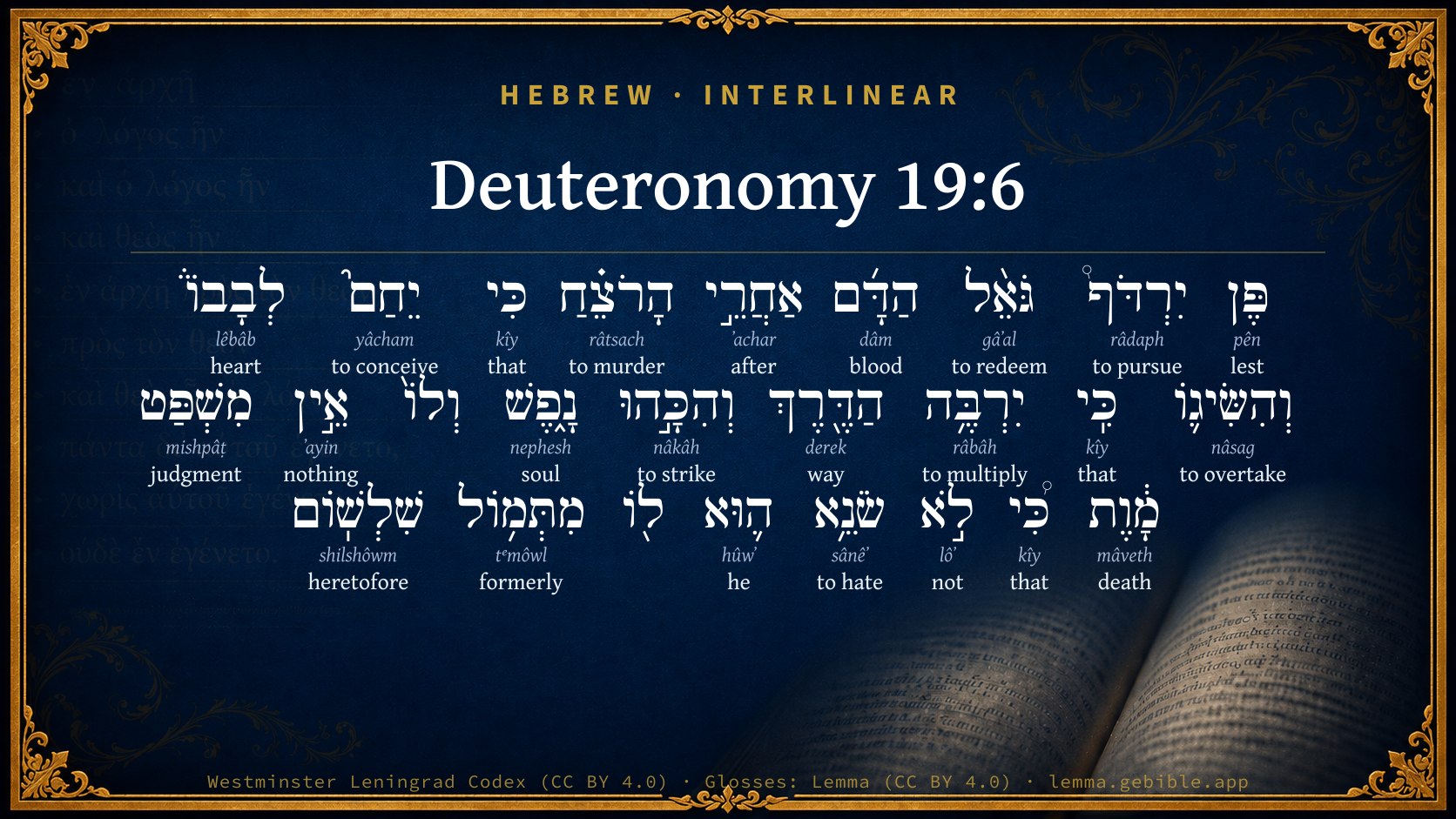
Hebrew (Westminster Leningrad Codex) Deuteronomy 19:6 appears in the Hebrew Old Testament. The text above is from the Westminster Leningrad Codex. Each word links to its Strong’s number, a concise gloss, and parsing drawn from the Open Scriptures Hebrew Bible morphology. Click any word for its full Brown-Driver-Briggs (BDB) entry.
Download image
Cite this verse

Deuteronomy 19:6 (World English Bible). Public Domain. Lemma interlinear Bible study tool, https://lemma.gebible.app/v/deuteronomy/19/6.

Show BibTeX & RIS
BibTeX
RIS
English Translation
lest the avenger of blood pursue the manslayer, while his heart is hot, and overtake him, because the way is long, and strike him mortally; whereas he was not worthy of death, inasmuch as he didn't hate him in time past.
World English Bible · Public Domain
Download a study sheet

One document with this verse’s original text, its word-by-word gloss line, the meaning frame, cross-references with their text, attributed commentary, and full source and license credits — printable, and it pastes into notes with its structure intact.

This verse Autodidact and up

Study sheet (.html) Plain text (.txt)

A passage Seminary Student

Up to 50 verses in one chapter. A passage sheet keeps up to 6 commentary sources and 12 cross-references per verse, in the order this page ranks them, and says so on the sheet whenever that leaves anything out. Ask for a single verse and you get the Autodidact verse sheet above.

Everything on this page stays free to read, with no account — the sheet is a download of what is already on screen, not access to it.

Want to remove ads? Support Godless Engineer
Compare translations 3

The same verse in 3 English versions, stacked beneath the original-language interlinear above. Click any original word for its lexicon entry.

Each is an independent rendering of the whole verse — the interlinear is not word-aligned to these translations.

Highlighted words mark where these versions differ — a whole-verse word diff, not a word-by-word alignment.

  • World English Bible Public Domain
    lest the avenger of blood pursue the manslayer, while his heart is hot, and overtake him, because the way is long, and strike him mortally; whereas he was not worthy of death, inasmuch as he didn't hate him in time past.
  • King James Version Public Domain
    Lest the avenger of the blood pursue the slayer, while his heart is hot, and overtake him, because the way is long, and slay him; whereas he was not worthy of death, inasmuch as he hated him not in time past.
  • unfoldingWord Literal Text CC BY-SA 4.0
    Lest the avenger of blood pursue after the killer when his heart is heated and overtake him, because the way is long, and he strike him the life, and he did not have a judgment of death, for he had not hated him from previous times.

unfoldingWord Literal Text — © unfoldingWord, licensed CC BY-SA 4.0. Word-aligned USFM3 via Door43 (git.door43.org/unfoldingWord/en_ult).

Versions to compare (up to 4)

3 of 4 selected

Show all 18 translations

Every available English version of this verse, each an independent rendering of the whole verse.

  • World English Bible Public Domain
    lest the avenger of blood pursue the manslayer, while his heart is hot, and overtake him, because the way is long, and strike him mortally; whereas he was not worthy of death, inasmuch as he didn't hate him in time past.
  • Berean Standard Bible Public Domain
    Otherwise, the avenger of blood might pursue the manslayer in a rage, overtake him if the distance is great, and strike him dead though he did not deserve to die, since he did not intend any harm.
  • Majority Standard Bible Public Domain
    Otherwise, the avenger of blood might pursue the manslayer in a rage, overtake him if the distance is great, and strike him dead though he did not deserve to die, since he did not intend any harm.
  • King James Version Public Domain
    Lest the avenger of the blood pursue the slayer, while his heart is hot, and overtake him, because the way is long, and slay him; whereas he was not worthy of death, inasmuch as he hated him not in time past.
  • American Standard Version (1901) Public Domain
    lest the avenger of blood pursue the manslayer, while his heart is hot, and overtake him, because the way is long, and smite him mortally; whereas he was not worthy of death, inasmuch as he hated him not in time past.
  • Revised Version (1885) Public Domain
    lest the avenger of blood pursue the manslayer, while his heart is hot, and overtake him, because the way is long, and smite him mortally; whereas he was not worthy of death, inasmuch as he hated him not in time past.
  • Geneva Bible (1599) Public Domain
    Least the auenger of the blood follow after the manslayer, while his heart is chafed, and ouertake him, because the way is long, and slaie him, although he be not worthy of death, because he hated him not in time passed.
  • Douay-Rheims (1899) Public Domain
    Lest perhaps the next kinsman of him whose blood was shed, pushed on by his grief should pursue, and apprehend him. if the way be too long, and take away the life of him who is not guilty of death, because he is proved to have had no hatred before against him that was slain.
  • Young's Literal Translation Public Domain
    lest the redeemer of blood pursue after the man-slayer when his heart is hot, and hath overtaken him (because the way is great), and hath smitten him -- the life, and he hath no sentence of death, for he is not hating him heretofore;
  • Literal Standard Version CC BY-SA 4.0
    lest the redeemer of blood pursue after the manslayer when his heart is hot and has overtaken him, because the way is great, and has struck his life, and he has no sentence of death, for he is not hating him before;
  • Unlocked Literal Bible CC BY-SA 4.0
    Otherwise the avenger of blood might go after the one who took a life, and in the heat of his anger overtake him, if the distance is too great, strike him and kill him, even though that man did not deserve to die, since he had not hated his neighbor in the past.
  • unfoldingWord Literal Text CC BY-SA 4.0
    Lest the avenger of blood pursue after the killer when his heart is heated and overtake him, because the way is long, and he strike him the life, and he did not have a judgment of death, for he had not hated him from previous times.
  • Darby Bible Public Domain
    lest the avenger of blood pursue the manslayer, while his heart is hot, and overtake him, because the way is long, and smite him mortally; whereas he was not worthy of death, since he hated him not previously.
  • World Messianic Bible Public Domain
    Otherwise, the avenger of blood might pursue the man slayer while hot anger is in his heart and overtake him, because the way is long, and strike him mortally, even though he was not worthy of death, because he didn’t hate him in time past.
  • Webster's Bible Public Domain
    Lest the avenger of blood shall pursue the slayer, while his heart is hot, and overtake him, because the way is long, and slay him; whereas he was not worthy of death, inasmuch as he hated him not in time past.
  • Free Bible Version CC BY-SA 4.0
    Otherwise the avenger in his anger might chase after the man and catch up with him and kill him, if it's a long distance. The man would be killed even though he didn't deserve to die, because he hadn't meant to cause any harm.
  • Bible in Basic English Public Domain
    For if not, he who has the right of punishment may go running after the taker of life in the heat of his wrath, and overtake him because the way is long, and give him a death-blow; though it is not right for him to be put to death because he was not moved by hate.
  • JPS Tanakh (1917) Public Domain
    lest the avenger of blood pursue the manslayer, while his heart is hot, and overtake him, because the way is long, and smite him mortally; whereas he was not deserving of death, inasmuch as he hated him not in time past.

Literal Standard Version (2020), Covenant Press — licensed CC BY-SA 4.0. Text via the HelloAO Bible API (eBible.org). Unlocked Literal Bible (unfoldingWord) — licensed CC BY-SA 4.0. Text via the HelloAO Bible API (eBible.org). unfoldingWord Literal Text — © unfoldingWord, licensed CC BY-SA 4.0. Word-aligned USFM3 via Door43 (git.door43.org/unfoldingWord/en_ult). Free Bible Version, Dr. Jonathan Gallagher — licensed CC BY-SA 4.0. Text via the HelloAO Bible API (eBible.org).

Word by word

More ways to search: Search by grammar → Find every occurrence → Compare this word →

Practice this passage: Drill this verse → Learn its vocabulary →

יֵחַם֮
yâcham
H3179
“to conceive”
Verb, Qal, Imperfect, 3rd Person, Masculine, Singular
Part of Speech
Verb
Stem
Qal
Form
Imperfect
Person
3rd Person
Gender
Masculine
Number
Singular
Full BDB Definition

Origin: a primitive root

TWOT: 860

to be hot, conceive - (Qal) - to be hot, become hot - to mate (of animals) - to be or become hot (figuratively of anger) - (Piel) - to conceive (sexually) - to be in heat (of animals)
  1. פֶּן pên H6435 “lest” Conjunction
  2. יִרְדֹּף֩ râdaph H7291 “to pursue” Verb, Qal, Imperfect, 3rd Person, Masculine, Singular
  3. גֹּאֵ֨ל gâʼal H1350 “redeeming” Verb, Qal, Participle Active, Masculine, Singular, Construct
  4. הַדָּ֜ם dâm H1818 “the · blood” Particle, Definite Article + Noun, Common, Masculine, Singular, Absolute
  5. אַחֲרֵ֣י ʼachar H310 “after” Preposition
  6. הָרֹצֵ֗חַ râtsach H7523 “the · murdering” Particle, Definite Article + Verb, Qal, Participle Active, Masculine, Singular, Absolute
  7. כִּי kîy H3588 “that” Conjunction
  8. לְבָבוֹ֒ lêbâb H3824 “heart · his” Noun, Common, Masculine, Singular, Construct + Suffix, Personal, 3rd Person, Masculine, Singular
  9. וְהִשִּׂיג֛וֹ nâsag H5381 “and · to overtake · him” Conjunction + Verb, Hiphil, Sequential Perfect, 3rd Person, Masculine, Singular + Suffix, Personal, 3rd Person, Masculine, Singular
  10. כִּֽי kîy H3588 “that” Conjunction
  11. יִרְבֶּ֥ה râbâh H7235 “to multiply” Verb, Qal, Imperfect, 3rd Person, Masculine, Singular
  12. הַדֶּ֖רֶךְ derek H1870 “the · way” Particle, Definite Article + Noun, Common, Both, Singular, Absolute
  13. וְהִכָּ֣הוּ nâkâh H5221 “and · to strike · him” Conjunction + Verb, Hiphil, Sequential Perfect, 3rd Person, Masculine, Singular + Suffix, Personal, 3rd Person, Masculine, Singular
  14. נָ֑פֶשׁ nephesh H5315 “soul” Noun, Common, Both, Singular, Absolute
  15. אֵ֣ין ʼayin H369 “nothing” Particle, Negative
  16. מִשְׁפַּט mishpâṭ H4941 “judgment of” Noun, Common, Masculine, Singular, Construct
  17. מָ֔וֶת mâveth H4194 “death” Noun, Common, Masculine, Singular, Absolute
  18. כִּ֠י kîy H3588 “that” Conjunction
  19. לֹ֣א lôʼ H3808 “not” Particle, Negative
  20. שֹׂנֵ֥א sânêʼ H8130 “hating” Verb, Qal, Participle Active, Masculine, Singular, Absolute
  21. ה֛וּא hûwʼ H1931 “he” Pronoun, Personal, 3rd Person, Masculine, Singular
  22. מִתְּמ֥וֹל tᵉmôwl H8543 “from · formerly” Preposition + Adverb
  23. שִׁלְשֽׁוֹם shilshôwm H8032 “heretofore” Noun, Common, Masculine, Singular, Absolute

About this verse

These counts appear in no published source. They are computed here, from the morphology-tagged text and Lemma’s own curated glosses. What Lemma adds →

26
words
22
distinct lemmas
Pentateuch
section

Notable vocabulary

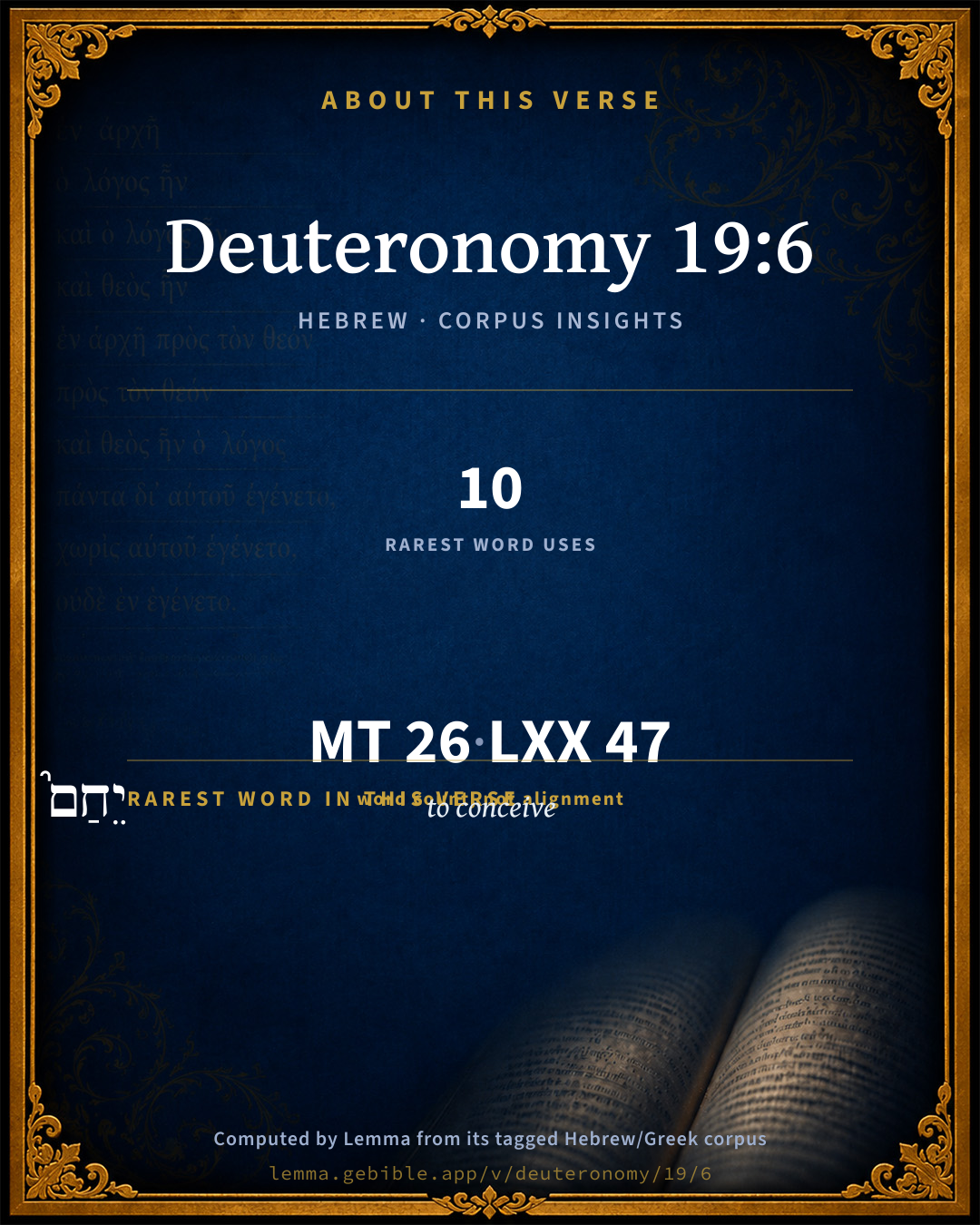
The rarest word here is יֵחַם֮ to conceive H3179 — appearing just 10 times in the whole Hebrew Bible.

Shared distinctive vocabulary

יֵחַם֮ to conceive H3179 occurs in 9 verses of the Hebrew Bible. Also found in:

Grammatical profile

  • 8 verbs
  • 7 nouns
  • 1 pronoun
  • 3 prepositions
  • 4 conjunctions
  • 1 adverb
  • 2 particles

Verb forms

  • יִרְדֹּף֩ Qal · Imperfect
  • גֹּאֵ֨ל Qal · Participle Active
  • הָרֹצֵ֗חַ Qal · Participle Active
  • יֵחַם֮ Qal · Imperfect
  • וְהִשִּׂיג֛וֹ Hiphil · Sequential Perfect
  • יִרְבֶּ֥ה Qal · Imperfect
  • וְהִכָּ֣הוּ Hiphil · Sequential Perfect
  • שֹׂנֵ֥א Qal · Participle Active

Repetition

A word recurs within this verse — often emphatic in Hebrew:

  • כִּי that H3588 ×3

Hebrew & Septuagint length

In English translation the verse runs 41 words from the Hebrew and 44 from the Septuagint (LXX English) — closely comparable.

A rough comparison of the two English renderings, which tokenize alike — not a word-level alignment.

Word counts can differ between the Hebrew and the Greek without any difference in meaning — e.g. the Hebrew direct-object marker אֵת has no separate Greek word, and Greek often adds the article ὁ.

In the original languages it is 26 Hebrew tokens and 47 Greek tokens — but the two are counted differently (Hebrew bundles its prefixes and suffixes into one token; the Greek is in lemma form), so that isn’t a like-for-like length.

Cross-references

5

Topical passages linked to Deuteronomy 19:6 in the Treasury of Scripture Knowledge — connected by theme and wording, ordered by reader-vote popularity; previews shown in the World English Bible.

  • Numbers 35:12 The cities shall be to you for refuge from the avenger, that the manslayer not die, until he stands before the congregation for judgment.
  • Deuteronomy 21:22 If a man have committed a sin worthy of death, and he be put to death, and you hang him on a tree;
  • Joshua 20:5 If the avenger of blood pursue after him, then they shall not deliver up the manslayer into his hand; because he struck his neighbor unawares, and didn't hate him before.
  • 2 Samuel 14:7 Behold, the whole family is risen against your handmaid, and they say, Deliver him who struck his brother, that we may kill him for the life of his brother whom he killed, and so destroy the heir also. Thus will they quench my coal which is left, and will leave to my husband neither name nor remainder on the surface of the earth.
  • Jeremiah 26:15–16 Only know for certain that, if you put me to death, you will bring innocent blood on yourselves, and on this city, and on the inhabitants of it; for of a truth Yahweh has sent me to you to speak all these words in your ears.

Cross-references courtesy of OpenBible.info (CC BY 4.0).

Hebrew and Greek witnesses Masoretic Hebrew ↔ Greek Septuagint

The same verse in the two great witnesses to the Old Testament, shown verse-for-verse.

These are two independent witnesses, not word-aligned to each other, and the Septuagint is shown in lemma (dictionary) form.

Hebrew Deuteronomy 19:6 Masoretic · Westminster Leningrad Codex

פֶּן יִרְדֹּף֩ גֹּאֵ֨ל הַדָּ֜ם אַחֲרֵ֣י הָרֹצֵ֗חַ כִּי יֵחַם֮ לְבָבוֹ֒ וְהִשִּׂיג֛וֹ כִּֽי יִרְבֶּ֥ה הַדֶּ֖רֶךְ וְהִכָּ֣הוּ נָ֑פֶשׁ וְלוֹ֙ אֵ֣ין מִשְׁפַּט מָ֔וֶת כִּ֠י לֹ֣א שֹׂנֵ֥א ה֛וּא ל֖וֹ מִתְּמ֥וֹל שִׁלְשֽׁוֹם

lest the avenger of blood pursue the manslayer, while his heart is hot, and overtake him, because the way is long, and strike him mortally; whereas he was not worthy of death, inasmuch as he didn't hate him in time past.

World English Bible · Public Domain

Greek LXX Deuteronomy 19:6 Septuagint · lemma form

ἵνα μή διώκω ὁ ἀγχιστεύω ὁ αἷμα ὀπίσω ὁ φονεύω ὅτι παραθερμαίνω ὁ καρδία καί καταλαμβάνω αὐτός ἐάν μακρός εἰμί ὁ ὁδός καί πατάσσω αὐτός ὁ ψυχή καί ἀποθνήσκω καί οὗτος οὐ εἰμί κρίσις θάνατος ὅτι οὐ μισέω εἰμί αὐτός πρό ὁ χθές καί πρό ὁ τρίτος

Lest the avenger of blood pursue after the slayer, because his heart is hot, and overtake him, if the way be too long, and kill him, though there is to this man no sentence of death, because he hated him not in time past.

LXX2012 (modern English Septuagint) · Public Domain

Hebrew: Westminster Leningrad Codex (CC BY 4.0). Greek: Septuagint (public domain); English from LXX2012 (modern English Septuagint) (Public Domain). How the Septuagint differs from the Hebrew →

Targum (Aramaic paraphrase)

2

The Targum is the ancient Jewish Aramaic paraphrase of the Hebrew Scriptures — an interpretive translation, not the Hebrew text itself. Onkelos (literal) and Pseudo-Jonathan (expansive) render the Torah, and Jonathan the Prophets. Coverage is partial: where no permissively-licensed English translation exists for a verse, only the Aramaic is shown. This is verse-level text, not a word-by-word alignment to the Hebrew.

  1. Targum Onkelos Torah (Genesis–Deuteronomy)
    דִילְמָא יִרְדוֹף גָאֵל דְמָא בָּתַר קָטוֹלָא אֲרֵי יֵחַם לִבֵּה וְיַדְבְּקִנֵהּ אֲרֵי תִסְגֵי אָרְחָא וְיִקְטְלִנֵהּ נְפַשׁ וְלֵהּ לֵית חוֹבַת דִין דִקְטוֹל אֲרֵי לָא סָנֵי הוּא לֵהּ מִתְּמַלֵי וּמִדְקָמוֹהִי

    (no public-domain English translation for this verse)

    Targum Onkelos — Aramaic: “Onkelos Genesis” (public domain); “Onkelos Exodus” (public domain); “Onkelos Leviticus” (public domain); “Onkelos Numbers” (public domain); “Onkelos Deuteronomy” (public domain). English: “Sefaria Community Translation” (CC0 1.0 (public-domain dedication)); “J.W. Etheridge. The Targums of Onkelos and Jonathan Ben Uzziel on the Pentateuch. London: Longmans, Green, 1862” (public domain). Text via Sefaria.

  2. Targum Pseudo-Jonathan Torah (Genesis–Deuteronomy)
    דִּלְמָא יִרְדוֹף תְּבַע אַדְמָא בָּתַר קָטוֹלָא אֲרוּם יִרְתַח עֲלוֹי לִבֵּיהּ בְּעַקְתֵיהּ וְיִדְבְּקֵיהּ אֲרוּם תַּסְגֵי אָרְחָא וְיִקְטְלִינֵיהּ נְפָשׁ וְלֵיהּ לָא אִית חוֹבַת דִּין דִּקְטוֹל אֲרוּם לָא סָנֵי הוּא לֵיהּ מֵאִתְמְלֵי וּמִדְקֳדָמוֹי

    Lest the avenger of blood follow after him his heart boiling within him on account of his grief, and apprehend him, if the way be long, and take his life, though he is not guilty of the judgment of death, because he had not enmity against him in time past.

    Targum Pseudo-Jonathan — Aramaic: “Targum Jonathan on Genesis” (public domain); “Targum Jonathan on Exodus” (public domain); “Targum Jonathan on Leviticus” (public domain); “Targum Jonathan on Numbers” (public domain); “Targum Jonathan on Deuteronomy” (public domain). English: “The Targum of Jonathan ben Uzziel, trans. J. W. Etheridge, London, 1862” (public domain). Text via Sefaria.

Commentary

Notes on Deuteronomy 19:6 from classic Christian and Jewish commentators (each source and its license shown beneath its notes). The classic Christian expositions comment on the surrounding passage and are grouped to its opening verse, so a note may address several verses; the Jewish commentaries on the Tanakh (Rashi and others) are per-verse, so they appear only where the commentator wrote on this verse.

Lemma curates 59 commentaries, every one of them public domain or Creative Commons licensed, each selected and text-cleaned for this edition rather than reprinted as found. About our sources →

Trapp's Complete Commentary

John Trapp

Deu 19:6 Lest the avenger of the blood pursue the slayer, while his heart is hot, and overtake him, because the way is long, and slay him; whereas he [was] not worthy of death, inasmuch as he hated him not in time past.

Ver. 6. While his heart is hot.] As Nebuchadnezzar’s oven - viz., with anger and grief, and such like passions; which, like heavy bodies down steep hills, once in motion move themselves, and know no ground but the bottom.

John Trapp, A Commentary or Exposition upon All the Books of the Old and New Testament (1647–1656) — public domain. Text from a community e-Sword module.

Tyndale Open Study Notes

Tyndale Open Resources

19:6 avenger (literally the redeemer of blood): The law allowed murder to be avenged by members of the victim’s family. When they found the killer, they could put him to death (Num 35:16-21). The idea was that blood shed by the victim must be paid for by the blood of the person responsible for the act (see Gen 4:15; 9:6). In this way, the land polluted by the shed blood could be purified (Num 35:33-34).

Tyndale Open Study Notes — © Tyndale Open Resources, licensed CC BY-SA 4.0. Text via the HelloAO Bible API.

Geneva Bible (1599)

Geneva Bible translators

Or, cannot be judged to death.

Geneva Bible (1599) marginal notes — public domain. Text via Bolls.life.

Jamieson, Fausset & Brown

Robert Jamieson, A. R. Fausset & David Brown

Lest the avenger of the blood pursue the slayer, while his heart is hot--This verse is a continuation of Deu 19:3 (for Deu 19:4-5, which are explanatory, are in a parenthetical form), and the meaning is that if the kinsman of a person inadvertently killed should, under the impulse of sudden excitement and without inquiring into the circumstances, inflict summary vengeance on the homicide, however guiltless, the law tolerated such an act; it was to pass with impunity. But to prevent such precipitate measures, the cities of refuge were established for the reception of the homicide, that "innocent blood might not be shed in thy land" (Deu 19:10). In the case of premeditated murder (Deu 19:11-12), they afforded no immunity; but, if it were only manslaughter, the moment the fugitive was within the gates, he found himself in a safe asylum (Num 35:26-28; Jos 20:6).

Jamieson, Fausset & Brown — Commentary Critical and Explanatory on the Whole Bible (1871) — public domain (CC PDM 1.0). Text via the HelloAO Bible API.

The Cambridge Bible for Schools and Colleges

gen. ed. J. J. S. Perowne

6. avenger of blood] Heb. go‘el haddâm (2Sa_14:11, Num_35:19-27, Jos_20:3; Jos_20:5; Jos_20:9). The consuetudinary law of the vendetta is not abrogated, but persists so far as the nearest, or other, kinsman of the slain still takes the duty of punishing the slayer. See v. 22 and Add. note.

while his heart is hot] and he cannot discriminate between accidental and wilful murder. It was doubtless to avoid the same unjust passion that the right of sanctuary arose among the nomad Arabs.

because the way is long] to the One Altar, Deu_14:24; cp. Deu_12:21.

mortally] Heb. to, or as to, the life (nephesh), Deu_19:11; cp. Deu_22:26.

whereas, etc.] Heb. there being no case of death to (against) him (a circumstantial clause); cp. Deu_21:22, Deu_22:26.

The Cambridge Bible for Schools and Colleges (gen. ed. J. J. S. Perowne; Cambridge University Press, 1878–1918) — public domain. Text from a community e-Sword module.

John Gill's Exposition

Lest the avenger of blood pursue the slayer,.... These words are to be connected with Deu 19:3, where it is ordered to prepare the way to the cities of refuge, and to divide the land into three parts, for the convenience of the slayer to flee thither, lest he that was next of kin, and incensed against the slayer, and determined to avenge what was done, should pursue after him:

while his heart is hot; by reason of the loss of his relation, upon which his passions being raised, his heart becomes inflamed with wrath and anger; which pushes him upon an eager and hasty pursuit of the slayer, before he sits down and coolly considers and deliberates on the affair:

and overtake him, because the way is long, and slay him; wherefore it was proper that everything should be done to make the way to these cities as easy and as short as it could be:

whereas he was not worthy of death; had not committed an action deserving of it, it being done ignorantly and without notice, as follows:

inasmuch as he hated him not in time past; See Gill on Deu 19:4.

John Gill's Exposition of the Whole Bible (1746–1763) — public domain (CC PDM 1.0). Text via the HelloAO Bible API.

Haydock's Catholic Bible Commentary

Grief. The law granted so much to the sudden passion of a relation, who met the man slayer out of the cities of refuge, as not to punish him if he gave way to the dictates of vengeance, how unjust soever. (Calmet)

George Leo Haydock (1774–1849), Haydock's Catholic Family Bible and Commentary, 1859 edition — public domain. Excludes Psalms (Douay-Rheims chapter numbering differs from Protestant) and Deuterocanonical books (Catholic canon only).

Matthew Poole's English Annotations

This verse is to be joined with Deu 19:3, as is evident, the 4th and 5th verses coming in as a parenthesis, which is usual in Scripture and other authors.

And slay him; which is supposed, but not allowed, as appears from the following words. But the avenger of blood is not to be punished with death for killing the manslayer, in case he found him without the borders of the city of refuge after he had been received there, Num 35:26,27, because then he was guilty of a new crime, to wit, a contempt of God’s ordinance, and a gross neglect of the duty of self-preservation, and therefore deserved death from God, who might permit it to be inflicted by the avenger of blood.

Matthew Poole's English Annotations on the Holy Bible (1683–1685) — public domain. Text from a community e-Sword/MySword module.

Scofield Reference Notes

C. I. Scofield

avenger

Heb. "goel," Redemp. (Kinsman type). (See Scofield "Isa 59:20").

The Scofield Reference Bible (1917 edition), notes by C. I. Scofield — public domain. Text from a community e-Sword module.

unfoldingWord translationNotes

Door43 World Missions Community

General Information:

Moses is still speaking to the people of Israel.

the avenger of blood

Here "blood" represents the person who was killed. An "avenger of blood" is a close relative of the person who was killed. This relative is responsible for punishing the murderer. (See: Metonymy)

the one who took a life

This is an idiom. AT: "the one who killed the other person" (See: Idiom)

in the heat of his anger

Someone being very angry is spoken of as if anger were something that could become hot. AT: "and being very angry" (See: Metaphor)

strike him and kill him

"And the blood avenger strikes and kills the one who had killed the other person"

though that man did not deserve to die, since he had not hated his neighbor in the past

"though that man did not deserve to die since he accidentally killed the other person and was not his enemy, and he had not planned to hurt the man"

translationWords

anger

die

command

unfoldingWord translationNotes — © Distant Shores Media and the Door43 World Missions Community, licensed CC BY-SA 4.0. Source: git.door43.org/Door43/en_tn.

Rashi

Rabbi Shlomo Yitzchaki (Rashi)

פן ירדף גאל הדם LEST THE AVENGER OF THE BLOOD PURSUE [THE SLAYER] — therefore I tell you to prepare the way for you and [to prepare] many cities of refuge.

Rashi on the Tanakh — English translations: “The Judaica Press complete Tanach with Rashi, translated by A. J. Rosenberg” (CC BY 4.0); “Pentateuch with Rashi's commentary by M. Rosenbaum and A.M. Silbermann, 1929-1934” (public domain); “The Metsudah Tanach series, Lakewood, N.J” (CC BY 4.0); and “The Book of Joshua, Metsudah Publications, 1997” (CC BY 4.0). Text via Sefaria.

Lesson kit

Teaching starters — assembled from the data on this page, not authored interpretation. Every prompt links to the verse data it draws on. Edit before teaching.

Deuteronomy, in the Pentateuch, opens this verse with 26 words (22 distinct Hebrew lemmas). Its most distinctive word is yâcham (“to conceive”). A historical commentator’s framing appears above. Read the whole chapter for the surrounding context.

Discussion questions

  1. How does “to conceive” (yâcham) shape what this verse is saying?
  2. How does Genesis 30:38, which shares the word «to conceive», read alongside this verse?
  3. What does the repetition of “that” (3× in this one verse) do in this verse?
  4. These translations render this verse differently. What is at stake in choosing one wording over another?
  5. «יִרְדֹּף֩» is a Qal Imperfect verb. How does that grammatical form shape the action described?
  6. Compare how Trapp's Complete Commentary and Tyndale Open Study Notes read this verse. Where do they agree or differ?

Things to notice

Reading settings

Reading text

Shown beneath each verse's original-language words.

Old Testament
Old Testament edition

Read the OT as the Masoretic Hebrew (MT) or the Greek Septuagint (LXX).

English shown for the Greek Septuagint (in the Hebrew ↔ Greek comparison).

Comparing translations? Open the Compare panel on any verse page to stack up to four side by side.