
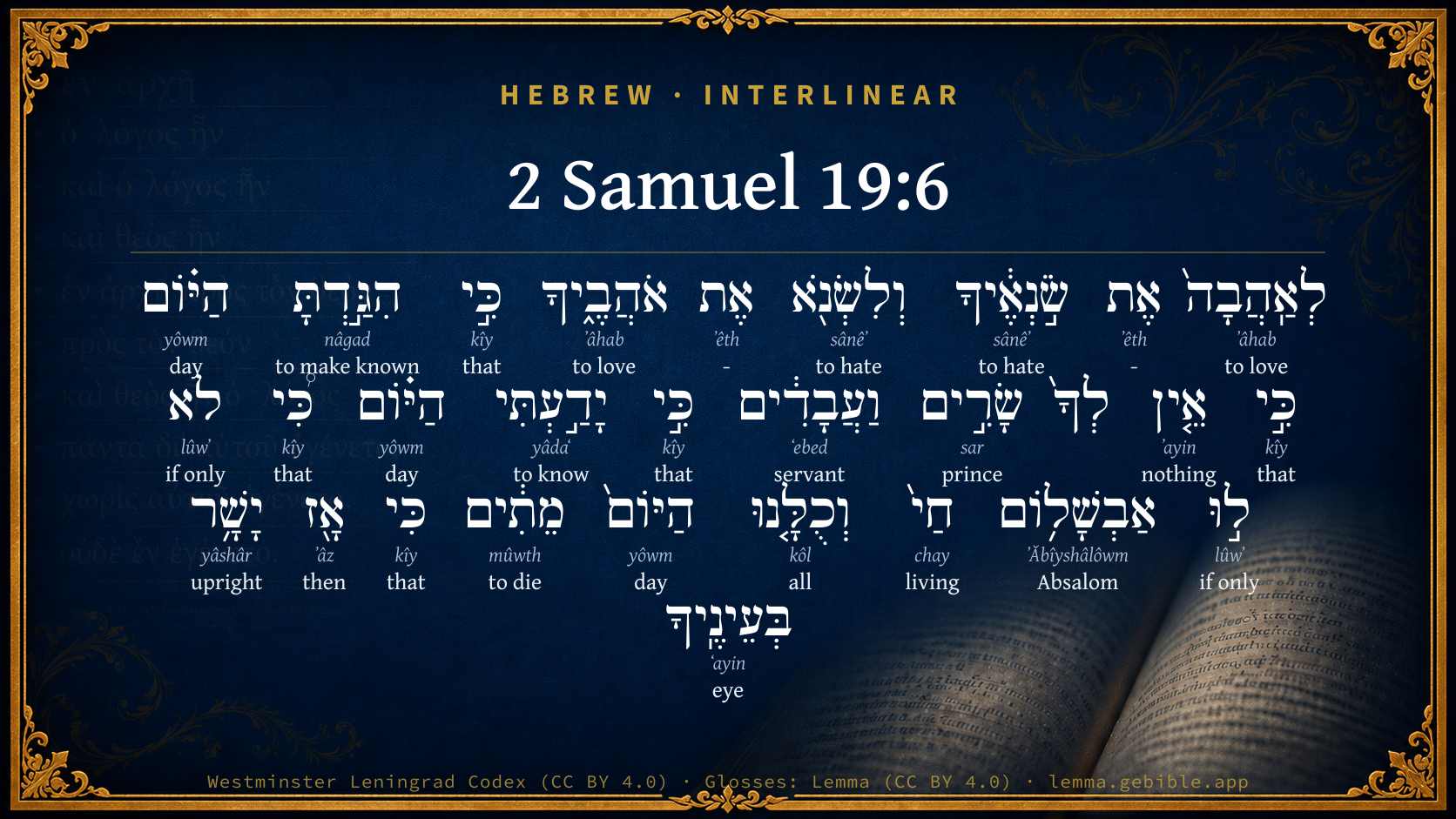
2 Samuel 19:6

Hebrew (Westminster Leningrad Codex) 2 Samuel 19:6 appears in the Hebrew Old Testament. The text above is from the Westminster Leningrad Codex. Each word links to its Strong’s number, a concise gloss, and parsing drawn from the Open Scriptures Hebrew Bible morphology. Click any word for its full Brown-Driver-Briggs (BDB) entry.
Download image
Cite this verse

2 Samuel 19:6 (World English Bible). Public Domain. Lemma interlinear Bible study tool, https://lemma.gebible.app/v/2-samuel/19/6.

Show BibTeX & RIS
BibTeX
RIS
English Translation
in that you love those who hate you, and hate those who love you. For you have declared this day, that princes and servants are nothing to you: for this day I perceive that if Absalom had lived, and all we had died this day, then it had pleased you well.
World English Bible · Public Domain
Download a study sheet

One document with this verse’s original text, its word-by-word gloss line, the meaning frame, cross-references with their text, attributed commentary, and full source and license credits — printable, and it pastes into notes with its structure intact.

This verse Autodidact and up

Study sheet (.html) Plain text (.txt)

A passage Seminary Student

Up to 50 verses in one chapter. A passage sheet keeps up to 6 commentary sources and 12 cross-references per verse, in the order this page ranks them, and says so on the sheet whenever that leaves anything out. Ask for a single verse and you get the Autodidact verse sheet above.

Everything on this page stays free to read, with no account — the sheet is a download of what is already on screen, not access to it.

Want to remove ads? Support Godless Engineer
Compare translations 3

The same verse in 3 English versions, stacked beneath the original-language interlinear above. Click any original word for its lexicon entry.

Each is an independent rendering of the whole verse — the interlinear is not word-aligned to these translations.

Highlighted words mark where these versions differ — a whole-verse word diff, not a word-by-word alignment.

  • World English Bible Public Domain
    in that you love those who hate you, and hate those who love you. For you have declared this day, that princes and servants are nothing to you: for this day I perceive that if Absalom had lived, and all we had died this day, then it had pleased you well.
  • King James Version Public Domain
    In that thou lovest thine enemies, and hatest thy friends. For thou hast declared this day, that thou regardest neither princes nor servants: for this day I perceive, that if Absalom had lived, and all we had died this day, then it had pleased thee well.
  • unfoldingWord Literal Text CC BY-SA 4.0
    by loving the ones hating you and by hating the ones loving you. For you have declared today that the commanders and servants nothing to you. For I know today that if Absalom alive and all of us were dead today, that then right in your eyes.

unfoldingWord Literal Text — © unfoldingWord, licensed CC BY-SA 4.0. Word-aligned USFM3 via Door43 (git.door43.org/unfoldingWord/en_ult).

Versions to compare (up to 4)

3 of 4 selected

Show all 18 translations

Every available English version of this verse, each an independent rendering of the whole verse.

  • World English Bible Public Domain
    in that you love those who hate you, and hate those who love you. For you have declared this day, that princes and servants are nothing to you: for this day I perceive that if Absalom had lived, and all we had died this day, then it had pleased you well.
  • Berean Standard Bible Public Domain
    You love those who hate you and hate those who love you! For you have made it clear today that the commanders and soldiers mean nothing to you. I know today that if Absalom were alive and all of us were dead, it would have pleased you!
  • Majority Standard Bible Public Domain
    You love those who hate you and hate those who love you! For you have made it clear today that the commanders and soldiers mean nothing to you. I know today that if Absalom were alive and all of us were dead, it would have pleased you!
  • King James Version Public Domain
    In that thou lovest thine enemies, and hatest thy friends. For thou hast declared this day, that thou regardest neither princes nor servants: for this day I perceive, that if Absalom had lived, and all we had died this day, then it had pleased thee well.
  • American Standard Version (1901) Public Domain
    in that thou lovest them that hate thee, and hatest them that love thee. For thou hast declared this day, that princes and servants are nought unto thee: for this day I perceive, that if Absalom had lived, and all we had died this day, then it had pleased thee well.
  • Revised Version (1885) Public Domain
    in that thou lovest them that hate thee, and hatest them that love thee. For thou hast declared this day, that princes and servants are nought unto thee: for this day I perceive, that if Absalom had lived, and all we had died this day, then it had pleased thee well.
  • Geneva Bible (1599) Public Domain
    In that thou louest thine enemies, and hatest thy friendes: for thou hast declared this day, that thou regardest neither thy princes nor seruants: therefore this day I perceiue, that if Absalom had liued, and we all had dyed this day, that then it would haue pleased thee well.
  • Douay-Rheims (1899) Public Domain
    Thou lovest them that hate thee, and thou hatest them that love thee: and thou hast shewn this day that thou carest not for thy nobles, nor for thy servants: and I now plainly perceive that if Absalom had lived, and all we had been slain, then it would have pleased thee.
  • Young's Literal Translation Public Domain
    to love thine enemies, and to hate those loving thee, for thou hast declared to-day that thou hast no princes and servants, for I have known to-day that if Absalom `were' alive, and all of us to-day dead, that then it were right in thine eyes.
  • Literal Standard Version CC BY-SA 4.0
    to love your enemies, and to hate those loving you, for today you have declared that you have no princes and servants, for today I have known that if Absalom [were] alive, and all of us dead today, that then it were right in your eyes.
  • Unlocked Literal Bible CC BY-SA 4.0
    because you love those who hate you, and you hate those who love you. For today you have shown that commanders and soldiers are nothing to you. Today I believe that if Absalom had lived, and we all had died, then that would have pleased you.
  • unfoldingWord Literal Text CC BY-SA 4.0
    by loving the ones hating you and by hating the ones loving you. For you have declared today that the commanders and servants nothing to you. For I know today that if Absalom alive and all of us were dead today, that then right in your eyes.
  • Darby Bible Public Domain
    in that thou lovest them that hate thee, and hatest those that love thee. For thou hast declared this day, that neither princes nor servants are anything to thee: for to-day I perceive, that if Absalom had lived, and all we had died to-day, then it would have been right in thine eyes.
  • World Messianic Bible Public Domain
    in that you love those who hate you and hate those who love you. For you have declared today that princes and servants are nothing to you. For today I perceive that if Absalom had lived and we had all died today, then it would have pleased you well.
  • Webster's Bible Public Domain
    In that thou lovest thy enemies, and hatest thy friends. For thou hast declared this day, that thou regardest neither princes nor servants: for this day I perceive, that if Absalom had lived, and all we had died this day, then it had pleased thee well.
  • Free Bible Version CC BY-SA 4.0
    You did this by loving those who hate you and hating those who love you. Today you have made it plain that the commanders and the men don't mean anything to you. Today I'm sure that you'd be quite happy if Absalom was alive and all of us were dead!
  • Bible in Basic English Public Domain
    For your haters, it seems, are dear to you, and your friends are hated. For you have made it clear that captains and servants are nothing to you: and now I see that if Absalom was living and we had all been dead today, it would have been right in your eyes.
  • JPS Tanakh (1917) Public Domain
    (19-7) in that thou lovest them that hate thee, and hatest them that love thee. For thou hast declared this day, that princes and servants are nought unto thee; for this day I perceive, that if Absalom had lived, and all we had died this day, then it had pleased thee well.

Literal Standard Version (2020), Covenant Press — licensed CC BY-SA 4.0. Text via the HelloAO Bible API (eBible.org). Unlocked Literal Bible (unfoldingWord) — licensed CC BY-SA 4.0. Text via the HelloAO Bible API (eBible.org). unfoldingWord Literal Text — © unfoldingWord, licensed CC BY-SA 4.0. Word-aligned USFM3 via Door43 (git.door43.org/unfoldingWord/en_ult). Free Bible Version, Dr. Jonathan Gallagher — licensed CC BY-SA 4.0. Text via the HelloAO Bible API (eBible.org).

Word by word

More ways to search: Search by grammar → Find every occurrence → Compare this word →

Practice this passage: Drill this verse → Learn its vocabulary →

לא
lûwʼ
H3863
“if only”
Particle, Negative
Part of Speech
Particle
Type
Negative
Full BDB Definition

Origin: a conditional particle

TWOT: 1085

if, oh that!, if only! - if (unlikely condition) - if only!, oh that!, would that!
  1. לְאַֽהֲבָה֙ ʼâhab H157 “to love” Preposition + Verb, Qal, Infinitive Construct
  2. אֶת ʼêth H853 “-” Particle, Direct Object
  3. שֹׂ֣נְאֶ֔יךָ sânêʼ H8130 “hating · you” Verb, Qal, Participle Active, Masculine, Plural, Construct + Suffix, Personal, 2nd Person, Masculine, Singular
  4. וְלִשְׂנֹ֖א sânêʼ H8130 “and · to hate” Conjunction + Preposition + Verb, Qal, Infinitive Construct
  5. אֶת ʼêth H853 “-” Particle, Direct Object
  6. אֹהֲבֶ֑יךָ ʼâhab H157 “loving · you” Verb, Qal, Participle Active, Masculine, Plural, Construct + Suffix, Personal, 2nd Person, Masculine, Singular
  7. כִּ֣י kîy H3588 “that” Conjunction
  8. הִגַּ֣דְתָּ nâgad H5046 “to make known” Verb, Hiphil, Perfect, 2nd Person, Masculine, Singular
  9. הַיּ֗וֹם yôwm H3117 “the · day” Particle, Definite Article + Noun, Common, Masculine, Singular, Absolute
  10. כִּ֣י kîy H3588 “that” Conjunction
  11. אֵ֤ין ʼayin H369 “nothing” Particle, Negative
  12. שָׂרִ֣ים sar H8269 “princes” Noun, Common, Masculine, Plural, Absolute
  13. וַעֲבָדִ֔ים ʻebed H5650 “and · servants” Conjunction + Noun, Common, Masculine, Plural, Absolute
  14. כִּ֣י kîy H3588 “that” Conjunction
  15. יָדַ֣עְתִּי yâdaʻ H3045 “to know” Verb, Qal, Perfect, 1st Person, Common, Singular
  16. הַיּ֗וֹם yôwm H3117 “the · day” Particle, Definite Article + Noun, Common, Masculine, Singular, Absolute
  17. כִּ֠י kîy H3588 “that” Conjunction
  18. ל֣וּ lûwʼ H3863 “if only” Conjunction
  19. אַבְשָׁל֥וֹם ʼĂbîyshâlôwm H53 “Absalom” Noun, Proper
  20. חַי֙ chay H2416 “living” Adjective, Adjective, Masculine, Singular, Absolute
  21. וְכֻלָּ֤נוּ kôl H3605 “and · all · our” Conjunction + Noun, Common, Masculine, Singular, Construct + Suffix, Personal, 1st Person, Common, Plural
  22. הַיּוֹם֙ yôwm H3117 “the · day” Particle, Definite Article + Noun, Common, Masculine, Singular, Absolute
  23. מֵתִ֔ים mûwth H4191 “dying” Verb, Qal, Participle Active, Masculine, Plural, Absolute
  24. כִּי kîy H3588 “that” Conjunction
  25. אָ֖ז ʼâz H227 “then” Adverb
  26. יָשָׁ֥ר yâshâr H3477 “upright” Adjective, Adjective, Masculine, Singular, Absolute
  27. בְּעֵינֶֽיךָ ʻayin H5869 “in/at · eyes · your” Preposition + Noun, Common, Both, Dual, Construct + Suffix, Personal, 2nd Person, Masculine, Singular

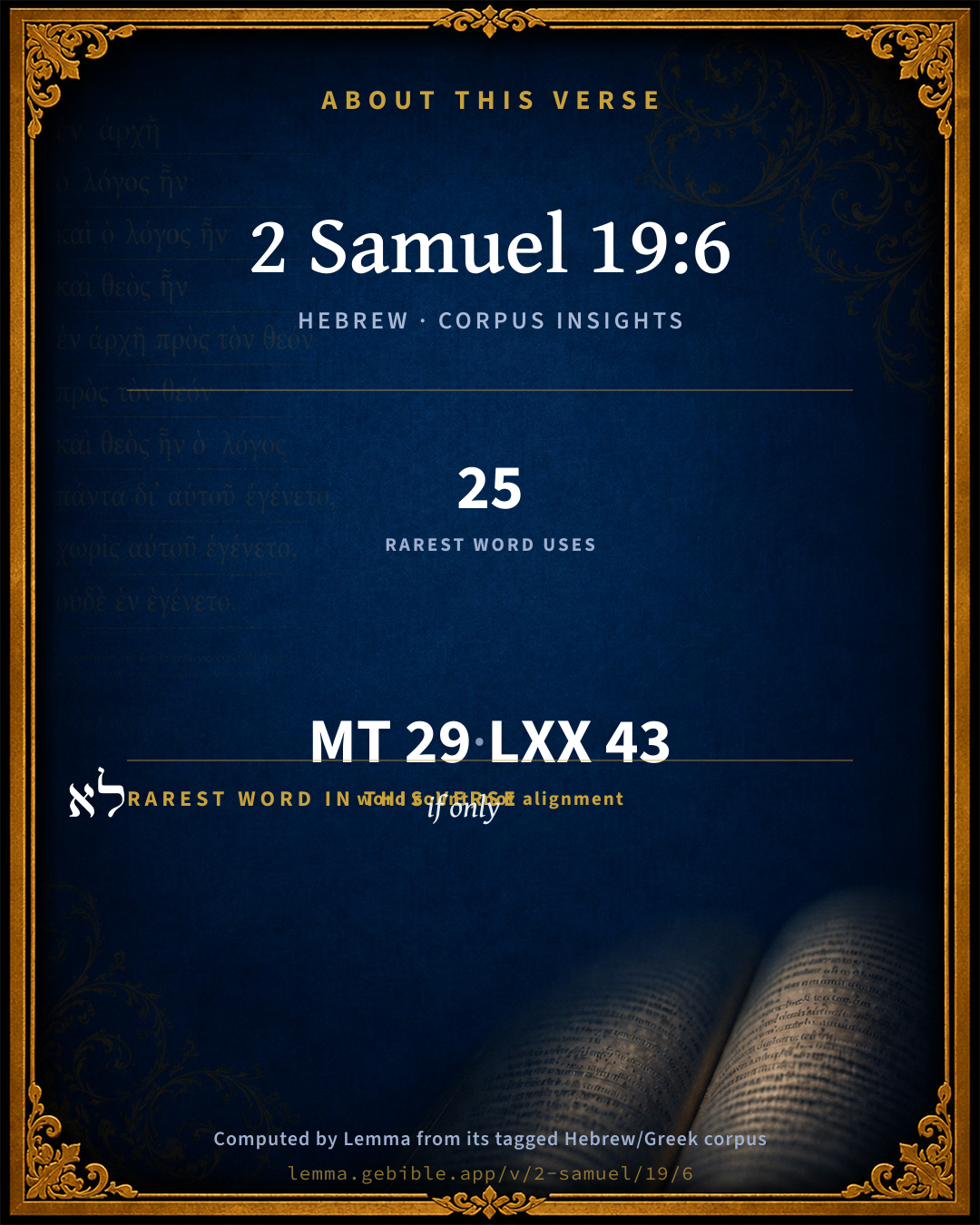
About this verse

These counts appear in no published source. They are computed here, from the morphology-tagged text and Lemma’s own curated glosses. What Lemma adds →

29
words
18
distinct lemmas
Historical
section

Notable vocabulary

The rarest word here is לא if only H3863 — appearing just 25 times in the whole Hebrew Bible.

Shared distinctive vocabulary

לא if only H3863 occurs in 22 verses of the Hebrew Bible. Also found in:

Grammatical profile

  • 7 verbs
  • 8 nouns
  • 2 adjectives
  • 1 preposition
  • 6 conjunctions
  • 1 adverb
  • 4 particles

Verb forms

  • לְאַֽהֲבָה֙ Qal · Infinitive Construct
  • שֹׂ֣נְאֶ֔יךָ Qal · Participle Active
  • וְלִשְׂנֹ֖א Qal · Infinitive Construct
  • אֹהֲבֶ֑יךָ Qal · Participle Active
  • הִגַּ֣דְתָּ Hiphil · Perfect
  • יָדַ֣עְתִּי Qal · Perfect
  • מֵתִ֔ים Qal · Participle Active

Repetition

Words recur within this verse — often emphatic in Hebrew:

  • הַיּ֗וֹם day H3117 ×3
  • לְאַֽהֲבָה֙ to love H157 ×2
  • שֹׂ֣נְאֶ֔יךָ to hate H8130 ×2
  • לא if only H3863 ×2
  • כִּ֣י that H3588 ×5

Hebrew & Septuagint length

In English translation the verse runs 51 words from the Hebrew and 56 from the Septuagint (LXX English) — closely comparable.

A rough comparison of the two English renderings, which tokenize alike — not a word-level alignment.

Word counts can differ between the Hebrew and the Greek without any difference in meaning — e.g. the Hebrew direct-object marker אֵת has no separate Greek word, and Greek often adds the article ὁ.

In the original languages it is 29 Hebrew tokens and 43 Greek tokens — but the two are counted differently (Hebrew bundles its prefixes and suffixes into one token; the Greek is in lemma form), so that isn’t a like-for-like length.

Cross-references

4

Topical passages linked to 2 Samuel 19:6 in the Treasury of Scripture Knowledge — connected by theme and wording, ordered by reader-vote popularity; previews shown in the World English Bible.

  • 2 Samuel 3:24–25 Then Joab came to the king, and said, What have you done? behold, Abner came to you; why is it that you have sent him away, and he is quite gone?
  • Job 34:18 Who says to a king, 'Vile!' Or to nobles, 'Wicked!'
  • Proverbs 19:9–10 A false witness shall not be unpunished. He who utters lies shall perish.
  • Acts 23:5 Paul said, "I didn't know, brothers, that he was high priest. For it is written, 'You shall not speak evil of a ruler of your people.'"

Cross-references courtesy of OpenBible.info (CC BY 4.0).

Hebrew and Greek witnesses Masoretic Hebrew ↔ Greek Septuagint

The same verse in the two great witnesses to the Old Testament, shown verse-for-verse.

These are two independent witnesses, not word-aligned to each other, and the Septuagint is shown in lemma (dictionary) form.

Hebrew 2 Samuel 19:6 Masoretic · Westminster Leningrad Codex

לְאַֽהֲבָה֙ אֶת שֹׂ֣נְאֶ֔יךָ וְלִשְׂנֹ֖א אֶת אֹהֲבֶ֑יךָ כִּ֣י הִגַּ֣דְתָּ הַיּ֗וֹם כִּ֣י אֵ֤ין לְךָ֙ שָׂרִ֣ים וַעֲבָדִ֔ים כִּ֣י יָדַ֣עְתִּי הַיּ֗וֹם כִּ֠י לא ל֣וּ אַבְשָׁל֥וֹם חַי֙ וְכֻלָּ֤נוּ הַיּוֹם֙ מֵתִ֔ים כִּי אָ֖ז יָשָׁ֥ר בְּעֵינֶֽיךָ

in that you love those who hate you, and hate those who love you. For you have declared this day, that princes and servants are nothing to you: for this day I perceive that if Absalom had lived, and all we had died this day, then it had pleased you well.

World English Bible · Public Domain

Greek LXX 2 Samuel 19:6 Septuagint · lemma form

καί εἰςἔρχομαι ιωαβ πρός ὁ βασιλεύς εἰς ὁ οἶκος καί εἶπον κατααἰσχύνω σήμερον ὁ πρόσωπον πᾶς ὁ δοῦλος σύ ὁ ἐκαἱρέω σύ σήμερον καί ὁ ψυχή ὁ υἱός σύ καί ὁ θυγάτηρ σύ καί ὁ ψυχή ὁ γυνή σύ καί ὁ παλλακή σύ

forasmuch as you love them that hate you, and hate them that love you; and you have this day declared, that your princes and your servants are nothing in your sight: for I know this day, that if Abessalom were alive, and all of us dead today, then it would have been right in your sight.

LXX2012 (modern English Septuagint) · Public Domain

Hebrew: Westminster Leningrad Codex (CC BY 4.0). Greek: Septuagint (public domain); English from LXX2012 (modern English Septuagint) (Public Domain). How the Septuagint differs from the Hebrew →

Targum (Aramaic paraphrase)

1

The Targum is the ancient Jewish Aramaic paraphrase of the Hebrew Scriptures — an interpretive translation, not the Hebrew text itself. Onkelos (literal) and Pseudo-Jonathan (expansive) render the Torah, and Jonathan the Prophets. Coverage is partial: where no permissively-licensed English translation exists for a verse, only the Aramaic is shown. This is verse-level text, not a word-by-word alignment to the Hebrew.

  1. Targum Jonathan Prophets (Joshua–Malachi)
    וַאֲתָא יוֹאָב לְוַת מַלְכָּא לְבֵיתָא וַאֲמַר אַבְהֵיתְתָא יוֹמָא דֵין יַת אַפֵּי כָּל עַבְדָיִךְ דְשֵׁיזִיבוּ יַת נַפְשָׁךְ יוֹמָא דֵין וְיַת נְפַשׁ בְּנָךְ וּבְנָתָךְ וּנְפַשׁ נְשָׁךְ וּנְפַשׁ לְחֵינָתָךְ:

    (no public-domain English translation for this verse)

    Targum Jonathan — Aramaic: “Mikraot Gedolot” (public domain). English: “Sefaria Community Translation” (CC0 1.0 (public-domain dedication)); “London "Chaldee Paraphrase," 1871” (public domain). Text via Sefaria.

Commentary

Notes on 2 Samuel 19:6 from classic Christian and Jewish commentators (each source and its license shown beneath its notes). The classic Christian expositions comment on the surrounding passage and are grouped to its opening verse, so a note may address several verses; the Jewish commentaries on the Tanakh (Rashi and others) are per-verse, so they appear only where the commentator wrote on this verse.

Lemma curates 59 commentaries, every one of them public domain or Creative Commons licensed, each selected and text-cleaned for this edition rather than reprinted as found. About our sources →

Trapp's Complete Commentary

John Trapp

2Sa 19:6 In that thou lovest thine enemies, and hatest thy friends. For thou hast declared this day, that thou regardest neither princes nor servants: for this day I perceive, that if Absalom had lived, and all we had died this day, then it had pleased thee well.

Ver. 6. And hatest thy friends.] This was not true: neither did David love Absalom as an enemy, but as a son, through a nimium excessively of natural affection.

Then it had pleased thee well.] But what, then, would have become of good David? and how would his darling son have served him? would he not have been forced, if he escaped with life, to supplicate Absalom in like sort as old Andronicus, the great emperor, to this effect did his young nephew? ‘Reverence my miserable old age, which of itself promiseth unto me shortly death, but unto thee a rest after long cares; reverence the hands which have oftentimes most lovingly embraced thee, yet crying in thy swathing clothes; reverence those lips which have oftentimes most lovingly kissed thee and called thee mine other self; have pity upon a bruised reed cast down by fortune, and do not thou again tread upon it. And seeing thou art thyself a man, be not too proud of thy present condition, but consider the uncertainty and variety of worldly things, taking by me example. See in me the end of long life, and marvel how one might, having received me an emperor of many years, leave me now subject unto another man’s power for ever.’ {a} Thus he, and much more to the same purpose.

{a} Turk. Hist., fol. 172.

John Trapp, A Commentary or Exposition upon All the Books of the Old and New Testament (1647–1656) — public domain. Text from a community e-Sword module.

Geneva Bible (1599)

Geneva Bible translators

Or, captains.

Hebrew, been right in thine eyes.

Geneva Bible (1599) marginal notes — public domain. Text via Bolls.life.

The Cambridge Bible for Schools and Colleges

gen. ed. J. J. S. Perowne

6. neither princes nor servants] Neither the captains of the army (ch. 2Sa_18:1; 2Sa_18:5), nor the soldiers.

The Cambridge Bible for Schools and Colleges (gen. ed. J. J. S. Perowne; Cambridge University Press, 1878–1918) — public domain. Text from a community e-Sword module.

John Gill's Exposition

In that thou lovest thine enemies, and hatest thy friends,.... Which though not strictly true, there was some appearance of it, which is here greatly exaggerated; in that he expressed so much grief and sorrow for Absalom his enemy, who had rebelled against him, and showed so little regard to his friends, that had exposed their lives for him:

for thou hast declared this day: by his conduct and behaviour, mourning for his rebellious son, and taking no notice of his faithful servants:

that thou regardest neither princes nor servants; neither the officers of the army, the generals and captains, nor the common soldiers: since neither the one were admitted into his presence privately, nor had the other public thanks as they entered the city, as might have been expected: or "that thou hast no princes and servants" (g); none that are accounted of as such; they are nothing with thee, in no esteem at all, as if thou hadst none:

for this day I perceive that if Absalom had lived, and all we had died this day, then it had pleased thee well; this was carrying the matter too far; for though it would have been agreeable to David if Absalom had lived, and not been slain, yet not that his army should perish, or his people be destroyed; it would have pleased him well if both had lived.

(g) "non tibi principes et servi", Pagninus, Montanus; "nihil tibi sint principes et servi", Piscator.

John Gill's Exposition of the Whole Bible (1746–1763) — public domain (CC PDM 1.0). Text via the HelloAO Bible API.

Haydock's Catholic Bible Commentary

Thee. What insolence! Kings are often forced to brook the affronts of their higher servants, as well as other masters. There is a gradation in human affairs, which make the next in dignity and power think himself equal to the highest. Similis ero altissimo, Isaias xiv. 14. (Haydock) --- David sincerely desired the welfare of all his people, as well as of Absalom. (Menochius)

George Leo Haydock (1774–1849), Haydock's Catholic Family Bible and Commentary, 1859 edition — public domain. Excludes Psalms (Douay-Rheims chapter numbering differs from Protestant) and Deuterocanonical books (Catholic canon only).

Matthew Poole's English Annotations

This is not to be understood as exactly true in the rigour of it, but only comparatively and hyperbolically spoken; for David desired their preservation and Absalom’s too: but it must be considered that Joab was now in a high transport of passion, which might easily hurry him into indecent expressions; and that David’s carriage gave too much colour to such a suggestion; and that such sharpness of speech was in a manner necessary to awaken the king out of his lethargy, and to preserve him from the impendent mischiefs.

Matthew Poole's English Annotations on the Holy Bible (1683–1685) — public domain. Text from a community e-Sword/MySword module.

Whedon's Commentary on the Bible

Daniel D. Whedon

6. Thou lovest thine enemies, and hatest thy friends — Certainly David’s conduct justified this charge.

Daniel D. Whedon (gen. ed.), Commentary on the Old and New Testaments (1874–1909) — public domain. Text from a community e-Sword module.

The Pulpit Commentary

HOMILIES BY G. WOOD Ver. 6.

Loving enemies and hating friends.

lovest thine enemies, and hatest thy friends." Joab"s remonstrance with David was rude, and in the language of exaggeration; yet in substance it was wise, as the issue proved. The king"s lamentations did show excessive love for his deceased son, who had been his deadly enemy; and his abandonment of himself to grief when he ought to have been thanking his brave friends as they returned from the battle, and congratulating them on the victory they had won for him, did indicate a present insensibility to their services and claims which might easily be construed as enmity. It is, however, no unusual thing for men to love their enemies and hate their friends; or at least, by their conduct, to give good reason for others to charge them with doing so.

I THOSE DO SO WHO LOVE ERROR AND HATE THE TRUTH. For truth is one of our best friends, error one of our worst enemies. Moral and religious truth especially is life, health, guidance, happiness, to the soul; it leads to God and goodness and heaven. But error in such matters is death, disease, delusion; producing false peace and leading to destruction. Yet men often love the errors which favour what they are inclined to, and hate the truth which shows them their duties, sins, and dangers. They "love darkness rather than light, because their deeds are evil". (Joh_3:19) "Fools hate knowledge". (Pro_1:22) Hence they love false teachers and hate the true. "I hate him," said Ahab of Micaiah, "for he doth not prophesy good concerning me, but evil". (1Ki_22:8)

II THOSE WHO LOVE THEIR LOWER RATHER THAN THEIR HIGHER SELF. Our lower nature is good in itself, but is very prone to run to excess, and become evil. Then, from a friend, it is transformed into an enemy. Our higher nature is a friend, especially when informed and directed by the Holy Spirit. Man"s worth and blessedness depend on his obeying the latter and subduing the former. Too often, however, he takes the opposite course, yielding himself to the government of the flesh, and resisting the promptings of the spirit.

III THOSE WHO LOVE THE WICKED AND HATE THE GOOD. Associating with the former and finding pleasure in their practices, but avoiding the society of the latter; loving flatterers, and hating faithful reprovers and advisers. Ungodly and unholy men are necessarily, though it may be unconsciously and unintentionally, the enemies of the souls of those whom they influence, whether by conversation or example; and the more attractive they are, so much the more dangerous. "Evil company doth corrupt good manners". (1Co_15:33, Revised Version)

IV THOSE WHO DELIGHT IN BAD BOOKS, AND DISLIKE AND NEGLECT GOOD ONES. Good books are good friends, promoting in us that which is good. The Bible is the best of books. Bad books, books which suggest and foster evil, are enemies; and the more they interest their readers, the more they injure them. Yet many delight in them, and dislike the books which would profit them.

V THOSE, IN A WORD, WHO LOVE, IF NOT SATAN, HIS WAYS, AND LIVE IN ENMITY WITH GOD AND CHRIST. Satan is our chief enemy, the head and ruler of all other spiritual foes. He seeks our ruin by manifold devices, and, so that we serve him, is quite content that we should do so in the fashion we most approve. We may join which company of his servants the coarser or the more refined, the open or the secret we may prefer. But to follow him in any way is, in effect, to love our worst enemy. Christ, on the other hand, and God in him, is our best Friend, who loves us most truly and most wisely, who has made greater sacrifices for us than any other can make, who has done for us what no other can do, who proffers us blessings beyond the power of any other to confer, who exalts those who love him to a position of honour and happiness to which no other can raise their friends, and lives on to bless them when others die and pass away. To reject him, to refuse him the love, allegiance, and obedience which he claims, is, in effect, to hate the Friend who is most of all needed by us, and most worthy to be loved with all the power of loving which our hearts possess.

Let those to whom these representations apply reflect on the sin and folly of which they are guilty; the incalculable good they are losing; the incalculable evils they are choosing. Their eyes will at length be opened; may it be in time! G.W.

The Pulpit Commentary (1880–1919), ed. H.D.M. Spence-Jones & Joseph S. Exell — public domain. Text from a community e-Sword module.

John Wesley's Explanatory Notes

Pleased thee - This is not be understood as exactly true; but David's carriage gave too much colour to such a suggestion; and such sharpness of speech was in a manner necessary to awaken the king out of his lethargy, and to preserve him from the impendent mischiefs.

John Wesley, Explanatory Notes Upon the Whole Bible (1754–1765) — public domain. Text via the GEBible commentary corpus.

Lesson kit

Teaching starters — assembled from the data on this page, not authored interpretation. Every prompt links to the verse data it draws on. Edit before teaching.

2 Samuel, in the Historical, opens this verse with 29 words (18 distinct Hebrew lemmas). Its most distinctive word is lûwʼ (“if only”). A historical commentator’s framing appears above. Read the whole chapter for the surrounding context.

Discussion questions

  1. The word lûwʼ carries the sense “if only.” How does it shape the verse?
  2. How does Genesis 17:18, which shares the word «if only», read alongside this verse?
  3. What does the repetition of “day” (3× in this one verse) do in this verse?
  4. These translations render this verse differently. What is at stake in choosing one wording over another?
  5. «לְאַֽהֲבָה֙» is a Qal Infinitive Construct verb. How does that grammatical form shape the action described?
  6. Compare how Trapp's Complete Commentary and Geneva Bible (1599) read this verse. Where do they agree or differ?

Things to notice

Reading settings

Reading text

Shown beneath each verse's original-language words.

Old Testament
Old Testament edition

Read the OT as the Masoretic Hebrew (MT) or the Greek Septuagint (LXX).

English shown for the Greek Septuagint (in the Hebrew ↔ Greek comparison).

Comparing translations? Open the Compare panel on any verse page to stack up to four side by side.