Deuteronomy 4:12

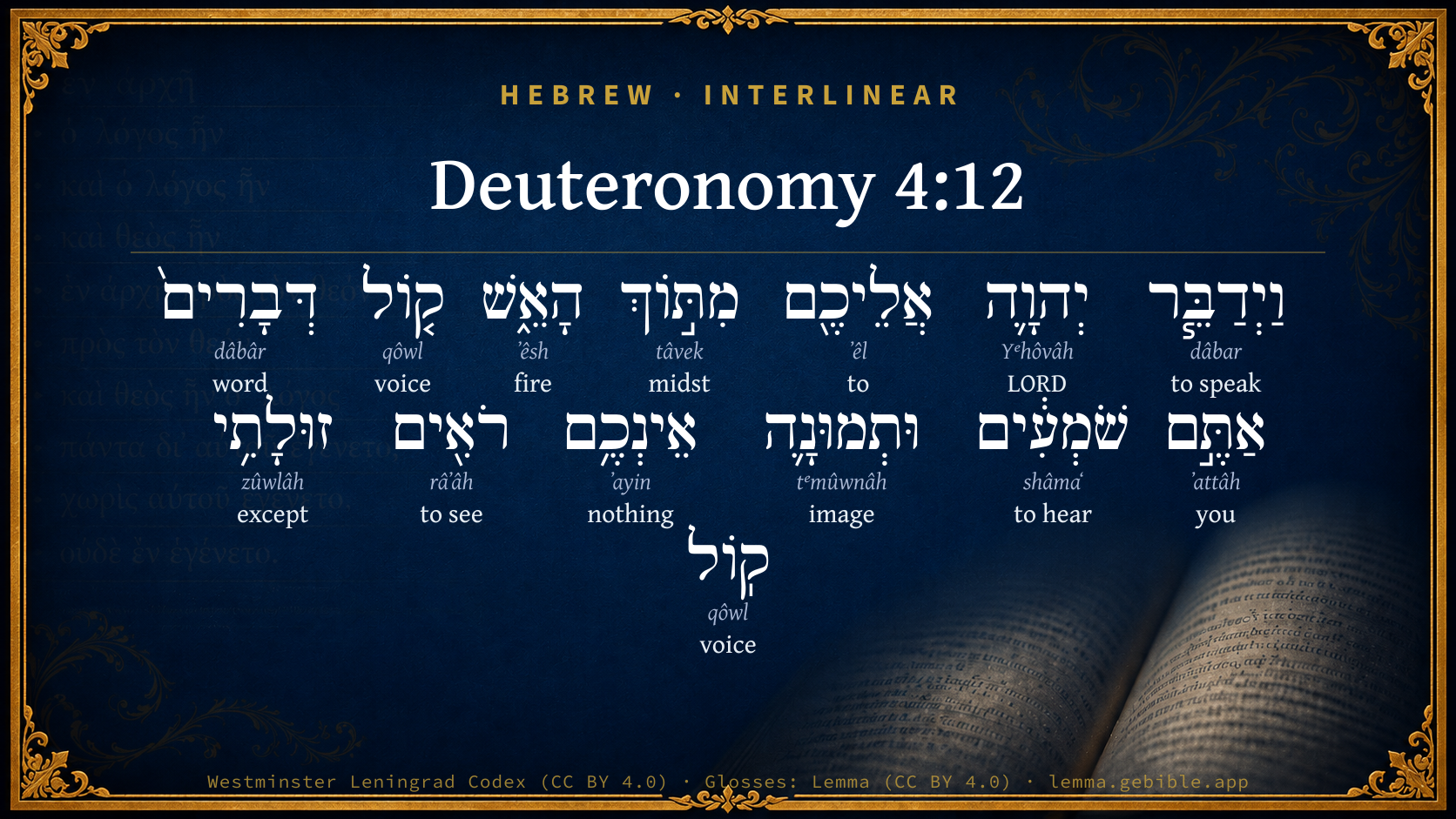
Hebrew (Westminster Leningrad Codex) Deuteronomy 4:12 appears in the Hebrew Old Testament. The text above is from the Westminster Leningrad Codex. Each word links to its Strong’s number, a concise gloss, and parsing drawn from the Open Scriptures Hebrew Bible morphology. Click any word for its full Brown-Driver-Briggs (BDB) entry.
Download image
Cite this verse

Deuteronomy 4:12 (World English Bible). Public Domain. Lemma interlinear Bible study tool, https://lemma.gebible.app/v/deuteronomy/4/12.

Show BibTeX & RIS
BibTeX
RIS
English Translation
Yahweh spoke to you out of the midst of the fire: you heard the voice of words, but you saw no form; only [you heard] a voice.
World English Bible · Public Domain
Download a study sheet

One document with this verse’s original text, its word-by-word gloss line, the meaning frame, cross-references with their text, attributed commentary, and full source and license credits — printable, and it pastes into notes with its structure intact.

This verse Autodidact and up

Study sheet (.html) Plain text (.txt)

A passage Seminary Student

Up to 50 verses in one chapter. A passage sheet keeps up to 6 commentary sources and 12 cross-references per verse, in the order this page ranks them, and says so on the sheet whenever that leaves anything out. Ask for a single verse and you get the Autodidact verse sheet above.

Everything on this page stays free to read, with no account — the sheet is a download of what is already on screen, not access to it.

Want to remove ads? Support Godless Engineer
Compare translations 3

The same verse in 3 English versions, stacked beneath the original-language interlinear above. Click any original word for its lexicon entry.

Each is an independent rendering of the whole verse — the interlinear is not word-aligned to these translations.

Highlighted words mark where these versions differ — a whole-verse word diff, not a word-by-word alignment.

  • World English Bible Public Domain
    Yahweh spoke to you out of the midst of the fire: you heard the voice of words, but you saw no form; only [you heard] a voice.
  • King James Version Public Domain
    And the LORD spake unto you out of the midst of the fire: ye heard the voice of the words, but saw no similitude; only ye heard a voice.
  • unfoldingWord Literal Text CC BY-SA 4.0
    And Yahweh spoke to you from the midst of the fire. You heard the sound of the words, and you saw no form, only a voice.

unfoldingWord Literal Text — © unfoldingWord, licensed CC BY-SA 4.0. Word-aligned USFM3 via Door43 (git.door43.org/unfoldingWord/en_ult).

Versions to compare (up to 4)

3 of 4 selected

Show all 18 translations

Every available English version of this verse, each an independent rendering of the whole verse.

  • World English Bible Public Domain
    Yahweh spoke to you out of the midst of the fire: you heard the voice of words, but you saw no form; only [you heard] a voice.
  • Berean Standard Bible Public Domain
    And the LORD spoke to you out of the fire. You heard the sound of the words, but saw no form; there was only a voice.
  • Majority Standard Bible Public Domain
    And the LORD spoke to you out of the fire. You heard the sound of the words but saw no form; there was only a voice.
  • King James Version Public Domain
    And the LORD spake unto you out of the midst of the fire: ye heard the voice of the words, but saw no similitude; only ye heard a voice.
  • American Standard Version (1901) Public Domain
    And Jehovah spake unto you out of the midst of the fire: ye heard the voice of words, but ye saw no form; only `ye heard' a voice.
  • Revised Version (1885) Public Domain
    And the LORD spake unto you out of the midst of the fire: ye heard the voice of words, but ye saw no form; only ye heard a voice.
  • Geneva Bible (1599) Public Domain
    And the Lord spake vnto you out of the middes of the fire, and ye heard the voyce of the wordes, but sawe no similitude, saue a voyce.
  • Douay-Rheims (1899) Public Domain
    And the Lord spoke to you from the midst of the fire. You heard the voice of his words, but you saw not any form at all.
  • Young's Literal Translation Public Domain
    `And Jehovah speaketh unto you out of the midst of the fire; a voice of words ye are hearing and a similitude ye are not seeing, only a voice;
  • Literal Standard Version CC BY-SA 4.0
    and YHWH speaks to you out of the midst of the fire; you are hearing a voice of words, but you are seeing no likeness, only a voice;
  • Unlocked Literal Bible CC BY-SA 4.0
    Yahweh spoke to you out of the middle of the fire; you heard the voice with its words, but you saw no form; you only heard a voice.
  • unfoldingWord Literal Text CC BY-SA 4.0
    And Yahweh spoke to you from the midst of the fire. You heard the sound of the words, and you saw no form, only a voice.
  • Darby Bible Public Domain
    And Jehovah spoke to you from the midst of the fire: ye heard the voice of the words, but ye saw no form; only [ye heard] a voice.
  • World Messianic Bible Public Domain
    The LORD spoke to you out of the middle of the fire: you heard the voice of words, but you saw no form; you only heard a voice.
  • Webster's Bible Public Domain
    And the LORD spoke to you out of the midst of the fire: ye heard the voice of the words, but saw no similitude; only ye heard a voice.
  • Free Bible Version CC BY-SA 4.0
    The Lord spoke to you from the fire. You heard the words, but you didn't see the form of anyone speaking—there was just a voice.
  • Bible in Basic English Public Domain
    And the voice of the Lord came to you out of the fire: the sound of his words came to your ears but you saw no form; there was nothing but a voice.
  • JPS Tanakh (1917) Public Domain
    And the LORD spoke unto you out of the midst of the fire; ye heard the voice of words, but ye saw no form; only a voice.

Literal Standard Version (2020), Covenant Press — licensed CC BY-SA 4.0. Text via the HelloAO Bible API (eBible.org). Unlocked Literal Bible (unfoldingWord) — licensed CC BY-SA 4.0. Text via the HelloAO Bible API (eBible.org). unfoldingWord Literal Text — © unfoldingWord, licensed CC BY-SA 4.0. Word-aligned USFM3 via Door43 (git.door43.org/unfoldingWord/en_ult). Free Bible Version, Dr. Jonathan Gallagher — licensed CC BY-SA 4.0. Text via the HelloAO Bible API (eBible.org).

Word by word

More ways to search: Search by grammar → Find every occurrence → Compare this word →

Practice this passage: Drill this verse → Learn its vocabulary →

וּתְמוּנָ֛ה
tᵉmûwnâh
H8544
“and · image”
Conjunction + Noun, Common, Feminine, Singular, Absolute
Part of Speech
Conjunction + Noun
Type
Common
Gender
Feminine
Number
Singular
State
Absolute
Full BDB Definition

Origin: from H4327

TWOT: 1191b

form, image, likeness, representation, semblance
  1. וַיְדַבֵּ֧ר dâbar H1696 “and · to speak” Conjunction + Verb, Piel, Sequential Imperfect, 3rd Person, Masculine, Singular
  2. יְהוָ֛ה Yᵉhôvâh H3068 “LORD” Noun, Proper
  3. אֲלֵיכֶ֖ם ʼêl H413 “to · you” Preposition + Suffix, Personal, 2nd Person, Masculine, Plural
  4. מִתּ֣וֹךְ tâvek H8432 “from · midst of” Preposition + Noun, Common, Masculine, Singular, Construct
  5. הָאֵ֑שׁ ʼêsh H784 “the · fire” Particle, Definite Article + Noun, Common, Both, Singular, Absolute
  6. ק֤וֹל qôwl H6963 “voice of” Noun, Common, Masculine, Singular, Construct
  7. דְּבָרִים֙ dâbâr H1697 “words” Noun, Common, Masculine, Plural, Absolute
  8. אַתֶּ֣ם ʼattâh H859 “you” Pronoun, Personal, 2nd Person, Masculine, Plural
  9. שֹׁמְעִ֔ים shâmaʻ H8085 “hearing” Verb, Qal, Participle Active, Masculine, Plural, Absolute
  10. אֵינְכֶ֥ם ʼayin H369 “nothing · you” Particle, Negative + Suffix, Personal, 2nd Person, Masculine, Plural
  11. רֹאִ֖ים râʼâh H7200 “seeing” Verb, Qal, Participle Active, Masculine, Plural, Absolute
  12. זוּלָתִ֥י zûwlâh H2108 “except” Preposition
  13. קֽוֹל qôwl H6963 “voice” Noun, Common, Masculine, Singular, Absolute

About this verse

These counts appear in no published source. They are computed here, from the morphology-tagged text and Lemma’s own curated glosses. What Lemma adds →

14
words
13
distinct lemmas
Pentateuch
section

Notable vocabulary

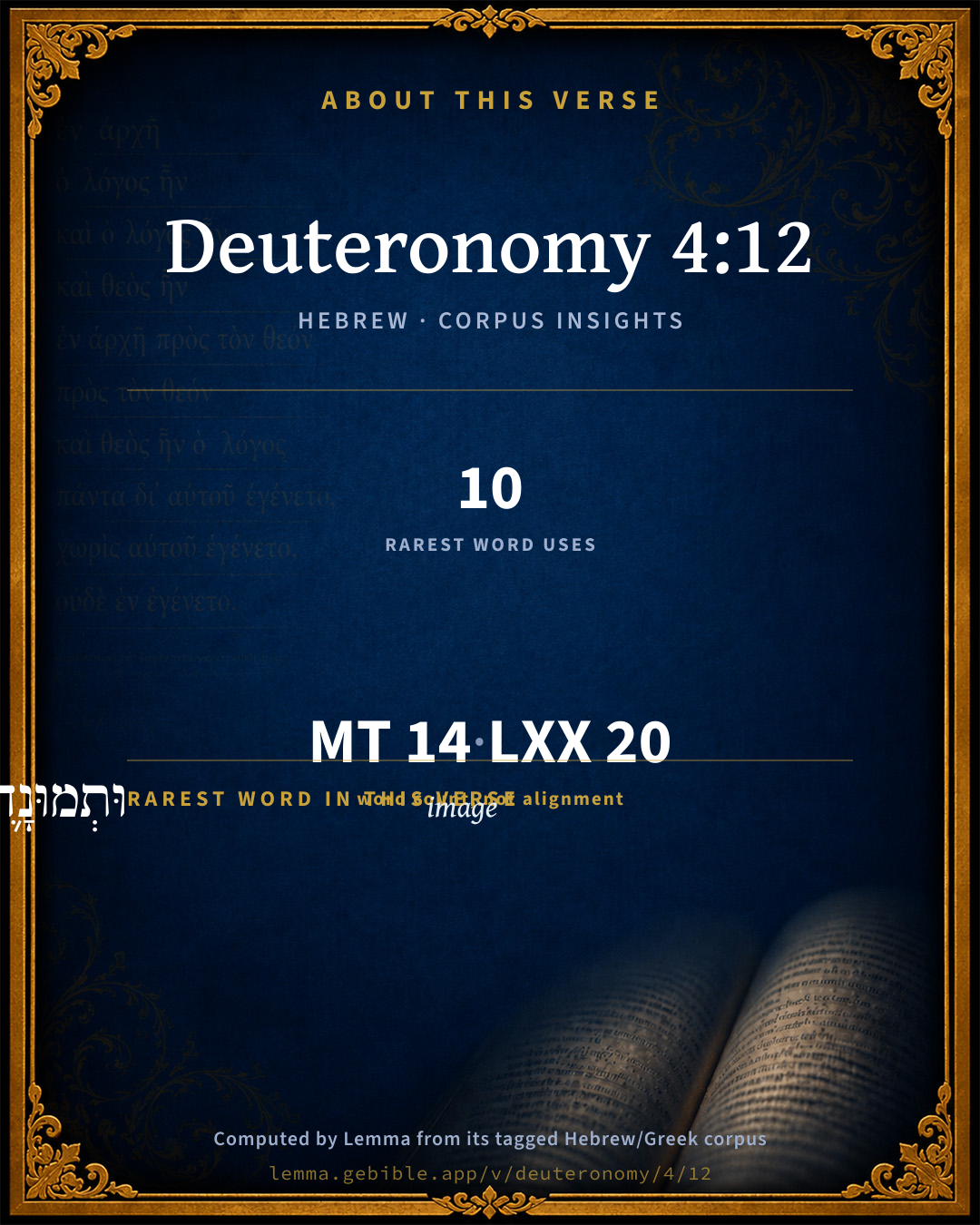
The rarest word here is וּתְמוּנָ֛ה image H8544 — appearing just 10 times in the whole Hebrew Bible.

Shared distinctive vocabulary

וּתְמוּנָ֛ה image H8544 occurs in 10 verses of the Hebrew Bible. Also found in:

Grammatical profile

  • 3 verbs
  • 7 nouns
  • 1 pronoun
  • 2 prepositions
  • 1 particle

Verb forms

  • וַיְדַבֵּ֧ר Piel · Sequential Imperfect
  • שֹׁמְעִ֔ים Qal · Participle Active
  • רֹאִ֖ים Qal · Participle Active

Repetition

A word recurs within this verse — often emphatic in Hebrew:

  • ק֤וֹל voice H6963 ×2

Hebrew & Septuagint length

In English translation the verse runs 27 words from the Hebrew and 30 from the Septuagint (LXX English) — closely comparable.

A rough comparison of the two English renderings, which tokenize alike — not a word-level alignment.

Word counts can differ between the Hebrew and the Greek without any difference in meaning — e.g. the Hebrew direct-object marker אֵת has no separate Greek word, and Greek often adds the article ὁ.

In the original languages it is 14 Hebrew tokens and 20 Greek tokens — but the two are counted differently (Hebrew bundles its prefixes and suffixes into one token; the Greek is in lemma form), so that isn’t a like-for-like length.

Cross-references

18

Topical passages linked to Deuteronomy 4:12 in the Treasury of Scripture Knowledge — connected by theme and wording, ordered by reader-vote popularity; previews shown in the World English Bible.

  • Deuteronomy 4:15 Take therefore good heed to yourselves; for you saw no manner of form on the day that Yahweh spoke to you in Horeb out of the midst of the fire.
  • Deuteronomy 5:4 Yahweh spoke with you face to face on the mountain out of the midst of the fire,
  • Deuteronomy 5:22 These words Yahweh spoke to all your assembly on the mountain out of the midst of the fire, of the cloud, and of the thick darkness, with a great voice: and he added no more. He wrote them on two tables of stone, and gave them to me.
  • Deuteronomy 4:33 Did ever a people hear the voice of God speaking out of the midst of the fire, as you have heard, and live?
  • Deuteronomy 4:36 Out of heaven he made you to hear his voice, that he might instruct you: and on earth he made you to see his great fire; and you heard his words out of the midst of the fire.
  • 1 Kings 19:12–13 and after the earthquake a fire; but Yahweh was not in the fire: and after the fire a still small voice.
  • Matthew 3:17 Behold, a voice out of the heavens said, "This is my beloved Son, with whom I am well pleased."
  • John 12:28–30 Father, glorify your name!" Then there came a voice out of the sky, saying, "I have both glorified it, and will glorify it again."
  • 2 Peter 1:17–18 For he received from God the Father honor and glory, when the voice came to him from the Majestic Glory, "This is my beloved Son, in whom I am well pleased."
  • Exodus 20:22 Yahweh said to Moses, "This is what you shall tell the children of Israel: 'You yourselves have seen that I have talked with you from heaven.
  • Isaiah 30:21 and your ears shall hear a word behind you, saying, This is the way, walk you in it; when you turn to the right hand, and when you turn to the left.
  • Isaiah 40:3 The voice of one who cries, Prepare you in the wilderness the way of Yahweh; make level in the desert a highway for our God.
  • Isaiah 40:6 The voice of one saying, Cry. One said, What shall I cry? All flesh is grass, and all the glory of it is as the flower of the field.
  • Isaiah 40:18 To whom then will you liken God? or what likeness will you compare to him?
  • Matthew 3:3 For this is he who was spoken of by Isaiah the prophet, saying, "The voice of one crying in the wilderness, Make ready the way of the Lord, Make his paths straight."
  • Colossians 1:15 who is the image of the invisible God, the firstborn of all creation.
  • Numbers 12:8 with him will I speak mouth to mouth, even manifestly, and not in dark speeches; and the form of Yahweh shall he see: why then were you not afraid to speak against my servant, against Moses?
  • Matthew 17:5 While he was still speaking, behold, a bright cloud overshadowed them. Behold, a voice came out of the cloud, saying, "This is my beloved Son, in whom I am well pleased. Listen to him."

Cross-references courtesy of OpenBible.info (CC BY 4.0).

Hebrew and Greek witnesses Masoretic Hebrew ↔ Greek Septuagint

The same verse in the two great witnesses to the Old Testament, shown verse-for-verse.

These are two independent witnesses, not word-aligned to each other, and the Septuagint is shown in lemma (dictionary) form.

Hebrew Deuteronomy 4:12 Masoretic · Westminster Leningrad Codex

וַיְדַבֵּ֧ר יְהוָ֛ה אֲלֵיכֶ֖ם מִתּ֣וֹךְ הָאֵ֑שׁ ק֤וֹל דְּבָרִים֙ אַתֶּ֣ם שֹׁמְעִ֔ים וּתְמוּנָ֛ה אֵינְכֶ֥ם רֹאִ֖ים זוּלָתִ֥י קֽוֹל

Yahweh spoke to you out of the midst of the fire: you heard the voice of words, but you saw no form; only [you heard] a voice.

World English Bible · Public Domain

Greek LXX Deuteronomy 4:12 Septuagint · lemma form

καί λαλέω κύριος πρός σύ ἐκ μέσος ὁ πῦρ φωνή ῥῆμα σύ ἀκούω καί ὁμοίωμα οὐ ὁράω ἀλλά ἤ φωνή

And the Lord spoke to you out of the midst of the fire a voice of words, which you⌃ heard: and you⌃ saw no likeness, only you⌃ heard a voice.

LXX2012 (modern English Septuagint) · Public Domain

Hebrew: Westminster Leningrad Codex (CC BY 4.0). Greek: Septuagint (public domain); English from LXX2012 (modern English Septuagint) (Public Domain). How the Septuagint differs from the Hebrew →

Targum (Aramaic paraphrase)

2

The Targum is the ancient Jewish Aramaic paraphrase of the Hebrew Scriptures — an interpretive translation, not the Hebrew text itself. Onkelos (literal) and Pseudo-Jonathan (expansive) render the Torah, and Jonathan the Prophets. Coverage is partial: where no permissively-licensed English translation exists for a verse, only the Aramaic is shown. This is verse-level text, not a word-by-word alignment to the Hebrew.

  1. Targum Onkelos Torah (Genesis–Deuteronomy)
    וּמַלִיל יְיָ עִמְכוֹן מִגוֹ אֶשְׁתָא קַל פִּתְגָמִין אַתּוּן שָׁמְעִין וּדְמוּת לֵיתֵיכוֹן חָזָן אֱלָהֵן קָלָא

    (no public-domain English translation for this verse)

    Targum Onkelos — Aramaic: “Onkelos Genesis” (public domain); “Onkelos Exodus” (public domain); “Onkelos Leviticus” (public domain); “Onkelos Numbers” (public domain); “Onkelos Deuteronomy” (public domain). English: “Sefaria Community Translation” (CC0 1.0 (public-domain dedication)); “J.W. Etheridge. The Targums of Onkelos and Jonathan Ben Uzziel on the Pentateuch. London: Longmans, Green, 1862” (public domain). Text via Sefaria.

  2. Targum Pseudo-Jonathan Torah (Genesis–Deuteronomy)
    וּמַלֵּיל יְיָ עִמְכוֹן בְּטוּרָא מִגּוֹ אֵישָׁתָא קַל דְּבִירָא אַתּוּן שָׁמְעִין וּדְמוּ לָא חֲמִיתוּן אֱלָהֵן קַל מְמַלֵּל

    And the Lord spake with you on the mountain from the midst of the fire: you heard the voice of the Word {Dibbura}, but you saw no likeness, but only a voice speaking.

    Targum Pseudo-Jonathan — Aramaic: “Targum Jonathan on Genesis” (public domain); “Targum Jonathan on Exodus” (public domain); “Targum Jonathan on Leviticus” (public domain); “Targum Jonathan on Numbers” (public domain); “Targum Jonathan on Deuteronomy” (public domain). English: “The Targum of Jonathan ben Uzziel, trans. J. W. Etheridge, London, 1862” (public domain). Text via Sefaria.

Commentary

Notes on Deuteronomy 4:12 from classic Christian and Jewish commentators (each source and its license shown beneath its notes). The classic Christian expositions comment on the surrounding passage and are grouped to its opening verse, so a note may address several verses; the Jewish commentaries on the Tanakh (Rashi and others) are per-verse, so they appear only where the commentator wrote on this verse.

Lemma curates 59 commentaries, every one of them public domain or Creative Commons licensed, each selected and text-cleaned for this edition rather than reprinted as found. About our sources →

Trapp's Complete Commentary

John Trapp

Deu 4:12 And the LORD spake unto you out of the midst of the fire: ye heard the voice of the words, but saw no similitude; only [ye heard] a voice.

Ver. 12. Ye saw no similitude.] Numa the Roman lawgiver would not permit any image, whether painted or carved, to be placed in their temples, eo quod nefas duceret praestantiora deterioribus adsimulare, because he held it unlawful to set forth a better thing by a worse, &c. Hence it was that the Roman temples had no pictures in them for a hundred and seventy years after the building of that city. Irenaeus reproves the heretics called Gnostici, for that they carried about the image of Christ, made in Pilate’s time, after his own proportion; for "to whom will ye liken God? or what likeness will ye compare unto him?" {Isa 40:18}

John Trapp, A Commentary or Exposition upon All the Books of the Old and New Testament (1647–1656) — public domain. Text from a community e-Sword module.

Jamieson, Fausset & Brown

Robert Jamieson, A. R. Fausset & David Brown

ye heard the voice of the words, but saw no similitude--Although articulate sounds were heard emanating from the mount, no form or representation of the Divine Being who spoke was seen to indicate His nature or properties according to the notions of the heathen.

Jamieson, Fausset & Brown — Commentary Critical and Explanatory on the Whole Bible (1871) — public domain (CC PDM 1.0). Text via the HelloAO Bible API.

The Cambridge Bible for Schools and Colleges

gen. ed. J. J. S. Perowne

12. the Lord spake … out of the midst of the fire] So Deu_4:15; Deu_4:33; Deu_4:36; Deu_5:4; Deu_5:22; Deu_5:24; Deu_9:10; Deu_10:4. J, Exo_19:18, descended in fire; P, Exo_24:17, the glory of Jehovah like devouring fire.

the voice of words … only … a voice] E, Exo_19:19, God answered by a voice; P, Exo_24:16, called out of the cloud; E, Exo_19:16; Exo_19:19; Exo_20:18, reiterates the sound of a trumpet, exceeding loud. The omission of this by D is noteworthy.

ye saw no form] Heb. temûnah, form or shape; E, Exo_20:4. This feeling, that seeing is more sensuous than hearing, was shared by the prophets, who forbad the presentation of God in any physical shape, yet did not hesitate to use words describing Him in the likeness of a man: father, husband, warrior, even as a travailing woman, Deu_32:18, Isa_42:13 f.

The Cambridge Bible for Schools and Colleges (gen. ed. J. J. S. Perowne; Cambridge University Press, 1878–1918) — public domain. Text from a community e-Sword module.

John Gill's Exposition

And the Lord spake unto you out of the midst of the fire,.... For the Lord descended on Mount Sinai in a cloud, in fire, and was in the thick darkness, from whence he delivered out the ten commands:

ye heard the voice of the words; distinctly and plainly, not only the sound of them, but the words themselves, and so as to understand what was meant by them:

but saw no similitude; not any likeness of the person speaking, by which they could form any idea of him in their minds, which was purposely done to prevent idolatry:

only ye heard a voice; that was all.

John Gill's Exposition of the Whole Bible (1746–1763) — public domain (CC PDM 1.0). Text via the HelloAO Bible API.

Albert Barnes' Notes on the Bible

Hero worship exhibited itself in the practice of setting up images of human form as household gods (Penates, compare Gen 31:19; Gen 35:2), or as local and civic divinities: a practice forbidden by Deu 4:16. Nature worship in its baser shapes is seen in the Egyptian idolatry of animals and animal figures, and is condemned in Deu 4:17-18 : while its less ignoble flight, the worship of the sun, moon, and stars, is forbidden in Deu 4:19. The great legislator may be regarded as taking in the passage before us a complete and comprehensive survey of the various forms of idolatrous and corrupt worship practiced by the surrounding Oriental nations, and as particularly and successively forbidding them every one.

Albert Barnes' Notes on the Bible (1834–1885) — public domain. Text from a community e-Sword/MySword module.

Haydock's Catholic Bible Commentary

At all. Hebrew, "but saw no similitude, only a voice." See Exodus xx. 18.

George Leo Haydock (1774–1849), Haydock's Catholic Family Bible and Commentary, 1859 edition — public domain. Excludes Psalms (Douay-Rheims chapter numbering differs from Protestant) and Deuterocanonical books (Catholic canon only).

Matthew Poole's English Annotations

i.e. No resemblance or representation of God, whereby either his essence or properties or actions were represented, such as were usual among the heathens.

Matthew Poole's English Annotations on the Holy Bible (1683–1685) — public domain. Text from a community e-Sword/MySword module.

The Pulpit Commentary

On this occasion the people heard the voice of the words, but saw no similitude; there was no form or shape apparent to the eye. No man can see God"s face; (Exo_33:20, Exo_33:23) "no man hath seen God at any time"; (Joh_1:18) and though the nobles or elders of Israel who went up with Moses into the mount are said to have seen God, it is evident that what they saw was only some luminous manifestation of his glory, and not a form or shape of which a similitude could be made. (Exo_24:9-17) Even Moses, with whom God said that he would speak mouth to month, and who should behold the similitude of God, (Num_12:8) was told that he could not see his face, his essential personality, but only his back, the reflection of his glory. (Exo_33:18-23)

The Pulpit Commentary (1880–1919), ed. H.D.M. Spence-Jones & Joseph S. Exell — public domain. Text from a community e-Sword module.

John Wesley's Explanatory Notes

No similitude - No resemblance or representation of God, whereby either his essence, or properties, or actions were represented, such as were usual among the Heathens.

John Wesley, Explanatory Notes Upon the Whole Bible (1754–1765) — public domain. Text via the GEBible commentary corpus.

Ramban (Nachmanides)

Rabbi Moshe ben Nachman (Ramban / Nachmanides)

AND THE ETERNAL SPOKE UNTO YOU OUT OF THE MIDST OF THE FIRE. I have already explained the matter in its place, 19:20, and 20:15. See Vol. II, pp. 282-284, and p. 325. that the people heard the speaking of the Great Name, blessed be He, out of the midst of the fire, as they saw His great fire and they perceived it. With this [Revelation] His covenant was declared to them in the ten words [i.e., the Ten Commandments], (i.e., the Ten Commandments). for in all of them they heard the Voice out of the midst of the fire. And the rest of the commandments He commanded me at that time to teach you, because I was already established to be a prophet of the Eternal by what you saw, just as He said, and they may also believe in thee forever, as I have explained.

Ramban (Nachmanides) on the Tanakh — English translation: “Commentary on the Torah by Ramban (Nachmanides). Translated and annotated by Charles B. Chavel. New York, Shilo Pub. House, 1971-1976” (CC BY 4.0). Text via Sefaria.

Lesson kit

Teaching starters — assembled from the data on this page, not authored interpretation. Every prompt links to the verse data it draws on. Edit before teaching.

Deuteronomy, in the Pentateuch, opens this verse with 14 words (13 distinct Hebrew lemmas). Its most distinctive word is tᵉmûwnâh (“image”). A historical commentator’s framing appears above. Read the whole chapter for the surrounding context.

Discussion questions

  1. How does “image” (tᵉmûwnâh) shape what this verse is saying?
  2. Exodus 20:4 shares the word «image» with this verse. How do the two illuminate each other?
  3. “voice” occurs 2× in this one verse. What is the effect of the repetition?
  4. The translations on this page render this verse differently — a whole-verse word diff, not a word-by-word alignment. What might account for the different wordings?
  5. The verb «וַיְדַבֵּ֧ר» is Piel Sequential Imperfect. How does its form color the action?
  6. Reading how Trapp's Complete Commentary and Jamieson, Fausset & Brown read this verse, where do the two commentators agree and where do they part?

Things to notice

Reading settings

Reading text

Shown beneath each verse's original-language words.

Old Testament
Old Testament edition

Read the OT as the Masoretic Hebrew (MT) or the Greek Septuagint (LXX).

English shown for the Greek Septuagint (in the Hebrew ↔ Greek comparison).

Comparing translations? Open the Compare panel on any verse page to stack up to four side by side.