
Leviticus 14:21

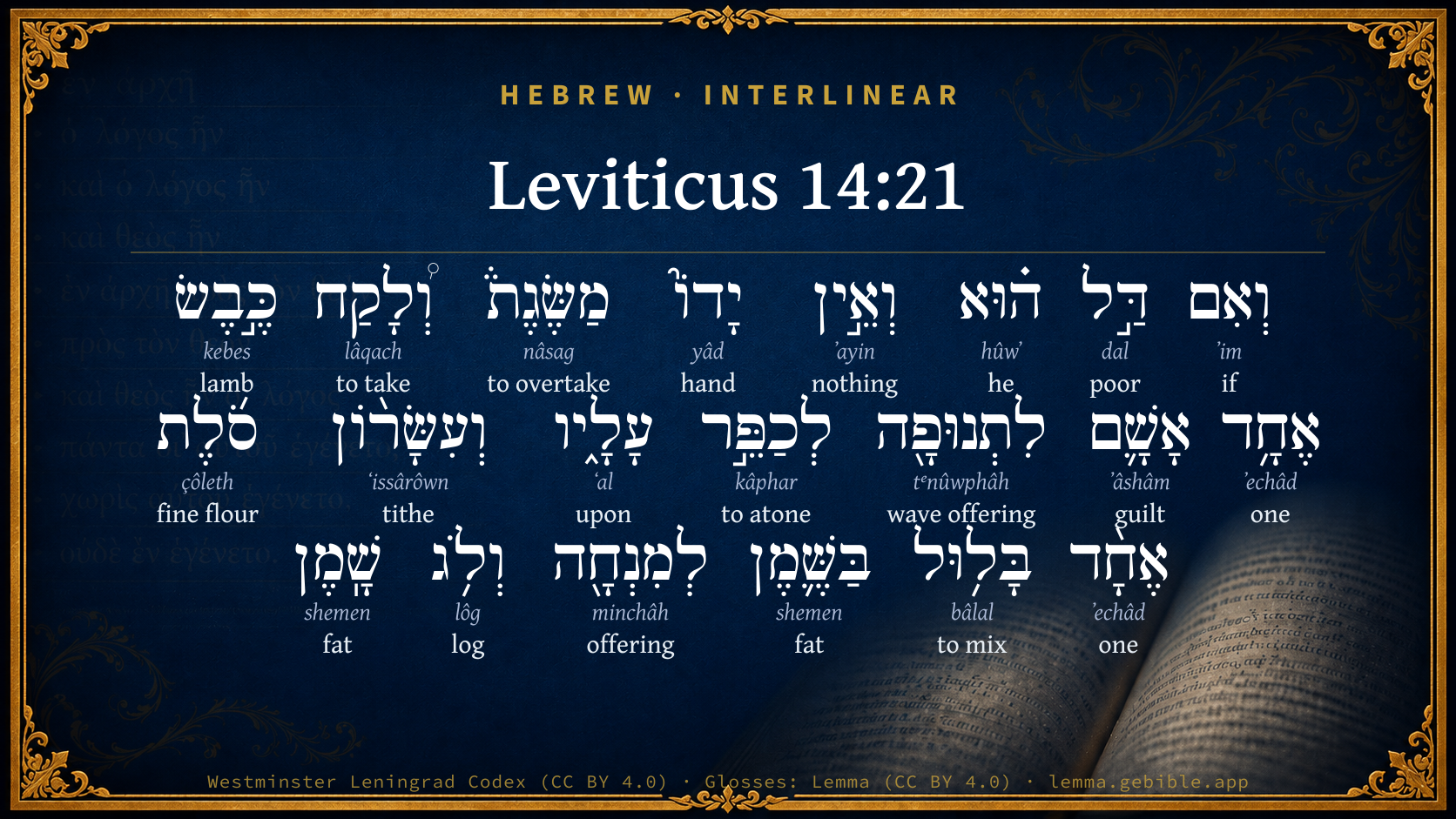
Hebrew (Westminster Leningrad Codex) Leviticus 14:21 appears in the Hebrew Old Testament. The text above is from the Westminster Leningrad Codex. Each word links to its Strong’s number, a concise gloss, and parsing drawn from the Open Scriptures Hebrew Bible morphology. Click any word for its full Brown-Driver-Briggs (BDB) entry.
Download image
Cite this verse

Leviticus 14:21 (World English Bible). Public Domain. Lemma interlinear Bible study tool, https://lemma.gebible.app/v/leviticus/14/21.

Show BibTeX & RIS
BibTeX
RIS
English Translation
"If he is poor, and can't afford so much, then he shall take one male lamb for a trespass offering to be waved, to make atonement for him, and one tenth of an ephah of fine flour mingled with oil for a meal offering, and a log of oil;
World English Bible · Public Domain
Download a study sheet

One document with this verse’s original text, its word-by-word gloss line, the meaning frame, cross-references with their text, attributed commentary, and full source and license credits — printable, and it pastes into notes with its structure intact.

This verse Autodidact and up

Study sheet (.html) Plain text (.txt)

A passage Seminary Student

Up to 50 verses in one chapter. A passage sheet keeps up to 6 commentary sources and 12 cross-references per verse, in the order this page ranks them, and says so on the sheet whenever that leaves anything out. Ask for a single verse and you get the Autodidact verse sheet above.

Everything on this page stays free to read, with no account — the sheet is a download of what is already on screen, not access to it.

Want to remove ads? Support Godless Engineer
Compare translations 3

The same verse in 3 English versions, stacked beneath the original-language interlinear above. Click any original word for its lexicon entry.

Each is an independent rendering of the whole verse — the interlinear is not word-aligned to these translations.

Highlighted words mark where these versions differ — a whole-verse word diff, not a word-by-word alignment.

  • World English Bible Public Domain
    "If he is poor, and can't afford so much, then he shall take one male lamb for a trespass offering to be waved, to make atonement for him, and one tenth of an ephah of fine flour mingled with oil for a meal offering, and a log of oil;
  • King James Version Public Domain
    And if he be poor, and cannot get so much; then he shall take one lamb for a trespass offering to be waved, to make an atonement for him, and one tenth deal of fine flour mingled with oil for a meat offering, and a log of oil;
  • unfoldingWord Literal Text CC BY-SA 4.0
    But if he poor and his hand is not reaching, then he shall take one lamb a guilt offering to raise, to make atonement for him, and one tenth of flour mixed with oil as a grain offering, and a log of oil

unfoldingWord Literal Text — © unfoldingWord, licensed CC BY-SA 4.0. Word-aligned USFM3 via Door43 (git.door43.org/unfoldingWord/en_ult).

Versions to compare (up to 4)

3 of 4 selected

Show all 18 translations

Every available English version of this verse, each an independent rendering of the whole verse.

  • World English Bible Public Domain
    "If he is poor, and can't afford so much, then he shall take one male lamb for a trespass offering to be waved, to make atonement for him, and one tenth of an ephah of fine flour mingled with oil for a meal offering, and a log of oil;
  • Berean Standard Bible Public Domain
    If, however, the person is poor and cannot afford these offerings, he is to take one male lamb as a guilt offering to be waved to make atonement for him, along with a tenth of an ephah of fine flour mixed with olive oil for a grain offering, a log of olive oil,
  • Majority Standard Bible Public Domain
    If, however, the person is poor and cannot afford these offerings, he is to take one male lamb as a guilt offering to be waved to make atonement for him, along with a tenth of an ephah of fine flour mixed with olive oil for a grain offering, a log of olive oil,
  • King James Version Public Domain
    And if he be poor, and cannot get so much; then he shall take one lamb for a trespass offering to be waved, to make an atonement for him, and one tenth deal of fine flour mingled with oil for a meat offering, and a log of oil;
  • American Standard Version (1901) Public Domain
    And if he be poor, and cannot get so much, then he shall take one he-lamb for a trespass-offering to be waved, to make atonement for him, and one tenth part `of an ephah' of fine flour mingled with oil for a meal-offering, and a log of oil;
  • Revised Version (1885) Public Domain
    And if he be poor, and cannot get so much, then he shall take one he-lamb for a guilt offering to be waved, to make atonement for him, and one tenth part of an ephah of fine flour mingled with oil for a meal offering, and a log of oil;
  • Geneva Bible (1599) Public Domain
    But if he be poore, and not able, then he shall bring one lambe for a trespasse offring to be shaken, for his reconciliation, and a tenth deale of fine flower mingled with oyle, for a meate offring, with a pinte of oyle.
  • Douay-Rheims (1899) Public Domain
    But if he be poor, and his hand cannot find the things aforesaid: he shall take a lamb for an offering for trespass, that the priest may pray for him, and a tenth part of hour tempered with oil for a sacrifice, and a sextary of oil,
  • Young's Literal Translation Public Domain
    `And if he `is' poor, and his hand is not reaching `these things', then he hath taken one lamb -- a guilt-offering, for a wave-offering, to make atonement for him, and one-tenth deal of flour mixed with oil for a present, and a log of oil,
  • Literal Standard Version CC BY-SA 4.0
    And if he [is] poor, and his hand is not reaching [these things], then he has taken one lamb [for] a guilt-offering, for a wave-offering, to make atonement for him, and one-tenth part of flour mixed with oil for a present, and a log of oil,
  • Unlocked Literal Bible CC BY-SA 4.0
    However, if the person is poor and cannot afford these sacrifices, then he may take one male lamb as a guilt offering to be waved, to make atonement for himself, and one-tenth of an ephah of fine flour mixed with oil as a grain offering, and a log of oil,
  • unfoldingWord Literal Text CC BY-SA 4.0
    But if he poor and his hand is not reaching, then he shall take one lamb a guilt offering to raise, to make atonement for him, and one tenth of flour mixed with oil as a grain offering, and a log of oil
  • Darby Bible Public Domain
    But if he be poor, and his hand be not able to get it, then he shall take one lamb for a trespass-offering, for a wave-offering, to make atonement for him; and one tenth part of fine flour mingled with oil for an oblation; and a log of oil,
  • World Messianic Bible Public Domain
    “If he is poor, and can’t afford so much, then he shall take one male lamb for a trespass offering to be waved, to make atonement for him, and one tenth of an efah of fine flour mixed with oil for a meal offering, and a log of oil;
  • Webster's Bible Public Domain
    And if he is poor, and cannot get so much; then he shall take one lamb for a trespass-offering to be waved, to make an atonement for him, and one tenth-part of fine flour mingled with oil for a meat-offering, and a log of oil;
  • Free Bible Version CC BY-SA 4.0
    But those who are poor and can't afford these offerings must bring one male lamb as a guilt offering to be waved to make them right, as well as a tenth an ephah of the best flour mixed with olive oil for a grain offering, a log of olive oil,
  • Bible in Basic English Public Domain
    And if he is poor and not able to get so much, then he may take one male lamb as an offering for wrongdoing, to be waved to take away his sin, and one tenth part of an ephah of the best meal mixed with oil for a meal offering, and a log of oil;
  • JPS Tanakh (1917) Public Domain
    And if he be poor, and his means suffice not, then he shall take one he-lamb for a guilt-offering to be waved, to make atonement for him, and one tenth part of an ephah of fine flour mingled with oil for a meal-offering, and a log of oil;

Literal Standard Version (2020), Covenant Press — licensed CC BY-SA 4.0. Text via the HelloAO Bible API (eBible.org). Unlocked Literal Bible (unfoldingWord) — licensed CC BY-SA 4.0. Text via the HelloAO Bible API (eBible.org). unfoldingWord Literal Text — © unfoldingWord, licensed CC BY-SA 4.0. Word-aligned USFM3 via Door43 (git.door43.org/unfoldingWord/en_ult). Free Bible Version, Dr. Jonathan Gallagher — licensed CC BY-SA 4.0. Text via the HelloAO Bible API (eBible.org).

Word by word

More ways to search: Search by grammar → Find every occurrence → Compare this word →

Practice this passage: Drill this verse → Learn its vocabulary →

וְלֹ֥ג
lôg
H3849
“and · log of”
Conjunction + Noun, Common, Masculine, Singular, Construct
Part of Speech
Conjunction + Noun
Type
Common
Gender
Masculine
Number
Singular
State
Construct
Full BDB Definition

Origin: from an unused root apparently meaning to deepen or hollow [like H3537 ]

TWOT: 1076

log - a liquid measure equal to about one half litre
  1. וְאִם ʼim H518 “and · if” Conjunction + Conjunction
  2. דַּ֣ל dal H1800 “poor” Adjective, Adjective, Masculine, Singular, Absolute
  3. ה֗וּא hûwʼ H1931 “he” Pronoun, Personal, 3rd Person, Masculine, Singular
  4. וְאֵ֣ין ʼayin H369 “and · nothing” Conjunction + Particle, Negative
  5. יָדוֹ֮ yâd H3027 “hand · his” Noun, Common, Both, Singular, Construct + Suffix, Personal, 3rd Person, Masculine, Singular
  6. מַשֶּׂגֶת֒ nâsag H5381 “overtaking” Verb, Hiphil, Participle Active, Feminine, Singular, Absolute
  7. וְ֠לָקַח lâqach H3947 “and · to take” Conjunction + Verb, Qal, Sequential Perfect, 3rd Person, Masculine, Singular
  8. כֶּ֣בֶשׂ kebes H3532 “lamb” Noun, Common, Masculine, Singular, Absolute
  9. אֶחָ֥ד ʼechâd H259 “one” Adjective, Cardinal number, Masculine, Singular, Absolute
  10. אָשָׁ֛ם ʼâshâm H817 “guilt” Noun, Common, Masculine, Singular, Absolute
  11. לִתְנוּפָ֖ה tᵉnûwphâh H8573 “to/for · wave offering” Preposition + Noun, Common, Feminine, Singular, Absolute
  12. לְכַפֵּ֣ר kâphar H3722 “to atone” Preposition + Verb, Piel, Infinitive Construct
  13. עָלָ֑יו ʻal H5921 “upon · him” Preposition + Suffix, Personal, 3rd Person, Masculine, Singular
  14. וְעִשָּׂר֨וֹן ʻissârôwn H6241 “and · tithe” Conjunction + Noun, Common, Masculine, Singular, Absolute
  15. סֹ֜לֶת çôleth H5560 “fine flour” Noun, Common, Feminine, Singular, Absolute
  16. אֶחָ֨ד ʼechâd H259 “one” Adjective, Cardinal number, Masculine, Singular, Absolute
  17. בָּל֥וּל bâlal H1101 “mixed” Verb, Qal, Participle Passive, Masculine, Singular, Absolute
  18. בַּשֶּׁ֛מֶן shemen H8081 “in/at the · fat” Preposition, Determined + Noun, Common, Masculine, Singular, Absolute
  19. לְמִנְחָ֖ה minchâh H4503 “to/for · offering” Preposition + Noun, Common, Feminine, Singular, Absolute
  20. שָֽׁמֶן shemen H8081 “fat” Noun, Common, Masculine, Singular, Absolute

About this verse

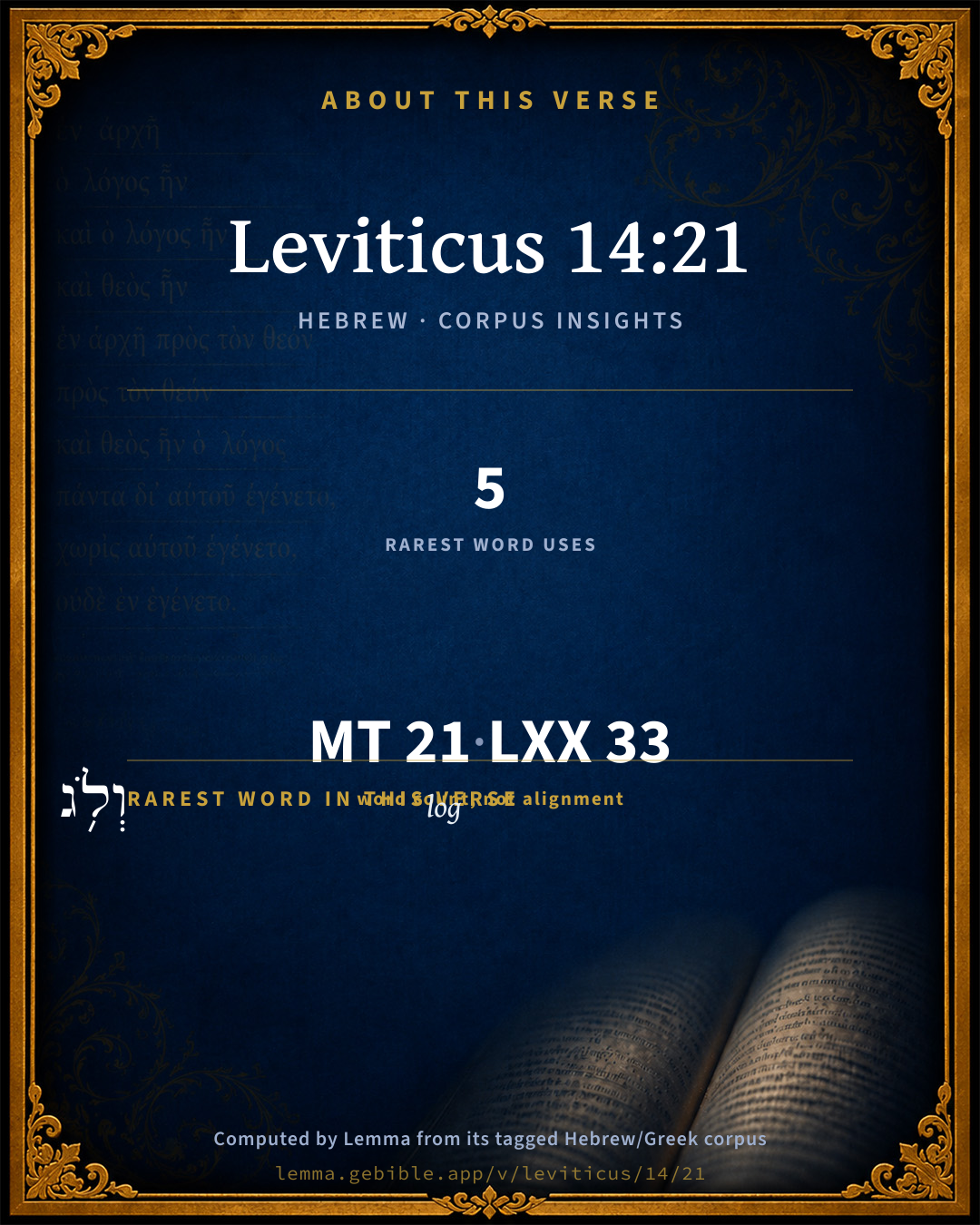
These counts appear in no published source. They are computed here, from the morphology-tagged text and Lemma’s own curated glosses. What Lemma adds →

21
words
19
distinct lemmas
Pentateuch
section

Notable vocabulary

The rarest word here is וְלֹ֥ג log H3849 — appearing just 5 times in the whole Hebrew Bible.

Shared distinctive vocabulary

וְלֹ֥ג log H3849 occurs in 5 verses of the Hebrew Bible. Also found in:

Grammatical profile

  • 4 verbs
  • 10 nouns
  • 3 adjectives
  • 1 pronoun
  • 1 preposition
  • 1 conjunction
  • 1 particle

Verb forms

  • מַשֶּׂגֶת֒ Hiphil · Participle Active
  • וְ֠לָקַח Qal · Sequential Perfect
  • לְכַפֵּ֣ר Piel · Infinitive Construct
  • בָּל֥וּל Qal · Participle Passive

Repetition

Words recur within this verse — often emphatic in Hebrew:

  • אֶחָ֥ד one H259 ×2
  • בַּשֶּׁ֛מֶן fat H8081 ×2

Hebrew & Septuagint length

In English translation the verse runs 49 words from the Hebrew and 47 from the Septuagint (LXX English) — closely comparable.

A rough comparison of the two English renderings, which tokenize alike — not a word-level alignment.

Word counts can differ between the Hebrew and the Greek without any difference in meaning — e.g. the Hebrew direct-object marker אֵת has no separate Greek word, and Greek often adds the article ὁ.

In the original languages it is 21 Hebrew tokens and 33 Greek tokens — but the two are counted differently (Hebrew bundles its prefixes and suffixes into one token; the Greek is in lemma form), so that isn’t a like-for-like length.

Cross-references

14

Topical passages linked to Leviticus 14:21 in the Treasury of Scripture Knowledge — connected by theme and wording, ordered by reader-vote popularity; previews shown in the World English Bible.

  • Leviticus 5:7 "'If he can't afford a lamb, then he shall bring his trespass offering for that in which he has sinned, two turtledoves, or two young pigeons, to Yahweh; one for a sin offering, and the other for a burnt offering.
  • Leviticus 12:8 If she cannot afford a lamb, then she shall take two turtledoves, or two young pigeons; the one for a burnt offering, and the other for a sin offering: and the priest shall make atonement for her, and she shall be clean.'"
  • Proverbs 17:5 Whoever mocks the poor reproaches his Maker. He who is glad at calamity shall not be unpunished.
  • Leviticus 1:14 "'If his offering to Yahweh is a burnt offering of birds, then he shall offer his offering of turtledoves, or of young pigeons.
  • Leviticus 5:11 "'But if he can't afford two turtledoves, or two young pigeons, then he shall bring his offering for that in which he has sinned, the tenth part of an ephah of fine flour for a sin offering. He shall put no oil on it, neither shall he put any frankincense on it, for it is a sin offering.
  • Leviticus 14:22 and two turtledoves, or two young pigeons, such as he is able to afford; and the one shall be a sin offering, and the other a burnt offering.
  • 1 Samuel 2:8 He raises up the poor out of the dust, He lifts up the needy from the dunghill, To make them sit with princes, Inherit the throne of glory: For the pillars of the earth are Yahweh's, He has set the world on them.
  • Job 34:19 Who doesn't respect the persons of princes, Nor regards the rich more than the poor; For they all are the work of his hands.
  • Proverbs 22:2 The rich and the poor have this in common: Yahweh is the maker of them all.
  • Luke 6:20 He lifted up his eyes to his disciples, and said, "Blessed are you who are poor, For yours is the Kingdom of God.
  • Luke 21:2–4 He saw a certain poor widow casting in two small brass coins.
  • 2 Corinthians 8:9 For you know the grace of our Lord Jesus Christ, that, though he was rich, yet for your sakes he became poor, that you through his poverty might become rich.
  • 2 Corinthians 8:12 For if the readiness is there, it is acceptable according to what you have, not according to what you don't have.
  • James 2:5–6 Listen, my beloved brothers. Didn't God choose those who are poor in this world to be rich in faith, and heirs of the Kingdom which he promised to those who love him?

Cross-references courtesy of OpenBible.info (CC BY 4.0).

Hebrew and Greek witnesses Masoretic Hebrew ↔ Greek Septuagint

The same verse in the two great witnesses to the Old Testament, shown verse-for-verse.

These are two independent witnesses, not word-aligned to each other, and the Septuagint is shown in lemma (dictionary) form.

Hebrew Leviticus 14:21 Masoretic · Westminster Leningrad Codex

וְאִם דַּ֣ל ה֗וּא וְאֵ֣ין יָדוֹ֮ מַשֶּׂגֶת֒ וְ֠לָקַח כֶּ֣בֶשׂ אֶחָ֥ד אָשָׁ֛ם לִתְנוּפָ֖ה לְכַפֵּ֣ר עָלָ֑יו וְעִשָּׂר֨וֹן סֹ֜לֶת אֶחָ֨ד בָּל֥וּל בַּשֶּׁ֛מֶן לְמִנְחָ֖ה וְלֹ֥ג שָֽׁמֶן

"If he is poor, and can't afford so much, then he shall take one male lamb for a trespass offering to be waved, to make atonement for him, and one tenth of an ephah of fine flour mingled with oil for a meal offering, and a log of oil;

World English Bible · Public Domain

Greek LXX Leviticus 14:21 Septuagint · lemma form

ἐάν δέ πένομαι καί ὁ χείρ αὐτός μή εὑρίσκω λαμβάνω ἀμνός εἷς εἰς ὅς πλημμελέω εἰς ἀφαίρεμα ὥστε ἐκἱλάσκομαι περί αὐτός καί δέκατος σεμίδαλις φυράω ἐν ἔλαιον εἰς θυσία καί κοτύλη ἔλαιον εἷς

And if he should be poor, and can’t afford so much, he shall take one lamb for his transgression for a separate-offering, so as to make propitiation for him, and a tenth deal of fine flour mingled with oil for a sacrifice, and one cup of oil,

LXX2012 (modern English Septuagint) · Public Domain

Hebrew: Westminster Leningrad Codex (CC BY 4.0). Greek: Septuagint (public domain); English from LXX2012 (modern English Septuagint) (Public Domain). How the Septuagint differs from the Hebrew →

Targum (Aramaic paraphrase)

2

The Targum is the ancient Jewish Aramaic paraphrase of the Hebrew Scriptures — an interpretive translation, not the Hebrew text itself. Onkelos (literal) and Pseudo-Jonathan (expansive) render the Torah, and Jonathan the Prophets. Coverage is partial: where no permissively-licensed English translation exists for a verse, only the Aramaic is shown. This is verse-level text, not a word-by-word alignment to the Hebrew.

  1. Targum Onkelos Torah (Genesis–Deuteronomy)
    וְאִם מִסְכֵּן הוּא וְלֵית יְדֵהּ מַדְבְּקָא וְיִסַּב אִמַר חַד אֲשָׁמָא לַאֲרָמָא לְכַפָּרָא עֲלוֹהִי וְעִסְרוֹנָא סֻלְתָּא חַד דְפִיל בִּמְשַּׁח לְמִנְחָא וְלֻגָא דְמִשְׁחָא

    (no public-domain English translation for this verse)

    Targum Onkelos — Aramaic: “Onkelos Genesis” (public domain); “Onkelos Exodus” (public domain); “Onkelos Leviticus” (public domain); “Onkelos Numbers” (public domain); “Onkelos Deuteronomy” (public domain). English: “Sefaria Community Translation” (CC0 1.0 (public-domain dedication)); “J.W. Etheridge. The Targums of Onkelos and Jonathan Ben Uzziel on the Pentateuch. London: Longmans, Green, 1862” (public domain). Text via Sefaria.

  2. Targum Pseudo-Jonathan Torah (Genesis–Deuteronomy)
    וְאִין מִסְכַּן הוּא וְלֵית יְדֵיהּ מְסַפְּקָא וְיִסַב אִימַר חַד אֲשָׁמָא לַאֲרָמָא מְטוֹל לִמְכַפְּרָא עֲלוֹי וְעֶשְרוֹנָא סְמִידָא חַד פְּתוּךְ בִּמְשַׁח זֵיתָא לְמִנְחָתָא וְלוּגָא דִמְשַׁח זֵיתָא

    But if he be a poor man, and his hand have not sufficiency, let him take one lamb for the trespass offering to be an elevation to make atonement for him, and one tenth of flour mingled with olive oil for the mincha, and a log of olive oil.

    Targum Pseudo-Jonathan — Aramaic: “Targum Jonathan on Genesis” (public domain); “Targum Jonathan on Exodus” (public domain); “Targum Jonathan on Leviticus” (public domain); “Targum Jonathan on Numbers” (public domain); “Targum Jonathan on Deuteronomy” (public domain). English: “The Targum of Jonathan ben Uzziel, trans. J. W. Etheridge, London, 1862” (public domain). Text via Sefaria.

Commentary

Notes on Leviticus 14:21 from classic Christian and Jewish commentators (each source and its license shown beneath its notes). The classic Christian expositions comment on the surrounding passage and are grouped to its opening verse, so a note may address several verses; the Jewish commentaries on the Tanakh (Rashi and others) are per-verse, so they appear only where the commentator wrote on this verse.

Lemma curates 59 commentaries, every one of them public domain or Creative Commons licensed, each selected and text-cleaned for this edition rather than reprinted as found. About our sources →

Matthew Henry's Commentary

We have here the gracious provision which the law made for the cleansing of poor lepers. If they were not able to bring three lambs, and three tenth-deals of flour, they must bring one lamb, and one tenth-deal of flour, and, instead of the other two lambs, two turtle-doves or two young pigeons, Lev 14:21, Lev 14:22. Here see, 1. That the poverty of the person concerned would not excuse him if he brought no offering at all. Let none think that because they are poor God requires no service from them, since he has considered them, and demands that which it is in the power of the poorest to give. "My son, give me thy heart, and with that the calves of thy lips shall be accepted instead of the calves of the stall." 2. That God expected from those who were poor only according to their ability; his commandments are not grievous, nor does he make us to serve with an offering. The poor are as welcome to God's altar as the rich; and, if there be first a willing mind and an honest heart, two pigeons, when they are the utmost a man is able to get, are as acceptable to God as two lambs; for he requires according to what a man has and not according to what he has not. But it is observable that though a meaner sacrifice was accepted from the poor, yet the very same ceremony was used for them as was for the rich; for their souls are as precious and Christ and his gospel are the same to both. Let not us therefore have the faith of our Lord Jesus Christ with respect of persons, Jam 2:1.

Matthew Henry's Commentary on the Whole Bible (1708–1710) — public domain (CC PDM 1.0). Text via the HelloAO Bible API.

Trapp's Complete Commentary

John Trapp

Lev 14:21 And if he [be] poor, and cannot get so much; then he shall take one lamb [for] a trespass offering to be waved, to make an atonement for him, and one tenth deal of fine flour mingled with oil for a meat offering, and a log of oil;

Ver. 21. And if he be poor.] there is a proviso for poor people: God makes no difference, but accepts of a little where much is to be had.

John Trapp, A Commentary or Exposition upon All the Books of the Old and New Testament (1647–1656) — public domain. Text from a community e-Sword module.

Tyndale Open Study Notes

Tyndale Open Resources

14:21-32 The ritual for the poor was very similar to the conventional purification offering, but it allowed for the use of less expensive birds in place of a lamb (see 5:7-13).

Tyndale Open Study Notes — © Tyndale Open Resources, licensed CC BY-SA 4.0. Text via the HelloAO Bible API.

Geneva Bible (1599)

Geneva Bible translators

Hebrew, his hand cannot take it.

Which is an Omer, read Exod. 16:16.

Geneva Bible (1599) marginal notes — public domain. Text via Bolls.life.

Jamieson, Fausset & Brown

Robert Jamieson, A. R. Fausset & David Brown

if he be poor, and cannot get so much; then he shall take one lamb--a kind and considerate provision for an extension of the privilege to lepers of the poorer class. The blood of their smaller offering was to be applied in the same process of purification and they were as publicly and completely cleansed as those who brought a costlier offering (Act 10:34).

Jamieson, Fausset & Brown — Commentary Critical and Explanatory on the Whole Bible (1871) — public domain (CC PDM 1.0). Text via the HelloAO Bible API.

Adam Clarke's Commentary

Verse 21. And if he be poor - he shall take one lamb] There could be no cleansing without a sacrifice. On this ground the apostle has properly observed that all things under the law are purged with blood; and that without shedding of blood there is no remission. Even if the person be poor, he must provide one lamb; this could not be dispensed with: - so every soul to whom the word of Divine revelation comes, must bring that Lamb of God which takes away the sin of the world. There is no redemption but in his blood.

Adam Clarke's Commentary on the Bible (1810–1826) — public domain. Text from a community e-Sword/MySword module.

Ellicott's Commentary for English Readers

(21) And if he be poor.—The benign consideration for the poor which has been evinced on former occasions in connection with the sacrifices (see Lev_5:7; Lev_5:11, Lev. 12:18) is also shown here. Three lambs and three tenth deals of flour were more than a poor leper could afford to bring. In such cases, therefore, all that was required was one lamb, which constituted the trespass offering, and one tenth deal of flour for a meat offering, and the log of oil which was needed for his consecration.

A Bible Commentary for English Readers, edited by Charles John Ellicott (1878–1897) — public domain. Text from a community e-Sword module.

The Cambridge Bible for Schools and Colleges

gen. ed. J. J. S. Perowne

21–32. The poor man’s offerings. The Sin-Offering and Burnt-Offering are modified; birds may be brought as in Lev_1:14, Lev_5:7, and the amount of the Meal-Offering is reduced, but the Guilt-Offering remains the same; a further indication that this sacrifice is the most important feature of the rite.

The Cambridge Bible for Schools and Colleges (gen. ed. J. J. S. Perowne; Cambridge University Press, 1878–1918) — public domain. Text from a community e-Sword module.

John Gill's Exposition

And if he be poor, and cannot get so much,.... As three lambs, and three tenth deals of fine flour:

then he shall take one lamb for a trespass offering to be waved, to make an atonement for him; one he lamb, and was excused the other he lamb for a burnt offering, and the ewe lamb for a sin offering; but a lamb he must bring, a type of Christ the Lamb of God, for without his blood and sacrifice there is no atonement for rich poor, but for both thereby:

and one tenth deal of flour mingled with oil for a meat offering: instead three tenth deals; this abatement in the several kinds of offerings was a great indulgence to the poor, and an instance of God's goodness to them, that they might not be pressed above measure, and yet share the same benefits and advantages as the rich:

and a log of oil; here was no abatement in this, nor was there need of any; half a pint of oil, in a country which abounded with it, might be bought for a small price: however, the grace of the Spirit, signified by oil, is to be had freely of Christ, and in as large a quantity by a poor man as by a rich man, and is equally necessary to the one as to the other, who are all one in Christ Jesus; see Gal 3:28.

John Gill's Exposition of the Whole Bible (1746–1763) — public domain (CC PDM 1.0). Text via the HelloAO Bible API.

Haydock's Catholic Bible Commentary

Offering. Hebrew, "a trespass-offering to be waved," ver. 12, 24. --- Oil. The same quantity of oil is required as ver. 10. The rest is diminished two-thirds; only instead of the ewe and one lamb, two turtles or pigeons are substituted. (Haydock)

George Leo Haydock (1774–1849), Haydock's Catholic Family Bible and Commentary, 1859 edition — public domain. Excludes Psalms (Douay-Rheims chapter numbering differs from Protestant) and Deuterocanonical books (Catholic canon only).

Whedon's Commentary on the Bible

Daniel D. Whedon

21. Cannot get so much — Literally, if his hand reach not. Thus the divine requirement mercifully adjusts itself to human ability. “God never omitted the sacrifice; however poor was the worshipper, some degree or form of sacrifice he was bound to supply. This shows that the true sacrifice is in the spirit rather than in the offering which is made by the hand.” — Joseph Parker. See Lev_12:8, note. The reduced requirement diminishes the meat offering two thirds, and substitutes two doves for the two sheep which are used for the sin offering and the burnt offering. But the offerings which are more especially consecratory, typifying positive blessings, are not diminished, namely, the trespass offering and the anointing oil. This may teach, that while penitents may be pardoned when faith in Christ is very imperfect, by simply looking toward him, believers receive cleansing and the fulness of the Holy Spirit only when they exercise a perfect faith in the great atonement.

Daniel D. Whedon (gen. ed.), Commentary on the Old and New Testaments (1874–1909) — public domain. Text from a community e-Sword module.

The Pulpit Commentary

Vers. 21-32. And if he be poor, and cannot get so much. The concession to poverty consists in the substitution of two turtledoves, or two young pigeons, for the two lambs required for the sin offering and the burnt offering, and one tenth-deal of flour for three tenth-deals of flour in the meat offering. But no difference is made as to the lamb required for the trespass offering, or the log of oil. These must be provided by the poor as well as by the rich, and the ceremonies used at their offering must be the same for poor and rich, as they are essential to the rite.

Vers. 21-32. Divine considerateness.

If there had been one parenthetical verso introduced or added intimating that Divine allowance would be made for the poor, we should have thought that sufficient for the purpose. But we have more than that here. We have legislation for the poor fully stated, and the whole body of injunctions restated for their especial benefit (vers. 21-32). This brings out into hold relief God"s mindfulness of the peculiar necessities of men his Divine considerateness. We see illustrations of this in

I SACRIFICES BROUGHT TO HIS ALTAR. Notably this kindly provision for the poor in the case of the healed leper; but not this alone. (see Lev_5:7 Lev_12:8)

II GIFTS BROUGHT TO HIS TREASURY. The widow with her two mites cast in more, weighed in the balances of heaven, than did the rich with their abundance. (Luk_7:41-44; see 2Co_8:12)

III OUR POWERS IN CHRIST"S SERVICE. To him who having received two talents gained two others beside them, was accorded by the Lord, when he returned and reckoned with his servants, approval quite as cordial as that rendered to him who having received five talents gained five talents more. (Mat_25:19-23) Equally cordial would have been the welcome to him who had been entrusted with only one, if he had gained one talent beside that.

IV OUR STRUGGLE WITH TEMPTATION. When the agonizing Master returned and found those he left to watch and pray "asleep, for their eyes were heavy," he gently rebuked them; but he considerately extenuated their fault by saying, "The spirit indeed is willing, but the flesh is weak". (Mat_26:40, Mat_26:41) "He knoweth our frame; he remembereth that we are dust.

V OUR ENDURANCE OF EVIL. God sends us privation, sickness, disappointment, perplexity, loss, bereavement, exceeding great sorrows, burdens grievous to be borne; he calls upon us to "endure as seeing him who is invisible," to be "in subjection to the Father of spirits." He expects that we shall not repine and rebel, but submit and serve. Yet he who knows all men, and who knows "what is in man", (Joh_2:25) who created us and made us what we are, understands and weighs our peculiar personal difficulties, temperaments, dispositions; he knows how much we strive to yield and acquiesce, and "judges righteous judgment." He is just, yet merciful, we say. We may also say, He is just, and therefore merciful. He has the requisite justice of Divine considerateness.

Let us

1. Take heart to serve so gracious and considerate a Lord.

2. Feel impelled to serve him all the more faithfully and devotedly because he is so worthy and righteous a Master.

3. Try to copy his grace and his righteousness in our dealings with our fellows. C. (Luk_6:36)

The Pulpit Commentary (1880–1919), ed. H.D.M. Spence-Jones & Joseph S. Exell — public domain. Text from a community e-Sword module.

unfoldingWord translationNotes

Door43 World Missions Community

General Information:

Yahweh continues telling Moses and Aaron what the people must do when someone is cleansed of a skin disease.

cannot afford

"does not have enough money to buy"

to be waved ... for himself

This can be translated in active form. AT: "that the priest will wave ... for him" (See: Active or Passive)

one-tenth of an ephah

One-tenth of an ephah is 22 liters. (See: Biblical Volume)

log

One log is 0.31 liters. (See: Biblical Volume)

translationWords

sacrifice

lamb

guilt offering

raise

Yahweh

atonement

oil

grain offering

dove

sin offering

burnt offering

clean

priest

tent of meeting

unfoldingWord translationNotes — © Distant Shores Media and the Door43 World Missions Community, licensed CC BY-SA 4.0. Source: git.door43.org/Door43/en_tn.

Rashi

Rabbi Shlomo Yitzchaki (Rashi)

ועשרון סלת אחד‎ AND ONE TENTH DEAL OF FLOUR — for this lamb which is a single one he shall bring one tenth part of flour to accompany its drink-offering.

שמן ‎‏ ולג AND A LOG OF OIL — to place of it upon the thumbs. The quantity of the oil required for the libations of the meal-offering Scripture did not find it necessary to specify here (since it is given in Numbers 15:4 where three logs are prescribed; consequently the one log mentioned hero cannot be intended for the libations but for placing on the thumbs).

Rashi on the Tanakh — English translations: “The Judaica Press complete Tanach with Rashi, translated by A. J. Rosenberg” (CC BY 4.0); “Pentateuch with Rashi's commentary by M. Rosenbaum and A.M. Silbermann, 1929-1934” (public domain); “The Metsudah Tanach series, Lakewood, N.J” (CC BY 4.0); and “The Book of Joshua, Metsudah Publications, 1997” (CC BY 4.0). Text via Sefaria.

Lesson kit

Teaching starters — assembled from the data on this page, not authored interpretation. Every prompt links to the verse data it draws on. Edit before teaching.

Leviticus, in the Pentateuch, opens this verse with 21 words (19 distinct Hebrew lemmas). Its most distinctive word is lôg (“log”). A historical commentator’s framing appears above. Read the whole chapter for the surrounding context.

Discussion questions

  1. The word lôg carries the sense “log.” How does it shape the verse?
  2. Leviticus 14:10 shares the word «log» with this verse. How do the two illuminate each other?
  3. “one” occurs 2× in this one verse. What is the effect of the repetition?
  4. These translations render this verse differently. What is at stake in choosing one wording over another?
  5. The verb «מַשֶּׂגֶת֒» is Hiphil Participle Active. How does its form color the action?
  6. Reading how Matthew Henry's Commentary and Trapp's Complete Commentary read this verse, where do the two commentators agree and where do they part?

Things to notice

Reading settings

Reading text

Shown beneath each verse's original-language words.

Old Testament
Old Testament edition

Read the OT as the Masoretic Hebrew (MT) or the Greek Septuagint (LXX).

English shown for the Greek Septuagint (in the Hebrew ↔ Greek comparison).

Comparing translations? Open the Compare panel on any verse page to stack up to four side by side.