
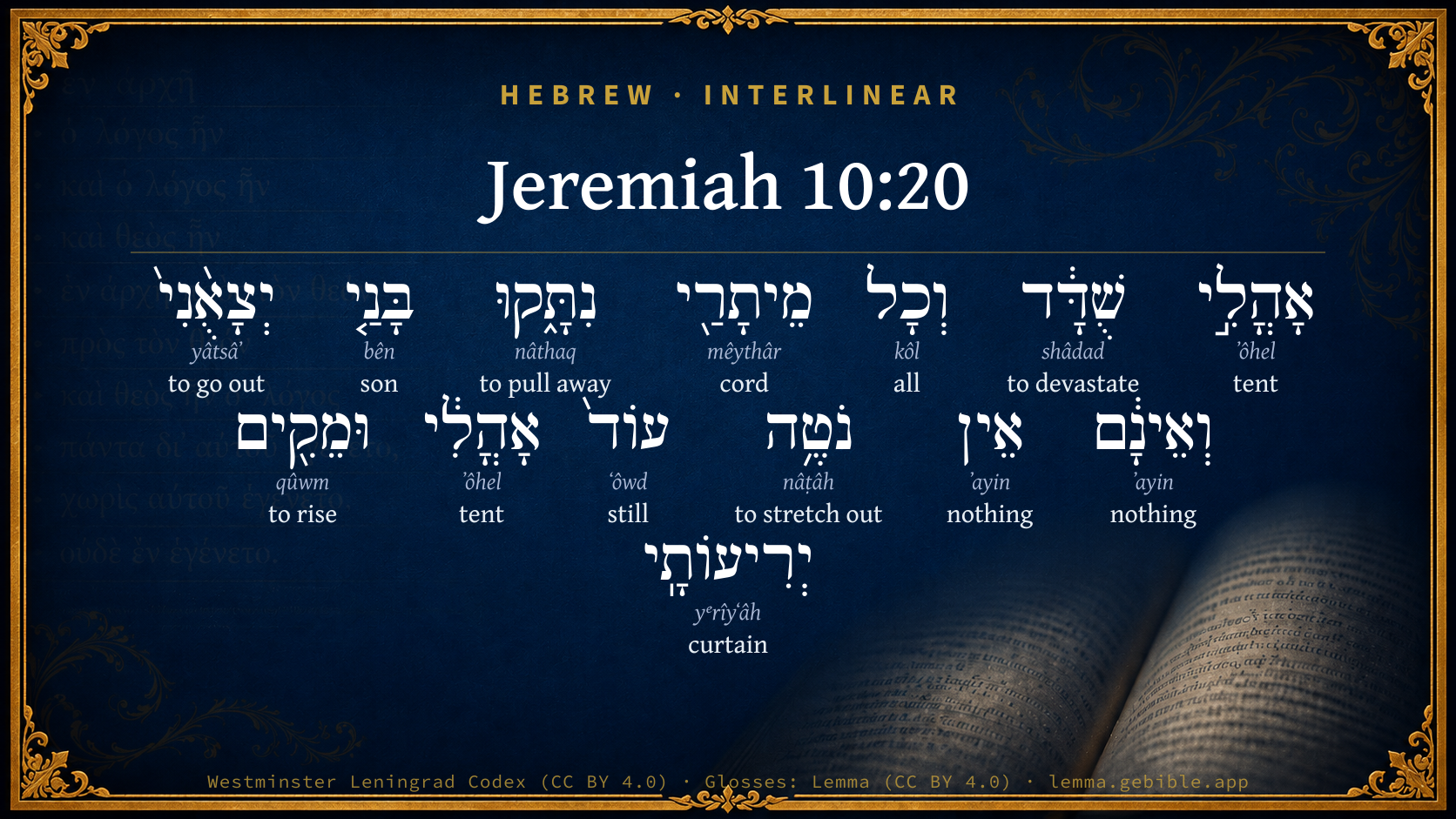
Jeremiah 10:20

Hebrew (Westminster Leningrad Codex) Jeremiah 10:20 appears in the Hebrew Old Testament. The text above is from the Westminster Leningrad Codex. Each word links to its Strong’s number, a concise gloss, and parsing drawn from the Open Scriptures Hebrew Bible morphology. Click any word for its full Brown-Driver-Briggs (BDB) entry.
Download image
Cite this verse

Jeremiah 10:20 (World English Bible). Public Domain. Lemma interlinear Bible study tool, https://lemma.gebible.app/v/jeremiah/10/20.

Show BibTeX & RIS
BibTeX
RIS
English Translation
My tent is destroyed, and all my cords are broken: my children are gone forth from me, and they are no more: there is none to spread my tent any more, and to set up my curtains.
World English Bible · Public Domain
Download a study sheet

One document with this verse’s original text, its word-by-word gloss line, the meaning frame, cross-references with their text, attributed commentary, and full source and license credits — printable, and it pastes into notes with its structure intact.

This verse Autodidact and up

Study sheet (.html) Plain text (.txt)

A passage Seminary Student

Up to 50 verses in one chapter. A passage sheet keeps up to 6 commentary sources and 12 cross-references per verse, in the order this page ranks them, and says so on the sheet whenever that leaves anything out. Ask for a single verse and you get the Autodidact verse sheet above.

Everything on this page stays free to read, with no account — the sheet is a download of what is already on screen, not access to it.

Want to remove ads? Support Godless Engineer
Compare translations 3

The same verse in 3 English versions, stacked beneath the original-language interlinear above. Click any original word for its lexicon entry.

Each is an independent rendering of the whole verse — the interlinear is not word-aligned to these translations.

Highlighted words mark where these versions differ — a whole-verse word diff, not a word-by-word alignment.

  • World English Bible Public Domain
    My tent is destroyed, and all my cords are broken: my children are gone forth from me, and they are no more: there is none to spread my tent any more, and to set up my curtains.
  • King James Version Public Domain
    My tabernacle is spoiled, and all my cords are broken: my children are gone forth of me, and they are not: there is none to stretch forth my tent any more, and to set up my curtains.
  • unfoldingWord Literal Text CC BY-SA 4.0
    My tent is devastated, and all of my cords are ripped apart. My sons have gone me and they are not. There is not one spreading out my tent again, raising up my tent curtains.

unfoldingWord Literal Text — © unfoldingWord, licensed CC BY-SA 4.0. Word-aligned USFM3 via Door43 (git.door43.org/unfoldingWord/en_ult).

Versions to compare (up to 4)

3 of 4 selected

Show all 18 translations

Every available English version of this verse, each an independent rendering of the whole verse.

  • World English Bible Public Domain
    My tent is destroyed, and all my cords are broken: my children are gone forth from me, and they are no more: there is none to spread my tent any more, and to set up my curtains.
  • Berean Standard Bible Public Domain
    My tent is destroyed, and all its ropes are snapped. My sons have departed from me and are no more. I have no one left to pitch my tent or set up my curtains.
  • Majority Standard Bible Public Domain
    My tent is destroyed, and all its ropes are snapped. My sons have departed from me and are no more. I have no one left to pitch my tent or set up my curtains.
  • King James Version Public Domain
    My tabernacle is spoiled, and all my cords are broken: my children are gone forth of me, and they are not: there is none to stretch forth my tent any more, and to set up my curtains.
  • American Standard Version (1901) Public Domain
    My tent is destroyed, and all my cords are broken: my children are gone forth from me, and they are not: there is none to spread my tent any more, and to set up my curtains.
  • Revised Version (1885) Public Domain
    My tent is spoiled, and all my cords are broken: my children are gone forth of me, and they are not: there is none to stretch forth my tent any more, and to set up my curtains.
  • Geneva Bible (1599) Public Domain
    My tabernacle is destroyed, and all my coardes are broken: my children are gone from me, and are not: there is none to spread out my tent any more, and to set vp my curtaines.
  • Douay-Rheims (1899) Public Domain
    My tabernacle is laid waste, all my cords are broken: my children are gone out from me, and they are not: there is none to stretch forth my tent any more, and to set up my curtains.
  • Young's Literal Translation Public Domain
    My tent hath been spoiled, And all my cords have been broken, My sons have gone out from me, and they are not, There is none stretching out any more my tent, And raising up my curtains.
  • Literal Standard Version CC BY-SA 4.0
    My tent has been spoiled, || And all my cords have been broken, || My sons have gone out from me, and they are not, || There is none stretching out my tent anymore, || And raising up my curtains.
  • Unlocked Literal Bible CC BY-SA 4.0
    My tent is devastated, and all of my tent cords are cut in two. They have taken my children away from me, so they no longer exist. There is no longer anyone to spread out my tent or to raise up my tent curtains.
  • unfoldingWord Literal Text CC BY-SA 4.0
    My tent is devastated, and all of my cords are ripped apart. My sons have gone me and they are not. There is not one spreading out my tent again, raising up my tent curtains.
  • Darby Bible Public Domain
    My tent is despoiled, and all my cords are broken; my children are gone forth from me, and they are not; there is none to stretch forth my tent any more, and to set up my curtains.
  • World Messianic Bible Public Domain
    My tent has been destroyed, and all my cords are broken. My children have gone away from me, and they are no more. There is no one to spread my tent any more, to set up my curtains.
  • Webster's Bible Public Domain
    My tabernacle is laid waste, and all my cords are broken: my children are gone from me, and they are not: there is none to stretch forth my tent any more, and to set up my curtains.
  • Free Bible Version CC BY-SA 4.0
    Our tents have been destroyed; all our ropes have been broken. Our children have been taken from us and are no more. We don't have anyone left to put up our tents or hang our curtains.”
  • Bible in Basic English Public Domain
    My tent is pulled down and all my cords are broken: my children have gone from me, and they are not: no longer is there anyone to give help in stretching out my tent and hanging up my curtains.
  • JPS Tanakh (1917) Public Domain
    My tent is spoiled, and all my cords are broken; my children are gone forth of me, and they are not; there is none to stretch forth my tent any more, and to set up my curtains.

Literal Standard Version (2020), Covenant Press — licensed CC BY-SA 4.0. Text via the HelloAO Bible API (eBible.org). Unlocked Literal Bible (unfoldingWord) — licensed CC BY-SA 4.0. Text via the HelloAO Bible API (eBible.org). unfoldingWord Literal Text — © unfoldingWord, licensed CC BY-SA 4.0. Word-aligned USFM3 via Door43 (git.door43.org/unfoldingWord/en_ult). Free Bible Version, Dr. Jonathan Gallagher — licensed CC BY-SA 4.0. Text via the HelloAO Bible API (eBible.org).

Word by word

More ways to search: Search by grammar → Find every occurrence → Compare this word →

Practice this passage: Drill this verse → Learn its vocabulary →

מֵיתָרַ֖י
mêythâr
H4340
“cords · my”
Noun, Common, Masculine, Plural, Construct + Suffix, Personal, 1st Person, Common, Singular
Part of Speech
Noun
Type
Common
Gender
Masculine
Number
Plural
State
Construct
Full BDB Definition

Origin: from H3498

TWOT: 936h

cord, string
  1. אָהֳלִ֣י ʼôhel H168 “tent · my” Noun, Common, Masculine, Singular, Construct + Suffix, Personal, 1st Person, Common, Singular
  2. שֻׁדָּ֔ד shâdad H7703 “to devastate” Verb, Pual, Perfect, 3rd Person, Masculine, Singular
  3. וְכָל kôl H3605 “and · all of” Conjunction + Noun, Common, Masculine, Singular, Construct
  4. נִתָּ֑קוּ nâthaq H5423 “to pull away” Verb, Niphal, Perfect, 3rd Person, Common, Plural
  5. בָּנַ֤י bên H1121 “sons · my” Noun, Common, Masculine, Plural, Construct + Suffix, Personal, 1st Person, Common, Singular
  6. יְצָאֻ֨נִי֙ yâtsâʼ H3318 “to go out · me” Verb, Qal, Perfect, 3rd Person, Common, Plural + Suffix, Personal, 1st Person, Common, Singular
  7. וְאֵינָ֔ם ʼayin H369 “and · nothing · them” Conjunction + Particle, Negative + Suffix, Personal, 3rd Person, Masculine, Plural
  8. אֵין ʼayin H369 “nothing” Particle, Negative
  9. נֹטֶ֥ה nâṭâh H5186 “stretching out” Verb, Qal, Participle Active, Masculine, Singular, Absolute
  10. עוֹד֙ ʻôwd H5750 “still” Adverb
  11. אָהֳלִ֔י ʼôhel H168 “tent · my” Noun, Common, Masculine, Singular, Construct + Suffix, Personal, 1st Person, Common, Singular
  12. וּמֵקִ֖ים qûwm H6965 “and · rising” Conjunction + Verb, Hiphil, Participle Active, Masculine, Singular, Absolute
  13. יְרִיעוֹתָֽי yᵉrîyʻâh H3407 “curtains · my” Noun, Common, Feminine, Plural, Construct + Suffix, Personal, 1st Person, Common, Singular

About this verse

These counts appear in no published source. They are computed here, from the morphology-tagged text and Lemma’s own curated glosses. What Lemma adds →

14
words
12
distinct lemmas
Prophets
section

Notable vocabulary

The rarest word here is מֵיתָרַ֖י cord H4340 — appearing just 9 times in the whole Hebrew Bible.

Shared distinctive vocabulary

מֵיתָרַ֖י cord H4340 occurs in 9 verses of the Hebrew Bible. Also found in:

Grammatical profile

  • 5 verbs
  • 6 nouns
  • 1 adverb
  • 2 particles

Verb forms

  • שֻׁדָּ֔ד Pual · Perfect
  • נִתָּ֑קוּ Niphal · Perfect
  • יְצָאֻ֨נִי֙ Qal · Perfect
  • נֹטֶ֥ה Qal · Participle Active
  • וּמֵקִ֖ים Hiphil · Participle Active

Repetition

Words recur within this verse — often emphatic in Hebrew:

  • אָהֳלִ֣י tent H168 ×2
  • וְאֵינָ֔ם nothing H369 ×2

Cross-references

9

Topical passages linked to Jeremiah 10:20 in the Treasury of Scripture Knowledge — connected by theme and wording, ordered by reader-vote popularity; previews shown in the World English Bible.

  • Jeremiah 4:20 Destruction on destruction is cried; for the whole land is laid waste: suddenly are my tents destroyed, [and] my curtains in a moment.
  • Jeremiah 31:15 Thus says Yahweh: A voice is heard in Ramah, lamentation, and bitter weeping, Rachel weeping for her children; she refuses to be comforted for her children, because they are no more.
  • Isaiah 49:20–22 The children of your bereavement shall yet say in your ears, The place is too small for me; give place to me that I may dwell.
  • Isaiah 54:2 Enlarge the place of your tent, and let them stretch forth the curtains of your habitations; don't spare: lengthen your cords, and strengthen your stakes.
  • Job 7:8 The eye of him who sees me shall see me no more. Your eyes shall be on me, but I shall not be.
  • Proverbs 12:7 The wicked are overthrown, and are no more, But the house of the righteous shall stand.
  • Isaiah 51:16 I have put my words in your mouth, and have covered you in the shadow of my hand, that I may plant the heavens, and lay the foundations of the earth, and tell Zion, You are my people.
  • Lamentations 1:5 Her adversaries are become the head, her enemies prosper; For Yahweh has afflicted her for the multitude of her transgressions: Her young children are gone into captivity before the adversary.
  • Lamentations 2:4–6 He has bent his bow like an enemy, he has stood with his right hand as an adversary, Has killed all that were pleasant to the eye: In the tent of the daughter of Zion he has poured out his wrath like fire.

Cross-references courtesy of OpenBible.info (CC BY 4.0).

Hebrew and Greek witnesses Masoretic Hebrew ↔ Greek Septuagint

The same verse in the two great witnesses to the Old Testament, shown verse-for-verse.

These are two independent witnesses, not word-aligned to each other, and the Septuagint is shown in lemma (dictionary) form.

Hebrew Jeremiah 10:20 Masoretic · Westminster Leningrad Codex

אָהֳלִ֣י שֻׁדָּ֔ד וְכָל מֵיתָרַ֖י נִתָּ֑קוּ בָּנַ֤י יְצָאֻ֨נִי֙ וְאֵינָ֔ם אֵין נֹטֶ֥ה עוֹד֙ אָהֳלִ֔י וּמֵקִ֖ים יְרִיעוֹתָֽי

My tent is destroyed, and all my cords are broken: my children are gone forth from me, and they are no more: there is none to spread my tent any more, and to set up my curtains.

World English Bible · Public Domain

Greek LXX Structure differs

In the Septuagint, Jeremiah is about an eighth shorter than the Hebrew and arranges its material differently — the Oracles Against the Nations (Hebrew chapters 46–51) appear in the middle of the Greek book, after 25:13. Because the chapter and verse boundaries do not line up, a verse-for-verse comparison with the Hebrew is not shown.

A verse-for-verse comparison isn’t shown here because the chapters and verses don’t line up. Switch to the LXX edition with the MT / LXX toggle above to read the Greek directly.

On this verse, John Gill's Exposition discusses the Septuagint’s reading. Read the note in Commentary ↓

Hebrew: Westminster Leningrad Codex (CC BY 4.0). Greek: Septuagint (public domain); English from a public-domain English Septuagint. How the Septuagint differs from the Hebrew →

Targum (Aramaic paraphrase)

1

The Targum is the ancient Jewish Aramaic paraphrase of the Hebrew Scriptures — an interpretive translation, not the Hebrew text itself. Onkelos (literal) and Pseudo-Jonathan (expansive) render the Torah, and Jonathan the Prophets. Coverage is partial: where no permissively-licensed English translation exists for a verse, only the Aramaic is shown. This is verse-level text, not a word-by-word alignment to the Hebrew.

  1. Targum Jonathan Prophets (Joshua–Malachi)
    אַרְעִי חֲרוֹבַת וְכָל קִרְוֵי אִתְבְּזִיזָא עַמִי גָלוֹ וְלֵיתִינוּן לֵית דְמָתַח עוֹד מַשְׁכְּנִי וּמְקַיֵם יְרִיעָתָי:

    (no public-domain English translation for this verse)

    Targum Jonathan — Aramaic: “Mikraot Gedolot” (public domain). English: “Sefaria Community Translation” (CC0 1.0 (public-domain dedication)); “London "Chaldee Paraphrase," 1871” (public domain). Text via Sefaria.

Commentary

Notes on Jeremiah 10:20 from classic Christian and Jewish commentators (each source and its license shown beneath its notes). The classic Christian expositions comment on the surrounding passage and are grouped to its opening verse, so a note may address several verses; the Jewish commentaries on the Tanakh (Rashi and others) are per-verse, so they appear only where the commentator wrote on this verse.

Lemma curates 59 commentaries, every one of them public domain or Creative Commons licensed, each selected and text-cleaned for this edition rather than reprinted as found. About our sources →

Trapp's Complete Commentary

John Trapp

Jer 10:20 My tabernacle is spoiled, and all my cords are broken: my children are gone forth of me, and they [are] not: [there is] none to stretch forth my tent any more, and to set up my curtains.

Ver. 20. My tabernacle is spoiled.] I am irreparably ruined; like as when a camp is quite broken up, not any part of a tent or hut is left standing.

John Trapp, A Commentary or Exposition upon All the Books of the Old and New Testament (1647–1656) — public domain. Text from a community e-Sword module.

Tyndale Open Study Notes

Tyndale Open Resources

10:20 Jeremiah’s beloved home community of Anathoth was destroyed; even the town’s children were taken into exile. The same was true of the entire nation.

Tyndale Open Study Notes — © Tyndale Open Resources, licensed CC BY-SA 4.0. Text via the HelloAO Bible API.

Geneva Bible (1599)

Geneva Bible translators

He showeth how Jerusalem shall lament.

Geneva Bible (1599) marginal notes — public domain. Text via Bolls.life.

Jamieson, Fausset & Brown

Robert Jamieson, A. R. Fausset & David Brown

tabernacle is spoiled--metaphor from the tents of nomadic life; as these are taken down in a few moments, so as not to leave a vestige of them, so Judea (Jer 4:20).

cords--with which the coverings of the tent are extended.

curtains--tent-curtains.

Jamieson, Fausset & Brown — Commentary Critical and Explanatory on the Whole Bible (1871) — public domain (CC PDM 1.0). Text via the HelloAO Bible API.

Adam Clarke's Commentary

Verse 20. My tabernacle is spoiled] The city is taken, and all our villages ruined and desolated.

Adam Clarke's Commentary on the Bible (1810–1826) — public domain. Text from a community e-Sword/MySword module.

John Calvin's Commentaries

This metaphor may have been taken from shepherds, and it seems suitable here; yet the prophets often compare the Church to a tent. Though indeed it is said elsewhere that the Church is built on the holy mountains, (Psalm 87:1) and great firmness is ascribed to it, yet, as to its external condition, it may justly be said to be like a tent, for there is no fixed residence for God’s children on earth, for they are often constrained to ehange their place; and hence Paul speaks of the faithful as unsettled. (1 Corinthians 4:11.) But as, in the next verse, mention is made of shepherds, the Prophet seems here to refer to the tents of shepherds. Though indeed he takes hereafter the similitude more generally, or in a wider sense, yet there is no reason why he should not allude to the shepherds of whom he afterwards speaks, and yet retain the metaphor which so often occurs in all the prophets.

He then says that his tent was pulled down, and that all his cords were broken Some take the tent for the city of Jerusalem, but this is a strained view, and unsuitable. We have already said that the Prophet speaks here in the name of the whole people; and it is the same as though he compared the people to a man dwelling with his family in a tent. He adds, My children are gone forth from me The people then complain that they were deprived of all their children; nor was this all, but they were scattered here and there, which was worse than if they had been taken away by death. He afterwards says, And there is no one to extend my tent, and to set up my curtains Jeremiah shews that the people would be so bereaved as to have none to bring them any assistance, though in much want of it.

No one then thought that such a thing would take place, and Jeremiah was held in contempt, and some raged against him, and yet He shewed what would be. And that what he said might be more forcible, and produce a stronger effect, he speaks in their name, like a poet in a play, who describes a miser, and mentions things suitable to his character, making use of such words and actions, so that he cannot but see, as it were in a mirror, his own disposition and conduct. So also the Prophet does here; for when He saw that the stupid people could not be moved by the simple truth, he told them what they all ought to have felt in their liearts, and to have testified by their mouths, — that they were solitary, deserted by all who belonged to them, and that there was no one to bring them any help. But he pursues, as we have said, the same metaphor. It follows —

John Calvin's Commentaries (1540-1563) — public domain. Text from the Calvin Translation Society English edition (1840s-50s) via the Christian Classics Ethereal Library (ccel.org). Calvin's coverage is partial (roughly two-thirds of the Bible); uncommented books and verses are honest gaps, never fabricated. The 19th-century editor's footnotes and remarks are omitted so the notes are faithfully Calvin's own voice.

Ellicott's Commentary for English Readers

(20) My tabernacle . . .—The tent which had been the home of Israel is destroyed, the cords that fastened it to the ground are broken, the children that used to help their mother in arranging the tent and its curtains “are not,” i.e. (as in Gen_42:36; Jer_31:15; Mat_2:18), they are either dead or in exile. There is something significant in the fact that the destruction of the city is represented under the imagery of that of a tent. The daughter of Zion has, as it were, been brought back to her nomadic state.

A Bible Commentary for English Readers, edited by Charles John Ellicott (1878–1897) — public domain. Text from a community e-Sword module.

The Cambridge Bible for Schools and Colleges

gen. ed. J. J. S. Perowne

20. The land is likened to a tent overthrown and injured beyond repair.

curtains] See on Jer_4:20.

The Cambridge Bible for Schools and Colleges (gen. ed. J. J. S. Perowne; Cambridge University Press, 1878–1918) — public domain. Text from a community e-Sword module.

John Gill's Exposition

My tabernacle is spoiled,.... Not the temple at Jerusalem only, rather Jerusalem itself, as Kimchi; or the whole land, as the Targum,

"my land is wasted:''

the allusion is to the tents of shepherds, and denotes the unstable condition of the Jewish nation:

and all my cords are broken: all the rest of the cities of the land are destroyed, as Kimchi; and so the Targum,

"my cities are spoiled:''

as the cords are what the parts of the tabernacle or tent are fastened and kept together with, they may intend the strength of the nation, which lay in its wealth, its fortresses, and the numbers of its people, now weakened, loosed, and broke.

My children are gone forth of me; into captivity, as the Targum interprets it; the prophet, representing Jerusalem, and the cities of Judah. The Septuagint adds, "and my sheep"; keeping on the metaphor of a shepherd, his tent, and flock.

And they are not; either not in the world, being destroyed by one judgment or another; or rather not in their own land, being carried captive.

There is none to stretch forth my tent any more, and to set up my curtains; which shows the great destruction and desolation of the land, and its inhabitants, that there would be none to set up a shepherd's tent; perhaps the rebuilding of Jerusalem, and the rest of the cities, may be meant.

John Gill's Exposition of the Whole Bible (1746–1763) — public domain (CC PDM 1.0). Text via the HelloAO Bible API.

Matthew Poole's English Annotations

He proceeds in his prosopopoeia to bring in the land, or the inhabitants thereof, enumerating their calamities, and by a metaphor sets out the overthrow of the land, or Jerusalem, by the breaking of the

cords of a tabernacle, the use whereof is to fasten it on every side to stakes in the ground, which cords being broken the tabernacle falls, implying all the supports of city and country were gone, nothing but desolation to be expected. See Jer 4:20.

My children are gone forth of me; either the inhabitants of the land, or the lesser cities, being frequently called daughters, viz. the Chaldeans have snatched them away from me, and carried them into captivity.

They are not; of the phrase and meaning of it see Jer 31:15. There is none to stretch forth my tent any more, i.e. it is irrevocable, I am without all help, either for defence or beauty, or any thing to regain my pristine state, which he chooseth to describe hereby, continuing this metaphor rather than any other, of a shepherd’s tent; possibly insinuating the ground of it to arise principally from their pastors, the neglect both of their civil and ecclesiastical governors, which the next verse favours.

Matthew Poole's English Annotations on the Holy Bible (1683–1685) — public domain. Text from a community e-Sword/MySword module.

Whedon's Commentary on the Bible

Daniel D. Whedon

20. Tabernacle — As though even at this time the tent was the ordinary dwelling.

Cords — Those which stayed the tent.

Children… are not — Mat_2:13.

Daniel D. Whedon (gen. ed.), Commentary on the Old and New Testaments (1874–1909) — public domain. Text from a community e-Sword module.

The Pulpit Commentary

My tabernacle; rather, my tent. It is very striking how present to the minds of the Israelites was the consciousness of their pastoral origin. Hence the cry, "To your tents, O Israel"; (1Ki_12:16) comp. also, "And the children of Israel dwelt in their tents, as aforetime". (2Ki_13:5) My cords ... my curtains. The "cords" are those which, by being fastened to poles and stakes, keep the tent steady; the "curtains," of course, are the covering of the tent. (comp. Isa_54:2)

Vers. 20, 21. The ruin wrought by the prayerless pastor.

I CONSIDER THE SCENE PORTRAYED BY THE PROPHET. Consider it both before and after that dread invasion of which he was ever warning his countrymen.

1. Before that invasion, whilst Judah was at peace, there might often have been witnessed over the wide downs and pasture-lands of Palestine the shepherds" encampment; for Palestine was an eminently pastoral country, as the psalms of David and the teachings of our Lord plainly show. And hence up and down the land might have been seen the shepherds" tents, whole camps of them, dotting the plains or valleys with their slender poles, their broad curtains and strong cords holding them erect and securing them firmly to the ground on which they stood. The swarthy children would be running in and out, and at even-time the greater portion of the whole inhabitants of these tabernacles would be gathered around or within them. And in the immediate neighborhood, carefully watched by their shepherds, would be the flocks quietly grazing, in which consisted their whole wealth. It was a pastoral scene the peacefulness and beauty of which were as manifest as the commonness of it in the happier days of Palestine and her people.

2. But after the invasion, in the unhappy days which, when Jeremiah spoke, were drawing so terribly near, when the land should be overrun by the armies of Babylon, there would be as often seen the actual circumstances portrayed in our text. The tent thrown down, its cords cut, its curtains a shapeless heap upon the ground, left to decay and rot by those who had wrought its ruin. And all would be silent and still; no merry prattle of children heard, or the coming and going of the men and women who once had made that tent their home. A few blackened ashes alone telling where the camp-fire had been. The flocks all scattered; those that the foe had not destroyed driven off and wandering in the wilderness, none knew where. It is a picture of utter and most mournful desolation.

II ITS MEANING. Its intent is to represent what was about to happen in regard to the Church and people of Judah. The temple should be overthrown and burnt with fire; her holy places profaned, her altars broken down, her sacred services all brought to an end, the solemn feast-day no more observed. Her children they who ministered at her altars and sang the high praises of the Lord should have gone forth from her and be as though they were not, and all the congregation of the people, the flock of the Lord, should be scattered. And all this came to pass, as we well know, violently and as in a moment, like as a stone is suddenly hurled forth from the sling (Ver. 18). But the prophet"s picture has a yet wider application; for it tells of the terrible desolation which may come upon any Church, whether in a nation, or a community, or in any given district. Under the vivid imagery which Jeremiah employs we may see represented the deplorable disaster of a Church"s desolation, and whence and how it comes. Therefore let us look at:

1. The overthrown tent. By it we may see represented the destruction of the whole organization of the Church. How beautiful is the spectacle presented to the outward eye by a Church that enjoys the blessing of God! Behold her sanctuaries. Look upon them, from the stately cathedral down to the humblest house of God in the land. Here, with dome and towers and spires piercing the sky, pointing upwards, heavenwards, and breaking the dull level of men"s common habitations, and of the buildings which they have reared for their dwellings, their labor, their trade. And out in the country, on the hillside, scattered over the wide plains and along many a quiet valley, in hamlet, village, and town, we behold the sanctuaries built for God, and the stream, larger or smaller, of worshippers that continually go up to them to worship. Each one of these sanctuaries a center of light and warmth, of energy and holy toil, blessing and being blessed, And think of the sabbaths of the Church those blessed days of rest, when the weary round of toil is made to hush its noise, and for the time to cease. The plough stands still in the furrow, the horses roam in the meadow or gladly rest in the stall; but the ploughman is gone home, that he may, if he will, give heed to the husbandry of the soul and to the preparation for the harvest of heaven. Nor, in this survey, may we pass by the Churchs worship. What myriads of jubilant anthems and glad psalms and triumphant hymns go up heavenwards, with a merry noise! What help for all who desire it is won by those who give heed to the holy truth that is at such times proclaimed! Ah! if spiritual thought and feeling could, by some Divine chemistry, be made visible, what a glorious scene would be witnessed! Like unto the rainbow which was round about the throne, beautiful to behold, would the worship of the Church be seen, even as it is seen by him to whom and for whom and by whom it is all rendered. Think, too, of the work of the Church. The ships that bear her messengers, charged to proclaim the glad tidings of the gospel to all mankind, speed their way through all seas, across all oceans, and enter every harbor. Ah! yes; Christ"s Church on earth, faulty, imperfect, unfaithful, as she so often and so largely is, where would the world be without her? and where would the wretched and the lost find their truest friends, if not in her? But all this outward organization, this visible tabernacle of the Church, is contemplated, nut as in her happy ideal, but in the very reverse. The prophet"s picture portrays the tabernacle thrown down, and desolation everywhere. Hence her sanctuaries forsaken, profaned, or left to decay and ruin; her services abandoned or turned into mere performances of worn-oat ceremonies; her sabbaths no longer days of guarded rest, but like all other days; her work paralyzed and dropped more and more, and all her external framework and organization overthrown. Try and realize what that would be. And this is not all.

2. Her children are represented as having gone forth from her. When all is well with a Church, it is our joy to see the children taking the fathers" place, coming forward to uphold the standard which the aged hands of the seniors are compelled to let go. How delightful such a scene is we need hardly say. But there is nothing of this kind contemplated here, but, on the contrary, those to whom the Church would naturally look to carry on her work are seen borne away captive by the foes of the Church, and as slaves to the world.

3. And the last feature in this sad picture is the scattering of the flock. The people at large, for whose interests the Church was bidden to care, turning from her with disgust, scouting her claims, running riot in sin, unchecked, unhindered, unwarned; sinking clown into awful depths of wickedness and spiritual ignorance, living without God and without hope in the world." Such is the scattering of the flock, the alienation of her children, and the spoiling of her tabernacle, from all which may God evermore keep and defend us. But that we may be thus defended, let us

III INQUIRE THE CAUSE OF SUCH DISASTER. It is clearly stated in Ver. 21, "The pastors have become brutish, and have not sought the Lord.

1. Who are these pastors? It would be a mistake to suppose that only ministers are meant. Jeremiah did not mean these only, but all to whom the flock of God were entrusted kings, rulers, judges, parents, and teachers, heads of families, and all to whom, by virtue of their position, the charge and responsibility of watching over the souls of others was given.

2. Now, these pastors had become brutish." By which is meant, first of all, unintelligent, stupid, blind to the meaning of facts, and incapable of perceiving what needed to be done; with no quick apprehension, if any at all, of their responsibility, their duty, or the peril that threatened both their flock and themselves; settled clown into the stolid apathy and indifference of ignorance, of dulled perception, and of blindness of heart. Brutish, too, because unspiritual, materialized, worldly, earth-bound; having little or no regard for anything beyond what this life can give or take away; caring more for the fleece of the flock than for its faith and fidelity. And brutish, it may be, in a yet lower sense, because sensual; like those of whom Paul tells with bitter tears. "Whose god," he says, is their belly, who glory in their shame, who mind earthly things.

3. "The pastors have become brutish." What an awful association of ideas! Can any condition be conceived of more horrible than this? No wonder such disastrous results followed. Think how dreadful such a fact must be for the honor of Christ. How his Name must be blasphemed! How such must crucify the Son of God afresh, and once more put him to open shame! How again the Lord Jesus, pointing to the wounds in his sacred hands and feet and side, must declare, These are the wounds with which I was wounded in the house of my friends!" Blessed Savior, keep us from such sin as this. And how dreadful for the Church of Christ, which he has purchased with his own blood l How such men discourage the Church l how they chill its ardor! how they stagger its faith! how they weaken its strength! how they imperil its very life! And how dreadful for the world! Woe unto the world," said our Savior, because of offenses!" This he said in pity for the world, hindered, made to stumble and fall by those who should only have helped it on its way to God. How many will be hardened in wickedness, encouraged to despise all religion, furnished with fresh subject for impious mockery and new arguments for sin; by such as they of whom our text tells! And how dreadful for these brutish ones themselves! But woe," said Jesus, unto them by whom that offence cometh!" Who shall abide the day of the Lord"s coming "to execute his wrath on them? Who, indeed! God, in his infinite mercy, save us from ever knowing what that wrath is.

4. But how came this awful fall? What brought down these pastors to this dreadful condition? And the answer to this question is plainly given. They did act seek the Lord; they were prayerless pastors : and that explains all. Now, this did not mean that there was no worship, no praise, no prayer, ever offered. We know there was. The temple service went on and the sacrifices were presented as usual. But there was no true, heartfelt prayer. They did not really seek the Lord. And so with ourselves, there may be, and there probably will be, the keeping up of pious customs, the daily prayers, the ordinary worship; but for such seeking of the Lord as is here told of, and the neglect of which worked such ruin, there must be far more than this. There must be that full application of the heart and mind, that lifting up of the soul to God, that drawing out of the affections after him, that cleaving of the desires to him, that ardor and yet that patience, that humility and yet that boldness which time cannot measure, which make long prayers seem short to him who offers them, and short prayers, if of necessity they must be short, count as long prayers with him who, for Christ"s sake, mercifully receives the soul who follows hard after him. This is the kind of prayer which can alone be our safeguard from the abyss into which the pastors here told of fell. Would we escape it, we must seek the Lord so ; all else is as seeking him not at all. It is no holiday task, but one demanding all the energies of the soul. How many, how mighty, how manifold, how subtle, are the difficulties in the way! There is the earthbound heart, that ever clogs our souls with its clinging- clay; that makes them like the bird with the lime of the bird-snarer on its feathers, unable either to fly or go: when it would soar aloft it is powerless to spread its wings, and so is as if chained to the ground. And incessant occupations clamor for attention, and are ever telling us we have no time. And indolence and sloth keep suggesting thoughts of ease and self-sparing. And want of practice in this, as in everything else, makes real prayer very difficult. And Satan, when he sees the soul threatening to escape him by means of such prayer as by such means it ever will escape him bends all his energies to thwart and hinder, to baffle and beat down, such prayer. All this is so, but yet we must thus pray. And let us not be disheartened. All these difficulties have been overcome by ten thousand of the saints of God, and shall be by us. And, for our help, remember our Lord"s intercession. Join all our prayers poor, weak things as at their best they are on to his almighty, all-prevailing intercession, and in this also we shall come off "more than conquerors through Christ who hath loved us." So shall we be kept from being one of those wretched pastors who have become brutish, and have, therefore, only scattered the Lord"s flock; yea, we shall be made and be confessed, now and hereafter in our Lord"s presence, as one of the pastors after his own heart. C.

The Pulpit Commentary (1880–1919), ed. H.D.M. Spence-Jones & Joseph S. Exell — public domain. Text from a community e-Sword module.

John Wesley's Explanatory Notes

My tabernacle - He describes the overthrow of the land, or Jerusalem, by the breaking of the cords of a tabernacle, the use whereof is to fasten it on every side to stakes in the ground, which cords being broken the tabernacle falls.

John Wesley, Explanatory Notes Upon the Whole Bible (1754–1765) — public domain. Text via the GEBible commentary corpus.

Rashi

Rabbi Shlomo Yitzchaki (Rashi)

have left me Heb. יצאוני, have left me, Jerusalem says this.

Rashi on the Tanakh — English translations: “The Judaica Press complete Tanach with Rashi, translated by A. J. Rosenberg” (CC BY 4.0); “Pentateuch with Rashi's commentary by M. Rosenbaum and A.M. Silbermann, 1929-1934” (public domain); “The Metsudah Tanach series, Lakewood, N.J” (CC BY 4.0); and “The Book of Joshua, Metsudah Publications, 1997” (CC BY 4.0). Text via Sefaria.

Lesson kit

Teaching starters — assembled from the data on this page, not authored interpretation. Every prompt links to the verse data it draws on. Edit before teaching.

Jeremiah, in the Prophets, opens this verse with 14 words (12 distinct Hebrew lemmas). Its most distinctive word is mêythâr (“cord”). A historical commentator’s framing appears above. Read the whole chapter for the surrounding context.

Discussion questions

  1. The word mêythâr carries the sense “cord.” How does it shape the verse?
  2. Exodus 35:18 shares the word «cord» with this verse. How do the two illuminate each other?
  3. “tent” occurs 2× in this one verse. What is the effect of the repetition?
  4. The translations on this page render this verse differently — a whole-verse word diff, not a word-by-word alignment. What might account for the different wordings?
  5. The verb «שֻׁדָּ֔ד» is Pual Perfect. How does its form color the action?
  6. Reading how Trapp's Complete Commentary and Tyndale Open Study Notes read this verse, where do the two commentators agree and where do they part?

Things to notice

Reading settings

Reading text

Shown beneath each verse's original-language words.

Old Testament
Old Testament edition

Read the OT as the Masoretic Hebrew (MT) or the Greek Septuagint (LXX).

English shown for the Greek Septuagint (in the Hebrew ↔ Greek comparison).

Comparing translations? Open the Compare panel on any verse page to stack up to four side by side.