
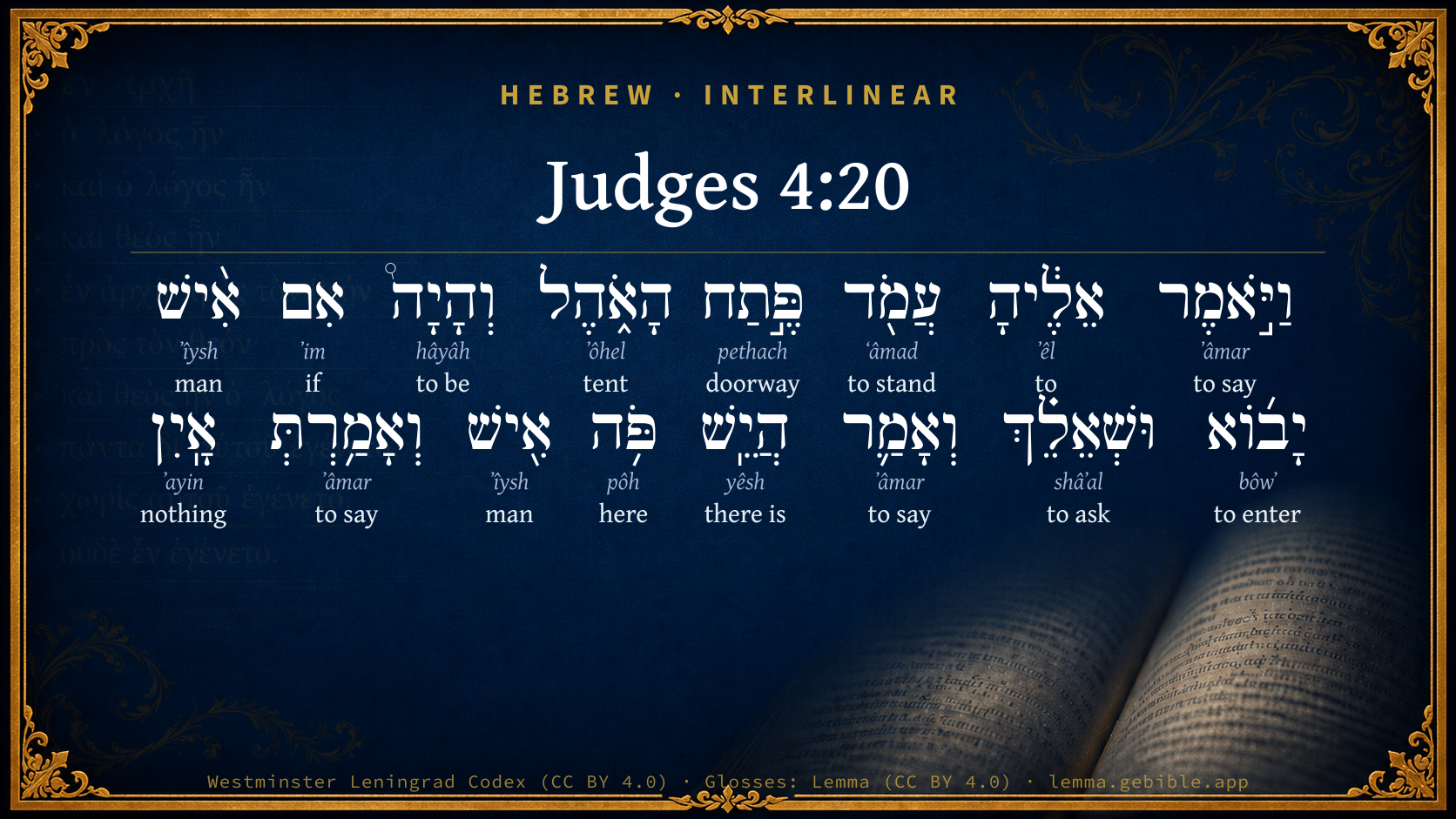
Judges 4:20

Hebrew (Westminster Leningrad Codex) Judges 4:20 appears in the Hebrew Old Testament. The text above is from the Westminster Leningrad Codex. Each word links to its Strong’s number, a concise gloss, and parsing drawn from the Open Scriptures Hebrew Bible morphology. Click any word for its full Brown-Driver-Briggs (BDB) entry.
Download image
Cite this verse

Judges 4:20 (World English Bible). Public Domain. Lemma interlinear Bible study tool, https://lemma.gebible.app/v/judges/4/20.

Show BibTeX & RIS
BibTeX
RIS
English Translation
He said to her, Stand in the door of the tent, and it shall be, when any man does come and inquire of you, and say, Is there any man here? that you shall say, No.
World English Bible · Public Domain
Download a study sheet

One document with this verse’s original text, its word-by-word gloss line, the meaning frame, cross-references with their text, attributed commentary, and full source and license credits — printable, and it pastes into notes with its structure intact.

This verse Autodidact and up

Study sheet (.html) Plain text (.txt)

A passage Seminary Student

Up to 50 verses in one chapter. A passage sheet keeps up to 6 commentary sources and 12 cross-references per verse, in the order this page ranks them, and says so on the sheet whenever that leaves anything out. Ask for a single verse and you get the Autodidact verse sheet above.

Everything on this page stays free to read, with no account — the sheet is a download of what is already on screen, not access to it.

Want to remove ads? Support Godless Engineer
Compare translations 3

The same verse in 3 English versions, stacked beneath the original-language interlinear above. Click any original word for its lexicon entry.

Each is an independent rendering of the whole verse — the interlinear is not word-aligned to these translations.

Highlighted words mark where these versions differ — a whole-verse word diff, not a word-by-word alignment.

  • World English Bible Public Domain
    He said to her, Stand in the door of the tent, and it shall be, when any man does come and inquire of you, and say, Is there any man here? that you shall say, No.
  • King James Version Public Domain
    Again he said unto her, Stand in the door of the tent, and it shall be, when any man doth come and inquire of thee, and say, Is there any man here? that thou shalt say, No.
  • unfoldingWord Literal Text CC BY-SA 4.0
    And he said to her, “Stand the entrance of the tent, and it shall be, if anyone comes and asks you and says, ‘Is there anyone here?’ then you shall say ‘No one.’”

unfoldingWord Literal Text — © unfoldingWord, licensed CC BY-SA 4.0. Word-aligned USFM3 via Door43 (git.door43.org/unfoldingWord/en_ult).

Versions to compare (up to 4)

3 of 4 selected

Show all 18 translations

Every available English version of this verse, each an independent rendering of the whole verse.

  • World English Bible Public Domain
    He said to her, Stand in the door of the tent, and it shall be, when any man does come and inquire of you, and say, Is there any man here? that you shall say, No.
  • Berean Standard Bible Public Domain
    “Stand at the entrance to the tent,” he said, “and if anyone comes and asks you, ‘Is there a man here?’ say, ‘No.’”
  • Majority Standard Bible Public Domain
    “Stand at the entrance to the tent,” he said, “and if anyone comes and asks you, ‘Is there a man here?’ say, ‘No.’”
  • King James Version Public Domain
    Again he said unto her, Stand in the door of the tent, and it shall be, when any man doth come and inquire of thee, and say, Is there any man here? that thou shalt say, No.
  • American Standard Version (1901) Public Domain
    And he said unto her, Stand in the door of the tent, and it shall be, when any man doth come and inquire of thee, and say, Is there any man here? that thou shalt say, No.
  • Revised Version (1885) Public Domain
    And he said unto her, Stand in the door of the tent, and it shall be, when any man doth come and inquire of thee, and say, Is there any man here? that thou shalt say, No.
  • Geneva Bible (1599) Public Domain
    Againe he sayde vnto her, Stande in the doore of the tent, and when any man doth come and enquire of thee, saying, Is any man there? thou shalt say, Nay.
  • Douay-Rheims (1899) Public Domain
    And Sisara said to her: Stand before the door of the tent, and when any shall come and inquire of thee, saying: Is there any man here? thou shalt say: There is none.
  • Young's Literal Translation Public Domain
    And he saith unto her, `Stand at the opening of the tent, and it hath been, if any doth come in, and hath asked thee, and said, Is there a man here? that thou hast said, There is not.'
  • Literal Standard Version CC BY-SA 4.0
    And he says to her, “Stand at the opening of the tent, and it has been, if any comes in, and has asked you and said, Is there a man here? That you have said, There is not.”
  • Unlocked Literal Bible CC BY-SA 4.0
    He said to her, “Stand at the opening of the tent. If someone comes and asks you, 'Is anyone here?', say 'No'.”
  • unfoldingWord Literal Text CC BY-SA 4.0
    And he said to her, “Stand the entrance of the tent, and it shall be, if anyone comes and asks you and says, ‘Is there anyone here?’ then you shall say ‘No one.’”
  • Darby Bible Public Domain
    And he said to her, "Stand at the door of the tent, and if any man comes and asks you, 'Is any one here?' say, No."
  • World Messianic Bible Public Domain
    He said to her, “Stand in the door of the tent, and if any man comes and inquires of you, and says, ‘Is there any man here?’ you shall say, ‘No.’”
  • Webster's Bible Public Domain
    Again he said to her, stand in the door of the tent, and it shall be, when any man doth come and inquire of thee, and say, Is there any man here? that thou shalt say, No.
  • Free Bible Version CC BY-SA 4.0
    “Stand guard at the tent door,” he told her. “If anybody comes and asks you, ‘Is there is anyone here?’ just say no.”
  • Bible in Basic English Public Domain
    And he said to her, Take your place at the door of the tent, and if anyone comes and says to you, Is there any man here, say, No.
  • JPS Tanakh (1917) Public Domain
    And he said unto her: 'Stand in the door of the tent, and it shall be, when any man doth come and inquire of thee, and say: Is there any man here? that thou shalt say: No.'

Literal Standard Version (2020), Covenant Press — licensed CC BY-SA 4.0. Text via the HelloAO Bible API (eBible.org). Unlocked Literal Bible (unfoldingWord) — licensed CC BY-SA 4.0. Text via the HelloAO Bible API (eBible.org). unfoldingWord Literal Text — © unfoldingWord, licensed CC BY-SA 4.0. Word-aligned USFM3 via Door43 (git.door43.org/unfoldingWord/en_ult). Free Bible Version, Dr. Jonathan Gallagher — licensed CC BY-SA 4.0. Text via the HelloAO Bible API (eBible.org).

Word by word

More ways to search: Search by grammar → Find every occurrence → Compare this word →

Practice this passage: Drill this verse → Learn its vocabulary →

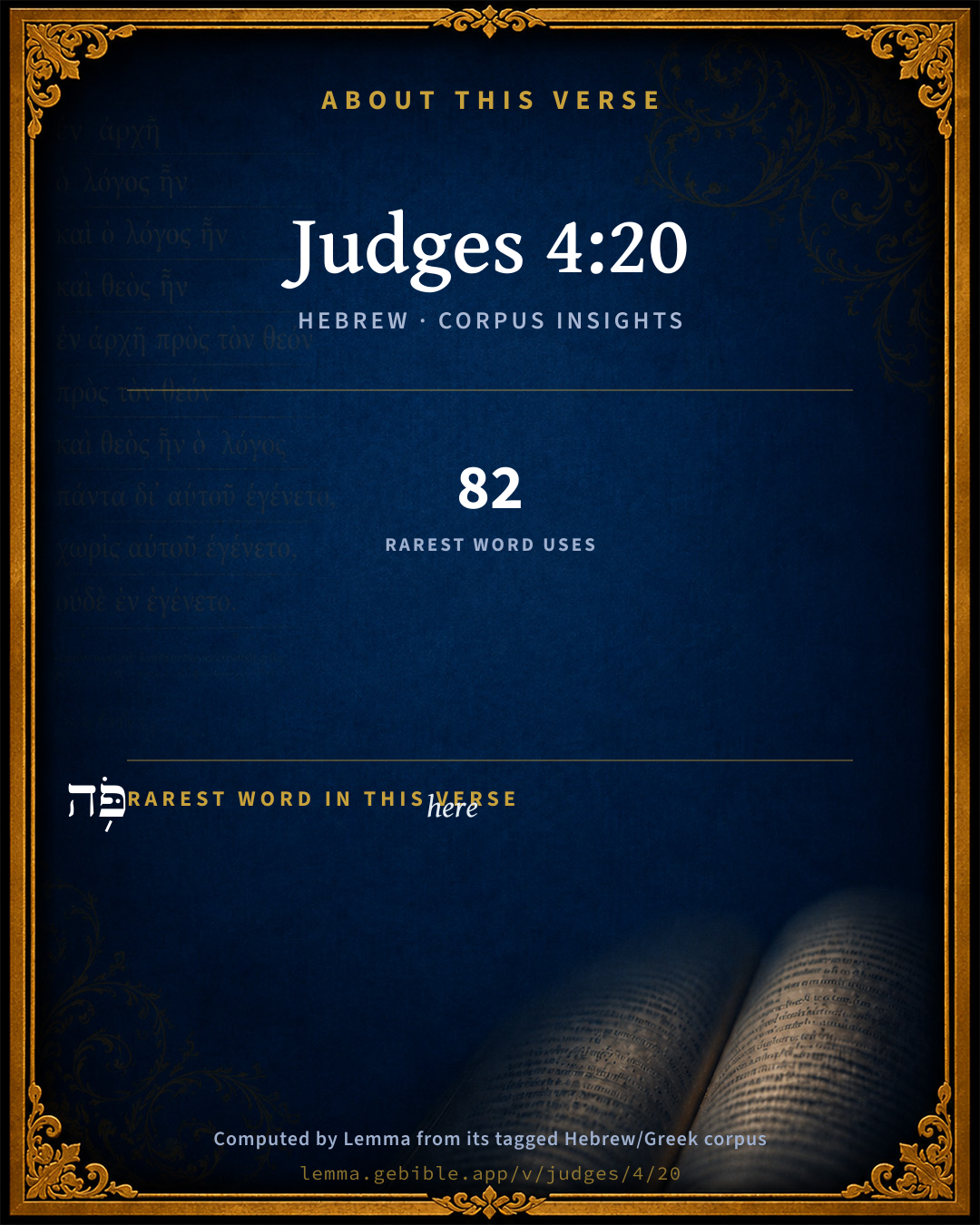
פֹּ֥ה
pôh
H6311
“here”
Adverb
Part of Speech
Adverb
Full BDB Definition

Origin: probably from a primitive inseparable particle "p" (of demonstrative force) and H1931

TWOT: 1739

here, from here, hither - here - hither
  1. וַיֹּ֣אמֶר ʼâmar H559 “and · to say” Conjunction + Verb, Qal, Sequential Imperfect, 3rd Person, Masculine, Singular
  2. אֵלֶ֔יהָ ʼêl H413 “to · her” Preposition + Suffix, Personal, 3rd Person, Feminine, Singular
  3. עֲמֹ֖ד ʻâmad H5975 “stand” Verb, Qal, Imperative, 2nd Person, Masculine, Singular
  4. פֶּ֣תַח pethach H6607 “doorway of” Noun, Common, Masculine, Singular, Construct
  5. הָאֹ֑הֶל ʼôhel H168 “the · tent” Particle, Definite Article + Noun, Common, Masculine, Singular, Absolute
  6. וְהָיָה֩ hâyâh H1961 “and · to be” Conjunction + Verb, Qal, Sequential Perfect, 3rd Person, Masculine, Singular
  7. אִם ʼim H518 “if” Conjunction
  8. אִ֨ישׁ ʼîysh H376 “man” Noun, Common, Masculine, Singular, Absolute
  9. יָב֜וֹא bôwʼ H935 “to enter” Verb, Qal, Imperfect, 3rd Person, Masculine, Singular
  10. וּשְׁאֵלֵ֗ךְ shâʼal H7592 “and · to ask · her” Conjunction + Verb, Qal, Sequential Perfect, 3rd Person, Masculine, Singular + Suffix, Personal, 3rd Person, Feminine, Singular
  11. וְאָמַ֛ר ʼâmar H559 “and · to say” Conjunction + Verb, Qal, Sequential Perfect, 3rd Person, Masculine, Singular
  12. הֲיֵֽשׁ yêsh H3426 “there is” Particle, Interrogative + Particle, Demonstrative
  13. אִ֖ישׁ ʼîysh H376 “man” Noun, Common, Masculine, Singular, Absolute
  14. וְאָמַ֥רְתְּ ʼâmar H559 “and · to say” Conjunction + Verb, Qal, Sequential Perfect, 2nd Person, Feminine, Singular
  15. אָֽיִן ʼayin H369 “nothing” Particle, Negative

About this verse

These counts appear in no published source. They are computed here, from the morphology-tagged text and Lemma’s own curated glosses. What Lemma adds →

16
words
13
distinct lemmas
Historical
section

Grammatical profile

  • 7 verbs
  • 4 nouns
  • 1 preposition
  • 1 conjunction
  • 1 adverb
  • 2 particles

Verb forms

  • וַיֹּ֣אמֶר Qal · Sequential Imperfect
  • עֲמֹ֖ד Qal · Imperative
  • וְהָיָה֩ Qal · Sequential Perfect
  • יָב֜וֹא Qal · Imperfect
  • וּשְׁאֵלֵ֗ךְ Qal · Sequential Perfect
  • וְאָמַ֛ר Qal · Sequential Perfect
  • וְאָמַ֥רְתְּ Qal · Sequential Perfect

Repetition

Words recur within this verse — often emphatic in Hebrew:

  • וַיֹּ֣אמֶר to say H559 ×3
  • אִ֨ישׁ man H376 ×2

Hebrew & Septuagint length

In English translation the verse runs 36 words from the Hebrew and 43 from the Septuagint (LXX English) — closely comparable.

A rough comparison of the two English renderings, which tokenize alike — not a word-level alignment.

Word counts can differ between the Hebrew and the Greek without any difference in meaning — e.g. the Hebrew direct-object marker אֵת has no separate Greek word, and Greek often adds the article ὁ.

Cross-references

2

Topical passages linked to Judges 4:20 in the Treasury of Scripture Knowledge — connected by theme and wording, ordered by reader-vote popularity; previews shown in the World English Bible.

  • Joshua 2:3–5 The king of Jericho sent to Rahab, saying, Bring forth the men who are come to you, who have entered into your house; for they have come to search out all the land.
  • 2 Samuel 17:20 Absalom's servants came to the woman to the house; and they said, Where are Ahimaaz and Jonathan? The woman said to them, They have gone over the brook of water. When they had sought and could not find them, they returned to Jerusalem.

Cross-references courtesy of OpenBible.info (CC BY 4.0).

Hebrew and Greek witnesses Masoretic Hebrew ↔ Greek Septuagint

The same verse in the two great witnesses to the Old Testament, shown verse-for-verse.

These are two independent witnesses, not word-aligned to each other, and the Septuagint is shown in lemma (dictionary) form.

Hebrew Judges 4:20 Masoretic · Westminster Leningrad Codex

וַיֹּ֣אמֶר אֵלֶ֔יהָ עֲמֹ֖ד פֶּ֣תַח הָאֹ֑הֶל וְהָיָה֩ אִם אִ֨ישׁ יָב֜וֹא וּשְׁאֵלֵ֗ךְ וְאָמַ֛ר הֲיֵֽשׁ פֹּ֥ה אִ֖ישׁ וְאָמַ֥רְתְּ אָֽיִן

He said to her, Stand in the door of the tent, and it shall be, when any man does come and inquire of you, and say, Is there any man here? that you shall say, No.

World English Bible · Public Domain

Greek LXX Judges 4:20 Septuagint · lemma form

καί εἶπον πρός αὐτός σισαρα ἵστημι δή ἐπί ὁ θύρα ὁ σκηνή καί εἰμί ἐάν ἀνήρ ἔρχομαι πρός σύ καί ἐρωτάω σύ καί εἶπον εἰ εἰμί ὧδε ἀνήρ καί εἶπον οὐ εἰμί

And Sisara said to her, Stand now by the door of the tent, and it shall come to pass if any man come to you, and ask of you, and say, Is there any man here? then you shall say, There is not.

LXX2012 (modern English Septuagint) · Public Domain

Hebrew: Westminster Leningrad Codex (CC BY 4.0). Greek: Septuagint (public domain); English from LXX2012 (modern English Septuagint) (Public Domain). How the Septuagint differs from the Hebrew →

Targum (Aramaic paraphrase)

1

The Targum is the ancient Jewish Aramaic paraphrase of the Hebrew Scriptures — an interpretive translation, not the Hebrew text itself. Onkelos (literal) and Pseudo-Jonathan (expansive) render the Torah, and Jonathan the Prophets. Coverage is partial: where no permissively-licensed English translation exists for a verse, only the Aramaic is shown. This is verse-level text, not a word-by-word alignment to the Hebrew.

  1. Targum Jonathan Prophets (Joshua–Malachi)
    וַאֲמַר לָה קוּמִי בִּתְרַע מַשְׁכְּנָא וִיהֵי אִם אֱנַשׁ יֵיתֵי וְיִשְׁאֲלִנָיךְ וְיֵמַר הֲאִית כָּא גַבְרָא וְתֵימְרִין לָא:

    (no public-domain English translation for this verse)

    Targum Jonathan — Aramaic: “Mikraot Gedolot” (public domain). English: “Sefaria Community Translation” (CC0 1.0 (public-domain dedication)); “London "Chaldee Paraphrase," 1871” (public domain). Text via Sefaria.

Commentary

Notes on Judges 4:20 from classic Christian and Jewish commentators (each source and its license shown beneath its notes). The classic Christian expositions comment on the surrounding passage and are grouped to its opening verse, so a note may address several verses; the Jewish commentaries on the Tanakh (Rashi and others) are per-verse, so they appear only where the commentator wrote on this verse.

Lemma curates 59 commentaries, every one of them public domain or Creative Commons licensed, each selected and text-cleaned for this edition rather than reprinted as found. About our sources →

Trapp's Complete Commentary

John Trapp

Jdg 4:20 Again he said unto her, Stand in the door of the tent, and it shall be, when any man doth come and enquire of thee, and say, Is there any man here? that thou shalt say, No.

Ver. 20. That thou shalt say, No.] An officious lie is held a peccadillo; but God’s children are such as will not lie. {Isa 63:8 Zep 3:13} Jael made him no promise to do as he desired, but said within herself, likely, as that good woman in Jerome did, Ideo mentiri nolo, ne peccem, I will do anything sooner than lie: for that were to sin against God.

John Trapp, A Commentary or Exposition upon All the Books of the Old and New Testament (1647–1656) — public domain. Text from a community e-Sword module.

The Biblical Illustrator

Joseph S. Exell

Jdg_4:20

Thou shalt say, No.

Thou shalt say, No

A human being has his destiny, in some measure, in his own hands, depending on his own voluntary determinations. We cannot define exactly the limits of the province of free-will, but that it has a province, and an important one, all consciousness attests. It is true that man, like the animals and the vegetables, is subject to those laws of his being which he had no choice in enacting, and to the outside influences which he does not invite, and they must needs go far towards deciding his character. But not exclusively. He can enact laws for himself, impose actions upon himself, and, what it is our business to consider now, he possesses a certain qualified, but real veto-power. He can, to a large extent, not suppress, but repress and hold in check, some of the laws and tendencies and demands of his own nature. And he can, in a degree, reject outside influences and solicitations, push them aside, defy them, avert them. He can veto them, can say No to them. And according as he says it, and says it on right occasions, says it promptly, decisively, he maintains the splendid self-sovereignty of manhood. A brave, frequent, and absolute exercise of the veto-power with which he is endowed, is one of the fixed conditions of success and honour in the world, of self-respect and dignity of character, of harmony with God and the happiness of life.

I. The exercise of this supreme power in reference to the tendencies and inclinations within ones self. There are tendencies and appetites in every man which, if allowed a free course and full swing, would drag him in the mire and hurry him to his ruin. The meanest of them has slain its thousands. So mean and paltry an appetite as that for stimulating drink counts its victims by millions, and our nature is largely made up of such dangerous proclivities, some inborn and some acquired. There is in man, also, a certain inscrutable, central authority, the mysterious Ego, the indefinable I myself, whose office is to watch over these necessary but dangerous members of the internal commonwealth, and keep them to their limits, and say, No to each and all their demands for undue power and over-indulgence. No man can live at all without exerting this power at some points; and no man can live nobly, and to the highest purposes of his being, without exerting it constantly, at all points, and with absolute supremacy. In the biographies of all persons eminent for character and achievement, you will notice how they have striven to acquire perfectly this form of self-mastery. What ingenious devices and shrewd practices they have resorted to, to this end. In some ages, what fasts and penances and seclusions and all forms of asceticisms, and in all ages what vigorous efforts, what watchfulness, and what contrivances and habits of self-discipline, whereby they might be able with promptitude and effect to say No to any tendency that is getting too strong, and any desire that is too clamorous! And success in that is their salvation, the open secret of their success in their high aims, and the glory of their lives.

II. The circumstances and events around us. These are very powerful, seemingly irresistible often. They claim to take full possession of a man, to carry him whither they will, and make of him what they will. They seem to say to him, We are a part of the irresistible order of nature; we move according to the eternal laws; we represent the forces of the universe; we come backed by the omnipotence of the Creator. What can you, poor, puny mortal, do in resistance to our overwhelming might? A pitiful speck of being as you are, an evanescent bubble on this vast sea of matter and force, what is there for you but to drift whithersoever we may carry you, and sink where we drop you? But not so, thou majestic universe, bearing upon man as you do with all your infinite might in the events and circumstances around us--not so! The soul in man, that mysterious essence, whose very existence you bring into question, is in its rightful province a match for you, can resist you, set you aside, say No to you, and in the ethereal, Godlike power it is endowed with, and with the humility of a little child, make good its audacious defiance. The brave but wary seaman knows the tremendous power of an adverse wind, a power that nothing can withstand, knows it and respects it, yet he is master of the situation. He can anchor in the roadstead, and look the very hurricane in the face, and let it blow. He will not budge. He can wait. That force will be spent before his will be. He will yet lay his course right along the pathway of the storm, and he does, and makes his voyage triumphantly. Or in another ease he refuses to drift with it. He will move right on against the opposing force, and never stop a moment, nor furl his sails; he must beat, go zigzag, tediously, but he gets on against it, and if need be, he will make the entire Atlantic voyage without one favourable breeze, with hard struggles but no yielding, delayed but not defeated. So in all human life. The power of circumstances must be respected, and dealt with valiantly but warily. The true man will accommodate himself to them, and yet refuse to drift with them; nay, will circumvent them, outwatch them, and make them serve his purpose. They may delay him, but not turn him back; discourage him, but not pluck heart of hope out of him. They may change his direction, but not stop his progress. They may change the form of his duty, but cannot hinder doing. They may combine to tempt and assail his integrity or purity, but if he say in Gods name, No! they cannot touch it.

III. It is most practical to consider the exercise of this veto-power in refusing the requests of other persons. There are always about us those who ask us or propose to us to do things that we ought not or had better not do. And such is the strength of the social tie, and so potent the influence of anothers desire, that there is always a disposition to comply, and an amiable disposition it is in itself. But it is often very misleading, and sometimes fatal to honour and integrity, to purity and peace and every sacred interest of life. Many a youth and many a man, not depraved, but simply weak and unestablished, has thus been led to his ruin, out of mere good-natured compliance and the difficulty of refusing a solicitation. Balancing between good and evil, with the promise and possibility of the best, he has gone to the bad, because he could not, or felt that he could not, say, No! The dangerous tendencies that are in him, and that are in everybody, acquire tenfold power when reinforced by the importunity of a friendly companion to join him in giving way to them. That little off-hand suit, Come along, coupled with the suggestion, Whats the harm? or Who will know it? or Just this once, or Dont be a coward, we cannot tell how many it leads astray every day, initiates in the downward path, and that too when every instinct of the conscience, every sentiment of honour, every affection of their heart, and every hope of their lives, is breathing its protest, and would hold them back. If all those hesitating consents could now be recalled, that fatal compliance reversed, and it should be as if the rightful refusals had been spoken in place of them, what blessed results should we see. Oh, learn betimes to say, No! when you know you ought to say it. Fear not the sneers of the evil-disposed, the corrupt, or the merely thoughtless, but fear rather the anguish and tears of those who love you, the strings of your conscience, and the displeasure of your God. Be prompt and strong to say, No! when you ought, and your better nature bids you, and so march on through your career in safety, honour, and peace. And it is not only to the solicitations or the suggestions that would lead us in fatal directions, into enslaving vices, or the outright sacrifice of truth, honour, and purity that we need to exercise this great prerogative of downright refusal in the thick of this our social city life, we have need to exercise it daily, and almost hourly, in respect to requests and invitations that have no bad intent, but are meant in courtesy and kindness, and that in other circumstances, and at other times, might be complied with in all propriety. We need, on moral grounds, to guard with some jealousy our personal independence, and let nobody unduly or unreasonably invade it. We cannot afford to hold ourselves, our time, faculties, thoughts, or even sympathies, entirely at the beck and call even of the best people or of the kindest-meaning friends. That high independence which never hesitates to say, No whenever and to whomsoever it should be said commands respect. It is a chief element of all nobleness and strength of character. It is essential to feminine dignity, and to the highest manhood. It makes you worth seeking, and causes your refusals to be better taken than the loose assents of those facile persons who from sheer weakness in the fibre and the making up of their character can never say, No! or say it as if guilty of an offence and fearful of your displeasure. (George Putnam.)

Thou shalt say, No

Here is one of the shortest words in our language; yet there is none which persons of an easy and yielding disposition find it so difficult to pronounce. To say it, however, is one of the first lessons which we have occasion to learn, and one of the most frequent we are called upon to practise. You can hardly mention a cause which has done more to lead men into embarrassment, distress, and crime, than disregard of this caution. A young man just entering into life is solicited by his gay companions to take part in their dissipations. He feels that it would be wrong; that it can lead to nothing but evil. And yet he cannot muster resolution enough to say, No. He consents, goes on from step to step, and in the end is ruined. An affectionate mother is besought by her children to grant them some improper indulgence. She feels that it would be an improper indulgence; that it can only do them harm. And yet she cannot find it in her heart to say, No.

I. In the first place, then, Let us learn to respect our own judgment in what we do. If, on a view of all the circumstances, we think we ought to say, No, let us have the courage and firmness and independence to say it. A man who dares not act according to his own convictions of what is right, for fear that after all he may be mistaken--I will not say that he has no regard for conscience, but this I will say: he has no confidence in conscience, which in practice amounts to nearly the same thing. Besides, with respect to the construction which other people may put on our motives, if we only take care that our motives are what they should be, and that our whole conduct is in keeping, we need not entertain any apprehensions but that in the long run ample justice will be done them by all whose approbation is worth having. I have shown that it is but the part of a manly independence to have the courage and firmness to say, No, when we are convinced that this is the proper word.

II. I proceed to show that it is no less a dictate of prudence, and practical wisdom. You can hardly step your foot on the threshold of life without encountering seduction in every possible shape; and unless you are prepared to resist it firmly, you are a doomed man. What makes it still more dangerous is, that the first solicitations of vice often come under such disguised forms, and relate to things seemingly so trivial, as to give hardly any warning of the fatal consequences, to which by slow and insensible gradations they are almost sure to lead. As you value, then, your health and reputation, your peace of mind and personal independence, learn to say, No. Inquire into the sources of human misery, study the first beginnings of crime, and, meet with it where you may, by tracing it back to its first cause you will find it to have been, in almost every instance, merely because they could not say, No, to the tempter. Put the question to one who has wasted his substance in riotous living. The burden of their confession will be, that they owe every calamity which has befallen them to their not having had firmness enough, at some turning-point of their destiny, to say, No. As you would avoid their fate, let me then conjure you to avoid its cause.

III. The same conduct which I have shown to be necessary to a manly independence and to a prudent regard to our own interest I shall next prove to be in no sense inconsistent with a benevolent and truly generous disposition. One of the most common mistakes on this subject is to confound an easy disposition with a benevolent disposition: two things which in fact are as wide asunder as the east from the west. A man of an easy disposition is so commonly merely because he will not make the effort a more firm and steady conduct requires. And why will he not make this effort? Because he will not take the trouble of making it. But is this benevolence? Is it so much as an abuse of benevolence? Is it not sheer selfishness?

IV. Having shown that independence, prudence, and benevolence alike require the conduct I have been recommending, it only remains for me to urge it upon you as a matter of moral and religious duty. It is a great error, though a common one, not to suppose that the principle of duty extends to almost all our actions; requiring them or forbidding them, as being either right or wrong. We talk of actions as being honourable or dishonourable, as being prudent or imprudent, as being benevolent or otherwise, but what is honourable or prudent or benevolent is also right. Everything, therefore, which has already been said to prove the conduct in question a dictate of benevolence, prudence, and manly independence, goes also to the same extent to prove it to be our duty, our imperative duty. Besides, take the words as they stand. If, considering all the circumstances, we ought to say, No, then it is our duty to say it, let the consequences be what they may. Some men can never say, No, unless they are in a passion, and are therefore driven to the mortifying necessity of working themselves up into a passion before they can find the courage to do it. Again, there are others, who will trust themselves to say, No, only as a matter of policy; and with whom, therefore, the question is not, What ought I to say? but, What will it be for my interest to say? There is also a third class that will say, No--and say it often enough too, if that were all--from mere churlishness and ill-humour; but I need not observe that this is very far from being the conduct I am here recommending. Putting aside all such considerations, let us learn to resist improper solicitations from a sense of duty. It should be enough to know that it is our duty. Let us act on this principle, and we shall never refuse except when duty requires it; but at such times our refusal will be much more decided and effectual, while it will be made under circumstances of much greater dignity on our part, and of much less irritation on the part of those whom it may disappoint. Moreover, while we act from a sense of duty, we should connect with this feeling a conviction that it is one of religious obligation. God has required us to pursue a course of undeviating rectitude. Whoever, therefore, would seduce us from this sets himself against God, and we must deny one or the other. Whether in such a case we should deny God rather than man let conscience judge. (James Walker.)

The Biblical Illustrator, edited by Joseph S. Exell (c. 1880s–1900s) — public domain. Text from a community e-Sword module.

Geneva Bible (1599)

Geneva Bible translators

To wit, Sisera.

Geneva Bible (1599) marginal notes — public domain. Text via Bolls.life.

Jamieson, Fausset & Brown

Robert Jamieson, A. R. Fausset & David Brown

he said unto her, . . . when any man doth come and enquire of thee and say, Is there any man here? that thou shalt say, No--The privacy of the harem, even in a tent, cannot be intruded on without express permission.

Jamieson, Fausset & Brown — Commentary Critical and Explanatory on the Whole Bible (1871) — public domain (CC PDM 1.0). Text via the HelloAO Bible API.

Adam Clarke's Commentary

Verse 20. Stand in the door of the tent] As no man would intrude into the women's apartment without permission, her simply saying, there is no man in my tent, would preclude all search.

Adam Clarke's Commentary on the Bible (1810–1826) — public domain. Text from a community e-Sword/MySword module.

Ellicott's Commentary for English Readers

(20) Stand.—The imperative here used has the masculine, not the feminine termination, but probably only because it is used generally.

That thou shalt say, No.—In that age, and among those nations, and under such circumstances, a lie would have been regarded as perfectly natural and justifiable; even under the Christian dispensation, many casuists declare a lie for self-preservation to be venial, though it is to be hoped that there are millions who, without condemning such a falsehood in others, would suffer any extremity rather than be guilty of it themselves. Under any circumstances, it would be very unfair to judge by the standard of Christianity the words and actions of ignorant nomads and idolatrous Canaanites, more than a thousand years before Christ. Sisera and Jael would have acted, without the faintest sense of conscientious scruple, on the heathen advice of Darius—“When it is necessary to lie, lie” (Herod. iii. 72).

A Bible Commentary for English Readers, edited by Charles John Ellicott (1878–1897) — public domain. Text from a community e-Sword module.

John Gill's Exposition

And he said unto her, stand in the door of the tent,.... This he said, not in an imperious way, as some think, but by entreaty:

and it shall be, when any man shall come and inquire of thee; seeing her at the door, and where he desired she would stand to prevent their coming into the tent:

and say, is there any man here? any besides what belongs to the family? or any of Sisera's army?

that thou shalt say, no; there is no man; but to this she made no answer that is recorded.

John Gill's Exposition of the Whole Bible (1746–1763) — public domain (CC PDM 1.0). Text via the HelloAO Bible API.

Albert Barnes' Notes on the Bible

Stand in the door ... - The characteristic duplicity of the Oriental character, both in Sisera and Joel, is very forcibly depicted in this narrative. It is only by the light of the Gospel that the law of truth is fully revealed.

Albert Barnes' Notes on the Bible (1834–1885) — public domain. Text from a community e-Sword/MySword module.

Matthew Poole's English Annotations

He speaks imperiously to her; but it is observable, that she gives him no promise to do so, nor makes him any answer; possibly because though she knew her design upon him was warrantable, yet she had proceeded too far in using dissimulation therein.

Matthew Poole's English Annotations on the Holy Bible (1683–1685) — public domain. Text from a community e-Sword/MySword module.

Whedon's Commentary on the Bible

Daniel D. Whedon

20. Thou shalt say, No — On these words Bush has the following: “The custom adopted in some families of instructing servants to say, ‘Not at home,’ when a master or mistress does not wish to receive company, is directly at variance with the dictates of Christian simplicity and sincerity; nor is it anything in its favour that it here has the sanction of a wicked heathen warrior, doomed to destruction.” On the morality of Jael’s action, see at the end of the chapter.

Daniel D. Whedon (gen. ed.), Commentary on the Old and New Testaments (1874–1909) — public domain. Text from a community e-Sword module.

Rashi

Rabbi Shlomo Yitzchaki (Rashi)

Stand at the entrance to the tent. Be zealous about it. Some interpret עֲמֹד [lit. "stand"] as לַעֲמוֹד, "to stand".

Rashi on the Tanakh — English translations: “The Judaica Press complete Tanach with Rashi, translated by A. J. Rosenberg” (CC BY 4.0); “Pentateuch with Rashi's commentary by M. Rosenbaum and A.M. Silbermann, 1929-1934” (public domain); “The Metsudah Tanach series, Lakewood, N.J” (CC BY 4.0); and “The Book of Joshua, Metsudah Publications, 1997” (CC BY 4.0). Text via Sefaria.

Radak

Rabbi David Kimhi (Radak)

Stand: It is an infinitive: And he said to her to stand at the entrance of the tent.

And she fastened: The peg went through his temple and became stuck in the ground.

Asleep: It is [vocalized with a] patach, and it is past tense, passive.

And exhausted (veyaaf): The [letter] ayin is with a patach, to differentiate between [this word] and "veya'af alai" (Isaiah 6:6), which is a different matter. And [it means that] he was already tired. Hence he did not feel her striking him, and he died.

Radak on the Tanakh — English translations: “Sefaria Community Translation” (CC0 1.0 (public-domain dedication)); “Eliyahu Munk, HaChut Hameshulash” (CC BY 4.0); “Rabbi Mike Feuer, Jerusalem Anthology” (CC BY 4.0); and “R. David Kimhi on the first book of Psalms, Translated by R.G. Finch, London, 1919” (public domain). Text via Sefaria.

Lesson kit

Teaching starters — assembled from the data on this page, not authored interpretation. Every prompt links to the verse data it draws on. Edit before teaching.

Judges, in the Historical, opens this verse with 16 words (13 distinct Hebrew lemmas). Its most distinctive word is pôh (“here”). A historical commentator’s framing appears above. Read the whole chapter for the surrounding context.

Discussion questions

  1. The word pôh carries the sense “here.” How does it shape the verse?
  2. Joshua 2:3–5 shares this passage’s theme. How do the two illuminate each other?
  3. “to say” occurs 3× in this one verse. What is the effect of the repetition?
  4. The translations on this page render this verse differently — a whole-verse word diff, not a word-by-word alignment. What might account for the different wordings?
  5. The verb «וַיֹּ֣אמֶר» is Qal Sequential Imperfect. How does its form color the action?
  6. Reading how Trapp's Complete Commentary and The Biblical Illustrator read this verse, where do the two commentators agree and where do they part?

Things to notice

Reading settings

Reading text

Shown beneath each verse's original-language words.

Old Testament
Old Testament edition

Read the OT as the Masoretic Hebrew (MT) or the Greek Septuagint (LXX).

English shown for the Greek Septuagint (in the Hebrew ↔ Greek comparison).

Comparing translations? Open the Compare panel on any verse page to stack up to four side by side.