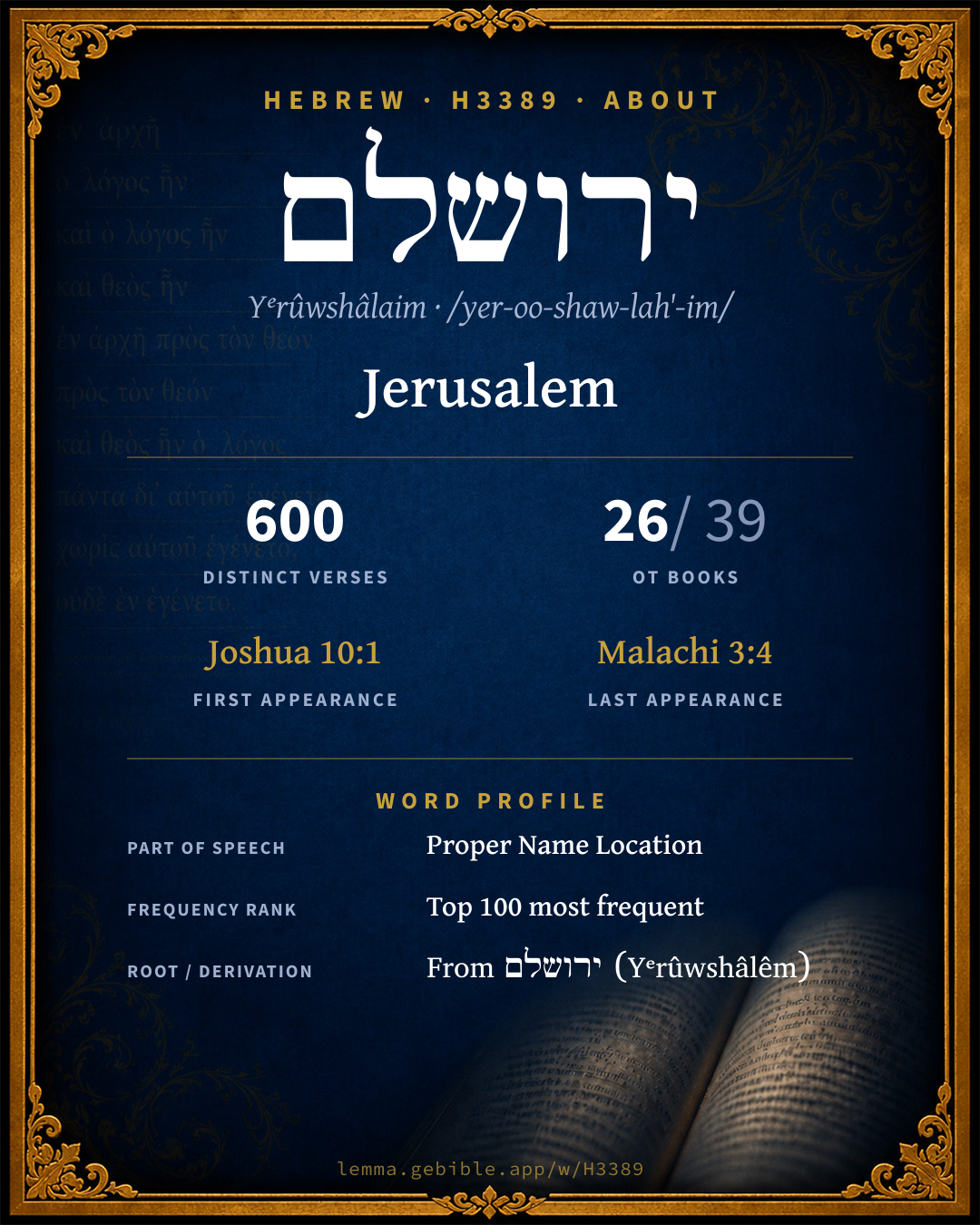
יְרוּשָׁלִַ֫͏ם
Jerusalem
BDB lists 2 entries for ‘Jerusalem’ fuller range ↓
Full lexicon entry — Brown-Driver-Briggs (BDB)
From Brown-Driver-Briggs (BDB)
Where this word appears
Grammar key — what these labels mean
Part of speech
- Noun
- A naming word — a person, place, thing, or idea.
Noun type
- Proper
- A name of a specific person, place, or people (e.g. Abraham, Zion, Israel).
Page 2 of 3 — showing verses 201–400 of 600 distinct verses where H3389 appears, across 26 books. Click any verse to open its interlinear word-by-word view. Verse text shown in the World English Bible for context — . Each verse’s Hebrew form is shown with its reference; the English is not keyword-highlighted, since the data carries no word-level English alignment. Use “Compare translations” on any verse to read it across multiple English versions. This concordance covers the Hebrew Bible; Septuagint (Greek Old Testament) occurrences are not indexed here.
2 Chronicles 117 verses
- 2 Chronicles 24:9 וּ/בִֽ/ירוּשָׁלִַ֗ם conj + prep + n Proper They made a proclamation through Judah and Jerusalem, to bring in for Yahweh the tax that Moses the servant of God laid on Israel in the wilderness.
- 2 Chronicles 24:18 וִ/יר֣וּשָׁלִַ֔ם conj + n Proper They forsook the house of Yahweh, the God of their fathers, and served the Asherim and the idols: and wrath came on Judah and Jerusalem for this their guiltiness.
- 2 Chronicles 24:23 וִ/יר֣וּשָׁלִַ֔ם conj + n Proper It happened at the end of the year, that the army of the Syrians came up against him: and they came to Judah and Jerusalem, and destroyed all the princes of the people from among the people, and sent all the spoil of them to the king of Damascus.
- 2 Chronicles 25:1 בִּ/ירוּשָׁלִָ֑ם מִ/ירוּשָׁלָֽיִם prep + n Proper prep + n Proper Amaziah was twenty-five years old when he began to reign; and he reigned twenty-nine years in Jerusalem: and his mother's name was Jehoaddan, of Jerusalem.
- 2 Chronicles 25:23 יְר֣וּשָׁלִַ֔ם יְרוּשָׁלִַ֗ם n Proper n Proper Joash king of Israel took Amaziah king of Judah, the son of Joash the son of Jehoahaz, at Beth-shemesh, and brought him to Jerusalem, and broke down the wall of Jerusalem from the gate of Ephraim to the corner gate, four hundred cubits.
- 2 Chronicles 25:27 בִּ/ירוּשָׁלִַ֖ם prep + n Proper Now from the time that Amaziah did turn away from following Yahweh they made a conspiracy against him in Jerusalem; and he fled to Lachish: but they sent after him to Lachish, and killed him there.
- 2 Chronicles 26:3 בִּ/ירוּשָׁלִָ֑ם יְרוּשָׁלִָֽם prep + n Proper n Proper Sixteen years old was Uzziah when he began to reign; and he reigned fifty-two years in Jerusalem: and his mother's name was Jechiliah, of Jerusalem.
- 2 Chronicles 26:9 בִּ/יר֣וּשָׁלִַ֔ם prep + n Proper Moreover Uzziah built towers in Jerusalem at the corner gate, and at the valley gate, and at the turning [of the wall], and fortified them.
- 2 Chronicles 26:15 בִּ/ירוּשָׁלִַ֨ם prep + n Proper He made in Jerusalem engines, invented by skillful men, to be on the towers and on the battlements, with which to shoot arrows and great stones. His name spread far abroad; for he was marvelously helped, until he was strong.
- 2 Chronicles 27:1 בִּֽ/ירוּשָׁלִָ֑ם prep + n Proper Jotham was twenty-five years old when he began to reign; and he reigned sixteen years in Jerusalem: and his mother's name was Jerushah the daughter of Zadok.
- 2 Chronicles 27:8 בִּ/ירוּשָׁלִָֽם prep + n Proper He was five and twenty years old when he began to reign, and reigned sixteen years in Jerusalem.
- 2 Chronicles 28:1 בִּ/ירוּשָׁלִָ֑ם prep + n Proper Ahaz was twenty years old when he began to reign; and he reigned sixteen years in Jerusalem: and he didn't do that which was right in the eyes of Yahweh, like David his father;
- 2 Chronicles 28:10 וִֽ/ירוּשָׁלִַ֨ם֙ conj + n Proper Now you purpose to keep under the children of Judah and Jerusalem for bondservants and bondmaids to you: [but] aren't there even with you trespasses of your own against Yahweh your God?
- 2 Chronicles 28:24 בִּ/ירוּשָׁלִָֽם prep + n Proper Ahaz gathered together the vessels of the house of God, and cut in pieces the vessels of the house of God, and shut up the doors of the house of Yahweh; and he made him altars in every corner of Jerusalem.
- 2 Chronicles 28:27 בִּ/יר֣וּשָׁלִַ֔ם prep + n Proper Ahaz slept with his fathers, and they buried him in the city, even in Jerusalem; for they didn't bring him into the tombs of the kings of Israel: and Hezekiah his son reigned in his place.
- 2 Chronicles 29:1 בִּ/ירוּשָׁלִָ֑ם prep + n Proper Hezekiah began to reign when he was twenty-five years old; and he reigned twenty-nine years in Jerusalem: and his mother's name was Abijah, the daughter of Zechariah.
- 2 Chronicles 29:8 וִ/ירוּשָׁלִָ֑ם conj + n Proper Therefore the wrath of Yahweh was on Judah and Jerusalem, and he has delivered them to be tossed back and forth, to be an astonishment, and a hissing, as you see with your eyes.
- 2 Chronicles 30:1 בִּֽ/ירוּשָׁלִָ֑ם prep + n Proper Hezekiah sent to all Israel and Judah, and wrote letters also to Ephraim and Manasseh, that they should come to the house of Yahweh at Jerusalem, to keep the Passover to Yahweh, the God of Israel.
- 2 Chronicles 30:2 בִּ/ירוּשָׁלִָ֑ם prep + n Proper For the king had taken counsel, and his princes, and all the assembly in Jerusalem, to keep the Passover in the second month.
- 2 Chronicles 30:3 לִֽ/ירוּשָׁלִָֽם prep + n Proper For they could not keep it at that time, because the priests had not sanctified themselves in sufficient number, neither had the people gathered themselves together to Jerusalem.
- 2 Chronicles 30:5 בִּ/ירוּשָׁלִָ֑ם prep + n Proper So they established a decree to make proclamation throughout all Israel, from Beersheba even to Dan, that they should come to keep the Passover to Yahweh, the God of Israel, at Jerusalem: for they had not kept it in great numbers in such sort as it is written.
- 2 Chronicles 30:11 לִ/ירוּשָׁלִָֽם prep + n Proper Nevertheless certain men of Asher and Manasseh and of Zebulun humbled themselves, and came to Jerusalem.
- 2 Chronicles 30:13 יְרוּשָׁלִַ֨ם֙ n Proper There assembled at Jerusalem much people to keep the feast of unleavened bread in the second month, a very great assembly.
- 2 Chronicles 30:14 בִּ/ירוּשָׁלִָ֑ם prep + n Proper They arose and took away the altars that were in Jerusalem, and all the altars for incense took they away, and cast them into the brook Kidron.
- 2 Chronicles 30:21 בִּ/ירוּשָׁלִַ֜ם prep + n Proper The children of Israel who were present at Jerusalem kept the feast of unleavened bread seven days with great gladness; and the Levites and the priests praised Yahweh day by day, [singing] with loud instruments to Yahweh.
- 2 Chronicles 30:26 בִּֽ/ירוּשָׁלִָ֑ם בִּ/ירוּשָׁלִָֽם prep + n Proper prep + n Proper So there was great joy in Jerusalem; for since the time of Solomon the son of David king of Israel there was not the like in Jerusalem.
- 2 Chronicles 31:4 יְרוּשָׁלִַ֔ם n Proper Moreover he commanded the people who lived in Jerusalem to give the portion of the priests and the Levites, that they might give themselves to the law of Yahweh.
- 2 Chronicles 32:2 יְרוּשָׁלִָֽם n Proper When Hezekiah saw that Sennacherib was come, and that he was purposed to fight against Jerusalem,
- 2 Chronicles 32:9 יְר֣וּשָׁלַ֔יְמָ/ה בִּ/ירוּשָׁלִַ֖ם n Proper + sfx dem prep + n Proper After this did Sennacherib king of Assyria send his servants to Jerusalem, (now he was before Lachish, and all his power with him), to Hezekiah king of Judah, and to all Judah who were at Jerusalem, saying,
- 2 Chronicles 32:10 בִּ/ירוּשָׁלִָֽם prep + n Proper Thus says Sennacherib king of Assyria, Whereon do you trust, that you abide the siege in Jerusalem?
- 2 Chronicles 32:12 וְ/לִֽ/ירוּשָׁלִַ֨ם֙ conj + prep + n Proper Has not the same Hezekiah taken away his high places and his altars, and commanded Judah and Jerusalem, saying, You shall worship before one altar, and on it shall you burn incense?
- 2 Chronicles 32:18 יְרוּשָׁלִַ֨ם֙ n Proper They cried with a loud voice in the Jews' language to the people of Jerusalem who were on the wall, to frighten them, and to trouble them; that they might take the city.
- 2 Chronicles 32:19 יְרוּשָׁלִָ֑ם n Proper They spoke of the God of Jerusalem, as of the gods of the peoples of the earth, which are the work of men's hands.
- 2 Chronicles 32:22 יְרוּשָׁלִַ֗ם n Proper Thus Yahweh saved Hezekiah and the inhabitants of Jerusalem from the hand of Sennacherib the king of Assyria, and from the hand of all [others], and guided them on every side.
- 2 Chronicles 32:23 לִ/יר֣וּשָׁלִַ֔ם prep + n Proper Many brought gifts to Yahweh to Jerusalem, and precious things to Hezekiah king of Judah; so that he was exalted in the sight of all nations from thenceforth.
- 2 Chronicles 32:25 וִ/ירוּשָׁלִָֽם conj + n Proper But Hezekiah didn't render again according to the benefit done to him; for his heart was lifted up: therefore there was wrath on him, and on Judah and Jerusalem.
- 2 Chronicles 32:26 יְרוּשָׁלִָ֑ם n Proper Notwithstanding Hezekiah humbled himself for the pride of his heart, both he and the inhabitants of Jerusalem, so that the wrath of Yahweh didn't come on them in the days of Hezekiah.
- 2 Chronicles 32:33 יְרוּשָׁלִָ֑ם n Proper Hezekiah slept with his fathers, and they buried him in the ascent of the tombs of the sons of David: and all Judah and the inhabitants of Jerusalem did him honor at his death. Manasseh his son reigned in his place.
- 2 Chronicles 33:1 בִּ/ירוּשָׁלִָֽם prep + n Proper Manasseh was twelve years old when he began to reign; and he reigned fifty-five years in Jerusalem.
- 2 Chronicles 33:4 בִּ/ירוּשָׁלִַ֥ם prep + n Proper He built altars in the house of Yahweh, of which Yahweh said, In Jerusalem shall my name be forever.
- 2 Chronicles 33:7 וּ/בִֽ/ירוּשָׁלִַ֗ם conj + prep + n Proper He set the engraved image of the idol, which he had made, in the house of God, of which God said to David and to Solomon his son, In this house, and in Jerusalem, which I have chosen out of all the tribes of Israel, will I put my name forever:
- 2 Chronicles 33:9 יְרוּשָׁלִָ֑ם n Proper Manasseh seduced Judah and the inhabitants of Jerusalem, so that they did evil more than did the nations whom Yahweh destroyed before the children of Israel.
- 2 Chronicles 33:13 יְרוּשָׁלִַ֖ם n Proper He prayed to him; and he was entreated of him, and heard his supplication, and brought him again to Jerusalem into his kingdom. Then Manasseh knew that Yahweh he was God.
- 2 Chronicles 33:15 וּ/בִ/ירוּשָׁלִָ֑ם conj + prep + n Proper He took away the foreign gods, and the idol out of the house of Yahweh, and all the altars that he had built in the mountain of the house of Yahweh, and in Jerusalem, and cast them out of the city.
- 2 Chronicles 33:21 בִּֽ/ירוּשָׁלִָֽם prep + n Proper Amon was twenty-two years old when he began to reign; and he reigned two years in Jerusalem.
- 2 Chronicles 34:1 בִּ/ירוּשָׁלִָֽם prep + n Proper Josiah was eight years old when he began to reign; and he reigned thirty-one years in Jerusalem.
- 2 Chronicles 34:3 וִ/יר֣וּשָׁלִַ֔ם conj + n Proper For in the eighth year of his reign, while he was yet young, he began to seek after the God of David his father; and in the twelfth year he began to purge Judah and Jerusalem from the high places, and the Asherim, and the engraved images, and the molten images.
- 2 Chronicles 34:5 יְרוּשָׁלִָֽם n Proper He burnt the bones of the priests on their altars, and purged Judah and Jerusalem.
- 2 Chronicles 34:7 לִ/ירוּשָׁלִָֽם prep + n Proper He broke down the altars, and beat the Asherim and the engraved images into powder, and hewed down all the sun-images throughout all the land of Israel, and returned to Jerusalem.
- 2 Chronicles 34:9 יְרֽוּשָׁלִָֽם n Proper They came to Hilkiah the high priest, and delivered the money that was brought into the house of God, which the Levites, the keepers of the threshold, had gathered of the hand of Manasseh and Ephraim, and of all the remnant of Israel, and of all Judah and Benjamin, and of the inhabitants of Jerusalem.
- 2 Chronicles 34:22 בִּ/ירוּשָׁלִַ֖ם prep + n Proper So Hilkiah, and they whom the king [had commanded], went to Huldah the prophetess, the wife of Shallum the son of Tokhath, the son of Hasrah, keeper of the wardrobe; (now she lived in Jerusalem in the second quarter;) and they spoke to her to that effect.
- 2 Chronicles 34:29 וִ/ירוּשָׁלִָֽם conj + n Proper Then the king sent and gathered together all the elders of Judah and Jerusalem.
- 2 Chronicles 34:30 יְרוּשָׁלִַ֗ם n Proper The king went up to the house of Yahweh, and all the men of Judah and the inhabitants of Jerusalem, and the priests, and the Levites, and all the people, both great and small: and he read in their ears all the words of the book of the covenant that was found in the house of Yahweh.
- 2 Chronicles 34:32 בִ/ירוּשָׁלִַ֖ם יְרוּשָׁלִַ֔ם prep + n Proper n Proper He caused all who were found in Jerusalem and Benjamin to stand [to it]. The inhabitants of Jerusalem did according to the covenant of God, the God of their fathers.
- 2 Chronicles 35:1 בִֽ/ירוּשָׁלִַ֛ם prep + n Proper Josiah kept a Passover to Yahweh in Jerusalem: and they killed the Passover on the fourteenth [day] of the first month.
- 2 Chronicles 35:18 יְרוּשָׁלִָֽם n Proper There was no Passover like that kept in Israel from the days of Samuel the prophet; neither did any of the kings of Israel keep such a Passover as Josiah kept, and the priests, and the Levites, and all Judah and Israel who were present, and the inhabitants of Jerusalem.
- 2 Chronicles 35:24 יְר֣וּשָׁלִַ֔ם וִ/יר֣וּשָׁלִַ֔ם n Proper conj + n Proper So his servants took him out of the chariot, and put him in the second chariot that he had, and brought him to Jerusalem; and he died, and was buried in the tombs of his fathers. All Judah and Jerusalem mourned for Josiah.
- 2 Chronicles 36:1 בִּ/ירוּשָׁלִָֽם prep + n Proper Then the people of the land took Jehoahaz the son of Josiah, and made him king in his father's place in Jerusalem.
- 2 Chronicles 36:2 בִּ/ירוּשָׁלִָֽם prep + n Proper Joahaz was twenty-three years old when he began to reign; and he reigned three months in Jerusalem.
- 2 Chronicles 36:3 בִּֽ/ירוּשָׁלִָ֑ם prep + n Proper The king of Egypt deposed him at Jerusalem, and fined the land one hundred talents of silver and a talent of gold.
- 2 Chronicles 36:4 וִ/יר֣וּשָׁלִַ֔ם conj + n Proper The king of Egypt made Eliakim his brother king over Judah and Jerusalem, and changed his name to Jehoiakim. Neco took Joahaz his brother, and carried him to Egypt.
- 2 Chronicles 36:5 בִּ/ירוּשָׁלִָ֑ם prep + n Proper Jehoiakim was Twenty-five years old when he began to reign; and he reigned eleven years in Jerusalem: and he did that which was evil in the sight of Yahweh his God.
- 2 Chronicles 36:9 בִּ/ירוּשָׁלִָ֑ם prep + n Proper Jehoiachin was eight years old when he began to reign; and he reigned three months and ten days in Jerusalem: and he did that which was evil in the sight of Yahweh.
- 2 Chronicles 36:10 וִֽ/ירוּשָׁלִָֽם conj + n Proper At the return of the year king Nebuchadnezzar sent, and brought him to Babylon, with the goodly vessels of the house of Yahweh, and made Zedekiah his brother king over Judah and Jerusalem.
- 2 Chronicles 36:11 בִּ/ירוּשָׁלִָֽם prep + n Proper Zedekiah was twenty-one years old when he began to reign; and he reigned eleven years in Jerusalem:
- 2 Chronicles 36:14 בִּ/ירוּשָׁלִָֽם prep + n Proper Moreover all the chiefs of the priests, and the people, trespassed very greatly after all the abominations of the nations; and they polluted the house of Yahweh which he had made holy in Jerusalem.
- 2 Chronicles 36:19 יְרוּשָׁלִָ֑ם n Proper They burnt the house of God, and broke down the wall of Jerusalem, and burnt all the palaces of it with fire, and destroyed all the goodly vessels of it.
- 2 Chronicles 36:23 בִּ/ירוּשָׁלִַ֖ם prep + n Proper Thus says Cyrus king of Persia, All the kingdoms of the earth has Yahweh, the God of heaven, given me; and he has charged me to build him a house in Jerusalem, which is in Judah. Whoever there is among you of all his people, Yahweh his God be with him, and let him go up.
Ezra 22 verses
- Ezra 1:2 בִּ/ירוּשָׁלִַ֖ם prep + n Proper Thus says Cyrus king of Persia, All the kingdoms of the earth has Yahweh, the God of heaven, given me; and he has charged me to build him a house in Jerusalem, which is in Judah.
- Ezra 1:3 לִ/ירוּשָׁלִַ֖ם בִּ/ירוּשָׁלִָֽם prep + n Proper prep + n Proper Whoever there is among you of all his people, his God be with him, and let him go up to Jerusalem, which is in Judah, and build the house of Yahweh, the God of Israel (he is God), which is in Jerusalem.
- Ezra 1:4 בִּ/ירוּשָׁלִָֽם prep + n Proper Whoever is left, in any place where he sojourns, let the men of his place help him with silver, and with gold, and with goods, and with animals, besides the freewill-offering for the house of God which is in Jerusalem.
- Ezra 1:5 בִּ/ירוּשָׁלִָֽם prep + n Proper Then rose up the heads of fathers' [houses] of Judah and Benjamin, and the priests, and the Levites, even all whose spirit God had stirred to go up to build the house of Yahweh which is in Jerusalem.
- Ezra 1:7 מִ/יר֣וּשָׁלִַ֔ם prep + n Proper Also Cyrus the king brought forth the vessels of the house of Yahweh, which Nebuchadnezzar had brought forth out of Jerusalem, and had put in the house of his gods;
- Ezra 1:11 לִ/ירוּשָׁלִָֽם prep + n Proper All the vessels of gold and of silver were five thousand and four hundred. All these did Sheshbazzar bring up, when they of the captivity were brought up from Babylon to Jerusalem.
- Ezra 2:1 לִ/ירוּשָׁלִַ֥ם prep + n Proper Now these are the children of the province, who went up out of the captivity of those who had been carried away, whom Nebuchadnezzar the king of Babylon had carried away to Babylon, and who returned to Jerusalem and Judah, everyone to his city;
- Ezra 2:68 בִּ/ירוּשָׁלִָ֑ם prep + n Proper Some of the heads of fathers' [houses], when they came to the house of Yahweh which is in Jerusalem, offered willingly for the house of God to set it up in its place:
- Ezra 3:1 יְרוּשָׁלִָֽם n Proper When the seventh month was come, and the children of Israel were in the cities, the people gathered themselves together as one man to Jerusalem.
- Ezra 3:8 לִ/יר֣וּשָׁלִַ֔ם יְרֽוּשָׁלִַ֔ם prep + n Proper n Proper Now in the second year of their coming to the house of God at Jerusalem, in the second month, began Zerubbabel the son of Shealtiel, and Jeshua the son of Jozadak, and the rest of their brothers the priests and the Levites, and all those who were come out of the captivity to Jerusalem, and appointed the Levites, from twenty years old and upward, to have the oversight of the work of the house of Yahweh.
- Ezra 4:6 וִ/ירוּשָׁלִָֽם conj + n Proper In the reign of Ahasuerus, in the beginning of his reign, wrote they an accusation against the inhabitants of Judah and Jerusalem.
- Ezra 7:7 יְרוּשָׁלִָ֑ם n Proper There went up some of the children of Israel, and of the priests, and the Levites, and the singers, and the porters, and the Nethinim, to Jerusalem, in the seventh year of Artaxerxes the king.
- Ezra 7:8 יְרוּשָׁלִַ֖ם n Proper He came to Jerusalem in the fifth month, which was in the seventh year of the king.
- Ezra 7:9 יְר֣וּשָׁלִַ֔ם n Proper For on the first [day] of the first month began he to go up from Babylon; and on the first [day] of the fifth month came he to Jerusalem, according to the good hand of his God on him.
- Ezra 7:27 בִּ/ירוּשָׁלִָֽם prep + n Proper Blessed be Yahweh, the God of our fathers, who has put such a thing as this in the king's heart, to beautify the house of Yahweh which is in Jerusalem;
- Ezra 8:29 בִּ/ירוּשָׁלִָ֑ם prep + n Proper Watch you, and keep them, until you weigh them before the chiefs of the priests and the Levites, and the princes of the fathers' [houses] of Israel, at Jerusalem, in the chambers of the house of Yahweh.
- Ezra 8:30 לִ/ירוּשָׁלִַ֖ם prep + n Proper So the priests and the Levites received the weight of the silver and the gold, and the vessels, to bring them to Jerusalem to the house of our God.
- Ezra 8:31 יְרוּשָׁלִָ֑ם n Proper Then we departed from the river Ahava on the twelfth [day] of the first month, to go to Jerusalem: and the hand of our God was on us, and he delivered us from the hand of the enemy and the bandit by the way.
- Ezra 8:32 יְרוּשָׁלִָ֑ם n Proper We came to Jerusalem, and abode there three days.
- Ezra 9:9 וּ/בִ/ירוּשָׁלִָֽם conj + prep + n Proper For we are bondservants; yet our God has not forsaken us in our bondage, but has extended loving kindness to us in the sight of the kings of Persia, to give us a reviving, to set up the house of our God, and to repair the ruins of it, and to give us a wall in Judah and in Jerusalem.
- Ezra 10:7 וִ/ירֽוּשָׁלִַ֗ם יְרוּשָׁלִָֽם conj + n Proper n Proper They made proclamation throughout Judah and Jerusalem to all the children of the captivity, that they should gather themselves together to Jerusalem;
- Ezra 10:9 יְרוּשָׁלִַ֜ם n Proper Then all the men of Judah and Benjamin gathered themselves together to Jerusalem within the three days; it was the ninth month, on the twentieth [day] of the month: and all the people sat in the broad place before the house of God, trembling because of this matter, and for the great rain.
Nehemiah 34 verses
- Nehemiah 1:2 יְרוּשָׁלִָֽם n Proper that Hanani, one of my brothers, came, he and certain men out of Judah; and I asked them concerning the Jews who had escaped, who were left of the captivity, and concerning Jerusalem.
- Nehemiah 1:3 יְרוּשָׁלִַ֨ם֙ n Proper They said to me, The remnant who are left of the captivity there in the province are in great affliction and reproach: the wall of Jerusalem also is broken down, and the gates of it are burned with fire.
- Nehemiah 2:11 יְרוּשָׁלִָ֑ם n Proper So I came to Jerusalem, and was there three days.
- Nehemiah 2:12 לִ/ירוּשָׁלִָ֑ם prep + n Proper I arose in the night, I and some few men with me; neither told I any man what my God put into my heart to do for Jerusalem; neither was there any animal with me, except the animal that I rode on.
- Nehemiah 2:13 יְרוּשָׁלִַ֨ם֙ n Proper I went out by night by the valley gate, even toward the jackal's well, and to the dung gate, and viewed the walls of Jerusalem, which were broken down, and the gates of it were consumed with fire.
- Nehemiah 2:17 יְרוּשָׁלִַ֨ם֙ יְרוּשָׁלִַ֔ם n Proper n Proper Then said I to them, You see the evil case that we are in, how Jerusalem lies waste, and the gates of it are burned with fire: come, and let us build up the wall of Jerusalem, that we be no more a reproach.
- Nehemiah 2:20 בִּ/ירוּשָׁלִָֽם prep + n Proper Then answered I them, and said to them, The God of heaven, he will prosper us; therefore we his servants will arise and build: but you have no portion, nor right, nor memorial, in Jerusalem.
- Nehemiah 3:8 יְר֣וּשָׁלִַ֔ם n Proper Next to him repaired Uzziel the son of Harhaiah, goldsmiths. Next to him repaired Hananiah one of the perfumers, and they fortified Jerusalem even to the broad wall.
- Nehemiah 3:9 יְרוּשָׁלִָֽם n Proper Next to them repaired Rephaiah the son of Hur, the ruler of half the district of Jerusalem.
- Nehemiah 3:12 יְרוּשָׁלִָ֑ם n Proper Next to him repaired Shallum the son of Hallohesh, the ruler of half the district of Jerusalem, he and his daughters.
- Nehemiah 4:7 יְרוּשָׁלִַ֔ם n Proper But it happened that when Sanballat, Tobiah, the Arabians, the Ammonites, and the Ashdodites heard that the repairing of the walls of Jerusalem went forward, [and] that the breaches began to be stopped, then they were very angry;
- Nehemiah 4:8 בִּ/ירוּשָׁלִָ֑ם prep + n Proper and they conspired all of them together to come and fight against Jerusalem, and to cause confusion therein.
- Nehemiah 4:22 יְרוּשָׁלִָ֑ם n Proper Likewise at the same time said I to the people, Let everyone with his servant lodge within Jerusalem, that in the night they may be a guard to us, and may labor in the day.
- Nehemiah 6:7 בִֽ/ירוּשָׁלִַ֜ם prep + n Proper You have also appointed prophets to preach of you at Jerusalem, saying, There is a king in Judah: and now shall it be reported to the king according to these words. Come now therefore, and let us take counsel together.
- Nehemiah 7:2 יְרוּשָׁלִָ֑ם n Proper that I gave my brother Hanani, and Hananiah the governor of the castle, charge over Jerusalem; for he was a faithful man, and feared God above many.
- Nehemiah 7:3 יְרוּשָׁלִַ֨ם֙ יְרוּשָׁלִַ֔ם n Proper n Proper I said to them, Don't let the gates of Jerusalem be opened until the sun be hot; and while they stand [on guard], let them shut the doors, and bar you them: and appoint watches of the inhabitants of Jerusalem, everyone in his watch, and everyone [to be] over against his house.
- Nehemiah 7:6 לִֽ/ירוּשָׁלִַ֛ם prep + n Proper These are the children of the province, who went up out of the captivity of those who had been carried away, whom Nebuchadnezzar the king of Babylon had carried away, and who returned to Jerusalem and to Judah, everyone to his city;
- Nehemiah 8:15 וּ/בִ/ירוּשָׁלִַ֣ם conj + prep + n Proper and that they should publish and proclaim in all their cities, and in Jerusalem, saying, Go forth to the mountain, and get olive branches, and branches of wild olive, and myrtle branches, and palm branches, and branches of thick trees, to make booths, as it is written.
- Nehemiah 11:1 בִּ/ירוּשָׁלִָ֑ם בִּֽ/ירוּשָׁלִַ֨ם֙ prep + n Proper prep + n Proper The princes of the people lived in Jerusalem: the rest of the people also cast lots, to bring one of ten to dwell in Jerusalem the holy city, and nine parts in the [other] cities.
- Nehemiah 11:2 בִּ/ירוּשָׁלִָֽם prep + n Proper The people blessed all the men who willingly offered themselves to dwell in Jerusalem.
- Nehemiah 11:3 בִּ/ירוּשָׁלִָ֑ם prep + n Proper Now these are the chiefs of the province who lived in Jerusalem: but in the cities of Judah lived everyone in his possession in their cities, [to wit], Israel, the priests, and the Levites, and the Nethinim, and the children of Solomon's servants.
- Nehemiah 11:4 וּ/בִֽ/ירוּשָׁלִַ֨ם֙ conj + prep + n Proper In Jerusalem lived certain of the children of Judah, and of the children of Benjamin. Of the children of Judah: Athaiah the son of Uzziah, the son of Zechariah, the son of Amariah, the son of Shephatiah, the son of Mahalalel, of the children of Perez;
- Nehemiah 11:6 בִּ/ירוּשָׁלִָ֑ם prep + n Proper All the sons of Perez who lived in Jerusalem were four hundred sixty-eight valiant men.
- Nehemiah 11:22 בִּ/יר֣וּשָׁלִַ֔ם prep + n Proper The overseer also of the Levites at Jerusalem was Uzzi the son of Bani, the son of Hashabiah, the son of Mattaniah, the son of Mica, of the sons of Asaph, the singers, over the business of the house of God.
- Nehemiah 12:27 יְרוּשָׁלִַ֗ם לִֽ/ירוּשָׁלִָ֑ם n Proper prep + n Proper At the dedication of the wall of Jerusalem they sought the Levites out of all their places, to bring them to Jerusalem, to keep the dedication with gladness, both with giving thanks, and with singing, with cymbals, psalteries, and with harps.
- Nehemiah 12:28 יְרוּשָׁלִַ֔ם n Proper The sons of the singers gathered themselves together, both out of the plain round about Jerusalem, and from the villages of the Netophathites;
- Nehemiah 12:29 יְרוּשָׁלִָֽם n Proper also from Beth Gilgal, and out of the fields of Geba and Azmaveth: for the singers had built them villages round about Jerusalem.
- Nehemiah 12:43 יְרוּשָׁלִַ֖ם n Proper They offered great sacrifices that day, and rejoiced; for God had made them rejoice with great joy; and the women also and the children rejoiced: so that the joy of Jerusalem was heard even afar off.
- Nehemiah 13:6 בִּֽ/ירוּשָׁלִָ֑ם prep + n Proper But in all this [time] I was not at Jerusalem; for in the two and thirtieth year of Artaxerxes king of Babylon I went to the king: and after certain days asked I leave of the king,
- Nehemiah 13:7 לִֽ/ירוּשָׁלִָ֑ם prep + n Proper and I came to Jerusalem, and understood the evil that Eliashib had done for Tobiah, in preparing him a chamber in the courts of the house of God.
- Nehemiah 13:15 יְרוּשָׁלִַ֖ם n Proper In those days saw I in Judah some men treading wine-presses on the Sabbath, and bringing in sheaves, and lading donkeys [therewith]; as also wine, grapes, and figs, and all manner of burdens, which they brought into Jerusalem on the Sabbath day: and I testified [against them] in the day in which they sold food.
- Nehemiah 13:16 וּ/בִ/ירוּשָׁלִָֽם conj + prep + n Proper There lived men of Tyre also therein, who brought in fish, and all manner of wares, and sold on the Sabbath to the children of Judah, and in Jerusalem.
- Nehemiah 13:19 יְרוּשָׁלִַ֜ם n Proper It came to pass that, when the gates of Jerusalem began to be dark before the Sabbath, I commanded that the doors should be shut, and commanded that they should not be opened until after the Sabbath: and some of my servants set I over the gates, that there should no burden be brought in on the Sabbath day.
- Nehemiah 13:20 לִ/ירוּשָׁלִָ֖ם prep + n Proper So the merchants and sellers of all kind of wares lodged outside of Jerusalem once or twice.
Esther 1 verse
Psalms 17 verses
- Psalms 51:18 יְרוּשָׁלִָֽם n Proper Do well in your good pleasure to Zion. Build the walls of Jerusalem.
- Psalms 68:29 יְרוּשָׁלִָ֑ם n Proper Because of your temple at Jerusalem, Kings shall bring presents to you.
- Psalms 79:1 יְרוּשָׁלִַ֣ם n Proper God, the nations have come into your inheritance. They have defiled your holy temple. They have laid Jerusalem in heaps.
- Psalms 79:3 יְֽרוּשָׁלִָ֗ם n Proper Their blood they have shed like water around Jerusalem. There was no one to bury them.
- Psalms 102:21 בִּ/ירוּשָׁלִָֽם prep + n Proper That men may declare the name of Yahweh in Zion, And his praise in Jerusalem;
- Psalms 116:19 יְֽרוּשָׁלִָ֗ם n Proper In the courts of Yahweh's house, In the midst of you, Jerusalem. Praise Yah!
- Psalms 122:2 יְרוּשָׁלִָֽם n Proper Our feet are standing within your gates, Jerusalem;
- Psalms 122:3 יְרוּשָׁלִַ֥ם n Proper Jerusalem, that is built as a city that is compact together;
- Psalms 122:6 יְרוּשָׁלִָ֑ם n Proper Pray for the peace of Jerusalem. Those who love you will prosper.
- Psalms 125:2 יְֽרוּשָׁלִַ֗ם n Proper As the mountains surround Jerusalem, So Yahweh surrounds his people from this time forth and forevermore.
- Psalms 128:5 יְרוּשָׁלִָ֑ם n Proper May Yahweh bless you out of Zion, And may you see the good of Jerusalem all the days of your life.
- Psalms 135:21 יְֽרוּשָׁלִָ֗ם n Proper Blessed be Yahweh from Zion, Who dwells at Jerusalem. Praise Yah!
- Psalms 137:5 יְֽרוּשָׁלִָ֗ם n Proper If I forget you, Jerusalem, Let my right hand forget its skill.
- Psalms 137:6 יְרוּשָׁלִַ֑ם n Proper Let my tongue stick to the roof of my mouth if I don't remember you; If I don't prefer Jerusalem above my chief joy.
- Psalms 137:7 יְֽרוּשָׁ֫לִָ֥ם n Proper Remember, Yahweh, against the children of Edom, The day of Jerusalem; Who said, "Raze it! Raze it even to its foundation!"
- Psalms 147:2 יְרוּשָׁלִַ֣ם n Proper Yahweh builds up Jerusalem. He gathers together the outcasts of Israel.
- Psalms 147:12 יְ֭רוּשָׁלִַם n Proper Praise Yahweh, Jerusalem! Praise your God, Zion!
Ecclesiastes 5 verses
- Ecclesiastes 1:1 בִּ/ירוּשָׁלִָֽם prep + n Proper The words of the Preacher, the son of David, king in Jerusalem:
- Ecclesiastes 1:12 בִּ/ירוּשָׁלִָֽם prep + n Proper I, the Preacher, was king over Israel in Jerusalem.
- Ecclesiastes 1:16 יְרוּשָׁלִָ֑ם n Proper I said to myself, "Behold, I have obtained for myself great wisdom above all who were before me in Jerusalem. Yes, my heart has had great experience of wisdom and knowledge."
- Ecclesiastes 2:7 בִּ/ירוּשָׁלִָֽם prep + n Proper I bought men-servants and maid-servants, and had servants born in my house. I also had great possessions of herds and flocks, above all who were before me in Jerusalem;
- Ecclesiastes 2:9 בִּ/ירוּשָׁלִָ֑ם prep + n Proper So I was great, and increased more than all who were before me in Jerusalem. My wisdom also remained with me.
Song of Solomon 8 verses
- Song of Solomon 1:5 יְרוּשָׁלִָ֑ם n Proper I am dark, but lovely, You daughters of Jerusalem, Like Kedar's tents, Like Solomon's curtains.
- Song of Solomon 2:7 יְרוּשָׁלִַ֨ם֙ n Proper I adjure you, daughters of Jerusalem, By the roes, or by the hinds of the field, That you not stir up, nor awaken love, Until it so desires.
- Song of Solomon 3:5 יְרוּשָׁלִַ֨ם֙ n Proper I adjure you, daughters of Jerusalem, By the roes, or by the hinds of the field, That you not stir up, nor awaken love, Until it so desires.
- Song of Solomon 3:10 יְרוּשָׁלִָֽם n Proper He made its pillars of silver, Its bottom of gold, its seat of purple, Its midst being paved with love, From the daughters of Jerusalem.
- Song of Solomon 5:8 יְרוּשָׁלִָ֑ם n Proper I adjure you, daughters of Jerusalem, If you find my beloved, That you tell him that I am faint with love. Friends
- Song of Solomon 5:16 יְרוּשָׁלִָֽם n Proper His mouth is sweetness; Yes, he is altogether lovely. This is my beloved, and this is my friend, Daughters of Jerusalem. Friends
- Song of Solomon 6:4 כִּ/ירוּשָׁלִָ֑ם prep + n Proper You are beautiful, my love, as Tirzah, Lovely as Jerusalem, Awesome as an army with banners.
- Song of Solomon 8:4 יְרוּשָׁלִָ֑ם n Proper I adjure you, daughters of Jerusalem, That you not stir up, nor awaken love, Until it so desires. Friends
Isaiah 47 verses
- Isaiah 1:1 וִ/ירוּשָׁלִָ֑ם conj + n Proper The vision of Isaiah the son of Amoz, which he saw concerning Judah and Jerusalem, in the days of Uzziah, Jotham, Ahaz, and Hezekiah, kings of Judah.
- Isaiah 2:1 וִ/ירוּשָׁלִָֽם conj + n Proper This is what Isaiah the son of Amoz saw concerning Judah and Jerusalem.
- Isaiah 2:3 מִ/ירוּשָׁלִָֽם prep + n Proper Many peoples shall go and say, "Come, let's go up to the mountain of Yahweh, To the house of the God of Jacob; And he will teach us of his ways, And we will walk in his paths. For out of Zion the law shall go forth, And the word of Yahweh from Jerusalem.
- Isaiah 3:1 מִ/ירוּשָׁלִַ֨ם֙ prep + n Proper For, behold, the Lord, Yahweh of Hosts, takes away from Jerusalem and from Judah supply and support, The whole supply of bread, And the whole supply of water;
- Isaiah 3:8 יְר֣וּשָׁלִַ֔ם n Proper For Jerusalem is ruined, and Judah is fallen; Because their tongue and their doings are against Yahweh, To provoke the eyes of his glory.
- Isaiah 4:3 בִּ/יר֣וּשָׁלִַ֔ם בִּ/ירוּשָׁלִָֽם prep + n Proper prep + n Proper It will happen, that he who is left in Zion, and he who remains in Jerusalem, shall be called holy, even everyone who is written among the living in Jerusalem;
- Isaiah 4:4 יְרוּשָׁלִַ֖ם n Proper when the Lord shall have washed away the filth of the daughters of Zion, and shall have purged the blood of Jerusalem from its midst, by the spirit of justice, and by the spirit of burning.
- Isaiah 5:3 יְרוּשָׁלִַ֖ם n Proper "Now, inhabitants of Jerusalem and men of Judah, Please judge between me and my vineyard.
- Isaiah 7:1 יְר֣וּשָׁלִַ֔ם n Proper It happened in the days of Ahaz the son of Jotham, the son of Uzziah, king of Judah, that Rezin the king of Syria, and Pekah the son of Remaliah, king of Israel, went up to Jerusalem to war against it, but could not prevail against it.
- Isaiah 8:14 יְרוּשָׁלִָֽם n Proper He shall be for a sanctuary; but for a stone of stumbling and for a rock of offense to both the houses of Israel, for a gin and for a snare to the inhabitants of Jerusalem.
- Isaiah 10:10 מִ/ירֽוּשָׁלִַ֖ם prep + n Proper As my hand has found the kingdoms of the idols, whose engraved images did excel them of Jerusalem and of Samaria;
- Isaiah 10:11 לִ/ירוּשָׁלִַ֖ם prep + n Proper shall I not, as I have done to Samaria and her idols, so do to Jerusalem and her idols?
- Isaiah 10:12 וּ/בִ/ירוּשָׁלִָ֑ם conj + prep + n Proper Therefore it shall happen that, when the Lord has performed his whole work on Mount Zion and on Jerusalem, I will punish the fruit of the stout heart of the king of Assyria, and the glory of his high looks.
- Isaiah 10:32 יְרוּשָׁלִָֽם n Proper This very day shall he halt at Nob: he shakes his hand at the mountain of the daughter of Zion, the hill of Jerusalem.
- Isaiah 22:10 יְרוּשָׁלִַ֖ם n Proper and you numbered the houses of Jerusalem, and you broke down the houses to fortify the wall;
- Isaiah 22:21 יְרוּשָׁלִַ֖ם n Proper and I will cloth him with your robe, and strengthen him with your belt, and I will commit your government into his hand; and he shall be a father to the inhabitants of Jerusalem, and to the house of Judah.
- Isaiah 24:23 וּ/בִ/יר֣וּשָׁלִַ֔ם conj + prep + n Proper Then the moon shall be confounded, and the sun ashamed; for Yahweh of Hosts will reign on Mount Zion, and in Jerusalem; and before his elders shall be glory.
- Isaiah 27:13 בִּ/ירוּשָׁלִָֽם prep + n Proper It shall happen in that day, that a great trumpet shall be blown; and they shall come who were ready to perish in the land of Assyria, and those who were outcasts in the land of Egypt; and they shall worship Yahweh in the holy mountain at Jerusalem.
- Isaiah 28:14 בִּ/ירוּשָׁלִָֽם prep + n Proper Why hear the word of Yahweh, you scoffers, that rule this people that is in Jerusalem:
- Isaiah 30:19 בִּ/ירֽוּשָׁלִָ֑ם prep + n Proper For the people shall dwell in Zion at Jerusalem; you shall weep no more; he will surely be gracious to you at the voice of your cry; when he shall hear, he will answer you.
- Isaiah 31:5 יְרֽוּשָׁלִָ֑ם n Proper As birds hovering, so will Yahweh of Hosts protect Jerusalem; he will protect and deliver [it], he will pass over and preserve [it].
- Isaiah 31:9 בִּ/ירוּשָׁלִָֽם prep + n Proper His rock shall pass away by reason of terror, and his princes shall be dismayed at the ensign, says Yahweh, whose fire is in Zion, and his furnace in Jerusalem.
- Isaiah 33:20 יְרוּשָׁלִַ֜ם n Proper Look on Zion, the city of our solemnities: your eyes shall see Jerusalem a quiet habitation, a tent that shall not be removed, the stakes of it shall never be plucked up, neither shall any of the cords of it be broken.
- Isaiah 36:2 יְרוּשָׁלְַ֛מָ/ה n Proper + sfx dem The king of Assyria sent Rabshakeh from Lachish to Jerusalem to king Hezekiah with a great army. He stood by the conduit of the upper pool in the highway of the fuller's field.
- Isaiah 36:7 וְ/לִ/יר֣וּשָׁלִַ֔ם conj + prep + n Proper But if you tell me, We trust in Yahweh our God: isn't that he, whose high places and whose altars Hezekiah has taken away, and has said to Judah and to Jerusalem, You shall worship before this altar?
- Isaiah 36:20 יְרוּשָׁלִַ֖ם n Proper Who are they among all the gods of these countries, that have delivered their country out of my hand, that Yahweh should deliver Jerusalem out of my hand?
- Isaiah 37:10 יְר֣וּשָׁלִַ֔ם n Proper Thus shall you speak to Hezekiah king of Judah, saying, Don't let your God in whom you trust deceive you, saying, Jerusalem shall not be given into the hand of the king of Assyria.
- Isaiah 37:22 יְרוּשָׁלִָֽם n Proper this is the word which Yahweh has spoken concerning him: The virgin daughter of Zion has despised you and ridiculed you; the daughter of Jerusalem has shaken her head at you.
- Isaiah 37:32 מִ/ירֽוּשָׁלִַ֨ם֙ prep + n Proper For out of Jerusalem shall go forth a remnant, and out of Mount Zion those who shall escape. The zeal of Yahweh of Hosts will perform this.
- Isaiah 40:2 יְרֽוּשָׁלִַ֨ם֙ n Proper Speak comfortably to Jerusalem; and cry to her, that her warfare is accomplished, that her iniquity is pardoned, that she has received of Yahweh's hand double for all her sins.
- Isaiah 40:9 יְרוּשָׁלִָ֑ם n Proper You who tell good news to Zion, go up on a high mountain; you who tell good news to Jerusalem, lift up your voice with strength; lift it up, don't be afraid; say to the cities of Judah, Behold, your God!
- Isaiah 41:27 וְ/לִ/ירוּשָׁלִַ֖ם conj + prep + n Proper [I am the] first [who says] to Zion, Behold, behold them; and I will give to Jerusalem one who brings good news.
- Isaiah 44:26 לִ/ירוּשָׁלִַ֜ם prep + n Proper who confirms the word of his servant, and performs the counsel of his messengers; who says of Jerusalem, She shall be inhabited; and of the cities of Judah, They shall be built, and I will raise up the waste places of it;
- Isaiah 44:28 לִ/ירוּשָׁלִַ֨ם֙ prep + n Proper Who says of Cyrus, [He is] my shepherd, and shall perform all my pleasure, even saying of Jerusalem, She shall be built; and of the temple, Your foundation shall be laid.
- Isaiah 51:17 יְר֣וּשָׁלִַ֔ם n Proper Awake, awake, stand up, Jerusalem, that have drunk at the hand of Yahweh the cup of his wrath; you have drunken the bowl of the cup of staggering, and drained it.
- Isaiah 52:1 יְרוּשָׁלִַ֨ם֙ n Proper Awake, awake, put on your strength, Zion; put on your beautiful garments, Jerusalem, the holy city: for henceforth there shall no more come into you the uncircumcised and the unclean.
- Isaiah 52:2 יְרֽוּשָׁלִָ֑ם n Proper Shake yourself from the dust; arise, sit [on your throne], Jerusalem: loose yourself from the bonds of your neck, captive daughter of Zion.
- Isaiah 52:9 יְרוּשָׁלִָ֑ם יְרוּשָׁלִָֽם n Proper n Proper Break forth into joy, sing together, you waste places of Jerusalem; for Yahweh has comforted his people, he has redeemed Jerusalem.
- Isaiah 62:1 יְרוּשָׁלִַ֖ם n Proper For Zion's sake will I not hold my peace, and for Jerusalem's sake I will not rest, until her righteousness go forth as brightness, and her salvation as a lamp that burns.
- Isaiah 62:6 יְרוּשָׁלִַ֗ם n Proper I have set watchmen on your walls, Jerusalem; they shall never hold their peace day nor night: you who call on Yahweh, take no rest,
- Isaiah 62:7 יְרֽוּשָׁלִַ֛ם n Proper and give him no rest, until he establish, and until he make Jerusalem a praise in the earth.
- Isaiah 64:10 יְרוּשָׁלִַ֖ם n Proper Your holy cities are become a wilderness, Zion is become a wilderness, Jerusalem a desolation.
- Isaiah 65:18 יְרוּשָׁלִַ֛ם n Proper But be you glad and rejoice forever in that which I create; for, behold, I create Jerusalem a rejoicing, and her people a joy.
- Isaiah 65:19 בִ/ירוּשָׁלִַ֖ם prep + n Proper I will rejoice in Jerusalem, and joy in my people; and there shall be heard in her no more the voice of weeping and the voice of crying.
- Isaiah 66:10 יְרוּשָׁלִַ֛ם n Proper Rejoice you with Jerusalem, and be glad for her, all you who love her: rejoice for joy with her, all you who mourn over her;
About this entry
At a glance — auto-summarized from this page’s data, not written by a person. Every figure links to its source below. This summary describes the numbers; it doesn’t interpret them.
“Jerusalem” is the headline sense of the Hebrew name ירושלם (Yᵉrûwshâlaim). Its earliest occurrence is Joshua 10:1. It turns up in 600 verses across 26 books, one of the most common footprint. The sections below give every occurrence and version rendering.
Gloss history
Strong's 1890 vs modern scholarship
About this word
Strong's H3389 catalogs a Hebrew word from the Hebrew Old Testament.
These counts are not copied from any lexicon or concordance. They are computed here, from the morphology-tagged Hebrew Old Testament. What Lemma adds →
- 600
- distinct verses
- The word appears in 600 distinct verses.
- 26 / 39
- OT books
- The word appears in 26 of 39 Old Testament books.
- #75
- by frequency
- Top 100 most frequent Hebrew words (rank 75 of 8,640 Hebrew words by occurrence).
View all 600 occurrences in the concordance →
Most concentrated in
- 2 Chronicles 117 verses 20%
- Jeremiah 98 verses 16%
- 2 Kings 56 verses 9%
By section of the Old Testament
By traditional corpus
Conventional, traditional groupings — biblical authorship is debated, so this is a traditional corpus grouping, not an authorship claim. Each share is this word’s portion of its verses in that division of the Hebrew canon. Each figure is a share of the word’s 600 distinct verses.
- Prophets (Nevi'im) 359 verses · 60%
- Writings (Ketuvim) 241 verses · 40%
How translations render this word
Counts come from each version’s own published word-to-Strong’s tagging or interlinear alignment — an approximate guide to how each version renders this word, not a word-level alignment the data otherwise carries. Because each total is that version’s own tagged count, the per-version totals vary from one another and need not match the appearance or distinct-verse counts above. These counts may also differ from a printed concordance because Lemma counts each distinctly tagged rendering and does not collapse phrase taggings into a single head-word total. This is a fixed set of word-tagged versions (KJV, ASV, BSB, ULT) and does not change with the reading translation you choose elsewhere. Each version’s license is shown beside its name below (and on Sources).
- King James Version: Jerusalem 557×, Against jerusalem 21×, He in jerusalem 5×
- American Standard Version: Jerusalem 518×, Against jerusalem 18×, Is in jerusalem 6×
- Berean Standard Bible: Jerusalem 615×, Against jerusalem 3×, Common in jerusalem 3×
- unfoldingWord Literal Text: Jerusalem 573×, And 5×, Is in jerusalem 5×
King James Version Public Domain
Renders H3389 across 643 tagged occurrences — most commonly:
Plus other, less common renderings. Plus 29 renderings that appear only once — usually multi-word phrases or single function words the recovered tagging swept in, not distinct renderings.
American Standard Version Public Domain
Renders H3389 across 641 tagged occurrences — most commonly:
Plus other, less common renderings. Plus 55 renderings that appear only once — usually multi-word phrases or single function words the recovered tagging swept in, not distinct renderings.
Berean Standard Bible Public Domain
Renders H3389 across 637 tagged occurrences — most commonly:
Plus 11 renderings that appear only once — usually multi-word phrases or single function words the recovered tagging swept in, not distinct renderings. Not rendered by a distinct English word in 6 further occurrences.
unfoldingWord Literal Text CC BY-SA 4.0
Renders H3389 across 600 tagged occurrences — most commonly:
Plus 7 renderings that appear only once — usually multi-word phrases or single function words the recovered tagging swept in, not distinct renderings.
Senses in BDB
The 2 senses BDB distinguishes for this word, in lexicon order (not ranked by frequency or importance). The full entry — with sub-senses — is in the Lexicon Entry tab.
- Jerusalem = "teaching of peace"
- the chief city of Palestine and capital of the united kingdom and the nation of Judah after the split
Word origin
n.pr.loc. Jerusalem (in Assyrian Urusalim, Tel Amarna, ZimZA, 1891, 252, 254; Ursalimmu, COTGloss.; 𝔊 Ιερουσαλημ; √ and meaning dub.; Rel Ew al. der. from יְרוּשׁ שׁלם possession of peace (or Salem’s possession); Thes al. from יָרָה, i.e. יְרוּ + שָׁלֵם a foundation of peace; GrillZAW, 1884, 134 ff. foundation of Shalem (Sh. = God of peace, = י׳); but name not certainly Hebr.; according to SayceAcad. Feb. 7, 1891, 138; Higher Crit. 176 (opposed by ZimZA, 1891, 263), JastrJBL xi, 1892, 105 = Uru (city) + Salim, n.pr.div.);—usually יְרוּשָׁלַ֫םִ (Qr perpetuum), Jos 10:1 +; יְרוּשָׁלָ֑םִ 1 S 17:54 +; -לַ֫יִם 5 times according to Mas. (vid. FrensdorffMass Magna, 293), viz. Je 26:18 1 Ch 3:5 2 Ch 25:1; 32:9 (c. ה loc.), Est 2:6, (but -לָ֑֫םִ 1 Ch 3:5 van d. H Baer), so Maccab. coins, LevyGesch. d. jüd. Münz. 42f.; c. ה loc. יְרוּשָׁלַ֫מֳה 1 K 10:2 Is 36:2 Ez 8:3; (-לַ֫יְמָה 2 Ch 32:9 supr.); -לָ֑מֳה 2 K 9:28; with prefixes: בִּירו׳ 2 S 9:13 +; לִירו׳ 2 K 18:22 +; מִירו׳ 2 S 15:11 +; וִירו׳ 1 K 23:1 +; —Jerusalem, renowned as capital of all Israel, afterwards of southern kingdom, seat of central worship in temple, first named as city of Canaanite Adoni-Ṣedeḳ †Jos 10:1, 3, 5, 23 (all JE), cf. 12:10 (D); inhabited by Jebusites Jos 15:63(×2) (P), Ju 1:21(×2), cf. v 7 (Adoni-Bezek); identif. with יְבוּס Ju 19:10, and הַיְבוּסִי (q.v.) Jos 15:8; 8:28 (both P); captured by Judah Ju 1:8; first named in connexion with David 1 S 17:54†; taken possession of by David as king 2 S 5:6; David’s royal seat v 5, 13, 14; 8:7; 11:1 +; it remained the capital until taken by Nebuchadrezzar, b.c. 588, 2 K 25:1 +; it became the chief home of the returned exiles Ezr 1:11; 2:11 Ne 2:11, 17 +; mentioned S 31 times, K 92 times, Ch 151 times, Ezr 25 times, Ne 38 times, Is1 27 times, Is2, 3 22 times, Je 107 times, Ez 26 times, Zc 41 times, etc.—Vid. also n.pr.loc. יְבוּס, שָׁלֵם.
— Brown-Driver-Briggs (Oxford 1906, public domain), digitized via Sefaria, supplemented by the OpenScriptures HebrewLexicon (CC BY 4.0). See Sources.
Derived from ירושלם (Yᵉrûwshâlêm) (H3390) — Jerusalem.
Jastrow Dictionary
A second Hebrew/Aramaic lexicon for comparison, covering Aramaic and post-biblical (Talmudic, Targumic, Midrashic) usage that the biblical-Hebrew BDB does not. Matched by lemma rather than by Strong’s number, so a lemma may carry more than one Jastrow headword (shown separately below), and the entries cover usage well beyond the Bible.
יְרוּשָׁלַיִם
- (b. h.) pr. n. pl. Jerusalem. Succ. 51ᵇ מי … י׳ בתפארתה וכ׳ he who has not seen J. in her glory, has never seen &c. Gen. R. s. 43 (interpret. מלכי־צדק, Gen. XIV, 18) צדק נקראת י׳ Jerusalem is called by the name of Tsedek (Righteousness; ref. to Is. I, 26). Num. R. s. 10; Meg. 15ᵃ שמו … בידוע שהוא מי׳ (a prophet) whose name is mentioned without the name of his home, is, to be sure, from Jerusalem (v. יְרוּשַלְמִי); a. v. fr. e.g. Genesis 14:18
יְרוּשְׁלֵם
- Targ. Gen. XIV, 18 (h. text שלם). Targ. Josh. XII, 10; a. fr.—Ned. 50ᵃ י׳ דדהבא a golden head-band with the picture of Jerusalem on it; Sabb. 59ᵃ (expl. עיר של זהב).—Lam. R. to I, 1 רבתי (J. compared with Athens); a. fr.
A Dictionary of the Targumim, the Talmud Babli and Yerushalmi, and the Midrashic Literature (Marcus Jastrow; London, Luzac, 1903) — Public Domain. Digitized via Sefaria. Digitized via Sefaria. Full attribution on Sources.
Forms in the corpus
The 127 distinct written forms H3389 takes in the Hebrew Bible, most frequent first — each parse links to that state’s occurrences in the concordance. Hebrew forms include their vowel points and cantillation, so a single lemma takes many written forms.
| Form | Parsing | Example | Uses |
|---|---|---|---|
| יְרוּשָׁלִָֽם | Noun, Proper | Amos 2:5 | 72 |
| יְרוּשָׁלִַ֖ם | Noun, Proper | Daniel 1:1 | 49 |
| יְרוּשָׁלִָ֑ם | Noun, Proper | Ecclesiastes 1:16 | 46 |
| בִּ/ירוּשָׁלִָֽם | Noun, Proper | Daniel 9:12 | 45 |
| בִּ/ירוּשָׁלִָ֑ם | Noun, Proper | Ecclesiastes 2:9 | 43 |
| יְר֣וּשָׁלִַ֔ם | Noun, Proper | Ezekiel 5:5 | 40 |
| יְרוּשָׁלִַ֔ם | Noun, Proper | 1 Kings 12:28 | 24 |
| יְרוּשָׁלִַ֗ם | Noun, Proper | Ezekiel 11:15 | 22 |
| יְרוּשָׁלִַ֨ם֙ | Noun, Proper | Ezekiel 4:7 | 22 |
| בִּ/יר֣וּשָׁלִַ֔ם | Noun, Proper | Ezekiel 4:16 | 17 |
| בִּ/ירוּשָׁלִַ֖ם | Noun, Proper | Ezra 1:2 | 16 |
| יְרוּשָׁלִַ֜ם | Noun, Proper | Ezra 10:9 | 16 |
| יְרֽוּשָׁלִָ֑ם | Noun, Proper | Ezekiel 9:4 | 14 |
| מִ/יר֣וּשָׁלִַ֔ם | Noun, Proper | Ezra 1:7 | 9 |
| וִ/ירוּשָׁלִָֽם | Noun, Proper | Ezra 4:6 | 8 |
| בִּ/ירֽוּשָׁלִָ֑ם | Noun, Proper | 1 Chronicles 20:1 | 7 |
| בִּֽ/ירוּשָׁלִָ֑ם | Noun, Proper | 2 Chronicles 22:2 | 7 |
| יְרוּשָׁלִַ֛ם | Noun, Proper | 2 Kings 25:9 | 7 |
| וִ/יר֣וּשָׁלִַ֔ם | Noun, Proper | 2 Chronicles 24:18 | 5 |
| וִ/ירוּשָׁלִַ֖ם | Noun, Proper | Ezekiel 23:4 | 5 |
| לִ/ירוּשָׁלִַ֨ם֙ | Noun, Proper | 2 Kings 23:4 | 5 |
| מִ/ירוּשָׁלִָֽם | Noun, Proper | 2 Kings 15:2 | 5 |
| בִ/ירוּשָׁלִַ֖ם | Noun, Proper | Ezekiel 21:20 | 4 |
| וְ/לִ/יר֣וּשָׁלִַ֔ם | Noun, Proper | 2 Kings 18:22 | 4 |
| יְֽרוּשָׁלִָ֗ם | Noun, Proper | Psalms 79:3 | 4 |
| יְרֽוּשָׁלִַ֔ם | Noun, Proper | Daniel 9:7 | 4 |
| מִ/ירוּשָׁלִַ֖ם | Noun, Proper | 2 Kings 24:15 | 4 |
| בִ/ירוּשָׁלִַ֨ם֙ | Noun, Proper | 1 Kings 11:42 | 3 |
| וִ/ירוּשָׁלִָ֑ם | Noun, Proper | 1 Chronicles 6:15 | 3 |
| וּ/בִ/ירוּשָׁלִַ֣ם | Noun, Proper | 1 Kings 2:11 | 3 |
| יְרֽוּשָׁלִַ֨ם֙ | Noun, Proper | Daniel 9:25 | 3 |
| יְרוּשָׁלִַם֒ | Noun, Proper | 1 Kings 12:21 | 3 |
| לִ/יר֣וּשָׁלִַ֔ם | Noun, Proper | Ezekiel 16:3 | 3 |
| לִ/ירוּשָׁלִַ֖ם | Noun, Proper | Ezra 1:3 | 3 |
| לִ/ירוּשָׁלִָֽם | Noun, Proper | Ezra 1:11 | 3 |
| בִ/ירוּשָׁלִָֽם | Noun, Proper | 1 Chronicles 8:28 | 2 |
| בִֽ/ירוּשָׁלִַ֛ם | Noun, Proper | 2 Chronicles 9:30 | 2 |
| בִּ/ירוּשָׁלִַ֔ם | Noun, Proper | 2 Samuel 16:3 | 2 |
| בִּ/ירוּשָׁלִַ֜ם | Noun, Proper | 2 Chronicles 30:21 | 2 |
| וִ/ירוּשָׁלִַ֨ם֙ | Noun, Proper | Jeremiah 19:7 | 2 |
| וִֽ/ירוּשָׁלִַ֨ם֙ | Noun, Proper | 2 Chronicles 20:27 | 2 |
| וּ/בִ/יר֣וּשָׁלִַ֔ם | Noun, Proper | 2 Kings 23:24 | 2 |
| וּ/בִ/ירוּשָׁלִַ֨ם֙ | Noun, Proper | 1 Chronicles 9:3 | 2 |
| וּ/בִ/ירוּשָׁלִָ֑ם | Noun, Proper | 2 Chronicles 33:15 | 2 |
| וּ/בִ/ירוּשָׁלִָֽם | Noun, Proper | Ezra 9:9 | 2 |
| וּ/בִֽ/ירוּשָׁלִַ֗ם | Noun, Proper | 2 Chronicles 24:9 | 2 |
| יְרוּשָׁלִַ֣ם | Noun, Proper | Psalms 79:1 | 2 |
| יְרוּשָׁלִַ֥ם | Noun, Proper | Psalms 122:3 | 2 |
| יְרוּשָׁלִַ֧ם | Noun, Proper | Daniel 9:16 | 2 |
| יְרוּשָׁלִַם֮ | Noun, Proper | Zechariah 14:2 | 2 |
| יְרוּשָׁלִָ֖ם | Noun, Proper | Jeremiah 8:1 | 2 |
| לִ/ירוּשָׁלִָ֑ם | Noun, Proper | Jeremiah 3:17 | 2 |
| לִֽ/ירוּשָׁלִָ֑ם | Noun, Proper | Nehemiah 12:27 | 2 |
| לִֽ/ירוּשָׁלִָֽם | Noun, Proper | 2 Chronicles 19:1 | 2 |
| מִ/ירֽוּשָׁלִַ֖ם | Noun, Proper | Isaiah 10:10 | 2 |
| מִ/ירוּשָׁלִַ֛ם | Noun, Proper | Ezekiel 33:21 | 2 |
| מִ/ירוּשָׁלִַ֨ם֙ | Noun, Proper | 2 Kings 19:31 | 2 |
| מִ/ירוּשָׁלִָ֑ם | Noun, Proper | 1 Kings 11:29 | 2 |
| בִ/ירֽוּשָׁלִַ֖ם | Noun, Proper | 1 Chronicles 9:38 | 1 |
| בִ/ירוּשָׁלִַ֛ם | Noun, Proper | 2 Samuel 11:12 | 1 |
The 60 most common forms are shown; 67 rarer forms follow in the full concordance.
Same root — word family
Other BDB entries built from the same root as H3389, grouped by Strong’s listed origin. These share a root / origin per the lexicon — not necessarily a shared meaning. Each links to that word’s own entry.
Derives from
Proper names from this root
People and places named from this root — a name, not an additional meaning of the word.
- Ιεροσολυμα Hierosólyma G2414 Jerusalem
- Ιερουσαλημ Hierousalḗm G2419 Jerusalem
- ירושלם Yᵉrûwshâlêm H3390 Jerusalem
Compare all same-root words → 3 of the same-root words are proper names (people or places). They share a root, not necessarily a meaning.
Bible dictionary
Public-domain dictionary articles matched to this entry by name (Jerusalem). A biblical name can be shared by more than one person or place, so an article may treat several.
Easton's Bible Dictionary · M. G. Easton, 1897
Called also Salem, Ariel, Jebus, the "city of God," the "holy city;" by the modern Arabs el-Khuds, meaning "the holy;" once "the city of Judah" (2 Chr. 25:28). This name is in the original in the dual form, and means "possession of peace," or "foundation of peace." The dual form probably refers to the two mountains on which it was built, viz., Zion and Moriah; or, as some suppose, to the two parts of the city, the "upper" and the "lower city." Jerusalem is a "mountain city enthroned on a mountain fastness" (comp. Ps. 68:15, 16; 87:1; 125:2; 76:1, 2; 122:3). It stands on the edge of one of the highest table-lands in Palestine, and is surrounded on the south-eastern, the southern, and the western sides by deep and precipitous ravines.
It is first mentioned in Scripture under the name Salem (Gen. 14:18; comp. Ps. 76:2). When first mentioned under the name Jerusalem, Adonizedek was its king (Josh. 10:1). It is afterwards named among the cities of Benjamin (Judg. 19:10; 1 Chr. 11:4); but in the time of David it was divided between Benjamin and Judah. After the death of Joshua the city was taken and set on fire by the men of Judah (Judg. 1:1-8); but the Jebusites were not wholly driven out of it. The city is not again mentioned till we are told that David brought the head of Goliath thither (1 Sam. 17:54). David afterwards led his forces against the Jebusites still residing within its walls, and drove them out, fixing his own dwelling on Zion, which he called "the city of David" (2 Sam. 5:5-9; 1 Chr. 11:4-8). Here he built an altar to the Lord on the threshing-floor of Araunah the Jebusite (2 Sam. 24:15-25), and thither he brought up the ark of the covenant and placed it in the new tabernacle which he had prepared for it. Jerusalem now became the capital of the kingdom.
After the death of David, Solomon built the temple, a house for the name of the Lord, on Mount Moriah (B.C. 1010). He also greatly strengthened and adorned the city, and it became the great centre of all the civil and religious affairs of the nation (Deut. 12:5; comp. 12:14; 14:23; 16:11-16; Ps. 122).
After the disruption of the kingdom on the accession to the throne of Rehoboam, the son of Solomon, Jerusalem became the capital of the kingdom of the two tribes. It was subsequently often taken and retaken by the Egyptians, the Assyrians, and by the kings of Israel (2 Kings 14:13, 14; 18:15, 16; 23:33-35; 24:14; 2 Chr. 12:9; 26:9; 27:3, 4; 29:3; 32:30; 33:11), till finally, for the abounding iniquities of the nation, after a siege of three years, it was taken and utterly destroyed, its walls razed to the ground, and its temple and palaces consumed by fire, by Nebuchadnezzar, the king of Babylon (2 Kings 25; 2 Chr. 36; Jer. 39), B.C. 588. The desolation of the city and the land was completed by the retreat of the principal Jews into Egypt (Jer. 40-44), and by the final carrying captive into Babylon of all that still remained in the land (52:3), so that it was left without an inhabitant (B.C. 582). Compare the predictions, Deut. 28; Lev. 26:14-39.
But the streets and walls of Jerusalem were again to be built, in troublous times (Dan. 9:16, 19, 25), after a captivity of seventy years. This restoration was begun B.C. 536, "in the first year of Cyrus" (Ezra 1:2, 3, 5-11). The Books of Ezra and Nehemiah contain the history of the re-building of the city and temple, and the restoration of the kingdom of the Jews, consisting of a portion of all the tribes. The kingdom thus constituted was for two centuries under the dominion of Persia, till B.C. 331; and thereafter, for about a century and a half, under the rulers of the Greek empire in Asia, till B.C. 167. For a century the Jews maintained their independence under native rulers, the Asmonean princes. At the close of this period they fell under the rule of Herod and of members of his family, but practically under Rome, till the time of the destruction of Jerusalem, A.D. 70. The city was then laid in ruins.
The modern Jerusalem by-and-by began to be built over the immense beds of rubbish resulting from the overthrow of the ancient city; and whilst it occupies certainly the same site, there are no evidences that even the lines of its streets are now what they were in the ancient city. Till A.D. 131 the Jews who still lingered about Jerusalem quietly submitted to the Roman sway. But in that year the emperor (Hadrian), in order to hold them in subjection, rebuilt and fortified the city. The Jews, however, took possession of it, having risen under the leadership of one Bar-Chohaba (i.e., "the son of the star") in revolt against the Romans. Some four years afterwards (A.D. 135), however, they were driven out of it with great slaughter, and the city was again destroyed; and over its ruins was built a Roman city called Aelia Capitolina, a name which it retained till it fell under the dominion of the Mohammedans, when it was called el-Khuds, i.e., "the holy."
In A.D. 326 Helena, mother of the emperor Constantine, made a pilgrimage to Jerusalem with the view of discovering the places mentioned in the life of our Lord. She caused a church to be built on what was then supposed to be the place of the nativity at Bethlehem. Constantine, animated by her example, searched for the holy sepulchre, and built over the supposed site a magnificent church, which was completed and dedicated A.D. 335. He relaxed the laws against the Jews till this time in force, and permitted them once a year to visit the city and wail over the desolation of "the holy and beautiful house."
In A.D. 614 the Persians, after defeating the Roman forces of the emperor Heraclius, took Jerusalem by storm, and retained it till A.D. 637, when it was taken by the Arabians under the Khalif Omar. It remained in their possession till it passed, in A.D. 960, under the dominion of the Fatimite khalifs of Egypt, and in A.D. 1073 under the Turcomans. In A.D. 1099 the crusader Godfrey of Bouillon took the city from the Moslems with great slaughter, and was elected king of Jerusalem. He converted the Mosque of Omar into a Christian cathedral. During the eighty-eight years which followed, many churches and convents were erected in the holy city. The Church of the Holy Sepulchre was rebuilt during this period, and it alone remains to this day. In A.D. 1187 the sultan Saladin wrested the city from the Christians. From that time to the present day, with few intervals, Jerusalem has remained in the hands of the Moslems. It has, however, during that period been again and again taken and retaken, demolished in great part and rebuilt, no city in the world having passed through so many vicissitudes.
In the year 1850 the Greek and Latin monks residing in Jerusalem had a fierce dispute about the guardianship of what are called the "holy places." In this dispute the emperor Nicholas of Russia sided with the Greeks, and Louis Napoleon, the emperor of the French, with the Latins. This led the Turkish authorities to settle the question in a way unsatisfactory to Russia. Out of this there sprang the Crimean War, which was protracted and sanguinary, but which had important consequences in the way of breaking down the barriers of Turkish exclusiveness.
Modern Jerusalem "lies near the summit of a broad mountain-ridge, which extends without interruption from the plain of Esdraelon to a line drawn between the southern end of the Dead Sea and the southeastern corner of the Mediterranean." This high, uneven table-land is everywhere from 20 to 25 geographical miles in breadth. It was anciently known as the mountains of Ephraim and Judah.
"Jerusalem is a city of contrasts, and differs widely from Damascus, not merely because it is a stone town in mountains, whilst the latter is a mud city in a plain, but because while in Damascus Moslem religion and Oriental custom are unmixed with any foreign element, in Jerusalem every form of religion, every nationality of East and West, is represented at one time."
Jerusalem is first mentioned under that name in the Book of Joshua, and the Tell-el-Amarna collection of tablets includes six letters from its Amorite king to Egypt, recording the attack of the Abiri about B.C. 1480. The name is there spelt Uru-Salim ("city of peace"). Another monumental record in which the Holy City is named is that of Sennacherib's attack in B.C. 702. The "camp of the Assyrians" was still shown about A.D. 70, on the flat ground to the north-west, included in the new quarter of the city.
The city of David included both the upper city and Millo, and was surrounded by a wall built by David and Solomon, who appear to have restored the original Jebusite fortifications. The name Zion (or Sion) appears to have been, like Ariel ("the hearth of God"), a poetical term for Jerusalem, but in the Greek age was more specially used of the Temple hill. The priests' quarter grew up on Ophel, south of the Temple, where also was Solomon's Palace outside the original city of David. The walls of the city were extended by Jotham and Manasseh to include this suburb and the Temple (2 Chr. 27:3; 33:14).
Jerusalem is now a town of some 50,000 inhabitants, with ancient mediaeval walls, partly on the old lines, but extending less far to the south. The traditional sites, as a rule, were first shown in the 4th and later centuries A.D., and have no authority. The results of excavation have, however, settled most of the disputed questions, the limits of the Temple area, and the course of the old walls having been traced.
Smith's Bible Dictionary · William Smith, 1863
(the habitation of peace), Jerusalem stands in latitude 31 degrees 46' 35" north and longitude 35 degrees 18' 30" east of Greenwich. It is 32 miles distant from the sea and 18 from the Jordan, 20 from Hebron and 36 from Samaria. "In several respects," says Dean Stanley, "its situation is singular among the cities of Palestine. Its elevation is remarkable; occasioned not from its being on the summit of one of the numerous hills of Judea, like most of the towns and villages, but because it is on the edge of one of the highest table-lands of the country. Hebron indeed is higher still by some hundred feet, and from the south, accordingly (even from Bethlehem), the approach to Jerusalem is by a slight descent. But from any other side the ascent is perpetual; and to the traveller approaching the city from the east or west it must always have presented the appearance beyond any other capital of the then known world--we may say beyond any important city that has ever existed on the earth--of a mountain city; breathing, as compared with the sultry plains of Jordan, a mountain air; enthroned, as compared with jericho or Damascus, Gaza or Tyre, on a mountain fastness."--S. & P. 170,
+ Jerusalem, if not actually in the centre of Palestine, was yet virtually so. "It was on the ridge, the broadest and most strongly-marked ridge of the backbone of the complicated hills which extend through the whole country from the plain of Esdraelon to the desert." Roads.--There appear to have been but two main approaches to the city:-- + From the Jordan valley by Jericho and the Mount of Olives. This was the route commonly taken from the north and east of the country. + From the great maritime plain of Philistia and Sharon. This road led by the two Beth-horons up to the high ground at Gibeon, whence it turned south, and came to Jerusalem by Ramah and Gibeah, and over the ridge north of the city. Topography.--To convey an idea of the position of Jerusalem, we may say, roughly, that the city occupies the southern termination of the table-land which is cut off from the country round it on its west, south and east sides by ravines more than usually deep and precipitous. These ravines leave the level of the table-land, the one on the west and the other on the northeast of the city, and fall rapidly until they form a junction below its southeast corner. The eastern one--the valley of the Kedron, commonly called the valley of Jehoshaphat--runs nearly straight from north by south. But the western one--the valley of Hinnom-- runs south for a time, and then takes a sudden bend to the east until it meets the valley of Jehoshaphat, after which the two rush off as one to the Dead Sea. How sudden is their descent may be gathered from the fact that the level at the point of junction -about a mile and a quarter from the starting-point of each-- is more than 600 feet below that of the upper plateau from which they began their descent. So steep is the fall of the ravines, so trench-like their character, and so close do they keep to the promontory at whose feet they run, as to leave on the beholder almost the impression of the ditch at the foot of a fortress rather than of valleys formed by nature. The promontory thus encircled is itself divided by a longitudinal ravine running up it from south to north, called the valley of the Tyropoeon, rising gradually from the south, like the external ones, till at last it arrives at the level of the upper plateau, dividing the central mass into two unequal portions. Of these two, that on the west is the higher and more massive, on which the city of Jerusalem now stands, and in fact always stood. The hill on the east is considerably lower and smaller, so that to a spectator from the south the city appears to slope sharply toward the east. Here was the temple, and here stands now the great Mohammedan sanctuary with its mosques and domes. The name of Mount, Mount, Mountain Zion has been applied to the western hill from the time of Constantine to the present day. The eastern hill, called Mount, Mount, Mountain Moriah in (2 Chronicles 3:1) was as already remarked, the site of the temple. It was situated in the southwest angle of the area, now known as the Haram area, and was, as we learn from Josephus, an exact square of a stadium, or 600 Greek feet, on each side. (Conder ("Bible Handbook," 1879) states that by the latest surveys the Haram area is a quadrangle with unequal sides. The west wall measures 1601 feet, the south 922, the east 1530, the north 1042. It is thus nearly a mile in circumference, and contains 35 acres.--ED.) Attached to the northwest angle of the temple was the Antonia, a tower or fortress. North of the side of the temple is the building now known to Christians as the Mosque of Omar, but by Moslems called the Dome of the Rock. The southern continuation of the eastern hill was named Ophel, which gradually came to a point at the junction of the valleys Tyropoeon and Jehoshaphat; and the norther BEZETHA, "the new city," first noticed by Josephus, which was separated from Moriah by an artificial ditch, and overlooked the valley of Kedron on the east; this hill was enclosed within the walls of Herod Agrippa. Lastly, ACRA lay westward of Moriah and northward of Zion, and formed the "lower city" in the time of Josephus. Walls.--These are described by Josephus. The first or old wall was built by David and Solomon, and enclosed Zion and part of Mount Moriah. (The second wall enclosed a portion of the city called Acra or Millo, on the north of the city, from the tower of Mariamne to the tower of Antonia. It was built as the city enlarged in size; begun by Uzziah 140 years after the first wall was finished, continued by Jotham 50 years later, and by Manasseh 100 years later still. It was restored by Nehemiah. Even the latest explorations have failed to decide exactly what was its course. (See Conder's Handbook of the Bible, art. Jerusalem.) The third wall was built by King Herod Agrippa, and was intended to enclose the suburbs which had grown out on the northern sides of the city, which before this had been left exposed. After describing these walls, Josephus adds that the whole circumference of the city was 33 stadia, or nearly four English miles, which is as near as may be the extent indicated by the localities. He then adds that the number of towers in the old wall was 60, the middle wall 40, and the new wall 99. Water Supply--(Jerusalem had no natural water supply, unless we so consider the "Fountain of the Virgin," which wells up with an intermittent action from under Ophel. The private citizens had cisterns, which were supplied by the rain from the roofs; and the city had a water supply "perhaps the most complete and extensive ever undertaken by a city," and which would enable it to endure a long siege. There were three aqueducts, a number of pools and fountains, and the temple area was honeycombed with great reservoirs, whose total capacity is estimated at 10,000,000 gallons. Thirty of these reservoirs are described, varying from 25 to 50 feet in depth; and one, call the great Sea, would hold 2,000,000 gallons. These reservoirs and the pools were supplied with water by the rainfall and by the aqueducts. One of these, constructed by Pilate, has been traced for 40 miles, though in a straight line the distance is but 13 miles. It brought water from the spring Elam, on the south, beyond Bethlehem, into the reservoirs under the temple enclosure.--ED.) Pools and fountains.--A part of the system of water supply. Outside the walls on the west side were the Upper and Lower Pools of Gihon, the latter close under Zion, the former more to the northwest on the Jaffa road. At the junction of the valleys of Hinnom and Jehoshaphat was Enrogel, the "Well of Job," in the midst of the king's gardens. Within the walls, immediately north of Zion, was the "Pool of Hezekiah." A large pool existing beneath the temple (referred to in Ecclus. 1:3) was probably supplied by some subterranean aqueduct. The "King's Pool" was probably identical with the "Fountain of the Virgin," at the southern angle of Moriah. It possesses the peculiarity that it rises and falls at irregular periods; it is supposed to be fed form the cistern below the temple. From this a subterranean channel cut through solid rock leads the water to the pool of Siloah, The Pool Of or Siloam, which has also acquired the character of being an intermittent fountain. The pool of which tradition has assigned the name of Bethesda is situated on the north side of Moriah; it is now named Birket Israil . Burial-grounds.--The main cemetery of the city seems from an early date to have been where it is still--on the steep slopes of the valley of the Kedron. The tombs of the kings were in the city of David, that is, Mount Zion. The royal sepulchres were probably chambers containing separate recesses for the successive kings. Gardens.--The king's gardens of David and Solomon seem to have been in the bottom formed by the confluence of the Kedron and Himmon. (Nehemiah 3:15) The Mount of Olives, as its name, and the names of various places upon it seem to imply, was a fruitful spot. At its foot was situated the garden of Gethsemane. At the time of the final siege the space north of the wall of Agrippa was covered with gardens, groves and plantations of fruit trees, enclosed by hedges and walls; and to level these was one of Titus' first operations. We know that the Gennath (i.e. "of gardens") opened on this side of the city. Gates.--The following is a complete list of the gates named in the Bible and by Josephus, with the reference to their occurrence:-- + Gate of Ephraim. (2 Chronicles 25:23; Nehemiah 8:16; 12:39) This is probably the same as the-- + Gate of Benjamin. (Jeremiah 20:2; 37:13; Zechariah 14:10) If so, it was 400 cubits distant from the-- + Corner gate. (2 Chronicles 25:23; 26:9; Jeremiah 31:38; Zechariah 14:10) + Gate of Joshua, governor of the city. (2 Kings 23:8) + Gate between the two walls. (2 Kings 25:4; Jeremiah 39:4) + Horse gate. (Nehemiah 3:28; 2 Chronicles 23:15; Jeremiah 31:40) + Ravine gate (i.e. opening on ravine of Hinnom). (2 Chronicles 26:9; Nehemiah 2:13,15; 3:13) + Fish gate. (2 Chronicles 33:14; Nehemiah 3:13; Zephaniah 1:10) + Dung gate. (Nehemiah 2:13; 3:13) + Sheep gate. (Nehemiah 3:1,32; 12:39) + East gate. (Nehemiah 3:29) + Miphkad. (Nehemiah 3:31) + Fountain gate (Siloam?). (Nehemiah 12:37) + Water gate. (Nehemiah 12:37) + Old Gate. (Nehemiah 12:39) + Prison gate. (Nehemiah 12:39) + Gate Harsith (perhaps the Sun; Authorized Version East gate). (Jeremiah 19:2) + First gate. (Zechariah 14:10) + Gate Gennath (gardens). Jos B.J. v. 4, - 4. + Essenes' gate. Jos. B.J. 4, - 2. To these should be added the following gates to the temple:--Gate Sur, (2 Kings 11:6) called also gate of foundation. (2 Chronicles 23:5) Gate of the guard, or behind the guard, (2 Kings 11:6,19); called the high gate. (2 Kings 15:35; 2 Chronicles 23:20; 27:3) Gate Shallecheth. (1 Chronicles 26:16) At present the chief gates are-- + The Zion's gate and the dung gate, in the south wall; + St. Stephen's gate and the golden gate (now walled up), in the east wall; + The Damascus gate and + Herod's gate, in the north wall; and + The Jaffa gate, in the west wall. Population.--Taking the area of the city enclosed by the two old walls at 750,000 yards, and that enclosed by the wall of Agrippa at 1,500,000 yards, we have 2,250,000 yards for the whole. Taking the population of the old city at the probable number of the one person to 50 yards, we have 15,000 and at the extreme limit of 30 yards we should have 25,000 inhabitants for the old city, and at 100 yards to each individual in the new city about 15,000 more; so that the population of Jerusalem, in its days of greatest prosperity, may have amounted to from 30,000 to 45,000 souls, but could hardly ever have reached 50,000; and assuming that in times of festival one-half was added to this amount, which is an extreme estimate, there may have been 60,000 or 70,000 in the city when Titus came up against it. (Josephus says that at the siege of Jerusalem the population was 3,000,000; but Tacitus' statement that it was 600,000 is nearer the truth. This last is certainly within the limits of possibility. Streets, houses, etc.--Of the nature of these in the ancient city we have only the most scattered notices. The "east street," (2 Chronicles 29:4) the "street of the city," i.e. the city of David, (2 Chronicles 32:6) the "street facing the water gate," (Nehemiah 8:1,3) or, according to the parallel account in 1 Esdr. 9:38, the "broad place of the temple towards the east;" the "street of the house of God," (Ezra 10:9) the "street of the gate of Ephraim," (Nehemiah 8:16) and the "open place of the first gate toward the east," must have been not "streets," in our sense of the word, so much as the open spaces found in easter towns round the inside of the gates. Streets, properly so called, there were, (Jeremiah 5:1; 11:13) etc.; but the name of only one, "the bakers' street," (Jeremiah 37:21) is preserved to us. The Via Dolorosa, or street of sorrows, is a part of the street thorough which Christ is supposed to have been led on his way to his crucifixion. To the houses we have even less clue; but there is no reason to suppose that in either houses or streets the ancient Jerusalem differed very materially from the modern. No doubt the ancient city did not exhibit that air of mouldering dilapidation which is now so prominent there. The whole of the slopes south of the Haram area (the ancient Ophel), and the modern Zion, and the west side of the valley of Jehoshaphat, presents the appearance of gigantic mounds of rubbish. In this point at least the ancient city stood in favorable contrast with the modern, but in many others the resemblance must have been strong. Annals of the city.--If, as is possible, Salem is the same with Jerusalem, the first mention of Jerusalem is in (Genesis 14:18) about B.C. 2080. It is next mentioned in (Joshua 10:1) B.C. 1451. The first siege appears to have taken place almost immediately after the death of Joshua--cir. 1400 B.C. Judah and Simeon "fought against it and took it, and smote it with the edge of the sword, and set the city on fire." (Judges 1:8) In the fifteen centuries which elapsed between this siege and the siege and destruction of the city by Titus, A.D. 70, the city was besieged no fewer than seventeen times; twice it was razed to the ground, on two other occasions its walls were levelled. In this respect it stands without a parallel in any city, ancient or modern. David captured the city B.C. 1046, and made it his capital, fortified and enlarged it. Solomon adorned the city with beautiful buildings, including the temple, but made no additions to its walls. The city was taken by the Philistines and Arabians in the reign of Jehoram, B.C. 886, and by the Israelites in the reign of Amaziah, B.C. 826. It was thrice taken by Nebuchadnezzar, in the years B.C. 607, 597 and 586, in the last of which it was utterly destroyed. Its restoration commenced under Cyrus, B.C. 538, and was completed under Artaxerxes I., who issued commissions for this purpose to Ezra, B.C. 457, and Nehemiah, B.C. 445. In B.C. 332 it was captured by Alexander the Great. Under the Ptolemies and the Seleucidae the town was prosperous, until Antiochus Epiphanes sacked it, B.C. 170. In consequence of his tyranny, the Jews rose under the Maccabees, and Jerusalem became again independent, and retained its position until its capture by the Romans under Pompey, B.C. 63. The temple was subsequently plundered by Crassus, B.C. 545, and the city by the Parthians, B.C. 40. Herod took up his residence there as soon as he was appointed sovereign, and restored the temple with great magnificence. On the death of Herod it became the residence of the Roman procurators, who occupied the fortress of Antonia. The greatest siege that it sustained, however, was at the hands of the Romans under Titus, when it held out nearly five months, and when the town was completely destroyed, A.D. 70. Hadrian restored it as a Roman colony, A.D. 135, and among other buildings erected a temple of Jupiter Capitolinus on the site of the temple. He gave to it the name of AElia Capitolina, thus combining his own family name with that of the Capitoline Jupiter. The emperor Constantine established the Christian character by the erection of a church on the supposed site of the holy sepulchre, A.D. 336. Justinian added several churches and hospitals about A.D. 532. It was taken by the Persians under Chosroes II in A.D. 614. The dominion of the Christians in the holy city was now rapidly drawing to a close. In A.D. 637 the patriarch Sophronius surrendered to the khalif Omar in person. With the fall of the Abassides the holy city passed into the hands of the Fatimite dynasty, under whom the sufferings of the Christians in Jerusalem reached their height. About the year 1084 it was bestowed upon Ortok, chief of a Turkman horde. It was taken by the Crusaders in 1099, and for eighty-eight years Jerusalem remained in the hand of the Christians. in 1187 it was retaken by Saladin after a siege of several weeks. In 1277 Jerusalem was nominally annexed to the kingdom of Sicily. In 1517 it passed under the sway of the Ottoman sultan Selim I., whose successor Suliman built the present walls of the city in 1542. Mohammed Aly, the pasha of Egypt, took possession of it in 1832; and in 1840, after the bombardment of Acre, it was again restored to the sultan. (Modern Jerusalem, called by the Arabs el-Khuds, is built upon the ruins of ancient Jerusalem. The accumulated rubbish of centuries is very great, being 100 feet deep on the hill of Zion. The modern wall, built in 1542, forms an irregular quadrangle about 2 1/2 miles in circuit, with seven gates and 34 towers. It varies in height from 20 to 60 feet. The streets within are narrow, ungraded, crooked, and often filthy. The houses are of hewn stone, with flat roofs and frequent domes. There are few windows toward the street. The most beautiful part of modern Jerusalem is the former temple area (Mount Moriah), "with its lawns and cypress tress, and its noble dome rising high above the wall." This enclosure, now called Haram esh-Sherif, is 35 acres in extent, and is nearly a mile in circuit. On the site of the ancient temple stands the Mosque of Omar, "perhaps the very noblest specimen of building-art in Asia." "It is the most prominent as well as the most beautiful building in the whole city." The mosque is an octagonal building, each side measuring 66 feet. It is surmounted by a dome, whose top is 170 feet from the ground. The church of the Holy Sepulchre, which is claimed, but without sufficient reason, to be upon the site of Calvary, is "a collection of chapels and altars of different ages and a unique museum of religious curiosities from Adam to Christ." The present number of inhabitants in Jerusalem is variously estimated. Probably Pierotti's estimate is very near the truth,--20,330; of whom 5068 are Christians, 7556 Mohammedans (Arabs and Turks), and 7706 Jews.--ED.)
Hitchcock's Bible Names Dictionary · Roswell D. Hitchcock, 1869
vision of peace
Classic public-domain reference works; full attribution on Sources.
Septuagint verse parallels
This word appears in 539 verses that also exist in the Greek Old Testament (Septuagint), out of the 600 Hebrew verses it occurs in. You can read those verses in Greek by switching the Old Testament edition to the Septuagint.
Read these verses in the Septuagint
- Joshua 10:1
- Judges 1:7
- 2 Samuel 5:5
- 1 Kings 2:11
- 2 Kings 8:17
- 1 Chronicles 3:4
- 2 Chronicles 1:4
- Ezra 1:2
- Esther 2:6
- Psalms 68:29
- Ecclesiastes 1:1
- Song of Solomon 1:5
This is a verse-level parallel only — the same verses exist in both the Hebrew and Greek Old Testaments. No word-level Hebrew↔Greek correspondence is claimed: the data carries no such alignment, so no Greek word is shown as this Hebrew word’s translation. Coverage is not total — the Septuagint omits the deuterocanon and renumbers the Psalms, so some Hebrew verses have no direct Greek parallel.