
2 Chronicles 35:24

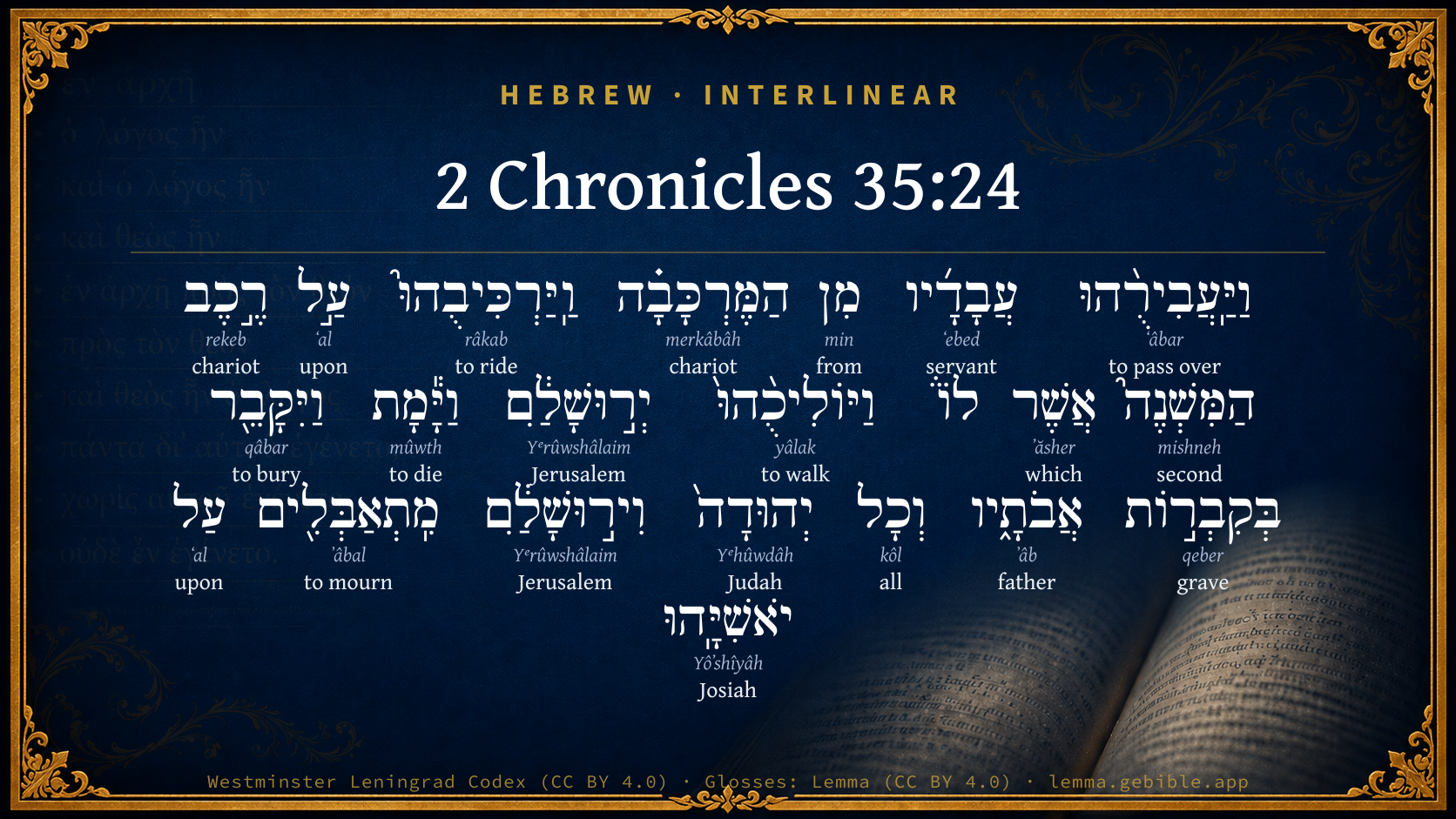
Hebrew (Westminster Leningrad Codex) 2 Chronicles 35:24 appears in the Hebrew Old Testament. The text above is from the Westminster Leningrad Codex. Each word links to its Strong’s number, a concise gloss, and parsing drawn from the Open Scriptures Hebrew Bible morphology. Click any word for its full Brown-Driver-Briggs (BDB) entry.
Download image
Cite this verse

2 Chronicles 35:24 (World English Bible). Public Domain. Lemma interlinear Bible study tool, https://lemma.gebible.app/v/2-chronicles/35/24.

Show BibTeX & RIS
BibTeX
RIS
English Translation
So his servants took him out of the chariot, and put him in the second chariot that he had, and brought him to Jerusalem; and he died, and was buried in the tombs of his fathers. All Judah and Jerusalem mourned for Josiah.
World English Bible · Public Domain
Download a study sheet

One document with this verse’s original text, its word-by-word gloss line, the meaning frame, cross-references with their text, attributed commentary, and full source and license credits — printable, and it pastes into notes with its structure intact.

This verse Autodidact and up

Study sheet (.html) Plain text (.txt)

A passage Seminary Student

Up to 50 verses in one chapter. A passage sheet keeps up to 6 commentary sources and 12 cross-references per verse, in the order this page ranks them, and says so on the sheet whenever that leaves anything out. Ask for a single verse and you get the Autodidact verse sheet above.

Everything on this page stays free to read, with no account — the sheet is a download of what is already on screen, not access to it.

Want to remove ads? Support Godless Engineer
Compare translations 3

The same verse in 3 English versions, stacked beneath the original-language interlinear above. Click any original word for its lexicon entry.

Each is an independent rendering of the whole verse — the interlinear is not word-aligned to these translations.

Highlighted words mark where these versions differ — a whole-verse word diff, not a word-by-word alignment.

  • World English Bible Public Domain
    So his servants took him out of the chariot, and put him in the second chariot that he had, and brought him to Jerusalem; and he died, and was buried in the tombs of his fathers. All Judah and Jerusalem mourned for Josiah.
  • King James Version Public Domain
    His servants therefore took him out of that chariot, and put him in the second chariot that he had; and they brought him to Jerusalem, and he died, and was buried in one of the sepulchres of his fathers. And all Judah and Jerusalem mourned for Josiah.
  • unfoldingWord Literal Text CC BY-SA 4.0
    And his servants carried him away from the chariot, and they made him ride on the second chariot which belonged to him. And they brought him to Jerusalem. And he died, and he was buried in the graves of his fathers. And all Judah and Jerusalem were mourning on account of Josiah.

unfoldingWord Literal Text — © unfoldingWord, licensed CC BY-SA 4.0. Word-aligned USFM3 via Door43 (git.door43.org/unfoldingWord/en_ult).

Versions to compare (up to 4)

3 of 4 selected

Show all 18 translations

Every available English version of this verse, each an independent rendering of the whole verse.

  • World English Bible Public Domain
    So his servants took him out of the chariot, and put him in the second chariot that he had, and brought him to Jerusalem; and he died, and was buried in the tombs of his fathers. All Judah and Jerusalem mourned for Josiah.
  • Berean Standard Bible Public Domain
    So his servants took him out of his chariot, put him in his second chariot, and brought him to Jerusalem, where he died. And Josiah was buried in the tomb of his fathers, and all Judah and Jerusalem mourned for him.
  • Majority Standard Bible Public Domain
    So his servants took him out of his chariot, put him in his second chariot, and brought him to Jerusalem, where he died. And Josiah was buried in the tomb of his fathers, and all Judah and Jerusalem mourned for him.
  • King James Version Public Domain
    His servants therefore took him out of that chariot, and put him in the second chariot that he had; and they brought him to Jerusalem, and he died, and was buried in one of the sepulchres of his fathers. And all Judah and Jerusalem mourned for Josiah.
  • American Standard Version (1901) Public Domain
    So his servants took him out of the chariot, and put him in the second chariot that he had, and brought him to Jerusalem; and he died, and was buried in the sepulchres of his fathers. And all Judah and Jerusalem mourned for Josiah.
  • Revised Version (1885) Public Domain
    So his servants took him out of the chariot, and put him in the second chariot that he had, and brought him to Jerusalem; and he died, and was buried in the sepulchres of his fathers. And all Judah and Jerusalem mourned for Josiah.
  • Geneva Bible (1599) Public Domain
    So his seruants tooke him out of that charet, and put him in the seconde charet which he had, and when they had brought him to Ierusalem, he dyed, and was buryed in the sepulchres of his fathers: and all Iudah and Ierusalem mourned for Iosiah.
  • Douay-Rheims (1899) Public Domain
    And they removed him from the chariot into another, that followed him after the manner of kings, and they carried him away to Jerusalem, and he died, and was buried in the monument of his fathers, and all Juda and Jerusalem mourned for him,
  • Young's Literal Translation Public Domain
    And his servants remove him from the chariot, and cause him to ride on the second chariot that he hath, and cause him to go to Jerusalem, and he dieth, and is buried in the graves of his fathers, and all Judah and Jerusalem are mourning for Josiah,
  • Literal Standard Version CC BY-SA 4.0
    And his servants remove him from the chariot, and cause him to ride on the second chariot that he has, and cause him to go to Jerusalem, and he dies, and is buried in the graves of his fathers, and all Judah and Jerusalem are mourning for Josiah,
  • Unlocked Literal Bible CC BY-SA 4.0
    So his servants took him out of the chariot, and put him in his extra chariot. They took him to Jerusalem, where he died. He was buried in the tombs of his ancestors. All Judah and Jerusalem mourned for Josiah.
  • unfoldingWord Literal Text CC BY-SA 4.0
    And his servants carried him away from the chariot, and they made him ride on the second chariot which belonged to him. And they brought him to Jerusalem. And he died, and he was buried in the graves of his fathers. And all Judah and Jerusalem were mourning on account of Josiah.
  • Darby Bible Public Domain
    And his servants took him out from the chariot, and put him in the second chariot that he had, and brought him to Jerusalem. And he died, and was buried in the sepulchres of his fathers. And all Judah and Jerusalem mourned for Josiah.
  • World Messianic Bible Public Domain
    So his servants took him out of the chariot, and put him in the second chariot that he had, and brought him to Jerusalem; and he died, and was buried in the tombs of his fathers. All Judah and Jerusalem mourned for Josiah.
  • Webster's Bible Public Domain
    His servants therefore took him out of that chariot, and put him in the second chariot that he had; and they brought him to Jerusalem, and he died, and was buried in one of the sepulchers of his fathers. And all Judah and Jerusalem mourned for Josiah.
  • Free Bible Version CC BY-SA 4.0
    So they carried him out of his chariot, and took him back in his second chariot to Jerusalem, where he died. Josiah was buried in the tomb of his forefathers. All Judah and Jerusalem wept for him.
  • Bible in Basic English Public Domain
    So his servants took him out of the line of war-carriages, and put him in his second carriage and took him to Jerusalem, where he came to his end, and they put his body in the resting-place of his fathers. And in all Judah and Jerusalem there was great weeping for Josiah.
  • JPS Tanakh (1917) Public Domain
    So his servants took him out of the chariot, and put him in the second chariot that he had, and brought him to Jerusalem; and he died, and was buried in the sepulchres of his fathers. And all Judah and Jerusalem mourned for Josiah.

Literal Standard Version (2020), Covenant Press — licensed CC BY-SA 4.0. Text via the HelloAO Bible API (eBible.org). Unlocked Literal Bible (unfoldingWord) — licensed CC BY-SA 4.0. Text via the HelloAO Bible API (eBible.org). unfoldingWord Literal Text — © unfoldingWord, licensed CC BY-SA 4.0. Word-aligned USFM3 via Door43 (git.door43.org/unfoldingWord/en_ult). Free Bible Version, Dr. Jonathan Gallagher — licensed CC BY-SA 4.0. Text via the HelloAO Bible API (eBible.org).

Word by word

More ways to search: Search by grammar → Find every occurrence → Compare this word →

Practice this passage: Drill this verse → Learn its vocabulary →

הַמִּשְׁנֶה֮
mishneh
H4932
“the · second”
Particle, Definite Article + Noun, Common, Masculine, Singular, Absolute
Part of Speech
Particle + Noun
Type
Common
Gender
Masculine
Number
Singular
State
Absolute
Full BDB Definition

Origin: from H8138

TWOT: 2421c

double, copy, second, repetition - double - copy (of law) - second (in order) - second rank - second in age - second quarter or district
  1. וַיַּֽעֲבִירֻ֨הוּ ʻâbar H5674 “and · to pass over · him” Conjunction + Verb, Hiphil, Sequential Imperfect, 3rd Person, Masculine, Plural + Suffix, Personal, 3rd Person, Masculine, Singular
  2. עֲבָדָ֜יו ʻebed H5650 “servants · his” Noun, Common, Masculine, Plural, Construct + Suffix, Personal, 3rd Person, Masculine, Singular
  3. מִן min H4480 “from” Preposition
  4. הַמֶּרְכָּבָ֗ה merkâbâh H4818 “the · chariot” Particle, Definite Article + Noun, Common, Feminine, Singular, Absolute
  5. וַֽיַּרְכִּיבֻהוּ֮ râkab H7392 “and · to ride · him” Conjunction + Verb, Hiphil, Sequential Imperfect, 3rd Person, Masculine, Plural + Suffix, Personal, 3rd Person, Masculine, Singular
  6. עַ֣ל ʻal H5921 “upon” Preposition
  7. רֶ֣כֶב rekeb H7393 “chariot of” Noun, Common, Masculine, Singular, Construct
  8. אֲשֶׁר ʼăsher H834 “which” Particle, Relative
  9. וַיּוֹלִיכֻ֨הוּ֙ yâlak H3212 “and · to walk · him” Conjunction + Verb, Hiphil, Sequential Imperfect, 3rd Person, Masculine, Plural + Suffix, Personal, 3rd Person, Masculine, Singular
  10. יְר֣וּשָׁלִַ֔ם Yᵉrûwshâlaim H3389 “Jerusalem” Noun, Proper
  11. וַיָּ֕מָת mûwth H4191 “and · to die” Conjunction + Verb, Qal, Sequential Imperfect, 3rd Person, Masculine, Singular
  12. וַיִּקָּבֵ֖ר qâbar H6912 “and · to bury” Conjunction + Verb, Niphal, Sequential Imperfect, 3rd Person, Masculine, Singular
  13. בְּקִבְר֣וֹת qeber H6913 “in/at · graves of” Preposition + Noun, Common, Masculine, Plural, Construct
  14. אֲבֹתָ֑יו ʼâb H1 “fathers · his” Noun, Common, Masculine, Plural, Construct + Suffix, Personal, 3rd Person, Masculine, Singular
  15. וְכָל kôl H3605 “and · all of” Conjunction + Noun, Common, Masculine, Singular, Construct
  16. יְהוּדָה֙ Yᵉhûwdâh H3063 “Judah” Noun, Proper
  17. וִיר֣וּשָׁלִַ֔ם Yᵉrûwshâlaim H3389 “and · Jerusalem” Conjunction + Noun, Proper
  18. מִֽתְאַבְּלִ֖ים ʼâbal H56 “mourning” Verb, Hithpael, Participle Active, Masculine, Plural, Absolute
  19. עַל ʻal H5921 “upon” Preposition
  20. יֹאשִׁיָּֽהוּ Yôʼshîyâh H2977 “Josiah” Noun, Proper

About this verse

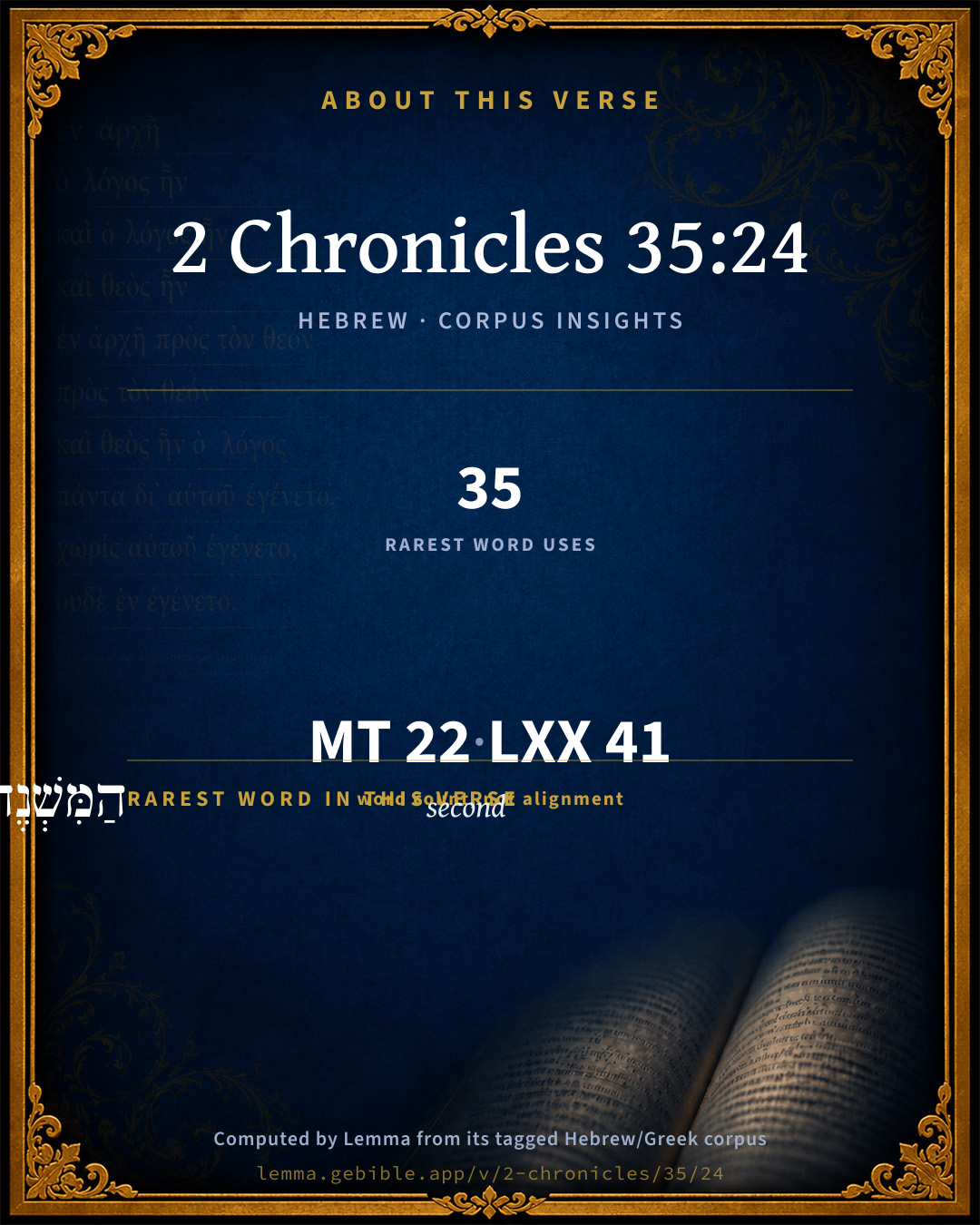
These counts appear in no published source. They are computed here, from the morphology-tagged text and Lemma’s own curated glosses. What Lemma adds →

22
words
19
distinct lemmas
Historical
section

Shared distinctive vocabulary

הַמִּשְׁנֶה֮ second H4932 occurs in 34 verses of the Hebrew Bible. Also found in:

Grammatical profile

  • 6 verbs
  • 11 nouns
  • 4 prepositions
  • 1 particle

Verb forms

  • וַיַּֽעֲבִירֻ֨הוּ Hiphil · Sequential Imperfect
  • וַֽיַּרְכִּיבֻהוּ֮ Hiphil · Sequential Imperfect
  • וַיּוֹלִיכֻ֨הוּ֙ Hiphil · Sequential Imperfect
  • וַיָּ֕מָת Qal · Sequential Imperfect
  • וַיִּקָּבֵ֖ר Niphal · Sequential Imperfect
  • מִֽתְאַבְּלִ֖ים Hithpael · Participle Active

Repetition

Words recur within this verse — often emphatic in Hebrew:

  • עַ֣ל upon H5921 ×2
  • יְר֣וּשָׁלִַ֔ם Jerusalem H3389 ×2

Hebrew & Septuagint length

In English translation the verse runs 43 words from the Hebrew and 41 from the Septuagint (LXX English) — closely comparable.

A rough comparison of the two English renderings, which tokenize alike — not a word-level alignment.

Word counts can differ between the Hebrew and the Greek without any difference in meaning — e.g. the Hebrew direct-object marker אֵת has no separate Greek word, and Greek often adds the article ὁ.

In the original languages it is 22 Hebrew tokens and 41 Greek tokens — but the two are counted differently (Hebrew bundles its prefixes and suffixes into one token; the Greek is in lemma form), so that isn’t a like-for-like length.

Cross-references

7

Topical passages linked to 2 Chronicles 35:24 in the Treasury of Scripture Knowledge — connected by theme and wording, ordered by reader-vote popularity; previews shown in the World English Bible.

  • Zechariah 12:11 In that day there will be a great mourning in Jerusalem, like the mourning of Hadadrimmon in the valley of Megiddon.
  • 2 Kings 23:30 His servants carried him in a chariot dead from Megiddo, and brought him to Jerusalem, and buried him in his own tomb. The people of the land took Jehoahaz the son of Josiah, and anointed him, and made him king in his father's place.
  • 2 Chronicles 34:28 Behold, I will gather you to your fathers, and you shall be gathered to your grave in peace, neither shall your eyes see all the evil that I will bring on this place, and on the inhabitants of it. They brought back word to the king.
  • Psalms 36:6 Your righteousness is like the mountains of God. Your judgments are like a great deep. Yahweh, you preserve man and animal.
  • Ecclesiastes 8:14 There is a vanity which is done on the earth, that there are righteous men to whom it happens according to the work of the wicked. Again, there are wicked men to whom it happens according to the work of the righteous. I said that this also is vanity.
  • Ecclesiastes 9:1–2 For all this I laid to my heart, even to explore all this: that the righteous, and the wise, and their works, are in the hand of God; whether it is love or hatred, man doesn't know it; all is before them.
  • Genesis 41:43 and he made him to ride in the second chariot which he had. They cried before him, "Bow the knee!" He set him over all the land of Egypt.

Cross-references courtesy of OpenBible.info (CC BY 4.0).

Hebrew and Greek witnesses Masoretic Hebrew ↔ Greek Septuagint

The same verse in the two great witnesses to the Old Testament, shown verse-for-verse.

These are two independent witnesses, not word-aligned to each other, and the Septuagint is shown in lemma (dictionary) form.

Hebrew 2 Chronicles 35:24 Masoretic · Westminster Leningrad Codex

וַיַּֽעֲבִירֻ֨הוּ עֲבָדָ֜יו מִן הַמֶּרְכָּבָ֗ה וַֽיַּרְכִּיבֻהוּ֮ עַ֣ל רֶ֣כֶב הַמִּשְׁנֶה֮ אֲשֶׁר לוֹ֒ וַיּוֹלִיכֻ֨הוּ֙ יְר֣וּשָׁלִַ֔ם וַיָּ֕מָת וַיִּקָּבֵ֖ר בְּקִבְר֣וֹת אֲבֹתָ֑יו וְכָל יְהוּדָה֙ וִיר֣וּשָׁלִַ֔ם מִֽתְאַבְּלִ֖ים עַל יֹאשִׁיָּֽהוּ

So his servants took him out of the chariot, and put him in the second chariot that he had, and brought him to Jerusalem; and he died, and was buried in the tombs of his fathers. All Judah and Jerusalem mourned for Josiah.

World English Bible · Public Domain

Greek LXX 2 Chronicles 35:24 Septuagint · lemma form

καί ἐκἄγω αὐτός ὁ παῖς αὐτός ἀπό ὁ ἅρμα καί ἀναβιβάζω αὐτός ἐπί ὁ ἅρμα ὁ δευτερεύω ὅς εἰμί αὐτός καί ἄγω αὐτός εἰς ἰερουσαλήμ καί ἀποθνήσκω καί θάπτω μετά ὁ πατήρ αὐτός καί πᾶς ἰουδά καί ἰερουσαλήμ πενθέω ἐπί ιωσίας

And his servants lifted him out of the chariot, and put him in the second chariot which he had, and brought him to Jerusalem; and he died, and was buried with his fathers: and all Juda and Jerusalem lamented over Josias.

LXX2012 (modern English Septuagint) · Public Domain

Hebrew: Westminster Leningrad Codex (CC BY 4.0). Greek: Septuagint (public domain); English from LXX2012 (modern English Septuagint) (Public Domain). How the Septuagint differs from the Hebrew →

Commentary

Notes on 2 Chronicles 35:24 from classic Christian and Jewish commentators (each source and its license shown beneath its notes). The classic Christian expositions comment on the surrounding passage and are grouped to its opening verse, so a note may address several verses; the Jewish commentaries on the Tanakh (Rashi and others) are per-verse, so they appear only where the commentator wrote on this verse.

Lemma curates 59 commentaries, every one of them public domain or Creative Commons licensed, each selected and text-cleaned for this edition rather than reprinted as found. About our sources →

Trapp's Complete Commentary

John Trapp

2Ch 35:24 His servants therefore took him out of that chariot, and put him in the second chariot that he had; and they brought him to Jerusalem, and he died, and was buried in [one of] the sepulchres of his fathers. And all Judah and Jerusalem mourned for Josiah.

Ver. 24. His servants therefore took him.] They forsook him not in his extremity, and last agony; as our Edward III’s servants did him; all but one poor priest, who called upon him, now dying, to remember his Saviour and to ask mercy for his offences: whereupon he showed all signs of contrition, and at his last breath expressed the name of Jesus. {a}

And they brought him to Jerusalem, and he died.] See 2Ki 23:30. He repented at his death, no doubt, of his rashness. As did also Curiensis, a godly Dutch divine, who held it unlawful to forbear to visit the infected with the pestilence; but when this good pastor, being too venturous, had got the plague, and was nigh to death, he cried out, O utinam Zanchii consilium secutus essem! O that I had taken Zanchius my colleague’s counsel, which was to forbear visiting such as were so visited!

And all Judah and Jerusalem mourned for Josiah.] As great cause they had; greater than the Thebans had for their Epaminondas, or the Romans for their Augustus. Who when he died, we feared, saith Paterculus, that all would have been nought with us. And did not our fathers fear the like when that peerless Queen Elizabeth died? When Louis XII left the world, such a turn of things fell out in France, saith Budaeus, that he who erst seemed to touch heaven with his finger, now lay grovelling on the ground, as if he had been thunderstruck. Think the same of this sad state, all whose happiness died with their good king Josiah.

{a} Dan. Hist., 260.

John Trapp, A Commentary or Exposition upon All the Books of the Old and New Testament (1647–1656) — public domain. Text from a community e-Sword module.

The Biblical Illustrator

Joseph S. Exell

2Ch_35:24-25

His servants therefore took him out of that chariot.

The lamentation for Josiah

I. The nature and quality of the lamentation.

1. Extensively. All Judah and Jerusalem.

2. Intensively. Bitter lamentation.

3. Protensively. Of long duration, an ordinance in Israel.

II. The cause and ground of it. The loss of a good leader whose life had been useful.

III. Doctrine. That faithful, active, and public-spirited men in the Church of God should not be laid in their graves without great lamentations. In replication I will show--

1. Negatively. On what account the death of good men is not to be lamented.

2. Positively. The true grounds and causes of such lamentation.

(1) Because so much of the Spirit of God as dwelt in them, when amongst us, is now recalled and gathered up from this lower world. As it is a real loss to a company when any merchant withdraws a great stock he had running in trade, out of the bank; so certainly it is a great loss to the Church of God, when the precious gifts and graces of the Spirit, dwelling in the saints, are drawn out by death.

(2) Because thereby a breach is made to let in the judgments of God upon the remnant that is left.

(3) The beauty and ornaments of the places they lived in are defaced and removed by their death.

(4) Because the propagation of religion is obstructed in the places from whence they are removed.

(5) The consideration of the time in which good men die aggravates the loss, if it falls out,--

(a) In a declining state of religion.

(b) When the numbers of the godly are thinned and lessened.

(c) When the spring and succession of good men is obstructed.

(6) When we consider what influence our sins and provocations have had upon those judgments and calamities. I look upon every good man, as a good book, lent by its owners for another to read, and transcribe the excellent notions and golden passages that are in it for his own benefit, that they may return with him when the owner shall call for his book again. But in case this excellent book shall be thrown into a corner, and no use made of it, it justly provokes the owner to take it away in displeasure.

Application. This reproves--

1. The worst of men, such as secretly rejoice at the removal of such men.

2. The insensibleness of good men, who are apt too slightly to pass over such tremendous strokes of. God (Isa_57:1).

3. The very best of men, who though they do bewail and lament the loss of such men, yet they do not lament it in the due manner. (John Flavel.)

The death and burial of Josiah

1. That the best of men may err in judgment and in act.

2. The danger of undertaking any work without asking counsel of the Lord.

3. How universal is the reign of death.

4. That we should be cautious how we attribute sudden and violent death to the vengeance of the Most High.

5. That it is not wrong to mourn for the dead. (J. S. Wilkins, B.A.)

The death of Josiah

I. What the people of God did upon the death of Josiah.

1. There was a general mourning for him.

2. The prophet Jeremiah made a particular office for it.

3. This office was used among others upon the day of lamentation.

4. This use was established by a law upon Israel, which was observed till the end of the Babylonian Captivity.

II. The reasons of their doing it.

1. Because it was caused by their sins.

2. Because it was a punishment for their sins. (Bishop W. Lloyd.)

A nations tears

Why does the Jewish nation now weep over Josiah? The reasons are:

I. The great national loss which the event involved. Josiah was a prince--

1. Of a reflective nature. His mind was in the quest of the highest truth.

2. Of a tender spirit.

3. Of reformative disposition.

II. The sad memory of the moral cause of the calamity.

III. The terribly distressing mystery associated with the dispensation. Josiah was the most useful man of his age; yet he dies at thirty-nine. Mystery though it be, it teaches us--

1. That Heavens government is no respecter of persons.

2. The irresistibility of death.

3. That there is nothing on this fleeting earth on which we should set our hearts.

4. That there must be an after life. (Homilist.)

.

The Biblical Illustrator, edited by Joseph S. Exell (c. 1880s–1900s) — public domain. Text from a community e-Sword module.

Joseph Benson's Commentary

2Ch 35:24. And put him in the second chariot — It was the custom of war, in former times, for great officers to have led horses with them in battle, that if one failed they might mount another. And, in like manner, we may presume, that when it became a fashion to fight in chariots, all great commanders had an empty one following them, to which they might betake themselves, if any mischief befell the other. They brought him to Jerusalem, and he died — Bishop Sherlock observes, that Josiah had so good a character in Scripture, that both Jews and Christians have been at a loss to account for his unfortunate end. The learned Dr. Prideaux endeavours to justify his conduct in opposing the passage of the king of Egypt, because it was a service due to the king of Assyria, to whom Josiah was a vassal. “Be it so,” says Dr. Dodd, “yet his duty to the king of Assyria could not dissolve his dependance on a higher Master. He went to war as vassal of the king of Assyria, but did he ask counsel of God as king of Judah? Or was he attended to the war with such forces only as the kings of Judah might lawfully use? That he had chariots and horsemen, appears plainly from this account of his death. That this was the true or only cause of his misfortune, I dare not affirm; for I have no express authority to support me in affirming it: but this I see, that he was found in the day of battle, not with the equipage of a king of Judah, but surrounded with forces which the law of his God had forbidden him to trust to, and which had often proved a strength fatal to his ancestors.” See Bishop Sherlock’s Dissertation on the Use and Intent of Prophecy, at the end.

Joseph Benson's Commentary on the Old and New Testaments (1811–1818) — public domain. Text from a community e-Sword module.

Geneva Bible (1599)

Geneva Bible translators

The people so much lamented the loss of this good king, that after when there was any great lamentation this was spoken of as a proverb, read Zech. 12:11.

Geneva Bible (1599) marginal notes — public domain. Text via Bolls.life.

Jamieson, Fausset & Brown

Robert Jamieson, A. R. Fausset & David Brown

took him out of that chariot, and put him in the second chariot--the carriage he had for ordinary use, and which would be more comfortable for the royal sufferer than the war chariot. The death of this good king was the subject of universal and lasting regret.

Jamieson, Fausset & Brown — Commentary Critical and Explanatory on the Whole Bible (1871) — public domain (CC PDM 1.0). Text via the HelloAO Bible API.

Adam Clarke's Commentary

Verse 24. The second chariot] Perhaps this means no more than that they took Josiah out of his own chariot and put him into another, either for secrecy, or because his own had been disabled. The chariot into which he was put might have been that of the officer or aid-de-camp who attended his master to the war. 2Kg 22:20.

Adam Clarke's Commentary on the Bible (1810–1826) — public domain. Text from a community e-Sword/MySword module.

Ellicott's Commentary for English Readers

(24) That chariot.—The (war) chariot.

Put him.—Made him ride.

Brought him to Jerusalem, and he died.—2Ki_23:30 says: “And his servants made him ride dead (or dying) from Megiddo.’ Even if it be not permissible to render mêth “dying,” we cannot agree with the suggestion of Thenius that the account of Chronicles is simply an arbitrary alteration of the older narrative for the sake of literary effect. The divergence proves that the chronicler had special sources of information at his command.

The second chariot was no doubt a more comfortable one, reserved in case of such an emergency.

In one of the sepulchres.—Omit one of. Kings, “in his own sepulchre,” which would be a chamber among those of his immediate ancestors, Manasseh and Amon. (See 2Ki_21:18.)

Mourned.—Were mourning.

A Bible Commentary for English Readers, edited by Charles John Ellicott (1878–1897) — public domain. Text from a community e-Sword module.

The Cambridge Bible for Schools and Colleges

gen. ed. J. J. S. Perowne

24. His servants therefore took him out of that chariot] R.V. So his servants took him out of the chariot.

the second chariot] War chariots were small, with (apparently) only standing room for their occupants; see the illustrations of Egyptian and Assyrian chariots given in Smith’s Bib. Dict. s.v. This “second chariot” was probably of a larger kind, suitable for travelling.

in one of the sepulchres] R.V. in the sepulchres.

The Cambridge Bible for Schools and Colleges (gen. ed. J. J. S. Perowne; Cambridge University Press, 1878–1918) — public domain. Text from a community e-Sword module.

John Gill's Exposition

And Jeremiah lamented for Josiah,.... Composed a lamentation for him, which is now lost; for what is said in Lam 4:20 respects Zedekiah, and not Josiah:

and all the singing men, and all the singing women, spake of Josiah in their lamentations unto this day; who were made use of on mournful occasions, as the "preficae" among the Romans, see Jer 9:17 these in their mournful ditties used to make mention of his name, and the disaster that befell him:

and made them an ordinance in Israel; an annual constitution, as the Targum calls it, appointing a solemn mourning for him once a year, which Jarchi says was on the ninth of Ab or July:

and, behold, they are written in the lamentations; not of Jeremiah; though the Targum is,

"lo, they are written in the book which Baruch wrote from the mouth of Jeremiah, concerning the lamentations,''but respect a collection of lamentations on various subjects then in being, but since lost.

John Gill's Exposition of the Whole Bible (1746–1763) — public domain (CC PDM 1.0). Text via the HelloAO Bible API.

Albert Barnes' Notes on the Bible

The fate of Josiah was unprecedented. No king of Judah had, up to this time, fallen in battle. None had left his land at the mercy of a foreign conqueror. Hence, the extraordinary character of the mourning (compare Zec 12:11-14).

Albert Barnes' Notes on the Bible (1834–1885) — public domain. Text from a community e-Sword/MySword module.

Haydock's Catholic Bible Commentary

After the manner of kings, is not in Hebrew, &c. H. --- Curtius (iv.) informs us, that the Persian monarch had always a horse behind his chariot, to be ready in case of any accident.

George Leo Haydock (1774–1849), Haydock's Catholic Family Bible and Commentary, 1859 edition — public domain. Excludes Psalms (Douay-Rheims chapter numbering differs from Protestant) and Deuterocanonical books (Catholic canon only).

The Pulpit Commentary

And he died. If the form of words used in the parallel, 2Ki_23:30, be followed, Josiah was dead before they reached Jerusalem. And all mourned for Josiah. We still find no note whatever of blame attributed to Josiah, and the general mourning (Zec_12:11) appears to have been most genuine.

Vers. 24, 25.

An early sunset.

That very good men may make very great mistakes we hardly need to be told; unfortunately, we have all too many illustrations of that fact. The text provides us with a very melancholy instance. What had Josiah to do with this contest between the kings of Egypt and Assyria? Was his heart, too, "lifted up," that he thought himself and his people more than a match for the disciplined hosts of Egypt? Had he been attacked, and had he cast himself on God as Hezekiah did when Sennacherib appeared against him, then he might have hoped confidently for victory. But to contest with a great world-power on worldly principles was a supreme and a fatal error. He paid the penalty of his folly with his life. His sun went down while it was yet day." So passed, needlessly and unfortunately, one of the best and boldest spirits that occupied the throne of Judah. Regarding his death as that of one early removed from the scenes of earthly activity, we are naturally affected by

I ITS EXTREME SADNESS. We are not surprised to read of so demonstrative and so fervent-natured a people as the Jews were, that "all Judah and Jerusalem mourned for Josiah;" nor that Jeremiah uttered his prophet"s plaint concerning him. It was a time for profound sorrow; and even passionate grief might, under such circumstances, be excused. For the nation had not merely lost its chief; it had lost an invaluable leader, a king who was leading in the paths of righteousness and therefore of prosperity. There must come occasions to the country, to the Church, to the city, to the family, when one man"s death will be felt to be a calamity. Very wise is that community, sacred or secular, national or domestic, that recognizes this fact and provides against it; that secures such resources, material or spiritual, that when such a blow comes everything will not be lost; that when its best is taken it has still much in reserve; that it is not dependent for the maintenance of its liberty, or its security, or its vigorous existence on anything so precarious as one human being"s life.

II ITS RIGHTEOUSNESS. Why did God not interpose to prevent Josiah from throwing his life away? Why did he let darkness come down at noon, and put an end to this bright and useful day? Why does he not now intervene between us and the death we speak of as premature? Why does he permit the young statesmen to overtax his strength and die in his prime; the young minister to commit himself to the treacherous tide and be drowned in the very fulness of his powers and the midst of his usefulness; the young missionary to expose his life to the savages who pierce him with the poisoned spear? We ask such questions, wondering, if not complaining, at the Divine inaction. But we might very justly and more properly ask ourselves another question What right have we to expect that God will give to any man a particular term of earthly life that we may choose for him? Has he promised to confer any one length of days on his servants? Is not the gift of every added day a prolongation of his goodness and his mercy? Ought we not, rather than complain, to bless him for the number of years he does bestow a number which is greater than our deserving? Would it be really wise or kind of our heavenly Father if he were always interposing to prevent us from suffering the natural consequences of our error or our negligence, because we were right at heart with him? Would that be the way to discipline, to purify, to perfect his children? No! when God lets death

Descend in sudden night On manhood"s middle day,

he is not unrighteous, nor is he really unwise or unkind. Get down far enough, and we stand on the rock of righteousness and wisdom and love. We may look at

III ALLEVIATING ASPECTS OF IT. No doubt, when Josiah found that he was "sore wounded," and that he could not recover, he would grieve more or less, as Hezekiah did. But as he confronted death he would become reconciled to the will of God, and he would, probably, have some hope concerning himself for the future, and would entrust his country to the care of God. But we have a much larger measure of alleviation than Josiah had. For there has visited us and spoken to us that Divine One who is the Resurrection and the Life indeed. And in the light of his revealing truth, and in the hope of his gracious promise, we look upon death as introducing us into another part of the kingdom of God another and a better; a sphere from which sin is shut out; and not only sin, but weariness and disappointment and sorrow; a sphere that will be ever brightening and broadening as added years reveal in us and to us "enlarged and liberated powers. C.

The Pulpit Commentary (1880–1919), ed. H.D.M. Spence-Jones & Joseph S. Exell — public domain. Text from a community e-Sword module.

Rashi

Rabbi Shlomo Yitzchaki (Rashi)

into his second chariot for it was customary for the king to ride on two chariots; he rode mainly on the first, but if necessary, he would ride on the second. The first one went before them, and when he was stricken, they put him into the second chariot.

Rashi on the Tanakh — English translations: “The Judaica Press complete Tanach with Rashi, translated by A. J. Rosenberg” (CC BY 4.0); “Pentateuch with Rashi's commentary by M. Rosenbaum and A.M. Silbermann, 1929-1934” (public domain); “The Metsudah Tanach series, Lakewood, N.J” (CC BY 4.0); and “The Book of Joshua, Metsudah Publications, 1997” (CC BY 4.0). Text via Sefaria.

Lesson kit

Teaching starters — assembled from the data on this page, not authored interpretation. Every prompt links to the verse data it draws on. Edit before teaching.

2 Chronicles, in the Historical, opens this verse with 22 words (19 distinct Hebrew lemmas). Its most distinctive word is mishneh (“second”). A historical commentator’s framing appears above. Read the whole chapter for the surrounding context.

Discussion questions

  1. The word mishneh carries the sense “second.” How does it shape the verse?
  2. Genesis 41:43 shares the word «second» with this verse. How do the two illuminate each other?
  3. “upon” occurs 2× in this one verse. What is the effect of the repetition?
  4. These translations render this verse differently; the difference is in the English rendering, not the original. What questions does that raise?
  5. The verb «וַיַּֽעֲבִירֻ֨הוּ» is Hiphil Sequential Imperfect. How does its form color the action?
  6. Reading how Trapp's Complete Commentary and The Biblical Illustrator read this verse, where do the two commentators agree and where do they part?

Things to notice

Reading settings

Reading text

Shown beneath each verse's original-language words.

Old Testament
Old Testament edition

Read the OT as the Masoretic Hebrew (MT) or the Greek Septuagint (LXX).

English shown for the Greek Septuagint (in the Hebrew ↔ Greek comparison).

Comparing translations? Open the Compare panel on any verse page to stack up to four side by side.