
2 Chronicles 34:3

Hebrew (Westminster Leningrad Codex) 2 Chronicles 34:3 appears in the Hebrew Old Testament. The text above is from the Westminster Leningrad Codex. Each word links to its Strong’s number, a concise gloss, and parsing drawn from the Open Scriptures Hebrew Bible morphology. Click any word for its full Brown-Driver-Briggs (BDB) entry.
Download image
Cite this verse

2 Chronicles 34:3 (World English Bible). Public Domain. Lemma interlinear Bible study tool, https://lemma.gebible.app/v/2-chronicles/34/3.

Show BibTeX & RIS
BibTeX
RIS
English Translation
For in the eighth year of his reign, while he was yet young, he began to seek after the God of David his father; and in the twelfth year he began to purge Judah and Jerusalem from the high places, and the Asherim, and the engraved images, and the molten images.
World English Bible · Public Domain
Download a study sheet

One document with this verse’s original text, its word-by-word gloss line, the meaning frame, cross-references with their text, attributed commentary, and full source and license credits — printable, and it pastes into notes with its structure intact.

This verse Autodidact and up

Study sheet (.html) Plain text (.txt)

A passage Seminary Student

Up to 50 verses in one chapter. A passage sheet keeps up to 6 commentary sources and 12 cross-references per verse, in the order this page ranks them, and says so on the sheet whenever that leaves anything out. Ask for a single verse and you get the Autodidact verse sheet above.

Everything on this page stays free to read, with no account — the sheet is a download of what is already on screen, not access to it.

Want to remove ads? Support Godless Engineer
Compare translations 3

The same verse in 3 English versions, stacked beneath the original-language interlinear above. Click any original word for its lexicon entry.

Each is an independent rendering of the whole verse — the interlinear is not word-aligned to these translations.

Highlighted words mark where these versions differ — a whole-verse word diff, not a word-by-word alignment.

  • World English Bible Public Domain
    For in the eighth year of his reign, while he was yet young, he began to seek after the God of David his father; and in the twelfth year he began to purge Judah and Jerusalem from the high places, and the Asherim, and the engraved images, and the molten images.
  • King James Version Public Domain
    For in the eighth year of his reign, while he was yet young, he began to seek after the God of David his father: and in the twelfth year he began to purge Judah and Jerusalem from the high places, and the groves, and the carved images, and the molten images.
  • unfoldingWord Literal Text CC BY-SA 4.0
    And in the eighth year of his reigning, and he was still a youth, he began to seek the God of David, his father. And in the 12th year, he began to cleanse Judah and Jerusalem from the high places, and the Asherim, and the idols, and the metal images.

unfoldingWord Literal Text — © unfoldingWord, licensed CC BY-SA 4.0. Word-aligned USFM3 via Door43 (git.door43.org/unfoldingWord/en_ult).

Versions to compare (up to 4)

3 of 4 selected

Show all 18 translations

Every available English version of this verse, each an independent rendering of the whole verse.

  • World English Bible Public Domain
    For in the eighth year of his reign, while he was yet young, he began to seek after the God of David his father; and in the twelfth year he began to purge Judah and Jerusalem from the high places, and the Asherim, and the engraved images, and the molten images.
  • Berean Standard Bible Public Domain
    In the eighth year of his reign, while he was still young, Josiah began to seek the God of his father David, and in the twelfth year he began to cleanse Judah and Jerusalem of the high places, the Asherah poles, the carved idols, and the cast images.
  • Majority Standard Bible Public Domain
    In the eighth year of his reign, while he was still young, Josiah began to seek the God of his father David, and in the twelfth year he began to cleanse Judah and Jerusalem of the high places, the Asherah poles, the carved idols, and the cast images.
  • King James Version Public Domain
    For in the eighth year of his reign, while he was yet young, he began to seek after the God of David his father: and in the twelfth year he began to purge Judah and Jerusalem from the high places, and the groves, and the carved images, and the molten images.
  • American Standard Version (1901) Public Domain
    For in the eighth year of his reign, while he was yet young, he began to seek after the God of David his father; and in the twelfth year he began to purge Judah and Jerusalem from the high places, and the Asherim, and the graven images, and the molten images.
  • Revised Version (1885) Public Domain
    For in the eighth year of his reign, while he was yet young, he began to seek after the God of David his father: and in the twelfth year he began to purge Judah and Jerusalem from the high places, and the Asherim, and the graven images, and the molten images.
  • Geneva Bible (1599) Public Domain
    And in the eight yeere of his reigne (when he was yet a childe) he began to seeke after the God of Dauid his father: and in the twelft yeere he began to purge Iudah, and Ierusalem from the hie places, and the groues, and the carued images, and molten images:
  • Douay-Rheims (1899) Public Domain
    And in the eighth year of his reign, when he was yet a boy, he began to seek the God of his father David: and in the twelfth year after he began to reign, he cleansed Juda and Jerusalem from the high places, and the groves, and the idols, and the graven things.
  • Young's Literal Translation Public Domain
    And in the eighth year of his reign (and he yet a youth), he hath begun to seek to the God of David his father, and in the twelfth year he hath begun to cleanse Judah and Jerusalem from the high places, and the shrines, and the graven images, and the molten images.
  • Literal Standard Version CC BY-SA 4.0
    And in the eighth year of his reign (and he [is] yet a youth), he has begun to seek for the God of his father David, and in the twelfth year he has begun to cleanse Judah and Jerusalem from the high places, and the Asherim, and the carved images, and the molten images.
  • Unlocked Literal Bible CC BY-SA 4.0
    For in the eighth year of his reign, while he was still young, he began to seek after the God of David, his ancestor. In the twelfth year, he began to cleanse Judah and Jerusalem from the high places, the Asherah poles, and the carved figures and the cast metal figures.
  • unfoldingWord Literal Text CC BY-SA 4.0
    And in the eighth year of his reigning, and he was still a youth, he began to seek the God of David, his father. And in the 12th year, he began to cleanse Judah and Jerusalem from the high places, and the Asherim, and the idols, and the metal images.
  • Darby Bible Public Domain
    And in the eighth year of his reign, while he was yet young, he began to seek after the God of David his father; and in the twelfth year he began to purge Judah and Jerusalem from the high places, and the Asherahs, and the graven images, and the molten images.
  • World Messianic Bible Public Domain
    For in the eighth year of his reign, while he was yet young, he began to seek after the God of David his father; and in the twelfth year he began to purge Judah and Jerusalem from the high places, the Asherah poles, the engraved images, and the molten images.
  • Webster's Bible Public Domain
    For in the eighth year of his reign, while he was yet young, he began to seek after the God of David his father: and in the twelfth year he began to purge Judah and Jerusalem from the high places, and the groves, and the carved images, and the molten images.
  • Free Bible Version CC BY-SA 4.0
    In the eighth year of his reign, while he was still young, Josiah began to publicly worship the God of David his forefather, and in the twelfth year of his reign he began to cleanse Judah and Jerusalem by removing the high places, the Asherah poles, the carved idols, and the metal images.
  • Bible in Basic English Public Domain
    In the eighth year of his rule, while he was still young, his heart was first turned to the God of his father David; and in the twelfth year he undertook the clearing away of all the high places and the pillars and the images of wood and metal from Judah and Jerusalem.
  • JPS Tanakh (1917) Public Domain
    For in the eighth year of his reign, while he was yet young, he began to seek after the God of David his father; and in the twelfth year he began to purge Judah and Jerusalem from the high places, and the Asherim, and the graven images, and the molten images.

Literal Standard Version (2020), Covenant Press — licensed CC BY-SA 4.0. Text via the HelloAO Bible API (eBible.org). Unlocked Literal Bible (unfoldingWord) — licensed CC BY-SA 4.0. Text via the HelloAO Bible API (eBible.org). unfoldingWord Literal Text — © unfoldingWord, licensed CC BY-SA 4.0. Word-aligned USFM3 via Door43 (git.door43.org/unfoldingWord/en_ult). Free Bible Version, Dr. Jonathan Gallagher — licensed CC BY-SA 4.0. Text via the HelloAO Bible API (eBible.org).

Word by word

More ways to search: Search by grammar → Find every occurrence → Compare this word →

Practice this passage: Drill this verse → Learn its vocabulary →

וְהַפְּסִלִ֖ים
pᵉçîyl
H6456
“and · the · idols”
Conjunction + Particle, Definite Article + Noun, Common, Masculine, Plural, Absolute
Part of Speech
Conjunction + Particle + Noun
Type
Common
Gender
Masculine
Number
Plural
State
Absolute
Full BDB Definition

Origin: from H6458

TWOT: 1788b

image, idol, graven image
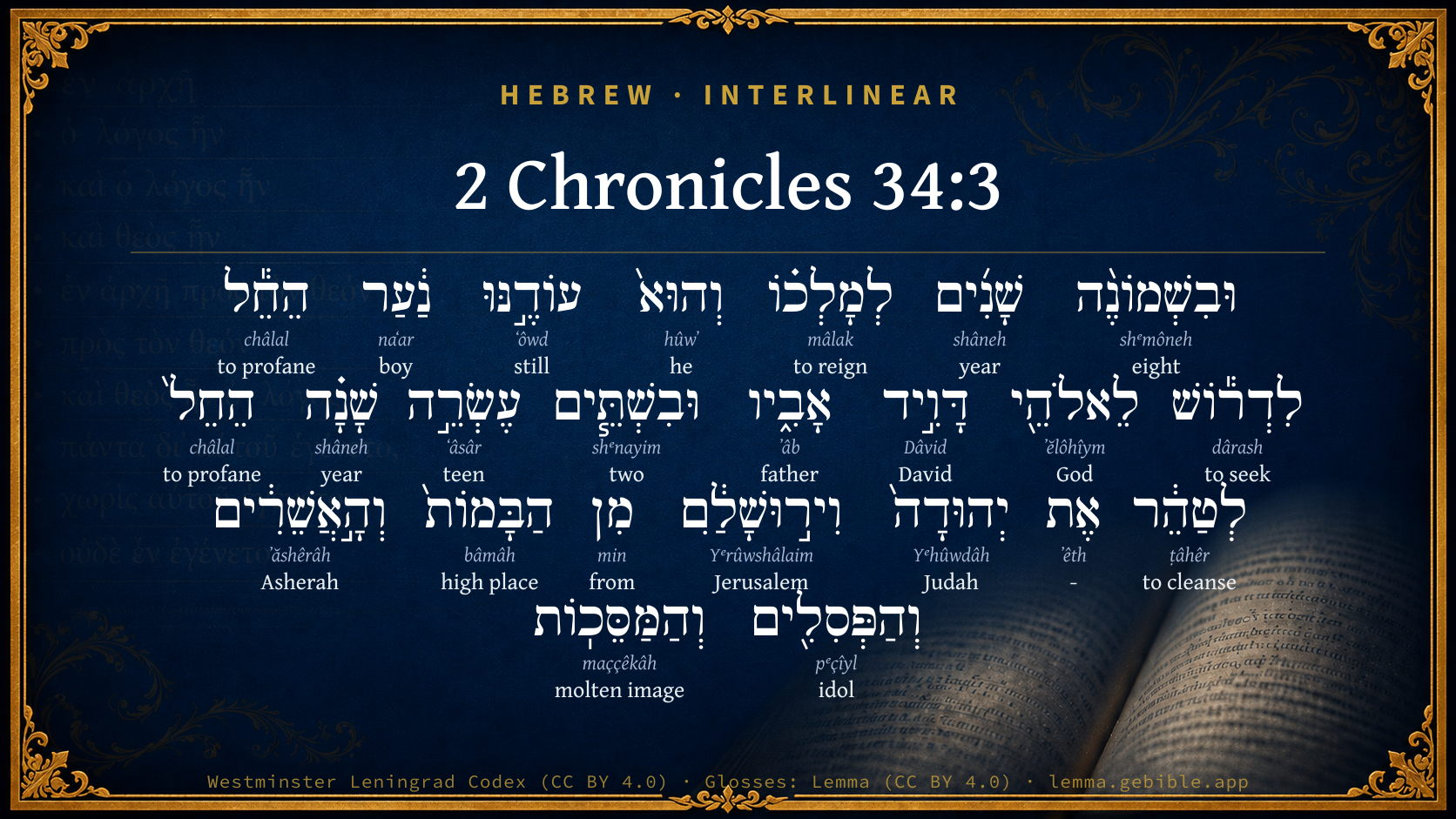
  1. וּבִשְׁמוֹנֶ֨ה shᵉmôneh H8083 “and · in/at · eight” Conjunction + Preposition + Adjective, Cardinal number, Feminine, Singular, Absolute
  2. שָׁנִ֜ים shâneh H8141 “years” Noun, Common, Feminine, Plural, Absolute
  3. לְמָלְכ֗וֹ mâlak H4427 “to reign · him” Preposition + Verb, Qal, Infinitive Construct + Suffix, Personal, 3rd Person, Masculine, Singular
  4. וְהוּא֙ hûwʼ H1931 “and · he” Conjunction + Pronoun, Personal, 3rd Person, Masculine, Singular
  5. עוֹדֶ֣נּוּ ʻôwd H5750 “still · his” Adverb + Suffix, Personal, 3rd Person, Masculine, Singular
  6. נַ֔עַר naʻar H5288 “boy” Noun, Common, Masculine, Singular, Absolute
  7. הֵחֵ֕ל châlal H2490 “to profane” Verb, Hiphil, Perfect, 3rd Person, Masculine, Singular
  8. לִדְר֕וֹשׁ dârash H1875 “to seek” Preposition + Verb, Qal, Infinitive Construct
  9. לֵאלֹהֵ֖י ʼĕlôhîym H430 “to/for · God(s) of” Preposition + Noun, Common, Masculine, Plural, Construct
  10. דָּוִ֣יד Dâvid H1732 “David” Noun, Proper
  11. אָבִ֑יו ʼâb H1 “father · his” Noun, Common, Masculine, Singular, Construct + Suffix, Personal, 3rd Person, Masculine, Singular
  12. וּבִשְׁתֵּ֧ים shᵉnayim H8147 “and · in/at · two” Conjunction + Preposition + Adjective, Cardinal number, Feminine, Dual, Absolute
  13. עֶשְׂרֵ֣ה ʻâsâr H6240 “teen” Adjective, Cardinal number, Feminine, Singular, Absolute
  14. שָׁנָ֗ה shâneh H8141 “year” Noun, Common, Feminine, Singular, Absolute
  15. הֵחֵל֙ châlal H2490 “to profane” Verb, Hiphil, Perfect, 3rd Person, Masculine, Singular
  16. לְטַהֵ֔ר ṭâhêr H2891 “to cleanse” Preposition + Verb, Piel, Infinitive Construct
  17. אֶת ʼêth H853 “-” Particle, Direct Object
  18. יְהוּדָה֙ Yᵉhûwdâh H3063 “Judah” Noun, Proper
  19. וִיר֣וּשָׁלִַ֔ם Yᵉrûwshâlaim H3389 “and · Jerusalem” Conjunction + Noun, Proper
  20. מִן min H4480 “from” Preposition
  21. הַבָּמוֹת֙ bâmâh H1116 “the · high places” Particle, Definite Article + Noun, Common, Feminine, Plural, Absolute
  22. וְהָ֣אֲשֵׁרִ֔ים ʼăshêrâh H842 “and · the · Asherah” Conjunction + Particle, Definite Article + Noun, Proper
  23. וְהַמַּסֵּכֽוֹת maççêkâh H4541 “and · the · molten images” Conjunction + Particle, Definite Article + Noun, Common, Feminine, Plural, Absolute

About this verse

These counts appear in no published source. They are computed here, from the morphology-tagged text and Lemma’s own curated glosses. What Lemma adds →

24
words
22
distinct lemmas
Historical
section

Notable vocabulary

The rarest word here is וְהַפְּסִלִ֖ים idol H6456 — appearing just 24 times in the whole Hebrew Bible.

Shared distinctive vocabulary

וְהַפְּסִלִ֖ים idol H6456 occurs in 24 verses of the Hebrew Bible. Also found in:

Grammatical profile

  • 5 verbs
  • 12 nouns
  • 3 adjectives
  • 1 pronoun
  • 1 preposition
  • 1 adverb
  • 1 particle

Verb forms

  • לְמָלְכ֗וֹ Qal · Infinitive Construct
  • הֵחֵ֕ל Hiphil · Perfect
  • לִדְר֕וֹשׁ Qal · Infinitive Construct
  • הֵחֵל֙ Hiphil · Perfect
  • לְטַהֵ֔ר Piel · Infinitive Construct

Repetition

Words recur within this verse — often emphatic in Hebrew:

  • שָׁנִ֜ים year H8141 ×2
  • הֵחֵ֕ל to profane H2490 ×2

Hebrew & Septuagint length

In English translation the verse runs 51 words from the Hebrew and 57 from the Septuagint (LXX English) — closely comparable.

A rough comparison of the two English renderings, which tokenize alike — not a word-level alignment.

Word counts can differ between the Hebrew and the Greek without any difference in meaning — e.g. the Hebrew direct-object marker אֵת has no separate Greek word, and Greek often adds the article ὁ.

Cross-references

17

Topical passages linked to 2 Chronicles 34:3 in the Treasury of Scripture Knowledge — connected by theme and wording, ordered by reader-vote popularity; previews shown in the World English Bible.

  • 2 Chronicles 33:22 He did that which was evil in the sight of Yahweh, as did Manasseh his father; and Amon sacrificed to all the engraved images which Manasseh his father had made, and served them.
  • 2 Chronicles 15:2 and he went out to meet Asa, and said to him, Hear you me, Asa, and all Judah and Benjamin: Yahweh is with you, while you are with him; and if you seek him, he will be found of you; but if you forsake him, he will forsake you.
  • 2 Chronicles 33:17 Nevertheless the people sacrificed still in the high places, but only to Yahweh their God.
  • Proverbs 8:17 I love those who love me. Those who seek me diligently will find me.
  • Leviticus 26:30 I will destroy your high places, and cut down your incense altars, and cast your dead bodies upon the bodies of your idols; and my soul will abhor you.
  • 1 Kings 13:2 He cried against the altar by the word of Yahweh, and said, altar, altar, thus says Yahweh: Behold, a son shall be born to the house of David, Josiah by name; and on you shall he sacrifice the priests of the high places who burn incense on you, and men's bones shall they burn on you.
  • 2 Kings 18:4 He removed the high places, and broke the pillars, and cut down the Asherah: and he broke in pieces the brazen serpent that Moses had made; for to those days the children of Israel did burn incense to it; and he called it Nehushtan.
  • 2 Kings 23:4 The king commanded Hilkiah the high priest, and the priests of the second order, and the keepers of the threshold, to bring forth out of the temple of Yahweh all the vessels that were made for Baal, and for the Asherah, and for all the host of the sky, and he burned them outside of Jerusalem in the fields of the Kidron, and carried the ashes of them to Bethel.
  • 2 Kings 23:14 He broke in pieces the pillars, and cut down the Asherim, and filled their places with the bones of men.
  • 1 Chronicles 22:5 David said, Solomon my son is young and tender, and the house that is to be built for Yahweh must be exceedingly magnificent, of fame and of glory throughout all countries: I will therefore make preparation for it. So David prepared abundantly before his death.
  • 1 Chronicles 28:9 You, Solomon my son, know the God of your father, and serve him with a perfect heart and with a willing mind; for Yahweh searches all hearts, and understands all the imaginations of the thoughts: if you seek him, he will be found of you; but if you forsake him, he will cast you off forever.
  • 1 Chronicles 29:1 David the king said to all the assembly, Solomon my son, whom alone God has chosen, is yet young and tender, and the work is great; for the palace is not for man, but for Yahweh God.
  • 2 Chronicles 30:14 They arose and took away the altars that were in Jerusalem, and all the altars for incense took they away, and cast them into the brook Kidron.
  • Psalms 119:9 How can a young man keep his way pure? By living according to your word.
  • Ecclesiastes 12:1 Remember also your Creator in the days of your youth, Before the evil days come, and the years draw near, When you will say, "I have no pleasure in them;"
  • Matthew 6:33 But seek first God's Kingdom, and his righteousness; and all these things will be given to you as well.
  • 2 Timothy 3:15 From infancy, you have known the sacred writings which are able to make you wise for salvation through faith, which is in Christ Jesus.

Cross-references courtesy of OpenBible.info (CC BY 4.0).

Hebrew and Greek witnesses Masoretic Hebrew ↔ Greek Septuagint

The same verse in the two great witnesses to the Old Testament, shown verse-for-verse.

These are two independent witnesses, not word-aligned to each other, and the Septuagint is shown in lemma (dictionary) form.

Hebrew 2 Chronicles 34:3 Masoretic · Westminster Leningrad Codex

וּבִשְׁמוֹנֶ֨ה שָׁנִ֜ים לְמָלְכ֗וֹ וְהוּא֙ עוֹדֶ֣נּוּ נַ֔עַר הֵחֵ֕ל לִדְר֕וֹשׁ לֵאלֹהֵ֖י דָּוִ֣יד אָבִ֑יו וּבִשְׁתֵּ֧ים עֶשְׂרֵ֣ה שָׁנָ֗ה הֵחֵל֙ לְטַהֵ֔ר אֶת יְהוּדָה֙ וִיר֣וּשָׁלִַ֔ם מִן הַבָּמוֹת֙ וְהָ֣אֲשֵׁרִ֔ים וְהַפְּסִלִ֖ים וְהַמַּסֵּכֽוֹת

For in the eighth year of his reign, while he was yet young, he began to seek after the God of David his father; and in the twelfth year he began to purge Judah and Jerusalem from the high places, and the Asherim, and the engraved images, and the molten images.

World English Bible · Public Domain

Greek LXX 2 Chronicles 34:3 Septuagint · lemma form

καί ἐν ὁ ὄγδοος ἔτος ὁ βασιλεία αὐτός καί αὐτός ἔτι παιδάριον ἄρχω ὁ ζητέω κύριος ὁ θεός δαυίδ ὁ πατήρ αὐτός καί ἐν ὁ δωδέκατος ἔτος ὁ βασιλεία αὐτός ἄρχω ὁ καθαρίζω ὁ ἰούδας καί ὁ ἰερουσαλήμ ἀπό ὁ ὑψηλός καί ὁ ἄλσος καί ἀπό ὁ χωνευτός

And in the eighth year of his reign, and he being yet a youth, he began to seek the Lord God of his father David: and in the twelfth year of his reign he began to purge Juda and Jerusalem from the high places, and the groves, and the ornaments for the altars, and the molten images.

LXX2012 (modern English Septuagint) · Public Domain

Hebrew: Westminster Leningrad Codex (CC BY 4.0). Greek: Septuagint (public domain); English from LXX2012 (modern English Septuagint) (Public Domain). How the Septuagint differs from the Hebrew →

Commentary

Notes on 2 Chronicles 34:3 from classic Christian and Jewish commentators (each source and its license shown beneath its notes). The classic Christian expositions comment on the surrounding passage and are grouped to its opening verse, so a note may address several verses; the Jewish commentaries on the Tanakh (Rashi and others) are per-verse, so they appear only where the commentator wrote on this verse.

Lemma curates 59 commentaries, every one of them public domain or Creative Commons licensed, each selected and text-cleaned for this edition rather than reprinted as found. About our sources →

Jamieson, Fausset & Brown

Robert Jamieson, A. R. Fausset & David Brown

HE DESTROYS IDOLATRY. (Ch2 34:3-7)

in the eighth year of his reign--This was the sixteenth year of his age, and, as the kings of Judah were considered minors till they had completed their thirteenth year, it was three years after he had attained majority. He had very early manifested the piety and excellent dispositions of his character. In the twelfth year of his reign, but the twentieth of his age, he began to take a lively interest in the purgation of his kingdom from all the monuments of idolatry which, in his father's short reign, had been erected. At a later period, his increasing zeal for securing the purity of divine worship led him to superintend the work of demolition in various parts of his dominion. The course of the narrative in this passage is somewhat different from that followed in the Book of Kings. For the historian, having made allusion to the early manifestation of Josiah's zeal, goes on with a full detail of all the measures this good king adopted for the extirpation of idolatry; whereas the author of the Book of Kings sets out with the cleansing of the temple, immediately previous to the celebration of the passover, and embraces that occasion to give a general description of Josiah's policy for freeing the land from idolatrous pollution. The exact chronological order is not followed either in Kings or Chronicles. But it is clearly recorded in both that the abolition of idolatry began in the twelfth and was completed in the eighteenth year of Josiah's reign. Notwithstanding Josiah's undoubted sincerity and zeal and the people's apparent compliance with the king's orders, he could not extinguish a strongly rooted attachment to idolatries introduced in the early part of Manasseh's reign. This latent predilection appears unmistakably developed in the subsequent reigns, and the divine decree for the removal of Judah, as well as Israel, into captivity was irrevocably passed.

Jamieson, Fausset & Brown — Commentary Critical and Explanatory on the Whole Bible (1871) — public domain (CC PDM 1.0). Text via the HelloAO Bible API.

The Cambridge Bible for Schools and Colleges

gen. ed. J. J. S. Perowne

3–7 (cp. 2Ch_34:33; 2Ki_13:4-20). Josiah destroys the Symbols of Idolatry

3. in the eighth year … and in the twelfth] The two dates given in this verse seem to be “doublettes,” i.e. various readings both of which have been adopted and placed side by side in the text. Moreover it is probable that neither reading is original, for both seem to have been derived by some transcriptional error or other from 2Ki_22:3, where the account of Josiah’s doings begins with the date, in the eighteenth year.

Thus we get:—

(a) 2Ki_22:3 (= 2Ch_34:8):

bishĕmôneh esreh “eighteenth” (the original reading).

(b) 2Ch_34:3 a:

bishĕmôneh “eighth” (defective reading; esreh having dropped out).

(c) 2Ch_34:3 b:

bishtçym esreh, “twelfth” (attempted correction, perhaps from memory, of the defective reading).

It should also be noticed that the order of the events of Josiah’s reign given in Chron. varies from that given in 2 Kin. Thus we have in 2 Chr.:

(1) Destruction of idolatrous symbols throughout Jerusalem, Judah and Israel; 2Ch_34:3-7.

(2) Repair of the Temple and Finding of the Law; ib. 2Ch_34:8-28.

(3) Renewal of the Covenant with Jehovah; ib. 2Ch_34:29-32.

(4) Great Passover kept; 2Ch_35:1-19.

(5) Death of Josiah; ib. 2Ch_35:20-27.

In 2 Kin. on the other hand (2), (3) precede (1), and there can be little doubt that this order is right.

while he was yet young] There is no clause corresponding to this in 2 Kin., and the statement rests on the probably faulty reading “eighth.” Yet his early piety is probably a fact, for though in 2 Kin. his reformation is dated in the eighteenth year of his reign, i.e. when he was 25 years of age (hardly “young” for a king), the favourable judgement passed on him (2Ki_12:2) is unqualified by any suggestion that he was tardy in turning to Jehovah.

in the twelfth year he began] The Chronicler spreads the cleansing of the land over six years, i.e. from the twelfth to the eighteenth; cp. 2Ch_34:8.

to purge] Josiah’s measures are more fully enumerated and described in 2 Kings 23; notice e.g. the removal of the Asherah from the Temple (2Ch_34:6), the destruction of the houses of the Ḳĕdeshim (cp. Deu_23:17-18) which were in the House of the Lord (2Ch_34:7), the deportation of priests from the cities of Judah into Jerusalem (2Ch_34:8-9), and the defiling of Topheth and of Beth-el (2Ch_34:10; 2Ch_34:15-16).

the groves] R.V. the Asherim; cp. 2Ch_14:3 (note).

carved images] R.V. graven, images; as 2Ch_33:7; 2Ch_33:22.

The Cambridge Bible for Schools and Colleges (gen. ed. J. J. S. Perowne; Cambridge University Press, 1878–1918) — public domain. Text from a community e-Sword module.

Trapp's Complete Commentary

John Trapp

2Ch 34:3 For in the eighth year of his reign, while he was yet young, he began to seek after the God of David his father: and in the twelfth year he began to purge Judah and Jerusalem from the high places, and the groves, and the carved images, and the molten images.

Ver. 3. For in the eighth year of his reign.] So soon as he had the reins in his own hands, he began.

He began to seek.] That is, Publicly to show his zeal for God; which was in him of a little child.

And in the twelfth year.] See 2Ki 23:4-5, &c.

John Trapp, A Commentary or Exposition upon All the Books of the Old and New Testament (1647–1656) — public domain. Text from a community e-Sword module.

The Biblical Illustrator

Joseph S. Exell

2Ch_34:3

For in the eighth year of his reign, while he was yet young, he began to seek after the God of David.

Seeking after God

I. Why we should seek after God.

1. We are by nature without God.

2. To be without God is certain misery.

3. In God alone we can obtain peace and rest.

II. How we are to seek after God.

1. With respect to God Himself. Josiah sought--not the God of nature; not the God of Providence; but the God of David his father. And why? David was a type of Christ; the covenant made with David a type of the covenant of grace, and the sure mercies of David, symbols of the better blessings of the New Covenant.

2. With respect to ourselves. By repentance, faith, and obedience.

III. When we are to seek after god. (Robert Stevenson.)

Early piety and its advantages

I. Enlightened piety consists in seeking God.

1. Earnestly.

2. Promptly.

3. Perseveringly.

II. Seeking God early will conduce to honour.

1. It keeps alive religious susceptibilities.

2. It saves from snares.

3. It brings eminent usefulness in life.

4. It prepares for happy death. (J. Wolfendale.)

Youth the best time to serve God

Let us think of some reasons why we should seek God in childhood.

1. The first reason is because youth is the best time.

2. Another reason is because youth is the most important time. Satisfy us early with Thy goodness, that we may be glad and rejoice all our days. What seems a slight mistake at the beginning may make a terrible difference at the end.

3. Another reason for seeking God in early life is because it is noblest to do right now, not to wait until we have spent most of our life doing wrong. (Christian Age.)

Well started

I. That any soul should begin early to seek the Lord, is an event that would be thought unimportant by some, but it is chronicled in heaven.

II. Every man must search carefully his own heart, and determine whether the definite desire after God is there or not. The desire is equivalent to spiritual sight. To help to build up righteousness is serving God.

III. Some will say: but i have no such opportunities as josiah. Have you sought them? Is not influence on relatives, friends, comrades, fellow-workers an opportunity? Can you never seize suitable occasions for uttering a Christian sentence or scowling on a social sin?

IV. A further objection is but i have so many difficulties in my way, that i can do nothing useful. Think of those Josiah must have met with.

V. Others say: but i never had any special call to serve God. What if parents, or brothers, or sisters, or friend never mentioned it? Have you never heard it in your heart, and cannot you hear it now? The very passage of time calls you to serve God.

VI. Those who begin life with Christ as Saviour, Guide, Helper, Eternal Friend, and who are honestly trying to serve Him, may be sure that He will rejoice over them, and remember them, even though them names may not be emblazoned on any great world-roll of honour.

VII. Some are conscious that they are not making a good beginning of life. They are drifting onwards and towards dangerous rapids and a deathly abyss. Christ comes to save and to give a fresh start. This is an opportunity which is worth seizing. (F. Hastings.)

Early piety

I. What Josiah turned from.

1. From what is familiarly called the way of the world.

2. From the carnal appetites of youth, which craved to be pampered by their gratification.

3. From all vanities of the imagination.

4. From the exercise of power, before weighing its responsibilities.

5. From false friends and evil counsellors.

6. From the delusions of the gaudy appendages of a worldly Court.

II. What Josiah turned to. He fixed his heart and the faith of his soul upon God, as his--

1. Friend.

2. Father.

3. Guide.

III. He was faithful and pious from his earliest days. (A Gatty, M.A.)

Early piety

I. Nothing is more amiable in itself, or more pleasing to God, than early piety.

II. Youth is a season in which you have the greatest advantages for cultivating the principles of piety, and the greatest need of religion, as a defence from temptation and dangers.

III. By early piety you will prepare tranquility and joy for old age, whilst by an opposite conduct you will fill it with remorse and fears.

IV. Regard to the feelings of all pious persons in the Church universal, a respect to the happiness of your parents, should induce you early to devote yourselves to God.

V. On your conduct in youth, your salvation or perdition almost infallibly depend. (H. Kollock, D. D.)

Early piety

I. We shall briefly notice the striking example of youthful piety here presented to our view.

1. He was a decidedly religious character.

2. His genuine religion commenced at an early period.

3. An exemplary life and conversation abundantly proved the sincerity and ardour of his piety.

4. Josiahs early piety is adduced as the pledge if not the basis of his future eminence in religion.

5. Josiah and his country reaped great advantages from his early devotedness to God.

II. We shall produce arguments urging upon all our young people the exemplification of similar decided piety.

1. A due regard to your personal welfare.

2. The plea of relative usefulness--

(1) In the family.

(2) The social circle.

(3) The Church.

3. Many whom you dearly love feel deeply interested in your spiritual welfare.

(1) Parents.

(2) Ministers.

4. The compassionate Saviour not only claims but kindly encourages youthful piety. (Essex Congregational Remembrancer.)

Early piety exemplified in Josiah

I. Josiah imitated david.

1. God was Davids teacher.

2. God was Davids comfort.

3. God was Davids delight.

4. God was Davids defence.

II. The manner how he sought after god. He sought God--

1. From a deep conviction that his conduct and the conduct of Israel generally was highly offensive to God, and that they were exposed to imminent peril.

2. In deep self-abasement of soul.

3. By destroying the idols out of the land.

4. By restoring Gods true worship and frequenting it.

5. With all his heart (2Ki_23:25).

III. The period of life when he did it. (Sketches of Four Hundred Sermons.)

Josiah

Josiah was--

I. An early seeker. Our Queen wears a velvet cap under her crown lest it should hurt her head: this eight-year-old king had more need of such a covering. The crown is a heavy burden for young soldiers. Yet there have been younger kings than Josiah. An old Norse king was called Olaf Lapking because he was king while on his mothers lap. Royal boyhood is often poisoned boyhood. The people of Israel around little Josiah were doing worse than the heathen. The sins and sorrows of that time are described in the Lamentations of Jeremiah, whose heart they had broken, Yet Josiah at the age of eight did that which was right in the sight of the Lord, and at sixteen began to seek the God of his father David with more earnestness than ever. God calls us to seek Him earlier. In our Latin exercises there was a story about a simpleton sitting one evening at the rivers brink. A traveller coming up wished his company in crossing. No, he replied, I am waiting till the river flows past. The tiny stream of difficulties between you and Christ wont flow past, but will flow on, and broaden and deepen, till it grows like an angry torrent, swollen with winter floods, that threatens to sweep down the old man who would ford it.

II. Josiah was also a hearty hater of evil. He did not hate in others the sins he practised himself, He was not like the Czar of Russia who used to say, I reform my country, and am not able to reform myself. Dr. Arnold used to say, Commend me to boys who love God and hate evil. Love without hate makes a mere milksop, and Christs disciples are to be the salt, and not the sugar of society. We need boys who will hate all evil as young Hannibal hated Rome. The young Christian ought to be the sworn foe of the kingdom of darkness.

III. Josiah was a real hero. A hero is one who, in doing duty, scorns great dangers. He had the spirit of Chrysostom, who replied to the threats of the Empress Eudoxia, I fear nothing but sin. Josiahs love for the Bible would open his soul to all the best influences from the heroic lives of Noah, Abraham, Joseph, Moses, Samuel and Gideon. Thus was developed in him what Dr. Chalmers calls the expulsive power of a new affection.

IV. Josiah was missed and mourned when he died. There is a night in Spain called the sad night: and so in the history of Judah, the death of Josiah was the sad day. The Rabbis say that the memory of him was like costly incense, and sweet as honey in the mouths of all. (James Wells, M.A.)

The Biblical Illustrator, edited by Joseph S. Exell (c. 1880s–1900s) — public domain. Text from a community e-Sword module.

Joseph Benson's Commentary

2Ch 34:3. While he was yet young — In the sixteenth year of his age; when he was entering into the age of temptation, and had the administration of his kingdom wholly in his own power, and none to restrain him, even then he begins to be religious in good earnest.

Joseph Benson's Commentary on the Old and New Testaments (1811–1818) — public domain. Text from a community e-Sword module.

Keil & Delitzsch

C. F. Keil & F. Delitzsch

Extirpation of idolatry. In the eighth year of his reign, while he was yet a youth, being then only sixteen years old, Josiah began to seek the God of his ancestor David, and in the twelfth year of his reign he commenced to purify Judah and Jerusalem from the high places, Asherim, etc. The cleansing of the land of Judah from the numerous objects of idolatry is summarily described in Ch2 34:4 and Ch2 34:5; and thereupon there follows (Ch2 34:6 and Ch2 34:7) the destruction of the idolatrous altars and images in the land of Israel, - all that it seemed necessary to say on that subject being thus mentioned at once. For that all this was not accomplished in the twelfth year is clear from the לטהר החל, "he commenced to cleanse," and is moreover attested by Ch2 34:33. The description of this destruction of the various objects of idolatry is rhetorically expressed, only carved and cast images being mentioned, besides the altars of the high places and the Asherim, without the enumeration of the different kings of idolatry which we find in 2 Kings 23:4-20. - On Ch2 34:4, cf. Ch2 31:1. ינתּציּ, they pulled down before him, i.e., under his eye, or his oversight, the altars of the Baals (these are the בּמות, Ch2 34:3); and the sun-pillars (cf. Ch2 14:4) which stood upwards, i.e., above, upon the altars, he caused to be hewn away from them (מעליהם); the Asherim (pillars and trees of Asherah) and the carved and molten images to be broken and ground (הדק, cf. Ch2 15:16), and (the dust of them) to be strewn upon the graves (of those) who had sacrificed to them. הזּבחים is connected directly with הקּברים, so that the actions of those buried in them are poetically attributed to the graves. In Kg2 23:6 this is said only of the ashes of the Asherah statue which was burnt, while here it is rhetorically generalized.

Keil & Delitzsch — Biblical Commentary on the Old Testament (1861–1891) — public domain (CC PDM 1.0). Text via the HelloAO Bible API. (Old Testament only.)

Tyndale Open Study Notes

Tyndale Open Resources

34:3 Josiah began to seek the God of his ancestor David when he was just sixteen. He initiated his own acts of reform when he reached age twenty.

Tyndale Open Study Notes — © Tyndale Open Resources, licensed CC BY-SA 4.0. Text via the HelloAO Bible API.

Geneva Bible (1599)

Geneva Bible translators

When he was but sixteen years old he showed himself zealous of God’s glory, and at twenty years old he abolished idolatry, and restored the true religion.

Geneva Bible (1599) marginal notes — public domain. Text via Bolls.life.

Ellicott's Commentary for English Readers

(3) For.—Now.

In the eighth year.—The specifications of time in this verse are peculiar to the chronicler.

While he was yet young.—Being about sixteen.

He began to seek.—2Ch_17:3-4; 1Ch_13:3.

And in the twelfth year.—When, perhaps, he began to govern alone.

He began to purge.—It is not said that the whole work was completed in the twelfth year; indeed, 2Ch_34:33 implies the contrary. But the writer having begun the story of the destruction of idolatrous objects, naturally continues it to its close, though that properly belongs to Josiah’s eighteenth year (2Ki_22:3, compared with 2Ki_23:4 seq.). It is not, therefore, clear (as Thenius asserts) that the chronicler has put the extirpation of idolatry first, simply to show that the pious king needed no special prompting to such a course; or that, as Noldeke supposes, the writer meant to clear this highly-extolled king from the reproach of having quietly put up with the abomination for full eighteen years.

The high places.—2Ki_23:5; 2Ki_23:8-9; 2Ki_23:13.

The groves.—The Asherim (2Ki_23:4; 2Ki_6:7; 2Ki_6:14). There was an Asherah in the Temple, as well as in the high places which Solomon built for Ashtoreth, Chemosh, and Milcom. The carved and molten images are not mentioned in the parallel passage, which, however, gives a much clearer and more original description of the different kinds of idolatry abolished by Josiah. (The Syriac has, “he began to root out the altars, and idols, and leopards, and chapels, and collars, and bells, and all the trees which they made for the idols.”)

(3-7) Idolatry extirpated. This brief account is parallel to 2Ki_23:4-20.

A Bible Commentary for English Readers, edited by Charles John Ellicott (1878–1897) — public domain. Text from a community e-Sword module.

John Gill's Exposition

And they broke down the altars of Baalim in his presence,.... He not only ordered them to be broke down, but he went in person, and saw it done; these were the altars Manasseh had reared up to the idols; and though upon his humiliation he cast them out, they were rebuilt by Amon his son, see Ch2 33:3,

and the images that were above them he cut down; sun images, as the word signifies; these Chamanim might be representatives of Cham or Ham, the son of Noah, the same with Jupiter Ammon; and there was another Heathen deity, Amanus, Strabo (w) speaks of, supposed to be the sun; see Gill on Lev 26:30, these, as Jarchi says, were in the form of the sun, and were set above the altars, over against the sun, to whom worship was paid; though some think this respects not place, but time, and that these were images in times past; in the preceding age, as the Tigurine version:

and the groves, and the carved images and the molten images, he brake in pieces; ordered them to be broken; the groves were statues, or images in groves, and thereby distinguished from those made of wood, and were carved, and from those that were of molten metal, and were placed elsewhere:

and made dust of them, and strewed it upon the graves of them that had sacrificed unto them, see Kg2 23:6.

(w) Geograph l. 11. p. 352.

John Gill's Exposition of the Whole Bible (1746–1763) — public domain (CC PDM 1.0). Text via the HelloAO Bible API.

Albert Barnes' Notes on the Bible

He began to purge Judah - Jeremiah’s first prophecies Jer. 2–3 appear to have been coincident with Josiah’s earlier efforts to uproot idolatry, and must have greatly strengthened his hands.

Albert Barnes' Notes on the Bible (1834–1885) — public domain. Text from a community e-Sword/MySword module.

Haydock's Catholic Bible Commentary

Boy; 16 years old. D. --- The kings of Juda were in their minority, till they had completed their 13th year. Grotius --- Cleansed. Heb. and Sept. "in the twelfth year he began to purify," &c. H. --- The work was not brought to perfection till six years afterwards, v. 8. C. T.

George Leo Haydock (1774–1849), Haydock's Catholic Family Bible and Commentary, 1859 edition — public domain. Excludes Psalms (Douay-Rheims chapter numbering differs from Protestant) and Deuterocanonical books (Catholic canon only).

Matthew Poole's English Annotations

While he was yet young; in the sixteenth year of his age, when he was entering into the age and state of temptations and youthful lusts, and had the administration of his kingdom wholly in his own hand and power and none to rebuke or restrain him; yet even then he begins to be religious in good earnest.

Matthew Poole's English Annotations on the Holy Bible (1683–1685) — public domain. Text from a community e-Sword/MySword module.

The Pulpit Commentary

This, with the following four verses, forms the commentary on the statement of ver. 2, that Josiah "declined neither to the right hand, nor to the left." We cannot mistake the allusion in this verse to his personal religion at, say, sixteen years of age, as the foundation of his religious reign and of the practical devotion to reformation, instanced as commencing with his twentieth year. It may be here noted that the Prophet Jeremiah was called to his work in the year following thereupon, or, perhaps, the very same year. (Jer_1:1, Jer_1:2) It is highly likely that Josiah and Jeremiah were given to one another providentially, to cooperate in all good works, now so needed for Church and state. The three dates of the eighth, twelfth, and (ver. 8) the eighteenth year of Josiah"s reign wore dates memorable in his life. For the two kinds of images of this verse, see succeeding note.

HOMILIES BY W. CLARKSON Ver. 3 (first part).

Piety in youth.

That Josiah "while he was yet young began to seek after the God of David his father" is to us an interesting fact; it provides an example to the young and an incentive to those who have charge of their welfare. Respecting piety in youth it is well to consider

I HOW MUCH THERE IS TO COMMEND IT.

1. All life belongs to God, and therefore this part of it. Unto him who gave us our existence and all our powers, and in whom we live and move and have our being, surely the whole of our life belongs; it cannot be withheld without wrong, without keeping back the "glory due to his Name," the gratitude and the love and the service due to himself. Therefore does this part of it along with the rest. Audit is certain that when life is past and we come to have it in review we shall be most happy in the thought, if we can but cherish it, that our youth also was spent in the fear of God, in the love and service of Jesus Christ.

"Twill please us to look back and see That our whole lives were thine.

1. Each period of life has its own peculiar offering to bring. If age has its patience and submissiveness, and if elderliness has its experience, and if prime has the fulness of its strength for service, and if young manhood has its hopefulness and its ardour, then has youth also its e special offering to

2. bring to its Redeemer; it has its affectionateness, its trustfulness, its docility, its readiness to obey, its beauty. Truly, the "flower when offered in the bud:" is "no vain sacrifice.

3. It saves the growth of injurious weeds in the garden of the soul. When the sense of sacred obligation is absent, youth is apt to let various evil habits grow up habits which choke much that is good, which constitute a serious drawback to Christian worth, and which require much effort and much time also for their extraction. But when the curly days are spent in the service and in the friendship of Christ, his holy will being the one rule of the heart and life, such evil habits are unformed, and all the after-days are stronger and better and more beautiful for their absence.

1. Each period in life is a stepping-stone to the next, is a preparation for the next. We sow in youth what we reap ill young manhood; as we go on our way we gather in the harvest of the thought and toil of the years that came before it. But this applies to our moral and spiritual character more perfectly than to anything else. How, then, can we afford to lose the great advantage of building up from the beginning? Our manhood will be much the weaker for an ill-spent youth, and much the stronger for a well-spent one. Our whole life will be greatly impoverished by the one, greatly enriched by the other.

2. Godly youth is a source of pure and deep joy to those whom the young should be most desirous of pleasing to those that have loved them and served them with tenderest solicitude and unfailing devotion.

II OUR DUTY IN REGARD TO IT.

1. To abstain most carefully from forcing it. No deadlier injury can be doneto the young than forcing a religious habit; constraining them to affect a language and to make a profession which is unreal, which will soon break down, and which will leave the heart far less open to all heavenly influences than it would have been.

2. To encourage it in every way that is in our power; more particularly bythe exhibition of a consistent life and the manifestation of a loving spirit toward them. Whom we win for ourselves we may lead to our Lord.

III THE WISDOM AND THE DUTY OF THE YOUNG. This is to enter the service of Jesus Christ without delay. He does not require of them anything they cannot offer. He does not demand of them that they should use the language or do the work which is appropriate, to other conditions; he asks them to receive him as their Divine Teacher, as their Divine Friend, as their Divine Lord. He asks them to trust, to love, to serve him to the height of their present power. This they can do; this they should do; this they will be truly and deeply wise if they do. "Seek ye the Lord while he may be found, call ye upon him while he is near. C.

The Pulpit Commentary (1880–1919), ed. H.D.M. Spence-Jones & Joseph S. Exell — public domain. Text from a community e-Sword module.

John Wesley's Explanatory Notes

Young - ln the sixteenth year of his age; when he was entering into the age of temptation, and had the administration of his kingdom wholly in his own power, and none to restrain him; even then he begins to be religious in good earnest.

John Wesley, Explanatory Notes Upon the Whole Bible (1754–1765) — public domain. Text via the GEBible commentary corpus.

Scofield Reference Notes

C. I. Scofield

groves (See Scofield "Deu 16:21") See Scofield "Jdg 3:7".

The Scofield Reference Bible (1917 edition), notes by C. I. Scofield — public domain. Text from a community e-Sword module.

Rashi

Rabbi Shlomo Yitzchaki (Rashi)

when he was still a youth, he started to seek The meaning is that although he was still a youth, he started to seek after the God of David his father. This is similar to (Gen. 37:2): “and as a youth, with the sons of Bilhah, etc., Joseph brought evil reports of them,” and this is not surprising, but if he were thirty years old, he would not have done it. It is, however, surprising, that he (Josiah) was a youth, and nevertheless, he started to seek, etc.

he started to purge Judah and Jerusalem of the high places, the asherim that Manasseh had made and that Amon his son had renewed, as above (33:3): “And he rebuilt the high places that Hezekiah his father had demolished, etc.”

Rashi on the Tanakh — English translations: “The Judaica Press complete Tanach with Rashi, translated by A. J. Rosenberg” (CC BY 4.0); “Pentateuch with Rashi's commentary by M. Rosenbaum and A.M. Silbermann, 1929-1934” (public domain); “The Metsudah Tanach series, Lakewood, N.J” (CC BY 4.0); and “The Book of Joshua, Metsudah Publications, 1997” (CC BY 4.0). Text via Sefaria.

Lesson kit

Teaching starters — assembled from the data on this page, not authored interpretation. Every prompt links to the verse data it draws on. Edit before teaching.

2 Chronicles, in the Historical, opens this verse with 24 words (22 distinct Hebrew lemmas). Its most distinctive word is pᵉçîyl (“idol”). A historical commentator’s framing appears above. Read the whole chapter for the surrounding context.

Discussion questions

  1. How does “idol” (pᵉçîyl) shape what this verse is saying?
  2. Deuteronomy 7:5 shares the word «idol» with this verse. How do the two illuminate each other?
  3. “year” occurs 2× in this one verse. What is the effect of the repetition?
  4. These translations render this verse differently; the difference is in the English rendering, not the original. What questions does that raise?
  5. The verb «לְמָלְכ֗וֹ» is Qal Infinitive Construct. How does its form color the action?
  6. Reading how Jamieson, Fausset & Brown and The Cambridge Bible for Schools and Colleges read this verse, where do the two commentators agree and where do they part?

Things to notice

Reading settings

Reading text

Shown beneath each verse's original-language words.

Old Testament
Old Testament edition

Read the OT as the Masoretic Hebrew (MT) or the Greek Septuagint (LXX).

English shown for the Greek Septuagint (in the Hebrew ↔ Greek comparison).

Comparing translations? Open the Compare panel on any verse page to stack up to four side by side.