
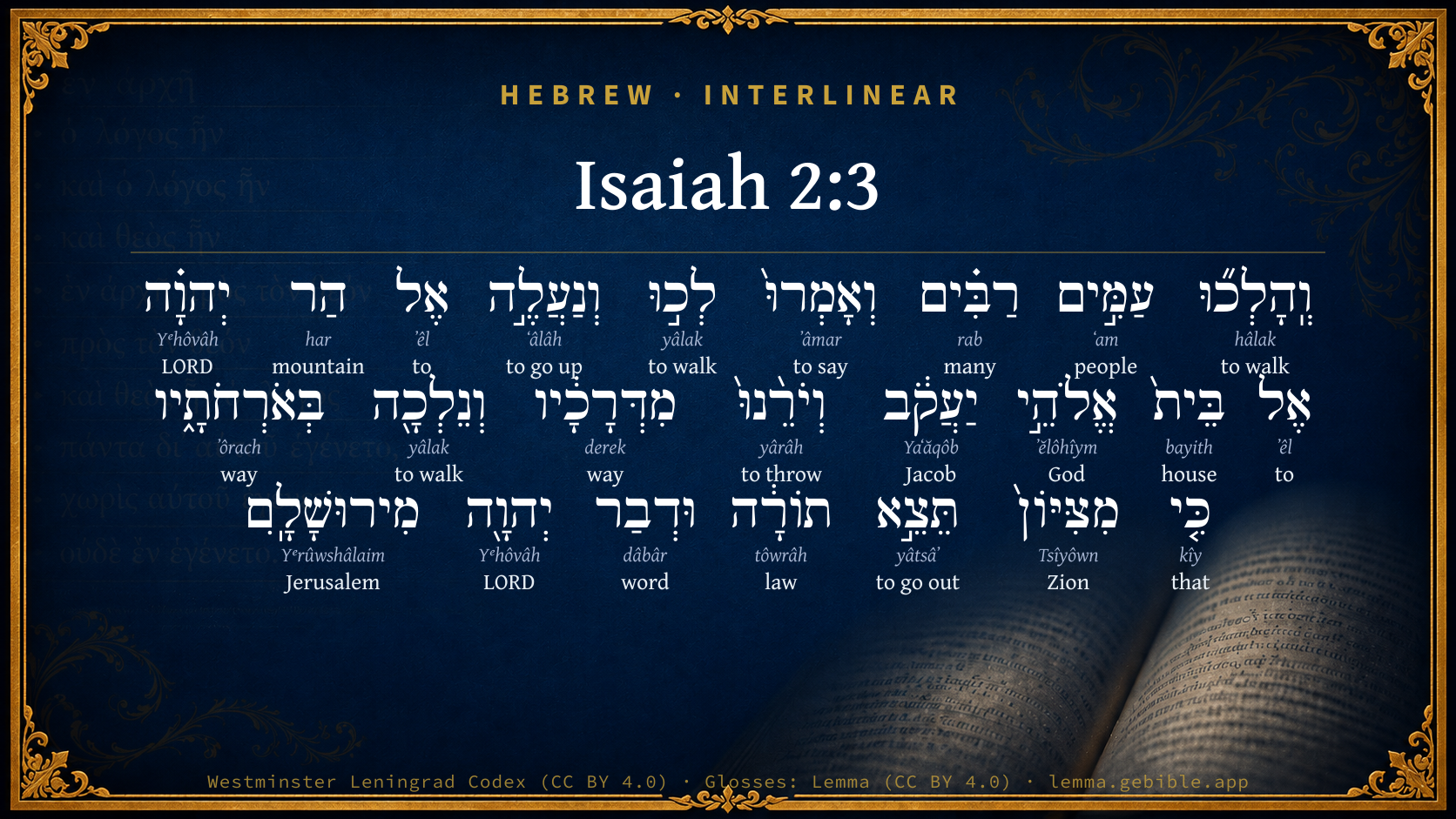
Isaiah 2:3

Hebrew (Westminster Leningrad Codex) Isaiah 2:3 appears in the Hebrew Old Testament. The text above is from the Westminster Leningrad Codex. Each word links to its Strong’s number, a concise gloss, and parsing drawn from the Open Scriptures Hebrew Bible morphology. Click any word for its full Brown-Driver-Briggs (BDB) entry.
Download image
Cite this verse

Isaiah 2:3 (World English Bible). Public Domain. Lemma interlinear Bible study tool, https://lemma.gebible.app/v/isaiah/2/3.

Show BibTeX & RIS
BibTeX
RIS
English Translation
Many peoples shall go and say, "Come, let's go up to the mountain of Yahweh, To the house of the God of Jacob; And he will teach us of his ways, And we will walk in his paths. For out of Zion the law shall go forth, And the word of Yahweh from Jerusalem.
World English Bible · Public Domain
Download a study sheet

One document with this verse’s original text, its word-by-word gloss line, the meaning frame, cross-references with their text, attributed commentary, and full source and license credits — printable, and it pastes into notes with its structure intact.

This verse Autodidact and up

Study sheet (.html) Plain text (.txt)

A passage Seminary Student

Up to 50 verses in one chapter. A passage sheet keeps up to 6 commentary sources and 12 cross-references per verse, in the order this page ranks them, and says so on the sheet whenever that leaves anything out. Ask for a single verse and you get the Autodidact verse sheet above.

Everything on this page stays free to read, with no account — the sheet is a download of what is already on screen, not access to it.

Want to remove ads? Support Godless Engineer
Compare translations 3

The same verse in 3 English versions, stacked beneath the original-language interlinear above. Click any original word for its lexicon entry.

Each is an independent rendering of the whole verse — the interlinear is not word-aligned to these translations.

Highlighted words mark where these versions differ — a whole-verse word diff, not a word-by-word alignment.

  • World English Bible Public Domain
    Many peoples shall go and say, "Come, let's go up to the mountain of Yahweh, To the house of the God of Jacob; And he will teach us of his ways, And we will walk in his paths. For out of Zion the law shall go forth, And the word of Yahweh from Jerusalem.
  • King James Version Public Domain
    And many people shall go and say, Come ye, and let us go up to the mountain of the LORD, to the house of the God of Jacob; and he will teach us of his ways, and we will walk in his paths: for out of Zion shall go forth the law, and the word of the LORD from Jerusalem.
  • unfoldingWord Literal Text CC BY-SA 4.0
    And many peoples will go and say, “Come, and let us go up to the mountain of Yahweh, to the house of the God of Jacob, that he may teach us from his ways, and let us walk in his paths.” For instruction will go out from Zion, and the word of Yahweh from Jerusalem.

unfoldingWord Literal Text — © unfoldingWord, licensed CC BY-SA 4.0. Word-aligned USFM3 via Door43 (git.door43.org/unfoldingWord/en_ult).

Versions to compare (up to 4)

3 of 4 selected

Show all 18 translations

Every available English version of this verse, each an independent rendering of the whole verse.

  • World English Bible Public Domain
    Many peoples shall go and say, "Come, let's go up to the mountain of Yahweh, To the house of the God of Jacob; And he will teach us of his ways, And we will walk in his paths. For out of Zion the law shall go forth, And the word of Yahweh from Jerusalem.
  • Berean Standard Bible Public Domain
    And many peoples will come and say: “Come, let us go up to the mountain of the LORD, to the house of the God of Jacob. He will teach us His ways so that we may walk in His paths.” For the law will go forth from Zion, and the word of the LORD from Jerusalem.
  • Majority Standard Bible Public Domain
    And many peoples will come and say: “Come, let us go up to the mountain of the LORD, to the house of the God of Jacob. He will teach us His ways so that we may walk in His paths.” For the law will go forth from Zion, and the word of the LORD from Jerusalem.
  • King James Version Public Domain
    And many people shall go and say, Come ye, and let us go up to the mountain of the LORD, to the house of the God of Jacob; and he will teach us of his ways, and we will walk in his paths: for out of Zion shall go forth the law, and the word of the LORD from Jerusalem.
  • American Standard Version (1901) Public Domain
    And many peoples shall go and say, Come ye, and let us go up to the mountain of Jehovah, to the house of the God of Jacob; and he will teach us of his ways, and we will walk in his paths: for out of Zion shall go forth the law, and the word of Jehovah from Jerusalem.
  • Revised Version (1885) Public Domain
    And many peoples shall go and say, come ye, and let us go up to the mountain of the LORD, to the house of the God of Jacob; and he will teach us of his ways, and we will walk in his paths: for out of Zion shall go forth the law, and the word of the LORD from Jerusalem.
  • Geneva Bible (1599) Public Domain
    And many people shall go, and say, Come, and let vs go vp to the mountaine of the Lord, to the house of the God of Iaakob, and hee will teach vs his wayes, and we will walke in his paths: for the Lawe shall go foorth of Zion, and the worde of the Lord from Ierusalem,
  • Douay-Rheims (1899) Public Domain
    And many people shall go, and say: Come and let us go up to the mountain of the Lord, and to the house of the God of Jacob, and he will teach us his ways, and we will walk in his paths: for the law shall come forth from Sion, and the word of the Lord from Jerusalem.
  • Young's Literal Translation Public Domain
    And gone have many peoples and said, `Come, and we go up unto the mount of Jehovah, Unto the house of the God of Jacob, And He doth teach us of His ways, And we walk in His paths, For from Zion goeth forth a law, And a word of Jehovah from Jerusalem.
  • Literal Standard Version CC BY-SA 4.0
    And many peoples have gone and said, “Come, and we go up to the mountain of YHWH, || To the house of the God of Jacob, || And He teaches us of His ways, || And we walk in His paths, || For a law goes forth from Zion, || And a word of YHWH from Jerusalem.
  • Unlocked Literal Bible CC BY-SA 4.0
    Many peoples will come and say, “Come, let us go up to the mountain of Yahweh, to the house of the God of Jacob, so he may teach us some of his ways, and we may walk in his paths.” For out of Zion will go the law, and the word of Yahweh from Jerusalem.
  • unfoldingWord Literal Text CC BY-SA 4.0
    And many peoples will go and say, “Come, and let us go up to the mountain of Yahweh, to the house of the God of Jacob, that he may teach us from his ways, and let us walk in his paths.” For instruction will go out from Zion, and the word of Yahweh from Jerusalem.
  • Darby Bible Public Domain
    And many peoples shall go and say, Come, and let us go up to the mountain of Jehovah, to the house of the God of Jacob; and he will teach us of his ways, and we will walk in his paths. For out of Zion shall go forth the law, and Jehovah's word from Jerusalem.
  • World Messianic Bible Public Domain
    Many peoples shall go and say, “Come, let’s go up to the mountain of the LORD, to the house of the God of Jacob; and he will teach us of his ways, and we will walk in his paths.” For the law shall go out of Zion, and the LORD’s word from Jerusalem.
  • Webster's Bible Public Domain
    And many people shall go and say, Come ye, and let us go up to the mountain of the LORD, to the house of the God of Jacob; and he will teach us of his ways, and we will walk in his paths: for out of Zion shall go forth the law, and the word of the LORD from Jerusalem.
  • Free Bible Version CC BY-SA 4.0
    People will come and say, “Let's go up to the mountain of the Lord, to the Temple of the God of Jacob. There God will teach us his ways and we will follow his directions. God's teachings will spread out from Zion, his word from Jerusalem.”
  • Bible in Basic English Public Domain
    And the peoples will say, Come, and let us go up to the mountain of the Lord, to the house of the God of Jacob: and he will give us knowledge of his ways, and we will be guided by his word; for out of Zion the law will go out, and the word of the Lord from Jerusalem.
  • JPS Tanakh (1917) Public Domain
    And many peoples shall go and say: 'Come ye, and let us go up to the mountain of the LORD, to the house of the God of Jacob; and He will teach us of His ways, and we will walk in His paths.' For out of Zion shall go forth the law, and the word of the LORD from Jerusalem.

Literal Standard Version (2020), Covenant Press — licensed CC BY-SA 4.0. Text via the HelloAO Bible API (eBible.org). Unlocked Literal Bible (unfoldingWord) — licensed CC BY-SA 4.0. Text via the HelloAO Bible API (eBible.org). unfoldingWord Literal Text — © unfoldingWord, licensed CC BY-SA 4.0. Word-aligned USFM3 via Door43 (git.door43.org/unfoldingWord/en_ult). Free Bible Version, Dr. Jonathan Gallagher — licensed CC BY-SA 4.0. Text via the HelloAO Bible API (eBible.org).

Word by word

More ways to search: Search by grammar → Find every occurrence → Compare this word →

Practice this passage: Drill this verse → Learn its vocabulary →

בְּאֹרְחֹתָ֑יו
ʼôrach
H734
“in/at · ways · his”
Preposition + Noun, Common, Both, Plural, Construct + Suffix, Personal, 3rd Person, Masculine, Singular
Part of Speech
Preposition + Noun
Type
Common
Gender
Both
Number
Plural
State
Construct
Full BDB Definition

Origin: from H732

TWOT: 161a

way, path - path, road - the path, way, passing of life (figuratively) - way of living (figuratively) - traveller, wayfarer (metonymy)
  1. וְֽהָלְכ֞וּ hâlak H1980 “and · to walk” Conjunction + Verb, Qal, Sequential Perfect, 3rd Person, Common, Plural
  2. עַמִּ֣ים ʻam H5971 “peoples” Noun, Common, Masculine, Plural, Absolute
  3. רַבִּ֗ים rab H7227 “many” Adjective, Adjective, Masculine, Plural, Absolute
  4. וְאָמְרוּ֙ ʼâmar H559 “and · to say” Conjunction + Verb, Qal, Sequential Perfect, 3rd Person, Common, Plural
  5. לְכ֣וּ yâlak H3212 “walk” Verb, Qal, Imperative, 2nd Person, Masculine, Plural
  6. וְנַעֲלֶ֣ה ʻâlâh H5927 “and · to go up” Conjunction + Verb, Qal, Imperfect, 1st Person, Common, Plural
  7. אֶל ʼêl H413 “to” Preposition
  8. הַר har H2022 “mountain of” Noun, Common, Masculine, Singular, Construct
  9. יְהוָ֗ה Yᵉhôvâh H3068 “LORD” Noun, Proper
  10. אֶל ʼêl H413 “to” Preposition
  11. בֵּית֙ bayith H1004 “house of” Noun, Common, Masculine, Singular, Construct
  12. אֱלֹהֵ֣י ʼĕlôhîym H430 “God(s) of” Noun, Common, Masculine, Plural, Construct
  13. יַעֲקֹ֔ב Yaʻăqôb H3290 “Jacob” Noun, Proper
  14. וְיֹרֵ֨נוּ֙ yârâh H3384 “and · to throw · us” Conjunction + Verb, Hiphil, Imperfect, 3rd Person, Masculine, Singular + Suffix, Personal, 1st Person, Common, Plural
  15. מִדְּרָכָ֔יו derek H1870 “from · ways · his” Preposition + Noun, Common, Both, Plural, Construct + Suffix, Personal, 3rd Person, Masculine, Singular
  16. וְנֵלְכָ֖ה yâlak H3212 “and · to walk” Conjunction + Verb, Qal, Cohortative, 1st Person, Common, Plural
  17. כִּ֤י kîy H3588 “that” Conjunction
  18. מִצִּיּוֹן֙ Tsîyôwn H6726 “from · Zion” Preposition + Noun, Proper
  19. תֵּצֵ֣א yâtsâʼ H3318 “to go out” Verb, Qal, Imperfect, 3rd Person, Feminine, Singular
  20. תוֹרָ֔ה tôwrâh H8451 “law” Noun, Common, Feminine, Singular, Absolute
  21. וּדְבַר dâbâr H1697 “and · word of” Conjunction + Noun, Common, Masculine, Singular, Construct
  22. יְהוָ֖ה Yᵉhôvâh H3068 “LORD” Noun, Proper
  23. מִירוּשָׁלִָֽם Yᵉrûwshâlaim H3389 “from · Jerusalem” Preposition + Noun, Proper

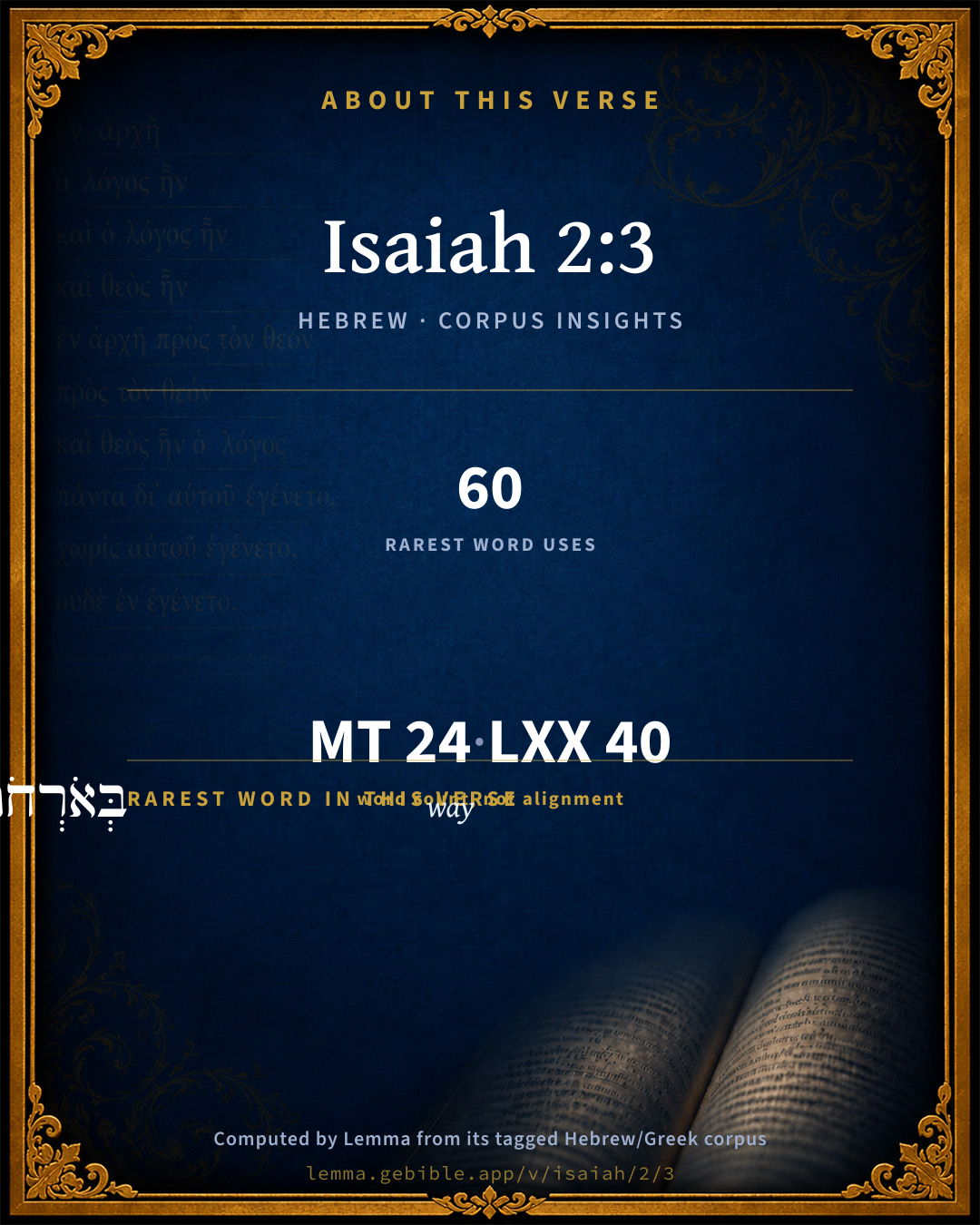
About this verse

These counts appear in no published source. They are computed here, from the morphology-tagged text and Lemma’s own curated glosses. What Lemma adds →

24
words
21
distinct lemmas
Prophets
section

Shared distinctive vocabulary

בְּאֹרְחֹתָ֑יו way H734 occurs in 58 verses of the Hebrew Bible. Also found in:

Grammatical profile

  • 7 verbs
  • 13 nouns
  • 1 adjective
  • 2 prepositions
  • 1 conjunction

Verb forms

  • וְֽהָלְכ֞וּ Qal · Sequential Perfect
  • וְאָמְרוּ֙ Qal · Sequential Perfect
  • לְכ֣וּ Qal · Imperative
  • וְנַעֲלֶ֣ה Qal · Imperfect
  • וְיֹרֵ֨נוּ֙ Hiphil · Imperfect
  • וְנֵלְכָ֖ה Qal · Cohortative
  • תֵּצֵ֣א Qal · Imperfect

Repetition

Words recur within this verse — often emphatic in Hebrew:

  • לְכ֣וּ to walk H3212 ×2
  • יְהוָ֗ה LORD H3068 ×2
  • אֶל to H413 ×2

Hebrew & Septuagint length

In English translation the verse runs 54 words from the Hebrew and 59 from the Septuagint (LXX English) — closely comparable.

A rough comparison of the two English renderings, which tokenize alike — not a word-level alignment.

Word counts can differ between the Hebrew and the Greek without any difference in meaning — e.g. the Hebrew direct-object marker אֵת has no separate Greek word, and Greek often adds the article ὁ.

In the original languages it is 24 Hebrew tokens and 40 Greek tokens — but the two are counted differently (Hebrew bundles its prefixes and suffixes into one token; the Greek is in lemma form), so that isn’t a like-for-like length.

Cross-references

16

Topical passages linked to Isaiah 2:3 in the Treasury of Scripture Knowledge — connected by theme and wording, ordered by reader-vote popularity; previews shown in the World English Bible.

  • Jeremiah 50:4–5 In those days, and in that time, says Yahweh, the children of Israel shall come, they and the children of Judah together; they shall go on their way weeping, and shall seek Yahweh their God.
  • Zechariah 8:20–23 Thus says Yahweh of Hosts: "Many peoples, and the inhabitants of many cities will yet come;
  • Luke 24:47 and that repentance and remission of sins should be preached in his name to all the nations, beginning at Jerusalem.
  • Isaiah 51:4–5 Attend to me, my people; and give ear to me, my nation: for a law shall go forth from me, and I will establish my justice for a light of the peoples.
  • Psalms 25:8–9 Good and upright is Yahweh, Therefore he will instruct sinners in the way.
  • Psalms 110:2 Yahweh will send forth the rod of your strength out of Zion. Rule in the midst of your enemies.
  • Deuteronomy 6:1 Now this is the commandment, the statutes, and the ordinances, which Yahweh your God commanded to teach you, that you might do them in the land where you go over to possess it;
  • John 7:17 If anyone desires to do his will, he will know about the teaching, whether it is from God, or if I am speaking from myself.
  • Jeremiah 31:6 For there shall be a day, that the watchmen on the hills of Ephraim shall cry, Arise you, and let us go up to Zion to Yahweh our God.
  • Romans 10:18 But I say, didn't they hear? Yes, most assuredly, "Their sound went out into all the earth, Their words to the ends of the world."
  • Matthew 7:24 "Everyone therefore who hears these words of mine, and does them, I will liken him to a wise man, who built his house on a rock.
  • Luke 11:28 But he said, "On the contrary, blessed are those who hear the word of God, and keep it."
  • Acts 1:8 But you will receive power when the Holy Spirit has come upon you. You will be witnesses to me in Jerusalem, in all Judea and Samaria, and to the uttermost parts of the earth."
  • Acts 10:33 Therefore I sent to you at once, and it was good of you to come. Now therefore we are all here present in the sight of God to hear all things that have been commanded you by God."
  • Acts 13:46–48 Paul and Barnabas spoke out boldly, and said, "It was necessary that God's word should be spoken to you first. Since indeed you thrust it from you, and judge yourselves unworthy of eternal life, behold, we turn to the Gentiles.
  • James 1:25 But he who looks into the perfect law, the law of freedom, and continues, not being a hearer who forgets but a doer of the work, this man will be blessed in what he does.

Cross-references courtesy of OpenBible.info (CC BY 4.0).

Hebrew and Greek witnesses Masoretic Hebrew ↔ Greek Septuagint

The same verse in the two great witnesses to the Old Testament, shown verse-for-verse.

These are two independent witnesses, not word-aligned to each other, and the Septuagint is shown in lemma (dictionary) form.

Hebrew Isaiah 2:3 Masoretic · Westminster Leningrad Codex

וְֽהָלְכ֞וּ עַמִּ֣ים רַבִּ֗ים וְאָמְרוּ֙ לְכ֣וּ וְנַעֲלֶ֣ה אֶל הַר יְהוָ֗ה אֶל בֵּית֙ אֱלֹהֵ֣י יַעֲקֹ֔ב וְיֹרֵ֨נוּ֙ מִדְּרָכָ֔יו וְנֵלְכָ֖ה בְּאֹרְחֹתָ֑יו כִּ֤י מִצִּיּוֹן֙ תֵּצֵ֣א תוֹרָ֔ה וּדְבַר יְהוָ֖ה מִירוּשָׁלִָֽם

Many peoples shall go and say, "Come, let's go up to the mountain of Yahweh, To the house of the God of Jacob; And he will teach us of his ways, And we will walk in his paths. For out of Zion the law shall go forth, And the word of Yahweh from Jerusalem.

World English Bible · Public Domain

Greek LXX Isaiah 2:3 Septuagint · lemma form

καί πορεύομαι ἔθνος πολύς καί εἶπον δεῦτε καί ἀναβαίνω εἰς ὁ ὄρος κύριος καί εἰς ὁ οἶκος ὁ θεός ἰακώβ καί ἀναἀγγέλλω ἐγώ ὁ ὁδός αὐτός καί πορεύομαι ἐν αὐτός ἐκ γάρ σιων ἐκἔρχομαι νόμος καί λόγος κύριος ἐκ ἰερουσαλήμ

And many nations shall go and say, Come, and let us go up to the mountain of the Lord, and to the house of the God of Jacob; and he will tell us his way, and we will walk in it: for out of Sion shall go forth the law, and the word of the Lord out of Jerusalem.

LXX2012 (modern English Septuagint) · Public Domain

On this verse, Adam Clarke's Commentary discusses the Septuagint’s reading. Read the note in Commentary ↓

Hebrew: Westminster Leningrad Codex (CC BY 4.0). Greek: Septuagint (public domain); English from LXX2012 (modern English Septuagint) (Public Domain). How the Septuagint differs from the Hebrew →

Targum (Aramaic paraphrase)

1

The Targum is the ancient Jewish Aramaic paraphrase of the Hebrew Scriptures — an interpretive translation, not the Hebrew text itself. Onkelos (literal) and Pseudo-Jonathan (expansive) render the Torah, and Jonathan the Prophets. Coverage is partial: where no permissively-licensed English translation exists for a verse, only the Aramaic is shown. This is verse-level text, not a word-by-word alignment to the Hebrew.

  1. Targum Jonathan Prophets (Joshua–Malachi)
    יִיהָבוּן עַמְמִין סַגִיאִין וְיֵמְרוּן אֱתוֹ וְנִסַק לְטוּר בֵּית מַקְדְשָׁא דַייָ לְבֵית שִׁכְנַת אֱלָהֵיהּ דְיַעֲקֹב וְיַלְפִינָנָא מֵאוֹרְחָן דְתַקְנָן קֳדָמוֹהִי וּנְהַךְ בְּאוּלְפַן אוֹרַיְתֵיהּ אֲרֵי מִצִיוֹן תִּפּוֹק אוֹרַיְתָא וְאוּלְפָן פִּתְגָמָא דַייָ מִירוּשְׁלֶם:

    And many people shall go and say, Come ye, and let us go up to the mountain of the house of the sanctuary of the Lord, to the house of the Shekinah of the God of Jacob; and He will teach us of His ways, which are right before Him, and we will walk in the instruction of His law; for out of Zion shall go forth the law, and the instruction of the word of the Lord from Jerusalem.

    Targum Jonathan — Aramaic: “Mikraot Gedolot” (public domain). English: “Sefaria Community Translation” (CC0 1.0 (public-domain dedication)); “London "Chaldee Paraphrase," 1871” (public domain). Text via Sefaria.

Commentary

Notes on Isaiah 2:3 from classic Christian and Jewish commentators (each source and its license shown beneath its notes). The classic Christian expositions comment on the surrounding passage and are grouped to its opening verse, so a note may address several verses; the Jewish commentaries on the Tanakh (Rashi and others) are per-verse, so they appear only where the commentator wrote on this verse.

Lemma curates 59 commentaries, every one of them public domain or Creative Commons licensed, each selected and text-cleaned for this edition rather than reprinted as found. About our sources →

Trapp's Complete Commentary

John Trapp

Isa 2:3 And many people shall go and say, Come ye, and let us go up to the mountain of the LORD, to the house of the God of Jacob; and he will teach us of his ways, and we will walk in his paths: for out of Zion shall go forth the law, and the word of the LORD from Jerusalem.

Ver. 3. And many people shall go and say, &c.] {See Trapp on "Mic 4:2"} where we shall find that that prophet hath the same words with this αυτολεξει. So hath Obadiah the same with Jeremiah, St Mark with St Matthew, St Jude with St Peter, the blessed Virgin in her Magnificat with holy Hannah in her Canticle, &c.

John Trapp, A Commentary or Exposition upon All the Books of the Old and New Testament (1647–1656) — public domain. Text from a community e-Sword module.

The Biblical Illustrator

Joseph S. Exell

Isa_2:3

Come ye, and let us go up to the mountain of the Lord

Many people

For people read peoples.

So ver.

4. (A. B. Davidson, LL. D.)

Desire for spiritual instruction

What I intend is to make use of the words as they express a sincere desire in many people of being better informed in the mind and will of God, by some particular revelation from Himself than they could be by the mere natural light of their own minds, reflecting only upon the general works of creation and providence.

I. EVERY RATIONAL MAN, WHO BELIEVES A GOD AND A PROVIDENCE GOVERNING THE WORLD, IS UNDER A NATURAL OBLIGATION TO INQUIRE WHETHER GOD HAS MADE ANY PARTICULAR REVELATION OF HIS WILL TO MEN, WHICH THEY ARE ANY WAY CONCERNED TO TAKE NOTICE OF.

II. WHOEVER SERIOUSLY MAKES THIS INQUIRY, WILL FIND IT REASONABLE TO CONCLUDE THAT SOME REVELATION MAY JUSTLY BE EXPECTED FROM GOD, CONSIDERING THE GENERAL STATE OF MANKIND.

1. In the nature of things, there is no impossibility that God should make a particular revelation of His will to men. That God should communicate His will to men in a particular manner, implies nothing contradictory, either to the nature of man or God. For if we believe that God is the Maker of mankind, and that from Him they received their reason and understanding, then it is unreasonable to suppose that the mind of man is incapable of receiving any impression of revelation or instruction from the Supreme mind, only because that Supreme mind is of an invisible nature. And it is yet much more unreasonable to suppose any incapacity in the Divine Being, of making such discovery of His will to the mind of man, as His wisdom sees fit; for this would, in effect, be to deny the perfection of His nature, and to make him a Being not acting freely but by necessity, without liberty or choice and this in the end comes to the same thing as denying His Being altogether.

2. Considering our natural notions of the goodness of God, there is no reason to think it incredible that He should at some time or other make such discovery of His will.

3. Considering the general condition of mankind, such revelation is by no means unnecessary.

(1) It is evident, that there is a surprising corruption in human nature; that the generality of men have hardly ever attended duly, at any time, to the natural dictates of their own reason. But much the greater part have shewn themselves more prone to extinguish than to improve the light of reason.

(2) Suppose they had really known the true state of their own case, yet the true cure for it was more than human power or skill could effect. Some of them had recourse to philosophy. But the disease was too inveterate and epidemical to be cured by so weak a medicine.

(3) Supposing the philosophers had been really designed to reform the morals and religion of mankind, they were not sufficiently qualified for such an undertaking, because they them selves were ignorant of many things necessary for it. As they knew not the first cause of the corruption of human nature, so they could know nothing of Gods design in suffering it, nor of the scheme and order of His providence, by which He designed to conduct mankind out of it, into a more perfect and happy state than that from which they had fallen.

(4) In matters of religion, which, naturally, have the greatest influence over the mind of man, and which therefore ought to be under the best and truest direction of all others, they were still more deficient than in anything else. When mankind had once generally fallen from the worship of the one true God, they sunk, by degrees, into the most brutal superstition and idolatry.

(5) Divers of the wisest philosophers did themselves confess that they wanted a Divine revelation to set them right, even in matters which were of the utmost consequence.

(6) Such men as now think that no revelation was ever necessary, but that the want of it might always have been sufficiently supplied by the use of human reason alone, do not state the matter fairly; because they confound part of that light which we insensibly receive by the revelation of the Gospel, with that light of nature which men had before it: that is, they do not distinguish between those notions which the mere heathen world were in possession of before, and those which they attained to after the preaching of the Gospel.

III. IF THIS BE SO, THEN IT IS EVERY MANS DUTY TO USE ALL THE PROPER MEANS HE CAN TO FIND OUT WHAT IS TRUE REVELATION AND WHAT IS ONLY PRETENDED. (R. Boyle.)

Let us go up

Those that are entering into covenant and communion with God themselves should bring as many as they can along with them. (M. Henry.)

He will teach us of His ways

The ways of God

By the ways of God may be meant--

1. His purposes and counsels, so far as are proper and necessary for His servants to be acquainted with, in order to promote their happiness and salvation.

2. His providential dispensations, so far as is consistent with their duty and interest to know them. That they may understand the loving kindness of the Lord.

3. The ministration of His Spirit and the way of salvation, by which the manifold wisdom of Jehovah is admirably displayed. These are, with great propriety, called the ways of God, as He points them out to us in His Word, and as they are intended to conduct to the enjoyment of Him in the land of everlasting upright ness. (R. Macculloch.)

And we will walk in His paths

Walking in Gods paths

The resolution before us--

1. Plainly implies a free choice of the precepts of the Gospel, in preference to all other ways, and in opposition to every kind of compulsion whatever.

2. It includes a fixed purpose of heart, a firm determination, to cleave unto the Lord, notwithstanding every difficulty and discouragement that may lie in the way.

3. And as walking is an uniform, progressive motion, it comprehends a constant, persevering progress in the good ways of the Lord, wherein they are instructed. (R. Macculloch.)

The Biblical Illustrator, edited by Joseph S. Exell (c. 1880s–1900s) — public domain. Text from a community e-Sword module.

Joseph Benson's Commentary

Isa 2:3. And many people shall go — Shall not only have some weak desires of going, but shall take pains, and actually go; and say, Come, &c. — Yea, such shall be their zeal, that they shall not only go themselves, but shall persuade and press others to go with them. And we will walk in his paths — Thus they show the truth of their conversion, by their hearty desire to be instructed in the way of worshipping and serving God acceptably, and by their firm purpose of practising the instructions given. For out of Zion shall go forth the law — The new law, the doctrine of the gospel, which is frequently called a law, because it hath the nature and power of a law, obliging us no less to the belief and practice of it than the old law did; and the word of the Lord — For the accomplishment of this promise, see Luk 24:47; Act 1:8; Rom 10:18. This last clause shows the reason why the people should be so forward to go, and to invite others to go with them.

Joseph Benson's Commentary on the Old and New Testaments (1811–1818) — public domain. Text from a community e-Sword module.

Tyndale Open Study Notes

Tyndale Open Resources

2:3 Human society will undergo changes as people conform to God’s revelation and follow his ways and paths. • Judah received the revelation (teaching . . . word) but did not obey it (1:10-15); however, the nations will be ready to do God’s will.

Tyndale Open Study Notes — © Tyndale Open Resources, licensed CC BY-SA 4.0. Text via the HelloAO Bible API.

Geneva Bible (1599)

Geneva Bible translators

Meaning, the whole doctrine of salvation.

This was accomplished, when the Gospel was first preached in Jerusalem, and from thence went through all the world.

Alluding to mount Zion, where the visible Church then was.

Geneva Bible (1599) marginal notes — public domain. Text via Bolls.life.

Jamieson, Fausset & Brown

Robert Jamieson, A. R. Fausset & David Brown

If the curse foretold against Israel has been literally fulfilled, so shall the promised blessing be literal. We Gentiles must not, while giving them the curse, deny them their peculiar blessing by spiritualizing it. The Holy Ghost shall be poured out for a general conversion then (Jer 50:5; Zac 8:21, Zac 8:23; Joe 2:28).

from Jerusalem-- (Luk 24:47) an earnest of the future relations of Jerusalem to Christendom (Rom 11:12, Rom 11:15).

Jamieson, Fausset & Brown — Commentary Critical and Explanatory on the Whole Bible (1871) — public domain (CC PDM 1.0). Text via the HelloAO Bible API.

Adam Clarke's Commentary

Verse 3. To the house] The conjunction ו vau is added by nineteen of Kennicott's, thirteen of De Rossi's MSS., one of my own, and two editions, the Septuagint, Syriac, Vulgate, Arabic, and some copies of the Targum; AND to the house. It makes the sentence more emphatic.

He will teach us of his ways] Unless God grant a revelation of his will, what can we know?

We will walk in his paths] Unless we purpose to walk in the light, of what use can that light be to us?

For out of Zion shall go forth the law] In the house of God, and in his ordinances only, can we expect to hear the pure doctrines of revelation preached.

1. God alone can give a revelation of his own will.

2. We must use the proper means in order to know this will.

3. We should know it in order to do it.

4. We should do it in order to profit by it.

5. He who will not walk in the light when God vouchsafes it, shall be shut up in everlasting darkness.

6. Every man should help his neighbour to attain that light, life, and felicity: "Come ye, and let us walk in the light of the Lord."

Adam Clarke's Commentary on the Bible (1810–1826) — public domain. Text from a community e-Sword/MySword module.

Ellicott's Commentary for English Readers

(3) Many people shall go and say . . .—What was precious to the prophet’s heart was the thought that these pilgrims from afar would not come as with a formal worship like that of Isa_1:10-15, but, like the queen of Sheba (1Ki_10:1-10), as seekers after truth, desiring to be taught. (Comp. Isa_60:3.) The “ways” and the “paths” are the great laws of righteousness, which lead to the eternal life. The verb for “teach” is the root of the Hebrew for “law,” as the “teaching” of Jehovah.

Shall go forth the law . . .—In the preaching of the Christ, in the mission of the Twelve, in the whole history of the Apostolic Church, we have, to say the least, an adequate fulfilment of the promise. The language of St. Paul, however, suggests that there may be in the future a yet more glorious mission, of which Jerusalem shall once more be the centre (Rom_11:12-15).

A Bible Commentary for English Readers, edited by Charles John Ellicott (1878–1897) — public domain. Text from a community e-Sword module.

The Cambridge Bible for Schools and Colleges

gen. ed. J. J. S. Perowne

3. The conflux of nations explained by the desire, everywhere expressed, to know and practise the ways of Jehovah. Cf. Zec_8:20-21. and he will teach us … and we will walk] Or that He may teach us … and that we may walk. The verb for “teach” is that from which the noun “Tôrâh” (Isa_1:10) is derived; hence the instruction must be conceived as communicated through the agency of prophets like Isaiah. of his ways] The preposition has a partitive sense (cf. Psa_94:12): “somewhat of his ways”; each people receiving such direction as is adapted to its peculiar circumstances. The “ways” and “paths” of Jehovah, denoting the revealed principles and maxims of religion and ethics, are figures too frequent in the O.T. to need detailed references.

for out of Zion … Jerusalem] These may be either words of the prophet, looking into the future, or of the peoples themselves as they exhort one another to go up to Jerusalem. In the latter case the verbs should be rendered in the present tense. the law] i.e. “Tôrâh.” See on Isa_1:10.

The Cambridge Bible for Schools and Colleges (gen. ed. J. J. S. Perowne; Cambridge University Press, 1878–1918) — public domain. Text from a community e-Sword module.

John Gill's Exposition

And many people shall go and say,.... This is a prophecy of the numerous conversions among the Gentiles in the latter day, and agrees with Zac 8:20 and even the author of the old Nizzachon (p) interprets it of the gathering of the people to the Messiah.

Come ye, and let us go up to the mountain of the Lord, and to the house of the God of Jacob; the church of Christ, so called; See Gill on Isa 2:2. This expresses the concern that truly gracious souls have for the house of God, and his worship in it; they go up to it, considering it both as their duty and their privilege; and which they do frequently and constantly, with much spiritual pleasure, though sometimes with difficulty, finding their account in it, and knowing it is for the glory of God; and not content with so doing themselves, they encourage others to do so likewise; either professors of religion with them, who are negligent and backward through a spirit of slumber and slothfulness on them; through lukewarmness, coldness, and leaving their first love; through an over love to the world, and the things of it; and through a vain conceit of themselves, as being as knowing as their teachers, or wiser than they: or else such who have made no profession, who are quite ignorant of divine things, these they endeavour to bring with them, out of love to their souls, that they may be under the means of grace, in order to their conversion; and such as are inquiring the way to Zion, with their faces toward it, these they encourage to join with them in holy fellowship; and in all they set an example by a constant attendance themselves; they do not stir them up to go alone, either one or other, but propose to go with them. See Psa 122:1.

and he will teach us of his ways: that is, the Lord the God of Jacob, the covenant God and Father of his church and people, who often in this prophecy go by the name of Jacob; he is the teacher, and there is none teacheth like him; and happy are they who are taught of God, and who have heard and learnt of the Father, and come to Christ: he taught men by his Son, when here on earth; who was a teacher that came from God, taught the way of God in truth, and with authority, as the Scribes and Pharisees did not: and then by his Spirit, sent after him to teach all things, and bring all things to remembrance; and since by his apostles and ministers, who have gifts, and a commission to teach men; though all human teachings are of no avail, without a divine blessing, unless accompanied with the anointing, which teacheth all things; and which will be abundantly bestowed in the latter day, when all the children of Zion, and that come to the house of the Lord, will be taught of God. Kimchi says, the teacher here is the King Messiah; the "us" to be taught are Gentiles, aliens from the commonwealth of Israel, and strangers to the covenants of promise, whom Christ, under the Gospel dispensation, has given his ministers a commission to teach; and here design such as are humble souls, and sensible of their ignorance, and who know something of Christ, and believe in him; yet, as they know but in part, they desire to know more. The things taught them are the "ways" of the Lord; his ways of love, grace, and mercy, in the salvation of men; the steps he took in eternity towards it, by consulting and contriving the best method of it, forming it in his Son, and agreeing with him in covenant about it, and choosing the persons in him he designed to save: and also his goings forth in time, by sending his Son into this world, to obtain salvation for them, and his Spirit into their hearts, to apply it to them; likewise the ways which he prescribes and directs his people to walk in, such as the ordinances of the Gospel, and every path of duty: and the place where these are taught is the church of God, and to this school all that desire to learn should go; and there is ever something more and more of these ways to be learnt; for they are not all learnt at once, only part of his ways; and it is but a small portion, we know of these in the present state, which God has taken in order to bring about our salvation.

And we will walk in his paths; in Christ, the way, by faith, and in all his ordinances and paths of duty, according to the rule of his word; in imitation of him, and as he walked; in a dependence on his wisdom, grace, and strength, continuing therein; for walking is a progressive motion, and designs a series and course of obedience and perseverance in it:

for out of Zion shall go forth the law, and the word of the Lord from Jerusalem; by which is meant the law or doctrine of the Messiah, Isa 42:4 for the Hebrew word signifies any doctrine, and so the evangelical one, the law or doctrine of faith, of justification by faith in Christ's righteousness, Rom 3:27 together with all other doctrines of the same kind; called the "word of the Lord", which the Lord Christ is the author, preacher, sum, and substance of; the word of righteousness, peace, reconciliation, life, and salvation by him. This first began according to his commission and direction to be preached at Jerusalem, and from thence it went forth into all the world; and it is in Zion, in the church of God, it is now preached, and will be more clearly and fully in the latter day; and so is an argument and an encouraging reason to engage persons to go up thither and hear it.

(p) Apud Wagenseil. Tela ignea, p. 29.

John Gill's Exposition of the Whole Bible (1746–1763) — public domain (CC PDM 1.0). Text via the HelloAO Bible API.

Albert Barnes' Notes on the Bible

And many people shall go - This denotes a prevalent “desire” to turn to the true God, and embrace the true religion. It is remarkable that it speaks of an inclination among them to “seek” God, as if they were satisfied of the folly and danger of their ways, and felt the necessity of obtaining a better religion. In many cases this has occurred. Thus, in modern times, the people of the Sandwich Islands threw away their gods and remained without any religion, as if waiting for the message of life. Thus, too, the pagan not unfreguently come from a considerable distance at missionary stations to be instructed, and to receive the Bible and tracts. Perhaps this is to be extensively the mode in which Christianity is to be spread. God, who has all power over human hearts, may excite the pagan to anxious inquiry; may show them the folly of their religion; and may lead them to this “preparation” to embrace the gospel, and this disposition to “go” and seek it. He has access to all people. By a secret influence on the understanding, the heart, and the conscience of the pagan, he can convince them of the folly of idolatry and its vices. He can soften down their prejudices in favor of their long-established systems; can break down the barriers between them and Christians; and can dispose them to receive with joy the messengers of salvation. He can raise up, among the pagan themselves, reformers, who shall show them the folly of their systems. It cannot be doubted that the universal triumph of the gospel will be preceded by some such remarkable preparation among the nations; by a secret, silent, but most mighty influence from God on the pagan generally, that shall loosen their hold on idolatry, and dispose them to welcome the gospel. And the probability that this state of things exists already, and will more and more, should be an inducement to Christians to make more vigorous efforts to send every where the light of life.

He will teach us of his ways - He will make us acquainted with his will, and with the doctrines of the true religion.

For out of Zion - These are the words of the “prophet,” not of the people. The prophet declares that the law would go from Zion; that is, Zion would be the center from which it would be spread abroad; see the note at Isa 1:8. Zion is put here for Jerusalem, and means that the message of mercy to mankind would be spread “from” Jerusalem. Hence, the Messiah commanded his disciples to tarry ‘in Jerusalem until they should be endued with power from on high.’ Luk 24:49. Hence, also, he said that repentance and remission of sins should ‘be preached among all nations, beginning at Jerusalem’ - perhaps referring to this very passage in Isaiah; Luk 24:47.

The law - This is put here for the doctrines of the true religion in general. The law or will of God, under the reign of the Messiah, would proceed from Zion.

The word of the Lord - The message of his mercy to mankind; that which he has “spoken” respecting the salvation of men. The truth which is here taught is, “that Zion or the church is the source of religious truth, and the center of religious influence in the world.” This is true in the following respects:

(1) Zion was the source of religious truth to the ancient world. Knowledge was gained by travel; and it is capable of about as clear demonstration as any fact of ancient history, that no inconsiderable part of the knowledge pertaining to God in ancient Greece was obtained by contact with the sages of distant lands, and that the truths held in Zion or Jerusalem thus radiated from land to land, and mind to mind.

(2) The church is now the center of religious truth to the world around it.

(a) The world by its philosophy never originates a system of religion which it is desirable to retain, and which conveys any just view of God or the way of salvation.

(b) The most crude, unsettled, contradictory, and vague opinions on religion prevail in this community called ‘the world.’

(c) If “in” this community there are any opinions that are true and valuable, they can in most instances be traced to “the church.” They are owing to the influence of the pulpit; or to an early training in the Bible; or to early teaching in the Sabbath-school, or to the instructions of a pious parent, or to the “general” influence which Christianity exerts on the community.

(3) The church holds the power of “reformation” in her hands, every cause of morals advancing or retarding as she enters into the work, or as she withdraws from it.

(4) The pagan world is dependent on the church for the knowledge of the true religion. There are “no” systems of truth that start up on a pagan soil. There is no elastic energy in a pagan mind. There is no recuperative power to bring it back to God. There is no “advance” made toward the truth in any pagan community. There is no well-spring of life to purify the soul. The effect of time is only to deepen the darkness, and to drive them farther from God. They only worship mere shapeless blocks; they bow down before worse looking idols; they enter less elegant and more polluted temples. The idols of the pagan are not constructed with half the skill and taste evinced two thousand years ago; nor are their temples built with such exquisite art. No idol of the pagan world now can compare with the statue of Minerva at Athens; no temple can be likened to the Parthenon; no sentiment of paganism in China, India, or Africa, can be compared with the views of the sages of Greece. The pagan world is becoming worse and worse, and if ever brought to better views, it must be by a “foreign” influence; and that influence will not go forth from philosophy or science, but “from the church.” If light is ever to spread, it is to go forth from Zion; and the world is dependent on “the church” for any just knowledge of God and of the way to life, The ‘law is to go forth from Zion;’ and the question whether the million of the human family are to be taught the way to heaven, is just a question whether the church can be roused to diffuse abroad the light which has arisen on her.

Albert Barnes' Notes on the Bible (1834–1885) — public domain. Text from a community e-Sword/MySword module.

Haydock's Catholic Bible Commentary

Jerusalem. Our Saviour preached there, and in some sense the religion established by him, may be esteemed a reform, or accomplishment of the old law.

George Leo Haydock (1774–1849), Haydock's Catholic Family Bible and Commentary, 1859 edition — public domain. Excludes Psalms (Douay-Rheims chapter numbering differs from Protestant) and Deuterocanonical books (Catholic canon only).

Matthew Poole's English Annotations

Shall go; shall not only have some weak desires of going, but shall be ready to take pains, and shall actually go. And say; such shall be their zeal, that they shall not only go themselves, but shall persuade and press others to go with them.

We will walk in his paths; they show the truth of their conversion by their hearty desire to be structed in the way or method of worshipping and serving God acceptably, and by their firm purpose of practising the instructions given to them. For: this last clause contains the reason why the people should be so forward to go, and to invite others to go with them; and they may be the words either of the people, continuing their speech; or of the prophet, now returning to speak in his own name.

The law; the new law, the doctrine of the gospel, which is frequently called a law, because it hath the nature and power of a law, obliging us no less to the belief and practice of it than the old law did.

The word of the Lord from Jerusalem: for the accomplishment of this promise, see Luk 24:47; Act 1:8; Rom 10:18.

Matthew Poole's English Annotations on the Holy Bible (1683–1685) — public domain. Text from a community e-Sword/MySword module.

Whedon's Commentary on the Bible

Daniel D. Whedon

3. Shall go and say — With missionary zeal they shall in multitudes gather other multitudes to be taught.

Mountain of the Lord — Zion again, where Jehovah dwells.

The house… Jacob — Second phrase, more familiar than the first, and so explains the first. See Psa_20:1.

Of his ways — “Of” is loosely partitive. We can know only in part, (1Co_13:1,) yet sufficient to walk in God’s “ways” and be saved.

The law — The true religion as a rule of duty.

Word of the Lord — The true religion as a revelation.

Daniel D. Whedon (gen. ed.), Commentary on the Old and New Testaments (1874–1909) — public domain. Text from a community e-Sword module.

The Pulpit Commentary

Many people; rather, many peoples. Shall go; or, set forth. The prophet means to represent the nations as encouraging one another on the way. There is no jealousy among them, for the "mountain" can hold them all. He will teach us. The nations feel their ignorance of God, and their need of "teaching." God alone can teach them concerning himself; (Rom_11:33, 34 1Co_2:10, 1Co_2:11) and "he will teach" them, either directly, as the Incarnate Son, or indirectly through those whom he has appointed to be "teachers". (1Co_12:28) Of his ways; i.e. "some of his ways," not "all of them;" for at present "we know in part" only, (1Co_13:9) and the greater portion of his ways are "past finding out". (Rom_11:33) The "ways" here spoken of are, no doubt, rules for the conduct of life, which are practically inexhaustible. God, however, will teach every man, who honestly seeks to learn, enough to enable him to "walk in his paths." Out of Zion shall go forth the Law; rather, instruction, or teaching. The word (torah) is without the article. The instruction intended is that of the Church of God.

HOMILIES BY W.M. STATHAM Ver. 3. Real religious revival

"Many people shall go and say, Come ye, and let us go up to the mountain of the Lord, to the house of the God of Jacob." Here is the tide of national feeling, no longer on the ebb, but on the flow. God is "to teach them his ways, and they are to walk in his paths;" for they have found out that pleasure gained by sin is peace bartered. Elevation of the truest kind is to be theirs now. This is the image of their uplifted state. They are to go up to the mountain of the Lord"s house the consecrated height of holiness and peace.

I THERE IS SPONTANEITY OF LIFE. "Come, let us go." It is no mere fashion, or custom, or compulsion of obedience. Life always says, "Come." I read delight here. For what we enjoy we invite others to see. When we ascend to the mountain-top, and see the winding river, like a streak of silver, and the village-dotted plains, we cry "Come!" to others, that they too may delight in the loveliness of the scene. So an earnest Christian not only says "Come!" because of the urgency of the salvation, but also because of the beauty and blessedness of religion. "Oh taste and see," he says, "that the Lord is good: blessed is the man that trusteth in him.

II THERE IS SACRED FELLOWSHIP. "Let us go up." For religion is intensified in its experiences by mutual faith and joy. The interaction of mind on mind and heart upon heart in a great congregation is wonderful. "Let us go up." And beautiful were those spectacles in Hebrew history, when the pilgrims went to tabernacle or temple. "Thither the tribes go up," The festal caravans met each other from distant parts, as they merged at last into one common road to time-beloved Jerusalem. At the Feasts of Pentecost and Passover, as in the days of our Savior, the interest felt in these upgoings to Jerusalem was both human and Divine. Old friends met again, whilst youths and maidens set eyes for the first time on the city and temple of their fathers. On their way they sang the songs of Zion, till in noblest worship the gathered tribes lifted up their praise to the Lord God of Israel.

III THERE IS SUBLIME PROPHECY. "Many shall go," Yes, and in these Christian days, Greek and Jew, bond and flee, have been united in one common song of deliverance. Missionary societies have founded Churches and schools on well-nigh every shore. "Many shall corns." Verily, unto Christ shall the gathering of the people be. "All nations shall call him blessed." How verified the words have been! "For out of Zion shall go forth the Law, and the Word of the Lord from Jerusalem. W.M.S.

The attractions of the gospel Church.

The earthly Jerusalem, which was thought of as a mountain surrounded by mountains, but superior to them all, is in the prophet"s mind, and it gives form to his thought of the Gospel times the setting up of the Christian Church, and the planting of the Christian religion in the world. Christianity shall then be the "mountain of the Lord"s house," or the "Lord"s mountain house," exalted above all other religions, and made the rendezvous of all the spiritual seed of Abraham. "The prophet sees the Church permanently placed in a conspicuous position, so as to be a source of attraction to surrounding nations. To express this idea, he makes use of terms which are strictly applicable only to the local habitation of the Church under the old economy. Instead of saying, in modern phraseology, that the Church, as a society, shall become conspicuous and attract all nations, he represents the mountain upon which the temple stood as being raised and fixed above the other mountains, so as to be visible in all directions" (J. A. Alexander).

T.K. Cheyne notices an "old belief in Eastern Asia that there was a mountain reaching from earth to heaven, on the summit of which was the dwelling of the gods. The prophet is, perhaps, alluding to this belief, which he recognizes as true in substance, though attached by the heathen to a wrong locality." The text may be illustrated by the custom of the Israelites to journey from all parts of the country for the yearly feasts. Keeping the figure of the prophet, we observe

I THE GOSPEL CHURCH IS LIKE A MOUNTAIN, Illustrate from the conspicuous position of Jerusalem, or of Safed. A mountain rises up out of the plain; so the gospel Church is right in the midst of the world and the people. A mountain towers up above the plain, within sight of all; and so the gospel Church is such a striking and impressive thing that all eyes must be turned to it. Men cannot be blind to it; men dare not ignore it. Like the mountain, it is an indestructible fact, of which men must take account. The buildings erected for its worship are the symbols of itself; in every village, town, and city, the church tower and cathedral spire rise above the buildings of the people, well in everybody"s sight. Show that however men may think to dispel the so-called myths that have gathered round the historic Christ, they must deal with this mountain-fact, the gospel Church exists; it must have had a source; it must have a mission at the heart of it. Surely it is the witness of the truth of Christ.

II THE GOSPEL CHURCH IS FIGURED AS ON THE TOP OF THE MOUNTAINS, Other religions, other social and philanthropic schemes for the elevation of the race, may be figured as mountains. But let them all be gathered together, and it will be found that Christianity towers high above them all. Its origin, its character, its provisions, make it the most conspicuous, the most important of them all. Comparisons may be instituted

(1) with man-made religions, paganism, Buddhism, etc.; and

(2) with previously given Divine religions, such as patriarchism, Mosaism, etc. The points of superiority are such as these:

1. Revelation of God to man under the figure of Father.

2. Manifestation of God in the person of his Son as a fellow-man.

3. Redemption of man by the intervention of Divine love.

4. Perfect provision for the needs of man, as a spiritual being.

5. Adequate and final mastery of all man"s moral foes and evils.

Show that other religions touch some of man"s needs. Christianity is at the "top of the mountains," because it reaches them all, and deals with them efficiently.

III THE GOSPEL CHURCH ATTRACTING ALL NATIONS. They will be drawn, not forced into it. One shall tell another of it. One shall invite another to journey to it. They shall flow to it as streams flow to the sea. "There is an Eastern fable of a great mountain of lodestone, out in the middle of the sea, that attracted, to their destruction, all the ships that came near it. This mountain of the Lord"s house is a great spiritual magnet, and it draws souls, not to destruction, but to everlasting life" (Dr. Edmond). Illustrate

(1) from the various nations attracted by the preaching of the early Church;

(2) from the power of the preached gospel in various heathen lands now;

(3) from its proved fitness to meet the needs of all sinners and all sufferers. Jesus said, "I, if I be lifted up, will draw all men unto me. R.T.

The Pulpit Commentary (1880–1919), ed. H.D.M. Spence-Jones & Joseph S. Exell — public domain. Text from a community e-Sword module.

John Wesley's Explanatory Notes

The law - The new law, the doctrine of the gospel, which is frequently called a law, because it hath the nature and power of a law, obliging us no less to the belief and practice of it, than the old law did.

John Wesley, Explanatory Notes Upon the Whole Bible (1754–1765) — public domain. Text via the GEBible commentary corpus.

Keil & Delitzsch

C. F. Keil & F. Delitzsch

"And peoples in multitude go and say, Come, let us go up to the mountain of Jehovah, to the house of the God of Jacob; let Him instruct us out of His ways, and we will walk in His paths." This is their signal for starting, and their song by the way (cf., Zac 8:21-22). What urges them on is the desire for salvation. Desire for salvation expresses itself in the name they give to the point towards which they are travelling: they call Moriah "the mountain of Jehovah," and the temple upon it "the house of the God of Jacob." Through frequent use, Israel had become the popular name for the people of God; but the name they employ is the choicer name Jacob, which is the name of affection in the mouth of Micah, of whose style we are also reminded by the expression "many peoples" (ammim rabbim). Desire for salvation expresses itself in the object of their journey; they wish Jehovah to teach them "out of His ways," - a rich source of instruction with which they desire to be gradually entrusted. The preposition min (out of, or from) is not partitive here, but refers, as in Psa 94:12, to the source of instruction. The "ways of Jehovah" are the ways which God Himself takes, and by which men are led by Him - the revealed ordinances of His will and action. Desire for salvation also expresses itself in the resolution with which they set out: they not only wish to learn, but are resolved to act according to what they learn. "We will walk in His paths:" the hortative is used here, as it frequently is (e.g., Gen 27:4, vid., Ges. 128, 1, c), to express either the subjective intention or subjective conclusion. The words supposed to be spoken by the multitude of heathen going up to Zion terminate here. The prophet then adds the reason and object of this holy pilgrimage of the nations: "For instruction will go out from Zion, and the word of Jehovah from Jerusalem." The principal emphasis is upon the expressions "from Zion" and "from Jerusalem." It is a triumphant utterance of the sentiment that "salvation is of the Jews" (Joh 4:22). From Zion-Jerusalem there would go forth thorah, i.e., instruction as to the questions which man has to put to God, and debar Jehovah, the word of Jehovah, which created the world at first, and by which it is spiritually created anew. Whatever promotes the true prosperity of the nations, comes from Zion-Jerusalem. There the nations assemble together; they take it thence to their own homes, and thus Zion-Jerusalem becomes the fountain of universal good. For from the time that Jehovah made choice of Zion, the holiness of Sinai was transferred to Zion (Psa 68:17), which now presented the same aspect as Sinai had formerly done, when God invested it with holiness by appearing there in the midst of myriads of angels. What had been commenced at Sinai for Israel, would be completed at Zion for all the world. This was fulfilled on that day of Pentecost, when the disciples, the first-fruits of the church of Christ, proclaimed the thorah of Zion, i.e., the gospel, in the languages of all the world. It was fulfilled, as Theodoret observes, in the fact that the word of the gospel, rising from Jerusalem "as from a fountain," flowed through the whole of the known world. But these fulfilments were only preludes to a conclusion which is still to be looked for in the future. For what is promised in the following v. is still altogether unfulfilled.

Keil & Delitzsch — Biblical Commentary on the Old Testament (1861–1891) — public domain (CC PDM 1.0). Text via the HelloAO Bible API. (Old Testament only.)

J. A. Alexander on Isaiah

Joseph Addison Alexander

This confluence of nations is described more fully, and its motive stated in their own words, namely, a desire to be instructed in the true religion, of which Jerusalem or Zion, under the old dispensation, was the sole depository. “And many nations shall go” (set out, put themselves in motion) “and shall say” (to one another), “Go ye” (as a formula of exhortation, where the English idiom requires come), “and we will ascend” (or let us ascend, for which the Hebrew has no other form) “to the mountain of Jehovah” (where His house is, where He dwells), “to the house of the God of Jacob, and He will teach us of His ways” (the ways in which He requires us to walk), “and we will go in His paths” (a synonymous expression). “For out of Zion shall go forth law” (the true religion, as a rule of duty), “and the word of Jehovah” (the true religion as a revelation) “from Jerusalem.” These last words may be either the words of the Gentiles, telling why they looked to Zion as a source of saving knowledge, or the words of the Prophet, telling why the truth must be thus diffused, namely, because it had been given to the church for this very purpose. The common version “many people” conveys to a modern ear the wrong sense many persons, and was only used for want of such a plural form as peoples, which, though employed by Lowth and others, has never become current, and was certainly not so when the Bible was translated, as appears from the circumlocution used instead of it in Gen 25:23. The plural form is here essential to the meaning. “Go” is not here used as the opposite of come, but as denoting active motion. The word “ascend” is not used in reference to an alleged Jewish notion that the Holy Land was physically higher than all other countries, nor simply to the natural site of Jerusalem, nor even to its moral elevation as the seat of the true religion, but to the new elevation and conspicuous position just ascribed to it. The subjunctive construction “that He may teach” is rather paraphrastical and exegetical than simply expressive of the sense of the original, which implies hope as well as purpose.

Joseph Addison Alexander, The Prophecies of Isaiah (1846–1847; New York: Scribner, 1870–1878) — public domain. Text from a community e-Sword module.

unfoldingWord translationNotes

Door43 World Missions Community

General Information:

Isaiah speaks to the people of Judah in the form of a poem. (See: Parallelism)

Jacob, so he may teach ... and we may walk

Another possible meaning is "Jacob. He will teach ... and we will walk"

he may teach us some of his ways, and we may walk in his paths

The words "ways" and "paths" are metaphors for the way a person lives. If your language has only one word for the ground on which people walk, you may combine these phrases. AT: "he may teach us his will so that we may obey him" (See: Parallelism and Metaphor)

For out of Zion will go the law, and the word of Yahweh from Jerusalem

These phrases mean the same thing. Isaiah was emphasizing that all nations will understand that the truth is found in Jerusalem. AT: "People in Zion will teach God's law, and people in Jerusalem will teach the word of Yahweh" (See: Parallelism)

For out of Zion will go the law

"For the law will go out from Zion." Isaiah speaks as if the law were something like a river that moves without people doing anything. AT: "Those to whom they teach the law will go out from Zion" or "Yahweh will proclaim his law from Zion" (See: Metaphor)

the word of Yahweh from Jerusalem

"the word of Yahweh will go out from Jerusalem." Isaiah speaks as if the word of Yahweh were something like a river that moves without people doing anything. You can make clear the understood information. AT: "Those to whom they teach the word of Yahweh will go out from Jerusalem" or "Yahweh will proclaim his word from Jerusalem" (See: Metaphor and Ellipsis)

translationWords

people group

Yahweh

house of God

Jacob

walk

Zion

law

word of God

Jerusalem

unfoldingWord translationNotes — © Distant Shores Media and the Door43 World Missions Community, licensed CC BY-SA 4.0. Source: git.door43.org/Door43/en_tn.

Rashi

Rabbi Shlomo Yitzchaki (Rashi)

to the house of the God of Jacob Since he [Jacob] called it [the Temple site] Beth El [the house of God], therefore, it will be called on his name, but Abraham called it a mount, “On God’s mount shall He appear” (Gen. 22:14); Isaac called it a field, “to meditate in the field” (ibid. 24:63).

Rashi on the Tanakh — English translations: “The Judaica Press complete Tanach with Rashi, translated by A. J. Rosenberg” (CC BY 4.0); “Pentateuch with Rashi's commentary by M. Rosenbaum and A.M. Silbermann, 1929-1934” (public domain); “The Metsudah Tanach series, Lakewood, N.J” (CC BY 4.0); and “The Book of Joshua, Metsudah Publications, 1997” (CC BY 4.0). Text via Sefaria.

Lesson kit

Teaching starters — assembled from the data on this page, not authored interpretation. Every prompt links to the verse data it draws on. Edit before teaching.

Isaiah, in the Prophets, opens this verse with 24 words (21 distinct Hebrew lemmas). Its most distinctive word is ʼôrach (“way”). A historical commentator’s framing appears above. Read the whole chapter for the surrounding context.

Discussion questions

  1. What does “way” (ʼôrach) contribute to the verse as a whole?
  2. Genesis 18:11 shares the word «way» with this verse. How do the two illuminate each other?
  3. “to walk” occurs 2× in this one verse. What is the effect of the repetition?
  4. The translations on this page render this verse differently — a whole-verse word diff, not a word-by-word alignment. What might account for the different wordings?
  5. The verb «וְֽהָלְכ֞וּ» is Qal Sequential Perfect. How does its form color the action?
  6. Reading how Trapp's Complete Commentary and The Biblical Illustrator read this verse, where do the two commentators agree and where do they part?

Things to notice

Reading settings

Reading text

Shown beneath each verse's original-language words.

Old Testament
Old Testament edition

Read the OT as the Masoretic Hebrew (MT) or the Greek Septuagint (LXX).

English shown for the Greek Septuagint (in the Hebrew ↔ Greek comparison).

Comparing translations? Open the Compare panel on any verse page to stack up to four side by side.