Isaiah 10:32

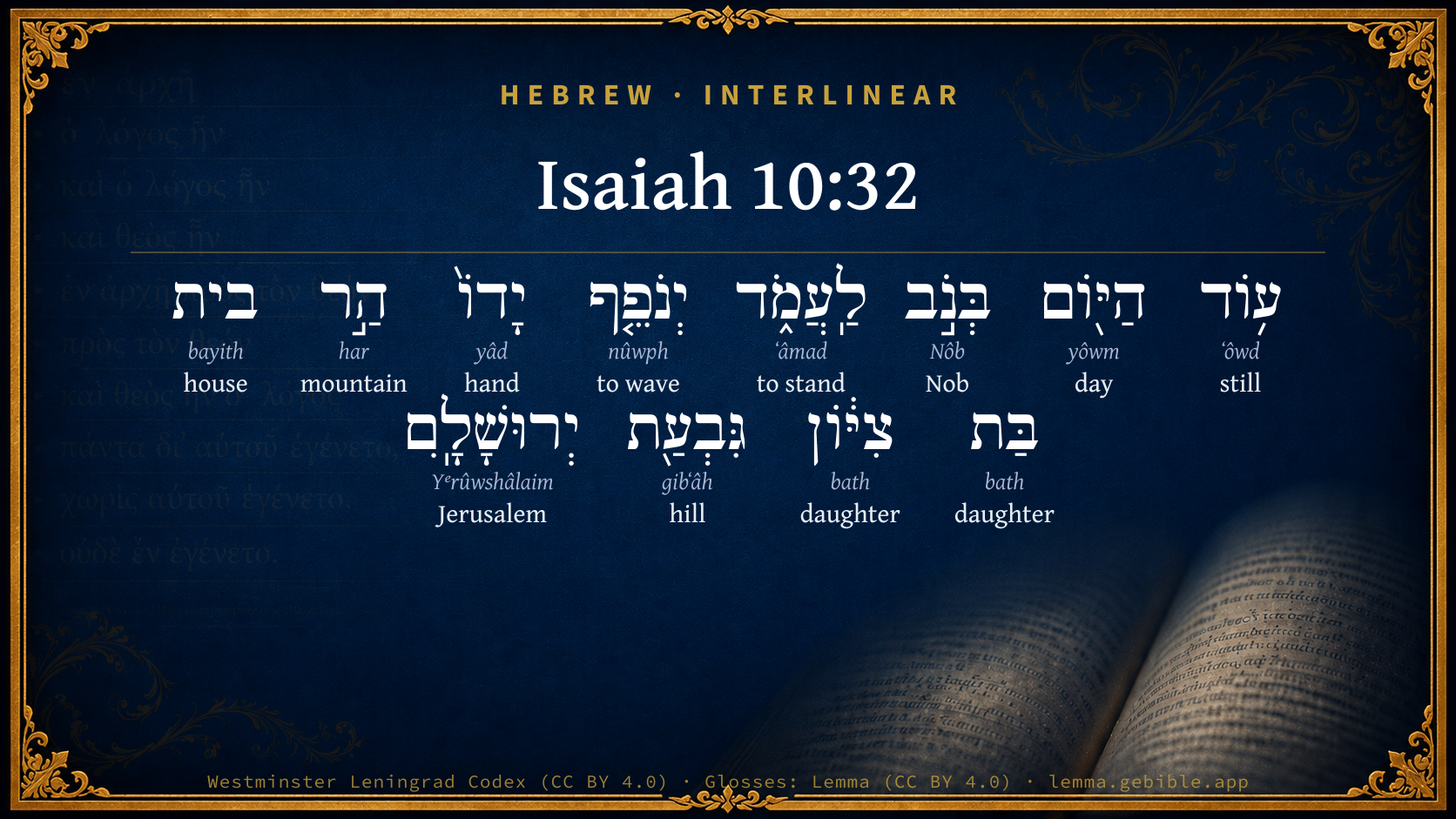
Hebrew (Westminster Leningrad Codex) Isaiah 10:32 appears in the Hebrew Old Testament. The text above is from the Westminster Leningrad Codex. Each word links to its Strong’s number, a concise gloss, and parsing drawn from the Open Scriptures Hebrew Bible morphology. Click any word for its full Brown-Driver-Briggs (BDB) entry.
Download image
Cite this verse

Isaiah 10:32 (World English Bible). Public Domain. Lemma interlinear Bible study tool, https://lemma.gebible.app/v/isaiah/10/32.

Show BibTeX & RIS
BibTeX
RIS
English Translation
This very day shall he halt at Nob: he shakes his hand at the mountain of the daughter of Zion, the hill of Jerusalem.
World English Bible · Public Domain
Download a study sheet

One document with this verse’s original text, its word-by-word gloss line, the meaning frame, cross-references with their text, attributed commentary, and full source and license credits — printable, and it pastes into notes with its structure intact.

This verse Autodidact and up

Study sheet (.html) Plain text (.txt)

A passage Seminary Student

Up to 50 verses in one chapter. A passage sheet keeps up to 6 commentary sources and 12 cross-references per verse, in the order this page ranks them, and says so on the sheet whenever that leaves anything out. Ask for a single verse and you get the Autodidact verse sheet above.

Everything on this page stays free to read, with no account — the sheet is a download of what is already on screen, not access to it.

Want to remove ads? Support Godless Engineer
Compare translations 3

The same verse in 3 English versions, stacked beneath the original-language interlinear above. Click any original word for its lexicon entry.

Each is an independent rendering of the whole verse — the interlinear is not word-aligned to these translations.

Highlighted words mark where these versions differ — a whole-verse word diff, not a word-by-word alignment.

  • World English Bible Public Domain
    This very day shall he halt at Nob: he shakes his hand at the mountain of the daughter of Zion, the hill of Jerusalem.
  • King James Version Public Domain
    As yet shall he remain at Nob that day: he shall shake his hand against the mount of the daughter of Zion, the hill of Jerusalem.
  • unfoldingWord Literal Text CC BY-SA 4.0
    Yet today he will stand at Nob. He will shake his hand the mountain of the daughter of Zion, the hill of Jerusalem.

unfoldingWord Literal Text — © unfoldingWord, licensed CC BY-SA 4.0. Word-aligned USFM3 via Door43 (git.door43.org/unfoldingWord/en_ult).

Versions to compare (up to 4)

3 of 4 selected

Show all 18 translations

Every available English version of this verse, each an independent rendering of the whole verse.

  • World English Bible Public Domain
    This very day shall he halt at Nob: he shakes his hand at the mountain of the daughter of Zion, the hill of Jerusalem.
  • Berean Standard Bible Public Domain
    Yet today they will halt at Nob, shaking a fist at the mount of Daughter Zion, at the hill of Jerusalem.
  • Majority Standard Bible Public Domain
    Yet today they will halt at Nob, shaking a fist at the mount of Daughter Zion, at the hill of Jerusalem.
  • King James Version Public Domain
    As yet shall he remain at Nob that day: he shall shake his hand against the mount of the daughter of Zion, the hill of Jerusalem.
  • American Standard Version (1901) Public Domain
    This very day shall he halt at Nob: he shaketh his hand at the mount of the daughter of Zion, the hill of Jerusalem.
  • Revised Version (1885) Public Domain
    This very day shall he halt at Nob: he shaketh his hand at the mount of the daughter of Zion, the hill of Jerusalem.
  • Geneva Bible (1599) Public Domain
    Yet there is a time that he will stay at Nob: he shall lift vp his hand towarde the mount of the daughter Zion, the hill of Ierusalem.
  • Douay-Rheims (1899) Public Domain
    It is yet day enough, to remain in Nobe: he shall shake his hand against the mountain of the daughter of Sion, the hill of Jerusalem.
  • Young's Literal Translation Public Domain
    Yet to-day in Nob to remain, Wave its hand doth the mount of the daughter of Zion, The hill of Jerusalem.
  • Literal Standard Version CC BY-SA 4.0
    Yet today to remain in Nob, || The mountain of the daughter of Zion waves its hand, || The hill of Jerusalem.
  • Unlocked Literal Bible CC BY-SA 4.0
    This very day he will halt at Nob and shake his fist at the mountain of the daughter of Zion, the hill of Jerusalem.
  • unfoldingWord Literal Text CC BY-SA 4.0
    Yet today he will stand at Nob. He will shake his hand the mountain of the daughter of Zion, the hill of Jerusalem.
  • Darby Bible Public Domain
    Still a day of halting at Nob; he shaketh his hand [against] the mount of the daughter of Zion, the hill of Jerusalem....
  • World Messianic Bible Public Domain
    This very day he will halt at Nob. He shakes his hand at the mountain of the daughter of Zion, the hill of Jerusalem.
  • Webster's Bible Public Domain
    As yet shall he remain at Nob that day: he shall shake his hand against the mount of the daughter of Zion, the hill of Jerusalem.
  • Free Bible Version CC BY-SA 4.0
    Today the invaders stop at Nob, shaking their fists at the mountain of the Daughter of Zion, at the hill of Jerusalem.
  • Bible in Basic English Public Domain
    This very day he is stopping at Nob; he is shaking his hand against the mountain of the daughter of Zion, the hill of Jerusalem.
  • JPS Tanakh (1917) Public Domain
    This very day shall he halt at Nob, shaking his hand at the mount of the daughter of Zion, the hill of Jerusalem.

Literal Standard Version (2020), Covenant Press — licensed CC BY-SA 4.0. Text via the HelloAO Bible API (eBible.org). Unlocked Literal Bible (unfoldingWord) — licensed CC BY-SA 4.0. Text via the HelloAO Bible API (eBible.org). unfoldingWord Literal Text — © unfoldingWord, licensed CC BY-SA 4.0. Word-aligned USFM3 via Door43 (git.door43.org/unfoldingWord/en_ult). Free Bible Version, Dr. Jonathan Gallagher — licensed CC BY-SA 4.0. Text via the HelloAO Bible API (eBible.org).

Word by word

More ways to search: Search by grammar → Find every occurrence → Compare this word →

Practice this passage: Drill this verse → Learn its vocabulary →

בְּנֹ֣ב
Nôb
H5011
“in/at · Nob”
Preposition + Noun, Proper
Part of Speech
Preposition + Noun
Type
Proper
Full BDB Definition

Origin: the same as H5108

TWOT: None

Nob = "high place" - a priestly city in the Benjamin situated on some eminence north but near Jerusalem
  1. ע֥וֹד ʻôwd H5750 “still” Adverb
  2. הַיּ֖וֹם yôwm H3117 “the · day” Particle, Definite Article + Noun, Common, Masculine, Singular, Absolute
  3. לַֽעֲמֹ֑ד ʻâmad H5975 “to stand” Preposition + Verb, Qal, Infinitive Construct
  4. יְנֹפֵ֤ף nûwph H5130 “to wave” Verb, Polel, Imperfect, 3rd Person, Masculine, Singular
  5. יָדוֹ֙ yâd H3027 “hand · his” Noun, Common, Both, Singular, Construct + Suffix, Personal, 3rd Person, Masculine, Singular
  6. הַ֣ר har H2022 “mountain of” Noun, Common, Masculine, Singular, Construct
  7. בית bayith H1004 “house of” Noun, Common, Masculine, Singular, Construct
  8. בַּת bath H1323 “daughter of” Noun, Common, Feminine, Singular, Construct
  9. צִיּ֔וֹן bath H1323 “daughter” Noun, Proper
  10. גִּבְעַ֖ת gibʻâh H1389 “hill of” Noun, Common, Feminine, Singular, Construct
  11. יְרוּשָׁלִָֽם Yᵉrûwshâlaim H3389 “Jerusalem” Noun, Proper

About this verse

These counts appear in no published source. They are computed here, from the morphology-tagged text and Lemma’s own curated glosses. What Lemma adds →

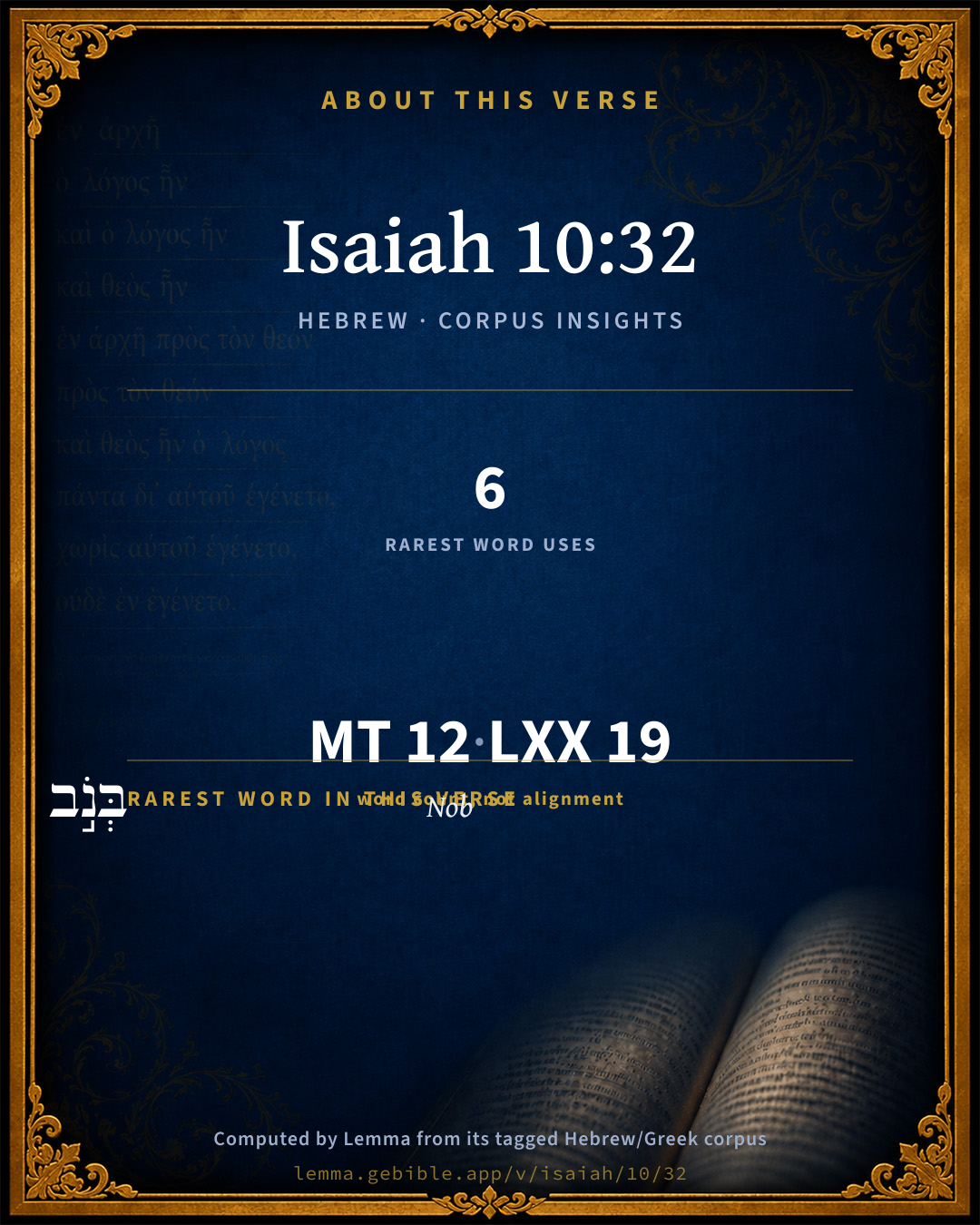
12
words
11
distinct lemmas
Prophets
section

Notable vocabulary

The rarest word here is בְּנֹ֣ב Nob H5011 — appearing just 6 times in the whole Hebrew Bible.

Shared distinctive vocabulary

בְּנֹ֣ב Nob H5011 occurs in 6 verses of the Hebrew Bible. Also found in:

Grammatical profile

  • 2 verbs
  • 9 nouns
  • 1 adverb

Verb forms

  • לַֽעֲמֹ֑ד Qal · Infinitive Construct
  • יְנֹפֵ֤ף Polel · Imperfect

Repetition

A word recurs within this verse — often emphatic in Hebrew:

  • בַּת daughter H1323 ×2

Hebrew & Septuagint length

In English translation the verse runs 24 words from the Hebrew and 28 from the Septuagint (LXX English) — closely comparable.

A rough comparison of the two English renderings, which tokenize alike — not a word-level alignment.

Word counts can differ between the Hebrew and the Greek without any difference in meaning — e.g. the Hebrew direct-object marker אֵת has no separate Greek word, and Greek often adds the article ὁ.

In the original languages it is 12 Hebrew tokens and 19 Greek tokens — but the two are counted differently (Hebrew bundles its prefixes and suffixes into one token; the Greek is in lemma form), so that isn’t a like-for-like length.

Cross-references

12

Topical passages linked to Isaiah 10:32 in the Treasury of Scripture Knowledge — connected by theme and wording, ordered by reader-vote popularity; previews shown in the World English Bible.

  • 1 Samuel 21:1 Then came David to Nob to Ahimelech the priest: and Ahimelech came to meet David trembling, and said to him, Why are you alone, and no man with you?
  • 1 Samuel 22:19 Nob, the city of the priests, struck he with the edge of the sword, both men and women, children and nursing babies, and oxen and donkeys and sheep, with the edge of the sword.
  • Isaiah 19:16 In that day shall the Egyptians be like women; and they shall tremble and fear because of the shaking of the hand of Yahweh of Hosts, which he shakes over them.
  • Isaiah 37:22 this is the word which Yahweh has spoken concerning him: The virgin daughter of Zion has despised you and ridiculed you; the daughter of Jerusalem has shaken her head at you.
  • Zechariah 2:9 For, behold, I will shake my hand over them, and they will be a spoil to those who served them; and you will know that Yahweh of Hosts has sent me.
  • Nehemiah 11:32 at Anathoth, Nob, Ananiah,
  • Isaiah 1:8 The daughter of Zion is left like a shelter in a vineyard, Like a hut in a field of melons, Like a besieged city.
  • Isaiah 2:2 It shall happen in the latter days, that the mountain of Yahweh's house shall be established on the top of the mountains, And shall be raised above the hills; And all nations shall flow to it.
  • Isaiah 10:24 Therefore thus says the Lord, Yahweh of Hosts, my people who dwell in Zion, don't be afraid of the Assyrian, though he strike you with the rod, and lift up his staff against you, after the manner of Egypt.
  • Isaiah 11:15 Yahweh will utterly destroy the tongue of the Egyptian sea; and with his scorching wind will he wave his hand over the River, and will strike it into seven streams, and cause men to march over in sandals.
  • Isaiah 13:2 Set up an ensign on the bare mountain, lift up the voice to them, wave the hand, that they may go into the gates of the nobles.
  • Jeremiah 6:23 They lay hold on bow and spear; they are cruel, and have no mercy; their voice roars like the sea, and they ride on horses, everyone set in array, as a man to the battle, against you, daughter of Zion.

Cross-references courtesy of OpenBible.info (CC BY 4.0).

Hebrew and Greek witnesses Masoretic Hebrew ↔ Greek Septuagint

The same verse in the two great witnesses to the Old Testament, shown verse-for-verse.

These are two independent witnesses, not word-aligned to each other, and the Septuagint is shown in lemma (dictionary) form.

Hebrew Isaiah 10:32 Masoretic · Westminster Leningrad Codex

ע֥וֹד הַיּ֖וֹם בְּנֹ֣ב לַֽעֲמֹ֑ד יְנֹפֵ֤ף יָדוֹ֙ הַ֣ר בית בַּת צִיּ֔וֹן גִּבְעַ֖ת יְרוּשָׁלִָֽם

This very day shall he halt at Nob: he shakes his hand at the mountain of the daughter of Zion, the hill of Jerusalem.

World English Bible · Public Domain

Greek LXX Isaiah 10:32 Septuagint · lemma form

σήμερον ἐν ὁδός ὁ μένω ὁ χείρ παρακαλέω ὁ ὄρος ὁ θυγάτηρ σιων καί ὁ βουνός ὁ ἐν ἰερουσαλήμ

Exhort you⌃ them today to remain in the way: exhort you⌃ beckoning with the hand the mountain, the daughter of Sion, even you⌃ hills that are in Jerusalem.

LXX2012 (modern English Septuagint) · Public Domain

On this verse, John Gill's Exposition discusses the Septuagint’s reading. Read the note in Commentary ↓

Hebrew: Westminster Leningrad Codex (CC BY 4.0). Greek: Septuagint (public domain); English from LXX2012 (modern English Septuagint) (Public Domain). How the Septuagint differs from the Hebrew →

Targum (Aramaic paraphrase)

1

The Targum is the ancient Jewish Aramaic paraphrase of the Hebrew Scriptures — an interpretive translation, not the Hebrew text itself. Onkelos (literal) and Pseudo-Jonathan (expansive) render the Torah, and Jonathan the Prophets. Coverage is partial: where no permissively-licensed English translation exists for a verse, only the Aramaic is shown. This is verse-level text, not a word-by-word alignment to the Hebrew.

  1. Targum Jonathan Prophets (Joshua–Malachi)
    עַד כְעַן יוֹמָא רַב וְסַגִי עִדַן לֵיהּ לְמֵיעַל הָא סַנְחֶרֶב (מַלְכָּא דְאַתּוּר נְטַל וַעֲבַר תְּלַת אַרְנִין וּדְבַר עִמֵיהּ אַרְבְּעִין אַלְפִין גוּסְפְּנִין דִדְהַב דִבְנֵי מַלְכִין קְטִירֵי תָגָא יַתְבִין בְּהוֹן וּדְבַר עִמֵיהּ מָאתָן אַלְפִין אֲחִידֵי סַיְפִין וְרוּמְחִין וּדְבַר עִמֵיהּ מָאתָן וְשִׁיתִּין אַלְפִין מְחַצְצֵי גִירִין גוּבְרִין דְרָהֲטִין קֳדָמוֹהִי מְאָה אַלְפִין אוּרְכָּא דְמַשִׁרְיָתֵיהּ אַרְבַּע מְאָה פַּרְסִין צַוָאר סוּסְוָתֵיהּ אַרְבְּעִין פַּרְסִין מִנְיָן מַשִׁרְיָתֵיהּ מָאתָן וְשִׁתִּין אַלְפִין רִיבּוֹא חָסֵר חַד וְכֵן אֲתוֹ עַל אַבְרָהָם כַּד רְמוֹ יָתֵיהּ לְגוֹ נוּרָא יְקֵדְתָּא וְכֵן עַתִידִין לְמֵיתֵי עִם גוֹג וּמָגוֹג כַּד יִשְׁלֶה עַלְמָא קִצֵי לְמִתְפַרְקָא מַשִׁרְיָתָא קַדְמֵיתָא כַּד עֲבַרוּ בְיַרְדְנָא שָׁתוּ מַיָא דַהֲווֹ בְיַרְדְנָא מַשִׁירְיָתָא תִנְיֵתָא כַּד עֲבָרוּ בְיַרְדְנָא חָפָרוּ בִירִין וְשָׁתוּ מַיָא) אֲתָא וְקָם בְּנוֹב קִרְיַת כַּהֲנַיָא לִקֳבֵיל שׁוּרָא דִירוּשְׁלֵם וְעָנֵי וַאֲמַר לְחַיָלוּתֵיהּ הָלָא דָא הִיא קַרְתָּה יְרוּשְׁלֵם דַעֲלָא אַרְגֵשִׁית כָּל מַשִׁרְיָתִי וַעֲלָהּ כְּבֵשִׁית כָּל מְדִינָתִי הָא הִיא זְעֵירָא וַחֲלָשָׁא מִכָּל כְּרַכֵּי עַמְמַיָא דִכְבֵישִׁית בִּתְקוֹף יְדִי עֲלָהּ קָם מָנִיד בְּרֵישֵׁיהּ מוֹבִּיל וּמַיְתֵי בִּידֵיהּ עַל טוּר בֵּית מַקְדְשָׁא דִי בְצִיוֹן וְעַל עֲזָרָתָא דְבִירוּשְׁלֵם:

    As yet the day is still high, and he has much time to come. Behold, Sennacherib the king of Assyria. He journeyed and passed three stations, and he brought with him forty thousand seats of gold, in which the sons of the kings encircled with crowns were sitting; likewise, led with him two hundred thousand holding swords and spears; he also brought with him two hundred and sixty thousand archers, and a hundred thousand men ran before him. The length of his camp was four hundred parasangs; the neck of his horses forty parasangs; the number of his army, was two hundred and sixty thousand myriads lacking one. And thus they came upon Abraham, when they had cast him into the midst of the burning fire, and thus they shall come with Gog and Magog, when the world shall have completed its end to be redeemed. When the first host passed through the Jordan, they drank up the waters which were in the Jordan. When the second host passed through the Jordan, the hoofs of the horses absorbed, and drank the waters. When the third host passed through the Jordan, they dug wells, and drank the waters. He came and stood in Nob, the city of the priests, before the wall of Jerusalem; he answered and said to his army, Is not this the city of Jerusalem, against which I have tumultuously brought together all my camps, and on account of which I have oppressed all my provinces? Behold, she is smaller and weaker than all the fortified cities of the nations which I have subdued by the strength of my hand. He came up, he stood and shook his head; he stretched out and moved his hand against the mount of the house of the sanctuary which is in Zion, and against the court which is in Jerusalem.

    Targum Jonathan — Aramaic: “Mikraot Gedolot” (public domain). English: “Sefaria Community Translation” (CC0 1.0 (public-domain dedication)); “London "Chaldee Paraphrase," 1871” (public domain). Text via Sefaria.

Commentary

Notes on Isaiah 10:32 from classic Christian and Jewish commentators (each source and its license shown beneath its notes). The classic Christian expositions comment on the surrounding passage and are grouped to its opening verse, so a note may address several verses; the Jewish commentaries on the Tanakh (Rashi and others) are per-verse, so they appear only where the commentator wrote on this verse.

Lemma curates 59 commentaries, every one of them public domain or Creative Commons licensed, each selected and text-cleaned for this edition rather than reprinted as found. About our sources →

Trapp's Complete Commentary

John Trapp

Isa 10:32 As yet shall he remain at Nob that day: he shall shake his hand [against] the mount of the daughter of Zion, the hill of Jerusalem.

Ver. 32. He shall shake his hand,] viz., At Jerusalem, as threatening her destruction; but she shall shake her head at him in contempt {Isa 37:21} God oft lets his enemies go to the utmost of their tether, and then pulls them back to their tasks with shame enough, as he did Pharaoh.

John Trapp, A Commentary or Exposition upon All the Books of the Old and New Testament (1647–1656) — public domain. Text from a community e-Sword module.

Jamieson, Fausset & Brown

Robert Jamieson, A. R. Fausset & David Brown

that day--literally, "As yet this (one only) day (is allowed to the soldiers) for remaining (halting for rest) at Nob"; northeast of Jerusalem on Olivet; a town of the priests (Neh 11:32).

daughter--rightly substituted for the Chetib reading, house. His "shaking his hand" in menace implies that he is now at Nob, within sight of Jerusalem.

Jamieson, Fausset & Brown — Commentary Critical and Explanatory on the Whole Bible (1871) — public domain (CC PDM 1.0). Text via the HelloAO Bible API.

The Cambridge Bible for Schools and Colleges

gen. ed. J. J. S. Perowne

32. Render with Cheyne: This very day he will halt in Nob, swinging his hand, &c. Nob (1 Samuel 21, 1 Samuel 22; Neh_11:32) must be sought in the immediate vicinity of Jerusalem, but its site has not yet been ascertained. The most probable conjecture is that it was on the height of Scopus overlooking the city from the north.

The Cambridge Bible for Schools and Colleges (gen. ed. J. J. S. Perowne; Cambridge University Press, 1878–1918) — public domain. Text from a community e-Sword module.

John Gill's Exposition

Behold, the Lord, the Lord of hosts, shall lop the bough with terror,.... Cut off the king of Assyria and his army, in a most terrible manner; "the glory" of it, as in Isa 10:18 the word signifies that which is the ornament, the beauty and glory, of the tree. The Septuagint render it, "the glorious ones"; and the Arabic version, "the nobles", the generals, and principal officers of the army; the Targum is,

"behold, the Lord of the world, the Lord of hosts, shall cast forth the slain in his camp, as grapes that are trod in a winepress.''

And the high ones of stature shall be hewn down; the princes of Assyria, so boasted of as kings, Isa 10:8 comparable to tall trees, to oaks and cedars:

and the haughty shall be humbled; who, like their monarch, boasted of their wisdom and strength, Isa 10:12 but now both he and they will be brought very low.

John Gill's Exposition of the Whole Bible (1746–1763) — public domain (CC PDM 1.0). Text via the HelloAO Bible API.

Albert Barnes' Notes on the Bible

As yet shall he remain - This is still a description of his advancing toward Jerusalem. He would make a station at Nob and remain there a day, meaning, perhaps, “only” one day, such would be his impatience to attack and destroy Jerusalem.

At Nob - Nob was a city of Benjamin, inhabited by priests; Neh 11:32. When David was driven away by Saul, he came to this city, and received supplies from Ahimelech the priest; 1Sa 21:1-6. Nob must have been situated somewhere upon the ridge of the mount of Olives, to the northeast of the city. So Jerome, professedly from Hebrew tradition, says, ‘Stans in oppidulo Nob et procul urbem conspiciens Jerusalem.’ - “Commentary in loc.” Messrs. Robinson and Smith sought all along the ridge of the mount of Olives, from the Damascus road to the summit opposite to the city, for some traces of an ancient site which might be regarded as the place of Nob; but without the slightest success. - “Bib. Researches,” ii. p. 150.

He shall shake his hand - That is, in the attitude of menace, or threatening. This language implies, that the city of Nob was so near to Jerusalem that the latter city could be seen from it; and the description denotes, that at the sight of Jerusalem Sennacherib would be full of indignation, and utter against it the threat of speedy and complete ruin.

The mount of the daughter of Zion - See the note at Isa 1:8. The Chaldee renders this, ‘He shall come, and stand in Nob, the city of the priests, over against the wall of Jerusalem, and shall answer and say to his army, “Is not this that city of Jerusalem against which I have assembled all my armies, and on account of which I have made an exaction on all my provinces? And lo, it is less and more feeble than any of the defenses of the people which I have subjected in the strength of my hand.” Over against that he shall stand, and shake his head, and shall bring his hand against the mount of the sanctuary which is Zion, and against the court which is in Jerusalem.’ Jarchi and Kimchi say, that Nob was so near to Jerusalem that it could be seen from thence; and hence, this is mentioned as the last station of the army of the Assyrian, the end of his march, and where the prize seemed to be within his grasp.

Albert Barnes' Notes on the Bible (1834–1885) — public domain. Text from a community e-Sword/MySword module.

Haydock's Catholic Bible Commentary

Nobe. He may arrive thither shortly, in the environs of Jerusalem. (Calmet) --- Septuagint, "exhort to-day, that they may continue on the road. Comfort with the hand the daughter of Sion, thou rock and hills within Jerusalem." (Haydock) --- Hand. As Nicanor did against the temple, 2 Machabees xv. 32. (Calmet)

George Leo Haydock (1774–1849), Haydock's Catholic Family Bible and Commentary, 1859 edition — public domain. Excludes Psalms (Douay-Rheims chapter numbering differs from Protestant) and Deuterocanonical books (Catholic canon only).

Matthew Poole's English Annotations

He shall shake his hand, by way of commination. But withal he intimates that he should be able to do no more against it, and that there his proud waves should be stayed, as it is declared in the following verses, and in the history.

Matthew Poole's English Annotations on the Holy Bible (1683–1685) — public domain. Text from a community e-Sword/MySword module.

The Pulpit Commentary

As yet shall he remain at Nob that day; literally, yet that day (is he) at Nob to halt. The Assyrians pitch their camp at Nob, the priestly city destroyed by Saul, (1Sa_22:19) 1 which was evidently within sight of Jerusalem. Major Wilson"s conjecture, that it occupied the site of the later Scopus, is probable.

The Pulpit Commentary (1880–1919), ed. H.D.M. Spence-Jones & Joseph S. Exell — public domain. Text from a community e-Sword module.

John Wesley's Explanatory Notes

Shake - By way of comminution.

John Wesley, Explanatory Notes Upon the Whole Bible (1754–1765) — public domain. Text via the GEBible commentary corpus.

J. A. Alexander on Isaiah

Joseph Addison Alexander

This verse conducts him to the last stage of his progress, to a point so near the Holy City that he may defy it thence. “Yet to-day in Nob (he is) to stand (and there) will shake his hand (a gesture of menace and defiance) against the mountain of the house (or daughter) of Zion (i.e., Mount Zion itself), the hill of Jerusalem.” Nob was a sacerdotal city of Benjamin, near Anathoth, {Neh 11:32} and according to some, within sight of Jerusalem. Robinson and Smith explored the ridge of Olivet for traces of this town, but without success. The Nob here mentioned is no doubt the same that Saul destroyed, although there was another in the plain towards Lydda.

Joseph Addison Alexander, The Prophecies of Isaiah (1846–1847; New York: Scribner, 1870–1878) — public domain. Text from a community e-Sword module.

Rashi

Rabbi Shlomo Yitzchaki (Rashi)

Still today, [he intends] to stand in Nob All this way he hastened, in order to stand in Nob while it is still day, since his stargazers told him, If you attack it today, you will conquer it. And, when he stood in Nob and saw that Jerusalem was small, he did not heed the words of his stargazers and began to wave his hand arrogantly: For a city like this have I mustered all these armies? Stay here overnight, and tomorrow, each one will cast his stone upon it.

Rashi on the Tanakh — English translations: “The Judaica Press complete Tanach with Rashi, translated by A. J. Rosenberg” (CC BY 4.0); “Pentateuch with Rashi's commentary by M. Rosenbaum and A.M. Silbermann, 1929-1934” (public domain); “The Metsudah Tanach series, Lakewood, N.J” (CC BY 4.0); and “The Book of Joshua, Metsudah Publications, 1997” (CC BY 4.0). Text via Sefaria.

Ibn Ezra

Rabbi Abraham ibn Ezra

And yet, etc. There will yet come a day when he will stay in Nob.

Ibn Ezra on the Tanakh — English translations: “Sefaria Community Translation” (CC0 1.0 (public-domain dedication)); “Yalkut, Sifsei Chachomim Chumash, Metsudah Publications, 2009” (CC BY 4.0); and “Commentary of Ibn Ezra on Isaiah - trans. by M. Friedlander, 1873” (public domain). Text via Sefaria.

Lesson kit

Teaching starters — assembled from the data on this page, not authored interpretation. Every prompt links to the verse data it draws on. Edit before teaching.

Isaiah, in the Prophets, opens this verse with 12 words (11 distinct Hebrew lemmas). Its most distinctive word is Nôb (“Nob”). A historical commentator’s framing appears above. Read the whole chapter for the surrounding context.

Discussion questions

  1. The word Nôb carries the sense “Nob.” How does it shape the verse?
  2. How does 1 Samuel 21:1, which shares the word «Nob», read alongside this verse?
  3. What does the repetition of “daughter” (2× in this one verse) do in this verse?
  4. These translations render this verse differently. What is at stake in choosing one wording over another?
  5. «לַֽעֲמֹ֑ד» is a Qal Infinitive Construct verb. How does that grammatical form shape the action described?
  6. Compare how Trapp's Complete Commentary and Jamieson, Fausset & Brown read this verse. Where do they agree or differ?

Things to notice

Reading settings

Reading text

Shown beneath each verse's original-language words.

Old Testament
Old Testament edition

Read the OT as the Masoretic Hebrew (MT) or the Greek Septuagint (LXX).

English shown for the Greek Septuagint (in the Hebrew ↔ Greek comparison).

Comparing translations? Open the Compare panel on any verse page to stack up to four side by side.