
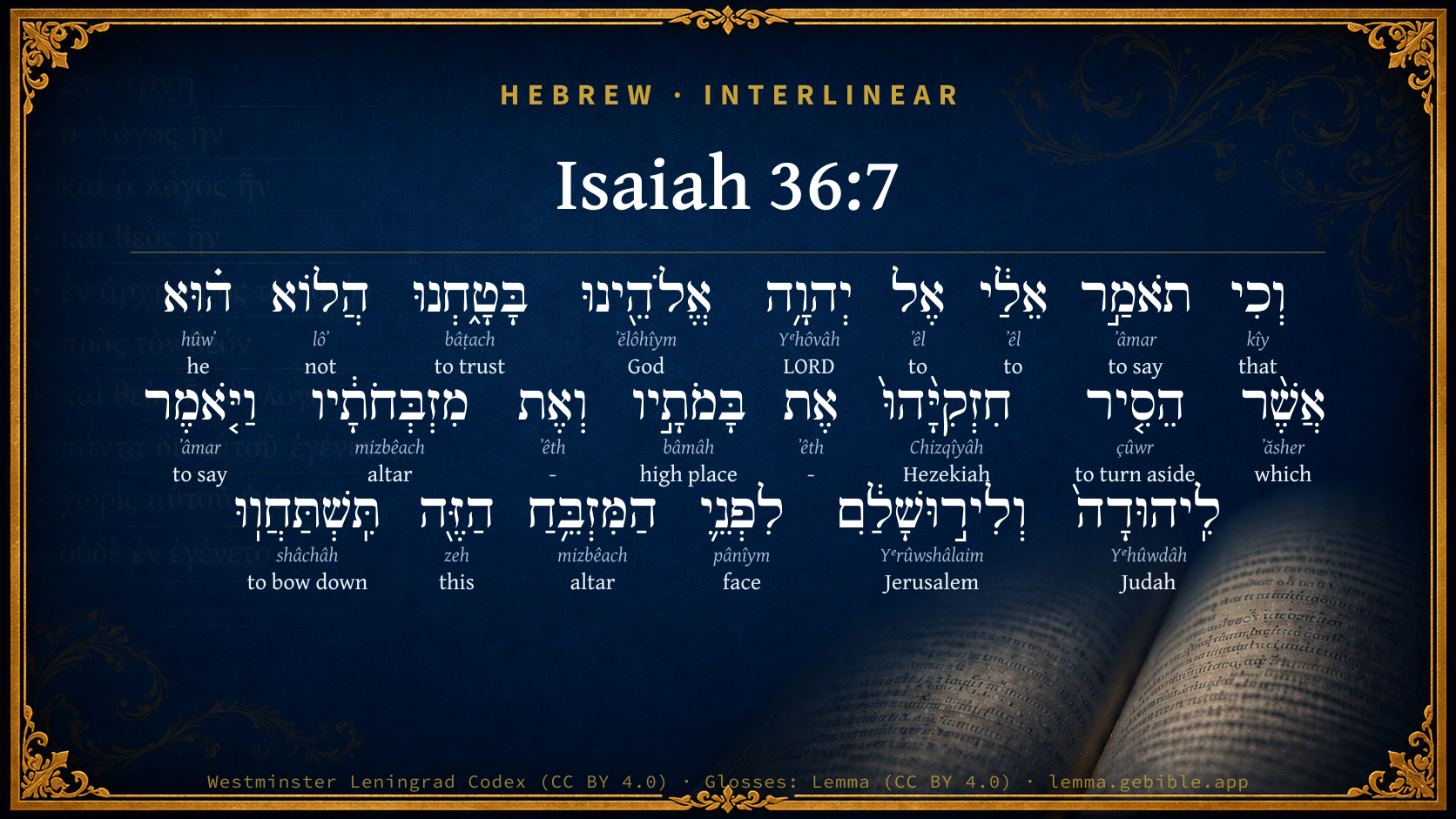
Isaiah 36:7

Hebrew (Westminster Leningrad Codex) Isaiah 36:7 appears in the Hebrew Old Testament. The text above is from the Westminster Leningrad Codex. Each word links to its Strong’s number, a concise gloss, and parsing drawn from the Open Scriptures Hebrew Bible morphology. Click any word for its full Brown-Driver-Briggs (BDB) entry.
Download image
Cite this verse

Isaiah 36:7 (World English Bible). Public Domain. Lemma interlinear Bible study tool, https://lemma.gebible.app/v/isaiah/36/7.

Show BibTeX & RIS
BibTeX
RIS
English Translation
But if you tell me, We trust in Yahweh our God: isn't that he, whose high places and whose altars Hezekiah has taken away, and has said to Judah and to Jerusalem, You shall worship before this altar?
World English Bible · Public Domain
Download a study sheet

One document with this verse’s original text, its word-by-word gloss line, the meaning frame, cross-references with their text, attributed commentary, and full source and license credits — printable, and it pastes into notes with its structure intact.

This verse Autodidact and up

Study sheet (.html) Plain text (.txt)

A passage Seminary Student

Up to 50 verses in one chapter. A passage sheet keeps up to 6 commentary sources and 12 cross-references per verse, in the order this page ranks them, and says so on the sheet whenever that leaves anything out. Ask for a single verse and you get the Autodidact verse sheet above.

Everything on this page stays free to read, with no account — the sheet is a download of what is already on screen, not access to it.

Want to remove ads? Support Godless Engineer
Compare translations 3

The same verse in 3 English versions, stacked beneath the original-language interlinear above. Click any original word for its lexicon entry.

Each is an independent rendering of the whole verse — the interlinear is not word-aligned to these translations.

Highlighted words mark where these versions differ — a whole-verse word diff, not a word-by-word alignment.

  • World English Bible Public Domain
    But if you tell me, We trust in Yahweh our God: isn't that he, whose high places and whose altars Hezekiah has taken away, and has said to Judah and to Jerusalem, You shall worship before this altar?
  • King James Version Public Domain
    But if thou say to me, We trust in the LORD our God: is it not he, whose high places and whose altars Hezekiah hath taken away, and said to Judah and to Jerusalem, Ye shall worship before this altar?
  • unfoldingWord Literal Text CC BY-SA 4.0
    But if you say to me, ‘We trust in Yahweh our God,’ not he whose high places and altars Hezekiah has removed and said to Judah and to Jerusalem, ‘To the face of this altar you shall prostrate yourselves’?

unfoldingWord Literal Text — © unfoldingWord, licensed CC BY-SA 4.0. Word-aligned USFM3 via Door43 (git.door43.org/unfoldingWord/en_ult).

Versions to compare (up to 4)

3 of 4 selected

Show all 18 translations

Every available English version of this verse, each an independent rendering of the whole verse.

  • World English Bible Public Domain
    But if you tell me, We trust in Yahweh our God: isn't that he, whose high places and whose altars Hezekiah has taken away, and has said to Judah and to Jerusalem, You shall worship before this altar?
  • Berean Standard Bible Public Domain
    But if you say to me, ‘We trust in the LORD our God,’ is He not the One whose high places and altars Hezekiah has removed, saying to Judah and Jerusalem, ‘You must worship before this altar’?
  • Majority Standard Bible Public Domain
    But if you say to me, ‘We trust in the LORD our God,’ is He not the One whose high places and altars Hezekiah has removed, saying to Judah and Jerusalem, ‘You must worship before this altar’?
  • King James Version Public Domain
    But if thou say to me, We trust in the LORD our God: is it not he, whose high places and whose altars Hezekiah hath taken away, and said to Judah and to Jerusalem, Ye shall worship before this altar?
  • American Standard Version (1901) Public Domain
    But if thou say unto me, We trust in Jehovah our God: is not that he, whose high places and whose altars Hezekiah hath taken away, and hath said to Judah and to Jerusalem, Ye shall worship before this altar?
  • Revised Version (1885) Public Domain
    But if thou say unto me, We trust in the LORD our God: is not that he, whose high places and whose altars Hezekiah hath taken away, and hath said to Judah and to Jerusalem, Ye shall worship before this altar?
  • Geneva Bible (1599) Public Domain
    But if thou say to me, We trust in the Lord our God. Is not that he, whose hie places and whose altars Hezekiah tooke downe, and said to Iudah and to Ierusalem, Ye shall worship before this altar?
  • Douay-Rheims (1899) Public Domain
    But if thou wilt answer me: We trust in the Lord our God: is it not he whose high places and altars Ezechias hath taken away, and hath said to Juda and Jerusalem: You shall worship before this altar?
  • Young's Literal Translation Public Domain
    `And dost thou say unto me, Unto Jehovah our God we have trusted? is it not He, whose high places and whose altars Hezekiah hath turned aside, and saith to Judah and to Jerusalem, Before this altar ye do bow yourselves?
  • Literal Standard Version CC BY-SA 4.0
    And do you say to me, We have trusted in our God YHWH? Is it not He whose high places and whose altars Hezekiah has turned aside, and says to Judah and to Jerusalem, Bow yourselves before this altar?
  • Unlocked Literal Bible CC BY-SA 4.0
    But if you say to me, “We are trusting in Yahweh our God,” is not he the one whose high places and altars Hezekiah has taken away, and has said to Judah and to Jerusalem, “You must worship before this altar in Jerusalem”?
  • unfoldingWord Literal Text CC BY-SA 4.0
    But if you say to me, ‘We trust in Yahweh our God,’ not he whose high places and altars Hezekiah has removed and said to Judah and to Jerusalem, ‘To the face of this altar you shall prostrate yourselves’?
  • Darby Bible Public Domain
    And if thou say to me, We rely upon Jehovah our God: is it not he, whose high places and whose altars Hezekiah has removed, saying to Judah and Jerusalem, Ye shall worship before this altar?
  • World Messianic Bible Public Domain
    But if you tell me, ‘We trust in the LORD our God,’ isn’t that he whose high places and whose altars Hezekiah has taken away, and has said to Judah and to Jerusalem, ‘You shall worship before this altar’?”
  • Webster's Bible Public Domain
    But if thou shalt say to me, We trust in the LORD our God: is it not he, whose high places and whose altars Hezekiah hath taken away, and said to Judah and to Jerusalem, Ye shall worship before this altar?
  • Free Bible Version CC BY-SA 4.0
    If you tell me, ‘We're trusting in the Lord our God,’ well didn't Hezekiah remove his high places and his altars, telling Judah and Jerusalem: ‘You have to worship at this altar in Jerusalem’?
  • Bible in Basic English Public Domain
    And if you say to me, Our hope is in the Lord our God; is it not he whose high places and altars Hezekiah has taken away, saying to Judah and Jerusalem that worship may only be given before this altar?
  • JPS Tanakh (1917) Public Domain
    But if thou say unto me: We trust in the LORD our God; is not that He, whose high places and whose altars Hezekiah hath taken away, and hath said to Judah and to Jerusalem: Ye shall worship before this altar?

Literal Standard Version (2020), Covenant Press — licensed CC BY-SA 4.0. Text via the HelloAO Bible API (eBible.org). Unlocked Literal Bible (unfoldingWord) — licensed CC BY-SA 4.0. Text via the HelloAO Bible API (eBible.org). unfoldingWord Literal Text — © unfoldingWord, licensed CC BY-SA 4.0. Word-aligned USFM3 via Door43 (git.door43.org/unfoldingWord/en_ult). Free Bible Version, Dr. Jonathan Gallagher — licensed CC BY-SA 4.0. Text via the HelloAO Bible API (eBible.org).

Word by word

More ways to search: Search by grammar → Find every occurrence → Compare this word →

Practice this passage: Drill this verse → Learn its vocabulary →

בָּמֹתָ֣יו
bâmâh
H1116
“high places · his”
Noun, Common, Feminine, Plural, Construct + Suffix, Personal, 3rd Person, Masculine, Singular
Part of Speech
Noun
Type
Common
Gender
Feminine
Number
Plural
State
Construct
Full BDB Definition

Origin: from an unused root (meaning to be high)

TWOT: 253

high place, ridge, height, bamah (technical name for cultic platform) - high place, mountain - high places, battlefields - high places (as places of worship) - funeral mound?
  1. וְכִי kîy H3588 “and · that” Conjunction + Conjunction
  2. תֹאמַ֣ר ʼâmar H559 “to say” Verb, Qal, Imperfect, 2nd Person, Masculine, Singular
  3. אֵלַ֔י ʼêl H413 “to · me” Preposition + Suffix, Personal, 1st Person, Common, Singular
  4. אֶל ʼêl H413 “to” Preposition
  5. יְהוָ֥ה Yᵉhôvâh H3068 “LORD” Noun, Proper
  6. אֱלֹהֵ֖ינוּ ʼĕlôhîym H430 “God(s) · our” Noun, Common, Masculine, Plural, Construct + Suffix, Personal, 1st Person, Common, Plural
  7. בָּטָ֑חְנוּ bâṭach H982 “to trust” Verb, Qal, Perfect, 1st Person, Common, Plural
  8. הֲלוֹא lôʼ H3808 “not” Particle, Interrogative + Particle, Negative
  9. ה֗וּא hûwʼ H1931 “he” Pronoun, Personal, 3rd Person, Masculine, Singular
  10. אֲשֶׁ֨ר ʼăsher H834 “which” Particle, Relative
  11. הֵסִ֤יר çûwr H5493 “to turn aside” Verb, Hiphil, Perfect, 3rd Person, Masculine, Singular
  12. חִזְקִיָּ֨הוּ֙ Chizqîyâh H2396 “Hezekiah” Noun, Proper
  13. אֶת ʼêth H853 “-” Particle, Direct Object
  14. וְאֶת ʼêth H853 “and · -” Conjunction + Particle, Direct Object
  15. מִזְבְּחֹתָ֔יו mizbêach H4196 “altars · his” Noun, Common, Masculine, Plural, Construct + Suffix, Personal, 3rd Person, Masculine, Singular
  16. וַיֹּ֤אמֶר ʼâmar H559 “and · to say” Conjunction + Verb, Qal, Sequential Imperfect, 3rd Person, Masculine, Singular
  17. לִֽיהוּדָה֙ Yᵉhûwdâh H3063 “to/for · Judah” Preposition + Noun, Proper
  18. וְלִיר֣וּשָׁלִַ֔ם Yᵉrûwshâlaim H3389 “and · to/for · Jerusalem” Conjunction + Preposition + Noun, Proper
  19. לִפְנֵ֛י pânîym H6440 “to/for · face(s) of” Preposition + Noun, Common, Both, Plural, Construct
  20. הַמִּזְבֵּ֥חַ mizbêach H4196 “the · altar” Particle, Definite Article + Noun, Common, Masculine, Singular, Absolute
  21. הַזֶּ֖ה zeh H2088 “the · this” Particle, Definite Article + Pronoun, Demonstrative, Masculine, Singular
  22. תִּֽשְׁתַּחֲוֽוּ shâchâh H7812 “to bow down” Verb, Hishtaphel, Imperfect, 2nd Person, Masculine, Plural

About this verse

These counts appear in no published source. They are computed here, from the morphology-tagged text and Lemma’s own curated glosses. What Lemma adds →

23
words
19
distinct lemmas
Prophets
section

Grammatical profile

  • 5 verbs
  • 9 nouns
  • 2 pronouns
  • 2 prepositions
  • 1 conjunction
  • 4 particles

Verb forms

  • תֹאמַ֣ר Qal · Imperfect
  • בָּטָ֑חְנוּ Qal · Perfect
  • הֵסִ֤יר Hiphil · Perfect
  • וַיֹּ֤אמֶר Qal · Sequential Imperfect
  • תִּֽשְׁתַּחֲוֽוּ Hishtaphel · Imperfect

Repetition

Words recur within this verse — often emphatic in Hebrew:

  • תֹאמַ֣ר to say H559 ×2
  • מִזְבְּחֹתָ֔יו altar H4196 ×2
  • אֵלַ֔י to H413 ×2

Hebrew & Septuagint length

In English translation the verse runs 38 words from the Hebrew and 11 from the Septuagint (LXX English) — the Septuagint runs noticeably shorter here. See the side-by-side →

A rough comparison of the two English renderings, which tokenize alike — not a word-level alignment.

Word counts can differ between the Hebrew and the Greek without any difference in meaning — e.g. the Hebrew direct-object marker אֵת has no separate Greek word, and Greek often adds the article ὁ.

Cross-references

14

Topical passages linked to Isaiah 36:7 in the Treasury of Scripture Knowledge — connected by theme and wording, ordered by reader-vote popularity; previews shown in the World English Bible.

  • 2 Kings 18:4–5 He removed the high places, and broke the pillars, and cut down the Asherah: and he broke in pieces the brazen serpent that Moses had made; for to those days the children of Israel did burn incense to it; and he called it Nehushtan.
  • Psalms 42:5 Why are you in despair, my soul? Why are you disturbed within me? Hope in God! For I shall still praise him for the saving help of his presence.
  • Psalms 42:10–11 As with a sword in my bones, my adversaries reproach me, While they continually ask me, "Where is your God?"
  • 1 Corinthians 2:15 But he who is spiritual discerns all things, and he himself is judged by no one.
  • Deuteronomy 12:2–6 You shall surely destroy all the places in which the nations that you shall dispossess served their gods, on the high mountains, and on the hills, and under every green tree:
  • Deuteronomy 12:13–14 Take heed to yourself that you don't offer your burnt offerings in every place that you see;
  • 2 Kings 18:22 But if you tell me, We trust in Yahweh our God; isn't that he whose high places and whose altars Hezekiah has taken away, and has said to Judah and to Jerusalem, You shall worship before this altar in Jerusalem?
  • 1 Chronicles 5:20 They were helped against them, and the Hagrites were delivered into their hand, and all who were with them; for they cried to God in the battle, and he was entreated of them, because they put their trust in him.
  • 2 Chronicles 16:7–9 At that time Hanani the seer came to Asa king of Judah, and said to him, Because you have relied on the king of Syria, and have not relied on Yahweh your God, therefore is the host of the king of Syria escaped out of your hand.
  • 2 Chronicles 30:14 They arose and took away the altars that were in Jerusalem, and all the altars for incense took they away, and cast them into the brook Kidron.
  • 2 Chronicles 31:1 Now when all this was finished, all Israel who were present went out to the cities of Judah, and broke in pieces the pillars, and hewed down the Asherim, and broke down the high places and the altars out of all Judah and Benjamin, in Ephraim also and Manasseh, until they had destroyed them all. Then all the children of Israel returned, every man to his possession, into their own cities.
  • 2 Chronicles 32:7–8 Be strong and of good courage, don't be afraid nor dismayed for the king of Assyria, nor for all the multitude who is with him; for there is a greater with us than with him:
  • 2 Chronicles 32:12 Has not the same Hezekiah taken away his high places and his altars, and commanded Judah and Jerusalem, saying, You shall worship before one altar, and on it shall you burn incense?
  • Psalms 22:4–5 Our fathers trusted in you. They trusted, and you delivered them.

Cross-references courtesy of OpenBible.info (CC BY 4.0).

Hebrew and Greek witnesses Masoretic Hebrew ↔ Greek Septuagint

The same verse in the two great witnesses to the Old Testament, shown verse-for-verse.

Here the Septuagint runs noticeably shorter than the Hebrew — LXX2012 (modern English Septuagint) 11 words vs World English Bible 38. A rough length comparison of the two English translations, not a word-level alignment — read both below.

These are two independent witnesses, not word-aligned to each other, and the Septuagint is shown in lemma (dictionary) form.

Hebrew Isaiah 36:7 Masoretic · Westminster Leningrad Codex

וְכִי תֹאמַ֣ר אֵלַ֔י אֶל יְהוָ֥ה אֱלֹהֵ֖ינוּ בָּטָ֑חְנוּ הֲלוֹא ה֗וּא אֲשֶׁ֨ר הֵסִ֤יר חִזְקִיָּ֨הוּ֙ אֶת בָּמֹתָ֣יו וְאֶת מִזְבְּחֹתָ֔יו וַיֹּ֤אמֶר לִֽיהוּדָה֙ וְלִיר֣וּשָׁלִַ֔ם לִפְנֵ֛י הַמִּזְבֵּ֥חַ הַזֶּ֖ה תִּֽשְׁתַּחֲוֽוּ

But if you tell me, We trust in Yahweh our God: isn't that he, whose high places and whose altars Hezekiah has taken away, and has said to Judah and to Jerusalem, You shall worship before this altar?

World English Bible · Public Domain

Greek LXX Isaiah 36:7 Septuagint · lemma form

εἰ δέ λέγω ἐπί κύριος ὁ θεός ἐγώ πείθω

But if you⌃ say, We trust in the Lord our God;

LXX2012 (modern English Septuagint) · Public Domain

On this verse, Adam Clarke's Commentary discusses the Septuagint’s reading. Read the note in Commentary ↓

Hebrew: Westminster Leningrad Codex (CC BY 4.0). Greek: Septuagint (public domain); English from LXX2012 (modern English Septuagint) (Public Domain). How the Septuagint differs from the Hebrew →

Targum (Aramaic paraphrase)

1

The Targum is the ancient Jewish Aramaic paraphrase of the Hebrew Scriptures — an interpretive translation, not the Hebrew text itself. Onkelos (literal) and Pseudo-Jonathan (expansive) render the Torah, and Jonathan the Prophets. Coverage is partial: where no permissively-licensed English translation exists for a verse, only the Aramaic is shown. This is verse-level text, not a word-by-word alignment to the Hebrew.

  1. Targum Jonathan Prophets (Joshua–Malachi)
    וַאֲרֵי תֵימְרוּן לִי עַל מֵימְרָא דַייָ אֱלָהָנָא אִתְרַחֵיצְנָא הֲלָא הוּא דְאַעְדִי חִזְקִיָה יַת בָמָתוֹהִי וְיַת אֱגְרוֹהִי וַאֲמַר לֶאֱנַשׁ יְהוּדָה וּלְיָתְבֵי יְרוּשְׁלֶם קֳדָם מַדְבְּחָא הָדֵין תִּסְגְדוּן:

    But if ye say to me, We trust in the WORD of the Lord our God: is it not he, whose high places and whose altars Hezekiah hath taken away, and said to the men of Judah and to the inhabitants of Jerusalem, Ye shall worship before this altar?

    Targum Jonathan — Aramaic: “Mikraot Gedolot” (public domain). English: “Sefaria Community Translation” (CC0 1.0 (public-domain dedication)); “London "Chaldee Paraphrase," 1871” (public domain). Text via Sefaria.

Commentary

Notes on Isaiah 36:7 from classic Christian and Jewish commentators (each source and its license shown beneath its notes). The classic Christian expositions comment on the surrounding passage and are grouped to its opening verse, so a note may address several verses; the Jewish commentaries on the Tanakh (Rashi and others) are per-verse, so they appear only where the commentator wrote on this verse.

Lemma curates 59 commentaries, every one of them public domain or Creative Commons licensed, each selected and text-cleaned for this edition rather than reprinted as found. About our sources →

Tyndale Open Study Notes

Tyndale Open Resources

36:7 We are trusting in the Lord our God: Ironically, the Assyrian chief of staff knew about and played on Isaiah’s message (26:4; 36:15; 37:10). • Hezekiah showed his zeal for the Lord by tearing down the pagan shrines and altars (2 Kgs 18:4), but the Assyrians mistakenly thought Hezekiah had angered God in the process.

Tyndale Open Study Notes — © Tyndale Open Resources, licensed CC BY-SA 4.0. Text via the HelloAO Bible API.

Jamieson, Fausset & Brown

Robert Jamieson, A. R. Fausset & David Brown

The Assyrian mistakes Hezekiah's religious reforms whereby he took away the high places (Kg2 18:4) as directed against Jehovah. Some of the high places may have been dedicated to Jehovah, but worshipped under the form of an image in violation of the second commandment: the "brazen serpent," also (broken in pieces by Hezekiah, and called Nehushtan, "a piece of brass," because it was worshipped by Israel) was originally set up by God's command. Hence the Assyrian's allegation has a specious color: you cannot look for help from Jehovah, for your king has "taken away His altars."

to Jerusalem-- (Deu 12:5, Deu 12:11; Joh 4:20).

Jamieson, Fausset & Brown — Commentary Critical and Explanatory on the Whole Bible (1871) — public domain (CC PDM 1.0). Text via the HelloAO Bible API.

Adam Clarke's Commentary

Verse 7. But if thou say - "But if ye say"] Two ancient MSS. have תאמרו tomeru in the plural number; so likewise the Septuagint, Chaldee, and the other copy, 2Kg 18:22.

Ye shall worship before this altar - "To worship only before this altar"] See 2Ch 32:12.

Adam Clarke's Commentary on the Bible (1810–1826) — public domain. Text from a community e-Sword/MySword module.

Ellicott's Commentary for English Readers

(7) Is it not he, whose high places . . .—This was this impression left on the mind of the Rabshakeh by what he heard of Hezekiah’s reformation. From the Assyrian stand-point a god was honoured in proportion as his sanctuaries were multiplied, but wherever he went, the Rabshakeh had found “high places “where Jehovah had been worshipped, which Hezekiah had desecrated. How could one who had so acted hope for the protection of his God?

A Bible Commentary for English Readers, edited by Charles John Ellicott (1878–1897) — public domain. Text from a community e-Sword module.

The Cambridge Bible for Schools and Colleges

gen. ed. J. J. S. Perowne

7. Not only is Hezekiah destitute of earthly help, but he has forfeited the protection of his own deity, by what from the heathen point of view seemed an act of sacrilege, the abolition of the local sanctuaries (see 2Ki_18:4).

The Cambridge Bible for Schools and Colleges (gen. ed. J. J. S. Perowne; Cambridge University Press, 1878–1918) — public domain. Text from a community e-Sword module.

John Gill's Exposition

But if thou say to me, we trust in the Lord our God,.... In his promises, providence, power, and protection, and not in human counsels and strength; not in allies and auxiliaries, as Pharaoh king of Egypt; should this be replied, Rabshakeh has something to say to that; having shown the vanity of trusting in the above things, he now proceeds to beat them off of all trust in the Lord their God:

is it not he, whose high places and whose altars Hezekiah hath taken away; the question might easily be answered in the negative; no, he has not; the high places and altars which Hezekiah took away were the high places and altars of Heathen gods, of false deities, and not of the true God of Israel, and which was to his honour and glory; but Rabshakeh would make a crime of it, and, ignorantly supposing that these were the altars and high places of the God of Israel, would insinuate that the taking of these away must be displeasing to him, and consequently Hezekiah and his people could not hope for any protection from him, whom he had so highly affronted; but all this talk was the fruit of ignorance, as well as of malice:

and said to Judah, and to Jerusalem, ye shall worship before this altar? the altar of the Lord, in the temple at Jerusalem, and before that only, confining their religious worship to one place, and their sacrifices to one altar; which was so far from being displeasing to God, as he would insinuate, that it was entirely agreeable to his will: and therefore there was no weight or strength in this kind of reasoning.

John Gill's Exposition of the Whole Bible (1746–1763) — public domain (CC PDM 1.0). Text via the HelloAO Bible API.

Albert Barnes' Notes on the Bible

But if thou say to me - If you shall make this plea, that you believe Yahweh will protect you in your revolt. The word ‘thou’ here refers to Hezekiah, or to the ambassadors speaking in his name. In 2Ki 18:22, it is, ‘but if ye say unto me;’ that is, you ambassadors. The sense is substantially the same.

Is it not he ... - This is given as a reason why they should not put their confidence in Yahweh. The reason is, that he supposed that Hezekiah had removed all the altars of Yahweh from all parts of the land, and that they could not calculate on the protection of a God whose worship bad been abolished. It is probable that Sennacherib and Rabshakeh had beard of the reformation which had been effected by Hezekiah; of his destroying the groves and altars which had been consecrated in the reign of his father to idolatry, and perhaps of the fact that he had even destroyed the brass serpent which Moses had made, and which had become an object of idolatrous worship 2Ki 18:4, and he may have supposed that all these altars and groves had been devoted to Yahweh, and were connected with his worship. He did not seem to understand that all that Hezekiah had done was only to establish the worship of Yahweh in the land.

High places - The worship of idols was usually performed in groves on high places; or on the tops of hills and mountains. It seems to have been supposed that worship in such places was more acceptable to the Deity. Perhaps it may have been because they thus seemed nearer the residence of the gods; or, perhaps, because there is sublimity and solemnity in such places - a stillness and elevation above the world which seem favorable to devotion (see 1Sa 9:12; 1Ki 3:4; 2Ki 12:2; 2Ch 33:19). Chapels, temples, and altars, were erected on such places 1Ki 13:22; 2Ki 17:29, and ministers and priests attended there to officiate (1Ki 12:32; 2Ki 17:32). Even the kings of Judah, notwithstanding the express prohibition of Moses Deut. 12, were engaged in such acts of worship 2Ki 12:4; 2Ki 14:4; 2Ki 15:4, 2Ki 15:35; 2Ch 15:17; 2Ch 20:33; and Solomon himself sacrificed in chapels of this kind 1Ki 3:2. These places Hezekiah had destroyed; that is, he had cut down the consecrated groves, and had destroyed the chapels and temples which had been erected there. The fact that Ahaz, the father of Hezekiah, had been distinguished for worshipping in such places had probably led the king of Assyria to suppose that this was the proper worship of the God of the Jews; and now that Hezekiah had destroyed them all, he seems to have inferred that he was guilty of gross irreligion, and could no longer depend on the protection of Yahweh.

And said to Judah and Jerusalem - He had commanded them to worship only in Jerusalem, at the temple. This was in strict accordance with the law of Moses; but this seems to have been understood by Sennacherib as in fact almost or quite banishing the worship of Yahweh from the land. Probably this was said to alienate the minds of the people from Hezekiah, by showing them that he had taken away their rights and privileges of worshipping God where they chose.

Albert Barnes' Notes on the Bible (1834–1885) — public domain. Text from a community e-Sword/MySword module.

Haydock's Catholic Bible Commentary

Altar. Such is the blindness of infidels, that they confound what is done to destroy idols, with their worship. (Worthington)

George Leo Haydock (1774–1849), Haydock's Catholic Family Bible and Commentary, 1859 edition — public domain. Excludes Psalms (Douay-Rheims chapter numbering differs from Protestant) and Deuterocanonical books (Catholic canon only).

Whedon's Commentary on the Bible

Daniel D. Whedon

7. The tantalizer turns now to the claim of a religious reformation on the part of Hezekiah. You trust in Jehovah, you say. But you have taken away his altars and high places, and restricted worship to Jerusalem, thus plundering the people of their broad privileges and liberal religion. The heathenish address is crafty, for it was spoken in Hebrew, and was intended for the people, listening in great crowds from the walls near at hand.

Daniel D. Whedon (gen. ed.), Commentary on the Old and New Testaments (1874–1909) — public domain. Text from a community e-Sword module.

The Pulpit Commentary

If thou say to me, We trust in the Lord. "The Assyrians," it has been observed, "had a good intelligence department" (Cheyne). It was known to Sennacherib that Hezekiah had a confident trust, which seemed to him wholly irrational, in Jehovah the special God of his people. It was also known to him that Hezekiah, in the earlier portion of his reign, (2Ki_18:4) had "removed the high places" and broken down the altars, where Jehovah had for centuries been worshipped throughout the length and breadth of the land. He concludes that, in so doing, he must have offended Jehovah. He is probably ignorant of the peculiar proviso of the Jewish Law, that sacrifice should be offered in one place only, and conceives that Hezekiah has been actuated by some narrow motive, and has acted in the interests of one city only, not of the whole people. Ye shall worship before this altar. The parallel passage of 2 Kings (2Ki_18:22) has "this altar in Jerusalem. " The brazen altar in the great court of the temple is, of course, meant. Hezekiah had cleansed it front the pollutions of the time of Ahaz, (2Ch_29:18) and had insisted on sacrifice being offered nowhere else. (2Ch 29:21-3:5 2Ch_30:15-24 2Ch_31:1, etc.) Such a concentration of worship was unknown to any of the heathen nations, and may well have been unintelligible to them.

Mistakes concerning him whom we trust.

The explanation of this taunt is well given by Sayce and Cheyne. "Sennacherib had heard of the reformation of worship undertaken by Hezekiah. This, from his heathen point of view, was an act of gross impiety towards Jehovah; for had not Jehovah from time immemorial been worshipped at most, if not all, of the "high places"? The local sanctuaries designated by the latter phrase appear from the inscriptions to have been known in Assyria and Babylonia, as well as Palestine; indeed, they go back to Accadian that is, pre-Semitic times." As he had passed through the country, the Rabshakeh had found the "high places" desecrated; so he assumed that the God of the country must he offended with Hezekiah. One of our gravest difficulties in witnessing for God in the world arises from men"s mistakes concerning him. They do not understand us, or feel the force of our pleadings, because they do not apprehend God as we do. This subject may be very practically illustrated and enforced from three spheres of modern religious activity and service missions, apologetics, preaching.

I THE MISTAKES OF THE HEATHEN CONCERNING OUR GOD HINDER MISSIONS. They have notions of God, or the gods, and attach them to the God we reveal to them. Much missionary labour is necessarily expended in correcting the mistakes which prevent the acceptance of the way of salvation by Christ Jesus. God pure, God love, God hating sin, God a Spirit, God our Father, God in sacrifice that he might save, these are all most strange and confusing to men who must think amidst heathen associations. It is eternal life to know the only true God.

II THE MISTAKES OF THE OPPONENTS OF REVELATION HINDER OUR ARGUMENTS FROM PRODUCING DUE CONVICTIONS. The atheist, infidel, agnostic, sceptic, make as grave mistakes about our God as the Rabshakeh did about Jehovah. They have created figures and representations of him which we can join them in declaring make him unworthy of trust. Only those figures do not represent our God. We cannot acknowledge them. If the mistakes could but be corrected, and our God be known as he is, they would "preach the faith" who now "seek to destroy it." Grave, indeed, is the sin of those who, professing to believe in God, nevertheless misrepresent him, and so give occasion to the enemy to blaspheme.

III THE MISTAKES OF SECTS AND CREEDS HINDER RELIGIOUS WORK AMONG PROFESSORS. There is the Calvinistic God, and the Arminian God, the God who is exacting. Judge, Moral Governor, august King. There are vague, repellent notions cherished in ignorant minds; and the preacher often speaks of a God who is really to the people an "unknown God." The Lord Jesus Christ came to earth to bring the full, last, all-satisfying revelation of God to men. We are still making hindering mistakes about God, because we will not receive his revelation. He taught men to lift up holy hands, and say, "Our Father, which art in heaven. R.T.

The Pulpit Commentary (1880–1919), ed. H.D.M. Spence-Jones & Joseph S. Exell — public domain. Text from a community e-Sword module.

J. A. Alexander on Isaiah

Joseph Addison Alexander

“And if thou say to me, we trust in Jehovah our God, is it not He whose high places and whose altars Hezekiah hath taken away, and said to Judah and to Jerusalem, before this altar shall ye worship?” Rabshakeh’s question evidently refers to Hezekiah’s reformation of religious worship (2Ki 18:4) which he erroneously regarded as a change of the national religion.

Joseph Addison Alexander, The Prophecies of Isaiah (1846–1847; New York: Scribner, 1870–1878) — public domain. Text from a community e-Sword module.

Rashi

Rabbi Shlomo Yitzchaki (Rashi)

Whose high places...has removed He abolished all the pagan temples and the altars and the high places, and has coerced all Judah to prostrate themselves before one altar.

Rashi on the Tanakh — English translations: “The Judaica Press complete Tanach with Rashi, translated by A. J. Rosenberg” (CC BY 4.0); “Pentateuch with Rashi's commentary by M. Rosenbaum and A.M. Silbermann, 1929-1934” (public domain); “The Metsudah Tanach series, Lakewood, N.J” (CC BY 4.0); and “The Book of Joshua, Metsudah Publications, 1997” (CC BY 4.0). Text via Sefaria.

Lesson kit

Teaching starters — assembled from the data on this page, not authored interpretation. Every prompt links to the verse data it draws on. Edit before teaching.

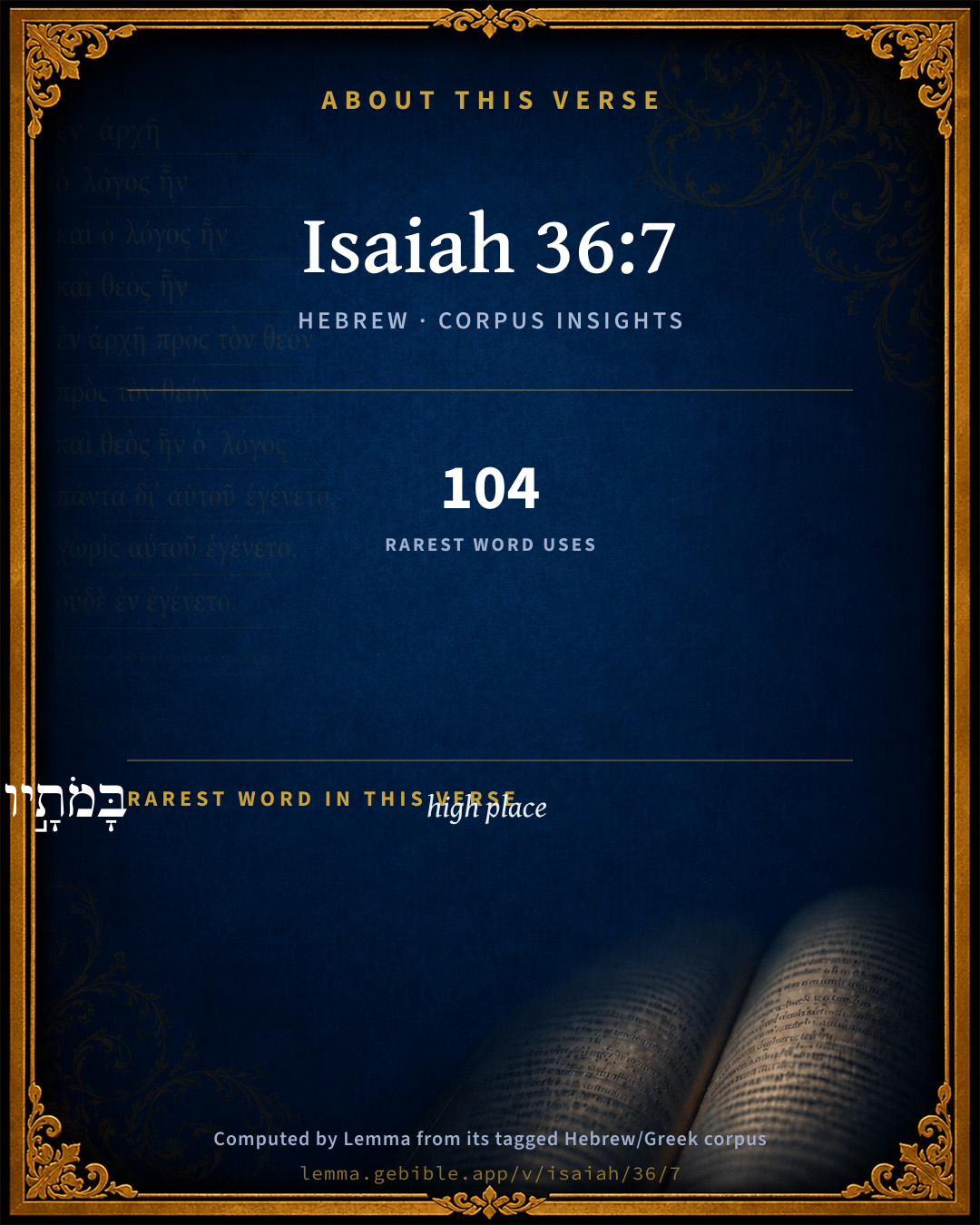
Isaiah, in the Prophets, opens this verse with 23 words (19 distinct Hebrew lemmas). Its most distinctive word is bâmâh (“high place”). The Greek Septuagint runs shorter here. A historical commentator’s framing appears above. Read the whole chapter for the surrounding context.

Discussion questions

  1. How does “high place” (bâmâh) shape what this verse is saying?
  2. How does 2 Kings 18:4–5, which shares this passage’s theme, read alongside this verse?
  3. What does the repetition of “to say” (2× in this one verse) do in this verse?
  4. The Septuagint runs shorter here than the Hebrew. What might account for the difference?
  5. These translations render this verse differently. What is at stake in choosing one wording over another?
  6. «תֹאמַ֣ר» is a Qal Imperfect verb. How does that grammatical form shape the action described?
  7. Compare how Tyndale Open Study Notes and Jamieson, Fausset & Brown read this verse. Where do they agree or differ?

Things to notice

Reading settings

Reading text

Shown beneath each verse's original-language words.

Old Testament
Old Testament edition

Read the OT as the Masoretic Hebrew (MT) or the Greek Septuagint (LXX).

English shown for the Greek Septuagint (in the Hebrew ↔ Greek comparison).

Comparing translations? Open the Compare panel on any verse page to stack up to four side by side.