
Nehemiah 12:43

Hebrew (Westminster Leningrad Codex) Nehemiah 12:43 appears in the Hebrew Old Testament. The text above is from the Westminster Leningrad Codex. Each word links to its Strong’s number, a concise gloss, and parsing drawn from the Open Scriptures Hebrew Bible morphology. Click any word for its full Brown-Driver-Briggs (BDB) entry.
Download image
Cite this verse

Nehemiah 12:43 (World English Bible). Public Domain. Lemma interlinear Bible study tool, https://lemma.gebible.app/v/nehemiah/12/43.

Show BibTeX & RIS
BibTeX
RIS
English Translation
They offered great sacrifices that day, and rejoiced; for God had made them rejoice with great joy; and the women also and the children rejoiced: so that the joy of Jerusalem was heard even afar off.
World English Bible · Public Domain
Download a study sheet

One document with this verse’s original text, its word-by-word gloss line, the meaning frame, cross-references with their text, attributed commentary, and full source and license credits — printable, and it pastes into notes with its structure intact.

This verse Autodidact and up

Study sheet (.html) Plain text (.txt)

A passage Seminary Student

Up to 50 verses in one chapter. A passage sheet keeps up to 6 commentary sources and 12 cross-references per verse, in the order this page ranks them, and says so on the sheet whenever that leaves anything out. Ask for a single verse and you get the Autodidact verse sheet above.

Everything on this page stays free to read, with no account — the sheet is a download of what is already on screen, not access to it.

Want to remove ads? Support Godless Engineer
Compare translations 3

The same verse in 3 English versions, stacked beneath the original-language interlinear above. Click any original word for its lexicon entry.

Each is an independent rendering of the whole verse — the interlinear is not word-aligned to these translations.

Highlighted words mark where these versions differ — a whole-verse word diff, not a word-by-word alignment.

  • World English Bible Public Domain
    They offered great sacrifices that day, and rejoiced; for God had made them rejoice with great joy; and the women also and the children rejoiced: so that the joy of Jerusalem was heard even afar off.
  • King James Version Public Domain
    Also that day they offered great sacrifices, and rejoiced: for God had made them rejoice with great joy: the wives also and the children rejoiced: so that the joy of Jerusalem was heard even afar off.
  • unfoldingWord Literal Text CC BY-SA 4.0
    And on that day they sacrificed great sacrifices, and they rejoiced, for God had made them glad with great rejoicing. Yes, even the women and the children rejoiced, so the rejoicing of Jerusalem was heard from far away.

unfoldingWord Literal Text — © unfoldingWord, licensed CC BY-SA 4.0. Word-aligned USFM3 via Door43 (git.door43.org/unfoldingWord/en_ult).

Versions to compare (up to 4)

3 of 4 selected

Show all 18 translations

Every available English version of this verse, each an independent rendering of the whole verse.

  • World English Bible Public Domain
    They offered great sacrifices that day, and rejoiced; for God had made them rejoice with great joy; and the women also and the children rejoiced: so that the joy of Jerusalem was heard even afar off.
  • Berean Standard Bible Public Domain
    On that day they offered great sacrifices, rejoicing because God had given them great joy. The women and children also rejoiced, so that the joy of Jerusalem was heard from afar.
  • Majority Standard Bible Public Domain
    On that day they offered great sacrifices, rejoicing because God had given them great joy. The women and children also rejoiced, so that the joy of Jerusalem was heard from afar.
  • King James Version Public Domain
    Also that day they offered great sacrifices, and rejoiced: for God had made them rejoice with great joy: the wives also and the children rejoiced: so that the joy of Jerusalem was heard even afar off.
  • American Standard Version (1901) Public Domain
    And they offered great sacrifices that day, and rejoiced; for God had made them rejoice with great joy; and the women also and the children rejoiced: so that the joy of Jerusalem was heard even afar off.
  • Revised Version (1885) Public Domain
    And they offered great sacrifices that day, and rejoiced; for God had made them rejoice with great joy; and the women also and the children rejoiced: so that the joy of Jerusalem was heard even afar off.
  • Geneva Bible (1599) Public Domain
    And the same day they offered great sacrifices and reioyced: for God had giuen them great ioy, so that both the women, and the children were ioyfull: and the ioy of Ierusalem was heard farre off.
  • Douay-Rheims (1899) Public Domain
    They appointed also in that day men over the storehouses of the treasure, for the libations, and for the firstfruits, and for the tithes, that the rulers of the city might bring them in by them in honour of thanksgiving, for the priests and Levites: for Juda was joyful in the priests and Levites that assisted.
  • Young's Literal Translation Public Domain
    and they sacrifice on that day great sacrifices and rejoice, for God hath made them rejoice `with' great joy, and also, the women and the children have rejoiced, and the joy of Jerusalem is heard -- unto a distance.
  • Literal Standard Version CC BY-SA 4.0
    and they sacrifice on that day great sacrifices and rejoice, for God has made them rejoice [with] great joy, and also, the women and the children have rejoiced, and the joy of Jerusalem is heard—to a distance.
  • Unlocked Literal Bible CC BY-SA 4.0
    They offered great sacrifices that day, and rejoiced, for God had made them rejoice with great joy. Also the women and the children rejoiced. So the joy of Jerusalem could be heard far away.
  • unfoldingWord Literal Text CC BY-SA 4.0
    And on that day they sacrificed great sacrifices, and they rejoiced, for God had made them glad with great rejoicing. Yes, even the women and the children rejoiced, so the rejoicing of Jerusalem was heard from far away.
  • Darby Bible Public Domain
    And that day they offered great sacrifices, and rejoiced: for God had made them rejoice with great joy; and also the women and the children rejoiced. And the joy of Jerusalem was heard even afar off.
  • World Messianic Bible Public Domain
    They offered great sacrifices that day, and rejoiced, for God had made them rejoice with great joy; and the women and the children also rejoiced, so that the joy of Jerusalem was heard even far away.
  • Webster's Bible Public Domain
    Also that day they offered great sacrifices, and rejoiced: for God had made them rejoice with great joy: the wives also and the children rejoiced: so that the joy of Jerusalem was heard even afar off.
  • Free Bible Version CC BY-SA 4.0
    Many sacrifices were offered that day, celebrating that God had brought them so much happiness, tremendous happiness. The women and children also celebrated, and the sounds of joy in Jerusalem could be heard far away.
  • Bible in Basic English Public Domain
    And on that day they made great offerings and were glad; for God had made them glad with great joy; and the women and the children were glad with them: so that the joy of Jerusalem came to the ears of those who were far off.
  • JPS Tanakh (1917) Public Domain
    And they offered great sacrifices that day, and rejoiced; for God had made them rejoice with great joy; and the women also and the children rejoiced; so that the joy of Jerusalem was heard even afar off.

Literal Standard Version (2020), Covenant Press — licensed CC BY-SA 4.0. Text via the HelloAO Bible API (eBible.org). Unlocked Literal Bible (unfoldingWord) — licensed CC BY-SA 4.0. Text via the HelloAO Bible API (eBible.org). unfoldingWord Literal Text — © unfoldingWord, licensed CC BY-SA 4.0. Word-aligned USFM3 via Door43 (git.door43.org/unfoldingWord/en_ult). Free Bible Version, Dr. Jonathan Gallagher — licensed CC BY-SA 4.0. Text via the HelloAO Bible API (eBible.org).

Word by word

More ways to search: Search by grammar → Find every occurrence → Compare this word →

Practice this passage: Drill this verse → Learn its vocabulary →

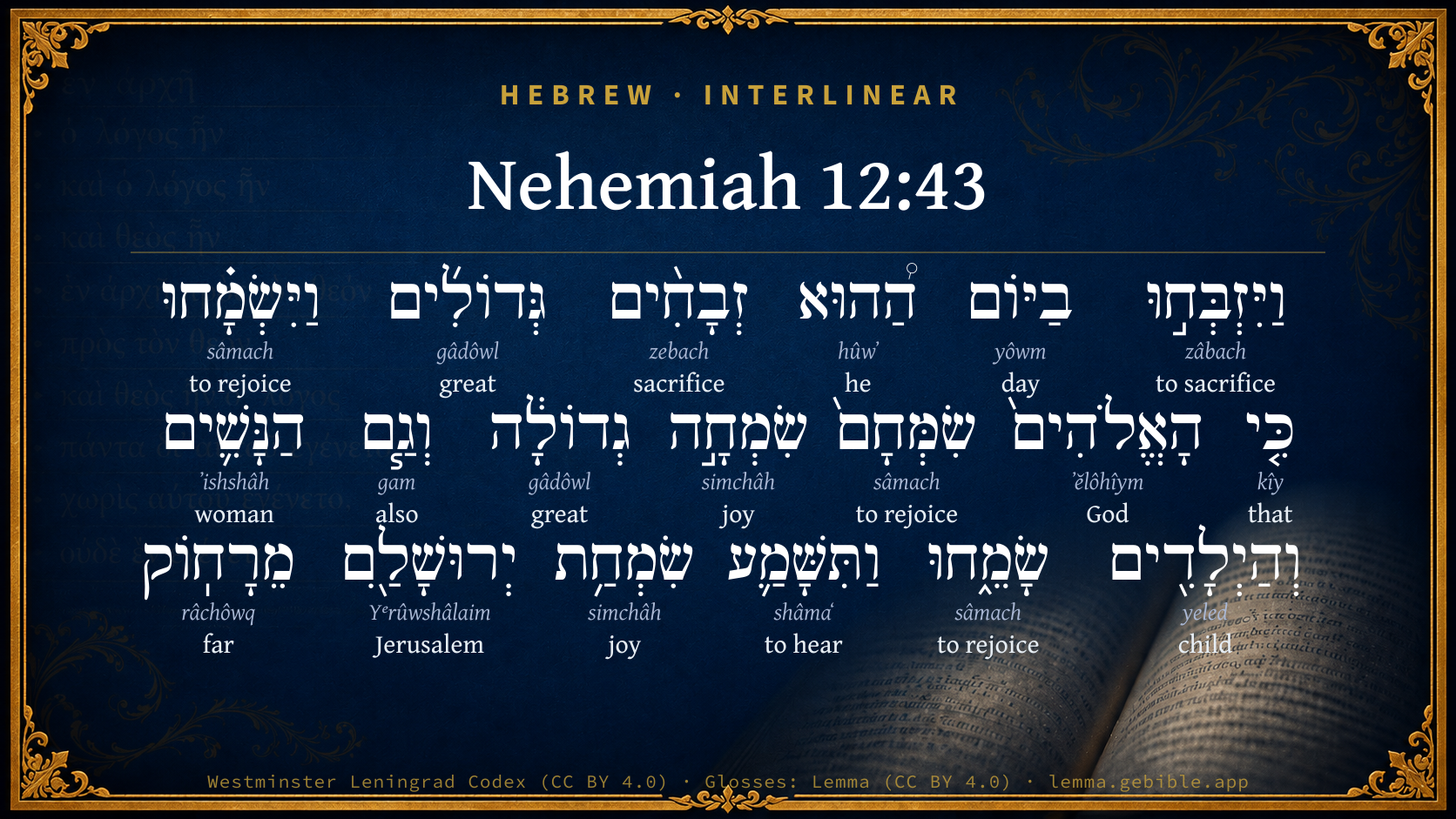
מֵרָחֽוֹק
râchôwq
H7350
“from · far”
Preposition + Adjective, Adjective, Masculine, Singular, Absolute
Part of Speech
Preposition + Adjective
Type
Adjective
Gender
Masculine
Number
Singular
State
Absolute
Full BDB Definition

Origin: from H7368

TWOT: 2151b

remote, far, distant, distant lands, distant ones (adjective) - of distance, time - distance (noun masculine) - from a distance (with preposition)
  1. וַיִּזְבְּח֣וּ zâbach H2076 “and · to sacrifice” Conjunction + Verb, Qal, Sequential Imperfect, 3rd Person, Masculine, Plural
  2. בַיּוֹם yôwm H3117 “in/at the · day” Preposition, Determined + Noun, Common, Masculine, Singular, Absolute
  3. הַ֠הוּא hûwʼ H1931 “the · he” Particle, Definite Article + Pronoun, Personal, 3rd Person, Masculine, Singular
  4. זְבָחִ֨ים zebach H2077 “sacrifices” Noun, Common, Masculine, Plural, Absolute
  5. גְּדוֹלִ֜ים gâdôwl H1419 “great” Adjective, Adjective, Masculine, Plural, Absolute
  6. וַיִּשְׂמָ֗חוּ sâmach H8055 “and · to rejoice” Conjunction + Verb, Qal, Sequential Imperfect, 3rd Person, Masculine, Plural
  7. כִּ֤י kîy H3588 “that” Conjunction
  8. הָאֱלֹהִים֙ ʼĕlôhîym H430 “the · God(s)” Particle, Definite Article + Noun, Common, Masculine, Plural, Absolute
  9. שִׂמְּחָם֙ sâmach H8055 “to rejoice · them” Verb, Piel, Perfect, 3rd Person, Masculine, Singular + Suffix, Personal, 3rd Person, Masculine, Plural
  10. שִׂמְחָ֣ה simchâh H8057 “joy” Noun, Common, Feminine, Singular, Absolute
  11. גְדוֹלָ֔ה gâdôwl H1419 “great” Adjective, Adjective, Feminine, Singular, Absolute
  12. וְגַ֧ם gam H1571 “and · also” Conjunction + Particle, Accusative
  13. הַנָּשִׁ֛ים ʼishshâh H802 “the · women” Particle, Definite Article + Noun, Common, Feminine, Plural, Absolute
  14. וְהַיְלָדִ֖ים yeled H3206 “and · the · children” Conjunction + Particle, Definite Article + Noun, Common, Masculine, Plural, Absolute
  15. שָׂמֵ֑חוּ sâmach H8055 “to rejoice” Verb, Qal, Perfect, 3rd Person, Common, Plural
  16. וַתִּשָּׁמַ֛ע shâmaʻ H8085 “and · to hear” Conjunction + Verb, Niphal, Sequential Imperfect, 3rd Person, Feminine, Singular
  17. שִׂמְחַ֥ת simchâh H8057 “joy of” Noun, Common, Feminine, Singular, Construct
  18. יְרוּשָׁלִַ֖ם Yᵉrûwshâlaim H3389 “Jerusalem” Noun, Proper

About this verse

These counts appear in no published source. They are computed here, from the morphology-tagged text and Lemma’s own curated glosses. What Lemma adds →

19
words
15
distinct lemmas
Historical
section

Grammatical profile

  • 5 verbs
  • 8 nouns
  • 3 adjectives
  • 1 pronoun
  • 1 conjunction
  • 1 particle

Verb forms

  • וַיִּזְבְּח֣וּ Qal · Sequential Imperfect
  • וַיִּשְׂמָ֗חוּ Qal · Sequential Imperfect
  • שִׂמְּחָם֙ Piel · Perfect
  • שָׂמֵ֑חוּ Qal · Perfect
  • וַתִּשָּׁמַ֛ע Niphal · Sequential Imperfect

Repetition

Words recur within this verse — often emphatic in Hebrew:

  • וַיִּשְׂמָ֗חוּ to rejoice H8055 ×3
  • גְּדוֹלִ֜ים great H1419 ×2
  • שִׂמְחָ֣ה joy H8057 ×2

Cross-references

26

Topical passages linked to Nehemiah 12:43 in the Treasury of Scripture Knowledge — connected by theme and wording, ordered by reader-vote popularity; previews shown in the World English Bible.

  • Ezra 3:13 so that the people could not discern the noise of the shout of joy from the noise of the weeping of the people; for the people shouted with a loud shout, and the noise was heard afar off.
  • Psalms 92:4 For you, Yahweh, have made me glad through your work. I will triumph in the works of your hands.
  • Psalms 148:11–13 Kings of the earth and all peoples; Princes and all judges of the earth;
  • Jeremiah 31:13 Then shall the virgin rejoice in the dance, and the young men and the old together; for I will turn their mourning into joy, and will comfort them, and make them rejoice from their sorrow.
  • Exodus 15:20–21 Miriam the prophetess, the sister of Aaron, took a tambourine in her hand; and all the women went out after her with tambourines and with dances.
  • Numbers 10:10 Also in the day of your gladness, and in your set feasts, and in the beginnings of your months, you shall blow the trumpets over your burnt offerings, and over the sacrifices of your peace-offerings; and they shall be to you for a memorial before your God: I am Yahweh your God.
  • Deuteronomy 12:11–12 then it shall happen that to the place which Yahweh your God shall choose, to cause his name to dwell there, there shall you bring all that I command you: your burnt offerings, and your sacrifices, your tithes, and the heave-offering of your hand, and all your choice vows which you vow to Yahweh.
  • 1 Samuel 4:5 When the ark of the covenant of Yahweh came into the camp, all Israel shouted with a great shout, so that the earth rang again.
  • 1 Chronicles 29:21–22 They sacrificed sacrifices to Yahweh, and offered burnt offerings to Yahweh, on the next day after that day, even one thousand bulls, one thousand rams, and one thousand lambs, with their drink-offerings, and sacrifices in abundance for all Israel,
  • 2 Chronicles 7:5–7 King Solomon offered a sacrifice of twenty-two thousand oxen, and a hundred and twenty thousand sheep. So the king and all the people dedicated the house of God.
  • 2 Chronicles 7:10 On the three and twentieth day of the seventh month he sent the people away to their tents, joyful and glad of heart for the goodness that Yahweh had shown to David, and to Solomon, and to Israel his people.
  • 2 Chronicles 20:13 All Judah stood before Yahweh, with their little ones, their wives, and their children.
  • 2 Chronicles 20:27 Then they returned, every man of Judah and Jerusalem, and Jehoshaphat in the forefront of them, to go again to Jerusalem with joy; for Yahweh had made them to rejoice over their enemies.
  • 2 Chronicles 29:35–36 Also the burnt offerings were in abundance, with the fat of the peace-offerings, and with the drink-offerings for every burnt offering. So the service of the house of Yahweh was set in order.
  • Job 34:29 When he gives quietness, who then can condemn? When he hides his face, who then can see him? Alike whether to a nation, or to a man:
  • Psalms 27:6 Now my head will be lifted up above my enemies around me. I will offer sacrifices of joy in his tent. I will sing, yes, I will sing praises to Yahweh.
  • Psalms 28:7 Yahweh is my strength and my shield. My heart has trusted in him, and I am helped. Therefore my heart greatly rejoices. With my song I will thank him.
  • Psalms 30:11–12 You have turned my mourning into dancing for me. You have removed my sackcloth, and clothed me with gladness,
  • Isaiah 61:3 to appoint to those who mourn in Zion, to give to them a garland for ashes, the oil of joy for mourning, the garment of praise for the spirit of heaviness; that they may be called trees of righteousness, the planting of Yahweh, that he may be glorified.
  • Isaiah 66:10–14 Rejoice you with Jerusalem, and be glad for her, all you who love her: rejoice for joy with her, all you who mourn over her;
  • Jeremiah 33:11 the voice of joy and the voice of gladness, the voice of the bridegroom and the voice of the bride, the voice of those who say, Give thanks to Yahweh of Hosts, for Yahweh is good, for his loving kindness endures forever; [and of them] who bring [sacrifices of] thanksgiving into the house of Yahweh. For I will cause the captivity of the land to return as at the first, says Yahweh.
  • Matthew 21:9 The multitudes who went before him, and who followed kept shouting, "Hosanna to the son of David! Blessed is he who comes in the name of the Lord! Hosanna in the highest!"
  • Matthew 21:15 But when the chief priests and the scribes saw the wonderful things that he did, and the children who were crying in the temple and saying, "Hosanna to the son of David!" they were indignant,
  • John 16:22 Therefore you now have sorrow, but I will see you again, and your heart will rejoice, and no one will take your joy away from you.
  • Ephesians 5:19 speaking to one another in psalms, hymns, and spiritual songs; singing, and singing praises in your heart to the Lord;
  • James 5:13 Is any among you suffering? Let him pray. Is any cheerful? Let him sing praises.

Cross-references courtesy of OpenBible.info (CC BY 4.0).

Hebrew and Greek witnesses Masoretic Hebrew ↔ Greek Septuagint

The same verse in the two great witnesses to the Old Testament, shown verse-for-verse.

These are two independent witnesses, not word-aligned to each other, and the Septuagint is shown in lemma (dictionary) form.

Hebrew Nehemiah 12:43 Masoretic · Westminster Leningrad Codex

וַיִּזְבְּח֣וּ בַיּוֹם הַ֠הוּא זְבָחִ֨ים גְּדוֹלִ֜ים וַיִּשְׂמָ֗חוּ כִּ֤י הָאֱלֹהִים֙ שִׂמְּחָם֙ שִׂמְחָ֣ה גְדוֹלָ֔ה וְגַ֧ם הַנָּשִׁ֛ים וְהַיְלָדִ֖ים שָׂמֵ֑חוּ וַתִּשָּׁמַ֛ע שִׂמְחַ֥ת יְרוּשָׁלִַ֖ם מֵרָחֽוֹק

They offered great sacrifices that day, and rejoiced; for God had made them rejoice with great joy; and the women also and the children rejoiced: so that the joy of Jerusalem was heard even afar off.

World English Bible · Public Domain

Greek LXX Structure differs

The Septuagint has no separate book of Nehemiah. Its Greek text is the second half of Esdras B (2 Esdras), chapters 11–23; Ezra is the first half (1–10).

A verse-for-verse comparison isn’t shown here because the chapters and verses don’t line up. Switch to the LXX edition with the MT / LXX toggle above to read the Greek directly.

On this verse, Haydock's Catholic Bible Commentary discusses the Septuagint’s reading. Read the note in Commentary ↓

Hebrew: Westminster Leningrad Codex (CC BY 4.0). Greek: Septuagint (public domain); English from a public-domain English Septuagint. How the Septuagint differs from the Hebrew →

Commentary

Notes on Nehemiah 12:43 from classic Christian and Jewish commentators (each source and its license shown beneath its notes). The classic Christian expositions comment on the surrounding passage and are grouped to its opening verse, so a note may address several verses; the Jewish commentaries on the Tanakh (Rashi and others) are per-verse, so they appear only where the commentator wrote on this verse.

Lemma curates 59 commentaries, every one of them public domain or Creative Commons licensed, each selected and text-cleaned for this edition rather than reprinted as found. About our sources →

Trapp's Complete Commentary

John Trapp

Neh 12:43 Also that day they offered great sacrifices, and rejoiced: for God had made them rejoice with great joy: the wives also and the children rejoiced: so that the joy of Jerusalem was heard even afar off.

Ver. 43. For God had made them rejoice with great joy] By giving them both matter of joy, and hearts to do it aright. Crede mihi res severa est verum gaudium, saith Seneca, true joy is a severe business. Quid nobis cum fabulis, cum risu? saith Bernard. What have we to do with jesting and pastime, &c.? we have meat to eat, pleasure to take, that the world knows not of; we can let out our souls into God the fountain of all good, and rejoice in his word, as one that findeth great spoil, wherein the pleasure is as much as the profit, Psa 119:162.

John Trapp, A Commentary or Exposition upon All the Books of the Old and New Testament (1647–1656) — public domain. Text from a community e-Sword module.

The Biblical Illustrator

Joseph S. Exell

Neh_12:43

Also that day they offered great sacrifices, and rejoiced.

A great rejoicing

A great rejoicing as it should be.

I. Associated with the bites of religion.

II. The outcome of a great deliverance. From captivity to freedom: heathen surroundings to heaven-chosen city and Divinely-built temple. The memory of Gods great goodness should awaken joy--a joy that all may share. The wives also and the children rejoiced.

III. The preparation for strong adhesion to a great cause. Sacred festivals not an end, but a means to an end. (Homiletic Commentary.)

True joy

I. Its right. The God who has given us life wishes also that it shall move joyfully; the God who always anew overwhelms us with favours wishes that they should fulfil their mission; that is, make us happy, in the end holy.

II. Its occasion. Gods grace, which has strengthened, protected, assured, and elevated our lower or higher life.

III. Its kind. It raises itself to God, is a joy in Him; that is, becomes s service to God and our neighbours. (Dr. Schultz.)

The joy of Christian work

Notice--

I. That great sacrifices always precede great joy. Gods best gifts never increase by saving, but by scattering. The sea is in a constant state of evaporation. The mist rises, there are clouds above the hills, there are streams running into the valleys, there is life and greenness everywhere. There are some men who do not believe in evaporation. They believe in getting all they can and keeping all they get. But they are never joyful There is no joy in selfishness. It is against the great law of God, the law of sacrifice by His own Son. What is the meaning of these sacrifices mentioned in the text?

1. The sin-offering. This shadowed the great sacrifice. Morality alone will not save any man, and if you will only admit sin, you admit half the Bible, and the rest has to do with Gods way of getting rid of it.

2. The burnt-offering. This means that we give ourselves up to God entirely; and the happiest men I have met in my life have been men who have handed the keys of every room in their soul up to Christ, without keeping one closed to hide a loved sin.

3. The peace-offering. This was a peculiar offering in Israel. It was a free-will offering. When a man brought the peace-offering, God gave him a feast there and then in his house. A part of the offering was given back to the offerer. This peace-offering is very much like your contributions to-day. You can keep your offerings, but if you do God will keep the feast from you. We in Wales have two sermons in one service very often, and the collection comes before the second sermon. I have watched a man drop the smallest coin into the plate from a richly gloved hand. I have seen a poor old woman unwrapping a two-shilling piece from a paper, from another paper, from a third paper, in which she had wrapped it in order to keep it for the collection. And I have watched them through the second sermon. The tears of joy are coursing down the wrinkled face of the poor Christian woman, but the man who dropped his miserly coin is as dry as Gilboa. It is a remarkable fact that the Almighty never accepted a wild animal as an offering in the olden time. A man was always obliged to offer something he had taken trouble with: the fruit of his own garden, the fruit of his own farm, or from his own flock. I have heard a man say sometimes, If I succeed in this speculation now, I will give to the cause of Christ. Ah! that is a wild hare.

II. Great work for God brings great joy from God. Charles Kingsley has said that every man ought to thank God every morning because he has something to do that must be done that day. Work is the greatest blessing. I was once struck down with complete nervous prostration, and a medical man told me that I must do nothing for a twelvemonth, and that was the hardest work I ever did in my life--to do nothing. I see gentlemen come up along the Menai Straits in their yachts fighting the tempest. On they come like sailors on the ocean-wave, because it is easier to do that than to do nothing. You may see the room in which Louis XVI. worked as a common blacksmith, because it was easier to do that than to do nothing. Prisoners have come to the gaoler many a time, when confined in a room to do nothing, asking him for permission to pick oakum, or anything rather than do nothing. It is possible to do the most common work to God, to Christ, and when every one will do his work to Christ, that is the time when this world will be full of happiness and song. There is joy in serving Christ. Just think, for instance, of the erection of a place of worship: what an investment it is to contribute towards that.

III. This religion of great sacrifice and great joy will tell on our families. The wives also and the children rejoiced. Joyful religion repeats itself to others. Parents should let their children see that they value religion.

1. By making sacrifices for it.

2. By letting them see that they are most anxious for them to become decided Christians.

IV. That the religion of great sacrifices and great joy will be heard of afar off. Then joy was heard afar off. It is the names of self-sacrificers that live--Abraham--Abraham Lincoln--Florence Nightingale--Jesus, the Redeemer of the world. (E. Herber Evans, D. D.)

Sacrifice, a condition of joy

The principle of sacrifice stands at the very threshold of the ever-fascinating study of life, and is found at every turn of the bewildering maze which marks lifes upward pathway of struggle and survival. In merely physical processes, as well as in many vital functions of vegetable and animal life, there are clear foreshadowings of the part which sacrifice plays in the great tragedy of existence. The primitive rock, when subjected to the disintegrating action of the atmospheric agents, yields up its characteristic compactness, and crumbles into soil, which, in turn, surrenders its richness to promote the welfare of multitudinous forms of vegetable growth. In the lower species of animal life the death of the parent is the essential condition of the life of the offspring, and in the higher grades of creatures there is invariably a parental sacrifice in favour of the well-being of the progeny. Notwithstanding that these functions are nothing more than compulsory obedience to the stern mandates of nature, Mr. Herbert Spencer calls them acts of unconscious sacrifice, and so distinguishes them from those voluntary surrenders of self which spring from love to others, and which, strictly speaking, can only be termed sacrifice. The helpless infant survives merely on account of the care which the maternal love lavishes upon it. Let the attention of others be withdrawn, and the child must perish. It lives by the sacrifices which others make for it. The bond of family life is kept intact by a succession of beautiful deeds, springing from the ever-growing tendency to sacrifice the immediate interests of self to promote the good of others. The capacity to enjoy purely egoistic pleasures is heightened by ministering to the wants of others. Indulged selfishness, by producing satiety, defeats itself. But a nobler truth than that is this--that the deepest satisfactions and most lasting joys of life are blossoms on the tree whose roots derive nutriment from the soil of sacrifice. (S. S. Chronicle.)

The Biblical Illustrator, edited by Joseph S. Exell (c. 1880s–1900s) — public domain. Text from a community e-Sword module.

Joseph Benson's Commentary

Neh 12:43. For God had made them rejoice with great joy — By restoring the holy city to such a secure condition, that they could praise the Lord there without disturbance or fear. And the children rejoiced — And their hosannas were not despised, but are recorded to their praise. All that share in public mercies ought to join in public thanksgivings. So that the joy of Jerusalem was heard even far off — Either their loud voices and instruments were heard at a great distance, or the fame of it was spread far and near.

Joseph Benson's Commentary on the Old and New Testaments (1811–1818) — public domain. Text from a community e-Sword module.

Tyndale Open Study Notes

Tyndale Open Resources

12:43 This community celebration included everyone. God was the true source of their great joy because his power had enabled them to accomplish the huge task of rebuilding the walls. Psalm 147 might have been written for this occasion.

Tyndale Open Study Notes — © Tyndale Open Resources, licensed CC BY-SA 4.0. Text via the HelloAO Bible API.

Jamieson, Fausset & Brown

Robert Jamieson, A. R. Fausset & David Brown

the joy of Jerusalem was heard even afar off--The events of the day, viewed in connection with the now repaired and beautified state of the city, raised the popular feeling to the highest pitch of enthusiasm, and the fame of their rejoicings was spread far and near.

Jamieson, Fausset & Brown — Commentary Critical and Explanatory on the Whole Bible (1871) — public domain (CC PDM 1.0). Text via the HelloAO Bible API.

Ellicott's Commentary for English Readers

(43) Rejoiced.—This verse is full of joy; but before the rejoicing comes the abundant offering of sacrifices.

A Bible Commentary for English Readers, edited by Charles John Ellicott (1878–1897) — public domain. Text from a community e-Sword module.

The Cambridge Bible for Schools and Colleges

gen. ed. J. J. S. Perowne

43. Also that day] R.V. And … that day.

great sacrifices] Cf. Ezr_6:17.

God had made them rejoice, &c.] 2Ch_20:27, ‘for the Lord had made them to rejoice over their enemies.’

the wives also] R.V. and the women also. The women and children who were present on the occasion of national gatherings (e.g. Neh_8:2) would participate in the festivities.

was heard even afar off] Cf. the very similar statement in Ezr_3:13, ‘for the people shouted with a loud shout, and the noise was heard afar off.’

44–13:4. This section, in which the Memoirs of Nehemiah probably only form the outline of the Compiler’s work, falls into two groups, (a) 44–47, dealing with Levitical organization, and (b) Neh_8:1-4, relations with foreign peoples. The 1st person sing. is dropped.

The Cambridge Bible for Schools and Colleges (gen. ed. J. J. S. Perowne; Cambridge University Press, 1878–1918) — public domain. Text from a community e-Sword module.

John Gill's Exposition

For in the days of David and Asaph of old there were chief of the singers,.... Persons appointed over the rest to instruct them, and see that they did their work aright, as besides Asaph, Haman, and Jeduthun, and their sons, Ch1 25:2

and songs of praise and thanksgiving unto God; such were made by them, some under divine inspiration, which bear the names of David and Asaph, as may be observed in the book of Psalms.

John Gill's Exposition of the Whole Bible (1746–1763) — public domain (CC PDM 1.0). Text via the HelloAO Bible API.

Haydock's Catholic Bible Commentary

Thanksgiving. St. Jerome, Septuagint, and Syriac have read in a different manner from the present Hebrew, (Calmet which has, "for the tithes to gather into them out of the fields of the cities, the portions of (or by) the law assigned to the priests, &c. Tora, "law," has been read, toda, "thanksgiving," by St. Jerome; and sarim, "princes," has been substituted for sadim, "fields." (Haydock) --- The Syriac admits the second reading. (Calmet) --- Septuagint omit the first entirely. "For the tithes, and for the collections in them, brought to the princes of the cities, being the portions for the priests," &c. (Haydock)

George Leo Haydock (1774–1849), Haydock's Catholic Family Bible and Commentary, 1859 edition — public domain. Excludes Psalms (Douay-Rheims chapter numbering differs from Protestant) and Deuterocanonical books (Catholic canon only).

Matthew Poole's English Annotations

Either their loud voices and instruments were heard to a great distance, or the fame of it was spread far and near.

Matthew Poole's English Annotations on the Holy Bible (1683–1685) — public domain. Text from a community e-Sword/MySword module.

Whedon's Commentary on the Bible

Daniel D. Whedon

43. Joy of Jerusalem — The joy of the people over their completed work, and the prospect of peace and prosperity. Their hosannas, says Wordsworth, “may be caught up and re-echoed by us, when we look forward to the time when the Church militant will have encircled the world, and have completed her mission in preaching the Gospel and in building up her walls; and when the two companies of Gentile and Jew will meet together at the heavenly Zion, and join in one song of united praise to God. Then will the saints see the jewelled walls, and the gates of pearl, and the streets of pure gold, of the heavenly Jerusalem, (Rev_21:11-21,) and will sing hallelujahs to God and the Lamb, and dwell forever there.”

Daniel D. Whedon (gen. ed.), Commentary on the Old and New Testaments (1874–1909) — public domain. Text from a community e-Sword module.

The Pulpit Commentary

Also that day they offered great sacrifices. David had inaugurated the "tabernacle" which he made for the ark of the covenant at Jerusalem with sacrifice, (2Sa_6:17) and had consecrated the threshing-floor of Araunah the Jebusite in the same way. (2Sa_24:25) Solomon, at his dedication of the temple, had sacrificed sheep and oxen "that could not be numbered for multitude". (1Ki_8:5) Zerubbabel had followed this example at the dedication of the second temple; (Ezr_6:17) and we may presume that it was with victims that Eliashib and his brethren the priests had "sanctified" their portion of the wall soon after they completed it. (Neh_3:1) Nehemiah now completed the dedication of the entire circuit of the walls by sacrifices on a large scale. God had made them rejoice with great joy. It is characteristic of Nehemiah to ascribe the universal joy, which another might well have claimed as his own work, to the Divine mercy and forethought, which had brought the matter of the wall to a prosperous and happy issue. The wives also and the children rejoiced. It is seldom that the Jewish women are mentioned as taking that prominent position in joy, which naturally belonged to them in sorrow. (Jud_1:11:40 Jer_31:15 Jer 49:3Jo Jer_1:8, etc.) There is, however, one remarkable example of the kind, besides the present one the rejoicing of the women after the passage through the Red Sea, under the leadership of Miriam. (Exo_15:20) The joy of Jerusalem was heard even afar off. See Ezr_3:13, and comp. 1Ki_1:40 2Ki_11:13.

The Pulpit Commentary (1880–1919), ed. H.D.M. Spence-Jones & Joseph S. Exell — public domain. Text from a community e-Sword module.

John Wesley's Explanatory Notes

The children rejoiced - And their hosanna's were not despised, but are recorded to their praise. All that share in public mercies, ought to join in public thanksgivings.

John Wesley, Explanatory Notes Upon the Whole Bible (1754–1765) — public domain. Text via the GEBible commentary corpus.

unfoldingWord translationNotes

Door43 World Missions Community

rejoice with great joy

"rejoice greatly"

So the joy of Jerusalem could be heard far away

"The joy of Jerusalem" here is a metonym for "the sound that the people of Jerusalem made." This can be translated in active form. AT: "people far away from Jerusalem could hear the sound that the people of Jerusalem made as they celebrated" (See: Metonymy and Active or Passive)

translationWords

sacrifice

joy

joy

Jerusalem

unfoldingWord translationNotes — © Distant Shores Media and the Door43 World Missions Community, licensed CC BY-SA 4.0. Source: git.door43.org/Door43/en_tn.

Lesson kit

Teaching starters — assembled from the data on this page, not authored interpretation. Every prompt links to the verse data it draws on. Edit before teaching.

Nehemiah, in the Historical, opens this verse with 19 words (15 distinct Hebrew lemmas). Its most distinctive word is râchôwq (“far”). A historical commentator’s framing appears above. Read the whole chapter for the surrounding context.

Discussion questions

  1. The word râchôwq carries the sense “far.” How does it shape the verse?
  2. How does Ezra 3:13, which shares this passage’s theme, read alongside this verse?
  3. What does the repetition of “to rejoice” (3× in this one verse) do in this verse?
  4. These translations render this verse differently; the difference is in the English rendering, not the original. What questions does that raise?
  5. «וַיִּזְבְּח֣וּ» is a Qal Sequential Imperfect verb. How does that grammatical form shape the action described?
  6. Compare how Trapp's Complete Commentary and The Biblical Illustrator read this verse. Where do they agree or differ?

Things to notice

Reading settings

Reading text

Shown beneath each verse's original-language words.

Old Testament
Old Testament edition

Read the OT as the Masoretic Hebrew (MT) or the Greek Septuagint (LXX).

English shown for the Greek Septuagint (in the Hebrew ↔ Greek comparison).

Comparing translations? Open the Compare panel on any verse page to stack up to four side by side.